← Not Dead Yet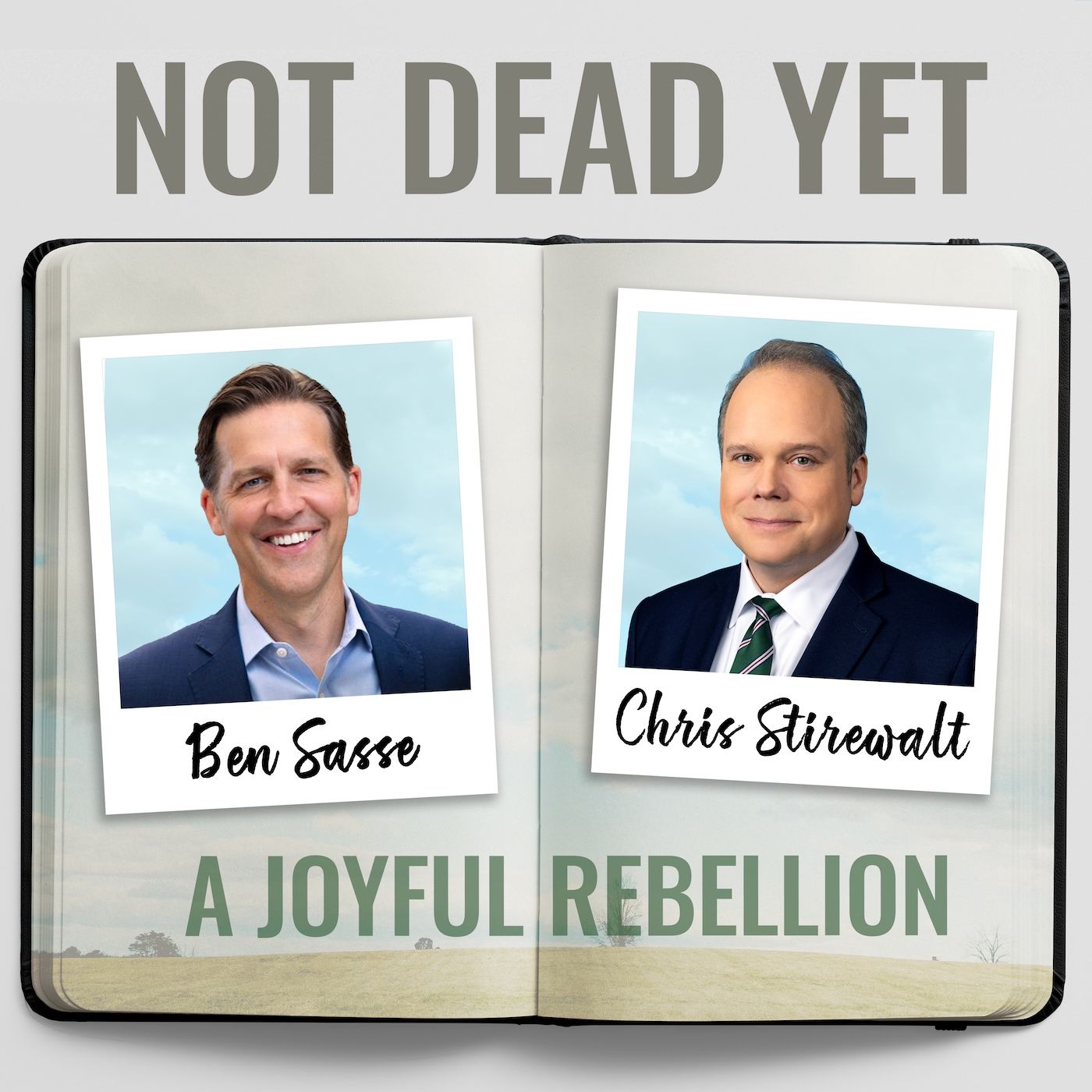
Not Dead Yet
Jeffrey Rosen
01:05:06
As America celebrates 250 years, the guys talk with Jeff Rosen about the pursuit of happiness. Did Ben Franklin and John Adams really see it the same way? Does self-government depend on reading and virtue? How was Milton an influence on the Founders?...
Loading summary
Transcript103 lines
- [00:00]
A
Foreign. Hi, I'm Ben Sasse.
- [00:08]
B
And I'm Chris Stirewalt.
- [00:10]
A
And this is not dead yet. We're all dying. But only some of us have been brought face to face with that reality.
- [00:17]
B
However long each of us have to do it, though, we all want to
- [00:20]
A
live a good life, one with meaning, love and joy. And our guests are here to help us do exactly that.
- [00:27]
B
Well, a belated Independence Day to you as we begin this 251st year of the American Republic. Good. Tomorrow, sir.
- [00:37]
A
Freedom. Liberty. Star Wars.
- [00:39]
B
Did you have a good, did you have a good Independence Day?
- [00:42]
A
It was glorious. Yeah, it's. I always want to be the same place on Independence Day, which is Dodge County, Nebraska. And we hosted a lot of my wife's family. We blew a lot of stuff up for freedom. We probably consumed 80 gallons of petrochemicals pulling kids in tubes and spend time at the river. It was great.
- [01:05]
B
You right on. Yes. Well, I worked.
- [01:08]
A
I'm sorry, I mean, congrats and thanks.
- [01:11]
B
Yes, I worked and got to be. I got to spend much of the day swimming and eating and lolling with fam, but returned to the Emerald City that night for coverage of a rain delayed fireworks extravaganza.
- [01:32]
A
And DC did stuff on the 4th. I was unaware.
- [01:35]
B
I don't know whether you heard anything about it, but there, there was, there was some stuff in Washington. Yeah, yeah. And that is actually one of the things that I was talking about during the coverage was most Americans don't care about this. Right. Which is not what you're supposed to say when you're trying to maintain people through the next commercial, maintain viewers for a four hour rain delayed extravaganza. But most Americans don't care because most Americans are doing their thing where they live with their people. Right. Independence Day is something to be experienced, not observed and all of that. But the next day I did my Sunday show and it included a really good debate. I can't even hardly call it a debate. With Cornel west and Robbie George. Nice. On the question of was the was independence worth it and was it necessary? And I was very surprised, I was not surprised by my fellow West Virginian Robert P. George's answers because I, I know, I know his stuff by heart. But Cornel west, he really surprised. It impressed me with his responses on this. Yeah, they're, they're tour.
- [02:50]
A
I didn't, I didn't see your show, but I will go watch it now. You don't have to. I, I really like Robbie and Cornell's touring show. Yeah, I Think when they're shtick, when they get to college campuses, it kind of blows kids minds that you don't have to agree on everything and you can still not just like each other, but they love each other, they're friends.
- [03:12]
B
That's right.
- [03:12]
A
It's pretty glorious.
- [03:14]
B
And as I was listening to them, I thought, you know, we should probably talk about the conceptual roots of these ideas that two men so different can both hold dear. Where, where do these ide. Where did the founders get them? So that's why we're going to talk to Jeffrey Rosen. Like a lot of these episodes, this sprang from another one. It may have been your friend Catherine about happiness as not a destination, but a byproduct, something that you get. And Jeffrey Rosen wrote a book about what the founders meant by happiness. So why not on the week after Independence Day talk about it?
- [04:02]
A
Life, liberty and the pursuit of happiness, which contra a lot of nonsense on Wikipedia, wasn't just a placeholder term for property.
- [04:11]
B
Yeah, and I'm also excited about this because as you pass yourself off as this, as the, this plow boy of the planes, you have a deep knowledge and deep study on these questions about the relationship between antiquity and modernity and all of this stuff. So I, I look at this as an opportunity to coax you out and, and hear the full professor says, if
- [04:40]
A
I ever become lots less ugly. And let's be clear, that's not an if that's ever going to be fully inaugurated. And we were showing the video of our recordings over my right shoulder back here, there's a little statuette of the sewer on the top of the Nebraska state capitol. So all Nebraskans love plowboy of the plains. So do not ever disparage it by implying that if someone became a philosopher, they would cease to be a plowboy of the plains.
- [05:12]
B
You can see over my shoulder the mail pouch tobacco thermometer. And you can see is that right
- [05:18]
A
under the coonskin that's still dripping?
- [05:21]
B
You can see the, the, the spike from the Mononga mine, the worst mine disaster in American history. You can see the mail pouch tobacco thermometer. And you might be able to see poking out a genuine carbide miner's lamp. Miners helmet with the lamp. So I. If you're, if you're the plow of the plains, then I am but a coal miner.
- [05:45]
A
Ag and extraction are often put together in economic history. But I'll take ag. You can have extraction. That's harder work to go inside and breathe that soot.
- [05:56]
B
But it's cooler down there, right underground. There's, there's a great, there's a great song called Greenbrier county by Nora Jane Struthers that she calls them the doves and the crows. And the men who worked in the limestone quarry were white powdered white from the work that they had been doing cutting limestone. And the crows were the coal mine miners who were covered in dust, but the coal miners had it on them because they were cool underground as opposed to baking in the midday sun.
- [06:24]
A
Hot.
- [06:24]
B
Yeah, it's hot. It's, it's hot out there. Okay. Here's what people should know about Jeffrey Rosen. He is a legal scholar who was president and CEO of the National Constitution center in Philadelphia from 2013 to the beginning of this year. He is now speaking of plummy classical terminology, CEO emeritus. He is emerited and he, in the time that he was at the National Constitution center, did a great deal to expand and open up the Constitution center to help Americans have a better grasp and have a better opportunity for access, including the surveys that I have written about year after year about how relatively little Americans know, which is a great opportunity for me every September to write a piece scolding my readers. Aren't I good at audience service? He.
- [07:21]
A
Thank you, Karen.
- [07:22]
B
He is a graduate, of course, of Harvard. Yeah, I know. I know you guys. He also went to undergrad outside of Boston. He studied at Oxford, got a second bachelor's degree at. Is it Balliol? How do you pronounce that? Bailey Balliol College and then got his JD At Yale. He clerked in the federal system. He taught law. He did all that stuff. He has been an extraordinarily prolific writer outside of his work at the Constitution Center, Pursuit of Liberty, how Hamilton vs. Jefferson ignited the Lasting Battle, Overpowered America, I read is good. He wrote a biography of the, I think, underappreciated William Howard Taft, a lot of Supreme Court kind of stuff. He's a good writer. But I love his book that we're going to talk to him about today, the Pursuit of Happiness, how classical writers on virtue inspired the lives of the founders and defined America.
- [08:32]
A
I've been interviewed by Jeff, facilitated interviews in lieu of speeches a few times. And the dude speaks in complete paragraphs like you'd think he has a teleprompter all the time. And it's that his brain is seeing three and four future punctuation, future periods out there, and he's, he's structuring a sentence. So I think he's going to make both of us look Like Plowboy and Minor.
- [08:57]
B
All right, well, let's see if.
- [08:58]
A
See if that's. So, Jeffrey Rosen, it is great to have you. You are always popular. But on this, the 200th anniversary of the Declaration, I assume you're scheduled 168 hours a week. So thank you for making time for us. We're delight to get this learning session with you.
- [09:15]
C
So wonderful to be with you. I so admire the podcast and can't wait for the conversation.
- [09:21]
B
Have you listened to it? Are you.
- [09:22]
C
Is it?
- [09:23]
B
You must not have listened. You must be lying. You have not listened to it. If that's what you said, I haven't
- [09:28]
C
listened with great pleasure.
- [09:30]
B
Untrue. And part of the premise is that Ben Sass gets to ask the first question.
- [09:35]
A
The problem is, I know Chris is going to have a better frame on classical conceptions of happiness than I do, so I'm going to ask a micro version and then he'll map it more philosophically wisely than I do. But the phrase pursuit of happiness is something that a lot of us have thought about over the years, but I think in this 250th moment, it becomes even more prescient and acute to unpack what they meant. Tell me this. How similar is the range of founders thinking about what they thought they were packing into that phrase? So in particular, Ben Franklin, John Adams, oh man, they have such different reasons why you'd like to have dinner with them. But it's hard to find many reasons in my head that are in common. What did they mean by pursuit of happiness? And did they think they agreed?
- [10:28]
C
It's such a great question. And you're right that the founders disagreed so much about politics and how to balance the big ideals of the Declaration, liberty, equality, and government by consent. But there was a huge consensus about the meaning of the pursuit of happiness. And for I would say all of the founders, happiness meant not feeling good, but being good. Not the pursuit of immediate pleasure, but the pursuit of long term virtue. And there was a lot of consensus about what virtue meant as well, because they're reading the same books. And I was inspired to investigate what they meant by noticing that both Franklin and and Thomas Jefferson had chosen the same book for the source of their definition of happiness. I'd never heard of it. It was Cicero's Tusculan Disputations, and Franklin uses it to illustrate his famous project to achieve moral perfection by listing 13 virtues and putting X marks every night next to the virtues where he falls short. And Jefferson used it to illustrate a list of 12 virtues that he drafted for his daughters. And Cicero says the short version is without virtue, happiness cannot be. In the longer version that Jefferson quoted when his dad died and he wrote it down in his commonplace book, he used a chief tranquility of soul who's neither unduly exuberant or unduly despondent. He is the calm and self possessed man of whom we are in quest. He's the happy man. So I just decided to read the other 10 books on Jefferson's reading list that he lists. Sometimes he calls it Natural Religion or Ethics or Moral Philosophy. And here's the list. Cicero's Tusculan Disputations, Seneca's Letters, Marcus Aurelius's Meditations, Epictetus, and then Enlightenment moral philosophers Locke, Hutcheson, Hume and Bolingbroke. And this was the core curriculum for the founding. Some of these guys read it at the famous universities, others with private tutors who were often Scottish. They brought the Scottish Enlightenment with them.
- [12:32]
A
What, what?
- [12:33]
C
And that was what created this huge consensus about the meaning. And I just did word searches putting pursuit of happiness into the primary texts. And it's everywhere. It's not hiding, it's in the Whig opposition literature from Cato's Letters, it's in the Christian preachers like Wolotson and Tolletson who are trying to balance reason and faith. It's in Blackstone, it's in the moral philosophers that the founders learned from. So I'm really confident in saying that they all agreed that happiness meant not pleasure, but self mastery, self improvement, character improvement, and ultimately lifelong learning.
- [13:21]
B
Well, you are here because we had a. Well, because you're nice. But also you're here because we had a great conversation with David Zahl not too long ago and his meditations on this and his books about happiness. And we had the discussion about happiness not being the objective, but the byproduct. Right, that if you, that virtue is the objective, living a good life is the objective. And if you are aiming for those things, happiness will ensue as you, as you do that. Before we, before we do that though, I want to, I want to ask you about the phrase. Right. So we've recently celebrated the Declaration of Independence and we've had that, we've, we've had that talk about is it true that they were going to say that somebody was going to say pursuit of property, but they changed it to. So the rap is. Well, it was going to just because they're a bunch of tax dodging slave owners who blah, blah, blah, Blah, blah. It's just marketing. They chose happiness. They really meant property. What do you say about that?
- [14:36]
C
They didn't. Life, liberty and property is in Locke's Second Treatise. But they get their definition of happiness from Locke's Essay Concerning Human Understanding and it's book 51 that the phrase appears. And the reason that they chose happiness and not property is because happiness, unlike property, is an unalienable right. You can certainly alienate property to give it value for exchange, but happiness is rooted in the rights of conscience. And I can't give you or Ben or anyone the power to control my thoughts because they're the product of reason, persuasion, not force or violence. And that's why Madison says in the Memorial and Remonstrance, the opinions of men being dependent on evidence contemplated by their own minds, cannot be controlled by other men. So it's just not true that they saw happiness as a synonym for property or they were embarrassed about property. Madison thinks the protection of property is the central goal of government. Getting that from Locke, and I'd say many of the founders believe that too. But Jefferson was just being technically precise that happiness, unlike property, is unalienable.
- [15:44]
A
Talk about that alongside the view of human nature not being perfectible. Because obviously the Founders are very different than Rousseau who's overly romantic and seems. Take Franklin's checklist and the fact that you're not going to get to perfectibility. And yet there's this progressive sense that's pretty optimistic. Not Russovian, but they're sisters.
- [16:09]
C
It's a great way to put it. Of course there's a root of Puritanism in all of this and some of the Founders are old fashioned Puritan theocrats like Roger Sherman, who fights Madison on the floor of the Convention about whether or not there should be state establishments of religion. The Puritan view of human nature is very dark. We're inherently fallen and not even good works can redeem us. Only God's randomly given grace. They call themselves reasonable Christianity. It's rooted in the Enlightenment and Locke and his essay concerning Toleration and is popularized by a bunch of the preachers who Franklin took seriously are more cautiously optimistic about our ability to perfect ourselves through reason and persuasion, not force or violence. And that's why Hamilton says in Federalist 1 this is the first test in human history of whether we can found a republic based on reason and conviction, not force or violence. They're not starry eyed optimists, unlike Condorcet and the French guys who Jefferson really loves. And that's why he has Rose Colored glasses. And he's always imagining that reason will slowly diffuse across the land and universal education will lead to the perfectibility of man. John Adams thinks this is just claptrap. And he says, has there ever been a time in human history when we've seen universal perfection? But the core consensus from Franklin and, and Madison and those guys is I would say a deep recognition of the flaws of human nature and the recognition that we're all sinners but a hope that through rigorous daily self examination and self improvement we can become a little more perfect.
- [18:01]
B
Okay, so we'll put this in, in Sassian terms here. Your, this book is a 8 by 13 matrix. You have. It's eight profiles, is that right?
- [18:18]
A
I feel seen right now. 8 by 13 is pretty damn good. Don't forget the Z dimension Starwall.
- [18:24]
B
I'm always forgetting the Z D of my many faults. Z dimension deficiency is one of them. But that you take. So it's the profile. So you do Franklin and Washington of course, Adams, Jefferson, Madison, Hamilton. And then you include Phyllis Wheatley and Mercy Otis Warren. So you're talking about these individuals and then you're overlaying it with Franklin's 13 and just I'm going to say them all quickly, so bear with me. Temperance, silence, order, resolution, frugality, industry, sincerity, justice, moderation, cleanliness, tranquility, chastity. And this is my favorite. Ben Franklin is an endlessly fascinating figure. But here's one that I love about Ben Franklin. He's got his 12. He's like, yeah, this is good. I'm checking the list, I'm doing it. And then he forgets. He says I should add humility at the end that the, the, the Ben Franklin, always very full of himself, is like, oh, I forgot humility. So he puts humility at the end. These are ideas. And you talk about Washington's own self help idea. This stuff was in the water, right? Like these are ideas that yes, have classic, that have their connections to antiquity. And I want to talk more about that because we're going to make Ben Sasse talk about the classics and the classical philosophers. But it, these must have been ideas that it seems like maybe there was a kind of self help, self improvement culture that would have been very present in the American colonies in the middle of the 18th century.
- [20:04]
C
There was, and Franklin is just scanning popular magazines of his day for his maxims to publish in Poor Richard's Almanac for his newspaper, the Pennsylvania Gazette. But they do all have their roots in the classical virtues which are temperance, prudence, courage and Justice. And the basic idea is the golden mean. There is a chart at the end of Aristotle's Nicomachean Ethics, and I can never remember all of them, but for each passion or emotion there's an excess and a deficiency. So we're supposed to be not exuberant or despondent, but temperate. And that's why moderation and the golden mean is the goal everywhere. I found it really interesting to learn that it all goes back to Pythagoras. I didn't know that in addition to inventing the harmonic system and the triangle, if that weren't enough, Pythagoras is this great moral philosopher who divides the soul into three parts. Reason in the head, passion or emotion in the heart, and desire in the stomach, and says we have to use our powers of reason to moderate or modulate our unreasonable passions and emotions to achieve the golden mean, courage, temperance, prudence and justice, and avoid unproductive emotions like anger, jealousy, fear and remorse. So that was the classical version. And then it gets popularized, as you said in the Enlightenment. They're all reading the Spectator, which is this British magazine that Washington in particular devoured, which has essays of moral uplift. Sometimes there are guest star commentators like Alexander Pope. Each essay begins with an axiom from Cicero or the classical philosophers. And then it's just this great self help advice about how to be a good person. So it's the classics filtered through the Enlightenment and that's how they got the breaches. They did.
- [21:54]
A
I want to go back to your point about Jefferson and Adams and what they thought they were disagreeing about, what they were agreeing about and how that friendship develops over half a century and the weird providence of July 4, 1826. But before we do, can we just linger for a minute on Chris called Franklin rich on humility, but on chastity as an example. How, how sincere are they? Like do. Do Jefferson and Franklin mean all these things equally? Or do they think virtue and self control, self discipline, self restraint, self governance, matter for the populace, but maybe not for them, or maybe it's different by virtue.
- [22:39]
B
Limousine liberals.
- [22:41]
C
Yeah, horse drawn carriage liberals, that's absolutely what they are. And I also have to fess up. I left chastity out of the book chapters. I just figured I couldn't illustrate that well enough. Although there are plenty of examples from all.
- [22:56]
A
Jefferson brought home some illustrations from Paris, I heard.
- [22:59]
C
He sure did. And he interestingly left chastity off his list of virtues to his daughter. So he had only 12. Sure they meant it. And they also, you Know, this is just. They're hit over the head with this as kids and they tried to practice the virtues but recognize that the flesh is weak. Adams is always storming against Franklin for being disorganized and having his papers everywhere. He disapproved of his morals and criticized him for chastity. Adams himself is criticized for being vain and self important, as we all know. But the point is that they in their moments of candor, were aware of their shortcomings and just thought that the responsibility of daily self examination required them to own up to it. Slavery is the best example because all of them in this generation, unlike the antebellum folks who tried to justify slavery as a positive good, they knew it was wicked and immoral. But for me, the most clarifying speech was Patrick Henry, right after he gives the give me liberty or give me death speech. He says, is it not amazing that I myself who believe that slavery violates the Bible and natural law, myself own slaves? I won't justify it. I won't attempt to. It's simple avarice or greed. I can't do it. The inconvenience of living without it. And that little moment of self awareness was shared by Jefferson and Alden. They liked the lifestyle and couldn't give it up.
- [24:31]
B
So we live in an age where we resolve cognitive dissonance very much in our own favor, right? So you have there Patrick Henry saying, you have Jefferson on multiple occasions acknowledging the wickedness of slavery. And you have Franklin acknowledging his own foibles, his own flaws. The, the way in modern life that we tend to resolve these kinds of conflicts is by rationalizing and saying, actually, actually what I'm doing is virtuous because it is authentic and I'm a well established pro hypocrisy person. The Rochefoucault line. Hypocrisy is the tribute that vice pays to virtue and that we have to keep the standards you write about. You write about the modern phenomenon of authenticity or the more modern phenomenon of authenticity as a principal virtue, I take it that is their conception at the time was rooted in that human sense of fallenness, right?
- [25:45]
C
Absolutely. I was so surprised to learn that the most popular happiness course at Yale, the main advice was get angry. And that was the opposite of the classical advice. You're supposed to never not get angry. Don't let it all hang out. The point is to get controlled, get self composed. Anger is not a productive emotion. Get calm so that you can actually get past your ego based self, focus and focus on others and connect to the Divine. So it's completely the opposite of the modern understanding.
- [26:25]
A
Jefferson here, I'll give you a Z dimension. Jefferson and Adams over time do. I mean. I don't mean you have to pop in every July, decade over decade. 1776, 1786, 1796. Fast forward to the day of their deaths, July 4, 1826. But how does the relationship change over time?
- [26:48]
C
For me, the late Jefferson and Adams letters after they've fought the revolution together, fallen out in one of the most violent elections in American history, the most violent at that time, and then reconcile, thanks to an intervention by Abigail and Benjamin Rush, and they start writing. And what do they want to talk about in these glorious letters? Not politics or rivalry. We ought to explain ourselves to each other. I think it's Adams who says. And what they really want to talk about is mostly the books they're reading, and in particular, comparative spirituality and religion. And Adams is so excited when he learns that Pythagoras may have traveled to India and read the Hindu Betas, which have just been translated, although he's not sure that the Joseph Priestley, who's writing about the Bhagavad Gita, has lived long enough to complete the translation. Jefferson says, good news, he's lived. I'll send you the book. And Adam says, this will prove that all of the wisdom traditions of the east and west converge on the central message. Love God and all his creatures. Rejoice in all things. And Adams recognizes that the central injunction of the Bhagavad Gita, renounce and enjoy. Renounce attachments to external results and enjoy eternal bliss is completely similar to the Stoic dichotomy of control. Don't try to control the thoughts and emotions or actions of others. Focus on the only thing you can't control, which is your own thoughts and emotions. It's so deep. And show such a broad interest in comparative religion. And then Jefferson responds, I've been thinking about this my whole life, and I've concluded I'm no longer a Stoic, but I'm now an Epicurean, by which he means not a wanton hedonist or pleasure seeker. That's a libel on Epicurus by the Stoics, Jefferson says, but someone who can rationally contract his desires so that he can virtuously meet them. And then, of course, after these wonderful back and forth, one of the last letters is Jefferson saying, I've learned much over my long life, but I know nothing so strongly is that I love you with all my heart and soul. So these two Great men, two great friends are just, they're lifelong learners. And if you want, if you want to be inspired by the founders, I, I can't imagine anything more inspiring than the fact that at the end of their great and glorious lives, they're not interested in reliving their past glories. They're just still reading and learning.
- [29:24]
A
I want Chris take the podium back. But real quick, the Abigail Adams and Benjamin Rush intervention. How long after March 1801 and to what degree do they at all discuss Adam's magnanimity in having left the White House? I mean, this was viewed as an impossibility that you'd have the first peaceful transfer of power in history without the decline or death of a ruler. Adams acknowledges that he loses and he leaves. There's no stop the steal bull. He just tells the truth, he's bitter, and he goes home. Did they, to what degree do they ever talk about it?
- [30:03]
C
I don't think they talked about it explicitly. You know, Adams was considered rude for not sticking around for the inauguration. He left at dawn. Abigail makes a unsuccessful attempt at reconciliation a few years later, where she reaches out and basically says, maybe you guys should get together. But then Jefferson rages at the midnight judges act and says, I'll never forgive her for that. So that falls short. And then Rush tries again more successfully. And I don't have the exact date, but it's more than a decade afterward. And then the correspondence really starts up. And I think at the beginning they just essentially say, let's set politics behind us and talk about more interesting things like the nature of the divine.
- [30:55]
B
So I want to talk about Cicero and I want to talk about. Because one of the other reasons that you're here is that I want to learn more. My, my understanding of Cicero is basically rooted in the idea of a guy who lost, right? So like when, when I think about Cicero, I think about a guy who had some very high minded ideas. He had, what was it, his book about duty and this, this kind of where this is what we're going to do. This is, this is how you're going to do it. He fights Mark Antony verbally. He is this great order. He ends up dead and so does the Roman Republic. I want both of you, please to edify me about Cicero. Tell me about the Trusculan disputations. Tell me anything to give me a better understanding about Cicero and why we should read him and why it matters.
- [32:00]
C
Well, Ben knows much more about Cicero than I do, but I'll start and then he can Take it over from there. Cicero writes the Tusculan disputations at a really tough time. He's just. His daughter Tullia has just died and he's just lost a huge political battle and is essentially in exile. So he goes to his villa in Tusculum and invites a bunch of friends over for a kind of group therapy session and seminar. Maybe not group therapy, because it wasn't sort of a let it all hang out thing, but the assignment was to discuss the nature of grief. Isn't it amazing that the leading happiness manual during the founding era and for much of history was a discussion about how to overcome crushing grief? And after a couple days of discussion, the friends leave and he just writes it up in a day or two. And this. I've reread it a bunch of times. It is not a romp. I have to say, for listeners who are looking for an introduction to Stoicism, Aurelius meditation is a much better gateway. But the essential lesson is that grief is unproductive. Perseverating about the past or speculating anxiously about the future will take us out of the present. We should, even if a loved one dies, we should be grateful for the times we shared, recognize that, accept whatever is and move on productively. And of course, anyone who's experienced grief or tragedy recognizes that it's very good advice to stay in the present and to serve others rather than focusing on your own travails. So that is the essence of Cicero. He goes on to have another series of political fallouts, and famously, he bets on the wrong horse with Pompey. Mark Anthony initially supports him, but when he becomes emperor, finally he's out of favor and he's assassinated. And he nobly holds out his head as well as his hands because the emperor wants the hands that wrote the Philippics as a trophy. So this model of the perfectly self composed death ultimately redeems his political failures and inspires patriots like John Quincy Adams, who dies on the floor of Congress. And his last whispered words are, I am composed. And he gets that from Cicero, But Ben, please take it away.
- [34:52]
B
Come on. Ben says, what would I know if I hadn't been busy trying to get through my foreign language requirement in college? What would I know if I had paid attention?
- [35:01]
A
I mean, I think the first thing to know about Cicero is that nobody loves Cicero as much as Cicero, right? Like, say, is a, is a snotty thing. The political philosophical thing that I think, you know, why we, we still are in his debt and in his train is that his Arguments about natural law, I think, are claiming that a republic can only conceivably be legitimate to the degree that it is honoring and protecting individual liberty and therefore, you know, trying to transcend arbitrary power. And so that, to me, is genius. But if we can link this back to the point you were making, Jeffrey, about death and about grief. And it still perplexes me a lot to think about what the collective middle brow and above consciousness was about death and the limits of government in this time. Because traditional Christianity is content with one cheer for government. Because you don't think this age is all there is. And when you talk about the unity of Adams and Jefferson over time in their spirituality, it is, in my mind, legitimate, important Stoic insight to try to shrink the denominator of what you worry about to things you can actually control. Why should I worry so much about society? Why should I worry so much about other people's foibles when I certainly have not yet achieved self mastery yet? But it. It's surprising to me that without more explicit discussion of death as one of the reasons for limits on political ambition, that you still don't end up with more French aspirationalism that says, holy crap, if this is all there is, I better dang well build the utopia. Now I get what traditional Christianity doesn't do it. But I don't fully get why American Stoics are content to limit themselves to one cheer for government. Whoa.
- [37:05]
C
It may be because the Stoics write history. And so central to the Roman model is Polybius, who says that, as we know, all aristocracies degenerated to oligarchy and monarchy into tyranny and democracy into the mob. And that's why separation of powers comes from that insight, and Cicero does describe it. So there's no reason to believe that any utopia would ever survive because it's an inexorable law of history that all the power corrupts. And the Enlightenment channels that through Montesquieu, who's really keen on separation of powers, and the English Civil War, which also is inspired by the classics. And I've been really struck to learn by how much the notion of republicanism and the right of revolution came from John Milton. He's such an inspiring, unbelievable source both of the ideas of the right of revolution in his tenure of kings and magistrates, which say the people are sovereign and if government breaks the social contract, then they have the right and duty to rebel against tyrants, and also for the views on free speech in Areopagitica, which Jefferson paraphrases when he says truth has nothing to fear from error as long as reason is free to combat it. And Milton also is the first guy to have a version of all people are born free and equal. So I think he's the unappreciated intellectual source of the founding, of course, a dissenting Puritan who deeply believes in religious toleration, except for Catholics, but is utterly motivated by his duty to the divine and completely rejects the divine right of kings. And marks the shift from the medieval view that you get your views from the king or the Pope or the tyrant to the. What would become the Enlightenment view that people have a duty to think for themselves.
- [39:10]
B
But when you talk about the Enlightenment here, there were voices and, you know, the French took some very unfortunate turns. Things went poorly. But, you know, Thomas Paine would have said, contemporaneous to all of this, that actually what we have to do is put unlimited power, or an un. An unfettered power in the hands of the people and allow them to have the good life by voting for good things. Right. The virtue of the people, once loosed upon the levers of government, is going to deliver maximum happiness. Right. It's going to make all of these things happen. Edmund Burke said, no, that would be wrong. If the idea, what I think of is a very American idea, and I think this is maybe Thoreau, who many people said it, but that a man becomes rich by reducing his wants. And that speaks to the Jeffersonian idea about what is epicureanism. It's actually working. It's an inside job, right, that I have to work on what's inside of me and deal with my appetites here, not arrange to have the correct appetites that I've. That I. It's. It's internal, not external. How is any of that. And just to. To re up Ben's question, how is any of that possible for people who. Yes, I take your point about history, but how is any of that possible for people who are not connected to something bigger, larger, more important, divine, universal, and whatever else that can't work without the idea that there is something greater than ourselves.
- [41:08]
C
That's right. And all of the founders believe in God. I think it's fair to say even Jefferson, the most deist among them, believe both in an afterlife, if not in providence. But they reach different conclusions about how faith is compatible with reason. And that also led to different conclusions about the nature of democracy and politics. So take the most democratic founder, and this is that underappreciated hero, James Wilson. There's a Good new biography of him just out by Jesse Wegman. He believes he read Milton and took seriously the idea that we the people have the sovereign power, not Parliament, not the king, and that sovereignty is indivisible. And he's responsible for the phrase we the people. And he wants a popular election of the House and the Senate and the President. And his democratic theory is perfectly purer and it's rooted in his understanding of God and natural law and our natural equality, which he gets from Milton. And his law lectures are all about how the purpose of government is to elevate us morally and increase human happiness by increasing human reason and connecting us to the divine. So he couldn't be more motivated by natural law and religion at the same time. In his personal life, he's a complete disaster. He's wild for speculation, he's basically an addict for overextending himself from the beginning.
- [42:45]
B
He's the polymarket enthusiast of his death.
- [42:47]
C
This is completely it. And he finally, after a life of reckless overspending, goes broke, is prosecuted for debt by Pierce Butler, a fellow framer imprisoned for debt and dies on the lam in a boarding house in Edenton of malaria. His young wife is mopping his brow and his last whispered words are, at least I was industrious. So he took seriously. He recognized that he fell short of his virtues, but he was always trying. But he, for me, is a really good example of the fact that you can be a person of faith, deeply religious, deeply intellectual, take seriously the virtues and completely and utterly fail to practice them in your personal life.
- [43:35]
A
As a follow on to Chris's kind of frame, is this possible with Montesquieu's critique that republics would not be able to scale? I don't really want to leave the 1770s yet, but in part, we're 338 million people today, not 4 or whatever they were at in this moment. And your point about a Yale class on happiness doesn't begin with self denial, but with more authentic, genuine anger against the bad tribes and the bad people. How do we think that the scale point plus the affluenza, the riches of our consumerism and instant gratification, put on your crystal ball. How would the Founders speak to our moment and whether or not it's possible for the experiment to continue?
- [44:29]
C
Well, it's a crucial question and as you suggest in so many ways, we're living in Madison's nightmare for him, the virtue of scale, where he's turning Montesquieu upside down. As you said, Montesquieu thinks you only have republics in small territories where people know each other and can deliberate face to face. Madison says not at all. The scale of the Republic means that it'll be hard for mobs to organize. And by the time they do, they'll get tired and go home and the diversity of factions will cancel each other out. But Madison has great faith in a new media technology, the broadside press. And he thinks when people read complicated arguments like the Federalist Papers in the newspapers and discuss them with their representatives with the aid of a virtuous class of journalists and statesmen he calls the literati, which is definitely this podcast. People will be guided by.
- [45:18]
A
Chris has the tattoo, he has Literati head of literati.
- [45:23]
C
People will be guided by reason rather than passion. And reason will slowly diffuse across the land. Obviously the opposite of an age of social media and AI and enraged to engage and filter bubbles and echo chambers, and most worryingly of all, an age when people are not reading. And this really is the existential crisis, because the whole premise of the Republic is that people will think as they will and speak as they think, quoting Tacitus. But you need access to competing points of view in order to discover the truth. There's this interesting distinction they get from Hume between self evident and truths and matters of fact. Self evident truths are axiomatic, like two plus two equals four, or all men are created equal, the axioms of natural law. But matters of fact, like what's true in matters of politics or religion, are contestable. And you need access to, even to erroneous views about politics or religion, both in order to virtuously resist them. It builds character and also to make up your own mind. So that's why Madison says that the commerce of ideas, which Holmes calls the marketplace of ideas, can only flourish if people take the time to listen to competing points of view in religion and politics. And that's the greatest danger if you're not listening to the other side or reading their best arguments, or if you're just delegating to a machine the power to synthesize the arguments and tell you what to think, then the Republic really
- [46:51]
A
cannot survive a republic if you can keep it by reading, by reading, by deep reading.
- [46:57]
C
Absolutely.
- [46:59]
B
All right, I'm going to run the buggy around the track one more time, and then I do have one more question after that. I promise we're going to be respectful of your time. Part of the appeal of the concept of the pursuit of happiness is that it is not a destination, right? It's it. It is an ongoing thing. And you talked about the love of learning and that Adams and Jefferson are lifelong learners and all of that stuff. The, that competing argument though, the, the Thomas Paine argument, the Jean Jacques Rousseau, whatever, but that there is the, the perfectibility argument. That it is, that it is there. If you think that, if you believe that, then it would be appropriate that the government should be doing a great deal more to help people be happy. Right? Talk about the tension between the pursuit of happiness and the destination of happiness.
- [47:59]
C
Yes, it is all a pursuit. And as Gouverneur Morris, that great realist said, nothing on earth is perfect. He came up with only the divine is perfect. And he came up with the phrase a more perfect union. And it was Morris, as ambassador to France during the French Revolution who observed the horrors of the Terror firsthand. Jefferson left before things got really bloody and never abandoned his preposterous Panglossian faith in the Revolution and chillingly said, you know, sometimes the blood of liberty has to be moistened with the heads of tyrants or something like that. But Morris was so struck and in his diary so records the horrors of the Terror. He advised the king about how to come up with a moderate constitution that would maintain separation of powers and thought. The biggest mistake of the revolution was concentrating all power in the estates general and the aristocracy giving up their separate house. Just recognized how dangerous it was to expect government to achieve happiness. It tends to end in violence and terror. And there have not been a lot of counter examples, if any, to that fact. Which is why the, which is why the liberal idea embodied in the Declaration and the Constitution, which, which is the idea we began with is based on an idea of human fallibility and the need for limited government to protect liberty. And that's why the separation of powers and an independent judiciary are crucial to establishing liberal idea. And that's what most has to be protected. I do have to say that although Jefferson was a starry eyed utopian in his philosophy, his politics have proved to be far more endearing. And I do think that American history, this is the point of the pursuit of liberty book is a battle between the ideas of Hamilton and Jefferson about how to balance liberty and power. And for Jefferson every increase in power is a threat to liberty. And for Hamilton, increases in government power can help to secure liberty. Jefferson as a liberal is a strict constructionist. Hamilton a liberal constructionist. Jefferson favors democracy. Hamilton ruled by elites, Hamilton national power, Jefferson states rights. And American history is a conversation between those two ideas. Politicians and justices have constantly been picking and choosing among Hamilton and Jefferson often to reach preordained results. But it's the productive tension between the ideas of Hamilton and Jefferson that have sustained the American idea. And on the rare occasions when we've gone too far in one direction or another or rejected the tension entirely, that's when the shooting begins. I do end the Liberty Book with this moving fact that after Hamilton dies in the duel, Jefferson places a bust of Hamilton across from his own in the central entrance, Old Monticello. And when he passes it and he's old, he smiles faintly and says, opposed in life as in death. And for Jefferson, Hamilton is not a hated enemy to be destroyed, but a respected opponent to be engaged with. And obviously that is the spirit that we've got to get back to today.
- [51:22]
B
An Aristotelian mean, if you if you will, if you will. Another Another theme of this podcast, very surprisingly to me, has been poetry and the and the importance of poetry. Is it true? And this Ben will have a more important question to ask you in conclusion. But is it true that you started writing sonnets, that as you were doing this work and thinking about these things, that you found sonnet writing to be a good way to distill and understand the thinking of the people you were reading?
- [52:03]
A
Let me just expand it before you answer, Jeff, because that was actually my question as well. When you said Milton, I wanted you to tell us and our audience what it is that you distill these learnings from your deep reading to sonnets that you then use as the story storage shelves and drawers. Go Go early morning deep reading in general and Chris's question in particular.
- [52:27]
C
Well, Jefferson says you've got to get up two hours before dawn, read moral philosophy for two hours and watch the sunrise. And then he has a schedule for the rest of the day. I just tried the morning. I It seems incredibly weird. I hadn't written sonnets before, although my friend Barry Edelstein, who runs the Old Globe Shakespeare theater, had a YouTube video about how to write sonnets. And the form is easy, you just need a volta or a change at the end. But mostly it was a form of note taking, just to keep straight in my head what the lesson of the day had been. But then I learned that all sorts of people in the founding era wrote sonnets about virtue, including Hamilton wrote some John Quincy Adams wrote beautiful abolitionist sonnets, and he valued his poetry more than his politics. And he said if he had had his druthers, he would have been a poet and focused on his literary endeavors. And then the great Phillis Wheatley, the first Published black poet after only months of education with the kids of her master, started writing some of the most inspiring poems of virtue of her time and became an international celebrity. So there's something in the literature that craved to be summed up in distilled form. But the more important point is that poetry writing at that time wasn't anything specialized or esoteric. It was something that people did to amuse and instruct for instruction and delight. As Homer said, it was an amateur thing. Rhyme is pleasing. It helps you remember stuff. And I didn't do it with obviously the goal of publishing anything, but I went through all of the wisdom literature, including the. The Hebrew Bible and the New Testament and the Dhammapada and the Upanishads and the Gita, and did something similar just to sum up each chapter in rhyme, because it's easy to remember and it's just a delightful way to spend time. That's great.
- [54:25]
A
Wow. I mean, Spotify, as one of our distribution platforms, we are grateful for, but it is weird when you have the opportunity to consume all the time. You know, the Nashville radio stations rising the 1920s and 30s, and the term broadcast, as opposed to narrowcast, is from agriculture and throwing your seed out as opposed to putting any individual one in its particular spot. If we can consume all the time, we inevitably produce less and it changes the nature of storage in our own memory if we're not doing those lay constructive tasks like sonic creation. I want to ask. We don't have time, but I want to ask who the best founder poet was and the worst founder poet. But instead I'll just say, you know, American history is indeed a conversation and an ongoing conversation, and this has been a delightful conversation. We covered a lot of ground. Milton, Adams, Jefferson, Panglossy, and Faith wasn't on my bingo card today. Americanism, it's been a. It's been a hell of a run. And here's to the next 250 years. Thank you for spending time with us, Jeff.
- [55:34]
C
It's been a joy. Thank you so much. Happy. 250.
- [55:37]
B
Very much so. Thank you, sir. All right, professor, what did we learn you? The Suetonius of the plains, that we
- [55:46]
A
don't know enough, that we didn't have enough time. I want to go more like I. I don't want to make it presentist, but I'm obsessed lately with how young all these dudes were, right? Alexander Hamilton was 21, Jefferson was 33. Adams, this old, old man had just broke. I want to linger more in their moment because my Kind of conservatism is a dispositional conservatism even before its economic policy or cultural and social conservatism. It is slow change. And these guys built a system which we've had now for two and a half centuries. Glorious. But holy crap, were they willing to tolerate a lot of contingency. And so I, I just. I kind of. The youthful energy and all that they were doing. Of course, there's lots more jokes we could go to about both Franklin and Jefferson removing chastity and sometimes prudence from their list of virtues. But what about you, brother?
- [56:46]
C
What'd you learn?
- [56:48]
B
I love that George Washington was a devoted reader of magazines and read the Spectator obsessively. I like that. I'm for that. The. His description. So I. I was, as you heard in our discussion. Not it. I have. Dubious about Cicero, but his description of the. What is it? The Tusculan tusk. What is it? Well, whatever his. His disputations that Jeffrey described as a discussion of how to overcome crushing grief and that the way out of crushing grief was to build. Right. And we think about you. We didn't talk about it, but Jefferson's grief at the loss of his wife, the. The grief that. That marked Alexander Hamilton's life at so many points. That the. The grief of George Washington. My goodness. Right. George Washington who lost his father, who was in. In difficult. It was in straightened circumstances. And that the answer for people when we are crushed by grief is if we are able to build. Right? If we are able. If we can summon that in the face of grief is to build and improve. And it's hard to do because improvement is necessarily a hopeful act. Right. I forget who said that. To be a people who plant trees of the. Plant trees of which they will never enjoy the shade. Building and improving is a hopeful act. And it's hard to do in the face of crushing grief. But it is an antidote.
- [58:48]
A
I mean, Romans 5, suffering produces perseverance, perseverance, character and character hope. That's a theological claim Paul is making, but there's a lot of common grace wisdom about the same thing. And your point about shared projects and building, you got to be able to build with an openness to uncertainty and to contingency, or you never build anything.
- [59:15]
B
When I got fired years ago, you told me, and I remember it well, you told me that I had. Fortunately, I had six months of salary saved, which was a hilarious. That was a. I laughed aloud at that. But you told me something good and useful, which is, you better come up with A plan for your day. And you better come up with what you're gonna do. Because if you sit and you didn't say it this way, but if you sit in it, right, if you sit in grief and you sit in loss, that's where you'll stay. You have to build and you have to improve. And that's where hope comes from.
- [59:56]
A
Man, I want to linger on the Just how casually you say fired or told the truth. Got it right and there were negative consequences. But anyway, to your point about how to spend your time, the point of this podcast is we're all on the clock. Time isn't eternal. We can't control the storehouses or the planet's orbits or the harvest. And therefore how do you still live in light of eternity? In a lot of ways, it's pretty great to not have the self delusion of pretending I'm all in control because then I can just focus on process and loving your neighbor and trying to do incrementally better over time.
- [60:37]
B
And not to make it like gooey, but just no gooey.
- [60:43]
A
That's one of the requirements of this.
- [60:44]
B
No gooey, no gooey, no politics. But just to say that mortality awareness, it is our mortality that makes us human, fully human, and opens us up to those other possibilities. And that's what growing up is, right? In a lot of ways, what growing up is, is like, oh, I, I also will die. Me, me. I will join. I will join. And if you are a person of faith, if you have the gift of faith that you will say, and I too will join the, the band of the heavenly host, and I will do that. But that this, that the time here is finite and that helps you do the necessary triage, right? Like you can grief the, the. We're all grieving our passing when we're kids and we realize that one day we will all die. But that's what gives you the, the if you're lucky, the chance to order your passions and order your priorities right.
- [61:44]
A
Is this the place where I break into Garth Brooks the dance? Is this where I'm supposed to sing that? I kind of feel like that was the prompt.
- [61:51]
B
Your terrible taste in country music. Well, we will have to have another country music artist on here to talk about how bad your taste in country music is. Maybe what we need is an intervention not to, not to misprioritize your time in this realm. But maybe it would help if we had an intervention about how bad your taste in music is.
- [62:11]
A
I mean, John Denver from the grave right now is a Good guest. Because you guys, Country Road is having a moment, right? I mean, it wasn't just the College World Series. It's now the song of the U.S. can I.
- [62:25]
B
Can I tell you that? Let me make the most West Virginian statement possible. I don't like it. Oh, geez. I know, I know. I'm the worst. We're the worst. Because it was fine. So West Virginia stole that song fair and square. It was written about Virginia. Western Virginia didn't work as well. We stole it fair and square. John Denver played at the dedication of mountaineer field in 1978 or 1979 with Don Nealon in a snap up windbreaker looking on. And that's been our thing this whole time. And whether they meant it to be about West Virginia or not, they said West Virginia. And we have inhabited it. And now, because Country Roads is America's Danny Boy or Londonderriere.
- [63:11]
C
Yeah. Which is great.
- [63:13]
B
It's the song the whole world knows that is about West Virginia and that they associate with America. So people are singing it in that way. And I resent it because West Virginia, it's West Virginia's and we don't have enough of our own. And I will stop complaining. I will stop complaining right now.
- [63:29]
A
West Virginia is now synonymous with soccer. Chris, Congratulations. All right, we're closing. We're closing out. We're closing out. Rosen. But I. I want to say in closing, it was really interesting to hear him say that Milton was an influence on the founders. I wanted to go to Jonathan Edwards there as well, because there's such different views of human nature with Franklin and America depends on both a high and a low view of human nature. That's the tension Rose and Rosen. Rosen.
- [63:59]
B
Rosen. Rosen. Rosen. And go read Calvin Coolidge's address on the 150th anniversary of the founding, because it does it all. Okay, that is it for this week's episode. We hope you'll like. Review and subscribe and tell a friend. Feel free to email us with your thoughts, corrections, questions, or whatever else is on your mind. Write us@sassandstirewaltgmail.com this podcast was produced by Scott Immerget with the help of our colleagues at the American Enterprise Institute. The music is from Drew Holcomb and the neighbors. Thanks for listening and keep living the good life.
- [64:40]
A
Sa.