← Not Dead Yet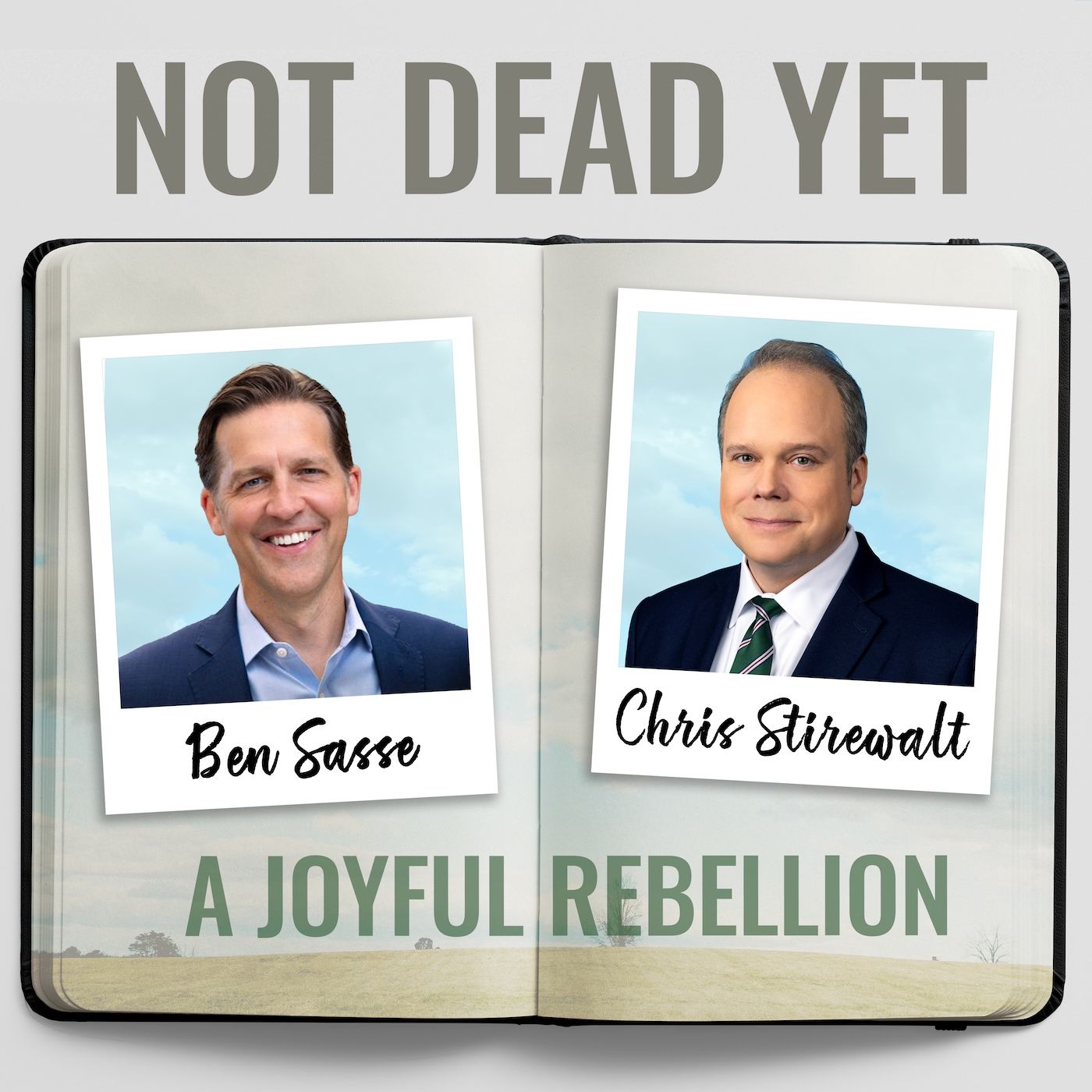
Not Dead Yet
Jonah Goldberg
01:19:31
Jonah joins the boys for their first in-person podcast. Friendship, morphine (higher than average morphine-brain for Ben), note cards, institutions, and journalism. Ben and Chris talk about the why behind the podcast. Wonks have fun too.
Loading summary
Transcript228 lines
- [00:00]
Ben Sasse
Jonah, I'm on a lot of drugs,
- [00:03]
Jonah Goldberg
and he didn't get the practice in
- [00:05]
Chris Styrold
college that I did, so.
- [00:16]
Ben Sasse
Hi, I'm Ben Sasse.
- [00:18]
Chris Styrold
And I'm Chris Styrold.
- [00:20]
Ben Sasse
And this is not dead yet. We're all dying, but only some of us have been brought face to face with that reality.
- [00:28]
Chris Styrold
However long each of us have to do it, though, we all want to
- [00:31]
Ben Sasse
live a good life, one with meaning, love, and joy. And our guests are here to help us do exactly that.
- [00:39]
Chris Styrold
And Ben's asked. It's been a minute since I rapped at you, and this is an episode that we recorded before, so I want to start. We're going to hear from Jonah Goldberg, and he's a very dear friend of mine, and I know of yours.
- [00:58]
Jonah Goldberg
Me, too.
- [01:00]
Chris Styrold
And when we recorded the episode, you were new to heavy doses of pharmacological bliss, and I ended up steamrolling the conversation a little bit. And Jonah and I fall into a very easy rhythm because we podcast together all the time and we talk frequently,
- [01:25]
Ben Sasse
and all of us, you have mini masters jackets. Green, yellow, every color.
- [01:30]
Chris Styrold
I have it all. But. So I think this episode lacks a Sassian, an appropriately sassy element. So I'm going to start by asking you this question. How are you doing?
- [01:44]
Ben Sasse
Thank you, brother. It is good to be with you. I think we are going to give people a little bit of whiplash on this episode, because I think the main body of this episode, I was higher than a kite on opioids, and right now I'm half as high, but mostly on meth. So life is a little different. Yeah, I look it. You remember the Alex Keaton episode of family ties when Mrs. Obeck calls over and Alex is supposed to be preparing for an AP exam tomorrow, but he installed solar panels on her roof after having put in a sprinkler system in the dark. I have a little bit of that energy tonight, which is pretty weird, because what people are going to hear on the part of the episode that was recorded earlier is me basically asleep for the whole episode. But I think this introduction provides us a fun opportunity to fight in public for the first time, because I love your West Virginia ass. And yet I kind of think we need. We are somewhere between 10 and 36.2% misaligned on the purpose of this podcast, which is just about the right amount of creative tension. But we've been hiding it so far, and so now I think it's Festivus. Let's air some grievances.
- [02:56]
Chris Styrold
Well, what do you think the purpose of this podcast is.
- [02:59]
Ben Sasse
Well, it sure as heck isn't politics. And the question for a nerd like me, and you mocked me in episodes 1, 2, 4, 5, not that I was keeping score or anything. You said that I am guilty of letting the perfect be the enemy of the Pretty Good. And you're definitely, definitely, definitely right. The question is, are we really aiming for perfect? Of course not. But what is the aspirational attainment of pretty Good? And I think you've been more right than I have in that I thought almost all of our episodes to date have been kind of C minus, and I think you've graded most of them at A minus. And it looks like crowd feedback is with you, not with me. But I have regularly been inclined to rethink who the next guest is, rerecord something. And you've said, shut up and move forward. And I think you've been more right than I have. But I think what's fun in this episode, and it's easy to say, since we both love Jonah, is that this is the first episode in a way that is a little more about specific nerd ideas than about the edge of biographical question of people about, hey, we're mortals and we need to prioritize. Well, in light of limited time. And I think almost all of our episodes, Mike Rowe, Chris Pratt, Caitlin Flanagan, Conan Al Michaels, maybe a tick less, but almost all of them have been questions about, given that time is limited, how do you decide what's important in life? And I think this is one of the first ones that's going to be a little more nerd team thought topic team slash topic specific rather than bio specific. And I'm anxious about this type of episode.
- [04:45]
Chris Styrold
Well, here's the thing, is that no one cares because you are publicly battling cancer in a. In a sort of heroic is the wrong word, but the definitely the wrong word. Your. Your. The story that you're telling America right now and what you are doing right now that has all these people. I mean, the number of people that I get to decline on a daily basis when they're like, hey, I would love for you to get me in touch with Ben Sass. And I'm like, no, he's asleep. I. I don't. I don't think. I don't think I'll do that. The. The reason that, you know, the episode we did with Chris Pratt was really affecting for me because here was this guy. He's. I don't know. He's maybe about my age. I don't know. I'm 50. So he's like, maybe late 40s, I don't know.
- [05:50]
Ben Sasse
That's right.
- [05:52]
Chris Styrold
And here's this guy who's like, I'm looking for good role models. I'm looking for good role models and knowing how to die. If you don't know how to die, you don't know how to be alive. And your experience and what you are doing and how you're doing it provides urgency for the conversation of what is the good life. And, you know, I enjoyed very much conversation with Jonah because I always enjoy my conversations with Jonah. And I think what people are going to hear today is a conversation that would happen between the three of us around a fire pit somewhere, right? Like, it's. It's the kind of stuff that, you know, we have talked about together before we get into journalism, how journalism works. There are many jokes, there's some bleeping, but a real inhumane experience. And for me, like, I'm not a good friend. Haver. I have some of the same friends that I have had since I was a kid, right? I have like a couple friends who I've had since I was a kid. I picked up a couple more friends in my early 20s. But I'm not like a person who has a bunch of friends. May. I don't like people I don't know.
- [07:21]
Jonah Goldberg
That's.
- [07:22]
Chris Styrold
I mean, it is true that I don't like people, but like, having and
- [07:25]
Ben Sasse
maintaining, like you, I feel liked by you.
- [07:28]
Chris Styrold
I don't want to be vulnerable, but push off. No, but, like, that's, you know, I joke about, like, with you about how it's usually easy to avoid becoming friends with politicians. Super duchy. Yeah, but like, Jonah is a person now. I don't know, 15 or however many years, like in Washington D.C. you often wonder, like, am I friends with this person or are we symbiotic? Is this a. Is, is this a remora shark relationship? And which one am I? And is this person want something that I have? Let me tell you, networking for me, I would rather have hot pokers shoved into my urethra than I would have when something's like, then we'll have a great opportunity for networking. And I think Jonah's my actual friend. So for me, it's like part of living the good life is definitely having friends. And Jonah is my friend,
- [08:34]
Ben Sasse
dude. I mean, I want to be mean and snarky and all that, but let me first just say the good life is definitely not listening to Ben Sasse just asked my bride, Melissa. Sass loves me and occasionally Even condescends to like me. But part of a life well lived is definitely hanging out with friends. And one of the reasons why I'm so grateful that you agreed to do this podcast, I was diagnosed 12-13-14, and I called you, I don't know, 12 hours later and asked if you would still do this, and you were confused. But part of a good life is definitely hanging out with your friends and wrestling through how to make sense of all the brokenness of the world. And you're my friend and you and Jonah are friends. And I haven't spent nearly as much time with Jonah as you have, but we are very, very friendly and I want our listeners to be able to be our friends. Obviously, it's not Aristotelian friendship when we don't get to break bread together physically. And so that's a bummer. But I don't know, I don't want to be too somber or serious here, but this slightly more than weekly convening has been very, very meaningful for me because it has provided destination timing for me to get serious when a lot of times it's easy just to go back to sleep again and again and again. When you're in and out of the hospital every week, there's somebody who wants to give you more drugs to solve your short term problem, but still make you less alive. And I'd rather have more pain and less painkiller and be able to wrestle on important topics.
- [10:21]
Chris Styrold
You said something. You said something to Chris Pratt that stayed with me, which is we were talking about, what do you do to not be a caged animal Once you have succeeded, once you're like, you did it. You went from the Bubba Gump Shrimp Company to 14 billion in box office, like, what do you do? And talking about the soul hole, I would imagine that the rigors, the daily rigors of treatment, of having a team of doctors, of having a family, of having discussions and meetings, and every moment that you're awake, talking about, what's the next treatment choice?
- [11:02]
Ben Sasse
Hospice. Hospice, yeah.
- [11:04]
Chris Styrold
What are we doing about this? What are we doing about that? That there's a lot of distraction that keeps you in a positive way from dwelling on other things, but also the negative way of, like, not checking in and keeping it real, as the kids would say.
- [11:23]
Ben Sasse
I know we need to pivot in a minute to Jonah, my friend Jonah. Your friend Jonah. Our friend Jonah. But I will say one of the things that's been gratifying about this, and I'll say a second time, thank you for your kindness and being willing to set aside time. You got lots of demands in your home life and in your real jobs, your vocations that are longer enduring than this one. But one of the things that's been really gratifying to me is the hospital I'm at, MD Anderson, Houston. I think the number is 36 people a day die there of cancer. That's how big this complex is. I have 15ish people who've reached out to me now, found a way to 2 or 3 or 4 degrees of Kevin Bacon, other people who are patients at my same hospital who are dying of mine or similar kinds of cancer reaching out and saying that our conversations and Mike Rowe has come to mind a couple of times this week as people have sent me notes as they try to make sense of how to die intentionally and think about what it means to call death. My phrase, Christian phrase, is the final enemy. Death is wicked. It's a wicked thief. It's evil. But the final is a pretty great adjective to get to be done with it.
- [12:44]
And a lot of people don't have
- [12:45]
any categories or not many categories to make sense of how to navigate this time. And even though we've not been very self serious about all this, thinking a little bit about how you prioritize when you're on the clock has meant a lot to me. So I'm really grateful that you've been willing to do this together. I'm grateful to our guests. I think the theme that we need to tease out just in front of our listeners who were kind enough to send us a lot of advice is how often do you do Again, our friend Jonah. But we're talking about institutional rebuilds in this episode, and I'm so high that I can't even distinguish between what reporting and journalism is. There are a number of things I say that I know I'm going to be very embarrassed by.
- [13:27]
But two weeks from now, I think
- [13:29]
we have Nick Ebersat on, and Nick is one of the world's demographic experts on the population collapse. And we're not really having Nick on to say, give us your wisdom about how to live life on the clock.
- [13:43]
We're saying, holy crap.
- [13:44]
Civilizationally, the digital revolution and other things affluenza is causing us to stop wanting to have babies. How freaking weird is that? That kind of episode is different than our majority type of episode, which is more Edge of Bio. And so I welcome the advice we're getting from our guests. And I'm just acknowledging my insecurity that this kind of episode is A little different than the others.
- [14:08]
Chris Styrold
Well, you can take it to the bank that Jonah's episode is much lighter on erudition than Nick's is. Don't worry about that. And look, this podcast can be whatever you want it to be. It can be anything you want it to be. And we have these people who have reached out and want to participate and to join us and whatever. It can go in any direction that you want to go, as far as I'm concerned, except for one, which is into politics. Because. Because I do politics. I've devoted my vocational life to politics. I have been interested in and fascinated by politics and demography and history since I was a boy. Right. It's my. I'm. I'm into it. You know, the.
- [15:07]
Ben Sasse
You know, the precinct voting breakdown of every county in West Virginia in 60 and 64.
- [15:13]
Chris Styrold
And Kennedy bought it in 60. The.
- [15:16]
Ben Sasse
He paid for a landslide, and Papa was pissed.
- [15:19]
Chris Styrold
Well, you know the joke that was at the Daniel Boone Hotel? He came out in front and he told the assembled throng, joking, don't. My just received a telegram from my father. He says, don't buy another vote. I won't pay for a landslide.
- [15:31]
Jonah Goldberg
Ha ha ha.
- [15:34]
Chris Styrold
And I could tell you stories about Frank Sinatra and the boys going through the back roads handing out pints of Old Crow. I'm really interested in politics, but this is. And this is something we talked about with Al Michaels. For me, like hosting a Sunday show, doing this. There's a lot of things that I'm doing right now that are supposed to not be about me. And you spend a lot of time in politics, and you spend a lot of time in media, whether you want to do it or not. You're like, okay, what's my brand? What am I about? What's the perception of me? What about me? How do I get my snout in the trough? And I've reached an age and I've reached a point in my life that I really powerfully want. I'm sick of me. I'm sick of overweening and pushing in and what's the contract and what's the deal and what can I get? Now I want everybody who's paying me and giving me contracts to continue to do those things. I'm not going anywhere. But for me, this is nice that it's not politics and it's not me, and it can be about you and it can be about our guests and we can learn stuff. And I just hope, you know, I've met my youngest son has never listened to anything that I've done. And he listened to the Al Michaels episode.
- [17:02]
Ben Sasse
Oh, that's fun.
- [17:04]
Chris Styrold
And he loved it. And it was good because I was finally talking about something that wasn't politics or history or culture or whatever.
- [17:12]
Ben Sasse
And because Al has the voice of the heavens and because Imragut just did such an amazing job displacing in 1980 footage. But yes, us, we did decent.
- [17:20]
Chris Styrold
Okay.
- [17:21]
Ben Sasse
As well.
- [17:22]
Chris Styrold
Yeah. And so that's what I'm in it for. I'm in it for to copilot with you wherever you want to go. And I'm in it so that it's not just the same old. Like you could, you could plug me in on any given day. And this is, I shouldn't say this, but it's like people say, oh, what do you, you know, what are you going to write about today? Or what are you going to talk about today? What are you going to go on this podcast and talk about? And it's like, it doesn't matter because you. It's like, it's almost like a parlor trick. Throw a topic out. I got it. I got something on it. I can riff something on it. I can be a politician and answer the question I want to, not the one that I was asked. I can do whatever. I like this. Because it's not that. This is different.
- [18:12]
Ben Sasse
Maybe the podcast is the friends we made along the way.
- [18:16]
Chris Styrold
Maybe the podcast is the friends we made along the way.
- [18:19]
Ben Sasse
We're coming out of Holy Week. We're going to get to Jonah. We're coming out of Holy Week. And I've been reflecting a lot, but we've been reflecting a lot at our house on that brilliant John Stott shorthand. Obviously we talk edge of Christian themes occasionally on this podcast. John Stott. The essence of sin is man substituting himself for God. The essence of salvation is God coming and substituting himself for man on the cross. Cross. Whoa, big stuff. Okay, we'll come down now to smaller things.
- [18:54]
Chris Styrold
So here we go. And the. I would just put in my version on that, which is the powerful implication of understanding that God is real is then understanding that it is not me.
- [19:09]
Ben Sasse
Amen. Oh, less of me.
- [19:14]
Chris Styrold
Amen.
- [19:14]
Ben Sasse
And less of you. Dude, seriously, for real.
- [19:18]
Chris Styrold
Okay. Jonah Goldberg. He is the editor in chief of the Dispatch. He is our colleague at the American Enterprise Institute, A E I. He is a columnist for the Los Angeles Times. He is the author of several best selling books.
- [19:35]
Ben Sasse
He loves all the titles of them, too.
- [19:38]
Chris Styrold
The brutally named Suicide of the west is, dare I say, I wouldn't say it in front of him, but is an important book that came at an important time. He is a dog. I was gonna say owner, but they really own him. He is a dog enthusiast. He's a great dad. He's a great husband. He's a mensch. Let's take a listen. All right, Jenna Goldberg, you're not dead yet.
- [20:07]
Jonah Goldberg
For sake. What's wrong with you guys setting me up?
- [20:11]
Ben Sasse
You have a lot of little old
- [20:12]
ladies in Iowa listening. What chirping going on?
- [20:16]
Jonah Goldberg
I apologize. I apologize. Somewhere in Nebraska, someone dropped their runza when they heard me curse. I apologize.
- [20:23]
Ben Sasse
Thank you for product placement.
- [20:27]
Jonah Goldberg
First of all, let me just say I'm happy to be here. Not the ideal circumstances to be on the SAS podcast or anything like that, but I think both of you have heard me tell this anecdote before, but there's this story about Boris Yeltsin when he was president of Russia and he was asked by reporters at a meet and greet thing about, could you describe the state of the Russian economy in one word? And Boris Yeltsin goes, good. And the reporter's got a chuckle. Okay, can you give us a little more? Maybe two words. And Yeltsin takes a long minute and then he says, not good. And I think that's sort of always the case about everything. Right. We all three of us believe in fallenness, maybe with different theological spins on it.
- [21:32]
Ben Sasse
And
- [21:34]
Jonah Goldberg
one of the most dangerous things to get caught up in is nostalgia. The past was never that awesome. One of the things, as Brother Stirewalt can attest, is there are these polls. It's amazing. If you go back and you look, it's like every five years they do a poll and they ask people, were things better off 50 years ago? And they always say, yes. And you're like, really? So, like, they did one a couple years ago, it was like, really 1973, better off, you know, like America was in better shape. That's a hard case to make. You know, when there was something like five domestic bombings a day for 18 months or something like that. Yeah.
- [22:11]
Chris Styrold
And miscegenation was illegal in 17 states and women couldn't get credit cards. And a point that Jonah frequently makes is when people imagine themselves living in the past, they are Cheops, not the guy building the temple of Cheops.
- [22:28]
Jonah Goldberg
That's right. That's right. It's never the club footed serf who dies at 16 after being horsewhipped for something you didn't do. It's always the master of the estate. So anyway, I think that's the first thing to just sort of keep in mind is that in this world things are never going to be perfect. And I try to keep that in mind. And then again, I think sharing with you guys, almost all of the important things in life are retail, friends, family, personal connections, that kind of thing. And I think one of the things that makes this moment. Again, I don't know if I'm actually saying the words that you want me to be talking about here, but we
- [23:20]
Ben Sasse
have no required words.
- [23:23]
Jonah Goldberg
But I think that one of the reasons why. And this gets to some of the work that Ben has done, one of the reasons why things are so annoyingly stupid. Right? I mean, that's the thing about today is that it's not that things haven't ever been worse, but it's sort of like, you know, was it. Is it. Is it Tolstoy's. All unhappy families are unhappy in their own way.
- [23:49]
Chris Styrold
Chekhov or whatever.
- [23:50]
Jonah Goldberg
Chekhov.
- [23:51]
Chris Styrold
It's a sad Russian.
- [23:52]
Jonah Goldberg
Yeah, it's a sad. Well, that's like people who like. Just as a side note, I think Russia is literally the most craptacular bad country of the last, say 500 to 1,000 years.
- [24:02]
Chris Styrold
They have an excess history.
- [24:04]
Jonah Goldberg
And whenever I say that, people say, oh, but Russian literature. I was like, why do you think Russian literature is good? It's because it's a miserable place to live where you're stuck in winter and you're oppressed all the time. And that brings out for a few cranks, some good fiction anyway. But my point is that I'm not really sure what my point is, but. Oh. That what makes this moment sort of uniquely craptacular is because of technological changes more than anything else. And technological changes change culture much more than people want to acknowledge is that when you spend so much of your life simply absorbing it through screens, it lets you see other people that you don't know as abstractions, rather NPCs. Yeah.
- [24:57]
Chris Styrold
And it incurred a non player character the idea that if you are the star of your video game as you are moving through Grand Theft Auto or Halo or whatever it is that you play these other entities that are there, are there for you, and if you shoot them or make sweet love to
- [25:14]
Jonah Goldberg
them or whatever, it's fine because they're all just tools rather than actual living, breathing human beings. And I think a lot of our tribalism is that at scale is that we see the people we disagree with as two dimensional characters from very far away. And it makes it very, very hard to actually have real conversations about how people should live.
- [25:35]
Chris Styrold
The point of the podcast for us is to ask questions of people that we don't normally get to ask them. And one of the things that I. One of the ways in which I want to be more like you is this is deadlift and squat. Deadlift and squat. Obviously glute game. But is your emotional presence and emotional availability living a public life? You've lived some form of a public life since you were like, 20 years old, right?
- [26:07]
Jonah Goldberg
That's a bit of an exaggeration, but
- [26:09]
Chris Styrold
a while, to some degree, since you were a very young man, you've lived a life in public. And I've never seen you lose connection to also being. You're a real softie. You're a real squishy, gooey person, and I'm a real squishy, gooey person, but I'm, like, fighting it. I'm, like, wrestling with it. You are emotionally present and emotionally available in your public life, in your writing, in what you talk about, in how you live in a way that would panic me. And it doesn't panic you. Or maybe it does talk to me about how you are a mensch and emotionally present while still being a public figure.
- [27:02]
Jonah Goldberg
Okay, well, I will go with the thrust of the question without. Don't quibble with me about getting forensic about. So I don't think that was always the case. I think, like a lot of men, I used to be very worried about showing I was vulnerable, that kind of thing. Right.
- [27:25]
Ben Sasse
And.
- [27:27]
Jonah Goldberg
And I was sort of desperate when I first came to Washington to be taken seriously because, you know, I was rejected from every college I applied to, and I was a screw up, and I had a good time in high school.
- [27:38]
Chris Styrold
Yeah, this is where you and I differ from that test.
- [27:44]
Jonah Goldberg
And it took me a long time to sort of just like, it's funny. My speakers bureau used to say, okay, so who do you want to be? Do you want to be PJ o'?
- [27:53]
Chris Styrold
Rourke?
- [27:54]
Jonah Goldberg
Do you want to be David Brooks? Do you want, like, who do you want to be? And at some point, I just was sort of like, you know, I kind of want to be Jonah Goldberg. Yeah.
- [28:02]
Chris Styrold
And.
- [28:03]
Jonah Goldberg
But even then, you know, I told jokes to audiences that wanted jokes, and I got wonky and serious and philosophical to audiences that wanted that. And I tried to mix the two wherever possible because that's my sweet spot. But I gotta say, it really wasn't. I don't think you guys want to get deep into Trump stuff, but it really wasn't until the Trump era that in part because I lost so much respect for other people, and particularly people who were pretending to be super masculine and all this kind of crap. And I just lost interest in playing those games. But then also, and I'm sure I said it to you a thousand times eleven years ago, my position back then was this is going to end in tears no matter what, so you might as well be honest. And I kind of just sort of take that to heart about a lot of things, not just the politics stuff these days. And part of it, I mean, Ben, you suggested to me that we could get dark and gallows. Y. I'm not sure I really want to do that, but it's relevant to the question. I really was. I didn't think I was at the time, but I was actually in a pretty close knit family growing up and I was very close to my parents who were very different people from each other, which makes psych evals of my personality type very strange. And cut a very long story short, I'm the sole survivor of that family. Both my parents died, my brother died very young or too young.
- [29:40]
Ben Sasse
And
- [29:43]
Jonah Goldberg
so part of what I kind of have internalized, first of all, I learned that some of my best writing is when I'm writing eulogies, which is a really bummer kind of thing to discover about yourself. But also that the really important stuff are like the, the indentations that the people in your life make on you. And it's not about arguments or intellectual stuff. It's about again, like with my dad being a mensch.
- [30:17]
Chris Styrold
Yeah.
- [30:17]
Jonah Goldberg
And you know, my, my dad more through show than tell, thought it was like just really important to have integrity and act like you have integrity and be a good person. My mom, who was a lot more outlandish whenever she had to do something that she really didn't want to do, but she knew she had to do it, she would say it's the Christian thing to do and then she would go do it. And that was about as deep as, like ethical conversations got most of the time, but it lasted on me. And so in this weird time, I kind of think that, like I remember saying to people when my mom died and they were talking about how I responded, I said the only standard I had going into this was act as if your parents were still alive and someone was describing to them, how are you behaving?
- [31:09]
Chris Styrold
Yeah.
- [31:10]
Jonah Goldberg
And how are you handling the load?
- [31:13]
Chris Styrold
Right.
- [31:13]
Jonah Goldberg
And the same thing with my brother and with my dad. And I've kind of internalized that that a Wall street guy told me at the beginning of the Trump era. You know, Jonah, integrity lowers the cost of capital. And I was like, what do you mean by that? He says, well, look, there's a reason why Donald Trump has to cannot borrow money on domestic equity markets because. Or debt markets, because no one trusts him, because they know he doesn't have integrity. And that has sort of been a metaphor that has stuck with me, not just about financial things, but about foreign policy. Like all this stuff with NATO. It's like, if you act as if you have no integrity as a nation, no honor as a nation, then people aren't going to trust you, and the alliances aren't going to be worth anything. But most importantly, it's actually true in all of that social capital, interpersonal relationship stuff, if people know who you are and can rely on you to be a good person, you're a good person. And as someone who. Who doesn't actually believe we can get eggheady on this if you want. I think one of the worst things that happened to modernity was the triumph of the romantic argument, capital R, as in romanticism, that the highest moral authority is your instincts, your gut, you know, and the example I often use when I'm trying to explain this to people is, what if my gut doesn't want
- [32:41]
Ben Sasse
to be faithful to my wife this month?
- [32:42]
Jonah Goldberg
Exactly. Or the way I always put it is like, the very essence of. Of good parenting is embracing the hypocrisy of learning the lessons from your youth and saying, do as I say, not as I did. And if you got a kid and you say to him, hey, look, you have to be true to yourself, I get it. You have to really honor your instincts and listen to your inner voice. So you run with those scissors, you eat that lead paint chip, because you just gotta be true to yourself.
- [33:10]
Chris Styrold
Well, it is delicious.
- [33:11]
Jonah Goldberg
To be fair, that is the essence of bad parenting, is to tell people to lean into that crap. And the essence of being a good person. And I'm very uncomfortable talking about myself. Lessons I've learned to try to be a good person.
- [33:25]
Chris Styrold
I know it's got to be a real serious diagnosis for Ben if we are able to squeeze this out of you. Yeah.
- [33:31]
Jonah Goldberg
So, like, my basic point is actually Aquinas and all those guys were right and Maimonides were right and all that kind of stuff is that you become a good person by acting like a good person.
- [33:44]
Chris Styrold
As my old daddy used to say, bring your ass and your heart will follow.
- [33:47]
Jonah Goldberg
Exactly.
- [33:48]
Ben Sasse
Everybody knows you fake it to make it at wrestling practice. You fake it till you make it you want to aspire to do the steps by process to become the thing you ultimately want to be. Genuineness, if that just means follow your laziest impulses, is certainly not our aspiration.
- [34:05]
Jonah Goldberg
That reminds me, one of these phrases that I hate that you hear all the time, and I get what people are saying is they always say, well, Einstein said that the very definition of insanity is doing the same thing over and over again, expecting different results. And I'm like, I thought that was called practice. And in fact, there were all these books about 10,000 hours about, you keep trying something until you get better, trying to be a good person. This gets us to our friend Yuval Levin. Stuff about institutions, which is supposed to be part of this, is that institutions expect you to bend your personality and your character to the needs of the institution. You go in an irresolute sloppy hippie and the Marines turn you into a Marine, or the Boy Scouts turn you from an unruly boy that can't be trusted to one who lets little old ladies helps little old ladies cross the street. That's what institutions are for, is to mold character for the greater good of the institution and by extension, the society. And in economics, an institution just means a rule. And I try really hard just to sort of think about, like, what's the right thing to do. Not in every regard. I'm not. No one thinks I'm a super goody goody guy, but about the things that matter. Like, if somebody, like, I think, I honestly think that the most important concept that we kind of lost in a lot of society is God fearing. Because the whole idea of God fearing is that, you know, they used to say, you know, character is what you do when nobody's watching. Well, if you think you live in a cold, soulless universe, then when no human is watching, then you can really do whatever the hell you want. But if you think God is watching and he's looking at what you're doing and judging you for it, it's a check on what you're doing. And that's about as religious as I get most of the time, but I believe in it.
- [35:52]
Chris Styrold
Cards have come out at the risk
- [35:54]
Ben Sasse
of getting in trouble with Brother Chris for having a four part setup to my question.
- [35:59]
Chris Styrold
The cards are, are throwing me for a loop right now.
- [36:02]
Ben Sasse
The cards have morphine pills between number two and number three. So we're gonna take a hit. In the middle of that, Chris asked you, how do you live so much of your worldview and deliberation in public? Another way of asking that question might be the old George Will question of if you have to write two or three columns a week, you can just start at two or three things that pissed you off and try to sort through it. But you could become really bitter doing that. And so I want to ask a. But this is gonna be the subordinate part. I wanna ask a question about the distinction between journalism and commentary as each of you two practice it now. But thinking about Peggy Noonan's recent column that was a lament about the changes at the Washington Post and the death of the sports section and whatever, there's a lot, Joan and I haven't done that yet. There's a lot of debates about small J versus capital J journalism. You have a whole bunch of people who can agree with the aspirational theory and what we need shared facts. But you could also be like, holy crap, it wasn't like NPR and Washington Post were doing shared facts during 2020 or during, I mean, the street stuff and the COVID stuff, not politics stuff. Yet, George, Floyd and Covid. And so I want to get to a distinction, as you two see it, between journalism and commentary. But you just said along the way, Jonah, multiple times. Given what we're going through right now, I think it might be useful to have a shorthand on what do we mean that doesn't require people to agree with. Not that the three of us all agree, but the three of us don't have to agree or listeners don't have to agree on partisan stuff about this period. But we are going through something really weird. And that's what you're getting at with the hypocrisy point, which is the post liberalism of the left we've been seeing people flirt with for a decade. Plus, the post class classical liberalism of the right is new. And what both of them now do with their nut picking is the totally online burn it all down kind of folks are both saying, we can race to kill the Constitution because the other side was going to do it anyway. And so the hypocrisy of everyone just saying screw it, that we've inherited a great American experiment is what's weird. Even if people don't agree on the partisanship, what's the shorthand for what our moment is? What do you mean when you say we're going through this terrible moment?
- [38:33]
Jonah Goldberg
Yeah, so I largely agree with that description, although I should say, just because it's the nerd in me. The original post liberal was Karl Marx. Quite explicitly. He's like, you need the liberal bourgeois phase of the Historical development, blah blah, blah, of the economy of the society. And then once we've got enough surplus wealth, we move beyond liberalism. And so Marxism has been post liberal or anti liberal since communist manifesto is 1848, maybe since Das Kapital, whatever. But I agree with your point. I would argue that sort of, if you take a 30,000 foot view, I mean, tribalism gets overused, but the logic of tribalism basically just says whatever's good for my tribe, that's what is good. That's sort of what at scale common good constitutionalism is. It's like we want the results and so therefore we'll rig the system to get the results that we want.
- [39:47]
Chris Styrold
Like a Ring of Gyges problem, which is if you can do anything that you want, what will you do? What will a good person do? A good person will help his friends. That's what a good person does. A good person takes care of his friends and his family.
- [40:04]
Ben Sasse
South Boston uber alles.
- [40:05]
Chris Styrold
Yeah, exactly.
- [40:06]
Jonah Goldberg
I think that's basically it, right? And what's important to point out, this is sort of the point of my last book was that's natural, right? That is the way, like I always thought it was me, if you talk to the guys who tried to do economic development in Afghanistan and they would say, you know, we would try to say, oh, you have to open this up for bidding, you have to have competitive this, or whatever that. And they were like, you want me to offer work to the clan I've been at war at for a thousand years. That's crazy. I got to give it to my cousin. And that's normal. What's abnormal is our stuff, right? Is this idea of, of non personal institutions following the rules even when they're inconvenient for elites in power and all of that. And I think the breakdown of faith and trust in institutions is partly a story of partisan politics corrupting everything, but it's also a story of, it's also a story of massive failure by the leaders of a lot of these institutions. But it's also, it's a story of technology to a large extent. You know. You know, institutions exist not just so everybody can hang out together. Institutions exist to do things. And so much of the, you know, like if you have robots, why would you have a barn? If the Amish were allowed to use robots, there would never be another barn raising where everyone's setting up the picnic tables and working together, right?
- [41:29]
Ben Sasse
It's inefficient.
- [41:30]
Jonah Goldberg
Technology gets in the way, replaces human institutions of interaction. And I think that A lot of people. I mean, I remember talking to you seven, eight years ago about how difficult it is to explain to people that the reason why we don't have more people working in factories isn't because of immigrants, it's because of robots. People like arguing about immigrants. That gets to our lizard brain stuff. They don't believe you when you say robots, but it's just obviously true. It's the robots for the most part.
- [42:02]
Chris Styrold
80%.
- [42:03]
Jonah Goldberg
Yeah. And so I think that that's part of the massive, the dislocation. The pace of technological change has people, you know, it's not a monocausal thing, but has people grabbing for comfortable arguments that go with their gut right. And the gut. The lizard brain arguments are that tribe is the enemy, my tribe is good. And so since no one really believes in these rules anyway, let's just rig the system for my team to win. And I think that that's. The left is really, really, really good at seeing that in the right, and the right is really, really good at seeing that in the left. And they are just deaf and blind to it on their own teams. And that's why hypocrisy is just such a driving thing in American politics. It's because people don't actually, I always say it's not a principle if it's never inconvenient for you. Right. And what people want to do is they want to take the principles and weaponize them against their opponents and exempt them for themselves. And you see that on the left, you see it on the right to the point where I used to reject horseshoe theory. We can talk about that if you want. But like, I now see it everywhere because once the right stops believing in classical liberalism, the rule of law, constitutionalism, all that kind of stuff, it's just another flavor of illiberalism. You know, it's right wing coded illiberalism instead of left wing encoded in liberalism, but it's still a liberalism.
- [43:32]
Ben Sasse
Let's let Chris ask another question. But I just want to underscore that because you said something really profound and it connects the last 10 minutes with the opening 10 seconds we had, why the rebuild of institutions is one of our big topics here. It is because the calcification and the collapse of our institutions is a technological thing, that then everything feels like it's merely hypocrisy. And then why you defend these institutions, which are largely hypocrisy, obsolete. It becomes really weird to be a small C conservative when a lot of these institutions should be burned down. But not because of some asshole on the other side of the political spectrum, but because the institutions are largely obsolete. In the 1870-1900-1920 moment, we went from 90 becoming 85, becoming 80% to only 40% of people needing to work in agriculture. Right. The Industrial Revolution didn't just pull people to cities with their factories, they also pushed you from the farm because farming became so much more efficient. Today, less than 2% of America's 330 million people are farmers. But with less than 2% of our workforce doing ag, we have far more agricultural output than we've ever had before. Nobody is out there screaming, if only we weren't getting screwed in Ohio because of some globalist at a meeting at a ski resort in Switzerland, we'd still have 48% of Americans farming.
- [44:52]
Chris Styrold
That's obviously because they did say that
- [44:55]
Ben Sasse
back then in 1930, and there was a populist moment that had the risk of swamping a constitutional order. And what you're saying, which I think is exactly right, is the industrial or your robots rather than immigrants as the bad guys story about factories is just True. We had 31% of Americans working in factories in the late 1950s. Today it's less than 7%. Our output today with less than 7% of the workforce, is much higher than it was when it was 31%. And, and America's voters, America's grass tops, community leaders in every town of 1,000 or 100,000 people need to understand that. The globalist argument and your people, you Jews who screwed it all up.
- [45:38]
Chris Styrold
I'm sure, thanks, Jonah.
- [45:42]
Ben Sasse
That it isn't gonna be fixed by some tariff policy. We're actually gonna have to go through the digital revolution and figure out what it looks like to have lifelong work. And so these institutions are largely obsolete. And so it feels, feels super weird to not want to burn it all down in the midst of tribalism and yet need to be honest about the fact that, well, these institutions are mostly going to go the way of the buggy whip manufacturers of history. We're going to have to build new institutions.
- [46:07]
Jonah Goldberg
Yeah, there's an added, just added version of this aspect of this. I don't like populism. I beat up on populism all the time. It's important to point out that intellectuals are part of the problem too. Too. Intellectuals love to argue about ideas. That's why they became intellectuals. I like to argue about ideas. I love intellectual history. But I've been making this point for a really long time. It's like the people who talk about cultural decay and decline and sordidness and decadence and all that kind of stuff. They love to talk about bad ideas, corrupting the youth and all that. And obviously there are examples of that to point to. There's a lot of filth in pop culture. But if you just go back and look at the explosion of out of wedlock births or shotgun marriages with the mass adoption of the automobile, it's true. You realize that, like, from the front
- [47:08]
Ben Sasse
porch to the back seat, we'll put it in the show notes.
- [47:10]
Jonah Goldberg
There you go.
- [47:10]
Chris Styrold
Oh, yeah, yeah, yeah.
- [47:12]
Jonah Goldberg
There's this, you know, this idea that. Oh, it was like these depraved bohemian ideas from Paris. No, it was. It was like you could actually drive away and watch the submarine races or whatever. It was like they said in Happy Days, away from your parents and fool around in a car. But intellectuals want to argue with Nietzsche or Sartre or whatever, and they don't want to argue with the Buick. And so they make the arguments about. It's like the drunk looking for his car keys under the streetlight because that's where the light is good. The tendency among eggheads on the right and the left to make everything about these dangerous ideas on the other side misses that. A lot of the stuff going on is downstream or in a different stream than that stuff. I mean, I think that historians are going to look back at the Occupy Wall street as two sides of the exact same coin. Totally. Right?
- [48:07]
Chris Styrold
Totally. You want me to ask a question?
- [48:10]
Ben Sasse
Would you?
- [48:12]
Chris Styrold
I guess I want to answer your question about journalism. You put it journalism versus what? Commentary.
- [48:23]
Jonah Goldberg
Oh, yeah, I forgot about that.
- [48:25]
Chris Styrold
So commentary is journalism, but not all journalism is commentary. So when we talk about, and Jonah, correct me wherever you think that I
- [48:38]
Ben Sasse
have gone astray, that's just like your opinion, dude.
- [48:43]
Chris Styrold
Opinion. Journalism is journalism, news. If I say to Jonah that that was a news story, what we mean is that that was a story on television, radio, in print, or in digital that was attempted to render the facts of the story in a clear and concise way without bringing too much of the opinion of the person who was writing it into it. So that's news. So that's straight news or news. Then you have the place where I live, which is the best place to live in all of it, which is analysis. Analysis is the next step. And the next step is, I'm not telling you what you should do, but I am telling you how I think it's going to go. Right?
- [49:38]
Jonah Goldberg
Analysis is the incestuous child of news and opinion.
- [49:42]
Chris Styrold
It's me, baby, that's me. And here I am, incestuous child. It is the one where you steal a base and say, I'm going to share some of my opinions here, but I promise that they're going to be just opinions about how things go. And whatever vocational success I have had is connected to the fact that some people think that I have a good sniffer for what is going to work or not work politically and that I can look at. And rather than you having to read all the cross tabs in the poll, I can read the cross tabs in the poll and then tell by it's corner cutting. Analysis is corner cutting and it should be done responsibly. Then the next step is pure opinion journalism. When Jonah writes a column in the Los Angeles Times, he is making two promises to his readers. One is that he is telling them what he actually thinks. He's not pulling a punch, he's not hiding what he's doing. He doesn't have an ulterior motive. He is being open faced about it. And the facts that he uses that he marshals in support of his argument are to the best of his knowledge, true. And that's opinion journalism. And it's still journalism and it all is still legitimate journalism.
- [51:02]
Jonah Goldberg
So I would say there's just is the fourth tranche which I personally name
- [51:07]
Ben Sasse
the three before the fourth.
- [51:08]
Jonah Goldberg
Okay, so one is news reporting, Right. The other one is analysis. The third is opinion. And then I will show my biases here. The fourth is what I would call turd polishing.
- [51:24]
Ben Sasse
Right?
- [51:25]
Jonah Goldberg
Technical.
- [51:26]
Chris Styrold
I was talking about three Cartesian term
- [51:29]
Ben Sasse
from the Northwestern Journal.
- [51:30]
Jonah Goldberg
That's right, that's right.
- [51:31]
Chris Styrold
I was talking about the three virtuous forms.
- [51:34]
Jonah Goldberg
But there's a legitimate debate among some people in the opinion world where I'm not saying they're bad people necessarily, but so like there's a debate between, there's a certain in the talk show radio, talk show world and you see this the most. But I should say you see it the most extreme sort of gargoyle version of this with like the podcast bro people and, and that kind of thing. But there are some people who say it's sort of, sort of like we'll make this more highfalutin. Burke's letter to the electors of Bristol where he says, look, I am not, I owe you my judgment. I am not just simply your vessel. Whatever you say goes. If I think my voters are wrong and I'm right, delegate versus representative.
- [52:22]
Chris Styrold
Right.
- [52:22]
Jonah Goldberg
Delegate versus representative model in political science. Right. There are people in the opinion space who think their job is to articulate the views of their audiences rather than simply tell the truth as they see it. And there are some people who are fairly honest and decent people who do that. And I just think they're merely what social scientists call wrong. And then there are people who are the journalist equivalent of what social scientists call filthy. And we don't have to necessarily name names of who I'm talking about here, but there are people who literally deliberately lie and there are people who who just simply spin what their audiences want to hear in the best possible way.
- [53:11]
Chris Styrold
And I call this algebraic writing where we already we're just solving for X and whatever. However fan service will work, fan service will win. And if you are writing for so sport in sports journalism it is very common and I've written about this about how I can choose any I can choose to watch the WVU basketball game on the WVU stream or I could have watched it on the Texas Tech stream. Which stream do I want? I want the WVU stream that on every missed shot they say oh, so there might be some momentum happening. They might get it going again. They might get it going again. And the Texas Tech stream is going to say these mountaineers are as cold as ice tonight. They can't touch the rim. These guys are a joke. I will prefer to be cosseted by the home team stream. And the solving for X journalism or opinion journalism is I'm going to find a way to say that we are good and they are bad and you're going to put the proof in front of me and I'm going to have to find a way to arrange the integers so that I can say aha, I solved it. We did it again. I was able to explain how the other side is actually worse or actually it was good that this happened because in the long run it's going to be a win. One of the things, things that Jonah, you have observed, I can't tell you how bad it is for people, politicians and parties to have uncritical remora swimming under and around them constantly solving for X because they don't learn, they don't get better, they don't accept the consequences of their bad choices. And that is the problem of stovepipes media is that if you can live in a climate controlled media world then it's all fine. And why would I change? Because people only change when it hurts too much to stay the way they are.
- [55:32]
Jonah Goldberg
Yeah. So like the way I think about this a lot is like I Think democracy is about disagreement, not about agreement. That unity is wildly overrated. It depends what you're unified about and for what purpose.
- [55:50]
Chris Styrold
But
- [55:53]
Jonah Goldberg
the best journalism, I argue, is somewhere between opinion and analytical journalism, insofar as it's trying to make an argument. And as our friend Ramesh Panuru used to say, I want to deal with the other side's best arguments, not their worst arguments. There are a lot of people in our line of work that take to your nut picking point earlier. They take the dumbest thing the other side says and say, see, this is what they all think. Rather than take like the smart position, which is much more nuanced and much more difficult to deal with. And so the analogy I often use is like, people get too worked up about bias. The problem is hidden bias. The problem is lying about your bias. And so the single, like the really great long form arguments in the New Yorker or the Atlantic or National Review or the New Republic, you can pick your thing. The writer is honest with the reader about where they're coming from and they're trying to make the case for something. And the place metaphorically where this happens the best or the best illustrates the point is in a court of law, in a court of law, everyone knows the prosecutor is biased towards conviction. In a court of law, everyone knows the defense is biased towards acquittal. There are rules in a court of law about dealing with facts. You can't lie. And if you don't deal with the other side's best arguments, you're probably gonna lose. And the judge is there to make sure the argument is done fairly and honestly. But the fact that the two sides disagree is the point. It's the feature, it's not the bug.
- [57:25]
Ben Sasse
But let's challenge this metaphor for a minute. You two have more agreement than I expected. And it's fun for me because I've learned a lot here already to be a little bit of an outlier in my greater skepticism.
- [57:36]
Jonah Goldberg
Let me just get another beer. Fire crack, brother.
- [57:40]
Ben Sasse
Of
- [57:42]
the two of you defending aggressively the opinion end of the continuum as the best form of journalism.
- [57:50]
Chris Styrold
No, I didn't say that. I did not say anything.
- [57:53]
Ben Sasse
The difference in the metaphor is you have 12 jurors and those 12 jurors are compelled to be there. And what happens right now in our weird market for confirmation bias and fan service is everybody's business model is to go narrow and deep. And so the reason why this is a center right nation and the reason so many center right Americans are willing to go stupid, I don't even think of it as right. So to your point on horseshoe theory are willing to just believe stupid stuff is because so many of the historically centrist ish or center left institutions have become so dumb. My shorthand version of talking about this with or explaining it to Nebraska voters is until like three years ago. I think the Nissan Pathfinder maybe became the number one selling vehicle in America two or three years ago. But for 55 straight years before that, every single year, the number one and the number two bestselling vehicles in America were the Ford F150 and the Chevy Silverado. Ford F150 and Chevy Silverado 50 plus years in a row. And I was at a conversation with a whole bunch of DC journalists and they were talking about the fact that none of them knew anyone who drove a pickup. And they didn't understand how incredibly stupid it was to be saying they understood America. They were translating America. This wasn't just hidden bias, this was ostrich. Till the end of time they didn't know anyone who drove a pickup. Except the majority of Americans mostly live in communities where pickups are the main thing. Vehicle that sold. And so I don't know how the rebalancing happens. It's not your responsibility to solve it, but your prosecutorial model is great. If there weren't a market incentive for people to only seek out fan service and almost everybody who's reading or paying any attention to news right now is only going to a fan service outlet wherever it is on the site.
- [59:42]
Jonah Goldberg
I want to be really clear. I agree with that entirely. I was just trying to illustrate the point that bias isn't necessarily the issue. It's honesty, right? Or it's frankness about what the facts are. And that's a big problem. In terms of the thing that you're describing, the sort of bubble thing of sort of coastal elites, better shorthand is I think that one of the worst things that happened to American journalism is that. And I'm not saying it's necessarily causal, more of a symptom, but just I'll make the point is that it started being an elite university thing. Some of the greatest journalists used to be cigar chomp and hacks with a high school diploma who knew something about something and they covered a beat and they worked.
- [60:36]
Ben Sasse
Fact came first.
- [60:39]
Jonah Goldberg
And you now look at. It's amazing to me you will look at cable news and I'm a CNN contributor, but I'll throw in CNN too. But I think the worst offender is actually MSNBC or Ms. Now Ms. Now get it Right. You see these White House correspondents who look like, you know, they're not old enough to buy a beer. And like it used to be this.
- [61:05]
Chris Styrold
No pores on their skin. Yeah.
- [61:07]
Jonah Goldberg
It used to be this gristled sort of liver spotted kind of thing. Right. Where you knew people, you knew where people were buried. You know, you knew the old stories and, and just the economics of journalism and the sociology of journalism has changed so much that the kids who want to go into journalism today, a lot of them, they think they're being heroic and principled to a certain extent by not going into investment banking straight out of Harvard and that kind of thing. And good. But they also don't want to take a vow of poverty.
- [61:40]
Ben Sasse
Do the police scanner work?
- [61:42]
Jonah Goldberg
Yeah. And so they want to parachute in at a pretty high level. And. And like even when we were. I'm a little older than you, but when Chris and I were coming up, I mean it's like it was like my partner who helped co found the Dispatch, you know, he was making 12, five a year his first year.
- [61:55]
Chris Styrold
200, $250 a week. A sweet $250 a week. And my dumb ass bought a new
- [62:00]
Jonah Goldberg
car
- [62:03]
Ben Sasse
that was not affordable.
- [62:05]
Chris Styrold
It was not affordable.
- [62:06]
Jonah Goldberg
But I'll tell you like my broader point about the adversarial thing and the disagreement is better than agreement. The Washington Post is a great example of this. The Washington Post got obsessed with its own legacy as the Woodward and Bernstein thing. And then part of the problem is there's this transmission thing from campus culture to elite institutions. That's where wokeism comes in. Right. The blood brain barrier gets broken down. But the main reason why the Washington Post could last as long as it did in the way it did was it was a monopoly. It was a monopoly in.
- [62:40]
Chris Styrold
I heard your thing on this. And there is a lot of truth in what you said about how at the end of the newspaper, if I can rehearse your argument, I listened to you tell this to pod that at the end of the Raj for newspapers, Profit margins were 33%, 34%. Incredible numbers. A license to print money because you were down to just one newspaper. And so they became insulated from the consequences of being bad at their work. And then when Craigslist showed up and it was that big and it said, I'm going to eat you, the newspapers were like, you're adorable. Maybe we'll let the food writer have a blog. And then they were eaten whole and didn't know how to respond. And all of that was 100%. Right. The thing with the Post, though,
- [63:36]
Ben Sasse
I
- [63:36]
Chris Styrold
believe I texted it to you that Jeff Bezos in the Washington Post was like a guy goes to a strip club and he meets a girl and he says, I'm gonna take you away from all of this. You're not gonna have to bump and grind to make a living anymore.
- [63:55]
Ben Sasse
I'm gonna make so uncomfortable. Hi, Mom.
- [63:58]
Chris Styrold
I'm gonna make an honest woman out of you. And then he takes her home and he puts her in a mansion and he gives her this wonderful life. And then one day he walks through the door and he says, how come you don't bump and grind anymore again, Mom?
- [64:11]
Ben Sasse
Just take a break. You can come back in four or five minutes.
- [64:13]
Chris Styrold
How come you aren't the way you used to be? And what Jeff Bezos did to the Washington Post was say, I'm going to take you out of the grind. The grimy grind of having to make a buck and grind it out and do local news and do all of the stuff that you have to do. And then after he got tired of it, understandably, he said, sorry, that's actually not what I wanted. I wanted somebody with a little glitter on her cheek.
- [64:43]
Jonah Goldberg
I think there's a lot of fairness to that. There's a lot of fairness to that.
- [64:46]
Chris Styrold
Running out of time, Ben Sass, what do you want to know?
- [64:49]
Ben Sasse
All right, Jonah. We started at the question of how institutions get rebuilt. And we're in a town where a lot of institutions are on fire right now. We talked about journalism. It's obviously weird stuff going on in the think tank world. Political parties, we have a similar view that they're strangely screwing up so badly because of how weak they've become. So everybody's tiktokifying the parties. But do you have a sense of what comes next for institutions writ large?
- [65:17]
Jonah Goldberg
Well, so I'm, you know, I'm inclined to believe that nature is healing in part.
- [65:31]
Ben Sasse
I told you he'd be optimistic for Stirewalt.
- [65:34]
Jonah Goldberg
Look, there's a lot of things I could complain about for a very long time. I have that ability. But
- [65:43]
Chris Styrold
you're a pro
- [65:48]
Jonah Goldberg
at the same time. So Edmund Burke has this line I use all the time. Examples, the school of mankind, and he will learn it no other. I often say that Ed Koch, former mayor of New York City, said it better when he ran for a third term and was defeated. He was asked if he was ever going to run for mayor again, and he said no, the people of New York fired me, and now they must be punished. And there's in a certain sense, that's life, right? Is like you learn from the bad stuff and from the mistakes and you recover. And that's one of the reasons why democracy or liberal democratic capitalism. Capitalism is so much more resilient than its detractors think, is that as a culture and as an ideology, as a system, it's designed to learn from mistakes. It is not designed to prevent mistakes, it is designed to learn from them. That's the point about competition and elections and all of that. I have come to believe this is a bit of a side note. I am so done with people talking about democracy and these glorious romantic, poetic terms about our democracy and how wonderful it is. You know why democracy is great? Elections. And why are elections good? Because they allow you to fire people. And they're not a guarantee of great things. They are a hedge against worse things. Amen. Amen. And I wish people would stop using the word democratic for anything other than elections because that's the only really important thing about, about democracy. The rest of the really good stuff that we ascribe to democracy is actually about classical liberalism, right? I mean, if I had to choose between living in a society where everyone got a right to vote on everything but the Bill of Rights could be rescinded with a 51% with a plebiscite, or I live in a society where I didn't get to vote on anything but I could be confident that the Bill of Rights would be enforced. I'd take that. But the problem is that you actually need the elections to make sure that the ruling classes don't start self dealing. And so anyway, I think there's a lot of capacity for learning from mistakes. The worst of the woke stuff I think is behind us for a while.
- [68:04]
Chris Styrold
I don't know.
- [68:05]
Ben Sasse
The parties are so dumb that the right could manage to. They'll be a right wing for elections. And the left isn't admitting that they were fools on this stuff.
- [68:16]
Jonah Goldberg
But you're not seeing a lot of candidates in the Democratic Party run on the craziest stuff. I mean, it was. Anyway, my point is that people learn. Sometimes it takes a couple election cycles to learn. One of the reasons why I think nature's healing in some regard is there have been a bunch of institutions, you know, higher ed far better than I do, but corporate institutions, higher ed institutions that have come out with new policies saying, you know, we're not going to opine on every political question. That's good news and that is very good news. And this sort of gets at why I don't know how to fix every institution out there. You're the institution builder. One of the reasons I started the Dispatch with Steve Hayes is I wanted to build an institution because it was one of the things my heroes had never done. But generally speaking, I'm a kibbitzer and pooh flinger. But I will say that the thing that I think really. The path to fixing institutions is for people to relearn the idea of staying in your lane. It doesn't mean on every issue for all time, you can have no opinion institutionally, but it's got to have something. It's either got to be the invasion of Poland, right, Or some kind of stuff, or it's gotta be, it affects our institution or it affects our institution, right? And there was this wonderful piece in the Sierra in the New York Times a couple months ago about how the Sierra Club just came apart like a cardboard submarine because the leadership decided that they had to get into racial inequity, DEI stuff, all the full spectrum wokeness stuff, right? And the problem is, I mean, I know Chris is old enough to remember this in politics, there was a time when the NRA used to give almost as much to Democrats as to Republicans,
- [70:20]
Chris Styrold
where they always kept like a third in. It was like, yeah, they wanted credibility
- [70:24]
Jonah Goldberg
in both parties, right? And that's the hedge, right?
- [70:27]
Chris Styrold
That's the hedge against Babylon. ACLU exactly the same way. Used to be like, we need to keep some credibility. Gotta make sure that we're backing a couple of these things.
- [70:36]
Jonah Goldberg
So the ACLU is another example of this, right, where like, I'll get back to the Sierra Club in a second. But the ACLU used to be the organization that cared primarily about free speech stuff.
- [70:47]
Chris Styrold
And they would, they, they represented the Nazis marching in Skokie, the Klan marching in West Virginia. They did, they did the unpleasant thing so that they could keep their credibility, right?
- [70:57]
Jonah Goldberg
And they stayed in their lane for the most part. They now have become this, like, we are the organization in favor of the good things defined by progressives. And so my favorite example of this recently was there's some suburb of Chicago that recently passed a bill or an ordinance or whatever banning gas stoves. And the ACLU came in with a friend of the court thing for the county government for banning gas stoves. I'm sorry, this is not in their lane, right? And like, why would you, like, why would you squander the credibility of your organization or something like that? The Sierra Club used to be the nice place that you could be an old fashioned Republican Sort of crotchety, Calvin Coolidge type living in Vermont.
- [71:50]
Chris Styrold
Oh, you never talked to my dad. You never definitely talked about pave the planet cold country.
- [71:57]
Jonah Goldberg
I'm talking about like normies, right? And the, the. The idea of the Sierra Club moving away from like a narrow conservation model that you could get buy in from people of ideological diversity to full spectrum wokeism was a disaster for them. They kind of fell apart because of it. And I think that lesson is being learned by a lot of institutions.
- [72:23]
Chris Styrold
And isn't that true about government, about institutions, about businesses. Core competencies are where it's at. A federal government that does everything in every place will be bad at doing all of those things. If you can limit the scope. If your church preaches the body and blood of Jesus Christ resurrected and does that well and ministers to the sick and to the public poor, it doesn't also have to have an environmental justice component. It can just be focused on doing that one thing. And I think the. I very much agree with what you're saying because I think so much of what is wrong with institutions and how things have gone wrong is you just need to do your job right. As Calvin Coolidge said, who wouldn't have joined the Sierra Club? I maintain, as Calvin Karl Coolidge said, when you don't know what to do, do the work that's in front of you, right? There's like something in front of you that you can do that will make it better. So just do that.
- [73:27]
Jonah Goldberg
So when I used to be a television producer a million years ago, we called this the Burrito Brothers Principle.
- [73:34]
Chris Styrold
The Flying Burrito Brothers?
- [73:36]
Jonah Goldberg
No, just the. There used to be a place.
- [73:37]
Chris Styrold
Oh, okay.
- [73:38]
Ben Sasse
Pennsylvania.
- [73:39]
Jonah Goldberg
Well, the first one was in Dupont and we used to go there for lunch all the time. It was Burrito Brothers. Great burritos. Much better than Chipotle. Loved the place. And one day I was there with a copy colleague and I was eating my burrito and he was eating tacos. And I was like, tacos? Are they any good? And he says, gotta say, there's a reason it's not called Mexican food Brothers. And that is the thing is, like, you do what you're good at and you outsource to the people and the other institutions that are good at the better thing, but you're not good at. Amen.
- [74:15]
Chris Styrold
Jonah Goldberg, we thank you for being here.
- [74:19]
Jonah Goldberg
It is an honor and a privilege. And as you both know, I am. Do not freaking say another nice word about me.
- [74:27]
Ben Sasse
We're editing them out.
- [74:28]
Jonah Goldberg
I am a huge fan of you both. And when I told my wife, who's also just a massive Ben Sasse Stan, that I was doing this. And I had some trepidation given the title of the podcast and all that. She yelled at me.
- [74:43]
Ben Sasse
She yelled at me too.
- [74:44]
Jonah Goldberg
Like I was rude to my neighbor's grandmother. And she was like, you do whatever that man wants you to do.
- [74:53]
Ben Sasse
Could you give me your pancreas?
- [74:57]
Don't.
- [74:57]
Jonah Goldberg
Don't suggest that to her.
- [75:00]
Ben Sasse
Thank you for taking this time.
- [75:01]
Chris Styrold
Thanks, Jonah. Okay, professor, what did we learn?
- [75:05]
Ben Sasse
That you two are smart. And I used to be half smart. I. I can't even define basic terms about reporting and journalism. I will not be self referential on this anymore, except to say thank you guys for carrying me. I apologize that I didn't bring enough morphine for the three of us. I think this is the first episode we ever did that was all in person.
- [75:26]
Chris Styrold
Right?
- [75:26]
Ben Sasse
We're all in the same room. This is the first time.
- [75:28]
Chris Styrold
I think it's. I think it's the. I think it's the only one that we have done together. And what I learned that day is that you are crazier than I thought because you did like 19 things that day. And we said, hey, maybe we do it another time. And you're like, no, no, because you are advance always. And we did it and it was good and it meant a lot to me and I know that it meant a lot to Jonah and I think that's cool.
- [75:59]
Ben Sasse
I really appreciate Jonah and I appreciate his tolerance of the parts of that were clunky. I really enjoy when you're a guest on his podcast too. On the Revenant, it's. Anyway, people listen podcast for different reasons. I know that the note card nerd version of Ben. When I'm learning a new topic, I will go into a podcast app and I will find the last dozen podcasts somebody has done on their book tour and I will listen to them all at 2x speed. Well, pre cancer, I would listen to them at 4am while on long rucksack walks. I have very different purposes when I listen to a podcast where I know the host and I sought out that guest versus when I want the. I don't listen to a lot of solo pods, but when you are on Jonah's podcast, I benefit a lot from you guys cleaning stuff up. So it was fun to get to be a third wheel in your weird romance.
- [76:59]
Chris Styrold
I remember one time you were like, do you have time for a call? Let's schedule a call. I was like, okay, what time? And it was like, 6:07am or whatever, some ridiculous sassy in time that you wanted to have the conversation. And then we're about talking, talking, and you were on a bicycle riding to work and I was like, we are not the same. You and me are not the same. You had already been up for like two hours, you know, deadlifting bales of hay or whatever and, you know, mixing creatine with matcha. You're ridiculous.
- [77:32]
Ben Sasse
I will totally admit that I did stupid, stupid, stupid things, but one of the things I really like is what I think of as the workout extender, which, which is when you have the core 30 minute or the core 45 minute workout, but you have a two hour block that is mostly gonna be long cycle work where you're gonna be able to write something up or read something or take notes on something that you're gonna wanna use to be grammar, dialectic, rhetoric for a speech module or something. And if you know that you can stay in motion after your workout and continue a slow sweat, that's a great joy to me. So thank you for, for agreeing to meet with me for 4.5 minutes in 3.8 minutes.
- [78:18]
Chris Styrold
Like I said, you and me are very, very different people. But I think that's why this works. I think we needed each other.
- [78:28]
Ben Sasse
Let's run it back. Thank you for the time. Talk to you soon.
- [78:31]
Jonah Goldberg
All right.
- [78:31]
Chris Styrold
All right, that's it for this week's episode. We hope you'll like. Review and subscribe and tell a friend. Feel to free Feel free to email us with your thoughts, corrections, questions, or whatever else is on your mind. Write us@sassandstyrewaltgmail.com this podcast was produced by Scott Emergott with the help of our colleagues at the American Enterprise Institute. The music is from Drew Holcomb and the neighbors. Thanks for listening and keep living the good life. Sa.