← Not Dead Yet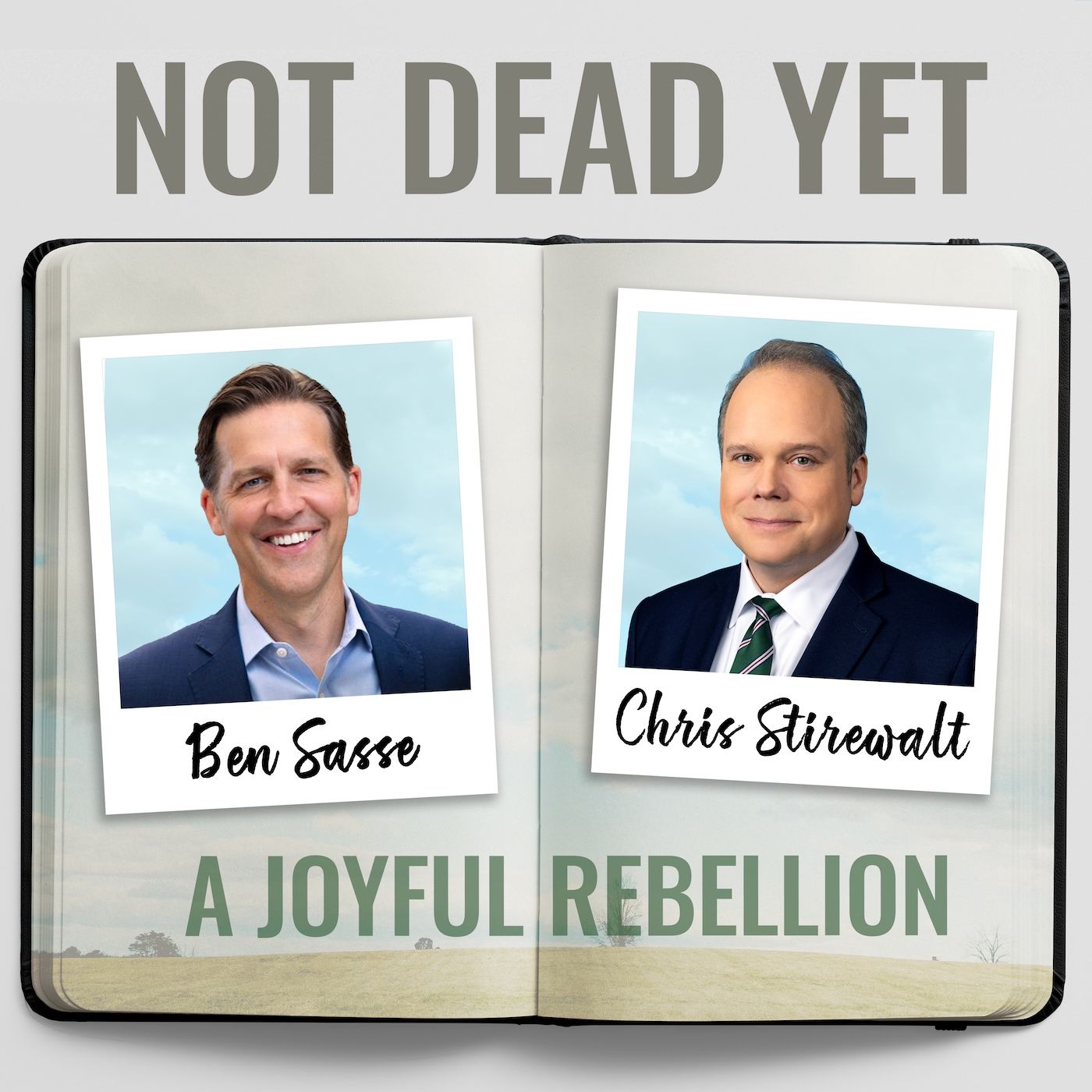
Not Dead Yet
Megan McArdle
01:05:07
Everything’s great and nobody’s happy? Megan joins the guys to talk about affluenza. Each generation has to figure it out — so take some risks, make some bad decisions, and embrace scar tissue.
Loading summary
Transcript126 lines
- [00:10]
A
Hi, I'm Ben Sasse.
- [00:12]
B
And I'm Chris Stirewalt.
- [00:14]
A
And this is not dead yet. We're all dying, but only some of us have been brought face to face with that reality.
- [00:21]
B
However long each of us have to do it, though, we all want to
- [00:24]
A
live a good life, one with meaning, love and joy. And our guests are here to help us do exactly that. Dang.
- [00:33]
B
Ben Sass. I love Megan McArdle. I love Megan McArdle as a friend, as a person, as an all around human, as a. As a dog owner, as a hilarious person. But I love her brain. Megan McArdle always makes me think and think about things in a way that I had not. She has a strange intelligence that allows her to disassemble issues, and she's like the intellectual version of molecular gastronomy. She can deconstruct a subject and put it back together.
- [01:11]
A
Nice. That is high price. I don't know her like you do, but I read her and I think what you say comports with my experience that she is accessible and gets at complicated stuff. She makes the complex, not easy, but accessible. And she disaggregates. So I'm a fan.
- [01:31]
B
Why do you want to talk to her?
- [01:33]
A
I mean, I think I want to talk to her about suffering makes things better. I mean, I'm kind of kidding, but the overly curated life is boring and I think she is very sympathetic. I care about a lot of the stuff she writes about. I don't know what you'd call her sort of applied libertarianism with a human touch. But I. In particular, I'm interested in her empathy for 20 to 35 year olds and the fact that I think we've got a weird moment that. You know, there's been a lot of viral stuff on Twitter the last couple weeks about this, where objectively the. The rising generation has the richest experience economically in human history. We're five generations in a row, greatest generation. Boomers, Xers, millennials, and now this generation. Five generations in a row, richest people ever at age 20, 30, 40, 50, 60, et cetera. And yet this is the first generation of those five that doesn't know it. They think they're economically impoverished. And objectively that's not true. And yet there's something broader going on with the collapse of social capital that does make the experience feel lonelier. And the economics not that great, even if they are great economically. And I think she teases apart a lot of that stuff. Clean me up.
- [02:53]
B
Make.
- [02:54]
A
Make my point better about why I think we want to talk to her.
- [02:57]
B
How, how could I even attempt? Why would I even try? Because that's, that's exactly right. I think for the millennial community, Megan McMurdle is, is a voice. I'm, I'm part of the. I, I don't know whether she, I don't know whether she considers herself Gen X or millennial, but for, let's say, for people born after 1970, 1975, she is somebody you should be reading and you should. She will, she will help you understand how the, how things actually are. She is a profoundly reality based human being and I appreciate that about her. All right.
- [03:43]
A
Yeah, she, she would not.
- [03:44]
C
What?
- [03:44]
B
One more.
- [03:45]
A
I, I mean, she would probably not say she does that her task is this moral. But I think in a way she helps people learn. Why you should celebrate scar tissue. A life without suffering is a suffering. It's impoverished because too much of life right now is taking the friction out, when frankly, the friction is what makes a lot of stuff worth doing. Right? I mean, if mixing your labor with something makes it a part of your experience, and just getting it for free isn't as good as getting it with work.
- [04:16]
B
All right, well, did you know what her first media, what her first part of America's media landscape was? I do not was a blog in November 2001 called Live from the WTC because she went to work and volunteer at ground zero. And she would have been very young. I think she's younger than I am, so she would have been very young when she did that. Megan went to Penn. She got an MBA at Chicago. Huge brain. And I hope she'll talk to us about her varied and unusual career path. But it was a career path that would eventually take her to the Atlantic, to Bloomberg Opinion. She has been for quite a while now a columnist for the Washington Post. She is also a contributing writer for the Dispatch, but you've read her in the Economist and every, every other place under the Sun. I recommend highly her book that goes to your point, the Upside of Down. Why Failing well is the Key to Success. Word. Say word.
- [05:34]
A
Amen.
- [05:36]
B
She has her own podcast at the Washington Post called Reasonably Optimistic. But I also recommend, I don't know whether you've heard it, the podcast that she does with Josh Barrow and Ben Dreyfuss, which is called Central Air, which is a bunch of dispositionally moderate dorks talking about what could be more fun. I love it. It's. It's as, as a, as a, as a emotionally moderate dork, I very much enjoy their content. It's a great show. And Megan's just. She's a peach. So let's. Let's hear what she has to say
- [06:15]
A
before we bring her in, though. Like, I'm going to affirm that you're a dork. Emotionally moderate. Yeah, sometimes. Let's go. I keep it chill. Megan, what a delight to have you. You are genuinely a polymath. Chris eschews editorial meetings. Like, I'm not really that much of a planner, but damn it, once I'd like to have an editorial meeting. He's like, never. It's gonna be genuine and authentic. No, that's not true. He tried to call me an hour ago, and I had a bloody nose. So. We have never before given the keys of not dead yet to a guest. And we think we're willing to try this. Like, it's. It's most you because you're amazing. It's a little bit about us as we grow.
- [06:58]
B
But you're.
- [06:58]
A
You are a polymath. And we have a bunch of things we would love to cover, but we kind of want to start with. Your topics would probably be as. Or more interesting. What are you interested in the last week? Like, what. What has your brain firing the most? And I said, I confess this, as someone who used to sometimes be on X, rarely is now, but I probably could have done research that way. But what you obsessing over?
- [07:22]
C
Okay, so I got a few obsessions. Number one, I went to a conference last week. I traveled too much. This was a. This was worth traveling for. To be clear, it was the Niskanin criminal justice convening. And what we talked about there is something that I have just been thinking a lot about. I don't have a solution for. And I'm kind of interested in whether you have a solution because you have actually been in government. I merely stand outside, you know, throwing rotten tomatoes at the denizens as. As they try to do their jobs. But one of the things that I was really thinking about in a panel on state capacities. Great panel. Is that we spend all of our time talking about government, trying. Talking about the things we can describe in a sentence or two, talking about, like, what the rules should be, what should the policy be, how much money should we spend. And we spend almost no time whatsoever thinking about who is going to implement this policy. How is the. Where do we find good leaders? And I think there are so many terrible incentives in government. I've written about this. This is, you know, this is not exactly a new topic for me. The ways that we. That we Created the civil service. Right. What's the primary, what is the biggest job benefit you get in the government that you can't get anywhere else? Job security. Right. You get so hard to get fired from these jobs. Now I am not doing the like kind of reductive conservative. They're all lazy, they don't want to work. I actually think the problem is more deeply that they're risk averse. You are selecting for people who are risk averse. And then I look at entrepreneurs like Bill Bratton, the legendary New York City police chief, who, you know, broken windows policing sort of foments the decline in crime under Giuliani. But also a thing that a lot of people are not aware of. Fun fact. The three big cities in the United States that have the best crime control relative to population, la, Boston, New York City. What do these three things have in common? Bill Bratton ran all of their police departments. Right. And. Or someone like Randy Clark in Washington who is currently, you know, in favor. He's, he's got all his fanboys and fangirls of whom I am one. Come on my pod. Randy Clark, if you're like listening to this.
- [09:46]
A
But he's a listener.
- [09:49]
C
But I mean the thing when I was listening to an interview with Randy Clark with did with Santa Ruiz for the Statecraft podcast and also I had, you know, been talking to people, I met Bill Bratton, I talked to him. I had also been talking to people about him. I'd read Peter Moscos's great oral history of what he did in New York. And the thing that struck me was that it's not that you can't get anything done in government, it's that to get things done in government, to really get things done that are good things, where everyone looks and is like, wow, how do we do that? You need a policy entrepreneur who is willing to get fired.
- [10:27]
A
Yes. 100%.
- [10:29]
C
Yeah. Right. And the scarcity of that in government, there's a lot going on there. We don't pay them enough to get the people we want often. But there are a lot of public service minded people who would like to go in and be entrepreneurial. Yes. Obviously the structures are bad and they're designed to make it hard to do good things, but a lot of it is about the people and no one talks about because management's really hard.
- [10:53]
B
Right.
- [10:53]
C
There's, you go to a bookstore, there's all of these books on management and they all seem often like trite. You know, you should be nice to your people. Lead to inspire.
- [11:05]
B
Right.
- [11:05]
C
They all have these epigrams. And then you kind of try to drill down to the epigram and you realize it's very. It's not really operational. You can't really operationalize it. I don't think operationalizable is a word. I think it is.
- [11:18]
A
We're going with it.
- [11:18]
C
It is now. It is now. But.
- [11:21]
A
But that a producer just said. Yes, he just weighed in. He just weighed in. Yes, operationalizable. Now a word.
- [11:27]
C
Now a word. That problem is, I think, in lots of ways the biggest problem in government right now. And no one's really thinking about it. And I'm listening to these public policy scholars who agree this is a problem, but the problem is they don't know how to describe a solution. This is precisely something you can't describe. Management is magic. And so that is the problem I am thinking hardest about right now.
- [11:54]
A
I think both Chris and I are chomping at the bit. I've got three and a half points of response. Chris, why don't you go first? Because I've got a numbered list in my head.
- [12:02]
B
No, stay, stay here. Stay on this. Do your, do your follow up here.
- [12:06]
A
Okay, so first let's say something about public trust. Because when you said this is the biggest problem, I think there's an argument that that's true, but only if we. I would only agree to it if we first said something about public trust. But then I think maybe it's worth us, the three of us and our listeners having some shared grammar about three agencies. So I'd say something about fda, something about CIA, and then maybe edge of something about HHS headquarters proper. But first on public trust, we know the collapse is just disastrous for a free people self governing. So Gallup and Pew have been doing studies for, you know, since the 30s and 40s, basically, and five consecutive decades in nine of the 10 largest areas, they measure the military academy, media, government, big business, whatever. Nine of 10 sectors of American life have had at least four consecutive decades of declining public trust. Like we're. It's so low now, it's hard to believe that we still function. As crappy as it is, I think it's still hard to believe the government functions this well when there's so little trust. So I think we have to have a theory of why that is. And I think it's way, way broader than government. I think affluenza is a big part of it. I think you. You' the world's expert on the perceived dissatisfaction of millennials. There's more of your Categories that apply. But as long as we agree that public distrust flows from a lot more than government, that inside government, the fact that we can't say here are simple things we're going to get done and then actually execute on those, I think that is dang close to the center of the biggest problem. So at the grammar of agencies, let's I want to set aside HHS because that one seems to me to touch back to all the dysfunctions of legislative underreaching. I was very skeptical of Obamacare as a policy that could work. And I think the data bears out that it works like crap. There are lots of ways you could spend more than this much money and get better health outcomes for more people than we get out of Obamacare. But that isn't just a policy problem. It's the cultural problem you're talking about. Because when the law was passed as again, I'm blaming Congress more than HHS Here, there were 550 explicit places and 1200 implicit places where the law read the Secretary of HHS, HHS shall finish the law. And so if one of the biggest things Obamacare did was make illegal delivering a health insurance policy that didn't meet the essential minimum benefits package floor, I think that's crappy policy. You ought to allow people to get a catastrophic first plan and be self pay on lots of stuff that you walk up to. Boob jobs and contact lenses are like two of the only things that are really, really high quality, low cost in the American healthcare system. It's because they're all self pay, right? Like we don't have enough self pay stuff in American health care. So I want more catastrophic. But because we don't allow it, the essential minimum benefits package is supposed to be the floor and the law never defined the dang floor. So whether or not in vitro and hair plugs are a part of the essential minimum benefits package, it's defined by a bureaucrat. That's not the bureaucrat's fault, it's Congress's fault. Okay, to your proper question.
- [15:12]
B
Whoa.
- [15:13]
A
I don't know what just happened. I mean morphine is usually a sedative.
- [15:16]
B
But now I am, I am ready
- [15:18]
A
to riff with you because you have opened a vein of important in my view, FDA and CIA George W. Bush and Ted Kennedy became weirdly friends in 2005, 2006, right before Kennedy died, they had a plan to reform the FDA to tackle exactly this problem of risk aversion. And Kennedy basically said, Chairman Kennedy said to President Bush, you guys think the FDA has way too Much power. I think it has too little power. But I think what actually is wrong is we do, as Republicans say or as market oriented people say, we give the government too much pre market power to keep drugs from the market, but then we give the government too little or the FDA too little power to pull drugs that are having negative effects from the marketplace. What we should do is lesser pre market powers and then give big data sets and post market surveillance powers to the government. Because Kennedy's view, I think rightly was that the bureaucrat is always incented to not improve the drug, approve the drug when there's a hard trade off, because the person who's going to suffer negative side effects is a known entity and the person who's not going to get the benefits of a drug that isn't approved is an unknown entity. And so they can't complain. So we structurally, we build the FDA to recruit people who are incented. Lots of great people at the fda, to be clear. But we move medical researchers into the FDA if they're the kinds of people who are biased to saying no, I've got stuff to say about CIA talent recruitment and come and go with big tech as well. But I went too long. So I'm going to stop there, beat up my FDA theory of why you're right and Chris, help me and I'll never speak again. I'm done. My words are spent for this episode.
- [16:59]
C
I think that's right. Right. I mean, this is, it's especially a problem in the FDA because the, because the stakes are so high. Right. I think you get, I think you get somewhat different problems in different agencies. So for example, I think the military is actually the only agency we have that really thinks about management and staffing.
- [17:20]
B
Yeah.
- [17:21]
C
In a way where like they understand they need excellence. Now I think that the conventional wisdom, and I have never been in the military, I am not an expert. But the conventional wisdom is that even there the pressure between wars lags. And so when we're not at war, what you get is people who are good at negotiating the bureaucracy. But when you, then you get into something like World War I 2 and you find out, no, those weren't the people we need. And you, you start elevating people who are just extremely excellent at executing because it's a highly visible rate, you're getting a lot of feedback from the universe and reason. I think one of the many reasons, I think that Doge didn't work in the way that Elon Musk and his supporters had hoped.
- [17:59]
A
We lied about entitlements but go ahead.
- [18:02]
C
Well, but that. But also that. You know what? Elon. Elon is actually kind of a managerial mad genius, truly. And I think you. You could have, like, a kind of distant hope that he would somehow go in and figure out a way to fix this. But the difference is, I think there's structural differences. Right. Elon Musk does not have a 500, like, member board of directors who can pull his funding anytime. But also that he. What he is excellent at innovating in is engineering, where you're getting a ton of feedback from reality all the time. And in government, feedback from reality often comes extremely slowly, and it often comes in the form of congressmen and senators who will hold hearings where they don't understand you're not. It's not exactly feedback from reality. In fact, your structural incentive is to make sure that you are never in front of a hearing, saying, like, well,
- [18:53]
A
I don't know what I'm talking about. Which is almost always true. But they'll. They can never say it, right?
- [18:59]
C
But. So you don't want to be in front of those guys and be like, well, we were hoping this worked. It was a calculated risk. But, you know, sometimes calculated risks don't pay off. And what they want to be able to say is there's a procedure. And of course, Jen Palka, in her great book Recoding America, just talks about all of the ways in which. For example, we had this protocol that did not work that was for our military satellites because someone had written a procedure in, like, the 90s, and it specified this thing that was kind of on its way out by the time the procedure was finalized, but no one could override it because that's the process, right? The process substitutes for results in too many agencies, but in the FDA especially, right, the stakes are so high. You approve thalidomide and you get deformed babies. You didn't approve thalidomide. I don't know, maybe people with leprosy died, but they don't even know that. They don't. You. No one knows who they are. And no one is going to blame you for erring on the side of caution. And, you know, this is the. I was in it before I was a journalist.
- [20:02]
A
Oh, we know. We surveilled your history.
- [20:08]
C
It's not hard to surveil. I, I, like, like all journalists, I talk about myself way too much. But the. It was. No one ever got fired for buying IBM. And then it was. No one ever got fired for buying Microsoft. Right? You don't buy the thing because it's the best thing. You buy the thing because it's the decision that you can defend to your boss. And this is true everywhere. But it is particularly true at the FDA because if you get it wrong, the decision is going to be like dead people. And the thing is they don't see the dead people that they don't have. And I think over the long term this strategy does not work. And I think you're actually seeing this with IBM. I don't know if anyone noticed, but this week IBM is like having really terrible, terrible earnings forecasts.
- [20:53]
A
They're 20% market cap erosion in a week.
- [20:56]
C
Yeah, like being, being that dominant and that kind of like safety strategy. It can work for a long time, but it tends to fail catastrophically. And I think the FDA is a like maybe the primary example of this, the worst agency for this. I think other agencies have problems with just like the process takes over to the point where like you're having three week fights. How are we going to docusign our Word documents? Right. And just getting mired in Trivia. But the FDA's problem is just getting mired in the fear of something going wrong and to the, to the expense of the possibility of something going right.
- [21:34]
B
I am interested in talking about how big and much how big government should be, how much we should entrust it with as a result of what I consider to be basically these inherent that you can solve them on a short term basis, but in the long term these are the kinds of problems that just assert itself in any system that isn't market facing. Right. And the ultimate market for the government is the electorate. And you only get feedback from the electorate every two years and it's only partial feedback. And then we could talk about our broken primary election system and how we have a government that is democratically elected but not representative. We could do many of these things and I would and I would and will with you in the future. But the idea of the podcast is that we talk about how to live a good life and that we're all on the clock and how do we have a good life and there are many Americans. So for the first question in that your, in your Senate testimony here is do you agree with Senator Sasse's assertion that millennials and elder Gen Z are economically worse off than it would appear?
- [23:03]
A
Hold on, hold. No, no, no, no, not. I want to clarify. Their perception is that I think we're at five consecutive decades of minting the richest people, middle class folks in all of human History, five consecutive generations that we could have said to America, we are the richest people anytime in place in all of history.
- [23:25]
B
Ms. McCardell, do you agree with my misrepresentation of Senator Sasse's assertion?
- [23:31]
A
Four of five. Two things that I'll be very brief grief. The four of five generations, we knew it. And this is the first one that doesn't. So the two part question is, is it true that middle class Americans keep getting richer and richer and richer and richer at the 20 year mark, the 30 year mark, the 40 year mark in their life cycle? And number two, isn't this the first generation that's ever not known it? And how the heck does that happen? Is that fair, Chris?
- [23:56]
C
So I, I might push back a little bit, only that I think everyone on this podcast is. Is Gen X best generation?
- [24:05]
B
Yeah. Hell yeah. Win the cold war.
- [24:10]
A
Listen to good rock.
- [24:11]
C
But I don't know if y' all remember the movie that was playing the summer I got out of college, very appropriately, Reality Bites, which was all about how like, you know, being young is a struggle and we're down downwardly mobile and everything's terrible. But no, I, I think that's broadly true. Right. Like, and in part that's because we all grew up in the 80s where we had had the godless communists to contrast ourselves with.
- [24:31]
A
We had an enemy. It was a benefit.
- [24:33]
C
So you, you could look at yourself and be like, wow, we're doing awesome. And so I think that, I do think that's true. Then there's the question of is it factually correct? And I think that's a really complicated question. So I think part of the problem for those guys is that the stuff they're buying is one big problem is obviously housing. And as it happens, right before I leapt onto this podcast, I filed my own podcast monologue script on why, on what's happened to housing markets since the Great Depression and why like that Some of these expectations are just not particularly realistic. Each generation, each of our generations, the boomers, the greatest generation, those guys each experienced a weird housing market that was really quite unique and not replicable, right? So the, the greatest generation comes home, you've got the 30 year fixed rate self amortizing mortgage. You've also got all of the automobile opening up, all of this farmland, so suddenly everyone can have a house in the suburbs, right? And then the second, you know, then
- [25:48]
A
the arrival, the arrival point, importantly the arrival point in the mid-1950s in Back to the Future, right? Yes, exactly. In 1985 and later in 2015, we both refer back to this idealistic 1955 and it's exactly the new housing tracts you're talking about.
- [26:03]
C
And you can also see it like in movies. So I'm an old movie buff that I'm an old movie buff in a very strange way that makes that my husband both finds endearing and somewhat annoying sometimes. Which is like I'll be watching an old movie, he'll be like, wow, look at that action scene. And I'll be like, like wow, did you see that oven? So like you need to know that this is when gas lines are being installed. Like I'm a lot of fun to watch movies with. So anyway, like so you in Father of the Bride, the second the Father's Little Dividend, which was the sequel to the original Father of the Bride. There's actually like a, a moment that I think really captures what's happening in the 1950s really well. So you've got two affluent families, one's a lawyer, I forget what the other guy does. Some sort of small businessman. And they're kids get married in the first Father of the Bride and then they have a kid. And that's the second movie with Spencer Tracy, Elizabeth Taylor. Great movie. Watch it. So the second movie, when the, when, when the kids, when the baby's arriving the parents go gaga and they are both plotting to have the kids move in with them because they're now in a little apartment and no one wants to raise a baby in a little apartment, right? And the kids are like well we just put a down payment on this house and in a new development, right. And like that really is like right there just capturing the change where you don't have to have a kid while living with your mother in law for the first three years before you can
- [27:31]
B
save in a movie today. You would never have Steve Martin's Father of the Bride. You'd never have it be considered a sought after status thing to have your kids move back in with you. That would be a mark of failure.
- [27:46]
C
Yeah, exactly. Really. My grandparents, this is, my grandparents did. My grandparents got married on Thanksgiving day because it was the only day my grandfather could get off from his job as a grocery boy. He, he was, he was 21 and working as a grocery boy, which he continued to do until he was 26 and he moved in with his parents and now they cut a hole in the side of the house, a thing you could do back in the day, stuck their stove pipe through and then they had a little, one bedroom, like one little studio apartment inside the house. They paid rent to his parents. It was really common arrangement. And that's all broken in the 50s. So people marriage age plummets, birth rates skyrocket. And that, you know, you've got the automobile is just changing all of that. And then you hit a bit of a rough patch in the 70s, but luckily there's also a birth and there is a birth trial, but I think there would have been anyway just for generational reasons. But then you get falling interest rates for four decades. And so all of the other problems in the housing market are just papered over by the fact that you can always borrow money cheaper to pay the increased cost. And that's all ended. And now you've also got this weird phenomenon that you also had in the 70s, but in the 70s was somewhat eased by the fact that mortgages used to be assumable. You could sell your mortgage with your house. Yeah. And now they are not because banks, this was a bad deal for the banks and they started putting these due on sale clauses into their mortgages and now you can't do that. So now you've got this problem where like people like me who got a sub 2% 15 year mortgage during the pandemic, like I'm never moving, I will be carried out feet first from that house. And so yeah, they really can't get housing and they really feel worse off. I also think that the, you know, something that we all took for granted, which is like you go to college, you get a decent job. That really started breaking down a while ago now I don't think it broke down for like elite college graduates. And you can, there's still plenty of decent jobs out there for college graduates, but it's not like the guarantee that it was now like I worked as a secretary for a while while after college. It's not like it was ever a guaranteed ticket to the good life. But the feeling is that it's harder and harder to negotiate. And I think that that feeling is valid. I don't think that that's fake. Right. Because like when I did that, eventually you could go to grad school and then you would definitely be on, on track to a pretty good job, almost certainly. And then that has also because too many people tried to take advantage of it. Right. The college didn't expand the supply of those jobs. It depends on it expanded the supply of people competing with the same degrees for those jobs. And so I think they feel more precarious, they feel like less like they have a path to getting onto homeownership. And family. But I do think that in other ways, they've never had it better. These guys are going to live longer than any humans in history. The biomedical innovations are incredible. The problem is like, you don't experience them until you need them, as you then can attest. Right. It is amazing that we have all these new cancer treatments. It makes me super happy. I hope I will never need to experience those benefits myself. And the thing is that I pay a little bit for those benefits every month. We all do, through our health insurance, through our taxes. The costs are widely distributed. And there is a benefit insurance. Benefit is real benefit. I buy house, homeowners insurance, not just because the bank think requires it, but because if my house burns down, I want someone to rebuild my house. Right. But it's, it's not a value that feels like you're getting richer. Even if you are, even if you have that security. It doesn't feel the same way as, like, I got a house. And I think that a lot of the goods people are consuming feel that way. There's also the fact that I think people are having kids later. Yeah. And they, they're just. They are experiencing their parents at a much more lavish time in their life than we experienced our parents. Right. I remember. So I grew up in what in the Upper west side is known as a classic six. Very nice apartment. It's got a center foyer, nice living room, dining room, two bedrooms, and then hilariously, a maid's room. Because middle class families in the 20s had to have, have. Obviously I had to have a room for the maid. And so that apartment went. It's really nice now. My parents sold it for a lot of money to someone who paid even more money to fold it into the penthouse upstairs and make a really nice apartment out of it. But I remember it when my parents bought it, when the building was close to insolvent, when my father, my mother basically staged takeover of the board, made my father run out to the curb. But she didn't make him. She made him run for the board, which he did not want to do. He liked being a political appointee, not doing politics. But he had to go out to the curb and pay the oil people because otherwise they would not extend us even a month's credit. The building leaked constantly. And because we were below the penthouse's patio, we got all of the leaks into our apartment. The heat would go off, the hot water would go off. I remember watching the wizard of Oz under every blanket my family owned with my parents on the living room floor because the heat was yet again off for a week in our building. And that was. And I remember my mom painting, scraping paint for like 10 years. I'm sure I have the lead poisoning to prove it. And all of that stuff. If it had been done, like, my expectation of what early married life looks like would be different.
- [33:26]
B
That is a great point.
- [33:27]
C
And instead, I saw my parents, like, really struggling. I, like, really, really struggling with money, with all of that. And that's normal. That is part of life. And there was.
- [33:38]
B
You even see that within families, among siblings. Right. That the older kids who were like, oh, you have it so good. I'm the youngest, and my mother had five, and I am the youngest. And this. The span from. Were a plucky band trying to put it together. To me saying, like, oh, I mean, if we. If we can't get a tee time at the club, I don't want to play golf. Like the, The. The trajectory on that. That's such a great point, Megan. That is a great point.
- [34:09]
C
So I, you know, my mom had me a little later than her parents did, and she always said she had a younger sister who's 11 years younger. My grandmother had her when she was 40. And my mother always said that my Aunt Annie had, like, a completely different childhood than she did because my grandfather, when she was growing up was. He owned a service station, and he was very successful by the standards of his small town. And in a way that if you've grown up in a small town, you know. Right. Like service. He was an alderman. He ran. He was on Rotary. You know, he was chairman of the County Republican Club. But. And when I knew him, he was successful and probably the most successful person in my family. But when my mom was growing up, he was a frantic small businessman. So in 1955, the state built the thruway. He had been on the major route that ran along the Erie Canal, and then suddenly he wasn't. And there was all of those cars that used to drive past him. So his business that he is was painfully brought up, and he literally worked as a grocery boyer until he was 26, took over this failing gas station from his boss and built it into, like, his family's empire. But, you know, he just bought a nicer house. And he was frantic and worried and anxious and going all the time. And he pulled it out and he made a go of it, and he was like. But my Aunt Annie didn't know any of that. She didn't live through that. My mom lived through it. And when I was first, I got out of business school. If people, you know, know who I am, they'll know the story. I got out of the business school and then I had a consulting job lined up and it fell through because it was 2001 and the dot com bubble had just crashed and I worked at ground zero for a year and then I almost took a job as a secretary. I was so desperate to find another job. By the end of, I was functionally kind of like long term unemployed for two years. Even though I was working, I did not have anything that looked like a permanent job job. And I finally get a job at the Economist and it pays $40,000 a year, which is two thirds of what I'd made before I went to business school. Only now I have a thousand dollars a month in loan payments. And as soon as I get the job, I'd been staying in my parents house. My mom's like, okay, well time to find an apartment. And I was losing my mind. And my mom takes me out for my birthday and she looks at me, she's like, I can see you're losing your mind. And I was like, yes, I'm panicking. And she said, you know what? When we had you, we had 500 in the bank. I was eight months pregnant and I just quit my job. When I just. When we moved into the apartment you grew up in, you'll figure it out. And she was right, I did. And that was the same advice her dad gave her. Is that like you're panicking and it looks like this can't possibly work and it does, but like if you've missed all that, that you have to be told it. And the thing is I knew because I had seen it. I had seen my mother panicking when I was little. I didn't really understand that was what, what it was. But I could look back and realize, oh yeah, my parents were like really concerned about my dad worked for the city. It was not. You not make a lot of money. And then they put me in private school and my mother lay awake at nights trying to figure out how the hell she was going to make tuition. But it feels like it's supposed to be easy, right? It feels like there's just supposed to be this and this and this. And my parents were very successful. By the time I was in college, my mom was selling real estate. My dad had a good job heading a trade association. But I witnessed some of the dislocations and if you never saw them, it feels really unfair. And the housing thing really is a problem. And I Think, think a difficult to fix problem. But a lot of the other stuff is that like the blessings are harder to see or you just take them for granted. Like all this Door Dash stuff, I'm not judging. You want to blow your whole salary on Door Dash, you're a free citizen. But that, but that's wasn't even something that you and that we could do, right? I, I couldn't afford anything except ramen when I was out of grad school. But even if I could, I lived in New York City. My delivery options were pizza and Chinese. The idea that I could just get a burrito taxied to my door at any time, even in Manhattan, would have seemed strange. So I didn't have the temptation, I didn't have the possibility of that stuff. And, and, but they don't even know. They don't, they don't remember a world in which that was not possible. And so it doesn't make them feel rich, it just makes them feel like, why can't I afford more doordash?
- [38:40]
B
I have a brilliant, absolute, utterly, earth shatteringly brilliant way to take us out of this podcast. But Ben Sass, before I do, before I throw this tight spiral through a tire at 40 yards. Ben Sass, what of the many thousand things that you guys have talked about here? Do you have a follow up? Do you have a final question for Megan McArdle?
- [39:06]
A
I won't submit to a single as you knew in your framing, but it's a nested.
- [39:12]
B
It's there the Russian nesting dolls of questions with Benson this two distinctions.
- [39:17]
A
One is at an economic level, I think it's pretty inarguable that consumption rates are higher. There are subcategories that have very real problems, like your housing point. But that's not to deny the deep pain of a lot of
- [39:37]
B
let's call
- [39:37]
A
it social capital, loneliness and ache and angst about not being in it together. And I think that might be derivative on some of the points, points you made about family cycles or life cycles or maybe even full on the success sequence. Because when you have kids so much later, it means as generations go from 20 years to 30 years, it means your connection to two generations above is 60 years instead of 40 years. Those people are not, you're not losing wisdom by not having much older people around, but you sure as heck are losing energy. You have fewer people moving around the yard and the neighborhood. And so I think there's a kind of deep ache about that. I also think there's a risk aversion problem, which is when you said your story of Erie Parkway moves and the gas station is no longer on the main road. You got to figure out how to grit and grind and take the property loss, but still move the social capital of the business to the new geography. And right now we have a lot of people where every commencement speech is setting up a lifetime of BC Safe out there, as if we're walking into war zones all the time. And there's so much danger that people have to navigate. So I think your mom was right that you will figure it out. You did figure it out, but we got to talk more about how each generation figures it out, because the people that are in the rising generation are going to have more disruption. That doesn't mean there won't be tons of economic opportunity. I think there will be, but they're going to have to be able to navigate a lot of uncertainty. And so I will try to submit to Chris's desire for there to be a single question in here. I'm curious how you think about the success sequence and life cycles in light of this, because delayed marriage and delayed parenthood is about a lot more than just economic factors, but it leaves people feeling achy on economic factor dimensions as well.
- [41:35]
C
Yeah. I think part of it is that a lot of the frictions that we've solved are not the frictions that lead to flourishing, which I agree is fundamentally about said, is fundamentally about the people. Right. You know, it's. So I. So I have a thing about cliches. I love cliches. I think cliches are great. You know why? Because the reason they became cliches is they're so true that people said them over and over again. And so, like, look, I am an ambitious person who has put a lot of time into my career. So is everyone on this podcast. But I think at the end of the day, we all recognize that it really is going to be the friends we made along the way and the people we loved. And so I have this. There's a guy who I became briefly obsessed with, a guy named Irwin Cobb. Have you ever heard of him? No. Yeah. No, you haven't. So he was the best paid newspaper columnist of his era, and no one has ever heard of him. And he's actually quite a charming writer. I highly recommend his book Thinking About Operations, which is about the operation he got. You never find out what it was for. It's wonderful.
- [42:42]
B
His name is Irving Cobb.
- [42:44]
C
Irwin Cobb.
- [42:45]
B
Erwin Cobb.
- [42:46]
C
And, yeah, he also wrote a book called Judge Priest, which became a movie about. It's a Kind of thinly disguised. Paducah, Kentucky, which is where he grew up. It's a book of interlaced short stories that are about how do we wrest justice out of the law. And it's that stuff like reducing the frictions that make it easier for us to spend more time scrolling TikTok and learning about pressure washing. And don't get me wrong, I do love a good pressure washing video. But also even the stuff we think, like the stuff I write, I want to think it's important. I want to think I'm touching people and I care about my audience and I care about what I do. I love what I do. I'm so lucky to get to do what I do. But at the end of the day, you know, I actually think that what remains of us is love is true. And so if you're maximizing the stuff that makes it easy to go out and have like a brief. And again, I love doing this. I'm not saying this is not worthwhile. I've had mind blowing experiences traveling, seeing where people were, experiencing like some fragment of history that is left over or just seeing other people and how they are. It's amazing. I love traveling. But you know, the thing that's going to ultimately matter is the time that you spent with your family. And it does have to be time. There's not like quantity. Time matters and the time you spent with your friends and the people you touched. And this is why, like I try to do kind of more service journalism stuff that tends to be low status within my profession. But I'll tell you what, I have had people come to me and be like, I got married because of something you said. I proposed to my girlfriend front or I paid off, you know, I paid off my debt. I got my credit score in shape, now I've got a house and we're about to have a kid. No one has ever come up to me and been like, you changed my life. I just think about Social Security in a whole new way now. Right. Like, and so that we do need to think about how are we maximizing the stuff that leads to that. I think the generational gap is part of it. I think that there's also a kind of curious lack of authority over the last 20 years. This unwillingness to like, I don't young people. You guys are great, you guys are hardworking, you're conscientious in a way that like I was definitely not at your age. I'm a little worried about you, frankly. And I, I worry what your midlife crisis will look like.
- [45:17]
A
But this is why stopping drinking is an insanely stupid thing.
- [45:23]
C
Yes, you. You guys need to do more drinking. Have you considered like rock climbing, rappelling off of bridges, bungee jumping? I'm actually kind of serious about think that the lack. When I wrote my book on failure way back in 2012, one of the things that really stuck with me and the thing they don't tell you is that you will forget what's in your own book after 10 years. I remember the high points, but sometimes I'm surprised when people are like, you wrote this in your book. I'm like, I did. Wow, I sound smart. But that kids. You would think that kids who fall off of jungle gyms, the kids who break their arms would be more afraid of falling. It's actually the opposite. It's the kids who haven't fallen who
- [46:04]
A
are afraid because the kid who has
- [46:06]
C
fallen has taken the measure and the kid who has not still, it's just an unknown danger and that's more frightening. And so I think we wanted to make kids safe and not ever be afraid. And that was an admirable goal. Be not afraid, right? For all. For I am with you. But there's a reason that God is not actually standing next to us all the time telling us what to do do. Right. We actually need. God knows that we need to actually go out and do it. That that's the only way we're going to be better, stronger, more courageous people. And we have not given kids like the pandemic obviously robbed them of a lot, but even more that. And obviously social media has some issues and so forth. But actually even more than that, it's. It's literally just that no one wanted their kid to suffer. And that's totally understandable. And also it makes their kids suffer more. It has led to this, like ended up with ennui. And unfortunately I have a message for the kids now. My generation, we made a mistake, but we can't fix the mistake. You may go to a therapist who will tell you that your parents screwed you up and that therapist may be right and your parents can't fix it.
- [47:27]
B
It.
- [47:27]
C
You are the person who is going to have to fix it, which means that you are going to have to do the thing of gathering your courage and doing uncomfortable stuff and taking risks and being okay with it. And I promise you, as the person I look, I went to an expensive private school. I then went to an Ivy League school and then went to a top five business school. You have never met Such an entitled whiner who thought that I was supposed to be able to push a button about my life. Life. And if I did all of the things and I ticked all the boxes, then like the reality was supposed to spit out the thing I expected. Honestly, the thing that I, I expected was not as good as what the universe had in store for me. But there was a lot of pain between point A and point B. And it was necessary. I would never. If I had not been long term unemployed for two years. Years. Then when the economist was like, would you like to accept a job that pays two thirds of what you made before business school and try to. And see if you can get your student loans paid on that? I would have been like, are you insane? No, obviously not. But because I didn't have any other good options, I took the leap and it was the best damn thing I ever did. And the. I have so many stories about that.
- [48:43]
B
I gotta say I'm even better than I thought. I'm even better than I thought. Because the question that I was going to ask you in conclusion, Ben teed up and you knocked down in your response to him. Because I was going to say how do the lessons from the upside of down. Why failing well is the key to success. How should younger.
- [49:10]
A
Nice book title title.
- [49:11]
B
It's. It's. And it's a banger. It's a, it's a, it's a legit good book. How do the lessons about embracing risk and embracing failure as a necessary precondition for success. How should young people carry that? And you did it. You plug the book. You guys did it all. This is a. I'm, I'm. Dare I say the greatest.
- [49:38]
C
Can I offer a closing thought here to any young people in the audience, which is this is like as I look back on that book 15 years ago, almost 2020, it was published in 2013. The thing I think that I wish I had said more explicitly is that if you. There's a saying in business school that if you are, if you never miss a flight, you're spending too much time sitting in airports. If you are never terrified and panicked,
- [50:12]
A
when will you grow?
- [50:14]
C
You are wasting a big chunk of your life. You are not living the life you deserve. If you are never terrified and panicked, you are never going to experience the sheer exhilaration of having gotten thrown into the fire, somehow figured it out and then gotten to the other side and realized that you are capable and that there's, that there's also. That there's possibilities that you never Imagined when you were just doing the like, now this, then this. And that's not to say that like my parents let me stay with them for two years while I was figuring it out. And it was great and I was really grateful. And they also pushed me out of the nest as soon as I was capable of flying. And I am even more grateful for that. And if you are contemplating this and thinking, but, but, but, but I just want to close with. I went to summer camp in Vermont and there was a lake and swimming in that lake commenced at 7 in the morning. And as you can imagine, in Vermont at 7 in the morning, even on a summer day, that water was, was extremely cold. And there was no way to like, ease in. You just had to jump off the dock. And I would stand at the end of that dock and I would look at the water and I would know. I would know it was going to be cold and the shock and I would fixate it. And eventually I realized that the longer I stared at the water, the less likely I was going to get in. And so I learned that I just had to like, stop thinking about the water. What I thought about was the mechanics of the jump. I thought about like, what do I have to do? I just gotta, like not thinking about the water. Water's not there. And that's how you have to be with the things that you're afraid of. Like, once you have, like taken their measure, obviously do not just do any insane thing. Understand the risks you're gonna. But once you understand it, you gotta stop thinking about it. You know, bend your knees, brace your body and leap. And you are always glad you did afterwards. Words, but you just. The way to get past it is not to think about what you're afraid of. It is to think about where you're going to end up.
- [52:27]
B
That's fantastic. Look at you. Look at us. It was the friends we made along the way. It was the friends we made along the way. Megan, as I say, I love you for a reason. You're delightful, you are brilliant and you are a great friend. And I really, I'm really grateful you were here.
- [52:47]
C
Thank you for having me. This was so much fun.
- [52:50]
B
Thanks, Megan.
- [52:50]
A
This was a lot of fun. Let's celebrate. More scar tissue. A life without suffering is impoverished indeed.
- [52:57]
B
Well, professor, what did we learn today?
- [53:00]
A
Well, professor is taking on kind of a snottier, funnier tone. I think we learned that we Gen Xers would have never thought you could finance a doordashed burrito, but now you can with a simple 25% down.
- [53:19]
B
Here we are.
- [53:21]
A
I think at the start of this, we said we wanted her to talk about living in the age of abundance for good and half for ill. And we live in an age of abundance for good and half for ill. It's good. But, but I think young people need to hear her advice. Go make some mistakes, go on some dates, be embarrassed, do something dangerous, be the right amount of reckless. That's, that's a good message.
- [53:50]
B
As I, as I have often said to people with whom I work, let's get out there and make a bunch of mistakes.
- [53:56]
A
Because I think the wedding crashers line is. All I really want to know is are we going to get hopped up enough to make some bad decisions?
- [54:04]
B
All right, so the. I promised as we were getting ready to do this that she always makes me think differently and think about something differently. And I am here to tell you that I'm a person who has spent a long time and a lot of energy thinking about and researching the questions of what happened to the age of marriage and what happened. I look at things mostly through a political lens as my vocational hands. I know, but what are the implications of people delaying marriage, marrying less frequently and having fewer children and having them later in life? What are the consequences of that? And so I've done a lot of demography on that, but I never thought about what Megan said today, say, which is, well, obviously if you missed the part and you, you heard my gobsmackedness. The, the, the feeling of the standard that you have to meet in order to be a parent. The. Has so shifted because people wait until they are better established in life to have children. As my old daddy used to say, there's never a good time to have children. That means there's never a bad time to have children either. Right?
- [55:31]
A
You can't, you, you can't hear some bad times.
- [55:34]
B
Well, sometimes are better than others. But if all the time. If all the times are bad. Right, all the time. At every point. Yeah, at every point. Having a child is disruptive, expensive, inconvenient, and it's. You don't. No matter what you. The every so often they put out one of those studies that says some consumer finance, whatever puts out a report that says it will now cost you $500,000 to raise your child to adulthood. And if you look at that and say, well, shoot, I don't have. Where am I going to get $500,000? Then you wouldn't have kids.
- [56:15]
C
Kids.
- [56:15]
B
But if you wait to have kids, you will be richer when you have them. And your children will not get to see you running around like a one legged man in an ass kicking contest trying to keep your family afloat, trying to make a living. They will miss that part of instruction and as it turns out is an important period of instruction.
- [56:36]
A
Yeah, I mean two, two thoughts, one small, one bigger. The small one is I hate those studies. If you have another kid it's going to cost 600 grand plus. Well, I mean you're probably assum that when we went from 750, 770 square foot houses in the late 50s to the average, you know, new start, new home start in America Today it's 2,600 square feet. You're probably assuming that every kid needs their own bedroom. And we screwed up a lot as parents. But one thing we got right is even once we got to the resources where kids could have had their own bedrooms, we didn't allow that. And I'm really glad that my. We're going to get to your boys fighting about something. I'm sorry but like my girls wanted their own bedrooms and we had an extra bedroom down the hall and we're like yeah, that one's, that one's on standby for whoever's going to need a, a stopover when there isn't room in the end. Because you two selfish replicas of us need to learn to live with people next to you who annoy you and who snore anyway. Small, small point is you're fun. Loading loading kids into bunk rooms is way healthier for their long term character development. But I think the bigger point is the way we've overlearned some of the lessons of the sequel success sequence. Right. Like I think that there's a lot of good policy folks who have demonstrated that, you know, not being indifferent to poverty, but there is a giant share of America that if you follow the three steps of the success sequence, we know that statistically you don't end up poor. And that is if you finish high school, if you're, if you get married before you start having kids and if you're willing to work hard, hard of those three boxes, you check them all and nobody's poor. But I think a lot of times what we do is we add a half step which is finish high school or college, get married before you start having kids and then make sure you're financially settled before you start having kids as well. That's terrible advice. At the end of the day that means nobody's having kids until they're in their mid-30s, and we'd all retrospectively wished that our kids were, you know, not so age gapped from us that our, our hips and knees have to hurt when you play on the floor with them. My last kid was born in our early 40s, and I'm, I'm glad we had him. I just wish we'd have loaded in a fourth and fifth kid before we had him.
- [58:54]
B
You're a pure lunatic. You're just a stone cold, thank you, lunatic. I, I, as I said to Megan, my sisters, I have twin sisters. Their experience of being part of a family that was, you know, making it, trying to come together was totally different than my own. And I think we've talked about this before, but my pastor gave one of a very affecting sermon one time when he took his first daughter to college. With the first of his children to go to college was he had the realization that they, he and his wife had devoted two decades to building a, an organism that they would now disassemble, right? And you build it and then you take it apart. And that's the natural order of things, right? The natural order of things is that you build it and then you take it apart. The idea of the fam of your family, a family as this organism that's going to have multiple phases of its life, right? It's going to have multiple incarnations, and it's good if one of those incarnations is okay, okay, gang, we got, we got to figure it out. We have to, as they would say, root hog or die. And that's a really important part. And I also think it goes to the pressure of perfect parenting, right? The brutal pressure of, oh, I'm going to screw these kids up. Oh, I'm going to do this. Oh, what if we don't do that? What if we don't have this? What if we can't do that? And what I learned was they're going to, number one, be who God made them to be. Their apologies to Charles Murray. 80%. It's their genes anyway, so the cake is mostly baked in who they are. Are. God has made them to be somebody. They're mostly going to be that at the edges. You can plus them up a little bit or you can screw them up a little bit, but you're not as important in this as you think you are. And I wish I would have known that. I learned it pretty quickly, but I wish I would have known that sooner.
- [61:15]
A
Well said. I mean, let me try to reduce some of that to aphorism. There's never been a perfect parent in human history. There sure as hell ain't a perfect parent on Instagram. And wasting your time faking the EOR is counterproductive to being a better parent. You're never gonna be perfect, but if you want to fake perfect, you're gonna be less good. So let's. Let's get married broke. Let's have kids young. Let's do life boldly.
- [61:39]
B
Yeah. And just to go to circle the Runway one more time. I'm sorry. I think the idea of having a family is. So the success sequence is a great way to avoid poverty, but extending it does not correlate to increased success. Right. We know all of the studies that say people's contentment with their lives increases dramatically up to. And I don't know what the number is currently, but it used to be about $150,000. Yeah. That it was like it would go up and up the. Yep, yep, yep. People are more content with their life. More content. More content. And then it stalls after that. Right. That your household income is closely correlated to your contentment and happiness. Up to enough. And then the two become disconnected after that.
- [62:40]
A
Enough. Well, well said. I mean, another way to say it, and we've bastardized Aristotle a lot of times. I mean, the kind of.
- [62:49]
B
Our jam in this podcast, the Golden
- [62:51]
A
Mean is true about, you know, courage is not the opposite of cowardice. Courage is a midpoint between cowardice and recklessness. There's a lot of ways to fall off both cliffs. And I think what you just said about, you know, getting from poor to middle class is correlated with happiness and flourishing. But getting from middle class to rich, you know, no. No aspersions on folks who get rich and the market rewards for loving their neighbor and producing a lot of stuff that adds value.
- [63:22]
C
World.
- [63:23]
A
I think Bezos's new model of how much value has been created for other people is sort of a more valuable thing than how many gazillion dollars somebody ends up in their own bank account. But another way to say it is parents are obligated to protect their kids from certain kinds of harm. Yes. And there becomes a point at which it's not just diminishing returns, but it's negative returns. And the instinct in us is to helicopter parent and snowplow parent. And that is bad for our kids.
- [63:52]
C
Kids.
- [63:52]
A
We want to protect them from real danger, but you sure as hell don't want them to not jump off a fence and get stitches now. And then they need to, as my
- [63:59]
B
wife says, safety third. Safety third.
- [64:02]
A
Micro forever.
- [64:04]
B
Exactly. Okay. That's it for this week's episode. We hope you'll like, review and subscribe and tell a friend. Feel free to email us with your thoughts, corrections, questions or whatever else is on your mind. You can write us at sass and stylewalt gmail.com this podcast was produced by Scott Immerget with the help of our colleagues at the American Enterprise Institute. The music is from Drew Holcomb and the neighbors. Thanks for listening and keep living the good life.
- [64:33]
A
Thanks brother.
- [64:34]
B
Thanks man.
- [64:43]
A
Sam.