← Not Dead Yet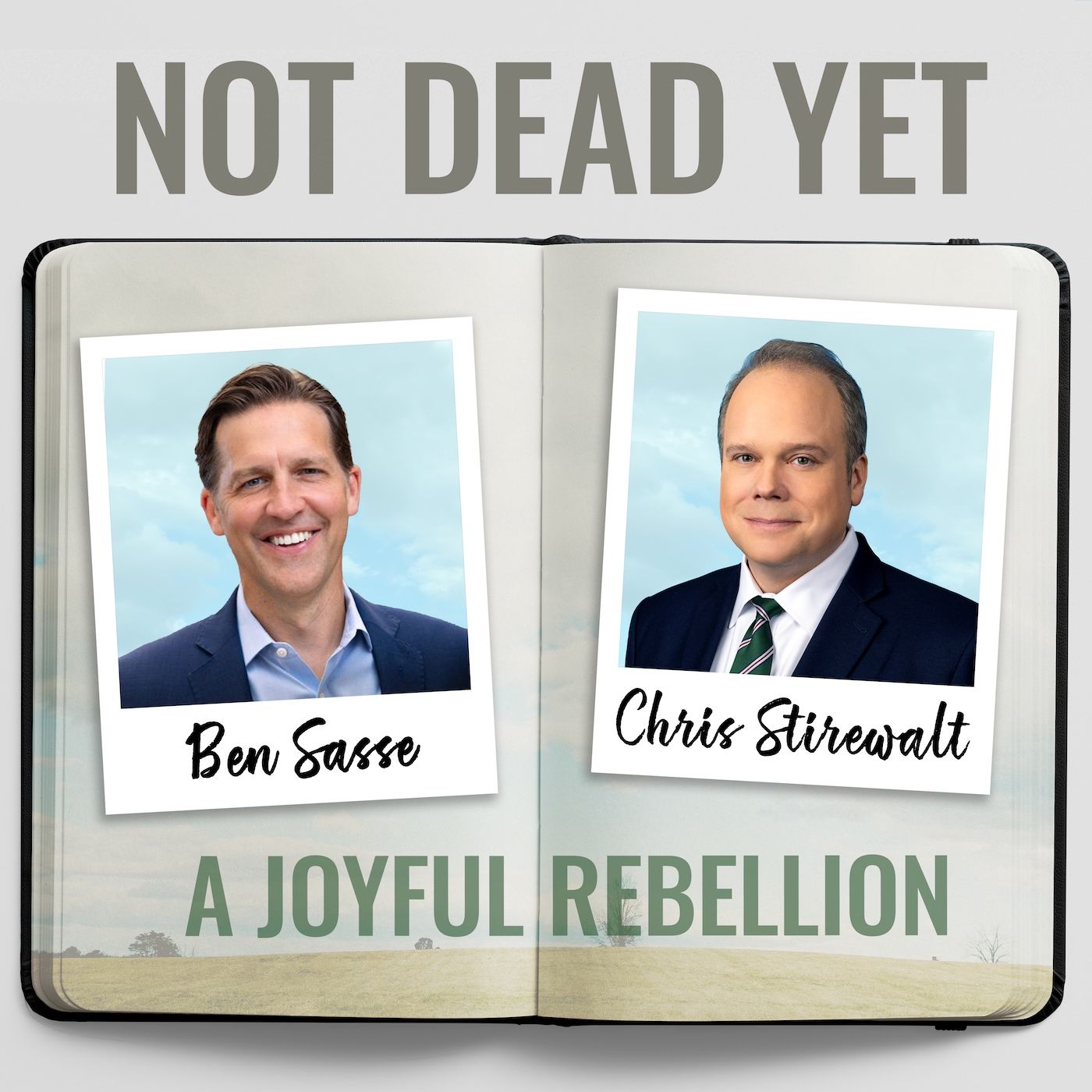
Not Dead Yet
Mike Rowe
01:10:18
Is the Dirty Jobs guy secretly America’s most popular philosopher? Mike Rowe joins the guys. This episode has everything: vomit, Stoics, turkey insemination, philosopher welders, wonder, and the problems with institutionalized childhood.
Loading summary
Transcript150 lines
- [00:00]
A
Foreign. Hi, I'm Ben Sasse.
- [00:10]
B
And I'm Chris Direwolt.
- [00:12]
A
And this is not dead yet. We're all dying, but only some of us have been brought face to face with that reality.
- [00:19]
B
However long each of us have to do it, though, we all want to
- [00:22]
A
live a good life, one with meaning, love, and joy. And our guests are here to help us do exactly that.
- [00:29]
B
All right, Ben Sass. I had a propitious encounter today to get me ready for today's episode, which is I had the broadcast journalism class from Bishop Ireton High School come and call on me at my job at News Nation. It's the school where my sons attend, and these kids were there.
- [00:54]
A
They got a nice football field.
- [00:56]
C
I like that football field.
- [00:57]
B
They have a very nice football field. They've got great athletics. But it turns out they do have some academics also. And I got talking to them about the difference between a vocation and a profession.
- [01:09]
A
Nice.
- [01:11]
B
And as I was talking about what it is to be called to do something versus trained to do it and all of that stuff, I got thinking about today's guest, Mike Rowe, who is the man synonymous with the dignity of vocation and the work that Americans do, who's become the avatar for that.
- [01:31]
A
I really, really like Mike Rowe personally, and I really like that he exists on our cultural landscape. I don't think much, I haven't thought much about the word profession. I think a lot about the word vocation. And Mike matters for a whole bunch of people's awareness of what it looks like to serve their neighbor at a time, especially at a time of transition from, you know, almost all jobs in history have been brawn based, and very few jobs in the future are going to be brawn based. And he helps wrestle through a lot tease out a lot of questions that we need to tease out regardless of what our professions are, because our vocations are plural, and they include a whole bunch of things that have to do with people's bodies that are around us that we need to serve. So I love teasing out questions with this guy.
- [02:20]
B
So we should state for the people who've been living under whatever rocks. Mike Rowe is most famous for the 10 years he spent as the host of Dirty Jobs, which was a cable sensation where he traveled around the country and showed people the often gross but sometimes extraordinarily cool work that Americans do to make life possible. One of the things that I like about Mike Rowe is a guy from Baltimore, or suburban Baltimore, I think, who sort of climbed his way up the ladder in Television or broadcasting, doing everything from QVC to voiceovers for DVD extras and all kinds of stuff. Making his way in a real journeyman fashion until he found a perch at a San Francisco TV station. Doing a segment called Somebody's Gotta do it. And Somebody's Gotta do it is what turned into eventually Dirty Jobs. So I'm looking forward to this because I have some fellow feeling with a guy who got into his, into his line in a way not too dissimilar from mine. A little local news, local yokel stuff and do it up from there. What is your big question for Mike Rogan to be today?
- [03:43]
A
Well, first, thanks for telling me that history, because I only knew little bits and pieces of that. I've known him personally for quite a while and I remember starting to read to my kids, my oldest kids are in their mid-20s. And how things Work was a book we used to read. But it's not gritty enough to maintain their focus a lot. And Dirty Jobs is just one heck of a great branding job. So I didn't know that local journalism piece of his history. So thank you for that. I want to wrestle through some of the stuff I don't want to be pessimistic about, but I am a little pessimistic about that. If you don't know a lot of people who do as their profession a vocation that is real gritty and grimy and within two or three or four miles of your house. It's hard for me to imagine how America develops a work ethic where lots of people are going have brain based jobs as opposed to brawn based jobs. If we don't respect both kinds of work and knowing that brawn based jobs are on the decline, I want to hear him reflect on the good, the bad and the ugly about what a recovery of work ethic across the continuum of all of us looks like.
- [04:51]
B
And this is something you wrote about in your book and I assume that you guys found common ground talking about that stuff, that that's where that connection came.
- [05:02]
A
Yeah. And I mean, obviously not much happens on a federal policy front that matters right now.
- [05:07]
C
But
- [05:11]
A
trying to get away from all the requirements that pretend they're trying to protect somebody but really are just barriers to entry so some cartel of credentialing and regulation can maintain power for themselves. Mike is a big deregulation guy to get people to work faster. And so we used to toss around some question about what policy could change and affect and improve.
- [05:36]
B
Okay, I like that. I think this is going to be a good episode. So let's get right to it and let's say hello to Mike Rowe.
- [05:43]
A
Mike, it is good to see you. You are looking good. Chris looks medium with the suspenders. I look bad. I will pre apologize that I will either run from the camera to puke now and then or I'll take an extra hit of morphine and try to get through. Chris is usually the wit of our operation. Now he's both the W and the brains because I supply limited. But you on here is special for us. One, it's good to see you. It's been two years probably since I've seen you and I'm delighted to get to learn from you today. It's also fun to celebrate what you celebrate. Chris and I were talking in advance of seeing you about distinctions between really important words like vocation and somewhat important words like profession and the kind of work that you do to encourage a lot of folks and also celebrate a lot of folks. But I'm going to start off with a half pessimistic question. When we know that the future because of really kind of awesome and interesting digital revolution stuff, the future is toward a lot more productive work for a lot of people. Not necessarily because we got more productive, but because our tools got more productive. Though there's going to always be some brawn jobs, there's going to be fewer of them and so people are going to know fewer people who do gritty brawn jobs, jobs in their hood. Are you really optimistic that the recovery of a broad work ethic is possible when we don't have models of a lot of people doing meaningful work two miles away from where people are sleeping at night?
- [07:19]
C
Wow, man, you came in hot, brother. It's good to see you too.
- [07:22]
B
I don't have a lot of time.
- [07:24]
C
Yolo. We're going to have big chat. Look, I am optimistic even if I don't have a clear explanation or. Or even if I can't see the exact path to it. My optimism is rooted in the fact that oftentimes things need to go splat before they get better. And you know, people are freaked out by uncertainty and we seem to be awash in it right now. But the uncertainty of our times doesn't mean there isn't a path forward. And just because we can't describe precisely every zig and every zag, you know, it's coming. We will zig, we will zag. Work ethic will continue to be a thing that we're capable of defining, you know, and a long list of things that we can't really control the way we think about. You called it, you know, purposeful work, meaningful work. You know, those things are fungible, and we can assign relative and disparate quantities of meaning as it suits us. And I think, you know, in a lot of ways with AI Right now, we're. We're struggling to do that. We don't understand the nature of the tool. It's evolving so fast, it's. It's freaking us out. But look, let me go back to one of the first words you used. Puke. This has been my specialty. I mean, you know, it's been a. It's been my stock and trade for a long time. You know, I was just. I was talking to my mom the other day about season one of Dirty Jobs when it hit my face. Wound up on the. On the COVID of TV Guide magazine, and the caption under it says, micro brings you feces from every species.
- [09:20]
A
Right. That's good. You should get that as a tat. It.
- [09:24]
C
I thought it had a nice snap to it. Now, my mom was both horrified and proud at the same time, which is an interesting juxtaposition of warring emotions that we could probably riff on. But. But the reason I was thinking about puke when you brought it up was that I was the first guy on primetime TV to vomit in the middle of the scene. Yeah. And it was. It was shocking, you know, because I didn't excuse myself. I was in the middle of a sentence, and there was only one camera on me, and I was on a fishboat and I was making chum. And the night before had involved a fair amount of gin, and we were in a following sea, and. And the air was warm and the breeze was thick, and the smell of the chum was unpleasant. Chum. Like, it was very chummy, Chris. Right. So in the midst of my sentence, I felt what I thought was the. The beginning of a yawn, a little tickle in the back of your throat.
- [10:19]
A
And then I realized I'm going to demonstrate.
- [10:22]
B
Oh, no.
- [10:25]
C
Well, here's the part you're going to love, Ben. I. I paused, I leaned over the gunnel of the boat and I vomited in a. I don't want to overstate it, but a sort of a fireman hose kind of thing. Just a full on from the. From your shoes out. It went for about five seconds, and then I turned back to the camera and I finished my sentence, which posed a huge problem at the network because there was no cutaway shot. And the sentence in question was, in fact, important. So they had to figure out what to do in 2004 with the host of their hit show puking his brains out in the middle of an important point. And what they wound up doing was they pixelated my vomit, which just made it weirder and worse. Just all these brightly colored little squares flying out of my. My GI tract.
- [11:22]
A
We call them chumlets.
- [11:24]
C
There it was. And so somewhere in that metaphor is an answer to your question. Something real is happening. We've covered it up in a way to make it ostensibly more palatable to our audience, but it doesn't change the fact that we're worried to death to the point that we're going to puke our guts up if we don't find something that feels like clarity.
- [11:47]
A
Bravo.
- [11:48]
B
All right, so one of the problems. I was thinking about this the other day. One of the advantages of physical work, of work in material space, is it is more likely that you can be done with it on a given day, right? You can set your tools down, your shift is over, and you can walk away, and then you will come back the next day and pick that work up and do it again for the rest of us, the crush of the feeling of there's always something else you could be doing, right? So in the universe of the knowledge worker, your phone is with you. It is pressing in on you at all times that there's something else you could be doing. The satisfying sensation of doneness is one of the real merits to that kind of trade work or. Or material work. Talk about. Because you've spent time in both of those worlds. Talk about getting your brain fried and what happens to our nervous systems and what happens to us as people when we can't have a clear delineation between the work that we could always do on our phones or on our laptops, or always versus work that can be done and then taken up again.
- [13:15]
C
Part of it's a state of mind, but a lot of it is rooted in the optics, right? I mean, we're visual people. I can look around at my desk right now, and there's no indicator here that I'm done anything. And there never is. It looks the same at 8 at night as it does at 8 in the morning. But the kind of work that you're talking about, it's satisfying in the same way that some writers are drawn to short stories. A beginning, a middle, and end. Boom, you're finished. Finishing a short story is very different than. Than finishing a chapter. And neither of those things has anything to do with finishing a novel, right? So you know, if the question is, what happens to a people who are slowly robbed of the sense of completion, well, then the answer is something very much like the world we're living in today. You probably can't see it, but over my shoulder is a picture of me. Let me tilt back. You wouldn't want to zoom in on this even if you could, but I'm. I'm artificially inseminating a turkey at a place called the Network.
- [14:21]
A
Execs have new questions.
- [14:24]
C
Well, again, you know, they. They. They thought they sorted the puke riddle out only to see this. I mean, that I am. I. I'm not sure where you want to go with this, Chris, but just trust me. I'll land the plane. The business of I violated all creatures great and small. Every barnyard.
- [14:45]
B
And I was going to say, yeah, and a turkey.
- [14:47]
C
But the turkey's different, right? The turkey has a. Chloe.
- [14:50]
A
Love.
- [14:50]
B
That was love.
- [14:52]
C
The turkey. In order to collect from a tom turkey, you need to turn him upside down. Ben, you know this. You're up on a farm, right? You need to. You need to squeeze them between your thighs. You need to use your thumb to stimulate the cloaca.
- [15:07]
A
Sure, I thought Pixelated Voma was our only alt rock band name, but right now, Stimulate the cloaca is another candidate. Continue.
- [15:15]
B
Micro. And the stimulated cloacas. Yes, I like it.
- [15:18]
C
There's. There are not enough pixels for this story. The bottom line is, you know, a guy who I barely met handed me a Gerber baby food bottle with the lid screwed on and two holes in the lid. In one hole, there was a straw. In the other hole, there was another straw. Oh, dear. After you stimulate the cloaca with this bird inverted between your legs to the point that the rectum fills up with the semen.
- [15:44]
B
Right? Right.
- [15:45]
C
Put one straw in your mouth and you start sucking, and you put the other straw in the rectum, and the semen comes through the straw and collects in the little baby jar. Now, as you're doing this right, you're focused on a lot of different things, like, don't suck too hard.
- [16:01]
A
Or like when mom won't be proud of you.
- [16:03]
C
Finally, when mom just stops calling. But. But to Chris's point, there's not a moment in this process where you don't know exactly how you're doing.
- [16:16]
B
Right.
- [16:16]
C
And. Right. And as absurd as it sounds, there's also a moment in the process to Ben's first question, where you always understand why you're doing it. And this is something that a lot of Americans don't get. You take artificial insemination out of the food chain. Well, sorry, McDonald's. Sorry everybody. There is no Thanksgiving. I mean, you're like 90% of the protein we eat can be walked back to that image of a turkey upside down between a stranger's thighs with horrible things happening. So look, if you want to talk about work and you want to think about meaning and, and you know, all of these other big meaty things that are coming as it were, then you then, then you can start to realize why in the world dirty. Why is Dirty jobs still on 23 years later? It was a hot mess of spectacle and regret and pixels. But it was also an honest rumination on the very things that I know we're going to talk about. Meaning and purpose and certainty in a world that seems to be lacking all of the above.
- [17:27]
B
Sounds like my 20s.
- [17:29]
A
That was great. What was it? Mess, meaning, certainty, confusion. Mike, that was really, really good. I do want to just foot stomp a couple times. The language from Chris about feelings of doneness and your line about what it looks like to live in a society where people's work is robbed of completion. There's no Manichean easy oversimplification to name a bad guy here. But this is a really important problem that more of our neighbors and citizens need to understand. In classical literature or in Christianity, Sisyphus as 666 or in the book of Revelation 7:7:7, the idea that work is a meaningful way to love your neighbor is an indisputable truth. The idea that you never get done with it is a is a picture of hell. To push the rock up the hill forever and never ever get to the top of the hill or get to a break. That's death. And the reason seven as a number of completion is seven. Seven, seven is completion. It's rest. After six days of work, you get to a Sabbath. You get to a day of being able to pause and admire the fence that you built that day. Not to make this too self referential, but when you're dying and yet you still got a little bit of life left in you, you want to try to do a little bit of work every day. And so I write, but man, writing kind of sucks when you're sleeping 15 or 16 hours a day and you just wake up for a little bit, you take a little morphine, you fall asleep again. Because it's just, I got one of those when I'm not in the hospital and I'm out of the hospital, the better part of every Week I got one of those little beds, desks, like a hospital bed next to my bed at home or a hospital desk. And it's just stacked up with the stuff that I'm writing. And you never, ever get to be done with it, and you're just in out of sleep. Well, a lot of our neighbors who aren't dying of metastasized stage 4 cancer, their life is still like that. Their bed has next to it endless stuff that never gets anywhere near done. And so then you just decide, well, maybe consumption is my purpose instead of production. It's not. Your purpose is to glorify God and enjoy him forever and to commune with your neighbors and to break ribs with people and to do work for the benefit of somebody that you get to be done with each day and look at it and say, that is good. And we don't. We don't get that.
- [19:53]
C
The Aristotelian definition of a tragedy, as I recall, is that moment in the narrative when the protagonist comes face to face with the inescapable truth of his own self. And that journey can be informed by, oh, I think it was anagnurisis and peripatea and all of the different literary. Literary devices that get us there. You know, I. I think that's a blueprint for. For living. You know, not to overthink it, but I. But I think that, you know, in so many cases, these, These dichotomies are. Are two sides of the same coin. You called it what? Consumption versus production. Well, what is one without the other? What's the point? It's. It's a bit like our love affair with innovation. You know, you see it certainly in Silicon Valley and the way virtually every company strives to identify itself in the Aristotelian fashion. We're innovators. Look what we made. Look at this amazing innovation. I'm holding up this. This iPhone. But nobody, Nobody thinks about imitation. Like imitation is the. Is the thing that no one wants to be the great imitator. They want to be the great innovator. But without the ability to make this thing billions of times right on the same, you know, with the same spec, the same exactitude, well, then all your innovation is just a little monument to yourself. It's a prototype, you know, so trying to find a way to balance consumption and production and imitation and innovation, teamwork with individuality. And your own Sisyphean reference is so great because it does. It is, on the one hand, the embodiment of hell and. And work without an outcome. But isn't it also right at the root of something beautifully stoic. I mean, don't our. Isn't stoicism rooted in the knowledge that the boulder is going to roll back down the hill and that somehow you're going to show up the next day, not broken, not defeated, but informed by the certainty of the physics that make the rock inevitable, and you're going to put your shoulder against it again? And is it the lesson, like, the real lesson in Sisyphus isn't be careful or you'll wind up rolling a a boulder up a hill. To me, it's. Look, you're gonna wind up pushing a boulder up a hill. It's gonna be unpleasant, and you are going to feel robbed and cheated, and you're gonna feel like a hamster on a wheel. Your mission, should you choose to accept it and even if you don't, is not to merely endure it. You have to figure out a way to like it and to show up the next day and to do it and to somehow be in on the joke, to somehow rise above all that crap. So, man, Ben, you never, I mean, literally, look, this is your show, but if I were to quickly recap, I'd hit you with puke, rectum, semen.
- [23:18]
B
Damn near killed him.
- [23:19]
C
Pixels, Aristotle, Plato, Sisyphus, and stoicism, as
- [23:27]
A
all the podcasts are doing. I mean, that's the hit list of every podcast right now.
- [23:32]
B
I think it's Camus. That said, one must imagine Sisyphus happy, right? And the idea is that I, I tell my children, Mikey fakes he's from
- [23:43]
A
West Virginia, then he pulls this kind of crap.
- [23:45]
C
I, I, I love it. I love it. Next, he's going to hit me with where the rats come yet again to dine in the happy City, and thus the plague ends.
- [23:54]
A
But he says it in French.
- [23:55]
B
Oui, oui. I tell my kids that it's about crushing the suck, that there's an amount of suck in your life that will never. There's an ocean of suck, and it stretches all the way out to the horizon. You're going to always have to do your taxes. The laundry's got to get done. The dishwasher's got to get emptied. There's just all of this stuff that has to be good. It has to be done. When you're young, you don't you believe that one day you will be freed from the ocean of suck. You will be transported to another place. But I tell them, it doesn't matter how rich you get. It doesn't matter how old you are. It doesn't matter your achievements. The ocean is still there. So what you have to get good at is crushing it. How do you become an efficient defeater of the oppressive things in your life that would otherwise overwhelm you?
- [24:47]
C
Step one, Understand the basic mechanics of the ocean. Understand tides, understand depths. Understand the effect of the moon. Understand. Right. All of those things. It doesn't change the fact that you're out there and you're digging in a rough, tempestuous sea. But at least if, if you're informed or maybe afflicted by some measure of curiosity, you'll look around and you'll start to take stock.
- [25:15]
B
So how do you get, how do you get young people to embrace a Sisyphean task? How do you get young people to embrace the idea of mastery of things that are unpleasant?
- [25:26]
C
Well, look, I. In my experience, for what it's worth, nobody wants a lecture. Nobody wants a sermon. I mean, not even on a Sunday, right? Not really. We don't want lectures, we don't want sermons. We don't want finger pointing and we certainly don't want finger wagging. We need to earn the right to answer that question. And in my weird little world, you do that by stimulating the cloaca. You do that by getting people's attention. That's what entertainment is. Dirty Jobs, first and foremost, had to work as an entertainment property. When it did, I realized I was given a certain amount of permission to occasionally wander over to the big boy table and talk about the changing face of the modern day proletariat vis a vis the digital divide and all these other high minded ideas that I've always been curious about. But I, but I learned. I mean, I, I was 42, Chris, when that show hit, right? I was in a better position to contemplate something that looked like success. Had that show hit 10 years earlier, I'd have blown up, I'd erect it, I'd have self destructed. But I, I felt somewhat stoical myself at that point in my life. And so I was able to like laugh and really appreciate the fact that, that you must entertain first, you know, and it was, it was five years into that show before Microworks became a thing and before my foundation became a thing. And, and today my answer to your question is. Your question is rooted in persuasion. What would another person find persuasive if you're trying to tell them that the boulder is not as big as it looks or that the job is not as daunting as it seems? What could you possibly say and to be honest, I don't have anything. What I can do is introduce you to people who seem to be aware of that. And I can spend time with them, I can work with them. And in the course of the work, I might pause to ask a question and let them answer it honestly. And then if I can navigate the slings and arrows of outrageous oversight and get that product on the air, I might be able to take that later and, and morph that into a teachable moment or an example. But never at the expense of a, of a lecture or a sermon. Those two things, for better or worse, have become profoundly unpersuasive.
- [28:20]
A
So I love these last 20 minutes and am in violent agreement with both of you guys about most of this. So let's maybe name what I think is right about the stoicism, but I'm still going to push a little bit. Mike, on the point about no sermons ever. I agree with no sermons on the work ethic point because I think what you said about the meaningfulness of work and the fact that it is there. Chris, your language about the awesome language about crushing the ocean of suck, agree completely with it. But we also need to be honest that grit and stoicism don't close all of our gaps because we need a framework for the death and the suffering too. That's the worldview piece and that's how you find meaning in the interim. One of the things I planned to talk about I hope we still get to, is how frequently dudes who do brawn based jobs die as soon as they stop working. Some of that's how hard their body's been hit, but some of that's the lack of the worldview that helps make sense of all the work. And so I think the two great commands are love God and love your neighbor. Serve your neighbor. And serving your neighbor isn't just, you know, cheesy romantic English Victorian language for little church lady stuff. It's love. Your neighbor is dudes who shovel manure or stroke the undercarriage of a turkey. That's loving your neighbor indirectly or by means. But it still requires us to have a worldview to make sense of the stuff that I'm going through now and all of us are going through eventually, which is the work isn't the way to find. Meeting the work is a way to live. Gratitude, right? So the stoicism is the emotional grit and toughness of crushing the suck and pushing through all the hard parts of work. But it's still in the context of the fact that we're Already beneficiaries who get to live a life of gratitude as we do it. So there's a place for sermon because that's the worldview framework to make sense of the death. There isn't a place for sermon around the whining at work.
- [30:33]
C
I'll buy it. Look, I. Again, I didn't mean to suggest that sermons were not extraordinarily valuable. What I meant to say was they're not extraordinarily persuasive to people who are not inclined to sit through one. So, you know, a sermon is a message to the choir. They've come, they're sitting, they're waiting, they're, they're predisposed, they're open to it. The individual and Chris's example, at least as I took it, is not open to it. They're not waiting to be converted, nor are they converted. They're lost. And that doesn't mean they can't be ministered to. That doesn't mean they can't be evangelized. It just means that you have to step back, in my view and really answer the this one question honestly. What is persuasive? And look, this is very philosophical and I certainly wouldn't be surprised if you took exception. But what is persuasive is different than what is the truth? Oh, 100%.
- [31:46]
B
If only they were the same thing.
- [31:48]
C
That's right. Now, sometimes they are. Sometimes, you know, when, when something persuasive is seen to be completely true, it, it typically becomes more persuasive. But I think there's probably a better word for that. I don't know. I don't know what it is. But truth plus persuasion equals what, Ben? Conviction? Certainty.
- [32:12]
A
Yeah, I mean, my. I. First of all, I really appreciate your clarification here because what you're saying is less hollow platitudes, less sermonizing. I agree with that completely. I just don't like the choir language. Because my sanctuary is the needy. It's the broken, the humbled. It's Johnny Cash. Johnny Cash is the guy in my pews because he says the things that are true about the fact that he ain't ultimately going to solve the world. As much as I want to fix everything, I ain't fixing it. I'm not even going to be here to give my, my 14 year old son really good advice. You know, who knows, who knows when? I won't put a time frame on it, but there's, there's some upcoming holiday where some other dude is going to have to be a wise Hand on his shoulder, not me. And I don't, I don't want us to lie about that. But in the interim, we ought to dang well be doing exactly the kind of work you're talking about. And even if people pitiable state that they have to do knowledge work instead of brawn work that has completion, that knowledge work also needs the benefit of grind and grit and gratitude to keep pushing up against that rock.
- [33:21]
C
Do you think go?
- [33:22]
B
No. No.
- [33:23]
C
I mean, I'm sorry, Chris, go.
- [33:25]
B
No, you go. You add something.
- [33:26]
C
All right, well, I mean, Ben has said gratitude three times, so in my world, but clearly it's a virtue, but it's also a choice, like work ethic, right? I mean, there's nothing magical about gratitude. Magical things can happen if you possess it. But, but the choice to wrap yourself in it strikes me as a, as a conscious one. My little foundation, you know, we award work ethic scholarships and everybody who applies has to sign a sweat pledge, which is something I wrote under the influence 12, 13 years ago, right? 12 simple points that to me played a huge role in whatever success I've, I've had. And something things that I believe any person would benefit from. At the top is a three sentence rumination on gratitude. And it says, I believe I have hit the greatest lottery of all time. I am alive. I live in the United States. Above all things, I'm grateful. And I guess my question to you guys both is that the sweat pledge, I wrote it because I knew it would be somewhat controversial and I was trying to thin the hurt a little bit. But the amount of pushback that we get every year, usually from parents who read this thing and call and say, why the hell does my kid have to sign this? What business is it of yours how grateful he is? Right? And my answer is always, look, you don't have to sign, you don't have to sign. And we can still be friends. It's just that this particular pile of free money might not be for you and then we all get on with our lives. But I mean, is there a better suit of armor, in your opinion, than the decision to be grateful?
- [35:27]
B
Once upon a time in my life, I found myself wearing a tuxedo in a place where I shouldn't have been in any clothes, but definitely not in a tuxedo in very straitened circumstances. And a fellow said to me at that moment, as I was confronting some very difficult circumstances, mostly of my own creation, he said, well, God has a tailor made ass whipping for all of us. And so Mike, the, the You. You can't have humility. You can't have gratitude without humility. Right. You can't. You can't get to the gratitude part until you've done the humility part. And I want to specifically ask you about the business. You and I, too, in very different ways, are both in, which is one of the problems that I have observed in tv. The news business side for me is people are able to. I like a low barrier to entry. I like that. Now, unlike when you started Dirty Jobs, everybody can be their own producer. Everybody's got a camera, everybody's got a way in.
- [36:47]
C
Sure.
- [36:48]
B
But when I was starting, and I know when you were starting, it was a grind, right? Like you. You had to do a lot of stuff. I think you. Is it true that you did qvc?
- [36:58]
C
Oh, yeah. I sang in the opera for seven years. Then I sold stuff in the middle of the night on the QVC cable shopping channel, items that I'd never seen before. And I all appeared to have been purloined from one of those machines on the midway of a carnival with the claw. Yeah, yeah, that's what I saw. I sold that stuff for three years.
- [37:21]
B
And you. And you ended up doing local tv, right?
- [37:24]
C
I worked my way up to the sewer, yes.
- [37:28]
B
So you mentioned about being in a place to make the most of Dirty Jobs when that. When that finally happened, when you were 40. Talk about how humility gives you the chance to have gratitude, and gratitude made you a better steward of what you were given.
- [37:48]
C
Wow, that's. Good one, Chris. I would suggest that there are actually three there. There are three legs on that stool. There's gratitude and humility for sure. The third one is curiosity. Yeah. You can't be curious and arrogant at the same time. You can't. If you're. If you're genuinely wondering how a thing works, then how. How puffed up can you be? You don't know. You're ignorant. So you. You enter the scenario with genuine curiosity, which in this case is a byproduct or. Or a symptom of unenlightenment. You just don't know. So admitting that you don't know is anathema to most TV hosts. You know, for 20 years, I was paid to show up, hit my mark, and then regurgitate some words I had memorized that would create the illusion of knowledge on a level that didn't exist for me, that that's what hosts do. Right. So Dirty Jobs was a complete and total upending of the host paradigm, and in it, through a Very Forrest Gumpian kind of serendipitous journey through a sewer, a literal sewer in which I was baptized in a river of excrement. I. I realized I was a better. I was a better guest. I was a better guest than I was a host, Disappearance notwithstanding. Obviously, I was better at being curious, and I was better at being weighed and measured. As an apprentice, not as an expert. Right, like you could really manage expectations on dirty jobs. And what was the price of accepting that expectation? Abject humility. How arrogant can you be puking your guts up off the side of a fishboat or giving a rub and tug to Uncle Tom? How. I mean, come on, you must.
- [40:01]
B
I mean, if the turkey really liked it, I don't know, maybe it was.
- [40:03]
C
Maybe.
- [40:04]
B
You got an ego.
- [40:04]
C
Balls, man.
- [40:05]
B
Yeah.
- [40:05]
C
Hey, when are you. When are you coming back to Minnesota, Mr. Fancy man with the opposable thumb? Miss you here on the farm? No, but look, it's like understanding what the expectation is allowing the sewage worker or the farmer, the turkey inseminator, to actually be the star of the show. Yeah, in that beat, all of those things really required an active stepping away from the Aristotelian definition of a tragedy. I thought I was a host. I was sure I was on a path that was taking me to a place, a good place. The peripetia. That moment in the tragedy when Oedipus realizes that, you know, he's married to his mom, that changes the direction of your. Of the narrative. You know, when Bruce Willis realizes that Little Coal isn't crazy but really can see dead people, that changes that, right? That's. Those peripetias, those moments, we all have them in our life, you know, and when we realize we're not who we thought we were, and when we allow that realization to change the trajectory of the narrative, then, yeah, maybe we do fumble towards enlightenment. Even if there's a boulder waiting to be pushed up the hill. You know, I. I don't know, but. But I do know that when you let go of humility, like, well, when you let go of your ego, you know, and then find a way to be grateful for the boulder, find a way to be grateful for all the trouble in the world, all the bad news. If you can do that, man. If you can do that, then they will write odes and sonnets about you and. And. And. And Ben, you will be there many years from now for your kid, because you will have. You will have confronted the sum of all fears. You're doing it right now. I'm looking at you. And you're doing one of the bravest things. One final thought on humility and maybe a little bit of sucking up. You might not remember it, Ben, but you called me, what, 10 years ago, 12 years ago, you were. You were doing the political thing. I was with my partner, Mary. We were at some event. You had read something I had written. You're a senator, for God's sakes, and you called a guy whose puke was pixelated to ask me the puke pixelator
- [42:47]
A
might be the greatest philosopher of 21st century America, but press on.
- [42:51]
C
You wanted to know what I thought about your communications. You wanted to know what advice my business partner might have and if somehow or another the thing I was trying to do with work might. Might translate into your world. And I'll never forget that call because I said to Mary when it was over, like, how many senators have called us, asking not quite for advice, but just for my take on something, you know, since then. It has happened again now and then, but. But always with an agenda, never with what I recall to be a genuine dose of honest curiosity from you. You're the curious cat. You're the humble guy, and you've been grateful for as long as I've known you. And I. Yeah, that. That is sucking up a bit. But I mean it, man. I. I mean it. That. That's. That's the triumvirate of things that I would suggest is a better answer to your first question. You know, Chris, what do I say to kids who are trying to, you know, it's, It's. It's that it's like, how do I. How can I help get you there? Grateful, humble and curious.
- [44:13]
A
That's really, really, really good. First of all, thank you for taking my call. Congrats that Mary would partner with you for so long because you got a little bit of skill, but she's got all the skill. We've hit Aristotle five times, so we may as well make it a half dozen. In the same way that courage is a golden mean between cowardice and recklessness, it isn't that the opposite of cowardice is just running full speed into a battle and making no difference and getting blown up. Courage is a midpoint between cowardice and recklessness. There's a sense in which, when you talk about the triumvirate like that, I think about wonder as a combination of curiosity and gratitude, and it's about finding your place in the world, because it's almost like a common grace, secular version of Calvin saying in the institutes that it doesn't really matter if you begin with God and the law and then you recognize that we're broken sinners, or you begin with the world being so broken and you say, well, there must be a righteous standard here somewhere. It refers to something else to understand the human's place. Because humanity is glorious. It's amazing to be able to be a human and do the stuff that we get to do. But the ocean is really big. And the number of stars in the galaxy, galaxies is so gigantic that you have to be humble about who you are. And if you don't begin with that kind of wonder, then if you don't have that combination of curiosity and humility, you won't possibly land at gratitude. It's pretty hard to not land at gratitude if you begin with curiosity and humility and you go out and try to redeem the time and do some work. So I want to flip it into a question for you institutionally, since you care so much through microworks and through your scholarships and whatnot, you care so much about the rising generation. I believe that the institutionalization of childhood has so much more cost than benefit. By taking kids and putting them indoors all day, every day and telling them to sit still and be mostly on receive mode and be passive and don't really produce anything. There's good things that happens in a classroom. I've been a teacher at all levels. I care about it. But the goal is to create somebody who's curious enough that they're going to go pound down a door on their own and go read important books and learn to sing opera, because they now have been inspired to go and do these things. And we create so much passivity in our institutions. Reflect on what you, what you think of the institutionalization of age 4 to 18 or 4 to 22, and what can they done about it?
- [46:57]
C
I would say it is the theft of wonder. We've robbed. We've robbed them of the chance to, to. To wallow in wonder. It's. It's a great word in the sense that it's got two very disparate usage. You know, like I. I wonder how that works. I wonder what Ben is thinking, right? I wonder how he feels. I wonder versus the feeling you get when you know the answer. You're right. I wonder how many galaxies there are. Turns out they're 2 trillion. Now I'm in wonder. I no longer wonder how many. But I've learned something. And that feeling like a tide in the ocean, it reverses. And now it's back. And now I'M awash in wonder. Wonder is very different than curiosity in that way. Curiosity gets you to the point where you give a damn enough to want to study and want to learn and want to take the trip and maybe, maybe get knocked around a little bit, you know. But then once you learn, once you're enlightened, it's a whole different kind of wonder, you know. And I guess maybe it's the difference between wonder rooted in curiosity and wonder rooted in appreciation. But to come back to the humility, or maybe, maybe this idea of certainty, which I think is kind of the enemy I. Right. I mean, it's, it's, this is difficult to unpack because there's, there's certainty in faith, and faith is the greatest of things. But certainty outside of faith, this, this idea that we know, that is the thing that leads to arrogance. And of course, that's the opposite of humility, and there's no curiosity in that. You know, to bring it back to me for a second, Ben, I narrate like a lot of stuff and I narrated 12 seasons of something called how the Universe Works. And the reason they hired me early on is that I can adapt a crisp, well modulated baritone and read through a big paragraph of sciency stuff and I can sound pretty certain and it lends credibility to the project. Wow. I wrote about this once because when it hit me, it hit me like a ton of bricks. But what I would do, like on every other recording session, the first thing we would do, the producers would get on the phone. One was in London and one was in Australia. And, you know, we had scientists always listening in. And the first thing I would do is typically re record something from an earlier episode that had been proven to be untrue or maybe new information. Right, that's, that's the. Yeah. Well, about eight or nine years ago, there was a big article that talked about, you know, we kind of settled on the 200 million galaxy number. How many galaxies in the solar system? 200 million. And then there was some new, new triangulating. I think the deep field, the Hubble found a spat, you know, a patch of empty universe and took a picture way, way back and more triangulating. And it was like, well, you know what? It turns out they're not 200 million galaxies. Turns out they're 2 trillion. So like when you're off, like the difference between 200 million to 2 trillion, it's a bit, it's basically 2 trillion.
- [50:50]
B
Even for Washington? Even for Washington.
- [50:52]
C
I mean, like, you just, you just, if, if Wrong were people.
- [50:57]
A
I, I, that'd be all the people.
- [51:00]
C
I'd be China. Yes, that'd be all the people. So I rerecord it. You know, it's not 200 million, it's, it's 2 trillion. And when I listen back to it, I realize I sound the exact same I sound. There's no difference between the way I sound when I'm right as when I'm off by 2 trillion. And so this went back and forth for a year. Every couple of months there was some new science. It went down to a trillion, and then it went back to 200 million. And then we just didn't know. And then I just started thinking, you know what? I should just take a lung full of helium before I narrate this thing. Because I'm a clown. I'm just another certain sounding guy behind a microphone reading somebody else's copy. And so the thing that really got me was just on a like a micro, micro level was that that narrating a show like that was the opposite of having my puke pixelated. But I was still not only in the same basic industry, I was working for the same company. I'm doing the same basic job in a completely different way. And so when I look at lockdowns and when I look at Covid and when I look at all of the uncertainty and all the, all the angst that so many people are feeling right now, and then I look at, you know, what is the antidote for that? And it seems to be this fake certainty. It just seemed people are so desperate to be believed and are all working very hard in the same basic way to sound as persuasive as they can. And yet we're living in a time where things are not only being debunked, they're being pre bunked. And all of the certainty is just turning into a cruel joke. And so I think, not that this is a great answer to your question, but back to the whole artificial intelligence thing and whatever the future is, I think we're coming into a time where artificiality will have its equal and opposite part in call it authentic. There's going to be a great striving to determine the difference between an authentic thing and an artificial thing. And those two things are liable to occupy two sides of the same coin too. But it won't change our struggle when we can't look at work and understand if it's real or somehow manufactured or art or music or even a sermon. Ben, I mean, how do you feel about the words Of a sermon that are the amalgam of some artificial thing. If those words in fact inspire faith and hope, how are we to think about artificiality? How are we to think about certainty? It's a lot.
- [53:54]
B
Well, you've really, you've really lifted us up there, Mike. I feel, I'm, I'm fired up and ready to go. I'm feeling good, I think.
- [54:05]
C
Ben, do you have any, any other
- [54:06]
B
last question for brother Ra?
- [54:08]
A
I mean, I, I got, I got three forks I'd like to do, but in the interest of time, I won't. But I, I, I do want to pursue in another conversation down the road, Mike, some of what can happen at age 12, 14, 16, 18, 20. Like what, what are the right steps of grit? Growth. To develop a growth mindset for kids, to develop exposure to things better and bigger and broader than the neighborhood or the hamlet where they're from and can kind of create that growth mindset that says, I can do more. And I'm going to scream no to every idiot who tells me I'm a victim. So I want to think about what your coming of age program is. I still want to talk to you sometime about, again about the future of higher ed, because the pluralization of this model is required. And I know you've thought a lot about it, but the only one I'll toss at you here. And then, Chris, you take the final word after Mike, but what do you make of how fast dudes die when they retire? Retirement is a weird thing. It shouldn't happen. But a lot of people whose jobs require so much out of their body have naturally had to retire because their bodies can't keep up with that job anymore. But what's your theory of partial retirement to help out a lot of guys who try to think they're going to finally live for the weekend and they're going to stop producing, and that's not satisfying. It's like moving into the casino. It's not enough.
- [55:37]
C
Look, the first thing I would say is I'm, I'm very wary of cookie cutter advice. You know, you talked about bromides before and platitudes, and I don't know who's listening to this, and I don't know what they need to hear.
- [55:51]
A
I'm Mike's mom. She's a regular listener.
- [55:54]
C
I, I know what she needs to hear. I don't know. I, I heard Larry Ellison say something not long ago that stuck with me. Somebody asked him, you know, how he did it? That just would sum it up. And he Said I, I had just the right amount of adversity growing up. Just the right, I had a lot, but that was just the right amount for me. You give, you know, anybody else the same amount of adversity that he got and, and maybe it crushes them, maybe not. I just don't know. It, it would be nice if there was a playbook. It would be nice if this scale didn't slide so far, you know, from side to side. But I think, I think kids in particular are, are all where they are at any given point and there's, there's very little in the way of advice that I think, you know, is, is always applicable or equally applicable. I do believe that anytime we, we paint with a super broad brush, we can, we can see the consequences. I mean we really did tell a whole generation that the best path for the most people was a four year degree. We, we did that, you know, and it, we did it not because we wanted to upend our workforce or create a massive skills gap. We did it, it because we genuinely want. We needed more engineers, we needed more doctors, we needed more big thinkers. We needed more people to enter that world of higher ed. And so the problem is we were afflicted with certainty and we couldn't make the argument for that thing without denigrating all the others. Yeah, we had to make it the, at the expense of, in this case the skilled trades. So it wasn't enough to say, hey, you know, a four year degree will give you this, this and the other. You really ought to think about it, blah, blah, blah. We had to say, and if you don't, you're going to wind up with a turkey between your legs, upside down, doing stuff to its cloaca. You're going to wind up winning the lottery.
- [58:10]
B
That's right. You prove you can do both, Mike. You proved both. You can be both.
- [58:15]
C
Well, look, I mean, it's important to have goals, Chris. And I, I would love to tell you that every good thing that's happened to me is the, a carefully orchestrated plan. It's, it's more Kirke Guardian. Right. It's. I've. I've tried to check in with myself at every turn and I've tried to stay in my lane to a degree where I don't start mouthing off too much. Look, I'll leave you with this. This. I think this is a decent answer sort of to a question that maybe you didn't ask. I remember Marco Rubio, I GUESS it was 2015, on stage with, you know, 15 other cats there. It's the Republican debate. And in the course of this thing, he got a question, and his answer was, look, my. He said, what the country needs are fewer philosophers and more welders. Well, the next morning, I probably had 5,000 comments all over the social channels from people who were saying, hey, Mike, he's singing your song. Right? And I had to say, actually, no, he's not singing my song at all. My song doesn't really have a memorable melody, but it. It basically says that what the country needs are more philosophers who can run an even bead and. And more welders.
- [59:46]
A
Yeah.
- [59:47]
C
Who might be able to talk intelligently about Descartes, Kant.
- [59:52]
B
Yep, yep.
- [59:53]
C
And. And Aristotle and Plato and the Stoics. And this idea that blue and white collar are on opposite ends of the spectrum. It's such man there.
- [60:03]
A
It's such denial of humanity.
- [60:07]
C
Well, it's. The color of collars is so 1980.
- [60:10]
B
Amen.
- [60:11]
C
It's over. Our future, going back to your very first question, will, I think, come back to our ability to inspire the curiosity, the gratitude and the humility that is ultimately necessary for someone to find their liberal arts background outside of a liberal arts college and someone to learn how to do a useful skill, perhaps outside of a trade school in the traditional sense. Those things need to be mashed together, and it needs to happen yesterday.
- [60:49]
A
Preach the sermon.
- [60:51]
B
We need philosophers. That was a very persuasive sermon.
- [60:54]
A
We need philosophers who weld, and we need welders who are philosophers. We need poets who are truckers and truckers who love poetry. We need more of both.
- [61:04]
B
And gosh, yes. Excellent, Excellent, excellent, excellent. Mike Rowe, you have disgusted us. You have entertained us. You have edified us. You have made us think. We are very grateful that you lent us your baritone for this hour and keep doing what you're doing. We really appreciate you.
- [61:22]
C
I'm at your disposal. And if you want to keep it going, Ben, you know how to find me.
- [61:26]
A
We'll do it again. Thanks for being a gross bastard.
- [61:31]
B
Thanks, Microsoft.
- [61:32]
C
The turkey sends his regards.
- [61:34]
A
Hello.
- [61:34]
C
Hello. To Mary Bellar.
- [61:37]
A
Thanks.
- [61:38]
B
Well, I heard a lot of things, professor, that I did not expect to hear, but what did we learn?
- [61:44]
A
Well, I knew that Mike Rowe was a philosopher, but it was fun to hear him say both and not beating up Marco here. But I enjoyed his vignette about all the people that called him, saying, hey, singing your song. And he's like, not exactly. I thought that was really well explained, because in that moment, I wanted there to be more welders. But that doesn't need to be an attack on philosophy. It's both. And Mike made the case better than I did.
- [62:13]
B
No, that was, that was awesome. I loved what he said about opportunity and adversity, which is, that's where it's at. That's the, those are the pearls in the oyster. And if you have too little of either one, you're going to be just, you're just going to be the muniscus. So I thought that was great. You said something I want to ask you about and I didn't get the very last part. You said, courage is a midpoint between cowardice and something else. Cowardice and what?
- [62:47]
A
Recklessness. One of the things I love about Aristotle's golden mean is he almost always defines a virtue as a midpoint between two vices because we tend to think of it as just an antonym and it's usually not.
- [63:02]
B
Well, say, say more. In my family, we always said do it scared, which is just like, yeah, we know you're scared. You got to do it anyway. But unpack that more and talk about the difference between something that's scary and something that's dangerous.
- [63:18]
A
Oh, that's really good. I don't, I don't know that I'm. I know that on the fly, but I mean, we'll just stay at courage for a minute. I think a 17 year old wrongly thinks that courage is just doing whatever is scary. You're worried about going to battle and you got a battle in front of you. Well, instead of being a coward, I guess I should just charge in. No, you should probably think and figure out what's the goal you're trying to accomplish. And is there a team goal here and is there a commander, et cetera, et cetera? Recklessness is as stupid or recklessness is as worthless as cowardice. And so courage is a midpoint between those two vices. You help me on your scared versus fearful.
- [64:06]
B
Well, scary versus dangerous, and this is something my wife talks about. This is something like I talk to my kids about the difference between if it's scary, you maybe ought to do it, but if it's dangerous, maybe you ought to not do it. Fear is not a sufficient reason to not do something, but danger is a reasonable consideration.
- [64:29]
A
That's good. I mean, so to go longer, you can't really be brave then without being scared, because bravery is forging ahead and doing the right thing even when you're afraid. Courage isn't running away and it isn't recklessness. It's the correct disposition. And so I guess that you taught me something, Professor.
- [64:58]
B
All right. The last thing I want to ask you about is the conversation basically ended on what's to come, right? The shape of things yet to come and how technology is going to continue to change who we are. The rector at my church preached a sermon a couple years ago that has sort of stayed with me and been a little haunting where he talked about the three ages of Christendom, or you can call it the west, if you don't like that flavor. The first was Christological, figuring out who this person was. And then the next big fight was over salvation, the salvific, like what do you have to do? Right. What do you have to do? And then he said something that I hadn't thought about, that the current age is humanistic in the sense of what is it to be human? Right? What does it mean to be a human being? What constitutes humanness? And that gets into questions of life and questions of ethics and questions of all kinds of stuff, but it also gets into the question of intelligence and it gets into the question of soul and spiritual.
- [66:18]
C
It.
- [66:19]
B
And I just.
- [66:21]
C
I would.
- [66:22]
B
I would like you to help me just briefly, as briefly as you as you can, to think about that bigger philosophical question beyond the question of what we're going to do for a job, about the challenges to humanness.
- [66:36]
A
Well, I guess here's what I know about the future. And that is you shouldn't have sex with robots. Chris.
- [66:43]
C
I think.
- [66:44]
A
Too late.
- [66:45]
C
Oh, shoot.
- [66:46]
A
All right, I'll stay serious for a minute. I mean, we didn't. We didn't hint that we were going to go here. And this tale of micro. The only obvious tie in my head is the thickness of the adversity point he made. The right amount of adversity and how that grows you. But I like your rector's early church stuff was largely Christological and trinitarian. What are these two natures? And then a lot of the medieval period is a debate about soteriological questions of salvation. I do think we're headed toward a weird place around some of the transhumanism stuff and technology, meaning sentience. Theological anthropology is obviously a super important topic. I don't know why you'd want to have this discussion in a. In a shallow, merely anthropological way.
- [67:49]
B
It's my specialty.
- [67:50]
A
Well, no.
- [67:50]
B
Is my brain in a jar? A human being? I don't know.
- [67:53]
A
I mean, I'm adding the word theological anthropology just because I don't know how you'd make any sense of what a human is without reference to being a created being that has dignity. If it's just an accidental puddle of cells, then there's really no point in debating meaning. But I think. I think we're headed to some pretty scary places because so much of human identity over the last hundreds of years has been borne up with our ability to be the smartest. And clearly at the EQ IQ handoff, a lot of what makes us human is not just the speed of our ability to do math problems. And I think we've always known that. But it's going to be much more obvious. And this is why the the anti death talk from the Tech Bros Is just so weird and meaningless. Because humans know that we have eternity written on our hearts. And it isn't just because of how smart we are. It's because of something about Imago Day.
- [68:56]
B
Well, we got to wrap this up because I have to return the sex robot that's on its way. So you've really. You've thrown a real wrench in my plans there, but that's fine. Okay, that is it for this week's episode we hope you'll like. Review and subscribe and tell a friend. Feel free to email us with your thoughts, corrections, questions, or whatever else is on your mind. Write us at sass&steyrwaltmail.com this podcast was produced by Scott Emergut with the help of our colleagues at the American Enterprise Institute. The music is from Drew Holcomb and the neighbors. Thanks for listening and keep living the news. Good, good life.
- [69:33]
A
Occasionally when we close, I want to sing the national anthem. I don't know why, but I just feel it right now. Oh, you can do it anytime you want.
- [69:41]
C
Good night.
- [69:42]
B
Good night.
- [69:58]
C
La.