← Not Dead Yet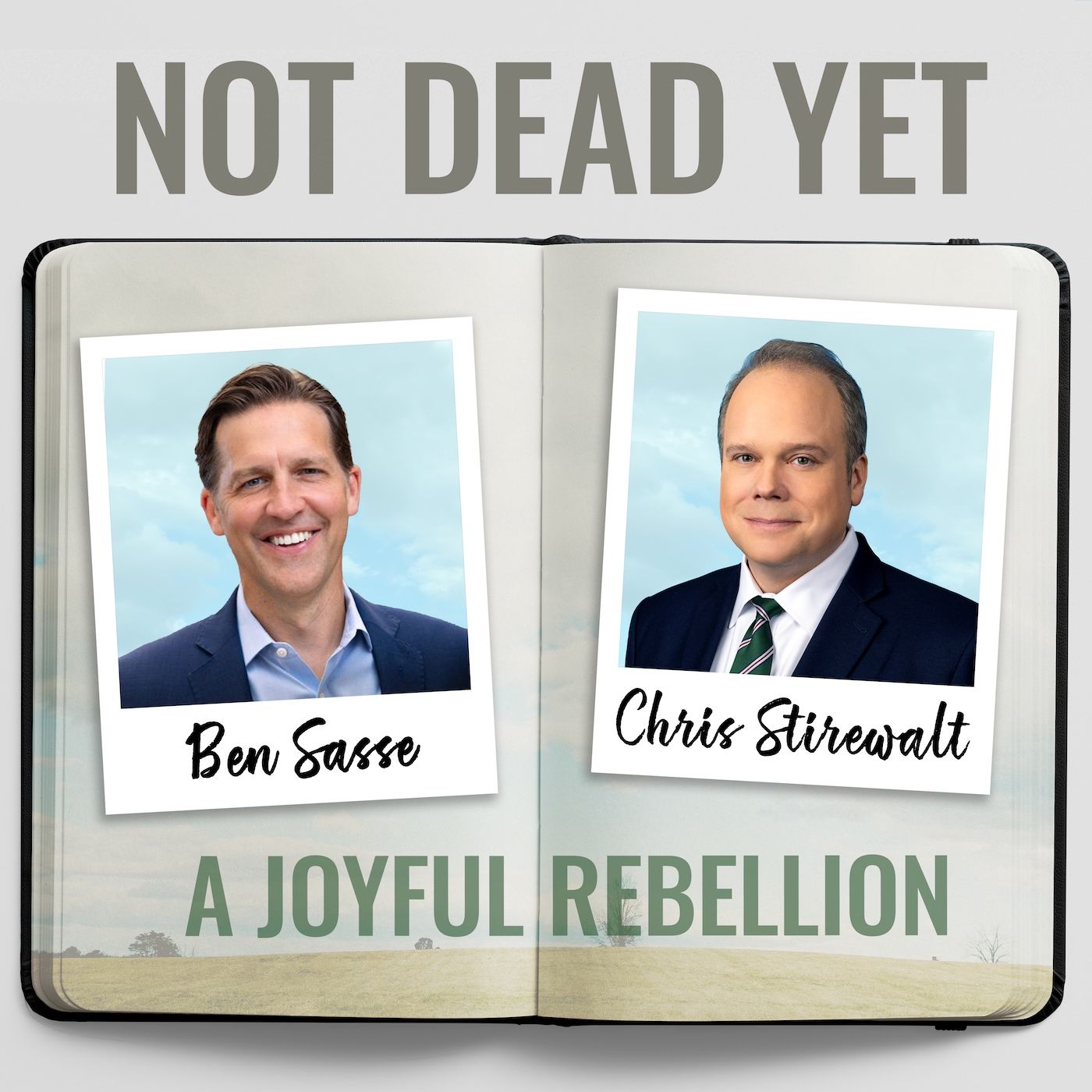
Not Dead Yet
Nicholas Eberstadt
01:06:46
Ben and Chris talk a bit about their first jobs and how child labor laws are ruining the country. Then things get super nerdy when Nicholas Eberstadt joins the guys to talk about demographic decline, labor force participation, why men need work.
Loading summary
Transcript124 lines
- [00:08]
A
Hi, I'm Ben Sasse.
- [00:10]
B
And I'm Chris Direwalt.
- [00:11]
A
And this is not dead yet. We're all dying, but only some of us have been brought face to face with that reality.
- [00:18]
B
However long each of us have to do it, though, we all want to
- [00:22]
A
live a good life, one with meaning, love, and joy. And our guests are here to help us do exactly that.
- [00:29]
B
All right, Ben Sass, what was your first job?
- [00:33]
C
Oh, so good.
- [00:35]
A
I walked beans, which isn't a job you really need to do anymore, but in normal Midwestern crop rotation, there used to be sort of corn, beans fallow. And so when you're growing soybeans, you had volunteer corn coming back from the previous year. Now it's really easy to just spray and hit the genetics of the corn. But you used to have to walk when you were like 8 or 9 years old, walk the bean fields with a hoe, and you're essentially weeding corn out of beans. And since corn is so much taller than beans, the adults can see from half a mile away if you're doing your work well. So it was the best of all work because it was brawny and yet it didn't require near supervision.
- [01:16]
B
Okay, and what did, what did that give you? What was the what, how did that benefit you?
- [01:25]
A
I mean, it was an amazing sense of accomplishment that you could look at a quarter mile or a half mile long field and go up and down that field for 6, 8, 10 hours with a hoe, and you could see that your work got done. It's like when you, when you mow a yard that's, you know, overdue, or when you vacuum a place that has dirt everywhere, like, the sense of accomplishment is palpable. And yet you didn't have to be closely supervised. You could get some distance away from the adults or, you know, 20 yards away from the next kid walking his or her rows. And he got paid like it was, it was crazy. 1979, 80, 81. I got paid almost three bucks an hour as an eight year old, which, I mean, I was, I'm sorry, I was busy. It was nuts. I shouldn't have been paid that much
- [02:15]
B
as an, as an 8 year old.
- [02:17]
A
It was nuts. Like, there was no need for them to do that. And I think that my uncles and my stepdad just decided, like, we're going to show that, like, when you do real work, that's definable accomplishment in the world. It comes with pay.
- [02:31]
B
You should write a book about that. You should write a book about how kids should. Oh, wait, you did that.
- [02:35]
A
Seven jobs, my man.
- [02:36]
C
What about you?
- [02:37]
B
Never.
- [02:38]
C
What did you do first?
- [02:39]
B
My. I had. My first job job was as a newspaper reporter. Sports reporter.
- [02:47]
A
You're 15?
- [02:49]
B
Seventeen.
- [02:49]
A
Okay.
- [02:50]
B
My work. First work was for my mother. My mother had. My mother, who had been a homemaker, a corporate wife her whole life. My father bought her a cabinet company, a kitchen and bath cabinet company late in life, and she loved it, and she was really good at it, and she was. It was a surprise, I think, to her and to everybody that she was really good. And I worked the shop sweeping with the guys who had the snap on tools, girly calendars, and played terrible country music and who enjoyed abusing me within the bounds of what they could do to the boss's son. And that was a really good job because it helped right size my ego because I thought that when the world got a load of me, brother, there was going to be no turning back. Once we unloosed the styro on the world, it was. It helped right size my ego, and it helped me feel like I could do something other than just talk, which I've ended up basically making a life. Life out of. But it was. It was very good for me, and it was good for me that my mom appreciated my contribution to her effort. That was very good. Yeah.
- [04:11]
A
I mean, child. Child labor laws really can ruin a country. I mean, I'm not saying this unironically. There's Obviously stuff in 1880-1890-1900-1910 progressivism that needed to push back against Joe Crisco and little kids working in dangerous environments. But the idea that we should be shielding kids from a connection to meaningful work and service and accomplishment and output and measurable teamwork, it's a disastrous thing.
- [04:40]
B
Sass embraces sweatshop. I see the headline. I like it.
- [04:44]
A
I'll take it.
- [04:45]
B
What's going to give the podcast juice? That's what's going to juice the podcast is. Sass embraces sweatshop.
- [04:52]
A
The opposite stuff is more dangerous.
- [04:56]
B
Before we introduce Nick Everstadt, what is political economy? What's the difference between political economy and economics and political theory?
- [05:09]
C
Oh, sheesh.
- [05:10]
A
You got to give me a heads up on these. You went to.
- [05:14]
B
You were a college professor. You are college president. What is political economy?
- [05:19]
A
Well, first, let's. Let's think about what institutions actually are in the order of things. So Abraham Kuiper, Dutch Prime Minister 130 years ago, who was a theologian before that, thought there were really only three institutions and all other institutions were derivative on family, church and state. So the question in a way is what is economy? What is what is a market? And it's a weird crosswalk between a state. You and I both lean libertarian.
- [05:49]
B
Ish.
- [05:50]
A
That is the state should be minimalist, but there obviously there have to be some rules of the road for the market. But the market is kind of a large scale expansion of the family. But industrialism created some giant tools. So political economy is a weird hybrid sector which you can come at it from macro or micro, right? To what degree is it the overflow of local trade that flows in your neighborhood from your families? And to what degree is it things that cross borders and oceans and therefore need giant infrastructure? And why are you asking? You didn't give me any heads up. Why we're going to talk taxonomy of political economy versus other social science quasi disciplines.
- [06:32]
B
Because Nicholas Eberstadt holds the Wendt Chair in Political Economy at the American Enterprise Institute. You have no chair. I have no chair at the American Enterprise Institute. But Nicholas Eberstadt does.
- [06:45]
A
Praise to Greg Wendt for funding that. We need more people like Greg Wendt funding more people like Nick Eberstadt.
- [06:51]
B
Anybody want to throw a chair my way? I'm ready to be seated. So Nick Eberstadt, we could say Harvard undergrad, master's in public Administration from Harvard, Ph.D. in Political Economy and government, all from Harvard. You guys all stick together. I know how it is. But I think it is fair to say that Nick Eberstadt is one of the most influential and consequential economists of our lifetimes. And I know that sounds like a bold statement, but I believe that the way that Nick Eberstadt has written and thought about work and has written and thought about particularly, and I know we're going to get into all of it, Men Without Work, the. The treatise that shaped so much thinking. But Nick Eberstadt is. Is the man. Man.
- [07:46]
A
Let's get to him. But in addition, and are those who know Nick already know this, but he's also become the front edge of a lot of the global birth rates conversation. He's a little less panicked about it than I am, frankly. But his data sets are really interesting about people stopping having babies. This crazy idea that children, which are kind of an ultimate inconvenience, but this crazy idea that you therefore treat an inconvenience as something you can just live with less of. And people have just in the desexification of the world have stopped having babies. It's new in human history. It's new under the sun.
- [08:26]
B
Then I will say that Nick Eberstad Speaking of inconvenience, one of the things that makes him great and one of the reasons I admire him so much is that he is determinedly inconvenient every time. One side or one argument is like, well, Nick Eberstadt's on our side. He follows the data, and he follows things where they go. And he is not quite iconoclastic, but he is his own person, and he goes to the beat of his own drummer. And I really dig that.
- [08:55]
A
Two episodes ago, you and I had a long intro. I think we got in trouble with the production team for having an intro that instead of being five minutes, became 17 minutes or something, but about different types of guests. And on our continuum of slightly more biographical, slightly more data themed.
- [09:12]
D
Nerd.
- [09:13]
A
We were going big data nerd today.
- [09:15]
B
Yes, big time. Grande.
- [09:17]
A
And we say that affectionately today.
- [09:19]
B
Very much so. So let's get into it.
- [09:22]
C
Even when the rain pours down Even when the light seems like it's fading
- [09:30]
D
Even when your heart aches Feels like
- [09:33]
C
it's gonna break that's when you sing out,
- [09:39]
D
hey, we're gonna shine like lightning.
- [09:45]
C
Well, this is an exciting opportunity for us.
- [09:48]
D
We.
- [09:48]
C
I. I will admit, Nick, we are delighted to have you, and we've already introduced you with flowery praise, so we won't make you have to sit through that. But usually we have people on here for their brains, but in your case, we have you on here chiefly for your. Your gorgeous beauty. And so we bounce back and forth between biography and ne stuff. This is the first episode. I think we're at number seven is this is the first episode we've done where there's a set of questions I arrive with, and I'm like, who's the expert in the world that can tutor me about this weird stuff that's happening? So, anyway, we are delighted to get this time with you. Thank you for being willing to lend us your brain and your wisdom.
- [10:29]
D
Ben, it's an honor for me to join you here. I'm thrilled to be invited. You don't know this, but you're one of my longtime heroes, and you can't possibly know this, but in 2016, I voted for you for president.
- [10:43]
C
So I've only been on morphine for 90 days. It appears you've been on morphine for a full decade. Thank you. Thank you for the kind words. I am a giant fan of a lot of the work you do, and I'll dive in. Chris has lots of more precise ways to frame this as well. But let me. Let me start by saying I don't understand what's happening in the demographic collapse, number one. So let's get a set of shared data under us. Then along the way, let's have you give us theories of why it's happening. And then obviously we need to transition to and what can be done about it, because it sure as heck feels like the levers that could make a difference are, you know, centuries to millennia long about cultures, habits and beliefs that it's really hard to figure out how you reverse course. And the, the time bomb collapse that's going on is weird. So would you tutor us? What is the Natalism crisis?
- [11:37]
B
Sure.
- [11:37]
D
Well, let's go back to the good old 20th century when so many of us were born. Those of us who were born in the 1900s are children of the population explosion. The world's population quadrupled more or less between 1900 and 2000. Nothing like that had ever happened before. But it wasn't because we suddenly started breeding like rabbits. It's because we finally stopped dying like flies. We had a health explosion that lifted humanity's life expectancy from about 30 years now at about over 70 years. And this is for the world as a whole. So all of the increase in human numbers over the last 125 years, all of it is due to better health conditions. And you know, if you have to have a population problem, I'll take better health conditions any day of the, you know, day of the week. What has been happening mainly since the post war era, although it began much earlier in France around the time of the French Revolution, is a kind of march downward in non catastrophic fertility decline. And it started in Europe, it spread all over the world. Today, pretty much everywhere on the planet you're seeing drops in birth rates or fertility rates, whatever you want to call them, whatever measure you want to use. It is possible, I can't prove this, but I think it is quite possible that we have reached the point where the total fertility level for humanity, for the whole planet has passed through the replacement level. We may be at the point where, if we're not at the point where insufficient numbers of children are being born to continue stable population in the future. We're very close to it. About three quarters of the people in the world, from what we can make out, are living in countries now where below replacement birth levels, below 2 and change babies per woman are being born. East Asia has already tilted into depopulation. Europe, broadly construed, is in depopulation. There are just weird things happening that I wouldn't have guessed 10 years ago. I went to Calcutta when I was a young guy 50 years ago and it was like a sea of children. Calcutta now has about one baby per woman per lifetime. Mexico City has less than one baby per woman per lifetime. Mexico since for the first time since numbers have been kept, Mexico's fertility is lower than the usa even in the poorest places of the world, or some of them like Burma, Myanmar, least developed country list that the UN keeps below replacement. So there's something that is sweeping the globe and radically rapidly transforming childbearing patterns. And the march to below replacement fertility hasn't shown any signs of stopping yet. Back in the 20th century, like the wise demographer said there's a limit to life expectancy and it's like 75 years, years. And when that got broken, they said, well it's got to be 80 years. And when that got broken they said, well, 85 years and so forth and so on. And they're still revising in that direction. That's with life expectancy 25 years ago, 15 years ago, 10 years ago. I don't think there are any demographers who would have guessed that South Korea could have a non catastrophic, non war, non famine, non four horsemen birth level that is almost 75% below replacement. But here we are, and this is
- [16:09]
B
like the, this is the double defeat of Malthusian economics. If the old thinking was the economist who wrote about the population bomb and said we're heading to, we're going to exterminate our species by overpopulating the earth was wrong because we kept growing, growing, growing and managed to feed everybody. But now we're heading toward a population decline not because of those external factors, not because of war or famine or pestilence or lack of food, but because of lifestyle choice. Is that right?
- [16:54]
D
I think you put your finger on it, Chris. Back 40 years ago, when I was a young guy, I was arguing with all of these Malthusians that you describe because I thought they had it all wrong. And basically, in my view their problem start with Ehrlich, Paul Ehrlich, RIP And I won't say anything bad about the
- [17:20]
C
dad, but we can say bad things about the New York Times stupid obits and their headlines.
- [17:26]
D
But he was a brilliant biologist and a great scientist in his area of expertise, which was insects. The mistake that he and others made was transplanting, bringing over the learning of population biology about other species and imposing it on human beings. We are the most adaptable, ingenious problem solving of all of the animals. We can make our life expectancy more than double. As I mentioned earlier. We can also make our fertility change deliberately outside of catastrophe, as we're discussing now. We can also increase our own resource base for our own consumption. We have cracked. We have cracked and solved the problem of abundance. We can mass produce abundance. Food is cheaper now in real terms than it was a century ago or half a century ago. Which means that in economic terms, even though there's so many more people, it's actually more plentiful, it's less scarce. So we basically, from a materialist standpoint, have figured out how to make the materialist Garden of Eden. But. But now we're seeing that maybe nobody wants to live in it.
- [18:49]
B
Well, let me ask that. And like. And by the way, shout out to Julian Simon, what was the line? Human beings are the greatest natural resource. The ultimate.
- [19:00]
C
Exactly.
- [19:00]
B
The ultimate resource, the ultimate resource are human beings ourselves. So why is it bad? What's bad about depopulation?
- [19:10]
D
Well, I'm going to be maybe a little contrarian here because I know that for sure lower death rates are good. I'm a lot more agnostic about what the right birth level is because I listened to population controllers for two generations who knew what the right birth level was, and they were always wrong and they always lacked human empathy. I mean, that's the essence of the overpopulation concept is a absence of empathy for human beings. It's a misunderstanding that what they called overpopulation is really poverty. And people can solve poverty. Right? So as far as I can see, there's been 150 years of. Call it social science, it's kind of an ugly term. But studies on. There's studies on fertility differences and what they correspond with and what may cause them. And everybody's got the pet theory in the 10,000 studies or whatever that have been done, it's income, it's like women's rights, it's like contraception, it's education, it's infant mortality, urbanization. We could go on all day about this, right? The most powerful predictor that I have seen, and you're going to laugh at me when I say this, is how many children women say they want. Right? You know, I mean, news flash, right? I mean, this is what I'm saying. This is what I'm saying. Yeah, we're not rabbits and we're not robots, and there's human agency in all of this. And it's not a perfect predictor, but it's the best predictor across countries and within countries over time. So then we get out of the you know, out of the slum of social science and into something else where we say, you know, you have to ask the question, what do people want? It's not just women that social scientists study what women say they want, but what do people want? And that I had argued that the person who explains why we're seeing this revolution in births right now should win a Nobel. But it shouldn't be in economics, it should be in literature, because you need that humanistic understanding to see what's going on in the human heart and the Zeitgeist and the mores and so many different things probably happening all over the world. I mean, if you had a Tolstoy on births, you'd get a really great story.
- [22:10]
B
And then, Tess, why should everybody have 11 children?
- [22:12]
C
I want to underscore two things you said and then pull on a thread a little deeper. So first of all, your quadruple shorthand from 1900 to 2000, just really helpful, right? So we go from a little under 2 billion to a little under 8 million people in that century, right. In 1800, I think we had about 800 million people on Earth and about 99% lived in abject poverty. When you get to 8 billion people on Earth, you still had about 800 million in abject poverty. But as a share, you went from 99% abject poverty, usually defined as you might not make it through the winter. Right. You don't have a storehouse big enough to handle a bad harvest. And so you have a really cold winter and you have a really bad productivity out of the fields, and you might starve in your community. 99% of the people 200 years ago were abjectly poor. Today it's less than 10%. Second, it's because of health extension more than birth rate change. But I think you also were saying that what we see right now is a shift from children as a default assumption and expectation to children as a lifestyle choice. So when you say this point about revealed choice, I mean, on so many things we know, if you just ask people in polling, what do they want, there's a huge bias to try to say what you think you're supposed to say, right? So there's some social science which tries to get at this by saying, what does your sister want? What does your next door neighbor want? As opposed to what do you want? Because you can reveal it more. What do we know across different continents right now about the revealed choice? Are people really of the view that kids are mostly a burden and Saturday morning, because you can't sit around and drink coffee and read the newspaper if you gotta take your kids to the park or feed them, what do we know about what people think they want in terms of kids?
- [24:00]
D
I mean, that's a really penetrating question, Ben. And what the answer to it, I think reveals is how ignorant and ideologically stilted and focused on the rich world so much of the work in this area has been. No, if we had ethnologists like Myanmar I mentioned, or let's say in Argentina, where barely more than one birth per woman per lifetime is now apparently like the new norm, we could go through these different places, all the below replacement fertility places, with people asking them questions, observing. We'd have thousand times more interesting information to answer your question than we do. If we had. Chris, cover your ears. If we had journalists worth their salt in the theater going around to hundreds of different areas, we'd have this information. I mean, I remember back in the 70s when I think it was Susan Sheehan for the New Yorker, spent a couple of months with a Puerto Rican family, welfare family, in the Bronx. It was one of the most fascinating, empathetic, detailed learning experiences that you could have. And just learning about how other people live and think, we don't have that for most of the world. And of course, in some parts of the world, like China, where you've seen this unbelievable crash in births since the end of their one child policy, since the suspension of the one child policy, there's no freedom of inquiry. You can't do that.
- [26:03]
B
But
- [26:05]
D
there's no reason to assume it's the same thing in Myanmar as in Sweden. But certainly it is clear that there's a revolution in mentality all around the world. Let me give you just a hint. I cannot prove this. I cannot prove this. But I think that in addition to the pill, which was a huge technological revolution for fertility, I think that our little friend here, the iPhone, I think that the smartphone has had a revolutionary impact on births all around the world. I cannot prove this, but if you look at the saturation of smartphones and iPhones in different countries and the birth trends over that period of time, they go down, they track in a negative way, really surprisingly well. Wow. So, I mean, part of this is this little baby here is like a narcissus mirror, right? And people want to jump into this world on the other side of it, which is irresistible and also vastly inferior to the one that they're living in, Right? And so children, I've got four of them and I like them all perfectly well, Right? But one Thing you won't say about children is that they are convenient. And so convenience seems to be also kind of like a revealed preference, you know, anywhere that it's offered. And I don't know where that fits into this global pattern, but I can't help but think that that's got something to do with it as well.
- [28:00]
B
Acknowledging the truth of that, the obvious truth of what happens both by increased inward turning and by the power of comparison, right. That now people can see a world that is different from their world. But wouldn't, wouldn't that also be a marker of affluence?
- [28:21]
D
Well, it was a marker of affluence at the beginning of the iPhone revolution. But there's some unbelievable number of iPhone smartphone subscriptions around the world now. I think we're talking north of 5 billion of these. And it's not just that there's one person with like 100 million. There are, they have saturated Asia, they've saturated sub Saharan Africa. They're a necessity increasingly in sub Saharan Africa because the alternative communication systems are so weak and spotty.
- [28:59]
B
And we've seen the ramifications on migration about how it changes the way people live and move. I guess what I'm getting at is when we see what happened to birth rates in China, I see a country that got richer and people chose an easier life. This is my ink stained wretch, simple country pundit understanding of these things. So I want you to, you help me. My understanding of all this was a long time ago you needed a lot of kids because they would work the earth with you and that when you were old and decrepit they would feed you and put a blanket over you so that you could have some comfort in your old age. And that as we moved from agrarian rural to manufacturing urban, and as we instituted the beginnings of a social safety net, that the necessity of having children decreased. And then children became a thing to do for the sake of having kids. And there are still in a lot of places, Washington D.C. is notable in this way. If you have three children, it's a mark of affluence, right? In high caste societies, the third child says, and that's $150,000 a year, that's $200,000 a year in private school tuition that we're paying and the nannies and the da da da da da da. But that for all of those reasons that as people got wealthier and their lives became more comfortable, the desire for children waned. What am I getting wrong?
- [30:58]
D
I think that's an excellent thumbnail Let me start with that and try to build on it. Back in the days when people were having six kids, it wasn't necessarily just so that they could have two to kind of continue the species. They might end up with a couple of others. There was a guy called E.O. wilson, and even though he was at Harvard, he was quite good and quite well regarded. He came up with this theory called sociobiology. And you get what it is when you hear it. Sociobiology. We're hardwired to procreate. We're hardwired to continue our gene pool, yada, yada, yada, yada. I think that what we're seeing now really challenges the idea of sociobiology, right? I mean, because it's starting to look all over the world as if it's more like a muscle memory thing or something like that than an inborn impetus to procreate and populate the planet. Instead of E.O. wilson, Chris, I think we want to look at Rene Girard a lot closer. We want to look at mimetics, because this may also be part of what you're describing, right? When Chinese peasants were trying to have five or six children, that was the norm. That was like what was going on everywhere. When you change that norm, you get a whole different formula of social imitation and, well, part of what we're losing the old social, what do we call it? Social memory of having big families now. But compare and contrast. Just to try to emphasize what I'm kind of trying to get at. I mean, think of American Jewry versus Israeli jewelry, right? I mean, obviously we're Americans, they're Israelis. So it's not apples and apples. But in Israel you have a affluent, educated population with over three births per woman per lifetime. And even if you only look at the people who say they are secular and non religious, it's above replacement. It's over two if you look at them. If you look at American Jewry who say that they're not religious and secular, it's only a little bit above one in the United States. So context and social imitation, I think, also matter a lot.
- [34:07]
C
Social limitation is a really, really good word. I want to run something by you that another scholar told me so you can correct it. And then I want us also to pivot a little bit from technology and birth rates to technology and the crisis of work. Another thing you're expert on. I heard that of all industri nations, basically to get north of 2.1 births per woman, you only have Orthodox and secular Jews in Israel, Orthodox Jews in the US and Mormons and that everybody else in the industrialized world now is 2.1 or lower, including Hispanic migrants from Latin America to the US after their migration. So you might have have some migrants who have north of 2.1 total, but once they're in the industrialized rich nation, they don't reproduce at that same rate. A, do you buy that shorthand? And B, what does that mean to your social limitation point about rich nations having this preference for convenience that feels
- [35:11]
D
almost like contagion as a general stylized fact that sounds unobjectionable? I mean, I don't want to get assistant professor on any of the little details, but as a generalist, what a
- [35:26]
C
great verb to be assistant professor. Assistant professor KAREN that's right.
- [35:32]
D
But you know, in general, what you're saying is correct, and the big truths in it, I think, are twofold. One is if you migrate and you assimilate successfully, you take on more or less the fertility patterns of the receiving country because you're taking on the norms and you take on the mentality. And the second is that. People who are secular tend to have way lower fertility levels than people who describe themselves as religious, who say that faith, faith is important in their lives, say that they go to worship every week. Religiosity is a huge cleavage line here and back 20 years ago, I did a study comparing the US and Europe, and I think it's still in some ways relevant, even though our birth level has kind of tanked since then. We were at about replacement when I was doing this homework and Europe was, I don't know, 30% below replacement, something like that. That it was made a little bit more complicated by the fact that your colleagues in Congress and the Senate had made it illegal for the Census Bureau to ask anybody about their religious affiliation. And that was done in the spirit of, I think, the Church committee back in the 70s and not having the government spy on privacy stuff. The fact is it's a little bit more difficult to find out about religiosity in the USA than you might imagine. As best I could tell, the people who said they were secular in the United States had about the same low level of births as people in Europe who said they were secular. People in the United States who said that they were religious had about the same high level of births as people in Europe who said they were religious. The trick was compositional. We had a lot of people compared to Europe who said they saw themselves as religious. With the waning of religiosity in the US over the last 20 years, and likewise the decline in optimism, the decline in people who say they're proud of their country. This little bundle of things that doesn't necessarily. I'd get flunked for saying this if I were in a grad course because I'd be committing the ecological fallacy because pessimistic 50 year old men aren't the ones who are having babies. But as an environment this does seem to affect the outlook and the perspective on societies and their fertility prospects.
- [38:27]
B
Okay, I want to get to the book and I want to get to the part of your work that has most affected me and changed the way that I thought of things. But I'm stuck on this and I'm going to ask it in a different way.
- [38:41]
A
Way.
- [38:41]
D
Yeah.
- [38:42]
B
Which is constitutionally, institutionally and intuitively I see declining birth rates and I despair. And I despair because of the very things that you described. Because the, the things that high birth rates are connected to are good things. Right. I, I believe that people being involved in vital religious communities is helpful for a strong nation and a strong self governing republic. And I think that people's optimism, when people are optimistic about where they are, they have more kids and all, all of that. But I want to make sure that I'm not being Paul Ehrlich because maybe it is so, or maybe tell me why it wouldn't be so. That this is just what's next and that we're going to figure out and we're going to solve the question of what happens in a depopulating West.
- [39:36]
D
From a economic, materialistic standpoint. I'm very optimistic about prosperity and the economic future of humanity. Even if we tilt into prolonged or indefinite depopulation and aging, we've cracked the code for abundance. We need to retool. Obviously something like a pay as you go system for Social Security and pensions isn't going to work quite so well when you've got an upside down population pyramid. But the Lord did not decree that we do that one right. And so we can solve the prosperity challenge. What I don't have a good answer for you about is what we do about everything that kind of makes us human in this future world. We've got more people now on the planet than we've ever had before. And look at all the loneliness. We're awash with loneliness. What happens as the family and the extended family atrophies with prolonged sub replacement fertility? We're a really adaptable animal. We're a really ingenious animal. Can we substitute or our best friend from the computer Science club for a sibling. Can we substitute a really good robot for a cousin? My imagination only goes so far, and reality always beats human imagination in thinking about some of the possibilities for the future.
- [41:26]
B
Okay, the Men Without Work Work. This book changed the way I, and I think a lot of people thought about what, what is happening and why and the, the crisis. And this contributes to the crisis of family formation and contributes to it. It, it touches on all of those things. I think you're going to have to do another edition. That is the AI edition about what comes out. You already did the post Pandemic edition. You may need to do the AI edition. But just for those people who aren't familiar, what is the premise of your work?
- [42:10]
D
So Men Without Work and I did the first edition of this ten years ago was a book that came to me. The idea came to me one evening when I was listening to the news. There's all of this happy talk about this, maybe about 2014, 2015, about how we were at full employment or near full employment in the US labor force. And I just read a survey saying that half of all Americans thought we were in a recession. And so I said, how come is this, don't these things seem to be a little bit cognitive dissonance? And I started, I'm not now, nor have I ever been a labor economist, but I kind of trespassed into that kind of domain and I started pulling on a thread and I said, gee whiz, we've got this system of, of employment statistics in our country that were developed to track the Great Depression, but weren't even built until 39 towards the end of the Great Depression. And they've got this binary. You're either working or you're unemployed and looking for work. If you're not employed and not looking for work, you're free from work. If you're free from work. Exactly. Yes. Yes. If you're work free, neither working nor looking for work, you're outside the system. System. Because they couldn't imagine that there'd be. This was basically male employment back then. They couldn't imagine that there'd be guys who didn't have a job who weren't looking for work unless they were completely incapacitated. But by the time I wrote this book, there were about three prime age. That's not my term, that's US Government term for obvious reason. Then prime of life, prime working age 25 to 54, there were about three prime age guys neither working nor looking for work. For every one guy who was formally Unemployed.
- [44:03]
B
So you were just say that again.
- [44:06]
C
That's unbelievable.
- [44:07]
D
Again, there were almost three guys who were neither working nor looking for work back then 10 years ago. For every one guy who was formerly unemployed in the sense of not having a job but looking for work.
- [44:24]
C
So the stats we were reporting are just dang close to pointless.
- [44:29]
D
Well, you're missing three quarters of the problem. Right. And so when they started pulling on this, I went, holy cow. We then had a lower work rate. There's a more technical term for it, but you know what I mean. We had a lower work rate for 25 to 54 year old guys in 2016 than we had the first time. We measured it in the 1940 census when the national unemployment level was 14%. So we have been living in the 21st century with a work rate for American prime age guys that is slightly lower on average than it was at the tail end of the Great Depression. So when I say that we've got a depression scale problem for work for American men, I'm not being hyperbolic. And then the rest of the book was just kind of laying out the, the facts about this and some of the details about it. I didn't come up with a 12 step program to revitalize the workforce, but I did see that there were a couple of really big things that were being missed. One of them was the huge explosion in felons in the United States over the period since the 60s. By 10 years ago, there were almost 20 million adult Americans with a felony in their background. That was about one in eight adult men. So when you talked about, when one talks about mass incarceration, that is a unique and troubling feature to America's social arrangements. But we've now got a situation where there are 10 ex cons in society as a whole for every person who's in prison and they're kind of invisible. But a disproportionate number of the dropouts are likely ex cons. We've got the disability archipelago, you know, has kind of mutated in a kind of a pretty malign way. And I can't prove this, I cannot prove causation here, but it does. Disability programs seem to be helping to finance a formally work free life life for a lot of the male dropouts. That's something that needs a big reform. Family is a big deal in this too. No matter what your ethnicity, no matter what your education, if you're married, you're more likely to be in the workforce. Does this surprise anybody? If you are not married but you have children in your home, you're more likely to be in the workforce. Is anybody surprised by this? You see all of this stuff which has to do with human agency in this passion play as well.
- [47:58]
C
So on technology and this crisis of worklessness. Talk about the impact of digital entertainment and pornography, but not exclusively and the declining labor force participation rates. Where does the time go that's not spent at work?
- [48:14]
D
It's even better than having an anthropologist in one's home maybe having self reported time use. And we've got these great big surveys the government does on time use that they mainly want to have for trying to figure out when people go to work and stuff. But they ask questions also of a lot of these dropouts, of these millions and millions of, of prime age male dropouts. And the consistent read back they get from the guys themselves is pretty dispiriting. For one thing, they say that they basically don't do civil society, not worship, not volunteering, not charitable work. They got a lot of time on their hands, but they don't do a whole lot of care for people in the household. They don't do a lot of cleaning or housework. What they you're pointing to then what they say they do is watch. They say they watch screens about 2,000 hours worth a year as if it were a full time job. Right, Like a full time job.
- [49:30]
C
50 weeks, 40 hours, 2,000 hours.
- [49:33]
D
Yeah, I mean it's tough, tough work, man. But so add to that every so often. There are these components that they add to these surveys. And they've asked from time to time about pain pills. Pain medication. Half of these dropout guys say that they're taking pain medication every day. Now it's not necessarily opioids. These are surveys that are very broad. We don't know from the surveys what type of devices people are watching. We don't know what kind of things they're watching on tv. I mean, I don't think it's crazy to imagine it's porn. I certainly isn't crazy to imagine that it's games and stuff. But you get this picture that's not just kind of like staying at home with Call of Duty. It's like staying home with Call of Duty stoned.
- [50:29]
B
They're not watching Arthur Clark, Clark's Civilization.
- [50:32]
D
Well, that's obviously because the BBC makes
- [50:34]
B
you get a flirt.
- [50:36]
D
Yes, yeah, but no. And so they're certainly not brushing up on their, you know, Mandarin or, you know, whatever. But it's so there is this, there's this intellectual, this nervous tick that economists have where they refer to free time automatically as leisure. Free time is not automatically leisure. You have to wish to enhance yourself in some sort of uplifting pursuit for it to be leisure. Free time can also be degrading. And I am afraid that there's an awful lot of degradation in the time use patterns I was just describing to you.
- [51:18]
C
This is related to your point about solving abundance. This is bleach week. Tell us some bright spot you see. Give us a little bit of hope on this landscape.
- [51:29]
D
I'm kind of a big believer in human agency. And. There is nothing in the brutally materialistic social probability functions that we see there that is kind of like unbendable and unchangeable. We all live in communities. We can do more in our own communities to pay attention to the local aspect of these sorts of problems. We know that religion and faith matter. We know that a lot of these guys are suffering pretty badly. There was that funny little old Greek guy back 2,500 years ago said we're like social beings. Right? Aristotle. And it's.
- [52:28]
C
That was a solitary confinement. Distract himself with video games now and again.
- [52:32]
D
Well, you know, so he. Solitary confinement is like. Some people think it's a cruel and unusual punishment. So we want to get. It's not just good for the economy to get the men off of the couch. It's good for them. It's good for connecting to family, connecting to church, connecting to community, connecting to work. If you haven't had an experience with work, you can't know how important it is to helping. Doesn't make you necessarily happy. Not saying that. But it helps to complete you as a human in a way that is difficult to describe. If you haven't done it, it's a service to other that helps you complete yourself.
- [53:17]
B
We're going to wrap up, I promise. Good doctor and not abuse your time. But I do want to ask you that AI question. So if. And this is something Ben and I talked about years ago and it seems to be coming true, which is that if work becomes less necessary. Right. If AI can really move through the knowledge worker community in a profound way and we remain rich and the material consideration, if that promise of artificial intelligence comes true. When you think about this, and I know you probably haven't done the deep research on this that you have on other questions, but when you think about what the implications of AI are going to be for American and Western society, what do you see?
- [54:11]
D
So you've given me a chance to make a fool of myself. So let me just Jump in. And so John Maynard Keynes was thinking about this, of course, as you know, back in 1930 and the economic possibilities for grandchildren when he said that 100 years from now, which is more or less today, the big problem was going to be trying to figure out what we do with all of our free time because everything's been automated. So I guess that's a shout out for John Maynard. We have Arthur C. Clarke, let me invoke him. Because when you talk about this stuff, you're kind of starting to talk about sci fi. And he did this wonderful book, profiles of the Future in which he talks about out who gets the future right and who gets the future wrong in imagining it. And he says the two biggest failures that people make in thinking about the future and he's going through predictions in the past are number one, failure of imagination. That's pretty self evident. But he says the second one is failure of nerve. You kind of, you get it right, but you can't believe that this, this really could be the way that things are going. So I think we've got kind of a, I'm not sure we've got a failure of imagination question here, but I think we may have a failure of nerve question. As a big fan of Schumpeter, I really like the concept of creative destruction. And the reason that we're able to do this zoom like we're doing now is because of market driven creative destruction and innovation. It's really easy for us to see the prospective destruction. It's very, very hard for us to imagine the perspective creation. And I think that would have been true when the auto came along, when refrigeration came along. And I can't give you a very smart answer about what the new things will be that people can contribute to the world, but they're going to be them. We're not a completed project. And one last thing about this, Claudia golden, who won the Nobel Prize in economics a while ago, co authored this book called the Race Between Technology and Education. And the elevator version for the United states Economic history U.S. the elevator version was, was you've got the magic lantern here and if you skill up, you can hold onto the magic lantern and then your income goes way up. And if you're not skilled enough to hold the magic lantern, you get displaced. The advent of AI is a super big argument for improving the training and skills of our population. That's an argument that wins on its merits anyhow. But I think with this thing on the horizon, it adds an urgency to
- [57:28]
B
it, to it Then I got my shump at a reference. I'm set, I'm good. I got everything. I. I've gotten everything that I wanted. So your bingo.
- [57:36]
C
Your bingo card is complete. Nick, this has been super helpful. I mean I, I heard you three, four, five minutes ago doing a beautiful subtext riff on freedom from freedom to right. What. What our republic believes is that government isn't the center of things. But it's necessary to create central some preconditions ordered liberty so that people can go out and choose the good. And we simultaneously we want freedom from bad stuff, then we want freedom to choose good stuff. And we care that people choose good stuff. But we don't define the good as a matter of coercion, compulsion, policy. And so it requires us to take that abundance and go and build something beautiful. And we need a lot more cultural evangelists to go out and win their neighbors universe to redeeming the time like to the degree we sound like old dudes, grumpy old dudes saying get off my lawn. Yeah, there's a ton of waste around the welfare subsidization of non work. And that's tragic because the fiscal cliff doesn't work. But the much bigger problem is the way it dehumanizes people by trying to take away their agency and say all you are is a consumer. Sit around and spend your 2000 hours a year on screens and it doesn't matter that you're not needed. Just go consume crap. Nobody cares about your work. Your neighbor doesn't need need you. Turns out their neighbors do need them. And so we need to go and win that battle. And that isn't a policy question. And you do a lot of really important work to enable these broader conversations to happen. So I look forward to the next version of this. You're wonderful to take time with us.
- [59:06]
D
Well, amen brother. And thank you so much for inviting me.
- [59:10]
B
Thanks Nick. We really appreciate you. We'll see you around campus. Okay, professor, you know what I'm going to ask you what did we learn?
- [59:16]
A
Well, I am scared to death about the disability numbers, but I don't think we learned that today because we already knew that. So to me the big two thrusts are the birth rate piece which I, I still am a lot more nervous about the neck and the men without work stuff. But to me the, the tie that binds here is a healthy civilization and a smaller republic has to believe believe in souls and children with souls and children are the greatest thing and also an amazing inconvenience. And it seems to me that the new technologies that we're walking around with in our pockets are just constantly screaming, we can comfort you, we can be convenient, we can be easy. And so the contrast between children and digital comfort is right there. And so I think if the big technological advance of the pill was sexual revolution 1.0, I kind of think the iPhone is sort of Huxley liquefied in our pockets, right? Like when we were 1986, 1988, right before the wall falls. And those of us who are of that era and thought that the Cold War could end in nuclear Armageddon for everybody. Orwell was the theory of what totalitarian and state hell looked like. And I think at the end of the day, Orwell's really useful literature, Animal Farm should be read by every kid three times while they're growing up. But it is Huxley that understands what our real temptation is, which is to dull ourselves to death with convenience. And I think the iPhone is that Sexual Revolution 2.0. And so in my mind, we're entering a world where a whole bunch of people, people decide that having a future is less interesting than living in the casino this moment. And I don't understand how we can be that dumb.
- [61:16]
C
You.
- [61:19]
B
I have come to be a great. In researching a book, I came to be a real admirer of Neil Postman who teased out the very thought that you just described, which was that we were worried about out authoritarianism, rightly because of what humanity had lived through in the 20th century. So we were worried about what Orwell foretold in 1984 and in his notes on the Spanish Civil War and the battle over truth and all of that. But it was Huxley that took the lead in the long run run because we can amuse ourselves to death. And there's a line that Postman has in that book, which is it is unnecessary to lie to a public that has been narcotized. And he wrote that in the mid-1980s and he was talking about television. But basically the idea is if you. And this is the Huxley premise, which is if you're doped out on whatever, and in some cases that's actual dope, if you're doped out on entertainment and being soothed, then you don't need, you don't. They don't need to take control and put you in camps, you've put yourself in one. And that is the, the struggle of. And this is what we talked about today. This is. Goes into all of it, which is, this is the struggle of affluence. When you have the ability to be free from the vicissitudes of work and the constant demands to stay alive. And you can be entertained constantly. You come to expect that you will be entertained constantly. And the removal of that entertainment feels like punishment. Right? When I have to put my phone down and say, nope, I'm not going to fill this little minute with Instagram reels. I'm not going to fill this little minute with playing a video game. I'm going to be still with my thoughts. It feels like punishment. And that's. That's what's up.
- [63:36]
D
Wow.
- [63:36]
A
I mean, there is a crisis of loneliness and people are the solution. And we are tempted to think that people are always the distraction. And so somehow the crisis of loneliness is more alone. Me and my instant need to never be bored. And maybe being able to sit still and reflect on a long thought, both a riddle or a problem or a grieving ache, is a hell of a lot more character building than that need to flee to instant distraction.
- [64:11]
B
And I will be remiss if I did not lavish praise on the invocation of Shambhat and the idea of creative destruction.
- [64:22]
A
You've got five Schumpeter tattoos already. You can't, you can't fit another one.
- [64:26]
B
The, the, the. The point for me always being, don't stay here. If it's bad, don't stay here. The goal is not to make the best of a terrible situation. It's the Churchillian. The only way out is through keep going. Right? Keep. And we're not going to do politics, but like, if you're in a bad place as a society or a person or a family or whatever, the idea isn't to learn to live with the problem. The idea is take your beating and keep going. And that's like, that's, that is also what is up.
- [65:04]
A
It feels like I wanted to say, touch grass, work hard, get a girlfriend. It feels like you're saying these are all forms of, of the obstacle is the way suffer, get a girlfriend, get married, have kids. The inconveniences of making a bet on the future.
- [65:22]
D
What we.
- [65:22]
B
What did we say with Mike Rowe? One must imagine Sisyphus happy. Just push the boulder, brother. Because it, it turns out it's, it's. It's pretty cool to do. It's pretty satisfying and pretty cool to do.
- [65:35]
A
It's like we have some themes to
- [65:36]
C
not dead yet and they're not polit bit.
- [65:39]
B
Oh, we're doing it. We're doing it. Look at us. Aren't we fantastic?
- [65:43]
A
No, no.
- [65:48]
B
Okay. That is it for this week's episode. We hope you'll like, review and subscribe and tell a friend. Feel free to email us with your thoughts, corrections, questions, or whatever else is on your mind. Write us at sass and styrewaldmail.com this podcast was produced by Scott Scott Immerget with the help of our colleagues at the American Enterprise Institute. The music is from Drew Holcomb and the neighbors. Thanks for listening and keep living the good life.
- [66:30]
D
Sa.