← Not Dead Yet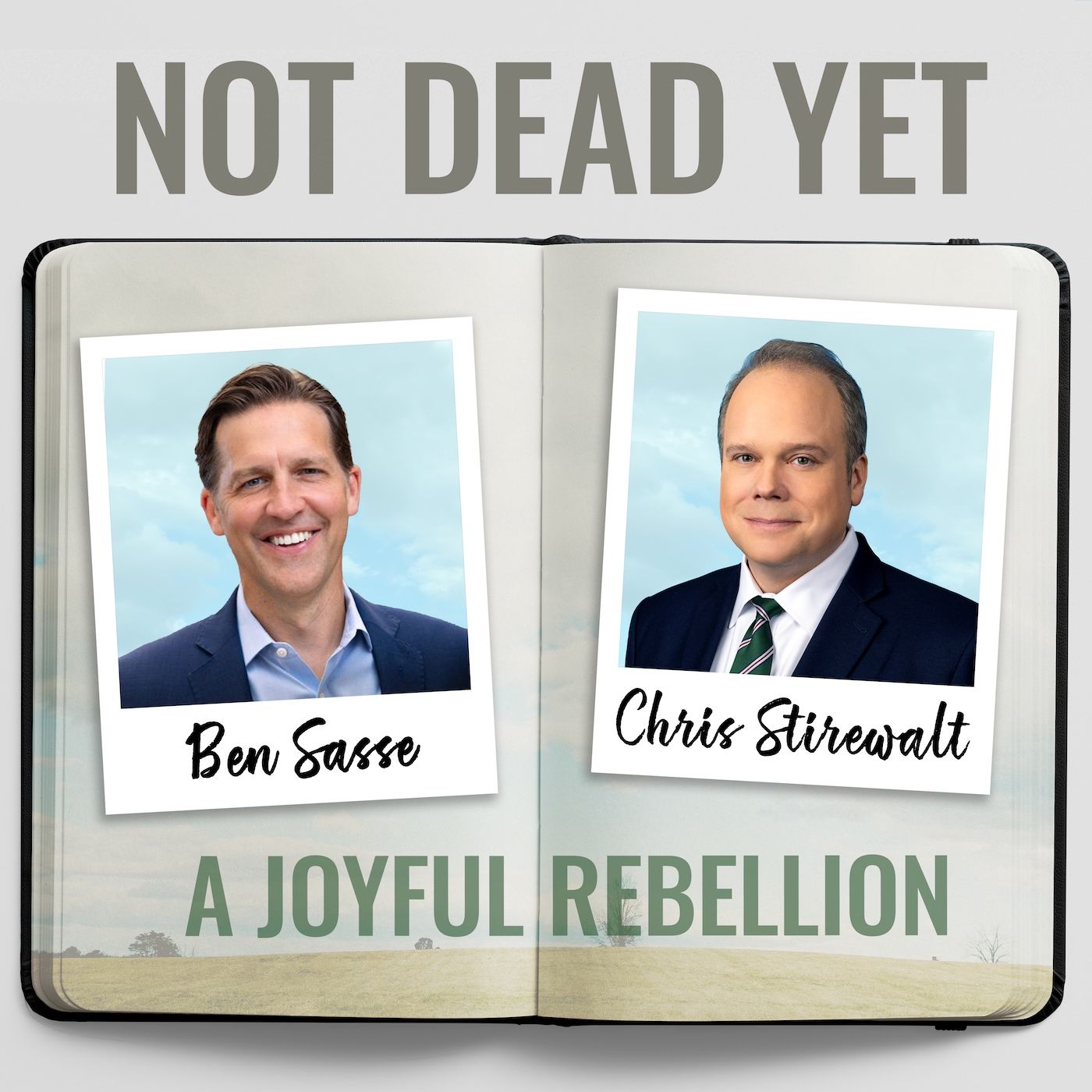
Not Dead Yet
Walter Russell Mead
01:18:31
Renaissance man Walter Russell Mead joins the guys to talk about history and global affairs. This episode has everything: Hamiltonians, Jeffersonians, Jacksonians, Wilsonians, Israel, Iran, tech companies, and the kitchen sink.
Loading summary
Transcript136 lines
- [00:00]
A
Foreign. Hi, I'm Ben Sasse.
- [00:11]
B
And I'm Chris Stirewald.
- [00:13]
A
And this is not dead yet. We're all dying, but only some of us have been brought face to face with that reality.
- [00:20]
B
However long each of us have to do it, though, we all want to
- [00:23]
A
live a good life, one with meaning, love, and joy. And our guests are here to help us do exactly that.
- [00:31]
B
All right, Ben Sass, it's been a while since I've rapped at you, but. But every time I turn around, there you are. You're like the. The ubiquitous Ben Sass. But I don't know how you're doing. How are you doing?
- [00:44]
A
Well, first of all, it is really weird not just to not do almost all the interviews. I don't know. I don't know what's. I don't even know how to think about the. The death interview pipeline for different media channels. But it isn't just that we're not of them. We're accidentally not replying to 92% of them. It's not that we're declining people. It's just. I know. I don't know how to manage the inbox right now. I sleep all the time. I'm super lazy, but. Because when interviews come out, they seem to, like, preview them and then do them and then talk about what they did. My mom also believes I'm way too unresponsive to her texts, because any day she's texted me, she then heard something on Nebraska Radio about something else we supposedly did, which wasn't really yesterday. It was like a month and a half ago, but whatevs.
- [01:32]
B
But you seem good. Do you feel good? How do you feel?
- [01:35]
A
I'm very grateful. You know, I don't want to do much cancer update, but I love you, friend. And we'll just pretend there's no podcast audience here. I was kicked off the trial for the second time three and a half weeks ago for only a week. So both times I've been off in my three and a half. Yeah, three and a half months on this super poison, which is actually awesome. Both times I've been kicked off, I've only been off for a week. And then I got back on this time while I was off because of, you know, rash stuff that had gotten a little bit out of control. I had a super dermatology oncology team that gave me enough steroids that I don't think I'm just sterile. I think by Lamarckian theory, my son and his great grandsons are all also sterile.
- [02:19]
B
So many stairs Giraffes necks are so long though.
- [02:21]
A
They're so long, skinny and long. But I ended up being able to go into the mirror in the bathroom about every 90 minutes and watch scar scabs heal. Skin just started growing on my face like it was nuclear, opposite the old nuclear problem. This was nuclear healing. So I'm really, I mean, I'm nauseous a lot, but I'm I'm overall incredibly blessed. Tumor shrinkage remains significant and I'm back on the poison. And we're getting a few extra weeks, months. Who knows what's going to happen. Grateful to the Lord, grateful to science researchers.
- [02:58]
B
Okay, we're going to talk to Walter Russell Mead today. And before he joins us, I'll give the actual ruffles and flourishes. But it got me thinking about the question, which is what is the point of studying history? And this is a germane question for you because you're a historian, Walter is a historian who takes the lessons of history and applies them to the world today. But so let me just start with the 30,000 foot question for you. Why do we study history? Why is that important?
- [03:34]
A
I'll answer fast. I mean, I'll engage your question, but let's just first say in the movie Good Will Hunting, you know the scenes about the guy who's from Southie who works his tail off and never went to college and just reads every book in the middle of the night. In a weird way, I think Walter was probably the inspiration for that character. One of the most interesting polymaths I've ever known. And we can talk more about that with him. We don't need to put it in the intro, so I'll pivot to your topic. But two of my good friends, guy named Frank Gavin, runs the Kissinger center at Johns Hopkins, is a historian who does history of national security and foreign policy. And one of my best friends in the world Will in Bowden, who's also a historian, but mostly a historian of Cold War and foreign policy and Reagan's decision making and the apparatus around that, et cetera. They're both a little bit like Walter Russell Mead in that they're doing history to get at national security questions. In my theology is the queen of science's view. But history is a pretty important second place. I don't think of history of a discipline as always being the same. History of economics versus history of foreign policy versus history of material conditions versus history of ideas. They're really different things. But numerators change. Denominator is time. And you can get at the essence of a discipline in a hurry by figuring out which things seem to be unchanging over lots and lots of decades or centuries despite different inputs. History of national security and foreign policy ideas is a really, really fun discipline. And in one sense, history is kind of the only thing you can ever really study because everything is in the past and that's your data set. The idea that history is a science requires you to pause and ask, okay, well now let's debate what a science is. Because at one level, if science just means knowledge, then everything science. But then biologists and physicists can't claim they are actually king. And if science is something different than all knowledge, then science, as in stem stu, is a lot smaller and really important. I would like cancer to be cured right now. I care about these things. But history is where you're going to history and literature. I think we're going to find wisdom.
- [05:45]
B
Okay, why did you want to talk to Walter Russell Mead and what do you hope he's going to teach us today?
- [05:51]
A
Just because it's been like months and months since I've been sick, I haven't been able to talk to him. And he's been one of the guys I've gone and begged as a beggar with tin cop for help and ideas. For 15 years I've been to Walter's door or in my two jobs ago in the Senate, he was kind enough to come to my office. I would ask him, please, I don't understand this. I don't, I don't get what's happening in Iran. I don't get what's happening in Indonesia. I don't get what's happening. Can you do the history of how we got to this moment? He tends to also be probably the most well versed or well read guy, especially without, you know, an active security clearance in the last 20 minutes on a topic, on almost anything on the present. But to get at every region, every ethnic conflict, every why is the border like this? Why did their economy do that? Are these demographics things happening? And he always does this, aw shucks, you know, South Carolinian, rural, you know, son of an Episcopal preacher man, I don't know very much aw shucks. And then picture Pocket a little bit like you.
- [06:50]
B
I was going to say, I don't know anything about that.
- [06:52]
A
He is so well versed, well read and wise and his Global View column in the Wall Street Journal, I think every week is a must read. So I, I love the guy and I love his perspective on stuff and I hope our Audience benefits from him. But I think you and I are just going to have fun talking to him again because I learned something every single time I talk to him. Okay.
- [07:15]
B
Walter Russell Mead is the Hamilton of the Alexander Hamilton professor of Strategy and Statecraft at the University of Florida's Hamilton Center. Oh, yeah.
- [07:24]
A
That's kind of important. I recruited him there. So I was a beggar in my Senate life for him to tutor me. And he still writes for the Journal, but then I persuaded him to come to University of Florida. Back to you.
- [07:35]
B
And. And by the way, the Hamilton center is kicking, brother. Like, it's. That's.
- [07:41]
A
They've had a good week. We've had a good week.
- [07:43]
B
That must make you feel pretty good.
- [07:46]
A
Okay.
- [07:47]
B
He is, as you said, global view columnist for the Wall Street Journal. He is a scholar at the Hudson Institute. He is a frequent contributor for the Journal for Foreign Affairs. He formerly taught American foreign policy at Yale. And he was very influentially. And I want to get into this when we talk to him. He was the editor at large of the American Interest and a very influential person in terms of creating a consensus that was important for directing American foreign and domestic policy. So there is a lot to learn from the. As my sister would say of Walter Russell Meade, he is one in a row.
- [08:23]
A
Ooh, that's good.
- [08:24]
B
I've never heard that.
- [08:24]
C
That's true.
- [08:26]
B
All right, let's get into it.
- [08:28]
A
Walter Russell Mead, welcome. It is a delight to see you. Thank you for making time for us, sir. And Chris and I don't have any windows behind us. I'm in a French prison. Chris is in a place that looks offic, but you look dang tropical. But is that dc?
- [08:44]
C
This is actually dc. This is the Hudson Institute. If we'd done this yesterday, there was a truck that you could have seen in that window that was attacking us for hosting a conference with members of the rss, the Indian Hindutva organization here. And they had a big picture of me as a collaborator with the rss. My name's up on lights in Pennsylvania Avenue. At last.
- [09:10]
A
You have played every side of the global arms trafficking industry in 30 conflicts for as long as I've known you.
- [09:19]
C
Well, I'd say to people, and this sometimes shocks my students, I say, listen, if this were the 1930s and Hitler, Mussolini, Stalin and Tojo all told me they were willing to meet with them, I'd be on a plane to see every single one of them. That's kind of my job.
- [09:37]
A
Let's start there. Chris and I don't do A lot of prep for not dead yet. You know, time is short, but we did admit to each other in the run up to this that we are scared about clock management because we don't have three or four genres of questions. We have a dozen. So what, what do you do? What I say, as somebody who's already said in the introduction, sycophant things about how much I love Walter Russell Mead and how much you've kindly tutored me for a decade and a half. But how do you explain to your family all the different balls you have in the air? What's your, what's your calling? Your paid callings?
- [10:15]
C
Well, a paid calling is different from the real calling. The, the paid callings are. I'm a fellow at the Hudson Institute, which is a think tank, Washington based think tank professor in part thanks to your intercession at the University of Florida and columnist at the Wall Street Journal. So those are, you know, they're all related. There's a lot of overlap between them. So that the kind of work that you need to do as a think tanker feeds into your teaching and into your columnist. So there's a lot of double counting involved, to be honest.
- [10:51]
B
Okay. I think it will be helpful for our audience. How does one become Walter Russell Meade? Where did you come from? How did you get to do what you do? Why did you get to do what you do? Give us, give us the sketch.
- [11:03]
C
Well, I was, my dad was an Episcopal preacher, his first church. When he got out of seminary and I was about three years old, he went down to the bishop of South Carolina to get his first pastoral assignment. A big moment. And the bishop said, well, it's a small town, he said, but it's in an up and coming part of the state. We think it's going to soon be an industrial district. And he comes out and he's got the name of the town. And the crusty old guy in the bishop's office, the manager says, so where's he sending you, son? And my head said, well, it's an up and coming industrial area. Come on, what's the name of the town? Pinopolis, South Carolina. The guy looked at him and said, son, he done sent you to hellhole swamp. So I come from hellhole swamp.
- [11:55]
A
You keep going, but explain your weird educational path as you go. Geography and years as well.
- [12:01]
C
Right. Well, I, I went from there. My dad got called to the church in Chapel Hill, North Carolina. And it was. And we spent. Then there was the whole diabetic, sorry, hemophilic dogs episode. Where the, the, the state. North Carolina University, University of North Carolina had bred a group of dogs that had hemophilia.
- [12:29]
B
Okay.
- [12:29]
C
And a British scientist and doctor who studied hemophilia spent a year studying these dogs, which meant they went to my parents ch and got to know us. As I understand it, they kind of wanted to get rid of their rector back home in England, but they couldn't. They didn't know a good way to do it, but they figured if they offered him an exchange in America that would like, start to like, grease the skids. So we ended up going and spending a year in the UK when I was 11 to 12. And that really was a formative. It was like an explosion, you know, for my parents and for me. For one thing, we found out what a good education looked like, which Chapel Hill public schools were not bad. And I had a great foundation and I had a great time there. But in England in the sixth grade, I'm taking Latin and French and algebra and a pretty aggressive English history course and so on. And so from that point on, we all knew there was a kind of a higher level, a more intense kind of education, which I think a lot of people never quite know. And then. So that laid the groundwork for the next step in my weird life odyssey where I, I became an affirmative action hire, a DEI hire at Groton School as a 13 year old. And those days DEI meant to Groton mostly white boys, not all, but mostly white boys whose families don't have trust funds and who don't come from Connecticut, Massachusetts or New York. And I qualified on all scores, especially the no trust fund score. I was completely without any sort of family money. So I got a scholarship to Groton School, which involved, which included three times a year round trip bus fare from Chapel Hill, North Carolina to Ayer, Massachusetts.
- [14:39]
A
That's an education.
- [14:43]
C
That bus stopped in the Port Authority terminal in New York City often from about 11pm to 4am to change buses. I had such an education in, in that, in there.
- [14:57]
B
Did that make you more Southern?
- [15:00]
A
Good question.
- [15:01]
B
The there's nothing like the most Southern people in the world. The Robert Penmore. You don't get to be Robert Penn Warren unless you're with Yankees all of the time. Your Southernness cannot be fully formed unless it exists as a, as scar tissue in the face of Yankee dom. Do you think that being that getting to go away to a fine, fine school like Groton, but in the most northern. There's nothing that could be more Northern than going to Groton, for goodness sakes. Do you think that experience made you more of a Southerner?
- [15:39]
C
I think it made me really aware of differences between north and South. You know, one of them was being a Southerner. You grew up knowing a lot about the Civil War. You know, you, like, people would argue, you know, sit around like kids would sit around arguing, you know, like, could Lee have won the battle of Gettysburg if that rat Longstreet hadn't, you know, etc. Etc. Etc. On and on I get up to Groton and these kids, a lot of them, I could look at their last name and I knew what their great great grandfathers had done in the Civil War. They had no clue. The Civil War was this distant, ancient memory for them of zero relevance to the present day. And that taught me something that actually has had a lot to do with how I see foreign policy and how I try to understand the world, which is that when it comes to history, winners forget, losers remember. And people often talk about America as a country where history isn't present, while in some other countries it's something you think about all the time. And this is. America has been on the winning side for most of our history. And so we don't, you know, we're like, why worry about history? Nothing all that bad happened in it.
- [17:06]
A
I want to go three different directions from here. I want to ask about a bunch of specific parts of the world. I want to know how you decide what to write about every week. And do you limit yourself when. When there's a topic like Iran right now? There's got to be a temptation every week to think, oh my gosh, these things are getting airplayed. This analysis is getting attention. That's crap compared to what I know because of the people I spoke to. But you don't write about Iran every week because you've. You're always surfacing something new and interesting well before other people know there's a conflict burbling. So I want to know how you make topic selection decisions, but stay at education for a bit longer. Go Groton, Yale. I made a joke in the intro that you are like the Matt Damon character in Goodwill hunting that in the middle of the night at MIT you actually solved the mathematical algorithms. I know you weren't at mit, but you worked in other jobs rather than getting a PhD, and then you read all the books that people getting PhDs in five disciplines might have read. Talk about the rest of your education and to what degree did you have any sense that you'd ever end up doing what you do now?
- [18:13]
C
Yeah, I, look, I really did.
- [18:17]
A
I had.
- [18:17]
C
And this, I think, is something people should really think about in terms of educational reform. By the time I got out of Groton at really about 17, I had a liberal education. Most of the founders, actually, you know, college in those days often meant 16, 17, 18. And so, you know, we'd had Latin, Greek, French, German, history, calculus. I mean, it was a pretty, you know, pretty intensive curriculum. And so in at Yale, I was kind of following up on liberal arts and wanting to get deeper into it, which is what I wanted to do when I got out of Yale. But I looked around and in the, you know, basically even back then, and it's much worse now, PhD programs were trying to turn you into a specialist. And yeah, that's one thing in the natural sciences. You know, actually, I think our university system works a lot better in the natural sciences. I think it's really in the humanities that it's kind of almost utterly broken because knowledge is cumulative in the, in the natural sciences. And you can, you can come up with a hypothesis and you can test it, and, and the answer, you know, the test reveals something and we learn more. Jane Austen scholarship doesn't work that quite that way. That is a, you know, it's. And, and, and what, what that ends up doing is you start creating theories of Jane Austen. Right, right. And, you know, the theories need to be elaborate and different.
- [20:03]
B
Different. You've got to have a new take.
- [20:05]
C
It can't be every decade has to
- [20:08]
A
have a new take, has to appeal to more than 4 and less than 14 other readers.
- [20:14]
C
And then it also, you get. And really, I think the job of a humanities professor, as opposed to the job of a natural sciences person, your job is to make your students fall in love with the material that you're teaching.
- [20:33]
B
Yes.
- [20:34]
C
You don't need for that kid to have the most advanced Jane Austen theory going, you know, that you want your kids to come out of it thinking, I want to keep reading fabulous novels like this for the rest of my life. And I have the tools that enable me to approach a work like this and get out of it. What. What is there?
- [20:59]
B
While I have both of you, let me ask, Let me put the question to you both, which is, and I know that Professor Sass has weighed in to some degree on this. It seems like maybe artificial intelligence is going to cause a return to, or an increase in the value of the kind of thinking that you're talking about, that if, if we have computers that are going to do all the jotting and tittling and all of that work can be done that way. Furnishing the mind and training people to think will be more important. What do you think?
- [21:38]
C
Basically, Yes, I think that, you know, the modern, if you think about this kind of classical university, sort of 18th, 19th century university or what have you, this was about the artisanal production of leaders or cultivation of leaders. And so these, you know, the kids that went to Oxford or Cambridge in the 17th, 18th centuries, even the ones that were just basically there to drink and do other things not entirely absent from the modern campus, but they were going home and they were going to be the justice of the peace, they were going to be the state in a certain part of England. They were going to make decisions and they weren't going to have a large bureaucracy behind them or a big force of police. They were actually, by power of personality, understanding, rhetoric, they were going to need to enforce the law in a way that the law would be upheld in the, in the community where they were. That's. If you think, what do, what do universities do today? It's about the mass production of functionaries,
- [22:56]
A
credentials, credentials about functionaries, even more than the function itself.
- [23:01]
C
Yes. Well, you know, what is a bureaucracy? In my view? A bureaucracy is a primitive form of AI in which human beings, instead of silicon chips, apply algorithms, I.e. regulations and rules, to data. And there should, in an ideal bureaucracy, two bureaucrats looking at the same set of facts would give the same result, right?
- [23:31]
B
Yes. Replicability that the state would be able to produce. Yes.
- [23:36]
C
So you need competent functionaries who are able to perform the mental task of applying an algorithm to data, but who don't see their function as independent leadership, who accept a kind of a subsidiary role. And we need to churn these folks out in the hundreds of thousands rather than in the thousands. And that the modern university system, again, I accept the natural sciences, that's a different thing. But often in social science and in the humanities, that's what it's about today.
- [24:18]
A
Let's foot stomp four different distinctions that I think are implicit in what you said. For those of you listening at home, Chris Stirewald is a bad man. And his cynicism, his scorn, his disdain. If we were a marriage, according to all of Arthur Brooks's data, we'd be on our way to divorce right now just because of the disparaging way he scowl, laughed at me saying Walter had four things. But he did.
- [24:45]
B
He.
- [24:46]
A
He said artisanal, which I'm never really sure how to finish the word. If you had more wine Maybe you just let it kind of Southern drool, marbles in the mouth, finish the word. But that's so good. It had one and a half syllables and I tried it as four syllables. The distinction between virtue and pre professional. There's a distinction between the German model of education and the English model. And ultimately the US system could be the best because it can really draw on the best of Oxbridge and the German research bench at the same time, which. But we don't do that. We're not succeeding at that. Downstream from that is the distinction between American higher education. Works pretty well in the sciences, doesn't work at all well in virtue inculcation or in the arts and humanities. But ultimately to where Chris started. The distinction between IQ and eq at this moment in the digital revolution, iq, not exactly, but access to intelligence, speed of compute is going to be a commodity. Almost everybody's going to have access to it. The difference between being 75th percentile, 95th percentile and 99th percentile smart is going to matter less and less. The EQ about that IQ matters a lot. And the ability to work with people and virtue in itself, but also just the sociability elements, not the nonsense sociability about are you up on the latest trends of whatever your peers were watching on TikTok or whatever social influencer made us all want to have the exact same set of consumer experiences, but actual sociability around humanity and souls? I think to your question I go with Walter. Definitely what you said is true, Chris, but the reason why I'm skeptical that this set of higher ed institutions is going to be able to reform fast enough is the network effects around brand are still big enough. You got, you know, 5000 accredited four year schools, but about 1600 comprehensives. There are only about 60 schools that you can't decide on June 15th you want your kid or grandkid to go to on August 15. There are only about 60 schools that are selective at all. And yet every school does the same thing of faking excellence because of who they exclude. And then they don't care very much about what happens in terms of life change and actual learning and community formation around a seminar table inside the classroom. Which is why for the sciences it can still be fine because it's pretty quantifiable whether or not you learned your biology or your chemistry or your physics this week. And it doesn't really implicate your worldview very much. And anything that gets at the edge of touching on your worldview gets way closer to virtue and your Actual identity. And I think the network effects around exclusion are really still addictive to most parents. The difference between going to a top 10 and a top 30 school or a top 30 and a top 60. Most people can't say, is this the right way for my kid to spend four years of their life? They just say, well, the credential look, right? And then they still go to these institutions, even though most of them aren't worthy of it. Where am I wrong, Walter? Most of the institutions aren't worthy of it.
- [27:55]
C
I mean, I don't hire that many people. But what I. You know, what you find is, as an employer, is you can't tell anything from a student's transcript. No, that's for sure, Stu. Harvard, I guess the students are now up in arms because they don't want A to be. The faculty doesn't want A to be the standard grade, so you can't tell anything.
- [28:23]
A
The modal grade and the median grade at Harvard now are A and A. The mean Average is a 3.83 GPA. Complete nonsense. Throw away the grades altogether. Like there is an argument to not having grades. And if you're going to be this crappy with your grade inflation. Harvey Mansfield was right about everything on this stuff. But if you're going to do this, just have no grades at all.
- [28:45]
C
Well, you know the story about the. The plaque, the name plaque on Harvey Mansfield's wall door at Harvard? It's. His name is Harvey C. Mansfield. Somebody actually penciled in on his nameplate. Minus. He was Harvey C minus. But look, if you, you know, but even, you know, you look at the list of courses that someone has taken, it doesn't tell you much. There's no sense, obviously, within colleges, there's not much of common curriculum. There's no national consensus or consensus curriculum about what a student should learn in the humanities. So if someone majors in English, what books have they read? I cannot tell you. If they majored in history, what sort of history have they studied, how much of it have they learned?
- [29:44]
B
This is my thing about the furnishing of the mind. The idea that there would be a common understanding. That if you met another human being in the world and they said they had a history degree, that you would feel confident that there would be a common frame of reference, that you could start the conversation and say that when we talk about the Peloponnesian War and everybody has read Thucydides, that when we talk about the Treaty of Westphalia, everybody knows what that is, those common building blocks so that you can have A grown up discussion with people about what's going on in the world today. A history degree doesn't mean that. It doesn't have to mean that anymore at many institutions. And you might have studied sort of an, a historical history degree. Do you guys. And then I'll, I'll get off it because I got to talk to Walter about old wigs versus Jacksonians. We're going to go deeper into hillbillies versus rednecks. We're going to have a whole thing on hillbillies versus rednecks.
- [30:39]
A
But nerds, dorks and geeks are coming up segment brother.
- [30:44]
B
But when I look around Washington D.C. occasionally I will stumble across a person and I will think, ooh, that could be a meathead. That person might be a meathead. There is a, there is a quiet army of mostly still young people, Walter, who worked for you or who were in your orbit. And it is very obvious to me that you take seriously the idea that the young people who have worked for you national interest and beyond that you and mentor is an overused word. But that, that is, that is another education for these people. Talk about your approach when. And I get to do it too. Because young people, they wash up in Washington. Ambitious young people wash up in Washington and they're here. Ben. A thousand people pass through Ben Sasse's Senate office for their first jobs and all of that stuff talk about how it. Because they love you, man. They're like still in love with you. Jason Willock, we could go down the list of people who are influencing the discussion in Washington now. Talk about the mentorship, the selection and the education.
- [32:00]
A
Walter, you're going to answer that so you get the flow right back. But I just want to underscore what Chris said. I've had the same experience that the alumni of your world love you. They care about you personally, but they recognize that they had a boot camp tutorial experience when they got to intern for or work for you. And we don't have a name for this. I mean maybe it's mentorship, but there's, there's something deeper that's quasi programmatic and I, you probably can't do it in three weeks, but it doesn't take two years. It can be three months or six months. And people's lives are changed by the time they spend with you. So first I just want to agree with Chris, praise you and thank you for that kind of work. And we got to find ways to celebrate that. Now to Chris's question.
- [32:42]
B
How do you ensure sold them what
- [32:44]
A
that's a dirty verb.
- [32:45]
C
Well, you know, it, it actually, it really starts out from a totally selfish, self interested point of view is, you know, the salaries that kids get in these entry level jobs in a place like Washington are not the fair market value of the actual services that they can provide. And so, and I want them to do more for me than, than you do in a standard job. I want more out of them. And to do that you have to be willing to put more into them. You have to, but you have to believe, and I tell them this, that I really think that, you know, mentorship and you know, and is part of their pay. It's part of our social contract. And I say, look, I can't tell you how I can help you. You have to figure out what it is that I can, how can I connect you, how can I help you develop whatever. You have to figure these things out, but come to me with these so that we can work on them. And, and I'm a terrible manager. You know, I, I cannot manage by fear, I cannot manage by numbers. You know, the, the way I find that I'm able to manage is find somebody where the passions that really get them going are aligned with the job that they're, they're being asked to do for you as, so that, so that doing their job is a way of entering more deeply into the vocation that they really want. And so, you know, I'm actually in that way, I'm kind of a lazy mentor that I try to help, help nature take its course with these talented, ambitious, public spirited kids who want to figure out how do I climb the ladder? How can I be more and do more and give more.
- [34:48]
B
And all these nerds that arrive in Washington every year, busloads of these very bright, very ambitious, and I will say mostly patriotic minded young people come to Washington and Ben says they find a real dump, right? Most of them get here and they
- [35:06]
A
want to get stupid on the Hill.
- [35:08]
B
Yeah, they get here, they want to get plugged in and they want to do something that is of service and is of all of those things. And what they find is somebody who is like, here's the rotten thing that I want you to help me do today. Here's the unworthy thing that. And so aren't you glad you don't have to be in Congress anymore?
- [35:26]
A
Forgive me for too hard a pivot. I think our university's point might be summarized as universities have started to treat education like a designer handbag. You claim it's valuable because it's scarce not because a lot of really meaningful stuff happens in the eight semesters or however long you're there. I think as we enter, we've already started entering, but as we have more clarity, as the mist lifts a little bit, I think we're going to see that EQ will be more valuable than iq. And along the way, virtue is going to become more important. And so the way you talked about what you experienced in the UK in school and then heading off to Groton, Virtue matters. Prudence, wisdom, decision making matter. I think there are two basic paths to build virtue, habit and history. You can have the experiences yourself or you can do a speed course by imbibing of a lot of other people's experiences, by reading a lot of history. So let's use that as my attempt to get back to your core work. What is it that the great leaders of American history have to teach us about virtue? I want you to do your four part typology on modes, styles and impulses in foreign policy. But let's, before we get to foreign policy and national security, just leadership in general. Why does it matter for people today to read about great leaders of America past?
- [36:57]
C
Well, one book I would suggest for people who want to know why books like this can really matter and you something would be to read Washington's Crossing by David Hackett Fisher, which looks at how, at the sort of, you know, after Washington had totally blown it in New York and basically the American Revolutionary army was lucky to still exist, as it retreated, he rallied them and led the attacks at Trenton, the sort of surprise attacks at Christmas. And this book looks at how he developed without the power of a state, often without like regular payments of salaries, shoes, all of this with an army of people. You know, in those days, somebody from Massachusetts and somebody from South Carolina had zero in common. Often, especially if, as was the case in Washington's army, there were free black Americans enrolled in the army. And then in the south you had Southerners who brought their slaves with them to the battles, including George Washington. So this incredible disparity of culture, of history, this absence of institutionalized support, he builds an army out of it that wins battles and holds together long enough to win the war. But at the same time, because this guy's a great historian, he's also looking at the British army and how the British general is actually very good in many ways. How did that he contrast the American way of war with the British way of war. And you learn that book is a terrific textbook on why leadership matters.
- [38:54]
B
Okay, so we've got these Southerners we have these slave owners, we have these flinty New Englanders. We have all of these people from very different backgrounds who manage to become Americans. Regional difference and cultural difference is a substantial part of your work. And you have thought about this and you have extrapolated it out into our foreign policy. What is a wig? What is an old wig? How are they different? Please explain.
- [39:26]
C
I think why is a wig different from a Jacksonian? Is that your question?
- [39:30]
A
Yeah, yeah.
- [39:32]
C
Well, the, you know, the. In. In American history, you've. You have traditionally the. The east, which was seen as what the Brits would call toffee nosed, you know, you know, sort of aristocratic or quasi aristocratic, established. They have money, they have institutions, and they really. They often have very good ideas about how the country should be run. You think about the Massachusetts Puritans, and they did not believe in the separation of church and state. They actually believed that what should happen is that only godly people should be able to vote. And then there should be basically no real restriction on what the power, you know, on. On what the godly people in government did in order to enforce godliness on the rest of the population. And that sort of New England vision of American governance, which you see it in all kinds of different. In different cultural moments, it takes on different content. I think a lot of. A lot of our universities today are great modern representatives of a sort of post Christian, you know, with. With the idea of progress and justice substituted for the idea of the Calvinist God as the engine of history. But the job of the state, the job of elites, the job of good people is to enforce the dictates of enlightened consciousness. Consciousness as understood by the great and the good. And it's a, you know, in politics that was really the Federalist Party. There were more people than that in the Federalists. But that's what the Federalists were kind of around the gentleman's party. And they were very dominant through a lot of early American history. And in fact, as late as the 1830s, there were American states where the qualifications for voting were harder than in a lot of the British seats in the House of Commons. Like, you had to own property to a certain amount, you had to pay taxes of a certain amount, et cetera, et cetera, et cetera. And the idea was that democracy really works if the right people are running it. Okay. And they often favor strong central banking and sound monetary policy and all of these things. The gentleman's view of politics and policy? Well, the, The. As they soon discover, America is not actually a nation. Of gentlemen there. There are a lot of people in the United States who come to life from very different paths and ways. And in American politics, Andrew Jackson was the first politician to really reject the sort of gentleman's club approach. Now Jackson himself was a gentleman. He was a self made man and he'd fought in a duel, but gentlemen did such things. But he was a lawyer, he was part of his establishment, but he made, unlike say, Thomas Jefferson who really tried to sort of invoke this aristocratic privilege and so on in his, in his appeals and all. Andrew Jackson wanted the unwashed to be his supporters. He wanted them to know he was one of them. And on economic matters, he was against central banks because they policed the lending that kept good, ordinary Americans from being able to do what they wanted with money.
- [43:29]
B
The farmers and mechanics.
- [43:30]
C
The farmers and mechanics and to some degree the moonshiners. But we don't need to really go there.
- [43:36]
B
It's a process. It's a process.
- [43:37]
C
It's a process. And in the same way, like we still had established churches in Connecticut and Massachusetts as late as the Jacksonian era, and the Jacksonian Democrats wanted to break the church establishments in the remaining states and they were, they were, you know, attacked as atheists. So on. The Whigs wanted to have no mail service on Sunday because that's the Christian Sabbath. And let's, let's be virtuous about this. The Jacksonians were against that establishment of religion. Whigs would be more in favor of blue laws restricting commerce on Sunday. Jacksonians are letter rip. So this, these two elements in American history have continued. We can still see both of these types today. And in some ways the fight between, say, Donald Trump and the older Republican establishment is a fight between neo Whigs and neo Jacksonians.
- [44:53]
B
Yeah, Mitch McConnell might as well be Henry Clegg.
- [44:57]
C
Very much so. And actually Kentucky was one of the states where the Whigs really were seriously competitive, much less so in some of the other Southern states. Now I think one of the reasons, I think people miss this sometimes is that in Southern politics after Reconstruction, the Jacksonians and the Whigs all become Democrats. So the Southern Democratic Party was actually two parties under one umbrella. And the real election in the south, even when I was a kid, the real election was the Democratic primary. The general election was a formality. Now actually, one of the reasons they did this originally was that the courts had ruled that while you can't totally exclude blacks from voting in federal elections, a primary is a private thing. And so you can have a completely white electorate. So that Was, you know, but for that reason in the Southern, old Southern Democratic Party, you had groups of people who hated each other as much as people who were normally in different parties do, but they were all Democrats. And then when most of the white south moves into the Republican party in the 80s and 90s, both tendencies move in, but they move in at a time when the Whiggish wing, let's say the Newt Gingrich kind of wing of New south capitalism, you know, laissez faire, free markets, is ascendance. And a lot of what we've seen in the last, say 10 years in the Republican Party has been the return of this Jacksonian element in the party that was always there under the surface, but was kind of forgotten and underrepresented.
- [46:52]
B
All right, then I got what I wanted. Now, now, now I've been paid.
- [46:55]
A
I was just gonna say that is, that is so good. Now do it again with a crosswalk of add your Hamiltonians and Wilsonians so that you, you're four schools. So Hamiltonian, Wilsonian, Jeffersonian, Jacksonian from back Then War of 1812 speeded up to the present. And when you contrasted our current president's Jacksonian impulses with the Whiggish alternatives, but you've still got your four schools. So bring us up to speed about how the other three, which are as different from one another as almost as different from one another as they are from Jacksonianism. How do you get to the place where that four part gloss which I find so useful, gets even? Stirewald, who says he doesn't care about things beyond our shores. Keep him on page too.
- [47:47]
C
Well, one of the things that I set out to write a history of American foreign policy back in the 1990s, and I really thought it would be like an easy book. I would just kind of, for the early post Cold War era, just kind of update conventional thinking, blah, blah, blah. But as I got into it, I realized that a lot of the things that we all think about American, the history of American engagement with the world just aren't true. You know, there was this idea that before 1941, World War II, we were basically an isolationist country, except for that brief Wilsonian era. But, you know, then you find out that like American had permanent naval presence in the South Pacific in 1819. We had essentially a base in the Mediterranean from very early on that American, we actually had fought two battles in what is now North Korea in the 1870s.
- [48:47]
B
I'm sorry, what?
- [48:48]
C
Yes, what? Yes, we did. American forces had been engaged, had, had sort of Drawn fire on every major continent. All right. Before the Civil War.
- [49:06]
B
Amazing.
- [49:07]
C
You know, the American, you know, I mean, there's obviously, you know, there are big things like the Barbary pirates and so on. Andrew Jackson actually threatened to. He mobilized the fleet to threaten an invasion of France because they. They were being slow to pay some debts from the war from the Napoleonic era. So it was very, very much this American engagement was constant. Also, American politics was full of it. If you think about what we think of often as the domestic politics of the 19th century, and maybe, Chris, this will wake your interest. I don't know. You think about what are the big issues? Well, okay, there's slavery, which is a domestic issue, but a lot of that stuff was, you know, the Emancipation Proclamation was issued when it was in large part to keep England out of the war. So then there was gold versus silver. The monetary question, which was basically, are we going to be in a monetary union with London anchored to the gold standard right before his cross of gold line in his 1896 stem winder, William Jennings Bryan says, it's the Go Nebraska. It is the issue of 1976 all over again. Are we going to be independent and have our own money, or are we going to just follow England's lead? So very much seen as the integration of the American economy with the British system. Trade and tariffs, I mean, the huge issue, tariff of abominations, everything else. Again, it's the integration of the American empire, American internal economy with the global system, and finally westward expansion, which a little bit like Greenland expansion today is how willing are you to have big arguments and fights with the European countries in order to acquire new land for the United States? All right. And if you go back to the history of the time and you read the newspapers and you see what people think about, people understood this. And so this notion that there was ever a time when Americans simply, without regard, without thought about the rest of the world, Americans just happily managed their own kind. It was never that way. Never.
- [51:44]
A
America's always been an empire, in spirit
- [51:47]
C
at least, and always been a rather troubling one to its neighbors and sometimes to ourselves. So that struck me. And then the next thing that struck me as I looked at this, you look back at the debates over American foreign policy. Should we be nice to this country? Should we ignore this country? Should we invade this country, should we send famine aid to this country, et cetera. You find we're very boring country. We've been having the same kinds of arguments back since Washington was president. So Thomas Jefferson Who I think later become much more of an isolationist. But Jefferson in the 1790s believes that the French Revolution is the dawn of a new humanity, and America should align with democratic France in a kind of global transformation. And the opponents want a realpolitik thing, but, you know, the. You know, should. Should democracy promotion be an essential part of American foreign policy? It's right there.
- [52:57]
B
And that's really the start of the two parties, right? That's like. That's the genesis of how the two parties see themselves.
- [53:03]
C
And by the way, Chris, if you go back and you look at the state debates over ratification of the Constitution, without fears of foreign countries and the Barbary pirates, the Constitution would have never been ratified in its current form because the federal government was so strong that people would have insisted on a much weaker federal government, except for the need to have a government that was strong enough to maintain national independence in the face of all of these threats.
- [53:35]
A
Huh?
- [53:36]
B
Okay.
- [53:36]
C
Because again, we'd like to think, oh, America, we were isolated in the Atlantic. We had. The greatest empires in the world were right there. All right? And they were pretty predatory and aggressive, those empires.
- [53:50]
B
I'm picking up what you're putting down. I'm smelling what you're smoking, brother.
- [53:54]
C
Okay. Well, it's. So that's one theme that America needs to. America is safe. When we promote democracy around the triumph of democracy globally is the way to make America safe. And you'll find that idea going back to the 18th century. Then you have another idea. The way to make America safe and strong is to be like England in the sense that England in the 18th century, you had the bank of England, which was closely aligned with the government and large economic interests and companies. That creates a really solid financial system which enables enormous growth of the economy, strength of companies. And then you have international trade which makes you rich with a strong navy that promotes the safety of your trade and the supremacy of your finance. And that was Alexander Hamilton's vision of what he wanted the United States to be and how he thought about our foreign policy. And the idea that American interests are well served in a global commercial setting. Right. And system with most favored nation status. That's in Benjamin Franklin's negotiated treaty with the French. Now, these are. These are just old, old, old ideas. And they change, they adjust, but they don't change in their fundamentals.
- [55:31]
A
What's the closest thing to a Hamiltonian view? Looking out at the world five and ten years from now? Where does Hamiltonianism go?
- [55:41]
C
Well, I actually think Hamiltonianism is changing because the American economy is changing as from World War II up until pretty recently, the classic way for American companies to grow and become rich was to become multinationals, manufacturing multinationals. And free trade is the heart of that vision, in a way. So that for a company like GE or General Motors, the ability to make stuff in the cheapest markets, buy raw materials in the cheapest markets, sell them as freely as possible in the richest markets, and move money around in as seamless a way as possible. That has been the Hamiltonian agenda in American politics since World War II. It wasn't, by the way, before World War II, but that's another story. And it very much, you know, it, it, it was also seen as a way of securing global prosperity and stability. And instead, and, and so you welcome Germany and Japan back into this global Hamiltonian system so that instead of being your enemies, they're just happily making money inside the system. And it worked with them. It did not work quite so well for China, but it worked with Germany and Japan. But what I think where we are now is a bit of an inflection point. This is going to be very interesting for the future of Republican politics because you know what, if you were open AI, you're not actually. Free trade does not actually matter all that much to you, except that it may or may not slow the over, you know, protectionism might slow the overall rate of growth, but in terms of what your company buys and sells, not so much. And not only that, I think particularly after the end of the Cold War, the American Hamiltonian vision became post national. That is, companies didn't want to identify anymore as an American company. Right. I'm a citizen of the world. And the tech companies, the cutting edge of the economy, were the most post national. Google wanted a cosmopolitan, progressive mindset where, you know, you can, you can have a Sikh working next to a lesbian from Peru, you know, and just kind of, you know, it doesn't matter. It's just all this like total interchangeable work units in a platform on a completely flat earth. It's like John Lennon's Imagine was basically the Hamiltonian vision, which for Hamiltonianism is a terrible idea because Hamiltonianism has always been about the American state and American power. Once you take the America out of that, what is Hamiltonian? What is the agenda? Tech companies now have become much more national in their thinking because tech, which was the most post national industry in the 90s, is now the chief seat of international great power competition. So who has the best AI first? Who gets to quantum computing first? And so on that will then may well determine who emerges on top, the US or China. But it also means, is it going to be Google or Huawei or whatever? And so the economic interests of the cutting edge companies of the American business world are once again coming, you know, coming, becoming linked to the geopolitical interests of the American state. I think that is actually going to be a very important force. I think it's going to drive even things like university reform because, you know, if I'm, if I'm running a tech company now, I want employees who think it is a really evil sin to sell IP to China, you know, and I want all their friends to think it's a sin and would rat them out in a heartbeat if they thought that one of their friends was going to create, you know, commit treason, essentially. Right. In that, in that sense, IP is for a tech company what free trade is for a manufacturing company. The kind of, you know, fundamental element of its business without which you can't flourish. Now this, it seems to me, is going to have big implications on the Hamiltonian side of American foreign policy. First of all, it means, I think, a bit of a weakening of Hamiltonian influence in the short term because the old companies haven't gone away, the legacy multinationals are still there and they still want what they want. And so the business interest in America is less cohesive than it was after 1990.
- [60:59]
B
Okay.
- [61:00]
C
And so you're going to see, you know, Hamiltonians on both sides of some political issues. And I think gradually power will shift from manufacturing into tech. Even as we revive of manufacturing in this country. I think the value added from tech and information processing and the importance of information processing to the state is going to give more of an edge to tech. But it doesn't happen.
- [61:34]
B
In five minutes Professor Sass is going to have a very high minded and important question to conclude. But, but let me give you the point of view of a simple country pundit, which is I take your work to tell me that there was a wrong consensus and people pick on Tom Friedman. I'm sorry to invoke Tom Friedman's name because it's somewhat unfair, but the idea that we were post historical in the world that the United States and the world had after the fall of the Berlin Wall and after the end of the Cold War were in a post historical period. No two countries with a McDonald's had ever gone to war with each other and all of that stuff. And from a remove of 30 years, when I read you and I look at your work, you Make a very persuasive case that all history is human nature, is the history of human nature, and it is immutable and undefeated. And that the same things will keep coming back around and the same things will assert themselves and that it isn't that we never move beyond history, right? We, we never get beyond the point of history. It just keeps happening. What do you say to my simplistic read on your take on the past 30 years?
- [63:02]
C
Well, I say amen, brother. You know, I. I think people like St. Augustine and Martin Luther have it right about original sin. And because Ben is with us, I'll say John Calvin too.
- [63:17]
A
I'm a liberal Calvinist. You can stick with Martin.
- [63:23]
C
So, you know, original sin warps and corrupts everything that people do, but doesn't take away the fact that people also do amazing things. So you can have extreme and awesome technological progress that, you know, does all kinds of wonderful things for people, but the people for whom who benefit from those wonderful things are just as flawed and sort of drawn to evil as they ever were. So it's not that history simply in a cyclical way, repeats and repeats. It's an ascending spiral. In a way, the technical and technological progress is moving up, but we are still the same crappy bastards that we were back, you know, thousands of years ago.
- [64:18]
B
My Presbyterian soul is, is right there with you, brother.
- [64:21]
C
I'm.
- [64:22]
A
I'm also singing out of this hymnal. When you write your latest version of the history of American foreign policy, crappy bastards better be in the subtitle at a minimum. That's excellent. An Augustinian truth about the nature of geopolitical conflict. We need to let you go. I want to stay there because I want to talk more about the question of free trade versus IP and contracts more generally. The nature of the fact that many of the. I think the eight largest corporations in the history of the world are all American. All exist today. Seven of the eight are tech companies on the west coast founded within the last 35 years. It's a crazy. Walmart is the only outlier and the largest company in the history of the world. They have geopolitical reach in ways that are going to require a stable global order that has to be America led. I want your take on all that. But we were over the time we asked you for and we'd be remiss to not leave with an Iran question. So pretend you have a smart listener. You just did a Global View column and then you're on the speaker circuit two days later and some guy gal asks you a question. And they're really smart, but they're not current. They're not well read on the topic. What are the three or four most important variables people should be looking at in the Straits of Hormuz and beyond over the next year? I mean, there's. Nobody ever thinks they're starting a long war, and yet there have been a lot of long wars. Right. So nobody ever thinks that's going to be outcome, yet it often is. A year from now. What are the variables that are going to have mattered from April of 26 to April of 27 with Iran?
- [66:02]
C
All right, well, obviously, you know, one big one is what's the Iranian countdown clock versus Trump's countdown clock, you know, is, you know, who can hold out the longest given that, you know, the war, you know, the American plan, hope that you could end the war fast by such a shock and awe, that there would be regime change and everything would be fine, or failing that, that they would just be forced very quickly to come to terms. That didn't work. And then I think the Iranian hoped that by withholding oil, threatening oil, they could cause so much economic turmoil that they'd have a Taco Tuesday, Trump would chicken out and they would win. That has not yet worked. So here we are. And this is typically what happens in war, that. But everybody has a plan for a short war. At the beginning, Putin was going to beat Ukraine by taking Kiev, and then Ukraine and the west were going to beat Putin quickly by such awesome economic sanctions that Russia would collapse in a heartbeat. And then what happens is, okay, now both sides theory of victory has failed and they're in a war. And then you start reaching around for what can, you know, looking for clubs and sticks and anything you can find to apply to the situation that you're now in, which in some ways its mere existence is proof that, that not all of your ideas going into it were correct. And that's very much where we are. So what are some factor, you know, on the Iranian side, you know, will unrest, will. Will the economic deprivation and lack of hope that so many Iranians are experiencing, will it gradually lead to a condition where you get an internally driven regime change or to a point where the regime sees that coming and in order to avoid regime change, is willing to make sacrifices and make concessions that so far it's resisted it. Right though, you know, so, and, and the trouble is we outside Iran don't have a lot of insight into that. Maybe the Israelis know more than I do, but, you know, their, their forecasts don't always seem that, that accurate here. So you have that, then you have. On the American side, it's a little bit more complex. What are the different factors? You know, we, a lot of us had kind of felt over the both Trump administrations that the two things he looks at most are public opinion polls and financial markets. And if they're both flashing red, that's usually something, a signal to Trump that he needs to rethink something that he's doing. So far, he has done a very good job, surprisingly good job of keeping the market flashing no worse than an occasional yellow signal. And I've, I've actually, you know, this is, you know, it begins to go down. He announces some sort of progress in peace and the markets come right up. Is this P.T. barnum's? There's one born every minute. You know, I don't know what's going on, but it is so far Trump has actually been very successful at limiting the impact of a lengthening war on financial markets. Then there's also the polling, which has been terrible for Trump, likely to grow worse, but it does not so far seem to be pushing him toward a reversal. And that I think is in part because, and sort of lose. The only thing worse than starting a war that people don't like is losing a war that people don't like. And so there may be a sense for Trump that even though he doesn't like the way his polls are going, capitulating or doing something that would be seen as capitulation to Iran doesn't help it. But then what are some factors that maybe people haven't looked at that they should be looking at? And I, I would give maybe two, one of them that suggests that Trump may actually have more staying power than, than a lot of observers think, and another that maybe could push the Americans toward more of a, a peace, peace concessions to Iran. The first is I think people underestimate the degree to which the Gulf Arab countries want Trump to keep going and push Iran. You know, get some stability, long term stability in the region, which may or may not mean regime change in Iran. And maybe the nicest way to put this is to say that the Gulf Arabs know how to speak Trump's love language much better than many other groups in the country. And we should. Everybody's going, oh, Israel, Israel, Israel is, you know, driving Trump to do these things. It ain't Israel. If there is an outside influence, it is. Gulf Arabs are much more there than the Israelis are. And it's remarkable to me, I think it's A degree to which anti Semitic stereotypes still have hold on a lot of the public minds that people don't make the really obvious and simple connections here. So that, I think, suggests that Trump may have more staying power and that may even have an effect on the calming of financial markets and so on. Beyond that, though, on the other side, this war is much more damaging to a lot of other countries, actually, than it is to the United States. And at a certain point, the diplomatic and political pressure that comes from those countries or the economic consequences of their problems are going to get worse. So you look at a country like Thailand or even Pakistan, which is, you know, doing this mediation thing, a lot of countries out there entered. They, they import most or all of their energy from the Gulf. They, their farmers are dependent on the price of fertilizer, much of which comes from the Gulf. And so they are facing a major set of interlocking economic and political crises that are going to get worse as the war goes on. It is easier for, you know, the United States has the easiest life of just about any country here. We have plenty of oil and gas here. We grow our own food. Okay, fertilizer goes up. But you know what? We may not want to pay more for food, but as a nation, we're not going to go hungry because the stupid price of fertilizer has gone up. That is not how we roll. But if all these other countries are experiencing that, financial markets will start to crack. American banks, who have large loans outstanding to countries, you might start seeing revolutions in different places. And so the global consequences now it. That can also impact Iran, that a lot of those countries will be going to Iran and say, well, you just make peace, for crying out loud. But I think on the whole, because America still has some sense of being engaged with a stable world order, that the pressure, the accumulating pressure of the instability in the Gulf may, resulting in the Gulf may just in the long term, push Trump toward a more accommodating standstill. I can't tell you how fast these different, faster, slowly, these different forces might work, but I think people underestimate those two.
- [74:27]
A
Thank you, friend.
- [74:28]
C
I love this. This is a great conversation. It is so good to see you again, Beth.
- [74:33]
B
All right, professor, what did we learn today?
- [74:37]
A
I mean, everybody needs to read the Ark of the Covenant, God in Gold. I can't remember what his survey is called. He's got. He's got six or eight books, but three or four of them, you know, are three inches thick and still worth having on having on your bedside table. But for me, I would love to hear him go longer on what the tech company positions which are not coherent.
- [75:03]
B
Right.
- [75:04]
A
The finance side and the venture side and the social media side versus the infrastructure if you're selling cloud computing. I think he's surely right that free trade may not matter to OpenAI and others, but intellectual property and contact sure as heck do. And I don't know how you have any of that stuff without a global order to uphold it. So we didn't talk much about the China versus us. Less leadership frames on what happens next. But I want him to go longer on that. What about you?
- [75:34]
B
Bureaucracy as AI.
- [75:37]
C
That's really good.
- [75:39]
B
And what I saw in my mind when he was talking about that was the difference between an abacus and a calculator.
- [75:46]
A
That's good.
- [75:47]
B
And that he's exactly right. That I know it's right because it hit. It hit like a javelin when it landed. The idea that the whole point of creating the and it put me in mind of Britain and India and the Raj of training up people to replicate decision making over and over and over again with predictable results. And if that's what AI does, if that's what AI can do for us is the predictability piece in decision making on if what we really need to be America is a new nation of people and it's an overused and it's an abused word, but leaders instead of managers, we're going to need institutions that can make leaders out of people.
- [76:39]
A
Amen. Leaders have to exercise wisdom in time. It reminded me when you were leading him down that line of questioning about the James C. Scott book Seeing Like a State how most schemes to improve the Human Kid edition throughout human history have failed because they try to a deny human nature, the brokenness of a selfish soul, as opposed to markets that successfully harness most of that for the common good. But also the idea that you're going to homogenize Seattle and Nitro, West Virginia. Different geographies.
- [77:14]
B
There you go. Anyway, don't get me started on poca, West Virginia, home of the polka dots.
- [77:19]
A
I would like you to segment all your counties and all your rubber chicken fests in those places. Good to be with you today.
- [77:27]
B
Good to be with you, brother. All right, America, that's it for this week's episode. We hope you'll like review and subscribe and tell a friend. Feel free to email us with your thoughts, corrections, questions or whatever else is on your mind. Why don't you write us at sass and styrewaltmail.com this podcast in fact, was produced by the Great Scott Immergan.
- [77:46]
A
Oh, good luck.
- [77:46]
B
And with the help of our colleagues at the American Enterprise Institute. The music is from Drew Holcomb and the neighbors. Thanks for listening and keep living the good life,
- [78:09]
A
Sam.