← NPR's Book of the Day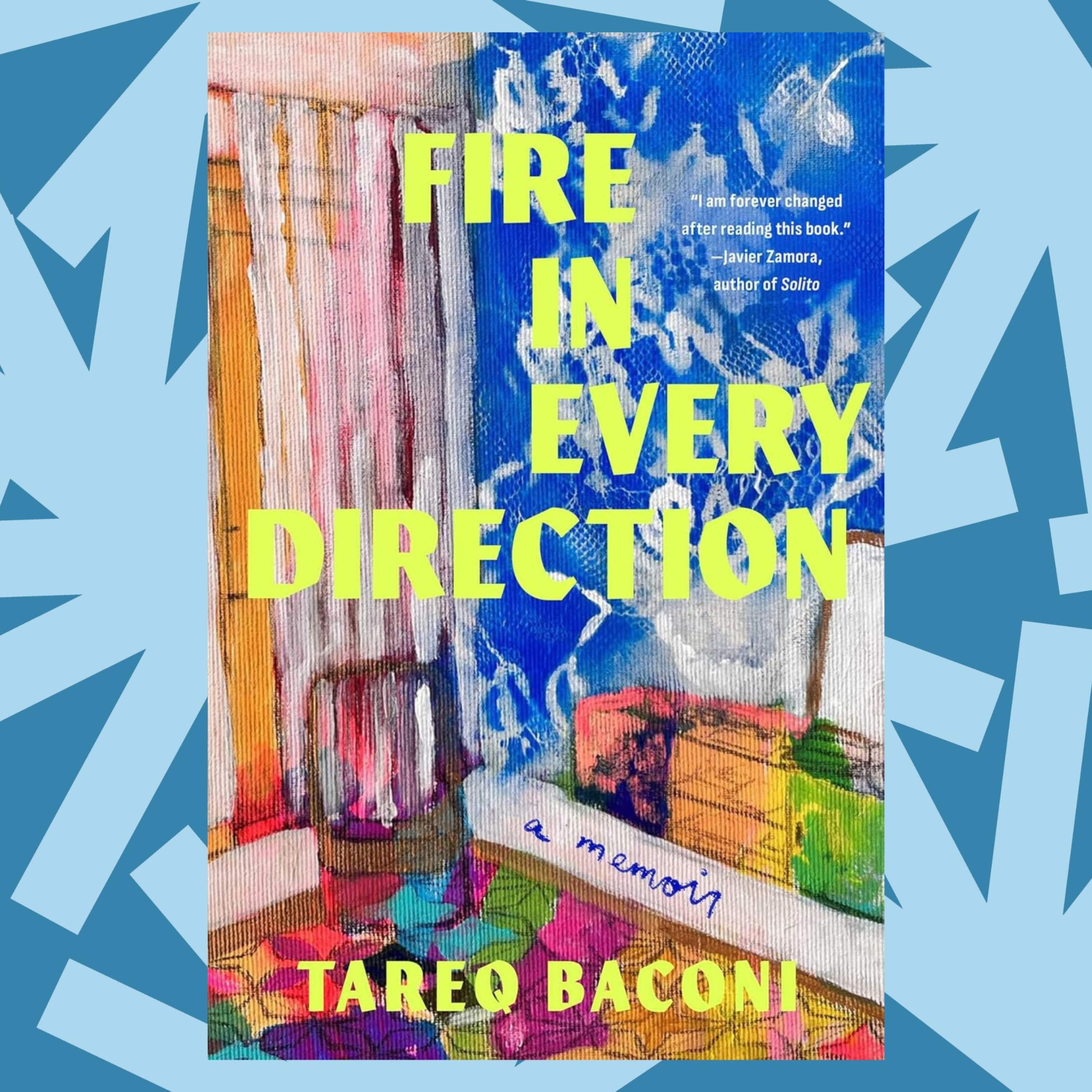
NPR's Book of the Day
'Fire in Every Direction' is a personal work by Palestinian scholar Tareq Baconi
00:14:28
Loading summary
Transcript38 lines
- [00:02]
Andrew Limbaugh
Hey, it's NPR's Book of the Day. I'm Andrew Limbaugh. Tarek Baconi's memoir Fire in Every Direction is an open, personal, vulnerable memoir about growing up as a queer boy in Jordan, hiding his sexuality from his family, the shame he felt and finally coming out. But before this book, Bocconi was known for his scholarship, writing academically about Hamas and Palestinian politics. And he tells NPR's Layla Fadel about how the that type of academic writing was for him, its own form of hiding. That's coming up.
- [00:37]
NPR Sponsor (Schwab)
This message comes from Schwab. Everyone has moments when they could have done better. Same goes for where you invest. Level up and invest smarter with Schwab. Get market insights, education and human help when you need it.
- [00:51]
NPR Sponsor (Progressive Insurance)
This message comes from Progressive Insurance and the name your price tool. It helps you find car insurance options in your budget. Try it today@progressive.com, progressive Casualty Insurance Company and affiliates. Price and coverage match limited by state law, not available in all states.
- [01:07]
Layla Fadel
A grandmother flees Palestine as a child on a fisherman's boat. A family is uprooted from Lebanon after a massacre of refugees. A writer grows up with a culture of silence in Jordan. Tarek Baconi, a renowned Palestinian scholar, has written a memoir of three generations of displacement. It's called Fire in and Tarek Bakhoni is with me now. Thank you for being here.
- [01:31]
Tarek Baconi
Thank you for having me.
- [01:33]
Layla Fadel
So in your book, you start with unpacking a yellow box full of letters from a childhood friend named Ramsey. Who was he to you?
- [01:42]
Tarek Baconi
Well, Remsey was in some ways my closest friend growing up. He was my neighbor. He was the first boy that I fell in love with. We met when I was around 11 and we were friends for a period of about 6, 7 years until I left for university. And during that period it was a beautiful friendship at its core and for me increasingly a friendship that turned into a romantic interest. And we were each other's in some ways. I mean, it's funny to say that because we were neighbors but also pen pals because we used to write each other letters the whole time that we knew each other.
- [02:27]
Layla Fadel
What was it that had you hold on to those letters with all of your moves throughout adulthood and look back on them as you wrote this coming of age story?
- [02:40]
Tarek Baconi
I think I always knew that I wanted to write this book because the way that our friendship ended was brutal and had misunderstood what I was trying to do and say. So I always felt that I wanted to salvage myself narrative. But also the letters were precious. They were a Part of him that I still had, you know, after our friendship ended, we didn't speak, so we haven't spoken in more than 25 years. And it felt. It felt that his letters were just a testament to that period of my life, at least.
- [03:14]
Layla Fadel
You know. Central to this book is growing up in Amman, Jordan. You really keep part of who you are and yourself is secret, almost even from yourself. And you start to fall in love with this boy, Ramsey. And you describe it as wearing a mask. What happens when you start to peek out from behind the mask and confess your feelings?
- [03:38]
Tarek Baconi
Well, I mean, the mask was also something that protected me in the sense that I was afraid of what it would mean to acknowledge these feelings. And the mask would help me pretend that everything was as it should be. And that was sort of increasingly unsustainable until obviously there's a confession of those feelings to him at some point and the mask sort of comes off, you.
- [04:00]
Layla Fadel
Know, as you try to stifle yourself, you find parallels in your mother's story. You describe her moving from Lebanon to Jordan, stifling a life of protest, trading it for a domesticated life. You write, quote, a good one, just not the life that she had imagined for herself. And the fire within her until she learned to control it, it burned in every direction around. What about her story resonated with your own story?
- [04:27]
Tarek Baconi
I think when I was growing up, I couldn't quite understand why my mom was so angry. And with time, I began to understand that the same way that silences shaped my life and made me smaller and prevented me from being the whole of who I am, those silences also impacted her. There were things she couldn't talk about. There were forms of politics she couldn't embody. And so she also was made smaller and as a result of that, became angry and bitter.
- [05:02]
Layla Fadel
Throughout the book, you use this Arabic word, ayb, shame, you know, which I'm very familiar with, too. Arab American woman growing up. And you just like, oh, this is ayib. You can't do this. You can't be like this. And that was sort of the start of your mother's life with your father, right? Like, oh, you can't just be dating now that you're in Jordan. We don't do this. You have to get married. And I just wonder, like, that theme, how it shaped the narrative.
- [05:25]
Tarek Baconi
Well, I mean, the notion of a' eb of shame, I think, is very oppressive and it's very resilient wherever you are, whether you're growing up in an Arab family in the U.S. in the west or back home. I think the strictures of EB Are very confining. But I think that notion of shame, I was really attracted to it or interested in it because I just. It's completely shaped my life. And, you know, my experience as a queer boy growing up, my mom's experience as a political feminist who's working to organize and to be a committed activist. How the same notions of Arab shape us.
- [06:05]
Layla Fadel
And, you know, what I found so beautiful about your story was that it was your story without judgment necessarily, of the culture that you came from. It was this. You still love who you are in all of its facets. Palestinian. Growing up in Jordan, from a family that had to flee through all these places. There was not an anger or a rage towards that. How did you hold both of those things?
- [06:35]
Tarek Baconi
Well, because there is love. You know, there is love. And this question, this idea of a. Of shame, part of the reason I find it frustrating is because what are we hiding from? We're so much bigger and we're so much better, and we're so much more honest when we hold our humanity in all of its complexities. Why do we try to make ourselves smaller? And so I think the love is there. I don't know if I agree that there's no anger.
- [07:01]
Layla Fadel
Well, you definitely. Okay, let me rephrase. Yes, you definitely have anger. And there's also parts of your life where you're like, I'm going to reject this part of my life for now.
- [07:09]
Tarek Baconi
Right? Yes. And I think that was very hard, you know, coming out of Jordan, sort of after the collapse of this period of unrequited love, the collapse of this friendship, and I leave. And I think, you know what? I don't want to be here. This is a community that's excised me, that's rejected me, and I want to move to somewhere like London that's able to hold my sexuality without judgment. And obviously that comes with. At the time, I don't understand that living in the west is also dealing with Western racism and with Western colonialism. And I don't quite understand that yet. But there is a period where I reject everything, and I reject sort of being an Arab man. And I have this aspiration to pass as a liberal in the West.
- [07:57]
Layla Fadel
So in college in London in 2003, you're going through this political awakening, but you've also been going through this very personal awakening for yourself. And there's a point where you tell your mother, you know, I'm a gay man, and she listens, and she hears you and she says, okay, we gotta tell your dad. And you go back and tell your dad. What was that conversation like?
- [08:22]
Tarek Baconi
It was very difficult. I mean, the first time I had tried to tell him, after everything erupted with Ramzi, he sort of dismissed it and said, you know, it's just a phase. It's fine. And I go back into the closet for about seven years. And so when I come back to this realization that, no, I am a gay man and I need to tell my mom and then my dad, I know that this time I will have to deal with whatever repercussions will unfold. I knew that that was the beginning of a journey for them and a continuation of one for me. And so I was scared about how to have this conversation. What would it mean? I was prepared to not see him for a long time after that. I approached it with a lot of trepidation. And actually my mom did as well because she put sedatives in his coffee to make sure.
- [09:18]
Layla Fadel
Just drug him a little for this one.
- [09:19]
Tarek Baconi
Just drug him a little. Which, you know, in hindsight, Arab mama in an Arab home, she knows what she's doing.
- [09:29]
Layla Fadel
Oh, man. When you tell your dad, he says. And you said damaging things, and I'm sure this was hurtful to hear. He says, you cannot live in Jordan anymore, that this is no longer the place for you. When you go to Haifa and find your grandmother's childhood home that she was Displaced from in 1948, you cannot bring yourself to ring the doorbell. It seemed like you are searching for home. Have you found that?
- [10:01]
Tarek Baconi
Yes, I have. I have found that my concept of home now is in my chosen family. It's in the community that I've cultivated. It's, you know, I feel at home in Jordan. I feel at home in London. I feel at home in Palestine, in different cities I've lived in. And home has come to mean something else to me. It's come to me and the people in my life that I love and that love me and that form a part of a community with me that has shared values and shared politics. It's not this sense of needing to go back to somewhere. I think it's my concept of it has. Has evolved.
- [10:38]
Layla Fadel
It was very heartwarming to read near the end of the book where your dad just, like, loves your husband. He's like, when are you coming back to Beirut? It's just a totally, like, things changed. Like, once you were open and clear to them about who you were and that you wouldn't back down.
- [10:55]
Tarek Baconi
From who that was, Absolutely. I think that he surprised me in so many ways. My dad has passed now, but, you know, before he passed away, I just couldn't believe where he got to and how he embraced me. And it really affirmed my impulse that, you know, these silences, who are they serving? My relationship with my father is much, much, or was much more loving and more honest than it ever was when I was hiding parts of myself from him.
- [11:30]
Layla Fadel
You say in your book, and you said earlier that you've been writing this memoir for nearly 20 years, that it's always been an idea there for you, and that's most of your adult life. What made you finish it now, in this moment?
- [11:45]
Tarek Baconi
Well, I was always scared of writing this book. I didn't know where it would take me. I also don't think that I was prepared emotionally to do all of the work that it would require of me. And so I distracted myself with other writing. And my first book came out in about 2018. That took 10 years of my life, so the first, I guess, decade of my adult life. And then when I published that first book, it was almost. It wasn't even a conscious decision. I just immediately turned to this. I knew that I had been hiding in that first book and that it was time to come to this. So I started writing this book in 2018. 2017. 2018. And I could have never imagined it coming out at a moment of genocide. You know, this is just not the universe that I had imagined this book being, but publish in. It's not the universe I imagined we could be living in. But it's been a big part of my life for many years. And I just turned to it when I. When I felt that I was able to meet what it required of me emotionally.
- [12:52]
Layla Fadel
I mean, you talk about your first book, which is a very well known book called Hamas, contained a totally different book. What was it like writing such a personal work that speaks to this larger question around displacement and loss and war.
- [13:06]
Tarek Baconi
And belonging to it was challenging in ways that I hadn't necessarily anticipated. You know, writing analytically or writing academically is important, but it's also a way of hiding. At least it was for me. And this book was a way of going into the lived experience. What did it mean that? Or what does it mean that? I'm the grandson of four refugees from Palestine, and in that way I found it painful in many ways, but also cathartic and important for me on a personal level. You know, the funny thing is I'm a very private person. And you know, I would have never imagined writing a memoir, but actually writing this book was the only way I could really confront myself and sit with myself and sort of embrace who I've become as a person in all of its different facets. Yeah.
- [14:03]
Layla Fadel
Is it freeing to have it in the world?
- [14:06]
Tarek Baconi
Well, we'll find out. You know, I keep saying this is either the bravest or the stupidest thing I've done. And we'll, we'll find out soon enough.
- [14:18]
Layla Fadel
Tarek Pakoni is the author of Fire in Every Direction. Thank you, Tarik.
- [14:23]
Tarek Baconi
Thank you for having me.
- [14:30]
Andrew Limbaugh
Hey, Andrew here, The host of NPR's Book of the Day podcast. And yeah, I love new books, but there's just something about rereading an old favorite on our new limited series, Books We've Loved. We're revisiting some classics from Pride and Prejudice to Dune to Everything in between and talking about why they're worth reading today. Listen to NPR's Books We've Loved right on this podcast feed every Saturday on the NPR app or wherever you get your podcasts.
- [14:58]
NPR Sponsor (Schwab)
This message comes from NPR sponsor, 1Password. Forget your password again. Skip the resets and sign in securely with strong unique passwords that auto fill across all your devices. Try it free for two weeks at 1Password.com NPR this message comes from CookUnity.
- [15:18]
NPR Sponsor (Progressive Insurance)
Choose from hundreds of meals prepared by award winning chefs. Flexible commitment, free subscriptions. Skip deliveries, pause or cancel anytime. Crush your health goals with mouth watering chef crafted meals delivered straight to your door. Go to cookunity.com NPR or enter code NPR before checkout for 50% off your first week. That's 50% off your first week by using code NPR or going to cookunity.com NPR this message comes from Mint Mobile. Starting at $15 a month, make the switch@mintmobile.com Slimmin Switch $45 upfront payment for three months. Five gigabyte plan equivalent to $15 a month. Taxes and fees extra first three months only. See terms.