← NPR's Book of the Day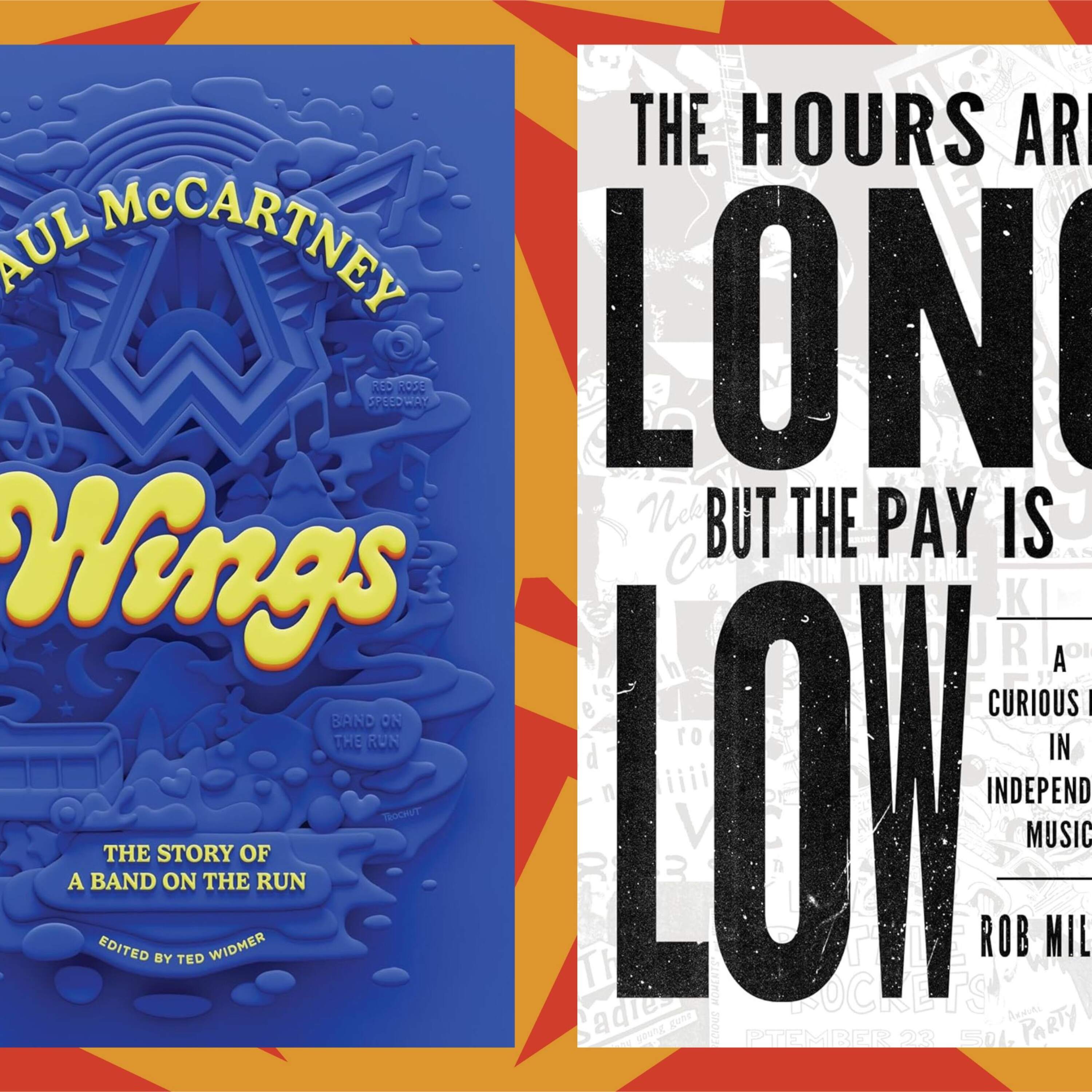
NPR's Book of the Day
Paul McCartney on his band 'Wings,' plus the story of indie label Bloodshot Records
00:17:22
Loading summary
Transcript69 lines
- [00:02]
Andrew Limbong
Hey, it's NPR's Book of the Day. I'm Andrew Limbong and if you are a regular listener, you know we love Friday music pairings around here. So in a bit, the one and only Paul McCartney is on the pod. His new book is all about his post Beatles band Wings. But first, if you were paying any attention right now to current day indie rock, you know that a lot of it is tinged with Americana, country, French folk. This is not the first time that the punks have picked up the pedal steel. There was a wave of alt country music back in the 90s, particularly out of Chicago, and much of it coming out of one indie label, Bloodshot Records. Rob Miller is a co founder of the label and his new book is about the music scene he helped cultivate. It's called the Hours Are Long but the Pay is Low. He talks to npr. Scott Simon, about the book and whether labels are still necessary today. That's after the break.
- [00:56]
NPR Sponsor Announcer
This message comes from Charles Schwab. When it comes to managing your wealth, Schwab gives you more choices like full service, wealth management and advice when you need it. You can also invest on your own and trade on thinkorswim. Visit schwab.com to learn more. This message comes from Progressive Insurance. Progressive makes it easy to see if you could save when you bundle your home and auto policies. Try it@progressive.com Progressive Casualty Insurance Company and affiliates. Potential savings will vary. Not available in all states.
- [01:26]
Scott Simon
In the early 1990s there was a new sound in music. Not quite country, not quite rock, not quite hung. It was dubbed alt country or even the alternative, bubbling up alongside alternative rock and grunge. Rob Miller called it insurgent country and in 1993 he co founded Bloodshot Records, an independent label in Chicago. Label put out albums by the old 97s, the bottle rockets and many more. He's now written a memoir, the Hours are Long but the pay is Low. Rob Miller joins us from Chicago. Thanks so much for being with us.
- [02:11]
Rob Miller
Oh, thanks so much for having me. I appreciate it.
- [02:14]
Scott Simon
You grew up in Detroit in the 70s and say in this book you went to Chicago to escape music. Didn't quite work out, did it?
- [02:22]
Rob Miller
No, no, in that I failed spectacularly.
- [02:27]
Scott Simon
Well, what happened?
- [02:29]
Rob Miller
I had been working in Detroit as a middling fanzine writer and I'd also been doing a lot of stage production and production managing. And I just found myself being at shows 14, 16 hours a day, first one in, last one out kind of thing, day after day. And I kind of got burned out on Music. And I was no longer hearing music. It was just something that was in the way as I did my job. And I thought I just was kind of done with music and let's move to Chicago, like so many other people from Detroit were doing at the time.
- [03:03]
Scott Simon
What did you happen upon? What did you discover in Chicago at that time?
- [03:07]
Rob Miller
It was a place where people in the creative fields, writers, theater people, woodworkers, musicians, people who wanted to start labels. It was a very wide open town and with a very low bar for entry. And you could screw things up, you could fail and just try again. There was no sense of, this is my shot. Because Chicago was not in the spotlight that, say, New York or LA or Nashville were, in terms of music. You could just kind of try things out.
- [03:42]
Scott Simon
So Bloodshot Records was, if I might put it this way, conceived on a bar napkin.
- [03:48]
Rob Miller
You may. Yes.
- [03:49]
Scott Simon
We.
- [03:50]
Rob Miller
A couple of friends of mine and I, we were sitting in one of our favorite bars and we just made up a list of names of bands that were kind of playing around with roots music tropes. And they were being completely ignored by the music press. That was happening at the time that were falling over themselves with Liz Phair and the Smashing Pumpkins and Urge Overkill and Chicago's kind of being portrayed as the next Seattle. But all these root spans were kind of percolating beneath the surface of this underground scene. The underground of the underground. We just thought it was a shame and that we should just put together a compilation album and see what happens.
- [04:31]
Scott Simon
Let me ask you about some artists and their releases. For example, 1997, straight out of Boone County.
- [04:38]
Rob Miller
Well, that was one where we had modern artists or artists in our circle do covers of songs from a label called King Records and a radio show called Boone county out of Southern Ohio in the 1950s. Hugely influential, but also has kind of been forgotten.
- [04:58]
Paul McCartney
Well, there's an evening train coming and.
- [04:59]
Paul McCartney Singing
I'm gonna be on it I've been playing sick and feeling my girl and I wanna go home But I'm really homesick and I'm tired of a big, big city I'm gonna hop that train and tell the engineer to get with.
- [05:12]
Rob Miller
It and so we had these people cover songs from that catalog. And they did it through their own lens in a way that was just vastly different from what it was originally done. But still in the same spirit of innovation and kind of an outsider mentality to it. And, yeah, a lot of people loved it, but a lot of people, you know, who were arbiters of country authenticity hated It.
- [05:39]
Scott Simon
And let me ask you about Just In Town's Earl.
- [05:41]
Paul McCartney
Good.
- [05:42]
Paul McCartney Singing
I'm going uptown to the hall of.
- [05:45]
Scott Simon
River to drown the son of Steve Earl, the the great country music artist named after Townes Van Zant. The kid didn't have a chance.
- [06:06]
Rob Miller
Justin was somebody who stayed at my house once and I didn't know who he was. I mean I knew who he was, but I didn't know his music. I knew who his dad was and he played at a house concert in the north shore of Chicago and I went to it and within the second song, by the second song, I knew I had to work with him. He just commanded that little makeshift stage in this house and had an intensity to him that it was a thunderclap moment for me.
- [06:35]
Scott Simon
Friend said your work was glamorous. Was it?
- [06:40]
Rob Miller
If you consider 3am tacos and not sleeping and long drives to watch somebody play for 30 people and make no money and be the first one in the building and last one out or of the office as well, it's not glamorous, but it was never boring and it was never the same. And it did have those moments of exaltation when it all went right.
- [07:06]
Scott Simon
In your appendix. You have some tour managers words of wisdom. May I ask you about couple?
- [07:12]
Rob Miller
Sure.
- [07:13]
Scott Simon
Never give your duct tape to anyone.
- [07:15]
Rob Miller
Well, that's pretty self explanatory. I mean everyone wants duct tape and they take it and then they never come back with it. And then the next day you're looking for your duct tape and it's gone.
- [07:26]
Scott Simon
Yeah, I. I guess you're right. And you advise never leave behind any food.
- [07:31]
Rob Miller
You're not hungry now. But in that dead zone between Columbus, Ohio and Louisville, Kentucky at 4:30 in the morning, whatever was left behind will seem like a stake to you.
- [07:46]
Scott Simon
I gotta ask you, you walked away from Bloodshot in October 2021 and there was a lot of controversy surrounding the label. There were allegations that some artists were owed thousands of dollars in royalties. How do you respond?
- [08:03]
Rob Miller
That I put my full faith and trust in a business partner who did not deserve it. For better and for worse. Our responsibilities were incredibly siloed and I just thought that we shared a conviction to make sure we were doing things above board. And apparently we did not. I will say that I made sure to the best of my abilities that people were paid what they were owed. We spent a lot of time and accounting money to make sure myself and the staff to make sure that people were paid what they were owed.
- [08:41]
Scott Simon
Is there still a need and a place for independent labels in a time when, you know, someone can sing a few lines into their iPhone and put it online and millions of people can.
- [08:56]
Rob Miller
Hear it, I think absolutely there is, because artists are by nature, let's say, let us just say that they do not have the logistical grace to carry off all the things that need to happen to make your music rise above the din of all these other people putting out music. So if label is maybe an antiquated term, then at least a team, you need a team behind you to help you help people find out what is so special about your music. We're all in it together, so no one can do this by themselves.
- [09:39]
Scott Simon
Rob Miller, co founder of Bloodshot Records. His new book is the Hours Are Long but the Pay is Low. Thanks so much for being with us.
- [09:48]
Rob Miller
Thank you very much for having me. I appreciate it.
- [09:58]
NPR Sponsor Announcer
This message comes from Wayfair. Wayfair makes it easy to tackle your home goals and gift list with endless inspiration for every space and budget with fast and easy delivery, even on the big stuff. So you get what you want when you need it. Get last minute hosting essentials, gifts for all your loved ones and decor to celebrate the holidays. For way less, head to Wayfair.com right now to shop all things home. That's W A Y f a I r.com Wayfair Every style, every home.
- [10:28]
This message is sponsored by DSW, the birthplace of the humble brag. Full of all kinds of shoes that get you at prices that get your budget. And when there are never ending options for every style, mood, occasion and budget, there is unlimited freedom to play. And that's something to brag about. So go ahead, stock up on fresh sneakers from your favorite brands or try those boots you always secretly knew you could find. The shoes that get you at prices that get your budget. Dsw, let them surprise you.
- [11:02]
Andrew Limbong
I don't know if I really need to do a setup here, right? It's NPR's A. Martinez talking to Paul McCartney about his band Wings. You know who Paul McCartney is, don't you?
- [11:10]
NPR Host (A. Martinez)
Here's a In 1970, the Beatles broke up. Paul McCartney and his family left the chaos of Abbey Road for a quieter life on a farm in Scotland. But soon the itch came back. He wanted to get back to writing silly love songs.
- [11:28]
Paul McCartney Singing
And what's wrong with that? I like to know. Cause here I go again.
- [11:43]
NPR Host (A. Martinez)
Paul McCartney's new band was called Wings, and they became one of the best biggest hit makers of the 1970s. McCartney chatted with us about his new book, the Story of a Band on the run. And we started where the Beatles ended.
- [11:57]
Paul McCartney
I didn't really see it coming. The sort of giveaway was that we weren't spending a lot of time with each other. Once we started to, you know, get girlfriends and wives. Once John, for instance, hooked up with Yoko, that was, you know, telling. I could see that he now wanted to go in another direction. And I just hooked up with Linda. I didn't need to go in another direction. We could have just continued as we were, but things were changing. But at the time, it was quite a shock.
- [12:35]
NPR Host (A. Martinez)
I mean, it sounds like you were willing to, you know, keep giving this a try.
- [12:38]
Paul McCartney
It sounded like, yeah, sure, with the Beatles, it would have been great. I was trying to encourage us to sort of go back and sort of start from square one. But in actual fact, I did that with Wings. It was kind of strange move, really. But the alternative was to have a big. What they would call the super group. I mean, looking back on it now and reading the. The Wings book, it was like, my God, I'm a maniac. I am a total maniac.
- [13:10]
Paul McCartney Singing
I can almost remember the money faces that time you told him that you gonna be marrying soon. And chance. I thought the only lonely place was on the moon.
- [13:35]
NPR Host (A. Martinez)
Tell me, though, post Beatles, now you're on your farm, your. Your sheep farm in Scotland. You're with Linda, the kids. Where were you creatively at that point?
- [13:46]
Paul McCartney
I was in a simpler frame of mind, and I think I was in a freer state of mind. I remember thinking when I was with the Beatles, we had our office in London, and at Christmas time, someone would buy a Christmas tree. And then when I was up in Scotland, I thought, this is great. No one's gonna buy me a Christmas tree. I've got to go and get my own. I mean, you know, something as simple as that felt like total freedom. It was like, this is great. I love this.
- [14:18]
NPR Host (A. Martinez)
So it sounds like the juices started to flow for sure.
- [14:21]
Paul McCartney
Yeah. You know, it really was like a rebirth. And then the craziest thing was my lovely wife Linda, we would sing around the house. And I always remember thinking, wow, she's really got something. But she's completely inexperienced.
- [14:39]
NPR Host (A. Martinez)
I mean, did you have to pitch her to be in the band, or did she want to be?
- [14:44]
Paul McCartney
No, she was very cute. She could tell I wanted to put a band together. I said, do you want to be in it? She sort of said, yeah.
- [14:54]
Paul McCartney Singing
When you were young and your heart was an open book.
- [15:02]
Paul McCartney
You used to.
- [15:03]
Paul McCartney Singing
Say, live and let live. You know, you did. You Know you did, you know you did. But if this ever changing world in which we live in Makes you give in and cry say live and let die.
- [15:28]
Paul McCartney
We had a lot of fun. It was crazy. There were certainly moments that were fraught with danger and. Oh, like what?
- [15:36]
NPR Host (A. Martinez)
Like what moments?
- [15:37]
Paul McCartney
Please tell me. Oh, my God. We were playing crazy little gigs. I had a song that we used to do called Wildlife. The intro is on piano. So Linda had the intro. I said, we'd like to do a song now called Wildlife. One, two, three, one, two, three, Nothing. And I look over at Linda, and she's looking kind of, you know, perplexed. Oh, hell, how does this go? So I think, oh, okay, I'll show her. So I walk over and I go, okay. And I've forgotten it. So we're. Bloody hell, the two of us. Well, luckily, the audience thought this was like a sort of gag. Was this rehearsed? And then suddenly it clicked in and Linda remembered it and she started it and we did the song.
- [16:30]
NPR Host (A. Martinez)
When Wings, you know, was. Was touring British universities, playing covers, playing Wing songs. No Beatles songs. I mean, it sounded like in the book that you really kind of rejected any of the doors that would open by you being a Beatle.
- [16:46]
Paul McCartney
Well, you know, at the time, I thought, I'm trying to make a new band here. I'm trying to do this new thing, you know, and promoters would say, would you just. Please just do. Yesterday we said, no, we're not doing it. We did it that way in order to build a Wings repertoire. Yeah. Once that happened, I was round about 76 when we had a record band on the run. Suddenly now we had songs that the audience would recognize were our songs, Wings songs. So then I felt easier about, oh, yeah, you know, here's a Beatles song. So now I interspersed. But I felt I had to establish the identity of Wings first.
- [17:33]
Paul McCartney Singing
If I ever get out of here. Thought of giving it all away to register charity. All I need is a pine today if I ever get out of here.
- [17:47]
NPR Host (A. Martinez)
That's Sir Paul McCartney. His new book is Wings the Story of a Band on the Run. Paul, thank you very much.
- [17:54]
Paul McCartney
Thank you. It's been fun. And listen, NPR is great and must always survive and educate us all in the ways of life.
- [18:04]
Rob Miller
Perfect, perfect way to end it.
- [18:14]
Andrew Limbong
And that's it for NPR's Book of the Day. If you want more, you can sign up for our newsletter@npr.org Newsletter Books. I'm Andrew Limbong. The podcast is produced by Chloe Weiner and edited by Megan Sullivan with help from Ivy Buck. Our founding editor is Petra Mayer. The show elements for this week were produced and edited by Jordan Marie Smith, Sarah Handle, Natalie Winston, Adriana Gallardo, Barry Gordemer, Martin Patience, Ed McNulty, some Samantha Balaban, Shannon Rhodes, Phil Harrell, Dave Mistich and Jacob Fenston. Yolanda Sanguini is our executive producer. Thanks for listening.
- [18:57]
NPR Sponsor Announcer
This message comes from BetterHelp. The holidays bring traditions and joy, but they can be tough, too. Therapy helps you care for yourself so you can truly show up for what matters most. Visit betterhelp.com NPR for 10% off this.
- [19:13]
Message comes from Vanguard Capturing value in the bond market is not easy. That's why Vanguard offers a suite of over 80 institutional quality bond funds actively managed by a 200 person global team of sector specialists, analysts and traders. They're designed for financial advisors looking to give their clients consistent results year in and year out. See the record@vanguard.com audio that's vanguard.com audio all investing is subject to risk. Vanguard Marketing Corporation Distributor this message comes from NPR sponsor Capella University. With Capella's flexpath learning format, you can set your own deadlines and learn on your schedule. A different future is closer than you think with Capella University. Learn more at Capella. Eduardo.