← On Purpose with Jay Shetty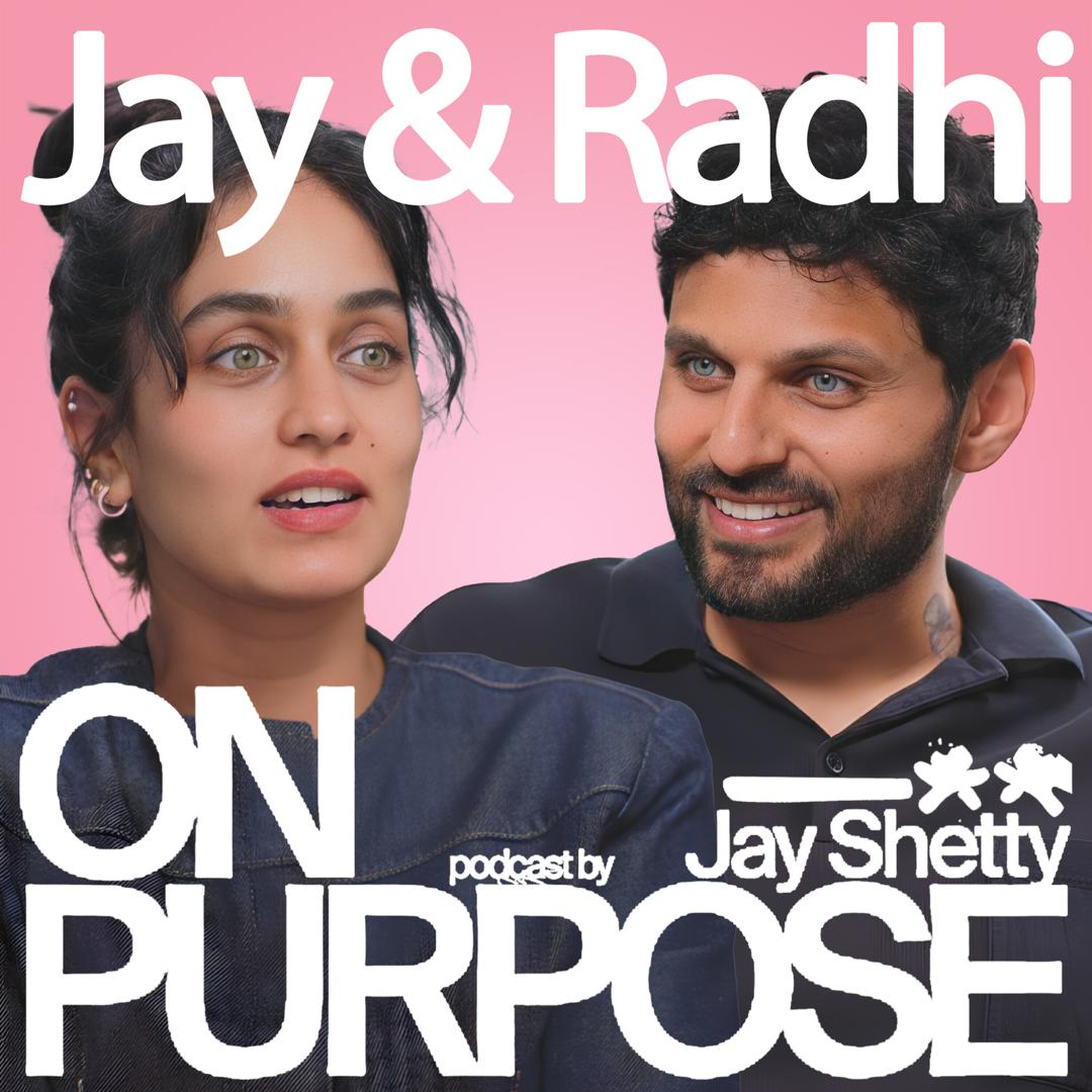
On Purpose with Jay Shetty
Jay & Radhi Talk About the Pressure and Expectations Around Parenthood
00:37:36
Loading summary
Transcript133 lines
- [00:00]
Az Fudd
This is an iHeart podcast. Have you ever looked at a piece of abstract art or music or poetry and thought that's just a bunch of pretentious nonsense? That's exactly what two bored Australian soldiers set out to prove during World War II when they tricked the literary world with their intentionally bad poetry, setting off a major scandal. We break down the truth, the lies, and the poetry in between on Hoax, a new podcast hosted by me, Lizzie Logan, and me, Dana Schwartz. Every episode, Hoax explores an audacious fraud or ruse from history. Listen to Hoax on the iHeartRadio app.
- [00:35]
Radhi
Apple Podcasts, or wherever you get your podcasts.
- [00:40]
Az Fudd
Hey, guys, it's Az Fudd. You may know me as a gold medalist, you may know me as an NCAA national champion. You may even know me as a people's princess. Every week on my new podcast, Futaround, and find out, I'll be talking to some special guests about pop culture, basketball and what it's like to be a professional athlete on and off the court. Listen to Futaround and production of iHeart Women's Sports in partnership with Unanimous Media on the iHeartRadio app, Apple Podcasts, or wherever you get your podcast. Not today. Not today. Do we really need another podcast with a condescending finance bro trying to tell us how to spend our own money? No, thank you. Instead, check out Brown Ambition. Each week, I, your host, Mandy Money, gives you real talk, real advice with a heavy dose of I feel useless. Like on Fridays when I take your questions for the Baqa. Whether you're trying to invest for your future, navigate a toxic place. I got you. Listen to Brown ambition on the iHeartRadio app, Apple Podcast, or wherever you get your podcast.
- [01:40]
Radhi
I do not want kids.
- [01:42]
Az Fudd
Being a mom is amazing.
- [01:44]
Radhi
It's the best thing.
- [01:45]
Az Fudd
I'm 33 and I have no kids. Being a mom is literally the best thing ever. Do not have kids.
- [01:51]
Radhi
I would argue it's one of the most important decisions.
- [01:54]
Az Fudd
You wanna have kids. No decisions.
- [01:56]
Radhi
Who you decide? When are you going to have kids?
- [02:00]
Az Fudd
There's no benefit to asking that question. Saying that to someone who is really struggling, it can end up triggering something so deeply.
- [02:06]
Radhi
Do I know how my life is going to change? And am I ready to embrace that change?
- [02:10]
Az Fudd
The older that you get as a woman, the more difficult it is to conceive.
- [02:14]
Radhi
The pressure of having a child financially is actually one of the biggest factors in why people are scared of having children. This is something I hear a lot when we're back in London. Yeah, for sure is when are you going to have kids?
- [02:29]
Az Fudd
Yep. It's a big question, especially after you hit 30s. It's something. Especially the aunties out there, they just really like knowing. For some reason, they want to know what's happening. And I think a lot of people struggle with it. My friends really do, especially my friends who are not even in a relationship at the age of 35 or, you know, in their late 30s, and they haven't got into a relationship, and then they're really scared about the idea of, when am I going to have children? And then the pressure of people asking on top of that, I think more so for women than men, it's just really. It can be really difficult for so many people to hear that regularly and not know when it's gonna happen for them.
- [03:10]
Radhi
Yeah. Talk to me about that pressure, because I think you're right. Women get it more than men, definitely. And they hear it a lot more often from a lot more people. So talk to me a bit about that pressure, because I may not even understand it fully, because that's not really something that men get hit with that often.
- [03:25]
Az Fudd
Yeah. I think, you know, biologically, look, it is true. The older that you get as a woman, the more difficult it is to conceive. And so I think biologically, women have this internal clock that is tick. And whether you're unsure about having children or whether you really want them, you feel it internally that your body is aging and what that means, because you've been told that from such a young age that as a woman, when you have to have children, the ideal age to have children is in your 20s. As soon as you hit your 30s, it's going to get harder. And so I think you feel it in your body and you notice changes that are happening which lead you to believe that it's kind of getting to the end of the time period where it's going to be easy for you to conceive. And then I think for a lot of women who aren't even in relationships yet, it's like, God, I have to find my partner and I have to get pregnant within the next two years or whatever it is. Yeah. I think it's a mixture of media and a mixture of people around you. And the reality of the situation being, unfortunately, that we do have a body clock.
- [04:24]
Radhi
Yeah. And I did some research before the episode, and it said that women born in 2007 are projected to have their first child by age 35 versus 31 for their mothers.
- [04:37]
Az Fudd
Yes. So true.
- [04:38]
Radhi
And girls born in 2025 may not reach that milestone until age 36. And so it's going up gradually. And so anyone who's feeling alone or anyone who is thinking, oh, gosh, like, maybe it's just me, the truth is, it's not just you. It is the trend. And I think often we don't look at statistics as a way of understanding we're not alone, because the trends show what everyone around you is doing. Even if you feel everyone around you is having kids.
- [05:04]
Az Fudd
Right.
- [05:04]
Radhi
I think a lot of people look around, they go, well, everyone on Instagram has kids, and all my friends have kids. And everyone does. It's just me. I'm the one who's been left behind. Either I don't have kids or I haven't found my person yet. And the reality is the stats show, no, you're not alone at all. Pretty much everyone around you is getting older is having kids older, and that's much more normal. And I think when you understand that, it kind of frees you up from some of that pressure. But what's. What's the different kind of pressure that people get from, like, family, society, friends? Like. Like, have you noticed any patterns or differences in what you hear? And I think there's two things that I find really interesting. The first is no one ever asked the question, do you want kids?
- [05:45]
Az Fudd
Yes.
- [05:45]
Radhi
Or you will, maybe from a friend or someone you're very close to. But generally people will skip that question. It's really strange because when you ask the question, when are you having kids? It's an assumption that people want kids, that people can conceive and have kids.
- [06:00]
Az Fudd
Yeah, that's the hardest today.
- [06:01]
Radhi
We'll talk about that. That's a whole nother area. It's quite an insensitive and unthoughtful question. It comes with good intent. People are not. People are excited. People are whatever. But if you look at it in reality, it doesn't make sense as a question. It's like saying to someone, like, when are you going to start a business? And the person's like, I'm happy in my job. Like, I don't want to start a business. Or like, when are you going to leave your job and find a better job? And it's like, I don't know if I need to leave my job. Like, why are you assuming that? But we assume everyone wants kids, can have kids, and is excited about that.
- [06:37]
Az Fudd
I think the biggest part of it is the insensitivity about it. And I know people don't mean it in that way, but I think nowadays we're all aware that more people than not are having miscarriages or not being able to conceive. I think it's like one in five women have miscarriages, and so we all have girlfriends, at least, like, five women in our life, that one of them will probably have had a miscarriage. And I think now we are aware of that. When people DM me or comment on stuff or even the craziest thing is I will sometimes have videos where a little bit of my belly's popping out a bit, or like, maybe I've just eaten and I'm a bit bloated, and people are like, oh, my gosh, are you pregnant? I'm like, first of all, okay. I actually don't mind if people think I'm pregnant based on how I look. But I always think if someone's saying that to someone who is really struggling to conceive to have a baby, not sure what they're doing, it can end up triggering something so deeply. So it's kind of like, what is the benefit of me asking, when are you having children? And what's the benefit of me writing it in a public forum questioning whether that person is pregnant or not? Because if they are pregnant and they haven't told you, they probably don't want to tell you. And that's the reality of it. People go through different phases in their life where they really want children, and then they're not sure, and then they're trying to figure themselves out and feel like it's not the right time. And there's so many parts of life where you can feel a different way about something. But I always struggle with the idea of, oh, you know, are we doing it in the wrong way? Or are we doing it in the right way? Like, yes, I think, you know, health aspect of it. We are. It is better to have children when you're younger, according to your health. But then when I think about it with mindset, if I had had children when I was in my 20s, I'm not sure I would have been a version of myself that has space to have a child, look after it in the right way, create the life that I would have wanted to for that child. But I would have. I would have done that because of pressure of people telling me that the 20s is when you should do it. And then I speak to women who are in their late 30s having children. They say, I'm so glad. I'm so grateful that I had children at a later age. I now can spend so much time with them. I figured my life out. I've spent time with my partner. I feel like I'm in a stable place financially. All of these things are in place for me to really bring up this child how I wanted to. And so I think there's so many. Obviously not. There is no right, right answer. But I do think it's difficult going through. I'm sure anyone listening, I don't know whether you've been through this, but in my 20s, I thought growing up I would have both my children or the two children that I thought I wanted in my 20s, like, I was going to be a young mom in my 20s that was pregnant, looking cute, you know, just getting, like, fit. After my pregnancy, you know, I had a vision of what that looked like. And then my life changed dramatically. Our life changed dramatically. And I felt like I went through a whole journey of really trying to. Having to figure out so much more about myself, to feel even comfortable about, about inviting another soul into my life that I then would be responsible for and I would. Would want to give them the best of myself. And so I think it's. It's really hard for women, honestly. I think it really is.
- [09:35]
Radhi
Yeah. You brought up two really good things. I think one part is the idea that when you ask the question, when are you having kids? If that person's just had a miscarriage, it's really, really tough to face that question. And they try and smile and hold a positive demeanor in that environment, and then they feel pain afterwards, or let's say they're going through IVF treatment, which so many of our friends are as well, and so many people we know, and it's not going that well right now. Again, it's become an emotional reaction for that person. And then there's the person who's like, well, I don't want to have kids at all. Now, it may start a debate that they don't really want to have because they don't need to convince you or anyone else. And so those first two, though, I've seen that be so hard. I've had so many friends in the last 24 to 36 months who've gone through 1, 2, 3, 5 rounds of IVF, had multiple miscarriages, and whenever that question or conversation comes up at family dinner or anywhere, it's so emotionally difficult for that individual. And just to be really clear, me and Radhya have not gone through either of those things. And just to be totally transparent and honest, we haven't. But for anyone who is going through that, I've had so Many of my friends come up to me and just say, like, dude, I just. I'm struggling. This is men, too, like, coming up to me and just being like, my wife's just been through this. I'm just trying to be there for her. But then all her friends keep saying, like, when are you having kids? And what's going on? And then she's coming to me, and it's a real thing. And so I'm really glad that you raised that point, because I think it's often forgotten or missed. And the other thing I was going to say is I think one of the biggest challenges with humans is that we try to time things perfectly. Now. The biological clock is real. Totally understand. Let's start with that foundation. But the idea of when are you having kids? Is the wrong question. I think the right questions are actually, do I know how my life will change when I have a child? And am I ready to embrace that change?
- [11:47]
Az Fudd
Right, Right. Right.
- [11:48]
Radhi
Now, the truth is, you won't know fully how your life is going to change. So I know parents will say, jay, you never know. Your life will change in the most incredible ways and crazy ways. I agree with that, too. I don't know. I don't have kids. But what I can observe is, am I prepared for the basics of that change? Do I know it's like changing anything in life? Am I aware of how my sleep patterns may change, how my social life may change, how my relationship with my partner may change? I was looking into the statistics about this because I was talking to a client of mine, and they were telling me that after they had their firstborn, him and his wife went through the toughest part of their marriage. And when I looked into the statistics, it showed that most men feel after their partner gives birth that they feel unloved, they feel like a second priority, and they feel unthought about. And that's also why the trend showed that more men are likely to cheat at that time.
- [12:48]
Az Fudd
No way.
- [12:49]
Radhi
When either. When their wife are pregnant. When their wife gives birth. Because again, I'm not condoning this. I'm just talking about the statistics because that's when they feel neglected. So the truth is, if you're prepared for that, you'll be less surprised in court of God.
- [13:03]
Az Fudd
Right?
- [13:04]
Radhi
Right. When I think about us having kids, I'm like, got it, Radhi. I'm going to go lower on the list. And that's a reality, not just for me, but for every man in my position who has that situation. And if I'm mentally prepared for it. I'm actually better ready to deal with it, rather than I'm, like, looking at you going, well, why? What's going on? Like, why am I not your priority anymore? You don't love me anymore. When in reality, of course, your energy is going to go towards this helpless little baby who actually needs it. And all I'm saying is, like, treat me like the baby. I'm not the baby anymore. And so I think there's a lot to be said for not asking the question of when's the right time? Because I don't think you'll ever know when it's the right time. But it's. Do I know how my life is going to change and am I ready to embrace that change? So my life is going to change, but I'm not going to be a top priority. Am I ready for that? My life's going to change by. I will have sleepless nights. Am I ready for that? My life's going to change with. I may not be able to have the freedom on the weekends that I have right now. Am I ready for that? And those are better questions to prepare me, because the question of when should we have kids? Doesn't really prepare me.
- [14:08]
Az Fudd
Effy. Yeah, no, I agree. I do think that the process is never going to be the same and never going to be understood as fully by a man as it is, obviously, for a woman, because a woman has to literally carry that child inside of her for those nine months. And so I think there's always going to be slight disconnects between how men perceive the situation and how women do. But I remember I was thinking about how, you know, I remember at the beginning, when we first met, you really didn't want to have children or like you were. You weren't sure whether you did. And it was so right at the beginning. Right at the beginning. Yeah.
- [14:44]
Radhi
Just come out of the monastery and at that time.
- [14:46]
Az Fudd
Exactly. And your mindset was like that. And I read this quote, actually, that I thought for anybody thinking of not having children, I thought it was really well put. I said, motherhood is not. Motherhood is not the only way to mother. You can mother a movement, a garden, a dream or a community. And I remember when we first met, back way back when you had said you wanted to help so many more people and you weren't sure whether you wanted to put all your emphasis onto one person or into one child. And so many people recently that I have met, or actually not so many, quite a few people that I met recently have said that they don't want to have children because they feel they are saving the child from all the pain that's happening in the world. They don't think this environment is an environment to bring children into the world. I know there's a big following of that philosophy from friends that we know and even in specific communities. And I was wondering whether you'd heard that or what your thoughts were on it.
- [15:36]
Radhi
Yeah, I think. I think for me, it was very much a feeling of. I feel I get to express a lot of paternal energy. Yeah, I know it's not the same, so I'm not trying to say it's the same, but I experience a lot of paternal energy in my work. I feel like I'm a parent to lots of people, and so that part of my life is quite full.
- [15:57]
Az Fudd
I mean, if you think about Radhanath Swami, who's a spiritual teacher, and all the spiritual teachers that are out there who are not in relationships and don't have children, who are. All they do is father people or mother people and are there for them through every type of problem and supporting them, caring for them. So I can totally understand how people could feel like that.
- [16:16]
Radhi
That was how I used to feel, for sure. And. And I think there's a lot of people now who are fearful of raising a child in a world with social media.
- [16:26]
Az Fudd
Yeah.
- [16:26]
Radhi
The mental health challenges that come with it, the security and safety issues, school systems that are failing, children, the worry with. I mean, that's just like war. Like, there's. There's just so much that I think people are becoming aware of. Again, it's not lots of people. It's. It's some people that I know that are having these conversations, and. And I think all of those are valid for that person now. At the same time, I know people who are raising amazing kids that are going to go on to become future leaders of the world in their areas. And I know amazing people raising beautiful children that I think will have a beautiful impact on their communities and the people around them. And I know people having kids early who are really happy. Like, we just had Nara Smith on the podcast, and Nara's in her 20s, and she has, like, four kids, and she loves it. Like, she's really happy. And it comes with her and her husband making certain choices and what. Whatever it may be, but she's happy about it. And I can see that when I'm with her. And she's a successful woman, she's very ambitious, she's driven. But they have a happy family setup.
- [17:35]
Az Fudd
And so it's funny because now people see that as, oh my gosh, she had kids so early. Yeah, but she hasn't had kids early. I don't know what's early and late, but technically, back in the day, like even 20, 30 years ago, that would have been seen as a very normal age to have children. And now on social media, when you see it, these people saying, wow, she's had four kids in her 20s. That is so, like, she's had them so young, so early. So it's so funny how things just change, isn't it?
- [18:01]
Radhi
That's a great, that's such a good point of, like, what is normal changes every 25 years. And so this idea of, well, everyone's doing it is a messy metric because what everyone's doing today will be different from what everyone's doing 25 years from now. Silly and different to what everyone did 25 years ago. And so trying to do what everyone's doing, it does make life easier. There's a reason why we want to do things at the same time as people, because you can share in that experience and I think that's important and we need that. But if you're not ready for something. And this, this was a really interesting statistic. It said 36% of adults under 50 without kids say they're delaying parenthood because they don't think they can afford it.
- [18:43]
Az Fudd
Oh, wow.
- [18:44]
Radhi
And that, you know, has become such a challenge. 66% of parents feel consumed by money worries versus 39% of non parents.
- [18:55]
Az Fudd
So that's true. Kids are expensive.
- [18:58]
Radhi
The pressure of having a child financially is actually one of the biggest factors in why people are scared of having children. I actually read that for someone to raise their child from age 0 to 18 is going to cost anywhere between 233,000 to $310,000.
- [19:17]
Az Fudd
No.
- [19:18]
Radhi
And by the way, that doesn't include college because 18's before college. So if you add tuition fees, if your child's going to go to college, you're adding potentially another 30, 50, hundred, $200,000 depending on where they go. And so that's a incredible amount. It's a lot of money. And so that has become a real factor. And I've heard that from a lot of people saying, we really want to have another kid, but we just don't know if we can afford it. And then again, if that person gets asked, when are you having kids? It triggers financial insecurity, it triggers economic uncertainty, it triggers a feeling of not being worthy enough, not being good enough. I Don't think we realize how that question, like you said, it affects your belief about your appearance. Imagine someone's trying to lose weight gain, muscle strengthening, and someone says you look like you're pregnant. Like that affects them. On that perspective, if someone's struggling to pay their bills and having a child, you ask them, when are you going to have kids? They're now worried about, especially if they.
- [20:19]
Az Fudd
Really want children and they're trying to figure it out financially and they really want them, but they're finding it difficult to even think of how that would be possible.
- [20:25]
Radhi
Yeah, and I think we do often, I do sometimes think we're living in an overly sensitive world, but I think this, and I'm one of those people who say sometimes we're being overly sensitive about everything these days, everything's a thing. But this is one of those ones that I think it's so interconnected to your personal belief about yourself, your self worth and your finances, your emotional well being because of miscarriages, IVF and everything else that's going on. It is one of those things that I think we should be sensitive about with others.
- [20:56]
Az Fudd
Definitely.
- [20:57]
Radhi
Because it can really make you distant in that relationship.
- [21:01]
Az Fudd
I also think sometimes people ask because they don't know what else do to, to ask about people's life. And I think it's a natural thing to speak about. I think it's more a cultural thing as well, because I actually think that a lot of people ask because they don't know what else to ask in a situation. They meet someone, they've talked about the weather, they've talked about, oh, okay, so now when are you guys having kids? And I think it's weirdly a very natural cultural thing to do in certain settings. And it can come from a place of worry, it can come from a place of, you know, interest or excitement. But at the same time I'm like, if you're not the person that's gonna be looking after my child in some capacity and it's not gonna affect your life, you do not need to know. Like there is zero, unless you're my mum who's gonna have to look after me. Unless you are somewhat in relation or going to be there physically helping me during that time, there is absolutely no need for you to know when I'm going to be having that child. And if I want you to know, I will definitely send you a message or a voice note. But if I don't and I don't openly tell you, and this is probably how many people feel no need no need. There's no benefit to asking that question. Yeah, there is actually. I will. I'll say that again. There is no benefit of asking that question because if they know, they would have already told you and if they don't know, you're making them anxious in some way. So actually zero benefit in asking. When are you having children? That's my conclusion of this whole situation.
- [22:28]
Radhi
I love it. I love it. Yeah. And men, some will get to deflect or tell the truth, which is, I'll always say it's father's body. It's when she wants like, you know.
- [22:35]
Az Fudd
Yeah. Men also can, you know, get someone. Men can. Men have like unlimited fertility. They're like 60 year old men or 70 year old men that are getting women pregnant. So I think there's less of a. You're never going to feel bad about it unless your wife is going through something. It's never going to be a trigger. Triggering question really, to a man.
- [23:01]
Radhi
We all want to feel better, to have more energy and more focus throughout the day. That's why I co founded Jooni, a sparkling adaptogenic drink made with powerful ingredients like ashwagandha and lion's mane. It's designed to boost your mood, support your focus and give you natural energy, all without a crash. A new classic reimagined. We're so excited to officially launch our new lemonade iced tea flavor. When we created Jooni, my goal was simple. I wanted to make drinks that help you feel balanced and energized without compromise. Our upgraded take on the classic Arnold Palmer is crisp, refreshing and crafted with adaptogens to support energy, focus and mood, all with zero sugar. Be among the first to try it. Available exclusively@drinkjuni.com, where you can use the code ONPURPOSE20 for 20% off your first order. Cheers to your daily mood boost. We all want to feel better, to have more energy and more focus throughout the day. That's why I co founded Jooni, a sparkling adaptogenic drink made with powerful ingredients like ashwagandha and lion's mane. It's designed to boost your mood, support your focus and give you natural energy, all without the crash. Get your daily mood boost with Jooni at Whole Foods Market or head to drinkjuni.com to find a store near you.
- [24:24]
Az Fudd
Hi, I'm Kurt Braunohler. And I am Scotty Landis. And we host Bananas, the Weird News podcast with wonderful guests like Whitney Cummings. And tackle the truly tough questions why is cool mom an insult? But mom is fine. No, I Always say, cool.
- [24:40]
Radhi
Kurt's a fun dad. Fun dad and cool mom.
- [24:43]
Az Fudd
That's cool for me. We also dig into important life stuff, like why our last names would make the worst hyphen ever. My last name is Cummings. I have sympathy for nobody. Yeah, mine's Brown Oler, but with an H, so it looks like brownhoehler. Okay. That's okay. Yours might be worse. We can never get married. Yeah. Listen to this episode with Whitney Cummings and check out new episodes of Bananas every Tuesday on the exactly right network. Listen to Banana is on the iHeartRadio app, Apple Podcasts, or wherever you get your podcasts.
- [25:18]
Radhi
I had this, like, overwhelming sensation that.
- [25:21]
Az Fudd
I had to call her right then, and I just hit call, said, you know, hey, I'm Jacob Schick. I'm the CEO of One Tribe foundation. And I just wanted to go on and let her know there's a lot of people battling some of the very same things you're battling, and there is help out there.
- [25:35]
Radhi
The Good Stuff podcast, season two takes a deep look into One Tribe Foundation, a nonprofit fighting suicide in the veteran community. September is National Suicide Prevention Month, so join hosts Jacob and Ashley Schick as they bring you to the front lines of One Tribe's mission.
- [25:49]
Az Fudd
I was married to a combat army veteran, and he actually took his own life to suicide. One Tribe saved my life twice. There's a lot of love that flows through this place, and it's sincere now. It's a personal mission. Don't want to have to go to any more funerals. You know, I got blown up on a react mission. I ended up having amputation below the knee of my right leg and a traumatic brain injury because I landed on my head.
- [26:10]
Radhi
Welcome to season two of the Good Stuff. Listen to the Good Stuff podcast on the iHeartRadio app, Apple Podcasts, or wherever you get your podcasts. It may look different, but Native culture is very alive.
- [26:22]
Az Fudd
My name is Nicole Garcia, and on Burn Sage, Burn Bridges, we aim to explore that culture. It was a huge honor to become a television writer because it does feel oddly like very traditional. It feels like Bob Dylan going electric, that this is something we've been doing for, like, hundreds of years. You carry with you a sense of purpose and confidence. That's Sierra Teller Ornellis, who, with Rutherford Falls, became the first Native showrunner in television history. On the podcast Burn Sage, Burn Bridges, we explore her story along with other Native stories, such as the creation of the first Native Comic Con or the importance of reservation basketball. Every day, Native people are striving to keep traditions alive while navigating the modern world, influencing and bringing our culture into the mainstream.
- [27:10]
Radhi
Listen to Burn Sage, Burn bridges on.
- [27:12]
Az Fudd
The iHeartRadio app, Apple Podcasts, or wherever you get your podcasts.
- [27:27]
Radhi
There's something that's really interesting here, which is this idea of parenthood still equates to success and purpose. And I think as society, it seemed that way. Like, if you're a parent, you're doing the right thing, you're normal, you're doing something good. And I actually found some quotes from Tracy Ellis Ross on rejecting societal scripts. This was in the New York Times, and she said it undermined my sense of worth and joy until I realized it was somebody else's idea. I do not believe that my life is unworthy because I don't have children. I do not believe that my life is unworthy because I don't have a partner. I mother all over the place. You were saying this. I do very valued things in the world for people I love. That's a really interesting. Like, you know, going back to that point that you made of people feel alone if they don't do that.
- [28:19]
Az Fudd
I do think though, when you. When you think about all spiritual paths, religious paths, when you think about evolution and how they talk about the human body, there is such a strong. There is no question of in any of those things, whether men and women were made to procreate. Think about Adam and Eve, think about any of the scriptures, any of the religions that you've seen. Everything does lead to. You are here to procreate. Even as our. If you're thinking about take God out of this, how the human body has been created, it does show towards. That is why we are here.
- [28:58]
Radhi
That is survival. I mean, that's.
- [28:58]
Az Fudd
That is survival. And so it's interesting, I don't have the answer for it, but when I do think about it in that way, it's kind of. It's interesting to think about. Okay, so how come we have gone towards this path of saying we shouldn't be doing something, that our body's made for that. If you believe in a certain religion or a specific path, they are saying that is what our essence is, is to create a beautiful child in this world, to help other people, whatever that notion is, but that there's such a strong wave going against it, which it's just interesting because I struggle with that idea of both.
- [29:31]
Radhi
I think everyone today is looking at their inner child and then thinking about having a child. Right. Like, you're almost so aware of how Much therapy, healing and work. You need that you feel inadequate and unqualified.
- [29:46]
Az Fudd
I feel like a child having a child.
- [29:47]
Radhi
Correct. Like, you literally feel like, I haven't even figured what's going on here. How am I meant to figure out what's going on there?
- [29:54]
Az Fudd
I'm sure there's a lot of unworthiness that plays into it. Like when you. If you don't feel good in yourself, you think, how am I going to do that to a child? And then at this. On the flip side, we've spoken about this before, that there are so many couples who think having a child will help their relationship.
- [30:09]
Radhi
Oh, my gosh, we have to talk about this. I'm so glad you mentioned that.
- [30:12]
Az Fudd
That's really interesting because I think there's one side where people don't feel prepared enough. And I think I've gone on that side a lot where I'm like, God, I need to be way better before I have a child. And then there's this other side and thinking whether you. Whether you're going to mess the child. There's so many things that have gone through my mind that have stopped me. And then there's this other group of people who really strongly believe that having a child will fix them or the pain that they've been through as a child. Or, you know, my friends, I've got a lot of friends who were ra by single moms. And it was really interesting. Their mindset was really similar and not saying this for everyone, but my friends who had this, where they fundamentally believed them. Having a child breaks the cycle so that they could give the love that they didn't receive. Like, having this family set up will make up for what they lacked. And then the couples who are really struggling and decide that having children will actually be the bridge between them and it will help bridge the gap between them that has been created.
- [31:08]
Radhi
Yeah, that was the advice that so many of my friends got.
- [31:11]
Az Fudd
Really.
- [31:12]
Radhi
They were struggling in their relationships, which was like, have a kid, it will solve it. And it actually did the opposite. Those people ended up becoming. Getting divorced or after. After having the kid, too.
- [31:22]
Az Fudd
Yeah.
- [31:23]
Radhi
And so now you have a kid, which makes it harder. Or their relationship got worse because now you had more responsibilities. And I think that's what doesn't make sense. Like, and the man felt even less of a priority. So how was it ever going to get better? So on all of those levels, it actually made it harder. Now, a kid can be great. It's not like it can't. But that can't Be your Hail Mary. Like, that can't be the thing. Like, let's create life in order to save this.
- [31:47]
Az Fudd
It definitely ties them back.
- [31:49]
Radhi
It's a lot of pressure to that person, to that kid.
- [31:51]
Az Fudd
Yeah, it's a pressure on the kid. And I think there's a difference between creating connection and creating a tie with someone. I think the child can create a tie. There's so many things that can create ties to people. Okay, we've got a house together. That's a tie together.
- [32:04]
Radhi
That's a bank balance.
- [32:05]
Az Fudd
Yeah. That's a tie together. A child. Yes, of course there's an emotional connection, but the emotional connection is actually to the child. It's not necessarily to the partner that creates just another tie to keep you strong together. But I don't know whether that action, if not done consciously and as a partnership, trying to connect each other and be better with each other in order to create this child, whether that creates a connection or just a tie.
- [32:30]
Radhi
I love that point. That's such a great point. And I was thinking about it as you were saying that. Yeah. For those people who are told, like, have a kid to save your relationship, what ended up happening was they lost the relationship, and now the kid was stuck in the middle of a bad relationship. You know, it only creates more trauma and pain for everyone.
- [32:50]
Az Fudd
Yeah. In the world.
- [32:51]
Radhi
And so that shouldn't be the kind of last resort or the. The hope.
- [32:55]
Az Fudd
No.
- [32:56]
Radhi
And, you know, then you've got this innocent child that's dealing with the fallout and the stress and the panic that comes from it, and it makes harder for both parents to move on, whether it's in future relationships or whatever it may be that. Because now they have that.
- [33:09]
Az Fudd
And still got that tie.
- [33:10]
Radhi
Yeah, yeah, still got that tie. And. And it's. And it's really, really hard because the challenge is when you marry someone, you don't really know how much they're going to change and grow, and you have no clue. Like, it is such. It is such a. I don't want to say the word gamble, but it is.
- [33:28]
Az Fudd
To some people, it is a gamble.
- [33:29]
Radhi
Because you meet someone at a certain stage in your life, you create life with them, and then 10 years on, you realize that they had trauma, a mental health challenge, they have something that happens to them, and everything changes.
- [33:41]
Az Fudd
Yes.
- [33:42]
Radhi
And so you can't plan this perfectly either. You can't say, like, oh, yeah, we'll have a kid when things are perfect. It doesn't work like that either. So there's no right advice or wrong advice. And I'm not trying to give any advice here. I'm just trying to say that there's a reality to this where we're all just living life.
- [33:58]
Az Fudd
I know.
- [33:59]
Radhi
And you're adapting as it goes along, and you're not going to get everything right in perfect order. And it's better to be able to react and adapt and be flexible than it is to think I'm going to get everything perfect and avoid all the stuff.
- [34:15]
Az Fudd
Definitely.
- [34:16]
Radhi
So even when we're like, I'm not worthy enough to have a child, the truth is you'll never feel worthy. You are going to make mistakes. It's probably true that your child's going to, you know, end up with a few things that you said.
- [34:27]
Az Fudd
Yeah, you might mess them up a little bit.
- [34:28]
Radhi
A little bit. It will happen. It's probably better to assume and then try your best than it is to think I'm gonna avoid anything. And then it's like you end up putting bubble wrap around your kid, but then that bubble wrap suffocates them.
- [34:44]
Az Fudd
Yeah.
- [34:44]
Radhi
Yeah, right. And it's like, so. So it doesn't make any sense. Are you trying to protect it? But the same thing that you think is gonna protect it is what hurts the kid and it hurts you, rather than going, you know what, I'm gonna make some mistakes. I'm gonna try my best. But, yeah, maybe they are gonna hit me shout and yell a couple of times. Maybe they are gonna see me stressed and tired because that's life, you know, if. And again, we don't wanna end up in a position where we're being neglectful. But I think there has to be some grace and reality to what it means.
- [35:12]
Az Fudd
Definitely.
- [35:13]
Radhi
I think one of the really interesting areas is that women in the workplace or entrepreneurs, they're building a career for themselves. We talked about how the financial struggle is making it harder for couples to think about kids. But for women especially, they have to go on maternity leave. They'll take some time out. Not all organizations and companies have great maternity leave, so you may not even get that long. You may take unpaid leave, which, again, financially impacts you. If you're an entrepreneur, your business can stall, stop, or at least slow down. And then you go back to the workplace and you feel like you've gone behind. Right. Whether you've taken nine months out, whether you've taken six months out, whether you've taken four months out, you're catching up and it can be really, really hard. What have your thoughts been on that? On the idea of, like, having a Slowdown career. Because, you know, you, last year you launched a book, you have your own podcast. You've got so many exciting things going on. When you think about kids and how to balance it with that, how do you look at that?
- [36:10]
Az Fudd
Yeah, I really struggle with the idea because I know I made a decision and, well, at least I think this is the decision I want to make, is that if I. If we have children, I would want to be able to look after the child fully. And I'd have loved to have help from other people to help look after myself, but I know that I would want to look after the child. And so that comes with a lot of, you know, there's so much you have to think about that would mean I would have to have full focus on this child. I would have to stop doing a lot of the things that I am doing. Because realistically, I. Yes, you can do a lot of different things, but can you do them as well? Probably not. If I'm trying to put full focus into raising a child, probably can't keep up with all the work that I'm doing. And so I think sacrifice comes with such a negative connotation to it, but I actually think it can be such a beautiful thing where different times in your life, you see yourself prioritizing different things. And so if I think that's how I'm trying to see it instead, where the priority lies here, that means that I may not be able to do as much, but I can still probably pre plan. You've got nine months to plan and figure out how am I going to financially figure this out, figure out with my work, figure out with my physical body, how am I going to look after myself, whatever those other priorities are? I do think you have to decide because I think there's this big notion that, yeah, women can do it, of course we can do it, but should you be at that time where your body's trying to heal, where you've got a new little thing that's come into your life that you're trying to nurture and look after? And so, yes, I'm sure women can do it all, but I don't know whether we should be doing it all. And I think being okay with that and everything you said is preparation, preparing my mind that maybe I won't be able to do this, this, and this while for the first year of this baby's life. And that's okay, because what I am doing is nurturing, creating, and pouring all my energy into creating a beautiful child. And so I think it's the prioritization and the preparation in your mind of being okay with what could happen so it's not a shock and then you don't end up feeling really depressed afterwards that I thought my life was going to be all these things. I was going to work out at 7am, I was going to feed the child at 12. I was going to do all my work from 12 to 6. I was going to put the baby to bed at this time. I said, I'm not sure that's how it can be. And so preparation and being realistic with that preparation I think is really important. But then again, I've never been through it. I've just seen it. So I can say all this and I'll be a hot mess after. Who knows? Who knows?
- [38:43]
Radhi
Yeah. And I wanted to share some real world voices. This was by a business insider and a lady named Viviana had her first child at 36. She said, I don't regret waiting. I think it was the right thing to do. Molly had her first child at 38. She said it felt irresponsible to even start thinking about a baby when I was worried about paying rent and college debt.
- [39:06]
Az Fudd
Oh, yeah.
- [39:06]
Radhi
And I just want to remind people that when you're navigating this pressure, whichever stage you're at, whether you want to have kids, whether you don't want to have kids, whether you're at any point on the spectrum that me and Radhi have talked about today, you can have the conversation. We've talked about it. And this is the timeline that works for us right now. That's a great mantra to kind of repeat to yourself. Almost like me and my partner have talked about it. This timeline works for us and we're building a life that's right for us even if it doesn't look like everyone else's. I think the takeaway from this conversation for me is we don't want to live a life ticking society's boxes or expectations because we end up letting ourselves down, we end up letting society down and we'll end up letting our child down. We've got to go at our own timeline. And ultimately, whether you choose to have children or not, life can be fulfilling, complete and beautiful because it's all about having that energy. If you have a space to share your maternal and paternal energy, it can be a beautiful thing. I know so many friends that have adopted and are very happy. Yeah, I know so many friends that don't have children, who are monks, who have just given their life to thousands of people that are happy. And I know families that have two, three, four, five children that are really happy at different ages. And so happiness doesn't have a timeline or an age or a specific setup. Even if you look at the projection of the nuclear family in history, whether it's cereal boxes or adverts, it was always parents and a boy and a girl. And, like, that was seen as, like, the nuclear ideal family. It's in every advert. And that's just not the image that we need to project. We need to realize that happiness and fulfillment looks very different for different people.
- [40:50]
Az Fudd
So true. Great.
- [40:52]
Radhi
Thanks for that. I learned so much. I'm so glad you brought up so many things that I hadn't even thought about. That's why I love these conversations, because you went in so many directions where I was like, oh, my God, I forgot about that, or we haven't talked about that before. And I learned so much. And it's helpful for me to get a good understanding from your perspective and what your friends who have had babies think, because as a man, sometimes I can be distant from that.
- [41:13]
Az Fudd
So when I realized this was the first topic that you thought of, I was like, damn, we're really getting into it.
- [41:19]
Radhi
We are.
- [41:20]
Az Fudd
First episode out, and it's, why don't.
- [41:24]
Radhi
You just tell them to subscribe for more so that they can hear more of these conversations?
- [41:28]
Az Fudd
Jay just asked me to tell you all to subscribe for more so you can hear more of these conversations and press like and share and stuff.
- [41:39]
Radhi
Hey, everyone, if you love that conversation, go and check out my episode with the world's leading therapist, Lori Gottlieb, where she answers the biggest questions that people ask in therapy when it comes to love, relationships, heartbreak, and dating. If you're trying to figure out that space right now, you won't want to miss this conversation.
- [42:01]
Az Fudd
If it's a romantic relationship, hold hands. It's really hard to argue. It actually calms your nervous systems.
- [42:08]
Radhi
Just hold hands as you're having the conversation.
- [42:11]
Az Fudd
It's so lovely.
- [42:12]
Radhi
The risks they took would be unthinkable to any doctor today, but odds are someone you know is alone live because of them. Welcome to the wild west of American medicine. I'm Chris Pine, and this is Cardiac Cowboys, a podcast that tells the gripping.
- [42:28]
Az Fudd
True story behind the birth of open.
- [42:30]
Radhi
Heart surgery and the maverick surgeons who made it happen. Listen to the Cardiac Cowboys podcast starting February 6th on the iHeartRadio app, Apple Podcasts, or wherever you get your podcasts.
- [42:45]
Az Fudd
I just think the process and the journey is so delicious that's where all the good stuff is. You just can't live and die by the end result. That's comedian Phoebe Robinson. And yeah, those are the kinds of gems you'll only hear on my podcast, the Bright side. I'm your host, Simone Boyce. I'm talking to the brightest minds in entertainment, health, wellness and pop culture. And every week we're going places in our communities, our careers, and ourselves. So join me every Monday and let's find the Bright side together. Listen to the Bright side on the iHeartRadio app, Apple Podcasts, or wherever you get your podcasts.
- [43:20]
Radhi
I'm Jonathan Goldstein and on the new season of Heavyweight. And so I pointed the gun at.
- [43:25]
Az Fudd
Him and said, this isn't a joke.
- [43:28]
Radhi
A man who robbed a bank when he was 14 years old and a centenarian rediscovers a love lost 80 years ago. How can 101 year old woman fall in love again? Listen to heavyweight on the iHeartRadio app, Apple Podcasts, or wherever you get your podcasts.
- [43:50]
Az Fudd
This is an iHeart podcast.