← On the Media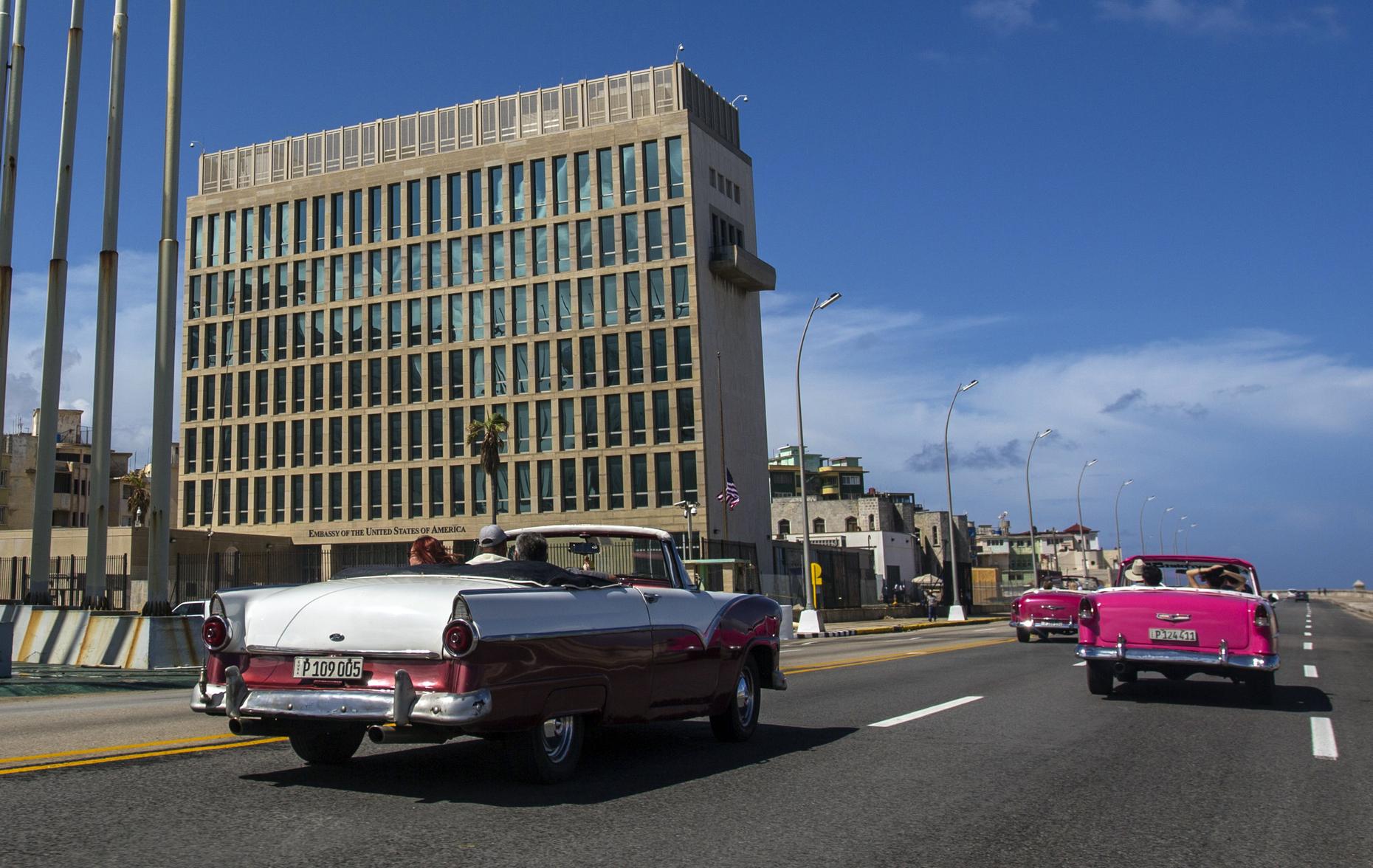
Loading summary
Transcript265 lines
- [00:00]
Brooke Gladstone
On the Media is brought to you by Progressive Insurance. Do you ever think about switching insurance companies to see if you could save some cash? Progressive makes it easy to see if you could save when you bundle your home and auto policies. Try it@progressive.com Progressive Casualty Insurance Company and affiliates. Potential savings will vary. Not available in all states.
- [00:20]
Tony
It started very, very loud. Like ear piercingly loud. Then the severe severe ear pain started.
- [00:26]
Michael Lowinger
On this week's on the Media we bring you three audio puzzles beginning with the Havana syndrome.
- [00:32]
Tony
So I liken it to like if you take a Q tip and you bounce it off your ear, you know, like you get that jarring like ah, well imagine taking like a sharpened pencil and then poking that off the eardrum.
- [00:43]
Michael Lowinger
Also a hum that you live with can help law enforcement solve crimes.
- [00:48]
John Lee Anderson
You hear it with my refrigerator, a.
- [00:51]
Michael Lowinger
Tv, elevators and buildings, you hear it.
- [00:54]
John Lee Anderson
Everything is interconnected, right?
- [00:56]
Michael Lowinger
It's very common. Plus how an invisible disturbance ruined a series of high stakes pigeon races. It was billed as the race of the century.
- [01:06]
Robert Krolwich
But many of the homing pigeons carefully prepared by their owners never returned.
- [01:11]
Michael Lowinger
The mysteries of sound and the limits of our senses. It's all coming up after this from WNYC in New York. This is on the media. I'm Michael Owensier filling in this week for Brooke Gladstone. We begin the show in Havana, Cuba in the fall of 2016.
- [01:33]
Tony
I'm just laying on my bed with my arm laptop, you know, like next to me and I'm watching the show.
- [01:38]
Michael Lowinger
This is a CIA officer going by the pseudonym Tony.
- [01:41]
Tony
And then all of the dogs in the neighborhood started barking and then.
- [01:48]
John Lee Anderson
This.
- [01:48]
Tony
Loud sound just blasted into my bedroom. It started very, very loud, like ear piercingly loud. The pressure started in the head and then the discomfort in the ear. Then the severe severe ear pain started. So I liken it to like if you take a Q tip and you bounce it off your ear, you know, like that you get that jarring like ah, well imagine taking like a sharpened pencil and then poking that off the eardrum.
- [02:16]
Michael Lowinger
Tony says the sound seemed directional. He stopped hearing it when he moved out of his bedroom. But that was just the beginning.
- [02:23]
Tony
I was at the top, physical, psychological, emotional place I could have ever been in my life. Then I was gung ho to do my job and within six months I was a zombie and non functional as a human being.
- [02:34]
Michael Lowinger
He was one of the first patients for what we now call Havana syndrome, a mysterious affliction that seemed to spread among American diplomats in Cuba and then across the globe. I felt paralyzed and I think it's just sort of one of those you're in a dream and you can't move.
- [02:53]
Brooke Gladstone
That's kind of how it felt.
- [02:56]
Michael Lowinger
These are the voices of American diplomats interviewed for a new podcast series from Vice called Havana Syndrome. So what was done to them? Were they being attacked? And if so, by whom? With what kind of weapon? In this hour, you'll hear about three audio mysteries and about the people trying to make sense of sonic clues, some audible, some not, sounds that hum and buzz all through our natural and built environments. We'll start with Havana Syndro, a seven year old mystery still driving headlines.
- [03:30]
Robert Krolwich
A new assessment by US Intelligence officials.
- [03:33]
Adam Entus
Says the debilitating ailment known as Havana Syndrome cannot be linked to any foreign adversary or weapon.
- [03:40]
Brooke Gladstone
There's nothing in this latest report that disproves the possibility that this is from.
- [03:46]
Michael Lowinger
A foreign adversary, which is what we should work with. The Intercept reported just last week that the Pentagon has requested $36 million to treat patients of Havana Syndrome and to continue studying its origins. That story came days after Fox News ran this primetime segment.
- [04:03]
Adam Entus
You feel confident that the government is covering this up?
- [04:06]
Michael Lowinger
It sure sounds like it to me, because an attack on American embassy personnel is an attack on the United States. It's essentially an act of war, which is to say there are a range of theories about what happened. And which theory you go with comes down to who you put your faith in.
- [04:22]
John Hagstrom
The first victims of Havana Syndrome were afflicted by a similar range of symptoms. Jarring, paralyzing pain, a sound in their heads that apparently wasn't audible to others as far as they knew, but was to them.
- [04:39]
Michael Lowinger
This is John Lee Anderson, a staff writer with the New Yorker, who traveled to Havana with Adam Entis, an investigative reporter for the New York Times, to try to solve the mystery once and for all.
- [04:51]
Rex Tillerson
It was the first time John Lee and I had been on the island together.
- [04:55]
John Hagstrom
Havana is my favorite city in the world, and I hadn't been back in a long time.
- [04:59]
Michael Lowinger
They laid out their findings in that new podcast series from Vice. Adam and John Lee say the story really began in December 2014, before anyone got sick.
- [05:10]
Robert Krolwich
Today, the United States of America is changing its relationship with the people of Cuba. In the most significant changes in our policy in more than 50 years.
- [05:19]
Michael Lowinger
The president ordered the opening of an.
- [05:21]
Rex Tillerson
Embassy, a US Embassy in Havana, for the first time in more than 50 years.
- [05:26]
Michael Lowinger
Then in the fall of 2016, almost two dozen U.S. spies and diplomats reported experiencing a similar array of symptoms. The story went public at a State Department press briefing on August 9, 2017. So some US government personnel who were.
- [05:43]
Robert Krolwich
Working at our embassy in Havana, Cuba on official duties that they've reported some incidents.
- [05:50]
Michael Lowinger
We don't have any definitive answers about the source or the cause of what.
- [05:54]
Robert Krolwich
We consider to be incidents.
- [05:56]
Michael Lowinger
The words attack and weapon weren't used by the State department. But within 48 hours, the media coverage had taken on a distinctly militarized tone. It reads like a Cold War spy novel. This was a terrorist attack against US diplomats and their families in Cuba. They used a sonic weapon, which is.
- [06:15]
Robert Krolwich
Who'S responsible for the acoustic attacks? Is it Cuba?
- [06:18]
Michael Lowinger
Is it Russia?
- [06:18]
Brooke Gladstone
Who's to blame for that?
- [06:20]
Michael Lowinger
We've not been able to determine who is to blame. We do. That last voice was Donald Trump's Secretary of State, Rex Tillerson, who was leading the administration's dismantling of the State Department.
- [06:30]
Robert Krolwich
Just some absolutely stunning news out of.
- [06:32]
Brooke Gladstone
The State Department and what's being described.
- [06:34]
Michael Lowinger
As the White House cleaning house. Latest plans from the administration call for a 37% cut to the agency's budget. 37%. Trump and his anti communist surrogates seemed pretty happy to exploit the ambiguities of the Havana mystery.
- [06:49]
Robert Krolwich
We can say that we don't know how it happened.
- [06:51]
Michael Lowinger
We can even say we can't know for sure who did it. But two things we know for sure.
- [06:56]
Robert Krolwich
It hap people were hurt and the.
- [06:58]
Michael Lowinger
Cuban government knows who did it. The Trump administration announced Friday that it is pulling more than half of its staff out of the American Embassy in Havana.
- [07:06]
John Hagstrom
Donald Trump is busily tearing down any aspect of Obama's legacy he can find. John Lee Anderson, including of course, the rapprochement with Cuba and then the reports of the Havana Syndrome. It's sort of used publicly as the reason for which the embassy is finally closed down.
- [07:30]
Michael Lowinger
Meanwhile, the US government reached out to a group of physicians at the University of Pennsylvania to study the Havana patients.
- [07:37]
Robert Krolwich
Doctors treating the victims have found abnormalities.
- [07:41]
Michael Lowinger
In the white matter of their brains.
- [07:43]
Robert Krolwich
This is the most specific finding so far about physical damage caused by those sonic attacks.
- [07:49]
Rex Tillerson
Dr. Smith at university of Pennsylvania is an expert in studying and helping people who suffer from concussions.
- [07:54]
Michael Lowinger
Adamentis.
- [07:56]
Rex Tillerson
He sees similarities between this kind of damage and what he sees in the concussion cases involving professional sports players.
- [08:04]
Michael Lowinger
Over the next couple of years, other diplomats and intelligence officers continued to report incidents. And not just in Havana. There are now more than 130 possible cases of Havana syndrome, including in China and Russia. In Vienna, even outside the White House, in their podcast, Adam Entice and John Lee Anderson explore the popular explanations for these incidents, like the sonic weapon theory. A team of researchers in the UK and the US quickly identified this sound, which was recorded by a patient in Havana as the mating call of the Indies short tailed cricket.
- [08:42]
Rex Tillerson
The Cubans brought me in to meet with their team of scientists that were trying to analyze it. And in that meeting they said that they believed that it was crickets.
- [08:52]
Michael Lowinger
Many experts argued that sound can't cause brain damage, not without deafening everybody in the area. So if not a sonic weapon, then what? 19 top experts from the National Academies of Sciences conclude the most likely explanation, directed pulse microwave energy. Microwave energy from some kind of external source. They don't really know what that source is. John Lee Anderson sees some Cold War precedent for this theory.
- [09:19]
John Hagstrom
There was this long history of the Russians barraging the US Embassy in Moscow going back to virtually the Stalin years.
- [09:28]
Michael Lowinger
John Lee and Adam interviewed officials who had been stationed at the Moscow Embassy in the 50s when microwave attacks occurred in.
- [09:36]
John Hagstrom
The reason behind the KGB barraging the US Embassy with microwaves wasn't apparently to necessarily harm the Americans. It was directed at some kind of interference with the CIA's own electronics, maybe eavesdropping equipment located inside the US embassy buildings.
- [09:56]
Brooke Gladstone
If somebody douses your room right now with microwaves, your WI fi system would probably shut down. There's a good chance your computer would turn off. Microwaves would literally heat your brain.
- [10:10]
Michael Lowinger
Robert Bartholomew is a journalist and a professor of medical sociology at the University of Auckland. He does not think it was a microwave weapon.
- [10:18]
Brooke Gladstone
They asked those early victims to record their attacks and they did. And microwaves cannot be recorded.
- [10:27]
Michael Lowinger
Bartholomew told me he was really frustrated by all the coverage of that University of Pennsylvania study, the one that found white matter changes in the brains of the early patients.
- [10:38]
Brooke Gladstone
That study should never have been published. White matter tract changes are common in everything from migraine to depression to normal aging. Brain anomalies do not equate to brain.
- [10:52]
Michael Lowinger
Damage when it comes to any of the foreign adversary theories. Bartholomew isn't convinced.
- [10:58]
Brooke Gladstone
For six years the US government went down a rabbit hole searching for secret weapons and foreign conspiracies. And when they reached the bottom of that hole, all they found were rabbits.
- [11:13]
Michael Lowinger
And in fact, his analysis aligns with a report published last month from several intelligence agencies which found it, quote, very unlikely a foreign adversary was responsible. Very unlikely a weapon or any device purposely or accidentally caused the symptoms. And there's not even a consistent set of physical injuries that could be characterized as Havana Syndrome. Now they're very. Robert Bartholomew says that in his opinion the best explanation for the symptoms experienced by all those spies and diplomats is the one he wrote about in his 2020 book, Havana Syndrome, Mass psychogenic illness, and the real story behind the embassy mystery and hysteria.
- [11:54]
Brooke Gladstone
It is a collective stress response that's based on a belief. We all have beliefs, therefore we are all potential victims.
- [12:05]
Michael Lowinger
He points to the original Havana patients who lived incredibly stressful lives.
- [12:10]
Brooke Gladstone
When American diplomats and spies have been in Cuba in the past, they had a long history of harassment. You'd wake up in the morning, come downstairs, and you'd find cigarette butts on your kitchen table and you don't smoke, or you'd see dog poo on your kitchen floor and you don't have a pet. And at the same time, they were told you're being targeted with a sonic weapon and don't stand or sleep near windows. That prolonged anxiety can trigger anomalies in the brain, and that's exactly what happened in the Cuban cohort.
- [12:48]
Michael Lowinger
That's not to say he discounts their pain.
- [12:51]
Brooke Gladstone
Their symptoms are as real as any medical condition out there, and they are genuinely suffering. But if you've been told you have brain damage from some secret weapon, you're not going to get well as fast as you would if you believed that it was psychogenic in origin.
- [13:11]
Michael Lowinger
You've described mass psychogenic illness as one of the most misunderstood and stigmatized conditions in medicine. In earlier decades, it was commonly called mass psychogenic hysteria. And that term, hysteria is very loaded because historically, doctors had said it came from a sickness caused by a, quote, wandering uterus that affected primarily women. I'd love to hear you respond specifically to the idea that there is this fraught history of telling people, and especially female patients, that they are not experiencing what they say they're experiencing, and that is just stress.
- [13:48]
Brooke Gladstone
Well, look, I have never claimed that the victims are crazy or are suffering from some type of mental disorder. Mass psychogenic illness is much more common than people realize. It affects normal, healthy people. Adam Entos recently described Havana Syndrome victims as serious people who had no incentive to make up a story. Well, that shows me that he doesn't understand mass psychogenic illness. Mass psychogenic illness is not people who are crazy or mentally ill or weak minded. It is a collective stress response based on a belief.
- [14:31]
Michael Lowinger
In the Vice podcast, Dr. Douglas Smith, leader of the UPenn study, told Adam and John Lee why he didn't buy the psychogenic theory.
- [14:39]
Adam Entus
In mass hysteria.
- [14:40]
Michael Lowinger
It's just like you have to be.
- [14:41]
Adam Entus
Essentially kind of contaminated or influenced by somebody else with the same Symptoms that.
- [14:46]
Michael Lowinger
Doesn'T work here because many of these.
- [14:49]
Adam Entus
Patients had never met the other patients. They just independently had the same kind.
- [14:54]
Michael Lowinger
Of history of some kind of exposure.
- [14:56]
Adam Entus
And then they had these symptoms, but independently described kind of the same type.
- [15:01]
Michael Lowinger
Of story without ever seeing another patient. Bartholomew says that mass psychogenic illness is not a conscious collusion between patients. But it's a moot point in this.
- [15:10]
Brooke Gladstone
Case because the majority of cases in Havana Syndrome, whether in Cuba or around the world, was not mass psychogenic illness. It was simply people being told they might be the targets and then redefining an array of pre existing health conditions under a new label, Havana Syndrome. To be a part of this in history is one of the most exciting things.
- [15:36]
Michael Lowinger
Some of the patients bristled at this theory on 60 Minutes last year, saying their suffering was sidelined by officials who didn't see evidence.
- [15:44]
Tony
I'm tired of the gaslighting that keeps happening from the US Government as I'm watching new colleagues and friends that I've trained with being sent to these countries and coming back a shell of their former selves. We need to help them and we need to stop this.
- [15:58]
Rex Tillerson
The work of Dr. Bartholomew and others who have been pushing this psychogenic argument. Adam ENTUS they're providing like an armchair analysis without actually having done any hands on research with these individuals.
- [16:12]
Brooke Gladstone
It's actually even better to look at it from afar.
- [16:14]
Michael Lowinger
Robert Bartholomew because you've got people who.
- [16:17]
Brooke Gladstone
Got so close to these victims saying things like, oh, I've talked to these victims, they're really suffering. You want a degree of emotional separation. Wherever we have strong emotions, we're liable to fool ourselves.
- [16:31]
Rex Tillerson
Seriously, the criticism here from Bartholomew is that we interviewed the patients. Would you want us to cover the earthquake in Turkey without interviewing the victims? I mean, you do really want to talk to the affected. That's the job of a journalist.
- [16:44]
Michael Lowinger
I don't think it's simply interviewing the patients. Some of the patients seemed primed to believe that it was an attack.
- [16:51]
Rex Tillerson
You're right that some of the patients more than others, you know, have strong opinions and beliefs about what they believe happened to them. Without evidence, they can describe the experience that they had, but they have no unique information about what caused it. That said, it could be psychogenic in some cases. I was agnostic when I started on this process and frankly, I still remain agnostic today.
- [17:19]
Michael Lowinger
But Adam's reporting partner, John Lee, says on the podcast that he believes a contingent within the Cuban government could have conspired with the Russians in Havana to target American diplomats with A microwave weapon.
- [17:33]
John Hagstrom
If Russia had the technology and it had worked in Havana, why not take it on the road? Especially if your goal in life is to with the US it's about messing with our heads anywhere they can.
- [17:48]
Rex Tillerson
I hear what you're saying, John Lee, but I really think we need to stick with the facts, and they're just not that many of them. What do we know? We know we have a bunch of people who say they've been hurt, but the CIA hasn't been able to find any communications intercepts in which officials in Russia or Cuba talk about what they did. I think it's very strange that they haven't been able to collect anything like that.
- [18:10]
Michael Lowinger
Toward the end of our conversation, I asked John Lee how he felt about ending up on the same side of the debate as Trump's former National Security adviser, John Bolton, who he interviewed for their podcast.
- [18:22]
Brooke Gladstone
It certainly, from all outward appearances, it.
- [18:24]
Michael Lowinger
Was an attack on American personnel, first in Cuba, then in China.
- [18:29]
Brooke Gladstone
And you know, we can't tolerate that.
- [18:32]
Michael Lowinger
This is a guy who has a reputation as a warmonger. He seems like the exact kind of person who would be very invested in there being a secret Russian weapon behind all of this.
- [18:44]
John Hagstrom
I totally agree with you. I mean, he's almost a cartoonish anti communist cold warrior. I mean, he didn't really make me feel more convinced of my hypotheses at all. Although he echoed the some of the same conclusions. The Russians are the most neurotically belligerent to the Americans, and they're the only ones, again, who had something relatively similar in terms of experimenting with microwaves against Americans in the past. So two plus two equals four, basically, for me.
- [19:19]
Michael Lowinger
For me, it doesn't add up. After listening to their podcast and reporting this piece for the past couple of weeks, I'm leaning towards the conclusion that reporter Jack Hitt came to when he investigated this story for vanity fair in 2019.
- [19:35]
Brooke Gladstone
I think the most likely explanation Jack.
- [19:38]
Michael Lowinger
Hitt is speaking here on the New Republic podcast.
- [19:41]
John Hagstrom
The Occam's Razor explanation, one that accounts for all of the facts as we know them in the simplest possible way. But for journalists, the least satisfying is what's known as mass psychogenic illness. Conversion disorder is the other phrase that is often used.
- [19:59]
Michael Lowinger
Look, I don't know what it feels like to be a spy or diplomat living abroad, facing regular harassment, or what the symptoms of the Havana patients felt like. We can study the arguments for this and that theory, but we can't say with certainty what happened to them. But oddly enough, while I was working on this episode. I had kind of a minor mental breakdown, and I had to take time off from work. I think it's burnout. And I'm working on it. And I know, wah, wah, woe is me, you know, another millennial journalist who feels bad for himself. But that's really how I felt. The more I watched and heard interviews with the Havana Syndrome patients, the more I came to see this as a story about the physical and mental toll of work, a toll we're taught to minimize, explain away, and hide from one another.
- [20:50]
John Hagstrom
It's called conversion disorder because intense stress under pressure is converted into real physical illness. And really, the key thing that all of these conversion disorder scientists and doctors that I talk to said is that.
- [21:10]
Brooke Gladstone
These are real symptoms.
- [21:12]
John Hagstrom
Conversion disorder makes you sick.
- [21:20]
Michael Lowinger
Coming up, how the police can use that buzzing sound from your fridge to help solve crimes. This is on the media. This is on the media. I'm Michael Oinger, filling in for Brooke Gladstone. Okay, so this next mystery is a little different. It has to do with an obscure form of audio forensics, a technology called Electrical Network Frequency analysis, or enf. Hi. That's Jen Munson. She's on the media's technical director. Her job is to make the hosts, producers, reporters, and the people we speak to sound as clean and clear as possible. My approach is mostly to find the thing that I like in someone's voice and bring that out. I called her up to tell her about ENF analysis, though she didn't know that at the time. I just said I was working on an episode about audio mysteries.
- [22:17]
Adam Entus
Audio mysteries.
- [22:20]
Michael Lowinger
I told her that I sent a scientist some recordings of me interviewing people on our show. Just my side of the conversation, just my voice. And using ENF analysis, this researcher was able to tell me the day and time almost to the exact second that I recorded each interview. Really?
- [22:39]
Robert Krolwich
Yeah.
- [22:40]
Michael Lowinger
But that's in the metadata. Because you sent him a digital file. But I rebound it. Okay, so that if you checked the metadata of the file, it would be when I made that file, not when I recorded it. Interesting. Forensic audio is really fascinating to me. I would think there would be a way to compare it to known other recordings. Traffic sounds, you know, like environmental sounds around you. Okay, that's a good guess, but I. That's not right, though. That's not right. No, tell me now. I want to know.
- [23:18]
John Lee Anderson
Hi, I'm Nasser Memon. I'm a professor here at NYU Standon School of Engineering in the computer science and engineering department.
- [23:25]
Michael Lowinger
Nasser oversees the group Group at New York University that published papers on ENF analysis. As recently as this year, they get funding from the Defense Advanced Research Projects Agency, AKA darpa, the research arm of the Department of Defense. This type of audio forensics has been studied in academia for a couple decades now, but its use by law enforcement is what caught his eye.
- [23:48]
John Lee Anderson
To my understanding, the first folks that had done it was the London metropolitan police.
- [23:55]
Michael Lowinger
In 2010, a specialist at the Metropolitan Police Department described ENF as, quote, the most significant development in the field since techniques were developed to analyze the Watergate tapes. Nasser explained to me that for ENF analysis to work, he needs to find something specific in the recordings I sent him. A bit of interference that Jen is very familiar with. You'll see on the graph you know you're getting, just like the low rumble. I had Jen use a fancy audio equalizer tool to look at the different frequencies in a recording I sent to Nasser's team. There's a little bit of this hum. 60 Hz. Can you hear that? I think it's kind of imperceptible in this recording, but my ears are tuned to hear it. Audio engineers will tell you that this 60 Hz hum contaminates all kinds of recordings. That's the first thing I'm approaching, is getting rid of. And you hear it a lot on guitar amps.
- [24:58]
John Lee Anderson
You hear it with my refrigerator, a.
- [25:01]
Michael Lowinger
Tv, elevators and buildings. You hear it.
- [25:04]
John Lee Anderson
Everything is interconnected, right?
- [25:05]
Michael Lowinger
It's very common. Many of our electrical things all around us are constantly buzzing at a 60 hertz or a harmonic, like 120 hertz, 180 and so on. And what we're hearing or not hearing is the electrical grid. The companies that manage our power, in my case, Con Edison in New York, are required by law to maintain that 60Hz output.
- [25:30]
John Lee Anderson
But it's unable to keep it exactly at 60 because the consumption is varying. Lights turn on and off and people turn on their devices. And so it's trying to maintain and cater to the load. It doesn't want to produce too much electricity.
- [25:44]
Michael Lowinger
The demand for electricity is constantly changing based on what's plugged in.
- [25:48]
John Lee Anderson
And the production mechanism is trying to keep pace with it. And it doesn't succeed. Right. In maintaining it to exactly 60.
- [25:57]
Robert Krolwich
Yeah.
- [25:58]
John Lee Anderson
So it becomes 59.8, 60.1.
- [26:01]
Michael Lowinger
If you were to map the frequency over time, it would not be the straight 60 hertz, it would be this ever so slightly wiggle.
- [26:09]
John Lee Anderson
Yes, ever so slightly wiggle. And the utility companies, they have to measure this and report it to the government, but we can Measure it too.
- [26:17]
Michael Lowinger
Nasser's former grad student, Safit Vatnsever, built a very simple computer that records the wiggle from the grid every second or so. And when I sent Safit my recordings, he isolated the 60 ish Hertz hum, which might have come from my laptop charger, plugged in a few feet from my microphone.
- [26:36]
John Lee Anderson
So he would pull out the data for the last three months that we've been capturing.
- [26:41]
Michael Lowinger
I told Safit that I often recorded my interviews, like around a couple weeks before they aired, which a forensic specialist would determine pretty quickly anyway. But I told him that mostly so he wouldn't have to spend unnecessary time cycling through years of data.
- [26:57]
John Lee Anderson
And then he would run an algorithm on the sound using a sliding window. So every 20 seconds he sort of slides it over and at some point matches, matches, matches, which is how he.
- [27:09]
Michael Lowinger
Guessed the time of three of my recordings within around 10 seconds each. Wow, it's such a one man's trash is another man's treasure thing. That for you and audio engineers, the thing that makes your job slightly harder is actually this forensic fossil that can be dug up to glean information about when something happened when the recording was made. I'm blown away. Even though ENF has been around for nearly two decades, it doesn't seem to have caught on in any significant way in the US I reached out to an editor at Bellingcat, the cutting edge investigative outlet known for its use of data and tech. They knew about ENF analysis but weren't familiar with journalists using it. I also couldn't find any court records mentioning its use by American law enforcement. Catalyn Gregoris, one of the early developers of enf, told me it's often used for checking to see if media has been edited or tampered with. You can compare the hum in a piece of media to the data from the grid to see if the audio has been spliced or rearranged. Other scholars have referenced the Osama bin Laden cave videos as a hypothetical application. You know, investigations in which the ability to learn which electrical grid a person is near might offer up new leads. But the issue here is that the technology only works if A, the hum is captured in the recording, which is a bit of a crapshoot, and B, you have access to the right grid data. Nasser Memin so if I was running.
- [28:43]
John Lee Anderson
This in an intelligence agency, I would make sure I'm capturing everywhere in the world.
- [28:46]
Michael Lowinger
Do you think the American intelligence agencies are interested in ENF?
- [28:50]
John Lee Anderson
Intelligence won't tell me. Right. And even If I knew, I may not be able to tell you as well, which I don't do.
- [28:57]
Michael Lowinger
I believe you.
- [28:58]
John Lee Anderson
No, I don't have any secret clearance, anything of that.
- [29:01]
Michael Lowinger
You mentioned that the study was funded by darpa, and I understand that similar research has been done completely independent of darpa. But it does seem like you are helping develop a technology that could be used for surveillance.
- [29:16]
John Lee Anderson
Right. So we are. We are scientists. We like to further science. And science can be used for good and bad. So we just. We just leave that question aside quite often. I mean, because it just gets very, very, very complicated. The answers are not clear.
- [29:31]
Michael Lowinger
He told me at one point in his team's research, he had considered collecting.
- [29:35]
John Lee Anderson
Way more data, even different countries. Make it public, put a tool whereby you submit a video, and then I'll tell you what time it was taken. And then I thought, that's going too far. That's going too far. Because the ethical issues started coming up.
- [29:52]
Michael Lowinger
Then to me, what if a stalker wants to try to track somebody down using videos you posted on Instagram?
- [29:59]
John Lee Anderson
Yeah, that's why I didn't do it. Right. I'm not trying to say I'm a very ethical person. If there was money there in it, maybe I would have done it. I don't know. There was no reason to do it for what purpose, So I did not.
- [30:12]
Michael Lowinger
I've gotten you to admit that you're corruptible.
- [30:15]
John Lee Anderson
Well, we all can be, let's put it that way.
- [30:19]
Michael Lowinger
I don't really know how useful ENF analysis is for mass surveillance. There are just far better ways to track people, like GPS or the type of stuff you can legally buy from a data broker. Even little visual clues in the back of a selfie can lead a dedicated sleuth to figure out where you live. What drew me to learn more about ENF is the poetry of it. I mean, think about it. Every time you turn on a light or plug in your phone or vacuum your rug or blow dry your hair, you're contributing to that. Ever so slightly wiggle as the grid adjusts itself to our needs. It's a barely audible symphony that. That we're all playing a part in. The American electrical grid, which has been called the largest machine in the world, is a pulsating map that should remind us of just how interconnected we all are. Coming up, our final mystery is about another map made of sound that no human, not even Jen Munson, can hear. This is on the media. The ultimate discovery. Electric flew with me. Never more to be free electricity. This is on the Media. I'm Michael Oenger, filling in this week for Brooke Gladstone. This next audio mystery might teach us something remarkable about a seemingly unremarkable bird. The pigeon. I first learned about this story from a fellow radio journalist, a man who happens to be a lifelong fan of pigeons.
- [31:58]
Adam Entus
Well, I'm a New York kid, so there were pigeons. At the very beginning of my life, when I would go to the playground, there was my mommy, the baby carriage and the pigeon.
- [32:08]
Michael Lowinger
Robert Krolwich is the co creator and former co host of Radiolab.
- [32:12]
Adam Entus
When I would look at the pigeons, apparently, according to my mother, I would try to touch a pigeon. That many people think that they're vermin and shouldn't be touched never occurred to me.
- [32:21]
Michael Lowinger
And weirdly, pigeons played an integral role in early journalism, in media history.
- [32:28]
Adam Entus
It's some guy named Israel Josaphat and he lived in Aachen in Germany.
- [32:34]
Michael Lowinger
In 1850, Josephat started a company that brought news to Aachen from Brussels faster than anyone else.
- [32:41]
Adam Entus
There was a stock market in Brussels and if you were over in Aachen, you'd want to know what was hot and what was cold and what was more and what was less. But you couldn't find that out unless you took the eight hour train.
- [32:52]
Michael Lowinger
There was a gap in the telegraph lines between these two cities, so the train was the bottleneck. Until he realized that pigeons could fly from Brussels to Aachen in just two hours.
- [33:04]
Adam Entus
You'd have to take them on the train to Brussels and then put messages on them. Brussels. And they go up at the end, go right back to Germany. He would put a little satchel onto the pigeon and into that satchel he'd place a little bit of information, like, you know, today the diamond price went up or yet these cantaloupes are selling down. And then he was the first one to know what was going on in Belgium maybe five hours before anyone else.
- [33:27]
Michael Lowinger
And that in the press, as we both know, is a competitive edge.
- [33:30]
Adam Entus
Oh gosh, yes.
- [33:31]
Michael Lowinger
There's actually a 1940 film about Josephat's brilliant business.
- [33:36]
John Lee Anderson
Who is this man who trades in secrets? This man who controls the most amazing dispatch system ever known? A lone pigeon soars into the skies carrying a crumpled scrap of paper.
- [33:48]
Michael Lowinger
And who was this man? Why are we even talking about him?
- [33:51]
Adam Entus
Well, he changed his name to Mr. Reuters of the famous Reuters news service.
- [33:55]
Michael Lowinger
It's true. Reuters, the global news agency, was started with pigeons. Which is to say that while we take these birds for granted, I know some of you are grossed out by them. You know, they're not called rats. With wings for nothing, pigeons are embedded in the DNA of modern communication. From the Middle Ages onwards, pigeons have been dutifully delivering the word. During the siege of Paris in 1870, pigeons flew thousands of messages to and from the city. Pigeons were awarded Medals of Honor for saving human soldiers in World War I and World War II. Which brings us to our final audio mystery of the show, a story that Robert wrote about for his blog on nationalgeographic.com a story that demonstrates how little we know about how pigeons do what they do.
- [34:45]
Adam Entus
One day, a guy named Tom Rhoden in Manchester, England, walks out the door of his house and he's gonna walk the dog.
- [34:54]
Michael Lowinger
This is in 2002.
- [34:55]
Adam Entus
And he looks and he sees a pigeon sitting right there in front of his house. And he goes, oh, I know this pigeon. It had a name. It was called Champion Whitetail.
- [35:06]
Michael Lowinger
This was the first time Tom had seen Champion Whitetail, his bird, in five years.
- [35:12]
Adam Entus
He was a pigeon fancier, and this was one of his greatest birds. It had won 13 races in its day. It had crossed the English Channel 15 times. So it was a real professional racing bird. And he hadn't seen it for five years because the last time he'd seen it, he'd sent it on a race and it hadn't come back.
- [35:33]
Michael Lowinger
It was billed as the race of the century.
- [35:35]
Robert Krolwich
Prize winning birds from all over Britain.
- [35:38]
Michael Lowinger
Were driven to France to mark the.
- [35:39]
Robert Krolwich
Centenary of the Royal Pigeon Racing Society.
- [35:42]
Michael Lowinger
With a cross channel flight.
- [35:43]
Adam Entus
And 60,000 birds were entered into that contest.
- [35:47]
Robert Krolwich
But many of the homing pigeons, carefully prepared by their owners, never returned.
- [35:51]
Adam Entus
Tens of thousands of birds just didn't come back.
- [35:54]
Michael Lowinger
The newspapers at the time had dubbed it the Great Pigeon Race Disaster.
- [35:59]
Adam Entus
Right. You know, these birds are trained and they're expensive. And then when five years later, one of those 10,000 birds suddenly shows up in Manchester and says hello to its boss. That's a thing.
- [36:11]
Michael Lowinger
It sounds like there are two mysteries. One is, what caused the Great Pigeon racing disaster of 1997?
- [36:18]
Adam Entus
Yes.
- [36:18]
Michael Lowinger
And where the hell has this pigeon been for five years?
- [36:22]
Adam Entus
That's right.
- [36:22]
Robert Krolwich
They were trying to figure out what the heck happened, and they ended up trying to blame it on the weather.
- [36:27]
Michael Lowinger
This is John Hagstrom.
- [36:29]
Robert Krolwich
I'm a geophysicist. I worked for the U.S. geological Survey for 41 years, and I'm now an emeritus there.
- [36:37]
Michael Lowinger
Like Robert, he's been thinking about pigeons for decades, and he might have crashed. The case of the Royal Race Queen.
- [36:45]
Robert Krolwich
Elizabeth birds were in this race. So it was a very big deal. And there was a Big inquiry. And I got a hold of the report on this inquiry.
- [36:53]
Michael Lowinger
Heavy rain.
- [36:54]
Brooke Gladstone
The birds just would not face it.
- [36:56]
Michael Lowinger
I think they spent hours and hours.
- [36:57]
Brooke Gladstone
Flying around the race point and just did not leave.
- [37:00]
Robert Krolwich
There was some rain offshore, but I don't really remember there being rain right along the route of the race. So didn't quite make sense to me. But anyhow, it was part of the collection of races that I was able to find at that point that had been smashed for mysterious reasons. That's the term that the pigeon racers use when they let the birds go. And for some reason, usually weather, the pigeons just go to roost and don't come back.
- [37:28]
Michael Lowinger
A trend began to form. There were a handful of other races like this across Europe a year later in 1998, this time in the U.S. on the East coast, there were two other smashed races on the same day.
- [37:43]
Adam Entus
On Monday, 2,000 homing pigeons were released in Virginia to begin their flight back to Allentown, Pennsylvania.
- [37:50]
Michael Lowinger
Only 200 made it.
- [37:52]
Adam Entus
The rest seem to have disappeared. In a separate pigeon race from Western Pennsylvania to Philadelphia. 600 of the 800 birds are missing.
- [38:02]
Robert Krolwich
And they were both going back toward lofts in the Philadelphia area. And they actually intersected.
- [38:08]
Michael Lowinger
Maybe the birds were disrupted by something that happened around the moment the flight paths crossed.
- [38:15]
Robert Krolwich
Actually, it was right over Harrisburg where Three Mile island, the nuclear plant was. So I got sort of sidetracked by nuclear plants. I called them up and I was very suspicious, you know, did you have any high pressure gas releases or were you doing anything funny at this time on this day? And they denied it.
- [38:30]
Michael Lowinger
You were a full on pigeon detective is kind of what I'm hearing.
- [38:34]
Robert Krolwich
Well, yeah, this is what you gotta do. You know, I was calling the Department of Transportation. Had they been doing any blasting? I was even thinking of calling to see if Gettysburg, they were having any Civil War reenactments and shooting off a lot of cannons. But what really finally gave it away was I had been thinking about infrasound, and I was reading infrasound papers.
- [38:55]
Michael Lowinger
Let me pull this back a little bit. What is infrasound?
- [38:59]
Robert Krolwich
Well, infrasound is basically sound at frequencies below our hearing range, just as ultrasound is the hearing above our hearing range. Dog whistles and bats are all working in the ultrasound range, which is very high frequencies, so very short wavelengths. But infrasound is below our hearing, and so it has very long wavelengths.
- [39:21]
Adam Entus
If you're a pigeon, you can sense tones that are 12 octaves below middle C. That would be beyond human hearing.
- [39:28]
Robert Krolwich
Pigeons were the first birds that were shown to be able to hear it. That was done at Cornell in the 1970s.
- [39:36]
Michael Lowinger
The question of whether birds can hear infrasound is still contested among biologists. Anyway, John Hagstrom was looking at this collection of races on either side of the Atlantic Ocean, the two Pennsylvania races and the Royal Race across the English Channel. And he was thinking what might connect them when he thought of the Concorde.
- [39:57]
John Lee Anderson
British Airways Concorde, the first supersonic passenger.
- [40:01]
Michael Lowinger
Airliner to fly you at more than twice the speed of sound.
- [40:05]
Adam Entus
Those gorgeous planes that look kind of like giant triangles with sort of curvy noses.
- [40:11]
Michael Lowinger
The now retired plane that once transported movie stars from London Heathrow to New York's John F. Kennedy airport. In less than half the time of a normal plane, Concorde has crossed the.
- [40:23]
John Lee Anderson
Atlantic in three and a half hours.
- [40:25]
Robert Krolwich
And so when I finally saw a map of the Concorde route coming in towards jfk, I saw that it was pointed right at the intersection of these races. And I went, oh, my God, that could be it.
- [40:37]
Michael Lowinger
A plane landing 200 miles away from the pigeon races. Seems like a wild explanation until you consider what defined the Concorde.
- [40:46]
Brooke Gladstone
We should be supersonic about 10 minutes.
- [40:49]
Michael Lowinger
After takeoff, escalating to Concorde's regular speed. Mach 2, twice the speed of Z. Faster than a rifle bullet. 23 miles every minute.
- [40:57]
Adam Entus
Now, when a plane breaks the sound barrier, it is constantly sending little sonic booms in its path. A boom, boom, boom.
- [41:06]
Robert Krolwich
They are quite loud. I actually heard one once. As a geologist, you know, I was way out in the field in Montana and I heard one. I thought it was an atomic bomb.
- [41:17]
Michael Lowinger
This is why supersonic flight over land in the US was outlawed in 1973. Because the sonic booms could break windows and freak people out. Hence why the Concorde mostly flew over the Atlantic.
- [41:33]
Robert Krolwich
The Concorde is pushing the sonic boom like a bow wave of a boat. And when it slows down and goes subsonic, that wave keeps going. And the thing is, the audible sound in that wave gets absorbed by the atmosphere relatively quickly. But the very low frequency infrasound wave just keeps going and going and going.
- [41:53]
Michael Lowinger
So he crunches the numbers with the two U.S. races.
- [41:56]
Robert Krolwich
The first thing I did was back of the envelope calculations. I know sort of how fast pigeons fly. I know how fast sound moves through the atmosphere. So I could calculate when this sonic boom came and hit. And, you know, was there an intersection between the pigeons racing course when the pigeons were there and the sonic boom wave coming through? And it matched. It matched for one of the races.
- [42:20]
Michael Lowinger
But the timing didn't match for the other race because they had actually delayed.
- [42:25]
Robert Krolwich
Releasing the pigeons so that they actually released them after the Concorde should have landed at jfk. So I called up this guy, I'll never forget, his name was Rob has been. And he was with Air France at jfk. And I said, in order for my calculations to work, your plane had to be late over two hours that day. And he said, this is the Concorde, two hours, Are you kidding? It's only three hours from Paris. So I said, please, it's a scientific question, will you please look it up? And he said, quote, are you a magician? It was two and a half hours late that day.
- [42:57]
Michael Lowinger
Wow.
- [42:57]
Robert Krolwich
Those are the moments you live for as a scientist, when you make a prediction and somebody tells you you're right.
- [43:02]
Michael Lowinger
So let's return to the 1997 Royal Centenary Race across the English Channel.
- [43:08]
Robert Krolwich
The Concorde leaving Paris go subsonic until it gets over water because they don't want to lay down a boom carpet right along the English Channel. And so I basically calculated that the birds that had been released in Paris in the centenary race in 1997 would have been passing over, crossing the Channel, just as the Concorde would have been going supersonic down the channel on its way to New York. You standing there wouldn't hear a thing. But the birds would be rocked by this boom. You know, it would be quite loud to them, but it's below our hearing.
- [43:44]
Michael Lowinger
Which would explain why the fanciers in Nantes had blamed it on the weather. The majority wouldn't try to go through.
- [43:50]
John Lee Anderson
That belt of rain. They would attempt to go around it. But of course, depending on the distance.
- [43:55]
Michael Lowinger
This could tie them out.
- [43:57]
Robert Krolwich
It's thought the pigeons are now just resting up somewhere in France before completing.
- [44:02]
Michael Lowinger
Their flight across the Channel. So let's go back to Tom Roden in Manchester and his prize pigeon champion whitetail, who returned home five years after.
- [44:11]
Adam Entus
The race because the bird was a news story in England. In Manchester, it got into the newspapers and maybe from Reuters for all I know, among others, that story got passed around.
- [44:24]
Michael Lowinger
I don't know if that's true, but I'd love it if it were so.
- [44:28]
Adam Entus
These people could read that story wherever they lived. And it turned out that there was a guy in Nantes who read the.
- [44:36]
Michael Lowinger
Story and he wrote a letter to Tom Rhoden saying essentially, wait a second, wait a second.
- [44:41]
Adam Entus
On the very day of that race, I walked into my backyard and there was a shaggy, sad ass looking bird sitting in my backyard, looking terribly exhausted. And it had a little ringlet on its foot. And I wrote down the number of the bird, then walked the bird to the Museum of Natural History in Nantes and said, here, I've found this bird. And then the museum took it, and presumably they eventually released it. So that was two weeks after the race. We now have four and a half.
- [45:13]
Michael Lowinger
Years to account for a lot of unaccounted time. The fact is, we really don't know how champion whitetail made its way home after five years. For John in Hagstrom, the geophysicist behind the Concorde theory, there's a more fundamental question about how champion whitetail, or any pigeon, makes these long journeys.
- [45:36]
Robert Krolwich
And the big mystery that's still afoot is how do they know where they are relative to home for humans or basically anyone? To navigate, you need a map and a compass. And a compass. I think everybody knows what that is. It'll tell you directions. Are you going north, south, east, or west? And birds have compasses, and they're pretty well understood. Pigeons in particular, have a sun compass. They have a magnetic compass, just the way we do. Night. Migrating birds can use the stars as a compass. But the big question is, what is the map?
- [46:08]
Michael Lowinger
He has a theory which gets pretty heady. It's an idea he outlined in the Journal of Experimental Biology, though none of this has been tested with pigeons. And like a controlled set, this is.
- [46:20]
Robert Krolwich
Where I'm getting more into speculation. What I'm basically saying is that the pigeons can hear the landscape.
- [46:29]
Michael Lowinger
Their map is made up of the infrasound emanating from the world below.
- [46:34]
Robert Krolwich
The ground surface is moving ever so slightly because of what are called microseisms. And the microseisms are generated by waves in the deep ocean. What I'm talking about exists, but whether or not the pigeons are using it, it is more sort of speculation.
- [46:50]
Adam Entus
But if you're a bird flying over a place you've never been before, there will be some kind of rumbling sound that will come from the air off the hills and off the valleys and off the rooftops and off the tumbling waves on the surface of water, off the calm water, which will tell you what's underneath you. And birds can, in effect, see with their ears.
- [47:14]
Michael Lowinger
They can feel the topography of the earth and the sea.
- [47:17]
Robert Krolwich
An infrasound has such huge wavelengths, and pigeons have such a small distance between their ears that they can't really tell its direction if they're just sitting still. And so what pigeons do when they're released is they circle. They fly in these big circles. And people have always wondered, what are they doing? I think what they're doing is Doppler shifting the low frequency signals. So when they're headed toward the signal, the frequency goes up. When they're headed away from the signal, the frequency goes down.
- [47:47]
Michael Lowinger
I see. So they can derive directional information by hearing the change in pitch from the infrasound source.
- [47:55]
Robert Krolwich
Correct.
- [47:56]
Michael Lowinger
How do we know it's not something much, much simpler, like they just form a familiarity just through eyesight. They understand the landscape, and they remember it the same way we do.
- [48:06]
Robert Krolwich
Good question. That's been studied. And they have actually put little goggles, frosted goggles, on pigeons so they can use their sun compass. That's their dominant compass. They can see the compass through these frosted lenses, but they can't see anything else. If you let them go, they can get within a couple kilometers of their loft, but they have to see it to be able to fly in and land at their loft.
- [48:29]
Michael Lowinger
So you're proposing that for, like, the majority of the navigation they're doing, even across places they've maybe never been before, they're using this infrasound detection.
- [48:38]
Robert Krolwich
That's correct.
- [48:40]
Adam Entus
I don't know how plausible that is or how much to believe in it. I don't know. It's like one of those things that brings me to the question of the umwelt, which is a German word which says, look, all the creatures that live on this planet, all of them have their own abilities and their own way of sort of experiencing being on Earth. This story points up to the deep when two species decide to do something together. In this case, humans say, let's race, and the bird says, I'm for it, and then off they go. But then what goes on in the bird's mind and what goes on in the people's mind are such different things. It's very hard to cross that sort of barrier of no understanding, like of nothing shared. Umevelt is the word that says that each creature lives really in its own sensual universe. We can do things with each other, but can we understand what's going on in each other? No, we can't. That's, to me, a kind of beautiful thing.
- [49:37]
Michael Lowinger
Robert, thank you very much.
- [49:39]
Adam Entus
You're welcome. You're welcome.
- [49:44]
Michael Lowinger
The umfelt seems like a fitting place to end this episode. After all, the concept describes how, even though we all share the same world, how our fellow creatures and our fellow humans experience it will always be something of a mystery for me. As a radio producer, I wanted to make this episode because I'M fascinated by sound. That's our medium. It's our bread and butter. So here's to the fluctuating hum of the grid and the vibrations that emanate from the very land we walk on. And to compassion for those whose experiences we can only guess at. That's it for this week's show on the Media is produced by Eloise Blondio, Molly Schwartz, Rebecca Clark Callender, Candice Wong and Suzanne Gaber, with help from Tammy George. Our show was edited by our executive producer, Katia Rogers. Our technical director is Jennifer Munson. Of course, our engineers this week were Andrew Nerviano and Shyam Sundar. Jared Paul did the sound design. On the Media is a production of WNYC Studios. I'm Michael Lowinger. Brooke Gladstone will be back next week.
- [51:05]
Brooke Gladstone
NYC now delivers breaking news, top headlines and in depth coverage from WNYC and Gothamist every morning, midday and evening. By sponsoring our programming, you'll reach a community of passionate listeners in an uncluttered audio experience. Visit sponsorship.wnyc.org to learn more.