← On the Media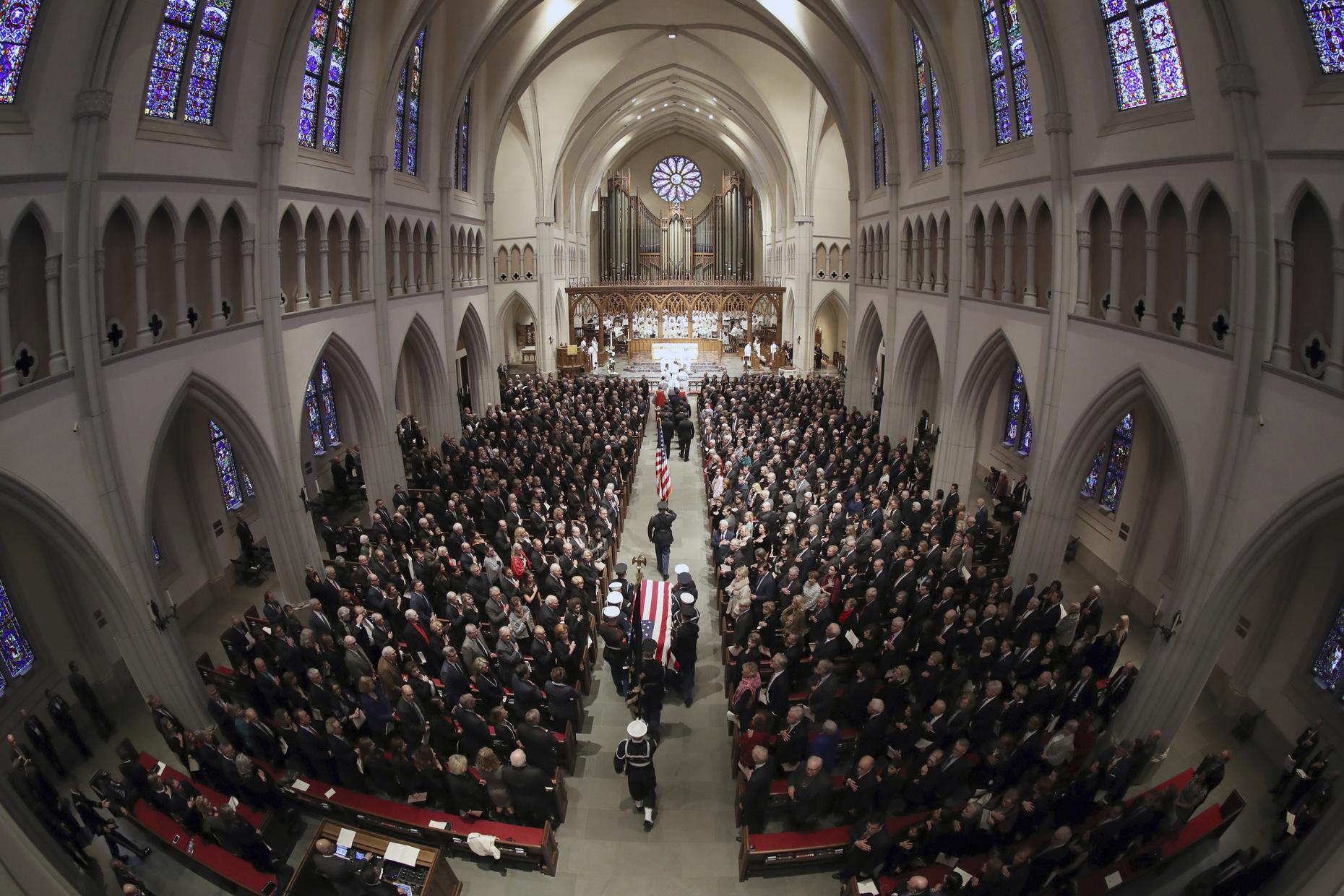
On the Media
How Quickly We Forget
00:50:19
Presidential eulogizing, special counsel speculation, immigration coverage, and forgotten Hanukkah history.
Loading summary
Transcript171 lines
- [00:00]
Bob Garfield
From WNYC in New York, this is ON THE media. I'm Bob Garfield.
- [00:06]
Brooke Gladstone
And I'm Brooke Gladstone. If you're a person who has TV news on all day in the background, your occasional upward glance would have marked this week's biggest small screen story as the funeral of a 94 year old man who was once president of the United States.
- [00:23]
Diego Salazar
He fancied himself to be a good bass singer.
- [00:27]
James Ponet
He was not. We'll sing for our president.
- [00:34]
Bob Garfield
Amazing grace, how sweet the sound.
- [00:44]
Brooke Gladstone
He was born to power and spent his life wielding it. But if not for those four years in the White House, the cameras would never have fixed so firmly all week long on his body in transit, flying up From Houston to D.C. lying in state in the Capitol rotunda, gracing the Washington Cathedral, lifting off from Joint Base Andrews, landing at Houston's Ellington Field and traveling still halting at St. Martin's Episcopal Church, rolling by motorcade to the Union Pacific Railway facility, rumbling by special train through small towns to College Station, pausing at Texas A and M University and finally dropping anchor at the George Bush Presidential Library and Museum for eternity. It seemed to go on for a long, long time. But it was not unusual. I'm guessing that the endless stream of short, sharp shocks delivered by the news, the last two, has left us too frantic for the measured pace of such events. There is a pattern to these presidential launches into the hereafter, each with its own theme and variations. The theme of this week's was summed up by Bush's secretary of state and lifelong friend, James Baker.
- [02:20]
Bob Garfield
His wish for a kinder, gentler nation was not a cynical political slogan.
- [02:28]
Masha Gessen
It came honest and unguarded from his soul.
- [02:32]
Brooke Gladstone
That view from the podium was echoed by the pundits.
- [02:35]
Bob Garfield
I think President Bush embodied this concept of being a gentleman.
- [02:39]
Brooke Gladstone
We talk about the need for decency. That's exactly what this man was, the.
- [02:43]
Bob Garfield
Strong, silent type, brave even, lethal if necessary. But not a braggart.
- [02:49]
Anne Helen Petersen
What George Bush recognized about America, which makes him, to me, the last gentleman in Washington, was that our political opponents aren't opponents at all. They're friends with whom we differ.
- [02:59]
Brooke Gladstone
Consider the letter the 41st president left in the White House for the 42nd. It was a presidential tradition he carried out with true grace. Read here by the recipient.
- [03:10]
Bob Garfield
Don't let the critics discourage you or push you off course. You will be our president when you read this note. I wish you well. I wish your family well.
- [03:19]
Anne Helen Petersen
Your success is our country's success.
- [03:22]
Bob Garfield
I'm rooting hard for you.
- [03:24]
Brooke Gladstone
One of the stations of the crossing of a president into death? Is the tone and the timing of the summing up candid or kind? Now or later? Isn't now the best time to be forthright when more people actually care? Or do we delicately delay to spare the bereaved? Television, awash with pictures of veneration and tributes from the late president's admirers, made its choice long ago. And the timing has made it even easier. In the case of George Herbert Walker.
- [03:56]
David Greenberg
Bush, I think any historical figure, the way that they are remembered is so contingent upon what historical moment they pass away in. I think it's tethered to what he is not. And what he is not is Donald Trump.
- [04:08]
Brooke Gladstone
Anne Helen Peterson is a senior culture writer and western correspondent for BuzzFeed News.
- [04:14]
David Greenberg
So what George H.W. bush is being remembered for, it's echoes of how John McCain was also remember.
- [04:22]
Brooke Gladstone
Nostalgia wrapped up in eulogy. The C word is used a lot.
- [04:26]
David Greenberg
Civility.
- [04:30]
Brooke Gladstone
Watching these things, you saw the recurrence of the Clinton letter, the civility theme. You were disturbed by it.
- [04:39]
David Greenberg
Do we remember those in power through how other people in power remember them? Or is it also important to think about, okay, how did the least of these, how were they affected? And you know, the day that I was seeing those Saturday was also AIDS Remembrance Day, December 1st every year. And so that juxtaposition led to a lot of people who were commenting on, oh well, here was George H.W. bush's legacy on AIDS, which is that much like Reagan, he did not do enough, he did not act soon enough. What prompted him to act was not the suffering of gay men, but you know, when it became associated with a young boy whose association with AIDS was not through sexual activity. So people who either were directly involved in that or are mindful of, you know, the actions of Act up dumping ashes on the White House lawn during HW's tenure, bringing the dead to your door.
- [05:36]
Bob Garfield
We won't take it anymore.
- [05:38]
Diego Salazar
The purpose of these people coming here is because George Bush and his administration has done nothing with our lives.
- [05:46]
Bob Garfield
So we bring our dead to you.
- [05:48]
Diego Salazar
And they were determined to to deposit the ashes of their loved ones on the White House steps. Part of aids, it's one of the.
- [05:56]
James Ponet
Few diseases where behavior matters.
- [05:59]
Diego Salazar
And I once called on somebody, well, change your behavior. If the behavior you're using prone to cause aids, change the behavior.
- [06:07]
Brooke Gladstone
Next thing I know, one of these.
- [06:09]
James Ponet
ACT UP groups is out saying Bush.
- [06:11]
Bob Garfield
Ought to change his behavior.
- [06:12]
Diego Salazar
You can't talk about it rationally.
- [06:14]
Brooke Gladstone
Peterson observed that to the overwhelming majority of citizens without power or direct acquaintance with the deceased. A president is not a person, but an event, one with vast and potent consequences, for good or ill. So when assessing a presidency, kindness simply doesn't apply.
- [06:34]
David Greenberg
If you were talking about World War II, right, and you only talked about the good things. You talked about victory in Europe, and you never talked about dropping the atomic bomb, we would say that that is not accurate to the historical record. You wouldn't say you're being mean to World War II.
- [06:52]
Brooke Gladstone
So what voices would you have included if you had to write the historical record of President George H.W. bush?
- [07:00]
David Greenberg
A soldier who served in the first Gulf War, Someone who lost a loved one to the AIDS crisis, someone who was sentenced under the war on drugs, but then also, you know, someone whose life was really changed by the Americans with Disabilities Act.
- [07:15]
Brooke Gladstone
Mm.
- [07:16]
David Greenberg
Or who, after Bush signed the Ryan White act into law, that made receiving AIDS treatment possible to them. So there's a full cornucopia that's not just people who have covered them or other presidents or senators and that sort of thing. The piece that I saw that really did a good job of this is David Greenberg's piece in Politico.
- [07:40]
James Ponet
Well, I think obituaries are often the first place that we turn when we want to learn about a historical figure.
- [07:47]
Brooke Gladstone
David Greenberg is a professor of history, journalism, and media studies at Rutgers University and contributing editor to Politico magazine.
- [07:55]
James Ponet
You know, we're not engaged in a discourse with the Bush family right now. We're engaged in a discourse with the American people and new generations who may be learning about President Bush's presidency and career for the first time.
- [08:10]
Brooke Gladstone
Okay, you wrote a book about President Nixon. You watched the obituaries. You read them. You saw them when he died. He's about as complex a character as you could encounter with Richard Nixon, even.
- [08:23]
James Ponet
More than with George Bush. You know, there was, I would call, almost a whitewash at the time of his funeral.
- [08:31]
Bob Garfield
Howard, you were the chief news editor for Newsweek in Washington. Richard Nixon didn't like you very much. Give us your first thoughts when he died. You knew it was coming. Sadness. Peter. Richard Nixon accomplished a lot in his political career. Opening the door to China, easing the tensions with the Soviet Union, peace in Vietnam, and brought a lot of good to the world. On the domestic front, he was very successful as a president. And the tragedy of Richard Nixon is that, most of all, he's going to be remembered from Watergate.
- [09:03]
James Ponet
It was sort of hard to imagine from hearing some of the eulogies, why this man has gone down in history in disgrace as the first president ever to resign as someone who committed constitutional crimes and abused the powers of his office. It was almost as though it's just one part of the story.
- [09:25]
Brooke Gladstone
So what was the main story in the eulogies of George Herbert Walker Bush that you think was left out?
- [09:35]
James Ponet
The story we have been hearing and is a man of great decency and bipartisanship. But in fact, that decency, which no doubt was part of who Bush was most of the time, lost out to political cynicism. When he wants to win in a Texas Senate race in 1964, he is denouncing the 1964 Civil Rights act, which is one of the great achievements of modern politics.
- [10:07]
Brooke Gladstone
He embraced supply side economics that he had called voodoo economics during the campaign.
- [10:14]
James Ponet
That's right. And he also threw aside his support for abortion rights because Reagan wanted him to. He dropped his support for the Equal Rights Amendment for women because Reagan wanted him to. So I see a pattern of repeatedly subordinating what we might call his nobler impulses, or at least his more liberal or moderate impulses, to political expediency.
- [10:41]
Brooke Gladstone
I won't even bother mentioning the low of the Willie Horton ad during the campaign. It's probably been played ad nauseam at this point.
- [10:51]
James Ponet
Bush liked to say, oh yeah, during the campaign I could get nasty, but once I was elected, you know, it was all pure governance from there on out. Well, it's never like that for Bush or for any president that the pressures of politics weigh on particular decisions. He wasn't standing up for this older strain of Republicanism. He was sacrificing it in the short term in the hope perhaps of being able to implement it in the long term. But that long term never came. What happened instead was the concessions that he made to the far right ended up only empowering the far right.
- [11:38]
Brooke Gladstone
Greenberg notes that such vaunted Bush achievements as the Americans with Disabilities act and amendments to the Clean Air act were concessions. Democrats controlled both the House and the Senate. He wrote that George H.W. bush often slunk aside to create space for far right ideologues and practitioners of personal destruction, and that it shouldn't surprise us to see that others, made of far more malignant stuff than he have now taken over that space. Where does a president or a powerful politician leave us? That is the essence of a legacy, and in this particular case, the role of eulogy. An event like a president is not a subject for public eulogizing. Like a film star, he so far he no longer belongs to his family or friends. A president, by dint of the power he wields belongs to us all, and especially, as Peterson says, the least among us. Anything less betrays history, our chance to learn from it. Choose better and do better.
- [12:56]
Bob Garfield
If you love you some infotainment, dive into the Hot Stove League. That's the old timey name for the rumor mill that follows every baseball season as teams acquire players for the next year, such as World Series hero Nate Yuvalve of the Boston Red Sox, who who's been linked for the past month to the Brewers, Braves, Angels, White Sox, Blue Jays, Padres, Phillies, Giants and Astros.
- [13:22]
Brooke Gladstone
It's been a little over five weeks.
- [13:24]
Anne Helen Petersen
Since we last saw the Astros play, but Houston is keeping their name in the headlines. The latest offseason news is their interest in acquiring free agent pitcher Nathan Ivaldi.
- [13:34]
Bob Garfield
The problem is, the fuel of the Hot Stove League is just scuttlebutt. Much of what passes for reporting is just repeating the tantalizing guesses of other outlets. It generates clicks, but insight. Not much of that.
- [13:49]
Diego Salazar
This just in.
- [13:49]
Bob Garfield
Kenny Rosenthal tweeting out free agent right hand a picture of Nathan Ivaldi in agreement with the Red Sox.
- [13:54]
Brooke Gladstone
Pending physical.
- [13:55]
Bob Garfield
The Red Sox. Oops. But of course, this is just sports. It's trivial. It's not as though the press would resort to third hand speculation in matters of consequence, like, say, the fate of the President of the United States.
- [14:11]
Diego Salazar
You know, whenever there's a ramping up.
- [14:12]
Anne Helen Petersen
Of information because we hardly get any.
- [14:13]
Brooke Gladstone
Information from this investigation, yeah, we start to wonder, okay, does that mean that they're wrapping things up?
- [14:18]
Diego Salazar
Yahoo News was reporting that, you know.
- [14:20]
Brooke Gladstone
Perhaps they're tying up loose ends. Any speculation here at all?
- [14:24]
Bob Garfield
Welcome to the Hot Stove League Special Counsel edition, where the vacuum of facts is filled with endless exercises in. Suppose it looks like Mueller is beginning to wrap things up.
- [14:35]
Brooke Gladstone
The smart money is betting on soon.
- [14:38]
Bob Garfield
Former FBI director James Comey predicted that the Mueller investigation was in its fourth quarter. We're now seeing signs that might be the case. Until Tuesday, the press focused on a sentencing memo for Michael Flynn, which we were told might be a play to preempt any quashing of Mueller's official report by Acting Attorney General Matt Whitaker. Flynn's sentencing memo, I think, will give us a lot of information about what he was doing working with the Russians. I don't know what that information will be, but I think we'll get a lot from that. Nope. Last night we expected a bombshell. Instead, we got a big teasing document with a lot of redacted material that tells us this guy's a canary and so attention immediately turned to Friday's filing in Paul Manafort's case. It is expected that that would be a great chance for the special counsel to reveal more details about exactly what it was that Paul Manafort lied about. And that may give us some clues.
- [15:30]
Anne Helen Petersen
About where else the special counsel investigation is headed.
- [15:34]
Bob Garfield
Look, something is going to happen with the Mueller investigation. Some guesswork will always end up seeming prescient, just as some outlets predicted Nate Yuvaldi would stay in Boston. But journalism is supposed to be a brokerage of fact, not a game of chance.
- [15:52]
Brooke Gladstone
So late Friday we learn something as we do. Mueller's latest filing says that Manafort lied multiple times. Multiple. But the substance was, shall we say, heavily redacted. And Michael Cohen's probably going to the big house. If we'd only waited just a little, we wouldn't have to guess. This is ON the media.
- [16:21]
Mary Harris
The election has come and gone. Now we're in a new era. It can be easy to get discouraged, frustrated, but you can't afford not to pay attention. You need trustworthy, independent journalism to cut through the noise and hold power to account. I'm Mary Harris, host of What Next from Slate.com we are a daily news podcast with a kind of transparent, smart yet tongue in cheek analysis you can only find at Slate. Follow and listen to what Next.
- [16:48]
Brooke Gladstone
Wherever you get your podcasts, this is ON THE media. I'm Brooke Gladstone.
- [16:54]
Bob Garfield
And I'm Bob Garfield. When we think of Latin American migration, we think of refugees trekking northward toward the U.S. border. But there is also heavy traffic in the other direction, buffeted by economic collapse, crime, political repression and even starvation. An estimated 2.3 million Venezuelans have fled to Colombia, Peru, Ecuador, Brazil, Chile and elsewhere. This week, for the first time, the United nations included the Venezuelan crisis in its global humanitarian appeal, seeking aid for Latin American countries who have taken in Venezuelans. Indeed, as NPR's Spanish language podcast Radio Ambalante reported this week, some nations are straining under the burden and are growing uneasy with the newcomers. Lima based journalist Diego Salazar, who reported the piece with his wife, reporter Lizzie Cantu, says Peru had never been home to a lot of outsiders.
- [17:51]
Masha Gessen
Let me give you this number in order for your audience to understand. Until 2016, all the foreigners in Peru were around 100,000 people from every country. Actually, there were more Americans than Venezuelas in Peru back in those days. Now we have 600,000 Venezuelans. So we have more than six times the amount of foreigners in the country.
- [18:17]
Bob Garfield
And at first, Peru rose to the occasion.
- [18:21]
Masha Gessen
The previous government, whose president Pedro Pablo Kucinski said, please, Venezuelans, come to our country. We're going to pay you fair salaries. We are happy to have you here. Los sueldos delay and a new permit, which was called the Temporary Residence Permit PTP allowed Venezuelans to spend a year in the country. They were allowed to work with that ID while they were trying to change their migration situation to regular migrant worker. And actually when the government approved the PTP, almost 60% of Peruvians agree with it.
- [19:01]
Bob Garfield
You have someone in your story talking about how beautiful the reception was from the people in the streets in Lima.
- [19:09]
Brooke Gladstone
Hugs. Yeah.
- [19:10]
Masha Gessen
We interviewed this young Venezuelan named Ana Mer, who is a journalist. She arrived to Lima in October 2017. And at first they were completely surprised about how welcoming people were, about how everybody in the streets recognized their accent and asked, oh, you are Venezuelans. We're so glad you are here. Please welcome to our country.
- [19:37]
Bob Garfield
These were fellow Latin Americans in extremis and Peru was going to offer them as much opportunity as it could.
- [19:45]
Masha Gessen
I think there were three main reasons. The first one was because Venezuelan received Peruvians back in the 70s and 80s and early 90s, where Peru was going through a terrible economic crisis. And also we were facing the dangers of local terrorism. And a lot of Peruvians flew out the country and some of them went to Venezuela. I think the second reason is from the early 2000s, Venezuela was kind of a scarecrow for Peruvian politicians. It was, you know, the far left country, the socialist country, who was actually trying to intervene in Peruvian, and not only Peruvian, but all across the region, politics. So now Venezuela was in a deep crisis. Politicians were saying, look, this is what happens when you go full socialist. So Peruvians felt good about themselves. And the other reason, the third one is Peru hasn't been a country who received a lot of migrants for a long time. We had migration in the early 20th century, but since then we've been a country of migrants. We weren't in the receiving end.
- [20:59]
Bob Garfield
And then things changed, like a lot.
- [21:04]
Masha Gessen
In January and February this year, I started to notice that the way Peruvian media was covering Venezuelan migration was different. It wasn't anymore, you know, the celebration and the self congratulation about how good we were because we were helping our brothers. It was different. It was about the way Peruvians and Venezuelans were colliding. You even have stories about a video where Venezuelans were saying they didn't like this or that Peruvian food and newspapers were making news out of them. So one day I was just checking Twitter and I saw someone who posted this Picture which said, venezuelanos, fuerra del pais, or we don't want more Venezuelans in Peru. Peru is only for Peruvians or something like that.
- [21:59]
Bob Garfield
Venezuelans had gone from being brothers to others. You are seeing the same patterns elsewhere.
- [22:07]
Masha Gessen
Yeah, everywhere. Colombia is the country who has received the most Venezuelans. There are over a million Venezuelans in Colombia who has arrived in the last two years. The same is happening in Ecuador, Argentina and Chile and even Brazil. On a news show in Colombian television, there were these journalists who very early in the morning was reporting about a robbery. And he said, well, you know, the door woman said they were Venezuelans and actually they raped her.
- [22:38]
Diego Salazar
Much attention porque denuncias.
- [22:43]
Masha Gessen
A minute later, you have a police officer saying exactly the same in front of the camera. Well, one of the producers of Radio Ambulante has her office in that same building. So later that morning when she arrived to work, she went to see the door woman. And this lady said, I didn't say they were Venezuelans and they didn't rape me. So it was just a regular crime scene. The police turned that into an opportunity to blame Venezuelans, and media covered it and put it on national television.
- [23:18]
Bob Garfield
You know, it's hard to imagine somebody saying without evidence that Venezuelans are rapists and murderers.
- [23:26]
Masha Gessen
Exactly. Who would say such a thing?
- [23:28]
Bob Garfield
You've identified a number of tropes now that Venezuelans are all criminals. Another that they're ungrateful, they reject our culture. Another is that they have special privileges. There's even something about stealing husbands.
- [23:44]
Masha Gessen
Yeah. This being going on not only in Peru, but in Colombia and the other countries, people were complaining about how beautiful Venezuelan women were. So that was a crisis in infidelity. An actual government official in Colombia said that infidelity was rising, and that was because there were so many Venezuelans and some of them were beautiful women.
- [24:05]
Bob Garfield
Some of these countries have now tried to roll up the welcome mat to reverse their policies.
- [24:12]
Masha Gessen
Right. What Peru, Chile and other countries are doing now is asking for a passport to Venezuelans who wants to get into our countries. Until very recently, until October, actually, Venezuelans didn't need a passport to get into our country. We were accepting their ID card, because to get a passport in Venezuela nowadays is impossible.
- [24:40]
Bob Garfield
It's almost the equivalent of building a wall because you need so many dollars to get a passport.
- [24:46]
Masha Gessen
There are some reports saying that you will pay about $1,000 in the black market in Venezuela in order to get a passport and $1,000. No one has seen that amount of money in a long Time.
- [24:58]
Bob Garfield
The story that Radio Ambalante tells is a very familiar one. We see it playing out in Europe as well, where the Syrian refugees at first were welcomed and then regarded as a scourge and created a big right wing backlash that is growing and growing and growing.
- [25:17]
Masha Gessen
Unfortunately, this is just the Latin American version of what we've seen first in the States, also in Europe, all across the world. The thing that make those stories very similar is how quickly everything changes. I was a migrant myself. I lived in Spain for 10 years and I was very lucky because I had a good job. I was a writer, I was a journalist. I was part of community of people who were more tolerant or curious about me and my country. But I also saw the way people in Spain treated other kind of migrants from other countries.
- [25:55]
Bob Garfield
Yeah, you've seen this movie before.
- [25:56]
Masha Gessen
Exactly. But, you know, to be an optimist in a way, at some point, that's an opportunity too, you know, that's an opportunity for media and for politicians to do it better the next time. Governments should be more careful the way they deal with it. And the media, of course, have to be more careful with information they amplify.
- [26:22]
Bob Garfield
Well. Diego, thank you very, very much.
- [26:24]
Masha Gessen
It was my pleasure, Bob. Thank you very much.
- [26:26]
Bob Garfield
Diego Salazar is a journalist based right now in Lima, Peru. He's also the author of We've Learned Nothing, which is a book and a journalism blog. Diego is featured in the latest episode of the Spanish language podcast Radio Ambalante on the migration issue, and you can find it wherever you get your podcasts. Diego Salazar hopes we can learn from our errors. Modern history suggests it's unlikely. It was only in 1939 that Cuba, the United States and Canada turned away the SS St Louis, sending 900 Jewish refugees back to Nazi terror. Since 2015, governments across Europe have moved to close their borders and reject Syrian refugees, to say nothing of other displaced populations around the world, such as the Palestinians. New Yorker staff writer Masha Gessen says that for refugees, being in limbo, constantly waiting typifies, quote, a defining condition of powerlessness in the modern world. But if the power to offer refuge is in the hands of the hostile, the indifferent, the selfish, or simply the overwhelmed, who else is complicit? In a speech this week, Gessen said the media share responsibility for failing to fully communicate the scale and the horror of the crisis. She joins us now. Masha, welcome back to otm.
- [27:56]
Anne Helen Petersen
Thank you. Great to be here.
- [27:57]
Bob Garfield
Whether we're speaking of Hondurans in Mexico or Syrians in the Netherlands or Venezuelans in Peru or, or for that matter, Russians in the United States. The individual stories are often so wrenching. We cover the impact of migrants on the host society, but we somehow fail to grapple with the horror that they're fleeing. War, crime, racism, sectarian violence, starvation, whatever might be compelling them to give up everything to start with. Absolutely nothing somewhere else. And maybe in a society more hostile than welcoming, it is kind of hard to fathom.
- [28:38]
Anne Helen Petersen
Yes, there's an insidious sort of motivation behind not focusing on some of the wrenching stories some of the time. When extremely well intentioned people make the argument for immigration, they do it not from the point of view of need, but from the point of view of contribution. There's a widespread, well intentioned argument of immigrants are good for the society, they're good for the economy, they're productive members of the society, they pay taxes, which I find highly objectionable because I think that the argument should be not that the immigrants are good, but that we're good. Right. The society has an obligation. It should be at least good enough to meet its international obligations to asylum seekers. At least that good. Preferably better.
- [29:31]
Bob Garfield
I should note that you were the recipient of the Christopher Hitchens Prize very recently, which is awarded for, quote, commitment to free expression and the pursuit of truth without regard to personal or professional consequence. One of the most poignant passages of your acceptance speech concerned journalistic power. And you noted that your coverage over the last few years actually influenced the outcomes of certain individual cases. And yet these experiences haunt you. Why?
- [30:11]
Anne Helen Petersen
I'd say there are at least three stories that I have written in the last year that probably had a better outcome for the people I wrote about than if I hadn't written about them. In one case, somebody was able to avoid deportation. In two cases, people got asylum. There's nothing better for an asylum claim than having a high profile journalist write about you in a high profile publication. To be honest, I find it more terrifying than gratifying, in part because I'm also aware of the stories I haven't written. These are not abstractions. I know which stories I haven't written. There's a story that I was following, but I haven't written about several men from Russia who were on hunger strike at a detention facility in Oregon and one of them died last week. There's a story that I haven't written about two transgender women from Chechnya who managed to smuggle themselves across the border with Mexico and have been in a detention facility in Chicago for a while. There's a story I haven't written about a couple of gay academics from Russia who have been separated now for about a year. I haven't written those stories because I've been writing other stories. And because these stories, one story is a little bit more difficult to report than other stories, two stories are a little bit less dramatic than other stories that I have written. You know, however I frame it, I'm engaging that kind of calculus about what I'm going to write and. And therefore who might benefit from being written about.
- [31:48]
Bob Garfield
You have a suggestion for solving the not enough of Masha Gessen to go around problem?
- [31:56]
Anne Helen Petersen
It's not just the not enough of Masha Gessen to go around problem. It's also the problem of tackling this overwhelming issue of displaced people by writing representative stories. So my proposed solution, which is probably impossible, but I propose we try it anyway, is. Is inspired by the New York times coverage of 9 11. If you remember, the Times ran small biographies of every single person they could identify who had died in the Twin Towers. And I think the logic behind that was that there was no single story or no set of stories that could be stand in for a tragedy that was particularly horrifying because of its scale. The Twin Towers was an unimaginable but measurable problem of scale. The same is true with immigration. It's unimaginable, but it's also immeasurable. What if we tried to write all the stories of immigration? We can't run 65 million stories. That is not physically possible. But we could, for example, write about nothing but immigration for a day, and then we could do it again, and maybe that would go away toward conveying the scale of the problem.
- [33:15]
Bob Garfield
Is this idea to be taken literally?
- [33:17]
Anne Helen Petersen
Yes, this idea is to be taken literally.
- [33:20]
Bob Garfield
But we could ask the same for climate coverage or racism or misogyny, dictatorship, malaria, all these horrendous conditions that never get their due in the New York Times or anywhere else. Because there's so much horror of every variety out there. Journalism is of necessity a game of picking and choosing. My question isn't only is it really doable? My question is, is it even fair?
- [33:53]
Anne Helen Petersen
You know, that question is actually, weirdly enough, a variety of whataboutism? This is not a suggestion of a change in approach to journalism in general. And I'm not saying that every time we face a problem of coverage or a problem of the inadequacy of journalism here, I have come up with a solution. We could just, like, write about nothing else for a day. I'm saying here's an idea that I think might go away toward doing our job better on this particular issue. And this particular issue, I think is important enough. And by important enough, I mean that the presence of 65 million displaced people in the world is something that is destroying the world. It is destroying the lives of those 65 million people who have been rendered less than human. It is destroying the politics of entire countries and the world as a whole, because you can't have politics when 65 million people have no political rights. It is enough of a crisis, and yes, in that sense that I think it is comparable to climate change. It is enough of a crisis to do something that is absolutely extraordinary. So here's this one idea of doing something absolutely extraordinary in journalism that will perhaps be helpful, and at the very least, it will be helpful to the many people who will end up receiving the benefit of that coverage. I'm sure it's not the only solution, the only possible solution. In fact, I'm sure it's not even a solution.
- [35:29]
Bob Garfield
Yeah. In fact, let me ask you about that. Putting aside whataboutism, let's just assume that this proposal is never actually going to materialize, that the world's press is not going to put aside everything else for one day to talk about immigration. Let's just assume that because planes crash and politicians get assassinated. Short of that, what else can we do as an institution on a large scale to see that the stakes for societies and just plain humanity are well understood?
- [36:06]
Anne Helen Petersen
You know, I think I prefer to not answer that question. You know, my suggestion is probably insane, and you're probably right. It is a fair assumption that it's not going to happen. But this is the suggestion I have made. So I'm not going to go sort of, okay, this is my plan A, and here's my plan B, which is easier to implement, I think, you know, at least for the next few days, I'm sticking with plan A.
- [36:30]
Bob Garfield
Well, plan A is a fetching plan. Thank you, Masha. Thank you very, very much.
- [36:35]
Anne Helen Petersen
Thank you for having me.
- [36:36]
Bob Garfield
Masha Getsen, the recipient of the Christopher Hitchens Prize, is a staff writer for the New Yorker.
- [36:44]
Brooke Gladstone
Coming up, the Hanukkah story, A heroic battle against extinction by a brave and united people. Maybe not.
- [36:52]
Bob Garfield
This is on the media.
- [36:58]
Mary Harris
The election has come and gone. Now we're in a new era. It can be easy to get discouraged, frustrated, but you can't afford not to pay attention. You need trustworthy, independent journalism to cut through the noise and hold power to account. MARY I'm Mary Harris, host of What Next from Slate.com we are a daily news podcast with a kind of transparent, smart yet tongue in cheek analysis you can only find at Slate. Follow and listen to what next.
- [37:25]
Bob Garfield
Wherever you get your podcasts, this is ON THE media. I'm Bob Garfield.
- [37:30]
Brooke Gladstone
And I'm Brooke Gladstone. This weekend brings us to the tail end of Hanukkah, Judaism's eight day festival of lights, marking one of God's lesser miracles involving lamp oil and the perseverance of the Jewish fest faith. Celebrated with dreidels and menorahs, latkes and jelly donuts, this relatively newish holiday serves as Michael David Lucas described in the New York Times as the Semitic sidekick to Christmas. The Hanukkah story begins in Greek controlled Palestine over 2000 years ago where Jews enjoyed religious freedom until a new ruler, the Assyrian Greek King Antiochus, took power. The as memorialized in the much beloved 1996 Rugrats Hanukkah special. From now on, King Antiochus says you have to wear what he wears and read what he reads. You also have to worship his gods. Some people thought this new way of life was fine, but others didn't. If that new king catches us with our old books, we're gonna get in a lot of trouble. I don't care. These are the books our forefathers read and our five fathers and our six Fathers and I'm not stopp Judah or Yehuda and his small band of followers, the Maccabees, defeated Antiochus. After the war, under the command of Judah's priestly family, the Hasmoneans, the Jews found the holy temple of Jerusalem in ruins, the temple lamp with just enough oil to burn for a single day.
- [39:04]
Bob Garfield
But one day went by, and then another, and another, until finally the eight days had passed and the flame was still burning. And to this day, we light the menorah every year to remember the miracle of Hanukkah.
- [39:24]
Brooke Gladstone
That's the popular Hanukkah narrative, passed down through cartoons and kindergarten classes wherever Jewish kids are at risk of feeling left out at Christmas. But this holiday has a contentious past. According to Rabbi James Ponet, Hanukkah was censored for millennia because the story exposed deep divisions within the Jewish community. That and the Hanukkah miracle, he says, were undercut when the Jewish people lost their land yet again after Hasmonean infighting.
- [39:57]
Diego Salazar
In some sense, the question is, what's the miracle here? Is it oil that burned for eight days? Or is it that for a brief period of time in the midst of a couple hundred Years in which the Jews were without political control of the land in which they lived. They achieved a political autonomy. It ended badly. The Hasmonean dynasty crumbles in a second civil war. But it happened. This is the most complex and adult of our holidays.
- [40:24]
Brooke Gladstone
Wait, I thought it was like tricks. It's for kids.
- [40:27]
Diego Salazar
Exactly. When we confront something that's completely beyond our ability to explain, even to ourselves, we give it to the children, as is often the case in Mother Goose and nursery rhymes. We drum out the terror and we bring in obfuscation. So this is a story that covers over a deeper and ongoing story of a civil war. The nature of civil war, then and now, is that once it happens, it never stops.
- [40:53]
Brooke Gladstone
Now, Judah of the Maccabees was a fundamentalist, but his principal fight was with the Assyrians, was it not?
- [41:03]
Diego Salazar
Well, he came from the priestly family. And the priests, we're talking 165 BCE were divided among themselves. There were those who wished to blend in, who thought that the uniqueness of Judaic practices could be abandoned. And there were others, and this was Judah and his family that were committed to maintaining the traditions that went back to the Bible. It was a fight among priests, and it was therefore a fight among. Among Jews. The nation has a will to live separate and a will to be part of something larger. We see this as part of the history of humanity.
- [41:39]
Brooke Gladstone
This holiday may have been incorporated into a kind of independence day for a dynasty that lasted about 80 years, the Hasmonean dynasty. Then it was pretty much hushed up. It's not actually in the Bible. Right. It's part of the apocrypha and not generally where we find our holidays.
- [42:03]
Diego Salazar
Exactly. Already in the third century, second third century, the rabbis who formed the Talmud determined that the books of Maccabees would not be included in the Bible. In fact, we don't have any of them even in Hebrew left. Why? Because these books stirred up a memory of political revolt that cost the Jewish people terribly. The rabbis couldn't drown completely the collective memory, but they could reshape it. The miracle is not in the books of Maccabees. The miracle of oil that burned was a creation of the Talmudic rabbis. So the Talmud was written in the aftermath of political and military and diplomatic failure. Now my feeling is they wanted to bury the story. It didn't serve the interests of the Jewish people. It was really until 1948, we were living still with the sense that we couldn't be a nation state until the Messiah came. Hanukkah is an attempt to reshape the memory of the war of Jew against Jew as well as a war of Jews against a foreign oppressor. So let's refocus it on the Temple and on a miracle that happened in the Temple.
- [43:09]
Brooke Gladstone
It was the Talmudic scholars who reshaped it that way. If you go back to the books of the Maccabees, they do tell us about the Jewish civil war. Here's a quote from it. There were some evildoers in Israel who tried to win popularity for a policy of integration with the surrounding nations. It was because the Jews had kept themselves aloof for so long. They claimed that so many hardships had befallen them. They applied to Antiochus, who authorized them to introduce the Greek way of life. They built a Greek gymnasium in Jerusalem and even. Even had themselves uncircumcised. Ouch.
- [43:50]
Diego Salazar
Exactly. What a stunning example of the radical capacity of the Jewish people, then and now to will itself out of separateness, out of particularity, out of the burden of being a small embattled nation into a larger participation of the super global culture of the day. We're still caught in that struggle.
- [44:16]
Brooke Gladstone
You co officiated Chelsea Clinton's interfaith wedding in 2010. Interfaith ceremonies are probably the most controversially assimilative thing that a rabbi could do.
- [44:31]
Diego Salazar
That's correct. I think of myself as in some way embodying every way there is of being a Jew today. Some Jews are atheists. I know the atheist in myself. Some Jews are ultra Orthodox Haredim. I know the Haredi Jew in me. I believe in the reality of a Jewish people that is at war in many ways against itself. But I embrace every aspect of it in an attempt to live within the war zone without going fully to war.
- [44:57]
Brooke Gladstone
Getting back to the political evolution of the holiday, it was rediscovered in modern times to enable Jewish kids not to feel left out during this season. But it was also embraced by the Zionists and proto Zionists.
- [45:15]
Diego Salazar
Yes, the image of the Jew as a military figure is absolutely critical to the standing and stability of the State of Israel. As a matter of fact, the tactics that Moshe Dayan deployed in the 67 war, the six day war actually benefited from a reading of the tactics used by the Maccabees, the Hasmoneans, against the Seleucidian Greek armies.
- [45:35]
Brooke Gladstone
Is it fair to say that Hanukkah feels a bit more urgent lately?
- [45:41]
Diego Salazar
It is our most urgent holiday because it's the holiday of the will to power and the dangers of power. It is a holiday that is both a call to arms and a warning about what arms can bring about. It's all there. The Jews of the Diaspora are choosing not to be fully part of the political exercise of power in Israel today. That allows them to articulate the Jewish voice of moral vision, why we are in the world. While many of the Jews living in the state of Israel today pay the price of being a Jewish national entity in the world, it's part of the secret, I think, of who we are, that we live both in this state and outside of this state. And so what happened in Pittsburgh, that.
- [46:24]
Brooke Gladstone
Was the synagogue shooting in October. Some might see that as a sign that we're vulnerable. We have to take our. We have to leave America and go to Israel. And then others who say, hey, look, we're not alone. We got solidarity, you're right.
- [46:40]
Diego Salazar
There were allies. There were Muslims, blacks and others that ran to our aid, and there were policemen who were on our side. It wasn't a pogrom, although some Jews in the United States experienced it that way, and the media kind of flamed it that way. A pogrom. And yet it was a tragic invasion of innocent people. And now synagogues in America will be ringed with police, I imagine, for quite some time. The right wing in Israel believes that we are terribly vulnerable. We could be destroyed, God forbid, at any time. The left wing believes we are completely insensitive to the moral blindness that motivates us and that we are strong enough to make major sacrifices so that we can bring about peace.
- [47:18]
Brooke Gladstone
How would you prefer we celebrate Hanukkah?
- [47:22]
Diego Salazar
I think it needs to be opened up to the most serious kind of discussions such as you and I are having today. What does it mean to be a Jew in the world? The miracle of Hanukkah is that the Jews returned to the world. They didn't just leave it. You know, there was an attempt then, and there have been repeated attempts to remove the Jews from the world. So there's a miraculous sense that a people that was doomed, recreated its old language, has taken political control of its own land, and is now in the deeply ambiguous and sometimes very ugly and brutal moral and frontier of being a nation state in an age where the nation state is itself as a system facing a possible extinction, and greater than that, the larger possible extinction, God forbid, of the whole species. As we look at universal issues that we Jews need to address, that complexity is what Hanukkah is about, who we are.
- [48:21]
Brooke Gladstone
So you would love it if we would celebrate Hanukkah asking those questions. But absent those questions, would we be better off without it?
- [48:29]
Diego Salazar
I don't think so. Because?
- [48:32]
Brooke Gladstone
Because the kids would get depressed.
- [48:33]
Diego Salazar
Well, the kids would get depressed. We would be diminished without that memory. It's like saying if we could redo Jewish history so that World War II didn't happen, wouldn't you do that? Doing that would be like attempting to turn life into a fairy tale.
- [48:49]
Brooke Gladstone
Much of the Bible is a fairy tale.
- [48:52]
Diego Salazar
Either it's a fairy tale or it is some kind of a deep expression of something going on in the Jewish imagination that is alive and well. Still, it's hard to be a human being, therefore it's hard to be a Jew. Shfort Zeina yid. I wouldn't give it up. I wouldn't give it up. I would keep it.
- [49:14]
Brooke Gladstone
A Jew invented the term the melting pot.
- [49:17]
Diego Salazar
Yes, Israel Zanguel created that term, the melting pot, which was then taken over in the United States. This goes back of course, to again a Jewish war between say the prophet Isaiah, who saw that the vision of the end of time Ahrit Hamim would be that all nations would come to Jerusalem, that the norm of humanity would be Jerusalem over against Micah, who saw that each nation would have its own God. But both of them felt that either through a universal standardization or through a pluralism, there would come about an era where nation would not lift up sword against nation. They yearned for and believed that peace could come, but they were prepared to live in the pre utopian world. And that seems to me the art of being a Jew somehow finding a way to live in the world even as you are at war against it and against yourself. And that strikes me as the stuff of this holiday. So I wouldn't get rid of it. Not at all.
- [50:12]
Brooke Gladstone
Rabbi James Pawnet is the emeritus Howard M. Holtzman Jewish chaplain at Yale University and the author of the slate piece titled Hanukkah as Jewish Civil War.
- [50:25]
Bob Garfield
Is this the eighth night we light with family.
- [50:32]
Brooke Gladstone
Recall with great pride our escape from great tyranny.
- [50:40]
Bob Garfield
That's it for this week's show on the Media is produced by Alana Casanova Burgess, Michael Loewinger, Leah Feder, John Hanrahan and Oster Chattervrdy. We had more help from Samantha Maldonado and our show was edited by Brook. Our technical director is Jennifer Munson. Our engineers this week were Sam Baer and Josh Hahn.
- [51:00]
Brooke Gladstone
Katya Rogers is our executive producer. On the Media is a production of WNYC Studios. I'm Brooke Gladstone.
- [51:08]
Bob Garfield
And I'm Bob Garfield.
- [51:11]
Anne Helen Petersen
OntheMedia is supported by the Ford foundation, the John S. And James L. Knight foundation, and the listeners of WWNYC radio.
- [51:20]
Mary Harris
Since WNYC's first broadcast in 1924, we've.
- [51:24]
Anne Helen Petersen
Been dedicated to creating the kind of.
- [51:26]
Mary Harris
Content we know the world needs.
- [51:28]
Anne Helen Petersen
In addition to this award winning reporting.
- [51:30]
Mary Harris
Your sponsorship also supports inspiring storytelling and.
- [51:34]
Anne Helen Petersen
Extraordinary music that is free and accessible to all.
- [51:36]
Mary Harris
To get in touch and find out.
- [51:38]
Anne Helen Petersen
More, visit sponsorship wnyc.org.