← On the Media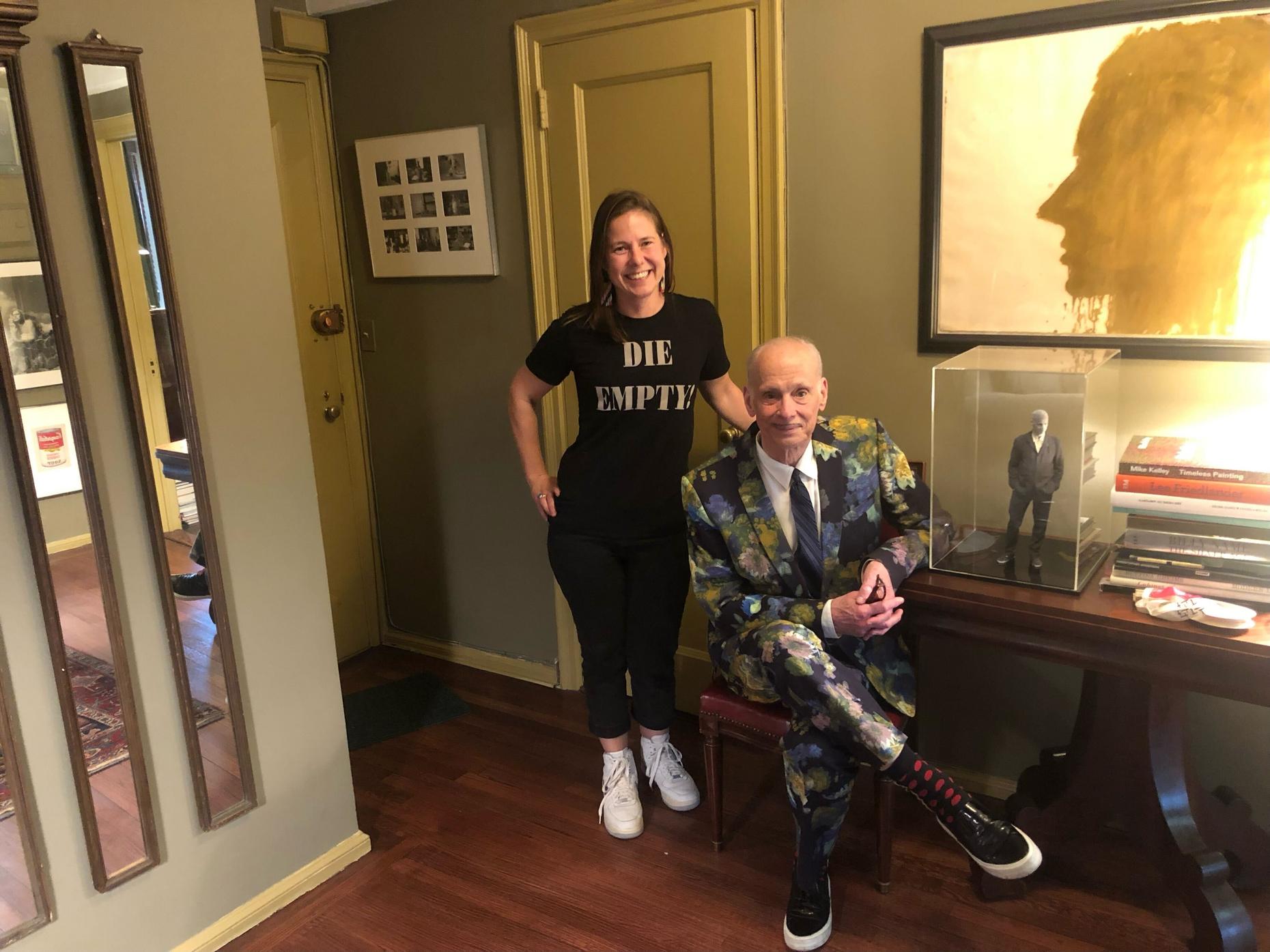
On the Media
In John Waters' Home (But Not In His Colon)
00:32:57
The delightful and rebellious writer-director welcomes "Death, Sex and Money" host Anna Sale into his apartment to talk about money, family, friendships, and colonoscopies.
Loading summary
Transcript132 lines
- [00:00]
Anna Sale
On the Media is brought to you by Progressive Insurance. You chose to hit play on this podcast today. Smart choice. Make another smart choice with Auto Quote Explorer to compare rates for multiple car insurance companies all at once. Try it@progressive.com Progressive Casualty Insurance Company and affiliates not available in all states or situations. Prices vary based on how you buy.
- [00:23]
Brooke Gladstone
This is on the Media. I'm Brooke Gladstone. Well, it's the midweek podcast and did you know that the film director John Waters has a new book out? It's so dirty in places that recently when Death, Sex and Money host Anna Sale was reading it on a plane, she had to put it down because she was too embarrassed to read it in public. I learned that and a lot more in the latest episode of her podcast in which she went to the home of John Waters. There's lots of bawdy talk and words and phrases not meant for the ears of the impressionable, including the C word.
- [00:57]
Anna Sale
So.
- [00:58]
Brooke Gladstone
So if you're someone who puts a podcast on in the kitchen while you're cooking or in the car on a school run, save this one for another time. Here's Anna.
- [01:07]
Anna Sale
Do you have any close friends who you think are snobs?
- [01:10]
John Waters
Yes, and I think they're kind of funny, some of them, you know, but they're always so serious. Once Valentino I was with on his yacht, I'm name dropping, but it's a good story. And we pulled in and we had dinner with other people and the waiter said to Valentino, water with bubbles without. And he went, bubbles make you fat. And he was not kidding. And I've never had bubbled water since.
- [01:34]
Anna Sale
Oh, I want for you to have some bubble water. It tastes so good.
- [01:37]
John Waters
No, thank you. I don't want to be bloated. As they say in Baltimore.
- [01:47]
Anna Sale
This is Death, Sex and Money, the show from WNYC about the things we think about a lot and need to talk about more. I'm Anna Sale.
- [02:08]
John Waters
How are you?
- [02:09]
Anna Sale
Hello, how are you?
- [02:11]
John Waters
I'm overdressed because I'm going on television right afterwards.
- [02:13]
Anna Sale
It's on your task.
- [02:14]
John Waters
I'm totally overdressed.
- [02:16]
Anna Sale
When John Waters opens his door, he is wearing a flower print suit. Pink, purple and yellow flowers reminiscent of Monet with red polka dot socks. And inside his Manhattan apartment, there is original art on nearly every wall, ornate candelabras hanging by the fireplace, and a small fluffy white dog lying underneath the table who doesn't move at all. Is that a fake animal over there?
- [02:45]
John Waters
Yes, it's fake. Okay. Or God, yes, yes.
- [02:49]
Anna Sale
I was like that doesn't seem like a natural sleeping position.
- [02:54]
John Waters
Really? It isn't. Oh, yeah. It's looking the other way, though. It would have turned around if it was a lot.
- [03:02]
Anna Sale
John Waters, of course, is the writer and director of the cult classics Pink Flamingos Cereal mom and his biggest mainstream success, Hairspray. He's been making movies since the 1960s and he also has a touring one man comedy show performing live across the country to sold out audiences. I think of John Waters as a provocateur with manners in real life, but his work is famously perverse. Whether in his movies or in his debut novel that came out earlier this year, A Feel Bad Romance. This novel is an incredibly dirty romper that was so raunchy at points that when I was reading it on a plane, I had to put the book down because I felt too embarrassed to be reading it in public. The book's main character, Marcia Sprinkle, is a criminal and a liar. But like many of the characters in John Waters universe, her backstory makes her more complex.
- [04:17]
John Waters
My women characters are better than my main characters, I think. Maybe. Maybe so. Marcia had a reason to be as crazy as she was. She did have a terrible thing happen to her and got pregnant, you know, and in a really awful way. So at the same time, you know, I always. Ricki Lake's a good friend of mine and she has done all these documentaries about the miracle of birth and everything. I said to her, oh, my God, when I saw that documentary, I said, don't let your children see you have birth in a bathtub in your bedroom. Are you insane? They'll be in shrinks for the rest of your life. So Ricky, I always say to her, birth is shameful just to kid her, to make her crazy. Because I don't believe that, but I don't. You know, when I read that people give birth and the father eats the placenta.
- [05:03]
Anna Sale
I'm sorry, that's too far for John Watts.
- [05:07]
John Waters
Yeah, it is. To me, I don't get why you'd have natural childbirth. To me, why didn't you just. Why would you want it to hurt? I don't know. So to me, I have never given birth, obviously. So at the same time, it's such a blasphemy for a woman to be against that and everything. And I think I was being a reactionary to Rick in a humorous way because I had to watch that whole movie of her giving birth. And I said, this is like Freddy Krueger for a gay man that we have to watch people give birth for 90 minutes.
- [05:39]
Anna Sale
I'm gonna tell you something and it might shock you. When I was. I had my second baby and it was a vaginal birth. The first one was a C section. And I noticed in the corner of the room there's this like big mirror. And I didn't know what it was. And then when the baby was coming, they said, do you want to watch? I could watch this child come out of my own body.
- [05:58]
John Waters
But did you?
- [05:59]
Anna Sale
I did, yeah.
- [05:59]
John Waters
Well, that's me when I got a colonoscopy. They said, do you want to watch? No. Why? Do I want to go on a fantastic voyage up my asshole? No, I don't want to watch. Why would you ask me that? But I can see that in a way that's a different thing. You see the first. But you entry.
- [06:16]
Anna Sale
I'm so surprised. I think that you would be very curious about seeing your colon.
- [06:22]
John Waters
No, not really. Not at this stage. Maybe my 20 year old colon, not my 76 year old one. If I'm. It's not my time for a close up in that department. Without retouching.
- [06:38]
Anna Sale
For the most part. When you were writing this, were you alone always or were there people in the room? Always alone.
- [06:43]
John Waters
I never write with anybody in the room. They can be in the house, but they know not to come in. And my favorite line ever that I always use to everyone I know is Ann Tyler's a friend of mine. And when she won the note, she doesn't give interviews much. Well, the Baltimore sun knocked on her door and she answered and said, excuse me, I'm in the middle of writing a sentence. Which I think is the funniest line I ever heard. So I always say that if anyone comes in, my friend always says, I know you're in the middle of writing a sentence, but do we need milk? You know, that kind of thing. So no, people know not to call me then.
- [07:19]
Anna Sale
And do you like read sections out loud to yourself to get the rhythm and laugh out loud?
- [07:26]
John Waters
Sometimes I do. And also I hand write everything I write by hand. So when it finally gets to the stage, which is the second or third draft, to give to my assistants, three of them who type, they can sort of read my Cy Twombly handwriting, but I make a tape of it so they can listen as we go along. I burn those tapes, nobody hears the tape. Cause then I do the audiobook later, but that way I can tell if I'm using the same word twice. I can hear the rhythm of it. And I always did that with movies. Cause I would Just play every part, say the dialogue. So I do do that. Yeah. That helps me, though, hear how it's going. Because I always want it to sound like I'm telling you a story. No matter. It might take seven drafts, but I want it to sound like I just made it up. Right. Then when you're listening to it and.
- [08:08]
Anna Sale
On those tapes that you burn, are you, like, cracking up when you get to the funny part?
- [08:11]
John Waters
No, sometimes I do. Once in a while I do. Then it's a really good joke if I can make myself laugh. That's the first audience. Yeah. And then I always go through with my staff who are three generations of different age women, like, what ages? 30, 40 something and 60. And I ask them, all right, when we go through it, they're my sensitivity readers, and they're good at it, and they bring up points that are good. But then I ask each one, like, what was the most hideous thing, do you think? And the one that everybody says is her favorite line. Three different people who said that even God thought she was a cunt. And that's a sensitivity editor. I might reject that line, but after you read the whole book. Maybe not.
- [08:58]
Anna Sale
Maybe not. This is the kind of taboo storytelling that John Waters really revels in. He loves to shine a light on the worst of us, but rarely to ridicule more as a reminder of how gloriously sinful we can be. He was raised Catholic. His father wasn't Catholic, but his mother, Patricia Ann, made sure he went to Sunday school. What was your mother's personality like?
- [09:27]
John Waters
My mother, when she saw Serial mom, she said, that is me.
- [09:31]
Anna Sale
Really?
- [09:31]
John Waters
No, she wasn't that. I mean, my mother, we called her Queen Elizabeth. She was very. She taught me good taste, you know, My favorite thing she used to say is, fools names and fools faces always appear in public places. So at her funeral, when I spoke, I said, sorry, Ma, I'm really violent. She thought, your name should be in the paper when you're born, when you die, when you get married. None of those things did I follow. She was great. I mean, and both my parents. I'm very lucky. They were horrified by what I. Thank God they don't have to read this. I would really be uptight to hand my parents this book. My father doesn't know what Analingus Week is. Does he even know what that is? Has it ever entered his consciousness? I don't know. Maybe not. I'd have my mother. But I don't know. Because once I gave him this book that I did, it was an art book. And I had this art piece that I did called 12 assholes on a Dirty Foot. And I said, I want to dedicate the book to you all. She said, oh, that's nice. I said, there's one thing. And she said, nothing you can do with Shaw goes anymore. Then I gave him the book. And then I didn't hear from him. I didn't hear from him. And I caught. And there was silence. And she said, why? Why would you do something like that? So I felt bad. I shouldn't have given it to her.
- [10:50]
Anna Sale
So just dedicate it without making it?
- [10:53]
John Waters
Well, no, then she would've looked through it. I taped the two pages shut with a post it, and she violated it and opened it. Well, that's what you get. That's what you get.
- [11:01]
Anna Sale
You really did.
- [11:03]
John Waters
Yeah. I told her, don't look at this. I warned her. So why would you? It used to be in the old days, they'd look through my drawers. And then they stopped because they found stuff they didn't want to know. That's why they never asked me if I was gay. They thought the answer was worse. But I made multiple maniacs in their house. Desperate living the bedroom. The baseball comes through. That's my mother's bedroom. They were supportive. I mean, they hated the movies, but they were amazed that I could do it. I was that driven to do it. So they respected that. I was lucky that they didn't try to stop, that they never said, don't make these movies. Even when I was getting arrested. And it was. No one said they were good. There were humiliating reviews in the newspaper.
- [11:49]
Anna Sale
Yeah, I've wondered about that. Like, you. Your discipline as a maker alongside your delight in rebelliousness. Like, do you. Are there, like, two parts of you that feel intention?
- [12:07]
John Waters
No, they're not intentional at all. But that's my dad. My dad taught me responsibility and business and how to be organized and how to have a plan and maybe how to have a backup plan. We just had very, very different product. He started a company that went on to be very successful. And my niece runs it. My brother who died ran it first. Now his daughter runs it. Very successful. And it's fire protection equipment. And so he sold that, and I sold Shock. You know, it was the same thing. And he liked talking to me about business, how the movie business worked. And he was amazed that I figured all that out and everything. But that's how we could relate.
- [12:47]
Anna Sale
Fire protection equipment. What does that mean?
- [12:50]
John Waters
It means. Well, in the beginning, it was fire extinguishers, you know, you have to have one in your house. But that now it's big, you know, systems and warehouses, everything, you know, and. But when we were young, every time we'd hear a siren, we'd jump in the car and go to people's houses. We're on fire to watch. And it would be exciting. It was like I felt close to my dad watching neighbor's house burn down because he would go to see it, you know, I don't think he was a power maniac. I hope not. But we did go to watch. We'd be eating dinner and hear the volunteer fire siren go off. So we'd jump in the car and we were fire engine chasers. The whole family would do it.
- [13:24]
Anna Sale
That's. I didn't know that. That's amazing.
- [13:26]
John Waters
It was fun. Yeah, it was fun.
- [13:28]
Anna Sale
And did you ever see, like, suffering? That was from a.
- [13:32]
John Waters
No, I haven't pulled up where families were running out of the house on fire. No, I did not see that. Thank God.
- [13:39]
Anna Sale
Yeah. Oh, the whole family would jump in the car.
- [13:42]
John Waters
Yeah.
- [13:43]
Anna Sale
And did he help you when you were figuring out the business side when you were just starting?
- [13:48]
John Waters
Well, he lent me the money and I paid him back with interest. And he was so shocked. And I think he was the only person that ever. Of the investors that I raised, hoped I would not pay him back so the career would end and I wouldn't ask him again. So he was disappointed when I paid him back. But when I would rent halls in the beginning, I would rent the place, and my brother would come get all the money, and then he'd take it home to my dad and they, you know, they would help me get the money out of there, as all his hippies didn't steal it.
- [14:19]
Anna Sale
The marshas and your fan base?
- [14:21]
John Waters
Yeah, yeah. No, we didn't have any marshas. We didn't. We didn't.
- [14:27]
Anna Sale
And do you feel like, how do you think acquiring wealth has changed the way you think about or, like, feel aligned with outlaws and rebels in America right now?
- [14:40]
John Waters
Well, I say in my show, when I was young, I wanted to burn the bank of America down. Now my money's in there, but I'd still like to burn it down. Cause they run the bank really badly. I think I gave all my huge art collection that I've collected for years to the Baltimore Museum. And so has it changed me. Nothing happened overnight. It happened very gradually. The career went up and down for a few years. When I made Hollywood movies. Yeah, I got real money and I bought a house and apartment, everything. And I went through what you have to do to get that money, too. And I don't have any complaints about it.
- [15:14]
Anna Sale
What do you mean, went through?
- [15:15]
John Waters
Well, if they give you that amount of money to make a movie, they're gonna give you notes, you're gonna go through test screening. They want it to make money. I always wanted to make money. I always thought the films were commercial, and weirdly enough, they all were. The difference was it took a long time to make the money back. But they're still all in print, they're still all playing. They still come out. And even the early ones had an audience. I didn't have critical support, but the audiences always came, even if it was in. Like, I would rent a church hall and have the premiere of Multiple Maniacs or Pink Flamingos. Friday, Saturday And Sunday at 8, 10, and midnight, they all sold out. The audience was great, you know, so it wasn't like I felt ignored ever. But I did learn how to do it. And I went with New Line Cinema in the very, very beginning. I got Variety when I was 14. So I learned the business. I learned how to fight in it. I learned about what expenses are, how it's hard to get the money even if you make money. Bob Shea used to always say to me, how do you make friends with the accountant? Which I always did. I still send Christmas cards to accountants from 30 years ago that I made friends with. And they were always furious because the accountants would say, whose dinner was this for in Cannes? And they'd say, that wasn't your pill. They would tell me.
- [16:42]
Anna Sale
I love one way that you have described your work life balance is that you've said, at least half of my dinners, I don't expense.
- [16:52]
John Waters
No, I don't. No. That just means you have a private life if all your expenses are not. Yeah. And I learned a long time ago from my accountant that clothes you can never deduct, even though wearing crazy clothes gets me fashion work. But you cannot deduct clothes if you can wear them on the street. They can't have pockets. And I like to say, I'd like to see an IRS wear this suit. Good luck. But still, I've learned business stuff. You know how it works and everything. Yeah. So. And I am honest. If I spend 20 cents, I have a receipt and I give it to my accountant.
- [17:26]
Anna Sale
Yeah, what's your system?
- [17:27]
John Waters
Every day, my accountant comes twice a week and she gives the envelope, and it's all the receipts that week, the bills and everything. So every receipt goes in if it's a personal receipt. It goes in one envelope if it's a business, on another one, if it's one that gets reimbursed, a third envelope.
- [17:41]
Anna Sale
Uh huh.
- [17:42]
John Waters
So. And I only got audited once and they said I had better records than General Motors. That's what the cat. I wasn't there because the tax account I had at the time said don't come. They didn't want me there.
- [17:57]
Anna Sale
So you must have three envelopes right now in the bag that you're carrying.
- [17:59]
John Waters
I have them right on my desk.
- [18:00]
Anna Sale
Yeah, yeah, that's so.
- [18:03]
John Waters
And all the boarding passes too, to print, so I make sure I get all those frequent flyer miles.
- [18:11]
Anna Sale
Coming up, John Waters talks about tending to his circle of friends who range from heiresses and business moguls to incarcerated people and petty thieves, including the one John told me about who inspired parts of his novel.
- [18:27]
John Waters
I did have a friend that used to steal the Stuarterson's pocketbook.
- [18:31]
Anna Sale
Really?
- [18:31]
John Waters
Yeah.
- [18:31]
Anna Sale
Wait, tell me how you found this out.
- [18:33]
John Waters
She told me and my other friend said I was with her and then we were about to take off and they made an announcement. Someone has taken the flight attendant's pocketbook and we're not taking off till we get it back. She looked over at her friend. She knew her friend did it and then she didn't tell and they did take off.
- [18:53]
Anna Sale
On the media supported by Progressive Insurance, you chose to hit play on this podcast today.
- [18:59]
John Waters
Smart choice.
- [19:00]
Anna Sale
Make another smart choice with Auto Quote Explorer to compare rates from multiple car insurance companies all at once. Try it@progressive.com Progressive Casualty Insurance Company and affiliates not available in all states or situations. Prices vary based on how you buy. Hi, I'm Willa Paskin, the host of Decoder Ring, Slate's podcast about cracking cultural mysteries. On Decoder Ring, we dive down rabbit holes and obsessively explore questions hiding in plain sight, like why has slow dancing gone out of style? And when did we all become obsessed, obsessed with hydration? And where did the word mullet, you know, to describe a hairstyle come from? That's Decoder Ring, named one of the best podcasts of 2023 by the New York Times. Listen to new episodes every two weeks and make sure to follow us so you never miss one. We have been updating our Anthems of Change Spotify playlist with your new additions. And we've loved hearing from you about the songs that are keeping you going right now and the songs that have carried you through some tough times. Baby, see how I've been living Velvet curtains on the windows too Keep the bright and unforgiving life from shining through. A listener named Lena was inspired to share her song Song after listening to our recent episode with Lucinda Williams, who was one of her mother's favorite singers. When I was trying to pick out a song for my boyfriend to sing at my mom's funeral, she wrote, he reminded me of the last song he ever sang for us, and it was Lucinda Williams, fruits of My Labor. I still can't get through five seconds of that song without a tidal wave of grief washing over me. We also heard from our former intern Marty Harding, who said that she had to throw in her song, even if in her words it is so cliche. There's more than one answer to these.
- [21:05]
John Waters
Questions pointing me in a crooked line and the less I seek my source for something it is Closer I am the higher closer I am.
- [21:24]
Anna Sale
Marty says that nothing hits home like shrieking Closer I am to find yeah at the top of her lungs. The song's popularity and consistency through the years, she wrote, is a reminder that I am not the first young person to feel listless. And then there's Amy, who wrote to us. She's sandwiched between kids and elderly parents, plus husband, house dog, not necessarily in that order. She added her Go to song Midnight Radio from Hedwig and the Angry Inch.
- [22:16]
John Waters
Your Eyes.
- [22:23]
Anna Sale
You can email us and let us know what songs you turn to in moments of transition. Send them to us@deathsexmoneynyc.org and we'll add them to our playlist. It doesn't have to be a new song. It could be an old one you're hearing in a new way. And you can check out our full Spotify playlist in the show notes or just search for Death, Sex and Money Anthems and Spotify. This is Death, Sex and Money from wnyc. I'm Anna Sale. I will tell you, John Waters makes you feel good. He likes talking and makes it feel like he likes talking to you, which makes you feel interesting, like he's your friend. So it makes sense that he has a lot of friends. He makes them easily and he takes good care of them.
- [23:14]
John Waters
I don't trust people that don't have old friends. Something's the matter with them if they don't.
- [23:18]
Anna Sale
Uh huh.
- [23:19]
John Waters
And they last longer even than your family because they're your age.
- [23:23]
Anna Sale
Hmm. When you think about your closest friends, like your closest, most intimate circle right now, are they fellow creative people who make art or are they people one yes they are.
- [23:37]
John Waters
But one it's my best friend Pat Moran. She's a casting agent, but I've known her forever and ever. And she did the Wire. She does a Me and stuff. Dennis Dermody, my dear, dear friend who's a horror film buff and he also has a cinema blog and the Fremonts up here. He used to work for Andy Warhol. They both did. Yes, they are. But I have lots of other ones that are not in the arts at all. And they mostly all live in Baltimore.
- [24:03]
Anna Sale
How did your old friendships shift during the period of isolation?
- [24:08]
John Waters
They didn't shift at all. Did I? Still, we talked all the time and, you know, sometimes. I don't see them all the time anyway. We're both working. I'm in a different city. The only thing that shifted is I didn't have my annual Christmas party. And I still am not having it. I don't know. 200 people in my house without masks, drinking, I'm not ready for. Will I ever have that party again? I don't know. And that, to me, the one I had in Baltimore was my Baltimore party. There were people there that have helped me or I've known my whole life. I only see, I'd say, half the people there that one time a year now at the party. And I know I'll probably never see them again. We're still in touch, but I'll miss that. But I ain't dying for that, you know, I'm not gonna have. I'm not comfortable for that yet. Will I go back to that? I hope, but I don't know.
- [24:55]
Anna Sale
Are you making phone calls to a wider circle of people than you did when you knew you would see them at a dinner or at a party?
- [25:03]
John Waters
No, I still see in each place I live the same people. Even during the pandemic, we would meet because my building in San Francisco wouldn't even let you have gas. We would order pizza and eat in the park or on the roof. Yes. I still stayed in touch with my core of, let's say, 25 closest people. I was always. I even saw them during the pandemic.
- [25:23]
Anna Sale
I love that you have 25 close people. That's a lot of most people.
- [25:27]
John Waters
Well, I mean, if you're saying probably.
- [25:32]
Anna Sale
Are they mostly your age?
- [25:35]
John Waters
Some are younger, but mostly. Or between, you know, It's a good question. I think they're varied in age, but certainly, I mean, like, I went to see my oldest high school friend that I hadn't seen in a long time the other day in a retirement community. It was so weird to go in there, you know, So I Do stay in touch. And if anything bad happens to you, I call. If you get a bad review, I call if you go to jail, I definitely am your first visitor. I never don't come visit you if you're in jail. My mother used to say it was my Junior League work.
- [26:16]
Anna Sale
What was the retirement community like? What was the retirement community like for you?
- [26:21]
John Waters
Yeah, you know, I get ads for retirement communities that infuriate me and I put them right in the shredder. How dare you. Including the one my parents was in. Don't think you're getting me.
- [26:33]
Anna Sale
There is a certain ease.
- [26:34]
John Waters
Well, I did. I don't know what I will eventually. You know, I mean, I did have someone I taught in prison. And he served 27 years for a double murder. And I got him out. He's doing great. And he said, the only way I can ever repay you if you're old, I'll carry up the steps. I remember that. I might take you up on that. Come on over. I'm on the first floor.
- [26:56]
Anna Sale
Have you felt that? I noticed you mentioned earlier, your back.
- [27:00]
John Waters
Yeah, it is crazy.
- [27:00]
Anna Sale
It hurt, like. How are you feeling about the way your body is changing with age?
- [27:07]
John Waters
You know, my dad had a bad back. I got one. Otherwise, you know, I'm going to 10 cities this week. I did five last week. I have a 20 city Christmas tour. It's not like it's holding me back, but sometimes. I'm 76. I'm not middle aged. I'm not 152. And people always say, why don't you retire? I think if I retire, I might drop dead the first day.
- [27:31]
Anna Sale
Really?
- [27:32]
John Waters
I don't know. Well, I don't know, though.
- [27:38]
Anna Sale
It's not just aging that John Waters doesn't relish. He makes the mundane details of living in a body seem grotesque as he explored through his novel's main character, who absolutely hated all of the functions that keep you alive.
- [27:55]
John Waters
I'm like Marcia a little. I resent that. I have to have a bowel movement. It's the only good thing about being dead. You never have to go through that again.
- [28:07]
Anna Sale
Can you tell me why?
- [28:08]
John Waters
Because you have no choice. I didn't think it up. Why do I have to do it? Even sex. I didn't think it up. Why is that in me? Instinct. Well, I have no choice but to do things.
- [28:20]
Anna Sale
Do you enjoy eating?
- [28:22]
John Waters
Yes, but I wish I didn't have. I mean, you know, it's. Why do you have to eat? It's this whole thing that you have no choice over you cannot really decide not to do that. Marcia has figured it out as much as she can. She only has little pellets that shoot out, so she doesn't even have to wipe. And she has no odor. She has no BO or anything. She has no odor in any way because she wants to smell like nothing.
- [28:51]
Anna Sale
I thought the detail about not having to wipe was quite evocative. Well, you eat the right kind of whole grain cracker and it's all taken care of.
- [29:00]
John Waters
Well, and you. Yeah. And I also think you should never, ever leave your house and do that. So even though when they talk about different kind of bathrooms, Well, I think no one should ever go to the bathroom except when you're in your house in the privacy of your own home and train yourself. And if you can't do that, stay home. When I see people go in the bathroom on an airplane, I think, God, how can you go in that room?
- [29:25]
Anna Sale
You're so disgusting.
- [29:27]
John Waters
Even in first class, they're disgusting.
- [29:32]
Anna Sale
So you going back to bowel movements and your resentment of bowel movements, the idea that you don't like something, having to do something that you didn't think up, like this idea of like, I don't want to be told to do something.
- [29:45]
John Waters
Yes.
- [29:45]
Anna Sale
Do you chafe at being told what to do?
- [29:49]
John Waters
Generally, I like to tell myself what to do.
- [29:51]
Anna Sale
Yeah. That's not being told what to do by someone else.
- [29:55]
John Waters
It depends on the tone. Again, yes. If I agree with it, fine. Yes. But not many people tell me what to do.
- [30:07]
Anna Sale
And writing a novel for the first time, knowing that you didn't have to cast it, knowing that you didn't have to find where you were gonna shoot that scene, did it allow you to be more wild?
- [30:17]
John Waters
It allowed me to go into more detail about people's obsessions and how they feel and feelings. I didn't have to show everything. I didn't have to have them say it out loud to get it. So there was a lot more inner turmoil that I could deal with and develop and go even deeper into their obsessions. But all the people that are obsessed in believe they're normal. They all think they're right. They think they're on a mission. And few of them have humor about themselves. And that's always the kind of people that amaze me. Like, how could you go out looking like that? You, you know, did you look in a mirror? But people look at me and think that.
- [31:02]
Anna Sale
And this is the last question, because I know you have to get to Fox, which I just. I love this transition. I Love this transition in your life right now. You use the word obsessions there, which I think is interesting. Like when is that kind of like when you think about what is this thing that this person can't let go of? Like what is that? The organizing?
- [31:23]
John Waters
Yeah. To me it's like so interesting to me. Like why are they so obsessed with that one thing? Why can they not do it another way? Why can't they see that it's unreasonable? And that is all people that are obsessed or cult like behavior or people that are so driven into one way that they get detoured out of normal life or normal emotions. And those kind of people always have fascinated me.
- [31:47]
Anna Sale
Are you one of those people detoured out of normal life? No.
- [31:50]
John Waters
Well, am I in normal life? It depends what that means. When I'm on tour I always think can I walk into the other, go outside for a minute where I'm not on TV or going into the next thing? But I don't live that life all the time. That is my normal life when I'm on a tour. So I think I live a normal life. For me in my position, what I do in the world. I have worked 76 years to make it as normal. By that I mean not causing me internal grief, a certain satisfaction. You've worked it out with yourself about what you expect can happen and what is realistic to believe in. What's going to happen in that day.
- [32:39]
Anna Sale
That is. John Waters debut novel Liarmouth is out now and you can see him perform this fall in a city near you. Death Sex and Money is a listener supported production of WNYC Studios in New York. This episode was produced by Zoe Azoulay and Liliana Maria Percy Ruiz. The rest of our team is AFI Yellow Duke, Lindsey Foster Thomas and Andrew Andrew Dunn. Our intern is Lily Clark. The Reverend John DeLore and Steve Lewis wrote our theme music. I'm on Instagram @annasalepics. That's P I C S. You can see a picture of that weird fake dog in John Waters apartment right there. And the show is ethsexmoney on Twitter, Facebook and Instagram. Thank you to Carrie Coffey in Charleston, South Carolina for being a member of Death Sex and Money and she supporting us with a monthly donation. Join Carrie and support what we do here by going to deathsexmoney.org donate and you know I asked John Waters a few follow up questions about that friend who steals flight attendants pocketbooks but I didn't get anywhere. Tell me about this friend.
- [33:54]
John Waters
She's alive and well so I don't want to libel her, but she's a piece of work. She was a true outlaw.
- [34:02]
Anna Sale
I'm Anna Sale, and this is Death, Sex and Money from wnyc.
- [34:08]
Brooke Gladstone
Don't forget to check out the big show on Friday. It posts on Friday around dinner time in the Eastern time zone. And thanks again.