Loading summary
Transcript239 lines
- [00:00]
Ira Flatow
USAA knows dynamic duos can save the.
- [00:03]
Brooke Gladstone
Day like superheroes and sidekicks or auto and home insurance. With usaa, you can bundle your auto and home and save up to 10%.
- [00:10]
Bob Garfield
Tap the banner to learn more and.
- [00:11]
Gabriel Stricker
Get a'@usaa.com bundle restrictions apply.
- [00:18]
Bob Garfield
From WNYC in New York. This is ON the media. I'm Brooke Gladstone.
- [00:22]
Gabriel Stricker
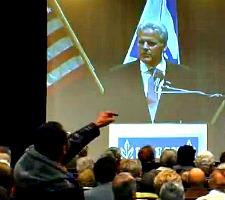
And I'm Bob Garfield. In the wake of last week's Palestinian bid for statehood, an 18 month old domestic dust up rears its head. In February of last year at the University of California, Irvine, a group of Muslim students protested a speech by Israel's ambassador to the US Michael Oren.
- [00:42]
Bob Garfield
MICHAEL oren, Propaganda murder is not an expression of free speech.
- [00:46]
Gabriel Stricker
Shut up the Irvine 11. Eight students from UC Irvine and three from UC Riverside were charged with conspiracy and disturbance of a meeting last Friday. A jury found 10 of them guilty. Tony Rikakis is the Orange County District Attorney. He said his office prosecuted the students because of overwhelming evidence. In emails, on video and from eyewitnesses.
- [01:11]
Bob Garfield
It was very clear that this was not just some kind of a shout down or some sort of a spontaneous heartfelt display. This was conspiracy developed over time to shut down the Israeli ambassador from speaking. So this was a serious challenge to freedom of speech.
- [01:28]
Gabriel Stricker
All right, fair enough. But there is no law that stops a citizen from depriving another citizen of freedom of speech. The Constitution protects us as citizens from the government repressing our right of expression.
- [01:41]
Bob Garfield
Well, there is a California law that says that it's unlawful to disrupt a lawful meeting. In this case, sir, it was a freedom of speech issue because here it was a case of this group saying that the speaker would not be allowed to speak.
- [01:54]
Gabriel Stricker
You know, I get that. But there's nothing in the Constitution that says an individual has a responsibility to let other people talk. It's annoying and it's obnoxious. But we're not talking about censorship in the strict legal sense, are we?
- [02:08]
Bob Garfield
We are talking about one group of individuals determining who can speak and what can be said on a university campus. So they did, in fact, make a censorship decision. What you're saying is that the only kind of censorship that could be called censorship is if it's done by the government. And frankly, I disagree with that.
- [02:25]
Gabriel Stricker
The University of California, Irvine police came to you with a complaint and then it behooves you either to pursue it or for whatever reason not to pursue it. There are a lot of speeches interrupted by protesters border to border, coast to coast, especially at universities.
- [02:46]
Bob Garfield
We have evidence of a Conspiratorial, planned shutdown of the speaker or. I'm not aware of ever turning down a case where we had that kind of evidence.
- [02:55]
Gabriel Stricker
Are you aware of ever prosecuting one?
- [02:58]
Bob Garfield
No. I think this is probably the first case that we got with this type of evidence where it was so clear.
- [03:03]
Gabriel Stricker
So that was the bridge too far for you? Not that a bunch of kids stood up at a meeting and repeatedly shouted down the speaker, but that they had planned to do it to make sure that this voice of the ambassador would be shut down?
- [03:17]
Bob Garfield
I think that the planning and the intention were clear and certainly were important to the case. Yes.
- [03:23]
Gabriel Stricker
Of all of the students in all of the universities who break up a meeting by doing something or another loud and obnoxious, the ones who end up getting prosecuted, 10 kids with an explicitly Muslim political agenda, did you discuss in your office whether the prosecution itself would be perceived as disproportionate administration of justice?
- [03:50]
Bob Garfield
I think what we discussed concerning the political implications were that if we don't proceed on this case, that we would not be able to proceed on another future case where, say, the Muslims were shut down in their attempt to give some kind of a speech. What it comes down to is whoever the group is, it doesn't matter if it's a Muslim group or some other group. We just can't allow one group to stop everybody else from putting their views forward. If it comes to us by way of a criminal complaint. I mean, you know, I don't. If it was any other group, we'd do the same thing.
- [04:20]
Gabriel Stricker
Tony, thank you very much.
- [04:21]
Bob Garfield
All right. Thank you very much.
- [04:22]
Gabriel Stricker
Tony Rikakis is the Orange County District Attorney. Irvin Chemerinsky is dean of the law school at University of California, Irvine. He said that even though the students clearly violated California law, he never expected this outcome.
- [04:39]
Brooke Gladstone
I was very surprised when the DA decided to bring criminal charges here. You only see prosecutions if there's injury to people or property or serious risk of injury to people or property that wasn't present here.
- [04:54]
Gabriel Stricker
Tony Rikakis, the DA with whom we've just spoken, says that he believes that apart from the statutes that the students violated, ultimately they were guilty of censorship, of abridging Ambassador Oren's freedom of speech. Do you buy that?
- [05:14]
Brooke Gladstone
I do, but it has to be put in perspective. Ultimately, Ambassador Oren was able to deliver his entire speech. They delayed his ability to do so. But it's different than the way it was being described of abridging, keeping him from speaking. He did deliver his entire address when.
- [05:32]
Gabriel Stricker
We spoke to Tony Rakakis. He said, look here, the police came to us with a case. We had video evidence, we had hundreds of eyewitnesses, and we had an email chain which proved conspiracy beyond a shadow of a doubt. And when police bring good cases to his office, his office prosecutes.
- [05:53]
Brooke Gladstone
It's so overly simplistic. DAs get strong cases all the time that they choose not to prosecute. In Los Angeles, for example, the city attorney is prosecuting almost no misdemeanor offenses because of budget shortfalls. So the strength of the case is one factor any district attorney would consider. But it's not the only factor. Is it good for the community to bring the prosecution? In this instance, it clearly wasn't good for the community. There's been a long history of incidents here at UCI of tensions between pro Palestinian students and pro Israeli students. This incident was particularly explosive. It was a year and a half ago. If there hadn't been the criminal prosecution, everyone could move on beyond it. But instead, what he's done is keep open and deepen a wound in the community.
- [06:50]
Gabriel Stricker
What about this? In a subsequent university sponsored event, a pro Palestinian speaker should be interrupted, shouted down, verbally abused by a group of Zionist students.
- [07:04]
Brooke Gladstone
I would be taking the exact same position. They should be punished by the university. There's no need for criminal prosecution now. Of course, if this happens in the future and the DA doesn't prosecute, then there'll be claims of unequal justice, of discriminatory prosecution, and I think those would be very powerful criticisms. On the other hand, it's really sad to see a bad decision become precedent for future bad decisions.
- [07:32]
Gabriel Stricker
Some have said that this prosecution in essence deprived the students of their free speech rights.
- [07:40]
Brooke Gladstone
There is no first amendment right to go into any public meeting and shout down the speakers. The students could have stood outside the auditorium and held up picket signs or hand out leaflets or held their own demonstration across campus. That's what the first amendment allows them to do. That said, the question then is, what's the appropriate punishment for these students? I think the appropriate punishment was university discipline. No need for criminal prosecution, but instead, the students now are celebrated as champions for free speech.
- [08:11]
Gabriel Stricker
All right, Erwin, thank you so much.
- [08:13]
Brooke Gladstone
Anytime.
- [08:14]
Gabriel Stricker
Erwin Jemerinsky is the dean of the law school at the University of California at Irvine. And here's another way to lodge a protest. If you Google Republican presidential hopeful Rick Santorum, the first result you'll get is a site called spreadingsantorum.com. the site's main purpose is to provide an alternate unbelievably obscene definition for the word Santorum. Spreadingsantorum.com is the brainchild of journalist and gay rights activist Dan Savage, and it's meant to punish Rick Santorum for what Savage considers the candidate's retrograde views on homosexuality. Santorum asked Google last week to redact the site from its search results, a request the company declined. Google doesn't comment on individual cases, but we were able to get Gabriel Stricker, Google's director of global communications and public affairs, to talk to us about the site's policy on these things in general. Gabriel, welcome to on the Media.
- [09:19]
Bob Garfield
Thanks for having me.
- [09:20]
Gabriel Stricker
Okay, Now, I have to tell you, Gabriel, I am no fan of Rick Santorum as a candidate, but my heart breaks for him that he has to live with this. What do you say to this guy?
- [09:33]
Bob Garfield
There's nothing especially new about these episodes.
- [09:37]
Ira Flatow
It was widely reported years back if.
- [09:39]
Bob Garfield
You did a query for Walmart, one.
- [09:41]
Ira Flatow
Of the most popular results that was.
- [09:43]
Bob Garfield
Coming up was a page that was.
- [09:45]
Ira Flatow
Very critical of Walmart. And you know, this is really largely a function of being in the public eye.
- [09:51]
Gabriel Stricker
But in the past, hasn't Google fiddled with its algorithm to deal with various kinds of abuse? For example, a few years back, if you typed in the words miserable failure in the Google search bar, you would come up with a picture of George W. Bush.
- [10:08]
Ira Flatow
That's right. You're describing one of the more high.
- [10:11]
Bob Garfield
Profile Google bombing episodes. And. And we made changes to our algorithms.
- [10:16]
Ira Flatow
To prevent that from happening because we.
- [10:19]
Bob Garfield
Don'T want people gaming our search results.
- [10:21]
Ira Flatow
We want to be able to provide.
- [10:22]
Bob Garfield
Results that are the best answer for your question.
- [10:25]
Ira Flatow
Now, sometimes your question might lead you.
- [10:28]
Bob Garfield
To a page that's in support of.
- [10:29]
Ira Flatow
What you're looking for, and sometimes it.
- [10:31]
Bob Garfield
Might lead you to a page against it.
- [10:33]
Gabriel Stricker
I have just typed into the Google search bar the term Jew. And up comes as the second search result, Jew Watch News, which is just a over the top antisemitic site. And high up in the results are a fair number of pretty problematic results. We had heard that Google had intervened in this case because so many of the results regard the search term Jew not as a neutral noun, but as an epithet. Is it true that you fiddled here on the margins with the algorithm?
- [11:12]
Bob Garfield
No, not at all.
- [11:13]
Ira Flatow
We were really disturbed by the results. But let it stand.
- [11:17]
Bob Garfield
The one thing that we did note.
- [11:18]
Ira Flatow
And this was an early case for.
- [11:20]
Bob Garfield
Us, we did provide an explanation of our search results there, where we ran.
- [11:24]
Ira Flatow
A message at the top of the page that said, we're disturbed by these results as well. And then it says, please read our note here. And if you click through, you'll see this explanation of how it is that we're personally disturbed by what you're seeing there.
- [11:38]
Bob Garfield
But let it stand, because this is.
- [11:40]
Ira Flatow
A reflection of what's out there on the Web.
- [11:43]
Gabriel Stricker
Funnily enough, it appears as a paid search result. In other words, an ad. Google took out an ad on Google to say that Google is upset about what's turning up organically on Google.
- [11:54]
Ira Flatow
That's right.
- [11:55]
Bob Garfield
That's something that we call a house ad.
- [11:56]
Ira Flatow
We don't remove a page from our.
- [11:58]
Bob Garfield
Search results simply because the content is unpopular.
- [12:02]
Ira Flatow
We really just want the results to.
- [12:04]
Bob Garfield
Be a reflection of what's available out.
- [12:06]
Ira Flatow
There on the Web.
- [12:07]
Gabriel Stricker
It is what it is.
- [12:08]
Bob Garfield
That's right.
- [12:09]
Gabriel Stricker
Gabriel, thank you very much.
- [12:11]
Bob Garfield
Thank you, Bob.
- [12:12]
Gabriel Stricker
Gabriel Stricker is director of global communications and public affairs for a little outfit called Google.
- [12:21]
Bob Garfield
Coming up, a new human rights effort puts eyes in the sky.
- [12:25]
Gabriel Stricker
This is on the Media.
- [12:29]
Brooke Gladstone
On the Media is supported by reputation.
- [12:32]
Bob Garfield
With tools designed to help lawyers, doctors.
- [12:35]
Brooke Gladstone
And business professionals protect and improve their online reputations. More about controlling online reputations@reputation.com this is NPR.
- [12:45]
Bob Garfield
This is on the Media. I'm Brooke Gladstone.
- [12:47]
Gabriel Stricker
And I'm Bob Garfield. Last Saturday, we saw Russian democracy at work.
- [12:53]
Jane McGonigal
I believe it would be right for the Congress to support the candidacy of Vladimir Putin in the presidential election.
- [13:00]
Gabriel Stricker
That was Russian Federation President Dmitry Medvedev. Medvedev at the conference of the United Russia Party endorsing Vladimir Putin as the party's nominee in the 2012 election. Putin had already been president eight years, a period of relative stability after the tumult of the Yeltsin era until constitutionally obliged to step down after two consecutive terms. Saturday's announcement was an open admission of what many had long suspected, that after four years of tandem rule with Medvedev, Putin was destined to resume full power of the country. The announcement was met with wild applause and was covered favorably on Russia's three major networks. Christian Science Monitor reporter Fred Weir has worked in Russia for more than two decades. He says that despite the chokehold on major media that has been Putin's legacy, some dissent has seeped out, mostly in a handful of opposition media outlets that remain. But it hasn't much mattered.
- [14:03]
Fred Weir
There's a certain amount of criticism, but it's mostly covering the to and fro of politics, much the same way an American network would cover American politics. And no one ever steps outside the boundaries of that on state tv.
- [14:20]
Gabriel Stricker
Describe for me some of the other coverage by less dominant channels.
- [14:25]
Fred Weir
There are some smaller regional TV channels and there's a small network called Ren tv. And you could hear on the talk shows on Ren TV worry that this can lead to stagnation in Russia, that Putin built his power on the basis of curbing pluralism and democracy. And there's also a radio station, Eco Moskva, to which all of the liberal commentators who were forced out of the big stations in the early part of the Putin era migrated. And there's at least one opposition newspaper, Novaya Gosiata, and there you got the full bore kind of criticism. And beyond that, there is the Internet, which is completely freewheeling and open.
- [15:12]
Gabriel Stricker
Did the Novaya Gazeta, or has anyone in the immense blogosphere invoked the D word?
- [15:20]
Fred Weir
The D word being dictatorship?
- [15:22]
Gabriel Stricker
Yeah.
- [15:23]
Fred Weir
No. And they use the word regime a lot. And certainly there's vast disgust there that this is basically the end of any pretense of democracy in Russia, that the whole thing was cooked up between two guys and announced to a cheering crowd who had played no part in making that decision. And this is basically the return of Soviet style politics.
- [15:48]
Gabriel Stricker
Michael Kirk Putin emerged just before the millennium, in the aftermath of the very tumultuous, chaotic, economically disastrous Yeltsin era, and was popular. He continues to be popular with the Russian electorate, does he not?
- [16:05]
Fred Weir
Yes. And in fact, he moved pretty briskly to do a lot of things that restored a sense of law and order, a sense of a working state after the shambles of the Yeltsin era. And he did a lot of that on the back of effectively nationalizing the main TV channels and bringing the media under control. And he also came to power at a time that coincided with the rising global oil prices. And this is the source of more than half of the Russian government's revenues. So the huge windfall of oil profits enabled Putin to restore really strong state power, along with almost Soviet style paternalism. All that income redistribution of the Putin era probably blunted the protests. It might have been at the curbing of elections and muzzling of the media and the crackdown on civil society that also took place.
- [17:08]
Gabriel Stricker
If nobody's agitating for a return to the kind of Wild west democracy of the Yeltsin era. If voices for true democracy are squelched and nobody cares, do they matter?
- [17:21]
Fred Weir
As a journalist, I've always thought that it matters a lot. I'm afraid that Russian leaders increasingly live in a bubble because they've cracked down on the media and basically manipulated Russian politics so that outcomes are virtually certain. They Also, don't get the signals that angry voters can deliver.
- [17:41]
Gabriel Stricker
There are journalists who are trying to render a watchdog function, and they're beaten, occasionally murdered in various ways, censored or intimidated. Can we assume that with the further ascendancy of Putin, that these problems are only going to get worse?
- [18:04]
Fred Weir
It should be pointed out that an awful lot of Russian political experts are saying that Putin may well use his new lease on power to institute sweeping liberal reforms. And there is logic to it. The Russian system is dysfunctional, and no one should know that better than Russians who have seen two states of this type collapse in the last century alone. I mean, they know that when you concentrate so much power and centralize it in the hands of such a tiny number of people that no matter how powerful that system looks, it can just go poof. And Putin surely knows this. So a lot of people are hopeful that now that he's back on top and completely in charge, that he will use that new authority to do something real. I'll believe it when I see it.
- [18:58]
Gabriel Stricker
All right, Fred, thank you so much.
- [19:00]
Fred Weir
Thank you. It's a real pleasure.
- [19:01]
Gabriel Stricker
Fred Weir is a correspondent for the Christian Science Monitor. He's been based in Moscow for 20 years.
- [19:08]
Bob Garfield
Last October, movie star George Clooney was in the genocide ravaged country of Sudan with human rights activist John Prendergast. They wondered who was it possible to track things like troop movements and human rights violations from the sky. Within weeks, and with funding from not on Our Watch, an organization Clooney sits on the board of the Satellite Sentinel Project was launched and was photographing what was going on on the ground in Sudan. The project can capture pictures in near real time of areas of Sudan that are too remote or too dangerous for journalists to get to. The project is the first of its kind. Jonathan Hudson is director of communications for the Enough Project and the Satellite Sentinel Project.
- [19:54]
Ira Flatow
The Satellite Sentinel Project's principal aims are to prevent a return to full scale war between Sudan and South Sudan and also to deter mass atrocities by creating liabilities for those who might commit war crimes. If you do commit mass atrocities, will document that and make it public and you could wind up standing trial for those war crimes.
- [20:18]
Bob Garfield
So how does it work? Where does it get its information?
- [20:20]
Ira Flatow
So I track down and interview confidential sources on the ground and feed these on the ground reports from eyewitnesses to Nathaniel Raymond and his team. They call themselves Spy Kids at the Harvard Humanitarian Initiative. And then that team uses commercial satellites and they tell the cameras what areas of interest to shoot on a daily.
- [20:42]
Bob Garfield
Bas These are Harvard undergrads and Harvard grads. I'm still wondering what exactly it is they're seeing that says, uh, oh, something bad is afoot down there.
- [20:51]
Ira Flatow
A good case example is one of our most recent reports showed a massive wall of armor, and it was headed toward a rebel stronghold in a place called Kermuk. We saw close air support from six attack helicopters. We saw infantry troop carriers, we saw mobile artillery. And we were able to give advance warning to the citizens of Kermuk.
- [21:15]
Bob Garfield
So in that case, you were actually able, possibly to prevent a fair number of deaths. In other cases, you are able to track from the sky atrocities that may have already occurred and been unreported. Right?
- [21:29]
Ira Flatow
Yeah. Our biggest report to date came on July 14th. We reported the first three of what we've now found are eight mass graves.
- [21:38]
Bob Garfield
And you also check out burn patterns on the ground.
- [21:42]
Ira Flatow
We looked, for example, at evidence of looting and raising. Our satellite saw a third of the civilian infrastructure in the town of Abye was burned to the ground.
- [21:52]
Bob Garfield
I also read that you pick up clues about roads being improved. Roads that are improved, that are not oil related, suggest that it's the military at work.
- [22:05]
Ira Flatow
The only reason to improve a road in these remote rural areas of Sudan is either if you're drilling for oil and there was no oil drilling in the area, or if you're preparing a road for what we call a tank run, an invasion. They were actually paving the roads and building them up to become all weather roads. And that allowed us to correctly predict one month in advance exactly how. How Sudan would invade Abye a month later.
- [22:33]
Bob Garfield
You're assembling evidence for war trials, but you're also assisting journalists.
- [22:38]
Ira Flatow
One thing we do is provide journalists with satellite imagery as well as summaries of our eyewitness reports. And we also work with people on the ground of the Nuba Mountains who are gathering information and helping them, training them how to work with journalists who might come in.
- [22:56]
Bob Garfield
You have different standards for how you handle information than, say, the New York Times does. Right.
- [23:04]
Ira Flatow
For example, the New York Times ran this story showing a girl who was a bombing survivor. And they gave her name at her age and her home village and a lot of other identifying information about her. We interviewed that same girl. We thought that for reasons of security, there was no reason to actually give the details about her actual name. The New York Times, you know, they are being true to journalistic standards. It's just that we actually are gathering evidence to a standard that could one day be introduced at a war crimes trial. In the Hague.
- [23:39]
Bob Garfield
Are you close to assembling enough evidence to bring a trial there?
- [23:44]
Ira Flatow
We have already submitted to the UN Security Council and to the International Criminal Court evidence of the government of Sudan's war crimes. And we've also submitted evidence of mass killings and mass graves.
- [23:57]
Bob Garfield
Are they acting it?
- [23:59]
Ira Flatow
About five hours after we released our July 14 report finding the first three of the mass graves, the UN Security Council went into closed session, and the U.S. the UK and France were pressing for action, and that was blocked largely by China and Russia.
- [24:17]
Bob Garfield
Tell me how you make use of media to get your messages out.
- [24:21]
Ira Flatow
In the case of the looting of Abye, we were able within hours to issue press releases, and we got hundreds of major media mentions in print, broadcast, and online media. The point is not that, you know, we're telling President Obama or the UN Security Council things that they don't already know through their satellite, but we're telling you, the public, here's the information. Now you can see it, and you can pressure policymakers around the globe to respond more quickly and effectively.
- [24:49]
Bob Garfield
Jonathan, thank you very much.
- [24:50]
Ira Flatow
Thank you, Brooke.
- [24:51]
Bob Garfield
Jonathan Hudson is director of communications for the Enough Project and the Satellite Sentinel Project. For two generations, studies have consistently shown TV news to be America's number one source of local information. But now a new Pew study paints a far more nuanced picture of our local information ecosyste. Pew broke down local news into specific topics, from politics to restaurants. And researchers found evidence of TV's dominance in only 3 of 16 weather, breaking news, and traffic. Lee Rainey, director of the Pew Research Center's Internet and American Life Project, co authored the study. Lee, welcome back to on the Media.
- [25:42]
Lee Rainey
Hi, Brooke. Thanks for having me.
- [25:44]
Bob Garfield
The big innovation here is you divided local news into these 16 different topics. Zoning, local art, scene, government. What difference did that approach make?
- [25:54]
Lee Rainey
Previous studies had tended to ask a single question, where do you get local news? And people would say either television or newspapers. But when you unpack the idea of news, it turns out that the ecosystem delivers different results depending on the topic that you're seeking. So, for instance, the most popular topics, weather, traffic, breaking news, are pretty well covered by television. And people say television is a source that they rely upon for those things. Newspapers are really important for civic kinds of news. What the government is doing, what the school board is doing, what's going on at local schools, what's happening in neighborhoods. But those are topics that are not as popular as the things that TV covers. And when we ask just a direct question, if your local newspaper vanished from the scene, would it have a major impact on your ability to get local information, A minor impact or no impact? 69% said it would have a minor or no impact on their ability to get information.
- [26:55]
Bob Garfield
But newspapers and newspaper websites ranked first are tied for first as the source people relied on for 11 of the 16 key topics that you examined, right?
- [27:06]
Lee Rainey
That's right. That's the paradox of our finding. Newspapers in the imagination of people is a primary source for lots of things necessarily fit very high, but on particular topics, they matter a lot.
- [27:17]
Bob Garfield
Why did you ask that question? How important would it be to you if your newspaper disappeared?
- [27:23]
Lee Rainey
There are two reasons we asked that question. The first is that newspapers are under financial stress. The other reason that we asked it is that some research by our colleagues in this study and in the past, the center for Excellence in Journalism studied the role of news newspapers in information ecosystem and found that if you actually take newspapers out of the mix, the amount of raw material there is for community information diminishes. The PEJ studied Baltimore and found that the newspaper was the originator of more than half the new information in the community on any given small time period, and that it was the raw material around which community conversation, community events, community activities, and politics were discussed.
- [28:05]
Bob Garfield
In most previous studies, people count newspaper websites as the Internet, but in yours, newspaper websites were counted as newspapers, which seems to make sense.
- [28:16]
Lee Rainey
What we wanted to do in this survey is have people think about the source of the information. If it came from a newspaper or newspaper website, we wanted to give credit to that legacy organization for producing that information, no matter what platform people used. And so for us, the Internet category only consisted of people who said they relied on search engines, on specialty websites, on social media, and other sort of local websites that only existed in the web environment.
- [28:44]
Bob Garfield
And how popular was the digital space? Did it win out for any of these 16 categories?
- [28:51]
Lee Rainey
Oh, yes. The Internet itself was the most relied upon source for five of the subjects that we asked about. It's very popular for getting information about local businesses, for local restaurants, for housing, for schools, and for jobs. And one of the most striking things that we saw is that if you're under age 40, you're much more likely to say the Internet is a primary source for you than if you are over age 40.
- [29:15]
Bob Garfield
And in the there is nothing new under the sun category, word of mouth ranks as the second most popular source of local news, right behind TV.
- [29:26]
Lee Rainey
74% said on a weekly basis they used local TV to get some local news. 55%, the second highest ranking, went to word of mouth. And that's when people said, I rely on my friends, I go to my neighbors, I go to trusted colleagues.
- [29:40]
Bob Garfield
Word of mouth is not limited to words shared across the backyard fence. You're talking about Twitter and Facebook, one to one communication on every platform.
- [29:52]
Lee Rainey
That's right. When a person's at the other end of the exchange, no matter what way they did that, if they mentioned a person as the source of the information, we scored it as a word of mouth activity.
- [30:04]
Bob Garfield
So what do these results suggest about future results?
- [30:10]
Lee Rainey
One of the most interesting things mobile users and people who actually participate in the news, people who have actively used social media platforms to contribute to news, to comment on news, to post pictures or videos. Both of those audience, the participators and the mobile folks, are way more into local news than everybody else in all of its forms. Encouraging news as conversation, encouraging people contributing their own stories to news operations and doing it in real time in the mobile environment. Both those things might have a significant payoff both to the audience and maybe even the business of news organizations.
- [30:44]
Bob Garfield
Lee, thank you very much.
- [30:46]
Lee Rainey
Thanks, Brooke.
- [30:47]
Bob Garfield
Lee Rainey is the director of the Pew Research Center's Internet and American Life Project.
- [30:55]
Gabriel Stricker
Coming up, gamers crack the code of organic chemistry and possibly the psychology of physical recovery.
- [31:02]
Bob Garfield
This is on the Media.
- [31:06]
Brooke Gladstone
On the Media is supported by Reputation.com with tools designed to help lawyers, doctors and business professionals protect and improve their online reputations. More about controlling online reputations@rePUTATION.com support for on the Media also comes from constant contact, committed to success for small businesses and Nonprofits. More@constantcontact.com Local the Doris Duke foundation for Islamic Art, seeking to improve Americans understanding.
- [31:32]
Bob Garfield
Of Muslim arts and cultures and the.
- [31:34]
Brooke Gladstone
Robert Wood Johnson foundation, providing resources to improve the quality of healthcare online@rwjf.org consumer this is NPR.
- [31:45]
Gabriel Stricker
This is on the Media. I'm Bob Garfield.
- [31:48]
Bob Garfield
And I'm Brooke Gladstone. Last New Year's we devoted the show to gaming. We wondered if all those millions of hours spent in virtual worlds could have any substantive impact on the real one. Well, an article published in a recent issue of the journal Structural and Molecular Biology may have one answer. Using a game available to anyone online called Foldit, gamers successfully built a model of an enzyme crucial to understanding how many diseases, such as aids, do their damage. Solving the crystal structure of the MPMV retroviral protease has stumped scientists for more than 10 years. But the puzzle was solved by crowdsourced gamers in only 10 days. Zarin Popovich is One of the conceptual designers of the game, Foldit, he says it's like a very complex jigsaw puzzle or a kind of three dimensional Tetris. Professor Popovich, welcome to the show.
- [32:47]
Jane McGonigal
Thanks for having me.
- [32:48]
Bob Garfield
Assume I am woefully ignorant of the significance of protein folding. That is what the gamers figured out. This enzyme, how it folded, right?
- [32:59]
Jane McGonigal
Right. If you know the shape of each one of the proteins, you more or less know the secret of life. And pretty much everything that's done in living organisms is done by proteins. This goes from digesting your food to moving your muscles, to defending against viruses and diseases. And everything is done through the way that the shape of protein interacts with shapes of other molecules.
- [33:24]
Bob Garfield
Like keys in locks.
- [33:26]
Jane McGonigal
Yeah, very much so.
- [33:28]
Bob Garfield
So figuring out how this enzyme folded, why is it a big deal?
- [33:32]
Jane McGonigal
Each virus has a whole bunch of proteins. A lot of them are on the surface. And how these surface proteins interact with other things is exactly how virus does its damage. Imagine if you had another jigsaw puzzle shape that you can attach to that protein on a virus. All of a sudden you can possibly neutralize that virus and it could no longer be attacking live cells.
- [33:55]
Bob Garfield
I thought that was how protease inhibitors work, that we already knew how the AIDS virus folded.
- [34:02]
Jane McGonigal
They know how some types of AIDS virus folded. They don't know all the proteins on the entire AIDS virus. And this particular virus is different than the human virus. This is a monkey virus that they're looking for. Because the more you understand how any one of the HIV viruses interacts and does its damage, the more likely you will create a universal drug that can prevent not just the virus, but its mutations as well.
- [34:27]
Bob Garfield
If I were playing this game, what would I be looking at? Some sort of 3D model, like one of those IQ tests? I would have to try folding things in different ways or imagine how they would look when they were folded. I mean, how is this undertaking different from regular research? What are they seeing?
- [34:48]
Jane McGonigal
Think of a necklace. And it's a necklace that instead of having beads, it has a whole bunch of these strange looking shapes on it, which are basically amino acids. And now you ask the question, what's the tightest possible way I can pack this necklace into smallest amount of space that turns out to be energetically the most stable shape of the protein. So what we're trying to do is move different parts of this necklace in such a way that you can pack it better. You have rubber bands and all sorts of tools with which you can do more and more of these manipulations and then there are also these superpower things you can apply, like wiggle and shake, which can sort of refine the protein even better.
- [35:27]
Bob Garfield
Is this a visual spatial exercise, or do you have to understand that these are molecular structures that you are working together?
- [35:39]
Jane McGonigal
You don't need to know any chemistry. And in fact, what we have done is encased the relevant biochemistry into the rules of the game. If you know the rules of the game, you know you can play and be highly effective.
- [35:51]
Bob Garfield
Some time ago, we spoke to Jane McGonigal, and she says that there's a kind of game personality that enables people to focus incredibly hard for many, many hours and fail in a game and learn from their failures without being traumatized by them in a way that we can't do in real life. Are those the kinds of people who play your game?
- [36:16]
Jane McGonigal
Many of the people that play our game have actually never really liked games until they found Foldit. And part of the reason for that is that it has this objective of actually helping humanity. And that's what pulled them on originally. They started playing it and it's like, oh, wow.
- [36:31]
Bob Garfield
But that's what Jane McGonagall says, that everybody has a role and they're glad to be moving towards a common purpose.
- [36:40]
Jane McGonigal
Yeah, yeah. So, I mean, basically our task was to cast the widest possible net and see how many of those people become really interested in this kind of endeavor.
- [36:49]
Bob Garfield
Tell me about the incentive structure.
- [36:51]
Jane McGonigal
Originally we had scoring, and then it became obvious that people have different types of gameplay. For example, some people really love to start from scratch and develop the game and just have their name singularly on that solution. Other people were very, very good at taking other people's solutions and evolving them into better solutions. If you play the game for a while, you become highly ranked on the overall ranking, all protein folders. There are also groups you can be very good at organizing the group. For example, we have some groups that have players playing in states, and when these guys go to sleep, the Australians take on the protein and work on it.
- [37:31]
Bob Garfield
What project do you have in the works that you're most excited about right now?
- [37:36]
Jane McGonigal
One of the key aspects of Foldit was this ability to develop experts. One thing that came to us is that, well, this really is education in a nutshell. So why can we not revolutionize education in the same way? We lose so many people in elementary school and middle school that just conclude that math and science is not for them. We can make a game that automatically adapts to every student, such that not only are they more Proficient at math and science, but they actually like it and have fun with it just like they do with games.
- [38:12]
Bob Garfield
You're working on a project to figure out how kids brains fold.
- [38:17]
Jane McGonigal
Yeah, we're trying to discover the space of all possible confusions that kids can have on these concepts and then figure out how to uniquely present material in the game that adapts to every kid and make sure that light bulb lights up in their brain and they suddenly get it. Oh, this is fun. This is easy.
- [38:35]
Bob Garfield
Zorin, thank you very much.
- [38:37]
Jane McGonigal
You're welcome.
- [38:38]
Bob Garfield
Zorin Popovich is one of the conceptual designers of the game Foldit. On that New Year's video game show I mentioned earlier, we played excerpts from a talk by game designer Jane McGonigal. A couple of years ago. She suffered a traumatic brain injury. In the headaches, vertigo and nausea it left behind. She couldn't work, she couldn't think, she couldn't stand it. Here, in a recent talk, she picks up the story.
- [39:02]
Brooke Gladstone
So my doctor told me that in order to get better, it would take about a month. And there were all these things I couldn't do because it would slow the healing process. No reading, no writing, no video games, no computer time, no running, and no caffeine. So in other words, no reason to be living. It is kind of funny, but in all seriousness, suicidal ideation is very common in people with traumatic brain injuries. It's part of the trauma. And it actually happened to me. My brain started telling me in all seriousness that, Jane, you want to die. 30 days passed and I had not gotten any better. I was more depressed, anxious and lonely than I'd ever been. My doctor told me that these emotions were actually slowing the healing process. The brain cannot heal without positive emotion. So that's when I said to myself, I'm either going to kill myself or I'm going to turn this into a game.
- [39:55]
Bob Garfield
Jane McGonigal told us that's how she came up with a game called Super Better.
- [40:01]
Brooke Gladstone
It seemed to me that all of my research showing that games help us provoke positive emotion could be really useful during this recovery process. So I actually invented the game to heal my own traumatic brain injury.
- [40:13]
Bob Garfield
How does it work?
- [40:14]
Brooke Gladstone
Well, think of it as a kind of a recovery adventure game. Then we take you on a series of seven missions to identify your power ups. So these are things that you can do every day to feel stronger or feel better. We identified the bad guys, which are things you need to avoid, that you want to vanquish so that eventually, eventually they can't harm you anymore. We help you pick allies, so close friends and family members that you want to go on this adventure with you. And then we help you think about an epic win. So what would be a really positive outcome? Not just getting back to normal, but something at the end of it that would be even better than normal. That would feel like a real accomplishment. And once you've identified all of that, you build a secret headquarters where your friends and family can help you overcome the challenge and battle the bad guys. Collect your power ups, go on quests, take some of this helplessness or hopelessness out of what can be a really difficult process. How do you play so super better? Isn't a video game where you have an avatar and you're in a virtual world? We are more like a social media platform, more like Twitter or Facebook. It just so happens that what you're doing in this social media environment is are very playful or as we would say, very gameful. They're really focused around challenges and missions. Instead of a status update from your friend, you might get a quest from your friend. So it's less like a video game and more like a life management tool.
- [41:45]
Bob Garfield
So what specifically were some of your goals, your enemies, and your quest?
- [41:51]
Brooke Gladstone
When I first hit my head, I was actually in the middle of writing my book, and I was terrified that I would never finish it. So one of my first epic wins that I set for myself was just to be able to sit down and write for an hour. Later on, as I started to get better, I set more fun and ambitious epic wins. One was to go to a Lady Gaga concert, which seemed really impossible at the time because loud music or bright lights or crowded spaces were triggering really terrible symptoms. And then, of course, my bad guys, for a mild traumatic brain injury, you have things like the bright lights, caffeine or alcohol. Physical activity can really bring on symptoms. And so I would just track over time how much exposure I was able to have, but vanquish them if I suddenly felt strong enough to be around them or do them again. The power ups were really great because sometimes when you're sick or injured, it feels like you can't do anything at all. But I was able to come up with things like cuddling my dog, listening to a power song, you know, picking a song that makes you feel like you can take on the world.
- [42:54]
Bob Garfield
Like, what?
- [42:55]
Brooke Gladstone
This is somewhat embarrassing. I mean, of course, Lady Gaga songs, but I was really into this song called Bad Day by DAV Daniel Powder.
- [43:03]
Lee Rainey
Cause you had a bad day, you take your one down, you sing a sad song just to turn it around.
- [43:10]
Brooke Gladstone
I had many bad days in a row, but I listened to that song to kind of get perspective.
- [43:14]
Bob Garfield
How is this different from self quantifying, just counting up how many minutes you can take an activity that you couldn't take before and positive thinking. I mean, what is it in the game mechanics that makes this different from that?
- [43:30]
Brooke Gladstone
We're really trying to unlock a couple of things that games do better than anything else. And you know, the first is the power of positive emotion. There's been a ton of research in the health field showing that if you can have three positive emotions for every one negative emotion on a daily basis, that it actually radically improves your ability to recover from any illness or injury. Also, social connections. If you can feel really connected to at least two to three people, that is better for your health than quitting a pack a day cigarette habit. It's better for your health than going from obese to non obese. And these are things that games do really well, connect you with people who can become allies or unleash positive emotions like curiosity, surprise, awe and wonder.
- [44:19]
Bob Garfield
When do you plan to make Superbetter publicly available?
- [44:23]
Brooke Gladstone
We've just started a clinical trial with Ohio State University Medical center for the traumatic brain injury aspect of the game and we've started a private game with the company Zappos, the online retailer where they're going to have all 5,000 employees play for goals like losing weight, getting in shape and quitting smoking. And we hope to launch early 2012, but you can sign up now and we're sort of rolling people in based on the challenge they're facing as we get the content ready for them.
- [44:54]
Bob Garfield
What if you have an injury or a problem you want to recover from, but you don't have any friends or family?
- [45:02]
Brooke Gladstone
It works really well with just one ally and there are a number of people play testing it now with just one or two allies. If there's nobody that you feel comfortable inviting to play, we also have an online community where you can reach out to other people who are facing the same challenge or maybe have successfully met the same epic win that you're going for. And so you can invite them to be an ally for you.
- [45:24]
Bob Garfield
You know, when we read about Super Better, it made us think immediately of our producer Alex Goldman, who suffered a pretty serious injury earlier this year. I want to bring Alex in. Alex, welcome back to the show. You made a brief appearance last week.
- [45:42]
Lee Rainey
Thanks, Brooke.
- [45:43]
Bob Garfield
Describe your hideous accident.
- [45:45]
Lee Rainey
I was riding my bike and I was run over by a car and I sustained multiple Fractures. I sustained a compound fracture, which at the time I didn't realize meant that the bone was sticking out of my leg. I had one surgery in which they put what's called an external fixator. That's kind of like scaffolding that's screwed directly into the bones in my leg.
- [46:06]
Bob Garfield
Your leg was entirely bolted to a contraption for weeks.
- [46:10]
Lee Rainey
It was about three weeks. It was pretty awful. And now I have a plate on my shin and a pin in my fibula. And I've been walking since the end of July, but I still experience a lot of pain when I walk. And it swells every afternoon unless I wear what's called a compression hose, which is basically like a long stocking instead of a sock.
- [46:31]
Bob Garfield
And you've been really down.
- [46:34]
Lee Rainey
It's changed pretty much every aspect of the way I live my life. It's made it much more difficult to do simple things. I can't really. I limp when I walk. I certainly can't run and I can't ride my bike anymore, which is really probably the hardest thing for me.
- [46:50]
Bob Garfield
So it seems like Alex is a perfect candidate for super better, right?
- [46:55]
Brooke Gladstone
Yeah, it sounds like it. I'm so sorry, Alex, that. That is the case.
- [46:59]
Bob Garfield
So where do you think he would be once he followed your six week timeline?
- [47:04]
Brooke Gladstone
The one thing that we've definitely seen about this game is that the thing it does most powerfully is take out some of the anxiety, the depression or frustration that you feel. And once those out of the way, then it really does become possible to tackle the challenge head on, faster, and sort of with more courage. Hopefully Alex will be surprised at how strong you are and how much better you can get.
- [47:30]
Lee Rainey
I'm curious, what kind of goal do you think I could set for myself? Because I thought about this a little bit in terms of the parameters of the game, and I'm kind of coming up empty. I'm not sure exactly what kind of goal I could set for myself that.
- [47:40]
Bob Garfield
Would constitute an epic win.
- [47:42]
Lee Rainey
Right.
- [47:43]
Brooke Gladstone
Some people start with really small epic wins, something they want to do in the next 24 hours. Other people set epic wins that. That could take months. And it doesn't necessarily have to be related to getting better per se. Some people choose epic wins of just going someplace they've never been before. The key is not to just pick something clinical like, I want to be able to walk for 30 minutes, you know, without pain. Although you could if that were really exciting to you. But maybe it's walk for 30 minutes to this amazing place that I've been dying to go to, and my friends will meet me there and we'll totally celebrate. Something that has a little bit of a kick to it like that.
- [48:21]
Bob Garfield
You played around a little in the game today, didn't you?
- [48:24]
Lee Rainey
Yeah, I tried it out. And one of the first things you do is you set a secret identity. And when I thought of what kind of secret identity I wanted, I immediately thought of Omar Little from the Wire. But then I realized he doesn't really have any allies.
- [48:36]
Brooke Gladstone
Oh, no, Omar had allies, sort of. I mean, they all wound up dead, but, you know.
- [48:43]
Lee Rainey
Yeah, I guess that's true. And, you know, in the latter half of the series, he even sort of wanders around with a broken leg after jumping out a window. So I felt a bit. A lot of kinship toward him when I was.
- [48:52]
Bob Garfield
So, Alex, are you game?
- [48:54]
Lee Rainey
I'm definitely game. I'm actually going to be trying it out over the next six weeks and I'm going to be blogging about it on the onthemedia website. So if you want to see my goals and my secret identity, you want to see my secret lair, you can come to the OnTheMedia website, click on blog at the top and you'll be able to see some of the stuff that I've been working on.
- [49:13]
Bob Garfield
Jane, do you think you might be able to come back at the end of six weeks and talk to Alex about it again?
- [49:19]
Brooke Gladstone
Oh, absolutely. Absolutely. That would be great.
- [49:22]
Bob Garfield
Thank you so much. And you too, Alex.
- [49:24]
Lee Rainey
Thank you.
- [49:25]
Brooke Gladstone
Good luck, Alex. I'm totally here as your ally.
- [49:28]
Bob Garfield
That's pretty cool.
- [49:29]
Lee Rainey
Yeah, that is cool.
- [49:29]
Bob Garfield
I'd take her up on that.
- [49:30]
Lee Rainey
I definitely will.
- [49:31]
Bob Garfield
Shane McGonigal is a designer of Super Better and the author of Reality Is why Games Make Us Better and How they Can Change the World.
- [49:40]
Jane McGonigal
I was born, baby.
- [49:43]
Gabriel Stricker
I was born. Just be a drag Just be a queen don't be a drag Just be.
- [49:48]
Ira Flatow
A queen don't be a drag Just be a queen.
- [49:53]
Gabriel Stricker
That's it for this week's show on the Media was produced by Jamie York, Alex Goldman, BJ Vogt, Sara Abdurhan, Chris Neary, and Laura Mayer, with more help from Doug Anderson and Gianna Palmer and and edited by Brooke. Our technical director is Jennifer Munson. Our engineer this week was Dylan Keith.
- [50:14]
Bob Garfield
Hatia Rogers is our senior producer. Ellen Horn is WNYC's senior director of national programs. Bassist composer Ben Allison wrote. Our theme on the Media is produced by WNYC and distributed by npr. I'm Brooke Gladstone.
- [50:29]
Gabriel Stricker
And I'm Bob Garfield.
- [50:33]
Brooke Gladstone
Support for on the Media comes from.
- [50:35]
Bob Garfield
The Ford foundation, the Jane Marcher foundation, the Overbrook foundation, and the listeners of WNYC Radio.
- [50:42]
Jane McGonigal
This is npr.
- [50:45]
Ira Flatow
This is Ira Flato, host of Science Friday. For over 30 years, the science Friday team has been reporting high quality science and technology news, making science fun for curious people by covering everything from the outer reaches of space to the rapidly changing world of AI to the tiniest microbes in our bodies. Audiences trust our show because they know we're driven by a mission to inform and serve listeners first and foremost with important news they won't get anywhere else. And our sponsors benefit from that halo effect. For more information on becoming a sponsor, visit sponsorship.wnyc.org.