← On the Media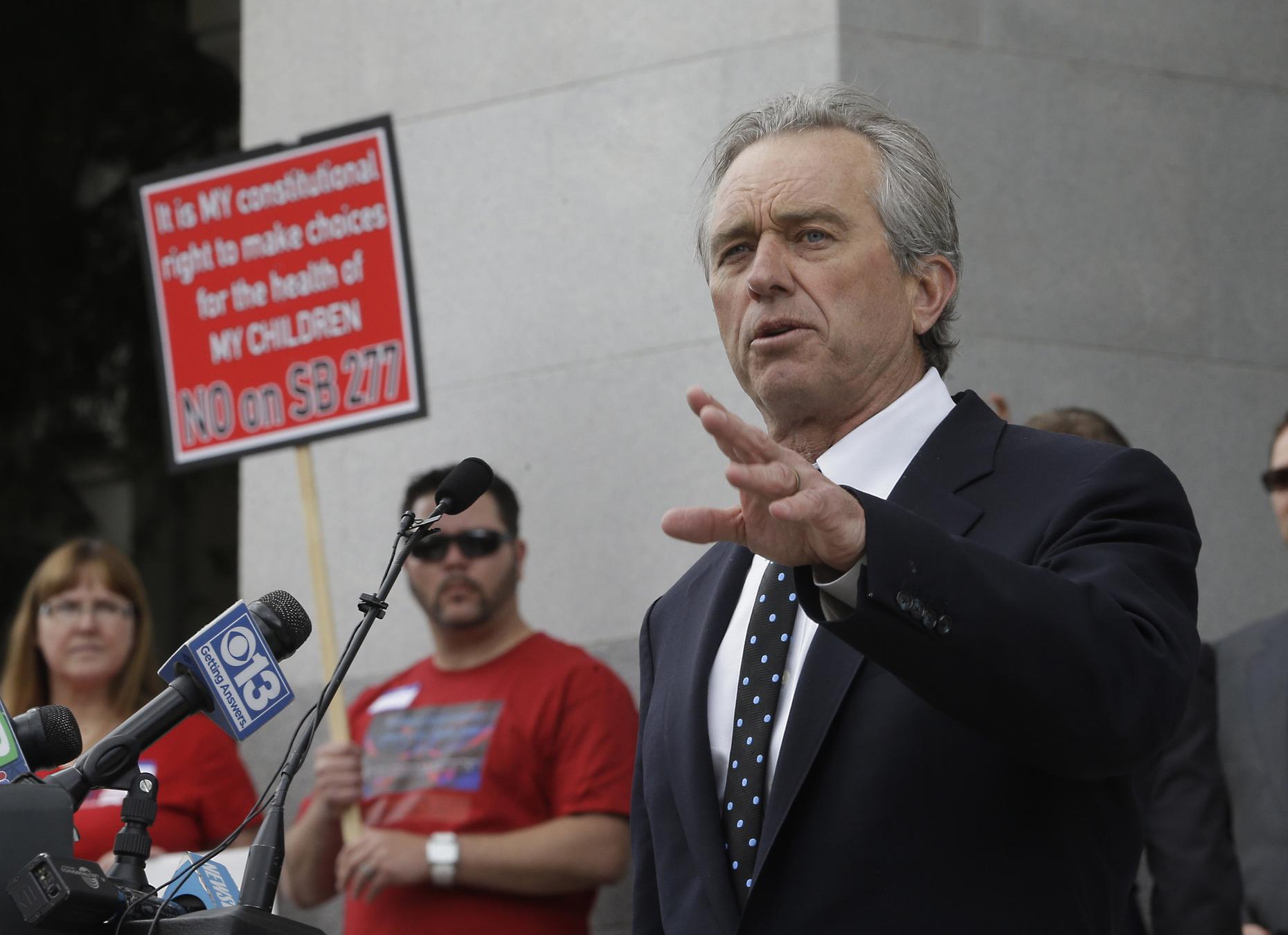
On the Media
On the Trail With RFK Jr.
00:50:59
Russian's short rebellion and the latest Kennedy to run for president.
Loading summary
Transcript177 lines
- [00:01]
Brooke Gladstone
We begin our report with the rebellion that wasn't in Russia. Or was it a rebellion?
- [00:07]
Brandi Zadrozny
Whiplash is a brief armed uprising and Russia disbands, replaced by a battle of narratives.
- [00:12]
Nani Halsing
It creates an understanding that Putin's position is weak, that he doesn't have enough support within the military, and that perhaps if someone else engages in a coup, the coup might succeed.
- [00:23]
Brandi Zadrozny
From WNYC in New York, this is on the Media. I'm Brandi Zadrozny. Robert F. Kennedy Jr. Is on the campaign trail and the media are learning to cope with the phenomenon known as the Gish Gallop.
- [00:35]
Paul Offit
The idea that Gish Gallop is that you are making claim upon claim upon claim, bad argument after bad argument, very, very, very quickly. It is hard for the person that you are speaking to to respond to all of those claims effectively and in real time.
- [00:47]
Brandi Zadrozny
Plus the ultimate victims of an anti vaccine candidate.
- [00:50]
Mary Harris
It's invariably the children who suffer our ignorance the most vulnerable among us.
- [00:55]
Brandi Zadrozny
It's all coming up after this.
- [01:00]
Brooke Gladstone
On the Media is supported by Progressive Insurance. Do you ever find yourself playing the budgeting game? Well, with the name your price tool from Progressive, you can find options that fit your budget and potentially lower your bills. Try it@progressive.com Progressive Casualty Insurance Company and affiliates Price and coverage match limited by state law and not available in all states. Running a business is hard work. Building your website shouldn't be. With wix you can express your ideas, give direction, then leave the heavy lifting to AI. From site creation to branded content and images. Have fun with the details, customize what you want the way you want, and manage your whole business from a centralized dashboard with expert AI tools. Build, scale and enjoy the incredible results. You can do it all yourself on wix.
- [01:54]
Claire Wardle
The election has come and gone. Now we're in a new era. It can be easy to get discouraged, frustrated, but you can't afford not to pay attention. You need trustworthy independent journalism to cut through the noise and hold power to account. I'm Mary Harris, host of What Next from Slate.com we are a daily news podcast with a kind of transparent, smart user, yet tongue in cheek analysis you can only find at Slate. Follow and listen to what Next Wherever you get your podcasts.
- [02:27]
Brandi Zadrozny
From WNYC in New York, this is ON THE media. I'm Brandi Zadrozny and I'll be sitting in for Brooke Gladstone this week, the.
- [02:35]
Stephen Kotkin
Last day or so has seen an.
- [02:36]
Brandi Zadrozny
Extraordinary turn of events in Russia. A week ago, the world watched as Russian President Vladimir Putin's favorite fixer made.
- [02:44]
Brooke Gladstone
A power Play in the Russian city of Rostov. Armed men and armor on the streets.
- [02:51]
Brandi Zadrozny
Wagner's founder, Evgeny Prigozhin, is calling for an armed rebellion.
- [02:55]
Brooke Gladstone
Prigozhin announced his army, tens of thousands strong, would reverse course, backing out of Ukraine, marching directly on Moscow.
- [03:03]
Brandi Zadrozny
Russian State TV threw to a lot of commercial breaks as the rest of the world tried to figure out what was going on.
- [03:09]
Mary Harris
What's the latest that we have confirmed?
- [03:13]
Brooke Gladstone
So there is very little confirmed and.
- [03:16]
Brandi Zadrozny
Utter baffling turn of events here.
- [03:18]
Brooke Gladstone
The rebellion that wasn't in Russia. Or was it a rebellion?
- [03:22]
Brandi Zadrozny
But then as quickly as the rebellion flared, it fizzled.
- [03:26]
Mary Harris
The leader of the Wagner group, Yevgeny.
- [03:28]
Brooke Gladstone
Prigozhin, has ordered his mercenaries to turn around and return to their bases to avoid bloodshed.
- [03:34]
Stephen Kotkin
He said Vladimir Putin began the day.
- [03:36]
Brooke Gladstone
Angrily denouncing an armed insurrection as terrorist methods and now appears to have struck.
- [03:41]
Brandi Zadrozny
A deal with Prigozhin.
- [03:42]
Nani Halsing
The Kremlin says it's dropped charges and Prigozhin will go to Belarus while promising his fighters contracts with the Russian military. It was not a coup because Prigozhin made his intention clear repeatedly. He was not trying to overthrow the government. He was not trying to seize power from Putin.
- [04:01]
Brandi Zadrozny
Nani Halsing is the author of Seizing the Strategic Logic of Military coups. Back in 2016, he helped on the media create a Breaking News Consumers Handbook Military Coup Edition after a failed attempt by the military to seize power in Turkey. He says what happened in Russia last week was less a coup than a mutiny.
- [04:21]
Nani Halsing
So there were some distinctions. Most mutinies are from the bottom, which is to say, if your average Russian conscript was to rise up against the war or against their conditions of service, that would be a lot more typical. However, this is not something which is unique, what Prigozhin did. In fact, there are other examples, like in Ecuador or in Argentina, where you have generals or people who are in command of significant military forces, who will mount an armed rebellion, who will use that force to attain a political objective. It's just that in this case, that political objective stops just shy of the removal of the president.
- [05:02]
Brandi Zadrozny
When you spoke to OTM in 2016, it was about a coup attempt in Turkey. You said then that coups are about making the outcome seem inevitable and putting out the message that they've already succeeded in overthrowing the people in power. Did Prigozhin do that?
- [05:17]
Nani Halsing
No, Prigozhin did not. And it's one of the ways in which he avoids being accused of mounting a coup. He never says, my intention is to take over. He never says, I've already succeeded in taking over. In fact, his first target is Rostov rather than Moscow, and he says he intends to go in and remove the top people at the Ministry of Defense. He doesn't say, I've already succeeded in doing so. However, he does do half of it. If you're going to create a narrative that your seizure of power is a fait accompli, that your success is inevitable, the first half of doing that is that you have to demonstrate that the state is no longer in control. And that's the part that Prigozhin does.
- [06:03]
Brandi Zadrozny
Do you warn that in the case of a coup or a mutiny, each side is battling to seize the narrative? What are the competing narratives here?
- [06:12]
Nani Halsing
You're seeing a lot more narrative creation. Now that things are over. Prigozhin wants to make it seem as if he could have succeeded. Putin is trying to make it seem that Prigozhin's activities were highly threatening to the state, but he was in control all along, and that he's still in control. Both sides want to create an impression, to create an understanding of what occurred because of the consequences for their existing position. If Prigozhin can make it seem like he came very close to succeeding, it'll make it a little bit harder for people to assassinate him, because if they assassinate him, maybe his troops will rise up and maybe they'll overthrow the government.
- [06:54]
Brandi Zadrozny
You've also said it's important to pay attention to who controls the broadcast stations. But what about the rise of social media? Was Prigozhin getting his message out via telegram? Was that equally effective?
- [07:07]
Nani Halsing
So I think that Prigozhin's use of telegram was very important here. He, in a series of voice messages, has been increasingly critical of the state of the Ministry of Defense, and this is how he put his case forward. However, I don't think that social media operates as a substitute for the regular media here. It was necessary for Prigozhin's message to be picked up by broadcast media sources alone. On telegram, it would not have had the same impact. The reason is this. When there is a mass broadcast, when somebody is on TV and they say, we've taken over the state, you know that pretty much everyone else has seen that. And it serves as a coordination mechanism when something is on telegram. If you're a general, you don't know if everybody else has heard that. What's more, you don't know that everybody else knows that everyone else has heard that. You need this publicness, and that allows for Common action.
- [08:08]
Brandi Zadrozny
You wrote on Twitter that coups tend to be bloodless, in part because coup dynamics are driven by a desire to avoid civil war. And most successful coups are also fast, right?
- [08:18]
Nani Halsing
Mm.
- [08:19]
Brandi Zadrozny
I think that's what was so shocking to some about this weekend. It's just that things felt like they were going so quickly and then suddenly just stopped.
- [08:27]
Nani Halsing
So this is one of the places where you do see coup like dynamics. For one thing, there was very little to no fighting. There may or may not have been some helicopters that were shot down. But near as I can tell, the bloodshed from this very serious threat was almost zero, and maybe entirely zero. Secondly, the whole thing happened and was over so quickly. And the reason here for all of that is that the pressure to both disturb normality and then return to normality is very, very strong. You want to disturb normality because that's what allows you to create a new order, to change what's going on. And then the minute there's any sort of resolution, it's in the interests of the state, it's in the interest of the President to move back to regular order as quickly as possible. And the result of this is that, as an observer, my head was spinning.
- [09:23]
Brandi Zadrozny
Same. I think we also saw, at least on social media, a lot of early celebrating. There are many who'd be very happy to see Vladimir Putin go. But why should listeners reserve judgment before acting as Prigozhin's cheerleader?
- [09:41]
Nani Halsing
Prigozhin is a war criminal. You look at the actions of Wagner within Ukraine, and they are horrific. And so if Prigozhin had, for example, been appointed Minister of Defense and been put in charge of the war effort in Ukraine, it is very possible that the war would have become even more bloody and aggressive and involved even more human rights violations than what we've seen thus far. And so just because we have very good reasons to be critical of Putin and want to see him removed doesn't mean we should ignore the question of who or what comes after Putin.
- [10:21]
Brandi Zadrozny
Stephen Kotkin wrote for Foreign affairs that there is one thing that all dictators properly an alternative. In his videos and voice memos, Prigozhin has been putting forth populist messages and claims that he knows the truth about Russia's elite and how they've lied, has Prigozhin presented himself as a viable alternative to Putin?
- [10:44]
Nani Halsing
It's hard to tell. But Prigozhin is one of the few people who has been able to engage in a sustained political critique of the current situation. And it creates space for there to be future challenges to Vladimir Putin. It'll be very interesting to see what occurs in the next few weeks to months in terms of Putin's ability to retain his hold on power. He's going to want to consolidate it and at the same time, he knows he has very few people he can trust. And the more oppressive he becomes to members of his own state security apparatus, the more incentives he gives them to either shirk or act against him. Russia is still a nuclear armed power. They have one of the largest nuclear arsenals in the world. So this is a very dangerous period for the world.
- [11:38]
Brandi Zadrozny
Nani hall, thank you very much.
- [11:40]
Nani Halsing
Thank you so much, Nani.
- [11:43]
Brandi Zadrozny
Hal Singh is the author of Seizing the Strategic Logic of Military Coups. You'll find the Breaking News Consumer Handbook, Military Coup Edition and all of our handbooks at our website onthemedia.org Coming up, how to cover Robert F. Kennedy Jr. This is OnTheMedia.
- [12:03]
Brooke Gladstone
OnTheMedia is supported by Progressive Insurance. Do you ever think about switching insurance companies to see if you could save some cash? Progressive makes it easy to see if you could save when you bundle your home and auto policies. Try it@progressive.com Progressive Casualty Insurance Company and affiliates. Potential savings will vary. Not available in all states. Running a business is hard work. Building your website shouldn't be. With wix, you can express your ideas, give direction, then leave the heavy lifting to AI, from site creation to branded content and images. Have fun with the details, customize what you want the way you want, and manage your whole business from a centralized dashboard with expert AI tools. Build, scale and enjoy the incredible results. You can do it all yourself on wix.
- [12:56]
Claire Wardle
The election has come and gone. Now we're in a new era. It can be easy to get discouraged, frustrated, but you can't afford not to pay attention. You need trustworthy, independent journalism to cut through the noise and hold power to account. I'm Mary Harris, host of what next from slate.com. we are a daily news podcast with a kind of transparent, smart, yet tongue in cheek analysis you can only find at Slate. Follow and listen to what Next.
- [13:23]
Brandi Zadrozny
Wherever you get your podcasts, this is ON the media. I'm Brandi Zadrozny, sitting in this week for Brooke Gladstone. In my role as a senior reporter for NBC News, I cover misinformation, extremism and the Internet. Which explains why a few weeks ago I was on a Los Angeles hiking trail with this guy.
- [13:42]
Robert F. Kennedy Jr.
Hello ladies.
- [13:44]
Paul Offit
Big slaughter dog.
- [13:45]
Brandi Zadrozny
Morning. You guys have been in the brush?
- [13:49]
Robert F. Kennedy Jr.
Yeah, it comes up. It's Hollyhock Hollyhock.
- [13:51]
Brandi Zadrozny
Yeah. Robert F. Kennedy, Jr. Former environmental activist and lawyer and scion of the most well known brand in American politics, had become a media pariah after his anti vaccine activism reached a fever pitch during the pandemic. But since announcing his bid for the presidency in April, he's everywhere. He hit up the usual conspiracist friendly podcasts like the one hosted by English comedian turned provocateur Russell Brand.
- [14:21]
Brooke Gladstone
We're going to have a pretty intensive reckoning over events of the last couple of years. I'm of course being joined by Robert F. Kennedy, Jr. Thanks for joining us, sir.
- [14:31]
Brandi Zadrozny
And Jordan Peterson.
- [14:32]
Mary Harris
Hello everyone.
- [14:33]
Brandi Zadrozny
Today I'm speaking with writer, attorney, environmentalist.
- [14:37]
Robert F. Kennedy Jr.
And 2024 presidential candidate Robert F. Kennedy.
- [14:41]
Brandi Zadrozny
Jr. And of course, the motherlode, the Joe Rogan experience.
- [14:46]
Nani Halsing
What do you think happens when you get into office?
- [14:49]
Brandi Zadrozny
Like if you're talking about your uncle who was assassinated and you believe the intelligence agencies were part of that, what happens to you?
- [15:00]
Robert F. Kennedy Jr.
Well, I gotta be careful.
- [15:01]
Brandi Zadrozny
And he's showing up in the respectable joints too. Interviews with the candidate appeared on both ABC News and cnn. And of course, I discussed my article about him with my colleagues on NBC and msnbc.
- [15:14]
Mary Harris
We're taking a look at what an.
- [15:15]
Paul Offit
RFK junior Administration could look like straight.
- [15:17]
Brandi Zadrozny
From the candidate himself.
- [15:19]
Paul Offit
In a new interview with NBC's own Brandy Zydrasny.
- [15:22]
Brooke Gladstone
NBC News senior reporter Brandi Zadrazny recently spoke with RFK Jr. I'm joined now by Brandi Zadrozny.
- [15:28]
Brandi Zadrozny
He told me on our hike that he's particularly happy to be back on the platforms that had banned him, like Instagram, which kicked him off in 2021 for spreading misinformation. He said this is partly why he's running.
- [15:40]
Robert F. Kennedy Jr.
There's rules that make it difficult for the networks, the public airwaves to censor you if you're running for president. You know, there's actually a rule that says that, and then the FCC is supposed to govern that and make sure that there's no bias. And so I thought maybe I should run just so that I can speak to the American people for the first time in 18 years.
- [16:02]
Brooke Gladstone
Come here.
- [16:03]
Brandi Zadrozny
Kennedy is misciting a federal law that requires broadcast stations provide candidates for public office with equal opportunity to airtime. But anyway, he says he isn't going to lead with vaccine talk on the campaign trail, which is odd given that he's the founder of Children's Health Defense, one of the largest anti vaccine organizations in America. And given that this is the issue that's Animated him. And that's made him a lot of money for the last 18 years. On Bill Maher's podcast this week, Kennedy said the quiet part out loud.
- [16:35]
Robert F. Kennedy Jr.
I'm not talking about this stuff on my campaign. I'm just talking.
- [16:38]
Mary Harris
Between you and me, that's a ridiculous assumption. Of course you're going to have to talk about you.
- [16:43]
Robert F. Kennedy Jr.
If somebody asks me, I'm going to.
- [16:44]
Mary Harris
They're all going to ask you, are you serious? This is all they're going to ask.
- [16:48]
Brandi Zadrozny
You about this glaring omission in his campaign speeches and videos. It's a calculated move. His views on vaccines put him at odds with most Americans, especially Democrats. And right now, among Democratic voters, He's polling about 15% against Joe Biden.
- [17:06]
Robert F. Kennedy Jr.
Only 22% of Americans now trust the government.
- [17:11]
Brandi Zadrozny
Kennedy told me that were he to become president, his plans would include redesigning the way childhood vaccines are tested. He says he would gut agencies like the fda, the nih, the cdc, and he would ask the Justice Department to investigate the editors of medical journals. If you're going to dismantle and repair.
- [17:29]
Robert F. Kennedy Jr.
Yeah.
- [17:30]
Brandi Zadrozny
Who leads the cdc? Do you have somebody in mind?
- [17:33]
Robert F. Kennedy Jr.
I have people for all of public health. I have people in mind who could actually turn them back into healing and public health agencies.
- [17:44]
Brandi Zadrozny
Kennedy is probably not going to win in November 2024. Most likely, he won't win the Democratic primary either. But even if he gets nowhere, just sticks it out through part of this election cycle, he'll garner plenty of media coverage and his dangerous ideas will reach more people. My article was published on nbcnews.com a few weeks after our encounter, after I'd had plenty of time to fact check and contextualize his response. But not everyone's gonna have that luxury. For help and advice on covering conspiracy peddling candidates on the trail, we called up Anna Merlin. She's the author of Republic of American Conspiracy Theorists and Their Surprising Rise to Power. In a recent article, Merlin described Kennedy's supporters as a, quote, coalition of anti vax activists, crypto enthusiasts, Silicon Valley moguls, and supporters from across the horseshoe of extremism.
- [18:38]
Paul Offit
So on the left, Mr. Kennedy is obviously talking a lot about his bona fides as an environmental lawyer, which is the job he sort of did prior to becoming an anti vaccine activist. And he is weighing heavily on the family name. On the right and the far right, he is promoting, frankly, Trumpian talking points. For instance, talking about sealing the border permanently, blaming mass shootings on pharmaceutical drugs like Prozac.
- [19:01]
Robert F. Kennedy Jr.
Anecdotally, it appears that Almost every one of these shooters were on SRI or.
- [19:06]
Paul Offit
Some other psychiatric drugs, promoting a view that the war in Ukraine is fundamentally a proxy war.
- [19:13]
Robert F. Kennedy Jr.
President Biden has said that we're there to de platform to depose Vladimir Putin. And if that's why we're there, we're killing a lot of Ukrainians as pawns.
- [19:23]
Paul Offit
He has said that he opposes trans women competing in women's sports. He also has an incredibly combative and often litigious relationship with both mainstream media and sort of mainstream systems of government. He wants to persuade people who think they're Democrats that they're not Democrats and people who think they're Republicans that they're not Republicans is how he put it to Dr. Drew. So he's presenting himself as kind of a nonpartisan everyman who is equally dissatisfied with both sides.
- [19:53]
Brandi Zadrozny
So let's talk about how journalists and media outlets are handling this candidacy. You wrote that ABC and CNN demonstrated how not to cover RFK Jr. Yeah. What did they do wrong?
- [20:05]
Paul Offit
So this was a very kind of early example of media platforms just not really being ready to cover Kennedy's candidacy. So what ABC did was they sat down for a fairly conventional candidate interview with Kennedy, but during it, he did what he does, which is he started spouting Covid and vaccine misinformation. And so ABC made the decision to just cut that portion from the interview and then tell their audience that that's what they were doing.
- [20:33]
Brandi Zadrozny
We should note that during our conversation, Kennedy made false claims about the COVID 19 vaccines. Data shows that the COVID 19 vaccines prevented millions of hospitalizations and deaths from the disease. He also made misleading claims about the relationship between vaccination and autism research.
- [20:46]
Paul Offit
I think that it was a well intentioned decision, but what it did was it gave Kennedy an incredibly powerful talking point to say, you see, my views on Covid and vaccines are so powerful and so threatening to the establishment that they cannot see the light of day.
- [21:03]
Robert F. Kennedy Jr.
This is what happens when you censor somebody for 18 years. They shouldn't have shut me up that long because now I'm going to really let loose on them for the next 18 months. They're going to hear a lot from me.
- [21:16]
Paul Offit
One thing that misinformation peddlers sort of do is they bank on the fact that if they put certain claims on mainstream platforms, they will get removed either under pandemic era misinformation policies or even before that, just under sort of general medical misinformation policies. But there's a gap of time between when you put something on a mainstream platform. And when it is taken down, that allows a claim to start gaining speed. And then when it is taken down, you can use it to feed back into a claim and a talking point that again, your information is so powerful and so dangerous to the establishment that it is being censored. CNN was a little bit more unusual. Essentially what happened is that a CNN political journalist named Michael Smerconish had Kennedy on and managed to use the word vaccines exactly once in his introduction and then proceeded to have a very friendly, jocular interview with Mr. Kennedy about his campaign that managed to not ask about his anti vaccine activism at all. And they spent more time talking about Mr. Smokonish's fandom of Cheryl Hines, Mr. Kennedy's wife.
- [22:18]
Robert F. Kennedy Jr.
If I had not convinced her that I can win this race, I would not be in it because she's the ultimate boss.
- [22:26]
Mary Harris
Okay, listen, I do love your wife. I'm Team Cheryl, having said that.
- [22:32]
Paul Offit
So it was really, really striking.
- [22:34]
Brandi Zadrozny
So, okay, that's what journalists do wrong. How can we do things right?
- [22:39]
Paul Offit
Right. I mean, the first, of course, is you absolutely cannot go into arguably any interview unprepared, but especially with someone who has spent the better portion of the later part of their adult life promoting and advancing false claims about one thing specifically and is very, very, very trained in how to do that. The second is to be prepared to push back in real time. And the third, I think, is sort of a broader existential question, which is ask yourself what the purpose of interviewing him is like at its base, what you are hoping to convey to readers and listeners. The sort of unanswered questions that, you know, an interview might go towards answering.
- [23:21]
Brandi Zadrozny
Well, let's talk about that. Fact checking in real time. It's very hard.
- [23:25]
Paul Offit
Yes, it is. Mr. Kennedy does something that is a kind of known rhetorical style that other folks do too, which is called this sort of Gish Gallop is the term.
- [23:36]
Brandi Zadrozny
For it, named after Dwayne Gish, a creationist.
- [23:40]
Paul Offit
Right. So the idea that Gish Gallop is that you are making claim upon claim upon claim, sort of bad argument after bad argument, very, very, very quickly. So quickly that it is hard for the person that you are speaking to to sort of respond to all of those claims effectively and in real time. So one thing that is sort of recommended for responding specifically to Gish Gallops is picking out one claim and focusing in on it whether it's the most ridiculous, the most dangerous, the one that has been debunked the longest. You can pick a single claim and go from there, debunking a single claim goes a long way to sort of illuminating the larger false premises on which some of these claims lie.
- [24:16]
Brandi Zadrozny
So a lot of these pointers deal with TV interviews. I work for a television company, but I prefer print because then you do have more control over the outcome. I'm actually reminded of the Brandolini's law, which is this Internet adage that says the amount of energy needed to refute bull is an order of magnitude bigger than is needed to produce it. And in print I can contextualize quotes more easily. I can take the time to consult experts and fact check. Do you think print journalists have it a little easier here and have they been doing a better job with him? And I'm also thinking that with presidential candidates, TV coverage is such a big part of it.
- [24:51]
Paul Offit
Yes, I agree with all of that. There is a reason why I do not work in tv and it's not just because I'm not photogenic enough. It's because I really believe that this is the appropriate mechanism for covering claims like this that often require not just a lot of explanation, but a lot of links to other sources. You know, I really believe in providing links to scientific studies, position papers, good, strong context that can lead people to understand better the claims that he's making. It is so hard to do that in a two minute TV hit. Even in a longer sit down interview. It can be just incredibly, incredibly difficult.
- [25:26]
Brandi Zadrozny
What have you learned from your experience reporting on conspiracy theorists? Is there anything that you've done that you wouldn't repeat?
- [25:33]
Paul Offit
In terms of things that I have done that I would no longer do, I would be less flippant about their ability to affect politics. I went on this cruise for conspiracy theorists in 2016 and I went into it with a sort of like light hearted attitude, thinking that this was going to be a fun kooky story and almost immediately was really checked, really sobered by what I saw and what was going on. Andrew Wakefield, who's kind of the father of the modern anti vaccine movement, was on that boat. People promoting conspiracy theories about the financial system that put themselves and others quite literally in prison. I think the one thing I would never do is discount the ways that conspiracy theories can shape our politics, shape our national conversation and decimate people's lives.
- [26:18]
Brandi Zadrozny
I think that's the biggest complaint that I get is why are you reporting on this? Just ignore them and they will go away.
- [26:26]
Paul Offit
Sure. I think that is a very attractive viewpoint that I certainly hear a lot of. I don't think that it Is our job as journalists to ignore reality? I also think that when we ignore candidates making false, misleading or polarizing claims, we fail to sort of accurately reflect or take the temperature on what is happening in this country, which is an increasing amount of political extremism and polarization. I really do not believe that ignoring things makes them go away. At the same time, and I think this was a conversation that we had sort of ad nauseam in the Trump era. We do know that coverage, even negative coverage, can have the effect of increasing a candidate's name recognition. And there are some people, I don't think it's a huge plurality of voters, but there are some people who, the more someone is debunked in the quote, unquote mainstream media, the more attractive that candidate becomes to them. As journalists, the way that we talk about a system impacts that system. We cannot just be observers, whether we like it or not. And so this is an incredibly sort of tangled, tricky area for us to get into. But I will simply never believe that the answer is ignoring something that we don't like or that is polarizing or that is false. I just don't believe it.
- [27:40]
Brandi Zadrozny
Regarding language specifically, how should we refer to Kennedy? Would you use the word French?
- [27:46]
Paul Offit
When I first wrote about his campaign, I referred to him as a long shot candidate. And I'm going to stop doing that because I don't think it's true anymore. The base of support that he's coalesced. This quickly suggests that he is not a long shot candidate. I think you can say that his beliefs are fringe or his beliefs are extreme, or his beliefs are often false and misleading. What I try to avoid doing in general is leaning on terms without explaining them. So if I'm going to call Mr. Kennedy fringe, if I'm going to call him a conspiracy theorist, I'm going to explain what that means, hopefully in the context of an article. Both because I think it can be desensitizing to readers and because I think that when I use terms like that, I need to make a case for it.
- [28:27]
Brandi Zadrozny
You've been covering conspiracy theories for over a decade.
- [28:31]
Paul Offit
Yeah. At this point, God help me, the.
- [28:33]
Brandi Zadrozny
Anti vax movement for longer than that, I think.
- [28:35]
Paul Offit
Yeah.
- [28:35]
Brandi Zadrozny
And you said when RFK Jr. Announced his candidacy that you understood what it meant. So what did it mean?
- [28:43]
Paul Offit
I think it's doing a couple things. First, he obviously has an eye towards his legacy. I can say that without being a mind reader. He is clearly trying to decouple his legacy solely from the anti vaccine activism by, you know, stressing his relationship with the family name. But it was also a very clear signal that Mr. Kennedy and his supporters were going to try to push their most extreme talking points about science and health further into the mainstream. And we already see that happening. The anti vaccine movement feels first of all like they have kind of the wind at their backs. They think that it is time for political and legal revenge. Whether that is running for office, whether that is filing this volley of lawsuits against mainstream health organizations and pharmaceutical companies. They kind of feel like now is their moment.
- [29:30]
Brandi Zadrozny
I see Kennedy's candidacy as a really, really significant moment in this movement overall.
- [29:37]
Paul Offit
Oh, absolutely. I mean, this is a huge test for how far they can get their claims into the political and social mainstream. And it's of course worth pointing out not just Mr. Kennedy's claims about vaccines, his claims about 5G technology and Wi fi, his claims about essentially making the case that perhaps HIV does not cause aids, which is a incredibly alarming and false claim that he made in one of his books. Claims about medical information and science and health that are not supported by any available evidence from any sort of trusted body. It is a real test of how far those can go.
- [30:15]
Brandi Zadrozny
Anna Marlin is a senior staff writer for Vice. Anna, thank you so much.
- [30:19]
Paul Offit
Thank you so much for having me.
- [30:23]
Brandi Zadrozny
My appearance last week on Chris Hayes show led to an unexpected appearance on another podcast. They want the disruption Steve Bannon has. I've been for months and months pumping him up, had him on his show during COVID and just saying all the best things about him. He's just wonderful. He should be Trump's running mate, et cetera, et cetera. Obviously, Steve Bannon likes to cause a little trouble. Yes, and so that seems clearly like what's going on there? Hold it right there. Don't hit rewind. Let's get beneath the surface here. This is not about a spoiler candidate. That's Steve Bannon on his show War Room. Bannon, Russell Brand, Joe Rogan and Jordan Peterson, among others, occupy the so called alternative media space. Although alternative is a misnomer, when you're reaching around 11 million people per episode like Rogan, or have nearly six and a half million subscribers on YouTube like Brand. In that universe of hours long falsehood filled podcasts and YouTube videos which throw to unsavory rumble accounts, the spread of mis and disinformation goes all but unchecked. It's a landscape that's very different from the early days of the pandemic in 2020, when there were real faith efforts being made by Officials and platforms alike to hold back the tide of fake news. Claire Wardle is a founder and co director of the Information Futures Lab at the Brown School of Public Health. She says that what we're seeing is a backlash in response to those efforts that were made on the fly and without community input.
- [31:51]
Stephen Kotkin
You have to kind of really go back and remember how quickly it was that we were saying, my goodness, we need Covid misinformation policies. That was kind of like March, April. And then just as people were figuring that out, we had the fight for racial justice and George Floyd, and there was misinformation around the protests and people saying it was antifa. And there was, oh, my goodness, what do we do about this kind of speech? And then it kind of got to the end of the summer into September. And then Twitter was talking about, well, actually, we're going to start labeling some of the President's tweets that were false. And then we had YouTube saying, we need to have a policy for what happens if President Trump doesn't accept the results of the election. And then, of course, we had January 6th, and then on January 7th, we had all of this on the fly policy being made by people in Silicon Valley deplatforming different players. You know, so it's kind of extraordinary in that one year, how many policies were created by platforms. Researchers didn't have time to figure out whether, well, if you've made that change, YouTube, this is how it impacts the ecosystem. People were just making it up as they went. And I think we're now paying the price for some of that.
- [32:53]
Brandi Zadrozny
There were unintended consequences that happened as a result. Right. I think especially the narrative of censorship and that we're seeing. It's so wild right now. Can you talk a little bit about the backlash?
- [33:03]
Stephen Kotkin
Yeah. I mean, going back to the speed at which these decisions were made and the lack of transparency around these decisions, they were mostly made by people in Silicon Valley overnight. They'd put a press release out. There was no wider consideration with the public. There weren't multi stakeholder meetings when people were invited in to talk about what, as a society would we like to see when it comes to speech? We weren't talking about what kind of norms are we creating around this. It was just people responding in many ways with kind of a gut instinct. So right now we're having people really equate content moderation with censorship.
- [33:39]
Brandi Zadrozny
Also, what happened was that whether because they were banned or because they said, I'm out of here, what you had was people sort of fleeing to alternative platforms. I mean, I'm thinking of Gab and rumble and Parlor and Bitch. I mean, we can just go on and on and on. And for a while, it seemed like these alternative platforms were never going to take off. Right. It was just like, okay, go to your tiny place. But that's no longer really the case, I guess I'm wondering what influence have those alternative social media sites had on the misinformation ecosystem?
- [34:10]
Stephen Kotkin
It means that in terms of understanding the influence where we already had that problem. We had that problem trying to understand the impact of what was circulating on YouTube and Facebook and Instagram. But we had a better sense of what the metrics were. We could make some kind of assertions of who'd seen it, who'd shared it, and what their behavior change might have been. But in these other spaces, it's very, very difficult.
- [34:30]
Brandi Zadrozny
Yeah, I mean, I guess for a long time it felt like the goal was to keep the worst kind of misinformation and disinformation off of the big platforms with the idea that it wouldn't reach a mainstream audience. Do you think that's still true? Do you think that if something doesn't appear on YouTube and Facebook and Twitter, then we've succeeded?
- [34:50]
Stephen Kotkin
There are people who are always going to seek out this stuff. There are always going to be people who are conspiratorially minded, and they're going to seek out other people who think the same way, and they're going to find closed spaces to have those conversations. I don't want to stop them. I can't stop them. That's going to happen. But what I don't want is the person who's like, I don't know, Barbara, I'm just a bit confused. I saw this thing on YouTube that got recommended to me. Like, it's saying some stuff. That, to me, is the bit that I feel like we should really be thinking about is the majority of Americans who are stumbling across information that's being pushed to them via algorithms and to me, the major platforms. That's what we need to, as a society, figure out those norms rather than, oh, my God, how can we possibly solve everything that people are sharing on telegram and bitchute and gab, like that's going to exist.
- [35:34]
Brandi Zadrozny
I'm fascinated by this thing that Kennedy's been saying, which is that he would really like more mainstream attention, but he doesn't need it. Right. He thinks that podcasts and alternative news outlets are enough.
- [35:48]
Stephen Kotkin
He wants to spend time with podcasters who are not going to Ask him the challenging questions who are not going to push back. You know, the example the other weekend with Joe Rogan when he was talking about the impacts of WI fi and Joe Rogan pushed him for more information and he said, oh, it's beyond my expertise and kind of moved on. Like he wants to be in spaces where he's not challenged, but he also knows that by being in those alternative spaces, those alternatives, I mean, Joe Rogan gets millions and millions of listeners. Like that's, that's not an alternative space anymore. And so by being on those kind of platforms, he also guarantees a huge amount of mainstream coverage. So he gets the best of those things. He doesn't get the pushback, but he also gets the clicks and the views and the talking heads and the commentators and other people taking him seriously as a candidate.
- [36:36]
Brandi Zadrozny
Let's talk about the backlash for people who've been studying and documenting disinformation around Covid and the election. Republican House Judiciary Chairman Jim Jordan, he started this task force in March. It was charged with investigating government censorship and he claims it's taken place under this guise of fighting mis and disinformation online. Several prominent researchers in the field have been subpoenaed. There is a conservative advocacy group that's filed a class action lawsuit targeting those same researchers and universities. Does this mean that we don't have the same sort of watchers going into 2024? And if so, what does that mean?
- [37:15]
Stephen Kotkin
So I think irrespective of what's happening in terms of the targeting of disinformation researchers, we also have to just recognize that the platforms themselves and their trust and safety teams look very different now than they did a year ago. You know, we obviously have a new CEO and owner of Twitter and we know that their trust and safety teams have been decimated. We know in a number of other large platforms they also have much smaller trust and safety teams. Now we're seeing the rollback of policies. You know, now election denialism is allowed on YouTube again. So even without the researcher part, we've got a different type of context in terms of the kind of speech that we have policies around. And then add to that this idea that many researchers are tied up responding to fois and subpoenas. I think we will just have less real time understanding of the kind of rumors that are circulating. And I think the other thing that should be stressed is that researchers weren't just kind of counting examples of misinformation for the sake of it. A lot of it was to try and inform for example, secretaries of state, so that they could do more debunking activities or pre bunking activities, which is ahead of time saying, hey, you might see something like posters on your street that are suggesting you need an id. You actually don't need an ID in this precinct. So the reason that we need that real time analysis is in order to empower those who are trusted in their communities to provide good information that allows voters and citizens to make decisions that keeps them and their families safe and healthy.
- [38:45]
Brandi Zadrozny
And the rollback of those policies, why were they rolled back?
- [38:49]
Stephen Kotkin
Well, I think with Elon Musk, he obviously came in and said, I want to ensure that anybody can say anything on my platform. I think his strong and very public opinions have had somewhat of an impact on other platforms. We've seen a little bit of that with Reddit, but I think there's just been a slight shift here, which is people were very concerned that there was an overreach during COVID And the uncertainty about whether or not there was overreach has now moved into other types of misinformation policies. And election denialism is one of them. And I would argue that's not one that we mess around with.
- [39:23]
Brandi Zadrozny
How do you see misinformation playing a role in the next presidential election, 2024? And what recommendations would you make to platforms and journalists for how to deal with someone like RFK Jr. We're already.
- [39:36]
Stephen Kotkin
Seeing worrying declines in childhood routine vaccinations. The idea that he by even running, let alone winning, might give additional oxygen to those ideas is deeply concerning. So I think for journalists covering him, it's about zooming out, understanding the ways in which he's using powerful narratives to shape people's understanding of the world and to really talk about the harms that might happen through somebody who their beliefs are not rooted in science. And what does that mean and why is that just so dangerous? So I think it's again less of the whack a mole, much more of the zooming out and trying to provide a much clearer sense of who he is, what he might do.
- [40:14]
Brandi Zadrozny
Claire, thank you so much.
- [40:15]
Stephen Kotkin
It's my pleasure.
- [40:16]
Brandi Zadrozny
Claire Wardle is the co founder and co director of the Information Futures Lab at Brown University. Coming up, the real dangers of Kennedy's anti vax rhetoric. This is on the media.
- [40:33]
Brooke Gladstone
On the media supported by Progressive Insurance. You chose to hit play on this podcast today. Smart choice. Make another smart choice with Auto Quote Explorer to compare rates from multiple car insurance companies all at once. Try it@progressive.com Progressive Casualty Insurance Company and affiliates not available in all states or situations. Prices vary based on how you buy.
- [40:58]
Brandi Zadrozny
So you've got a business, but what about a brand? The difference? More of you WIX gives you the freedom to create your website, own your brand and do it on your own, exactly how you envisioned it. Experience limitless customization. Boost your creativity and efficiency with AI tools for every part of your business journey. Scale up with built in SEO, e comm and scheduling features. Put more of you in your business. Go to wix.com and do it all yourself.
- [41:29]
Claire Wardle
The election has come and gone. Now we're in a new era. It can be easy to get discouraged, frustrated, but you can't afford not to pay attention. You need trustworthy independent journalism to cut through the noise and hold power to account. I'm Mary Harris, host of What Next from Slate.com we are a daily news podcast with a kind of transparent, smart, yet tongue in cheek analysis you can only find at Slate. Follow and listen to what Next Wherever.
- [41:56]
Brandi Zadrozny
You get your podcasts, this is ON the Media. Brooke Gladstone is out this week. I'm Brandi Zadrozny. We're still over six months away from the start of the presidential primaries and if Kennedy stays in the race till then, he'll have plenty of opportunity to peddle his anti vaccine BS on the media main stage. To assess the potential future danger of Kennedy's rhetoric and the damage already done, I spoke to Paul Offit, a pediatrician specializing in infectious diseases, vaccines, immune immunology and virology, and the co inventor of a rotavirus vaccine. First, I asked him about his personal history with Kennedy.
- [42:37]
Mary Harris
Almost 20 years ago he called me on the phone. He said that there were a number of women who had come into his office and were concerned about vaccines and vaccine safety. He was trying to find a way to reassure them. Could I help him? And so we had a conversation for about maybe an hour that I thought went really well. I thought I answered his questions and felt good about the whole thing.
- [42:59]
Brandi Zadrozny
The way Kennedy tells it, those concerned mothers told him their kids had been harmed by the Mercurian vaccines, specifically a mercury based preservative thimerosal. The short answer as to why that has no basis in fact is that methylmercury found in contaminated fish is different from the ethylmercury in thimerosal, which is easily cleared from the human body, so less likely to cause harm. According to the Centers for Disease Control and Prevention, it was removed from most vaccines out of an abundance of caution in 2001. Nevertheless, Kennedy blamed the phony scientists, federal bureaucrats and the pharmaceutical industry, laying out his claims in a 4,700 word article published in Rolling Stone and Salon.com the piece was debunked by researchers and journalists and ultimately retracted.
- [43:48]
Mary Harris
It was just a complete hit piece on vaccines. It was a hit piece on me.
- [43:52]
Brandi Zadrozny
I asked offit just how influential he thinks Kennedy's anti vax rhetoric has been.
- [43:57]
Mary Harris
I think it's quite influential. He has the Kennedy name. I mean, arguably, you know, the greatest democratic family in the history of this country. And people see that name and they trust it. When people have a famous name, many of them use that platform to do good. He has used that platform to do the opposite. He's done a lot of harm. I mean, he's traveled to Samoa to say that deaths were caused by the MMR vaccine when that wasn't true at all. He there were two children who received an MMR measles mumps rubella vaccine that then died. And so the question was why? And an investigation showed that instead of diluting the vaccines with the right diluent, what those nurses inadvertently did was they diluted it with a muscle relaxant so the children stopped breathing and died. He seized upon that as a way of saying, look here, MMR vaccine causes fatalities. As a consequence, there was a dramatic reduction in the immunization rates for measles mumps rubella vaccine. And Samoa massive deadly measles outbreak.
- [44:56]
Brandi Zadrozny
The virus has infected more than 4,800 people.
- [45:00]
Mary Harris
At least 70 of them have died, including many young children died because they thought that the MMR vaccine had killed those two children. When that wasn't true, there's now been 18 studies done in seven different countries on three different continents, looking at hundreds of thousands of children who either did or or didn't get the MMR vaccine. Making sure you controlled for other variables like health care seeking behavior or medical background or socioeconomic background. And you found that you were at no greater risk of getting autism if you got that vaccine or if you didn't. So there's two ways you can interpret those studies, those 18 studies. One, you could say MMR vaccine doesn't cause autism, which is the reasonable interpretation. Or you could take his interpretation, which is there is a vast international conspiracy among hundreds of researchers across this world to hide the truth.
- [45:47]
Brandi Zadrozny
I've spoken with Kennedy now and I think what's really interesting is that anything you hand back to him, anything that you can possibly say can still be covered or can still be explained with. Well, those researchers are in the pockets of big pharma. You can't trust those researchers. But I don't know who you're supposed to trust besides Kennedy and a few of his cohorts, which don't seem very trustworthy at all.
- [46:11]
Mary Harris
It really severely undermines the integrity and passion and devotion of many people in the scientific and medical community to do what they do. I mean, I can speak for myself. I mean, why did I choose to go into pediatrics? I have a love for children and I guess at some level passions of our adulthood and very rooted in the scars of our childhood. But as a five year old I was in a polio ward for about six weeks. I didn't have polio, I had a failed operation on my right foot. But I remember polio. I remember those iron lungs, I remember the so called Sister Kenny treatments, those hot pack treatments that they would put on withered arms and legs to try and restore muscles. And children screaming. And so that's my image of that event. I mean, it was literally hell on earth. And I think when I see those children in the same way that I saw myself, I guess as vulnerable and helpless and alone, I mean, that's what drives me. For all his money, for all his education, what has he done to advance the health of people or the well being of people in this country? He has done the opposite. And nonetheless he attacks me or attacks well meaning researchers and clinicians. It's shameful.
- [47:18]
Brandi Zadrozny
The mainstream media has learned our lesson, I think from the early aughts where we were platforming RFK Jr. All the time, and Jenny McCarthy and all of these other prominent anti vaxxers, we learned our lesson and said, oh, we should not do that. But yet the proliferation of all of these alternative media outlets seems to have provided a way for the anti vaccine movement to grow and to experience continued growth.
- [47:39]
Mary Harris
The anti vaccine movement, I would argue, was born with the first vaccine, which was Edward Jenner's smallpox vaccine, which was basically cowpox, which prevented an antigenically similar human smallpox. And if you look just a few years after that vaccine came out, which was the late 1700s, there was a picture done by James Gillray in 1804 where you see a disinterested Edward Jenner vaccinating someone who's clearly fearful. And she's fearful because as she looks around her, you see that people are developing snouts and tails and little cows are growing out of their butts. And that was the fear. The fear was that somehow this cowpox would turn you into a cow with that Came, you know, the Anti Vaccine League and other anti vaccine movements. So the notion of injecting somebody with a biological that induces fear is not new. But you're right, I think that this sort of limped along for the most part. I think the media was responsible. I think generally the public was responsible. But there was an event in the early 1980s, there was a film that was made by NBC called DPT Vaccine Roulette. And it was about an hour long program and it showed a series of parents, all of whom said the same thing. Look, my child got this whooping cough, this pertussis vaccine, and now look, we.
- [48:52]
Stephen Kotkin
Had a child up to 4 months of age that was developing bull.
- [48:55]
Brandi Zadrozny
Well, after a group of doctors conferred.
- [48:58]
Stephen Kotkin
And indicated that it was indeed the.
- [49:01]
Brandi Zadrozny
DPT shots that injured Scott, I went home and cried. Jim cried.
- [49:07]
Stephen Kotkin
We couldn't believe that we could possibly.
- [49:10]
Mary Harris
Have such a black future. And you would see children with withered arms and legs, drooling, with bicycle helmets on, staring up in the sky, sort of clearly developmentally delayed, with seizures or attention deficit disorder and other developmental problems. And it was a riveting show. It was wrong, but nonetheless it was a riveting show. And later there was a researcher named Sam Berkovic in Australia that did studies showing that if you actually looked at those children, they had something called Dravett syndrome, which is a sodium channel transport defect that you're born with. So the vaccine didn't cause it, but nonetheless it gave birth to the notion that the whole cell pertussis or whooping cough vaccine could cause harm. And with that, there was enormous litigation.
- [49:50]
Brandi Zadrozny
This is for sure. The whooping cough or pertussis vaccine is.
- [49:53]
Mary Harris
The main, most unstable, least reliable vaccine.
- [49:56]
Brandi Zadrozny
We give our children.
- [49:57]
Mary Harris
And you went from basically 27 vaccine makers in 1955 to 18 vaccine makers in 1980, before this piece came out in 1982, to basically four vaccine makers today. I mean, vaccine makers abandoned the industry because of a flood of litigation. And that was the birth ultimately of the National Childhood Vaccine Injury act to some extent, to try and protect vaccine makers through the vaccine injury compensation program. That was really the main push then. And then in the late 1990s, 1998, when Andrew Wakefield published his paper claiming that the measles mumps rubella vaccine caused autism, which was really just a case series of eight children who got a vaccine, then developed autism, which is in no sense proof. He was very charismatic, very well spoken. There is sufficient anxiety in my own mind that it would be sensible to divide them into separate doses that is, give them individually as measles vaccine, mumps vaccine, and rubella vaccine. Until this issue has been resolved, immunization rates in England plummeted, and there were hundreds of hospitalizations and thousands of cases and four deaths arguably caused by that paper.
- [51:01]
Brandi Zadrozny
So in this BBC documentary, journalist Brian Deer explains how he debunked Andrew Wakefield's claims.
- [51:07]
Nani Halsing
It turned out that he'd been hired two years before that paper was published by a firm of lawyers expressly to make these allegations. And in fact, more recently, I've discovered where he admits that the lawyers actually asked him to write it. The paper itself was funded, and his research was funded by a British government fund set up to cover litigation for parents who didn't have enough money to sue themselves.
- [51:38]
Brandi Zadrozny
So let's go back to Robert F. Kennedy, Jr. He's not a real contender right now, but thought experiment, what are the dangers of a candidate like him being elected?
- [51:49]
Mary Harris
Right. Well, you could actually go back to Trump's election. When Trump was elected, he, Robert F. Kennedy Jr. Met with Trump because Kennedy Jr. Was interested in heading a group that would something like the center for Scientific Integrity and Vaccine Safety. He wanted to head that group. That was dangerous. I mean, were that true, I think that vaccines and the perception of vaccines would have taken a major hit. Fortunately, that never happened. Were he to become president, I am sure he would do everything he could to basically dismantle the expertise in the Food and Drug Administration, dismantle the expertise in the CDC and as well as state or local health agencies, because those groups are telling him things he doesn't want to hear.
- [52:30]
Brandi Zadrozny
And what does that look like when he dismantles these organizations?
- [52:33]
Mary Harris
Then we could go back to where we were, where diphtheria was the most common killer of teenagers, caused by essentially strangulation, as that sort of thick membrane formed at the back of your throat or polio would cause upwards of 50,000 cases of paralysis a year and 1500 deaths, or whooping cough would kill 8,000 children a year, or measles would cause hundreds of thousands of hospitalizations and up to 500 or more deaths per year. That we would go back to, start to approach those numbers, and once again, then we would realize the importance of vaccines. But that may be what it takes. I think vaccines largely have been a victim of their own success. I think people don't realize what vaccines have done. And maybe the only way to get people to realize it is to see these diseases come back. I hope that's not true. I mean, I was fortunate enough to know a man named Maurice Hilleman who I think in many ways was father of modern vaccines. He did the primary research or development on nine of the 14 vaccines that we give to infants and young children. I mean, he passed away in 2009, but in his dying days, I was able to interview him and I asked him that question because that's when you were starting to see pushback where the MMR caused his autism story and you were starting to see measles cases again. And I said to him, is there any way we can educate people away from this so that children don't have to suffer in order for us to realize how important vaccines are? And he spent a long time answering that question. He looked out the window sort of behind him over this sort of wintry landscape in suburban Philadelphia, and then he looked back to me and he said, no, I think that's what it's going to take. And here this man who had devoted his life to trying to prevent children from suffering and be hospitalized and being permanently harmed and dying, realized that in many ways his enormous amount of work was essentially really hurt by just the inability of people to understand what vaccines can and can't do. And I think it's invariably the children who suffer our ignorance the most vulnerable among us.
- [54:23]
Brandi Zadrozny
Paul Offit is the director of the Vaccine Education center at Children's Hospital of Philadelphia and co inventor of the rotavirus vaccine. Thanks so much, Paul.
- [54:31]
Mary Harris
Thank you, Brandy.
- [54:37]
Brandi Zadrozny
That's it for this week's show on the Media is produced by Micah Loewinger, Eloise Blandio, Molly Schwartz, Rebecca Clark Callender, Candace Wong and Suzanne Gabber, with help from Sean Murchison. Our technical director is Jennifer Munson. Our engineer this week was Josh Hahn. Katja Rogers is our executive producer. On the Media is a production of WNYC Studios. Brooke Gladstone will be back next week. I'm Brandi Zadrozny. Till next time.
- [55:09]
Mary Harris
This is Ira Flato, host of Science Friday. For over 30 years, the science Friday team has been reporting high quality science and technology news, making science fun for curious people by covering everything from the outer reaches of space to the rapidly changing world of AI to the tiniest microbes in our bodies. Audiences trust our show because they know we're driven by a mission to inform and serve listeners first and foremost with important news they won't get anywhere else. And our sponsors benefit from that halo effect. For more information on becoming a sponsor, visit sponsorship.wnyc.org.