← On the Media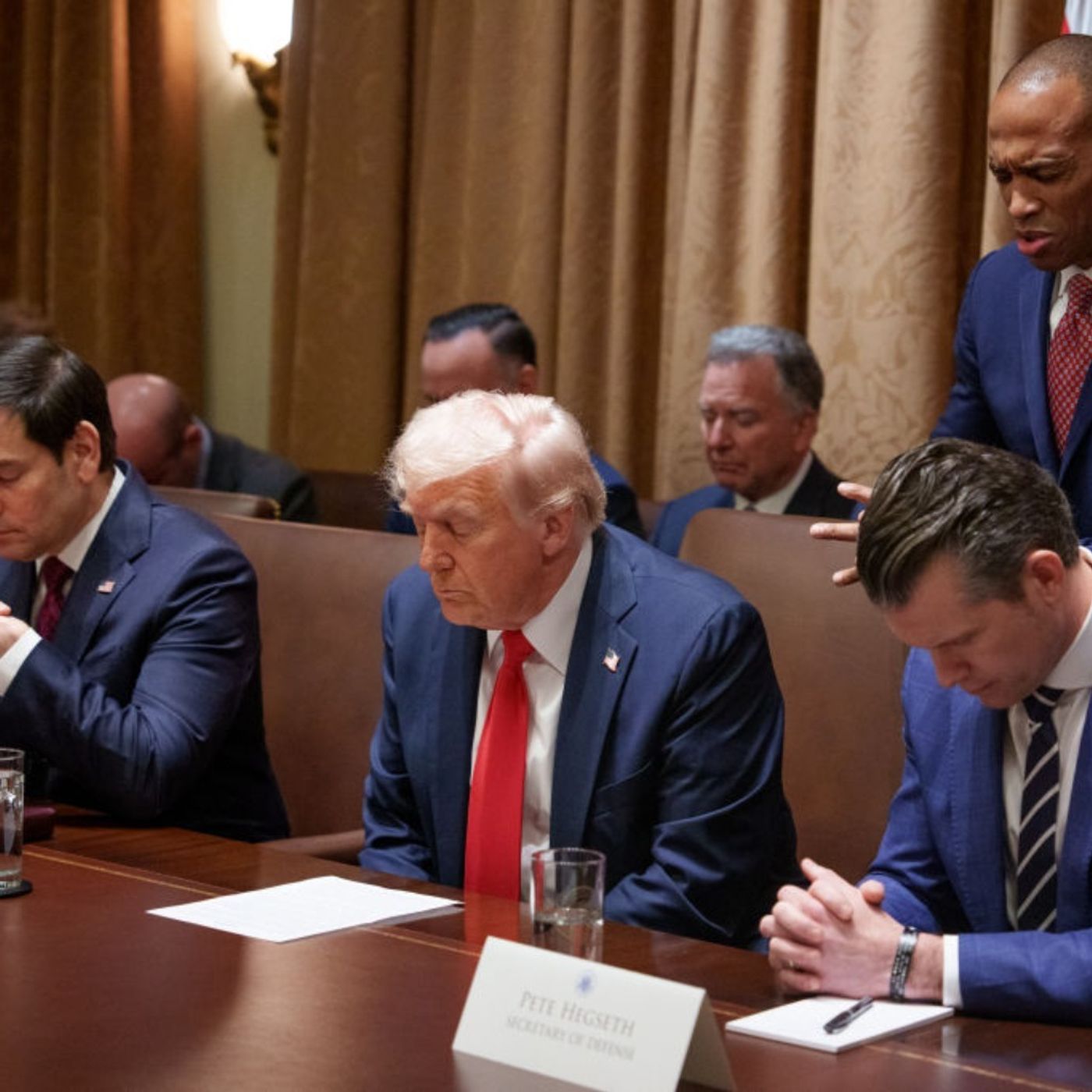
On the Media
Pete Hegseth is Praying for a Holy War
00:50:49
Plus, Peter Thiel’s theory of the antichrist.
Loading summary
Transcript190 lines
- [00:00]
Brian Kaler
Let every round find its mark.
- [00:02]
Brooke Gladstone
Pete Hegseth's monthly Pentagon prayer meeting infuses worship with the furor of Christian nationalism.
- [00:09]
Brian Kaler
What he's done is he's taken all these verses about violence out of context and thrown them all together.
- [00:15]
Brooke Gladstone
From WNYC in New York, this is ON the media. I'm Brooke Gladstone. Also on this week's show, in a fire and brimstone speech that predicts the coming of the Antichrist, billionaire Peter Thiel runs up against the Vatican's skeptic.
- [00:31]
Brian Kaler
An advisor to the pope on artificial intelligence published an essay this weekend saying Thiel's entire action could be read as a prolonged act of heresy against the liberal conscience.
- [00:44]
Brooke Gladstone
Plus how America is employing a legal framework likened to one used in 1930s Germany to put part of its population in purgatory. It's all coming up after this.
- [01:00]
Brian Kaler
Onthemedia is supported by Viking, committed to exploring the world in comfort, offering destination focused small ship experiences on all seven continents, with a shore excursion included in every port and programs designed for cultural enrichment. And every Viking voyage is all inclusive with no children and no casinos. Learn more@viking.com from WNYC in New York.
- [01:28]
Brooke Gladstone
This is ON the Media. Michael Ohinger's out this week. I'm Brooke Gladstone. On Wednesday night, President Trump stepped up to the podium in the White House to deliver his first national address about the US And Israel's war with Iran.
- [01:43]
Alejandra Caraballo
We are going to finish the job and we're going to finish it very fast.
- [01:46]
Brooke Gladstone
We're getting very close. Close to what? He didn't exactly specify beyond broad claims that the US Is removing the threat of a nuclear Iran. So how soon's that?
- [01:58]
Alejandra Caraballo
Shortly. Very shortly.
- [02:00]
Brian Kaler
We're going to hit them extremely hard over the next two to three weeks. We're going to bring them back to
- [02:07]
Brooke Gladstone
the Stone Ages where they belong. In almost the same breath, he said that talks were ongoing, which Iran denies, presumably too busy preparing their future cave homes. And with gas prices rising and the stock market dipping even as the president spoke, he proposed a solution to the energy crisis in the form of a directive to all those countries who didn't start a war with Iran, but do import their oil through the Strait of Hormuz.
- [02:36]
Brian Kaler
Build up some delayed courage.
- [02:39]
Alejandra Caraballo
Should have done it before.
- [02:40]
Brian Kaler
Should have done it with us as we asked. Go to the strait and just take
- [02:45]
Marlon Laurel
it, protect it, use it for yourselves.
- [02:47]
Brian Kaler
Iran has been essentially decimated. The hard part is done. So it should be easy.
- [02:54]
Brooke Gladstone
No, it wouldn't because it's very narrow and hugs the coast. Of Iran, which could repel invaders by using sea mines, small boat swarm attacks and land based missile batteries. Meanwhile, though the US doesn't import much oil from there, it's still subject to the soaring oil prices caused by the war.
- [03:15]
Brian Kaler
Oil prices are up 7% overnight after the President's address back above $100 per barrel. They are interpreting President Trump's speech as not being a very clear commitment to
- [03:27]
Brooke Gladstone
ending this war soon altogether, a muddy speech about an inexplicable war waged with no discernible strategy, plan or objective. But Brian Kaler, president and editor of Word and Way and a Baptist minister, has found some clarity as to the way the US Is fighting the war in the substance of Defense Secretary Pete Hegseth's mother Monthly Prayer Meetings Ladies and
- [03:53]
Brian Kaler
gentlemen, welcome to the Secretary of War's prayer service. First, a reading from the book of Psalms 18:37-42. King David writes, I pursued my enemies and overtook them, and did not turn back till they were consumed. Hegseth is trying to evangelize the military leadership with his version of Christianity.
- [04:17]
Brooke Gladstone
Let's go to the prayer meeting that happened at Christmas. Franklin Graham was the preacher.
- [04:23]
Brian Kaler
Yes. And I have to admit, as a preacher who has preached at Christmas time and I've been in church at many more Christmases beyond this, this was the most bizarre Christmas sermon that I have ever heard. He starts off by saying, we know that God loves, but did you know that God also hates?
- [04:40]
Alejandra Caraballo
Do you know that God also is a God of war? Many people don't want to think about that or forget that.
- [04:46]
Brian Kaler
He goes on to justify this God of war argument by reading from a passage in the Old Testament which is really a call to genocide. Samuel is telling King Saul to go and kill them. And kill who? Everyone.
- [05:01]
Brooke Gladstone
This is Amalek.
- [05:02]
Brian Kaler
And Graham reads, don't spare them, but kill them both man and woman. Infant, infant, nursing child, ox, sheep, camel and donkey. Don't spare them. After he's read this passage justifying genocide, he adds, but Franklin, that's not the
- [05:17]
Alejandra Caraballo
God I believe in. Well, you had better believe in him.
- [05:20]
Brian Kaler
Well, you had better believe in him. So he's proclaiming a God who calls his military to genocide and then says to the leadership of the US Military, this is a type of God you need to follow a God who calls you to genocide for Christmas.
- [05:37]
Brooke Gladstone
Wow. Hegseth has used Psalm 144 to justify the conflict in Iran in January. Also in a prayer for Venezuela.
- [05:49]
Brian Kaler
Yes.
- [05:49]
Brooke Gladstone
And he said he was reading and praying through that passage as Part of his preparation for the operation in Venezuela.
- [05:57]
Brian Kaler
He says, may the Lord grant unyielding strength and refuge to our warriors, unbreakable protection to them in our homeland, and total victory over those who seek to harm them.
- [06:11]
Brooke Gladstone
That's sort of like a version of any coach sending their team out onto the field. But you've described the way Hegseth uses scripture as a Mad Libs mashup of political violence. How so?
- [06:26]
Brian Kaler
This is a line I particularly used because of the highly violent prayer that he prayed during the March Pentagon worship service. As I started looking through that prayer, I realized there's a lot of biblical passages mixed in. So the prayer, for instance, starts with actually Psalm 144 Again, Almighty God, who trains our hands for war and our fingers for battle, and then jumps to Jeremiah 53, you who stirred the nations from the north against Babylon of old, making her land a desolation where none dwell. There's half dozen different psalms that are cited at some point. There's three different verses mixed in from Jeremiah 50. There's a verse from Isaiah, one from Job, another from Proverbs, Biblical verses that are crammed into this prayer. At first glance, it might look like, well, hey, this is a really biblical prayer. I mean, look at all the Bible that's in it. But it's actually not. What he's done is he's taken all these verses about violence out of context and thrown them all together. Grant this task force, clear and righteous targets for violence, Surround them as a shield, protect the innocent and blameless in their midst, make their arrows like those of a skilled warrior who returned not empty handed. Let every round find its mark against the enemies of righteousness and our great nation. So the Jeremiah 50 chapter, where he draws three different times, three different verses into his prayer, is a passage that's really written to those who have been oppressed by the global empire, who have suffered the violence of the world's strongest, most powerful military. And he's plucked those verses out of that context and thrown them into this prayer to justify imperial might, to justify the world's largest, most powerful military going to do violence towards others.
- [08:14]
Brooke Gladstone
Right.
- [08:14]
Brian Kaler
But he's completely removed it from that context.
- [08:17]
Brooke Gladstone
You've said the March service was one of the most violent protests meetings you ever heard.
- [08:23]
Brian Kaler
You know, I'm a professional Christian, I guess, if you will. Right. I mean, I have preached a lot of services, I have attended even more. I have heard a lot of prayer and I was stunned by the level of violence in that prayer. By Hegseth to Justify the Iran war.
- [08:37]
Brooke Gladstone
Hegseth said about the soldiers, give them
- [08:40]
Brian Kaler
wisdom in every decision, endurance for the trial ahead, unbreakable unity, and overwhelming violence of action against those who deserve no mercy. He's praying for overwhelming violence and no mercy towards our enemies. He's made that comment as well in press conferences about showing no mercy, showing no quarter, which is not only a violation of international law, it does fit with the theology that he hears in his church. Doug Wilson, this denomination that Hegseth is part of, has a Bible emphasis every year that they call no quarter November. And so this is a metaphor that he's now using in a much more literal sense as head of the U.S. military.
- [09:18]
Brooke Gladstone
Okay, so let's dig into that. You mentioned Hegseth's own church. That would be the Communion of Reformed Evangelical Churches denomination crec. That's Doug Wilson's church. We also know Hegset's a Calvinist who subscribes to a Reconstructionist worldview.
- [09:39]
Brian Kaler
Yeah. And I think this is really important to think about the ways that that theology is guiding so much of what we're seeing in the Pentagon and even other parts of the administration. This sense that God is supposed to be in control of every aspect of life. That starts to limit even some of the free will of human beings. To the point then that they see their job is to take over government and all realms of society so that they can enact God's will. It's kind of like a Project 2025 theology. This idea of we need to take over everything and institute what we believe is God's will in all areas of society.
- [10:23]
Brooke Gladstone
Isn't Calvinism the belief that everything that happens is God's will? You don't really need to take control in order to enact God's will.
- [10:35]
Brian Kaler
There are obviously degrees of Calvinism and, you know, some will preach much more that God has control in all aspects of society. And one way that we can see this theology is with Hegseth's own pastor, Brooks Pottager from Tennessee. During the first Pentagon worship service In May of 2025, he talked about this concept, and here's a little bit of what he said during his sermon. He said, our Lord Jesus said in Matthew 10, not a sparrow will fall to the ground apart from my heavenly Father. And if our Lord is sovereign even over the sparrow's fallings, you can be assured that he is sovereign over everything else that falls in this world, including Tomahawk and Minuteman missiles, including strategy meetings and war room debriefings. Jesus has the final Say, over all of it. Now, that's a hyper Calvinistic idea that God is the grand design moving every piece on the chessboard. And so it also can be a convenient excuse then of, well, if a tomahawk missile falls on a girl's elementary school and kills a lot of people, that's not our fault. That's not Hegseth's fault. That was God's will.
- [11:47]
Brooke Gladstone
So Wilson, the head of the denomination Hegseth belongs to, is teaching Christians to dominate the world, right? To take over all aspects of society. And he wants to ban public idolatry. What does that mean?
- [12:06]
Brian Kaler
Yeah, so this is this idea of not only arguing that the United States was supposedly founded as a Christian nation, but that it needs to be codified as an explicitly Protestant Christian nation. And by this, they really mean they want to codify their version of Christianity on the first glance. It's like, well, he wants to ban Muslims and Hindus and those of other religious traditions from practicing. Practicing their faith out in public. Doug Wilson explicitly says that whatever they want to do inside their homes or inside of their houses of worship is fine, but they can't have this, quote, idolatry out in the public square. But then we realize that as you push him further on, that he has said this explicitly. That also would mean banning many Catholic events in the public square, because as a far right Protestant, he is very anti Catholicism. And so then even some Christians who would be banned from the public square. This completely turns the idea of religious liberty on its head. It completely strips away any idea of church state separation found in our Constitution and the religious liberty that comes from that. They want to instead create an explicitly Christian national state where only their brand of Christianity is allowed to fully express themselves.
- [13:21]
Brooke Gladstone
And when you say in the streets, do you mean you can't see a mosque or walk around with ash on your forehead on Ash Wednesday?
- [13:31]
Brian Kaler
Yeah. That's the level he's getting to, is this idea that they couldn't have public processions and parades that might be part of a religious expression, that there would be some limits on even the way the building might present itself, not that it would have to be completely hidden, but that there would be limits on what it could have on the outside. This definitely turns on its head the way the United States has tried to be, you know, since our Constitution.
- [13:56]
Brooke Gladstone
Now, there have been some narratives that you've talked about that you want to debunk, principally the one that claims Hegseth wanted to go to war in Iran because this would catalyze the armageddon that would usher in the second coming of Jesus. You say that isn't his theology, nor is it the theology of Doug Wilson.
- [14:21]
Marlon Laurel
So.
- [14:22]
Brooke Gladstone
So what's the deal here?
- [14:23]
Brian Kaler
Yeah, we've obviously seen some of these viral claims that haven't been well sourced yet to know whether or not some commanders were making the claim that the Iran war would lead to Armageddon, the return of Jesus. Kind of the classic left behind theology that people might be familiar with. And to be clear, there are some people in the administration that do hold that theology, like Mike Huckabee, Ambassador to Israel. But Doug Wilson explicitly critiques that theology. He thinks it's not biblical, and he instead pushes for a post millennial view.
- [14:52]
Brooke Gladstone
The idea that premillennial. What are you referring to?
- [14:55]
Brian Kaler
Yeah, so the premillennialism is saying that Jesus is gonna come back suddenly and then establish a 1000 year reign of perfect God's will on earth. So post millennial says that that reign's gonna happen first and then Jesus will come back. So the return is more than a thousand years off in the future, not something that's gonna come imminently from some big battle.
- [15:19]
Brooke Gladstone
So Doug Wilson's church is gonna create the thousand years of perfect governance.
- [15:24]
Brian Kaler
Exactly. So this is why it's a call not to blow up the world, but to control the world. It's not about Armageddon. It's about domination. It's about taking over the structures of society so that we can create that perfect millennia, so that then Jesus will come back. And then that's what these worship services show us. They show us the theology that's driving the war decisions. They show us the philosophy behind Hegseth.
- [15:48]
Brooke Gladstone
And he's telling everybody in command to come to the prayer meetings, right?
- [15:52]
Brian Kaler
Yes, that's right. And I know they'll tell you that they're voluntary services, but in a military hierarchy, when the Secretary of Defense is telling you, hey, you should come to the service that I'm holding, I'm not sure it necessarily feels completely voluntary. And we've heard that anonymously from some in the Pentagon as well as some defense contractors, people who are not government employees, but are trying to sell various weapons and so forth to the US Military, they're also getting these invites and they're worried, well, if I don't show up and have FaceTime, so maybe this would cost me a million or billion dollar defense contract.
- [16:27]
Brooke Gladstone
So the way that he's fusing his duties in public office with his religious beliefs is that unique within the Trump administration.
- [16:36]
Brian Kaler
So I would say that Hegseth is not necessarily unique in his theology, his political philosophy of Christian nationalism inside the Trump administration.
- [16:45]
Brooke Gladstone
That's all over the place.
- [16:46]
Brian Kaler
Exactly. But what we have seen as unique is how he is implementing it, how forceful he has been in actually establishing these Christian nationalist ideas. I mean, this is showing us why we are going to war, why we are fighting war in the way we are fighting it. And this crusader theology, whenever it's been tried in the Crusades by the Russian Orthodox Church today in Ukraine, by Hegseth now in the Pentagon, it's always only led to more violence, more blood, more death of innocent civilians. Because when it's a holy war, when, when you're fighting God's enemy, that's when you don't show any mercy. That's when you go and kill them all. Even as, you know, Franklin Graham was justifying with genocide that you kill the women and the children and the infants. This theology is really important to pay attention to because it's literally dangerous when it's from the person who is running the United States military from the Pentagon.
- [17:41]
Brooke Gladstone
Were the Crusades a success?
- [17:46]
Brian Kaler
That is the irony of the Crusader cosplay today is that the Crusades were a failure. They only briefly held the Holy Land, and many of the Crusaders never even made it to the Middle east to fight for Jerusalem. They ended up just slaughtering other Christians in other parts of Europe. The Crusades were by any measure, politically, militarily, and definitely theologically an abysmal failure. And so it's just wild that this idea has been picked up by Hegseth, by Representative Andy Ogles, who likes to also view himself as a modern crusader by others in the administration and Congress that the Crusades have been popularized as some sort of role model. It ended poorly the first time, and I think it'll end poorly for all of us the second time as well.
- [18:35]
Brooke Gladstone
Brian, thank you very much.
- [18:37]
Brian Kaler
Well, thank you.
- [18:38]
Brooke Gladstone
Brian Kaler is the president and editor in chief of Word and Way and author of the book the Bible According to Christian Nationalists. Coming up, some tech billionaires believe that their technology is the only thing standing between us and the Antichrist. This is on the media.
- [19:11]
Brian Kaler
Onthemedia is supported by Viking, committed to exploring the world in comfort, offering destination focused small ship experiences on all seven continents, with a shore excursion included in every port and programs designed for cultural enrichment. And every Viking voyage is all inclusive with no children and no casinos. Learn more@viking.com I'm Earlonne Woods.
- [19:39]
Alejandra Caraballo
I'm Nigel Poor. We're the hosts and creators of ear hustle from PRX's Radiotopia.
- [19:44]
Brian Kaler
When we met, I was doing time at San Quentin State Prison in California
- [19:48]
Alejandra Caraballo
and I was coming in as a volunteer. The stories we tell are probably not what people expect from a prison podcast,
- [19:55]
Brian Kaler
like cooking meals in a prison cell,
- [19:57]
Alejandra Caraballo
keeping little pets, prison nicknames, and trying to be a parent from inside.
- [20:01]
Brian Kaler
Stories about life on the inside shared
- [20:03]
Brooke Gladstone
by those who live it.
- [20:04]
Alejandra Caraballo
Find Ear Hustle.
- [20:05]
Brooke Gladstone
Wherever you get your podcasts, this is on the media. I'm Brooke Gladstone. For years, billionaire Peter Thiel, who co founded and made his money at PayPal and also co founded Palantir, the surveillance tech used by ICE in the Pentagon, has been delivering not so secret, secret lectures to select crowds about religion, tech, politics, society and the Antichrist. His recent speechifying in Rome did not go down well at the Vatican.
- [20:38]
Brian Kaler
An advisor to the Pope on artificial intelligence published an essay this weekend saying Thiel's entire action could be read as a prolonged act of heresy against the liberal conscience.
- [20:51]
Brooke Gladstone
Thiel's theme hangs on the urgent need for the unbridled experience expansion of AI and big tech that he says is key to humanity's very salvation. But the papacy isn't buying it.
- [21:05]
Marlon Laurel
I mean, the Vatican doesn't have the policy power to do that, but symbolically it's very important until as a Christian and a Catholic will be kind of. Yeah, unhappy with that decision because that would mean that the Pope is siding with the Antichrist.
- [21:20]
Brooke Gladstone
Oops.
- [21:22]
Marlon Laurel
Yes, oops.
- [21:24]
Brooke Gladstone
Marlin Laurel is the professor at Luis University in Rome and director of the Illiberal Studies Program at George Washington University. And she's delved into Thiel's particular take on Armageddon.
- [21:39]
Marlon Laurel
Thiel believes that the United States and technological elites from Silicon Valley are the last shield defending Western civilization. And the notion of progress is telling us that stagnation is bringing the Antichrist and artificial intelligence technologies are the only way for societies to continue to progress and therefore avoid the arrival of the Antichrist.
- [22:07]
Brooke Gladstone
He is preaching that the west is stagnant and that liberalism sets us up for him.
- [22:15]
Marlon Laurel
Liberalism is indeed responsible for the stagnation and the arrival of the Antichrist. Right. Because liberalism is preaching stability, peace, regulation, equality between human beings. So everything that we tell human beings are equal and we should be careful for equality. That doesn't allow Western civilization to continue to progress.
- [22:39]
Brooke Gladstone
This is what I don't get. How do those tenets of liberalism set the stage for Armageddon?
- [22:47]
Marlon Laurel
Because in the biblical interpretation, the Antichrist is preaching a fake peace, fake stability, and therefore is indeed opening the gate for the Antichrist.
- [22:59]
Brooke Gladstone
So the far right and Silicon Valley are essentially keeping the gates shut on the Antichrist by tamping down on these fake emblems of stability like justice, fairness, equality, diversity, whatever. He thinks, regulating Silicon Valley clears the path for Armageddon by constraining its operation,
- [23:26]
Marlon Laurel
absolutely limiting the revival of Western civilization and of American power. So it's a very libertarian view, but put in a biblical language.
- [23:38]
Brooke Gladstone
So Thiel and his ilk are the bulwark against Armageddon. Let's talk about some of his influences. French academic Rene Girard. His idea is that societies are built on something called mimetic rivalry, that our desires are essentially imitative and. And that leads to rivalry and violence.
- [24:03]
Marlon Laurel
Girard himself is much more complicated than the way Thiel and several of the big tech figures are presenting it. But what they have interpreted is indeed this idea that we are all animated by the fact that we want the same things as what the other have. And I don't think that Tilly is reading the violence aspect in his famous talks when he said, when we created PayPal, we thought about Jira, this idea that if you create a product and you tell you can transfer money easily, you can become richer easily, you can buy product easily, then you create the mimetic will to have what the other have. So a very marketing oriented reading of this idea that as human being, we are animated only to get the same things as our neighbors.
- [24:54]
Brooke Gladstone
But Girard thought this was a dangerous or pernicious impulse in humanity, right?
- [25:00]
Marlon Laurel
Absolutely. Thiel and several of the big tech figures have this very pessimistic vision of humankind, Right? They are very optimistic for the few elective ones, the best ones, but for the majority of the population, they see us as raw material that can be animated by very negative feelings. And for them, the idea that people can fall into violence because of this mimetic feeling is not a problem.
- [25:29]
Brooke Gladstone
The second element of Girard's theory revolves around the idea that for some kind of social order to take root, there has to be a historical moment when conflicting individuals find common cause by converging on a single victim. A sacrificial scapegoat that resonates. Trump has immigrants and he has trans people. But what kind of social order does that leave us with?
- [25:58]
Marlon Laurel
Thiel, in his lecture, he was complaining against liberalism, not allowing societies to have scapegoats anymore.
- [26:06]
Brooke Gladstone
This is the ideal way to structure society so that people are manipulated to converge on scapegoats that really don't have anything to do with what ails them. And this is a good thing.
- [26:19]
Marlon Laurel
Yeah, it's totalitarian. The few will get full freedom and full kind of transhumanist transformation, and the majority of humanity will be left in very poor conditions. They are pretty explicit on the model they want for their society.
- [26:37]
Brooke Gladstone
You wrote that when a billionaire venture capitalist speaks in the language of apocalypse, it's tempting to dismiss it as an eccentric detour. But Thiel's turn to theology signals something larger for him and a growing cadre of others. You say that this is theopolitics, which is distinct from political theology. Political theology describes a theological background of political beliefs. Theopolitics makes religion the explicit framework for our system of government. And you've said, and this is crucial, that theopolitics shines a particularly bright light on some of the weaknesses of liberalism.
- [27:23]
Marlon Laurel
Yeah, I think one of the problems that liberalism is facing now is that it has been used to think the relationship between religion and politics as being, you know, a classic separation between state and church. And in the time of theopolitics, which I think we are in very visibly in the U.S. but more globally, liberalism doesn't have the right answer. If the answer is just, you know, just separation of church and state, that looks like you are evading the debates while the theopolitical side is asking you to explain what is your kind of philosophical principle, this kind of deep vision of the world.
- [28:00]
Brooke Gladstone
Yeah, it isn't really addressing those existential questions. You say that in periods of anxiety and fragmentation, that approach increasingly feels empty, that using procedures, using the law, institutions, rights, all those things don't address that feeling of emptiness in a time of great stress. You also say liberal frameworks don't privilege any particular vision of the good life. That's up to people. So by reintroducing Christian language, Thiel and those around him are forcing liberalism to confront and name its own implicit theology.
- [28:49]
Marlon Laurel
So for very long, liberalism was inviting us to deconstruct power and deconstruct identities. Right.
- [28:56]
Brooke Gladstone
For instance, by saying that race doesn't really exist, it's a social contract. That would probably be Exhibit A. I don't know.
- [29:05]
Marlon Laurel
Exactly. And once you have deconstructed social groups and collective and individual identity, you need to rebuild, you need to reconstruct. Right. And I think that's the core problem now of liberalism. It's always promoting deconstruction, always telling us things are relative, things can be discussed, things can be challenged. But the societies, because we are living in a time of super fast change and really deep social Economic stress people need to feel, where do they belong, what is stable, what are their identity, where are they going? And I think liberals have difficulties finding answers to that.
- [29:43]
Brooke Gladstone
You've written that liberal frameworks presuppose a baseline normality, but when crises are everywhere, norms appear as constraints, and that opens the door to theopolitics.
- [29:55]
Marlon Laurel
I think Covid really deeply transformed our societies. Things you thought were so obvious that you never imagined something else could happen suddenly happened. Covid reopened our imagination of how society can work. Democracy needs time, it's slow, but the world is going fast. And you indeed open yourself to theopolitics, to some form of digital totalitarianism, then the scope of the possible in the future world is kind of becoming huge.
- [30:26]
Brooke Gladstone
You're saying theopolitics gives license to move fast and break things, as they say in Silicon Valley?
- [30:36]
Marlon Laurel
Absolutely, yes.
- [30:39]
Brooke Gladstone
So you said that liberalism needs to confront its lack of a theology, that there has to be a set of common values. A lot of us thought that America up until recently did have a set of common values as a kind of secular theology. I guess. No.
- [30:59]
Marlon Laurel
Well, I think probably American society was more polarized. That's what many liberals were hoping, right?
- [31:06]
Brooke Gladstone
Yeah.
- [31:06]
Marlon Laurel
Then I think another issue is that liberalism gradually lost its meaning and the way it has been functioning, with more and more social economic inequalities visible in American society, liberalism in practice doesn't look as good as liberalism as a political philosophy.
- [31:26]
Brooke Gladstone
Yeah, to the extent that liberalism did have a theology or does have a theology, that would be mutual solidarity, the struggles against different forms of domination, it needs to act on them.
- [31:42]
Marlon Laurel
The Democratic Party has been losing a large part of its popular electorate and blue collar world because it couldn't answer the kind of deep trauma that this part of the population has been suffering. So if you don't find policy answer, you won't be able to fight just with a set of values.
- [32:03]
Brooke Gladstone
So it needs a language to engage theology. Imbue liberalism with its own set of values, then its policies have to align with those values. What is the third option that you suggest?
- [32:20]
Marlon Laurel
So the third option is what I think liberalism is doing, and I don't think that's the good answer. That's the defensive answer. By being on the defensive, they are not helping their own cause. When liberal forces are always, for example, denouncing illiberal forces as being fascist, racist, brainwashed by Russian propaganda, they are also showing their inability to engage with the real grievances that the other side of the electorate is trying to promote. Liberals tend to stand on their higher moral ground and say, well, it's obvious we are the best solution. Well, no, it's no more obvious. Right, because the cultural hegemony of liberalism is over.
- [33:03]
Brooke Gladstone
This isn't easy. Democracy can't be in a defensive crouch. But how do you mount a defense when the holy saber rattling is coming from so many places? Pete Hegseth at his prayer meetings, Peter Thiel in Rome, countless pulpits on Sundays. What do you do?
- [33:25]
Marlon Laurel
There have been so much kind of obsession around Trump over the last 10 years that opponents of Trump have forgotten to argue on what they are proposing as solutions. So I think there is a lot of inner work that has to be done, even if it's now in a very complicated context. And indeed, it's a challenging one and it's a risky one. But we have to begin somewhere.
- [33:51]
Brooke Gladstone
Marlon, thank you so much.
- [33:53]
Marlon Laurel
No, thank you. That was wonderful. Depressing.
- [33:57]
Brooke Gladstone
Fascinating. Marlon Laurel is a professor at Louise University in Rome and also the director of the Illiberalism Studies program at George Washington University. Coming up, it's one state for me, another for thee when it comes to trans rights. This is on the media.
- [34:26]
Brian Kaler
Onthemedia is supported by Viking, committed to exploring the world in comfort, offering destination focused small ship experiences on all seven continents, with a shore excursion included in every port and programs designed for cultural enrichment. And every Viking voyage is all inclusive with no children and no casinos. Learn more@viking.com I'm Earlonne Woods.
- [34:53]
Alejandra Caraballo
I'm Nigel Poor. We're the hosts and creators of ear hustle from PRX's Radiotopia.
- [34:58]
Brian Kaler
When we met, I was doing time at San Quentin State Prison in California
- [35:02]
Alejandra Caraballo
and I was coming in as a volunteer. The stories we tell are probably not what people expect from a prison podcast,
- [35:09]
Brian Kaler
like cooking meals in a prison cell,
- [35:11]
Alejandra Caraballo
keeping little pets, prison nicknames, and trying to be a parent. From inside.
- [35:15]
Brian Kaler
Stories about life on the inside shared
- [35:18]
Brooke Gladstone
by those who live it.
- [35:19]
Alejandra Caraballo
Find Ear Hustle wherever you get your podcasts.
- [35:23]
Brooke Gladstone
This is ON the media. I'm Brooke Gladstone. On Tuesday, which happens to be Trans Visibility Day, the Supreme Court ruled 8 to 1 against a law that back banned conversion therapy for LGBTQ kids in Colorado, sending the case back to a lower court to decide.
- [35:42]
Brian Kaler
This case was brought by a practicing Christian talk therapist who took on Colorado's law banning conversion therapy. It's a practice favored by many Christian conservatives, encouraging LGBTQ kids to either identify as heterosexual or, in the case of trans kids, to identify as the gender assessment assigned to them at birth. Colorado's law banned that practice for Licensed therapists.
- [36:05]
Brooke Gladstone
The following day, Idaho's governor signed a bill criminalizing trans people using public bathrooms that align with their gender identity. A first offense could lead to one year in prison.
- [36:18]
Brian Kaler
Legislation includes changing rooms, locker rooms, and shower rooms. If there's a repeat offense, it becomes a felony and could be punishable by up to five years in prison.
- [36:28]
Brooke Gladstone
And in Kansas last month, around 1700
- [36:31]
Alejandra Caraballo
people in Kansas are about to have their driver's licenses declared invalid.
- [36:35]
Brian Kaler
Why?
- [36:36]
Alejandra Caraballo
Because they're transgender.
- [36:38]
Brooke Gladstone
And in Tennessee, House Bill 754 would
- [36:40]
Brian Kaler
require clinics who perform gender transition surgeries
- [36:43]
Alejandra Caraballo
to also perform detransition procedures.
- [36:45]
Brooke Gladstone
It would also require clinics and insurance
- [36:48]
Alejandra Caraballo
companies to report the occurrence of these
- [36:49]
Brian Kaler
procedures to the tenancy department, Department of Health, who would then record various statistics into a database.
- [36:54]
Brooke Gladstone
And in West Virginia, the 4th Circuit
- [36:57]
Brian Kaler
Court of Appeals has reversed a lower court ruling, meaning that the state's Medicaid policy excluding coverage for gender affirming surgeries will be upheld.
- [37:07]
Brooke Gladstone
That last ruling was based on a Supreme Court decision from June. In a case called U.S. v. Scarmetti. The high court upheld a Tennessee law banning puberty blockers and gender affirming care for minors. To better understand this cascade of legal setbacks for the trans community, civil rights attorney Alejandra Caraballo says we need to look back to the dual state, a contribution to the theory of dictatorship penned in the 30s and 40s by the German Jewish lawyer Ernst Frankl.
- [37:43]
Alejandra Caraballo
He created what was called the dual state, and he divided it into two categories, the normative state and the prerogative state. The normative state is basically everything that you run into every day. You go and pay your taxes, you go to court. The state is pretty much acting as normal. And then there's the prerogative state, which acts with an arbitrary violence against a targeted minority group. That group cannot expect fair or consistent treatment by the state.
- [38:13]
Brooke Gladstone
Frankl saw this play out. He was a lawyer. Jewish lawyer in housing.
- [38:19]
Alejandra Caraballo
Yeah. Jews were being stripped of their homes, property rights, legal rights to own businesses. Nothing in the Weimar Constitution, which was still operative, allowed for that. But none of that mattered because they were part of the prerogative state. That's essentially what we're starting to see here in the United States with the ways that courts and the legal system are starting to abrogate the rights of trans people.
- [38:43]
Brooke Gladstone
Let's go to Kansas, shall we? Governor Laura Kelly vetoed the bathroom bounty bill, which contained two provisions. The immediate invalidation of the driver's licenses of trans people if their gender marker doesn't match their gender Assigned at birth. The second provision, the so called bathroom bounty, allows anyone to sue anybody they suspect of being transgender if they walk into the wrong quote unquote restroom in a government facility. The governor vetoed it, calling it poorly drafted with overreaching consequences that would cost millions of taxpayer dollars to comply with when that money is already really tight in Kansas. And then the state legislature overturned her veto. Two trans residents in Kansas are suing. Now, this strikes me as textbook dual state stuff. They seem to be persecuted for simply existing.
- [39:46]
Alejandra Caraballo
Exactly. They went without any sort of committee hearings. They did what was called a cut and go, where they essentially took another bill, completely cut out the text, and put in this new bill that had the bathroom bounty bill and the revocation of licenses and birth certificates. The Kansas legislature rushed this through and in less than three weeks, it went from basically no one knowing that this bill existed to being enacted and people were losing their driver's licenses. That's how quickly it went.
- [40:17]
Brooke Gladstone
Let's explain why these two things are a big deal, why we could go slowly padding up to the dual state structure of the Nazis with driver's licenses and bathrooms.
- [40:30]
Alejandra Caraballo
A lot of people will just say, well, you could just use the bathroom of your sex assigned at birth. Well, if you're a trans person, you often don't look anything like your sex assigned at birth anymore. For trans women, if you go and use the men's restroom, that puts you at extreme risk of sexual assault, harassment, even violent assaults. And this is not a theoretical. This has happened. Trans men are really in a bind because oftentimes they have deep voices, beards, they look just like any other man, and they're being told they have to use the women's bathroom. So what's gonna happen if somebody who comes in with a very deep voice, burly with a beard, walks into the women's restroom? Everyone is gonna freak out about it. That's exactly what this law requires. Ultimately, what that means for trans people is they can't participate in society because you can only hold going to the bathroom for so long. Then there's the driver's license aspect, right?
- [41:24]
Brooke Gladstone
The driver's licenses of trans people in Kansas were suddenly invalid.
- [41:30]
Alejandra Caraballo
Some people say, well, you just have your driver's license that says your sex assigned at birth. And for trans people, that's oftentimes incredibly dangerous. Just even buying a six pack of beer. The way you look is not going to match the sex listed on the driver's license, which could out you, subject you to harassment and violence.
- [41:48]
Brooke Gladstone
You might say, well, why don't you just go and get your driver's license in a state other than Kansas?
- [41:54]
Alejandra Caraballo
Yeah, if you were to move to New York or California and try to activate a license in those states, you would not be able to until you lifted the suspension on your Kansas license. So you can't even leave the state without the indignity of going to the dmv. Getting a new license issued with a gender marker that does not align with your gender identity.
- [42:18]
Brooke Gladstone
Last December, the Texas newsroom obtained internal documents that showed that the Texas Department of Public Safety had compiled a list of 110 trans people who tried to update their license information between August 2024 and August 2025. The Department of Public Safety in Texas didn't say why. And Texas isn't alone here. Indiana, you've said, may also be compiling a similar list. So connect this to, to the dual state framework. Governments compiling lists of minority groups is never a great sign.
- [42:57]
Alejandra Caraballo
Yeah, we don't know why they're compiling these lists. Kansas ultimately had a list of trans people that had changed their gender markers and immediately they were able to suspend their licenses. Texas, Indiana, or these other states, if they're able to compile them, could do similar things. We've heard the Governor of Texas, Greg Abbott, saying that trans people should not be teachers in public schools. In Texas, they could use these kinds of lists to target trans people and ensure that they cannot have any sort of meaningful contribution to society. They can't work, they can't get driver's licenses, they can't get identification documents. And ultimately, with this push around, voter IDs, even be able to vote. Pretty much every aspect of this is trying to strip any semblance of normality from a trans person's life. That's intensely scary. Idaho right now they just passed through the House and it's going through their state Senate. A bill that would enact a five year felony charge for using the bathroom that aligns with your gender identity. I mean, this is where we're at.
- [44:04]
Brooke Gladstone
Now you've noted that unless these lists are used in a discriminatory manner, they're legal. If they say, hey, we have this list of people we identified as trans and now they're barred from being teachers, that's unconstitutional no matter what the Governor of Texas says. Your worry with regard to the law is that the Supreme Court is hinting that they don't view trans status as something that is immutable, something that just can't be changed with the wind.
- [44:40]
Alejandra Caraballo
You could see this in Justice Barrett's questioning and her concurrence in Scrometti. And they view being trans as essentially as a choice and something that can just be easily changed. And so as a result of that, they don't believe that it meets the requirements for protected class status. I do believe being trans is immutable, like it's not subject to external change. But even if it wasn't, we do protect other classes that don't have immutable status, and that includes religion. You can change your relig and that is still protected under the Constitution. So that's kind of a frustrating double standard. But regardless, that is worrying because if they don't believe that it's something that is immutable and can be changed, they can then endorse methods to enforce that change. And we're seeing that with the decision in Chiles v. Salazar, which invalidates bans on conversion therapy in over 21 states.
- [45:38]
Brooke Gladstone
In Tennessee, the Attorney General was able to access and identify incredibly intimate medical records of trans people held by Vanderbilt Medical Center Therapy notes pre op and post op photos. No one knows why.
- [45:56]
Marlon Laurel
Yeah.
- [45:57]
Alejandra Caraballo
So the Tennessee Attorney General used the pretext of investigation for fraud against Vanderbilt University and issued subpoenas asking them for all of their medical records related to gender, not just for trans youth, but for all their transgender patients.
- [46:12]
Brooke Gladstone
That is a very familiar Trump administration pretext to intrude into places.
- [46:18]
Alejandra Caraballo
This is exactly where the Trump administration got its playbook. For years, Tennessee, Missouri and Texas had been attempting to get at the medical records of trans people. Tennessee was the most successful, and Vanderbilt did not even fight those subpoenas. There was a lawsuit filed arguing that they violated the privacy rights of their patients, and that's still pending.
- [46:38]
Brooke Gladstone
The Ninth Court of Appeals heard a case involving QueerDoc, a telehealth gender affirming care practice that the DOJ subpoenaed in July. It was seeking more than a dozen types of records dating back to 2020, demanding names, birthdates, addresses, Social Security numbers of patients. DOJ said it needed this data to investigate whether Queer Doc was engaging in fraudulent insurance.
- [47:05]
Alejandra Caraballo
The Justice Department sent out over 20 different subpoenas to 20 different medical providers, some of the top children's hospitals around the country, claiming that using any billing code other than ones that are directly tied to gender dysphoria is somehow fraudulent. So for instance, when prescribing hormones, they'll say endocrine disorder, unspecified. And that just may be how the insurance companies prefer that to be billed. A single provider can bill potentially 20 different insurance companies at Any given time. Medicaid, Medicare. And each one of those may have a different practice for how they accept the billing code. There's not intent to defraud insurance companies here, but again, tying to the framework of the dual state, that's just everyday billing practices. But when it comes to trans people, they are using that pretext to issue these subpoenas and claims broad authority to access not only medical records, but internal employee communications, external emails. That is just basically a giant fishing expedition. Queer Doc fought the subpoena and they won. The Trump administration is appealing that they want the threat of the subpoenas to get people to stop provision of care voluntarily. And that's what we've seen with so many different providers who have voluntarily withdrawn, providing this career just out of pre compliance and fear.
- [48:31]
Brooke Gladstone
In a piece for the Dissident last September, you wrote that these structural attacks against trans people are the prerogative state in action. A raw and undisguised exercise of power to eliminate a disfavored minority from the public sphere. Eliminate.
- [48:53]
Alejandra Caraballo
This is straight up from Michael Knowles, who was at CPAC now three years ago.
- [48:58]
Brooke Gladstone
That's the conservative gathering that sort of sets the template for where the far right will move.
- [49:06]
Alejandra Caraballo
There's an old study that said that about 41% of trans people attempt suicide at some point in their life, which is a pretty stark number. And there's people online saying we've gotta raise that 41% to 100%.
- [49:19]
Brooke Gladstone
Is this just a couple of cranks?
- [49:22]
Alejandra Caraballo
I mean, it's pretty widespread. On Twitter, there was a young girl, a trans girl who's 17, who took a picture of a bridge and said, it's so pretty from up here. The next day it was found that she had taken her own life and jumped from the bridge. That image that she posted on Twitter went viral, over a hundred million views. The vast majority of the replies were celebrating that she took her own life, making jokes about it. Now trolls are taking the picture that she took and putting it in the replies of trans people and making a meme out of that picture. It's very clear they want to drive. The factors that cause trans people to be suicidal just make everything so bad that trans people do it themselves.
- [50:11]
Brooke Gladstone
So what do we learn from other historical moments when the dual state framework has come into play?
- [50:19]
Alejandra Caraballo
What's unique about trans people is that we're actually on the other side of this. A lot of the things that are happening to us were policy wins that we already won years or decades ago. The ability to change our gender markers that was through quiet advocacy for over years. In many states, you've been able to do that for decades. You're able to change the gender marker on your passport since 1992. So that's 33 years that you were able to do that. And then Iowa became the first state ever to remove duly enacted civil rights protections for a group based on any protected class. And they enacted another bill that prevents cities from even enacting their own protections for trans people. So this is far beyond just backlash. This is now wiping out decades of what trans advocacy has been able to accomplish. Wow. I struggle to find. I mean, there was obviously backlash to the civil rights movement and the feminist wave of the 70s. None of them were able to strip the kinds of rights that they are doing now.
- [51:23]
Brooke Gladstone
This is kind of more like what happened after reconstruction.
- [51:27]
Alejandra Caraballo
Reconstruction is probably the closest I can think of where a group who had previously been able to secure substantial civil rights protections is systematically having them erased.
- [51:40]
Brooke Gladstone
Elon Musk and other groups on the far right are pushing an idea that empathy is weakness. They call it suicidal empathy.
- [51:51]
Alejandra Caraballo
Yeah. What they really mean by that is if you're concerned about immigrants, if you're concerned about trans people, if you're concerned about Muslims, you are contributing to the downfall of Western civilization. And if anything, it's the opposite. It's the lack of empathy, it's the lack of compassion for our fellow humans that is causing so much of the problems in our world.
- [52:16]
Brooke Gladstone
Alejandra, thank you very much.
- [52:18]
Alejandra Caraballo
Of course. Thanks for having me.
- [52:20]
Brooke Gladstone
Alejandra Caraballo is a civil rights attorney and a clinical instructor at Harvard Law Cyber Law Clinic. And that's the show on the Media is produced by Molly Rosen, Rebecca Clark Callender and Candice Wong, with help from Macy Hanslick Behrend. Travis Mannon is our video producer. Our technical director is Jennifer Munson with engineering from Jared Paul and Sam Baer. Eloise Blondio is our senior producer, and our executive producer is Katya Rogers. On the Media is produced by wnyc. Michael Loewenter will be back soon. I'm Brooke Gladstone. Whether it's news from around the world
- [53:09]
Alejandra Caraballo
or the latest from your neighborhood, New Yorkers engage with WNYC studios for the
- [53:13]
Brooke Gladstone
information and connection they can only get from our programming.
- [53:17]
Alejandra Caraballo
Be a part of that conversation through your business's support.
- [53:20]
Brooke Gladstone
Learn more@sporship.wnyc.org.