← On the Media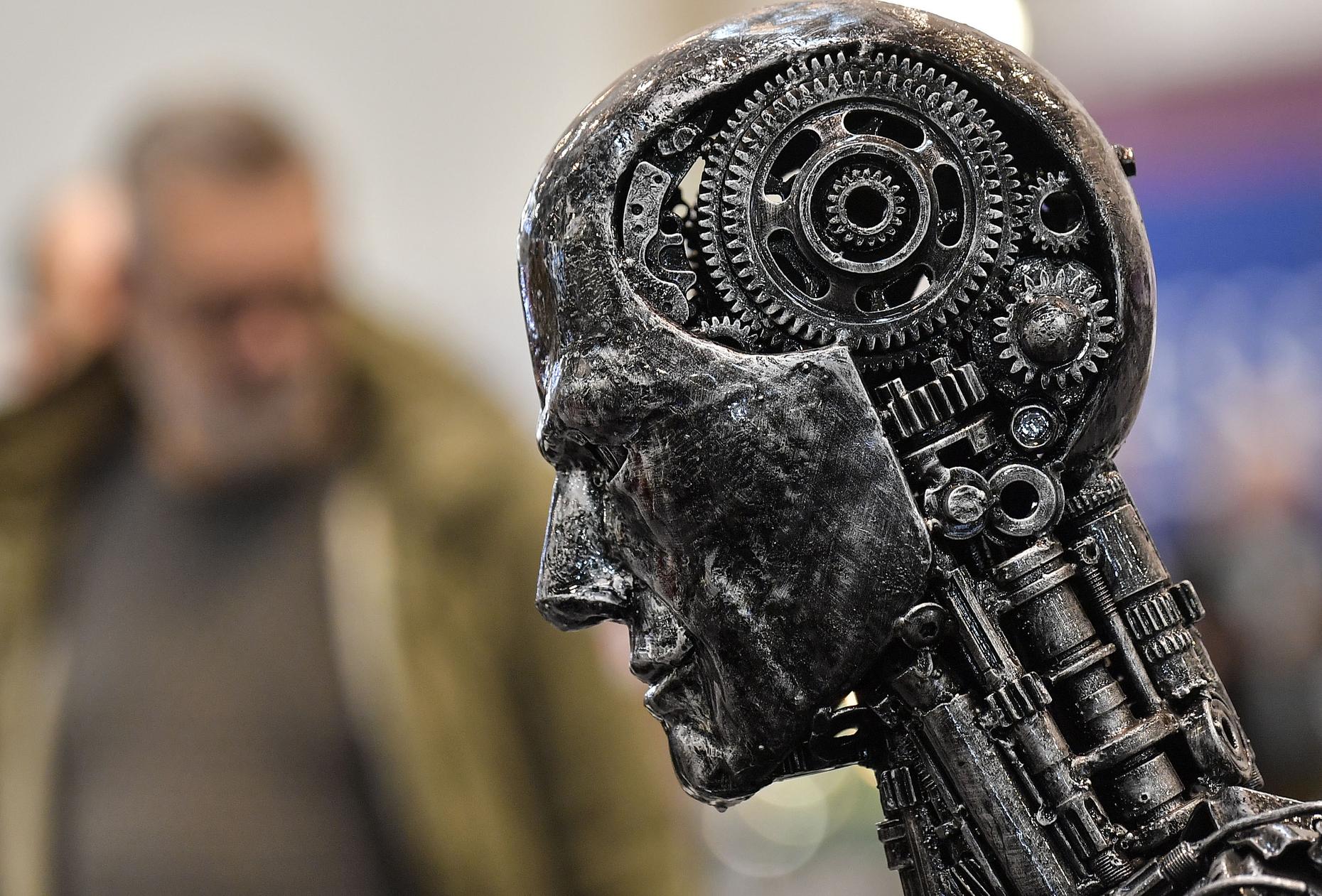
Loading summary
Transcript59 lines
- [00:00]
USAA Representative
How many discounts does USAA Auto Insurance offer? Too many to say here. Multi vehicle discount, Safe driver discount, New.
- [00:07]
Megan O' Giblin
Vehicle discount, Storage discount.
- [00:09]
Interviewer
How many discounts will you stack up? Tap the banner or visit usaa.com autodiscounts restrictions apply.
- [00:21]
Narrator
Human aspirations for technology are vast. One day, maybe, our tech will cure cancer, rid us of viruses, fix that pesky cl, even deliver us from death.
- [00:34]
Elon Musk
Elon Musk Everything that's encoded in memory you could upload and ultimately you could potentially download them into a new body or into a robot body. The future is Going to be weird.
- [00:43]
Narrator
Writer Megan o' Giblin put her faith in technology after leaving the fundamentalist evangelical church that nurtured her. Her teachers at Bible College, who embraced a resurgent Calvinist theology, believed in a God. O. Giblin couldn't accept.
- [00:59]
Megan O' Giblin
Calvinism in the form that I was taught was very much focused on predestination. You know, we don't have a choice in our own salvation. It's decided for us before we were ever born. We don't really have free will. And it also brought up a lot of problems for me just about the nature of God, this idea that people were going to suffer for eternity in hell when they didn't even have a choice in accepting or rejecting the gospel.
- [01:27]
Narrator
O. Giblin is the author of the book God, Human, Animal, Technology, Metaphor and the Search for Meaning. After last week's show, all about the recent advances in AI, we thought this interview, which originally aired in the fall of 2021, would make an interesting follow up. Megan told me that when she became an atheist, the world was suddenly, quote, disenchanted. She ascribed that term to Max weber, the late 19th and early 20th century sociologist.
- [02:00]
Megan O' Giblin
Before the modern era, the world was what he called a great enchanted garden. It was a place of wonder and mystery. There was a sense that the world was full of spirits and ghosts and other forms of life. And then with the advent of the Enlightenment and the scientific revolution, there was this new idea that nature was a system that we could figure out something that we could control. The way that Weber described it, it was a loss for humans. Right. It was traumatic because the scientific worldview, for all its accuracy, was not able to provide a source of meaning.
- [02:40]
Interviewer
You quoted Sartre. He said, life has no meaning a priori, it's up to you to give it meaning, potential. But you wrote that I didn't want to give life some private meaning. I wanted meaning to exist in the world.
- [02:54]
Megan O' Giblin
Yeah, yeah. It was really, it was a difficult process for me. And I was lost for a long time.
- [03:01]
Interviewer
When you started searching for meaning outside of religion, you found that all the eternal questions had become engineering problems.
- [03:11]
Megan O' Giblin
During that time, when I had left Bible school, I started reading a lot about technology. And one movement that I would say I developed an obsession with was transhumanism, which is very utopian. It grew out of Silicon valley in the 80s and 90s. Very much interested in how we could use technology to perfect ourselves as humans and to help us evolve into another species called post humans. There was a lot of excitement at the time about nanotechnology, about the possibility that we could upload our minds to a computer and possibly, possibly live forever, maybe even that we could digitally resurrect the dead. I was introduced to this through Ray Kurzweil's book, the Age of Spiritual Machines, a landmark transhumanist text.
- [03:59]
Narrator
He believed he could resurrect his father.
- [04:02]
Interviewer
By collecting all the data that he could about him and then developing a machine that could whip it into consciousness, that of his dad.
- [04:12]
Megan O' Giblin
I think he has, like, a storage unit in Massachusetts full of his father's memorabilia that he's going to use to create this AI version of him. Years later, sort of thinking back about this narrative about the future, I realized it was very close to what I believed when I was a Christian that, you know, the human form was going to be glorified and perfected at the end of time. The dead were going to be raised. We were going to become immortal. And I think part of the reason why it took me so long to realize those similarities is because most transhumanists identify as atheists. They're actually very eager to point out that their worldview is based in materialism. The technologies they're writing about, some of them are hypothetical, but they're all theoretically plausible. So it was offering basically everything that a religious worldview had once offered me, but it was doing so through science and technology.
- [05:11]
Interviewer
In 2012, Kurzweil became director of engineering at Google. You've got the singular University, the World Transhumanist Association. Peter Thiel, Elon Musk, bunch of venture capitalists all identify as transhumanists. And the technologies dreamed up by the pioneers of the movement, you said are being developed at Google and Apple and SpaceX.
- [05:36]
Megan O' Giblin
Elon Musk's Neuralink is one example.
- [05:39]
Interviewer
That's the brain implant that connects you directly to the Internet.
- [05:44]
Megan O' Giblin
Yeah. And it's very much a technology that grew out of transhumanist ideas that we'll be able to upload endless knowledge to our minds instantaneously, and also that we'll possibly be able to upload our minds to some sort of computational substrate so that our minds will be able to exist there after we die.
- [06:04]
Interviewer
All of this is possible if you believe that the mind is a kind of meat computer, and that is the prevailing metaphor for how the mind works.
- [06:16]
Megan O' Giblin
Anytime we're talking about something that's happening in our mental life, we defer to metaphorical language. We need metaphors. They're not merely linguistic tools. They structure how we think about the world. Going back to the 18th century, Leibniz compared the mind to a mill. Descartes proposed that the mind was hydraulic. In the early 20th century, the brain was compared to a telephone exchange. So the idea that the brain is a computer, it's part of this very long lineage of metaphors that we now can see as limited or imperfect in some way.
- [06:50]
Interviewer
You noted that one of the big.
- [06:52]
Narrator
Problems with the metaphor is that in.
- [06:54]
Interviewer
Order for it to work, you have to ignore things that the rest of the body experiences through your senses, for instance, emotions that the mind has to deal with.
- [07:06]
Megan O' Giblin
It also becomes really difficult when we're using that metaphor, to talk about things like agency or free will, because we don't see AI systems as having free will, right? They're programmed. They don't have desires or motivations that are unique to them. And so when we see our brain through that lens, we start thinking about ourselves as these deterministic machines that can only do what evolution programmed us to do. The other thing is that when we're talking about an AI system as a form of intelligence that can learn or understand, the assumption is that they're doing the same thing internally that our minds are doing.
- [07:49]
Interviewer
And what's missing from that metaphor?
- [07:52]
Megan O' Giblin
Consciousness. To speak broadly, this is the great mystery still in science. David chalmers in the 90s called it the hard problem of consciousness. We can describe a lot of the systems in the brain. We can talk about how vision works or how memory works. But this idea that we have subjective experience, that we have an interior life, is very difficult to describe. You can't observe consciousness in a lab. You can't weigh it or measure it.
- [08:20]
Interviewer
And so what do scientists do with it?
- [08:23]
Megan O' Giblin
Well, one theory is that consciousness doesn't exist, that it's just an illusion. That idea has been popular for the last several decades. It doesn't make any sense from our subjective point of view. Everybody is convinced that they're conscious.
- [08:37]
Interviewer
This argument over whether what we experience with our minds is real, as opposed to the Physical world outside. Where does reality fit into that?
- [08:49]
Megan O' Giblin
Well, that's the tricky question because we filter reality through our minds. One hypothesis that I talk about in the book is the simulation theory, which is an idea that Nick Bostrom, Oxford philosopher, came up with about 20 years ago. And his theory was that what we know as the world is actually an enormous computer simulation. We basically are like sims living in a software program that was created by some higher species or in some versions of the hypothesis, by our own descendants. Neil Degrasse Tyson has also written and spoken about it. So there's a lot of high profile and very smart people who are proponents of the theory.
- [09:33]
Interviewer
You don't buy the simulation hypothesis, right?
- [09:37]
Megan O' Giblin
I don't buy it. I did at one point when I was very into transhumanism. It's essentially, it's a form of creationism. It's an argument from design. The equivalent of God would be the programmers, I guess. And it satisfies a lot of the same longings as arguments from design. You know, it implies that we're here for a purpose, that there might even be an afterlife. Maybe we'll be taken out of the simulation at some point. There's no way to prove that it's not true.
- [10:05]
Interviewer
Is it true that there are a couple of billionaires, I don't know their names, who are currently funding scientists to figure out how to break us out of the simulation?
- [10:16]
Megan O' Giblin
There's a popular rumor it made it into the New Yorker, which is a notoriously rigorous fact checking process. So I assume that there's some truth to it.
- [10:25]
Interviewer
Isn't this the plot of the Matrix?
- [10:27]
Megan O' Giblin
Yeah.
- [10:28]
Elon Musk
Right now we're inside a computer program. Is it really so hard to believe this isn't real? What is real? How do you define real?
- [10:36]
Megan O' Giblin
Part of the reason I think, especially for people of my generation, it's so convincing is because we do have these narratives about, yeah, what if you wake up and realize that everything that you've experienced is actually just a simulated reality? This really goes back to again, these questions that are really at the foundations of disenchantment. You know, Descartes whole philosophical crisis began with this problem of how can I prove that I'm not dreaming?
- [11:02]
Narrator
Right.
- [11:03]
Interviewer
Rene Descartes, the 17th century philosopher, who asked how do I know if I exist? And answered, cogito ergo sum, I think, therefore I am.
- [11:12]
Megan O' Giblin
Yes.
- [11:13]
Interviewer
And after that it became an argument between those who say we can only believe what goes on in our heads because we can't prove matter exists, and those who say that what goes on in our heads is just a crunching of the gears. And matter is the only thing we can count on for reality.
- [11:30]
Megan O' Giblin
And that's something that got baked into the legacy of modern science, and there still is today. This tension between those two perspectives. It comes up in quantum physics with things like the measurement problem, where it appears as though the physical world changes when it's observed. It comes up in the problem of consciousness. We are convinced that we have subjective experience, but there appears to be no way to prove that objectively. This irresolvable tension keeps coming up in.
- [12:01]
Interviewer
Different forms in much the same terms. New technology never seems to be able to settle the matter for those who want to see the world re enchanted with life soul, the spirit of divine fire, or would prefer to shear our world of enchantment altogether.
- [12:21]
Megan O' Giblin
When people talk about the impulse toward re enchantment, they're often talking about a reaction against science and technology. But what I'm interested in exploring is the fact that science and technology often get enlisted into that impulse toward re enchantment. On one hand, through these ideas like transhumanism that are recapitulating old spiritual narratives, and then also just through the fact that as AI becomes more ubiquitous, it's almost like we're making the physical, material world conscious again, Much like this old animist cosmology where we believe that spirits lived in rocks and trees and that the world was alive, that we could have social relationships with physical objects.
- [13:09]
Narrator
You've observed that people are exhausted with.
- [13:11]
Megan O' Giblin
Disenchantment with these technologies. We're kind of always moving in and out of disenchantment and enchantment. So it's sort of a strange time in the evolution of intelligent machines where there's moments where they are very convincing and where we even experience wonder. I think everybody's experienced this. When Alexa or Siri says something really intuitive or tells a joke, it feels like you're talking to a real person. And then, you know, the next minute they aren't able to understand what you mean or take your command too literally. So, yeah, this desire for re enchantment, it's being played upon as we interact with machines.
- [13:51]
Interviewer
In your book, you talk about the current belief that if consciousness does emerge in the technological world we've made, it won't happen in individual computers, but in the Internet as a whole.
- [14:05]
Megan O' Giblin
Yeah, this is one of the really wild theories out there right now. One of the leading cognitive neuroscientists, Christophe Koch, has argued that it's possible that the Internet is conscious now or that it might be in the future.
- [14:19]
Interviewer
Meaning self aware.
- [14:21]
Megan O' Giblin
Yeah. That it might have some sort of subjective experience. His theory of consciousness is based on the amount of connections in the brain and the way in which information is integrated within a system. Even the most advanced modern computers don't have enough of that integrated information in order to be conscious. But he makes the case that the Internet does. And at a certain point, if it becomes more complex, then our consciousness might actually become subsumed, become this conglomerate consciousness that is a collective mind.
- [14:59]
Interviewer
There are scientists, some of whom with big prizes, who fear this tremendously. There are others that you cite that say, you know, if they're smarter than us, you don't have to ask the why anymore. If the computers of the world find something in data that is true, do you have to interrogate any further than that? It seemed to you that this hearkened back to don't question God under Calvinism.
- [15:32]
Megan O' Giblin
Exactly. And that was the most frustrating thing to me when I was in Bible school was this idea that maybe this theology doesn't make sense to you. This is something I was often told by professors, maybe it seems unethical to you, but God's ways are higher than ours. One of the books I really struggled with was the Book of Job. Job undergoes this horrible suffering and asks why? Why is this happening to me? And the answer that he gets from the divine whirlwind is basically, your human mind is too small. I can see the world at a scale that is impossible for you to glimpse. What was interesting to me is that when a lot of these really sophisticated algorithms, which are often called deep learning algorithms, emerged just within the last five years, several critics had referred to the Book of Job because they are black box technologies. What that means is that the algorithms, they're very, very good at predicting, but they're actually so complex that even the people who designed them are not able to explain how they reach their conclusions. Thankfully, there's been a larger debate about these technologies in the past several years which are now being used in the criminal justice system, in medicine and finance. And a lot of people have expressed anxiety about the fact that we're using these very mysterious machines to guide our decision making processes. A common defense was, well, they're much more intelligent than us. They have so much more data, they can understand the world in a way that we can't. And it really echoed back to these answers I was given in theology courses. I think it's interesting, you know, we for centuries hypothesized this form of higher intelligence that we call God. And you know, now we're building a form of intelligence that it's possible it will surpass us at some point in the near future. There's a reason why these theological metaphors are emerging at the moment that they are.
- [17:33]
Interviewer
It's been a real pleasure talking to you, Megan.
- [17:36]
Megan O' Giblin
Thanks so much for having me.
- [17:38]
Narrator
Megan o' Giblin is the author of God, Human, Animal, Machine Technology, Metaphor and the Search for Meaning. Thanks for listening to the Midweek podcast. As you probably know, we have a newsletter, but did you know that we recently relaunched it with two new writers? Go to onthemedia.org to subscribe.
- [18:11]
USAA Representative
Since WNYC's first broadcast in 1924, we've been dedicated to creating the kind of content we know the world needs. In addition to this award winning reporting, your sponsorship also supports inspiring storytelling and extraordinary music that is free and accessible to all. To get in touch and find out more, visit sponsorship.wnyc.org.