← On the Media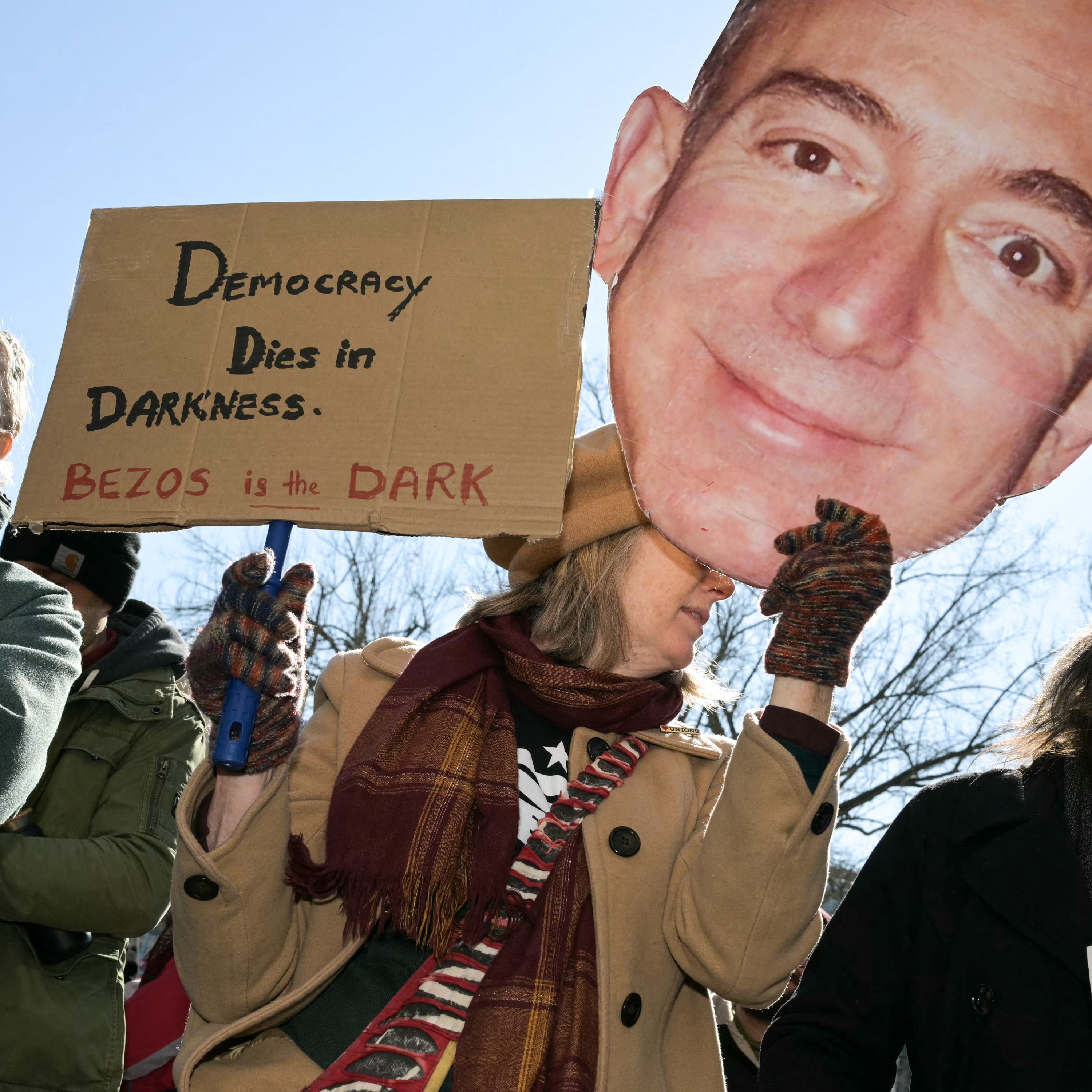
On the Media
The Century-Long Capture of U.S. Media
00:21:07
Capitalists, oligarchs, and authoritarians, oh my!
Loading summary
Transcript46 lines
- [00:00]
Micah Sifry
Hey, you're listening to the on the Media midweek podcast.
- [00:03]
Michael Olinger
I'm Michael Olinger. As once formidable media behemoths like the Washington Post and CBS News continue to take more and more damaging blows, it would be easy to point fingers at entirely modern causes. But press scholars have been crying for decades that this industry's foundations contained significant cracks. There's actually a phrase for what's happening not just in the United States, but around the world.
- [00:31]
Micah Sifry
Media capture, or the idea that when
- [00:34]
Michael Olinger
the government fails to codify protections around the press's obligation towards public interests, political and commercial interests can take over. No coup required, just a slow, steady transfer of power.
- [00:49]
Micah Sifry
Victor Picard is a professor of media
- [00:51]
Michael Olinger
policy and political economy at the University of Pennsylvania. He recently wrote about how American media have actually seen three cascading layers of capture. Capitalistic, oligarchical, and authoritarian. And to start with capitalistic, we have to go a little ways back in time.
- [01:11]
Victor Picard
In the late 1800s, early 1900s, in the newspaper industry, there was a structural transformation where they shifted to a more advertising dependent business model. So they went from relying on advertising revenue, roughly 40% their overall revenues in the the mid-1800s into the 1860s. By the early 1900s, they were relying on advertising for well over 70% of their revenues. And what that did was it changed the relationship between publishers and readers. Publishers saw their readers not as engaged citizens in a democratic society, but primarily as consumers whom they would deliver to advertisers. It also led them to rely on more sensationalized media coverage. It also incentivized further media consolidation. You saw the rise of newspaper chains and press, Barrett's, Pulitzer, and Hearst and others that took over many newspapers and would sometimes exert political control over the types of coverage and content that was being produced for broadcast media. It makes sense to look at the early 1930s.
- [02:20]
Micah Sifry
Yeah. In the 1930s, there were three networks that essentially dominated the market. CBS, NBC, and the Mutual Broadcasting System. The FCC in the early 1940s basically cornered NBC, splitting it up into what has become NBC and ABC. What do you think regulators could have done at the time to steer us away from the type of media consolidation
- [02:45]
Victor Picard
that would follow this critical juncture in the early 30s, which culminated with the Communications act of 1934, which established the Federal Communications Commission and really sanctified this commercial broadcast media system? But at that time, there was even up until the very end, ongoing debates about should we at least have some set asides for public programming? And there was this proposed amendment called the Wagner Hatfield Amendment, that tried to reserve 25% of the airwaves to nonprofit, non commercial educational programming not to leave your listeners in suspense. That did not pass. And therefore we ended up, as you say, with a highly commercial oligopolistic. There were really just three. Even to call MBS one of the three big players is probably overly generous. It really was just CBS and NBC that dominated the public airwaves at that time. And as you also noted, they did force NBC to essentially break itself into two. But going from two big players to three big players did not transform the media landscape. So throughout the 40s, you had these ongoing media policy battles where they tried to mandate things like mandated public affairs coverage or to not allow for excessive advertising. They did not succeed in passing these public interest protections. But by the end of the decade, they did establish what later became known as The Fairness Doctrine, 1949, which of course was later jettisoned in the Reagan administration.
- [04:21]
Micah Sifry
What exactly was the Fairness Doctrine? How did it work?
- [04:24]
Victor Picard
So the Fairness Doctrine is widely maligned and misunderstood. It's often conflated with the equal time rule. But in fact, Fairness Doctrine was more progressive than that. It was based on this idea that broadcasters, in order to hold on to their monopolistic rights to the public airwaves, to hold onto their licenses, had to cover controversial issues that were important to local communities and to do so in a balanced manner. So it was this affirmative duty that broadcasters had to uphold. There's a long history to how this very imperfect media policy was deployed and adhered to. But it was at least some kind of social contract that these commercial broadcasters had to give something back to democratic society in order to hold on to their licenses.
- [05:15]
Micah Sifry
You talked a little bit about how earlier efforts to introduce some kind of regulation for public interest content fell flat. But in the late 60s, we did finally see the birth of public media. The Corporation for Public Broadcasting was created in 1967. We're speaking on public radio right now. Obviously it's been defunded by this administration, but how would you say that American public media has compared to other Western democracies?
- [05:46]
Victor Picard
The US Was a global outlier pretty much from the beginning, when we established this hyper commercialized broadcast media system dominated by a handful of corporate television networks, what FCC Chairman Newton Minhow referred to at the time as a vast wasteland. So by the end of the 60s, we did finally establish a public broadcasting system, but it never followed the original blueprint that at least one of the revenue streams would be based on a 5% excise tax on television sets and so compared to most democratic societies around the world, the US public media system was always deeply impoverished. It was always forced to rely on private capital. So to even call it a public media system really was a bit of a misnomer. Most of its funding came from individual listeners and viewers like us, also foundations and also corporations, sometimes euphemistically referred to as enhanced underwriting. If you look at how much we allocated towards our public media system at the federal level, and this is before the rescission package, when even this poultry amount was jettisoned, it came out to about a buck 59 per person per year. You compare that to the Brits who spend close to $100 per person per year for the BBC. And many other democratic countries spend far more than that. And it shows, I would argue, in the health of their democratic society.
- [07:16]
Micah Sifry
You've actually studied the sort of correlative effect between public media spending and the strength of a country's democracy. How do you study that kind of thing?
- [07:28]
Victor Picard
It's actually not as complicated as it sounds. The Economist magazine puts out this democracy index on an annual basis that really assesses the health of democratic societies around the world. The U.S. of course, has been characterized as a flawed democracy for a number of years now. But what you find is that the countries that are determined to have the strongest democracies also have the healthiest and best funded public broadcasting systems. So this doesn't necessarily argue for causation, although my co author Timothy Neff and I found positive correlation that they tend to rise and fall together. But at the very least it puts to rest this deeply American fear that it if government gets involved in funding our media, we're on some kind of slippery slope towards totalitarianism. In theory, the US could have adopted something much more similar to a BBC model. But even to compare us to our neighbors to the north, the cbc, the Canadian Public Broadcasting System, they all put ours to shame in terms of how much they're allocating towards their public broadcasting at the federal level. It's fairly well established that a commercial media system can never guarantee universal service, can never make sure that all members of society have access to a baseline level of news and information. And this might seem counterintuitive because people are often saying, oh, maybe we don't need public broadcasting anymore. But honestly, I think it's fair to say that we need it more now, today than ever before.
- [09:05]
Micah Sifry
I have more to ask you about the future of public media in just a moment, but let's talk a little bit more about history. You were Walking us through how early revenue models for newspaper and other commercial media, radio and tv, sort of set us up for this capitalistic capture that we're currently experiencing. And you argue that regulators have made it worse over the course of the 20th century, culminating with the Telecommunications act of 1996, which essentially dictated how many radio and TV stations a single company could own. This move opened the door for another type of capture, oligarchical. Can you explain that?
- [09:45]
Unidentified Interviewee or Reporter
Sure.
- [09:46]
Victor Picard
So what you see with the capitalistic form of media capture are these systemic incentives to grow larger, to consolidate and conglomerate. And you start seeing these massive media conglomerates spanning a number of markets. The 1996 Telecommunications act was a major manifestation of this kind of deregulation. Although I must point out that deregulation is a misnomer as well. It's really a form of re regulation. Re regulating our media along more corporate lines and basically ensuring that we're going to have media ownership concentration. So to give one stark example would be the radio company Clear Channel. Prior to the 1996 act, one company could not own more than 40 stations nationwide. 20am stations, 20 FM stations. The telecommunications act jettisoned that rule. It allowed Clear Channel to quickly buy up a bunch of stations so that before long, they had more than 1200 across the country. And oftentimes, with this consolidation in media ownership, you had a homogenized form of radio content.
- [11:05]
Micah Sifry
Yeah. In the case of Clear Channel, they would basically buy up local stations, turn them into, like, automated pop rock stations. And there's one famous example. In Minot, North Dakota, a city that had seen its radio market gobbled up by Clear Channel, There was a train crash that sent a noxious gas cloud into the city. And public officials were not able to get word out quickly enough because of this highly automated, highly consolidated local news market.
- [11:39]
Victor Picard
Right? That's right. The sociologist Eric Klinenberg covers this in the introduction or in the early part of his book, Fighting for Error. But essentially, people were calling into radio stations trying to report and get the word out about this toxic event that was perhaps even life threatening. Is certainly a public health disaster.
- [12:00]
Micah Sifry
Here's a clip from a video on
- [12:02]
Michael Olinger
the disaster put together by investigative journalist Sue Wilson.
- [12:07]
Unidentified Interviewee or Reporter
Dispatchers were advising callers to listen to their emergency broadcast station.
- [12:11]
Sue Wilson
What should we listen to? A certain radio. KCJB, radio 910.
- [12:15]
Unidentified Interviewee or Reporter
But a full hour after the crash, there was still nothing on kcjb.
- [12:20]
Sue Wilson
Okay.
- [12:20]
Unidentified Interviewee or Reporter
Or any other radio station.
- [12:22]
Sue Wilson
We've been putting it on over the radio. What's the radio station? All the radio stations Sir, I had it on. I haven't heard it once. How come there's nothing on the radio or the TV yet?
- [12:32]
Victor Picard
But no one was home, no one was answering the phone because these programming formats were all automated. And this is just a glaring example of a media system that has no allegiance to local communities, no allegiance to public service responsibilities.
- [12:48]
Micah Sifry
Of course, one very timely example of an oligarch who is having his way with a once great news outlet is Jeff Bezos and the Washington Post.
- [12:58]
News Reporter
Washington Post is laying off a third of its workforce across both the newsroom and its business operations. A massive blow at a storied newspaper that has struggled in recent years to stay profitable and retain subscribers.
- [13:10]
Micah Sifry
Now that we've seen him gut this organization, it's painfully obvious that relying on the whims of one very rich man, one very rich owner, is a bad idea. Is it possible for billionaire newspaper owners to be responsible, good stewards of news organizations?
- [13:30]
Victor Picard
Perhaps in theory it might be possible. But I think by now it's time to put to rest this notion of a benevolent billionaire. We should not invest so much power into one individual over our media system and over our democratic society. It's just a problem, if not immediately. And I think you could say that about Jeff Bezos. Early on, critics like myself began to feel like maybe we overreacted. When I first heard that he was buying the Washington Post, I thought, this is very bad. But then he supported a very robust newsroom that was doing fantastic journalism for a number of years. But I think we should be learning from these mistakes by now. When Jeff Bezos bought the Washington Post in 2013 for $250 million, that was less than half of what he later paid for his superyacht. This is like pocket change for someone like him. The temptation to use it instrumentally for political aims is always going to be there. And this is part of the oligarchic media capture problem, which is it might be the case where Jeff Bezos is losing money with the Washington Post. Reportedly, he was losing somewhere around $100 million a year, but he stands to gain billions of dollars in government contracts with his aerospace company, Blue Origins. We could look at Musk. Musk might be losing money with X, but he stands to gain tremendous amounts of money with SpaceX and some of his other companies. Even if it looks like they're taking a hit. And these are kinds of loss leaders, they're still performing a benefit for their long term political and economic objectives.
- [15:14]
Micah Sifry
But just to drill down a little bit more specifically on the Washington Post. Why do you think Jeff Bezos is killing it? If he doesn't want to lose $100 million a year and he doesn't want to even attempt to right the ship anymore, why not just sell the paper and just stop worrying about it?
- [15:31]
Victor Picard
That would be great for all of us if he decided to let go of this asset and give it to more responsible owners. But it's still a highly valuable asset. It's still a major newspaper, it's based in the nation's capital. And so unfortunately, I don't think he's caring about the health of democracy. He cares more about the future of his own political economic power. It's important to note that there are exceptions that not every commercial media outlet becomes oligarchic and that even commercial media outlets are quite capable of delivering amazing content and hard hitting journalism. So it's not over determined. But at the same time, I think there are some very clear systemic trends here and there are some deep structural problems that we're going to have to wrestle with if we're going to try to ensure that there is a healthy democracy going well into the future.
- [16:31]
Micah Sifry
So we've talked about capitalistic capture, we've talked about oligarchical capture. Do you mind just quickly defining what authoritarian capture is?
- [16:40]
Victor Picard
Authoritarian media capture would be a scenario where a government takes over or influences media. And I think in most cases it's the latter. Newsrooms aren't taken over by gunpoint, but instead it's what might be referred to as the Victor Orban model, where governments can rely on friendly oligarchs to police the media for them. And it often happens in subtle ways and gradually, although increasingly in our own political moment, we're seeing quite glaring and obvious interventions from the Trump administration and the Federal Communications Commission.
- [17:19]
Micah Sifry
Yeah, so maybe on the more subtle side of the spectrum, you encourage your buddies Larry Ellison and Marc Andreessen to put up cash to buy TikTok. Or maybe you signal that if a certain owner of CBS wants to buy Warner Brothers, then they better not let somebody say bad things about the president, et cetera, et cetera. On the less subtle side of the spectrum, you have raiding the home of a prolific Washington Post reporter or having agents arrest Don Lemon and independent journalist Georgia Fort because of their coverage in Minneapolis. So I guess we're kind of getting all flavors of coercion from this administration.
- [18:00]
Victor Picard
Another way of thinking about it is that there is this kind of broad spectrum of authoritarian media capture, and we seem to be sliding down that spectrum towards more overt cases but oftentimes, the more dangerous form are these subtle influences, even at the level of the individual psychology of individual journalists, where they're internalizing chilling effects throughout media coverage. And certainly this administration has made it abundantly clear what it sees as off limits.
- [18:33]
Micah Sifry
Okay, so let's say tomorrow you and I are sort of imbued with magic powers and we can just snap our fingers and reimagine, remold, rebuild American media from the ground up. We've got well funded public media. We have, you know, no more billionaires, strong antitrust regulations, et cetera. What evidence do we have that audiences would like this, would want this, have people not gravitated away from legacy journalism on their own volition?
- [19:11]
Victor Picard
You're absolutely right to suggest that it's not as if we can simply build a new media system. And they will come. Current survey studies show even amongst people who might hate the media, when you talk about their local media institutions, they have warm fuzzy feelings towards those kinds of media outlets. Another way of looking at this commercial logic that drives so much of our media, there's this implication that if a news media outlet is no longer profitable, then it's a shame, but it's just going to have to wither away, right? The market has spoken. There's not enough consumer support, but there are many public goods and democratic needs whose value aren't determined by how much they fetch on the open market. An analogy that I sometimes use is to imagine what if there was no longer demand for public education? Would we just let public schools all wither away? Would we just determine that the market has spoken and we can no longer provide education for all children throughout society because it's no longer profitable? That simply is no way to design a democratic society. And we have to start looking at our media in the same way. It's a public good that should not be left up to the mercy of these market logics.
- [20:28]
Micah Sifry
Victor, thank you so much.
- [20:30]
Victor Picard
Thank you so much for having me, Micah. It's been great talking to you.
- [20:33]
Micah Sifry
Victor Picard is a professor of media policy and political economy at the University of Pennsylvania. His latest book is titled Democracy Without Confronting the Misinformation Society.
- [20:50]
Michael Olinger
Thanks for listening to the on the Media midweek podcast. You can find us on TikTok, Reddit and Instagram. Just search on the media. Don't forget to listen to the big show this weekend. I'm Michael Leinger.
- [21:08]
Ira Flatow
This is Ira Flato, host of Science Friday. For over 30 years, the science Friday team has been reporting high quality science and technology news, making science fun for curious people by covering everything from the outer reaches of space to the rapidly changing world of AI to the tiniest microbes in our bodies. Audiences trust our show because they know we're driven by a mission to inform and serve listeners first and foremost with important news they won't get anywhere else. And our sponsors benefit from that halo effect. For more information on becoming a sponsor, visit sponsorship wnyc. Org.