← On the Media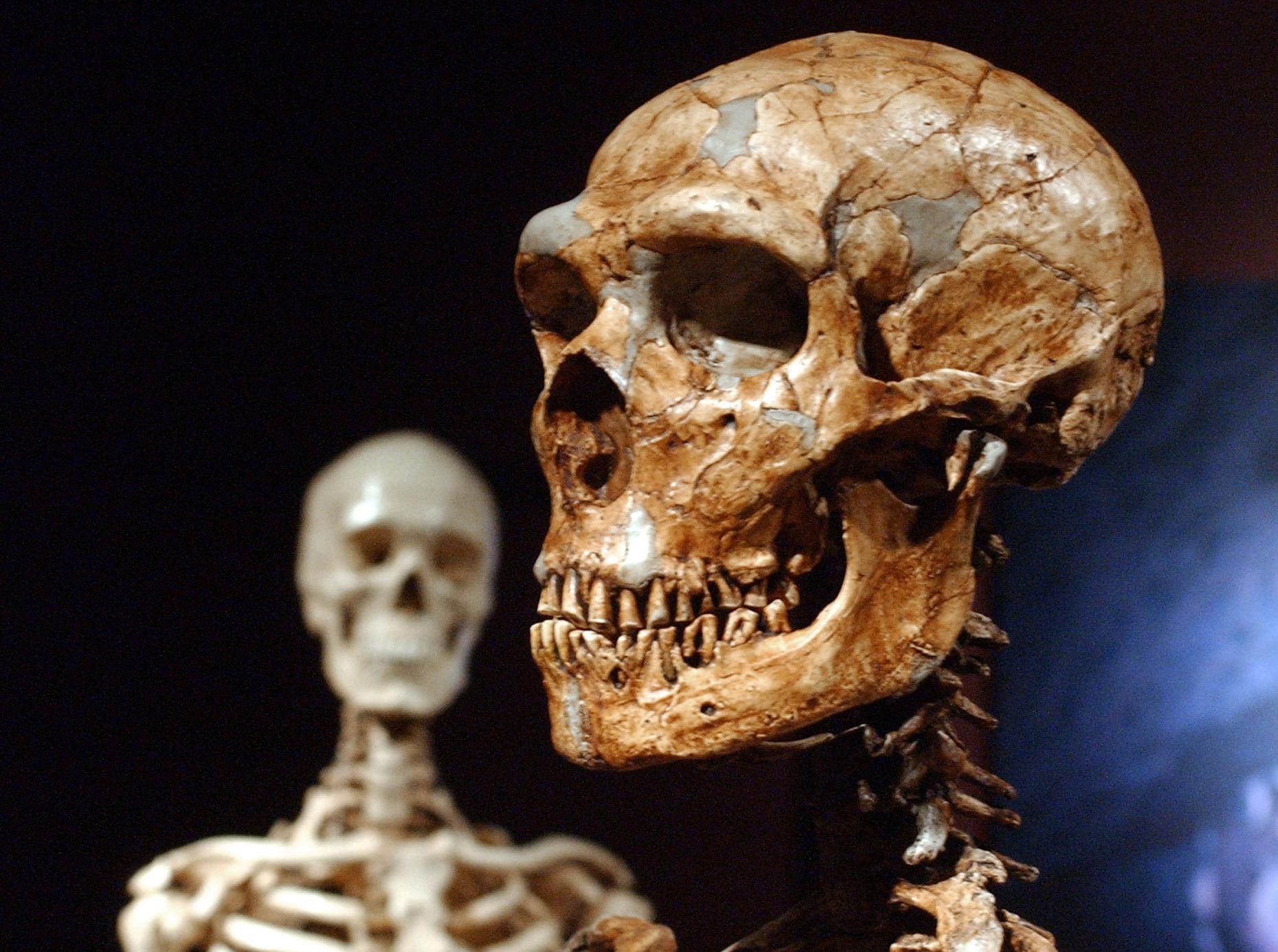
Loading summary
Transcript153 lines
- [00:01]
Unknown Speaker
You wouldn't usually say that stupid congressman is a Neanderthal. You'd probably say Neanderthal.
- [00:08]
Brooke Gladstone
That's the right way to pronounce everybody's favorite Paleozoic insult. From WNYC in New York, this is on the media. I'm Brooke Gladstone. This week we spelunk into the real story of our cave dwelling cousins.
- [00:22]
John Hawks
Neanderthals had lived across Europe and Asia from 2 or 300,000 years and very successfully. We have another 200,000 years to go before we catch up with the Neanderthals.
- [00:32]
Brooke Gladstone
And expose the worldview behind the scientific racism that seems to know no limits of time or place.
- [00:39]
Angela Saini
So there was this belief that white Europeans were at the top of this hierarchy and other races were slotted below. And also that those at the bottom of this hierarchy were like Neanderthals, doomed to die out.
- [00:52]
Brooke Gladstone
Join us as we reckon with our family history after this.
- [01:00]
Willa Paskin
OnTheMedia is supported by Progressive Insurance. Do you ever think about switching insurance companies to see if you could save some cash? Progressive makes it easy to see if you could save when you bundle your home and auto policies. Try it@progressive.com, progressive Casualty Insurance Company and affiliates. Potential savings will vary. Not available in all states.
- [01:22]
Hi, I'm Willa Paskin, the host of Decoder Ring, Slate's podcast about cracking cultural mysteries. On Decoder Ring, we dive down rabbit holes and obsessively explore questions hiding in plain sight, like why has slow dancing gone out of style? And when did we all become obsessed with hydration? And where did the word mullet, you know, to describe a hairstyle come from? That's Decoder Ring, named one of the best podcasts of 2023 by the New York Times. Listen to new episodes every two weeks and make sure to follow us.
- [01:52]
Brooke Gladstone
So miss one from WNYC in New York. This is on the Media. I'm Brooke Gladstone.
- [02:00]
Annalee Newitz
And I'm Annalee Newitz.
- [02:01]
Brooke Gladstone
That's the Annalee Newitz, science journalist and science fiction author. Their most recent book is four Lost A Secret History of the Urban Age and their co host of the podcast. Our opinions are correct. At some point we discovered that we were both kind of obsessed with Neanderthals. Who they were, what they have to teach us. So back in January, we decided to co host an episode on our much maligned cousins. This is a rebroadcast of that hour.
- [02:33]
Annalee Newitz
The last thing we need is the.
- [02:35]
John Hawks
Neanderthal thinking that in the meantime, everything's fine.
- [02:38]
Angela Saini
Take off your mask.
- [02:39]
Annalee Newitz
Forget it.
- [02:40]
Brooke Gladstone
We both heard it of Course, we were both appalled.
- [02:44]
Annalee Newitz
I mean, it's just not true. There's no evidence that Neanderthals couldn't understand existential risks.
- [02:50]
Brooke Gladstone
Yeah, right.
- [02:51]
Annalee Newitz
Why are Homo sapiens always insulting Neanderthals?
- [02:54]
Brooke Gladstone
You may be wondering why that matters. We found that we both shared the view that to understand who you are and where you're going, you cannot go too far back. In fact, there is no back too far.
- [03:10]
Annalee Newitz
So we're going to explore the prism through which we have long viewed Neanderthals. And what that says about us and how our view of them is changing and what that says about us, too.
- [03:21]
Brooke Gladstone
We're going back to the Paleolithic, and it's gonna blow your mind because it wasn't like this.
- [03:30]
Annalee Newitz
Or this.
- [03:34]
Brooke Gladstone
Or this.
- [03:35]
John Hawks
I really don't understand your Congress or your system of checks and balances because I'm just a caveman. I fell in some ice and later got thawed out by scientists.
- [03:47]
Unknown Speaker
But there is one thing I do know. We must do everything in our power.
- [03:52]
John Hawks
To lower the capital gains tax.
- [03:55]
Unknown Speaker
Thank you.
- [03:56]
Annalee Newitz
It was more like this.
- [03:58]
Unknown Speaker
The Neanderthals conquered challenges with cooperation. They collected pigments, red ochre and manganese dioxide, and they colored things.
- [04:09]
Annalee Newitz
That's John Hawks, an anthropology professor at the University of Wisconsin at Madison who knows his Neanderthals.
- [04:16]
Unknown Speaker
To me, studying Neanderthals is like trying to study an alien intelligence. I don't understand the language that they might have spoken, but I can tell from the patterns that there was sophisticated behavior there.
- [04:29]
Annalee Newitz
We got started on this whole thing by talking about the word that Joe Biden used to describe people who refuse to wear masks. I say Neanderthal, I say Neanderthal. The difference is academic, but it also has to do with pop culture.
- [04:43]
Unknown Speaker
You wouldn't usually say that stupid congressman is a Neanderthal. You'd probably say Neanderthal. And that kind of is. The popular culture versus really scientific point of view is encapsulated in that.
- [04:57]
Annalee Newitz
Hawkes says there are really two versions of the Neanderthal. The one from pop culture who exists on the Flintstones and in the mind of Joe Biden, and the one who scientists understand as an early human who has gone extinct. They're kind of our sisters and kind of our mothers. What I mean is that they share a common ancestor with Homo sapiens. And how to put this delicately, they also exchanged genetic material with our fathers. Hawkes says that Africa was once teeming with different types of early humans. And all of them were interacting with each other. They were also migrating out of Africa into Europe and Asia. Homo sapiens were not the first humans to leave Africa and colonize Europe.
- [05:38]
Unknown Speaker
Neanderthals emerged as a different population from our African ancestors around 700,000 years ago. And when they first split off from those African populations, they were a population that's joined together with another group that we today know as the Denisovans. The Neanderthals ultimately lived in the western half of Eurasia. The Denisovans, we think in the east and southeast part.
- [06:02]
Annalee Newitz
And elsewhere in the world, there was a diminutive human called Homo floresiensis, nicknamed the Hobbit people. All of them were human with complicated social lives and art and culture. But there were also early humans that Hawkes says probably weren't like us.
- [06:18]
Unknown Speaker
Homo naledi, a species that I have been working on for the last decade in South Africa in the middle Pleistocene, as Neanderthals and the ancestors of modern humans in Africa were diversifying, there's this other species in South Africa, Homo floresiensis, that you mentioned. Many of these groups represent deeper branches than that connect earlier in our evolutionary history and are very different from us. Some of them, like Homo naledi, I would really hesitate to call human. They had brains a third the size of ours.
- [06:52]
Annalee Newitz
Our scientific understanding of who counts as human and who our closest ancestors are has changed a lot over the past half century. And this brings us back to terminology. In 1950, you'd call a human like me hominid.
- [07:07]
Unknown Speaker
And the reason is that ID is this suffix in taxonomy that means family. The great apes living today, chimpanzees, bonobos, gorillas, are our close relatives, and chimps and bonobos are our closest living relatives. So the tree of relationships doesn't separate the living great apes from us, it puts us within them. For taxonomists, what that means is that our family is a family that includes the other great apes. They're the hominids.
- [07:37]
Annalee Newitz
But in the past few decades, taxonomists have started using a new category, hominin, that is just for humans and our direct ancestors. And thus, with a change in suffix, we have a new way of separating ourselves from the apes and firmly putting us in the same tribe as Denisovans, the hobbits, small brained Homo naledi, and yes, the Neanderthals. And given that we were all in the same tribe, it's not a surprise that a lot of, you know, love was flowing between all these groups, or, as the scientists say, there was a lot of genetic admixing.
- [08:17]
Unknown Speaker
It's certainly true that we all belong to populations that have mixed with each other, that have mixed repeatedly. And that mixture is fundamental to our nature as a species. It's accelerating, if anything, with long distance movement between different populations. But it was true prehistorically. One perspective that ancient DNA has given us of these skeletons from different times in the past is that we can see that, hey, the people that lived in this place 3,000 years ago weren't the same as the people that lived there earlier because there was immigration, there was mixture. And that's true at every time stage that we can observe.
- [08:57]
Annalee Newitz
So that means that most of us are a little bit Neanderthal. In fact, Brooke did a genetic test and she was a little disappointed that she was only 2 1/2% Neanderthal at most.
- [09:08]
Brooke Gladstone
Hey, rub it in.
- [09:09]
Annalee Newitz
The path from hominid to hominin was pretty recent, and it's also pretty significant. Science has now acknowledged that Neanderthals, among other early hominins, were human like us. Of course, we're still having arguments about the relative humanity of Republicans and Democrats.
- [09:27]
Brooke Gladstone
So, you know, up next, how after more than 100 years, we came to understand what we didn't understand about Neanderthals, like how they lived, what they ate, what they wore, and how they died.
- [09:42]
Annalee Newitz
This is on the media.
- [09:52]
Willa Paskin
On the media. Supported by Progressive Insurance, you chose to hit play on this podcast today. Smart choice. Make another smart choice with Auto Quote Explorer to compare rates from multiple car insurance companies all at once. Try it@progressive.com Progressive Casualty Insurance Company and affiliates not available in all states or situations. Prices vary based on how you buy.
- [10:18]
Hi, I'm Willa Paskin, the host of Decoder Ring, Slate's podcast about cracking cultural mysteries. On Decoder Ring, we dive down rabbit holes and obsessively explore questions hiding in plain sight, like why has slow dancing gone out of style? And when did we all become obsessed with hydration? And where did the word mullet, you know, to describe a hairstyle come from? That's Decoder Ring, named one of the best podcasts of 2023 by the New York Times. Listen to new episodes every two weeks and make sure to follow us so you never miss one.
- [10:51]
Annalee Newitz
This is on the Media. I'm Annalee Newitz.
- [10:54]
Brooke Gladstone
And I'm Brooke Gladstone. Our kinship with Neanderthals is at the heart of Rebecca Rag, Sykes's Kindred, in which the archaeologist and science writer explores Neanderthal life, love, death and art. But historically, the study of Neanderthals has been guided not by a sense of kin, but rather otherness, a search For Neanderthals, defects to account for their supposed inferiority and their disappearance from the earth. But in recent years, we've learned a lot more about how they lived. And it isn't so other at all.
- [11:30]
Rebecca Wragg Sykes
They were living in caves or rock shelters. But also we know that they were living in the open air as well, because we can find those sites and they fit in with what we know from ethnographic research on living and historical hunting and gathering cultures all over the world. Most of the time, the people that you actually live with, that's a small number, maybe 25 maximum. The way that a Neanderthal home might appear to you, you would probably see maybe two halves active at the same time, some that were blazing really hot temperatures, much more perhaps a cooking hearth versus other ones towards the back of a rock shelter, which look like they were smouldering, which matches what we see from the way hunter gathering peoples live, where you have like little sleeping fires to keep you warm at night. So they were using different parts of the site in a different way. And we can see that also reflected in other kinds of material evidence. For example, animal bones. We can see different animals being prepared in different parts of the cave. And there's even an Italian site called Grotto for Mani, where it looks as if different body parts of birds that Neanderthals were hunting there were being processed in different areas. Like the wings, all seem to be discarded in one area. We can even see in some cases there are like little middens where they're cleaning the hearths out and then they dump the ashes somewhere else on that site.
- [12:54]
Brooke Gladstone
You say that there's evidence of furnishings made from plant material, that they were picky about the wood they used.
- [13:02]
Rebecca Wragg Sykes
Yeah, we can see really impressive wooden spears. They're selecting the wood, not only the species, but the parts of the tree, the lower part of the trunk, or the base of the branch for the tip of the spears. Because it's the strongest wood. They also are carving it away from the grain so it's not going to shatter on impact.
- [13:23]
Brooke Gladstone
Talk to me about glue. How hard is it to make?
- [13:27]
Rebecca Wragg Sykes
So we know that Neanderthals were using stone, it's the basis of their technology. But they also are able to understand the concept of joining different parts together to make a multi component tool. So this is what we call hafting, basically sort of sticking a handle on something. Sometimes they might be using plant twine or maybe sinews to do this. But in other cases we have direct evidence that they were using adhesive. In the Middle East. In the near east, we can see that they're using natural asphalt, but elsewhere they're making their own glue. So in the European context, we can see that they knew how to make birch bark tar. So in the States, you have very rich indigenous cultural traditions that use birch for all sorts of stuff, including glue. You have to cook this black tar out of the bark under controlled conditions. That's quite a sophisticated process to understand how to control the fire. Less air is better because if you allow too much air in, it just burns. Also recently we found new evidence from an Italian site that suggests that they are making glue recipes mixing together pine or conifer resin with beeswax. And when you mix those two things together, it really improves the properties and it actually becomes more like birch tar. It's a part of their technological repertoire.
- [14:49]
Brooke Gladstone
So let's talk about culture. Now you write about the Bruniquel cave, the quote, strangest Neanderthal site.
- [14:59]
Rebecca Wragg Sykes
What makes it so people always want to know, were Neanderthals making anything that we can call art? And there are an awful lot of different forms of evidence, like color and pigments and engravings. But this site, Bruniquelle, is in Southeast France and it was only discovered quite recently. You know, when it was reported in the media, it was like, oh, Neanderthal Stonehenge. And that's totally overblown. It doesn't look like Stonehenge, but parts of it have that same balancing pieces on top of each other. And it's basically an massive underground construction of two rings formed of snapped off pieces of stalagmite. The natural formations that you get growing caves sort of look like fingers sticking up from the ground. And in a chamber 300 meters deep into a hill would have been totally in the dark. Neanderthals took hours snapping these pieces off and arrange them in two large circles with piles inside them. And then there's burning around on the edges and on these central piles as well, for a purpose that's not really clear to us because it doesn't really look like a living site. It's too deep inside. You'd have to have lighting all the time, be very smoky. And this was during a cold period as well, when there just wouldn't be huge amounts of trees around to provide you with all the fuel. But it gets even more interesting because these piles and these rings, when you look at the detail of them, you can see it's not something that you could just accidentally produce. So what is it about?
- [16:34]
Brooke Gladstone
You suggest it's a large art Project.
- [16:37]
Rebecca Wragg Sykes
Well, I mean, we don't like, as archaeologists to use the word mysterious because it's overused so much. But in this case, if there's no practical explanation that we can see at the moment, then perhaps it is something to do with aesthetic structures and productions.
- [16:56]
Brooke Gladstone
Also, the Shahanidar Cave in northern Iraq. There were Graves created there 65,000 years ago with the bones of adults and infants, fossilized flower pollen surrounding one of them, maybe a burial ritual or maybe even a mythology about life after death. And in the cave, the remains of people who were clearly cared for and in a hard life, a difficult kind of care to provide.
- [17:30]
Rebecca Wragg Sykes
There's two threads to what you're talking about. One is the question of the treatment of the dead, and the other thread is looking for evidence of care. Shanidar is a classic site for that because one individual, an old man, just had a catalogue of severe traumatic damage to his body that would have really impacted how he could live.
- [17:52]
Brooke Gladstone
A blind eye, a missing, possibly amputated lower arm, two broken legs, some really.
- [17:58]
Rebecca Wragg Sykes
Awful thing happened to him where one of sides of his body was really crushed. Both his arms are well developed, so he was still using them. An individual like that would have had many different things to offer the group, but they may have had to have support in terms of providing food, for example, if they were not able to hunt themselves and things like that. So Shanidar is one among a number of different cases that are usually discussed when we're talking about evidence for care. Then there's also some others where, like, there's a really severe injury and you can see that it has healed, but it would be so severe that they just wouldn't be mobile. For example, like a break in the top of your thigh bone. People are going back to these classic sites and reinvestigating them. So there's a new team working now at Shanidar looking at the unexcavated sediments and they have found more remains. And we can use all of our 21st century Wysi scientific methods to actually really look at this question of are these bodies intentionally deposited? What is going in with those bodies? If anything, can we actually see remains of plants?
- [19:06]
Brooke Gladstone
There are a couple of reasons why I'm obsessed with Neanderthals. I've always had a passion for science fiction and the idea that there were other kinds of humans was fascinating to me. But then doing this job, I was really interested in how the interpretations of Neanderthals, one replacing another replacing another, seemed to be a wonderful lens through which to Examine how we look at each other.
- [19:33]
Rebecca Wragg Sykes
The Neanderthals were the first other form of humanity that we encountered. So I think because they were the first found, they have played this role as the other for us. And, I mean, I'm a big science fiction fan as well. And Neanderthals are like the original Alien Encounter. You know, they weren't from another planet, they're from another time. And we rediscovered them during a time when people's interest in the concept of aliens was really kicking off this notion that time was much deeper because of the geological understanding is there. And it's also the same time people are turning big telescopes and looking at the sky and realizing that space is much bigger than we thought, challenging our position in the universe and the cosmos. You know, where do we fit? If there was another way of being human on this planet, they really fulfill that role of a mirror among the.
- [20:27]
Brooke Gladstone
Many pop culture images of Neanderthals. I take it you're partial to William Golding's novel the Inheritors. Right. He is the author of Lord of the Flies.
- [20:38]
Rebecca Wragg Sykes
I actually quote from the novel the Inheritors, and that book is really interesting. It's written in the 1950s, after the war. He basically tries to imagine and see the world through the eyes of some Neanderthal people as they encounter, for the first time, Homo sapiens. You kind of have access to the thoughts of this Neanderthal, although he doesn't use, like, a formal language or anything. And it's very much about imagery and impressions. It's absolutely remarkable writing. But also it's very interesting that the Homo sapiens people are framed, not just dominant in terms of sort of being socially aggressive, but coming in, altering the environment. There's a quote in my book from that that I really like.
- [21:22]
Brooke Gladstone
Would you read it?
- [21:23]
Rebecca Wragg Sykes
Yeah. Yeah, sure. He's talking about the people coming in, and he says they are like a famished wolf in the hollow of a tree. They are like the river and the fall. Nothing stands against them. For me, that's, I don't know, a really great way to describe the way that we have overwhelmed the Earth. And the idea that that's been there potentially in us for a very long time is a really intriguing one to consider the way that we want to live as a global species, which we are now. And we have to learn how to use our ability to manipulate materials, which I think Neanderthals would have loved to see the stuff that we can make. We have to use that capacity that we have in a way that is not A maladaptive in scientific parlance. If you trash your own environment, your survival is not guaranteed.
- [22:16]
Brooke Gladstone
Rebecca, thank you very much.
- [22:18]
Rebecca Wragg Sykes
It's been an absolute pleasure to speak with you.
- [22:21]
Brooke Gladstone
Rebecca Rag Sykes is an archaeologist, author and honorary fellow in the School of Archaeology, Classics and Egyptology at the University of Liverpool. She's the author of Neanderthal Life, Love, Death and Art. At the base of the Rock of Gibraltar, off the south coast of Spain, are the Great Gorham and Vanguard Caves, more akin to cathedrals than your average grottoes. Rising sea levels have encroached on the caves, submerging some of the landscape where the Neanderthals once ranged. But Clive Finlayson, director, chief scientist and curator of the Gibraltar National Museum, has committed himself to, quote, un drowning a lost world those caves contain. His team has uncovered stone tools, the first Neanderthal etching ever found, and even their footprints. But equally important were the bones, not just of Neanderthals, but of birds. 161 species, 33% of all birds in Europe at the time. Those bones refute the notion that Neanderthals were neither clever nor nimble enough to catch fast flying prey. Welcome to the show, Clive.
- [23:39]
John Hawks
Hi. It's a pleasure to be with you.
- [23:42]
Brooke Gladstone
You didn't just examine the birds as a biologist, you examined the behavior of the descendants of those birds, the golden eagle, the snowy owl. Vultures also feature in your story.
- [23:58]
John Hawks
Yes, indeed. There are four different species of vultures in Europe still today, and we find all four of them in the caves. One of our trips, we went up to the Pyrenees in northern Spain. There's a guy there who spent the last 30 years putting food out for vultures. You start going up a slope and the vultures start flying around you because they've seen him. You have to shoo them with your hands. Wild vultures. And when they come to feed, they feed from your hand. Now, Neanderthals were probably much better naturalists than any of us are today because their lives depended on it. I'm sure they could do very similar things and catch birds in a diversity of ways that we can't imagine. For me, the most exciting one of the four vultures is the one we call the bearded vulture that comes in at the end of the feast and eats bone. It's a bone breaker. But the interesting story with that one is the bearded vulture is the animal that invented cosmetics. Oh, yes, hear me out. Bearded vultures, when you look at them, are orange underneath, some of them are whiter, some of them are less White. We know they go to streams rich in iron and they paint themselves orange. There is a lot of data now that shows that the more orange the males and the females look, the more successful they are producing. Baby bearded vultures. If you go to the island of Crete in the Mediterranean, where there are no iron ponds or streams, the bearded vultures are all white because they can't paint themselves. Now, what do humans do? They paint themselves with ochre. They do what bearded vultures do. Were Neanderthals somehow watching these bearded vultures, which were living in the same environments as they were, and did we pick up that particular habit of using ochre as paint from those vultures?
- [25:51]
Brooke Gladstone
What would you say were the greatest discoveries and the biggest correctives that the caves at Gibraltar revealed to you?
- [26:02]
John Hawks
The biggest one was popularly known as the hashtag.
- [26:06]
Brooke Gladstone
Describe the hashtag.
- [26:07]
John Hawks
The hashtag is a series of crisscross lines dug with stone tools by the Neanderthals onto the side of the cave onto rock to find an engraving made by a Neanderthal. The first in the world was a big claim. So we had to be really, really sure of what we were doing. We got similar rocks and reproduced the engraving. We did one stroke at the groove and another one until we reached the depth of the groove. And one groove took 60 strokes. And we were not very good at it. We kept breaking the stone tool. We couldn't keep to a straight line.
- [26:43]
Brooke Gladstone
You're using the equivalent tools that you found in the cave.
- [26:47]
John Hawks
Correct. And on the same rock surface type. So we knew already that whoever had done this had done it before because it wasn't an easy thing to do, to keep 60 strokes, a straight line. Rock and rock. Not that easy anyway. So we calculated the whole thing and we reckon the whole design took two hours to do. So this wasn't a doodle, this wasn't casual. So the next question was, okay, maybe they're just marks left as they're butchering the meat. Right. Next experiment, we sent somebody to the butchers and we got cuts of meat. We put them on the rock surface. First thing you realize you can't keep a straight line. It wasn't butchery marks. So is it art? Well, I've seen worse things today called art.
- [27:26]
Brooke Gladstone
Or it could have another meaning. It could be a calculation of some sort.
- [27:31]
John Hawks
Exactly. So the significance of this was that it showed that somebody, a Neanderthal, was abstracting something from their world and trying to represent it on those rocks. Whether it was art, whether it was a map, whether it was a clan symbol, we can speculate at length and it's fun to do that. But the point was, it was revealing these higher cognitive abilities that had previously only been attributed to modern humans.
- [27:59]
Brooke Gladstone
Could you take me into the cave? Preserved under a layer of sand, you found a moment in time, an abandoned dinner.
- [28:08]
John Hawks
One archaeological level in the cave, which goes back to about 45,000 years. There, the Neanderthals had come in, they'd made a campfire, they butchered a wild goat, an ibex, and they ate it and they walked away. The fire was put out and the remains of the butchered animal were left there. We found all that and even the embers of the charcoal as it was spitting from the fire, it's all there. But then, interestingly, just above, if it's above, it happened just after the Neanderthals left. We found a lot of hyena poop. We call them coprolites. What happened, obviously, was the hyenas came in to scavenge the remains of the Neanderthal barbecue. Well, the hyenas eat a lot of bone, so their coprolites are quite solid and hard and preserved. Now, why should that be interesting? Because if you take that to the lab and you dissect it, you look at it under high power microscope, we find residues of pollen. Now, how does pollen get into hyena poop when a hyena is a carnival? Well, in ingesting the intestines of the herbivores, they're ingesting the meal of the herbivore and the pollen. So this is really like ultra forensic research. But we can then look at the pollen that was in the hyena poop from 45,000 years ago. We can identify the pollen and therefore we can reconstruct the landscape outside in terms of what plants were growing there. Because the hyenas are telling us the.
- [29:36]
Brooke Gladstone
Hyena poop helped you reconstruct what life outside the cave may have looked like. Our popular image of the Neanderthals, if they aren't running around grunting, is they're shivering in freezing temperatures all the time.
- [29:53]
John Hawks
These people were living in a Mediterranean environment with a wonderful view out of the cave into a landscape of olive trees and stone pine trees, interspersed by freshwater lakes and herds of animals. And then all these birds on the cliffs singing and in the woodland.
- [30:11]
Brooke Gladstone
Your finding of the snowy owl helped you understand the climate better too.
- [30:16]
John Hawks
And there's a paradox there, because you could easily then ask me, well, how come there were snowy owls there if it was that mild and warm? Well, when you look at the levels where you find snowy owls and other Arctic birds. In those levels, you still have olive trees and other Mediterranean plants and animals. What we think is happening is that conditions are so inhospitable in the north. England is covered by a kilometer of ice that nothing's living up there. So all these Arctic birds are pushed southwards. They have no choice. So the presence of snowy owls and these Arctic birds where we are is not necessarily indication the conditions were that cold here, but that they had no room to go. You had to come south or go extinct. So we find these incredible combinations of species that you wouldn't find anywhere in the world today.
- [31:04]
Brooke Gladstone
Tell me about Nana and Flint. You're the director of the Gibraltar National Museum. You commissioned forensic artists, artists who were used to reconstructing, you know, murder victims from their bones to create statues of Neanderthals. Why did you do it?
- [31:26]
John Hawks
We had this Gibraltar skull that was found in 1848 and we then had the fragments of a child skull that had been excavated in 1926. We wanted to know what these people looked like. Now we were at a time when we had a much better picture of, if you like, the soft parts of the tissues of Neanderthals because the genome had been sequenced. So we knew their skin was pale, we knew the range of eye color, we knew the range of hair color similar to us, including red haired, brown and so on. So we had a pretty good idea, we thought from these two skulls, let's reconstruct these two individuals. The Kennis brothers from the Netherlands are fantastic. They're artists, but scientists at the same time doing these incredible forensic reconstructions. We work with our friends in Zurich who are anthropologists, and they could apply the metrics to reconstruct the whole body from that. So we used a bit of poetic license in putting them together and suggesting that Nana was the grandmother of the child Flint. We knew by then that Nana was female and we knew that the boy was a boy. All that was accurate.
- [32:34]
Brooke Gladstone
But they'd lived eons apart, presumably.
- [32:36]
John Hawks
Presumably they did. So that was where we used a bit of poetic license. You know, we wanted to break the mold from the stereotype. Traditionally, the Neanderthal is hairy, bent forwards, grumpy looking. But when you look at Nana now, she's got a glint in her eye and she's smiling and looking at you and the boy's hanging on to granny almost a bit scared. You're looking at humans. Skulls named with a lot of originality by anthropologists Gibraltar 1 and Gibraltar 2. No matter how many books I can write, how many papers I can write, when you put flesh to them and you call them Nana and flint, a lot of people empathize with them. You see those people there in the museum and suddenly you go, wow, I understand.
- [33:19]
Brooke Gladstone
You regard Neanderthals, you've said, as my species, as human.
- [33:26]
John Hawks
Indeed, there were differences. But we're not all the same in this planet today either. We're all part of one human family.
- [33:33]
Brooke Gladstone
We know now that Neanderthals didn't have fatal flaws like stupidity or bad hunting abilities or physical weakness or a lack of innovation. But what do we know about why they vanished?
- [33:51]
John Hawks
We don't give enough importance to contingency, to chance. Chance events do sometimes matter, especially when you have small populations. Neanderthals that lived across Europe and Asia for two or 300,000 years, at least.
- [34:06]
Brooke Gladstone
Very successfully, their species lasted far longer than ours has.
- [34:12]
John Hawks
Yep, we have another 200,000 years to go before we catch up with the Neanderthals. They were living very successfully in these woodland environments, being omnivores, eating plants, catching animals largely by ambush hunting. And they developed this incredible muscular physique for dealing with animals at close quarters. If you wanted to compare Neanderthal with a modern human in very broad terms, then Neanderthals are a wrestler and the modern human is a long distance runner. Completely different physics. And these long distance runners were used to open environments where they could catch animals using projectile technology. And they enter Eurasia at a time when the climate is actually hitting hard and the woodland has been overrun by steppe tundra. Steppe tundra with animals like reindeer. The world is changing completely. And my view is that the long distance runner could handle that world much better than the wrestler. If instead of getting cold at that moment, the climate had got warmer, more humid, the woodland would have expanded at the expense of tundra. Perhaps you and I today, and I say this with the greatest respect, would be Neanderthals discussing the disappearance of those others who turned up in Europe and couldn't make it.
- [35:26]
Brooke Gladstone
Clive, thank you very much.
- [35:28]
John Hawks
It's my pleasure and you're always welcome to come and visit us.
- [35:31]
Brooke Gladstone
I will. Clive Finlayson is director, Chief Scientist and Curator of the Drama Gibraltar National Museum. He's also author of the book the Smart Cave Art, Bird Catching and the Cognitive Revolution.
- [35:50]
Annalee Newitz
Coming up, what are evolving notions of our long vanished kin say about us?
- [35:56]
Brooke Gladstone
This is on the media.
- [36:12]
Willa Paskin
OnTheMedia is supported by Progressive Insurance. Do you ever think about switching insurance companies to see if you could save some cash Progressive makes it easy to see if you could save when you bundle your home and auto policies. Try it@progressive.com, progressive Casualty Insurance Company and affiliates. Potential savings will vary. Not available in all states.
- [36:33]
Hi, I'm Willa Paskin, the host of Decoder Ring, Slate's podcast about cracking cultural mysteries. On Decoder Ring, we dive down rabbit holes and obsessively explore questions hiding in plain sight, like why has slow dancing gone out of style? And when did we all become obsessed with hydration? And where did the word mullet, you know, describe a hairstyle come from? That's Decoder Ring, named one of the best podcasts of 2023 by the New York Times. Listen to new episodes every two weeks and make sure to follow us so you never miss one.
- [37:07]
Brooke Gladstone
This is ON the media. I'm Brooke Gladstone.
- [37:09]
Annalee Newitz
And I'm Annalee Newitz. As we've heard earlier this hour, pop culture depictions of Neanderthals are just full of foolishness.
- [37:17]
John Hawks
It's so easy to use.
- [37:18]
Brooke Gladstone
Geico.com, a caveman could do it.
- [37:21]
Annalee Newitz
Which were followed by a whole cycle of Geico ads where the Neanderthals protested their negative portrayals, which led to a whole new round of jokes about how funny it was when cavemen tried to sound smart. Like this one featuring the so called stupid caveman from Adult Swim.
- [37:38]
John Hawks
There me was beating boulder into powder.
- [37:41]
Willa Paskin
Because me couldn't eat it.
- [37:42]
Brooke Gladstone
And magic ball Landon Lapp.
- [37:45]
John Hawks
Naturally me think alright, free egg because.
- [37:48]
Unknown Speaker
Me stupid and me caveman.
- [37:51]
Annalee Newitz
But something else lurks beneath the surface of these stories. To see it, let's go back to 1953, when the Civil rights movement was heating up and some states were striking down laws that banned marriage between people of different races. That year, audiences at the drive in watched a monster movie called Neanderthal man, in which a mad scientist uses an experimental drug to turn himself into a Neanderthal. For reasons, he becomes a swarthy, violent brute who of course conks his girlfriend on the head and brings her back to his cave. That's when a mob of white guys with guns track them down.
- [38:26]
Brooke Gladstone
We figure on trying to smoke him out and trust her luck that she'll get away.
- [38:29]
Angela Saini
It's too dangerous.
- [38:31]
Brooke Gladstone
Well, the only other solution is to get the state police down with tear gas.
- [38:34]
John Hawks
That's just as bad.
- [38:35]
Annalee Newitz
So as this mob of randos with guns gets ready to storm the cave, Ms. Marshall and her Neanderthal boyfriend emerge. Get him.
- [38:43]
Brooke Gladstone
No, don't shoot. Flatten out quick. We'll fire over your head. No, don't.
- [38:48]
Annalee Newitz
Yeah, sure, it's just a monster movie. But to anyone familiar with the history of lynching in the United States up to that point, this scene probably felt a little too on the nose. Then in 1968, we got another story about our hominid cousins that was a thinly veiled allegory for racial politics. In Planet of the Apes, a group of astronauts led by Charlton Heston have gone way off course and found themselves landing on Earth. In the distant future, talking apes have replaced Homo sapiens and relegated the planet's former rulers to the status of animals. They assume Charlton Heston is an animal, too, but when they lasso him like a stray cow, he shouts the movie's most famous take your stinking paws off me, you damn dirty ape. Today, this memorable line isn't just a nerdy reference. It's a racist dog whistle. In 2014, New York politician Jim Coughlin brought this usage into the mainstream when he called then MSNBC anchor and now host of the Takeaway, Melissa Harris Perry, a damn dirty ape. And in 2018, ABC fired Roseanne Barr from her own show after a nasty tweet linking former Obama adviser Valerie Jarrett to Planet of the Apes. And it's this aspect of the Neanderthal myth that fascinates science journalist Angela Saini, who writes about the ways that science can perpetuate racism.
- [40:15]
Angela Saini
Very quickly after Neanderthal bones were discovered, they were recruited into existing ideas about how people thought about race. In the 19th century, the bones were discovered in Germany, but one of the first things scientists did was to compare those bones to the bones of living Aboriginal Australians. In the 19th century, there was this very widespread belief in the scientific community in this idea of a racial hierarchy that white Europeans were at the top and other races were slotted below, and also that those at the bottom of this hierarchy were, like Neanderthals, doomed to die out.
- [40:55]
Annalee Newitz
I wonder if we can blame all of this on Linnaeus, because I'm thinking about how back in the 18th century, this botanist, Carl Linnaeus, he created a bunch of the taxonomic categories of animals and plants that we use today. He also developed a hierarchy of humans, though, based on racial categories, and he always put Homo africanus at the bottom, right alongside Homo monstrous and Homo farus, what he considered to be feral and monstrous people. So do you think it goes back.
- [41:24]
Angela Saini
To Linnaeus because there were these existing racialized ideas about the world because of colonialism and slavery that became woven into this taxonomic project? So when Linnaeus was creating these quite arbitrary categories in his head, because as we know the human species is one human species. There are no natural subdivisions between us. He was working within what was already a wider project.
- [41:54]
Annalee Newitz
So you've written about how scientists and journalists began to talk about Neanderthals in a different way when genetic analysis revealed that they were probably fair skinned with red hair.
- [42:05]
Angela Saini
Of course we will all know that the word Neanderthal is not something we purely associate with another species of human. We also use it to describe a kind of oafish, stupid man. So there was this widespread assumption that Neanderthals went extinct because they were too stupid. They were like thugs almost. Even those comparisons that were made between Aboriginal Australians and Neanderthal remains in the 19th century, I think point to this idea that European scientists, North American scientists at that time, thought about races in that deeply offensive, destructive way. In the 19th century, one of the very first laws that was passed in Australia was a white Australia policy. And this was a about essentially breeding the colour out of Australia, brutally tearing children away from their parents, putting them in care homes where they were often abused or horrible, disgusting things happened to them. This was all justified under this racialized policy that said that this is a group of people that don't have a right to be here, that they're going extinct anyway. And science became part of that project. Now it's become quite clear over the last couple of decades that modern humans mated with Neanderthals, Europeans in particular, when you look at the way in which Neanderthals are now being described in the media. So over the last 10 years or so, suddenly we hear them being rehabilitated. You know, Neanderthals were actually much smarter than we thought they were. They didn't go extinct because they weren't clever enough. It was some other reason. Look how similar to us they are. And that's what I find particularly galling is that only a hundred or so years ago the supposed similarity between Neanderthals and Aboriginal Australians was used as a justification to draw living modern humans out of the circle of humanity. And now because we see that Neanderthals have some relationship to modern day Europeans, Neanderthals themselves an extinct species has been drawn into that circle of humanity.
- [44:10]
Annalee Newitz
I wonder if you could talk more about the implications of this discovery, that in a sense a lot of us are a hybrid of humans and Neanderthals who were once viewed as not human.
- [44:24]
Angela Saini
So there was this quite popular theory 30, 40 years ago and it's very much discredited, called the multi regional hypothesis, which posited that different races evolved separately on the continents on which they're found. So it sounds very 19th century and it is. And as we know, quite categorically, you know, we are all products of the out of Africa expansion. We all evolved into modernity in Africa. But that multi regional hypothesis has to some extent or some degree, I think, been revived with this idea that once we arrived in these various places around the world that we interbred with other human species that were already there. And maybe that's what gives rise to our racial differences, which I think is nonsensical. But you do see in the literature and in the media people trying to make those kind of distinctions, which to me smacks sometimes of 19th century pseudoscientific racism.
- [45:22]
Annalee Newitz
It really does. And I mean you've talked about how a lot of the scientific theories ascribed to Neanderthals are basically just reckless speculation. Why do we keep doing this? Why does this keep happening? Why do we keep going back to these 19th century models?
- [45:39]
Angela Saini
So many of the power structures around us were built on slavery and colonialism. And these beliefs have become so internalized and embedded in the way that we think about each other that we believe them to be biological. We mistake it for nature, we keep coming back to it because we just cannot convince ourselves that it isn't real.
- [46:01]
Annalee Newitz
So you've talked about the multi regional hypothesis and I wonder if there are any other examples of the scientific speculation about Neanderthals that you consider to be equally absurd.
- [46:12]
Angela Saini
You know one thing I did find really interesting was during the COVID 19 pandemic, which for me was just chock full of very weird racial speculation. You know, as soon as we see saw ethnic minority disparities in health, people, even experts, you know, people who should know better, began immediately entering into racialized speculation about what they were seeing. We saw a number of scientists looking into the possibility that Neanderthal genes, and I put that in quotation marks, you can't see me doing that, I can hear it, were somehow responsible for why some people were more kind of protected to the virus than others. And it was suspect even at the time because there are so many complex reasons why people are exposed to a virus and why they catch it within families. You see such differences in how people respond. And yet that did look to me again as an attempt to reinforce this theory that there are some fundamental genetic differences between big population groups. Now, since then, what further study has shown that these so called Neanderthal genes which people talked about conferring special protection on certain people, they're not necessarily Neanderthal genes. And that galaxy of protection that people have is actually quite well distributed everywhere. It's not as though some continents have been spared. Everyone's been hit.
- [47:38]
Annalee Newitz
So where do you see Neanderthals showing up in contemporary debates and conflicts over race? It seems like an odd figure to be showing up, and yet we see it happening.
- [47:52]
Angela Saini
I've spent quite a few years now doing what I do not recommend anyone else does, which is spending a lot of time online looking at what scientific racists say and do and reading their publications. They are always on the hunt for whatever within the sciences will support their racialized theories. And what they're essentially trying to do is prove that race is biologically real, that there are fundamental psychological, behavioral, intellectual differences between racial groups that can explain racial inequality in a society like the United States.
- [48:27]
Annalee Newitz
Fringy groups are arguing that Neanderthals are kind of the great white ancestor.
- [48:32]
Angela Saini
Not. No, not in those terms. But they're always on the lookout for scientific proof of white superiority and difference. There's very little genetic evidence to support this idea that race is biologically real. We are one of the most homogeneous species on the planet. I mean, we are more homogeneous than chimpanzees. There is more genetic diversity among chimpanzees than there is among humans. More than 90% of the differences between people are not between population groups. They're between one person to the next. So what they're trying to do is find something that will support this idea that Europeans are somehow genetically exceptional. You know, the genes associated with lactose intolerance are distributed unevenly around the world, Europeans in some regions. And again, this goes up and down because there are many Europeans who are intolerant to milk. But far right wingers have leapt upon this idea that tolerance to milk is one of their special racial qualities that they have. They're really reaching. I mean, you have to work very hard these days to be a scientific racist, but they will look for absolutely anything.
- [49:40]
Annalee Newitz
I wonder if you could leave us with some guidelines. How would you like scientists to be talking about Neanderthals so that they don't feed into these racial myths?
- [49:52]
Angela Saini
What I would really love is for scientists to be educated about the history of the sciences more so that they understand the mistakes that were made in the past around race, science, eugenics, the ways in which scientists entered into speculation that was completely illegitimate and pseudo scientific and the risks of doing that again. Now, one of the things that I think is a tragedy really, is that when you're trained in the sciences, or engineering. And I studied engineering engineering myself. We get very little exposure to the politics that is embedded within scientific history. Less mistakes would be made if scientists had a much broader understanding of their own fields.
- [50:36]
Annalee Newitz
What does that sound like? As someone who is listening to a scientist or say, reading something that a scientist has written, how would you want them to explain it? So that I, as the naive reader, don't come away from what they've said thinking, oh, so turns out there's different.
- [50:50]
Angela Saini
Subspecies of humanity when we explain things and put them in context. I think that's much better. And also hold their hands up to the racist assumptions of the past. I don't think there's any doubt that the way scientists talk about Neanderthals now is sometimes also tinged with race and racism. Is there enough introspection about that? I would say no, because it's only in hindsight, in my experience, that researchers ever hold up their hands and say, yes, we were biased.
- [51:21]
Annalee Newitz
Thank you so much for joining us today, Angela.
- [51:24]
Angela Saini
It's been my pleasure. Thanks so much for having me.
- [51:26]
Annalee Newitz
Angela Saini is a science journalist and author. Her latest book is the Return of Race Science. The Mother the most pernicious myth about Neanderthals is actually something you hear all the time about humans. The idea that some groups of us are destined to die out because we're inferior.
- [51:52]
Brooke Gladstone
It comes back to that question of why the Neanderthals disappeared. There's lots of theories. First, of course, is that we just killed them all. Or maybe the rapidly changing climate killed them. Or maybe their social groups were so small they couldn't get enough genetics variety which weakened them. Or maybe we simply absorbed them.
- [52:12]
Annalee Newitz
If you look at how long they lived and how they lived, it's impossible to say that they failed. In fact, they live on in our DNA. In your DNA?
- [52:22]
Brooke Gladstone
My two and a half percent.
- [52:24]
Annalee Newitz
Yes, long live the Neanderthals and all our hominin sister.
- [52:37]
Brooke Gladstone
That's it for this week's show on the Media is produced by Michael Loewinger, Eloise Blondio, Molly Schwartz, Rebecca Clark Callender, Candace Wong and Suzanne Gaber. Our technical director is Jennifer Munson. Katya Rogers is our executive producer. On the Media is a production of WNYC Studios. I'm Brooke Gladstone.
- [53:08]
Willa Paskin
NYC now delivers breaking news, top headlines and in depth coverage from WNYC and Gothamist every morning, midday and evening. By sponsoring our programming, you'll reach a community of passionate listeners in an uncluttered audio experience. Visit sponsorship.wnyc.org to learn more.