← On the Media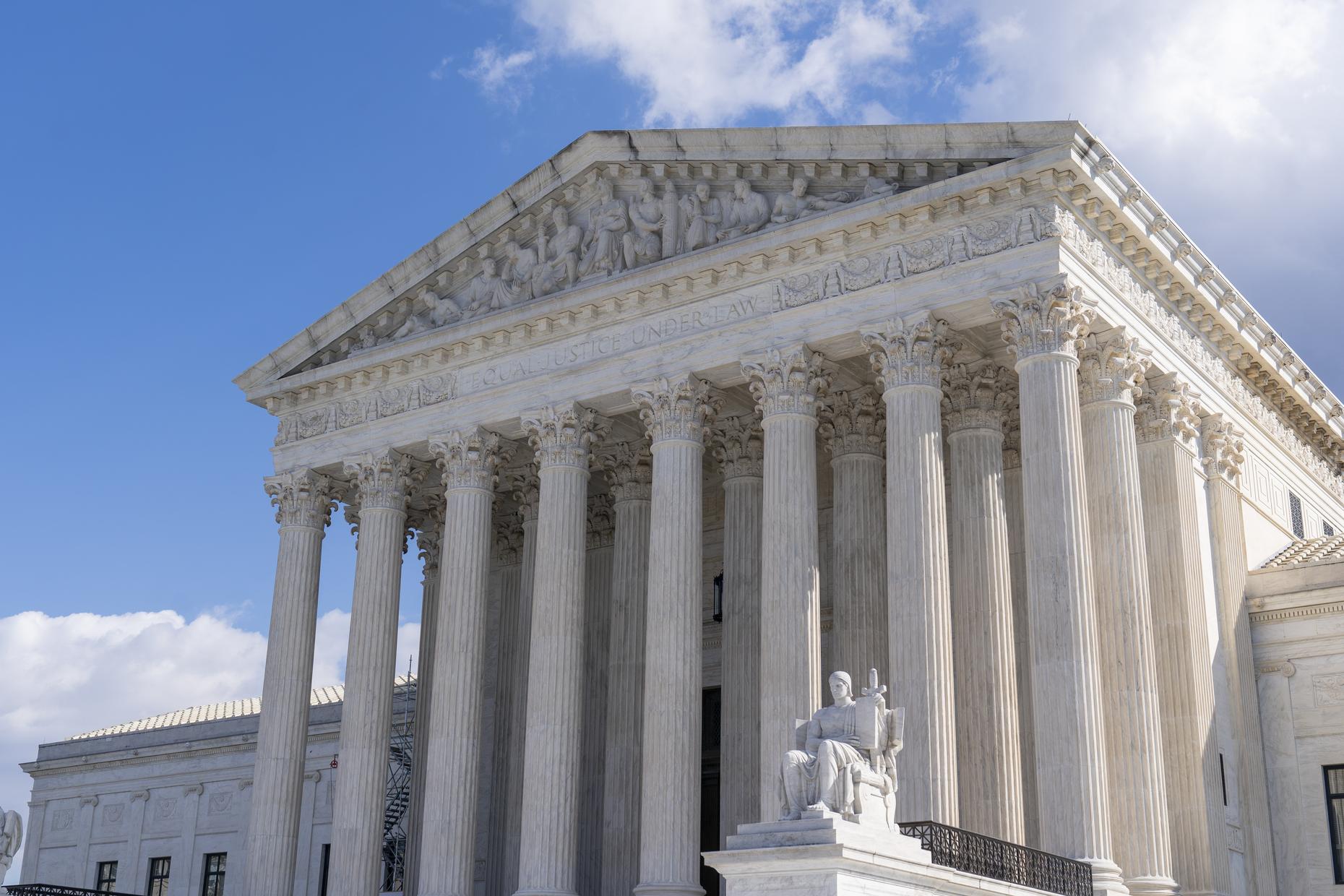
On the Media
Who Profits?
00:50:52
The Supreme Court tackles the future of the Internet; the myth of the free market; The Communist Manifesto in today's era.
Loading summary
Transcript167 lines
- [00:02]
Brooke Gladstone
Landmark cases that could change the Internet and social media as we know it. Two cases argued before the Supreme Court this week elicited cries that the cyber sky is falling.
- [00:12]
Michael Loewinger
After all, it is only nine justices on that bench. And for them to kind of remake the legal framework that all of the tech industry of the United States and a lot of the free speech online around the world depends on is kind of a lot.
- [00:26]
Brooke Gladstone
From WNYC in New York, this is on the Media. I'm Brooke Gladstone. Some Americans are looking at capitalism and wondering if they've been conned.
- [00:35]
Naomi Oreskes
Nobody wants to be a sucker. And in a sense, we've been suckered by the market fundamentalism narrative.
- [00:42]
Brooke Gladstone
Plus re reading the Communist Manifesto.
- [00:45]
China Mieville
If you cannot engage with the way that the substance and the style are working together, you will never understand what kind of book this is.
- [00:55]
Brooke Gladstone
It's all coming up after this.
- [01:00]
Michael Loewinger
On the Media is supported by Progressive Insurance. Do you ever find yourself playing the budgeting game? Well, with the name your price tool from Progressive, you can find options that fit your budget and potentially lower your bills. Try it@progressive.com progressive casualty insurance company and affiliates price and coverage match limited by state law. Not available in all states. I'm Ben Smith. I'm Max Tawney. And we host Mixed Signals from Semaphore Media. The future of media feels like a moving target. So every Friday we pull back the curtain on the platforms, ideas and people that are shaping the new media landscape. We'll tell you what really matters and try to figure out what's coming next. Plus, we go behind the scenes with the most important players in media right now. Whether you are yourself a media insider or just simply curious about who or what will be all over your feed next, Mixed Signals from Semaphore Media is the perfect addition to your media diet. Listen wherever you get your podcasts.
- [01:59]
Brooke Gladstone
From WNYC in New York, this is on the media. I'm Brooke Gladstone.
- [02:03]
Michael Loewinger
And I'm Michael Loewinger. This week, the high court pondered the fate of Silicon Valley, back to back.
- [02:09]
Brooke Gladstone
Oral arguments and landmark cases that could.
- [02:12]
Michael Loewinger
Change the Internet as we know it. This seems to be a comeuppance for Twitter, Google, Facebook. At the Supreme Court, it's just uncharted territory. I mean, what would happen if you.
- [02:21]
China Mieville
Opened up the companies to that kind of liability?
- [02:23]
Michael Loewinger
The Supreme Court is set to hear a case that could break the Internet. The justices heard oral arguments for two cases both concerning social media and terrorism and the future of speech and business on the Internet. On Wednesday, they heard Twitter v. Tamna A case which stems from a 2017 ISIS attack in Turkey. An urgent manhunt this morning for this man caught by surveillance cameras as he.
- [02:45]
Brooke Gladstone
Fired his way into Istanbul's reina nightclub.
- [02:48]
Naomi Oreskes
About 39 people were killed in the attack.
- [02:51]
Michael Loewinger
Emily Birnbaum is a reporter with Bloomberg. And the family of one of the.
- [02:55]
Naomi Oreskes
Victims of the shooting sued Twitter and other social media companies, saying. Saying that they had turned a blind eye while ISIS took their platforms and radicalized people around the world.
- [03:07]
Michael Loewinger
The court debated whether Twitter had facilitated terrorist violence.
- [03:11]
Naomi Oreskes
You have to prove Twitter had substantial knowledge that Islamic State material was on.
- [03:17]
Michael Loewinger
Their platform, and then you need to.
- [03:20]
Naomi Oreskes
Draw a line between that material and.
- [03:22]
Michael Loewinger
The actual act of terrorism.
- [03:24]
Naomi Oreskes
The justices wanted to figure out, is a social media platform like giving a gun to a terrorist? Is it like giving a pager to a criminal? How far should this law go?
- [03:37]
Michael Loewinger
But journalists and legal scholars were far more focused on Gonzalez v. Google. The case argued on Tuesday a similar premise with much higher stakes. An American college student, Noemi Gonzalez, was killed in the 2015 ISIS terror attacks in Paris. Her parents claim YouTube's algorithms highlighted ISIS, produced materials and further radicalized the extremists.
- [04:00]
China Mieville
That killed their daughter.
- [04:01]
Michael Loewinger
But Google says they aren't responsible, given the broad protections of section 230 of the Communications Decency Act. Written before Facebook or Google were invented.
- [04:12]
Brooke Gladstone
Section 230 says in just 26 words.
- [04:15]
Michael Loewinger
That Internet platforms are not liable for.
- [04:19]
Brooke Gladstone
What their users post.
- [04:21]
Michael Loewinger
Ah, section 230 of the Communications Decency Act. When it was passed in 1996, it was supposed to solve some big problems of the early web. In 1994, a business called Prodigy, which hosted an Internet forum, was sued for $200 million because of a defamatory post written by an anonymous user. The court sided against Prodigy, saying the company, which moderated its forums, failed to take down the post. Other tech companies looked at this decision and basically said, well, if we stop moderating what our users post or just quit hosting any third party speech, then we can't be held responsible. In other words, the decision incentivized giving up on moderation altogether. Oregon Senator Ron Wyden, one of the co authors of Section 230, said he wrote it to be both shield and sword. It offers protection from liability, but it also gives companies the authority and more importantly, the responsibility to foster the sort of Internet Americans want to be proud of. It is the foundational law that has allowed for free speech on the Internet to flourish. Mark Joseph Stern covers the courts for Slate. And yet, until Tuesday, the Supreme Court had never actually heard a case about section 230 at a moment when both conservative and liberal justices might want to curb the power of big tech. He says they are two big issues in Gonzalez v. Google holding them back, one factual and one legal. The factual issue is that this lawsuit is just never going to succeed. This is a suit filed by the family of a victim of the 2015 Paris attacks. Her family claims that the attackers were radicalized on YouTube because YouTube had an algorithm that suggested ISIS recruitment videos to them while they were watching something else. There is absolutely no evidence that YouTube was recommending ISIS recruitment videos to the Paris attackers. There is no evidence that any of them saw these videos. And then the legal issue is that by creating the algorithm, YouTube had stepped outside of Section 230, that it had moved beyond immunity because it was sort of creating its own content, creating its own speech. And I think if you think about it for 10 seconds, it makes sense. If you think about it for 30 seconds, it falls apart because it's algorithms that enable sites and users to navigate the constant content. That's why Yelp, Craigslist and ZipRecruiter submitted amicus briefs to the Court arguing that algorithms are essential to the architecture of the Internet, including content moderation, and that without Section 230 protection for algorithms, the web would more or less fall apart. Justice Clarence Thomas wrote an opinion two years ago arguing section 230 goes too far. But Justice Brett Kavanaugh cautioned against unraveling the law. To pull back now from the interpretation.
- [07:26]
Naomi Oreskes
That'S been in place would create a lot of economic dislocation, would really crash.
- [07:32]
China Mieville
The digital economy with all sorts of.
- [07:35]
Michael Loewinger
Effects on workers and consumers, retirement plans.
- [07:38]
Naomi Oreskes
And what have you.
- [07:39]
Michael Loewinger
He is heeding the warnings of the business lobby, the Chamber of Commerce, the very well paid lobbyists and lawyers at Google and Meta and Twitter, and believes them when they say this could potentially destroy the Internet. Bloomberg's Emily Birnbaum says Google hired a very familiar face to make its case.
- [07:59]
Naomi Oreskes
Lisa Blatt. She has argued more cases before the Supreme Court than any other woman in history.
- [08:06]
Michael Loewinger
Blatt painted a catastrophic picture of what would happen to the web without section 230, where sites would either give up on content moderation and you basically have the Internet of filth, violence, hate speech, and everything else that's not attractive or overly sanitize.
- [08:20]
Naomi Oreskes
Everything, websites taking everything down, anything that anyone might object to.
- [08:25]
Michael Loewinger
You have the Truman show versus a horror show.
- [08:27]
Naomi Oreskes
You have only anodyne cartoon like stuff, and otherwise you just have Garbage on the Internet.
- [08:33]
Michael Loewinger
Representing the Gonzalez family is Eric Schnapper. You turn on your computer, and the computers at YouTube send you stuff you didn't ask them for, they just send you stuff.
- [08:46]
Naomi Oreskes
He is a really talented and storied lawyer who has done a lot of work on civil rights. But it's been a long time since Eric Schnapper argued in front of the Supreme Court, and he is not an expert on tech issues in any way.
- [09:02]
Michael Loewinger
There's only a small pool of people who have the skills and expertise to argue in front of the Supreme Court. And that pool gets even smaller when it comes to lawyers who have tech expertise and no conflicts of interest. That scarcity, by the way, is by design.
- [09:18]
Naomi Oreskes
The biggest tech companies have a lot.
- [09:20]
Michael Loewinger
Of money, and they often will hire.
- [09:23]
Naomi Oreskes
Firms even if they don't use them.
- [09:26]
Brooke Gladstone
Just to conflict them out.
- [09:28]
Naomi Oreskes
Basically, we're going to say that you work for us just so that you can't work for our rivals.
- [09:33]
Michael Loewinger
It remains to be seen whether Schnapper swayed anyone. Meanwhile, Justice Neil Gorsuch wondered whether AI chatbots like ChatGPT should be liable. Artificial intelligence can generate some forms of content, poetry, polemics, content that goes beyond picking, choosing, analyzing, or digesting content.
- [09:53]
Naomi Oreskes
And that is not protected.
- [09:55]
Michael Loewinger
So if a chatbot tries to say, recruit you to ISIS or says something defamatory, is its programmer responsible? Are the justices out of their depth? I mean, we're a court Justice Elena Kagan.
- [10:08]
Naomi Oreskes
We really don't know about these things. You know, these are not the nine greatest experts on the Internet.
- [10:14]
Michael Loewinger
The Supreme Court is supposed to hand down its decision by this summer. The justices may very well punt this case and the questions it raises to Congress or lower courts. But I think if it's not in this case, there will be future cases. EM Alonzo is the director of the Free Expression Project at the center for Democracy and Technology. And so I would say it's less that the court has decided they're doing nothing on tech and much more. The court has whet its appetite and is now figuring out what it wants to choose next on the menu. Section230 has provided a shield for tech companies up to this point. But while lawmakers and court justices try to draw lines, lines between publishing and hosting content, lines between discriminatory and neutral algorithms, Lonzo says there's a constitutional right that may ultimately shield big tech Online services are in many ways like editors of the content that are on their services and have the right to say, I don't want to host racist speech or I don't want to have COVID19 disinformation circulating on my service or I want to run a blog that's just about cats. They can make any number of decisions that affect their users lawful, constitutionally protected speech. And that's not something that they get just from section 230. Section 230 helps really operationalize that right and make it very easy to vindicate in court proceedings quickly. But if you took away Section 230, we would still have the First Amendment. That puts strong limits on what Congress can do as far as restricting speech. Free speech is one of the nation's most distinctive traditions. So is the freedom of corporations. Over the rest of this hour, we'll be looking at the idea of the free market and how it came to hold such a tight grip on the American imagination.
- [12:06]
Brooke Gladstone
Coming up, the most blockbuster PR campaign in American history.
- [12:12]
Michael Loewinger
This is OnTheMedia. OnTheMedia is supported by Progressive Insurance. Do you ever think about switching insurance companies to see if you could save some cash? Progressive makes it easy to see if you could save when you bundle your home and auto policies. Try it@progressive.com, progressive Casualty Insurance Company and affiliates. Potential savings will vary. Not available in all states. I'm Ben Smith. I'm Max Taney. And we host Mixed Signals from Semaphore Media. The future of media feels like a moving target. So every Friday we pull back the curtain on the platforms, ideas and people that are shaping the new media landscape. We'll tell you what really matters and try to figure out what's coming next. Plus, we go behind the scenes with the most important players in media right now. Whether you are yourself a media insider or just simply curious about who or what will be all over your feed next, Mixed Signals from Semaphore Media is the perfect addition to your media diet. Listen wherever you get your podcasts, this is on the media. I'm Michael Loewinger.
- [13:20]
Brooke Gladstone
And I'm Brooke Gladstone. As the high court litigates the freedom of speech in corporations, we sidle up to another American fundamental the so called free market. It's come up a lot this week as Senator Bernie Sanders released a book called it's okay to Be Mad about Capitalism and then charged a fair amount for people to see him talk about it on tour.
- [13:42]
Michael Loewinger
Tickets for your tour apparently are selling for $95 on Ticketmaster, which is accused of anti competitive behavior. Aren't you benefiting yourself from this system that you're trying to dismantle?
- [13:52]
Brooke Gladstone
He could have ducked the easy knock if he charged 45 bucks instead. That said, with wealth inequality in the US at an all time high, debates about capitalism have ramped up. Rep. Marco Rubio is thrilled. It's a great debate to have.
- [14:08]
Naomi Oreskes
We should have it. It's important to reinvigorate in every generation.
- [14:11]
Brooke Gladstone
The belief in capitalism. Fox News is on board. The greatest wealth producing system for anybody that wants to work hard and drive themselves to success. Now we turn to Congresswoman Ocasio Cortez, who just proudly announced that capitalism just.
- [14:26]
Michael Loewinger
Is not a redeemable system for us.
- [14:29]
Brooke Gladstone
Capitalism at its core is the absolute pursuit of profit at all, human, environmental and social cost.
- [14:38]
Naomi Oreskes
That is what we're really discussing.
- [14:41]
Brooke Gladstone
To me, that is not a redeemable system for the prosperity and peace for.
- [14:46]
Naomi Oreskes
The vast majority of people. Those comments are now the mainstream of the Democratic Party.
- [14:49]
Brooke Gladstone
They woke up one day and I.
- [14:50]
Naomi Oreskes
Guess decided that Marxism was right all along and that the Cold War should have never ended.
- [14:54]
Brooke Gladstone
That's Rubio again, reinvigorating the next generation's belief in capitalism, I guess. Naomi Oreskes is a professor of the history of science at Harvard University and the co author with Eric M. Conway of the Big How American Big Business Taught Us to Loathe Government and Love the Free Market. It's a big book tracing the evolution of what she calls free market fundamentalism from its humble beginnings. The one true faith wasn't always so unquestioned. Planners and politicians have tinkered with the market throughout our history, putting up guardrails, usually after we've crashed, and then dismantling them, moving fitfully but inexorably to the free market extremism evinced on Capitol Hill and Fox today. But Areewski says the intensity of our faith in the myth of the free market as invisible hand, freedom's shield, part of the natural order, is no accident. It's rooted in a century old masterfully conducted public relations campaign. And its first big challenge was over child labor. The free market propagandists were for it.
- [16:09]
Naomi Oreskes
And this is something I think most Americans either never knew or have forgotten how incredibly deadly and dangerous work was. And this included children as young as 2 years old working in textile mills in Massachusetts. And if a child began work in a miner mill or factory at the age of 2 or 5 or 6, the odds were very great that that child would not live to see adulthood. The manufacturers claim that it wasn't really that dangerous, and they argue that child labor laws are denial of freedom, that if the government says children can't work in factories, it's denying the freedom of business leaders and the freedom of parents, particularly fathers, to decide what is right for their children. And so they begin to construct the story that links economic prerogatives of American big business with American freedom. That's the story that we see being built and told over and over again for the next 100 years.
- [17:05]
Brooke Gladstone
The big PR campaign pushing back against government regulation of labor was headed by something called the national association of Manufacturers. It was a group composed of some of the heads of the largest companies at the time. Sears, General Electric. They got together and created a campaign in support of child labor. Now pull another thread and tell me about Friedrich von Hayek, the influence he had.
- [17:32]
Naomi Oreskes
In 1944, a group of American business leaders, led by a man named Jasper Crane, who had been an executive at DuPont, and a man named Harold Luno, who was the head of one of America's first libertarian foundations, had the idea to try to promote neoliberal thinking in the United States. Neoliberalism had been born in Austria. It was developed by a group of economists, two of whom were Ludwig von Mises and Friedrich von Hayek. So a group of businessmen who had in the 30s, criticized socialism and communism as foreign theories, actually imported a genuinely foreign theory behind closed doors, gave money to universities to hire these two men. Von Mises was hired at New York University, and Hayek was hired at the University of Chicago.
- [18:19]
Brooke Gladstone
Von Hayek wrote a famous book, the Road to Serfdom, that went on to influence Ronald Reagan and then Glenn Beck and Rush Limbaugh, Ted Cruz, Paul Ryan.
- [18:31]
Naomi Oreskes
Yes, and its essential argument is that capitalism and freedom are indivisible, that if you begin to compromise economic freedom, then it's only a matter of time before you're on a slippery slope to totalitarianism. Now, von Hayek's book was written mainly in response to Soviet style centralized planning, that for a government to actually plan the economy, they'd have to control the economy. They'd have to decide how much a particular factory would produce there and how many workers. And so they would have to control people. So pretty soon, you're not just controlling the economy, you're controlling the whole society. They raise some important and interesting questions, but they then begin to use it as an argument for any government action in the marketplace, for example, banning child labor. Now, in fairness to von Hayek, he's not nearly as extreme as his later followers make him out to be. Von Hayek actually says, no, no, there is an appropriate role for government. For example, there is a role for government to stop pollution and deforestation. But in the hands of his followers, it becomes a much more black and white argument. So these same business leaders who get him hired at the University of Chicago produce a reader's digest version of the book in which all the caveats are stripped out. And then they create a cartoon booklet which is distributed through look magazine to millions of households all across the United States with this argument that any government involvement in the marketplace, the next thing you know, we're living under a Soviet style dictatorship. Then they funded a major project at the University of Chicago called the Free Market Project to develop a blueprint for an unregulated or very weakly regulated American capitalism. And one of the key components was supporting the work of Milton Friedman. These business executives funded Friedman to give a series of lectures in the United States pushing forward this idea. He turned that set of lectures into a best selling book, Capitalism and Freedom. It's made into a television series.
- [20:34]
Brooke Gladstone
The national association of Manufacturers, as you say, sponsored radio shows, most notably the American Family Robinson, which aired around the country.
- [20:43]
Naomi Oreskes
Webb was telling me is how you explained to him about taxes and government spending, how people are hollering for more.
- [20:48]
Brooke Gladstone
Money to spend and then hollering about.
- [20:50]
Naomi Oreskes
Heavy taxes at the same time.
- [20:53]
Michael Loewinger
You know, there are a lot of.
- [20:54]
Brooke Gladstone
Folks who don't seem to realize that all this money has to be taken out of the people's pockets by the government.
- [20:59]
Naomi Oreskes
The American Family Robinson was a radio program that was designed to be propaganda.
- [21:04]
Brooke Gladstone
That was the word that NAMM officials used in their documents to describe the program.
- [21:10]
Naomi Oreskes
Correct. Designed by NAMM to propagandize the values of big business and the threat of the New Deal. How? Well, through stories in which the government interferes in ways that damage people's businesses through speeches given by characters about how the American way is to stand on your own two feet, how government involvement threatens the primacy of the nuclear family. Distributed free of charge to hundreds of radio stations around the country, it ran for many, many years, would have been heard by millions of Americans.
- [21:42]
Brooke Gladstone
There was also a TV show hosted by none other than Ronald Reagan.
- [21:47]
Naomi Oreskes
Ronald Reagan is a really important part of the story of how these views, which up until the 1950s are decidedly not mainstream, become mainstream. So most Americans know that Ronald Reagan, before he was a politician, was an actor. But what they don't know is that his acting career was pretty much on the skids in the mid-1950s when he was recruited to be the host of a television program called General Electric Theater, which under Reagan became the third most watched television show in the United States in the late 1950s. It was a high quality program with good actors. There's one episode starring Harry Belafonte. But they all began and ended with little didactic introductions or conclusions about rugged individualism. Standing on your own two feet and not relying on government, you expect something.
- [22:35]
Brooke Gladstone
From liquor that liquor was never intended.
- [22:37]
Naomi Oreskes
To do for you, like helping you.
- [22:40]
Brooke Gladstone
Cope with the lousy breaks of life. Therefore, it becomes a moral issue not to take that first drink.
- [22:46]
Naomi Oreskes
But hosting General Electric Theater was only half of Reagan's job. The other half was going on the lecture circuit on behalf of GE to promote a very anti union, anti government, pro market ideology. He would give talks in factories, in schools. He would go to the Rotary Club or the Lions Club in the evening and present this set of arguments. Now we don't know exactly what happened inside Ronald Reagan's head, but what we do know is that he went into General Electric a pro union New Deal Democrat, and he came out an anti union, anti government Republican.
- [23:23]
Brooke Gladstone
The national association of Manufacturers is still going full swing, right?
- [23:28]
Naomi Oreskes
NAMM still carries quite a lot of weight in Congress because there still are millions of American workers in manufacturing. They have been a major force lobbying against climate change litigation and trying to block the SEC from having disclosure rules regarding conflict minerals.
- [23:44]
Brooke Gladstone
You've suggested that all of this messaging is intended to reduce our options to either capitalism without regulation or repressive communist dictatorships like those of the Soviet Union or China.
- [24:02]
Naomi Oreskes
A lot of the propaganda and also the academic work done by the Chicago School presents this as a dichotomy over and over and over again. That's a false dichotomy. There are lots of choices and we do have all kinds of regulations, about eight hour work days and being paid overtime. But it's been hard for us to have that conversation about the right choices because we've been so bombarded with this false dichotomy of laissez faire economics, unregulated markets, the invisible hand versus we give up all our freedom and next thing we know we're facing a firing squad.
- [24:38]
Brooke Gladstone
Some Western democracies, notably in Europe, seem to have found a middle ground without giving way to soul sucking authoritarianism.
- [24:48]
Naomi Oreskes
So they're still fundamentally capitalist market based systems, but they have stronger social safety nets, stronger protections for workers, stronger protections for the environment, in many cases, stronger protections against dangerous products like endocrine disrupting chemicals. And yet these countries are prosperous, they are democratic, and actually by some measures they're actually more democratic than the United States.
- [25:11]
Brooke Gladstone
How are they more democratic?
- [25:13]
Naomi Oreskes
Just look at Things like to what extent policies reflect what public opinion polls show the people of that country actually want. We know that here in the United States that many of our national policies don't reflect what a majority of Americans would like to see happen. And of course, you know, we're facing massive efforts at voter suppression here in the United States, various kinds of corruptions formed by the lack of controls on campaign financing. I mean, in France, elections are only allowed to last for a certain number of days.
- [25:44]
Brooke Gladstone
Now, part of the myth of the market is that government intervention doesn't work. And you say that you can easily disprove that by considering the economies of individual states.
- [25:58]
Naomi Oreskes
Today I moved to Massachusetts from California and I can tell you that I think Massachusetts does have a bit of a nanny state mentality. And I have personally been sometimes frustrated by the fact that I can't buy a decent bottle of wine on a Sunday. But the reality is that Massachusetts is one of the richest and most successful states in the United States, has extremely high levels of education and relatively low levels of a lot of the social ills that plague other states. Regulation works, public education works, high levels of taxes work. If you invest them in education and infrastructure, which Massachusetts does.
- [26:35]
Brooke Gladstone
The Human Development Index that was developed by the UN as kind of a counterweight to the GDP to try and track how people are faring in terms of health, education, life expectancy, standard of living. And Massachusetts ranks number one on that scale, and it's closely followed by Connecticut, Minnesota and New Jersey. In contrast, the the bottom eight tend to be states more hostile to big Mississippi, West Virginia, Alabama, Arkansas, Kentucky, Louisiana, South Carolina and Tennessee.
- [27:12]
Naomi Oreskes
So what these data show is that the states that have high levels of taxation and highly engaged governments, people are doing better. And states like Mississippi, Alabama, Louisiana that are hostile to government and have low levels of taxation, people are doing worse.
- [27:31]
Brooke Gladstone
One of my favorite things is the exception that proves the rule in this case, which is Utah.
- [27:38]
Naomi Oreskes
So Utah is interesting because Utah is a very red state. It has very low levels of taxes, but it's economically successful. And it turns out one of the many things that it's doing right is being a large recipient of federal government largesse. So a lot of the boom in Utah in the last 20 years was because of the growth of what's called the silicon slopes. Salt Lake City was one of the original nodes in Darpanet, which was the federal government precursor to the Internet, developed by the US Military to support military communications. And so it was out in front when Darpanet became commercialized as the Internet. So because of a major government program, Salt Lake City was way ahead of the curve when the opportunities began to develop the tech industry.
- [28:25]
Brooke Gladstone
But. But there's more. The Salt Lake region, you said, also proved attractive to young professionals because of its easy access to great outdoor recreation, particularly its world class skiing, all of which takes place on federally protected land.
- [28:40]
Naomi Oreskes
Some of the best skiing in the world, beautiful hiking, and all of that was developed on federally protected lands. And then it turns out because Utah is considered an agricultural state, many residents can get federally subsidized mortgages through the Department of Agriculture. Example after example after example. What we see is that so called small government doesn't yield the prosperity, the economic outcomes, or the health and well being for people that its advocates promote.
- [29:09]
Brooke Gladstone
The 2008 financial crash would be even further proof that government regulation is necessary. So let's return to that spectacularly influential Chicago school. Its oft quoted jurist and legal scholar, Richard Posner changed his free market notions after that crisis when he saw that self regulation didn't work, at least in financial markets.
- [29:35]
Naomi Oreskes
So Posner was one of the leading proponents of the Chicago School of Law and Economics, a big advocate of deregulation, of allowing markets to mostly operate on their own. But after the 2008 crash, he says, look, these guardrails were put in place to prevent the economic system from crashing. And when we took them away, the system crashed. Because self interest doesn't actually work to protect the common good. Because what's in the interest of a person as an individual may not be in the interest of society as a whole. I think what he's written is very courageous, but it's amazing to see how little influence it has had in so many other people who are still sticking to the Chicago story.
- [30:18]
Brooke Gladstone
So now let's talk about the stakes. Naomi, what you call the high cost of a free market. Start with climate change.
- [30:27]
Naomi Oreskes
Climate change is one of the clearest examples of market failure that we've seen in our lifetimes. Nick Stern, the former chief economist of the World bank, has called climate change the greatest and most wide ranging market failure in history. Because oil and gas and coal are legal products. People have used them to do legal things, but in the process of doing that, they have created this giant external cost that accrues to people, irrespective of whether they did or didn't use those products. And so now we're looking at trillions of dollars in damages from climate change. And who's going to pay that bill? Well, all of us. People in Bangladesh, people in Pakistan. It's a market failure because the market doesn't account for the true costs of using these products.
- [31:12]
Brooke Gladstone
Let's talk about happiness.
- [31:15]
Naomi Oreskes
What we know, and the evidence is very, very clear now, is that Americans are actually very unhappy. Money has not bought us happiness. Overall, the happiest people in the world are the ones who live in the European social democracies because those countries have a few key things, good social safety nets, so you don't have to have tremendous anxiety about what will happen to you if you get sick or if you lose your job. Better distributions of income so they don't generate the kind of resentment and frustration that we have here in America. And they have health care because it's hard to be happy when you're not healthy. And they have trust in institutions, which is the most interesting of all, because if you ask yourself, well, why don't Americans trust our institutions? Well, one of the big reasons is because we've been subject to a century long propaganda campaign telling us not to trust our most important institution, which is government.
- [32:07]
Brooke Gladstone
Finally, freedom. In your conclusion, you wonder, did the men and women in this story really believe in liberty?
- [32:17]
Naomi Oreskes
America was capitalist in the 19th century and we had slavery. America was capitalist in the 20th century and until 1918, women didn't get to vote. America is capitalist today and millions of people are incarcerated. Freedom is something we fight for. It's something that we protect with our political and civic institutions. And the idea that we can somehow protect our freedom by letting business people do whatever the heck they want is refuted by the facts of history. And so this is why this question comes up about whose freedom were they really trying to protect? Ultimately, the people who we studied were trying to protect their own freedom, their own profits. But they constructed a myth about the defense of political freedom because they knew that if they said, oh, yeah, I'm working to protect my profits, there's no reason why any of us would have bought that story. Nobody wants to be a sucker. And in a sense, we've been suckered by the market fundamentalism narrative.
- [33:13]
Brooke Gladstone
Naomi Oreskes is the co author with Eric M. Conway of the Big How American Business Taught Us to Loathe Government and Love the Free Market.
- [33:24]
Naomi Oreskes
Thank you very much.
- [33:30]
Michael Loewinger
Coming up, the ghost that won't stop haunting us.
- [33:34]
Brooke Gladstone
This is ON the media.
- [33:37]
Michael Loewinger
On the Media is supported by Progressive Insurance. Do you ever think about switching insurance companies to see if you could save some cash? Progressive makes it easy to see if you could save when you bundle your home and auto policies. Try it@progressive.com, progressive Casualty Insurance Company and affiliates. Potential savings will vary. Not available in all states. I'm Ben Smith. I'm Max Taney and we host Mixed Signals from Semaphore Media. The future of media feels like a moving target, so every Friday we pull back the curtain on the platforms, ideas and people that are shaping the new media landscape. We'll tell you what really matters and try to figure out what's coming next. Plus, we go behind the scenes with the most important players in media right now. Whether you are yourself a media insider or just simply curious about who or what will be all over your feed next, Mixed Signals from Semaphore Media is the perfect addition to your media diet. Listen wherever you get your podcasts, this is ON the media. I'm Micah Lowinger.
- [34:36]
Brooke Gladstone
And I'm Brooke Gladstone. So over the course of a century of what Naomi Oreske has exposed in the previous episode segment as free market propaganda, there have been periodic spasms of resistance efforts of the disaffected to rouse themselves from the fever dream. And often the instrument of that arousal is yet another doctrine, another piece of propaganda even older than the one it seeks to displace.
- [35:03]
Michael Loewinger
On college campuses, a Communist Manifesto is one of the most frequently assigned tests.
- [35:09]
Brooke Gladstone
Karl Marx and Friedrich Engels slender volume appeared in 1848. For many of those betrayed by the so called free market in the years since, the pamphlet has offered refuge, inspiration and argument. So many arguments still in 2012 the Guardian reported on Marx's growing influence and.
- [35:31]
Michael Loewinger
Popularity across Western Europe, noting the continued rise of in book sales and the.
- [35:36]
Brooke Gladstone
Incredibly ironic fact that a bank in.
- [35:38]
Michael Loewinger
Germany issued a credit card with Marx's image.
- [35:42]
Brooke Gladstone
Like Hamlet's ghost, the manifesto is both impossible and imperative in its call for action.
- [35:48]
Michael Loewinger
Joe Biden, that's where he's gone. He signed on to Bernie Sanders Crazy 110 page communist manifesto that will absolutely destroy America. 4 trillion in new taxes. A green New Deal.
- [36:00]
Brooke Gladstone
China Mieville writes stunning speculative fiction, but his latest book, A Specter Haunting on the Communist Manifesto is a nonfiction rumination on that stalwart text, its place in the world and how best to read it today. Welcome to the show, China.
- [36:18]
China Mieville
Thank you so much for having me.
- [36:20]
Brooke Gladstone
One of the few gripes I think you have with the book is that its authors are rather too admiring of the bourgeoisie. One of its most famous passages goes everlasting disturbance and agitation distinguish the bourgeois epic from all earlier ones. All fixed, fast frozen relations with their train of ancient invulnerable prejudices and opinions are swept away. All New formed ones become antiquated before they can ossify. All that is solid melts into air. All that is holy is profane. And man is at last compelled to face, with his sober senses, his real conditions of life and his relations with his kind.
- [37:04]
China Mieville
It is often a surprise to the newcomer to the Manifesto quite how much praise they heap on the bourgeoisie. It became very quickly evident in the Revolutions of 1848 that much of the bourgeoisie of Europe was more afraid of the working class than it was of the ancien regime. Across Europe, the middle class made their peace with these old reactionary powers, and there was a period of immense reaction through the 1850s. If they had written the pamphlet even a year later, I think it would have had a much darker and more pessimistic tone.
- [37:40]
Brooke Gladstone
Let's talk a little more about the text then. It is stirring. It scans. Some of its critics call that a weakness.
- [37:48]
China Mieville
The argument is, because this is written in such a style that is almost evidence in and of itself that its arguments don't hold up, is straightforwardly absurd. And one of the things that has frustrated me a lot, one of the main reasons I wrote the book, is the lack of curiosity among a lot of its critics about the nature of the manifesto form itself. There is a notorious bit in which the manifesto says the working class has no country. This is often read as saying that the working class movement has to be internationalist, which is great, and that Marx and Engels grossly underestimate the power of nationalism. There is an element of truth to that. I think they were too sanguine about how powerful nationalism was. But what they are doing in that moment is grabbing the working class by the lapel and shaking them and saying, stop identifying with your countries. You have to be an internationalist. That's the nature of that sentence. And if you cannot in good faith engage with the way that the substance and the style are working together, and that sometimes a claim in the book is a prophecy, or is a plea, or is an entreaty, or is an encouragement. If you can't seriously engage with that, you will never understand what kind of book this is.
- [39:05]
Brooke Gladstone
It is exhortation, prediction, assessment.
- [39:09]
China Mieville
Exactly.
- [39:10]
Brooke Gladstone
Let's tick off the three most prevalent arguments made by critics of the manifesto. The first is something called capitalist realism, the notion that it really can't be any other way.
- [39:25]
China Mieville
Exactly. This is a term that was coined by Mark Fisher, a very brilliant cultural critic. And the interesting thing about capitalist realism is that all it requires is to disseminate the idea that nothing can be done. Therefore, even if you think that this is a terrible system, there's no point fighting against it. And this has never been more clearly put than with Margaret Thatcher's notorious and famous phrase that there is no alternative.
- [39:51]
Brooke Gladstone
Tina.
- [39:52]
China Mieville
Exactly. We all call it Tina. That is the most pure propagandistic expression. It's absolutely vacuous and empty. Ursula Le Guin, the great writer, has a beautiful formulation about capitalism, that its power seems inescapable. But then so did the divine right of kings.
- [40:10]
Brooke Gladstone
Onto the next argument, human nature. With regard to the manifesto, you quote biologist E.O. wilson writing, It's a lovely theory. Wrong species. In other words, it can't work because human nature is just too base. I've changed my view of human nature from thinking it'll always go low to a belief that it's more plastic, it can be manipulated to dwell with the devils or respond to its better angels.
- [40:42]
China Mieville
Conservatives often accuse socialists of having a dewy eyed view of human nature. But to have a sense of the potential for a radical reconfiguring of the everyday, you don't need to believe that people dwell with the angels. All you need to believe is that whether people dwell with the angels or the devils depends on an awful lot of complicated circumstances. Capitalism is a system that quite explicitly rewards selfishness. It's hardly a surprise that precisely that kind of dog eat dog behavior is very often valorized and very often the way people live in some cases, because they have to. We know that people behave incredibly differently throughout history and throughout different societies.
- [41:27]
Brooke Gladstone
How about the last criticism of the manifesto? In one word, Stalin.
- [41:32]
China Mieville
It marshals the existence of the Stalinist regimes against communism, both because they were awful and not sustainable. I completely agree. But the problem is, if you were to only listen to them, you would not know that there have been literally for over a hundred years been very serious debates within Marxism, within the left, precisely criticizing those regimes. Not just that these are not desirable and not sustainable, but that they are also not in any meaningful way, communism. If you look at Marx and Engels writing, this is why these regimes cannot be considered legitimate representations of this political program. And I want to be very clear about this, I'm not saying you have to agree with that, but to simply act as if the mere fact that there were these unpleasant regimes that called themselves communist is therefore evidence that communism is doomed. And to have no curiosity about the internal debate, again, it's just not serious. That idea that Stalinism disproves communism rings very hollow if you are someone who has spent a long time reading the communist critiques of Stalinism.
- [42:48]
Brooke Gladstone
You quote Marshall Berman, the late great humanist, modernist Marxist, who observed that whenever there's trouble anywhere in the world, the book becomes an item. It provides music for their dreams.
- [43:01]
China Mieville
And this really kicked off after 1871 with the Paris Commune. And then, of course, it exploded again after 1917 with the Bolshevik revolution in Russia. And for the first time, you had this powerful nation identifying with the communist project. And that led to interest and also a plethora of cheap editions, the Soviet Union turning it out in various translations. Even in 2008, 2009, when the great financial crash occurred, it was reported, often with a kind of wry amusement in the business press, that sales of the Communist Manifesto had spiked. I actually find it incredibly poignant and incredibly moving that in this moment in which for a lot of people, their retirement funds, their life plans have been destroyed, that one of the things that happened in that moment is this yearning sense of, surely there has to be a better way of organizing things than this. I think that ebb and flow of interest is something that we are going to continue to see.
- [44:05]
Brooke Gladstone
You also observed that in the aftermath of 2008 and in the rise of social media, you had a very strong right and a much weaker but more vocally unbound left that punched above its weight, and the result was the right starts to hallucinate enemies.
- [44:24]
China Mieville
Yes, the right has always hallucinated enemies. A friend of mine, the writer Richard Seymour, has called this the era of anti communism without communism. And yet you still have supposedly mainstream American politicians denouncing Obama and Biden as communist. This is so absurd that you have to understand it as a kind of lazy sloganeering and as a kind of fever dream. I like to hope that overblown febrile attack might actually encourage a certain degree of curiosity about what this bogey man is. And particularly because, although on a much smaller scale, you have various young leftists, even though their numbers are not particularly big, talking about communism in that online way, which is like somewhere between a joke and a provocation. It's very unstable, but as you said, it punches above its weight. And when that's happening in the context of a generationally unprecedented upsurge of interest in socialism and the left in Britain and in the us the explosion of membership of the Democratic Socialists of America and Bernie Sanders campaign and Corbyn in the uk, there is, I think, a real good faith fascination with these radical traditions.
- [45:41]
Brooke Gladstone
You've observed that there's a sense in which every generation reads it anew and that certain things come up quite sharply. What's coming up now?
- [45:50]
China Mieville
The planetary crisis, that famous phrase, you have nothing to lose but your chains, and we have a world to win. The fact is that the world that we have to win is deeply wounded. So even were capitalism to be done away with tomorrow, how do we salvage and repair a livable world? So even a radical program has, I think, to approach that with a serious sense of humility. Secondly, I think the rise of an iteration of the far right, of terrifying strength and a particular kind of overt sadism provides a very strong sense of the dangers facing us. I think they are, in fact, inevitable excrescences of a system predicated on profit over need, built on the bones of a system of patriarchy and white supremacy and so on. If you see this new sadistic hard right as an inevitable feature of capitalism, then the stakes of moving beyond capitalism become ever more urgent.
- [46:54]
Brooke Gladstone
You wrote at the end of your introduction that a specter haunts your text, a hunch that in fact the manifesto now looms more than ever. I'd suggest the enforced isolation of the recent lockdowns that enabled us to look through our computer screens at the world and to think more in terms of systems. You make a very persuasive case that the totality of capitalism, it's not just an economic system, but one with its own philosophy, principles, worldview, culture, everything is very hard to dislodge. But I don't think it's seen now through a glass quite so darkly.
- [47:40]
China Mieville
I think you're right, and I hope you're right. One of the things that is interesting as capitalism enters this, this doddering and dangerous phase is that it has spent so long saying that there is no alternative and so on, that when it is forced to do things that it said for decades it couldn't do, like this enormous influx of public funds into furlough schemes during the pandemic. Having said it couldn't possibly do that, it starts to make people think, well, if it's not true that that couldn't be done, what else couldn't be done? American business for decades said universal health care is impossible. It's not a question of whether or not we want it. It cannot be set up. If that demand becomes loud enough that people at the top start to feel that continuing to deny it will put their position in jeopardy. You can absolutely bet your bottom dollar they will grudgingly allow a universal healthcare system. And the point is, all these things that they say are impossible are not impossible. What they are is not desired by capital.
- [48:43]
Brooke Gladstone
But capitalism, as you note, is enormously adaptable.
- [48:47]
China Mieville
It is incredibly adaptable.
- [48:49]
Brooke Gladstone
Something not anticipated by Marx and Engels.
- [48:51]
China Mieville
No, indeed. And this is one of the things that I think they got wrong. They underestimated the extent to which it can accommodate certain reforms as a way to continue. The manifesto and the tradition have to be read today with a much sharper sense of how adaptable capitalism is. Now, I do think that that flexibility is diminishing as it becomes more and more shaky, and these moments of outright sadistic hard right are symptoms of that shakiness.
- [49:22]
Brooke Gladstone
People of goodwill are frightened by violence and by hate, which can spread so quickly out of control. These aren't intellectual arguments against revolution, but visceral ones. In your book, you build up to a discussion of the utility, the necessity even of hate.
- [49:43]
China Mieville
I had a debate with a friend. She basically said to me that she always felt uncomfortable when I talked about hating capitalism. And I understand that. But all I can say is I look at the cruelty and the waste and the violence and the sadism. Who would I be ethically not to hate this system? If that hatred is one of the things that can help us to be motivated to overthrow this system of iniquity, surely that is hate in the service of love.
- [50:12]
Brooke Gladstone
Overthrow how?
- [50:14]
China Mieville
People think that they are fundamentally opposed to the use of force in any situation, but actually very, very few people are. Do we really think that the fighting of. Of slaves on a slave ship or the activists in the Warsaw ghetto was not justified? So the question then becomes, if you think, like me, that this is a world built on oppression, exploitation, racism, homophobia, sexism, then it becomes an ethical urgency to see its end. And one of the reasons that I think it's so important to build socialism as a mass movement is that the more people who simply say, we deserve better than this, the less likely any kind of coercion or force becomes necessary. I'm not interested in 100 people with guns saying, right, we now have socialism. There's no point at all. But I am interested in the mass of people simply turning around and saying, we will no longer be treated like this by this system. Overthrow, for me, is the point at which the majority of people simply say, no more.
- [51:20]
Brooke Gladstone
So that could happen by the system adapting itself to the point where it is no longer that system.
- [51:28]
China Mieville
I'm not interested in reforms, of trying to make capitalism a little bit better. I mean, don't get me wrong, I'll take them if they come along, because I'm not indifferent to life being better for people along the way. But any reform within the context of a system that is fundamentally about prioritising profit over human need will always be embattled and endangered. You know, you say overthrow how change how? The point is, I don't have a blueprint. People do sometimes imply if you can't lay out a point by point planned alternative, somehow your demand for change is illegitimate. I think that's just complete nonsense. You look throughout history, whole social situations have been overthrown and changed because a critical mass of people could no longer live with the world the way it was.
- [52:17]
Brooke Gladstone
Tell me, what did you want to accomplish with this book?
- [52:20]
China Mieville
I want this book to be an introduction to the manifesto for the curious reader to actually find out what this notorious document is all about. I want to talk to the critics of the manifesto and to say, by all means, let's actually have a serious debate. But one of the starting points for that is you are going to have to acknowledge that most of the stuff you say about this text is embarrassingly weak. And if you want to be taken seriously, bring your A game instead of this D game you've been bringing for decades.
- [52:54]
Brooke Gladstone
China, thank you very much.
- [52:56]
China Mieville
Thank you so much for having me.
- [52:57]
Brooke Gladstone
China Mieville is the author of A Specter Haunting on the Communist Manifesto. And that's the show, co hosted this week by OTM correspondent Micah Lowinger. On the Media is produced by Eloise Blondio, Molly Schwartz, Rebecca Clark Callender, Candace Wong and Suzanne Gaber, with help from Tami George, our technical directors, Jennifer Munson. Our engineers this week were Andrew Neriano and Martin Mike Kutchman. Katja Rogers is our executive producer. On the Media is a production of WNYC Studios. I'm Brooke Gladstone.
- [53:42]
Naomi Oreskes
This is Ira Flato, host of Science Friday.
- [53:45]
Michael Loewinger
For over 30 years, the science Friday team has been reporting high quality science and technology news, making science fun for curious people by covering everything from the outer reaches of space to the rapidly changing world of AI to the tiniest microbes in our bodies. Audiences trust our show because they know we're driven by a mission to inform and serve listeners first and foremost with important news they won't get anywhere else. And our sponsors benefit from that halo effect. For more information on becoming a sponsor, visit sponsorship.wnyc.org.