Loading summary
Transcript150 lines
- [00:00]
A
In Walmart's Huluville. Everyone ready their cart. Amazing Black Friday deals are about to start online and in the app. Such great deals to explore everything you love from tech, toys and more. The days to save and the ones to remember. It's only the 25th to the 30th of November. Set your alarms. Don't miss out. These deals are epic. Without a doubt, the who's are all ready. But are you? Walmart Black Friday deals await. Who knew?
- [00:30]
B
Hi one Chicago fans. Wolf Entertainment has a brand new show for kids and families. It's called Patrick Picklebottom Everyday Mysteries where young detective Patrick and his best friend Claire solve fun kid sized mysteries around their hometown. It's smart, funny and perfect for family listening. Plus, with episodes available now, you can start your first case right away. Find Patrick Picklebottom Everyday Mysteries out now, wherever you listen to podcasts.
- [01:04]
A
Hey, I'm Brian Lucci and this is the official One Chicago podcast Action. So many One Chicago stories are, as they say, ripped from from the headlines. But sometimes these stories come straight from the lives and the hearts of the writers and the producers. We're coming up on the one year anniversary of the wildfires in Los Angeles County. 31 people lost their lives. These apocalyptic conditions now in their third day and the biggest infernos are still 0% contained. 200,000 people were forced to evacuate.
- [01:48]
C
We found so much heartbreak. People coming back to nothing left at all.
- [01:52]
A
And around 18,000 homes and other buildings were destroyed. This was a shopping center and beyond that a school. And now you can't even figure out what it is. One of the people who lost everything is a dear friend of mine, a Chicago Fire writer by the name of Victor Terran. And today on the podcast, you'll hear directly from Victor and another fire writer, Alec Wells. We'll talk about what it means to lose everything you own. Those things that just cannot be replaced. How hard it could be for friends trying to say the right things. And how these guys brought all those complicated feelings onto Chicago Fire with their amazing, heartfelt writing.
- [02:33]
C
When somebody's lost everything, what do you say? How do you make it better? But there is no guidebook for these things.
- [02:41]
A
That's all coming up after the break. Don't go anywhere.
- [02:54]
B
The holidays are approaching and everyone knows that this time of year, the sooner you can get things done, the better. For both shoppers and businesses. The best time to score great deals during the holidays is during that Black Friday Cyber Monday weekend. And if you have your own business, whether you've been around the block a few times or this is your first year going through the holiday sale rush. The most important thing you can have is a platform that can handle everything that's about to be thrown at you. This is a crucial time for your business and your customers, and with Shopify, you can be sure that your tools and platform are ready for anything that comes your way. Shopify is the commerce platform behind millions of businesses around the world and 10% of all e commerce in the US from household names to entrepreneurs who will be participating in their first Black Friday Cyber Monday this year. With everything else going on, you probably don't have time to spend hours poring over every little detail in your online store. That's why Shopify's thousands of templates and tools help you streamline website creation and make sure that your site isn't just aesthetically pleasing, but functional and easy to use. Shopify's expedited checkout shop pay saves customer information and reduces hassle. And the best part is that it's been proven to boost conversions, meaning you'll see less abandoned carts and more profits. You can also stress less knowing that Shopify's award winning customer support team is on standby 247 to help with any issues that arise, allowing you to get back to your business as fast as possible this Black Friday. Join the thousands of new entrepreneurs hearing for the first time with Shopify. Sign up for your free trial today@shopify.com realm that's shopify.com realm go to shopify.com realm and make this Black Friday one to remember.
- [04:46]
A
Alrighty, here we go with Chicago Fire writers Alec Wells and Victor Taran. I wanted to hear about how they became writers and their journey to the wolf world. And it turns out Alec, well, he's a hometown guy.
- [05:01]
D
Well, I grew up in Chicago. I'll start there. I don't know when I when I really began to think about storytelling. I was an athlete first. Really wanted to play football as a kid because I grew up around the 85 Bears time in Chicago and that was a very special time in Chicago, as you know Luch. And then sometime in high school I guess I had a teacher who thought I was good at it, I guess. And I started doing it more. And then in college I started watching more movies and realizing, you know what, that looks really fun, I want to do that. And so I transferred to Columbia College in Chicago and started doing that to speak to the inspiration part of it. I remember specifically the show that made me want to become a television writer was a Show called Six Feet under on hbo. Incredible show. Incredible show. And it did something that I think we try to do too, which is like, tell a family story against the backdrop of something bigger, more extraordinary, with real life and death stakes. I didn't make that connection until literally this moment. But that's what we're doing on Chicago Fire now.
- [06:17]
A
Yeah.
- [06:17]
C
What about you? My story is kind of one of just sort of fumbling around until I. Until I found a home. I actually came out to LA to follow a girl out here. I had no plan. I just knew that wherever she went, I wanted to be there too. There's a good ending to that story, which is she's my wife now, Catherine.
- [06:38]
A
Oh, awesome.
- [06:39]
C
Yeah. And so she came out here, she knew she wanted to be in la. And I figured I should probably find some kind of career out here. And through my college, I got an internship at Ridley and Tony Scott's production company. And I ended up becoming a reader for Ridley. Which basically means that any script that an agency submits to Ridley or his company, potentially for him to direct or produce, somebody at the bottom rung's got to read that script first. And if that person at the bottom rung likes it, they pass it on. So I had the privilege of being that person at the bottom. It was an incredible grad school for learning how to write because I must have read a thousand scripts maybe in two years. And I got the opportunity to see what works, to see what doesn't work and get paid to do it. And that was really incredible. And there were a couple circumstances that happened at that job where I ended up becoming friends with the head of the. And he was producing a show called the Good Wife at the time on cbs. And that was another sort of watching how Robert and Michelle King, who are the showrunners of that show, how they work, how they craft story. Again, it was an incredible learning experience. Eventually I got into the Wolf World. The first show I worked on was Law and Organized Crime and Through that ended up On Fire. And I couldn't love it more. It's an incredible show and you get an opportunity to do action comedy, drama. You get to do everything. It's awesome.
- [08:06]
A
Victor, what was the first thing you wrote, or what was the first thing you worked on?
- [08:10]
D
I was always wanting to write, but it took getting laid off from a job to finally kick me into writing full time. And then I was basically just developing my own stuff. And eventually during COVID I wrote this pilot about ambulances. And somehow it got into the. Into the Wolf World into Andrea and Guilveria at the time, into their hands. And they said, I think this guy could write Chicago Fire. It was pretty close to what we do here.
- [08:39]
A
Congratulations. That's awesome. Alec, do you mind breaking down 1404 for us? Do you mind breaking down this fourth episode? Just giving us, like, the bones of it, and then we're going to jump over to Victor.
- [08:51]
C
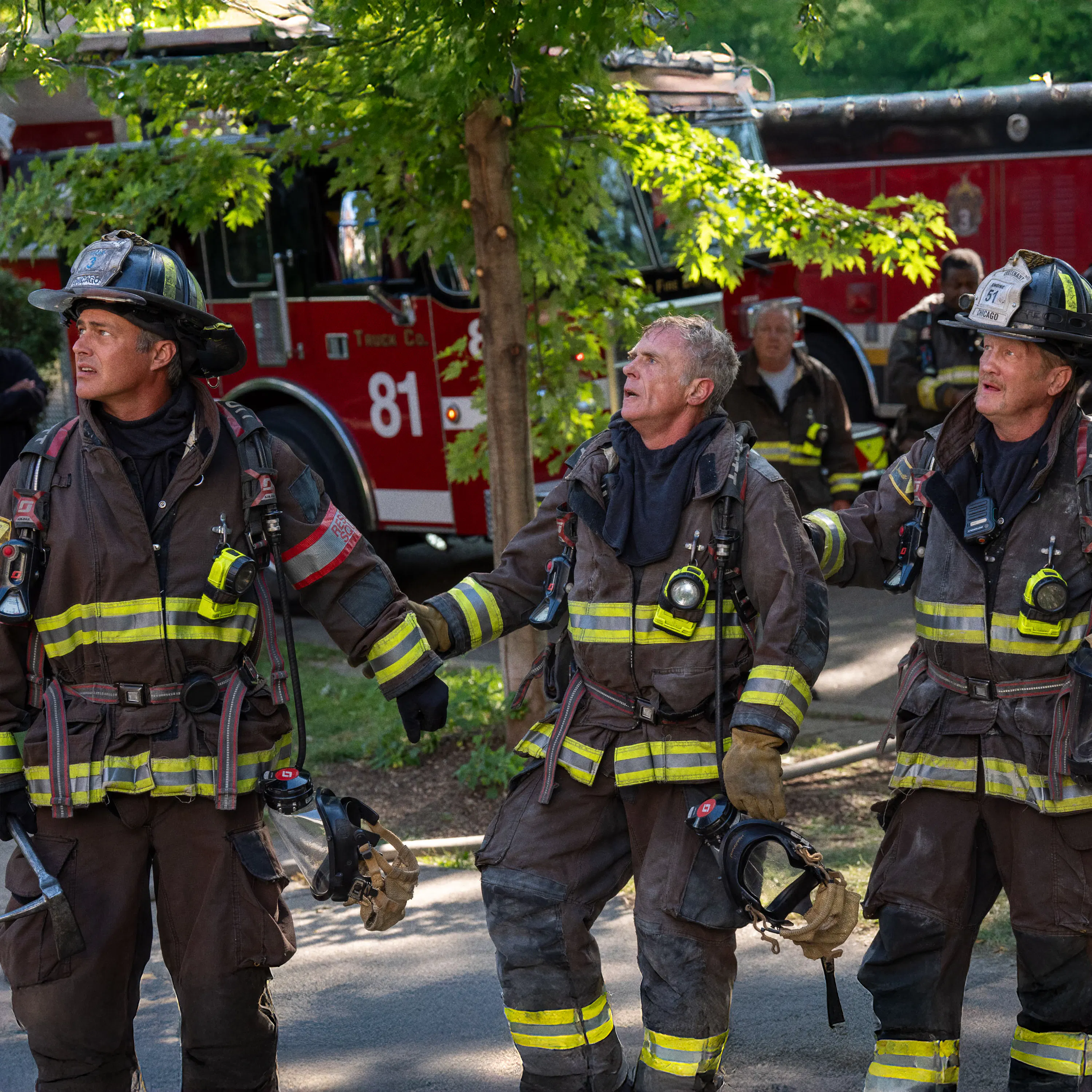
Sure, no problem. So episode 1404 finds us probably taking the most personal fire call the show has ever taken. Christopher Herman. He finds out his house is on fire, and all of 51 explodes into motion to try and save his house and save what they believe might be his daughter Annabelle inside.
- [09:17]
A
Damn it, she gone. Hey, are you trying Annabelle? Yeah, she's not answering. Try the house phone. She's staying home today.
- [09:26]
C
Luckily for Herman, everybody in his family is safe, but they've lost the house entirely and it can't be saved. And what comes from that is the real life fallout of what happens when you lose everything. You have your family, you have your safety, but you've lost everything you own. And we really thought this episode was an opportunity to explore a version of a fire we've just never seen on the show before, which is sort of through the victim's eyes and through Herman's eyes, we're able to see the pain, the strife, and the loss that comes from losing everything you own. And when Victor and I talked about this a lot, we talked about the importance of stuff, and that a lot of times in fires, everybody says, at least you're okay, at least everybody's safe. And that's true, and that is important. But that doesn't or shouldn't diminish the importance of the things we own. So this episode is a little bit of, like, an elegy to stuff.
- [10:29]
A
I read it and I'm not kidding. I couldn't put it down. And I'm a PD guy, I thought it was amazing, all the little details, and we'll get into that in a little bit. Victor, do you mind sharing the day of the fire with us so we can marry the two and then we'll get into it?
- [10:43]
C
Sure.
- [10:44]
D
For me, it started driving home from the office on Tuesday night and getting off the freeway and seeing the fire on the hillside. We live in Altadena, kind of at the base of the hills there. We have a fire season in la, so you don't. They don't really freak you out all the time, even when they're kind of close. I've lived in a place where I could See the fire just like on the other side of the hill. And it never touched me, so I wasn't freaking out at that time. But it was also, we were having a windstorm that was kind of epic, like something I had never experienced in LA before. They said that the winds got up to like 100 miles an hour. So I got home, the power was out. We hadn't gotten an evacuation notice, but we noticed all our neighbors were leaving their houses, which is an eerie feeling when you see people packing up to evacuate. And my son, I'll never forget, my son was at a playdate with a friend of his that lived down the street a little ways from us. And the power was out and they were deciding to evacuate, so they were texting for us to come get him. My son's friend's family was flipping out and the kids were crying and they were just like in a panic to get out. And I was like, oh, my God, this is suddenly feels real. And I took him home. He was pretty scared, and I was trying to calm him down. I really didn't think anything was going to happen at that point still. And my wife started packing up a couple things. And me, like an idiot, I was like, this is. We're overreacting. We're going to be fine. But we left and went to a hotel. Then that night, the fire just exploded. And we woke up the next morning to, you know, just like dozens of texts and emails from people checking in. Oh, my God, are you okay? Cause everyone in la, I'm sure, was looking at, like, the fire maps to see how big the fires were getting. Cause they were in the Palisades. They're over here. And overnight we went from being outside of the formal evacuation zone to being in the dead center of it. Like, it had just grown so much that our house was right in the middle of it. So we went to a friend's house to watch the news. You know, they called off work, everyone stayed home, they closed the studio. We were watching, like, a man on the street interview. And we recognized that it was, like, right by our house and there were houses still standing. So we're like, oh, shit, let's go. And we had our pickup truck and let's just go load as much as we can into the pickup truck. And as we got closer and closer, it was like there was less and less that was still standing.
- [13:27]
A
And.
- [13:27]
D
And we managed to get all the way up to the. To our house to see it. And it was just. I mean, you've never seen anything like It. It was like. It was an apocalyptic landscape. Every house on our street, every house for, like, blocks around us, was just gone.
- [13:46]
A
We were watching it from Chicago, and, you know, working in this industry, you have so many friends that are out in California. I don't know if you know, Tim Walsh, he was show. One of the showrunners from on call. He ended up driving up to see where his house was, and it was like one of the only houses still standing. And then he had this guilt. You know, he. He looked around and every neighbors out there crying, and it was. I mean, it was horrific. Our friend Will, who's a set decorator here in Chicago, got the call from his wife, and they put him on a plane. He lost everything. Not one thing. Every memory, every burnt, every neighbor, every bush, everything you took for granted, you know, was. Was just gone. And then. I don't even know how you. How do you come back from that?
- [14:31]
C
I guess, first I should say that there were six writers on staff, including our showrunner, Andrea Newman. Two of the writers lost their houses, so two out of six of us lost everything. And that whole experience, aside from being tragic and awful, was also incredibly surreal because at the time, we were writing an episode where Dermot Mulroney's character had just lost his wife, and there was a storyline about one of the firefighters not knowing how to react in the wake of this tragic event and, like, trying to do or say the right thing, but it's a really tough thing to do. And there was just this really strange irony of breaking that story and writing that story. And then me personally and I feel like some of the other people wanting to reach out to Victor or wanting to. How do you even put into words when somebody's lost everything? What do you say? How do you make it better? But there is no guidebook for these things in terms of supporting somebody who's gone through something so horrible. And it was kind of strange how it came out in the show in an unrelated way. His wife dies, and I say good morning.
- [15:42]
A
In what world is it a good morning for him?
- [15:44]
D
He knows.
- [15:44]
A
He didn't mean it like that.
- [15:45]
C
Cruz.
- [15:46]
A
I'm so terrible at these situations.
- [15:48]
B
I just.
- [15:48]
A
I never know what to say or how to help or if they want any help.
- [15:52]
C
My two cents.
- [15:53]
D
It's not about what you say or what you do.
- [15:55]
C
It's just about showing up. But if there's, I guess, any kind of silver lining to any of this, it's like you can take this pain and try to, you know, find a creative direction to fuel that pain.
- [16:08]
D
This was episode 16 of last season, which I'm the credited writer on, even though I will freely confess we wrote as a group. Alec wrote some of it. Andrea wrote this beautiful story that had Violet doing this voiceover. And it all felt like what I was going through. But what we were all going through was really infused into that episode so deeply because it was the episode of Pascal losing his wife and that voiceover that she did. I remember the first time reading it and I cried because it felt like it was capturing this moment in time. And so this feels like the second time we're actually getting to do this in a way.
- [16:48]
A
The search to understand how and why.
- [16:51]
B
This could have happened, it takes over.
- [16:57]
A
Swallows you up. You know, you have to do something, so you make a plan. Who had the idea to write it into the series?
- [17:11]
C
This is. I think this is Victor's idea.
- [17:12]
D
Yeah, it was my idea. I spent the whole hiatus thinking about it and trying to figure out how to pitch it, trying to figure out if I wanted to pitch it, and then second guessing myself about not just a good idea for me personally and emotionally, but, like, narratively. Is this something that would be interesting for other people? And I think you're the first person I talked to actually before I pitched it. And you were super encouraging. And even at that stage, we talked about the idea of what the stakes were for Herman, of, like, making it different in the way of it not being about saving somebody's life necessarily, but about what it means to lose this thing.
- [18:01]
C
Usually when we tell these kind of stories on the show, we meet the victim, we save the victim. We may have some interpersonal story with them, but then we usually move on. We move on to the next fire. And the aftermath of what has happened to this person in the long term is something that's in the rear view that we don't really ever revisit. And there was something really, from a storytelling standpoint, it felt fruitful that we could explore all of the stuff that Victor was going through in his real life. In the aftermath of the fire, there's so much story to tell about people who lose everything and how they rebuild.
- [18:43]
A
We gotta take a quick break, but we'll be right back.
- [18:51]
D
Hey, Michael.
- [18:51]
A
Hey, Tom. So big news to share, right?
- [18:54]
C
Yes.
- [18:54]
A
Huge, monumental, earth shaking heartbeat sound effect.
- [18:57]
D
Big.
- [18:59]
A
Mate is back. That's right. After a brief snack nap, we're coming back. We're picking snacks, we're eating snacks, rating snacks. Like the snackologist we were born to be mates is back. Mike and Tom, eat snacks wherever you get your podcasts, unless you get them from a snack machine, in which case, call us.
- [19:20]
D
Call us. From the darkest corners of our imagination comes a game show that's more ridiculous than terrifying. Welcome to Tickled to Death. I'm your host, Roz Hernandez, and I'll be guiding guests through the creepy questions and chaotic games, all to win the ultimate title of horror movie champion. Listen to Tickled to Death wherever you get your podcasts. And hit follow, unless you want the show to follow you.
- [19:59]
C
The detective said missing kids usually come home. What happens when they don't?
- [20:04]
A
Based on a true story. Police looking for John Gacy. We discovered bodies by the looks of it. The younger men. The things he did to those kids.
- [20:15]
C
He's sick. The system failed. These families.
- [20:19]
A
Devil in disguise. John Wayne Gacy. Streaming now only on Peacock. Do you know how many there are?
- [20:25]
C
Up to you to find out.
- [20:41]
A
Now, just like that, we're back talking with Victor Taran and Alec Wells. Let's pick it up with Alec. And the episode where Herman and his family lose everything as their house goes up in smoke.
- [20:56]
C
The story went through a couple iterations as far as where Herman ended up emotionally. Probably my favorite story is between him and Mouch. And, you know, Mouch kind of puts his foot in his mouth a little bit by saying it's just stuff to Herman. And he's doing it in an attempt to reassure Herman and make him feel better, but it sort of causes a rift between them. And I spent a lot of time with Victor trying to figure out what lesson is Herman learning here. Like, is Herman learning to let go? Is Herman learning to move on? You know, what is Mouch saying to him? And Victor and I finally got to a place where we said, Herman doesn't need to learn a lesson. This isn't about learning a lesson. This is about the tragedy of what he went through and sitting in that. And the real person who has something to learn is Mouch. And what Mauch learns is it's not just stuff. And that's why Malt shows up. And he's not trying to pull Herman.
- [21:52]
D
Out of the house.
- [21:52]
C
He says, I'm just here to help.
- [21:54]
A
Cindy's been calling. He's worried about you. You came to pull me out of here, tell me to let it go, move on?
- [22:06]
C
No.
- [22:09]
A
I'm just here to help.
- [22:14]
C
Once we cracked that, I felt like we really figured out, what is this about.
- [22:19]
A
No, I mean, Herman. I mean, I love him. Like, I did a little podcast with him, but he's been My friend for a long time. For 13 years, he's been showing up at, like, a turkey bowl and a fundraiser, and he works with Special Olympics. He's just got a heart of gold. And to put him through hell is just wonderful reading it. I mean, it is. Who better? You know, I sat there and I was like, oh, my God, the door frame. I know it sounds stupid, but I. I loved hearing about the door frame with the measurements.
- [22:49]
C
You're right. There are some things we can't get back. Like your journals or Lee Henry's trophies, Your mother's ring.
- [23:02]
A
I know it's hard.
- [23:04]
C
What about the door frame?
- [23:08]
A
I don't think it made it, pal.
- [23:11]
C
I don't even know if I beat.
- [23:13]
B
Luke.
- [23:16]
D
To me, I really couldn't have imagined or conceived of a more appropriate, a more perfect symbol of a thing that is both inherently worthless and means so much, that is so infused with history and emotion of your family and everything that means. It's like the story of your family is literally etched into it. And that's what it feels like. That's the. It's not just stuff part. It's everything that these little things represent and all the memories that they carry.
- [23:50]
A
These little, like, nuggets. You know, what killed me was being a father of four and my daughter is like, the most precious thing in the world. And he thought his daughter was home. When I was reading, it was like, yeah, I felt to be Herman. And I couldn't get that truck to go fast enough. You got me. You know what I mean? It's like, I got, like, a little emotional because the first responders are knowing that it's a family member. And like you said, it's not just stuff. He tried to take things. And the new character. Yeah, that was bold. Like, how balls he was at. There was so many layers of this. That was real life. And it felt so good. And just so you guys know, I know I'm talking too much, but it was amazing, you know?
- [24:34]
C
No, not at all. The two bedroom apartment is literally straight ripped from Victor's life. The first place they moved in and Victor should speak to. This was not dissimilar to the situation Herman and the family found themselves in.
- [24:48]
D
Yeah, I think I gave you guys a little tour of the place over zoom. I think you captured it pretty well.
- [24:55]
C
And one of Victor's kids said the temporary place they were living. Can I say this? I don't want to get you in trouble.
- [25:03]
A
Get him in trouble.
- [25:04]
D
Yeah. You can say it now in this.
- [25:05]
C
Temporary place, which somebody lent to him and was wonderful.
- [25:08]
D
Graciously wonderful.
- [25:09]
C
Very gracious. But one of Victor's kids said, this place smells like a nursing home. So I put that in the script.
- [25:16]
A
This is it. He did say it could use a little love.
- [25:20]
C
Smells like a nursing home, Max. One of Herman's kids says that, but that's ripped from real life.
- [25:25]
D
Yeah, ripped from the headlines.
- [25:27]
C
And to speak to what you were talking about earlier with Vasquez, what we really liked about Vasquez pulling Herman from the fire is, Vasquez is new. He's the newest guy. He doesn't have this long history with Herman. So in a way, he's the perfect guy to pull him out. There's a version where Vasquez saved Herman's life in that moment, because the fire had serious collapse potential, and it could go down any second, and the right thing to do was pull Herman out. Take care.
- [26:09]
A
Herman.
- [26:09]
D
Best guys, evacuate immediately.
- [26:14]
A
Let go of me.
- [26:16]
B
Guys.
- [26:18]
A
Get him the hell away from me. All right, Step away.
- [26:23]
C
And, you know, Herman's anger at Vasquez in that moment is, like Kidd says, it's not about Vasquez. Herman's in shock, and he's angry, and he's going through all these emotions, and the person he directs it at is Vasquez. But, you know, later, when Herman says thank you, it's not just thank you for helping me in that moment in that scene. It's thank you for pulling me out of that fire. Because firefighters, so many of them have stories of people whose houses are burning down, and they try to run back inside. They try to run back inside to get the safety security box or their marriage certificate or whatever. And firefighters say, these dumb people risking their lives for some item, for some piece of junk. But then Herman, despite himself, finds himself doing the exact same thing. Because it's his house. It's personal. It's his.
- [27:14]
A
Also, what got me is Herman felt like it was his fault. Like, he thought he rewired that. And that was so amazing that you're bringing Kenny in and they're investigating it. I was praying, oh, please don't let this be Herman's fault. Like, but then I could see you twisted bastards, like, making it his fault. So I'm hanging on, like, oh, shit, I can't put this down. Because, I mean, that's what we do. Like, let's stick him with a knife. Let's twist it. So I thought for sure that's right. It was gonna be him. How did that get in there? Like, what made you guys think of that?
- [27:45]
C
There's always an element of, you know, especially when it's a firefighter's home that burns down, they're going to want to know how it happened. And I think that from a storytelling standpoint, there was something interesting about, well, what would be the worst case scenario for a firefighter whose house burned down? And that would be it was his fault. That would be the nightmare. Realized that I lost everything, and it's my fault. Everything my kids lost, everything my wife lost. Lost. And on the other side of that, Herman couldn't have a better colleague and friend at his side than Sevide, who's been an arson investigator for a long time. Now. People might say he's the best in the biz. And so if you're going to find yourself in a tough spot, who better than Seid to try to get you out of it? And Sevride has that moment with Kid. What'd she tell Herman?
- [28:39]
A
I told him that right now there's no reason to think that any of this is his fault, as far as I can see, at least. But you couldn't rule it out. Well, I didn't say that part to him. But no matter what, I mean, he's.
- [28:51]
D
Not legally liable, though, right?
- [28:53]
A
No. But I think we both know that's not what this is really about.
- [28:58]
C
There's a reality at the end of the day where it could have been. And if that's the case, then I guess better than no one that it be Severide to tell Herman. But luckily for Herman, it was not his fault. It was that dang stove.
- [29:12]
D
Yeah. You know what I just want to say here, something we haven't said, which is that what I love about the way this episode turned out is that it's not a very spec on a very special episode of Chicago Fire. It's a Chicago Fire episode. It is a classic Chicago Fire episode in so many ways. And it's got a great comedy runner, and it's got, you know, a B story that connects, and it all dovetails in this perfect way, in the way a great Chicago Fire episode does. But it doesn't feel like we've stepped outside of our world to tell some personal story. It is, like, very grounded in the language and the history of the show in a way that I was happy to see, because I think that's important.
- [29:57]
C
Yeah.
- [29:57]
A
And, you know, riffing off of that, you know, so you've been writing for the show for a long time, but now you actually lived it. Do you think it'll change the way that you'll write for people who live through this trauma now that you had it firsthand?
- [30:10]
D
God, that's a good question. I mean, it must. Yeah, it's inevitable. I think we just carry everything that we go through into what we do. And this is a particularly timely and profound thing. But I can't say that I know exactly how it will change it, you.
- [30:29]
C
Know, because our job as writers on this show and most staff jobs in television writers rooms is more than just what you're putting down on the page. It's how you're pitching, how you're helping produce, the advice you're giving, the notes you're giving. And so I feel like I've seen a profound change in the way that you approach some of these things since you came back after the fire. I mean, this episode wouldn't exist, not only because of what Victor literally went through, but his knowledge and his know how. And I think, like, even if it's not in the particular dialogue or the beats of what you've written up till now, since then, I do think it has had a profound effect on the show.
- [31:12]
D
Yeah, you just made me think of something, which is that I don't know if we'll ever do a story about this necessarily, but one of the things that. That I've taken out of the experience is it humanizes firefighters for me in a way that hadn't been before. And not just like that they're humans, that stuff happens to them, but also that they fail. We let our firefighters fail in certain ways, of course, because that's real. But sometimes they're overmatched and they just, you know, they can't help you.
- [31:48]
C
Yeah.
- [31:49]
D
And, you know, just to, like, be completely straight up about it, my kids were mad at the firefighters at first, like, why didn't they save our home? Why didn't they save all these homes? And, you know, we had to have lots of tough conversations about those kinds of things, but I think that that's a thing that everyone felt to some degree, even as you understand why every house couldn't be saved. You get it on an intellectual level, but you still have to deal with the tension within yourself over that question. That's something that I would have never really brought into my thinking about the show before that.
- [32:29]
A
Alec, can you tell me about a line or a scene that you really sweated over? Cause you wanted to honor not just the character in the show, but your friend Victor and what he went through?
- [32:39]
C
Oh, yeah. It is the fight between Herman and Mouch. It's the. It's not stuff conversation. I must have written five different versions of a monologue for Herman where, you know, he was extrapolating. I lost this thing. I lost that. I built this with my bare hands, and I would write it, and it would just feel wrong. It would just feel like, that's not. Herman wouldn't say it that way. But I wanted. I just. It felt really important to me to express because it's a. It's a fine line we're on here because this is a show about saving people, and it's a show about the importance of human connection. And we're sort of swimming upstream and we're saying, yeah, but items are important too. It's tricky. So I spent a lot of time going like, I have to nail this. I have to make it clear how important the things we have are. And when I finally got someplace where I was happy with it, it wasn't specific at all.
- [33:36]
A
I'm not saying it's not important. Our whole lives, we're in that house, Mouch. Everything that mattered to us, it was in there.
- [33:48]
D
Everything.
- [33:50]
A
Tell me that he's just stuff.
- [33:53]
C
It's a universal experience. So when you say something like, everything we cared about was in that house. Everything. What else do you need to say? I think we all know what that means.
- [34:04]
A
Yeah.
- [34:05]
D
Yeah. And where you landed was perfect. We talked a lot about that. And Herman's not a speech guy anyway.
- [34:12]
C
Yeah. And, you know, just to put a fine point on this, too, what made us really excited about getting to tell this story is that the story doesn't end in episode four, Herman's story. And the fallout from this fire will continue for the rest of the season to some degree. So we're excited to be able to continue to tell a story that hasn't been told on the show before.
- [34:37]
A
What do you guys think the fans might find interesting about the writers room if they could be a fly on.
- [34:41]
D
The wall, how much we talk about them?
- [34:49]
C
You're in it now.
- [34:50]
D
Okay. On a long standing show with such a devoted fan base, it's hard not to think about expectations. As writers, we are playing with expectations. We're setting expectations. We are sometimes subverting them, sometimes meeting them, but in ways that are surprising and so that, you know, in some ways, that's the enterprise. Like, that relationship between us and the fans is just an inherent part of the process. I think on a show like Chicago Fire, where there's, like, a vocal fan base, there's even more of a feedback loop because they tell us how they feel about things in real time often.
- [35:36]
A
And they don't hold back.
- [35:37]
D
No, they don't.
- [35:38]
C
No, they do not. I've said this before, but it's a double edged sword being a writer in the era of social media, because when you were a writer, pre social media, your work went out into the world and maybe there'd be one or two reviews, but it was kind of this thing that just went into the ether and you didn't really know. Now I get real time feedback second by second when an episode I've written is on the air. And I don't say that in a pejorative way. Like a lot of it is really wonderful and validating in a way because writing is such a lonely endeavor. You spend a lot of time inside your own mind and a lot of time on the page wondering, will this ever get to the screen? Will anybody ever see my work? So the fact that millions of people see what we do and react so passionately about it, I honestly couldn't ask for anything better. It's awesome.
- [36:37]
D
It's fun. It's both stress inducing and fun.
- [36:42]
C
And Luch, I'm sure you see this every time I'm in Chicago and we're outside the firehouse or on location somewhere, there's always fans taking pictures and the cast walks over there and takes pictures with them. And I mean, it's great.
- [36:57]
A
You don't know who you're gonna run into, but there's people coming in Spain, Mexico, I mean, Istanbul, huge fan base. And it's, it's. I, like you said, we live and die with them. I go on Instagram or whatever, and somebody just recently told me, have you been on Reddit? Oh, what a hole. You'll fall in on that one. They. They call you out on your.
- [37:20]
D
That's your hole.
- [37:25]
A
You guys, I can't thank you enough for. I know how busy you guys are. I really do. I spent time in the writers room every year I come for like a week and it's my favorite week of the entire year.
- [37:36]
C
Yeah, I really appreciate the great questions and the insights and it was so fun talking to you.
- [37:41]
D
Yeah, super fun.
- [37:42]
A
It was great talking to you, man. I'm telling you, you guys knocked it out of the ballpark with that episode. And Victor, I'm sorry you had to go through that, but. Yeah, what a hell of a story to walk away from. And much love.
- [37:56]
C
Thank you so much.
- [37:56]
D
Thank you.
- [37:59]
A
Victor Taran and Alec Wells, two of the best writers in the biz and we are so lucky to have them in the One Chicago family. And you know how things slow down just a little bit over the holidays. Well, the same thing's happening with the podcast, but the star, the writers, the crews, everyone on these shows have been working their butts off for months now and they deserve just a little bit of a break. And even for an old copper like me, it's a little bit tricky to track everyone down and get them behind the mic. So we've got one more episode coming your way in a couple weeks. Then we'll be back with more big names and more behind the scenes stories right after the new year. So eat that big bird, jingle them bells. Enjoy this little holiday break and we'll be back real soon. One Chicago airs on Wednesday night at 8, 7 Central on NBC and you can stream it on Peacock. The One Chicago podcast is a production of Wolf Entertainment and USG Audio. The series is hosted by me, Brian Lucci. It's executive produced by Dick Wolf, Elliot Wolf and Steven Michael at Wolf Entertainment, Josh Block at USG Audio and John Yale Kastner at Spoke Media. Our showrunner is Derek John. Our producer is Maggie Dubrizzi and our audio producer is Jason Mark. Video production by Bo Delmore. Coordinating production by Tess Ryan. Our production assistant is Montserrat Rodriguez. With engineering and mix by Evan Arnett and original music by John o'. Hara. This series is produced by Spoke Media and distributed by Realm. Production support for USG Audio by Josh Lalonghi. I'm Brian Luch. Thanks for listening and we'll see you all.
- [40:02]
C
The detective said missing kids usually come home. What happens when they don't?
- [40:07]
A
Based on a true story. Police looking for John Gacy. We discovered bodies by the looks of it. The younger man. The things he did to those kids.
- [40:18]
C
He's sick. The system failed these families.
- [40:22]
A
Devil in disguise. John Wayne Gacy. Streaming now only on Peacock.
- [40:27]
C
Do you know how many there are? Up to you to find out. Hi.
- [40:32]
D
I'm here to pick up my son, Milo. There's no Milo here.
- [40:35]
C
Who picked up my son from school?
- [40:37]
A
Streaming only on Peacock.
- [40:42]
C
I'm gonna need the name of everyone.
- [40:43]
D
That could have a connection.
- [40:44]
A
You don't understand.
- [40:45]
C
It was just the five of us.
- [40:47]
A
So this was all planned?
- [40:48]
C
What are you gonna do?
- [40:50]
D
I will do whatever it takes to.
- [40:52]
A
Get my son back. I honestly didn't see this coming. These nice people killing each other. All her fault. A new series streaming now only on Peacock.
- [41:01]
D
Cut.