Loading summary
Transcript97 lines
- [00:00]
Narrator/Host
KPBS On Demand is supported by Zocalo Public Square presenting a panel discussion and screening with Food and Drinks exploring the history of deportation with MacArthur geniuses Alex Rivera and Kelly Little Hernandez at Bread and salt on December 13th. Sign up for no cost at ZPS LA KPBS.
- [00:19]
Katie Hyson
This podcast contains discussion of suicide and domestic abuse. We discuss opinions expressed by others. We at KPBS don't endorse those opinions. No one has been charged with a crime relating to Sierra Estrada's death, and we don't intend to imply that anyone should be charged or engaged in wrongdoing.
- [00:47]
Larry Estrada
So this is my letter to the San Diego Police Chief and It was sent August 27th of 2020 and the subject line is Death of San Diego Police officer number 7334 Sierra Anastrada to San Diego Police Chief Nislet I'm sitting.
- [01:06]
Katie Hyson
With Sierra's father Larry at his kitchen table. He's reading a letter he sent to then Police Chief David Nislet. He sent copies to the San Diego Community Review Board and SDPD Internal Affairs.
- [01:22]
Larry Estrada
Do you remember my daughter, Sierra Ann Estrada, San Diego Police Officer 7334 Sierra cannot speak for herself anymore. She is dead. But why is she dead? The reason Sierra's dead is because she had a relationship with another San Diego police officer while she was still alive. Did San Diego police conduct interventions with her San Diego police boyfriend? If not, why not? We have pictures that were taken of her that night around 10pm in which she was happy and looked radiant. According to San Diego police, she was dead two hours later. How could one of your police officers be dead? How she died parenthesis Gunshot to the head does not explain why she died.
- [02:02]
Katie Hyson
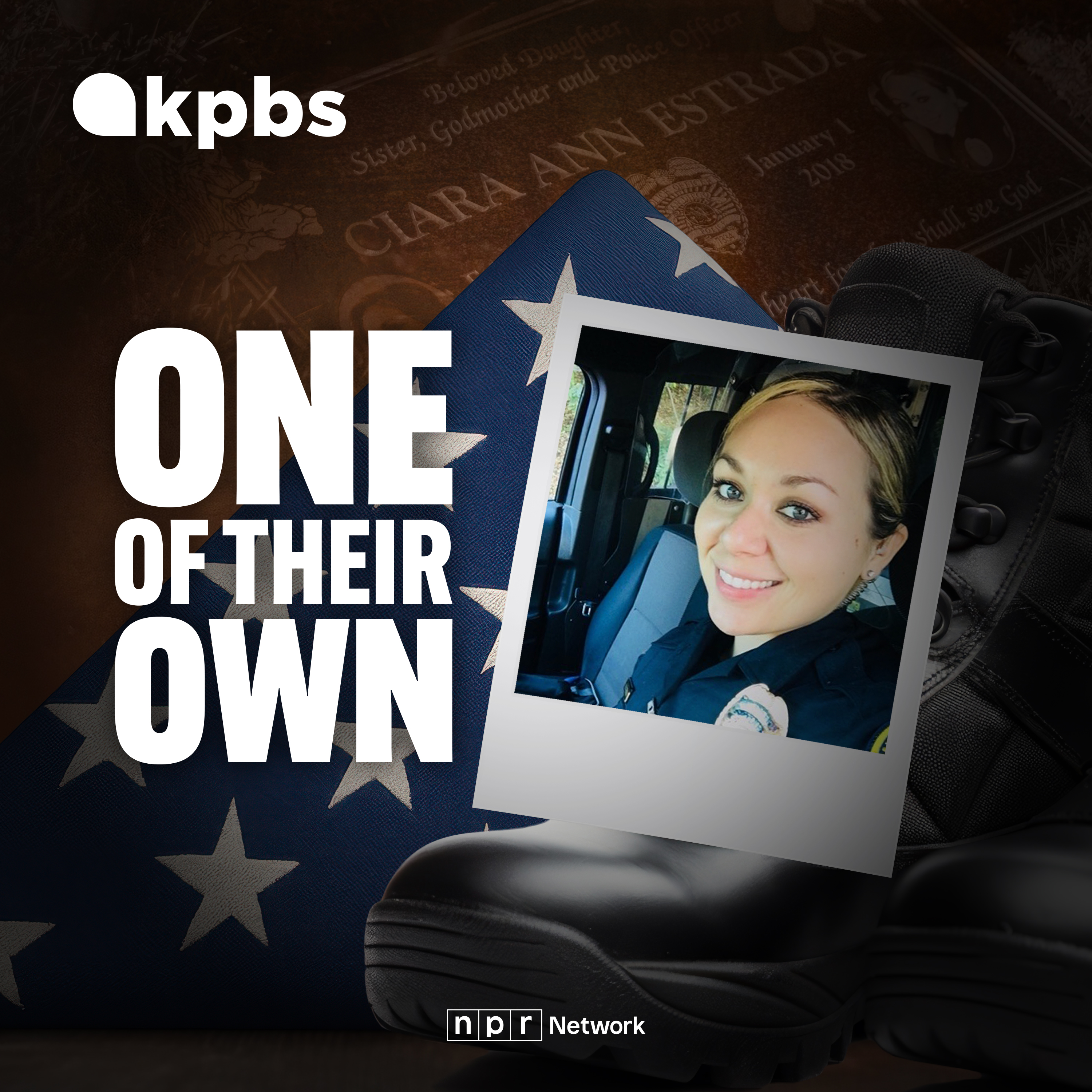
I'm Katie Hyson and this is one of their own the story of a San Diego police officer's death and the way her department handled it.
- [02:35]
Narrator/Host
KPBS on Demand is supported by San Diego Congregations of the United Church of Christ, a community where Christmas is the story of a love greater than all that makes us despair. Learn more at San Diego ucc.
- [02:53]
Katie Hyson
The letter Larry sent to San Diego police is four pages long. It reflects the family's belief that if Sierra died by suicide on New Year's Eve 2017, it was because of her relationship with Eric Hansen. It outlines the family's concerns that the department didn't appropriately respond to an abusive relationship involving their own officers, that they never gave the family the complete unredacted case records, that they initially told the family there was no autopsy, that they didn't Give the family enough specific evidence to substantiate the cause of death, that they never held officers accountable for their actions or inactions that night.
- [03:42]
Larry Estrada
Police officers are not supposed to escalate a situation. They are supposed to de escalate a situation. Police officers are supposed to be held to a higher standard of conduct. Have you held Officer Hansen accountable? San Diego police had a domestic disturbance that occurred in public that night between two San Diego police officers, and one of them is dead because of it.
- [04:06]
Katie Hyson
Witness statements in Sierra's case file describe multiple officers witnessing a heated dispute between Sierra and Eric the night she died.
- [04:16]
Larry Estrada
How many other off duty San Diego police officers could have intervened that night?
- [04:20]
Katie Hyson
The letter questions whether the real lessons from Sierra's death were ever learned or taught.
- [04:27]
Larry Estrada
We also learned that after Sierra died, the San Diego police was telling other police officers during training sessions that Sierra killed herself because of the job. Were you aware of this? Does your department think my daughter killed herself because of the job? What should be used in training is how to avoid toxic relationships and how to de escalate a situation that a police officer creates. Creates. Did San Diego police ever communicate to the entire department the circumstances of her death?
- [04:54]
Katie Hyson
It also questions SDPD's decision to continue to employ Eric given the volatility of his relationship with Sierra.
- [05:03]
Larry Estrada
Why is Officer Hanson still a San Diego police officer?
- [05:09]
Katie Hyson
In an email, SDPD spokesperson Ashley Nichols said they're restricted by employment law and the Peace Officer's Bill of Rights and how they can discipline or fire someone. Issues in personal relationships, unless against the law or done while on duty, are not typically subject to discipline.
- [05:32]
Eric left STPD in 2022. Hay records show he worked for the police department in Sandy city, Utah, from 2022 through 2024. I couldn't find any record of Eric after that. I do have his cell phone number, and he picked up the first time I called. But when I told him why I was calling, that Sierra's family attributes her death to his relationship with her and I wanted to hear his side of the story. He hung up, and he hasn't answered any of my texts since.
- [06:08]
Larry Estrada
As painful as it may be, if we don't completely understand why this loss of life occurred, it will happen again. Signed Hilario. Larry Estrada, Commander, U.S. navy, retired.
- [06:22]
Katie Hyson
Larry says he never got an answer to this letter. Former Chief Nislit declined to talk with me. For Larry, those four pages boil down to this.
- [06:34]
Larry Estrada
If you believe it was suicide or if you believe it was homicide, it doesn't matter. It never should have happened. She should be alive today.
- [06:42]
Katie Hyson
That belief motivated Sierra's family to eventually file the legal claim against the city of San Diego, holding the police department responsible for, quote, failing to protect Sierra Estrada from Officer Eric Hansen. But they filed it in July 2018, passed the statute of limitations for legal claims against the city.
- [07:04]
Larry Estrada
We had no idea the statute of limitations with the city was six months. It's kind of criminal in itself that how can the city not have a lawsuit filed against it if it's six months and a day? So we couldn't really find any information out that we were yearning for at that point because the kind of the legal door kind of got closed in our face.
- [07:27]
Katie Hyson
Maybe if the claim had gone to court, they could have gotten Sierra's case documents sooner. They say they were told by detectives in the months following Sierra's death that they couldn't get any of the documents. They submitted a formal written request for investigation records in 2020. The city rejected that request with a note saying, for what you are requesting, you will need to submit subpoena. Larry says they only learned they had rights to portions of Sierra's case file and received those documents by filing a public records request through the online portal in 2022, four years after his daughter died.
- [08:10]
Larry Estrada
It was kind of like pulling teeth.
- [08:12]
Katie Hyson
Cyra's mother, Julie, says they're still fighting for some kind of justice for the full records.
- [08:20]
Judd Campbell
That was my baby, you know, she was my baby. I'm gonna fight. I'm gonna fight to the very end.
- [08:27]
Katie Hyson
January 1, 2025, just one week before Julie first reached out to me, a new California law went into effect that might have changed everything. For Ciara's case.
- [08:41]
I spoke with a co creator of that law, Casey Guin. When I spoke with him on Zoom, he was in the middle of training the Justice Department in South Carolina on hidden homicides. Deaths that are wrongly classified as suicides or accidents when they're actually homicides. So called hidden homicides are often staged by the killer to look like something else and follow a history of domestic violence. Casey used to be San Diego city attorney. He's been leading work against domestic violence for 40 years.
- [09:17]
Narrator/Host
I wish I could say that it was a really noble beginning, but at the very beginning of my career 40 years ago, I was sick the Friday of my first week of work as a prosecutor. And that was the day that everybody pick their area of interest. And I came back the following Monday and the only area that had not been picked was child abuse and domestic violence.
- [09:39]
Katie Hyson
Now he's president of alliance for Hope International, an organization that supports survivors of domestic violence. He says, four years ago, we had.
- [09:49]
Narrator/Host
A woman come in who was seeking counseling because her daughter died, and it was ruled a suicide. And she is struggling with it because she doesn't believe her daughter died by suicide. Her husband was abusive, and we'd love your help.
- [10:08]
And so we then pulled our whole team together and started looking at Joanna's case.
- [10:17]
Katie Hyson
Joanna Hunter Lewis died in Solano county, California, in 2011. Her husband was a pastor.
- [10:24]
Narrator/Host
The case was quickly ruled a suicide within a matter of minutes, less than half an hour, and they made a decision to do no further investigation in the case.
- [10:39]
Katie Hyson
Joanna's brother, Joe Hunter, began to advocate for justice in her case. He worked with Casey to draft and pass Joanna's law. He testified to the California Senate about what happened to Joanna.
- [10:53]
Larry Estrada
When my sister was the victim of domestic violence, it changed my life and everything in it forever. This bill will bring justice to Joanna Hunter and so many other victims like her.
- [11:08]
Katie Hyson
Unlike Cierra, Joanna's relationship had a documented history of physical violence. Joanna filed restraining orders against her husband years after Joanna died. He went to prison after pleading no contest to hiring people to firebomb his ex girlfriend's house.
- [11:27]
Narrator/Host
And the deeper we got into the case, the more convinced we became that Joanna Hunter Lewis murdered.
- [11:37]
Katie Hyson
Joanna's family wanted an independent review of the case, but they hit some of the same information and record barriers as Sierra's family.
- [11:47]
Narrator/Host
And so we started advocating with the Solano County Sheriff's Department to have the case reopened. We started making Public Records act requests. We started demanding more and more information. They did not provide it. They did everything they could to avoid giving us the records that we wanted. They had been stonewalling Joanna's family for more than a decade at that point.
- [12:08]
Katie Hyson
Given Joanna's history with her husband, her family didn't feel confident in the suicide ruling. They wanted a thorough outside investigation of the case. Without more information and records, that was impossible. And law enforcement was denying them what they needed.
- [12:29]
Joanna's next of kin was her husband, not her family. And at the time, Casey says the list of suspicious death cases in California law didn't include cases with a history of domestic violence.
- [12:45]
Narrator/Host
Everybody knows that if a wife or a girlfriend dies, the suspect first suspect's always going to be the intimate partner. So why in the world would that not be suspicious if a woman dies and there's a prior history of domestic violence?
- [13:01]
Katie Hyson
Casey says Joanna's case isn't isolated. Alliance for Hope has a program called Justice Project, which independently Reviews possible hidden homicides around the country at the request of family members. Casey says they saw so many cases like Joanna's that they realized they needed laws.
- [13:24]
Narrator/Host
When a family loses a loved one and law enforcement shuns them or treats them as if they're not important, and you've just got to stay out of this, they're really violating the fundamental rights of a family that really, at the end of the day, may well themselves be secondary crime victims.
- [13:47]
Katie Hyson
It wasn't just that the families didn't have access to records in cases like Joanna's. It's that most law enforcement offices either lacked protocol around investigating deaths with a history of domestic violence, or they didn't follow the protocol that was in place.
- [14:06]
Narrator/Host
Joanna's Law became a focus on basically these three things. One, we need to make sure families have a right to all these records. Number two, we need to make sure that when there's a premature death of a person where there's a prior history of domestic violence, it should be investigated as a homicide until proven otherwise. And number three, we put these 10 red flag factors into state law to say nobody should determine manner and cause of death until they have evaluated those 10 factors.
- [14:37]
Katie Hyson
10 red flag factors. The person died prematurely or in an untimely manner. The death scene appeared to result from a suicide or accident. One partner wanted to end the relationship. There was a history of being victimized by domestic violence that included coercive control. The person was found dead in a home or place of residence. The person was found by a current or previous partner. There was a history of being victimized by domestic violence that included strangulation or suffocation. The current or previous partner of the person who died or their child was the last to see the person alive. The partner had control of the scene before law enforcement arrived. The body of the person was moved or the scene or other evidence was altered in some way.
- [15:42]
Casey says the Justice Project has never had a case that met all 10 factors that they didn't determine was actually a homicide.
- [15:56]
Joanna's Law passed unanimously in California. Casey wants to see a similar law rolled out in every state. But he says there are barriers.
- [16:07]
Narrator/Host
We meet some resistance from law enforcement who feels like maybe this is an attack on law enforcement. We don't see it as an attack on law enforcement. We have a ton of detectives, medical examiners, death investigators on our faculty, and all of them say what we're talking about in Joanna's Law should be standard practice. The people that oppose it tend to think that we're somehow trying to second guess law enforcement in their investigations or try to show that they did something wrong, he says.
- [16:39]
Katie Hyson
Opponents also raise concern about the cost if so called hidden homicides are really happening. How much money would it take to reopen all those cases if there are.
- [16:51]
Narrator/Host
Another thousand murders in the United States of women happening? We shouldn't be talking about cost, we should be talking about solving them.
- [17:04]
Katie Hyson
More after the break.
- [17:28]
How does AI even work? Where does creativity come from? What's the secret to living longer? TED Radio Hour explores the biggest questions with some of the world's greatest thinkers. They will surprise, challenge, and even change you. Listen to NPR's TED Radio Hour wherever you get your podcasts.
- [17:53]
Sierra's case is very different from Joanna's. We didn't find any records of domestic abuse charges against Eric in criminal or civil court, and no one, including Sierra's family, says Eric was ever physically abusive toward her. Ciara's case doesn't meet all 10 red flags in Joanna's Law, but the available evidence indicates her death could have met several of them. SDPD Captain Jud Campbell reviewed Sierra's case in 2022. He did not talk with me directly, but provided recorded audio statements through an STPD spokesperson for this story. He says Joanna's Law wouldn't have changed anything about Sierra's case because he believes they already investigated it thoroughly, as Joanna's.
- [18:44]
Judd Campbell
Law requires when there are risk factors present. What Joanna's Law asks you to do is to actually deploy resources to confirm, you know and investigate what it is. And that's what happened here. The same thing that would have happened under Joanna's Law happened when an entire homicide team was deployed to this.
- [19:05]
I.
- [19:05]
Katie Hyson
Asked Casey if his team had any estimate of how often hidden homicides happened. He says it's hard to know. A peer reviewed research study estimated the rate in England and Wales more than 130 a year. That's just one study and of course it's not great science to extrapolate from one country to another. But Casey says if that study is anywhere near accurate, adjusting for factors like population, there would be somewhere between 1200 and 2000 cases of hidden homicide a year in the US, 200 a year in California.
- [19:46]
Narrator/Host
Whether or not that is true, I cannot tell you. All I can tell you is that as our focus on this and our program is called the Justice Project now working on these cases as our program has evolved, are training all over the country and everywhere we go and train, someone in the audience in that community says we have a case like that. We've Never been any place where somebody hasn't said we have a case. In fact, we have three cases in a rural community in Oregon in one small county. There are three of these cases since we started raising awareness there, so I don't think that the number is small.
- [20:24]
Katie Hyson
He says passing the law is just the first step. It's hard to roll out, to enforce, to get the attention of local agencies and to train them all. I brought up Joanna's law to an STPD homicide lieutenant who denied the family's most recent request for the full and unredacted case files. In Cierra's case, her family were already her next of kin. STPD said they gave them all the records they would give any next of kin. In an email, they maintain their denial for the full records, saying that evidence is exempt from disclosure, including the photographs, text messages, Eric's Uber receipt, and audio recordings of the witness interviews in Sierra's case.
- [21:10]
Judd Campbell
Judd again, there are still laws in place and there are still items that if we provide them that it waives confidentiality, for example, and it can have pretty significant complications for not just this case but other cases.
- [21:30]
Katie Hyson
Casey Guinn says the Justice Project would argue that if the investigation is closed, there's no exemption for scene photos or other evidence. In Joanna's case, all scene photos were turned over, he wrote in an email. It saddens me that STPD continues to hide records and information in a closed case. Why? Why not give the family the information they have requested? End quote. Maybe the complete records would confirm some of the police department's conclusions. Maybe they would answer some of the family's questions. Maybe they would raise new ones. Of course, Sierra's death affected the department, too. Her squadmate found her body. Her sergeant had to radio in her death. Cierra was their co worker and for some, their friend. They ruled her death a suicide. I sent SDPD a few dozen questions related to Sierra's case, including why the gun was removed from the scene before the medical examiner arrived, whether they had record of Jeremy Gates call to dispatch and to an STPD officer to check on Sierra, what response they had to the concern that tossing the bloody bath mat into the apartment dumpster was throwing away possible evidence, whether detectives investigated the discrepancies between Eric's witness statement and Sierra's call log. They didn't answer specific concerns with the investigation, but Jud said that any inconsistencies don't shake the suicide ruling in his eyes.
- [23:16]
Judd Campbell
Any investigation you give to me from any department or any case throughout this country I can pick it apart, I can go through and find minor things and say look at this, it's inconsistent with this. That's what an investigation looks like. In fact, I would be super concerned if an investigation perfectly lined up because people's memories aren't always the same. They don't quite get this date right or get this time right. If an investigation was completely streamlined, I would have significant concerns about the investigators that were assigned to that. So yes, any.
- [23:55]
Investigation that you look at of this scope is going to have minor things that you can point to. But what you have to do with all of these investigations is you have to weigh out the evidence, weigh it out against each other. Look at, you know, scene diagrams and photographs and statements and you take all of that evidence and that's how you eventually reach your ultimate conclusion. You know it's my hope that this podcast going back and looking at Ciara, looking at her life, looking at the circumstances surrounding her suicide, but it's my hope that it will give the Estrada family closure.
- [24:44]
Katie Hyson
Jeremy Gates, the sheriff's deputy who is one of the last people to speak with Sierra also believes it was a suicide.
- [24:52]
Narrator/Host
Law enforcement needs more resources for suicide prevention.
- [24:57]
Katie Hyson
Jeremy says law enforcement officers are exposed to trauma regularly and the culture teaches them to shove it aside.
- [25:06]
Narrator/Host
If you talk about, you know, your troubles and you talk about, you know, you're dealing with this, you're viewed as weak, you're viewed as little, you're not viewed like you can handle critical situations.
- [25:17]
Katie Hyson
It's a deadly combination. Data show officers are far more likely to die by suicide than be killed by a suspect. For Ciara's family, her death isn't something that can be resolved even by changing policy, even by telling her story.
- [25:39]
Larry Estrada
Will it help somebody else? That'd probably be the best thing. Is it gonna help heal the family? No. We're damaged goods for the rest of our lives.
- [26:02]
Katie Hyson
Five months after my first visit, I drive up to the Estradas house in Murrieta. The Easter decorations are gone. Halloween decorations are up.
- [26:14]
Judd Campbell
Monsters in the trees like here.
- [26:17]
Katie Hyson
Skeletons and ghosts.
- [26:19]
Judd Campbell
I have a witch that goes here that really scary.
- [26:22]
Katie Hyson
A photo of 5 year old Sierra in a Cinderella costume, the same one I had at that age.
- [26:28]
Judd Campbell
And there's Sierra, Cinderella.
- [26:30]
Katie Hyson
Oh my God.
- [26:31]
Judd Campbell
Cheyenne's a little witch.
- [26:33]
Katie Hyson
I hand her parents back all the things they gave me to try to make sense of what happened. Condolences sent to the funeral home from all around the world from people who'd seen the viral video of Sierra. Astrological readings. Julie paid to have Done about Sierra and that night, Sierra's laptop and iPad. The chargers Larry plugs into them every three months to make sure they never die. The DVD slideshow that played at her funeral.
- [27:13]
We climb into their van and head to Sierra's grave site.
- [27:18]
Judd Campbell
None of these rows were here when Sierra died. All these people filled up this whole thing, and now look how they're already putting them over there. Wow, so many people have died.
- [27:32]
Katie Hyson
The area of the cemetery Sierra is in, hashtag filled up since she died. There's one empty spot next to her where Julie and Larry plan to be buried one day. Julie glances at the clock when we arrive. 2:13. Sierra's birthday. Julie says it's a sign that Sierra knows I'm here.
- [27:58]
Her headstone has two photos of her. One in uniform and one in plain clothes. I put sunflowers, one of her favorite flowers, into vases on either side and set down a monster energy drink. Small tokens to say that I tried to learn who she was, that I listened carefully to each word her family said.
- [28:27]
I ask Julie what she wants people to take from Sierra's story.
- [28:32]
Judd Campbell
If you're a woman and you're, you know, contemplating a career in law enforcement, don't.
- [28:37]
Katie Hyson
Larry had a different answer.
- [28:40]
Larry Estrada
I think the podcast will help make the truth about who she is because anybody can Google search a name and come up with all sorts of weird stuff. And when you Google Sierra's name, you get all sorts of stuff not related to her or related to her. But that's not true. Or so I think. What I look forward to is that there at least be more of an.
- [29:03]
Katie Hyson
Official.
- [29:05]
Larry Estrada
Record of what happened and more about her.
- [29:09]
Katie Hyson
He wants the record cleared up and her story preserved.
- [29:14]
Judd Campbell
Everybody that knew Sierra knows that she would never do this.
- [29:19]
Katie Hyson
As Julie talks, Larry walks to the front of Sierra's headstone. He bends down and sweeps off the yellow petals that have already begun to fall. He opens a water bottle and pours it onto the stone, takes out a cloth and rubs in careful circles. The dirt and debris lift off.
- [29:44]
And to see his face and name.
- [29:49]
Become clear again.
- [30:15]
If you or someone you know have thoughts of suicide or need emotional support, Please call or text 988. If you or someone you know are experiencing domestic abuse, please call 1-800-799-7233 or text START to 88788 Hope is available 24. 7. One of their own is produced by me, Katie Hyson and edited by David Washburn with support from Elizabeth Hames. Mix and sound design by Emily Jankowski.
- [31:00]
Narrator/Host
Sa.