← Openwork: Inside the Watch Industry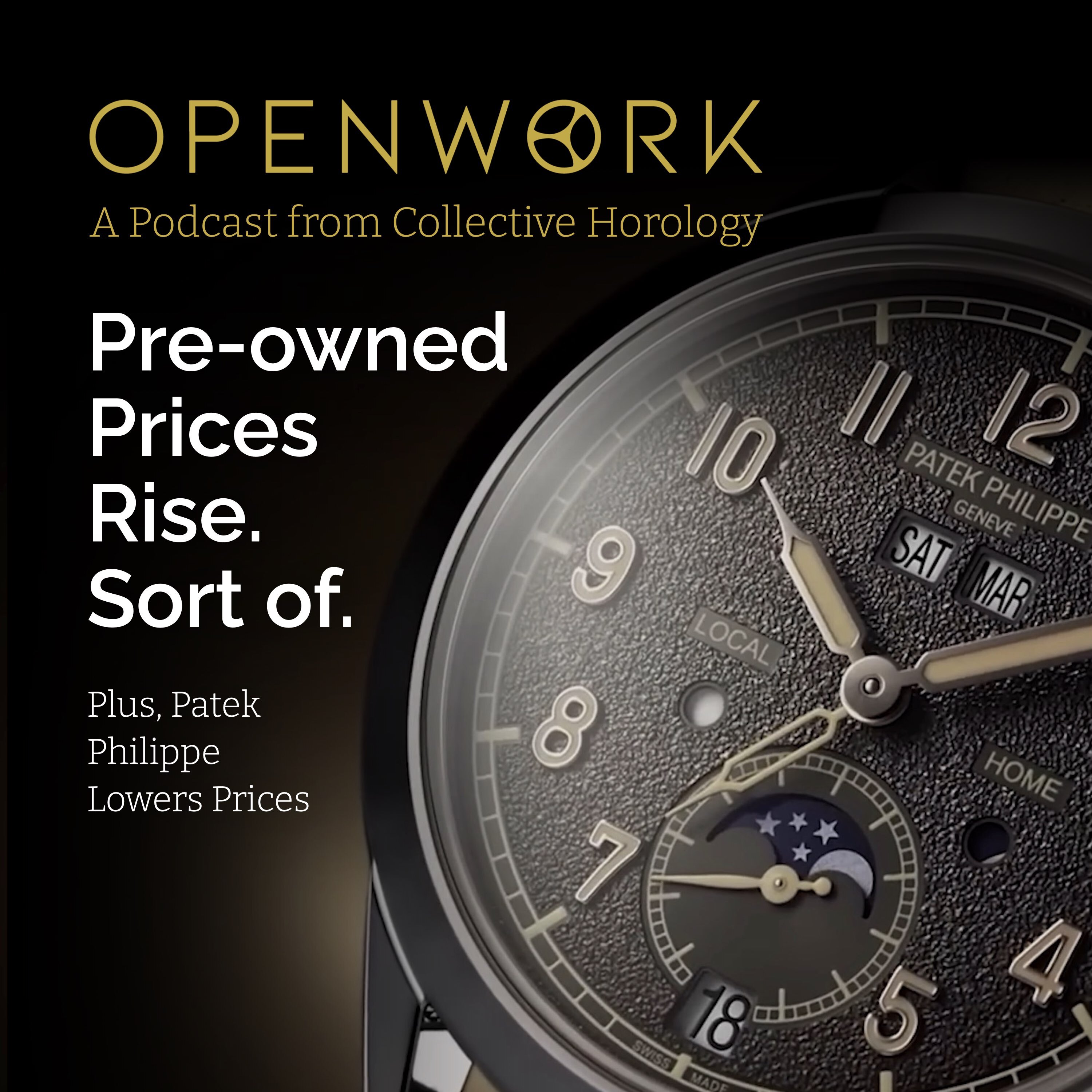
Openwork: Inside the Watch Industry
Pre-owned Prices Rise. Sort of. – Plus, Patek Philippe Lowers Prices – Episode 65
00:49:32
Loading summary
Transcript166 lines
- [00:01]
A
Both Gabe and I come from the corporate world and we're well aware of what happens and can happen when you are caught in a contract that has more trap doors than a Scooby Doo house. And they are Scooby Doo house. I mean, it's true.
- [00:22]
B
This is openwork, a look inside the watch industry, a podcast from Collective Horology. I'm Gabe Riley, co founder of Kollective.
- [00:29]
A
And I'm Asher Rapkin, co founder of Collective. Collective Horology is an independent watch retailer based in Southern California. We carry a wide range of independent brands, including Renault, Tixier, David Candeau, Armin Strom, and more. To learn more about us and check out our available inventory, visit collective horology.com hey, Armin Strom.
- [00:48]
B
Cool. Yeah, they're joining the shop, or I guess they've officially joined the shop. So if you are into Arm and Strom and what they do in terms of open worked highly technical in house watchmaking, well, then get in touch because we love their watches, but just as importantly, we love the people at Armstrong. They're really good people and we've become friends with them over the years. We, we did two collaborations with them, not just one. That's how much we like them and how much we like their watches. So we are proud to represent them. But enough of that stuff. Let's boogie. Asher. There is a ton going on in the watch world, starting with price reductions. So this was something you called out,
- [01:32]
A
rumors of price reduction?
- [01:33]
B
Well, more than rumors. I think it's been reported.
- [01:36]
A
Substantiated rumors.
- [01:37]
B
It's been reported now by our. By our good friend Andy Hoffman at Hodinkee. This week they published a story about plans for Patek Philippe to roll back pricing. So tell us a little bit about what's. What's going on there because it's. It's complicated. Yeah.
- [01:52]
A
So the reporting is that Patek, who like so many other manufacturers, had to raise their prices due to the. In the fluctuation of the Swiss franc, as well as, of course, the punishing tariffs that were in place from August until mid December of last year, is saying that they are planning to roll back some of the pricing now by
- [02:15]
B
as much as 8%.
- [02:17]
A
By as much as 8% now, one might say. Hmm. The tariffs were 39%. Now they're 15. So that's a delta of 24%, but you're only changing it by 8%. What's going on there? I think there's a couple of things to pay attention here and a couple of Interesting things for us to talk about. So the first is, as we know and as we've discussed in the past, tariffs and duties are calculated on the cost basis on import, not on the MSRP of a watch, unless you are an individual buying a watch from abroad at full msrp. So the actual total percentage against the MSRP of a watch of the tariff is not going to be 39%. If bought through a retailer, it'll be substantially lower. So one has to imagine that this 8%, you could probably do the math backwards and determine what the actual import costs are, but that's probably part of the difference. There's also a rumor that some points are going to go back to the dealer margin because also as discussed in previous episodes, dealers, wholesalers, agents, et cetera, we've all given up points of margin,
- [03:25]
B
the brands too, indeed, to be able
- [03:27]
A
to keep prices from skyrocketing as high as they could have gone if the entire cost of the, of the additional tax of a tariff had been passed on. So they're going to come down. So they say. Now, this poses a multitude of fascinating questions. First one, which I think a lot of people are going to ask is like, what happens to the people who bought a Patek Philippe in that period?
- [03:50]
B
That's the big one. We know some people who did buy a Patek Philippe during, during the period where prices were up significantly. It was a 22% price hike in 2005 overall and 15% price hike in September alone. That's when that 39% rate took took effect.
- [04:08]
A
So I think the answer is nothing because I don't know what could possibly be done there. Now. If I, if I were Patek Philippe, I would probably want to try to do something for those clients just to recognize that challenge. And that could be anything. Right. That could be a strap, that could be a letter. That could be.
- [04:26]
B
Do you think they'll do anything?
- [04:27]
A
Nope.
- [04:28]
B
Yeah, we had a client who bought Patek Philippe, I think, around Sept. Remember, right after that price hike took effect and initially he was gonna not do it when he was offered the watch, but then decided to do it after all and just viewed himself as a sort of a glutton for, for, for punishment or, you know, a punching bag for Patek Philippe and, and did it. Didn't feel great about it then. Yep. And certainly can't feel great about it now. But, you know, maybe it's water under the bridge. Who knows what to do here? Look, it's not great and you're right there. It would be nice if they did something. Maybe they, maybe they will. But these are the realities of a punishing tariff environment and extreme volatility.
- [05:08]
A
Yeah. So let's talk a little bit about the volatility side because that I think is actually what gives me the most pause about this change. I mean, look, writ large, the fact that Patek is presumably going to lower some of their retail prices, which by the way, stinks for Patek retailers between now and the end of the month. Because if I were them, like, good luck to any Patek salesperson trying to close the sale between today.
- [05:28]
B
Yeah, the sale February round to a halt. Yeah.
- [05:31]
A
I mean, you know, can you imagine?
- [05:32]
B
But if they wait till February 1, when this takes effect, they do get a few more points of margin.
- [05:37]
A
Yeah, sure.
- [05:38]
B
There's an incentive for everyone.
- [05:39]
A
I'm being, I'm being a little facetious.
- [05:40]
B
Sure.
- [05:41]
A
But anyway, the thing about this is, and this was, this was exemplified by the text message I awoke to this weekend saying that Donald Trump had decided on his own accord to apply tariffs, NATO allies, because he wants Greenland.
- [05:58]
B
Why not?
- [05:58]
A
Sure. That's a thing that's happened in the world that we live in. So putting that aside for other podcasts that talk about it at nauseam, from our perspective, the thing that it indicates is that we still live in a extremely volatile trade environment. Not just because of currency fluctuation, because of the second and the third order impacts of some of the choices that are made. I'll give some examples. Because of the President's decision and the pretty obnoxious attitude towards our Danish allies, one of the repercussions of that was that a very large union of teachers and academics in, in Denmark decided to pull, I believe it was, $100 million worth of T bills from their investments. Now when that happens in mass, and it's happening.
- [06:49]
B
So this is like a pension fund.
- [06:50]
A
Exactly. And it's happening more than it normally does. That depresses the value of the dollar. When it depresses the value of the dollar, that once again makes goods more expensive to import when you're buying them in foreign currencies.
- [07:03]
B
Fewer people want to hold our debt. It drives up the cost of our debt.
- [07:07]
A
And then of course, you have the other side of it too, which is we had an agreement with the European Union. The eight countries that Donald Trump threatened with this tariff, which he's since backed off of, are members of the eu. And the EU is a unified trading bloc. So you can't really impose tariffs on one member of the bloc, despite the fact that he, he Would very much like to.
- [07:33]
B
Oh, there was the pasta tariff last month. You remember that one? Well, and as of yesterday, yeah, there's
- [07:38]
A
a 200% tariff on, on wine too. I mean, you know, well, that, that
- [07:42]
B
was a joking sort of threat, but still, what you're pointing to is, was it the. You're right. There are plenty of podcasts and others who will cover the political machinations of this, but it's an extremely volatile environment. You never know what you're up to.
- [07:55]
A
So why does this relate to Patek Philippe? To me, I wonder, is this a smart move to bring these prices back down when the dollar versus the frank is still highly volatile and when the United States head of government, whether or not he actually has the legal right to do this? We're still waiting on the Supreme Court to make a decision on these IEPA tariffs, whether or not those trade deals can even be trusted. So if that. So when we say things like, oh, there's a 15% tariff on Swiss goods and European goods, the caveat to that is until there isn't. So Patek is making a really interesting bet here. They're basically moving their watches in some degree to that lobster style market pricing, which is to say if, you know, if the US Government decides to reimpose punishing tariffs, up go the prices. If those come down, down go the prices. And the thing about that is that's one thing when you're dealing with like a commodity.
- [08:54]
B
Right.
- [08:54]
A
So I want to do the coffee or we're talking about cheese, for example, where there's sort of fluctuation in that market, just sort of in general, it's a very different thing when you talk about a luxury good. Because of course, luxury goods rarely ever come down in price. Because when they come down in price, there are of course other consequences for that that impact secondary market, that impact all sorts of other elements of that space. And the watch market is very exposed in that context. So this is a really interesting move. You know, there's some discussion out there that maybe suggests that maybe sales, the United States softened dramatically because those price increases. So they had to do this in order to increase demand. I don't know if that's true. That's, that's pure conjecture. But one has to wonder what put the pressure on them to do this because Patek Philippe is not a brand that's known for like, value.
- [09:44]
B
Yeah. You know, now some of the, some of the reporting and the discussion and some of the groups I'm in around this has lacked some nuance, which is to say, well, look, now Patek is rolling back prices. That's great. I mean, people are always happy to see prices come down. Yeah, this is one of the things, you know, with inflation and price increases writ large, you know, the rule of thumb is generally prices only go up. They never go down. Well, here they're going down. Part of the reason, you know, in the broader economy, people feel no sense of relief over inflation is because even as inflation cools and the rate of growth of inflation, the rate of inflation slows and cools, prices still go up and they're never going back. So, so what, what happens now with Patek here is people are like, oh, see, prices are going down. Fantastic. Hallelujah. Well, why isn't everyone else doing this? And I think, you know, part of this is like, part of one of the things I heard is I can't believe Patek is lowering prices, but Rolex and AP are sticking with their price increases. And of course, on our last episode, or maybe it was two episodes ago, one of the things we talked about, and I don't know if this is true of ap, but certainly with Rolexes, they took a more measured approach. They didn't do what Patek did, which is to price watches like lobster, and say, well, today this is the market price, tomorrow this is the market price. Instead, what they did was when the 39% tariffs came into effect, they took a beat. They said, we're not going to bring in watches to the country in any significant volume under this new tariff regime, 39% and we're going to wait. And so what they're doing now with raising their prices, Rolex is doing now with raising their prices in 2026 modestly, is they're just playing catch up. They're, they're playing catch up. So they had a different strategy.
- [11:21]
A
Also have raised their prices in January most years in the last 10.
- [11:25]
B
Sure. And by the way, as part of their price changes for, for 2026, Patek did raise their prices in most of the rest of the world about 4%. And so that's in line with what we saw from, I don't track Patek
- [11:37]
A
pricing in general, but that sounds pretty normal.
- [11:39]
B
That's, that's in, I don't know about Patek, but that's in line with what, what Rolex and AP did in the rest of the world. So the US Is an isol. It further under. The US Is isolated and the way the brands chose to navigate the last year of tariffs and tariff changes and the volatility is Different. Rolex took a more measured approach. Patek took a more reactive approach. And now, even though one is raising prices and one is lowering prices, if you step back and you look at the last 12 months of price increases, they're probably ending up in about the same place. So one of the things that just bums me out is, you know, when I see this happen and people say, well, Patek is giving us some, some reduction and some relief, why isn't everyone else doing it? They're greedy. That's not, that's not the case. It's more nuanced than that.
- [12:26]
A
Yeah, it is. So that's, that's what we're looking at. So I think what we need to pay attention to with Patek moving forward is a, does this actually happen?
- [12:33]
B
And then B. February 1st, the moment of truth.
- [12:36]
A
Exactly. Does it actually happen? If it does happen, you know, I'll be curious to see if we can reach out to, if any. Pat, if there are any Patek ads that listen to this podcast, we'd love some anecdotal, you don't have to give us quantitative, but anecdotal information about what that's done in terms of demand.
- [12:50]
B
Send us your receipts.
- [12:51]
A
Exactly.
- [12:52]
B
Podcastollectiveherology.com Exactly.
- [12:55]
A
But in all seriousness, you know, we'd love to, we'd love to hear from you on that as well, because this is a really interesting and unusual scenario. Patek Philippe lowers prices is a headline that nobody expected.
- [13:06]
B
Let's talk about more slipping prices. And we'll take a look at the secondary market and what's going on in the secondary market because we've got some new data from Morgan Stanley and from Watts charts. But this, this next segment here actually came to us from a listener question. So this was a question that got posed to us a few months ago on YouTube. When we ask you guys to send us your questions, I want you to know we really do read the questions that you send us. They inform episode topics. And at the end of this episode, we have a couple of additional listener questions we're going to feel that we got in the last few weeks that are kind of, kind of interesting. But this came from a user question and the question was, if the Swiss tariffs hold, will the price of existing units used watches increased dramatically as a result? And that was an interesting question. I think, Asher, you've pointed out several times when it comes to market pricing in general is what's going on in the secondary market, what's going on with price increases. We need to wait and See, we got this question, I think it was back in August when that 39% tariff rate was, was announced. Now we have some data specifically watch charts released their end of date, end of year numbers for what's going on in the watch market. And we need to have Hamza back on because this was a big turning point this year for the secondary market. And just like all the things we're discussing here as it relates to watch pricing, it's very complicated. There are many factors driving what's going on in the secondary market. But I found this fascinating. So the answer to this question is are prices for used watches going to increase as a result of tariffs? The answer is kind of yes and no. So overall in 2025, the pre owned market saw a 4.9% increase in, in the price of, of pre owned watches. Now if you've been following this podcast for any number of years, that's an aggregate right? It's an aggregate right. And it's, that's being driven by the usual suspects which we'll talk about in a second. But if you've been listening to this podcast for any amount of time and the coverage we've done, thanks to watch charts on the secondary market. Every time we seem to talk about the secondary market, it's about the secondary market continuing to slip and to go
- [15:16]
A
down, down and down.
- [15:18]
B
So this was a real inflection point in, in 2025 and I remember about a year ago and we had Hamza on to talk about, you know, what he saw coming for this year. There was basically no end in sight for the, the, the secondary market to continue slipping. Well, no one could have predicted tariffs or I guess we didn't understand at that time the impact tariffs would have on the watch market overall and driving up prices of watches overall. And now we're seeing them affect the secondary market. And while that 4.9% number is interesting, there's two caveats there. That's why I say yes and no. First, Asher, you're absolutely right. The brands that are driving, in fact the only brands that are trading above retail so that are increasing in value on the secondary market are Patek, Rolex and AP. That's it. So that 4.9% is on the back of those three brands alone. And we've talked about how those three brands plus Richard Mille drive essentially half of the pre owned market. You know, they're, they're the big four.
- [16:22]
A
By, by, by value.
- [16:24]
B
Yeah, by value. Yeah. So a transaction, transaction value. So your average. So take out those three Brands now take out Patek, Rolex, ap. Is your Omega increasing in this, the secondary value of your Omega Speedmaster? I'm wearing one right now. Increasing year over year. No, it's continuing to go down. Is your tag Aquaracer or whatever else it may be? They're continuing to go down, but that's only part of the story. One of the things watch charts does that is so brilliant is they talk about value retention. So that is what is the value of a pre owned example of a watch relative to the new example of the same watch. Right. So what is the delta in price? Let's just take a Rolex Submariner. What is the pre owned value of a Rolex Submariner relative to the new value of a Rolex Submariner? And what we're seeing overall, and I probably shouldn't have used a Rolex Submariner, let's say that it's a Speedmaster. What we're seeing is that actually the gap between the new price of a watch and the used price of that same watch is continuing to grow. In other words, sure, the, sure the, the, the, the, the secondary market is increasing 4.9% overall. But how much have new watch prices increased overall? A lot more than that, into the double digits. You know, just talking about Patek Philippe prices last year went up 22%. So is the fact that the used examples are up 10.7% great? No, actually it's losing ground and it's very reference specific. It's not doing well.
- [18:00]
A
It's very reference specific. So like I looked up one of my favorite non hypey Pateks, right. Which is a 5196P. This watch was discontinued about two and a half, three years ago, give or take with the introduction to the 6119S. I sound like I know way more about Patek than I do, by the way, but I don't.
- [18:17]
B
I can remember some reference numbers for things, but Patek is just.
- [18:21]
A
Yeah, usually I'm like, you know the one with the repeater.
- [18:25]
B
Anyway, I know like R means rose gold, I think. Oh, good job.
- [18:29]
A
Excellent.
- [18:29]
B
That's about all I got.
- [18:30]
A
Very talented. Anyway, my point is so the, the, the 5196P which was basically the base Calatrava in platinum brigade numerals. Beautiful watch that continues to decline in value. It's a little bit of a bump in the last couple like months, but essentially steady decline. When that watch, when that watch was retired, it cost $42,420 today. A pre owned example of that watch, the best version of the 5196 that was ever made in my opinion is $31,000.
- [19:06]
B
There's one now you said they discontinued this watch. If they were still selling that watch today, it would be selling for what,
- [19:12]
A
mid-50s or 60 grand. Yeah. And the delta on that would be almost a 50% loss. Now when you talk about, you know like the elbow watch or you talk about where you talk about, you know like more in demand pieces, like 51 5164s, you know, aquanauts, things like that, those obviously perform well above retail because those are, those are hyped in demand watches. But the vast majority of the Patek catalog trades well under retail.
- [19:39]
B
But even those hyped watches, let's take an aquanaut, I'm just guessing, right, looking at the numbers here from Patek, that a new aquanaut has increased in price, let's say 20% year over year, has the pre owned exit.
- [19:54]
A
It's gonna, you're, you're laughing.
- [19:56]
B
Maybe it's higher, maybe it's less.
- [19:57]
A
Sorry, 5167. Pardon me, 5164 is the travel time. So I got those wrong, but go ahead.
- [20:02]
B
Yes. So let's take an aquanaut, you know the new price of an aquanaut, let's say it went up 20% last year. Did a pre owned example of that same watch increase in price just as much? Probably not. I mean Patek overall is up 10.7%. So the secondary, I'll give you, I'll
- [20:16]
A
give you the actual numbers. Right. So the last time I looked at the retail price of a 5167A. So that's a stainless steel time and date modern aquanaut. Okay, that watch was about $19,000 and that was around 2017, 2018. Okay, that watch today is $30,000. So that's gone up more. More than half. Yeah, well, no, just.
- [20:43]
B
Yeah, sure.
- [20:45]
A
The market price of that watch right now and I'm pulling this data from watch charts to be clear, the market price list data of this watch is at a relative all time high of $63,842. Okay. So essentially it's, it's twice the. You basically can sell it for twice what you bought it for, which is about the same as it was in 2017, where if you bought an Aquanaut for about 20 grand, you could sell
- [21:12]
B
it for like so many watch holding.
- [21:14]
A
So some are. But again an Aquanaut and a, and a Nautilus are the hypiest watches from Patek. Okay, so let's look at a watch that I really, really like from Patek Philippe. It's beautiful chronograph, also I believe discontinued, which is the 5170P. Absolutely stunning.
- [21:34]
B
No idea what that is. For those listening, what Is that watch?
- [21:41]
A
5170p is A, is a beautiful chronograph with baguette indices made in plat platinum. Absolutely gorgeous. Right now that Watch costs about $93,000. It's discontinued, so it's been somewhat, you know, it has some attention. So it's. But as I recall, that watch ended its retail life at just about 10k below that. So the appreciation on that watch is like 10%.
- [22:02]
B
Now.
- [22:03]
A
That's great relative to the market, but relative to Patek, I don't know, if we go down this rabbit hole, we can start looking at world timers, we can start looking at 24s, we can start looking at annual calendars and it's going to go lower and lower and lower.
- [22:15]
B
Or we could look at another brand. You know, look at any other watch brand that's not any other watch in any other watch brand that's not in that big three.
- [22:22]
A
But I want to be careful here about the point that we're making because the point that I hope people take away from this isn't that, oh, if I buy a watch now, it's going to be quote, unquote, worth less. Because one thing that we regularly say and truly believe is that watches are not investments. So we don't advocate that you think about them like investments. However, when we start seeing the implications of high taxation and depressed currency, it becomes more of a forced issue than it has in the past. Because now the deltas, the chasm between what you pay for something new and the depreciation when you drive it off the proverbial lot is so much bigger. I'd be very curious to look at this from in the automotive sector as well as we look at European cars or Japanese cars or things like that, where we're now seeing an average tariff of what is it, 15 or more because of the steel. Right.
- [23:18]
B
I, I don't know how the tariffs are calculated.
- [23:20]
A
I'd be curious to look at that too.
- [23:21]
B
It's complicated. There are tariffs on American made cars as well because of course the components have to come from somewhere else. Sometimes cars in production get shipped across borders. You know, they're started in assembly one place, finished somewhere else. So there's, it's complicated. There are some tariffs on cars as high as 25%.
- [23:37]
A
Yeah.
- [23:37]
B
There are tariffs on. High tariffs on trucks. That's almost. That's why you never see a truck that's made outside the US Even when you see, like, a Toyota Tundra that's made in Texas. So the car thing is complicated.
- [23:51]
A
I guess the reason I bring this up is just to say we are in a period of extraordinary volatility that no side of this market is exempt from.
- [24:02]
B
Yeah. And no one's winning.
- [24:03]
A
No. So I think as we look at this, we're going to have to look at it in aggregate, not in these, like, these weekly or monthly chunks of, like, oh, this price came down, or that value went up, or this other. Because it's all part of this complex economic ecosystem that, you know, that we'll be able to see in broad strokes over the course of 12, 24, 36 months what the true impact is. But right now, the fog of war is still there. We could wake up tomorrow and find out that anyone who doesn't want to let us own the moon has to pay a 10,000% tariff of.
- [24:38]
B
Well, I'd love to have Hamza back on to take us through this in more detail and more thoughtfully than what you and I are capable of doing, but the reason I bring this up is because headlines matter. And so the headline out of this is, oh, the secondary watch market has stabilized. Prices are. Have rebounded. They've stopped sliding and sliding and sliding. The market is up 4.9%. Whoa. That's a major reversal, however, comma, but that's really isolated and driven specifically by three brands and balance. Even still, overall, the used market is losing ground in terms of value retention to the new market. And here's why I think this is important.
- [25:15]
A
Yeah.
- [25:16]
B
Because you and I get phone calls all the time, emails, messages, all that stuff. We get this stuff all the time. Where people, of course, understandably want to trade a watch they have toward a new watch. And people, you know, are always. It's just a fact of life. No matter which dealer you talk to or how you try to sell a watch, whether it's selling it on the forums or on ebay or trading it to a dealer or consigning it, no one is ever happy with the valuation they get on their current watch. This is the endowment effect. As soon as you own something, it somehow becomes worth more valuable and you expect more. But one of the things I. I kind of wonder about here is when people hear the headline, oh, the secondary watch market is up. It's up 4.9%. Great. This is the perfect time to trade in my watch because finally the value of used watches has stopped slipping. Now I can get more money when I trade in.
- [26:10]
A
If you have a 5711, that might be true. If you have a 15, 500, that might be true.
- [26:16]
B
You still may be. You're still likely, for the reasons we just outlined, to be disappointed by the value you're getting. And so it's important, I think, to go beyond just the headline of the number, the aggregate number of the market, and explore this in a little bit more detail.
- [26:29]
A
Yeah. And one more point just about this before we move on to talk about a watch I know you really like is to roll all the way back to April of last year and look at why all this is happening in the first place. The presumed rationale for the volatility that this market and so many others are going through was one, this concept of a trade imbalance, which we've discussed in the past, but that's in the context certainly of Switzerland, is not accurate. But also this belief that the imposition of punishing tariffs would bring manufacturing of the goods that we import into the United States. Patek Philippe is lowering their prices, but they're not moving their watchmakers here. And even though Rolex, you know, and Richemont and several other companies do employ thousands of watchmakers in the United States, these people are not making watches, they're repairing watches. And there are no stated plans to build European or Swiss watches.
- [27:30]
B
It undermines the whole provenance of Swiss 100%.
- [27:33]
A
It's also. It doesn't really make any sense for a multitude of reasons. So it's important to also look at this and say we have a ton of volatility, unpredictability, and inflation with. No. With, like, nothing to show for it.
- [27:49]
B
Yeah. And by the way, thousands of people, to your point, are employed in this sector in the United States, and it hasn't helped them.
- [27:56]
A
No. You can make a, I think, a perfectly fair argument for wanting to produce goods domestically. There's a lot of validity to that argument, whether we're talking about luxury goods or medical or medicine or what have you. But there has to be some degree of consistency to the intellectual backing of this. And that's what we're lacking here, which is causing what we've just been discussing, these deltas, these price shifts, this unpredictability, and where we're at.
- [28:25]
B
Look, I'm not going to get into the politics of it with you, but more than anything, what this has created is an extremely volatile and unpredictable business Environment. It is impossible to do business in this kind of environment because we just don't know what our cost structure is from day to day. And it's not great to be a collector or an enthusiast either, where the same thing goes. So hopefully we can move past this stuff. All right. Speaking of moving. Oh, and just. By the way, thank you for. Thank you to the. The listener who shared that question with us. It had been lingering in the back of my mind, and after. To your point, I wanted to wait to get some more data before we addressed it, but send us those. Send us those questions now. This is just something. Speaking of things that I can't get out of my mind, man. It's this. It's this new Speedmaster, black and white, the reverse Panda Speedmasters in moonshine, gold and stainless steel.
- [29:18]
A
Didn't they have a sound effect for that one?
- [29:20]
B
Yeah, you did for the lacquer. She had the sound effect. In any event, which, to be clear,
- [29:26]
A
I actually think that watch is very attractive.
- [29:28]
B
Okay. You're into the watches, too. I can't stop thinking about these. These two watches on. On several levels. One, I think they're. They're gorgeous. I'd love to see one in. In person. I'm wearing a Speedmaster now. I love the Speedmaster, by the way. I'm wearing a Speedmaster you turned me onto, which is the Hesselite Sandwich. So this is a reference from the 1990s, where you've got a Hesalite crystal in the front, but on the back you've got Sapphire.
- [29:54]
A
The reason I know about this watch is that this is Rob Kaplan's favorite Speedmaster, and it's.
- [29:59]
B
It's fantastic. So long live the. The. The Hesselite Sandwich forever. May you wave. But I can't get these new. These two new watches out of my head for two reasons. One, I just. I think they look really good, but for sure. But two, when I take a step back at what they're doing here with these two watches and what they've done with the rebooted Planet Ocean, I'm starting to wonder if Omega isn't pushing up market. And, I mean, it's pretty clear they are. I mean, you pointed this out. I mean, the pricing on the new Planet Ocean puts it equivalent to essentially a Rolex Submariner. The Speedmaster here is a $10,400 watch. I mean, it's a Speedmaster, like a standard production Speedmaster. Over US$10,000, €10,200.
- [30:52]
A
So, yeah, it's doubled in price, I think, in the last five Years.
- [30:55]
B
Yeah. And so all of this suggests. So not just the pricing and the positioning of these products, but also the construction and the materials being used. I mean, if you take a look again at that planet Ocean and the case, it's got the faceted case, the beautiful polishing on it, it catches light. The center polished lens and the 3861
- [31:14]
A
cal is a significant improvement over the 1861, there's no doubt about it.
- [31:17]
B
You've got that lacquer dial, you've got rhodium accents on the dial. You have a ceramic tachymeter bezel. On the Speedmaster, they're just blingier watches. They're more luxury objects. You know, the standard Speedmaster is very toolish. You have a plastic crystal, you have a very matte dial, you have a closed case back. It's very utilitarian and it has the story to go with it. These watches are core collection watches that are not just higher in price, but they're very cleverly. They're very cleverly manufactured to help justify the price increase. You know, it's not just. They could have just done a reverse panda dial. They did it with the Speedy Tuesday. Now, the reverse panda on that, I believe was luminous, but it was printed. These are lacquer. So they found these little ways, you know, to upgrade the aesthetics of the watch or make them more lux and therefore justify that price delta, which I find really interesting. Omega continuing to find ways to push up market. And I guess they have to look at Rolex and what Rolex is doing over time. You're right. The result of a 3 to 4% price increase per year from Rolex, the interest compounds, and all of a sudden a Submariner goes from a $7,000 watch to an $11,000 watch. And Omega's sitting there watching this, and I think they're saying to themselves, how do we make our products more premium? Well, we can't just raise the prices on what we have, like what Rolex does. We have to start to introduce product that's a bit more luxe.
- [32:50]
A
So for that to work, I think what we're going to need to see is a reduction of doors for Omega. And we've talked about this in the past, but part of the. I think that, you know, the reality of the market for them is there's so many Omega doors that if you want a production watch, the laws of commodities will come into effect and you'll be able to find it. And price protection just isn't there. Price protection is also not, not the Only factor, but a factor in the secondary value of a watch. I think, you know, if you go into, say, you know, if you go to our watches or any other massive forum about this, a lot of the comments are like, pretty watch, I'm going to wait until somebody else buys it and then I'll buy it, you know, depreciated, you know, and I'll pay 6,500 or $7,000 this one.
- [33:35]
B
Or I'll wait a year and buy it at a discount. New.
- [33:37]
A
Yeah, exactly. So. So in order to address that, one of the core things that I'm going to look for to see if. If your theory is right, is if Omega starts to limit their points of sale here in the United States. And that's an interesting one because they've
- [33:53]
B
limited the distribution of the hot watches. So you may remember, like with the white dial Speedmaster, same thing. This was a premiumization of the product. They only really made it initially. And same with the Speedmaster. When they relaunched it with the 3-861-formation, they made it available pretty much through their boutiques only kind of screwed their authorized dealers. Yeah.
- [34:12]
A
But then if you look at the planet Ocean, it's everywhere. Yeah, okay. You know, like I was just walking around at the Topanga mall, for example, and I saw every single one there. And when I walked, there's a omega dealer. There's no. There's no mega boutique there.
- [34:25]
B
Oh, interesting.
- [34:25]
A
Which doesn't necessarily prove your point, but when I've gone to other Omega dealers and I've called around or we have friends who are omega deals, they have them. So my point is right now, I mean, heck, there's no mega dealer in Jackson, Wyoming. Now you might say, well, I mean, obviously it's a very high net worth place.
- [34:42]
B
This is our last episode, man. I mean, that's a great location.
- [34:45]
A
Totally. But. But my point is the entire state of Wyoming has 500,000 people in it. So the question will be, will we start seeing some of these? Like that's clearly catering to a very specific audience. So that. Maybe that. Maybe that kind of a place, maybe that's like an Aspen kind of place. But I think some of these smaller Omega dealers, we have one here in Ventura, for example, you know, like is that. And you know, I'm not advocating, of course, for like that business to change, but one has to ask if there's an Omega dealer in Ventura here where we're recording another one 20 miles away in Thousand Oaks at the Oaks mall. Another one 20 miles away at. In Topanga. And then another one 20 miles away at Feldmar. Do you see what I'm saying?
- [35:32]
B
I gotcha. I gotcha.
- [35:33]
A
And in la there's seven of them.
- [35:35]
B
They probably have too many doors. But you know, I, I think it's an interesting watch. I have a conspiracy theory though. Do you entertain my conspiracy theory?
- [35:44]
A
I have for 30 years.
- [35:45]
B
All right, so here's my conspiracy theory about the new Speedmasters and the Speedmaster product line in general. One of the hardest watches to get retail from Rolex. One of the hardest Submariners to get retail from Rolex may actually not be the Kermit. I have this from a well placed source. It's the no Date Submariner. And you're like, well, hold on a second. I guess maybe that kind of makes sense because you actually don't see a ton of no Date subs in the wild. You typically see the Date sub out there, whether it's the Standard or the Kermit. But you really don't see a ton of the node aids. But when you think about it, you're like, well that's kind of the entry level model. You know, it's the classical look for the Submariner. The Submariner had no date for a long time before they ever introduced a date function. And you know, it's the simplest configuration of it. It's the most accessible in price. Like that's strange that it's the hardest to get and I think that's what's going. And so that's. As a result that is a watch that trades at a, at a premium. It's kind of the most desirable sub to have new steel at least. Here's my conspiracy theory now about the, the Speedmaster. I wonder if the, the base Speedmaster with the Hess light crystal and the closed case back becomes kind of like the no Date sub. It's no longer the watch you can just stroll into your Omega dealer and get. The supply of it becomes limited, it becomes harder to get. And the watch that if you go into the dealer looking for Speedmaster that's available and you're directed to becomes the Sapphire Sandwich and the Reverse Panda and even the white Speedmaster. It's an interesting thing and that helps them move up market. And if you want, and this helps with the Halo and the appeal, the sexiness, the desirability of the Speedmaster overall, if you want the classic Hesalite Speedmaster, you're going to have to wait for it.
- [37:38]
A
Yeah, I mean it's interesting.
- [37:40]
B
That's what I would do if I were playing that game, and I'm not saying I would like playing that game, but if this is the exercise that's happening in Beal, which is how do we move up market, how do we increase our margin, make our product more valuable and desirable, that's what I would do if I was playing that cynical game.
- [37:59]
A
It's an interesting thought.
- [38:01]
B
We'll see. So keep an eye out there. You let us know the next time if you go to the Topanga Mall, if you see a, if you see a Hesselite Speedy in the window, maybe you won't. All right, so as I mentioned, we asked for questions all the time. We're going to end here with a few questions we got. We already covered one of them. We've got a few more. We'll see how much time we have left. Oh, we're doing pretty good on time. The first question we got, and this, this is an interesting one. This came in over email. Hodinkee's business of Watches podcast is now weekly. Is that why you guys are now weekly? And the short answer to that is, first of all, we love the Business of Watches podcast. We listen to it. Andy Hoffman is a wonderful person. We had a great beer with him in Geneva when we were there. I think it was over Geneva watches.
- [38:45]
A
I had a non alcoholic Negroni. He's a reporter.
- [38:48]
B
Oh yeah. I had the non alcoholic beer as well. You know, the non alcohol. I'm a non alcoholic beer fan and I will say the non alcoholic beer options in Europe generally are better and that they taste more like the alcoholic option for better or worse than they do here.
- [39:01]
A
So also just like, good advice. Don't get drunk with a reporter.
- [39:05]
B
Yeah, don't, don't do that. But yeah, no, he's a wonderful guy. We've, we've run into him a number of times. He was at the, that Chapek 10th anniversary party the last time. We love Andy Hoffman. He's a great guy. We, we love his reporting. Everything he writes for Hodinki, we read. We love the Business of Watches podcast. It's a different, different thing from what we do. The same general territory. We're talking about the business of watches. They've got a very different approach. Long story short, no, we decided to do this podcast weekly at the end of last year in December before Hodinkee ever announced or moved to move to, to weekly had no impact on, on what we do here or how we, we do it. But now you've got two great options every week if you're into the business of watches. Any other Any other thoughts on that?
- [39:52]
A
Yeah, I mean, it's a little bit more than that. I mean, the reality is, from a digital media standpoint, the algorithm tends to favor podcasts that, that publish more often. And, you know, we're really proud of the work that we do here and we want as many people to listen to it as possible. So I think we need to focus on the tools at hand and how we take that and use it to our advantage.
- [40:09]
B
Yeah. The reason why we went to weekly is most notably like, we just like doing this. It's fun for us. It's a great way to meet people. It's a great way to stay up on the watch industry. It's a great way to, to kind of get our thoughts together and organized around the business and the industry, which helps us in managing our own business. It's a time for reflection. But two, the audience has grown to the size where it now makes sense and is worth our time because of course, when we're doing this, we're not doing something else. And the audience and the podcast has grown to the point where it just made a ton of sense. Asher, next question. This one is for you. Curious. Would you ever sell a non independent brand?
- [40:52]
A
As it stands right now, no. But never say never. There's two main reasons for that. The first is the reason we got into this at all was because we wanted to champion what we see in independent watchmaking. You know, we could joke about it, but there are plenty of other ways to make money. Selling independent watches is not the easiest way to do it. And we do it because we genuinely believe in what we sell and the brands we represent. The other reason why is that both Gabe and I come from the corporate world and we're well aware of what happens and can happen when you are caught in a contract that has more trapdoors than a Scooby Doo House. And those things are real and they
- [41:40]
B
are Scooby two House.
- [41:42]
A
I mean, it's true. I mean, I could, you know, without going into it, like, we've gotten some pretty incredible contracts from folks who are our friends with whom we've worked at large companies where the expectations contractually are untenable. So I would say it's not that we are completely averse to it. It's just a little bit off of our strategy in terms of why we exist. And we believe in equality in business relationship. And a small business of five people versus a, you know, 10,000 to 20,000 person Goliath is not an equal relationship. So generally speaking, that's been a lot of what's held us back. But you know, look, just cause you work at a big corporation doesn't make that corporation evil. And just because one contract's dunk doesn't mean another one, you know, will be the same. So I think the short answer is it's not in our plans at all right now. But if a brand that we admired approached us and it made sense, we certainly would not rebuff it purely because it was corporate.
- [42:50]
B
Yeah. And it also just depends on how you define independent. I mean the definition of an independent brand is probably not as squishy or controversial controversial as like a micro brand, but like technically Audemars, Piguet, Rolex, Patek Philippe are independents. And then there are brands that people think of as kind of in the indie world that really actually aren't independent. I mean some of LVMH's watchmaking brands, their high end stuff, you know, like Daniel Roth kind of has an indie vibe. It's a corporately owned brand, but kind of, you know, competes for mindshare, I think against a lot of indies. And then Arnold and Son and Angelus are technically owned by the Citizen Group. But a lot of times people kind of intellectually lump them together and position them as an, as an indie and they're thought of in the same breath as a lot of independent brands. So the lines are, the lines are, are blurred and they' are independent brands with whom we have decided not to do business with for the reasons you discussed. Business tactics that are typical of larger holding company owned brands. So I'd say the long story short is it's more about the philosophy of a, of a brand than what their technical ownership structure is. Yeah, for sure, that makes sense.
- [44:05]
A
All right, this next question I really,
- [44:07]
B
I really like, I threw this in last month.
- [44:08]
A
Minute.
- [44:09]
B
This is a fun one.
- [44:10]
A
So, okay, so this is a quote. Be honest. What percentage of your watch budget goes to those under the radar indies versus something safe like a Tudor? What's the most risky watch purchase you've made in the last year? So I'll answer this and I'll hand it over to you. So look, I, I buy watches and you know, maybe I'll get an eye roll for this, but I, I buy watches that I like and I like watches from major manufacturers all the way to super indie manufacturers. So let me tell you, the last watches I bought, I bought a no date Rolex sub and I'm talking about last year, a no date Rolex sub. I bought a pre, owned a Breguet tradition, which I absolutely love.
- [44:47]
B
Yeah, what a watch.
- [44:48]
A
Totally. I bought a whole and Ricks signature ornament. I bought.
- [44:52]
B
It's going to be a long.
- [44:54]
A
I'm about to run out of time
- [44:56]
B
and we've got to go. Thanks for listening work.
- [44:58]
A
And I bought a Ming Iris. And I mean, I mean, to me, that's my taste, that's my style. I've learned the hard way. I've certainly been irresponsible in my collecting from a monetary standpoint, certain points in my life. And I've learned the hard way two things, which is ultimately buy the watches that you like and you love because those are the ones you're going to wear. And from my perspective, the reason, for example, I went out and I bought a no date sub is I haven't had a sub in my collection for many, many, many years. And honestly, I missed it. You know, I've owned multiple variants of Breguet traditions over the years. And there's one that I really liked and I hunted for it and I got it and I'm very, very happy that I did. The Holthen Ricks was a no brainer. You know, I had to own that watch for the same reason that we had to carry them. It's an incredible timepiece. And the Ming Iris really blew my mind because I was a true disciple of the, of the minimalist. That's what I wore every day for many, many months in a row last year. And then when I saw the and it was shared with us, I knew I had to order one of those. So, you know, look, I don't think of it as like, quote unquote safe or not safe because my entire life is buying watches. So in that sense, like, what is safe?
- [46:11]
B
Yep.
- [46:12]
A
You know, but I also don't like grouping it in that way because, you know, like, today I'm wearing an Iris, tomorrow I might wear a Sub. The day after that I might wear a G Shock. I mean, I like that kind of diversity. And even though it's sometimes tempting to say I'm going to put it all on the table and turn it into like a Renault Tixier and have like a Renault Tixier and a G Shock, intellectually that sounds kind of great to me, but like, in practice, the way I wear watches, that would bum me out because I'd only ever have two watches.
- [46:41]
B
It's really funny for me. So I just mentally did the same exercise as you. And in transparency, I actually don't really think of myself as an indie watch person. If You. If I were to say, you know what, what are the brands and this is based on over. I, you know.
- [46:54]
A
Sure. Over the course of your collecting, you
- [46:56]
B
know, what are the brands I gravitate towards? It's been more mainstream tool watch brands. It's definitely been Tudor, it's definitely been iwc. It's definitely been.
- [47:05]
A
You've dabbled in Blancpain.
- [47:07]
B
I owned one Blancpain.
- [47:08]
A
I think you owned two, didn't you?
- [47:10]
B
No, just one. A bathy scaff. Great watch. But yeah. So you know, Tudor, Omega, iwc, Rolex, like those are the brands that are, are that are kind of in my wheelhouse and I've had the most from. And I just don't think of myself as an indie watch.
- [47:25]
A
Interesting. Because you bought a Garrick.
- [47:27]
B
Well, I was about to say, but if I think about what I bought in the last year, I. I've only bought four watches in the last year and that was a Rolex Submariner, a Ming Bluefin, a Fierce Jump Hour and a Garrick S6. Actually, most of my collecting now is. Is focused on indies which having an identity crisis. But so I, I guess kind of like Asher said, look, my collecting is actually pretty diverse and I just buy things I like. I don't actually think about whether they're indie or not. In fact, the fact that I think about myself as a more mainstream watch collector. But three out of the four watches I bought last year were indies tells you that my taste is. Is pretty eclectic and I don't place any value judgment. Look, we make they. Because we're biased and, and also we love. Forget the watches themselves. We love the spirit and the community and the creativity of independent watchmaking just as much as the watches themselves. And it's our business and it's what we, we. We talk about and we love but we have nothing against more conventional watches and watches from, from big, big companies. And whether we want to do business with them is separate from what. Whether we collect them and, and love them and we love, we love everything.
- [48:43]
A
My kids birth watches are GMT masters.
- [48:45]
B
Well, there you go. Lucky kids.
- [48:47]
A
Yeah.
- [48:47]
B
So there you have it. Thanks for. That was a great question. Thank you guys for the questions. Please continue to send them in. Asher, why don't we leave it there?
- [48:55]
A
Sounds good.
- [48:56]
B
All right, well, thank you so much for listening. Openwork is of course a production of Collective Horology. You can find us online@collativeparology.com and yes, please get in touch, send us those questions, send us us feedback, send us suggestions and to do that. Just email podcastollectivephorology.com.