← Openwork: Inside the Watch Industry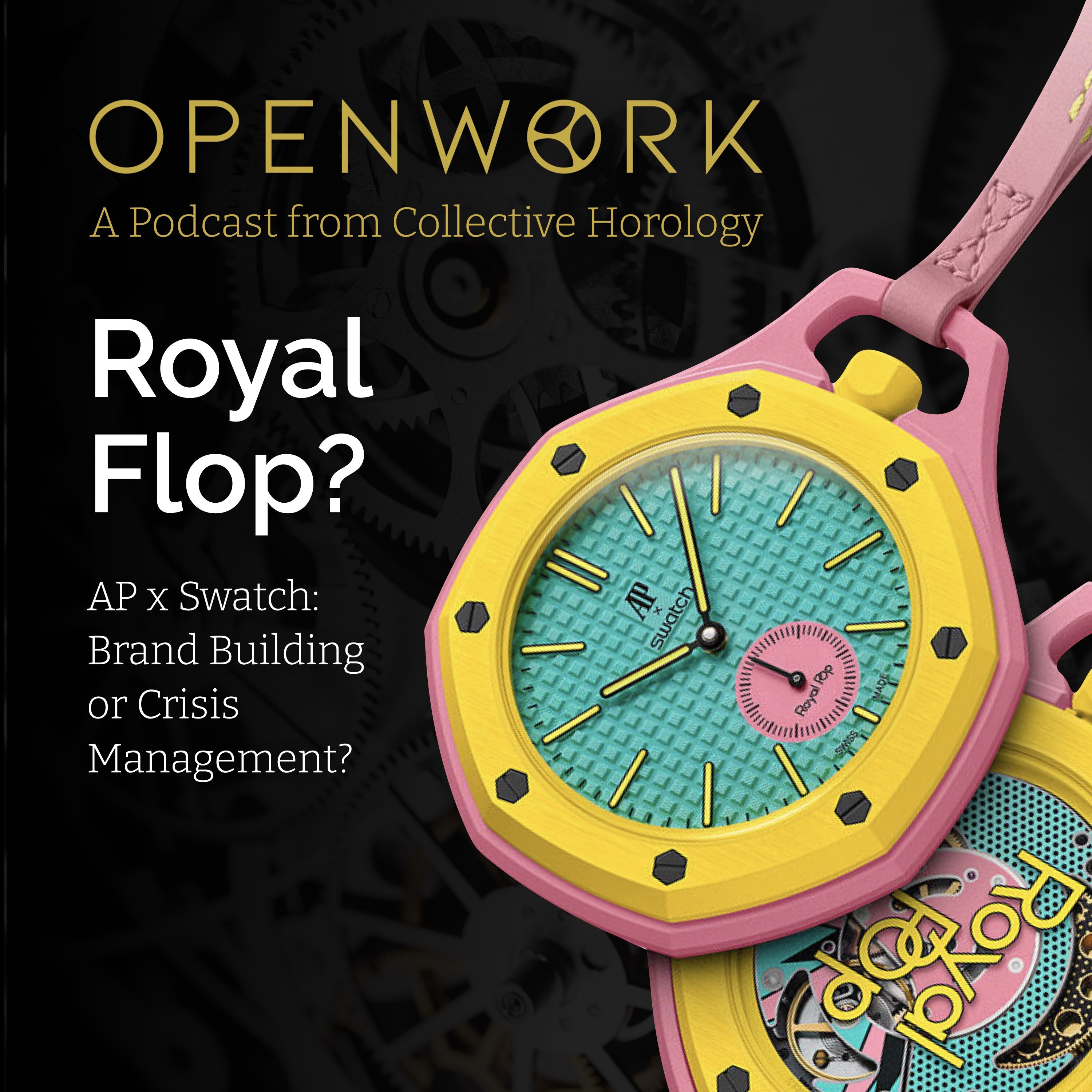
Openwork: Inside the Watch Industry
Royal Flop? – AP x Swatch: Brand Building or Crisis Management? – Episode 81
00:57:30
Loading summary
Transcript284 lines
- [00:00]
A
We recorded Today's episode on May 13, just a few days before the AP Swatch Royal Pop went on sale. We discussed the decision making and implications of this project for both companies, brands and businesses. And for many reasons, we consistently question why AP in particular would partner with Swatch on this project. Now, on the positive side, we do point out Swatch's competencies in production, distribution, marketing and retail of these kinds of projects, sales. Sadly, however, today's events, store closures, out of control crowds, and even fist fights undermine that case. And they only serve to underscore our skepticism in this project and the points we discuss on today's episode. In sum, this botched on sale has turned this project from an exercise in brand building to one in crisis management. Certainly not what AP or Swatch had in mind. All right, let's get on with the show. Look, I can't. We can't allow you to make another Royal Oak. Like, that's just not going to work. We need to protect that product and the brand. You can make like a pocket watch kind of version of it. And I'm sitting here from Swatch and I'm kind of like, yeah, man, look, I'll do whatever you want.
- [01:12]
B
Yeah, exactly.
- [01:13]
A
Like, I get. Wait, I get to make something.
- [01:15]
B
Yeah.
- [01:15]
A
Okay. This is openwork, a look inside the watch industry, a podcast from Collective Horology. I'm Gabe Riley, co founder of Collective.
- [01:25]
B
And I'm Asher Rafkin, co founder of Collective. Collective Horology is an independent watch retailer based in. You know what, let's just say it. Ventura, California. We carry a wide range of independent brands, including Carl Suki and Zone, Holten Ricks, Dominique Renault and more. To learn more about us and check out our available inventory, visit collective horology.com or. And you guys will only have to hear us say this for another couple weeks or come visit us at Open House, our annual event where you can go hands on with many of the brands that we carry this year, 14 of them. You guys have heard the spiel. I want to say one thing which we haven't said yet.
- [02:00]
A
News, news.
- [02:01]
B
There will be some special watches at the show that have not yet been released, including some that will be first available at our own Open House show. So if you are passionate about one of our makers, some of our makers, all of our makers, I suspect you will be excited about what we have in store for you. And the only way to know what that is is, is to sign up for the event and of course, join our mailing list.
- [02:27]
A
Yeah, I already know of two watches that will be there at the show, available at the show. Both of them are very wild, very wild watches. One of them is a collaboration, actually, of two of the brands who will be at the show. Who could it be? You're shaking your head.
- [02:44]
B
Yeah, we're not supposed to even say that.
- [02:46]
A
Why not?
- [02:47]
B
Because we were told that if we screwed that up, and I quote, if you ever saw Liam Neeson on the phone, I will do that to you.
- [02:56]
A
That was from the other two brands.
- [02:58]
B
There's another one.
- [02:59]
A
I'm talking about the other two brands that are cool. All right, well, speaking of feedback, we got some feedback recently that, about the watches we wear on this podcast. And so, first of all, if you didn't know if you listened to this podcast on audio only, although I suspect from the views on YouTube, a lot of people are watching this on YouTube now. We never do a wrist check, but obviously we wear watches every day. And some people have noticed, like, hey, you don't necessarily always wear independent watches or the brands that you sell. What's up with that? You guys shouldn't be wearing Rolexes or anything else. You should just be wearing the watches you sell. And, you know, I had to think about that in two ways. One or a few ways. One is like, I'm, I'm kind of shocked and amazed that anyone even, like, notices or cares. So that's great. Thank you. And then, too, you know, I always tell you this, like, we have to separate out being right from being effective. And like, part of me, the side of my brain that is like, well, you don't understand. We love all watches, not just independents, and clearly we love all watches. And we talk here about the industry at, at large and the business of watches at large, but, you know, separating being right from being effective, I think it's a, it's a good, it's a good point. You know? Right. While we've certainly put a huge financial stake on the line for this business and for the brands that we carry, and we own plenty of independent watches that are in our safe. I think it, I think it's reasonable feedback. So we're both wearing some, some special watches today. You've got a fierce Brunswick Midas, the original.
- [04:34]
B
No, no, no, no, no. You're gonna, you're gonna do a wrist check. We don't do wrist checks.
- [04:36]
A
And I've got on a, I've got on a Moser, our Moser collaboration. So I, I, I, I'm not doing the, the wrist check to do the wrist check.
- [04:43]
B
I want it, man, you broke a seven. What is it, 81 EP? True.
- [04:48]
A
We've mentioned watches that we're wearing all the time. This wouldn't be the first time. It's not a wrist check, it's an acknowledgment. First of all, we ask for feedback. So people who are forget just noticing and having a thought about it, but the people who take the time to actually share the feedback, thank you. And we take it to heart. So at least today you're not wearing a Rolex today, neither am I.
- [05:10]
B
You know what else neither of us is wearing today?
- [05:12]
A
I don't think that would be appropriate.
- [05:16]
B
Jesus. Also a Royal Oak.
- [05:19]
A
We are not. Yes, we're talking about. Well, nor are we wearing a Royal Pop. I've got nothing around my neck.
- [05:26]
B
Yes, indeed.
- [05:26]
A
Actually, I do have a necklace on, but it's not a Roy. It's not a Royal Pop.
- [05:30]
B
So I'm gonna. For those who listen to the podcast regularly, I think my opinion about the way that Odemar Piguet runs its business is pretty clear. So I want to preface this discussion by saying I'm going to take my skepticism and you know, I think frustration with the way that that company has chosen to run itself. And I'm going to put it aside for me.
- [05:54]
A
I feel the same way as you, however, maybe a little bit differently. This has actually changed my mind in some ways about Grape.
- [06:01]
B
So we're going to talk about this,
- [06:02]
A
but I think we have to acknowledge the bias.
- [06:04]
B
Yeah, but I want to look at this project because there's obvious. I mean, look, every single person listening to this podcast loves watches enough that you've had a fire hose of this Royal Pop. Either it's whether it's the, you know, AI slop variants before they actually came out or the actual, the actual clocks themselves coming at you. You know, you probably consumed as much about this watch as you ever could have wanted to. Plus, by the time this episode drops today is Wednesday the 13th that we're recording it this Saturday is when these watches go on sale. So I'm sure we're going to go through tsunami wave of, you know, or not of people waiting outside of Swatch boutiques waiting to to buy these, these co branded items. What we want to do here is to look at this from a case study standpoint within the context of both brand product and the business of ap. And for that matter, Swatch.
- [06:58]
A
I think that's more existential to Swatch than it is ap.
- [07:02]
B
I do, I do too. Well, sort of. But you Swatch is Obviously, a big component to it. So I want to look at it from that standpoint. I think there's a lot of questions here and a lot of sort of interesting. There's a lot of things to look at here. I don't think this is a simple. A simple question, and there's a lot of hot takes out there. So, you know, I'd like to challenge us both as we look at this to really be thoughtful about how we approach this and avoid, I think, some of the, you know, the scorched earth.
- [07:29]
A
You know, I don't have a scorched earth. I mean, I have. It's interesting. I have both some very strongly negative thoughts about this. I believe that's scorched earth, and strongly positive thoughts about this that are. That live side by side and are creating this state of cognitive and emotional dissonance.
- [07:48]
B
Well, this platform that Swatch has created here, you know, with the Moon Swatch and with the Scuba, has definitely, I think, elicited that feeling in a lot of people where you hold those two different ideas in one hand.
- [08:04]
A
You know, for me, less so with those and more with. With this. I. I mean, just starting with the. The. The Omega Moon Swatch and then the. It's called the Blancpain Scuba Scuba.
- [08:18]
B
I don't even think they call it the 55.
- [08:19]
A
It's a scuba Scuba. I think those are fine. I mean, I owned. I. I suspect you have as well. I've owned a Moon Swatch. It was. Okay. I kind of lost. Lost interest in it, but, like, I. I get it and look it. It. I think it worked wonders for the Omega brand. It's actually helped the. Ironically, maybe it's actually helped put some more shine on the actual Moonwatch itself. I don't know if I could say the same for the. The Scuba or whatever it is, but, like, they're. They're fine products. I get it.
- [08:47]
B
Well, so this is. This is where I want to start. I want to start by looking at this from a brand standpoint. And then let's talk about product.
- [08:53]
A
Okay.
- [08:54]
B
When we think about the Moon Swatch or we look at the Scuba, that is intellectual property that is owned within the Swatch group in many ways, whether you like them or you don't. I think it is almost impossible to say that the moonswatch was anything other than a stroke of genius and an absolutely exceptional marketing play. Forget about the revenue.
- [09:16]
A
I mean, the revenue was commercial success, too. I mean, we'll get to the product in a second. They talk about in the. Well, it's important to the shine of the Swatch group overall. I mean, the Moon Swatch in particular has been a huge driver of success for their business.
- [09:30]
B
I wish I had the data for this, but anecdotally I can certainly confirm that there are many clients out there. And I just had a conversation actually yesterday with, with a friend of mine who specified, you know, like, I went out and I bought a Moonswatch and after about a week and a half I realized what I really actually wanted was a Moonwatch. And then I went and bought it. I bet the conversion rate from Moon Moon Swatch to Moonwatch is not insignificant. I don't know. And there, there is this, there is this thread of a theory that, that weaves across each of these projects and Hilarious herself says this, the CEO of AUD RPG in a post on LinkedIn today, the 13th that they operate under this theory that Swatch watches exist for young people and that these are somehow gateways into these luxury brands that will hook these people into a love of watchmaking. I'm going to quote Hilary Oresta on this here quote. This is a one off collaboration with a singular ambition to ignite collective desire.
- [10:31]
A
Oh, thank you.
- [10:32]
B
To spark the kind of cultural conversation that makes people feel about watches the way they feel about art or great cars. Making mechanical watchmaking something cultural, emotional and alive, perpetually relevant, even when it is entirely unnecessary. Because every generational shift is a reminder. An industry that turns inward and stops connecting does not just lose relevance, it loses its meaning. Okay, so let's, let's decorporatify that. Basically, what she's saying here, her thesis or one of her theses, is I'm going to bring more people into independent, pardon me, into proper watchmaking by making this available to them. Now we'll talk about this in a product.
- [11:09]
A
The general point of like having watches that break through to culture, mainstream culture is a gift and no one should take that, take that for granted, or take that lightly. In fact, it's something that we should all aspire to. I think there is a lot of inward looking and navel gazing in the watch industry. That's dangerous because the more we do that and the more we bicker with each other over englage and Escape mints and what's in house, it's like the more we lose relevance in mainstream culture and the more we close the door to this hobby. So I would agree with her point. Overall, I think the Moonswatch does that successfully. I don't know that the Scuba did. And we'll talk about the AP Collaboration, I'm not sure that will either.
- [11:51]
B
Yeah. So I think part of that though is also a gross misunderstanding of what it is that she's trying to do. Because the other thing that she says here is that, and I'm going to quote again from her comment here, this project has a quote. This project has a deeper ambition to safeguard rare watchmaking savoir faire that risks disappearing entirely. That is why Audemars Piguet will donate 100% of the collaboration's proceeds to support the artisans who keep high watchmaking alive through scholarships on the next generation and financial support for those who craft whose craft is under pressure. Hmm. Okay, here's when I take a step back and I look at this from the brand standpoint. I am very skeptical of a lot of this because it feels to me like some of this comes from a, honestly, like I think a really good place. Some of this comes from an incredibly like self serving place. And some of this is just bullshit. So let's break that down.
- [12:50]
A
I think some of it is also very shrewd.
- [12:53]
B
I think we're saying the same thing. So from my standpoint. All right, let's talk about the. This is not going to make, this is not a support for watchmaking. These are like, these are, these are cheap watches, these are plastic watches. These are disposable and irreparable watches, as all swatches are. That doesn't make them a bad watch. You know, like this isn't like everything has to be a $20,000. Of course not. But is this watch making of a variety? Of a variety?
- [13:23]
A
I think it is of a variety and I'm not sure I agree with you.
- [13:26]
B
That's fine, but let me finish the thought.
- [13:28]
A
The idea of a mechanical watch and what is even a royal oak into mainstream culture.
- [13:35]
B
But hang on one sec because I want to extrapolate a little bit because what she's doing here is she's saying she's connecting two ideas that don't really jive. Right. Because what she's basically saying is I'm going to work with Swatch who makes, you know, machine made, extruded cheap products
- [13:55]
A
isn't necessarily a bad. No, no, no, I'm not careful.
- [13:58]
B
Yeah, I'm not saying that as like I'm like judging anyone who loves watch. I'm just saying that is factually what they are.
- [14:04]
A
Yes.
- [14:05]
B
They're disposable, fast fashion versions of watches.
- [14:07]
A
Yes, well said.
- [14:09]
B
And then she's saying I'm going to, I'm going to use that to Hook people into watchmaking. Okay? Now, you can make an argument and say, all right, look, man, you know, people go to Zara, they buy suits, you know, because that's what. That's what they want. That's what they can afford. That's fast fashion. And then over time, maybe they end up buying something from J. Crew. And then after that, they go to J. Press. And then after that, they go to, you know, X, Y, and Z. And by the time they're in their 40s, they're, you know. You know, buying a really nice suit from. From the Armory. Okay, fair enough. But that. But nobody's saying that Zara's tailoring. You know what I mean? It's a cheap suit, and you're not gonna expose people to the beauties of handmade tailoring from a Zara suit. So it's a little thin, but here's the. Here's the.
- [14:54]
A
I think you're being a little bit literal there.
- [14:55]
B
I think I'm being very literal.
- [14:57]
A
I think it opens people's eyes to a world. So this certainly happened. Okay, but this happened with the moonswatch, and this happened again with this thing before it was announced. I had people who know that I have a watch business.
- [15:08]
B
Yeah.
- [15:08]
A
Don't know anything about watches, except Gabe's the watch guy, who are texting me about this and asking me what. I think this is putting watches into mainstream culture in a way. And what it does. You're right. Are these the fast fashion versions of watches? Yes, but what it does is it points to. There is a whole world of watchmaking out there that you have maybe not thought about, considered, or. Or even been aware of. And it. It just opens this portal to this other world. Are these products themselves high watchmaking or fine watchmaking? No, they're not. But they certainly open a portal to that world, I think that's fair to say. Or in my. In my.
- [15:52]
B
I think what you're stating is her thesis, which. Which, by the way, may very well be proven true.
- [15:57]
A
It's not. I'm not just stating her thesis. I'm saying I see proof of that thesis or I see evidence of that thesis playing out. When I have people who know nothing about watches asking me about this and curious about this and wanting to learn more about ap.
- [16:11]
B
Well, see, I haven't heard a single person say that to me, but I did about the moonswatch, and I make an argument about that, which is to say that the Moon Swatch and the moon watch have a place in cultural history and knowledge that APs do not.
- [16:23]
A
I think AP does have a place in culture. If you look at. I mean, one of the successes of the last CEO, Francois Benjamias, was that he did a lot of work to take HP AP out of kind of the world of the watch enthusiasts and the Cognizanti and put it into mainstream culture, not just through collaborations with Marvel, but by putting it on the right wrists and putting it into culture. You have APs being mentioned in rap songs. You have celebrities on Red cross carpets wearing APs. These are things that weren't happening 20 years ago. The brand is in culture now. Is there a certain segment of the world who can even afford or forget a Ford get access to these things?
- [17:11]
B
For sure.
- [17:12]
A
But I do think AP is. Look, it's one of the big four brands, along with Rolex, Patek Philippe by revenue and Richard Mille by revenue. They dominate the market even if they don't make a ton of watches. I do think AP is one of the few watch brands, along with Rolex and Patek Philippe, that has broken through to more mainstream culture in a way most watch brands have not. So I would argue. Is. Is the. Does the. Does the Royal Oak have the same history or cultural resonance writ large as a Speedmaster? No, it doesn't have all those same ingredients. But is it a much more culturally relevant watch brand than the average watch brand? 100%.
- [17:53]
B
So I want to agree with you, and we'll get to this when we talk about product, but if that's the case, their choice and form factor for this product is bizarre.
- [18:03]
A
Well, I think, yes, I understand why
- [18:06]
B
they're doing it by trying to have
- [18:07]
A
their cake and eat it, too. So I think the same reason AP is saying we're donating the profits here.
- [18:13]
B
Well, we're gonna. We're gonna get to that.
- [18:14]
A
I think. Well, you already brought up. I think that's shrewd because if they. If they had just taken the money and thrown it to their bottom line, that would have looked like greed. That would have looked like selling.
- [18:26]
B
Oh, they are doing that, but they're doing it in a much more clever way.
- [18:29]
A
We could talk about that, but I think by them saying, like, hey, we're donating this, it. It removes that argument. It doesn't look like just a cash grab for them. The fact that they did a pocket watch or a necklace and not an actual watch try. I think they're trying to have their cake and eat it, too. And again, be rather shrewd here by saying we're not cheapening The Royal Oak. By making a plastic wristwatch, we're making another object that's inspired by the Royal O. That isn't a substitute or just a facsimile of it. It's a totally new form factor for this design language and this. This esthetic. I think the problem with that is if you're doing this to create a cultural moment, I'm not sure that a pocket watch is the product to do that.
- [19:16]
B
So.
- [19:17]
A
So we'll come back, create the next moon Swatch and the next thing that people are lining up for. I don't know that you do that with a pocket watch or a pendant.
- [19:26]
B
100%. So, look, I think we can go back and forth on this one a little bit. You know, I will agree. The fact that everybody is talking about this, that it is growing into Main street, that is, it is appearing in mainstream press, that it has gotten the attention that it's getting, does prove that Swatch is an absolutely incredible platform for the expansion of awareness for some of these other brands.
- [19:52]
A
Yeah. But I think you have to. I think you have to separate the chatter about this and the conversation about this and the cultural impact of this into two things. One is that conversation and that chatter before the thing was revealed. And two is now the conversation, the chatter and the cultural impact that everyone knows what this is, which is a necklace.
- [20:13]
B
Yes.
- [20:13]
A
So I think those are two different things. With the MoonsWatch, it wasn't with the moon, because it was.
- [20:19]
B
Well. And look at what's happening right now. Right. Everyone's immediately offering mods to make it into the product that they wanted it to be.
- [20:24]
A
Yeah. Or. But with the Blancpain, it wasn't either. It was like we were expecting a Blancpain, a plastic Blancpain watch, and that's what we got. And it was like it was teased, there was some excitement granted, less than the. Than the moonswatch. And when it was revealed, it was like, oh, yeah, that's kind of what we were expecting. Cool. This is. Oh, my God. AP Swatch. What are they going to do? This is incredible. We're so excited. People are lining up before they even know what it looks like, then it's revealed. And I gotta be honest, I think overall, if I look at all the sentiment I'm seeing, whether it's comments on social media or in groups, I'm in things like that. It's kind of a sad trombone.
- [21:03]
B
So let's talk about the product in a second, because we need to discuss the other thing that Hilaria Resta said as the rationale, you said more, you've got more. She will donate 100% of the collaboration to the proceeds to keep high watchmaking alive through scholarships in the next generation. And I really want to focus on this next sentence. Financial support for those whose craft is under pressure. Hmm. So I did a little bit of research and wouldn't you know it, there is no public statement whatsoever about what charity there's actually, they're actually going to be donating to nothing. So I'd like to offer a theory. Here's what I think is happening. There is a significant labor shortage in Switzerland, globally, really, for watchmakers. We see all sorts of solutions to this program, right? Rolex has a school. All of these large companies have apprentice programs. Modern watchmaking, industrialized watchmaking, of which the majority of AP watches are, is essentially a form of assembly line production. They don't like to describe it that way, but that's basically what it is.
- [22:11]
A
You got to run your company efficiently 100%.
- [22:13]
B
You got to figure it out. Same thing with Omega. You can't make a million watches if somebody's sitting there. Not, not that AP does. I think they make 70,000. But 70,000 watches, I mean, like, let's just do the math, right? I mean, 70,000 watches, if they were, if somebody worked every single day, you're still pushing out 190 watches a day. They don't work every single day. So it's hundreds of watches a day are being made. You have to industrialize it. That means you need people and you need people who are talented and skilled, who can execute this and not scratch a bridge and not, you know, ruin a screw.
- [22:42]
A
Blah, blah, blah, blah, blah.
- [22:44]
B
So by quote, unquote, donating this to something, we don't know who. My guess is what they're doing is that they're pumping it into a. Either a, not for profit. And again, this is a theory that they're a party to, that they are partner with, maybe that they own who knows where they will be using that money to train watchmakers, which will then help them staff up their business now.
- [23:05]
A
Well, that's a conspiracy theory.
- [23:07]
B
No, I don't think it is. Because there's two ways to look at that. You can say, oh, it's a conspiracy theory. How dare they. It's self serving. I'm like, actually it's pretty great because just because you go to a school or you work for a specific company doesn't mean you have to work there forever. You're not an indentured servant. If you get trained by ap. You work there for a few years, you can do what you need to do, and you get hired, then you know what they're making. Jobs. Is that a bad thing? I don't think so. But is it completely altruistic? No, but those two. Those two incentives align. You know, we need watchmakers. We'll train watchmakers. We'll. We'll take the profits from this program and we'll put it into a program that helps us get more watchmakers. It helps us make more watches, helps us sustain the business. That's not a bad thing. No, it's not. Who knows what they're doing because they're not actually telling us. But if that's the case, I dig it. Now, here's the other side, and this is the part if you want to get conspiracy theorists.
- [23:56]
A
So AP is donate. I did some research here myself.
- [23:59]
B
I couldn't find anything. Could you?
- [24:01]
A
You know, I got perplexity here, man. This is the research tool of the century. So what I'm seeing here is that. And the source is from the AP website, is that AP is donating to the Audemars Piguet Foundation.
- [24:15]
B
Right. So, okay. So theory.
- [24:17]
A
Foundation focused on environmental, educational, and community programs formerly found.
- [24:22]
B
So my. So my. My. My theory is correct.
- [24:25]
A
Yeah. But is the. The fact that there's an AutoMrp. Gay foundation, some terrible.
- [24:31]
B
No, no, no, no, no. I'm not saying it's terrible. What I'm saying is that's what they're doing. They're taking this money. They're. They're. They are taking it.
- [24:38]
A
They're not giving it to some third party.
- [24:41]
B
They're not donating to vstep.
- [24:42]
A
Sure.
- [24:42]
B
You know what I mean? They're donating it to themselves to create programs, to create watchmake.
- [24:48]
A
They will hire again.
- [24:50]
B
Is this a bad thing? I don't think so. Vocational training is important. Creating opportunities is important. They're not exactly being direct, but let's.
- [25:00]
A
Again, I think they're being incredibly shrewd with this aspect of it, which they are. Which is. Which is to say this is about. You and I both know that whatever money AP makes on this is trivial relative to their core business. Right?
- [25:16]
B
I don't know that. Do you?
- [25:17]
A
I'm. I'm gonna guess. I mean, this is. They don't need this project, is my point.
- [25:22]
B
Like, I don't know that. Do you?
- [25:23]
A
The. The brand is doing well. Their sales are up. I think they said. Hilarious. Said the sales was up. Revenue is up 10% year over year.
- [25:31]
B
Brand. I'm T, you're. Now you're talking about the business.
- [25:34]
A
I think the business is fine.
- [25:35]
B
Sure.
- [25:36]
A
Regardless of this project. The business doesn't need this project. I don't think the brand does either. We can talk about that. But I don't think the business of AP needs this project. So I think it's incred. Shrewd for them to just say, we're not taking this money and putting it in our pockets. We're donating it to charity. I think that's smart.
- [25:53]
B
It is.
- [25:54]
A
Now, how exactly they do it, we can pick it apart and scrutinize it. But I do think that that is purely a sort of a PR and communications. It is, and it's a smart and a savvy one. It is because it allows them to escape any criticism that they're selling out the Royal Oak or this is just a cynical cash.
- [26:12]
B
Okay, but let's just, but let's call it what it is. They're donating to their own foundation, which someone I suspect controls, who probably is also on the board of ap. So, you know, did they. So really, what are they doing? They're just taking the money and they're allocating it to another project that is tax exempt. Again, like now draw your conclusion.
- [26:33]
A
I would suspect in Switzerland, as in other countries, there are criteria that a non profit organization or a foundation must.
- [26:40]
B
Me, I, I'm. All of this is theoretical because we don't have evidence of it. But we're looking at what we're seeing. Right. And that's that. And again, I want to be clear, I don't think this is bad. I just find it interesting that this is how they're organizing it. But then there is the other sentence
- [26:55]
A
here, which is there's more from the
- [26:57]
B
quote, the financial support. It keeps giving financial support for those whose craft is under pressure. So the way I read that is kind of the same angle that LVMH is taking with independent watchmaking, which is to say we, AP would love to help independent watchmakers and supply chain folks and things like that through our largesse, through this project. And I guarantee you that will be in exchange for, you know, something contractual. It's interesting when you look through like the LVMH award contract, there's a lot of stuff in there where independent watchmakers in exchange for.
- [27:41]
A
So when they sign up to participate in the program, they sign a contract.
- [27:44]
B
Oh, yeah. And there's a lot in there about the expectations of that watchmaker and also the expectations of lvmh, you know, to Be clear. But it's not a free ride. And I have to imagine that there's probably something in their mind around this which is like, well, let's take the money from this project. Let's use it to invest in training watchmakers and scholarships and things like that. We have a vector for that. That's our foundation. Everybody wins here. Let's do that. Okay. Then there's this other sentence which is very vague, but I think is open to interpretation, and says, maybe we take some of this money as well and we use it to bolster the supply chain, which also helps our bottom line. Or we take this and we use it to, you know, support an independent watchmaker who can help add some, you know, help add some. Some. Some juice to our moribund product line and things like that.
- [28:33]
A
I don't. I'm not so cynical.
- [28:35]
B
I don't think that's cynical, man.
- [28:37]
A
I think.
- [28:37]
B
I think this is business doing business.
- [28:39]
A
But. But I, I don't think it's worth singling out. Ap. I mean, you've said LVMH is doing something. Sure. Rolex does something similar. I mean, they go out of their way to say, like, you know, we support the watchmaking industry as an ecosystem overall.
- [28:52]
B
I mean, if you want to go there, I mean, Rolex essentially is hypothetically enough for profit.
- [28:56]
A
Yeah. So I, you know, I'm not, I'm not so sure that this is like some, Some conspiracy that we all need
- [29:03]
B
framing this up as if it's a conspiracy. And that is not what I'm saying. What I'm saying is we need to look very clearly at what they're telling us with open eyes.
- [29:12]
A
Sure. Which is that they're going to have discretion over how this, how these funds are distributed.
- [29:19]
B
And when they say they're donating it to charity, that is factually accurate. And in practice, not so much.
- [29:25]
A
Well, there could also be a game of telephone here where people read this, they glaze over the press release, and they say charity, when AP has been saying all along, as I said on their website in their press. Press release, the proceeds go to the AP foundation, which does many things, including education. So there we have it. Now we. I said the business. And you were right to, to force me to be clear with my words, I said the. The business doesn't need this. The brand doesn't need this. You think the brand does need this?
- [29:56]
B
No, I don't. And it makes me wonder what it is that they think they're accomplishing from a brand standpoint.
- [30:03]
A
Interesting thing about that's the biggest puzzle of all of this.
- [30:05]
B
Like, here, let me, let's go back to our thesis that this brings people in. Like, putting aside the cultural thing, which I agree with you completely, but let's just talk about this as a gateway, right? Like, how many people who buy MAD watches buy mbnfs? I don't know. But like, you know, interesting question. Same question here. How many people who buy Royal Pops, you know, are going to buy a Royal Oak? Well, I know the answer to that. That. Well, they're going to go to the Audemars Boutique and they're going to get the same treatment that anybody else gets. Because if they walk in there and they think that like their 300 like plastic dongle is going to suddenly, like, open a door for them.
- [30:38]
A
Yeah, basically we're just, we're just sending more people into the buzzsaw here. Kind of like for a brand that says all the time, well, we have, we don't make enough watches. We can't accommodate all the demand we already have. You walk into the AP boutique, you get the stiff arm or they try to bundle you on a less desirable watch. Now we're going to. More people running into that.
- [30:58]
B
Just, just imagine, imagine some of the customers. No, imagine what we hear when someone walks in there is like, hi, I have 5 or 6 Odem RPKs that I've collected over the last 10 years and I'd like a 15202St. Best of luck in your future endeavors. Now, if I show up and I'm like, hey guys, I've got like three plastic pocket watch dongles and a monocle, like, who's going to hook me up?
- [31:20]
A
Oh, you do have a monocle.
- [31:21]
B
I do have a monocle. So get that guy, get that guy a watch. But, but you see, it's very different
- [31:25]
A
from I, I bought a moonswatch or I heard about the moonswatch and I realized that what I really want or opened my eyes to me, I really love Speedmaster. Okay, go into the store.
- [31:35]
B
You want Speedmaster at retail, Walter Socheck and get you one by three o'. Clock. You don't want to know how. You know what I mean? My point is, like, you can get one. Yeah, you can't get one of these. So they're just setting this up. And it's, it's bizarre to me too,
- [31:50]
A
because they, you're right. They risk making the core the what is the Achilles heel of the brand, which is the way that they treat potential customers. They actually risk making that problem worse for themselves 100%. And for more. And treating more people in that way. So why would you do that?
- [32:09]
B
Like, so to that point, I don't like. Sure. Could you make an argument on a slide in a presentation that's like, we believe that we'll see X percentage of conversion over time by bringing younger people, you know, who are more, like, oriented towards experience and less towards objects into watchmaking. And, you know, let's all approve this and everyone around the board, you know, boardroom goes, yes, great idea. I see that. But I don't know that AP needs it. And I would go so far as to say that, look, maybe AP is the aspirational first watch for. For some people, that is entirely possible. I believe that that's true. And maybe. Oh, I think that's 100%. And I believe also that, like, by doing this, they'll broaden the horizons of folks who may not have paid any attention before. Get Bob, all the things we just talked about. About doesn't solve their. Their core problem, which is that nobody cares about any watches they make, you know, other than the Royal Oak.
- [33:02]
A
Yeah, you're exacerbating all.
- [33:04]
B
You're right. I mean, if the royal pop was like the, you know, the royal, like, remaster. You know what I mean? Like, the remaster pop. All right, well, maybe you're creating some degree of demand. Obviously, that would be not successful because nobody knows what that is, you know, or like the Jules Artemar pop, you know, code 1158. Exactly.
- [33:22]
A
Pop.
- [33:23]
B
You know, but the point is, like, I get it, but you're just generating demand for a thing you can't service anyway, so weird choice, but follow. Follow your bliss. Let's talk about the product.
- [33:33]
A
So I get why they didn't make a watch.
- [33:36]
B
Totally. I totally get it.
- [33:37]
A
It protect. It actually protects the Royal Oak itself. It doesn't cheapen the Royal oak itself to give them credit. I'm going to give both Swatch and AP some credit here. I think what they're trying to do is, like, create a new product fad or new product category, which is a very bold thing. Like, I've heard a lot of people
- [33:56]
B
say, like, I think they're trying to make fetch happen.
- [33:57]
A
Yeah, yeah, I think. Exactly. I think I've heard a number of people say, and I. I agree that this is the goal. I don't know that it will happen, but it's like they're trying to create the next Labubu, you know, like, and I get that, like, they want this thing to be a product category. Of one and a cool thing to have. And maybe someone wears it as a necklace. Someone told me in a text message. Again, someone who knew nothing about AP or like, I might want to put one of those on my purse, you know? Sure.
- [34:23]
B
Like, my daughter would hang one of these from her backpack. You know, not that I'm buying her $300.
- [34:27]
A
Way to mark yourself as a target. But like, don't. Don't watch our two.
- [34:31]
B
Imagine.
- [34:32]
A
But like, you know, like. And so I think that that's actually bold. Sure. I think that that's daring. I think that that's risky. They didn't do the safe thing, which is make a facsimile of a royal oak as a watch. Like, that would have been the EAs. They chose the harder path here, which we can discuss because I don't know that this is going to have the same product resonance. I don't know that this. I respect the strategy, but they, they took a risk.
- [35:01]
B
I respect the product strategy. Put me on the record for that one. You know, don't ever say the obvious thing. They did not do the obvious thing. They could have done the easy thing and they didn't. Now, whether that will play out in terms, I mean, I do think we're going to see a massive opening weekend of sales. Of course, you know, whether or not sustained. I don't know that it will. I mean, she refers this as a one off, so maybe it's limited. I don't know. Look, I, I don't. There's a reason why the pocket watch isn't as popular today. And I love pocket watches. But isn't as popular today as it was in the past. Because there's better form factors.
- [35:34]
A
Yeah.
- [35:34]
B
Yeah.
- [35:34]
A
We have some, some AP facsimiles here. We got a AP wall clock. Yeah. And then we have. Actually, you want to talk about some cool stuff? Like, we have a small collection not of pocket watches, but of stopwatches. This is a Minerva. We had a couple of Minerva stopwatches. We got a hoyer. Like, we have a cool desk clock there from the folks at Solabs. Like, these things are really cool and neat, but they're niche.
- [35:59]
B
Exactly.
- [35:59]
A
The only person who cares about an AP wall clock or a Minerva stopwatch or a Solabs desk clock, as cool as these things are. And we have them because we think they're really cool are watch nerds.
- [36:13]
B
Yeah. So that. But which goes against the theory that they're presenting.
- [36:16]
A
Exactly.
- [36:17]
B
You know, which is why it is maddening. And I look at this and this is why when I, you know, you were accusing me of being a cynic or skeptical or conspiracy theorist. But if you really zoom all the way out here, let's describe this project. We're going to take some of the most valuable IP. In fact, I would argue for AP, the most valuable IP intellectual property, one
- [36:40]
A
of the most valuable IPs in all of watch making, one of the most valuable IPs in, in the world of product.
- [36:45]
B
Right. We're going to take that and we're going to democratize it through a fast fashion machine. And then what we're going to do is we're going to take away its core identity, which is a watch, to put it into a form factor for which nobody's been asking for, doesn't mean there might not be interest. And then we're going to take the proceeds from that and we're going to fund our own charity with it, which is regulated presumably by them, to potentially educate watchmakers, which I suspect will help the industry, but also them. And then this other thing in the corner about what they're going to do with, you know, people who work in the watch industry under duress, whatever that means. Weird. But for one thing, for one thing, let's talk about the Swatch group here.
- [37:33]
A
Yeah. Yeah. Well, I, I have a, my own Rube Goldberg machine here, which is. I do want to. We've spoken a lot about ap. I do want to talk about.
- [37:43]
B
Well, I, I really want to talk about Swatch. Yeah.
- [37:46]
A
2 thoughts on AP. One is like, I see it a little bit differently, which is like, we being culturally relevant is part of ap.
- [37:53]
B
Yes.
- [37:53]
A
You know, like, that's one of the things that they've done really well that has contributed to their success over the last 10 to 15 years is they've realized they can't be just a watch brand, but they need to be a brand and they need to be a cultural force.
- [38:06]
B
Yes. And me, and me sitting here with strong feedback about it is the relevancy.
- [38:10]
A
And they've done that.
- [38:11]
B
Yes.
- [38:11]
A
So now they're like, what's our next move on the chessboard of cultural relevancy? You know, it can't just be about the, you know, a mention in the next rap song or the next red carpet at the Met Gala or whatever it is. What's our next move? Let's do a project that gets our name and our, you know, one of our core brand assets, which is the design, their core brand asset out there in the culture. Everyone's talking about it. Everyone wants it. There's lines for it. And the way we're going to do that is to make the most insidery horological product we possibly could, which is a pocket watch. Like, that's what. What. And I know why. It's like, well, we can't make a watch.
- [38:57]
B
Not even technically it's a pendant.
- [38:59]
A
Well, a pendant. It's like we can't make a watch a wristwatch. So what do we do? We want to be.
- [39:04]
B
It's like they already made the clock.
- [39:07]
A
The, the. You know, the biggest thing they could do to have this huge cultural impact was make this horological object that is something that is likely only to appeal to insiders.
- [39:17]
B
Yeah.
- [39:18]
A
Like, that's what. Now, I could be wrong and we could be eating crow. This really could be the next Labubu. But product hits like Neato or Labubu or Snap bracelets or whatever it might be.
- [39:31]
B
Yeah.
- [39:31]
A
They catch fire and they become popular. Not because they were designed to be. It's just dumb luck.
- [39:38]
B
Yes.
- [39:38]
A
Lightning strikes. You can't make lightning strike. You can't put it in a bottle. And that's what I find so, so puzzling here. Now, the one thing where I will eat crow is we were pretty harsh on AP and the way they showed up at watches and wonders by saying they showed up and they had closed doors, they couldn't even be bothered to put a watch out. And a number of people told us, like, yeah, well, we actually were able to get in there. When we went inside the booth, it was this really cool wonderland. And like, I don't know, it actually was one of the more interesting things at all of all of the fair. I still stand by the. Putting the velvet rope up in the closed doors wasn't. Wasn't the look for a brand that said they want to be at the center of the watch industry and participate in the watch industry's most important event and be a good corporate citizen in the industry at large. I will say, as puzzling as I find this product and this project for ap, I do think it is them showing up and participating in the wider watch ecosystem. And that to me, is surprising, unexpected, and not something I saw coming. So I will give them some credit for that. But they're doing it with a curious partner or strange bedfellow, which is Swatch Group.
- [40:58]
B
I think the fact that everyone looks at this and says, there is no one who's like, oh, they're doing this with Swatch because it is the only company that can do this. And say what you will about the Swatch Group and brand management or whatever, they have proven that Swatch as a platform is a cultural accelerator like nothing else in the watch industry.
- [41:26]
A
Well, couldn't you argue the opposite? Which is to say, if we look at. If we look at the Swatch, these products, whether it's the moonswatch, the Scuba, or now this, I would argue maybe it's the opposite. It's like Swatch needed the Speedmaster to catch fire again. They released the Blancpain Scuba collaboration, and the world was like. Like, yeah, they do this collaboration with ap, and everyone is so excited about the product project because it's an AP and a Royal Oak. And then they see what the product actually is, and they're just like, huh, Okay, I guess so.
- [42:04]
B
But I mean. But there's two parts that, like, you're saying two things. You're saying that the money doesn't matter, and it's the cultural relevancy. You. The cultural relevancy for both Blancpain and for Omega and ap, all of that went up and the attention went up. Who cares how many of these they sold in. In that sense, yeah. But more attention for Blancpain than Blancpain's
- [42:27]
A
gotten in forever because they effectively lowered the entry price of a Blancpain. It's nothing to do in my mind. I like Swatch. My first watch was a Swatch. I've collected Swatch watches. I know a lot of people love them. I own Swatch watches. My kid has a Swatch. Like, I get, like, no shade on Swatch. But I think the borrowed interest here goes the other way, which is to say it's Swatch borrowing interest from Omega, Swatch borrowing interest from Blancpain, Swatch borrowing interest from ap, because what they're doing is democratizing those products that are premium products or out of reach. So I don't necessarily view Swatch as an accelerant on Omega or on ap. I view it as the opposite. It's borrowed interest. To make Swatch more relevant, I think we don't.
- [43:17]
B
I think to answer that question, we would need data that we don't have, which is the conversion rate of the million, you know, moon Swatches that were sold in 2022 into. Into full on speedy buyers.
- [43:29]
A
Sure. Well, let me put it this way. No one was lining up outside the Swatch store until they put an Omega logo in the window or a Blancpain logo in the window or now an AP logo in the window. And to me, that's all you need to know. The borrowed interest is going the other way To Swatch.
- [43:44]
B
I guess I think the flip side of that, I mean, yes, that's true. That is true. But I think the other side of that is who else in the industry would be capable of doing this? That's my point. That, like, sure. Is Swatch, you know, trading at that same level of interest Of. No, it's certainly not. But because of the, the, the infrastructure that Swatch has from a, from a production standpoint, there is nobody else that can do this.
- [44:10]
A
Oh. And I think the Swatch brand means something and has value and is a. And Swatch is a platform that can bring other.
- [44:17]
B
Exactly.
- [44:18]
A
Whether it's pairing or AP or whatever it might. How many cool co branded Swatch collaborations? You got a Van Gogh Swatch. Those are cool. Like, it's a. They've. They've defined Swatch more than anything. Not just as its own. They've defined it both as its own brand and identity. Identity, but over the decades as a platform for collaboration.
- [44:40]
B
So from Swatch's standpoint, Swatch is not saying anything about donating anything.
- [44:44]
A
No, they need, they need the money.
- [44:46]
B
So Swatch, they owe. They owe money. And we're going to quote the big Lebowski, as much as we can here. Look, I think, I think.
- [44:51]
A
But for Swatch, look, look at the financial results of the Swatch group overall. They need this to succeed.
- [44:57]
B
Well.
- [44:57]
A
And there's material to their business in a way that it isn't for ap.
- [45:00]
B
Well, and there's another side to it too, which is notice how all of the discuss discussion and all of the feedback and all of the opinions and what. How long have we been talking about this? We've been talking about this for 47 minutes. Right? All of the. We've just been talking about ap.
- [45:12]
A
Every time I edit out most of what you said, It'll be 20 minutes.
- [45:15]
B
Exactly. But my point is, all we've talked about is AP for Swatch. We're like, oh, yeah, totally.
- [45:21]
A
I mean, I think for them it's a coup.
- [45:23]
B
It is. That's my point where I'm just like, for Swatch, I'm like, good job, dudes. Like, great job. You get. You nailed it. Whether this thing is a success or a failure does not fall on the shoulders of Swatch. You know what I mean?
- [45:36]
A
No, but benefits. Look, I think if I was Swatch
- [45:41]
B
from a brand and I'm on the
- [45:42]
A
other side of the table and I'm yeah, sure.
- [45:44]
B
Like, can you see any way this hurts the Swatch brand? No, I can't.
- [45:47]
A
And it's like, you'll take what you can get. Like, if I'm the person from Swatch and to role play a little bit here, and you're from ap and we're kind of negotiating what this project exactly is going to be, and you're telling me, like, well, look, I want to do this. I want to help the industry overall. I want to at look like, you know, keep watchmaking front and center in the cultural conversation. Let's do that together. We'll donate the money to, to charity. But guy from Swatch, like, I can't. We can't allow you to make another royal Oak. Like, that's just not going to work. We need to protect that product and the brand. You can make, like, a pocket watch kind of version of it. Like, don't really give people what they want. Give them, you know, like, a few degrees out from what they actually want. And that way, you know, like, we're not diluting our brand. And people who have invested in a proper Royal oak aren't mad.
- [46:33]
B
This person must married to a product designer. A tutor.
- [46:36]
A
Yeah, exactly. Well, I have a theory about Tutor. I've changed my theory about Tutor not giving us exactly what we want because I, I got a watch recently from Tutor that I think is perfect. But I digress. Okay, so you're, you're sitting there from, from AP telling me all this, and I'm sitting here from Swatch, and I'm kind of like, yeah, man, look, I'll do whatever you want.
- [46:56]
B
Yeah, exactly.
- [46:56]
A
Like, I get. Wait, I get to make something. Yeah, okay. Okay. Like, sure.
- [47:00]
B
Yeah.
- [47:01]
A
It'll be a necklace. Like, great.
- [47:03]
B
Whatever. You know, let me send, let me send you the invoice. So I, I, I say, you know, I, I have a lot of strong opinions about the Swatch group, but in this particular instance, I say to you folks, what an excellent job, well done. I cannot see a single downside to Swatch doing this for Swatch.
- [47:22]
A
Yeah. I mean, it's like, well, it's a pendant. So do they sell as many of them as they could? No, but they still sell something. They got the brand out there and culture and y. And, and, and it set for Swatch.
- [47:33]
B
They're also going to get some AP boys into the Swatch store.
- [47:36]
A
Yeah.
- [47:37]
B
You know what I mean?
- [47:37]
A
And it sets up the next move for Swatch. Like, it keeps Swatch desirable. Like, is this the, the, the, you know.
- [47:44]
B
Do you want to talk about the Rebro Jeppe Swatch that we saw in.
- [47:47]
A
Well, no, it does have. Is this the most desirable version of what this product could be? No, but is it Is what will happen at the Swatch Boutique this weekend better than what would have happened otherwise with. No.
- [47:59]
B
Yeah, I mean, there will be that Swatch Journe sundial.
- [48:02]
A
Does it, does it, does it set up the next collaboration for Swatch to do something bold and unexpected? Does it raise people's expectation of the brand? Does it keep Swatch top of mind? Does it. Well, Swatch alive as a platform.
- [48:15]
B
Well, it opens the door outside of the Swatch Group's intellectual property, which to me is the most interesting.
- [48:21]
A
Making things other than watches.
- [48:23]
B
Yes, that. But it, you know, I look at it and I'm like, okay, this is kind of cool in the sense that now that they broke the seal on this, now anybody hypothetically has permission to approach Swatch with their own intellectual property to see if they can fast fashion
- [48:37]
A
it and like, and if AP did it, then what's the, what's the downside?
- [48:41]
B
What's to stop anybody else from doing it? Now, granted, you might get to a place of diminishing returns here, blah, blah, blah.
- [48:46]
A
They may end up creating Rolex is next in line, I'm telling you.
- [48:49]
B
Exactly. But, but. And then you end up creating this whole other subculture of collecting kind of like, you know, the plastic version of X, Y and Z. I cool, like, all right, you know, that's more people in the space. Like, that's a whole thing. Like, I get it. You know, I think, you know, remember
- [49:07]
A
when Swatch used to make those wall clocks that were just not just giant Swatch watches, but they also had giant straps? Yeah, man, I want to get one.
- [49:17]
B
They used to buy them at Think Big. Remember Think Big?
- [49:19]
A
Yeah, I want to get one of those for, for the office. Like, well, that's a cool wall.
- [49:23]
B
Well, the funny thing is I look at this and I'm like, you really want to bring new people in? Like, you should be doing like ap, you know, AP coded Flic flacs. You know what I mean?
- [49:33]
A
What would an AP coated flic flac be? What do you mean?
- [49:36]
B
Well, just what I'm saying is like flic flac, you know, the children's like version of a Swatch watch.
- [49:43]
A
So like an octagonal bezel.
- [49:45]
B
You know, it's like, it's like, no, no 7 year old is knocking on the door of the AP boutique, but you could definitely program into their. You know how you and I talk about the fact that like a Rolex Submariner is like the, the, the definite. Like if you think watch and you look up watch in the dictionary. Picture of a sub. You know, there's a certain degree I
- [50:00]
A
stole that chestnut from Ben Clymer.
- [50:02]
B
Well, there you go. But you could. Thank you, Mr. Climber. But my point is, you could imagine if you. If you really were trying to do that, where you just start taking design elements from, like, these iconic other watches and start programming them into flic. Flacs. And, you know, you saw. But the challenge of that, of course, like, you have to have fun with them because the whole point of a flick flat. It's fun. So. So it.
- [50:20]
A
You're.
- [50:21]
B
You're. You're mess. You're playing with fire a little bit. But it's kind of this interesting idea of, you know, okay, well, if you're gonna really, you know, tease this idea out, what other assets, what other platforms to Swatch have anyway, you think people
- [50:31]
A
would have been more stoked if it was a flick flack and not a pendant? I think so.
- [50:35]
B
I think so.
- [50:36]
A
And I. It might have even hit on the. The.
- [50:39]
B
I would have thought it was obscenely charming. You know, like, that's just so cool.
- [50:43]
A
Yeah, I think that's the way maybe you do a watch without doing a watch.
- [50:46]
B
Exactly.
- [50:46]
A
Yeah.
- [50:47]
B
Anyway, look, all of this to say coming next summer.
- [50:52]
A
The pendant is a limited product, but the flick flack is next in line.
- [50:56]
B
Exactly. The, you know, instead of. Instead of whatever, we can keep coming up with crazy ideas. Point being, look, no matter how you cut it, this was a fascinating thing to do. Whether it's a commercial success or not, you know, whether it's a brand. Good brand choice or not, whether it's. Whether, you know, the charitable thing is, you know, as clear as mud or not. Like, whatever. Bottom line here is, did you see this coming?
- [51:24]
A
I did not see this coming.
- [51:26]
B
Neither did I.
- [51:26]
A
This is my point. I am willing to eat crow on AP now because I did. We can say whatever about whether it was the right choice strategically, but it does show that they are willing to participate in the wider industry now, which I think is interesting. I think that's a good thing. The fact that they're. The fact that AP is like, hey, let's see if we could figure out something cool to do with Swatch. And maybe we can't do the product that everyone wants, but, like, we're gonna do something, and it's gonna put watchmaking back in the headlines in the real world where real stuff actually matters and real people will hear about this stuff. Like, I wonder.
- [52:03]
B
I wonder also whose project this was. I wonder if this was Benny Hamas or I wonder if it was rather it.
- [52:08]
A
Apparently, you know, these things in the corporate world take forever. But Ben Hamius is swatch collector. So interesting. I heard somewhere he sold off most of his collection, but apparently, excuse me, at his, at his height of swatch collecting, he had hundreds of swatches. Like, interesting. He was known as like a swatch enthusiast. And you know, at these smaller companies like ap, it's family owned company, it's personality driven. Hilary Oresta is very much the face of the brand now. Ben Jamias was the face of the brand. These things are always personality driven. You know, they don't. These things aren't decided by committee. So I would suspect it might have started with, with him.
- [52:49]
B
Well, the reason, the reason I ask, you know, is prior to, prior to being the CEO of, of ap, Resta had spent virtually her entire career Procter and Gamble.
- [53:00]
A
Mm.
- [53:01]
B
And to me I'm like, this actually feels like something that, that would really align with, with her or like Procter and Gamble's like theories of brand building.
- [53:10]
A
One of the questions that like I've
- [53:12]
B
worked and by the way, like I actually.
- [53:14]
A
Packaged goods branding. And I can tell you one of the things that consumer packaged goods brands think about is not just like their, you know, what the brand stands for and the product intrinsics and its attributes and the key selling points. I think about the role of their brand not just in the life of their consumer, but they think about the role of their brand in the world. And this is a project where AP is showing us like they're at least trying. They're thinking about what is the role of, of AP in the world. And I think that's an interesting question to ask that we can disagree with how they did it, but most watch brands aren't doing that and that's to their detriment. And I do think her core thesis of if all we do as watchmakers is focus on the savoir faire and the finest finishing and the best watchmaking and the luxury experience and all this stuff. We just start talking to ourselves and an audience that is either shrinking or aging out. We have to think about the role of our brand in the world and the role of watchmaking in the world and keeping watches alive as a cultural.
- [54:19]
B
The only problem with that though, and I would say I get that is everybody needs toilet paper, everybody needs deodorant, everybody needs shampoo poo. And anyone can get those things easily. None of that applies here.
- [54:32]
A
Yeah, but they're. Oh, well, that makes the, the role of the Brand even more important.
- [54:38]
B
Yeah, sure, sure, sure. But brand. The brand isn't product intricacy. No, but brand. Brand is in service. Product is in service of brand, and brand is in service of product. Like these two things exist in. In, you know, they have to serve each other. Right. If the brand promise is not. Not brought to life in the product, it's a failure. If the product doesn't serve the brand promise, it's a failure. Right. So those two things have to align. Right? Now, when you look at this, it's like this project is about brand promise, but the product itself and the outcome doesn't necessarily play out in that way. Which is another reason why it's kind of a bizarre choice from a brand standpoint. That said, taking a step back and looking at why brand is so critical to consumer packaged goods, it's because they're commodities and the commodity itself has no fundamental value until you wrap it in the value of the brand. Right. Like shampoo. If you buy head and shoulders, it's just white goo. It's the fact that it's head and shoulders only matters because that's, you know, there's been investment in that brand. You've seen ads for it for decades.
- [55:43]
A
You could get the same active ingredient from the drugstore brand.
- [55:46]
B
Exactly, exactly. So brand for consumer packaged goods is everything.
- [55:52]
A
I think brand is pretty much everything
- [55:54]
B
for ap, and here what they've created is something that does where the product doesn't serve the brand promise. So I find that interesting. Or may not serve the brand. Yeah.
- [56:04]
A
I mean, on the one hand, yes, you're right. I think it's great that AP is saying, you know, look, we have a stake in the watch industry and in watch culture and putting watches into culture, that's great. On the other hand, and for a brand that has managed itself so well and been methodical about protecting their brand and their image and their exclusivity, it is a bit puzzling. Yeah. That's why this whole thing is so, like, we could probably keep chatting about this for. For hours. It is.
- [56:30]
B
It's fascinating.
- [56:31]
A
It's a fascinating, puzzling thing with no clear answers, and it still hasn't even gone on sale. We'll have to see how it does.
- [56:39]
B
All right, shall we leave it there?
- [56:40]
A
I think so. I have a few more points now. Yes, we should. We should leave it there. I'm really curious what folks think about not the product itself, but the business decisions about this. So. So let us know. Thank you for listening. Openwork is, of course, a production of collective horology. You can find us online@collective horology.com and like I said, get in touch. Let us know your thoughts on all of this. And to do that you can email podcastollectiveherology.com.
- [57:13]
B
It.