← Openwork: Inside the Watch Industry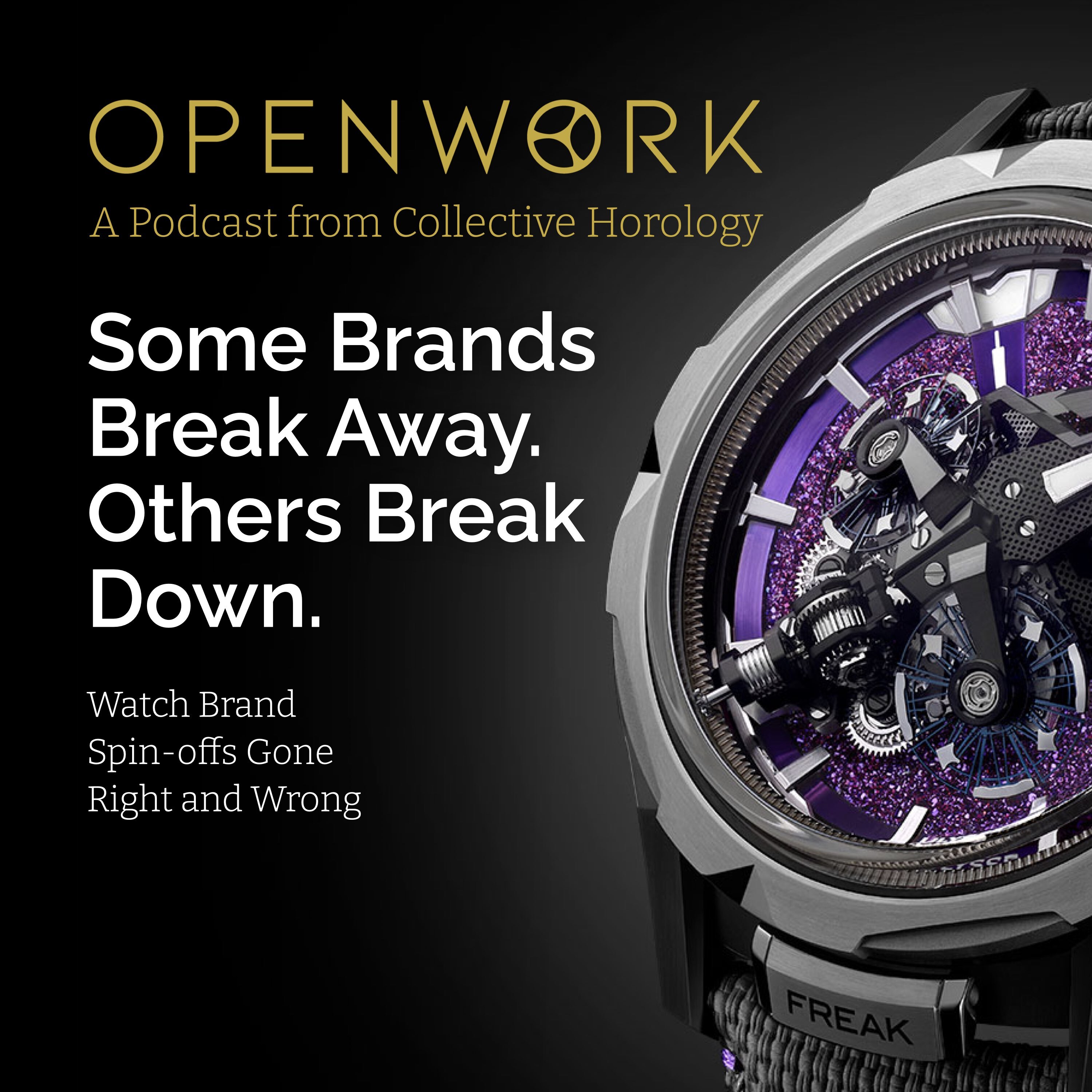
Openwork: Inside the Watch Industry
Some Brands Break Away. Others Break Down – Watch Brand Spin-offs Gone Right and Wrong – Episode 68
00:47:39
Loading summary
Transcript204 lines
- [00:01]
A
If we're looking at crown jewels like JLC being potentially a discussion topic for sale, then anything's on the table.
- [00:11]
B
This is openwork, a look inside the watch industry, a podcast from Collective Horology. I'm Gabe Riley, co founder of Collective.
- [00:18]
A
And I'm Asher Ravkin, co founder of Collective. Collective Horology is an independent watch retailer based in Southern California. We carry a wide range of independent brands including Armand Strom, Garrick Fiers and more. To learn more about us and check out our available inventory, visit collective horology.com hey Gabe. We have some new inventory that is coming in this week from our friends at Armin Strom.
- [00:42]
B
Oh wow. Oh, the good thing I put them in there. We have some stuff coming in from Fears too, which is also cool.
- [00:47]
A
We do. And I'm sure we're gonna have some video content coming up soon on Armin Strom. If you haven't had the chance to check out some of the content that our dear friend Adrian Barker made a couple years ago when we did our collaboration with Armin. Oh yeah, I highly recommend going and checking that out on his chann. He went to the manufacturer on our behalf back in 2022 and did a bunch of in person interviews and shoots of what that. That gives you a little bit of a better idea of what that manufacturer is all about and also a look at the folks behind it. Both Serge and Claude are two really great guys and Claude in particular, the master watchmaker, is an exceptional talent and you really can see that at work, not only in the most recent creations, but in that video in particular that Adrian created.
- [01:34]
B
Yeah, I will link that up in the blog post for this show. So go to collective horology.com blog in the episode. This is episode 68. So in the blog post, the show notes for this episode. I'll put that video right in there. Adrian is incredibly talented and he did a fantastic job with, with that video.
- [01:52]
A
Yeah, and Armin too. I mean look, it's interesting, you know, they are predominantly almost an entirely in house manufacturer and they don't make many watches, make a few hundred watches a year. You know, we ordered these watches that we're receiving shortly months and months ago.
- [02:07]
B
Yeah, Geneva watch days.
- [02:08]
A
Exactly. So not only are we excited to get them, we're excited to get them out to you. So if you don't know much about Armon, if you know a lot about Arman or if you just want to talk about them, give us a call.
- [02:18]
B
Yeah, it's never a good sign when you like open a brand and that, you know, in the process they're telling you how desirable their watches are and suddenly everything's available. You place your order and then the watches are on your doorstep the next day. I mean, this is truly an example. Of course, Armin wants to deliver as many watches as they can to their, their retailers and ultimately their customers. But we've been, We've been waiting in line for this stuff. I also threw Fears in there. They just released an absolute banger, which is their jump hour Celestials. This has a really cool dial. It's got Aventurine and Mother of Pearl and I think just this incredibly beautiful, lyrical minute track on it. Check this thing out. It really is stunning. I can't wait to get the watches here to shoot.
- [03:01]
A
They're in transit to us.
- [03:02]
B
I think they're in transit to. We've sold most of them, so I may just be shooting them for the sake of shooting them because they're really, really beautiful. But I cannot wait to get them and to photograph them and do some video which will. Which we'll get up online as well. But enough of all that stuff. Who cares about watches? Let's talk about the watch business, which is what we're. We're here to do. Our last episode, we talked about a number of topics, including rumors, sales, or spinoffs. Well, in one case, a confirmed sale and spin off of Bauman Mercier from the Richemont. And then rumors that have been swirling around LVMH spinning off Zenith. Again, LVMH denies this, but it's been reported pretty, pretty extensively that they've taken some steps to at least explore what that would look like. Who knows? That episode and the Zenith sale, or the topic of Zenith in particular, sparked a ton of discussion. We got a lot of emails, we had tons of comments, Instagram, on YouTube and elsewhere about this stuff. And people have a lot of really interesting theories about, like, whether it would be good for LVMH to spin them out. Maybe to your point, if it ended up in the hands of someone who really, you know, valued it and saw what made it special and could focus on it maybe in a way that LVMH can't. I don't know if they can or can't, but that might be interesting. Then there are other folks who are like, look, this is so integrated into LVMH because they supply movements. It's a really important and storied brand. LVMH would be foolish to give it up. It just sparked all of this Discussion. So we thought today we would take a look at a couple of things. One is a couple of other brands that are out there that are rumors to potentially be shopped as well. But more importantly, take a look at two case studies of situations where selling a brand and spinning off a brand has gone really well.
- [04:50]
A
Yeah.
- [04:50]
B
And when it's not gone well, or at least not according to expectations. Because I think these are really helpful case studies and examples to look at to sort of ground us in the moment we're in now where the industry is going through a consolidation phase, where brands are up for. Brands are potentially up for sale or being approached for sale. And looking at these case studies I think helps put a lot of that stuff into focus and can help us understand what some of the trade offs of these decisions are versus being abstract about it.
- [05:20]
A
Totally. And I think it's also valid to take a look and realize that we are, and we've been talking about this for months, but we are in a transitional period. There are several brands that are rumored to move, some, you know, handful that are confirmed, many that are rumored. And it does bring up that question of are we approaching an age of deconsolidation? I don't know that we're anywhere near being able to make that kind of a claim, but we would be foolish not to notice that these things are shifting.
- [05:48]
B
It's in the water in a way that it hasn't been for years. I mean there's been frankly in the last 10 years of watch collecting in the industry, there's been remarkable stability with a couple of exceptions. But in terms of brands, in terms of brands staying in place, particularly within the major holding companies, there have been some changes around the edges, but it's been a remarkably stable period. Now we've got this Bauman Mercier deal confirmed. We have rumors about Zenith. Who knows if they're true or not or what the nature of them is. JLC came up said this was reported by Ms. Tweed. Apparently Jerome Lambert, someone we've spoken about on this podcast before. Yeah, is has apparently approached his colleagues at Richemont about whereas in discussions to do a spin off and have management take the brand separate. Again, this isn't confirmed, but this has been reported. Debitune as well has been the subject of speculation. You may remember, I think it was a couple of years ago the 1916 company took a pretty significant stake in the brand. And there have been rumors that they've been at least approached to sell off their stake in the. In the brand by this honorable merchants Guild or whatever. Whatever. I can't remember the name.
- [06:54]
A
Yield Guild of Merchants.
- [06:56]
B
Yeah, and that was. That was reported in Hodinkee. It seems that maybe those talks have stalled out or that's not moving forward or who knows what. But like, there's. There's also been some talk around Grubel Forsey. There are some management changes that happened at Grubel recently. They've been rumored to be in play. Apparently one of the reasons, again, this is reporting that we've read. We can't confirm it, this is not our reporting, but there's reporting that part of the reason 1916 was maybe interested in selling off Debitune was to make an acquisition of Grubel Forsey.
- [07:27]
A
So interesting. I mean, Grubel has had like a rotating door of financing for some time, including a minority stake that was held actually by Richemont.
- [07:36]
B
Interesting. I forgot about that.
- [07:38]
A
Yeah. And going back to JLC for a moment, because I think this is an important distinction. Years and years and years ago in a former career, I was in a meeting with Jerome Lambert, not on behalf of Kollective. And I got to see the man in action. And I found him to be an incredibly thoughtful, really dialed in leader.
- [07:57]
B
Was this when he was leading all of.
- [07:58]
A
Yeah, this is when he was leading all of Richemont. And this is something I think some people don't always take for granted, like really good leaders in the corporate world. I tend to find to define by being honestly kind of more. More quiet, sitting back, listening to everything around the table. Not domineering a meeting or, you know, a decision, but trying to understand every input and perspective and then, you know, doing their best to. To bring.
- [08:23]
B
To.
- [08:23]
A
To make a decision on behalf of all these other companies. That was the impression that I got from him. He wasn't a boisterous guy. He wasn't really loud. He wasn't a domineering presence. He was quiet. He listened. He paid very close attention. I remember the watch he was wearing too, which was a. It was a Lange's.
- [08:42]
B
It work. Oh, wow.
- [08:43]
A
It's pretty cool. And if you're gonna rep. If you're gonna be the CEO of, you know, Richemont, like, you can wear whatever you want.
- [08:48]
B
Go watch.
- [08:49]
A
Cool watch. But bottom line, I have, in my limited experience with him individually, I have a lot of respect for the man. And I think that there's. With him if this is true, if there. If this is gonna happen, I think he'd be an incredible leader. And I would argue, you know, the numbers that are being Rumored around there it's been like a billion chf for the brand, which is, you know, a ton of money. So when people say like he's self financing, unless I'm unaware of something, I don't think he has a billion francs. Maybe he does.
- [09:20]
B
That seems really high for jlc. And we'll talk about what some of the, I mean potentially that number's out there. I mean one of the brands we'll talk about today sold from LVMH for, you know, 40 million. Yeah.
- [09:32]
A
So that, that is, that is reported from Watch Pro that the deal is said to value JLC at more than 1 billion francs.
- [09:39]
B
You got to get outside financing for that.
- [09:41]
A
You do, but it tells you two things.
- [09:43]
B
One, and you really have to believe.
- [09:45]
A
There you go. That's what I'm getting at, which is that if you have a guy who appears to be a level headed, thoughtful, you know, strategic corporate thinker who's willing to put a billion dollars plus. Well, definitely plus dollars. Billion francs plus on in play.
- [10:03]
B
This isn't Swiss francs.
- [10:05]
A
Yeah.
- [10:05]
B
Or well, is Richemont.
- [10:07]
A
It's in Swiss francs. Yeah. So my point is he must see something there that is so profound that he feels he can only do it if he had total control. So I'm really, really curious to see where that goes and should that happen based on my own passion for that brand. I love jlc. I mean, we've talked about how it's been kind of a moribund brand for the last few years, but you know, the potential is endless. The brand is, is incredible. And he is a thoughtful, thoughtful guy. So I'm really curious to see where that goes.
- [10:44]
B
Yeah, he, he absolutely. Both you and I worked with Richemont and capacities outside of Kollective in the past and he had an incredible reputation throughout that organization. And years ago or when that big management shakeup at Richemont happened and he moved from CEO of the group back over to, to jlc. I think a lot of people were scratching their head.
- [11:07]
A
Now we kind of get it.
- [11:08]
B
And this, maybe this was setting up or telegraphing their move. I believe their past, the CEO before him at the group wasn't there very long and I don't think she had, I could be wrong. I'm not sure she had watchmaking experience prior to, to running that, to that maison. So this to your point, like clearly this is a guy who believes in jlc. Clearly this is a guy who, an executive who knows watches and we'll see. Very interesting space to watch. A billion francs. Oh my but yes, look, something is in the water and it's a natural, I think, evolution of what's happening in the industry. When it goes through a period of turmoil and downturn the way it has over the last few years, these things start to happen, movement starts to happen. But this is not the first time this stuff has happened. We're going to take a look at two case studies today of situations where brands have been spun off from major luxury holding companies and where it goes well, where it maybe doesn't go so well. And the first one we're going to look at is the spin off of. Is it Ebel or Ebel or Ebel?
- [12:12]
A
I've always said Ebel.
- [12:13]
B
All right, Ebel. We'll go with Ebel. If you know the proper pronunciation, correct us in the comments. We know you won't hold back and we appreciate that. But. Okay, so Ebel they were. This is an fascinating story, but what we're really going to focus on is on the spinoff of Evel from lvmh in, in 2004 to the Movado Group, where it still sits to this day, 20 years later now. And, and the, you know, the analog here is quite interesting, right? We're talking about a spinoff from lvmh. We're talking about a spin off of a major and historic brand, and we're talking about a spin off of a brand that they acquired, couldn't quite figure out what to do with, and wasn't performing at the level of their other brands and they spun off. But I think for a lot of folks in the US in particular, Ebel is not a brand that has been top of mind certainly for the last 20 years. This is a major global brand. It's particularly strong in Europe and Germany in particular, and in the Middle east to this day. That's kind of where the core of its sales are. This was a brand that was widely popular in the United States. It goes back to 1911. In fact, they have a collection of watches called the 1911, which are, which are really cool, kind of their signature sports watch line. But this was a brand that was really popular in culture in the 1970s and 80s. Don Johnson famously wore an E Bell 1911 in Miami Vice. So, yeah, yeah, this was a brand that was part of that culture. I remember I had a friend in college, my friend James, who had an orange dial Ebel 1911 chronograph, which I just thought was so cool. He was like the one kid in college who had like a legit watch and those Watches, because they were owned by LVMH at the time, were powered by Zenith El Primero. And I actually messaged him about this today. I was like, hey, I'm doing, doing a podcast segment on kind of the, the decline of E Build. You remember that watch you had in college? Was it this one? And I sent him an ebay listing. He's like, oh yeah, that's it. And I still have it to this day.
- [14:12]
A
Oh, cool.
- [14:13]
B
It's a really, really cool watch. We'll, we'll, it'll be on video and then I'll link it up in the show notes as well. But that was the first, like, luxury watches I remember encountering on, on someone's wrist. And that was, you know, previously you'd.
- [14:27]
A
Only ever encounter them in a giant Ziploc bag.
- [14:29]
B
Yeah, exactly.
- [14:30]
A
That's a story for another time.
- [14:31]
B
That's a story for another time. But this was, I mean, this is a brand like in the late 90s. He bought the watch in 1999. And this was a brand that in the late 90s, if you were thinking about like buying your, like a nice luxury watch, this was a brand that was competing and in the mix among other mainstream brands, whether it was Omega, Tag Heuer, whome this was right in that wheelhouse. And today, certainly, at least in the US it's kind of an afterthought.
- [14:58]
A
Yeah.
- [14:59]
B
So what happened there was really, really interesting. So the brand was actually family owned for most of its, most of its existence. And in 1994 it was taken over by private equity, not because the brand so much was failing, but because the family who owned the brand had encountered some separate financial hardship and needed needed money. They needed to sell the brand. So they sold it to a private Equity Group in 1994. LVMH acquired it from them in 1999. So LVMH, this wasn't like a brand. Sometimes you have these acquisitions where like one brand is kind of bundled in with another. We'll talk about one of those actually in a second or later in this episode. But this isn't a case where like they were buying a bunch of brands and E. Bell was like thrown in with them. No, LVMH made a calculated decision, like, we're going to buy this one brand and add it to our portfolio. It didn't last long. They spun it back out in, in 2004. In fact, they spun it reportedly at a loss. So they made a decision like they needed to, to get out of it, which we'll talk about In a second. But what's interesting is during this period of ownership, LVMH really kind of upped the quality of the brand, not just in terms of the product, but also the way the brand was positioned and perceived and also their retail network and how they managed the brand, which I think is a really important takeaway here. So, you know, famously we, we spoke about, there were El Primero movements went into the 1911 chronograph. There had been El Primero movements used in E Belt watches in the past. But again, under lvmh, the synergies here made some sense. They upgraded E. Bell's factory and their capabilities, they upgraded the product. They massively trimmed down the number of SKUs from the literally the thousands to the hundreds. And they positioned the brand more kind of clearly upmarket the way you would position a brand, you know, like a Zenith or Omega for sure, today. They also obviously gutted and reconfigured their whole distribution network. So, you know, the company had been separate and independent before. Now it's managed by LVMH. It goes through LVMH's wholesale network. So it's being, you know, offered and moved into, into doors, into dealers where LVMH has relationships, where they're selling other products like Tag Heuer, Zenith and so on. So they did a lot to improve the perception and the prestige of the brand to the point where you're looking for a really nice chronograph in 1999. Ebel makes sense. It's, it's hanging in there with everyone else in a way that it isn't today. Ultimately, it sounds like the issue for LVMH was, was twofold. One, and this makes sense. Over time they've made a calculated decision that they wanted to move up and up and up market from sort of mass luxury to, to high luxury. And so the brand was challenged in there. It was also in this weird spot where it wasn't quite as differentiated or at the volum, like a Tag Heuer as far as volume and differentiation as Zenith. And it's sort of, it was kind of like the Bauman Mercier in some ways of LVMH's watch portfolio at that time. And so they made the decision just kind of like they had streamlined the product catalog for, for, for ebel. They made the decision like, we're going to streamline our product catalog. We're going to make sure our brand catalog and portfolio. We're going to have brands that own a clear lane, that are differentiated by price point. And have a, you know, clear identity and all that. So in two, they sold the brand to Movado Group, which is interesting. Now Movado is historically a Swiss brand, but it's actually an American company now. The brand was bought I think in the 80s by American owners. It's headquartered in Queens in New Jersey. Oh really? Thinking of Bolova.
- [18:41]
A
Ah, that's right. You're bad.
- [18:42]
B
Yeah, yeah. Bolov, I believe was an American brand. But historically Movado is a Swiss brand now owned by. It's now a publicly traded stock on the New York Stock Exchange. It's an American company. They own a number of brands. Movado is certainly the one that comes to mind with the museum Watch. Watch, probably what you see the most often. But do you know they bought the, that, that kind of Internet Quartz brand movement. Mvmt. Yeah. So they own them. They also have a huge business in private label. So they do like watches for like Calvin Klein, Tommy Hilfiger and others. So this is a, this is a big business sort of hidden, hidden in plain sight. And not one that gets a lot of discussion among watch collectors.
- [19:23]
A
Again, they're probably not targeted at collectors.
- [19:25]
B
No, they're, they're not. I think that's part of the challenge here. So Movado takes the brand over and understanding what else is in their portfolio. This makes sense. EBEL was going to kind of be this upmarket crown jewel of the Movado business. Right. So you have a lot of what are essentially mall brands in there. You have these private label brands. Then you've got Movado itself, which I would essentially say, and I don't mean this in a disparaging way, I would guess it's kind of a mall brand. It's distributed in.
- [19:54]
A
Yeah, it's an upscale Macy's watch.
- [19:56]
B
Yeah, there you go. And so E. Bell was going to be this opportunity for them to move up into a new price segment and they've to say that the acquisition didn't go according to plan or didn't meet expectations. I think is, is fair to say. And look, if I think the most people listening to this are probably like, I have never heard of Ebel or I have not thought of Ebel in 20 years or something like that. It's just not a brand that hangs among the mainstream mid tier watch brands that we think of today with some exceptions.
- [20:35]
A
You know what the parallel is to me here, I think a little bit about this one. In the same way they think about Fossil Group buying Zodiac because it happened around the same time Fossil Group bought Zodiac in 2001. And they had this really big push, if you remember, in the early 2000s, late 2010s, where they really. And I mean, they tried hard. Yeah, yeah. To really build that brand up. And, and it kind of swelled over a wave and then kind of crashed into the shore, you know.
- [21:05]
B
And so you can find Zodiac watches literally at Kohl's right now.
- [21:08]
A
Yeah, but I think, I think there's sort of two parallels here about this, which is around distribution channels.
- [21:14]
B
Exactly.
- [21:14]
A
And also tied to just general consumer brand perception. So, interestingly, and one thing I really appreciate and respect about Zodiac is like, they tried real hard on both of those fronts. And they got Zodiac into some better doors. They got Zodiac better distribution. You know, they hired some, some really well known folks in, in the industry. Mike Pearson was there for years. What a mensch, what a dude. You know, they had, you know, they, they even started notch pricing up a little bit. Suddenly, you know, you're looking at zodiacs in the 3000s.
- [21:46]
B
You know, like they got in house movement. So Fossil also owns stp, so group movements.
- [21:52]
A
Yeah, sure, sure, sure. But my point is. And then it kind of fizzled.
- [21:55]
B
But one thing that Mike did that was really smart, he talked to me. I hope I'm not betraying confidence here, but you know, he worked at Zodiac years ago. He's at Christopher Ward now, bless his heart. But one of the things he told me about Zodiac is he was intentionally looking to overhaul their distribution. And to your point, the doors they were in, he was like, one of my biggest focus is getting it out of the wrong doors and into the right door. So an example of a great door.
- [22:21]
A
He, I think he worn and wound Topper.
- [22:26]
B
They had Zodiac for a while. I mean, credit to Rob Kaplan, he's. He was ahead of the curve on Zodiac, but one of the things.
- [22:32]
A
Well, he rode that wave.
- [22:33]
B
Yeah. One of the things that Mike did was like retool their distribution network. Yeah. And this is one of the challenges with Movado, owning ebay.
- [22:40]
A
This is, this is my point.
- [22:41]
B
LVMH did a great job in retooling the distribution network so that you get the E. Bell brand in stores, in, you know, the display next to Tag Heuer and, you know, maybe Long Jean is on the other side or something like that when it goes to Movado. Well, they've built up an infrastructure around distribution, but it's an infrastructure infrastructure around distribution to malls.
- [23:01]
A
Yes.
- [23:02]
B
And to a lower tier of jeweler or watch retailer than where E. Bell had been Positioned, they just didn't have the institutional knowledge. And so it's like the brand is the same, but the, the skeletal and organ system that powers the brand. You know, the inner workings of the company that then needs to put it in the right doors just isn't there in the same way. Same thing with branding and advertising and sponsorships. You know, know, LVMH can do advertising, branding and sponsorships at an elite level.
- [23:34]
A
A hundred percent.
- [23:35]
B
Movado does advertising, branding and sponsorships at a different level. And so the different organizations aren't necessarily able to take care of the brand and steward the brand in the same ways.
- [23:46]
A
Yeah, totally. So I, I think, you know, that, that this is a good sort of warning sign slash opportunity for Bauman Mercier as they start thinking about their, you know, some of the challenges that we've seen in the past around.
- [23:59]
B
It's very analogous.
- [24:00]
A
Yeah. Around doors and distribution. And that I think opens up sort of the next, the next topic here, which is like, well, what happens when it works? You know, and I think we have a really good example of when it works, which is the departure of Gerard Perregaux and Ulise Nardin from the Kering Group. And this is still a relatively recent thing. You know, it's within the last decade. This happened in what, 2022, a couple years ago.
- [24:23]
B
Yeah, got. We have the notes here in, in the, in the. Yeah. And I think 2022 management buyout.
- [24:30]
A
Yeah, it's, it's interesting. I remember hearing some of this news as well because the, the dude who is now the co founder and the CEO of the Sowin Group, so the folks essentially that are the independent group that, that now owns UN and gp, the gentleman behind it is a guy named Patrick Prunetta. The reason I know who he was is because I worked at Apple around the same time that he was there.
- [25:00]
B
Oh, he was at Apple. He was interesting.
- [25:02]
A
He was based in, he started in, he started in California. He was, he worked, believe it or not, on the Apple Watch and then he moved to become the managing director of Apple UK and Ireland where some of my former colleagues worked for him. And that was. And then he was recruited in 2017 to go become the CEO of Ulysse Nardan.
- [25:23]
B
And so at that point Ulysses Nardan and GP were sitting as the watchmaking group within Kering. And so just for context, Kering, it's a luxury holding company we don't talk much about on this podcast because they, to your point now, they don't really have any focus in Watches. But they have a stable of some really impressive brands. Gucci, Saint Laurent, Bottega Veneta, Balenciaga. I mean, the, the list goes. The list goes on.
- [25:52]
A
Bottega.
- [25:52]
B
What? Bottega Veneta.
- [25:55]
A
You know, you don't buy a lot of purses, huh?
- [25:57]
B
I don't know. I have no idea. What, what do you.
- [25:59]
A
I, I'm.
- [25:59]
B
I've seen the brand. How do you pronounce it?
- [26:01]
A
I don't know, I'm just making it funny.
- [26:02]
B
Okay.
- [26:03]
A
Yeah.
- [26:03]
B
So it's called the bodega brand.
- [26:06]
A
It's a bodega brand.
- [26:06]
B
I have a bodega purse.
- [26:09]
A
There has been creative, both creative watchmaking from Gucci. Whether you like it or not, there's some stuff there.
- [26:15]
B
Absolutely.
- [26:15]
A
And if you remember, Saint La, which is a brand that I have always kind of dug the style of, had some crossover and some collaborations with the Girard Perregaux, with Gerard Perregaux just only a couple of years ago. So there's been some overlap in there. What I think is really interesting, you.
- [26:35]
B
Need a Balenciaga watch.
- [26:36]
A
Could you imagine? But I think what I find really interesting is you have a guy who's coming over because, remember before he worked at Apple, he also worked at lvmh.
- [26:49]
B
Oh, that makes sense why they'd want him at Apple and wearable.
- [26:53]
A
You've got a guy whose career started at Mowin and Hennessy. He became the VP of global sales and retail for TAG Heuer. He goes to Apple, he works on the Apple watch, and then he becomes the CEO of Ulysses Nardan. And you see this really interesting trajectory there. But the one thing that's really clear is that here is a person who understands how mass market distribution and sales works in the luxury watch world. Don't forget the first Apple watch that came out in 2014. Do you remember the gold Apple watch watch? Yeah. So there was like. So there was.
- [27:23]
B
They still make those Hermes straps.
- [27:25]
A
They still make the Hermes Apple watch. It's a very popular, very popular execution. It's four figure watch, the gold app. But do, do you remember that? Yeah, forgot all about that, man.
- [27:35]
B
Why, you know, don't bag on a gold D. So when you can bag.
- [27:38]
A
On a ceramic Apple watches too.
- [27:40]
B
Right? There was a lot that.
- [27:41]
A
Anyway, whatever. Point is. And then he goes over into Elysian Ardennes. So you've got some of the, you've got some of the avant garde design elements in there. You've got some of the mass market distrib elements in there. You've Got the biggest mass market of anything, which is Apple. And then you, and then you get narrowed into.
- [27:58]
B
Well, it's an interesting zag. It's like I can see the Apple thing may sound like an aberration, but when you think about like the career path of Moet and you know, lvma.
- [28:08]
A
Not an aberration at all.
- [28:10]
B
Exactly. And then you know, you, you move into, into Apple, you're in these very well established, highly regarded, prestigious big brand corporate rules.
- [28:21]
A
Apple is a luxury brand.
- [28:22]
B
Exactly.
- [28:22]
A
It's just, it's mass market.
- [28:23]
B
But the move to UN is a, is like a right, is a right hand turn. It's interesting. It's like kind of jumping off of that, off of that treadmill to some extent into something that's more niche and less mainstream, less prestige. Like the average person on the street has heard of Tag Heuer, you know, generally speaking, has heard obviously of Apple, has heard of Moet. Have they heard of Ulysses Ulysse Nardan?
- [28:52]
A
Not in the United States perhaps, but in Europe maybe.
- [28:54]
B
Well, I'm saying like the average punter on the street, you know, maybe, maybe I stand by. But it's more niche. It's way more niche.
- [29:00]
A
Anyway, all this to say. So you have, you do have, you have senior leadership that does have their head on straight and has had a pretty exceptional amount of experience leading into this transition that he organizes a management bias out from the Kering Group only a few years ago in 2022. And we see some really, really, really good signs coming out of the brands. So if we look for example at un, this brand I really love, not only have we seen continued innovation in the UN Diver line, we're also seeing.
- [29:35]
B
Oh yeah, you love those watches.
- [29:36]
A
I do like those watches. We've seen a, also a very significant resurgence in excitement around the Freak.
- [29:43]
B
Yes.
- [29:44]
A
As well as great product development in the Freak which has brought the average price point down and increased demand for that line such that the Freak is the dominant watch that people now associate with un. Whereas if I'm being frank, I think if you roll the clock back a decade, it's probably like The Marine chronometers 100% and now like they've really. And those.
- [30:03]
B
I used to think of UN as synonymous with those like enam beautiful but more conventional enamel dial Marine Torpillo. Yes, exactly.
- [30:12]
A
And those are cool watches. Don't get me wr wrong.
- [30:14]
B
And there's also un's got an indie vibe to it.
- [30:16]
A
Well, in a certain, to a certain they've kind of always done, I mean the thing that people don't realize too about UN is like, there's a lot of actually really interesting, a lot of really interesting engineering that goes into their watches. Like those movements that you find like in house movements that you do find in those, you know, the, the $8,000 and up marine chronometers, et cetera. The more expensive divers, for example, demonstrate some really impressive in house watchman. Now, UN and GP share a watchmaking facility. And gp, if we pivot over there, I mean, not only have they been focused on haute horology for decades upon decades upon decades, Lord knows they've really been delivering on that of late.
- [30:55]
B
Well, it sort of, it sort of slipped late in the Caring Group era. So one of the criticisms about. Let's just take the Laureato. This is a GP watch that most people are familiar with. One of the challenges with the Laureato is people found that they were basically like reusing old movements. And they're not reusing, but like putting old movements into the Laureate. And part of the reason why the l' Oreal for so long shipped with a closed, closed case back was because the movement didn't fit the watch. The movement was like microscopic within this 42 millimeter stainless steel sports watch.
- [31:28]
A
Also, if I'm being frank, feeling that it was kind of just like biting off the, you know, the Jeep, the, the ap Royal Oak and.
- [31:36]
B
Sure, but let's say that the, let's, let's put that to the side because I think everyone has a right to make an integrated bracelet sports watch.
- [31:43]
A
And let's say with an octagonal bezel.
- [31:45]
B
Well, let's also say, like, look, GP has some additional legitimacy because the Lado is based on a watch that first came out in the 1970s.
- [31:54]
A
It preceded the Royal Oak. Actually, I believe it did.
- [31:57]
B
It didn't precede the Royal Oak, but it did precede, I think the overseas or it came out in the late 70s. We'll have to double check.
- [32:03]
A
We should double check the timelines. But the point is, like they had.
- [32:06]
B
Bona fides in this segment.
- [32:09]
A
Bonafides, I don't know, man. Bonafides. They have bonafide bonafides with the bodega brand.
- [32:15]
B
Bodega. The Bodega bonafides. They have bonafides in this category. Let's just give them that. And so I think one of the criticisms is, you know, when you're comparing the watch to a Royal Oak or to a Nautilus or whatever it might be, you know, those watches have beautiful movements, extremely well finished. Well Done. You look through the case back, they're joy to look at. Look at the Chapek Antarctic. You look at the case back of a Chapek antarctique and it's like, holy smokes. You look at the case back of a l' Oreal in the past and you either couldn't look at it or in the watches where they did show you the. The case back. It was, you know, the movement. The movement was tiny. It was well finished, well made. But the point here is they weren't able to invest under caring. They just weren't investing in. In product development and in research and pushing their products fundamentally forward. They were take. It was like Taco Bell. They're taking the components they kind of already had and repurposing them into different products versus doing things that were new. Now, we went to the GP boutique in Geneva over the summer and we looked at the new. One of the new Laureato products. I think they're in this transition phase where they're phasing in newer product and they still have some of the older product. But we saw Laureato with an updated movement that was beautifully finished size, new case size, refined proportions. And it was the most promising thing to me about that wasn't just like, oh, this watch looks great and it's well made. It's like, here we go. GP is investing in product development again in a way that they sort of weren't. It's not the Taco Bell. Let's take the same five ingredients and remix them. It was, no, we're going to do this the do this the right way and we're going to develop, if I'm.
- [33:56]
A
Being honest, product that's been happening well before the acquisition. I'm sure the acquisition is supercharged it through necessity as well as access, you know, direct access and more streamlined decision making. But it's not just that. I mean, they're also really trying to take what they're known for on the super high ends, like the three Bridges, for example, and they're actually putting that into different formats. So now we have the Girard Perregaux l' Oreal Auto Three Gold Bridges.
- [34:18]
B
Doesn't that look cool?
- [34:19]
A
Oh, it's amazing now. And that is a $175,000 steel watch. Wow. Now, there's obviously some white gold in there, but what you're paying for is the watchmaking. And we actually had a really beautiful houterology piece come through on a trade just a couple of weeks ago.
- [34:36]
B
Incredibly impressive. Yeah.
- [34:37]
A
So my point Is like, look, gp, it's got the right distribution, largely speaking. They've done a ton of work to overhaul the brand and the product, and they've done a ton of work on the product. I think GP is on a five to ten year trajectory to really reclaim and build on its former credibility, to build themselves back up to something great. Now un's a little bit more avant garde and I think that's going to be a. I think the. I think you can find product market fit for GP faster in the United States than you can find product market fit for UN in the United States. Because GP has a broader appeal. You know, like a Laurias are more.
- [35:17]
B
Straightforward and you understand UN is a.
- [35:19]
A
Little bit more gonzo. And even when you even know, even when you look at the Freak, the freak is still kind of like a. I mean, by definition, a wild watch.
- [35:29]
B
And they're leaning into that. They're not, you know, going back to the Marine chronometer style stuff.
- [35:34]
A
Which begs the question, when you think distribution, if the distribution channels for. For GP are X, you know, today you really tend to see GP and UN go hand in hand. Well, and it makes me wonder if, like, really splitting that off makes more sense. And I think we see some of that. Right. Like we saw like a shop and shop open in Steven Silver.
- [35:57]
B
Oh, really? Yeah.
- [35:58]
A
You know, so we're starting. So. And I. And I would argue, like, to me that makes a lot of sense. Like that in the Bay Area is a great target. Like, that's a. That seems like the right. Like, like yes channel for that.
- [36:09]
B
He's built a palace for independent watchmaking. And this fits. Right.
- [36:12]
A
But it's also where it's what it's surrounded by. Right. Like if you're.
- [36:15]
B
Exactly.
- [36:15]
A
I mean. And this is exemplified by their partnerships. Right. I mean, we just had the Earth.
- [36:19]
B
Freak launch they carry as well, and an MBNF and an Urwerk in an afternoon.
- [36:24]
A
Yeah. But all three of those, I think, overlap a certain narrow band of which GP doesn't. Correct. Even though GP could touch there, like maybe someone would be interested. But GP probably will do better in.
- [36:36]
B
A more mainstream outlet. So let me ask you this question then, about. About all this. We were talking about Watches and Wonders and the. The seating chart for Watches and Wonders. Ulysse Nardan is at Watches and Wonders. GP isn't. What's with that? I've never understood why they didn't show up with both brands. I think this year it's.
- [36:53]
A
Because it's an anniversary year for.
- [36:55]
B
No, but the last few years, GP hasn't been there. It's just been us.
- [36:58]
A
UN oh, that's interesting.
- [36:59]
B
Yeah.
- [37:00]
A
I don't know.
- [37:00]
B
I always. So, to your point about, like, GP being a more mainstream brand, easier to understand, maybe more commercial in some sense. I. I always. I always wondered, like, why is it that UN is here, but GP isn't? Now, again, this could be our bias as Americans. You know, these brands have different strengths in different parts of the world. And maybe UN is simply a much bigger, more commercial brand. But that always, like, puzzled me. Why? It's like, where's Gerard Perrito? Because I would love to check out Gerard Pero.
- [37:27]
A
We're gonna. We're gonna meet with some just, you know, around the. When we're walking around, and we'll bump into some folks from there. We should just ask.
- [37:35]
B
Yeah. I mean, I'm really curious to see what UN has at Watches and Wonders, and maybe I missed something. Maybe GP is there, but I'm pretty sure they're not. They haven't been the last few years. I always just thought that was. That was puzzling. But I think. Let's take a step back here. The way we looked at the Ebill spin off.
- [37:54]
A
Yeah.
- [37:56]
B
Versus the way we're talking now about this GPUN spin off is a little bit different. We're focusing a lot on product and saying how great the product is and how great the change in ownership has been for the direction of the product. Do we know how the. The. This change in direction is working for these brands commercially now? We may. It's a private company. They're not reporting numbers or anything like that. But are there.
- [38:20]
A
Do we get a sense of anecdotally. No.
- [38:22]
B
Okay.
- [38:22]
A
This is anecdotally, no.
- [38:23]
B
How do we think it's going?
- [38:24]
A
Freak is driving a ton of success for un.
- [38:28]
B
It certainly has a level of attention among collectors in the last year. Two years that it hadn't had before.
- [38:34]
A
Yeah. And. And I think GP, you know, GP had this, like, this intense moment in, like, 2021 to 2022 where the Lado became, like, Unobtainium, and it just. It. It kind of exploded. But what. When the Tide came back on that.
- [38:49]
B
Thanks to the timepiece gentleman for that. I love how that guy, like, took credit for popularizing the la. It's like, wasn't there some Woody Allen movie, like Broad where some character claimed to have popularized shrimp?
- [39:03]
A
He invented the piano key necktie. But I think. Anyway, I think when you look at gp, when the Tide came back out, a couple of pieces were left standing. Like the l' Oreal skeleton, for example, which I still maintain, I think is a finer watch than what is available from AP in the similar format. And I do think that that really reminded people of Rose Gold.
- [39:26]
B
Gold, the Laureate skeleton. Oh my God, it's amazing.
- [39:31]
A
Anyway, but before we go off on like, what references we like, my point is I think that what they gained from that, like, minor explosion there, even though there was a pullback after, it was a boost in awareness and credibility, which is to say prior to that.
- [39:44]
B
Period, you're right, GP entered the conversation in a way they hadn't for 10, 20 years almost.
- [39:50]
A
Yeah. So I think people are open to GP in a way.
- [39:54]
B
GP has entered the chat. Yeah.
- [39:56]
A
In a way that I don't know that they were before. So I'm. But no matter how you cut it, whatever time frame or horizon you want to put on is clear that under Patrick Pernod that brand is going to work. It's going to avis it. Right. They're going to try harder and they're going to do everything they can to not just attract the attention, attention of collectors, but also earn their continued respect and ultimately their cash. And it's being built on a strong foundation of good distribution, good product and good brand development. And when we go back to the things that didn't work and we look at like an E. Bell or we look to a degree at Zodiac, et cetera, it's like those things weren't there.
- [40:40]
B
Yeah, exactly. So going all the way back to what we chatted about last week, there were so many opinions and I'd encourage you guys check out the post we did about Zenith on, on Instagram. There's just that thing has taken on a life of its own. It's like, you know, you know, something you've made like, you know, for social media is on fire and has taken on a life of its own when people start arguing with each other in the comments. You know, usually we post something the Internet and, and, and people just, you know, they comment about what's in the post and move on. But it's like this thing, they're like full on debates in, in this post about it, which, look, hey, I'll take it. That's, I'm, I'm glad that, that, that conversation clearly struck a nerve. But you know, a lot of people are saying things like, you know, good, you know, good riddance. I hope lvmh, you know, gets rid of Zenith and ships them over to someone who will do a better job managing the brand. And some people said, I think Swatch Group would be a much better fit. They do a much better job. Or others have said, you know, Richemont would do a much better job than lvmh.
- [41:46]
A
I think Swatch Group has the worst. Or go buy stuff.
- [41:48]
B
Right there' another f. Yeah, exactly. There's another fascinating one. Like, what if a group of collectors, you know, spun it off themselves? And, you know, there's that old saying in the, in the watch industry, the fastest way to become a millionaire in the watch business is to start as a billionaire. Billionaire. So woe to the person who buys any watch brand. But there are a lot of interesting theories about how and where it might be a better fit. But all of this goes back to saying, like, you, you can't do just take on the brand. Like, the brand has the value it has not because it exists in a vacuum. Like Ebel had some of the value it had when Movado acquired it because of what LVMH had done to, to make it more premium and to clean it up. And when that infrastructure went away, a lot of value in the brand was destroyed, you know, because Movado just didn't. And this isn't a knock on them. Like, people run businesses in different segments and that's totally okay. There should be a Movado and a Movado Group and they should make watches that are sold in places that are different, where other products are sold. But they didn't have the ability to take on the brand from an infrastructure standpoint. Now, they certainly had the ability from an infrastructure standpoint to take on things like watch service. Yeah. And. And distribution. Like, of course they could do all of the things that a watch group should be able to do, but not at the level. Level of what LVMH was able to do. And so when Zenith goes somewhere else, if Zenith goes somewhere else, when Bauman Mercier moves into the Damiani Group, these groups, it's not just enough to take the brand and then it sets you on a new course. You also have to retool your own organization or be able to. And I think that's the, that's the silver lining of this GPU and story is they took on the brand because they believed in it and they believed they could do better with it than the group was doing, but they also had the ability to operate and run the business at the level that befit the brands. And so that, to me, that, that's the open question here and the caveat for anyone who Wants to buy a watch brand.
- [43:55]
A
Yeah, 100%.
- [43:57]
B
I think it's a big, way bigger risk with JLC if they are spun off. I mean think about this. If JLC is spun off to an investor group, this is a little bit different than the spin off of a more niche player like GP and UN to a management takeover. The stakes. Now, God bless anyone who's willing to buy, to buy a watch brand at any, at any level, particularly from a luxury holding company because you're, you're stepping into the big leagues here. But like the stakes at a billion dollars for JLC will be a lot higher. And JLC has benefited massively from the scale of Richemont and integration into Richemont and spinning it off I think creates a way bigger, way bigger risk because that business just runs at a, at a huge scale.
- [44:47]
A
Yeah, it's a much higher volume business. I mean there's no public numbers but the general estimate is somewhere between 60 to 100,000 units per year. Some massive, Massive business.
- [44:56]
B
And it depends on volume, it depends on distribution. So we could say, hey, look for jlc, they management could take it over and absolutely do a better job with the watchmaking and the product. Product. Maybe even the brand. Of course that seems reasonable if that were were to happen. Can they. But this is a brand that needs volume to survive. Can, can a management takeover achieve the kind of distribution and volume and scale that Richemont is able to do for the brand? I don't know.
- [45:27]
A
Yeah, I don't know either.
- [45:28]
B
It's a good question to me. That's the.
- [45:30]
A
But they must have an answer to that question if they are willing to bet a billion francs on.
- [45:35]
B
Yeah, particularly if the guy who's the former CEO of, I mean he knows where all the BO buried and how the sausage is made and whatever other analogy you want to throw in there.
- [45:44]
A
Yeah, I would have to imagine that someone like Jerome Lambert is able to go to the CEO of Bucher and the CEO of Watches of Switzerland and have a conversation with them that has some oomph behind it in a way that, you know, if you and I decided to go out and buy a brand, we would not.
- [45:59]
B
Well, here's a question for you. What if there was a movie studio model in Watches where JLC was a separate company but its distribution was done through Richemont?
- [46:10]
A
I think anything.
- [46:11]
B
Is that a model that could work in, in the business?
- [46:14]
A
Presumably? I mean, I think it's a low.
- [46:16]
B
Margin business for Richemont though I don't know why they'd want that the brand is where the value and the juices.
- [46:21]
A
I mean, it depends how easy it is, how profitable it is. It's difficult to make that analysis like on the fly. But what I think, I think the bigger takeaway from that, that thought is if, if we're looking at crown jewels like gl, like JLC being potentially a discussion topic for sale, than anything's on the table.
- [46:41]
B
Yeah.
- [46:45]
A
I'm serious.
- [46:46]
B
That is, that's a good, good way to put it. And those are the times we are in. So we will stay tuned and we will see what happens. You want to leave it there?
- [46:54]
A
Let's leave it there.
- [46:55]
B
All right. Well, thanks for listening. Open Work is of course a production of Collective Horology. You can find us online at Collective Horology. And please keep getting in touch. Send us your thoughts, your questions, your feedback, suggestions, all that stuff. We love it. And to do that, just email podcastollectivephorology.com. There you go. Stupid.