← Openwork: Inside the Watch Industry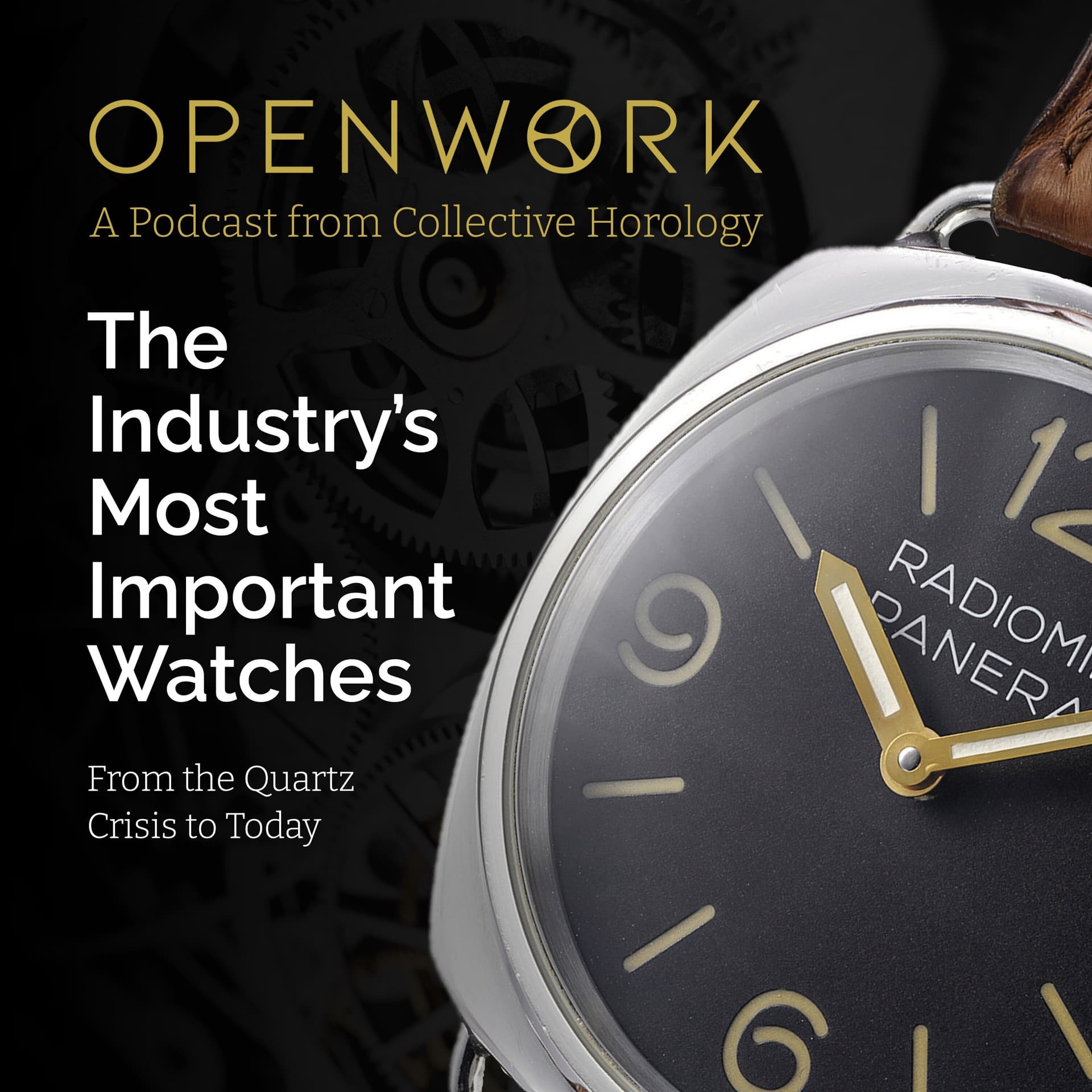
Openwork: Inside the Watch Industry
The Industry's Most Important Watches – From the Quartz Crisis to Today – Episode 47
Loading summary
Transcript163 lines
- [00:00]
A
But it's easy today to roll your eyes at Panerai or let's just say scratch your head at Panerai today. The modern version of the brand. It's certainly not for everyone, but oh my gosh, through the Paneristi, these, the limited editions, the manufactured scarcity, the culture around straps, all of this stuff is now core to the way the enthusiast communities run, is core to the way the industry runs and its business models. And so much of modern watch collecting was really started in many ways with Panerai and the Panarici. It's pretty profound. This is openwork, a look inside the watch industry. A podcast from Collective Horology. I'm Gabe Riley, co founder of Collective
- [00:47]
B
and I'm Asher Apkin, co founder of Collective. Collective Horology is an independent watch retailer based in Southern California. We carry a wide range of independent brands including Fierce, Ming, Singer, Reimagined and more. To learn about us and check out our available inventory, visit collective horology.com Asher
- [01:04]
A
Speaking of fears, we just brought in, just got in some of the coolest Fears watches I've seen in a while. These are and that's because I am a tool watch guy. And we just brought in the Fiers Brunswick Odyssey Edition. This was a limited edition that Fears announced over the summer and has just begun delivering. We brought in a few of these. We only have a couple left. I think there's the, there's only a hundred of these made. It's a limited edition watch but it is so cool. Obviously a lot of people love the, the Brunswick and love Fears, but have been looking for something a little bit sportier and these are just so cool. So it's a Brunswick 40 with a screw down crown with applied numerals with numerals at the cardinal points of, of the dial that are luminous and they are chock full of lume. It's got a beautiful white dial and it is topped off with an Erica's original sort of national strap which is done custom for Fears in this beautiful orange color. And it is just a really cool, really sporty, really limited Brunswick and it's just neat. So I'm stoked that we have those. Hopefully they're still up on the site by the time this podcast goes live. And we will also put up a detailed article on that watch@collectiveparology.com blog so you can learn all about it and you can learn about what the Odyssey Edition actually means and refers to because there is a cool story about that behind that limited production watch as well. So check out the Fierce Brunswick 40 Odyssey Edition. Should we talk about some other watches?
- [02:41]
B
What's a watch?
- [02:41]
A
Good question. Hopefully today we will find out and we'll finally have the answer to what is a watch?
- [02:47]
B
What is watch?
- [02:48]
A
This is one of those rare open work episodes that's actually about watches. And while it's about watches, it's about the business behind these watches and the business implications of these watches. This is an episode we've been wanting to do for a while. The idea here is we are going to talk about the industry's most important watches and we're going to look specifically at the Quartz. The Quartz era on. So Quartz crisis through to today. Let's call this the modern era of watches. If we wanted to talk about the most important watches to the industry, we could go very far back in time. We'd have all. Many, almost too many choices. We had almost too many choices here. But we're going to be focusing on. On the Quartz era onward. And really the focus here is on not the watches themselves, but what they meant to the watch industry. Watches that were significant to and fundamentally shaped and changed the course of the watch industry. And we'll come at that from a few perspectives. But this is basically about the, the business side of these watches. This is an episode I wanted to do for a while. You've been reticent to do it, but here we are. It's a fun one. It's August, it's summer, so let's talk about some watches.
- [04:01]
B
Reticent. I don't know. Let's talk about some.
- [04:06]
A
Yes. All right, let's do. So we'll do this snake style. We'll do it draft style. We actually rochamboed before we. We started the, the recording. You're gonna go first and so we'll go. We'll go. We'll go back and forth with you going first. I guess when there's only two people doing it. Snake style is essentially. It's just the way we talk going back and forth. So we'll go, we'll go back and forth on this. You'll. You'll go first. I haven't seen your picks. You haven't seen mine. If we do overlap, I have a couple of extras back pocket. We'll see if we do. And if not, I've got some honorable. We've got some honorable mentions. I would say just having done my picks here, if you could kind of try to go chronologically at least starting
- [04:48]
B
back in the 70s.
- [04:49]
A
Yeah. Like start. If you have anything from the early part of that period versus something that's more modern or whatever. Try to go chronologically, because I have the feeling we're going to be telling a story that builds kind of watch from watch, potentially. At least that was how I thought about my pick. So let's do it that way so you don't have to retrace history and go back in time later on in the.
- [05:11]
B
So we're starting in the 70s?
- [05:13]
A
I don't know. You tell me where we're starting.
- [05:15]
B
I'm going to start in the 60s because I don't follow rules.
- [05:18]
A
We're starting in the 60s.
- [05:20]
B
But in fairness, the reason I picked this is that this is the watch that broke everything. So I want to start with the Seiko Astron 35 sq. This is a watch that came out on Christmas Day in 1969, and this was the watch that fundamentally changed everything that we know about modern watchmaking, because this was the very first Seiko quartz watch. And that in turn was also the first commercially available quartz watch. And I think, you know, everybody talks about the quartz crisis, and I think we talk about it a lot in the context of how it fundamentally impacted the SW Swiss business, but. Or the Swiss watch business. But I think what people don't necessarily think about in these moments is how profound the release of a quartz caliber fundamentally was.
- [06:10]
A
And if I'm not mistaken, was the Astron a digital watch versus analog?
- [06:15]
B
No, it was analog. It was solid gold.
- [06:17]
A
Oh, okay.
- [06:18]
B
It was solid gold. It was quite expensive too. At the time it was just under half a million yen, which was approximately the size of like a compact car. And again, this is important to put into context because we think about quartz watches in the modern era as like an affordable solution. But of course, quartz in 1969 was cutting edge technology and it offered a lot of things that mechanical watches simply couldn't, not the least of which being consistent and predictable accuracy over time.
- [06:50]
A
Do you know what the. The, the accuracy of those?
- [06:52]
B
I do. It was plus minus five seconds a day. Excuse me, I. Correct. I'm so sorry. Plus minus five seconds a month.
- [06:59]
A
A month. Okay. Even if it were plus minus 5 seconds a day in that era, that really would have been something. But. Holy smokes. Okay.
- [07:06]
B
Yeah.
- [07:07]
A
I mean, so this basically blows any kind of chronometer of that era out of the water.
- [07:12]
B
Oh, completely. And the other thing to note too is, believe it or not, it was actually a very short run production watch because it really kind of was a shot across the bow. Proverbially speaking, there were A hundred of them made. So this watch in particular, like this particular unit, the 35 sq, is a comically collectible watch, if you could actually get your hands on it. Also, not for nothing, if you have a chance, go take a look at what it looked like. It's a stunningly beautiful watch too.
- [07:35]
A
Yeah, we'll do show notes and all of these watches will be in the show notes with photos and all that stuff.
- [07:41]
B
So I think, you know, we can't talk about modern watchmaking until we talk about what essentially created the concept of luxury watchmaking and what the quartz revolution or the quartz crisis, however you want to, at what side of the table you're on. What it effectively spawned was a real era of self questioning among the Swiss in particular, where they had to ask themselves, like, how they wanted to position what was essentially. And put your pitchforks down. But what was essentially an inferior product that was taking over the world. This was not handcrafted. There's no one, you know, sitting in Neuchatel and making, you know, the components for this watch. This is an industrially made, electronically driven watch. Some might even say who come from a port, from the point of, or the point of the perspective of mechanical watchmaking, that it was soulless. But it wasn't. And I think you can see that through the aesthetic of the actual watch itself. And what it forced was the Swiss and the luxury watch industry in general to ask itself, well, if accuracy is no longer on the table per se. And of course, that changed over time and we've gotten to a place where chronometers are actually more accurate than, well, have the potential to be more accurate than this watch. What do we want to be? And what the answer effectively came out to be was a luxury product. Which isn't to say, of course, there weren't upscale watches prior to 1969. Of course there were, but the. But the entire industry essentially reoriented along that path. And the reason that happened were these 100 gold watches out of Japan.
- [09:16]
A
Yeah. It also put the Japanese watch industry on the map. Oh, today, you know, I think from the 70s, really, the 80s onwards, Seiko, Casio, Citizen are global brands, household names. They've sold, I can't. Billions of watches. I would presume in that.
- [09:33]
B
In that, in that time, if not probably close. Yeah, I mean, certainly hundreds of millions.
- [09:40]
A
So this was technology that, that was so shocking. It put these brands on the map. I don't know a ton about the Japanese watch industry going back historically, but I would imagine, relative to the Swiss, it was probably something of a, of a backwater. And this, those brands and Japanese brands synonymous with watches and these global in modern technology.
- [10:02]
B
I mean, I can't overstate like what this meant from a technological standpoint because if you look at like what the pinnacle of technology was in 1969, it was arguably maybe the trip computer on the Apollo capsules. And the trip computer on the Apollo capsule had the same amount of memory in it, for example, as a $3 drugstore calculator does today. So this was a profoundly modern invention in an industry that was driven by championing anachronistic technology. And I think that like there are so many layers and elements of the industry that were shook by this. You know, it's coming from Japan. It's utterly brand new technology. It's not based on anything that like Al Breguet, you know, invent. This is its own thing. And that is scary.
- [10:58]
A
Yeah, no, it's a big change in that way. It's also a big change in terms of the building of the watch industry in Asia. Now we talk about these as being Japanese brands and a lot of, I'm sure the Astron was made in Japan, but because Seiko and Citizen and Casio grew to be these massive brands, they introduced the idea of industrialized watchmaking throughout Asia. So I know, I don't know a ton about Citizen or, or Casio, but in the case of Seiko for instance, they moved a lot of their production in the late 70s, early 80s to Hong Kong. And I don't know if it was on in Hong Kong proper or in the greater China area. I believe it was in Hong Kong. So a lot of like Seiko turtles for instance, began being assembled in, in Hong Kong in the early 80s. Those aren't quartz watches, but they were. They expanded their industrial base across Asia, not just into Hong to Malaysia as well. They began to make movements, components and handle assembly in countries outside of Japan, including ultimately in China. And this helped build up the base for watchmaking across Asia and in China in particular. And we've talked about what an industrial force China is today in the watch world. In fact, a lot of Swiss watches have many of their components coming, coming from, from China. And I think a lot of that traces back to the role that Seiko and Prob. Other brands played in spreading watchmaking on an industrial level across the the Asia region. So yeah, that's a good one. Can I give you my, my first choice or not my first choice, but my first.
- [12:42]
B
It's the Snake.
- [12:43]
A
My first nominee. Okay, so My, my watch is very much the antidote to what to, to what you nominated. I'm going to Skip forward to 1983 to Swatch or the Swatch originals, the first watches from Swatch, which were in many ways the, the response to this. So you talked about the fact that, you know, the, the quartz technology and the rise of the Japanese brands forced this reckoning among the Swiss. Who are we? What do we stand for? What is a Swiss watch even mean anymore? What's the future? How do we reconcile courts and incorporate that or not into, into what we do? And Swatch was one answer. You know, there are other answers. Blancpain, certainly under the leadership of Jean Claude B? Ver, was another response, going back to old school watchmaking, traditional finishing, classical design, haute horology, and saying, no, no, we are the antidote to the drugstore watch. But I think sw. And that's important. That didn't make my list. Maybe we'll give Blancpain some honorable mention here. But I think Swatch makes the list because of its cultural impact in force and its economic impact and force. I mean, Swatch came out of the ashes of the sort of quartz crisis.
- [13:59]
B
When, when did Swatch, like, when was the first swatch?
- [14:02]
A
1983.
- [14:02]
B
1983, yeah.
- [14:03]
A
Came out of the sort of the, the ashes or the chaos of the tumult of, of the sort of quartz era and provided a response that put Swiss watchmaking back on the map again, of course, in very different terms. You know, these watches were fun, they were playful, they were cheap and cheerful, but, but they were radical. They were radical departure for what, for what people expected from Swiss watchmaking. They were fun, they were collectible, they were these cultural objects. They had cachet. There were limited editions. It was fun. There were artists. You know, Keith Haring famously collaborated in the 80s with Swatch and it basically one, you know, people will talk about the fact that, well, it saved sort of the Swiss watch industry. But one is it reminded people that this, even in the quartz era, Swiss made meant something and was still relevant and important. It also put analog watches back on the map. You know, most quartz watches from that era and the watches that excited people, you know, you go back and look at some, like the cool Seiko's that Roger Moore wore in James Bond movies. A lot of them were digital watches. You know, digital was cutting. Digital quartz watches were cutting edge. They were new, they were hip, they were computer like. Analog watches were in this place of, you know, no man's land. And it put analog watches back on the map. Right. And I think that that's, that's important later for the rise of the rebirth of Swiss mechanical watchmaking and things like that. And from a business standpoint, it probably saved the Swiss watchmaking industry. Swatch Group became a thing. I'm going to talk more about that later at the end, end of the end of the pod. But like the business implications are real. But I think the most important thing was its cultural force in sort of making watches cool and importantly for us and for this industry today, making watches culturally relevant and collectible.
- [16:05]
B
So another thing I find really interesting is that the, the brand Swatch is a portmanteau of the words Swiss watch. Right. Swatch Swiss watch. And in this same era there was kind of a, just a global rebranding of like what Swiss meant from a luxury standpoint, from a tooling standpoint, because there was one other major Swiss product that was ludicrously popular in the 1980s. Do you remember what that was?
- [16:29]
A
I have no idea.
- [16:31]
B
Swiss army knives. Oh, and oh yeah, the height of the Swiss army knife like craze and popularity was the mid-1980s. In fact, I distinctly remember as like a seven or eight year old asking my dad for a Swiss army knife. And much to the like great dismay
- [16:47]
A
of my mother, off brand hardware store
- [16:50]
B
version of no, my dad actually bought me a proper Swiss army knife which I immediately sliced my hand open with, of course. And I was like, I think it was seven years old maybe.
- [17:00]
A
I remember it was like the kids who are really cool had the like the ultra thick version.
- [17:04]
B
Oh yeah. With like the fork and the knife in it and the magnifying glass and you know, all that stuff. But anyway, like before we go down that path, that also interestingly I think aligned like all kidding aside with the rebirth and the redefinition of Switzerland as a manufacturing hub, Switzerland as a tooling company. That's how I as a child of the 1980s got to know Switzerland Swatch and Swiss Army Knives. And if you think about it in those terms, like those were two very powerful vectors for influencing an entire generation of people to think a Swiss made product was good because it came from Switzerland.
- [17:44]
A
Well, but also I think, don't underestimate, I mean you point this out with the Swiss army knife, I would even throw Swiss chocolate in there, right. I mean if you asked a kid in the 1980s what's made in Switzerland, they would tell you Swiss Swiss watches or Swatches, Swiss army knives for sure. And then of course there were these Swiss army knife Watches, if you remember, remember those?
- [18:04]
B
Well, the Victorinox, the holding company that makes Swiss army knives, has made and continues, I believe, to make watches.
- [18:10]
A
That was more of a 90s thing, but that was really cool in the 90s. And chocolates, right? Like those. And so think about that for a second. Those are widespread, mainstream and like kind of like culturally cool things, right? It's not stuffy and serious. And so it actually starts to recast like Swiss. For sure. It, it adds to the legend and the, the provenance of Swiss made, right? Like the off brand Swiss army isn't an acceptable substitute. It needs to be the Victorinox Swiss army knife, right? So there is this cachet for Switzerland and Swiss made, but it also makes it cool and cultural in a way that I don't really think it was before. And I think that helps watches if, if Swiss made things are in the culture and part of the zeitgeist. Like that's a good thing for a more expensive product that is maybe less accessible and a little more stuffy. But hey, it comes from Switzerland, which has this aura around it that understands.
- [19:11]
B
And in fact, I'm always reminded of that, that like, funny scene in. I think it's Back to the future 2 maybe where they, without getting too deep into the DeLorean from the future, is powered by a Mr. Fusion, which when they go back to the 1950s, the 1950s version of Doc goes, well, here's your problem. This thing says made in Japan, you know, and it really goes to show you how much of a halo a halo effect technology and innovation can have on not just specific products, but just the overall perception of the value of a product coming out of a country. Refer back to our episode on Chinese manufacturing for a much greater conversation about this. But to that point, Swatch from a cultural and technological standpoint, Swiss army knives from a material and tooling standpoint, these all added up.
- [19:57]
A
And don't forget Toblerone.
- [19:59]
B
And don't forget Toblerone. All of these added up from a branding standpoint around what it meant to be Swiss made, why something Swiss made was presumed to be luxurious and why that, that why a watch made in Switzerland fundamentally carries not just the technique and I'm not trying to set aside the technical and, you know, centuries of heritage there, but there is a brand component to it and you know, that, that has, that these watches and these products helped rebrand Switzerland. My turn now?
- [20:27]
A
Yeah, please. I cede the floor to you. Here you go.
- [20:33]
B
Okay, so now we're going to jump ahead into the 1990s. Even though this is going to utilize technology invented in the.
- [20:41]
A
Oh, man, this is perfect because my next pick is in the 90s too. This has really worked out. Who knows, It'll probably go terribly off the rails, but keep going.
- [20:49]
B
This is my turn, Gabe. So this one is the Omega Devil coaxial escapement. This is a watch that came out in the mid-90s. There's a couple of things that are really important about this watch. First of all, for those who are not familiar, this was the watch that introduced Omega's now famous coaxial escapement. And for those who are not familiar, the coaxial escapement was a technology that was invented by probably one of the most famous living independent watchmakers, the granddaddy of a lot of the current generation of independent watchmakers, George Daniels. And what's so important about this is that this piece of technology became one integral to Omega's marketing for decades to come. The coaxial escapement has been something that Omega has spoken about for literally 25 plus years. Up until we started getting into some of their master chronometer marketing, this was really like the thing that they like to talk about in the majority of their watches.
- [21:45]
A
Yeah, but I always wondered in this era, and it came a little bit later when they started putting coaxial escapements into everything. And like a seamaster would say coaxial on the dial. Did anyone even know or care what that did? Like the average, you know, punter buying their, their seamaster at the airport even know or care what coaxial meant?
- [22:03]
B
Probably not, but that's not what I think is integral about it. What I think is important about it is it was a, it was a public and visible statement that a unique piece of technology was integrated into that watch. And previously there were plenty of engineers, plenty of third party firms that were designing things for these major, these mass market brands, but they weren't advertising this stuff. It wasn't, it wasn't supposed to be like a selling point. It wasn't on the, like, bullet points that went out in the sales team.
- [22:28]
A
Okay, that's fair. Like so many of the mechanical watches that came out in that era, it was about like the purity of mechanical watches and doing things in a, in a traditional.
- [22:37]
B
I don't even think it was about that. I think it was about the brand. Like, if you roll all the way back to like, you know, the advertising of that era, it was about what the watch said about you, you know, not necessarily like what was inside the watch.
- [22:50]
A
Yeah, but I Think a lot of ways. I mentioned this with the Blancpain thing a lot of early on in this post Quartz crisis era, where Swiss watchmaking and mechanical Swiss watchmaking is beginning to take off again and find its footing, a lot of it just had to. The value proposition was like, this is a, this is a tried and true approach to watchmaking. It is an ancient craft. It is time honored. We're using, you know, mechanical movements that are, that are true and tested. It was not like, hey, we have the wildest innovation. We're putting in a traditional watch.
- [23:23]
B
Steve, I don't think about it like that. I think about it. There's two things. One, there's the implication, and this is a key point for me, of this technology being advertised and this technology coming not from a giant holding company, but from an individual watchmaker.
- [23:35]
A
Oh, I see what you're saying.
- [23:36]
B
So I think in that sense it was sort of a proto push towards independent watchmaking because they're highlighting something which was attributed to. They didn't hide the fact that it came from George Daniels. And it was a huge and meaningful impact for George Daniels, I suspect financially, but also reputationally.
- [23:52]
A
Do we know what they paid for this technology? Did it make George Daniels financially or did he get screwed in the transaction?
- [23:59]
B
Is this like a longitude thing?
- [24:01]
A
Probably, yeah.
- [24:01]
B
I don't know. But, but, but regardless, like, to me, it's like that was, you know what it is. It's kind of like the way I think about how in the 1990s, like the early 90s, art house film kind of became a thing. And we saw, you know, like, we saw people break out from that because folks were excited to go see like specific writers or specific or specific talent, you know, like a Parker Posey, for example. And then that became the mainstream over time. And I kind of. It's a little bit of a loose metaphor, but that's sort of way I look at it, where it's like this, this sort of fringe, very technical, high end watch suddenly is like edging its way into the mainstream. And now we zoom all the way to the future. You go all the way to like 2008, 2009, the dawn of Hodinkee. Suddenly everybody cares about things like in house movements and, you know, the mass market, not just, you know, the, the ultra dorks out there, myself included, you know, who cared about it initially. Like, now everybody cares about it. And part of that is because we find ourselves seeing technology being championed and both the technical and the artistic component of it being championed and folded into the Idea of Swiss luxury.
- [25:12]
A
Yeah, I'd say, like, because just to
- [25:14]
B
finish the thought, like, I don't think if the coaxial escapement had come out as a foil in 1969 to the 1999. No, no, no. Like I'm saying if it had not. If it had come out 30 years earlier.
- [25:26]
A
Oh, I see.
- [25:27]
B
In 1969 as a foil to astronaut, nobody would have cared. But because the Swiss had done all that work to re engineer and reposition what luxury meant in that space, this now added to that luxury. Oh, look at this. New technology, different finishing, interesting design. Wow. The architecture of this movement is intriguing to me and I'm willing to pay more for it. Even though across the street there's Seiko astronauts coming out of the ears of the newsstand venture.
- [25:59]
A
Yeah. I think for me, one of the things that's important and consequential about coaxial, especially relative to the Swiss brands, is it's. It was the opening shot of this sort of arms race. Right. Because you had, all of a sudden you had the coaxial escapement. Then you started seeing new approaches to hairsprings from, you know, Rolex with, I think they use a Nivarox hairspring and then they move to silicone. You obviously have other kinds of escapements that brands have, have tried. You've got a magne becoming a thing in movement and basically starting with coaxial between then and now, Omega and Rolex in particular. But really the Swiss watch industry has been in this arms race of like all this one upsmanship over movement technologies and innovation around innovation around the movement that really didn't exist before, which I find interesting. Let me ask you this. Forget the astron for a second. Do you know what year spring drive was introduced? Because I believe it was before coaxial. If coaxial was in 1999, I would have to imagine Spring Drive was probably a few years earlier.
- [27:10]
B
It was invented originally in 1977, but I don't think there was a production one until like 99 or 2000.
- [27:17]
A
Interesting. Okay. So yeah, I remember there was like this 15 year gap.
- [27:21]
B
Here you go. Yeah, the first one was 1999.
- [27:23]
A
Okay, interesting. So they probably really had nothing to do with one another. I thought that maybe the first production spring drive watch was a little bit earlier than this, but they were around the same time. I was going to ask like, do we think spring Drive had anything to do with Omega using a new kind of escapement to show that like the Swiss can innovate movement technology in the way the Japanese work.
- [27:43]
B
I mean, I. These things drive is so niche. Like when it came out, I don't think it was. It was that, but fair enough. But to your point, the fact like the obsession with things like Spring Drive or different types of escapements or things like that was only made possible by the luxury, the luxuries of luxury cation, luxury luxurization by making the Swiss watch industry, or the making the watch industry generally a luxury thing versus a, an everyday carry.
- [28:14]
A
All right, well, I need to rewind the clock two years, so going slightly off the rails. But this is a very different kind of watch and a very different kind of significance and impact on the, on the industry and really the watch community. So 1997, I'm, I'm going to the Panerai Luminor Marina, Pam 20.
- [28:35]
B
Oh, that's a good one. Yeah.
- [28:36]
A
And look, I'm going to preface this by saying maybe you know more about Panerai than I do. I don't know a ton about Panerai. So for, for people who, out there who are experts or passionate about Panerai, please don't shoot me. But again, this is less about the watch itself and more about the significance of the, of the watch on, on the industry. So this was an interesting watch. The, the Panerai brand had been reborn, I think, in the early, early 1990s and then in 1997.
- [29:06]
B
Although the brand of course goes back. Yes, well, prior to World War II,
- [29:10]
A
of course, but it was effectively relaunched and brought back to life in a meaningful way in the early 90s, I think, 1993. And then in 1997 it is acquired by the Vendome Group, which goes on to become part of Richemont, where Panerai sits today. And it was the Vendome Group that really put, put Panerai sort of on steroids. Not in terms of like the size of the watches themselves, although maybe, or those that wore them, but in terms of, in terms of, you know, its cultural relevance and the power of its brand at, at the time. This is, this is the line in the sand where Panerai gets on the map and becomes a major luxury watch brand under the stewardship of the Vendome Group and the luminor marina. The PAM21, I believe, was a platinum model from this era to commemorate Panerai becoming part of the Vendome Group. It was a limited edition of watches and more than that and more than the watch itself, it could have been this watch or any number of, of other watches. But what's Important here is not just that panerai becomes part of the luxury watch culture writ large. Where you would see Panerai in, you know, high end watch stores and advertised in, you know, luxury magazines and things like that. More important than that is the paneristi. Yeah, this is the era that gives birth to the paneristi who are not just Panerai enthusiasts, but are online Panerai enthusiasts. The paneristi, I'm going to argue, are sort of the template. They are sort of like the proto modern day watch enthusiastic. They are organized online. They connect with each other across boundaries. You know, think about what it was like to be a watch collector in the 1990s and earlier, before the Internet. It was probably a relatively lonely hobby because it was hard to find other people who shared the interest. For most of us, it still is in our real lives. Like how many of us count? You know, Asher and I are fortunate, but like, how many of you have, you know, your best friend is also into watches? Probably not, you know, the people you know, who are into to watch, as you've probably met through collector groups and online. Well, guess what? The paneristi set the template for that. They were sort of the proto modern day watch enthusiasts. And that carries through to basically the way the watch community is organized today. It's organized online, it's organized by groups of people who are into collecting things. You know, like a great example would be the grenado community. These are people really into tool watches. You know, that's a different kind of take than the paneristi. They're not just into Panerai watches, they're into this category of watches, but they're organized online. They do get together in person. And so what I would basically say is like, we wouldn't have modern watch collectors and modern watch enthusiasts without the panerisi. And maybe it's not without them, but they were the tip of the spear for that. They were the first. And they set the template for what it's like to be a watch enthusiast in the modern era. And that's why I'm putting Panerai on this list.
- [32:24]
B
Yeah, there are a couple other things about Panerai which I think are interesting from a business standpoint. That early pan Panerai. When I say early Panerai, I'm talking about like early Richemont. Panerai really capitalized off of successfully or three things. The first was Panerai. I don't know if they still are, but certainly during the era like the peak of Panarici, all Panerai were serialized in a very particular way with a specific letter code, for example. And that limitation, every edition, every version had a specific limitation and specific numerical code or alphanumerical code that accompanied it. And that created this real kind of like Pokemon on style, collect them all energy around it that I think really drove part of what, for better or for worse, has set a lot of expectations around repurchase here within.
- [33:10]
A
If you're rolling your eyes at Omega for doing a limited edition, one limited edition after one limited edition after another on the Speedmaster. Well, who set the template for that?
- [33:19]
B
No, no, not exactly. They weren't. They weren't limited editions in the same way.
- [33:24]
A
Oh, interesting.
- [33:25]
B
That like, we thought of like, you know, know, like Omega is like race to asteroid 327, you know.
- [33:32]
A
Oh, that was a good one.
- [33:33]
B
Sure. No, I mean, like the. They were limited in the sense that here was a model that they created. It was a production model that had a certain limitation per year, might have a certain limitation in totality, but it was a production model and they were just only going to be so many of them. It's. It's similar in the same way that like.
- [33:50]
A
But. But still it's finite.
- [33:51]
B
Okay. The. It wasn't a themed limited edition edition. It was. It was just that the product was produced in. It was limited in nature.
- [33:58]
A
Yeah. But I think that set a template for still a lot of the way the industry behaves today, because at that time that was a very different sort of approach to doing production.
- [34:07]
B
So there was that. Which was like the. Create the. The. The manufacturer manufactured scarcity. So that's number one.
- [34:12]
A
Okay. So I mean, dude, that's. That's very relevant and that is a playbook the industry still runs on to this day.
- [34:19]
B
Yeah, I mean, the other thing that they did too, which was huge, was they were very big on upselling clients on accessories. So a lot of clients who owned a Panerai would own, you know, three, four, five pams, but they'd also own 30 or 40 different straps for it. And the. And this was something that they really leaned into as SKUs. So this isn't to say that like watch companies haven't sold straps, and of course they have forever.
- [34:43]
A
But.
- [34:43]
B
But this was like a real thing where there were actual, like marketing tools that were given to sales teams. The upsell on straps was a huge component of the experience. And these straps were big. They were unusual. Like, you couldn't. They weren't 20 millimeter straps in some cases. These were 26, 28 millimeter straps. So these were very unique and idiosyncratic to Panerai and Paneristi. And that was a huge element. Which leads to the third thing.
- [35:12]
A
Are straps even still a thing? I'm kidding. I mean, there's a huge. I think a lot of people attribute the culture around straps. Like when I read reporting in the. In the media now about watch straps, so much of it gets attributed to Hodinkee. But I mean, let's be honest, if. If we go by what you're saying, I mean, strap culture.
- [35:33]
B
I'm not. I'm not saying that straps. I'm talking about straps as a vector for upsell.
- [35:38]
A
Sure.
- [35:39]
B
You know, not. Not like as an accessory.
- [35:41]
A
Yeah. But I think what this points out, looking at a bigger picture, like, yes, for the business model, straps are this clever upsell.
- [35:47]
B
Yeah, Trap.
- [35:48]
A
True. But it also points out that straps are like this kind of kryptonite for collectors. Like, they can't resist it, and they'll buy 1, 2, 3, 4 straps for their watch. And there's like, the cynical business take on it, which is like, this is a great upsell to line our pockets with. But I think it also points out in a more cultural way around Rotch collecting, that, like, whoa, straps are this thing, and like, people are into them and want multiple straps of the same watch, and it changes the watch. And the straps themselves are cool and collectible, which I think we still see the echoes of today.
- [36:25]
B
So. Yeah, 100%. And then there's one other thing which is sort of a combination of the previous, but I think was. Was really critical, which was Paneristi additions. Panerai acknowledged the proto collab. Exactly. Panerai acknowledged and didn't just acknowledge the existence of a collector community. They created. Created for that collector community. And that's a huge, huge pivot to recognize your core audience in that way and to not just cater to them from an event or marketing standpoint, but from a product standpoint. And it also shows you the confidence that the brand had in that community because they would produce these watches with the expectation that they would sell, which they did. And for the people who owned them, they were a matter of identity and they were a matter of collecting pride. So Panerai, in that sort of early 2000s to around early 2010s, that kind of era there sort of pre. The Brooklyn Bridge watch debacle. If you don't know what that is, just Google it.
- [37:29]
A
Brooklyn Bridge, Yeah.
- [37:31]
B
It's like a whole thing.
- [37:32]
A
But, like, that one doesn't involve Chris Chris, that was a different bridge, the George Washington Bridge.
- [37:38]
B
I think that was the gwb. But it's good reference. But my point is that that era, that era really changed, I think the way that modern watch marketing works.
- [37:50]
A
Oh, yeah. When you go to the watch dealership, when you go to a watch retailer today, or you're in the mall and you pass the Panerai boutique or whatever, it's really. I've never owned a Panerai. Maybe I need to change that, but I'm just not interested. But maybe I should be. It's easy.
- [38:07]
B
I've owned several and I kind of love them.
- [38:09]
A
Yeah, look, it's. My point is it's easy today to roll your eyes at Panerai. You know, I know a lot of people who have said things to me like, why is this brand even around? It's not relevant anymore. It peaked 20 years ago. We can debate all that. That's not the point. But it's easy today to roll your eyes at Panerai, or let's just say scratch your head at Panerai today, the modern version of the brand. It's certainly not. Oh, my gosh. Through the Paneristi, these, the limited editions, the limit, the manufactured scarcity, the culture around straps, all of this stuff is now core to the way the enthusiast communities run, is core to the way the industry runs and its business models. And so much of modern watch collecting was really started in many ways with the Panerai. With Panerai and the Panerisi, it's pretty
- [39:02]
B
profound, which actually, I think leads into my final choice here, which is a much more modern watch. It's a watch that came out in 2021 and that is the original mad one. And if you're curious about this watch's history, I encourage you to go back and listen to our interview with Max Bousser from almost a year ago now about the origin story of the MAD editions. But the reason I bring it up is it from a business standpoint, one, it was a pretty significant extension of this idea of creating for a community, because, of course, the first MAD one was created exclus exclusively for the tribe. So the group of people who own Mad Editions, or, excuse me, MB and fs, and then that created a whole fervor which ultimately led to the modern matte editions, which are now created at scale and available to the public, albeit by a lottery. The thing that I think is so remarkable about that watch from a business standpoint, though, is a demonstration of the power of brand. And what I mean by that look, all you have to do is walk around the Wind Up Watch Fair in New York to know that there is boundless creativity in the watch world and boundless creativity powered by Le Joux Perret or Miyota movements. No doubt about it. Yet somehow those watches don't sell 2500 or 4000 at a time and are sold by lottery. There's no shade on them. Some of those watches are absolutely magnificent. But they don't sell the way the MAD Edition does. And there's many, many, many reasons why. But if you boil it all the way down to like the core reason, it's that MAD Editions have a very clear reason for existing and a very articulate and a clearly articulated value proposition. In other words, a brand. And part of what, Even though Max himself claims that Mad Editions is not a brand.
- [40:58]
A
Yeah, no, you could argue that they're. Let's take the example of the watches on the showroom floor at Windup. You could argue that there are on, on that floor powered by Miyota movements like the original Mad one was or Lejoux Parade or whatever that are just as, or maybe even more creative than a Mad one, which is certainly a wild and creative watch. But you could argue there's a ton of creativity in the, in the price point of, you know, $3,000 and below. However, none of them commands the cachet, the rabid interest.
- [41:34]
B
Yeah, we had a mad one s in pre owned that lasted less than 24 hours.
- [41:38]
A
It vaporized. So it's not to say that I don't think the Mad one s is more creative than any number of other watches. It's extremely creative, sure, but it's not necessarily any more creative than a lot of watches you would see at the Winded Watcher.
- [41:51]
B
Well, this is my point exactly.
- [41:53]
A
It's the brand that makes that difference. So it's easy to say, oh, there's no brand, it's not even an mbnf. But, but like it's that popular because of it, the brand.
- [42:03]
B
Very few people even say that because the power of the brand is clear. It's not trying to be that. And I think this really hits home. You know, we went from, from the quartz crisis all the way to the modern era and to me. And again, you know, I had you not sharpen your pitchforks once, please don't sharpen them again on this one. I would argue that a lot of what's going to be the next decade of watchmaking will be brand driven because we've gotten to a point now now, where, finishing, where manufacturing, a lot of these things are accessible to companies that are seeking them out. And if you want to make a beautifully finished watch, there are third party vendors that will do that for you if you want to. If you have an idea of a watch in your mind, there are people who will help you bring that to life more than there ever have been in this industry in many ways. Ways because of scale technology, because of the globalization of trade, current challenges notwithstanding. And the real thing that ultimately in my mind makes the difference between a brand that is going to, has the potential to succeed and a brand that may fade into irrelevance is a clear and articulated purpose that is beyond just the definition of its, of its.
- [43:28]
A
Oh, I see where you're going. Yes. Okay, I get this totally. The, the major holding companies, whether it's Richemont Group, Swatch Group, lvmh, have typically organized the brands in their portfolio to fit into price points. When I was doing some research on this, you know, we, we looked at a ton of different watches and their, and their consequences. And you know, know, in doing so, I did some research on the Richemont Group, which really kind of innovated the idea of, of brand positioning and having very tidy and very well organized brand positioning within their, their portfolio of brands. And, and the way they organize their brands is effectively by, by price point. You know, there's some overlap here and there, but like you think about Swatch Group, it's like on one end you've got Tissot, then you work up to Longines, then Omega, then Blancpain, then Brigade. There's obviously stuff in the middle and some overlap, but the brands, watch brands in the modern era have been organized by price point. And what something like the Mad One does, and you know, Max Booster writ large does is he's like, no, no, no. Brands aren't defined by price positioning. They're defined by an idea and by creativity. So let's look at another brand that breaks that mold. Ming. You can get a Ming that is exceptionally finely finished in precious metal with a haute horology movement for tens of thousands of dollars. You can also buy a monolith for like $4,000. Right? It's not a brand. But, but they, but both are clearly Mings. They're not defined by price positioning. They're defined by a creative idea, an approach to watchmaking, a design language that is appealing, whether appealing and meaningful, whether you choose to, to get into that at $4,000 or $40,000 or more. And that starts to Break the way the industry is organized and thinks about how to manage brands.
- [45:25]
B
Yeah, exactly.
- [45:27]
A
All right, I got to go slightly back in time for mine. I got to go back to 2001. But wouldn't you know, Max Booster makes another appearance. And this is this. But it's on a topic we haven't really talked about yet. There's some overlap on things. And this is the Harry Winston Opus 1. And the Harry Winston Opus 1 was a watch that essentially was creative directed by Max Booster.
- [45:50]
B
So Max joined Harry Winston concept of the Opus.
- [45:53]
A
Yes, Max's Harry Winston hired Max Booster at that time, away from Jaeger JLC. To oversee their. What? Their Jaeger. Jaeger LeCoultre Jaeger. Okay. To oversee their. To oversee their, their watchmaking. And the, the Opus One was the, the first sort of project that Max brought to life. And it wasn't just a hairy, a fancy. And it wasn't just a fancy Harry Winston watch. It was actually a collaboration. So they invited Francois Paul Jorn to make this watch for Harry Winston. And of course there was an Opus 2 and an Opus 3. And in doing so, Max and Harry Winston worked with watchmakers like Kari Voodelainen. Her work, the list goes on. A who's who, a modern who's who of independent watches. And back then those watchmakers and their, their names and their brands weren't on the map the way they are today. And so what I would argue is this did several important things. I mean, one, it gave rise to Max Bousser, who is a, a major force of, not just of creativity, but in terms of the industry and the business of watches. It put independent watchmakers and independent watchmaking on a pedestal. It, I mean, think about the power of the Harry Winston jewelry brand in the year 2001. I mean, this, this was the, of the walk. You know, this was the high end jewelry brand of its time. It still really is. And they were taking these little known independent watchmakers and elevating them to the highest level of watchmaking and the highest level of jewelry. And that was a very provocative, a very bold and a very untested move. And so it not only put those watchmakers on a pedestal, but it put independent watchmaking on a pedestal and really brought, you know, what was a backwater of watchmaking into, into the limelight on the highest stage possible. Possible in the industry. It also was critical to this idea of collaborations where a brand or a watch could be the work of multiple creators, which is really interesting. And of course that set the template for MB And F itself which every watch is essentially a collaboration where max is sort of creative directing and, or orchestrating the work of, of other watchmakers and engineers and artists into each watch and project that they create. But collaborations have obviously been a huge force in the watch industry. I mean, there probably be no collective. We got our start with collaborative watchmaking. If it wasn't for a watch like the Harry Winston Opus 1, which said, this is a way you can make watches. Now the person whose name is on the dial doesn't have to be the person who made the watch. Other people can come into the space and put their fingerprints on it.
- [48:54]
B
Yeah. You know what else strikes me here? It's a really good reminder that like change, both positive and scary, is a constant in all forms of business and arguably, I suppose in life. And like when we run it, when, whenever I think we feel frustrated as, as collectors or an industry that maybe we're not seeing the innovation that we want to see or we're not seeing the creativity or some other component of challenge or issue or what have you has come up for a multi century old industry. It's seen all this stuff before and it's come up with creative solutions to it every time. And sometimes the industry may end up going in directions that it didn't expect or it may end up going, it may be caught completely offsides like, you know, the courts, the court's crisis, or you know, erratic tariffs or what have you. And it's, I think very positive and exciting to be reminded that none of this is new and things can come
- [49:52]
A
out of nowhere to break the mold
- [49:54]
B
which I think leads into the executive that.
- [49:56]
A
Well, before we do executive, I just want to do quickly honorable mentions. We're going to, in doing this, we're like, you know, we should, we should look at a couple of executives who we thought really defined the industry as well, because personalities come up here. But real quickly, I just want to rattle off a couple of honorable mentions. I think we're remiss. Not to mention one is the Apple watch. I mean, this is the number one selling watch watch in the world. Another one I had was Paul Newman's Paul Newman Daytona. This was a watch that I think really, it was a shot across the bow.
- [50:28]
B
I mean, well, it, it changed the auction industry.
- [50:30]
A
It changed the auction industry. It put Rolex on the map in the widespread culture. I can't tell you how many people who knew nothing about watches talked to me about that watch. Like, oh my God, I heard this watch sold for $17 million and this was sort of like the, the firing, the opening shot of kind of Rolex Mania that went into, into Covid and omega Seamaster Professional 300m, which I think was an interesting template for modern watch marketing through, through James Bond, obviously Jean Claude Beaver was behind the marketing of that watch and, and set it, set a template there. So I think those watches are important. I just picked the others for, for the reasons we stated. Was there anything else that came to mind for you that's worth mentioning or acknowledging is an important watch?
- [51:15]
B
I think there are a lot of them and we could probably do another episode about this, but just keeping it tight on. We can't.
- [51:20]
A
I just did the honorable. Yeah, it showed my cards.
- [51:23]
B
I mean, listen, there are so many. Honestly, any iconic watch arguably could be, could qualify for this. Right? The Submariner, the 50 Fathoms, the Moonwatch,
- [51:34]
A
like some of those wouldn't qualify because they predate our era.
- [51:37]
B
Sure. But I'm just saying in terms of watches that have fundamentally like impacted or had a critical business, you know, I mean, Hell Brigades subscription pocket watches, you know, like there's always been these like throughout the, throughout the time. So maybe what we should do is without history. So maybe what we should do is look at different, different eras at one point and, and break it down that way. But.
- [51:58]
A
Well, now we can't do that because you just gave away all the answers.
- [52:01]
B
Yeah, well, you know, start all over. There's 47 episodes.
- [52:04]
A
We'll just delete that part. Okay.
- [52:06]
B
Okay.
- [52:07]
A
Executives, we gotta move on to executives.
- [52:09]
B
So from an executive standpoint, from my side, I picked Gunter Blumlein, who is, I think whether, whether you know who he is or you don't, probably had a pretty significant impact on your experience of collecting or the watch industry in the 90s all the way through to today. And there's so much that he did starting in the 70s until his passing in the early 2000s that had a fundamental impact. He took over IWWC in the 1970s.
- [52:36]
A
So in the middle, I didn't realize it was that went back that far.
- [52:39]
B
Yeah, he was in the middle of essentially IWC crashing to the ground like everybody else. And he was one of. Going back to my point about the reorientation of the Swiss watch industry. He was one of the people who did that. And he really reoriented IWC away from, you know, that just creating mass market pieces, so to speak, into high complications and focusing on engineering and materials. Ceramic watches became a thing at IWC under him. The da Vinci perpetual calendar, which was a combination of also ceramics and high technology was a thing under him. He was responsible in the 1980s for the resurrection of Jaeger Lecout.
- [53:18]
A
He was he involved in along and Zona as well?
- [53:21]
B
Well, I was getting there. So he was responsible at JLC for heritage reissues like the Reverso for example. So now that we think about the Reverso being utterly synonymous with jlc, that's Gunther Blumlein. And yes, as you pointed out after the reunification of Germany, one of the first things that. That came out of that from a mass luxury standp the recreation and resurrection of a Langanzone which was a company which like so many others was essentially ripped apart during, during the, the era of east and West Germany. And he partnered with Walter Lange to bring, to bring not just, not just along and Zone back, but really like the recreation, the revitalization, the funding of along and Sone was a huge component of the, of the revitalization of Glashute just in general. And now when we think about all of the brands that have a home in Glashute and the fact that that name is recognized and synonymous with high German watchmaking globally is in, I would argue in large part de Guenther Blumlein. And that was a wildly risky, wildly risky launch along in Zone at the time they did it. Because think about what they launched with. And that was with the data graph and the long.
- [54:33]
A
Yeah, I mean it was a, it was a bold move.
- [54:36]
B
So these were two bangers of a watch, one of which was extraordinarily complicated
- [54:42]
A
and I'm sure people, a lot of people, more casual collectors or people in the world that much for a German made watch. What?
- [54:49]
B
Well, some and others were huge believers. Leon Adams for example, at Cellini was the first US retailer of a Lange and Zone. And so there, you know, it goes to show like there are people out there who are willing to take risk and lean in when they see something incredible. But if you really zoom out and that's only part of what he did with his career. But if you really zoom out and you say this man essentially reoriented IWC into the direction it's still in many ways walking today. He reoriented JLC into again a direction it's still walking in today. And I mean along and Zone is nothing if not consistent. The Datagraph and the various sons and daughters of that watch are still in regular production. So what is the through line across the iwc? JLC and ALS make the case.
- [55:36]
A
Asher make the case.
- [55:37]
B
High quality luxury watchmaking being redefined As a high end ultra luxury product. As an ultra precise mechanical product. Not just an everyday product, an everyday wear which was the downfall arguably that led to the quartz crisis.
- [55:51]
A
Yeah. Now I bet a lot of people thought one of us is going to pick and spoiler, I'm not picking this person. One of us was going to pick Jean Claude Biver. And most people are very familiar with his accomplishments and he's cheese. Yes. But Gunter Bloom line is sort of the yin to his yang. You know he is a much more lowkey person, much more methodical. He set brands on a long term course where Jean Claude Beaver is more known for kind of marketing and gimmickry. So it's, it's an interesting choice. It's the connoisseur choice. Gunter Bloom line. So I was going to do Nick Hayek Senior. Nick Hayek classic, the original watches. Nick Hayek. Yeah.
- [56:27]
B
If you have seen those photos.
- [56:29]
A
Yeah, they're great. If you get Google Image, Nick Nicholas Hayek Senior. And there's some great photos of him just wearing gobs of watches on, on, on both wrists which are, which are cool. I was going to pick him. As I researched him and his significance, of course he, he was the guy who basically created or organized, pulled together the Swatch Group. Swatch watches, all those brands. We talked about the fact that, you know, Swatch really set the template for how you organize a house of watch brands in terms of price positioning, which is the template major holding companies have done. The formation of Swatch Group, not just the brands but also eta, the movement manufacturer critical to the industry. But as I researched Nicholas Hayek and the sort of the creation of what became the Swatch Group, it was clear to me there was another player behind the scenes who was probably even more important, that is the Swiss government. The Swiss Federal government. Hayek was basically brought in to liquidate a bunch of failing watch brands and their assets. And he was given a mandate by the Swiss federal government to combine two holding companies at the time which together became the Swatch Group. So Asuag, pardon my French, Asher, don't even attempt it. But this was one holding company that included brands like, like Tissot and Rado and Sertina. So obviously that's still a key part of the, of Swatch Group. And then ssih, which was essentially Omega, Long Jean and Lemania, he brought those, those two groups together. But this was provoked by the Swiss federal government. They basically gave him the mandate you need to combine these organizations and figure out what to do with them. Had it not been for the hand of the Swiss government in this, we wouldn't have had the creation of what became the Swatch group. We wouldn't have Swatch watches. We wouldn't have the template for the way these companies are organized and managed today. And wouldn't you know it, at the crossroads we're at in the industry now, who is playing a critical role in the future of the industry with respect to tariffs, which we talked about on, on last episode, it's the Swiss federal government. So they are, are critical to the industry and they have had a heavy hand, or maybe not a heavy hand, but they've had a guiding hand on, on the industry and they still do.
- [59:05]
B
Certainly seen the same here in the US with the automotive industry, for example.
- [59:07]
A
Yeah. So most important executive, the Swiss federal government. I don't know if that really counts, but that's what I'm going with.
- [59:15]
B
Well, I think that's just about a wrap for us. But as far as some things coming down the line, we will have another episode in two weeks and then a special episode following that show shortly. Live from Geneva Watch Days.
- [59:27]
A
Yeah, maybe we'll have representatives of the Swiss federal government on our, on our special podcast. Probably not, but we'll be at Geneva Watch Days. We'll have plenty to talk about. We'll of course be talking about what's, what's going on on the ground and the industry scuttlebutt. And we'll probably talk about some cool
- [59:43]
B
watches as well before we hit the outro. What hotel will you be thrown out of this year?
- [59:48]
A
I'm not going to get thrown out of any hotel. Those famous last words. I don't know. What do you think? Do you have some prediction?
- [59:56]
B
Tune in and find out.
- [59:57]
A
All right, well, yeah, tune in and find out. All right, well, thanks so much for listening. Open Work is of course a production of Collective Horology. You can find us online@collective horology.com and to get in touch with your suggestions, your feedback, your questions, your significant watches, just email podcast collective horology.com com.