← Openwork: Inside the Watch Industry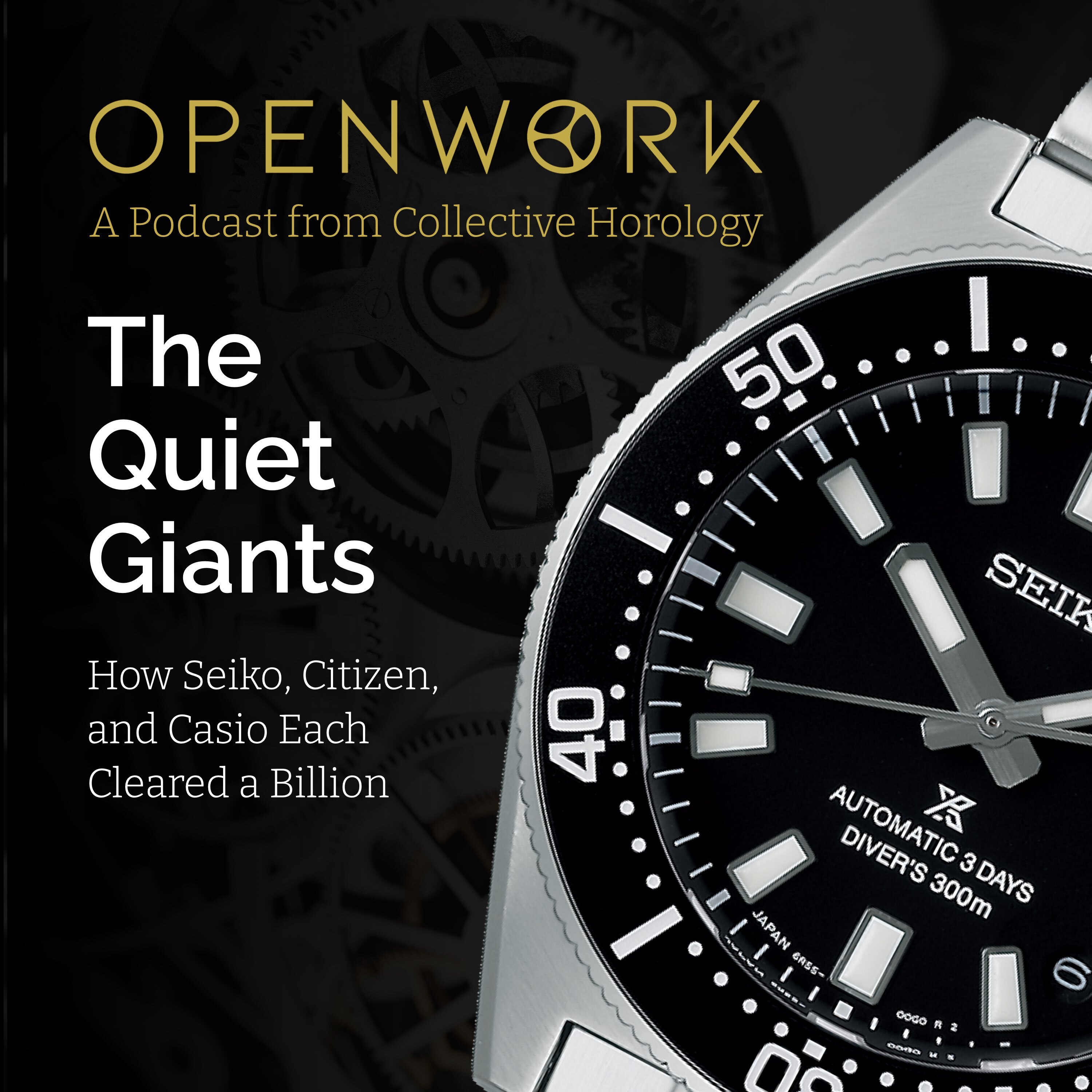
Openwork: Inside the Watch Industry
The Quiet Giants – How Seiko, Citizen, and Casio Each Cleared a Billion – Episode 82
00:58:13
Loading summary
Transcript253 lines
- [00:01]
A
Seiko, Citizen Casio, they are all doing over a billion dollars each in revenue. These businesses operate on a scale that is just unimaginable. They are in every mall, they are in every country, they are in every corner of the world. Everyone on, you know, you ask anyone on the street, anywhere in the world to name a watch brand. If it's not Rolex that comes out of their mouth first, it would probably be Seiko next. This is openwork, a look inside the watch of podcast from Collective Horology. And I'm Gabe Riley, co founder of Collective.
- [00:38]
B
And I'm Asher Rapkin, co founder of Collective Selective.
- [00:41]
A
Still here.
- [00:41]
B
Still here.
- [00:42]
A
Collective is an independent watch retailer based in Southern California. We carry a wide range of independent brands including Armin, Strom, Toledano and Chan Niton.
- [00:53]
B
Huh.
- [00:53]
A
And more. To learn more about us, to check out all the all of those brands and so much more, just visit collectiveherology.com Asher who and what is Nitan?
- [01:05]
B
I want to give a warm welcome to the Niton Prima and the gentlefolk behind the brand. This is a watch and a maker that we became aware of with everybody else a few months ago with the Niton Prima launch edition. This is a really beautiful jump hour, a chiming jump hour. In fact. There's a number of fascinating elements to the design of this watch which, which we'll go in depth on in a video I'm sure in the coming days.
- [01:33]
A
We spoke about this watch, I think on our Watches and Wonders recap.
- [01:38]
B
You know, this watch features an ultra modernist movement that is Geneva sealed. Very unusual in modern independent watchmaking. Its dimensions are incredible. It is a beautifully wearing, very svelte curved case, precious metal jump hour that in all honesty, I had a very strong emotional reaction to when I, when I went hands on with it in Geneva with Gabe. We are very proud to be part of a very small retail network. There's only two of us here in the United States, three or four abroad. There will be just about 60 watches made every year by the brand, at least at the moment, in two different metals, rose gold and platinum. And we are extremely proud to be able to offer this to collectors and listeners of Openwork and collectors from Collector Horology. So we'll have a lot more content on this coming up in the near future. But, but welcome to Collective Niton. We are happy to have you.
- [02:33]
A
Yeah, watches that, these are my favorite kinds of watches in that the more time you spend with them and the more you dig in, these are both very design driven objects. But the more time you spend with them, the more they reveal themselves, the more details you pick up on, but they don't overwhelm you with those details. It works as a cohesive whole. So these are just, as you like to say, very satisfying watches. Now we're going to talk about the success of the Japanese watchmakers today, of the big Japanese brands. But before we do, I think we need to take a moment to, to share some final thoughts here on the Swatch AP release. The last episode we did, we, we talked all about that. We're not going to go into anywhere near that level, level of depth today, but we recorded before the on sale and obviously the on sale and the store launch of these watches was absolutely wild. I've got a few thoughts on, on that. I think the biggest thing for me is one of the things we talked about was and kind of questioned was how culturally resonant is Audemars Piguet. And I think one of the things we saw is there is much more cultural relevance for AP than I ever would have guessed. You know, I think it's easy to view it as a super haute horology brand, a brand that's really among people who are into watches, but this is a brand that clearly has crossed over into mainstream culture and there was clearly pent up demand from, you know, mainstream society around the world for this project.
- [04:13]
B
Yeah, I mean, look, I think that that's true, but I, I think we have to look at that with two other, I think, you know, factually accurate realities. First, I think it's safe to say that this was an unmitigated disaster from the perspective of the Swatch Group. This project, according to reporting from Hodinkee, had been in the works prior to Ellaria Resta's ten year beginning, which means years. So it's been years that this project's been in the works.
- [04:39]
A
And they had trial runs with the Moonswatch and the Scuba.
- [04:43]
B
And for whatever reason, which, you know, I mean, we can speculate on, they decided that the best way to do this was an in person drop, despite all of the evidence to the contrary. In terms of customer experience, albeit far less chaotic, but still quite significant. With the original Moonswatch launch, the Swatch group's decisions put people in danger. It put, some people got, some people got hurt, like physically hurt. It's not okay. It's not okay. And I think it's really important that we acknowledge that this is not an acceptable way to launch any form of a product. And on top of that, I think it's really Critical that. We also acknowledge that a lot of the people waiting in line were resellers. This has been corroborated by any number of journalists, influencers, just folks online.
- [05:39]
A
Yeah. If you take a look at the media interviews of people who are interviewed in line, many of them seemed like they were there to make a.
- [05:45]
B
Is that cultural relevancy? I suppose, of a sort, for sure. But it blows a pretty big hole in Hilary Oresta's, you know, claim that this is for the. The young horologist aspiring.
- [05:58]
A
No, it was. Yeah, it was another. Another moment for hype culture.
- [06:02]
B
Yeah.
- [06:03]
A
So the fact that it was a watch is maybe almost incidental.
- [06:06]
B
Yeah. So a real. A real failure on behalf of the Swatch group and one that they haven't acknowledged, by the way, when you look at their public commute, which I think is also fascinating.
- [06:16]
A
Yeah.
- [06:17]
B
Their public said nothing.
- [06:18]
A
Nor his ap.
- [06:19]
B
No. Well, we'll talk about that in one second and then. And let's move on to a more important actual, like, watchmaking topic. But just to put a cap on this one, Swatch groups almost went. Went victim shaming on this one. You know, like, we're closing this to keep everybody safe. Like, oh, my God, who could have ever imagined? You. You could have imagined.
- [06:38]
A
Well, Nick Hayek was interviewed, I believe, on the BBC. Nick Hayek Jr. Was interviewed on BBC about all of this and his. This was covered by Screw Down Crown. Nick Hayek comes across as incredibly flip about the. The whole thing and overall described the launch as a huge success and said that essentially, like corporate speak always goes, that these incidents were. Were very isolated. Yeah, it was nice that you just mentioned some stores that had crowds, incredible crowds, and there were so much enthusiasm.
- [07:11]
B
But, you know, out of 220 stores,
- [07:14]
A
there were 20 stores that were affected where there was an overcrowding. Like hell. By the way, Manchester will open today. So it's about 10% of our stores that had certain issues. The rest went smooth because the people are passionate. And that's what is happening. We see something, a phenomenon that's based on a fantastic product and a very positive, provocative message that we have done. And you at BBC, you know how many bad messages you give every day over the last months? This should be a positive message.
- [07:49]
B
And having crowds at the beginning of
- [07:52]
A
the launch of a product should not
- [07:54]
B
be a bad news.
- [07:55]
A
It should be something that is good news. I was thinking this has now moved into an area of like, crisis management instead of brand building. But it seems that neither AP or Swatch are really interested in engaging Crisis management.
- [08:09]
B
Exactly. At least, at least Swatch said something.
- [08:11]
A
Crisis gaslighting.
- [08:12]
B
Yeah. Is just moved on to the next whatever they're going to do.
- [08:18]
A
Not watchmaking's finest moment. That, that's for, that's for sure. Let's talk about a fine moment and that is the performance of the big three Japanese watch brands. And of course we're talking about Seiko, we're talking about Citizen and Casio. All three of these businesses recently released their financial year results for the last year. And I was shocked. I first saw the Casio results, although I think they came out the most most recent. But I saw the Casio results then I was like curious about Citizen and Seiko and I looked them up. All three of these businesses are seeing huge success and in most cases record breaking revenue, which I find really interesting. We have talked so much about how the sub $5,000 segment of the watch industry has really been struggling. The Swiss brands in particular. We've talked plenty about Swatches business and how it's really struggling because they're so concentrated in that sub $5,000 segment. These guys are killing it. All of these businesses did over a billion dollars in revenue last year. And what's fascinating is they're all about neck and neck. Depending on how you do all the calculations and the currency. They're all around like kind of one $3 billion in revenue. Some are a little bit more profitable than others, but they're all, you know, somewhere around like 9 to 14% in, in, in terms of their net net revenue, their, their profitability. So they're, they're doing remarkably well at a time when the industry more broadly is struggling to find its footing. And there's a lot of reasons why that I just think are absolutely fascinating. But first of all, when we talk about some and competent management in the watch industry and among big watch companies and holding groups, which these all are, these guys are absolutely killing it and they deserve some credit. We don't talk a ton about the Japanese brands on the show.
- [10:26]
B
No, I mean a, we're not in business with the bigger ones and then the independent Japanese brands operate almost exclusively direct to consumer and have also been frankly quite successful. I mean if we look at everything from like you know, Asuaka or Hida or everything under precision Watch, you know, out of Japan. So that's stuff like Otsuka low tech, you know, these brands are on subscription in many cases they're in, they're trading for above retail value. They're incredibly difficult to find. They have lotteries you know, these are really healthy, successful businesses. You're right.
- [11:01]
A
Across the board, from micro or challenger brands to mainstream brands to luxury brands like Grand Seiko, Andy Hoffman at Hodinkee did a great interview. It's one of the better interviews he's done because of how transformative parent the. The CEO of the Seiko Watch Group is. It was an interview they did at. sih. Sih watches and wonders really focused on Creedor and who was.
- [11:28]
B
Who was at Watches and Wonders. Yeah, yeah, they were there.
- [11:30]
A
They talk a lot about Credor and Grand Seiko, but I found the CEO of Seiko to be extremely direct and transparent, which was very refreshing. You don't get that from watch CEOs, which is why I really enjoyed. Really enjoyed that interview. So across the board, whether it's watches that are a few hundred dollars, from challenger brands or mainstream brands to luxury brands like Grand Seiko, Credor growing, these companies are doing remarkably well. Japan watchmaking in Japan is doing remarkably well at a time when the rest of the global industry is struggling to find its footing.
- [12:08]
B
Yeah. When you proposed this topic, I. I realized how much of a gap it's been in our conversation to exclude these folks. And I also realized that's not uncommon in a conversation just about the global watch industry in general. We talk a lot about China as a production powerhouse, as it relates both to Chinese watches, but also, of course, to the supply chain for the greater international watch market. But of course, the Japanese have been
- [12:35]
A
making a watch consumption.
- [12:37]
B
Oh, of course. Yes. But the Japanese market, of course, is only a huge consumer of watches and has been for a long time. For over a century. It's been a significant, also creative entity for watches and clocks in general. You know, the Seiko Watch Company, of course, being a significant and major leader in global watch Trends.
- [12:56]
A
Founded in 1881.
- [12:57]
B
Yeah. And of course, the famously, you know, Japan was the. The spark that lit the fire of the quartz crisis and fundamentally changed the watch industry forever. Because of. One could even make an argument that the quartz crisis essentially created the luxury watch industry.
- [13:13]
A
Yeah.
- [13:13]
B
You know, as a result of the democratization of accuracy and. Which is, of course what the word Seiko means, if I'm not mistaken.
- [13:20]
A
I have no idea. I don't know. But sure, we'll fact check that.
- [13:24]
B
The word Seiko, which. Which does translate directly into English as exquisite precision and. Or craftsmanship.
- [13:30]
A
So there's a lot in that.
- [13:34]
B
In Japanese, apparently the name combines the word Seiko, which translates to exquisite precision or craftsmanship, with sh. House. So it's literally the house of exquisite workmanship.
- [13:44]
A
They fit a lot into two syllables there.
- [13:46]
B
Yeah, we talk too much.
- [13:48]
A
Pretty markable. Yeah. What's interesting is Seiko goes all the way back to 1881. Citizen was started, I think, in the 1910s, but Casio only got into. They're more of an electron. Or historically we're more of an electronics company. Got into watchmaking in the 1970s, and now they've built a business the scale of Seiko and Citizen. In fact, some reporting. I was looking at estimates that Casio is actually, and doesn't really surprised me with the success of G Shock. Casio is maybe the number one brand in terms of overall revenue, but again, for all intents and purposes, they're. They're relatively tight. I think the other thing about these three companies is, you know, Japanese corporate structure is famously complicated. Yeah. And these companies are usually in multiple industries. They're these conglomerates. So Seiko and the Seiko Group overall comprises Seiko Watches. The ownership structure is very convoluted for Seiko there. There's also the Seiko Epson Company, which owns a stake. Stake in Seiko. They make them, the quartz and. And spring drive movements for Seiko watches. And for Grand Seiko, it's fascinating, the Micro Artist Studio, for which Grand Seiko and Credo are known, is actually owned by the Seiko Epson Company, not by the Seiko Watch Company. So it. It's all. In any event, they have these large corporate structures, but Seiko mostly does watches. Seiko Epsom.
- [15:14]
B
Most watches are clearly produced in the cyan and magenta facilities.
- [15:18]
A
So Seiko, largely a watch company. But what's fascinating is if you look at Casio, it's an electronics company across many different categories in consumer electronics and other technologies, watchmaking went from something that they had never done until the 1970s to now over 50% of their business, most of their revenue. For Casio, it's not keyboards. Forget about keyboard, cat or whatever else it might be, or calculators. It's. It's watches. Citizen as well. I mean, they make all sorts of stuff. Medical devices, electric lathes. Yeah. All sorts of machining, tooling, and other components. Watchmaking. Actually, for Citizen, this might surprise people. Just a few years ago, it was less than half of their revenue. Now it's more than half of their revenue. So watches are not just booming for Japan, watches are booming businesses. And these. It's fascinating, you would think with these diversified businesses, you'd think that over time, watchmaking would become a less and less relevant part of their business and a smaller share. It's growing and dominating these well diversified companies, which is remarkable.
- [16:28]
B
It is. And I think there's a couple of trends that we're seeing that are helping that some that are within the control and the power of these organizations and some that are just opportunistic and beneficial. Not the least of which being that they. We have the inverse situation that the Swiss are currently facing when it comes to an exchange rate. The yen right now against the US Dollar is significantly weaker than the Swiss franc, which is almost 20 at the time of this recording, 27 to 28% higher than the US dollar in a direct one to one trade. So for every one US dollar, you're getting about 75 cents worth of Swiss francs. And it's essentially the inverse, if not better, the yen, which of course makes.
- [17:06]
A
Which was punished for a very long time.
- [17:08]
B
Yeah. But in this particular use case is actually incredibly valuable to these brands because for tourists, for visitors, for just overall purchase of these watches now retailers and consumers are able to buy a lot more Seiko, Citizen and Casio products for less than what they would have traditionally when the yen was stronger. And of course, when we compare that against the double whammy of tariffs and fx as we've talked about many times on this pod that the Swiss are facing, it makes the market significantly more appealing. So that's actually fascinating when you look at the inversion of this, because we've talked about the punishing nature of the current economic situation. But there are bizarre benefits to both consumers and brands sometimes when we see the inverse of that happening as it is in Japan. Yeah.
- [17:54]
A
The other thing going on in Japan is the domestic market for these brands is incredibly strong. I mean, a lot of these brands were frankly incubated in Japan before where they became global powerhouses. I mean, Seiko is a great example of that, certainly Grand Seiko as well. But all of these brands have a very, very strong domestic market. And sometimes that can actually be a risk for them or a headwind for them. In this case, the Japanese economy right now is doing remarkably well. I mean, famously, it's been reported the Japanese stock market has been growing, or I think it finally surpassed its highs in the 1980s due to a lot of economic reforms that have happened in recent. And this of course creates a wealth effect and this stimulates consumerism and all the good side of consumerism. But the domestic market in Japan has been remarkably resilient. Plus because of that currency arbitrage, you have people going there to buy stuff.
- [18:51]
B
By the way, respect to Japanese swatch collectors. The only videos that I saw of organized, polite and respectful AP swatch purchases were from Osaka.
- [19:01]
A
All right, I should have gone there. So, yeah, the, the nature of these companies being based in Japan, all of their sales ultimately being denominated in yen, their strong domestic market. Right now, there's all these structural favors benefiting them right now. Now of course they don't really have any control over that and in good times, like right now for them, that's great. It can also cut the other way and has for frankly a very long time. The other thing going on here, there's a number of things, but another thing is we've talked a ton about how this segment of the market generally and I know Grand Seiko Creedor fit under this and I know even Citizen and frankly even Casio, they make, Casio makes precious metal G shocks. But let's say the preponderance of the Japanese watch market is in this $5,000 and below area. This is an area that has struggled for the Swiss brands who really rely on luxury to sell their watches. You know, they, all of these brands in this segment, particularly in the Swiss corner of the segment, very much position themselves as luxury and aspirational brands. And the brand is a big part of the selling proposition of, of these other businesses. Seiko, Citizen and Casio on the other hand, have very workmanlike brands. They're not flashy, they don't market themselves or position themselves generally as luxury objects. They position themselves based on their value proposition, on the reliability, on their quality. These are household names. You know, in fact, some of these, these brands may even be more household names to the average person off the street than a Swiss brand. Yeah, but these are brands that are absolutely counter positioned to the Swiss brands in the same segment that are struggling. So at a time when the wind is coming out of the sails of luxury brands, people very much turn to, or at least they have the benefit of, they haven't positioned themselves along the lines of luxury. They've consistently positioned themselves as a value brand.
- [21:08]
B
Yeah, so I had this thought a couple of days ago when I was looking at a very attractive new release from Longines which is their new Hydro Conquest Legends. Ivor, did you see this?
- [21:18]
A
Oh yeah, yeah, yeah. It's an handsome watch.
- [21:20]
B
It's extremely handsome, all of them. Do you know how much that watch costs?
- [21:22]
A
No.
- [21:23]
B
Yeah, it's in the mid-4000s.
- [21:25]
A
So that's going head to head with a Black Bay 58.
- [21:28]
B
Yeah. And what I found interesting about that when you think as we were prepping for this pod is they clearly are trying to push the upper limits of Longines, because, I mean, look, Longines always had slightly more expensive watches. They've had gold watches, you know, and I'm talking about modern Longines, not historical.
- [21:45]
A
But that's moving into the price point where a Seamaster 300 used to sit
- [21:48]
B
it about a thousand bucks under where it sat for a long time. But my point in this is just to say, clearly they're like, okay, we're going to try to lift up Longines a little bit there with, with a mainline product because a Hydro Conquest, very, very popular line for. For Longines, very nice watch, you know, and it's, it's clicking up. Whereas Seiko has always had multiple, like many striations to its line. Citizen group too, for sure. You know, I mean, there's everything from like a $150 Eco Drive all the way up to Citizen for 8, 500 and beyond. And they don't make excuses for that, nor do they attempt to nudge up or out of it. So, for example, they just focus very heavily on the development of products for Seiko 5 in which they innovate regularly, you know, for prospects for presage for, you know, obviously, once you step into.
- [22:40]
A
Make up another product line. Quick.
- [22:42]
B
Exactly. Or when you step into like, you know, Grand Seiko or of course, Creedor or King Seiko now, of course, which has come back.
- [22:47]
A
Right.
- [22:48]
B
You know, all of these different product lines. Occupy. They certainly occupy.
- [22:51]
A
Keep.
- [22:52]
B
All right, I'm gonna pause. I recognize that people sometimes like, bristle when we say occupy a price point. So I want to specify segment. Right. So what I'm saying when I say that is that there are certain products and certain categories that are priced in a certain range under a brand. It's not a value judgment on that, but it is a. It is. It is an important, because we're a business podcast way to look at the way a business is organized. And Seiko feels very comfortable and Citizen feels very comfortable. And frankly, for that matter, with G Shock, MrG, MtG and all of these various different versions, you are a G Shock. I do like G Shock, you know, does have these zones of pricing and product that they're very comfortable with, and they don't try to change or move up market.
- [23:40]
A
Well, I don't think that's entirely true. Seiko in particular has been criticized a lot in the last five years, maybe even 10 years for pushing prices up and up and Up.
- [23:51]
B
Yeah. But on certain models that are enthusiast focused. So let me give you an example. Seiko 5. Right. Which in my mind still occupies that entry price point. Yeah. Like to me that's like, what was it? The SKX 007.
- [24:02]
A
I'm wearing an SKX right now.
- [24:04]
B
Yeah, there you go. So like to me like the SKX 007 or the 005s or whatever those were, the SKX basically was like, at least to me, kind of like the entry level Seiko diver. You know, like you had to give it the Seiko shake to get it started, you know and, but they were always like fun watches. And I, I, there was a period of time where I had several fantastic.
- [24:22]
A
I've had this watch for like 15 years.
- [24:24]
B
Yeah. And then when kills, when they, when they retired that. And they essentially introduced the Seiko 5, which in my mind, and I guess it's open to debate with Seiko Boys, but like in my mind kind of like replaced the blasphemy.
- [24:35]
A
It's not a substitute.
- [24:36]
B
There you go. But it, you know, for sake of argument is kind of in, I think.
- [24:40]
A
But it replaced it to your point. Point in from a price segment.
- [24:44]
B
Yeah.
- [24:44]
A
Not really a product. Correct.
- [24:46]
B
Thank you. That's a good way to put it. But my point is.
- [24:48]
A
But it did probably more successful than the SKX was. I see those watches.
- [24:53]
B
Well, there's more diversity in product.
- [24:54]
A
Yeah. And I think they recognize like let's make a cool entry level watch with, with fun colors and interesting limited editions. They've done much more with it creatively than they ever did with the sk. Yeah.
- [25:05]
B
But my point is. But they're doing all that around 500, 600 bucks or less or. And they're. And they're keeping it there.
- [25:11]
A
Yeah, yeah.
- [25:11]
B
Which I think is remarkable. So like. Yeah, sure.
- [25:13]
A
Are they 62? They've moved.
- [25:15]
B
Yeah. I mean the 62 ma, I mean when people talk about like oh geez, these 62 moss pieces are more expensive, I'm like, yeah, that's true. They certainly are. And they are doing some things like bringing the movement class up on them, etc. I don't want to get off on too much of a tangent, but I think the main point is the 62 Moss products are not for the mainstream. The 62 Moss products are for enthusiasts.
- [25:34]
A
I don't know when I go, when I go to retailers who carry Seiko, it's a great retailer down the street here who has an amazing assortment of Seiko Citizen, all sorts of stuff.
- [25:45]
B
Those watches sell the four and $5,000 60.
- [25:48]
A
That's not those reissues but like the 1,014. I'm talking about the, talk about the prospects.
- [25:55]
B
Okay. When people complain about, about pricing generally
- [25:58]
A
that's complain about those too because they're, they're anchored to your point, to the skx. And then they see like the SKX was the Seiko dive watch for such a long time in the mind of enthusiasts at least. Now the watch that's sort of taken its place is, that is the six. I don't know what the product numbers or the reference numbers, but it's that 62 moss reissue that's probably around 15 to 1900 dollars. It could even be more than that. Like that's kind of the benchmark now and people complain about that. However, it seems to be working for them. Seiko is making more money, they're making more, they're earning more money on that. And this is probably what's pushing SPB143.
- [26:37]
B
So it's like a $1200 62 MAS ISH watch.
- [26:40]
A
But that's the previous reference. There's a new reference now. They relaunched that. But in any event these, these watches are exactly what's putting the Swiss brands under pressure because now Seiko has moved into the territory that was staked out from a price standpoint by Hamilton.
- [26:59]
B
SPB453. It's gone up $100.
- [27:01]
A
Okay. Ooh, a hundred dollars. All right, so not as expensive as I was imagining but like the fact that I could imagine it there tells you what a good watch it is. Now they've moved into the segment. It's a good looking watch that, that was occupied by Hamilton, by Longines, by Tissot, by the, by these other brands. So they're very much, it's like well of course Seiko is doing well when these other brands are struggling because not completely, but to some extent they're eating the lunch of those other brands. They're offering a stronger value proposition. They're not relying on luxury and branding. They're letting the product speak for itself. And at times when luxury brands are struggling, they're counter positioned to that. The other thing, man, they do.
- [27:49]
B
I'm just looking at this because honestly I'm not as tuned into Seiko. I will say the difference between the 143 and the 453 significant. It is significant. So you paying 100 bucks more for a slimmer case profile. New dial designs like significant upgrades. It's not, it's not raising the price.
- [28:04]
A
Telling you man, you got to go down the street to the Seiko dealer, check the stuff out, he's got a case full of them. The other thing they're, they're counter positioned to in many ways, with some exceptions, like with the watch we're talking about here, is a lot of the Swiss brands have been focused on heritage.
- [28:20]
B
Yep.
- [28:21]
A
And I think that was a really, since the dawn of the Black Bay, through the last few years, like heritage watches were what sold, you know, they were commercially viable. And the Japanese brands have always focused more on technology. I mean, you mentioned they disrupted the entire industry with, with quartz. But to this day there's, you know, there's solar cords, high accurate accuracy cords, spring drive, all of these technologies, the Japanese brands, I mean all of what G Shock does, they just, they define themselves more by technology than heritage. And so again, at a time when the tastes are shifting and moving away from vintage reissues and heritage watches, again, they're counter positioned from a brand and a product standpoint to, to do well. So I think that that has benefited them as well. Hey, it's Gabe. Now if for some reason you find yourself wondering what you can do to survive, support openwork and the good folks at Collective Horology, you can of course pick up an independent watch or maybe submerged@collective horology.com but really the number one thing you can do to support us if you're enjoying the podcast, is give us a rate and review on your podcast player of choice. That just goes a long way to helping the right audience find this show. And while you're at it, you can check out and please subscribe to our YouTube channel where we've got hundreds of videos on independent watches and of course on the business of watches. Thanks so much, of course, for listening and for your support. We hugely appreciate it. We never take it for granted. Let's get back to the show. Another important thing is their channel and geographic positioning where these watches are sold. Oh yeah, we have talked about, talked tons obviously about the, the struggles of the watch industry in the United States with, with tariffs and all sorts of trade shenanigans. We've talked about how China, although it seems to be stabilizing, if not recovering. China has been a really dark spot for, or source of pain specifically for the Swiss brands for the last five years or so as luxury sales in general there have really have really declined. The Japanese brands have very different geographic distribution and strength. So we talked about Japan, their home market really being the backbone of their business. So Japan is doing well, but beyond that, if you look globally at where these brands are distributed, they are much more diversified than the, than, than the Swiss brands are. So all of the Japanese brands sell particularly well in Latin America. This is not a part of the world we talk a lot about as far as a driver of the watch industry, but they have very strong distribution and sales into Latin America.
- [31:12]
B
Interesting.
- [31:12]
A
And as well, and we've talked a lot about how India is really growing aggressively as a watch market. We know who is there first.
- [31:21]
B
We know anything about free trade agreements between some of those regions in Japan.
- [31:24]
A
I have no idea.
- [31:24]
B
I'd be really curious about whether or not that's part, I mean, I don't know. But that'd be just as a side note, if anyone knows who is a economist here, I'd be very curious.
- [31:32]
A
Yeah, I don't know what those dynamics are. And then these brands are all reporting in terms of distribution, strong performance from their own direct sales and online sales. This is something they've prioritized and it's a growing segment for them and obviously it's a more profitable segment and it's a segment that drives higher revenue for all the reasons we've talked about. So they have a unique distribution model or geographic strengths that a lot of the Swiss brands don't have. That again are helping them. So China can be struggling, but hey, you know, Japan is doing well and we're in, we're in other parts of the world that are, that are more stable if China or Europe or the US are struggling. P.S. the US is doing incredibly well for all of these, all of these brands as well. Again, I can't recommend the Hodinkee business of watches. Interview the CEO of Seiko Watches Enough. He talks specifically about the strength of Grand Seiko and the growth of Grand Seiko in the United States. I believe the US is now their largest market.
- [32:29]
B
Really, which is for years it was Japan.
- [32:31]
A
Exactly. So, but again, this is built on a strong foundation. Japan probably continues to be a hugely important market for them and they built that foundation and they've managed to expand globally. So again, they're sort of counter positioned. You know, this is counter positioning at work. Whether it's brand, product, distribution, currency, all of these things are creating this moment where the, these brands are, are, are well positioned in exactly the areas that the Swiss brands in their segment are struggling.
- [33:05]
B
Yeah, it, it's, it's fascinating. It's also interesting just to look at the amount of Runway that each of these companies has given themselves by virtue of their diversification of product and brand, you know, when you think about Seiko like. Oh yeah, you know, that's a great point.
- [33:21]
A
They are not defining themselves by a price segment the way the Swiss do. Seiko has given itself permission across price segments.
- [33:29]
B
Correct. So there's a solution for everything. But it's all under the Seiko brand.
- [33:34]
A
Mall watches are on decline. No problem. We have grand Seiko or prospects or whoever it might be. So you can see as market is soft, no problem. Street wear Seiko 5. Check out this cool new drive drop.
- [33:46]
B
Yep. And the other thing, same with G Shock. The other thing a lot of people don't realize too is that certainly for Seiko and for some elements of Citizen, I believe as well, and I would have to imagine for Casio, by nature of the modules they make, many of these are fully vertically integrated manufacturers. They are, you know, so when you talk about a hell man, Even a Seiko 5 is essentially a fully in house watch.
- [34:09]
A
Yeah.
- [34:10]
B
So.
- [34:10]
A
And it truly is because in that case I went down this rabbit hole. The mechanical movements for for Seiko are made by Seiko watches by another company called Seiko Instruments Incorporated. I think it is SSI or sii,
- [34:25]
B
a division of Shinehart Wood Company.
- [34:26]
A
Yeah. And so they make just the mechanical movements for Seiko and Grand Seiko, but Seiko Epson makes the quartz and the spring drive. So if you have a mechanical Seiko watch, it is a truly fully in house watch.
- [34:39]
B
I think they. And they make cases and bracelets too.
- [34:41]
A
Oh, they make it. They. I mean they grow Seiko Epson grow own crystals.
- [34:46]
B
So
- [34:49]
A
they make their own lubricants. I mean. Yeah, and screws and everything. I mean they truly are fully integrated. So cool.
- [34:56]
B
It is cool. But that level of investment and knowledge gives you a lot of flexibility to be able to pivot and manage economic challenges more effectively than if you are reliant on a long supply chain. And we've talked about this too at again on previous episodes of the Pod where that can be a major pain point point which can drive prices up, can limit the creation of product, can do all these issues and to a degree by controlling all of that, these companies are somewhat immune to those pushes.
- [35:29]
A
So they control their costs.
- [35:31]
B
It's so interesting when you consider the parallels between these two industries because of course the end product results in the same thing, watch or clock. But the way in which these companies go about their business is so profoundly different. And what I think is interesting too is but they can still hang. And what I mean by that is Grand Seiko and Now Credor at watches and wonders fit in perfectly. Yeah, they still, they present, they, they are able to present at the same level. The product speaks for itself and they can do this at these profitable margins which Swiss companies would literally, you know, throw themselves onto a bomb to get. You know, I mean these are, yeah,
- [36:13]
A
you may be thinking oh a 14 profit margin ain't that great.
- [36:17]
B
But that's tell that to the Swatch group.
- [36:19]
A
That's after all, that's after your costs and that's on over a billion dollars in revenue and that's with everything going on in the world. It's, it's pretty remarkable. And yes, I know like LVMH or Richemont have larger margins but that's driven primarily by their jewelry businesses and not by their watch businesses. The watch businesses are barely profitable if you go off of the latest earnings for those other companies. So it's pretty remarkable that the Japanese brands have of that level of performance.
- [36:51]
B
Couldn't agree more.
- [36:52]
A
Now there's this famous meme we've talked a lot about how they're counter positioned relative to the Swiss. I want to talk about the other side of the market which is micro brands and challenger brands. There's this meme among watch enthusiasts. You hear this all the time. Seiko, let's take Seiko. Seiko is dead. The micro brands are killing them and cleaning their clock. You know Seiko dive watches have gotten so expensive. They used to be kind of of the poster child for you know, the entry level of watches and enthusiast watches and things like that and now they've priced themselves into oblivion. And the micro brands offer so much more value and are so much more creative and so much more interesting and a just a better smarter buy.
- [37:34]
B
Smash cut you micro brand powered by Seiko movement.
- [37:36]
A
Well okay, well there's that deep or Citizen, there's that, there's that deep irony of course. But sure I, I think that there, most of what's being said there is true except that the micro brands aren't going to take down Seiko and Citizen and Casio. That's not going to happen. Depending on this source. You look at the total market size for micro brand watches and I think this one is low. It's anywhere from $100 million to a few hundred million dollars for across every micro brand combined. Every micro brand combined. And again there, there are some micro brands that are doing 10 million more or more in revenue but it's a very long tail. And what's fascinating is when you look at any one of These companies, Seiko, Citizen Casio, they are all doing over a billion dollars each in revenue. So any one of these companies, any them is bigger than the entire micro brand market combined. These businesses operate on a scale that, that is just unimaginable. They are in every mall, they are in every country, they're in every corner of the world. Everyone on, you know, you ask anyone on the street anywhere in the world to name a watch brand. If it's not Rolex that comes out of their mouth first, it would probably, probably be Seiko next. These businesses are huge. Number two to your point, they're powering these micro brands. The micro brands rely on them. Not entirely, but Seiko Movements and Citizen movements of course go into so many micro brand watches, whether they're mechanical or quartz movements. So you know, it's easy to say that the micro brands are going to clean their clock and take them down, but it's certainly showing no signs.
- [39:35]
B
I mean that's like here we know that at one point or another everyone from, oh, here's a brand we've never mentioned on this pod. Invicta. Invicta uses Seiko movements and Citizen Tag Heuer has in the past Unimatic Veyr notice. Zelo San Martin. Well, that's a, that's kind of a sticky one. We'll leave that one alone for a second.
- [39:53]
A
You know, San Martin will use any movement.
- [39:55]
B
Yeah, Orient, you know, which is also owned by Epson.
- [39:58]
A
Seiko. Epson.
- [39:59]
B
Yeah, yep. You know, like and the list goes on and on and on and on. So you know, that argument to me is a little, is a little, is a little challenging because we've talked about this like in the context of like ETA movements for example or you know, Salina movement certainly. But these are, these are in many cases the engines of innovation that empower these other companies to exist. And also I think important to note, Seiko employs thousands upon thousands upon thousands of people. A micro brand could be in the case, you know, in the case of some one so that we know one person. So and by the way, there are
- [40:30]
A
probably people at Seiko working on that micro brand in some capacity.
- [40:34]
B
So my point is like, you know, pricing is not the only, is not the only interpretation of value, even though it's the easiest metric for it.
- [40:41]
A
Well, I think it again, you ha. We have to always separate out the enthusiast market from the real world.
- [40:47]
B
Well, that's the other side too. Like the likelihood that, that, that and I'll give an example of a brand I really like, like Laurier for example, lovely human beings behind it, really cool watches. They use TMI movements which are says Time Module Inc. Which is essentially a white label of Seiko. Their watches are rad. But the likelihood that a random human being who is not at all remotely connected to the watch industry would want a Laurier, pardon me, versus A, you know, a Seiko is, is very low.
- [41:16]
A
Yeah.
- [41:16]
B
So it's, it's not, they're not for
- [41:18]
A
the same enthusiast attention and share of wallet maybe moving away from a brand like Seiko and towards micro brands again in the real world out there in the streets, man, these companies are still doing fine. In fact they're, they're stronger than, than, than ever. Which I just think is. Again I, I'm, I was flabbergasted going.
- [41:39]
B
Most of the people arrested in line at Swatch were wearing Seikos.
- [41:43]
A
You know, I bet there were. There were.
- [41:45]
B
That is not a fact. That is not true.
- [41:47]
A
I bet a lot of the people there was probably disproportionate number of people wearing G shocks. I mean talk about, talk about like you know, hype culture. I mean there's certainly been G shocks that have played into that as well. Although I don't think any G shock launch was as much of a debac buckle as, as this. But they're not the hype G shocks.
- [42:07]
B
Yeah, man, when people lined up for the Bamford G shock in London, people were super cool about that. But anyway, enough of that. But, but, but coming back to this. Yeah, I, I do. That's the other thing about Seiko which I think is fascinating. People are wearing Seiko movements on their wrists and many times don't even realize that they are. Seiko is so pervasive in watch culture, you know, and so, and when I say watch culture, I'm not talking about enthusiasts. I mean just like the culture of the business and the industry, it is a critical component to it. And if I may be so bold, I don't think it gets half the respect or credit that it nearly deserves for building the kind of company that it's built. You know, so many people would turn their nose up at A$500 Seiko and then go around talking about what in house watchmaking is.
- [42:53]
A
Yeah.
- [42:53]
B
You know, so yeah, that in and of itself I think is an incredibly important point. Now Obviously, obviously an NH35 caliber is not the same as like a super high grade Solita movement. Like clearly. But those are, those exist at different price points and for different products. And I think it's really important sometimes to actually take a break and look at these companies and say that's amazing. Let's talk about Citizen for a second because Citizen is a really interesting group too. Right. Because in, you know, I think a lot of people think about Citizen and I thought about Citizen for a long time as being defined by the eco drive. Right. And like a very accessible solar powered Quartz watch. But of course the Citizen Group is a very diverse watchmaking enterprise.
- [43:43]
A
Good point.
- [43:44]
B
So let's just look at that one because they've got, they have a different approach than Seiko, but. And they've actually, they've actually got their hands pretty aggressively in the Swiss market too. And they do that through a couple of different vectors. The first of course is through their ownership of Lejoux products. And so for those who don't know.
- [44:02]
A
Yeah. Why do you think Leux Parade is supplying a solar Quartz movement to TAG Heuer?
- [44:08]
B
Yeah, well, there you go. But I mean Leux Parade makes a number of great movements. We sell watches with Leux perret calipers. The G100 is a pervasive movement. It's very reliable.
- [44:17]
A
Dude, they're incredibly reliable. Yeah.
- [44:20]
B
And there are a lot of Swiss brands that use, there's British brands, there's all sorts of brands that use LJP calibers. But so, so you've got so different than the Seiko group or Seiko family of companies. The Citizen Group does also not just create a significant amount of watches at multiple price points for various different markets, but it also supplies very clearly to high end and mid tier brands in the more sort of European watch segment.
- [44:47]
A
And also is doing manufacturing in Switzerland.
- [44:50]
B
Correct. The other thing is that they have their own, own high end hot horology brands, Angelus and Arnold and Son and both of those brands have over the last several years really gotten their head on straight and are creating really great, I mean look, hats off to both Angelus and Arnold and Son. Both of them have had extremely strong releases for the last two years. And, and you know, I think that they've taken, they've really paid attention to the market and they're working really hard at it. But the major difference there is that when you look at Grand Seiko, for example, like Japanese culture and the way that the product is represented as a Japanese product is intrinsic to Grand Seiko, you know, right down to the rice paper in the, in the boxes of all of these. Whereas Citizen Group does separate out their, what are more sort of like European focused brands from their, from their more mainline watches. Like there isn't a whole lot of that push or messaging around Arnold and Son, which of course has its origins in England. Many, you know, and Angeles, which, you know, both of these are very culturally separated. So it's, it's a different strategy that that group has taken on. But it's fascinating when you consider how they look at Movement Supply. Right. They've rebranded that under or they purchased really Lejoux Perrett versus, you know, TMI or Seiko Instrument Incorporation.
- [46:20]
A
Well, Citizen also does, through Miota, sell movements as well.
- [46:24]
B
Absolutely. Good point. Thank you for pointing that out. And then of course, all of their primary Citizen branded products as well as their high end, the Citizen products. And then of course, we can't forget Frederic Constant.
- [46:36]
A
Oh my God. Or Alpena. Correct. Yeah.
- [46:40]
B
You know, both of which are also owned by the Citizen Group and benefit from the wealth of industrial technology and knowledge that the company has.
- [46:49]
A
Yeah. So that's a very different strategy.
- [46:51]
B
Yeah. So interesting when you consider, you know, at the beginning of the conversation we talked about how.
- [46:55]
A
Don't forget about Bulova. Of course. Yeah.
- [46:58]
B
Right. So when you think about this and you look at the very strong American identity, 100% they do. In fact, I believe, if I'm not mistaken, that their US headquarters are in the Empire State Building. Right?
- [47:08]
A
They are now. Yes. So don't they have a boutique somewhere near there?
- [47:11]
B
Yeah, they have a beautiful boutique up on Fifth Avenue.
- [47:14]
A
Interesting.
- [47:15]
B
Citizenship.
- [47:15]
A
Never been.
- [47:16]
B
Yeah, it's a, if you go upstairs, they have a bunch of really cool.
- [47:18]
A
You know, the Citizen Factory, Factory outlet store is a couple towns over from here.
- [47:23]
B
Yeah. Sadly, they don't sell Frederick Constan or Arnold and center Angeles.
- [47:26]
A
You poked your head in there.
- [47:27]
B
Yeah, I have. And you don't. And the, and, and interestingly, at the Citizen boutique in New York, they do not have Angeles or Arnold and Son, which is fascinating. So they, they cap out at the top there with, with actually they might have the Citizen pieces in there. I didn't see anyone. I was. But maybe they do. But they definitely have Frederic Monstan in there. Anyway, my point is, is when you look at the structure and you consider, well, these brands are head to head from a revenue standpoint, for profitability standpoint, but two profoundly different business models.
- [47:52]
A
Different.
- [47:52]
B
So really, really important.
- [47:54]
A
Casio, much stronger focus on digital watches,
- [47:56]
B
to put it mildly.
- [47:57]
A
Yeah. So look, I think when these brands, these companies do well, that is good for the hobby because again, to the average person on the street, a Citizen or a Seiko or G Shock is just a good watch. Yeah. And And I'm wearing an skx. This was not this watch here, but an skx.
- [48:19]
B
Although you did upgrade it with a Uncle Seiko.
- [48:22]
A
Uncle Seiko, or Uncle, he's now Uncle Straps. Seiko, I think, went after him. He got a cease and desist. I'm guessing Uncle Straps. But yeah, shout out to. He's also a couple towns away from.
- [48:33]
B
No, he moved. He moved.
- [48:35]
A
He was a few towns away in Fillmore, California. But I guess he's no longer the
- [48:40]
B
fireworks capital of aso.
- [48:41]
A
Yeah, if you want to buy his fireworks, you got to Fillmore. But it's a terrifying thought around here. But look, a Seiko SKX was my first proper watch and I suspect a Seiko 5 for a lot of people will be their first proper watch. Or maybe a Citizen or a Casio.
- [48:59]
B
In fact, remember when we hired somebody to work at Collective who hadn't worked in watches, what was the first thing that we gave them?
- [49:04]
A
Seiko5 told them to figure it out. So this is great news because let's go back, rewind, all the way back to Hilaria Resta's theory of the case with the AP Swatch collab, that this was going to open the doors and be the gateway to the world of horology and watch collecting that we need. Turns out that was a bit of a disaster. And the answer, the gateway is already here. It's hidden in plain sight. It's the Japanese brands. The. They are, they have never done better. They are selling more watches by revenue. Their businesses are extremely healthy. They have products to offer everyone around the world across multiple price segments. They're the watch brands who are top of mind and awareness for people like this. These guys are the entry into watchmaking. And so for them to be doing well is the best news we could possibly have for this hobby and for this industry. Industry.
- [50:10]
B
You know, listening to you say that poses a really interesting rhetorical question, which is, whose responsibility is it to introduce somebody to watchmaking? And is it a presumptive question to think that any one brand can or should introduce you to horology?
- [50:31]
A
I don't know.
- [50:31]
B
You know, it is a fascinating thing, right? Like, I think sometimes again, like price becomes such a big factor here, right? In the sense that, yeah, okay, an SKX is a affordable watch, mechanically speaking, you know, generally compared to if you're
- [50:46]
A
curious and you want to dabble, it's there for the taking.
- [50:48]
B
You know, you've got swatches, you got these, you got all sorts of other brands. But, you know, it also presumes that the only way in to watchmaking is by owning a watch. I'll give you an example. I'm reminded of one of my favorite collectors and personalities in the watch world. World times. Roman Au Roman is one of the most knowledgeable and hilarious people that I know in the watch collecting world. And do you want to know what I mean? He collects watches, of course. He collects pocket watches, of course. But you want to know what he has a massive collection of and how he and Roman, if I'm wrong about this, you can message me and tell me, but I believe he really got into this and started a lot of this through collecting watch books. And a lot of those were about Al Briguet, you know, about other masters of modern watchmaking. I guess my point is we're going
- [51:37]
A
to have to do an episode about the watch book industry. They're flying off the shelves.
- [51:44]
B
Get Mandani on the phone. No, but my point is I think there's so many ways into this and there's so many opportunities. And one question for someone like, apart is like, maybe that's not your lane. You know what I mean? Like, like, forget about like all of the commentary and the rest of it. It's also like you, you, you do make extremely high end luxury watches. Right. Mercedes doesn't have to teach you how to drive.
- [52:05]
A
Yeah.
- [52:05]
B
You know what I mean?
- [52:06]
A
Yeah. No, it's the, like, it's the all the old Jeff Bezos thing of like, if it doesn't make the beer taste better, why are you doing it? Does the AP Swatch collaborate?
- [52:17]
B
Have you seen Jeff Bezos recently, by the way?
- [52:18]
A
I don't want to get it, but he. This is a famous quote of his. Let's do they talk about on the acquired podcast time. And it's basically, stick to your knitting. Right? Like that. Let's, let's use that chestnut there. Stick to your knitting. Does it really help AP to make a plastic watch with swatch? Is that them sticking? Does it make an AP better?
- [52:38]
B
Forget about that for a second. Just come back to like, the key point of like, if the, if the stated purpose was to introduce people to watchmaking, is this even their job?
- [52:46]
A
Yeah.
- [52:47]
B
And I think.
- [52:49]
A
Or, or, or to just challenge it a bit more at another level. It's like, isn't it presumptuous to say for AP to say it's our role. We're uniquely positioned to open up the eyes of the world to watchmaking in a way that no one could have done without us? Here we are coming in on our white Horse to save the day. The rest of the industry can thank us later for popularizing watchmaking. These other guys are already selling over a billion dollars of watches each and popularizing watchmaking every day. And only getting stronger is, is the entry or the gateway to watches somehow closing off or getting smaller or under threat when these guys are just going gangbusters?
- [53:35]
B
No, dude, you sound like me. So all this to say, say is
- [53:43]
A
that a compliment or an insult?
- [53:45]
B
Depends on, depends on the day. Look, all of this to say the greatest respect for these businesses and what they've accomplished, the innovation that they continue to show, the respect for consumers and the quality of these products. And I'm going to end with one, with one little anecdote. You and I have had the opportunity over the years to meet lots of different people, brands. One of the most courteous and lovely people that we've ever met in watchmaking is Rusty from Seiko and now Grand Seiko. And he worked there for, he's worked there for decades upon decades on all manner of different products. He's a senior guy there now.
- [54:29]
A
He's in their sales organization.
- [54:31]
B
Yeah, but they, you know, and, and, and it's not just Rusty. Right. I mean there's a lot of, of people.
- [54:37]
A
Joe Kirk.
- [54:38]
B
Joe Kirk, absolutely amazing person.
- [54:40]
A
Yeah.
- [54:41]
B
And you know, good example of how Seiko hires. Right. Enthusiast before he was hired by them, you know, and legendary knowledge base.
- [54:48]
A
Yeah. And a successful salesperson as well at the Seiko store.
- [54:53]
B
So these are people who, who believe in what they're doing, who hire good people who are, you know, thoughtful, open minded, curious. Before Collective had even released a watch ever as a collaboration, Rusty took a meeting with us, was kind and respectful and other brands were just like, okay, you have a nice day now. And I get that.
- [55:15]
A
Really amazing.
- [55:16]
B
Yeah. And look, and by the way, for the record, like, I get that, like, sure, you know, that's not, you know, nobody had, nobody had any time or
- [55:23]
A
a dime a dozen. Exactly.
- [55:25]
B
But, but my point is the level of courtesy and kindness and open mindedness and curiosity that came from them really, I think opened my eyes. And even though we've never done a project with Seiko, we don't carry Seiko or Grand Seiko or anything like that. Everyone we know who does, admires and likes the people that they work with. You know, we ran into a Grand Seiko sales manager.
- [55:49]
A
Oh my God, that's right.
- [55:51]
B
You know, having drinks as one does. Yeah. And he couldn't, he could not have been a more lovely person. And I, I, you Know, same thing with the guy.
- [55:58]
A
Genuinely interested in watches.
- [56:01]
B
The staff in the New York Grand Seiko boutique are fantastic. Fantastic.
- [56:04]
A
Anytime you go to a Seiko boutique or Grand Seiko boutique, you'll have a nice time. The salespeople there are informed. They're respectful. They are not predatory. They're not. They're not salivating at the mouth to sell you something. They don't follow you around the store like a lost puppy dog. It's a pleasant experience.
- [56:21]
B
You know, shout out to Weston at the New York.
- [56:24]
A
Oh, yeah, yeah.
- [56:25]
B
At the New York Grand Seiko boutique, who is an incredibly knowledgeable. And, you know, he was there when
- [56:29]
A
that boutique was just a hole in the wall.
- [56:31]
B
Yeah, but that's the point, isn't it? You know, and if I'm not mistaken,
- [56:34]
A
I believe it just a Seiko boutique original.
- [56:37]
B
They sort of jammed everything in there, you know, but he. If I'm not mistaken, he moved from. From a Richemont brand over there and then. And then really, you know, dedicated himself and grew it. These are the kinds of people that they bring in.
- [56:46]
A
So, you know, it's funny, whenever I go to a watch boutique of any kind, go in there and I tell the salesperson, I know Asher, they're like, oh, I know Asher. You go pretty much anywhere in the
- [57:00]
B
world, followed immediately by get out, and
- [57:03]
A
has nothing to do with Collective or the podcast. This has been going on for years before Collective was even a thing, you know, that, you know, sale. In fact, all of the salespeople who work at Collective, you are a customer of.
- [57:16]
B
Yeah, that's true.
- [57:17]
A
Before. Before they ever worked here. So, yeah, shout out to. To the army of. Of Watch Boutique staff around the world
- [57:24]
B
who know Asher, and thanks for tolerating me. Shall we leave it there?
- [57:29]
A
We will leave it there. Thanks, of course, for listening. Openwork is a production of Collective Horology. You can find us online@collective horology.com you won't find any Japanese watches there. That's a bummer.
- [57:42]
B
We got to fix that.
- [57:43]
A
We got to fix that. But, you know, hey, if you have thoughts on that or anything else, you can always email podcastollectivephorology.com.
- [58:06]
B
Do not use that.
- [58:07]
A
I will not use that. You have my word. All right.