← Openwork: Inside the Watch Industry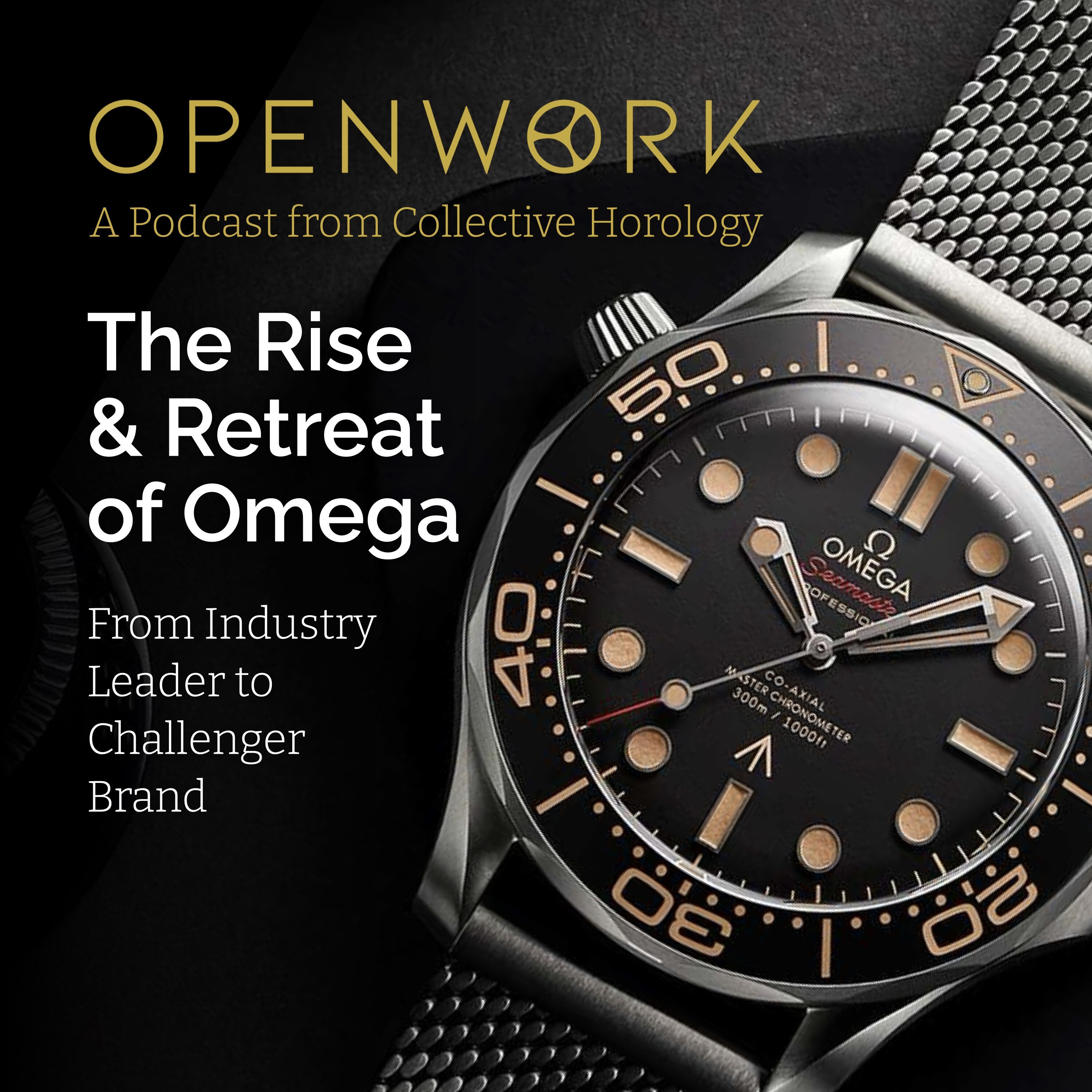
Openwork: Inside the Watch Industry
The Rise & Retreat of Omega – From Industry Leader to Challenger Brand – Episode 54
Loading summary
Transcript164 lines
- [00:00]
A
Omega has a lot of skus and there's a little bit of a feeling of like, you don't like this.
- [00:04]
B
How about this?
- [00:04]
A
You don't like this. How about this? You don't like this. How about this?
- [00:07]
B
You don't want it in black. Here it is in blue. No blue. How about white?
- [00:10]
A
I don't know if I can get it for you in white, you know, so my point is. And then you pick up the phone, you call the next guy and he's got one.
- [00:18]
B
This is openwork, a look inside the watch industry, a podcast from Collective Horology. I'm Gabe Riley, co founder of Kollective.
- [00:26]
A
And I'm Asher Rapkin, co founder of Kollective. Collective Horology is an independent watch retailer based in Southern California. We carry a wide range of independent brands, including Holthenrichs, David Candeau, Atelier Wen and more. To learn more about us and check out our available inventory, visit collective horology.com.
- [00:44]
B
Atelier Wen We've carried them for months now, most recently with the launch of the Ancestra. But today, after this podcast drops, Atelier Wen is introducing a new watch. And it is is absolutely remarkable. It is a horological tour de force. I just wrapped up publishing and putting together a video on the Watch. We had the chance to go hands on with this watch on multiple occasions, both here in California and in Geneva earlier this year. It is absolutely wild. I think it's going to be unexpected for Atelier Wen and sets the brand on another level and in a new direction. So at 3 o' clock Pacific today, on Monday, November 3rd, the day this episode drops, they'll be releasing that watch. So if you're listening to this after, you may already know what it is and if you don't go to collective horology.com you can check out all of the details, including that video. They're absolutely wild and really cool watch. But enough about these brands, Asher, that.
- [01:45]
A
Was a long plug.
- [01:46]
B
Today we are talking about a different brand. We're talking about Omega. It's the Omega Sode. Do you ha. You have any idea how long I've been. I've been waiting to say that. But in particular today we're taking a look at the business of Omega, how they went from the world's number one watch brand. Now that's both in terms of sales and, yes, units shipped to number three. What happened along the way and where they might be headed next. Now, of course, a lot of ink has been spilled on the topic of the world's number one watch brand, which is Rolex. Great episode from the guys that acquired and Hodinkee on their business of watches podcast, did an interesting episode on the. On the history of Rolex. Those are great resources. And it occurred to us, hey, what about Omega? Because usually when one thinks about Rolex, the brand that's sort of, at least in the modern era, and we'll talk about the different eras of Omega, Pepsi.
- [02:42]
A
To the Coke, if you will.
- [02:42]
B
They're the Pepsi to the Coke. They're the challenger brand. They're the, you know, they're number two. They try harder. Well, technically, actually, now they're number three. And we'll talk a little bit. Is that Avis about. About that? Yeah, Avis, the famous ad campaign from the 50s.
- [02:55]
A
We just try harder.
- [02:56]
B
We try hard. We're number two. So we have to try harder. We're not hurts. We. We have to go above and beyond. We can certainly ask that question about Omega. Are they trying harder? Are they delivering more value and horological interest and all that kind of stuff? But I think it's worth a look at Omega, not just because they exist as the Pepsi to maybe Rolex's Coke, but because this was the world's biggest watch brand for a very long time. And more importantly, over the last 70 years, they've been a top three watch brand. This is an industry stalwart. And when you think about. We'll talk a little bit about the history of the brand, whether they're number one or number three. Three or whatever, being in that top three and being in that position for such a consistent in a long period of time is pretty remarkable. We'll talk about the drivers of that and the ingredients that go into that success. So I was thinking maybe we could start quickly with the current situation at omega, where the business sits today. We'll look a little bit about, you know, their historical context, how they rose to be the number one watchmaker in the world and what that looked like, what the drivers were of that. And then I really want to focus on the modern era of Omega, Megan. I want to look really at the business and how it's evolved from the 1980s through the current century and what kind of the ingredients of the brand's success really are and where maybe there are some threats for them as well. So, Asher, are you ready to chat Omega?
- [04:22]
A
Yeah, I'm ready to chat Omega.
- [04:23]
B
All right, cool. So Omega today, it's the world's third largest watch brand in terms of sales, and it sits behind Rolex, obviously, as well as Cartier. Now Cartier moved into that number two position and eclipsed Omega just a few years ago.
- [04:38]
A
That's total brand value for Cartier. Right? Not just watchmaking.
- [04:41]
B
That's an estimate of Cartier's watch business.
- [04:44]
A
Oh, interesting.
- [04:44]
B
Okay, exactly. So for instance, and these numbers are estimated. Now of course, Omega and Cartier are part of publicly held companies, but they don't necessarily break out the performance of those brands or the watch sales in particular in the case of Cartier. So these are based on industry estimates. Typically this is coming from like Morgan Stanley and Lux consult, but in 2024, it's estimate estimated Omega did just about $3 billion in revenue, maybe a little bit less. Cartier, on the other hand, was probably in the 3 to 4 billion range in revenue for watches. And then Rolex at over 11 billion, probably about 11.5 billion. And again, these are estimates, but these estimates use a similar methodology. So, you know, within these models, we're comparing apples to apples. Omega's as a result, has about a 7% market share and they've generally hovered in the modern era around 7 to 8% market share. So it's, it's relatively so it would be accurate, stable.
- [05:41]
A
Characterize that as seven out of every hundred watches is an Omega sold.
- [05:44]
B
In terms of value.
- [05:46]
A
Yeah. Oh, okay.
- [05:47]
B
In terms of value, not units sold. Not units sold. In terms of units sold, though this is interesting, we do have that data. It's estimated they sold about half a million watches last year in 2024. That compares to 660,000 for Cartier. So that's a significant delta. In terms of numbers sold, Cartier's average price point is about $1,500 lower than Omega. Their average price point for a Cartier watch is about 5,000. Omega is just under 7 or something like that. We have that data, but it's a lower price point.
- [06:19]
A
Needless to say, it's certainly a lower entry point into the line.
- [06:22]
B
Lower average price point. Rolex is about 10k US for a watch. Rolex, over a million 1.2 million watches. Again, these are estimates. They don't publish them publicly. So that's double Cartier. Right. So Rolex is in the lead by a mile, but Cartier, just in terms of units shipped is ahead of Omega. And again, this is new as of, as of 2020, really, Omega was in that number two position for 20 or 30 years. So quite a while. In terms of historical context. This is a brand that goes all the way back to 1848. It was once the number one brand, as we said, in terms of sales and units sold. So not just in terms of revenue, but the number of watches sold. And that was really from the 1950s to the 1980s. So they had about a 30 to 40 year stret where they were the world's number one watch brand. their height, they were shipping over a million watches per year. That was in the early 1970s, which is wild. So almost as many as Rolex is doing today. Obviously that was a different time where more people wore. Wore watches. They ceded that ground. So in the 1970s, Seiko became the number one brand in terms of, in terms of watches sold. And Omega did seed their leadership in terms of revenue in terms of total sales to Rolex probably in the late 1980s to early 1990s. It's not totally clear. Again, the numbers are opaque enough as they exist today. Going back historically, it's really hard to figure out, but most people estimate that it was in the late 80s to early 90s that Rolex overtook Omega in terms of total sales.
- [08:03]
A
Yeah, you know what's also interesting there because I'm really trying to contextualize the production numbers for myself. In order to ship about half a million watches a year with about 260 working days in a year, you have to make about 2,000 watches a day. Yeah.
- [08:20]
B
That's insane.
- [08:21]
A
Yeah. So when we talk, I mean, we'll get to this in a moment, we talk about part of why the company is in fact named Omega. But it really does, I think, give some insight into what it is to be a fully industrialized watchmaker and maintain that level of market share. Because it's not only just a matter of having the market to sell them, it's also about having the industrialized infrastructure to manufacture them. And if, if you want to blow your mind even further, if it takes, if you'd have to, if you're averaging it out and it's about 2,000 watches a day for Omega, that means it's something like 5,000 watches a day for Rolex.
- [08:54]
B
Yeah, or just imagine how many watches an hour. Let, let you know, trip out on that.
- [08:59]
A
Which also talks about not just. And this is also, I think puts a fine point on when people talk about a watchmaker shortage, how, how that literally plugs into this. Because it's not just a matter of component manufacturer with machinists and metallurgists and all that. Just manpower required to assemble is key. And this I think also we should talk about this on a later episode about the impact of robotics.
- [09:20]
B
Can you imagine what it must have looked like at Omega's factory in the 1970s when they're cranking out, you know, hand assembly a million watches a year. Yeah, well, so there are no robots on the factory floor.
- [09:33]
A
Yeah, and we should talk about this because robotics is actually a really large component of how Omega assembles. It's true about Tudor and Rolex as well, but it's also really true about how they manage their own parts and materials. There's great videos online, for example, that show you in the relative. There was a recent renovation at, within the last decade or so at Omega's primary manufacturing facility where there's massive robotic arms that are very reminiscent of the end of Rogue One, for example, in the data center where they're able to. And I use that as a reference point because it looks quite a lot like that. This massive structure where robotic arms are constantly hunting for tiny little parts and bringing them to the watchmakers. So that's a level of efficiency that's only enabled by modern day technology. To Gabe's point, to imagine shipping 4,000 watches on average in a day years ago, prior to any form of industrialized or computer revolution is absolutely mind blowing and helps put some context into what the scale of the industry was like in a pre, in an industrialized, but pre computerized age.
- [10:34]
B
Yeah, so just doing a little like light desk research here while you point this out, but thinking about at its height, you know, how many watchmakers would Omega have to have had kind of on the factory floor to do that? And it's, it's about a thousand watchmakers now. They may have had, you know, more on staff because people call it sick or. But you know, you're basically asking each watchmaker to assemble four watches a day, which, you know, seems about, seems about reasonable if you're doing it at an industrial scale. So.
- [11:02]
A
But that's also just massive leverage. Just the watchmaker that's kind of the support staff.
- [11:06]
B
Exactly. Yeah. Yeah. Pretty, pretty wild. So I think the question is like, how did Omega get to that place? Right. Like you don't have, you're not cranking out a million watches a year overnight. And you know, you mentioned the focus on robotics and automation that they have now, but that actually goes way back into the, into the company's history. And the reason why the brand is even called Omega has a lot to do with production efficiency. So as I said, the brand was founded back in 1848, but it was called Louis Brandt Effie. So Louis Brandt and Sons, founded by Louis Brandt, but the Brand name didn't change to omega until about 1903. And the reason why is in 1894, this was the real breakthrough for the company. And ultimately for the Omega brand, they introduced what was essentially a modular movement. So move a movement. So 19 line movement, pretty large. But you know, it's probably for pocket watches, but it had interchangeable parts and this was a breakthrough. So you can imagine this allowed all sorts of efficiency in both the manufacturing of watches and you know, adding complications, things like that, as well as the ability to service them. So this was a massive breakthrough. And this approach to like a more kind of efficient and industrialized approach to watchmaking is what really allowed the company to, to achieve success. And the movement was so important, the movement was called the Omega movement, that the company rebranded and changed its name about nine years after introducing it to Omega. So it, it, it's kind of wild, the things you point out about Omega's industrialization today. Trace it back all the way to the origins of the brand.
- [12:54]
A
You know, what other company I, I realize omega rebranded in 1903, but you want to know what other major company opened in 1903?
- [13:02]
B
Well, not Rolex.
- [13:03]
A
Ford.
- [13:04]
B
Ford. Oh, interesting.
- [13:05]
A
Yeah. And it is interesting, of course, because what is Ford most famous for? Fundamentally industrialized assembly line manufacture and introducing that into the. So you can see two very different worlds, but having the same sort of being part of the same zeitgeist and approaching manufacture with a very 20th century mindset right from the, right from the get.
- [13:26]
B
Yeah. And in the historical context of Switzerland and the Swiss watch industry, like I think when you, when we say something today like, you know, Omega pioneered movements with interchangeable parts, people are probably like, so what? Like, of course they would do that. It's kind of like listening to the Beatles and just being like, yeah, that sounds like rock and roll music. You don't realize how revolutionary it is. But if you think about the context of Swiss watchmaking, as we've said before, at this point in time, in the late 19th century, it's a very fragmented industry. Things are very specialized. It's a very much, quite literally a cottage industry. And you know, part of the history, for instance, of iwc, and the reason that that brand was founded right on the German border in Schaffhausen, in that part of Switzerland, is because it was more open to industrialization. And the whole founding of that brand was premised on bringing American style watchmaking and assembly to Switzerland. Because Switzerland was not doing large scale assembly. It was not doing specialized or modular assembly or Anything like that. So the fact that Omega, which was founded, you know, in the cradle of Swiss watchmaking in the French speaking part of Switzerland, was doing modular movements was actually quite radical and anathema to how the rest of the industry was operating. And this is what allowed them to basically leapfrog so many other brands. And by the 1930s, they became a mainstay brand. In 1932, they became the official timekeeper of the Olympics. They're still the official timekeeper of the Olympics. We'll talk about that. Remarkable consistency. Also in 1930, just two years before that, they actually merged with Tissot and they formed what was probably the first holding company of watch brands in Switzerland. So they formed a company. I'm not going to get into the French, excuse my terrible French, but this was the precursor to Swatch Group, which is ssih. They later added Lamania, Hamilton and Certina to the group, which then ultimately became part of Swatch Group, which will be important to Omega's story as well. So this is a brand that becomes industrialized. This is a brand that basically sets the template for the group structure. And by the 1950s, the key ingredients are all in place here from a product position. So by 1957, and it's really between 1948 when they introduce the Seamaster and 1957 when they introduced the Speedmaster, Omega's product portfolio becomes what it is. So they introduce in that nine year span the Seamaster, the Constellation and the Speedmaster.
- [16:13]
A
Yeah.
- [16:13]
B
Which are still. Plus the deville, which are still the tent poles and kind of the organizing products of their brand lineup.
- [16:23]
A
Yeah, incredible when you consider just the level of impact that those three lines have. And then of course, when we just jump to the future of that. Pardon me, by 1983, we have a merger between SSIH and another company, ASUAG, which ultimately leads to what we now know of as the Swatch Group, which of course created from a business standpoint, access to much better finances, cost efficiencies, global distribution, research and development, et cetera. We have now entered essentially what is the beginning of the, of the more modern era of the Swatch Group thing.
- [16:56]
B
Is really important though. And you know, obviously, like everyone knows we have a big company, of course you have more, as you pointed out, financial resources. But I did a little bit of research on this in terms of the research and development piece of Swatch Group. So companies that the Swatch Group owns that don't make watches, Right. Non watch brands that the company owns and Omega's access to these resources. So the most famous one is eta. Right? And we know ETA has obviously done a ton for Omega, not just literally in terms of providing them with movements, but also research and development and movement.
- [17:32]
A
Technology, arguably a ton for the industry.
- [17:34]
B
Period, and things like that. But within the Swatch Group, you have a number of really fascinating companies that don't make watches. So you have Renata, which produces small batteries both for watches and other industries. You've got Nivarox, which has hair springs. You have Commodore, which specializes in advanced ceramics. You have companies within the portfolio that focus on microelectronic engineering. And they're providing components not just for watchmaking, but for aerospace. So you have all of this access to research and development. And this, I think is going to become really critical for the modern era of Omega, which we'll get to in a little bit. Not just in terms of like producing on an industrial scale, but the technology of the watches themselves and what the Swatch Group enables there become a key ingredient to what makes Omega what it is today.
- [18:28]
A
Yeah. It also touches on a little bit of why global trade or globalist markets are so intertwined with an industry like this. I think sometimes it's easy to look at a niche industry like watchmaking, which is a multi billion dollar industry, but compared to other things from a manufacturing standpoint, is relatively small. And then you look at the holdings of the Swatch Group and you realize that the employment of people at that group spans from everything from the way that we picture it, right? Lean know decorators and movement designers and watch engineers and watchmakers, all the way to the extremes of electrical engineers and, you know, folks with experience in metallurgy, people who have skills that overlap with other industries. So when we look at like the impact, for example, of good years or bad years economically on something like the Swatch Group, that impact, it seeps into other industries and it has an impact on a global level. So when we have these massive conglomerates with these holding companies that are as diverse, you get all the benefits. Benefits that Gabe just pointed out. But you also have a significant connection to the rest of the economy. And I find that really fascinating there too. So if you depress the Swiss watch industry, you're pushing some people potentially out into, you're pushing that economic depression out into other segments, which creates challenges and vice versa, when you have strength in the watch industry, we're creating, nurturing and feeding talent across associated and dispersed industries. So it's fascinating to me when you think about all of the talent within something like a Swatch Group or a Richemont, for example, and what the implications are outside of just this one particular art form.
- [20:09]
B
Yeah, it's a great point. How many horological firsts or things like that, like the Ming poly mesh bracelet for instance.
- [20:17]
A
The process for that was not invented to make a bracelet.
- [20:20]
B
Yeah. The process for that, laser sintering, which is the 3D printing a metal, essentially was not developed by the watchmaking industry. How many things that are sort of horological firsts are adapted from other industries and how many things that the watch industry develops are then picked up by related industries as well. I mean, we know watchmakers who to this day supply components because they can micro engineer them and produce them to the aerospace industry. So it's kind of fascinating. So it's the 1980s. Congratulations, Omega. You are the world's number one watch brand in terms of sales. You have survived the quartz crisis. You are now part of the, what becomes the Swatch group here. You have access to all of these incredible resources. You're a global brand, you have distribution everywhere. But a little bit of bad news. In the late 1980s, Rolex finally overtakes Omega as the world's number one watch brand in terms of sales. And you know, when I, when I looked into this, I was trying to do research to figure out like when exactly this happened and why exactly it it happened. And the fact of the matter is this may not be very, very satisfying, but when you think about Rolex, particularly if you're a fan of vintage Rolex, this will make sense in terms of like, you know, rareness and collectibility of vintage Rolex watches. Rolex slowly but surely overtook Omega. It wasn't a particular product hit, it wasn't a particular event or anything that, that, that happened. Rolex was on a slow methodical rise through the mid century into the 1980s, where they finally overtook Omega in terms of sales. And now we have a brand that enters the 1990s and finds itself in a new position. It's no longer the world's number one watch brand. It's no longer necessarily perceived as a leader in mechanics and watchmaking and things like that. You know, if you think about a lot of the Omega watches, I'm wearing one actually from the 1990s. Today I'm wearing an Omega Seamaster. And this is a watch from the 1990s. And there's, it's a very cool watch from a design standpoint. But if I think about the technology of this watch, there wasn't really much that was fundamentally unique, exciting or Differentiated about it.
- [22:52]
A
Yeah. But was that a thing that people.
- [22:53]
B
Cared about at that era? Well, at scale, at this era, I don't know that it was. But at this era, Omega is beginning to get leapfrogged by companies like Seiko in terms of technology.
- [23:06]
A
Right.
- [23:06]
B
They're leapfrogged on Quartz. They're beginning. This is a time when Rolex is investing more in its own movement development and making a number of upgrades to its movements throughout the 1990s. This Omega watch is beautiful, it's really cool. But it's essentially an assembled watch using an ETA movement. And there's nothing remarkable about it in the way that Omega seamasters today are fundamentally remarkable and high tech. So Omega finds itself in this position where not just in terms of sales, but I do think in terms of watchmaking and technology is beginning to be lapped by its competitors. And this sets Omega on a new footing for its business where it's no longer the market leader, it's now a challenger brand. It's operating in many ways in opposition to Rolex. Now, I don't think that's necessarily a bad thing. I think it forces Omega to up its game. But. Well, this is where that shift happens. It's in the 1990s.
- [24:08]
A
Yeah. And this is where Omega enters my awareness. Right. I mean, the watch that Gabe is wearing, for those wondering, is a Bond Seamaster. So this is like a Goldeneye essentially era Seamaster, which for me at 43 years old is like a very, like Goldeneye was, was an awesome movie. The game the show or the game the movie. You know, even the watch, watch was in the video and the BMW was a Z3 in that. Yeah, like I remember. Even right now, I don't even. You guys all know this. I don't know anything about cars, but I remember the Z3 Z3 Roadster. So my point being, the marketing wing came into full effect. And in fact, my very first luxury watch purchase from myself was a pre owned Quartz seamaster, which I did not know was Quartz at the time, but that's a separate issue. But regardless, badass watch. Now at that period of time, they also made an investment. They bought the rights to the coaxial escapement from George Daniels. So they don't hide that fact at all, of course, but that is for clarity's sake. Who invented it originally? Which for those of us who love independent watches, I think is an incredibly cool thing and a reminder that technology developed by, you know, individual watchmakers can find growth and scale. It is possible. And that sort of intellect. And it happens all the time. I mean a lot of movements are designed by third parties and are quote unquote in house, which is fine because you have a third party designer make it or technology is developed elsewhere. And I think to my earlier point of like, well, did it really matter to people in the 80s, I wonder. The late 90s we start to see a more robust through the, through the Internet, a more robust community connecting around, watch collecting, purist pro things like that. And I wonder if part of the reason that we see Omega benefiting from technological growth and achievement is because there were easier ways for people to connect that weren't just one way streets like traditional print watch media was in the 1980s. There certainly were watch enthusiast publications and magazines in the 80s, without a doubt. But you know, message boards and communities like that changed that dynamic. And I think, you know, coaxial escapement probably didn't mean anything to the average consumer who was looking for a cool diver, but did mean something to enthusiasts who were beginning to form those communities and grow what is now, you know, quote unquote, the watch community. And the way that we think about.
- [26:29]
B
It today, yeah, I think fan service and enthusiast engagement is in the modern era, which we'll get to in a second here. A very important ingredient to Omega success. But if I think back to the 1990s and the picture we painted of where the brand is, he just got lapped by Rolex. Yikes. What do we do? You're absolutely right. Jean Claude Biver takes over. Omega becomes a marketing brand. Right. James Bond, not just, you know, associated with a movie and a watch, but like this is a major expenditure in marketing.
- [27:01]
A
Yeah. Shoved the watch into the culture.
- [27:04]
B
You know, think about some of their other high profile ambassadors at the time. Cindy Crawford famously was an Omega ambassador. I mean, huge global megastar. They continue to invest in the Olympics as the official timekeeper. So they very much become a marketing brand. Number two, I think the coaxial escapement, you're right. To the average person buying a diver, do they even know or care? No, but internally at Omega it says we need to up our game and we need to invest in. Even if we're buying and bringing this technology in, we need to invest in and get serious about the tech and the product innovations that we can offer because it's not going to be good enough going forward when our competitors are getting better. Rolex is doing more and more and more in house. Like we need to get serious about technology. So I think if anything it's a Shot across the the bow within the company and within the industry to say we need to invest in technology. And the third thing they did in this era is they focused on retail and customer experience. So this is when they began to build out their own company owned and operated boutique network which if you think back to the 1990s was actually a very big and innovative step. This was an industry at large. Not just a brand in Omega, but an industry at large that really relied on third party retailers. Now Omega Mega is upgrading that experience with dedicated boutiques and opening their first boutiques and likewise making some changes in the way they handle service. So famously for a very long time, Omega, and this was a strength in some ways of the brand, had a very decentralized servicing network. They would train up a lot of independent watchmakers and watch watchmakers who worked at retailers or independently or independent service centers to service their watches and give them access to parts accounts. And still Omega does provide training and parts accounts to watchmakers outside of their, outside of their company. But this is when they really begin to, began to scale up their own service centers to be able to provide more consistent kind of aftercare service. So they're thinking about marketing, they're thinking about product and they're thinking about how they manage their customer experience differently and maybe better through their own retail network and their own service center. So this kind of sets them up to make a shift. You know, I think they, they basically got the memo they needed to change and they began to lay those foundations. And then I think it's really in the 2000s and in the last 20 years where the, the, the brand we know as Omega today and the ingredients that make the brand what it is today really came into focus. And I think there's a few things that contribute to the success of Omega in the last 20 years years. And the first is going to be consistent brand and marketing investment. So we mentioned they made the pivot to being a marketing brand in the 1990s. They have maintained that in I think a remarkably consistent way in the last 20 years. Sidney Crawford aside, like someone like George Clooney, has been an Omega ambassador for quite a long time. Daniel Craig continues to be an Omega ambassador even though he's no longer in the James Bond role. They continue to invest in the Bond for they continue to invest in the Olympics. They have made commitments to be a marketing driven brand that have lasted decades, which in the world of advertising and marketing is pretty remarkable.
- [30:39]
A
Yeah, I mean it's really, really important for all of us to myself Included, Lord knows, to remind ourselves that if you're shipping 2,000 watches a day, enthusiasts are not not your target. And while Omega absolutely makes watches for enthusiasts and there is a large collecting community of enthusiasts, the majority of people who buy an Omega watch are not watch guys. And as a result, a lot of the things that I think sometimes watch the watch community shuns, like, oh, the marketing budget, oh, we don't need influencers, blah, blah, blah, is like, like important to remember. You may not or we may not, but the business does.
- [31:27]
B
If you stop an average person on the street and tell them, name me a luxury watch brand, of course, most people are probably going to say Rolex and if they can name a second.
- [31:37]
A
Brand, it's probably Omega.
- [31:39]
B
It's probably Omega and this is why it's a significant investment. But it's also remarkably consistent. They don't keep changing it up. I worked in advertising for decades. I can tell you how often clients constantly change their marketing strategies, their sponsorships, the things that they stand for, the budget levels they put into things. It's very erratic. The average lifespan of a cmo, it's like a couple of years, four years at most. It's like two to four years. Like, that means there is a ton of turnover in marketing at large companies and a ton of changes in strategy that go along with it. But here Omega is being remarkable consistent. They're not just spending a lot of money, but I do think the consistency accrues every two years. Well, the initial timekeeper of the Olympics.
- [32:27]
A
They'Re there, they are consistent, but they're also really good at segmenting their audiences. So, for example, you're right, the majority of the marketing that we see from them is like, you know, George Clooney looking off to space holding, you know, a watch in front of his chest. Like classic watch marketing pose, which really speaks to like 85% or 90%, I imagine, of the people who interact with the brand on a daily basis. But when they look at their, when they do look at their enthusiast community, which, like I said, may not represent the majority of sales, but certainly represents, I would imagine the folks who are buying regularly and are significant repeat buyers, the folks who own 3, 4, 5, 6, 7, 10 plus Omegas, we're well into enthusiast territory at this point and they do a very good job of segmenting for those people. What I mean by that is they've introduced product at different price points. You know, this idea of quote unquote, bronze gold, which isn't really gold, but sure, but like the idea of bronze gold as a marketing play speaks to a community of people who want the look and feel of gold, don't necessarily like the properties of bronze, finds a middle ground and allows them to increase their revenue against a. What is essentially a marketing innovation that has driven significant uptake of brands. Because you can imagine somebody who's like, Well I own four Seamasters but I don't own a gold one. Don't want to spend $45,000 or whatever costs for a seamaster on a bracelet in full Sedna gold, but I'm willing to pay half that for something that essentially gets me most of the way there. That's a really, really clever approach and you can be very cynical about it and roll your eyes and call it mall gold and do all of that. That. But the reason it's successful is because they identified a segment that wanted that and they delivered on it. So there's. You have to look at it from the perspective of a consumer product goods company and a little bit less I think sometimes as a watch company.
- [34:25]
B
Yeah, pure, pure horological thing. So yeah, I think that that points out the second area where Omega has done really well and been really consistent. So if the first is in marketing in the modern era, if we take that as a strength and something generally we think the brand is doing well. I'd say the second is product strategy. There are a few holes in their product strategy which we, we can chat a little bit about as tastes evolve here. But like when it comes to their product strategy they've been remarkably consistent. They have continued to focus on tech technological progress like as they started in the late 90s with coaxial. Like this is a very like people today regard Omega as like a very high tech watch brand for movement technology.
- [35:06]
A
I think it's a high tech watch.
- [35:08]
B
It is, yeah. And they also manage to keep things fre. I think the bronze gold is part of, part of that. So here's where I think in the product strategy they're doing well. First is in flagship collections. As we mentioned in the mid century, by 1957 we had the core pillars of Omega's collection in place and they have not changed since then. They've been remarkably consistent with Seamaster, Speedmaster, deville, Constellation and you might say, well why does that really matter? Who really cares? If you look at the other brands here that are doing remarkably well, they are also likewise extremely consistent in how they organize their product offering. Rolex, Cartier, these are brands that have iconic products and that have stuck with them. Do they Paint within the lines. Yes. And of course, Omega paints within the lines of those collections. Really more so than those other two brands. There's a lot of experimentation, there's a lot of colorways, there's materials that are explored and things like that, but they've remained remarkably consistent. And when you look at the brands that have succeeded over the long time, they continue to invest in iconic collections, technical progress. They have gone from acquiring the coaxial escapement to developing tons of really important techno technological breakthroughs, in particular in the area of movement. Certainly being part of Swatch Group helps them. They've got a large R and D budget. I don't know how they parse the movement development between ETA and Omega and all that. I mean, it's kind of opaque, but like, they have the resources and they are developing movements that are incredibly reliable, robust, interestingly architected. They're doing fascinating things in the areas of ceramics, for instance, and other case materials. Like this is a brand that makes watches that compete with or exceed Rolex on the level of technology.
- [37:05]
A
Omega embraced ceramics super early. I mean, the dart side of the moon was. I remember my first time handling a dark side of the moon, which was years after its release, but probably 15 years ago, 13 years ago. And I'd never seen anything like it. Because, remember, with them, it wasn't just ceramics because they weren't the first to do this. I mean, IWC was using ceramics decades prior, but the real innovation for them was ceramics was their ability to finish. Because if you think about it, when we look at like, you know, was it 3,000, 705? That was.
- [37:40]
B
Yep.
- [37:40]
A
Yeah. So like the thousand pieces of those 3705, you know, super awesome Gunter Bloom line era IWC's and ceramic. And then actually even before that, there was the IWC da Vinci and the white ceramic.
- [37:51]
B
Yeah, the da Vinci was the first.
- [37:52]
A
There we go.
- [37:53]
B
Thank you, ceramic watch.
- [37:54]
A
But if you look at the finishing of that watch, it's consistent finish. So the real innovation there was the material. But. But Omega pushed it way further. So it wasn't just that they could make a ceramic case, it's that they could finish it. There were brushed surfaces, there were polished surfaces, there were facets. And that changes the character of the watch in a profound and dramatic way. That is also cool. And this is another thing that is neat about some of the things that Omega does. That kind of an innovation speaks to both an average consumer and an enthusiast. An average consumer can pick that up and just admire it as an object and Say this is rad. And an enthusiast can look at it and appreciate, wow, I can't believe they.
- [38:32]
B
Did that with ceramic.
- [38:33]
A
Exactly. And that I think is just the coolest thing.
- [38:36]
B
Well, and I think this is kind of the third and fourth area they manage well with product, which is freshness. So this would be, you know, having fresh product. This means like doing interesting things, launching new colorways, doing watches and new materials, things like that. But also doing special editions and collaborations. I think it's easy to lampoon them for. They did a limited edition for this Olympic and that one and, and this tie in over here. And here's another anniversary of a, of a. Well, in fairness, there was a speedy.
- [39:07]
A
There was a period in the, in the last 25 years where the limited edition thing got so out of control that their current CEO even publicly said, we're going to, we're going to, we got to get this under control.
- [39:17]
B
The point though is whether. And they sure have maybe over indexed on the past. They keep the product fresh and interesting. Yes, you know, they have these core collections, but as I said, they really paint within the lines. And I think that has been a competitive, competitive advantage. And part of that finally is enthusiast appeal and fan service. And that's not just in terms of we did a limited edition for Speedy Tuesday. Of course that's fan service. Of course that's enthusiast appeal. But even in core products like the first Omega in space, the Ed White certainly.
- [39:47]
A
Well, the.321 caliber is the perfect example of that because that speaks explicitly to a very particular community.
- [39:54]
B
And that's in regular production, even I would say more recently, the return of kind of the classic wave dial Seamaster. These are part of the permanent collection. This is fan service. You know, the people who really love that watch, like me, they see it and that's cool. So I think they get a lot right from the product standpoint. But I think there's a challenge here. If you look at how Cartier has exploded and you know, it's not like Rolex where they slowly and methodically chipped away at Omega, Cartier really rose quickly to take that number two spot in the industry. And I think in a lot of ways it comes on the back of trends. So, you know, smaller, smaller and shaped watches being being in tastes of younger generations. So Gen Z in particular, really preferring kind of the aesthetic of say a Cartier to an Omega. When I look at Omega's product portfolio, there's two big gaps. One is in these smaller, elegant, more dressy watches and the other is in an integrated bracelet sports watch. These are watches and kind of categories that are not just on trend but have driven significant sales. And as much as Omega has these consistent and iconic product lines, they don't fundamentally address those areas of the market. And I think there's two ways to look at it. I'm curious for your thoughts on this. One is, well, maybe Cartier is just the brand of the moment, the flavor of the week because their aesthetic is in at the moment. Or it could be, you know, like, look, Omega has enough flexibility within their product line that as tastes evolve and change, the pendulum will swing back toward the kind of watches that they're most known for. I don't know. But I start to wonder given that Cartier entered into the number two position and has stayed there over the last five years and has grown their lead over Omega in that time, if Omega's product strategy needs some additional work.
- [41:59]
A
I don't know. Because the metrics that we're using aren't the only metrics to determine like brand health, profitability or overarching success of a brand. You know, I don't know. Omega could be more profitable than, than Cartier. Cartier.
- [42:12]
B
It's not. So this is one of the interesting things I did, I looked at in.
- [42:15]
A
From a net profitability or gross profitability standpoint.
- [42:19]
B
Net. So part of Cartier's profitability is when you. This speaks to the technology in Omega's watches. Omega's watches are insanely high tech as we talked about. Right. And they. And a lot of it's proprietary.
- [42:33]
A
Sure.
- [42:34]
B
Now the average selling point of an Omega Watch is about $1,500 higher than the average selling point of a Cartier watch. But the costs associated for Omega to build those watches because there's so much proprietary technology and what they do is a lot higher. A lot of what Cartier is selling are quartz watches.
- [42:52]
A
Yeah.
- [42:52]
B
Or watches that are much more mechanically straightforward. Now Cartier obviously has high end, incredibly impressive horology pieces as well. Things that exceed what Omega can do for sure in that area. But generally speaking, the average Cartier watch is significantly cheaper to produce than an Omega watch because they're, they're much more straightforward, they're much more design driven pieces. And therefore Cartiers, when you look at. And again, we don't have the numbers because these are rather opaque. But when you look at the estimates, the estimates all suggest that Cartier is making more, more profit on their watches than Omega because they're just more straightforward kind of horologically.
- [43:33]
A
Yeah.
- [43:35]
B
Now Is that to say Omega should not not invest in research and development? Of course not. It's a fundamental differentiator. But I just start to wonder as tastes change, is Omega maybe too stuck in the past with, with their product lineup?
- [43:49]
A
I don't know. I mean, where my head goes on this is. It's a little. The. That that Cartier might be a little bit more of a distraction and a blip in the long term than Rolex and Rolex. I think from an, from an Omega standpoint, one of the most interesting ways to look at the two is how they distribute and sell their watches. Right. Rolex is 100% through authorized dealer network. So there, there is no. I think, I mean, depending on how you want to define that, I suppose Bucherer is technically Rolex owned, it's company owned, but it's certainly kept at arm's length.
- [44:23]
B
Yeah.
- [44:23]
A
Omega is distributed through franchises. So when you're at the airport, you know, that's through a franchise through their owned and operated physical boutiques and of course through authorized dealer networks. And authorized dealers can open Omega boutiques as well if they are at a certain, if they have a relationship at that level with the brand, if their sell through is at that. That level. What's fascinating to me about that structure and I be. And there's. I tried to look this up, but there's no publicly available data, I guess we could run it manually of how many doors there are in the United States for Rolex versus how many doors there are in the United States for Omega. I would fathom there's way more doors for Omega if you include their branded boutiques in addition to their authorized dealers. Because there's an authorized dealer or two in virtually every dma, even small ones. I mean, I was in Jackson, wyoming for my 10th anniversary with my wife last month. Wyoming has. The state is 500,000 people. That's half the size of Ventura county where we're based. And there's an Omega dealer there.
- [45:24]
B
Oh, in, in Ventura there is an Omega dealer.
- [45:27]
A
Good point.
- [45:27]
B
Down. Down the street from us, there's no Rolex dealer until you get to Los Angeles County.
- [45:32]
A
That's correct. And not another one until you get up basically up to 14. So the reason, the reason I bring all of this up is to say Rolex has a much tighter grip on its retail network and distribution than Omega. And Omega's gotten bitten by this before, if you recall the gray market reality, which was a combination of, of heavy discounting on Omega watches as well as overproduction and this was like in the 2000s, early 2000s, led to a severe depression in the secondary value of those watches. And Omega, to their great credit, did a pretty exceptional job of cleaning that up. But part of the way that they got there was a much more distributed dealer network that had perverse incentives that created a gray market that thrived and diminished the value of the watches on that market. So I think with Omega, one of the interesting things to look at moving forward is not just the innovation and the branding. The branding, I think we can. We can safely say, has been exceptional.
- [46:32]
B
Yeah.
- [46:32]
A
You know, distribution. It sounds like they've done a pretty solid job just looking anecdotally at how they've cleaned up some of the network.
- [46:39]
B
Well, in terms of their network, this is. This is a gobsmacking number. They operate themselves over 350 boutiques.
- [46:48]
A
Yeah. And this is. This is a fund. This, I think, is a. Is one of the biggest liabilities for the brand, if I can be honest with you, because Omega boutiques attempt to be everything to everyone and therefore are nothing to anyone. Here's what I mean by that. An Omega boutique is designed fundamentally, it's not a showroom. They really want to build client relationships at those boutiques. But the way that the boutiques are built, and I can speak from personal experience on this one, the way that those relationships are built is entirely free.
- [47:19]
B
Fiscal.
- [47:20]
A
Entirely. And that doesn't fly, as I'm sure everyone listening to this knows, with enthusiasts. I remember at one point when I was a client of Omega Boutique, I was explicitly told that if I wanted a specific watch, I had to spend over $50,000 in cash with them, which is an explicit communication.
- [47:39]
B
And they're far from the only brand that's made that kind of explicit communication.
- [47:44]
A
Of course they are.
- [47:44]
B
Sure.
- [47:44]
A
Of course they are.
- [47:45]
B
They are.
- [47:45]
A
But I'm just explaining here why I think this is a liability. There are people who walk into those boutiques who don't know anything about watches, who want to buy a Seamaster because it's a nice watch, which it is, and they get it. And I'm sure the experience of buying that there is a pleasant. One problem, though, is that that's also where a lot of enthusiasts go, and the way that they interact with the enthusiast community is transactional.
- [48:08]
B
Yeah.
- [48:08]
A
And that is deeply problematic at the scale you're talking about. So, for example, let's say that there was a flagship boutique in New York, one in Los Angele Angeles, one in Chicago, one in Dallas or something, and that was what we had which is basically like what we see with Longa, right. Like four or five doors in the United States. That's a very tight network. You can choose to distribute a handful of product through it that's maybe exclusive. You can create different kinds of relationships with clients. And even if it's financially motivated because they're a business, you know, even if it's financially motivated and transactional in nature, there's some exclusivity to it. But when you can't go out the door and not trip on an Omega boot to boutique, that exclusivity goes away. Well, and I think you run into this problem which leads to a second issue.
- [48:55]
B
Well, I don't know that that's a problem.
- [48:57]
A
I only think about this from an enthusiast standpoint.
- [49:00]
B
But I think the business of Omega and again, like we're talking about a business that needs to compete with the likes of Rolex, who is the luxury watch brand on the tip of the tongue of every person on Main Street. Right. And Cartier, which is a global brand. Forget just watches, but global and iconic brand. This is a biz. Omega, to succeed, as you pointed out, and ship 2000 watches a day needs to be a mainstream brand. And part of. Part of their. If you give me a sec, a second part of. I think their success here, and this may be a bit cynical, but part of their success is the availability of their watches. Now over availability of watches and flooding of the gray market, which has been a problem for Omega and the the past doesn't serve anyone. But the general availability of I want a blue dial seamaster, I can walk into the boutique or the authorized retailer and get one. Is an advantage and is something that it's not only nice to talk about and enthusiasts talk about this all the time. One of the reasons enthusiasts like Omega is because if you want to watch, you can generally. I know there are exceptions like the Ed White and others, but if there's a watch you want, you can generally go to the boutique and get it. This is not something that enthusiasts just harbor this sentiment of exclusively. This is if you ask analysts and you look at the reporting on Omega as a business, this is a strategic advantage of theirs because so many people are turned off by how hard it is to get a Rolex watch or anything else. And it is a relief. So here's my theory of the case with Omega on this one. You remember that restaurant in San Francisco called Zoo Zazi?
- [50:38]
A
Sure.
- [50:38]
B
Yeah. So Zazi is a restaurant in San Francisco that is famous for its brunch and on the weekends there is a wait. They don't take reservations.
- [50:49]
A
I know, I know where you're going.
- [50:50]
B
There is a wait list and a line out the door to have brunch at Zazi. And it's a good restaurant. It's better for dinner, actually go there for dinner. You can make a reservation. That's what. What I would recommend. But people go nuts for the. And you know, there's like one of these places in every city or every town, right? Like the. The it place for brunch. Well, next to Zazi there is a restaurant called Bambino's. And wouldn't you know it, Bambino's serves brunch too. And the entire business of Bambino's next door to Zazi is that if you show up at Zazi and you're told you're going to need to wait 90 minutes for some eggs, you just walk over next to Bambino and sit down. Their entire, entire brunch business. And I would imagine a significant portion of the business at Bambino's and the restaurant's. It's Italian food. It's perfectly good. But a significant driver of the business at Bambino's is that they're next door to Zazi. Right. This is, I think, part of what happens with Omega. They make a watch that is positioned from a marketing standpoint, but also a product and a product quality standpoint is positioned against Rolex. And I would argue a large number of their sales or a significant amount of their sales sales exist. And this isn't a bad thing or a cynical thing. I could see how it would be taken that way. I think it's actually clever and shrewd. I would imagine a significant amount of their sales exist because you can get a seamaster and you can't get a submariner. And I don't know that that's a bad thing.
- [52:19]
A
I think that that's probably true. But the line at Zazi is still there even if Bambino's is. And when we look at.
- [52:26]
B
Sure, but Bambinos is making money. And I'm not being next to. And being next to Zazi is an asset for Bambinos, not a lia.
- [52:35]
A
I'm not debating that at all. There's a reason why These guys own 7% of the gross market share of the watch industry. Aside from the quality.
- [52:42]
B
I think it's strategically smart to, in this era of Omega's business to position themselves against Rolex.
- [52:50]
A
Agreed, 100%. I think the point I'm trying to make there is Rolex makes Twice as many watches every day as Omega has fewer doors, doors channeling demand through those doors and therefore essentially could sell more than the 1.2 million watches they make.
- [53:10]
B
That's a really good point. You're right. Omega Rolex sells way many more watches, does way more business than Omega through fewer doors.
- [53:19]
A
Omega has spread the peanut butter so thin that the advantage of one or the other becomes a commoditized element. So if I'm going to go to the boutique, boutique to the retail store or I'm going to try to get it on my trip to St. Martin or whatever, now it's a commodity that I'm price shopping.
- [53:38]
B
Interesting. Yeah.
- [53:39]
A
So I, my point about the boutique is the boutique to me feels performative versus access oriented.
- [53:49]
B
It probably doesn't help their margins because what it does to your point is if you have a, whether it's a boutique or a retail or whatever, if you have an Omega store on every street corner. Right. You do encourage cross shopping and commoditizing your product in a race to the bottom. And bad incentives when you have multiple doors in the same town. As you're pointing out, bad incentives among the retailers.
- [54:12]
A
Forget about the same town. Everybody has Google. I mean it's just pick up the phone and call around. I think this is why for example, when I look at a much smaller by volume watch company, not by revenue, but by volume, Patek Philippe, right. Patek makes something like 70, 80,000 watches a year. I, I believe the only place in the world that you can see, granted they're, they're usually non functioning but the only place in the world that you can see every Patek is at the Patek Salon which is owned by Patek Philippe in Geneva. And that serves a phenomenal marketing purpose for the brand because aside from the fact that the experience of that boutique is top notch and, and, and I'm not even a huge Patek fan, but God, man, I love it in there. It is, it is amazing. The incredibly knowledgeable staff, any single reference you could ever possibly want to see. They can, they can, they produce for you. The, the physical building itself is magnificent and beautiful. The experience of being there is a physical manifestation and extension of the brand in a way that I think is, is really second to none. And then they send you back to your hometown. 99. You can buy from the salon, certainly, but generally they encourage you to buy locally from your local Patek dealer of which there are not many in the United States anymore. There's less than 50 now. And you get in line for The Patek that you want and slowly over time, you do it and that builds this demand around this watch. Rolex, you know, they've done a pretty good job of the four exhibition. Only thing we can quibble about whether that's a good idea or not. But bottom line, like you're able to go hands on with the watches. Exactly. And then you get in line to buy the watch. The demand is built. Built in. It is not. Even though it is quite literally more of a commodity than an Omega watch, by definition, feels like it isn't.
- [56:01]
B
Yeah, it feels special.
- [56:02]
A
Right. So Omega, because they've spread it so thin, they're trying to act like something is exclusive when it isn't. They're trying to act like a. I.
- [56:12]
B
Don'T know that they're trying to act like things are exclusive, but they, they do position the brand in a premium way. Is that what you mean? It's positioned as a hundred.
- [56:19]
A
Exactly, exactly. Which again, it is a premium luxury brand.
- [56:23]
B
Maybe it's a premium brand and not a luxury brand. I don't know. Who cares? Now we're splitting hairs.
- [56:28]
A
Exactly. But I guess my point is I don't know that they're doing themselves a favor by having such a diversified way of buying. You can buy an Omega watch off the Omega watches website, for God's sake. Yeah. So there is. So on the one hand you could say, well, if we use your bambino example example, all they're doing is making sure that you know that you can get your scrambled eggs next door too. Which to your point, probably makes them millions of dollars a week.
- [56:55]
B
But do they taste as good as the scrambled eggs you waited 90 minutes for?
- [57:00]
A
There you go.
- [57:00]
B
Right. So look, I think if we're, if we're, we're taking a look.
- [57:04]
A
We are, we are. We are kind of like we're throwing pebbles at what is essentially an incredibly successful business.
- [57:10]
B
This is my point. It's a remarkably successful business. And let's zoom out here, right? So when we think about the modern Omega, what did, what did do we talk about the strength of their marketing. Right. Like they're doing a great job. They're remarkably consistent. It's impressive. They built a global brand that people know and associate with luxury watches. They've got a really good product strategy we can quibble about. Do they have an integrated bracelet sports watch or a small dressy watch or whatever it is. But generally they have iconic products. They manage their products well. They bring freshness, They've invested in technology. These are excellent watches and compelling products. Where I think we're saying they may have some challenges around retail and customer experience. And if there's an opportunity for Omega going forward. And look, gosh, we don't. We don't work at Omega. We don't work at Swatch Group, so it's easy for us to say. But looking at it from an outside standpoint, it would seem that perhaps the area of opportunity they have would be in cleaning up. In cleaning up how they. How they're distributed, distributing. How they're distributing watches. And even if it is more readily available, maybe making it feel a bit more. A bit more special.
- [58:22]
A
Yeah, I. I think that. And. And I think maybe this speaks to. To what I mean by. Omega's boutiques are trying to be everyone, you know, everything to everyone and nothing to anyone because they. They. They're trying to be in every lane. Because they make so much money in every lane, it's difficult for me to determine what it is. Rolex is in one lane.
- [58:40]
B
Do you mean.
- [58:40]
A
I mean, whether you're buying a Oyster Perpetual, just like a base model Op, or you're buying a off catalog day date, All Rolexes stand for the same luxury experience. And that. It's the same thing with Patek, right. Like a Calatrava and a complicated, you know, super complicated, like chronograph perpetual calendar, very different price classes, et cetera. But they both exude the same level of elegance. They both have the same, same. They both have the same gravitas, I think, in the world outside. And it's a tighter line. Omega has a lot of skews, and there's a little bit of a feeling of like, you don't like this. How about this? You don't like this. How about this? You don't like this. How about this?
- [59:20]
B
And you don't want it in black. Here it is in blue. No, blue. How about white?
- [59:24]
A
If I can get it for you and wife, you know, so my point is, and. And then you pick up the phone, you call the next guy, and he's got one. So this goes back to my earlier quibble with they want to be a lot of things. And I think Omega's next step, if I may humbly make a prediction on them, is that they have to choose what lane they want to be in to compete. You asked to go back to your last thought before we wrap here about should they be worried about Cartier? Cartier has a very clear lane.
- [59:52]
B
Yeah, yeah, yeah.
- [59:53]
A
So part of the reason why I think Cartier is elbowing them out of the way right now is because when you think, I want a dress watch for a lot of people people, or more formal watch for a lot of people, that's a Cartier. Omega means a lot of things to a lot of different people. Rolex just means luxury.
- [60:13]
B
Yeah. Back in the day, when I was working in advertising, one of our clients was Audi. And they were in this predicament where it wasn't really clear what they meant. And when we looked at their competitors, whether it was Mercedes Benz, BMW or Lexus, people could tell you for each of those brands in one word, what those brands start stood for. And that drove the success and the sales of those brands. I feel like I'm accomplished in life. I buy a Mercedes, I want performance. I buy a BMW, I want something reliable, I get a Lexus. Well, why would you get an Audi? I don't know. All wheel drive, German.
- [60:49]
A
Do me now.
- [60:50]
B
Do me.
- [60:50]
A
Do my Toyota.
- [60:51]
B
So.
- [60:53]
A
You just want to get there.
- [60:55]
B
You get a Toyota. It's easy to be everything to everyone, or it's easy to fall into the. The trap of being everything to everyone. However, conversely, being very clear about who you are and what you stand for is a competitive advantage and does drive sales because it simplifies things in the mind of the consumer. I want a dress watch. I get a Cartier. I want to look like I made it. I get a Rolex. Omega needs to answer that question.
- [61:21]
A
There you go.
- [61:21]
B
All right, let's leave it there. Sound good?
- [61:25]
A
Absolutely.
- [61:25]
B
You want to go get an Omega? Want to go to the ad down the street for lunch?
- [61:31]
A
No, we love Rob too much for that.
- [61:33]
B
All right, cool.
- [61:33]
A
Fair.
- [61:33]
B
Fair enough. Right. Well, thank you so much for listening. Open Work is, of course, a production of Collective Horology. You can find us online@collective horology.com you won't find any Omegas there, but you will find a crazy, wild assortment of unusual independent watches. And while you're at it, make sure you get in touch with your questions, your feedback, or your suggestions. We want to hear those from you, so please send them to podcastollectiveherology.com.