← Optimal Finance Daily - Financial Independence and Money Advice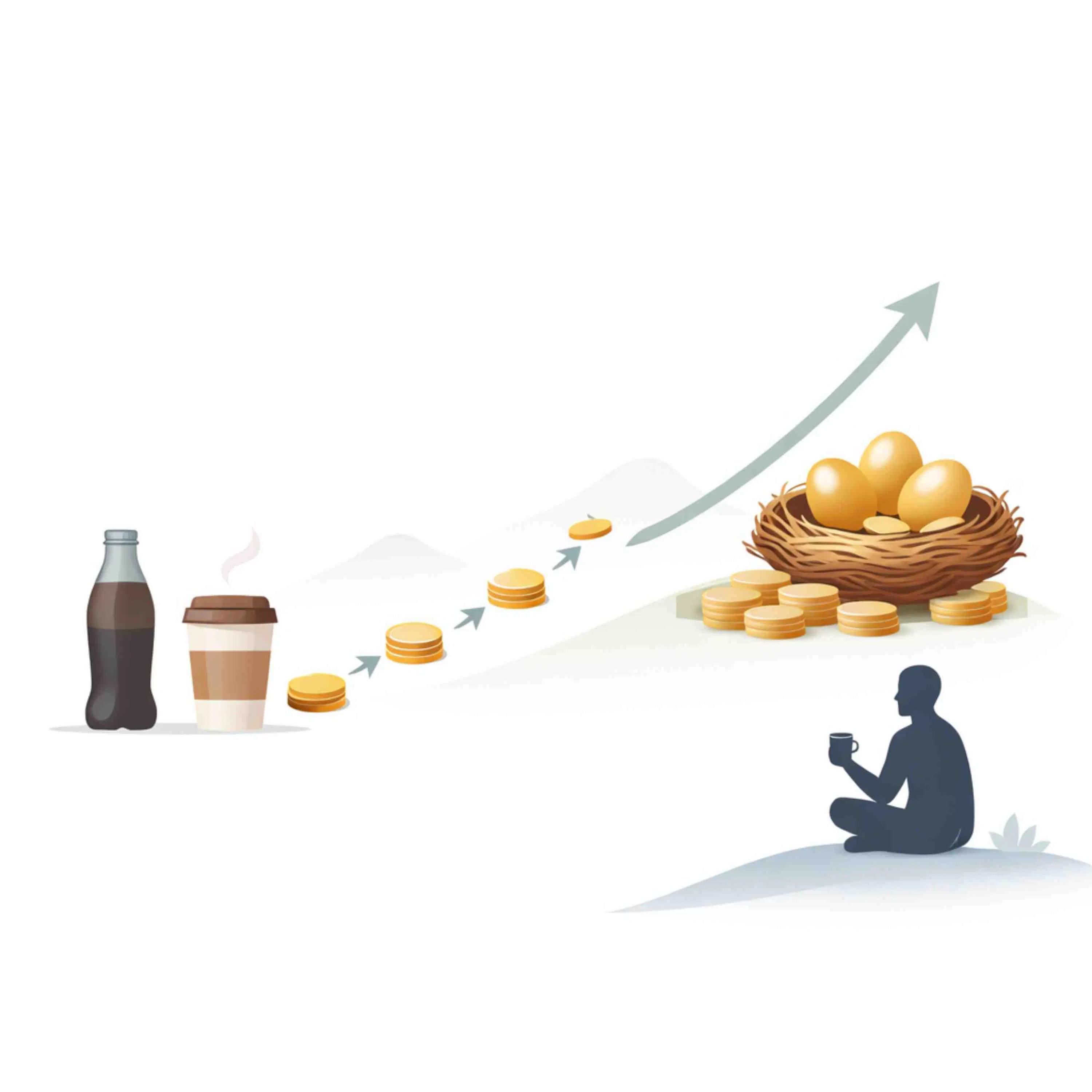
Optimal Finance Daily - Financial Independence and Money Advice
3501: How Kicking My Soda Habit is Fueling My Retirement by Chris of Keep Thrifty on Small Habit Savings
00:09:51
Chris shows how a simple shift from daily soda to coffee quietly transforms long-term finances
Loading summary
Transcript14 lines
- [00:01]
A
Carvana is so easy.
- [00:02]
B
Just a click and we've got ourselves a car.
- [00:05]
A
See so many cars. That's a clicktastic inventory. And check out the financing options payments
- [00:11]
B
to fit our budget.
- [00:12]
A
I mean that's Clickonomics101.
- [00:14]
B
Delivery to our door.
- [00:16]
A
Just a hop, skip and a click away. And bot no better feeling than when everything just clicks. Buy your car today on Carvana. Delivery fees may apply.
- [00:30]
B
Zootopia 2 has come home to Disney. Let's go get ready for a new case.
- [00:35]
A
We're the greatest partners of all time. New friends Gary the Snake and your last name the Snake Dream Team. New Habitats Zootopia has a secret reptile population.
- [00:44]
B
You can watch the record breaking phenomenon at home. Zootopia 2 now available on Disney. Rated PG. Right now you can get Disney and hulu for just $4.99 a month for three months with a special limited time offer. Ends March 24. After three months, Plan Auto renews at $12.99 a month. Terms apply.
- [01:01]
C
This is optimal Finance Daily. How Kicking My Soda Habit Is Fueling My Retirement by Chris of keepthrifty.com I used to love Diet Mountain Dew. That might not even be a strong enough statement. I was pretty much addicted to it. It was my source of caffeine and one of those self indulgent treats I convinced myself I needed. I was drinking at least a bottle a day for a number of years and at times I was going through more. Back in the summer of 2014, my wife challenged me to an experiment to see if I could go our whole road trip 10 days without drinking any as a replacement. My wife offered up coffee, which has never suited my taste, but I knew the health benefits were there and I love a good challenge, so I took her up on it. Surprisingly, the transition wasn't as tough as I had thought, and while I had a bit between the end of the road trip and late 2014, I'm proud to say that I haven't had any in well over a year and don't see going back while the health benefits are reason enough on their own. This is a personal finance blog, so let's talk about the surprisingly big financial impact this little change had. Basic numbers at my worst, I was drinking more than a bottle a day. But let's be conservative and go with one a day at $1.50 each, that's $550 a year. As a replacement, we bought a grinder and a French press and we buy our coffee beans in bulk from the grocery store. We get the good stuff. So we pay $10.96 a pound with 100 tablespoons per pound and 4 tablespoons per cup. We we like it strong. That gives us a cost of about 44 cents a cup for what I drink at home. At work we have a community coffee machine that pumps out medium strength Folgers all day long. While not my favorite, it does the trick and the cost is a lot less. A three pound tub is about $15, which translates to 15 cents a cup for work. I drink about one cup a day when I'm home and closer to three a day when I'm at work. So I average 45 cents a day for my caffeine intake. Now for current prices, I only spend $160 a year on coffee instead of $550 a year on soda and get the health benefits of not putting toxic chemicals in my body from here. Let's take a look at both the impact on how much I save between now and retirement by switching, as well as the impact on how much I need to accumulate in my retirement account to fund my caffeine intake. Impact on Amount Needed to Retire Most financial aficionados will tell you to follow the 4% rule to determine your target for how much to have in your retirement accounts to allow you to retire. If you're not familiar, take 4% of the number in your retirement account. If you can live for the next year spending that amount, you probably don't need this block. There's a good chance you could go retire right now. Determining savings needed from expenses to work from expenses to the amount needed in your account for retirement. You just reverse it. Take your expected annual expenses at retirement and multiply that number by 25, the equivalent of dividing by 4%. That tells you how much you need in your retirement account in order to retire with a good level of confidence that your expenses will be covered for the long haul if you just take out 4% of the balance of your account each year. The Beauty of the 4% rule is that you can apply it to groups of expenses to calculate the retirement savings burden of each guilty pleasure you want to continue. Soda Retirement Burden versus Coffee Retirement Burden if I want to cover my soda habit in retirement at age 65, I need 25 times the annual expense of my soda habit in my account when I retire based on expected inflation 3%, bringing it to $1,400 a year. That's just over $35,000 I need in retirement savings just to cover soda with coffee instead. Inflation gets us up to $420 a year, which means I only need $10,000 in savings to cover coffee. All told, switching to coffee drops the amount I need in my savings to retire by the difference between these two, which is 25 grand. In other words, by switching from soda to coffee, I reduced the amount I need to save for retirement by $25,000. We can't stop here. We've only figured out one of the two benefits of the switch. And get this, that was the smaller number Impact on savings on the flip side, let's look at what we can do with the money we save between now and retirement. By switching again, I'd be spending about $1,400 a year on soda by the time I would hit normal retirement age at Instead, by switching to coffee and investing the difference every year in retirement savings, assume an investment account at 8% return. I'd have an extra $77,000 in my retirement account by age 65. No, that wasn't a typo. That's a seven, then another seven and then three zeros. That's the beauty of compound interest, my friends. Putting in a few hundred dollars a year over 33 years gets you a pretty healthy chunk of change at the end of all together now. So at age 65, I have an extra $77,000 in my retirement account and I need 25,000 less than I would have if I were a lifelong soda drinker. That's a savings swing of $102,000 at retirement just by switching from soda to coffee in my early 30s. This is the crazy powerful math you get when you put interest and long timelines together. Small changes get you big numbers. Let me put it back in perspective. By spending about $30 less per month on my caffeine habit and being smart with that savings, I can have $102,000 benefit at retirement. I'd consider getting one of those big novelty checks you see at golf tournaments, but we're pretty minimalist and I don't think banks actually take those, do they? What's in your cup? If a $30 per month reduction now can benefit $102,000 at retirement, what would happen from whittling down expenses by $100, $200 or $500 a month? This post isn't really about soda. It's about the big power of small changes in your financial habits. Knowing what kind of impact small changes can have on long term finances. Here's the question for you. What is one reoccurring expense that you could really live without? You just listened to the post titled How Kicking My Soda Habit Is Fueling My Retirement by Chris of keepthrifty.com when you're ready to start a business, there's
- [08:08]
D
so much more to it than just filing paperwork. You need a business address, a website, a phone number, an operating agreement, basically a complete business identity. And Northwest Registered Agent helps you build all of that from day one. Northwest Registered Agent has been helping small business owners and entrepreneurs launch and grow businesses for nearly 30 years. They're the largest registered agent and LLC service in the US with over 1500 corporate guides. Real people who know your local laws and can help you and your business every step of the way. Plus your home address, personal email and phone number. Stay private. No upsells, no selling your data. Don't pay hundreds or thousands of dollars for what you can get from Northwest for free. Visit northwestregisteredagent.com ofd free and start using free resources to build something amazing. Get more with Northwest registered agent@northwestregisteredagent.com ofdfree
- [09:13]
E
the world moves fast. Your workday even faster. Pitching products, Drafting reports, analyzing data Microsoft 365 Copilot is your AI assistant for work built into Word, Excel, PowerPoint and other Microsoft 365 apps you use, helping you quickly write, analyze, create and summarize so you can cut through clutter and clear a path to your best work. Learn more@Microsoft.com M365cpilot this article reminded me
- [09:43]
C
how self imposed restriction or experimentation can help us learn about our own unique preferences and help us question the status quo. When you're forced to make cost effective changes because you've maxed out your credit cards and simply don't have the funds to make ends meet, I can see how that would feel like deprivation, but I think when you willingly experiment with frugality and use it as a way to test your assumptions about what you need and don't need, it can be a very freeing experience. The key here is choice. Experiment with frugality on your own terms and you're more likely to not find yourself in a position where it's forced on you. I also think reframing the concept can change your relationship to it. So rather than thinking of myself as frugal, I like to think of myself as resourceful. The key here is to watch out for feelings of deprivation. Chris didn't seem to miss his soda habit at all, so that makes it much easier for him to enjoy his coffee as well as all the money he's saving. That should do it for another edition of Optimal Finance Daily. I'll be back tomorrow as usual, so I'll see you there on the Wednesday show, where your optimal life awaits.