Loading summary
Transcript192 lines
- [00:00]
A
Hi, I'm Frances Frey.
- [00:02]
B
And I'm Ann Morris, and we are
- [00:04]
A
the hosts of a new TED podcast called Fixable.
- [00:06]
B
We've helped leaders at some of the world's most competitive companies solve all kinds of problems. On our show, we'll pull back the
- [00:14]
A
curtain and give you the type of
- [00:15]
B
honest, unfiltered advice we usually reserve for top executives. Maybe you have a co worker with boundary issues or you want to know how to inspire and motivate your team. No problem is too big or too small.
- [00:27]
A
Give us a call and we'll help you solve the problems you're stuck on.
- [00:30]
B
Find Fixable wherever you listen to the
- [00:32]
A
podcast, because if I were to ask you what determines how much money you make, you would not say it's the Herfindahl Hirschman Index in my town.
- [00:44]
B
I'm going to now. I'm going to now.
- [00:54]
A
Hello and welcome to Optimist Economy. I'm economist Katherine Ann Edwards.
- [00:58]
B
I'm editor Robyn Rousey.
- [01:00]
A
On this show, we believe the US Economy can be better and we talk about how to get there one problem and solution at a time.
- [01:11]
B
This week on Optimist Economy, we're going to talk about the problem of not earning enough money. Wages, wages at the top. We'd like to make some quick announcements. I want to thank Gail from Chicago, who is our latest big donor. I also want to thank everybody who's moved their recurring either monthly or annual donations to optimisteconomy.com that saves us about 10% on all the donation fees. On to Retcon, aka Retroactive Continuity, where we reflect and add to our previous conversations. First up, we had a letter about our description of the argument that capital gains taxes are double taxed. And the letter said we described it as the individual is double taxed. And the letter writer suggested that in fact it's the company paying the tax and then the individual paying the tax that qualifies it as double tax.
- [02:08]
A
It's funny. So for this argument that we don't like, there's actually two of them and I said one, which is that people are double taxed on savings that is turned into investment that has turned into income and then taxed again. But there is also another double tax argument that companies have already been taxed through the corporate income tax and so then their shareholders don't need to be taxed again on that income. Honestly, I don't love either of them, but there are two. And thank you, Becky, for writing that in. I think the double income taxes on personal incomes was definitely more Something that was brought up in the early 2000s, around the 2001 tax cut under the Bush administration.
- [02:46]
B
So the other thing related to taxes was our tax reform episode. I thought that we'd done a pretty good sweep of the proposals that were out there, but Senator Bernie Sanders of Vermont came out with his own, which has been, you know, introduced to committee, and it's called the Make Billionaires Pay Their Fair Share Act. And that legislation would establish a 5% annual wealth tax on to billionaires. And interestingly, he's designed this in a way, so in the first year in a household that doesn't make at least $150,000, every man, woman, and child would get $3,000 directly back. And then after that, then the revenue would be used to address all sorts of other social needs, including, you know, free childcare.
- [03:29]
A
I mean, if anything, that just illustrates how much money that billionaires have, that. That's how much money we could all get from it. But, yeah, taxes. Robin and I could talk about it for forever, but we have a really cool subject today, which is a pure labor econ subject, that is wages. So, terms and conditions. I have a term and condition for y', all, and it's called monopsony.
- [03:51]
B
I remember when you taught me this word.
- [03:53]
A
Yeah. It sounds like I'm trying to say monopoly, but I can't. But that's not the case. I am trying to say the word monopsony. Monopoly is when you sit down to play a board game with your brother and sister that drives you apart because you're all deeply competitive. It is also when you're trying to buy something and there's only one seller. That's a monopoly. A monopsony is when you only have one buyer. And it applies to the labor market, in which we are all selling our labor and we only have one person to sell it to. That's a monopsony.
- [04:23]
B
There's only one employer who's willing to hire.
- [04:26]
A
Yeah. In, like, the most severe example, like a monopsony, there's only one employer in town and nobody else.
- [04:31]
B
It's like you're in a company town. Yeah.
- [04:33]
A
Yes. And the idea of monopsony is really old. It goes back to the 1930s and a female economist named Joan Robinson. She's British. Was she at Cambridge or Oxford? Hold on. I mean, I don't care, but they'll care. So then. And they're not the same thing, apparently. Cambridge. Okay, Cambridge, was being very much run by another economist named Alfred Marshall, who was a giant, and she wrote a book Basically saying that the way he thought about the world was wrong. And she called it the economics of imperfect competition. And her central thesis way back in 1933 was that economists view the world through the way they want markets to work, which is perfectly competitive, but in fact, almost no market is perfect or even competitive. And that the way that economists should view the world is through imperfection rather than perfection.
- [05:29]
B
This is at Cambridge in the 30s.
- [05:32]
A
Yeah, Cambridge in the 30s. The other distinction she has is she is one of the, if not the most cited economists. Without a Nobel. There was so much certainty that she was going to be awarded the Nobel Prize in 1975. The gossip was, obviously it's because she's a woman, which is like, seriously, she shouldn't have thought about that. And then she was a little too, like, sympathetic to communist and Marxists and their alternatives to capitalism. So, yeah, I mean, being a lefty woman doesn't always work out for economists. Noted, noted. But she gives us over, you know, almost 100 years ago, the idea of imperfection and her way of looking at the world, the idea of monopsony, it went quiet for a really long time, and now it is in, like, a modern renaissance where there are dozens of articles coming out every year about imperfect competition in the labor market and monopsony. And we're going to talk about it today, but I had to do a thank you, Joan. Snaps for Joan. Everybody snaps from podcast. Snaps from our podcast instead of that Nobel hashtag. Sorry, Joan.
- [06:46]
B
All right. I have a. I have a term on the level of, you know, chuffed to bits, but it's septel. Septel is a portmanteau, which is when you put two words together for separate telegram. And so it means like, you've contacted someone else separately about this same issue. It's kind of like what you used to do before you CCed everybody on all your emails all the time.
- [07:07]
A
Oh, in lieu of a cc, you would have septels.
- [07:10]
B
Yes.
- [07:11]
A
I didn't send it on the group chat. I sep. Telled each person individually. Okay.
- [07:15]
B
Yeah, I don't know if you use it as a. You don't use it as a verb, though. We would.
- [07:19]
A
You do now. I mean, we can now. The future is ours for the taking. Robin is turning nouns into verbs.
- [07:26]
B
Okay.
- [07:27]
A
Nouns gone. Verb is awesome. That's one of my favorite things.
- [07:31]
B
Yep. Yep. We'll be right back in a second for the big pilcrow. Wages.
- [07:36]
A
Wages.
- [07:37]
B
Why? They haven't gone up. So I feel like they're like these themes that we circle around on this podcast a lot. And one of them is, especially this year when we've been talking about affordability, has been like, basically, people aren't making enough money.
- [07:54]
A
Yeah, let's talk about it head on. Americans don't earn enough money.
- [07:58]
B
Right.
- [07:58]
A
Do we know why? And is there anything we can do about it? Yes, and yes.
- [08:03]
B
I want to just do a tiny bit of table setting here. The bank of America Institute, which actually looks at, like, data of bank accounts, says that they find that 24% of Americans are spending 95% of their income just on necessities. So that just gives you a little bit of a sense of where we are in terms of people not earning. You know, how many people are really definitely not earning enough money.
- [08:28]
A
Yes. So earning enough money means that we're talking about wages, which is the money that you get from your job. And I'm told that saying the money that you get from your job is actually easier for you humans to understand than the way that I think about it, which is how much you get when you sell labor in the labor market. That is not the same thing as income, which is the total amount of money that flows to your household from all sources.
- [08:54]
B
Okay, so are wages only hourly, or can wages be salaries? So long as it's coming from an employer, yes. Okay. It's all money for time.
- [09:04]
A
Money for time. Selling it in the labor market. Okay. I just had to get that in. Money for your time. Money in the labor market. Let's go.
- [09:16]
B
Okay.
- [09:16]
A
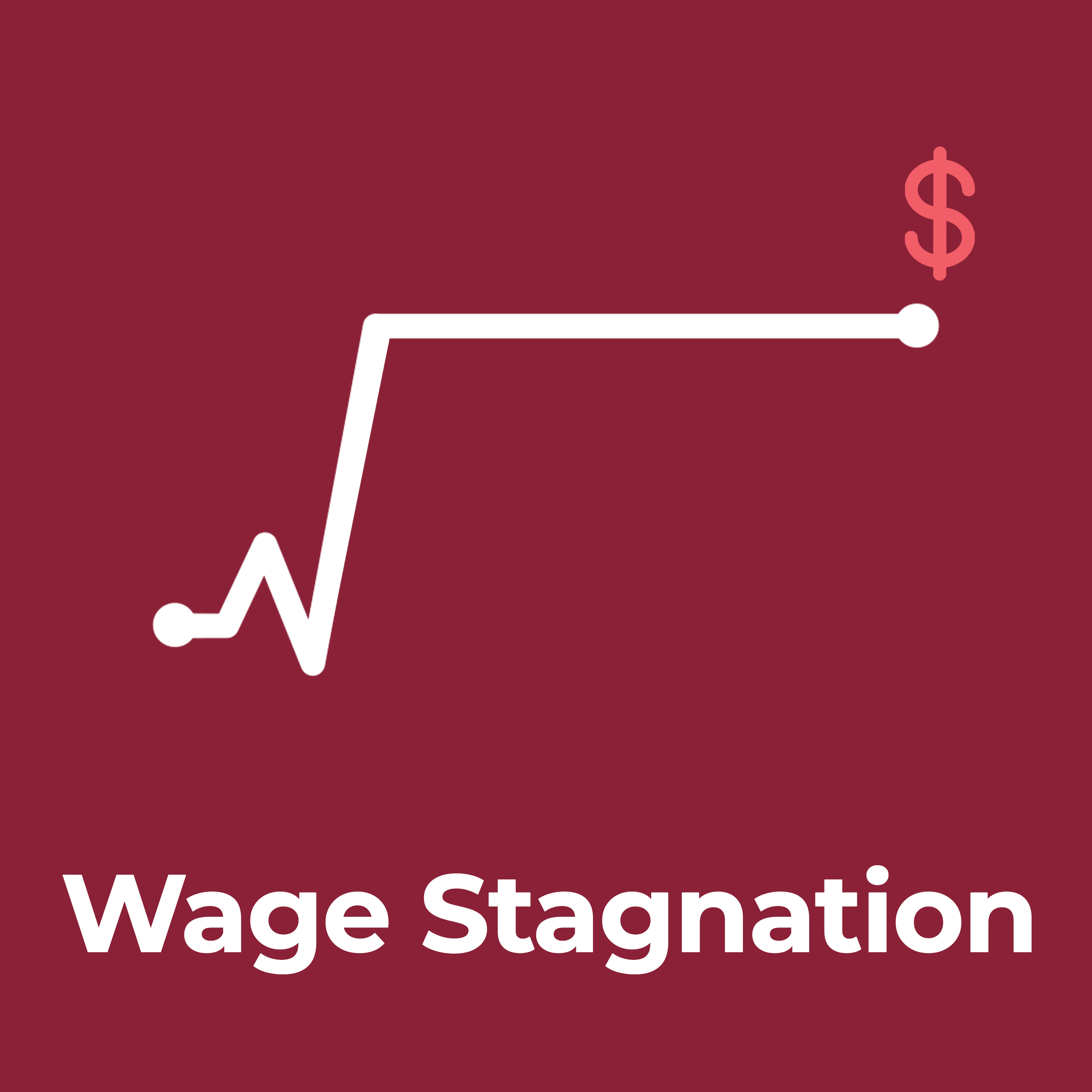
The reason why we're talking about wages is because they're not growing enough. I think what can make this clear is if I were to just take the most vanilla measure of wages in the US which is just the average wage that all Americans make in inflation adjusted terms. So real wages. Okay, I can look at that series from about the Great depression to the mid-1970s. It's a line that's going up, wages are growing, and every year, average wages are higher than the year before, and it's going up at a steady pace. Then in the 1970s, something breaks in our economy to the effect that wages no longer go up every year, and instead they flatten.
- [09:56]
B
And do we know what? Do we know what happened?
- [09:59]
A
The short version is that there's a really bad recession in 1973, followed by two bad recessions in 1881, the double dip. And in that era, there are periods of decline, there are periods of stagnation, there are periods of weak growth followed by decline. Again, not only is there not agreement about what happened to wages in this period of what caused it. There's not even agreement that this was a total era of stagnation. And it has, it is a truly like a renaissance of labor economics research to understand what happened with wages. But the, the material point for workers is that wage growth was bad. You know, depending on what you measure. If you're looking at the median versus the average, if you're looking at people, the bottom 30 versus the top 30, real hourly earnings have hardly increased since 1975.
- [10:51]
B
Right. And we, we talked about this when we, we looked at the, the missing $79 trillion or, or yeah. Which is like what would have happened if those wages had kept pace with GDP growth.
- [11:02]
A
What's interesting is that, I mean, one of the things I find most surprising about this is that if, if you were to adjust the composition of workers in the United States, part of the wage growth that we've seen has come from the fact that workers now have more education, workers now are older than they were then. If you were to just keep wages and kind of correct for the changes in composition to make us look again, like 1975, there were people who will tell you that we have had no wage growth. We have had a change in composition to have more high wage earners, but we have not actually seen the labor market generating higher wages in five decades.
- [11:42]
B
We just have more college educated people bringing down big salaries. Oh, interesting, huh?
- [11:48]
A
Yeah. So like if you have like a hundred workers and 20 of them have gone to college and 80 of them have not, and in 50 years, 40 of them have gone to college, the average wage is higher, not because people are earning more in each kind of their individual slot, but just because you have more high earning people. So I mean, by 1985, people were looking at data and saying like, we are not seeing the wage growth that we had seen for the, you know, four decades prior. This became a huge problem for Social Security that wages did not grow. I mean, they reformed Social Security in 83.
- [12:21]
B
Right.
- [12:22]
A
And the pattern of wage growth that they had built Social Security reform on vanished in the years after reform had passed.
- [12:29]
B
And it's, it's, it turns out it had already vanished. They just didn't know it.
- [12:32]
A
They, they were not able to predict just how stagnant wages had become.
- [12:37]
B
Did something happen?
- [12:38]
A
A lot happened. And this, what's funny is that if you go from like 1985 to 2025, we have like rotated through major explanatory candidates for wage stagnation and then the undercurrent to all of this is that you have. Lots of conservative economists will tell you actually wages haven't stagnated. And they will make, there is like a real measurement data fight to say wages are fine, income is fine, we're so much richer. You know, looking at it the wrong way, wages are great. Yeah, I don't think that's why I'm not going to give it so much airtime.
- [13:14]
B
Yeah, but we, I mean, we saw that. We, we talked about a little bit about that in the piece about the $140,000 poverty line that the conservative economists in particular kind of lost their mind about.
- [13:24]
A
Yeah, they did. They really lost it because like, I mean, like we said in that episode, like we're in their world, like we are in a deeply conservative economic era. And so something as basic as people don't earn enough money is an absolute affront to their entire economic philosophy. So they have to deny it and they have to say it's not as bad. And actually everything is great because we're in their low tax cut, tax deregulate everything. Light touch on every part of regulation. Don't make up for public services, like don't interfere in markets. That is the era we're in.
- [13:59]
B
Don't worry about busting up Google or Amazon. Don't worry about. Yeah, merger, merger, merger, merger.
- [14:04]
A
Yeah. So with the caveat that there are lots of conservative economists that will tell you that I don't know what I'm talking about and I'm manipulating the data. You know, the real question that I think gets presented is why has wage growth stalled out in the United States? It is a story that has changed over time and the story has really transformed from there's something wrong with the workers to there's something wrong with the economy.
- [14:30]
B
That's the grand arc.
- [14:31]
A
That's the grand arc. And we call this the great stagnation. Labor economists do lefty labor economists, the great wage stagnation. But the reasons for it, I mean, the first one that comes up that takes hold for like 20 years is called skill biased technical change. And what drives this reasoning is that one of the things that happened starting in the 1980s is that wages for college educated workers grow really quickly and wages for non college educated workers start to sink. We have a new technology, computers, and that technology is going to reward workers who use this new technology on the job. And so the reason why wages are stagnant is because of skill biased technical change. The economy is rewarding different skills differently.
- [15:20]
B
I can see why this would be an appealing thing, but you know, you're your plumber is still your plumber.
- [15:26]
A
Like, why thank you, Robin. There's like five guys at Harvard who got tenure for this exact argument. And anyone who disagreed with them was stupid. I mean, I don't like using that word, but the number of times I have been called stupid for saying I don't think sticklebuys technical change is enough
- [15:46]
B
anyway, I am equally stupid about it because I'm about to pay a plumber $350 to scope a clogged line.
- [15:54]
A
Oh my God. But I mean, this, this really aligns with like the decline of manufacturing in the US and so the, the sister to skill bias technical change is trade. We globalized, we trade. We want to have more efficient supply chains and cheaper consumer goods. And as a result of that, we kind of hollowed out high paying jobs for workers who don't have a college degree. And so skill bias, technical change, and trade is the story, I mean, for like 30 years.
- [16:22]
B
Yeah. Say till well after 2001. Right.
- [16:25]
A
Yeah. I mean, it's such a nasty story. Like you've just got a lot of people who don't have that many skills and the economy's not strong enough for them to get jobs. The companion to that is that the labor market needs to be really, really tight for wages to grow. Because if you look at this very bumpy line that is wage growth in the economy, the periods in which we can see the line jump up are when the unemployment rate is at 4% or lower. Like they need really special economic conditions to be paid more.
- [16:55]
B
And that's acceptable to the. I don't know who's ever doing these analyses or ideal. It's actually ideal.
- [17:02]
A
I mean, it would be like. Yeah, I mean, they make it really a skills story. Like workers don't have enough skills. Those skills aren't valued enough in the labor market. There's too many of them. So unless the labor market's at, you know, 4% unemployment and we're at full employment, their wages aren't gonna go up. And in fact, if you look at wage growth, real wage growth for the bottom, say 20% of workers, it is like an absolute flat line. And then it'll jump up during like, say the late 1990s when unemployment was really low, and then it's like an absolute flat line. And then it jumps up in like 2022 when unemployment was at like three and a half percent. That story is true, but it also makes it seem like we don't have any power over that.
- [17:45]
B
Yeah, I was gonna say like this, it does just sound like, well, this is just perfect competition and this is how it works.
- [17:51]
A
It's not that it's not true, it's just that it, I think it was not a satisfying story because it takes a lot of the responsibility out of the hands of policymakers of like, this is just what our economy looks like now. And in fact, one thing I always think about when we talk, when you hear people talk about AI, is that they're basically repeating this over again of like, well, it does sound familiar. Yeah, AI is going to reward people.
- [18:15]
B
Well, we're all just going to lose our jobs. Yeah.
- [18:17]
A
You know, like, it's going be big job loss and people who can use ChatGPT will make a lot of money and everybody else, you know, and it's very much like, aw, shucks, I guess our economy is $31 trillion in size, but actually 70% of us don't deserve a raise. That's just how the economy works. Like, I see what you're saying, and I think it's, it could, it's true to a degree, but it is not our fate. It is not a complete explanation. So that's, that's the, I think, first half of this explanation. The second half is like all my favorite stuff. Why aren't wages growing? Well, you stopped raising the minimum wage. You stopped enforcing labor standards. We don't have overtime really anymore because the standard by which people are regarded as neat and deserving and have the right of overtime has basically eroded over time. So almost no one gets it. We don't have unions anymore and they're really good at raising wages, even for people who aren't in unions. It's like, hey, don't throw up your hands and make it sound like there's nothing we could do. You also walked away from that.
- [19:16]
B
Right, Right.
- [19:18]
A
It's not just that the economy has changed. It's not just that labor standards and labor enforcement and the government's view on what workers deserve in terms of protection has changed. It's that the market itself is becoming slowly poisoned. And it's really the counterbalance to the first story of workers don't have enough skills or the right skills, which is really that workers don't have enough power. And that the problem with monopsony isn't that there's anything wrong with the workers. It's that there's something wrong with the markets so that workers don't have power. So, yeah, I mean, the classic version of monopsony is a company town, like a coal mining town. In West Virginia in the 1920s, even people who work at the grocery store are working at the coal mine owned grocery store. That's like a extreme version in like a static form. But monopsony is really just the idea that you do not have many employers competing for your labor. And it's not a one or a zero. It's something that happens in degrees. Economists have a tool that they have to measure concentration. I'm going to get these guys names wrong because they both start with H. It's called the Herfindahl Hirschman Index. See, and who says economics can't be fun? The Herfindahl Hirschman Index is an index of market competitiveness. You just put various features of the market in it. It can also be a seller's market, but you put features of a market in it and it kind of spits back the degree of competitiveness.
- [20:49]
B
Like any kind of market, or specifically a labor market.
- [20:51]
A
Any kind of market. But we've been using the Herfindahl Hirschman Index to see how competitive labor markets are. And you get these like really staid economic research reports that are like, yep, every decade since the 1970s, the HHI index is showing we have less and less competition in employer markets. And so now I guess that's.
- [21:13]
B
That shouldn't surprise us, I guess. I mean, we were talking about, wasn't a few weeks ago about like the concentration of like engineering firms or accounting firms, like there used to be the big seven and how many are there now? Like, are there two? Are there three?
- [21:27]
A
Yeah, the big consulting firms, the big banks. Like the corporate consolidation that you see on the consumer side has its own labor market consequences.
- [21:35]
B
I mean, that wasn't necessarily the problem in the 70s when this started though. Right. Like this has just evolved into that being the big force. Yeah.
- [21:43]
A
We're getting like the labor market is getting more and more concentrated over time.
- [21:48]
B
Right. So this may be a sidebar, but the other thought that I've had about wages is the other things that are, particularly healthcare costs that are being drawn off of people's wages.
- [21:59]
A
Essentially that one's hard to see because the people who get health insurance from their employer are higher paid.
- [22:07]
B
That's true. And I guess at lower level wages they were never getting that and they're not getting it now.
- [22:12]
A
Yeah. So it's hard to know how much it suppresses wages because it's a luxury benefit.
- [22:18]
B
Right.
- [22:18]
A
I should say like this weak wage growth is something that affects, I mean, this is a, this is a failure of labor markets to produce Enough competition to bid up wages for everyone in them. Now, people at the very, very top are doing well and can do well, really, in almost any condition. But the competition that you need to see in the labor market for the rest of us is not like, think of your poor fellow man out there like, this is your wage. This is you.
- [22:48]
B
This is, this is teachers.
- [22:49]
A
This is you. Yeah, I mean, this is, this is you, like lawyer. This is you doctor. This is, this is you programmer. This is you, you know, person who runs a shop. Like, like all of these.
- [23:02]
B
Definitely you journalists.
- [23:04]
A
Definitely you journalists. Yeah. So. So this is, I mean, this is a problem.
- [23:09]
B
Is the only way that you deal with monopsony. Like, I don't. Antitrust bust, bust them up. Litigation.
- [23:17]
A
I mean. Yeah, that would help. Yeah, that would help. I mean, we don't have a ton of successful strategies for breaking up employer concentration because we don't care about employer concentration.
- [23:28]
B
We care about, like, product concentration. Right. Like, we only care about competition is for us as consumers, not us as, as actually sellers of our wages.
- [23:38]
A
And when the FTC makes decisions, they don't really look at the labor market consequences. No, it's really about, like, the seller concentration and whether the stuff you get will be cheaper.
- [23:50]
B
And I think it's one of the reasons that they have continued to allow so much mergers, because companies have gotten very good at making the argument that this will be good for consumers. And nobody's out there making the argument about what it's going to do for employees or against employees.
- [24:05]
A
Oh, yeah, in some mergers, they'll be required to close 10 stores. Was it Kroger Albertsons? That was like a mega merger after another merger. And in one of them, I mean, they profiled a grocery store where a guy was on his, like, fourth grocery store merger. And every time the grocery stores merged, he was one of the stores that had to close for competitive reasons, like in order to keep the consumer market competitive. He kept losing his job through grocery store mergers. It was so dystopian. He's an extreme example of something that affects a lot of us, which is the employer concentration.
- [24:40]
B
Sure.
- [24:41]
A
So I wanted to talk to the optimist about this because for me, this links together a lot of aspects of the labor market in public policy. So California raised its fast food minimum wage to $20 an hour.
- [24:57]
B
Wow. Is it 20?
- [24:59]
A
On April 1, 2024, California implemented a $20 hourly wage floor for workers in large fast food restaurants and snack and non alcoholic beverage bars. So a group of researchers in California looked at the effect of this minimum wage increase and whether or not it reduced employment and increased prices. And they found really, really small effects. This is from their summary. Large employer fast food minimum wage increased wages by about 11%. It did not reduce employment. Prices increased by about 1.5%, equivalent to $0.06 for every $4 item. Employers passed 50% of the higher wage cost onto consumers. Consistent with a monopsony model.
- [25:48]
B
Huh?
- [25:49]
A
This is from the Institute for Research on labor and Employment out of Berkeley. So, I mean, basically, you have heard probably your whole life whenever someone brings up the minimum wage, that it'll cause job loss. And yet in study after study, the minimum wage is supposed to cause job loss, but you just don't see it. It's not large, it's not demonstrable. I mean, even with these large wage increases, like $20 per hour for fast food workers in California, you just don't see these massive drops in employment. That makes sense because the drop of employment is predicted off of perfect competition. It would not reduce employment if employers had monopsony power. So I think what's emerging over the last maybe 15 years of labor economic research is not only the degree of concentration, but the consequences of concentration, not just for wages, but for wage policy.
- [26:46]
B
Hmm.
- [26:48]
A
I think maybe I'm saying this wrong because I'm saying it in the term that makes sense to me, which is employer concentration, monopsony. And it's possible that that maybe either hasn't sunk in or just isn't natural for regular humans. So let me try a different term.
- [27:05]
B
Okay?
- [27:05]
A
It's about mobility in movement of workers, of workers. The more concentrated the employer market gets, the fewer options workers have, the less that they can move around. And that matters because mobility is at the heart of wage growth in the U.S. true. The reason why employer concentration is bad is because mobility is so important and it limits that.
- [27:31]
B
And people aren't, they don't. They can't move enough within a job, within a company. As these companies get really big, you would think that you could move around inside them.
- [27:39]
A
I mean, a big company can be a good employer. Having one job for your whole life can be fine. But in a market, what drives up wage growth for everybody is having movement across jobs and employers. That doesn't mean that the only people who have high wages are people that moved and that people who stayed in employer never get a wage increase. This is a basic measure of health.
- [28:01]
B
The market itself isn't dynamic. It isn't a healthy market if people aren't moving around.
- [28:05]
A
Yeah, you can be at an Employer for a long time in a dynamic market and you will make more money than if you were at an employer for a long time in a static market.
- [28:19]
B
Interesting. That's.
- [28:20]
A
That's it. You don't have to be mobile. Workers have to be mobile. And that bids up wages for everybody. So, you know, I think what makes this lack of mobility particularly damaging is periods where you have a lot of people who were unemployed. Like during recessions. A lack of mobility would be what makes it really hard to find a job after you lose one.
- [28:43]
B
Oh, sure. Okay.
- [28:44]
A
Like, if you lose your job, how many employers do you want in your city? Five or 500. Like, you want 500. Because, you know, the more employers, the easier it is for you to get a job when you don't have one.
- [28:54]
B
Right. So the rebounding from losing a job is a lot harder.
- [28:57]
A
It gets worse. It gets a lot. Rebounding from losing a job gets a lot worse if you don't have as many options. So it's the same. Same question, but for wages, how are you going to have more wages if there are five employees or 500? You know, there's a study that came from former BLS commissioner Erica McIntarfer. Before she became BLS commissioner, she wrote a research paper about wages after you leave a job. But what the paper found was that the reason why unemployment can have such a scar on people's wages is because of how long it takes them to find a job and that they fall down the job ladder. If there's 10 firms at each rung versus one firm at each rung, like, it's just a lot easier to fall down.
- [29:37]
B
Oh, so instead of working at the LA Times, I'm working at, you know, the Legal Beagle Court reporter paper.
- [29:45]
A
Right.
- [29:46]
B
And it's interesting that when I just kind of look at a lot of these other reasons about wage stagnation, you can tell me if I'm getting off track here, but if we really believe that these were the things that were causing wage stagnation and we cared about and we cared that wages were stagnating, if we really believed it was skills, we could have done something about that. If we really believed it was trade, we could have done something about that. I guess what I'm wondering is, like, do our policymakers care about wage stagnation? We know that our corporate leaders don't care. Wage stagnation is great for them.
- [30:16]
A
We could still do things.
- [30:17]
B
We could still do things. I mean, we've talked about a lot of the things that we could do. Over the last year and a half on this show, raise the minimum wage, make it easier to form a union, and force employers to actually negotiate with the unions that have been formed. Starbucks still doesn't have a. A contract.
- [30:34]
A
Starbucks still doesn't have a contract. And remember anyone who works for Starbucks Corporate, that we are registered as a charity.
- [30:40]
B
With benevity.
- [30:42]
A
With benevity. So you can double the contributions through your employer like Starbucks for the show. I see so much optimism in the labor market because a little can do a lot. It's not like 170 million people are all malemployed or none of them have jobs or none of them are earning like it really is. Like we have to make some fixes, but the dividends are so high because it is such a large labor market. I don't know if every labor economist would agree with that. I think some of them would say that like maybe markets are too segmented or different parts of the labor market need different things, but I don't know. To me, the north star of the labor market being more remunerative is movement. We need people to be able to move around from job to job to job to get lots of offers to take, to use them in bargaining.
- [31:31]
B
So I think, you know, when we have our nostalgic fantasy for what, you know, the great economics of the 1950s and 60s were, we imagine somebody who worked in the same job for 30 years and got a gold watch at the end of it and retired. I don't know. I don't think that those of us who are employees generally think of a lot of movement as a desirable characteristic. We think slow and steady wins the race. I, as you know, worked for five years as a contract editor for a talent management firm. And one of the things that I learned was that if you really wanted to get ahead in corporate America, you change jobs every three years.
- [32:12]
A
Yeah. So there's a lot that goes into wage growth that I'm not talking about. And certainly one of them is that part of what explains wage growth is that you're at a more productive or less productive firm. And so they develop what we call firm specific human capital, where it's not just that they're good at lawyering, they've really figured out this firm and they're very good at their firm. And that is one way that wages accumulate is that you stay at a high paying firm. Again, that that is also true, also important.
- [32:42]
B
Sure.
- [32:44]
A
But it's not the main character that's like little sister in the movie who's helping you pick out an outfit before the date, like it's still in that main character energy.
- [32:53]
B
You know, my, my wife says that science, but I think economics is probably more true than actual science is what science really is at the end of the day is competitive storytelling. Yes.
- [33:05]
A
She's so right.
- [33:07]
B
Yeah, I think she's right too. Scientists really hate to be told this, but I think in economics or in the kind of policy related space that we're talking about, the competitive storytelling is, it's like the heart of it. Right. If people believe that the story is skill based technical change or if people believe that the story is lack of unions, then that's what they act on. And, and it's why these fights are, or these disagreements, like they're not just, you know, bar arguments for fun. Like they, they have potential real effects. And one of the things that we've, you've pointed to is, you know, the conservative economic arguments and the conservative ideas about policy interventions being unnecessary and everything would be better if it's just this kind of laissez faire market for everybody and everything. Well, you know, they won that debate, that storytelling competition for years and years and years and you know, it's an open as to whether they continue to win it.
- [34:03]
A
And you know, and I, I think about how important it is to stress that like I don't wander through the world bright eyed, bushy tailed, that someone just needs to hear me explain the minimum wage and then they'll be for it. Like the, the hold that this narrative that we just need markets to be market, like let market be market. That has such a hold on people.
- [34:27]
B
Yeah.
- [34:27]
A
Like, yeah, markets are great, but when they fail, like what do you think we should do? Should we let them hurt people? Like I, I think that sometimes the narrative gets lost and like trying to defeat the other narrative as opposed to like building yours in its own lane. Yeah. I don't know how many times I've talked to people. I mean I realize now that I'm going to be losing some invites. But like at parties or dinners or holidays where I've said like, hey, like I also think high taxes could be bad. But then like we've had five tax cuts and you still can't afford housing. So like maybe try something new. Right. Like, or, or the skill bias technical change of like I understand that when people started using computers in the office it was thought that that's the reason why someone in Akron can't have a good wage. But like it's been 55 years.
- [35:16]
B
Yeah.
- [35:17]
A
Like there might Be another reason why people in Akron aren't earning as much money. And I think I try to start from the perspective that dislodging a narrative is so tough and that the one that's most effective doesn't require you to convince people to totally reverse course. Yeah, yeah. Or reject everything that they had previously believed. And the wage story here is a really interesting one because it's a very empowering story to say, man, employers are crushing the market. We don't have as much movement. You know, we're basically turning America into a series of, like, small industry towns a la coal mining in the twenties. Like, we need.
- [35:58]
B
We actually need more market in this.
- [35:59]
A
Yeah, we need. We need more market. And that to me is like, it's a more interesting way to engage. I don't know. I try to do that. I don't know how successful I am, but it's definitely a lane I try to walk. And the wage story with movement and mobility in monopsony, I think is one that can hit more than just, we need to regulate employers.
- [36:21]
B
Yeah, yeah.
- [36:24]
A
So, okay, what can we do? I didn't nearly get to this part.
- [36:30]
B
I mean, what can we do besides. I mean, obviously minimum wage, obviously increasing unionization, but what can we do about.
- [36:36]
A
Yeah, well, first thing we could do is take advantage of the moment. If we know and have decades of evidence that employer power has never been so concentrated in markets, this is the time to pass every labor regulation you could possibly think of. Because labor regulations could have market consequences, but those consequences are really small when the market is biased or when the market is concentrated because the market's not operating.
- [37:00]
B
You're saying, like the minimum wage is the example you were just using. If we raise the minimum wage, that initially, if you had a lot of small players in the market, it might actually cause some, not just job loss, but maybe small firms to go out of. Out of business. But there such concentration that that won't happen.
- [37:18]
A
What we know from employer concentration is that they've got a lot of room. What we know from two and a half decades of city and state experimentation with minimum wages is that they have a lot of room. And for the hundred or so minimum wage increases we've had this century in various localities, we would have seen massive job loss by now. And the fact that we haven't seen it is pointing to the same story of we have concentration employer markets, which means the actual cost of implementing labor law is low because they. They're not pressed thin, it's not tight for them, it's Loose. So this means you could raise the minimum wage, but you could also have mandatory paid sick days, mandatory paid holidays, mandatory vacation days and paid time off for every worker. And you could just roll that out in the labor market and they would cry wolf and say this is going to lead to so much job loss. But you can't have your cake and eat it too in a market.
- [38:10]
B
Mm.
- [38:11]
A
So that's. That would be one thing we can do is roll out decent labor law.
- [38:14]
B
Oh, they're just. These would all be sort of updates to the. What is it? The, the National Labor Relations Act.
- [38:20]
A
The Fair Labor Standards Act.
- [38:21]
B
Fairly were Standards Act. Right, right.
- [38:22]
A
Yeah. You could also increase the threshold for what it means to get overtime protection. We can get rid of that. Then we can work on empowering workers knowing that they are outgunned in the labor market. Like, assume we don't have an effective way to change employer concentration. We can start empowering workers in a non market way through access to unions, collective bargaining, sectoral bargaining, just, I mean, getting more powers to workers to bargain so that they can bid up their wages. I think the big change, one that will take a long time to really see the fruits of our labor would be breaking up big business, which something that has to happen on the consumer side and on the employer side and changing the amount of concentration that we allow.
- [39:12]
B
Yeah.
- [39:12]
A
I don't know, it goes back to narrative. Right. Like I'm with you. Like the government shouldn't have control of all markets, but like the pendulum can swing too far in the other direction. Like do you know where the line is when we have too much concentration in markets? Like, we've got four airlines.
- [39:27]
B
Yeah.
- [39:28]
A
What do we get down to?
- [39:30]
B
One, We've got like three phone companies, you know.
- [39:32]
A
Yeah, yeah. We've got. And I don't know about you, we've
- [39:35]
B
got basically one Internet company.
- [39:36]
A
I mean, the question I pose to a lot of people who tell me that they don't want the government involved is, you know, how many, how few people do you need in a market before you will believe that it's concentrated?
- [39:47]
B
I had a theory about this. I thought that all markets needed is at least as many players as we have teams in a professional sports league.
- [39:55]
A
Oh, fun.
- [39:56]
B
Yeah. Like, because I think we can understand that if there were only three teams in the NFL, it wouldn't really work.
- [40:03]
A
Yeah, yeah.
- [40:04]
B
There are only six baseball teams. Not great.
- [40:08]
A
Yeah. You understand this on so many levels. And I think that the market kind of trends towards consolidation.
- [40:15]
B
Yeah.
- [40:15]
A
Which is fine. We just can't let it go too far. And every so often, it really helps to just, like, reset and be like, all right, Ma Bell, you're all broken up. Yeah. I mean, a new. Oh, my God, I dream about a new antitrust act, but maybe we don't need one. Maybe we just need this one to be better enforced. But I. I carry a lot of optimism in this conversation because this is the type of problem that you could solve to the benefit of tens of millions of people. I can't say all because speaking in absolutes isn't always great. But, I mean, the more movement we have, the payoff here for the payoff. The payoff here is so high. And the mechanism for the payoff is not like a typical liberal, big progressive policy. It's just get workers moving.
- [41:04]
B
All right, we're going to be back in a second, and we'll do executive orders and spiritual sponsors.
- [41:13]
A
Okay. We end our show with very petty ways to make the world better, called executive orders in the Rousey Republic and Edwards Republic.
- [41:23]
B
Yeah. So my executive order today doesn't have anything to do with the clogged pipe in my house. If the. The workers arrive without the tools that they need to do the job, the billing clock begins to move backwards until they get back with said tool. That's my rule. Now, I know that this might be against all this stuff about wages and paying people better.
- [41:47]
A
This does sound very specific.
- [41:50]
B
I'm just going to say that if you don't show up with the tools you need to do the job, you're not on the job.
- [41:58]
A
Okay. My executive order, staying in the kind of visual arts space that I've been in for the past few episodes, is that I think that if any type of, like, chat leak, the one that happened with all those, like, young Republican kids who turned out to be like, Nazis, the Libor scandal, the Puerto Rican governor who got taken down because of his group chat. Anytime. Oh, Pete Hegseth for sure. The Pete Hegseth one. Yeah, yeah. What is it just the emojis?
- [42:26]
B
Yeah, the signal. The signal chat.
- [42:27]
A
The signal chat. Anytime there's something like that, we need to have, like, a public service where people act it out. Like, if there's a group chat, we're gonna get a roundtable of actors, and people are gonna read and act the group chat out loud.
- [42:43]
B
A table read.
- [42:43]
A
Think of this as, like, cousin of, like, the new C SPAN that I did last season, where we're gonna give C SPAN complete production control to really turn our Congress into drama. This is a YouTube, YouTube hit. This would be such a YouTube hit anytime. Just. Just read the emails out loud when they're leaked. Read the. Read the text message chain out loud. Assign everyone a speaker and I. Cause I think it helps people to hear it. This is like. Sorry. There was a past listener who said that they really appreciated the Lily Allen recommendation, but they're also haunted by the demise of her marriage and listening to it. I think hearing and seeing seen has
- [43:19]
B
a different impact than it does. It does. That's why I read and don't watch TV news. Okay, spiritual sponsors.
- [43:28]
A
Ah, the things that get us through the week because we love them and they keep us sane and happy and motivated in a crazy world. What is your spiritual sponsor?
- [43:39]
B
My spiritual sponsor this week was introduced to me by a fellow optimist at an Angel City football game. And it is called a dole whip. Do you know what a dole whip is?
- [43:49]
A
No.
- [43:50]
B
So a dole whip is where you take like pineapple juice and you whip it and freeze it and then make it like soft serve ice cream. And it's amazingly good. And they can also add rum and it can be almost like a pina colada soft serve. Apparently this was known to be almost exclusive to Disneyland, but now it's available at BMO Stadium where the LA Football Club and Angel City play. And there's always a huge line, and I never realized what it was, but now I know.
- [44:20]
A
So this actually reminds me of the really amazing Texas Monthly article I read on the history of the frozen margarita machine and the restaurant that invented it. And they're like, did they know that they landed on pure gold? Yes, they did. Lines out the door of like a frozen margarita, like, give this man a Nobel. It's. It's. That one's also really good. But it sounds like the dole whip is like California's frozen margarita. Like, it's changes things.
- [44:48]
B
Yeah, it's really good. There's this huge line. I never knew what these people were standing in line for. I'm actually dreaming about the next home game so I can go get another one.
- [44:58]
A
So my spiritual sponsor this week is good sad songs.
- [45:05]
B
Oh.
- [45:06]
A
Just songs that are sad, but they're just so good that, like, even if you're sad and they're sad, like, you're still just happy that this song exists. It's a real nuanced moment.
- [45:16]
B
Is there one in particular?
- [45:18]
A
So, yeah, I've been listening a lot to Waxahachie, which is Miranda Lambert. It's off of the Marfa tapes, but that's a perfect like, it's a good sad song. Sad songs are amazing. When they hit, they hit. So for the optimist that wrote in and said, Robin and I have been doing pretty good with music recommendations. Waxahachie, I will also, I should say that my spiritual sponsor should be the Optimist. We hit a major milestone in our show, which is that I got recognized out in the world where someone came up to me and said, hey optimist. And I was like, wait, what? That's the name of my podcast. And they're like, yeah, I know. Because I listen. I was like, wow, I got there. So yeah, I was recognized out in the wild this week. Twice in one night. It was kind of delightful. I was caught way off guard. My other spiritual sponsor for the week is being recognized as the Optimist in the Wild. And then separately, sad songs. I'm going through a lot. That's our show. We're done. Sophie Lalonde edits the Optimist Economy podcast and our video excerpts are created by Andy Robinson and you can find them and share them on YouTube, TikTok, Instagram and LinkedIn. If you're on substack, we have free transcripts of the show and subscribers can join our chat room paid or unpaid. But first, let's snap out to Andy and Sophie and then Robin's bit natural. It's my production note. Make it as natural as I am not.
- [46:58]
B
Optimist Economy is actually a 501c3 tax exempt non profit. So if you have a donor advised fund or an employer like Starbucks who matches donations, please keep us in mind. We truly appreciate actually all contributions and we're still on all the creator platforms, but we do keep the largest share of your donations when you Give it optimist economy.com com.