Podcast
Optimist Economy
Hosted by Kathryn Anne Edwards and Robin Rauzi · EN
Optimist Economy is the anti-doomscroll economics podcast. Work rules, tax fairness, healthcare, housing costs, retirement security — the economic forces shaping American life have real problems. But also real solutions. Each week, economist Kathryn Anne Edwards and editor Robin Rauzi break down one problem and solution with data, history, humor, and a belief that tools to build a better economy exist. We just haven't tried them. New episodes on Tuesdays.
✨ Support the podcast at: optimisteconomy.com ✨
Ask questions or share your economic worries with us at: optimist.economy@gmail.com
61episodes
Episodes
Newest firstAll episodes

Simple Immigration Economics: Bigger is Better.
Jun 24, 202500:50:44Summary readyOne in five workers in the United States was born in another country. Without them, the country’s prime-age workforce would be shrinking, and thus so would our economy. So the calumny (Terms & Conditions) directed at immigrants is at odds with the basic fact that the U.S. needs them. What about depressing wages? Research finds such a mixed bag of results that the overall effect is about zero. Indeed, if the goal is to save “American jobs” or help American workers, there are a lot more effective ways to spend $185 billion than on a massive crackdown on immigration rules. Support us by becoming a paid Substack subscriber here, or by making a contribution at https://buymeacoffee.com/optimisteconomyComplete show notes with links to articles and data at optimisteconomy.com.You can also find Optimist Economy on:TikTokYouTubeInstagram
Summary
Work Requirements Don’t Work
Jun 17, 202500:53:44Summary readyHere’s what work requirements rarely accomplish: Getting more people to work or lifting them out of poverty. They are, however, very good at driving people off public benefit programs, which was their primary role during the welfare reform of 1996. Yes, Kathryn Edwards economist/human will tell you that in theory, people will optimize how much they work and “consume leisure” according to their preferences, and that if some people get free stuff, they’ll work less and swim at the beach more. But that effect mostly gets swallowed whole by the reality of low-wage work in America.Support us by becoming a paid Substack subscriber here, or by making a contribution at https://buymeacoffee.com/optimisteconomyComplete show notes with links to articles and data at optimisteconomy.com.You can also find Optimist Economy on:TikTokYouTubeInstagram
Summary
The U.S. is in the Hole. Will We Stop Digging?
Jun 10, 202500:50:43Summary readyThe national debt is $36 trillion — a panic-inducing big number. So maybe it will help to understand how the U.S. ran up that debt. We’ve blown 37% of it on tax cuts, with precious little to show for that. But 28% went to stabilize the economy during two major crises (in ’08-’09 and during the COVID pandemic), which is when you do want the federal government to pull out its credit card. Good news is we don’t have to get the debt to zero. We just need to get pointed in that direction. And for listeners who’ve been waiting for Kathryn Edwards to discuss MMT (Modern Monetary Theory), your moment has come.✨ Support the Optimist Economy podcast at: https://optimisteconomy.substack.com/subscribe or https://buymeacoffee.com/optimisteconomy ✨Complete show notes with links to articles and data at optimisteconomy.com.You can also find Optimist Economy on:TikTokYouTubeInstagram
Summary
College Rules! But Student Loans are a Hot Mess!
Jun 3, 202500:58:57Summary readyThe U.S. government makes student loans because our economy benefits enormously: Improved human capital. Higher earnings for taxpayers. Innovation and productivity gains. (Side note: Education has also been a $50 billion per year “export” because so many international students come here.) Meanwhile, colleges are basically getting blank checks for whatever tuition prices they pull out of the air. So there’s all this upside for the government and cash flowing to colleges, but student borrowers are left holding the bag. Kathryn Edwards thinks we can do better, and in a way that preserves what makes the American college experience great for students and the country.✨ Support the Optimist Economy podcast at: https://optimisteconomy.substack.com/subscribe or https://buymeacoffee.com/optimisteconomy ✨Complete show notes with links to articles and data at optimisteconomy.com.You can also find Optimist Economy on:TikTokYouTubeInstagram
Summary
OE Lightning Round: Kathryn Edwards Takes Your Economy Questions
May 27, 202500:49:34Summary readyKathryn Edwards answers listeners’ economic questions, with her co-host's stopwatch running. In under an hour, we cover risks to U.S. economic data, college tuition, taxes, bonds, degrowth, mortgages, tariffs vs. income taxes, wealth concentration, and why the future can’t be built on lies. Finally, for those of you not from Wisconsin, do you know how to pronounce Waukesha? Because Robin sure didn’t. And apparently it’s not Wauke$ha, either.You can also find Optimist Economy on:TikTokYouTubeInstagramSubstackSupport us by becoming a paid Substack subscriber, or by making a contribution at https://buymeacoffee.com/optimisteconomy
Summary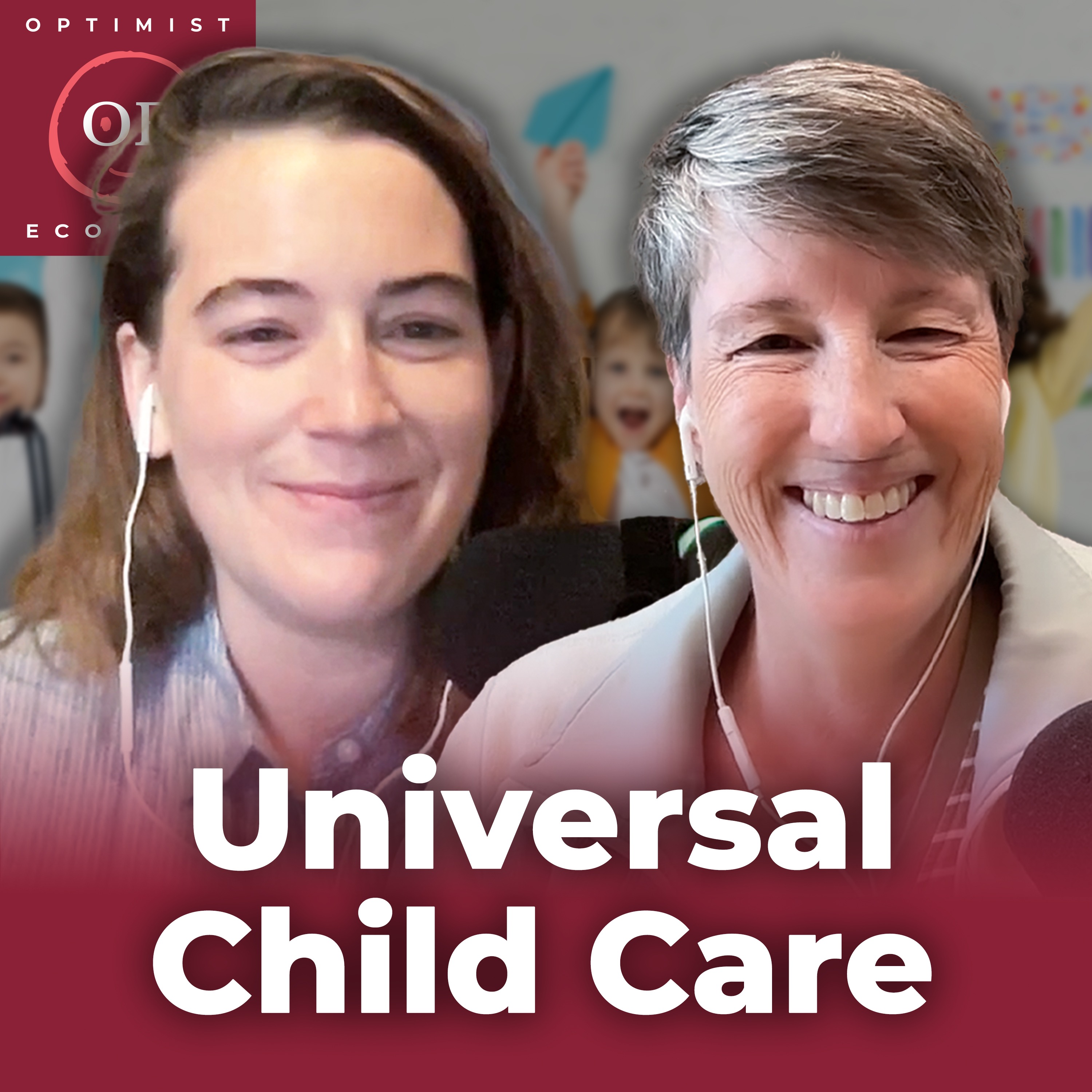
The Invisible Hand Doesn’t Want to Change Diapers
May 20, 202500:58:47Summary readyChild care is exhibit A that not everything can be solved by private marketplaces. It is too expensive and too scarce — and as Kathryn Edwards points out, nothing will change that fact. (Maybe you’ve heard someone say that preschool costs more than state university tuition? True in 38 states.) Even among those who think that there’s a role for the government to play in early childhood care, there are still very strong disagreements about what public support should look like and who it should go to. This is a sequel of sorts to our conversation last week about U.S. birth rates last week and the demographics that might force big policy changes in the years to come.✨ Support the Optimist Economy podcast at: https://optimisteconomy.substack.com/subscribe or https://buymeacoffee.com/optimisteconomy ✨You can also find Optimist Economy on:TikTokYouTubeInstagram
Summary
A Family Bill for a Shrinking U.S.
May 13, 202500:51:32Summary readyThe declining birth rate in the United States is often discussed not only as a major demographic shift, but as a looming economic disaster. Ideas being pitched to the White House include a $5,000 baby bonus for new parents and (truly) giving medals to women who have a half-dozen babies. But what are the real contours of this supposed crisis? Indeed, according to economist Kathryn Edwards, if we haven’t done anything to remove the constraints on having kids, can we call it a crisis at all?✨ Support the Optimist Economy podcast at: https://optimisteconomy.substack.com/subscribe or https://buymeacoffee.com/optimisteconomy ✨You can also find Optimist Economy on:TikTokYouTubeInstagram
Summary
Progress is a Long Game
May 6, 202500:51:04Summary readyWhat sparks progress? The right political conditions? Social pressure? Economic upheaval? In response to two listeners’ questions, Kathryn Edwards says… both none of those and all of the above. (Also, "not a historian.") Still, as an example, we talk through just one bit of the New Deal in the 1930s, which was the law to limit child labor. That movement started decades earlier, and continued decades afterward. For those keeping score at home, this a sneaky third installment of Kathryn’s 68-part series on the Fair Labor Standards Act of 1938.✨ Support the Optimist Economy podcast at: https://optimisteconomy.substack.com/subscribe or https://buymeacoffee.com/optimisteconomy ✨You can also find Optimist Economy on:TikTokYouTubeInstagram
Summary
Paid Sick Days for Lady Gaga (and Everyone Else Too)
Apr 29, 202500:42:31Summary readyIn the category of low-hanging policy fruit, why won’t any politician pluck the ripe, juicy goodness of federally mandated paid sick leave? About 30 million American workers not only don’t get a paid day off when they have the flu, there’s no law on the books to prevent them from being fired if they call in sick. Economist Kathryn Edwards points out that research has found that the job-protection aspect alone is worth $2,000 a year to vulnerable working moms. Of course this also keeps communities healthier because who needs to be exposed to baristas with bronchitis?✨ Support the Optimist Economy podcast at: https://optimisteconomy.substack.com/subscribe or https://buymeacoffee.com/optimisteconomy ✨You can also find Optimist Economy on:TikTokYouTubeInstagram
Summary
AI Suggested Five Horrible Titles for This Episode
Apr 22, 202500:45:43Summary readyA recent article in the Washington Post proposed that U.S. labor data has just started to show the bite artificial intelligence is taking out of U.S. jobs – in this case, for computer programmers. Is AI going to cause mass joblessness? Silicon Valley bros seem to think so. Journalists seem to think so. So what’s with economist Kathryn Edwards' ho-hum reaction? The long view: The United States has seen lots of technological progress over time, but technology has been the most villainized since 1980—also the era of declining worker power. It’s our gutted worker protections that make periods of technological transition so painful.✨ Support the Optimist Economy podcast at: https://optimisteconomy.substack.com/subscribe or https://buymeacoffee.com/optimisteconomy ✨Read More:More than a quarter of computer-programming jobs just vanished. What happened? [The Washington Post]Majority of U.S. adults think AI will eliminate jobs over next two decades, but experts’ views are more mixed [Pew Research Center]You can also find Optimist Economy on:TikTokYouTubeInstagram
Summary