← Classical Music Happy Hour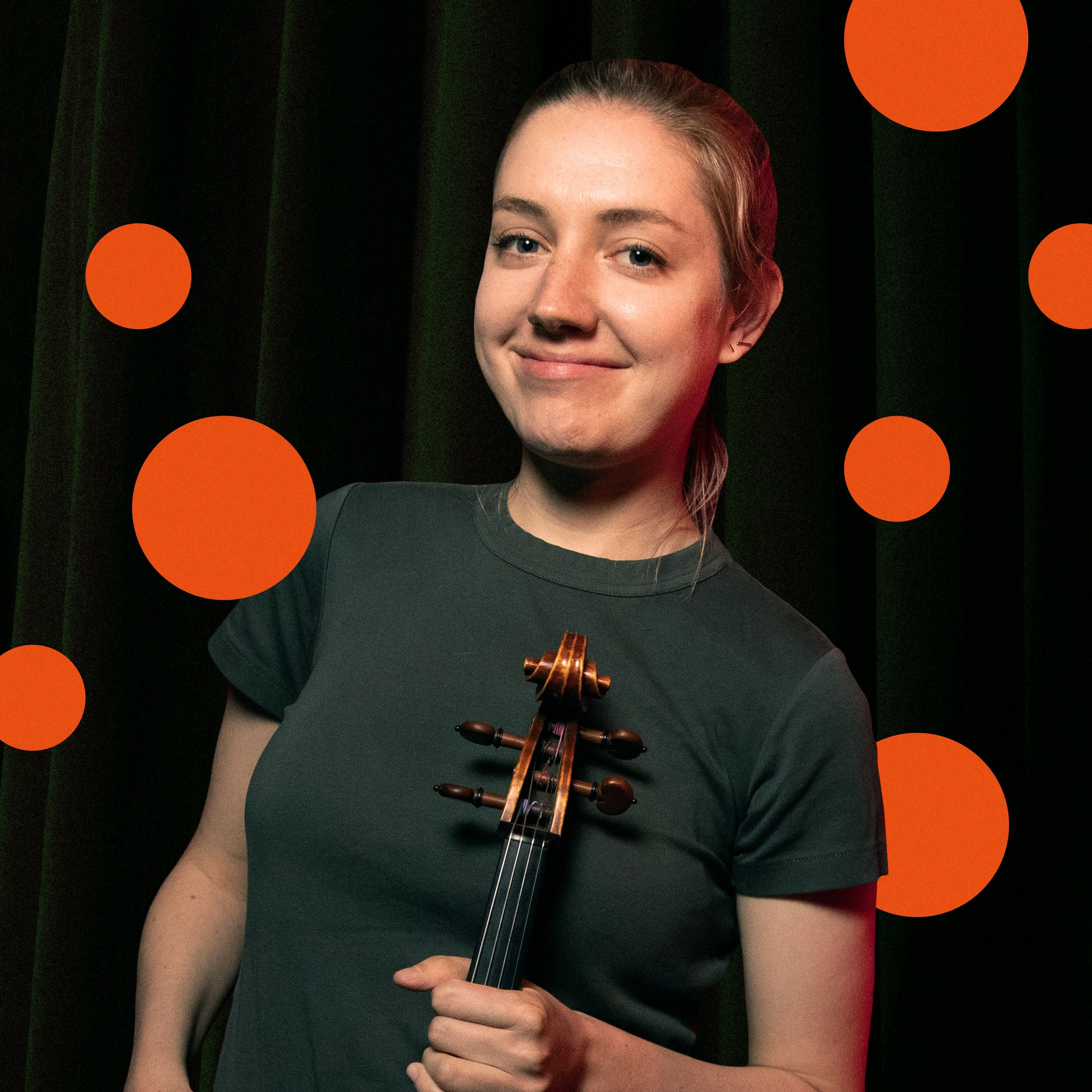
Classical Music Happy Hour
Isabel Hagen - likes a good viola joke
00:32:20
Comedian Isabel Hagen is a classically trained violist, and a filmmaker. As a comedian, she has been featured on The Tonight Show Starring Jimmy Fallon and was a New Face of Comedy at the Just for Laughs festival in Montréal. She talks to Manny about how the viola can be funny and make people love classical music by making them laugh!
Loading summary
Transcript181 lines
- [00:00]
Podcast Announcer
Classical Music Happy Hour is supported by Viking, committed to exploring the world in comfort, offering destination focused small ship experiences on all seven continents with a shore excursion included in every port and programs designed for cultural enrichment. And every Viking voyage is all inclusive with no children and no casinos. Learn more@viking.com it feels like one of
- [00:29]
Isabel Hagen
those pieces that I don't need to hear ever again. But that's my hot take
- [00:36]
Maniacs (Host)
from WQXR and Carnegie hall. This is Classical Music Happy Hour hosted by me pianist maniacs. Each episode will speak with a special guest about their lives, listen to some of their favorite musical gems, play music inspired games, and answer questions from you, our listeners. Isabel Hagen is a woman of many talents. A Juilliard trained violist, her career took a bit of a left turn when she discovered comedy. She has appeared twice on the Tonight show starring Jimmy Fallon and was a new face of comedy at the Just for Laughs festival in Montreal. These days she also moonlights as the writer, director and star of a film called I Isabel, welcome to the show.
- [01:26]
Isabel Hagen
Thank you. Thanks so much for having me.
- [01:28]
Maniacs (Host)
No, it's great. It's a pleasure. It's a pleasure to meet a fellow Juilliard graduate.
- [01:33]
Isabel Hagen
Yes, I'm finally getting to meet a fellow Juilliard graduate myself.
- [01:38]
Maniacs (Host)
Did you have a good time at Juilliard?
- [01:40]
Isabel Hagen
I did.
- [01:40]
Maniacs (Host)
You enjoyed it?
- [01:41]
Isabel Hagen
I think people sometimes assume I'm on some sort of crusade because I gave up music to pursue stand up comedy. But I really loved my time at Juilliard and my issue with music is only a battle with myself and my own performance anxiety, demons and you know. But I had a lot of great friends, really good experiences. It was a second home for me.
- [02:02]
Maniacs (Host)
Why did you decide to go into music at all?
- [02:05]
Isabel Hagen
I came from a musical family, so my dad is a jazz sax player and my older brother is a classical pianist and conductor. And my mother's musical, though not professional, but very musical family. And so it was just sort of
- [02:19]
Maniacs (Host)
natural thing to do.
- [02:20]
Isabel Hagen
Yeah, I started on piano when I was 4, but really. And then I begged my dad to get me violin lessons and then switched to viola at age 10. Cause honestly I just. My brother had a friend who played the viola who I thought was cool. I had a bit of a crush on him.
- [02:35]
Maniacs (Host)
You liked the larger instruments?
- [02:37]
Isabel Hagen
Yeah, yeah. The deeper tone.
- [02:38]
Maniacs (Host)
Why not?
- [02:39]
Isabel Hagen
And I, you know, fell in love with it and that's all I wanted to do.
- [02:43]
Maniacs (Host)
No, that's fantastic. And then somehow you went into comedy. Now I will say that I know a lot of musicians who Try to be funny and we don't succeed very often, but it's amazing to meet someone who's actually succeeding at this very difficult craft.
- [03:03]
Isabel Hagen
Well, yeah. I often say, you know, now I have a new appreciation for the music career because it took pursuing the one career more miserable than music to really appreciate.
- [03:14]
Maniacs (Host)
Yes, it must be even harder, huh?
- [03:16]
Isabel Hagen
I mean, in a way, I think it's harder, but I'm more suited for the specific difficulties of it. Cause with music, sure, they applaud no matter what, whereas.
- [03:27]
Maniacs (Host)
What a blessing.
- [03:27]
Isabel Hagen
Yeah, really, you've got to appreciate that. Whereas comedy, you know, you're looking for a specific reaction throughout the performance. And if you don't get it, as Seinfeld said, it ceases to be the art form. If it's not working because people aren't laughing, it ceases to be comedy. But at the same time, there's a lot more freedom for me. I don't have to worry about my finger moving in a weird way and the whole thing going south. And I can be my nervous self and not worry about having to relax my body and all these things that plagued me when I was just a violist.
- [04:00]
Maniacs (Host)
I would have thought it's actually more nerve wracking to come up with what to say when the thing is, so
- [04:07]
Isabel Hagen
much of standup, at least for me, is planned. So I'm doing jokes that I've already written, that I've already tweaked. Sure, someone might heckle me and I come up with something in the moment, but a lot of it is very much planned and practiced, just like you practice your instrument.
- [04:34]
Maniacs (Host)
I'm hoping that you can help me answer some questions about classical music from our listeners. We've invited them to submit their questions and we're going to do our best to answer. And if I don't know the answer, I'll just make something up.
- [04:50]
Isabel Hagen
Yeah.
- [04:51]
Maniacs (Host)
So here's the first one. A listener wants to know about orchestras.
- [04:56]
Isabel Hagen
I'm curious about how orchestra musicians are seated and why there seems to be a set seating pattern.
- [05:04]
Maniacs (Host)
Although other times I see it, it varies. Does it vary according to the acoustics
- [05:10]
Isabel Hagen
in a particular hall, or does it vary according to what the conductor likes?
- [05:14]
Maniacs (Host)
Just a curious question that I've had for a long time. Thank. Great. Well, I think we both probably have several answers.
- [05:23]
Isabel Hagen
Oh, yeah.
- [05:24]
Maniacs (Host)
First of all, everything you said is correct because sometimes it's the piece of music and there are certain requirements, you know, if you have a piece for which I was involved in once, for three percussion players, three clarinets and a brass section. You're obviously gonna seat things differently from having strings, woodwinds. And so for. So that's one thing you've played in orchestras, of course, all your life. So have you found this idea of seating, for example, first violins one side, second violins other side. Then sometimes it's first violins, second violins next to them. What's your take on all of that?
- [06:11]
Isabel Hagen
Yeah, well, as a violist, sometimes the viola section is on the outside, sometimes they're on the inside. That's the most common variation I noticed.
- [06:20]
Maniacs (Host)
Right.
- [06:20]
Isabel Hagen
And that was always conductor preference. From my observation. I always thought that the violins on either side was more of a European tradition, but I might be making that up.
- [06:29]
Maniacs (Host)
I think it used to be that way. And then I think maybe people found that it was better for ensemble. I wondered if it has to do with who has to dress better, because if you're seated on the outside, you have to look fairly decent. But actually, to be serious about the answer, I think the tradition has grown because people have found that the particular way of seating strings in the front, woodwinds behind, brass behind them, percussion behind them, is usually the best sounding for most traditional music. And that's where you switch back and forth. But one great example of what's possible in a given hall is. Is in Vienna, where the hall is not so big and the stage is particularly small. The basses all go in a row at the very back of the orchestra. They don't sit in a section, you know, to one side. They very often sit in one row because that tends to work there. And the chairs are also very funny because the back of the orchestra is on steps. And so some of the chairs have front legs that are normal and back legs which are very, very short. So they go onto the riser. Depends on the whole.
- [07:55]
Isabel Hagen
Yeah. And certain pieces have. But very few have actual prescriptive seating. Mostly modern, more 20th century pieces.
- [08:02]
Maniacs (Host)
Yes. All I know is when I play the piano, I have to be seated in front of the keyboard. And the rest of it works fine for me. Right, so have we bored our poor listener enough? Did you start with musical jokes?
- [08:26]
Isabel Hagen
No. I did talk a little in my recital and made some musical jokes within that. And I did an all Hindemith recital. Cause I thought that would be kind of funny.
- [08:34]
Maniacs (Host)
Ah, that is kind of. Yes. In a way. It could be the punchline to a very good musical joke.
- [08:41]
Isabel Hagen
Yeah. And I played Trower music, which was written for the death of King George V, in like six hours. So I made a little Joke about, you know, this piece was written in six hours. You decide if you can tell it was written that quickly or not.
- [08:52]
Maniacs (Host)
Well, at least it's good he waited for the guy to die to write it. That's always nice, you know?
- [08:56]
Isabel Hagen
Exactly. But when I did just stand up, I actually. I tried to keep them very separate. I didn't let on that I was a musician or anything. I was just trying to be a comedian.
- [09:05]
Maniacs (Host)
Well, one of the reasons I ask is because there is a whole subgenre of musical jokes, which are viola jokes.
- [09:12]
Isabel Hagen
Yes.
- [09:12]
Maniacs (Host)
I mean, infinite examples. Oh, yeah, I'm sure you know them all.
- [09:16]
Isabel Hagen
As soon as I switched to viola when I was 10, I immediately googled viola jokes and just memorized a bunch of them.
- [09:23]
Maniacs (Host)
I think actually the first viola joke was Berlioz. I think somewhere in either the memoirs or his book of criticisms. Of course, what used to happen was that violists were violinists who then became violists. And he says somewhere something about the Paris Opera Orchestra, he saw such and such, and he said, oh, so young and already a violist. And I think that may have been the first one ever.
- [09:50]
Isabel Hagen
I was gonna say, can we trace the origin of the viola joke?
- [09:53]
Maniacs (Host)
I thought maybe. I seem to remember reading that somewhere, but I. I could be completely wrong.
- [09:58]
Isabel Hagen
All right, well, there's also Harold in Italy. Is that just one big viola joke or.
- [10:08]
Maniacs (Host)
Well, no, I mean, it's a beautiful piece.
- [10:10]
Isabel Hagen
That's Berlioz, right? I'm not having a.
- [10:12]
Maniacs (Host)
It's Berlioz. Yeah, yeah, yeah, yeah. No, it's definitely Berlioz. And I guess if there is a joke in that, is that in the first movement, there's a lot for viola. And then it gets less and less as it goes on. But I don't know for sure. Anyway, I'm full of misinformation about many things, and this is probably one of the things. I saw some clips of you and being an old guy. You know, I still remember Henny Youngman, and he used the same pattern that you use. Sometimes you play a little bit and then you tell a joke.
- [11:02]
Isabel Hagen
So I do comedy and I play viola. And, you know, a lot of people would ask me, oh, you know, you do both. Do you ever do, like, a viola comedy show? And I usually say no, because who would want to see that? But enough people asked that I decided to sort of humor them. So if you don't mind, I'm going to experiment and I'm going to play a little viola and then do A little stand up, and we'll see how it kind of goes together.
- [11:24]
Maniacs (Host)
All right.
- [11:39]
Isabel Hagen
I hate when people show me pictures of their kids. It's like, we get it, he's missing. Move on. My friend recently told me I have resting, sad face. I was like, oh, no, it's active help.
- [12:34]
Maniacs (Host)
Henny Youngman did the same thing with the violin. Was he kind of something that I won't say inspired you, but no one will believe me.
- [12:42]
Isabel Hagen
But the way I came up with what I do is I wanted to combine the two things. After four years of keeping them separate, I didn't want to diminish the quality of either one. So finally I thought, well, what if I just play beautiful music and then tell a really funny joke next to each other? And then the juxtaposition of how ridiculous that is will be the humor. And that's what happened. And then someone said, well, Henny Youngman, who I knew as someone who had a violin but never really watched him.
- [13:09]
Maniacs (Host)
So you came to it later.
- [13:10]
Isabel Hagen
And so I saw it and I said, oh, my gosh, that's what I do. So it felt really nice to see it. But I actually wasn't inspired by him originally.
- [13:18]
Maniacs (Host)
Okay.
- [13:18]
Isabel Hagen
But no one will believe me, so that's fine.
- [13:21]
Maniacs (Host)
I believe you implicitly. Thank you completely. You were gonna talk about the Brahms F major string quintet.
- [13:29]
Isabel Hagen
Yeah. I think Brahms's string writing often gets criticized for being, I don't know, a little inefficient or a little awkward. But I've always loved both viola quintets. But I feel like the other one is played more, the one that's in G major. But I never hear people perform the F major.
- [13:48]
Maniacs (Host)
I'm ashamed to say that I don't know it.
- [13:51]
Isabel Hagen
No, but I expected you not to. This is how no one ever plays it, but I had a CD as a kid with both of them on it, and I listened to both of them, and every movement is so beautiful. It just reminds me of the joy of chamber music camp and everyone just coming together for a simple goal of enjoying music. And I remember saying to a teacher that I enjoyed the string writing of Brahms. And he responded that he was a little worried about my intellectual inquiry for liking.
- [14:45]
Maniacs (Host)
Does that mean asking a question?
- [14:46]
Isabel Hagen
Just that I didn't want to delve in to see the problems of Brahms stringwriting.
- [14:52]
Maniacs (Host)
I find it interesting that people are able to say that about a composer like Brahms because I've also heard, for example, from my side, I've heard people say that Beethoven is unpianistic, which I feel that it's kind of a meaningless statement because if anybody defined the piano, it was Beethoven. So to say that his music is unpianistic doesn't really mean very much. I mean, it's for you to figure out how to make it sound good. And people do. And the same is true for, I would say for Brahms's string writing. Added to which, he probably had one of the great string teachers of the entire century working with him, hand in glove. Joseph Joachim, who was probably the great violinist after Paganini, renowned all over Europe. And Brahms was constantly writing to him. Is this practical? Does this work? Should I do this? How do I double stop this? You know, how do I.
- [15:54]
Isabel Hagen
Was Joachim the one who helped him with the clarinet sonata transcriptions, or was that.
- [15:59]
Maniacs (Host)
I'm sure. I'm sure they were very close friends in spite of a couple of periods of falling out. But the Double Concerto for violin and cello was like a makeup gift to Joachim. So I think there's no issue with the writing. I think it's okay.
- [16:18]
Isabel Hagen
Maybe it was more a criticism of his string, chamber music, his quartets and his. Maybe it was that specific. But it was just something I sort of grew up hearing and never really agreed with. I think people like to find things to criticize. But why Brahms?
- [16:34]
Maniacs (Host)
Yeah, why Brahms? My God, we could do it to a lot of other people, like Beethoven and Mozart. Those guys can take it.
- [16:42]
Isabel Hagen
Yeah, yeah, they're fine.
- [16:46]
Maniacs (Host)
I'm maniacs. And this is Classical Music Happy Hour. We'll return in just a moment.
- [16:58]
Podcast Announcer
Classical Music Happy Hour is supported by Viking, committed to exploring the world in comfort. For over 25 years, Viking has been connecting the thinking person with the world. First on the great rivers, then on all five oceans, now on all seven continents. Whether you choose to journey through the heart of Europe on an elegant Viking longship, explore the ancient cities of the Mediterranean on a small ocean ship, or venture to the white shores of Antarctica on a purpose built expedition ship. You will always experience thoughtful service, destination focused dining and cultural enrichment on board and onshore. And every Viking voyage is all inclusive with no children and no casinos. Learn more@viking.com
- [17:53]
Maniacs (Host)
I'm maniacs. Here's a little more from Isabel Hagin. This is Classical Music Happy Hour. What is your go to beverage after a long day?
- [18:06]
Isabel Hagen
Either a white wine or a tea, depending on the day.
- [18:10]
Maniacs (Host)
Wow. Not so adventurous. Okay.
- [18:16]
Isabel Hagen
Yeah.
- [18:16]
Maniacs (Host)
What is the first concert you ever went to?
- [18:20]
Isabel Hagen
I'm trying to remember. I mean, my father's a musician. The earliest memory, he played this revival of this show called the Gospel at Colonus, and it was at Carnegie Hall. It was a sort of concert version of this Broadway show he played. That's my earliest memory of going to a concert besides my brother's piano recitals. I have an older brother, so you
- [18:38]
Maniacs (Host)
would have been very young.
- [18:40]
Isabel Hagen
Very young.
- [18:40]
Maniacs (Host)
Very young. Okay, what's your favorite musical? Hot take.
- [18:46]
Isabel Hagen
I mean, I guess there's been this push to let people clap between movements.
- [18:51]
Maniacs (Host)
Yes. Do you not like that?
- [18:52]
Isabel Hagen
No, I like that.
- [18:53]
Maniacs (Host)
Yeah. I love it.
- [18:54]
Isabel Hagen
I think let people enjoy the music.
- [18:57]
Maniacs (Host)
Absolutely. And I think it's above all, it's authentic.
- [19:00]
Isabel Hagen
Yeah. I mean, in Mozart's time, they were whooping and hollering during the recap.
- [19:06]
Maniacs (Host)
If there were no applause at the end of the first movement of the fifth Symphony of Beethoven, Beethoven would have been devastated.
- [19:14]
Isabel Hagen
Right?
- [19:14]
Maniacs (Host)
Yeah, it would have been horrible. So we have to go back to that.
- [19:17]
Isabel Hagen
Yes.
- [19:19]
Maniacs (Host)
Obviously, musical performers, most of the time, they come out and they play set music. It's already written. They know what's going to be played. We don't need to feel out the people we're playing for on a second to second basis. Whereas I imagine that if you're doing a standup show, you get an instantaneous feel for, are they going to laugh at this? Are they going to laugh at all? And you have to adjust all of that immediately. Yeah, that's the part I think would be incredibly difficult.
- [19:58]
Isabel Hagen
It's kind of a macro version of adjusting for intonation, you know? Cause I heard someone say intonation is mostly just adjusting, but it's these tiny intangible amounts of time.
- [20:08]
Maniacs (Host)
I understand. Because there's no such thing as this is the correct intonation. This is incorrect. Depends on what's around you.
- [20:15]
Isabel Hagen
Right. And the same with audiences for comedy. Immediately I get a sense, oh, they're not liking this, or they need this kind of thing. And there's only so much I can do to adjust. I'm not gonna become someone else on stage.
- [20:28]
Maniacs (Host)
One of the reasons that all of this fascinates me endlessly is because I think we're now entering a period where musicians like me that are essentially boring piano players also do a little bit of speaking to the audience about pieces that may not be quite as familiar. And I have to figure out what works with whom and even try to be funny when it's useful.
- [20:57]
Isabel Hagen
I think it's so great to talk when you're playing classical music. And I just find the audience just sort of sighs like, oh, okay, we're all here together. And do you find it has a disarming effect?
- [21:09]
Maniacs (Host)
I find it has a disarming effect both on the audience and on me.
- [21:13]
Isabel Hagen
Yes.
- [21:14]
Maniacs (Host)
I'm a lot less nervous once I finish doing that. On the other hand, they're not expecting me to be brilliant at speaking. If I stumble, if my joke doesn't work, there's always Beethoven to fall back on, which is very helpful. Is that the way you started going into comedy? By having a chance to play and do some speaking?
- [21:35]
Isabel Hagen
In a way. I also went to a couple open mics just on my own, without my instrument as well. Cause I was studying music in New York and there are so many places to go do comedy and try it.
- [21:45]
Maniacs (Host)
You mean you can actually go to a club or a place or something?
- [21:48]
Isabel Hagen
Yeah, there's a website that had all the open mics listed and I just picked one and I went. But the New York City open mics are not always wonderful. In fact, they're often the opposite of wonderful. And it's a good weeding out situation.
- [22:00]
Maniacs (Host)
You've talked about performance anxiety, both sides, comedy and music. Do you find that one helps the other?
- [22:08]
Isabel Hagen
Absolutely. Comedy really helps. Just the sheer amount you get on stage as a comedian, I mean, I'm taking the stage sometimes three times a night for different spots. So it's just that flexing the muscle of performing, which, you know, I never went on to have a big performance career after Juilliard as a soloist, but at school you don't get that many performance opportunities, you know, so I wasn't flexing that muscle. But now it's just performances have become less precious. I mean, I still. They're of great importance, but I'm less. Oh, this better be. This is it, you know.
- [22:43]
Maniacs (Host)
Do you play full length pieces?
- [22:45]
Isabel Hagen
Sometimes in my act, I'll play a full movement of a box suite. And then I occasionally still play regular gigs with a quartet or a group. So then in that situation, I do.
- [22:54]
Maniacs (Host)
And when you do that, do they let you introduce things?
- [22:58]
Isabel Hagen
They try. I don't like doing it.
- [23:01]
Maniacs (Host)
I see.
- [23:01]
Isabel Hagen
There's. Sometimes people think my comedy is like a good idea when I know it wouldn't be.
- [23:07]
Maniacs (Host)
I see.
- [23:07]
Isabel Hagen
So I. I tend to be a little cagey about combining them sometimes.
- [23:13]
Maniacs (Host)
So it depends on the situation.
- [23:15]
Isabel Hagen
Yeah, absolutely.
- [23:15]
Maniacs (Host)
Okay. Okay. When you come out, you're always looking at who's out there. To what degree does that affect you? And do you tend to focus on one friendly face or is it a wash of people?
- [23:42]
Isabel Hagen
I was just dealing with this because I played in a theater that's a little bigger than I'm used to playing, so you have a little more variety of people to focus on. And there was someone right in the front who didn't look like they were enjoying it at all, and then a bunch of people behind them who were having the time of their life. And I couldn't not look at this one person in the front. I just wanted to. I was like, but if they're having a bad time, then all is lost.
- [24:08]
Maniacs (Host)
So you wanted to grab that person.
- [24:10]
Isabel Hagen
Yes. Even though the common advice is to focus on the people enjoying it, because people will try to join their bandwagon rather than the one person scowling or. So I try to keep it a general thing and focus on my energy out broadly. But sometimes I get distracted.
- [24:27]
Maniacs (Host)
I ask because I'm in the lucky position of just looking across the piano and not really noticing that people are yawning or whatever's going on. And now that I'm getting older, I can't even hear the coughing and rustling and phones. So everything is fine.
- [24:47]
Isabel Hagen
Well, when I was just a violist and playing long recitals, if I ever looked out at the audience during the performance, it felt like such a faux pas and also would really screw me up. Don't look, don't look.
- [24:58]
Maniacs (Host)
That's another interesting thing. We don't tend to look at audiences when we play, do we?
- [25:04]
Isabel Hagen
No.
- [25:04]
Maniacs (Host)
And if somebody does, Lang Lang, for example, sometimes we'll look at the audience and people are so shocked by this when they see, my God, he looks at people. Maybe it's fine.
- [25:17]
Isabel Hagen
Right. In all other music genres, it's normal. I mean. Yes, I guess you could compare it to ballet. Ballerinas don't tend to look at the audience, I guess.
- [25:25]
Maniacs (Host)
Yeah. I don't know why. They have nothing to do except move their feet.
- [25:29]
Isabel Hagen
Right. And they twirl. They have so many opportunities.
- [25:31]
Maniacs (Host)
Yes, exactly. So here we have a question from New York. Hi, my name is Steve and I live in New York City. I would like to know the difference between atonal and dissonant. It has been explained to me before, but as a layman who does not play an instrument or read music, I never quite got it and would be grateful for any further explanation. Thank you. Well, I'll have a go at it. I think it's more a matter of definition of words than a definition of sounds. The reason I say that is because dissonant actually just means not in harmony with. And that can be true of language, a relationship, and certainly music. So a Beethoven symphony, a Mozart piece. Any traditional music contains an enormous amount of dissonance. Basically, most of music is going from dissonance to consonance. So the very idea that in the Beethoven Fifth Symphony, for example, which we all ta, ta, ta, ta. And then it winds up on this. That chord is not dissonant in itself, but it requires some kind of closure. And I think that's really the point. Dissonance to consonants. So that's true of basically all classical music. Now, atonal would be music that has no center, such as C major, G minor. But it's not what you call it, it's what you hear. If you hear something that resolves into a sound where you say, oh, yes, this is the end. This is the end of the Star Spangled Banner. Is, let's say, a C major chord that sounds to you like a consonant chord. Am I making sense with this?
- [28:03]
Isabel Hagen
Yeah, you actually made me realize what it is.
- [28:06]
Maniacs (Host)
So atonality would be if you are doing. Let's say you are going O say. And you stop on the probably. That's more of an atonality because there's a weird note in that chord. There's a D in an A minor chord.
- [28:28]
Isabel Hagen
Right. Well, atonal music, it's dissonant without the resolution, whereas. So dissonance is just the quality of the clashing.
- [28:36]
Maniacs (Host)
Yes.
- [28:36]
Isabel Hagen
All atonal music is dissonant, but not all dissonant music is atonal. Does that make sense?
- [28:42]
Maniacs (Host)
That sounds logical to me, even though I didn't quite follow it. But that sounds perfect. And I think to most of us, when you say atonal music, it means stuff that sounds not harmonious. I think that's probably the best answer I can come up with off the cuff.
- [29:00]
Isabel Hagen
Well, I thought it was a very good answer and made a lot of sense to me.
- [29:03]
Maniacs (Host)
Okay, well, what do you know?
- [29:05]
Isabel Hagen
Yeah, it's true. Don't take my word for.
- [29:07]
Maniacs (Host)
For. So I want to ask you about some of your substack things. First of all, I was absolutely struck and very much in agreement with the idea of we don't need to save classical music. Sometimes we do emphasize the glass is half empty aspect. And I just wondered, do you mind older audiences?
- [29:46]
Isabel Hagen
Not at all. I mean, I have a lot of older audiences come to see me do standup because they're intrigued by the viola, and sometimes they're the best crowds.
- [29:55]
Maniacs (Host)
But I think that's one of the things people talk about a lot, about the idea that audiences are older and
- [30:02]
Isabel Hagen
how can we get the young people to the maybe if we offer them Beer. You know, like just.
- [30:09]
Maniacs (Host)
Yeah, I guess. We're all living so much life and we seem to have more time toward the end of our lives than we did at the beginning.
- [30:19]
Isabel Hagen
Right.
- [30:20]
Maniacs (Host)
Now, the other sub sec thing that struck me very forcibly was your opinion on concertos.
- [30:27]
Isabel Hagen
Uh huh.
- [30:28]
Maniacs (Host)
Now you seem to have a pet peeve of the Tchaikovsky Rococo Variations.
- [30:33]
Isabel Hagen
Yes. There are many concertos that are beautiful pieces and of course I want to hear the soloists that play them. So it's a bit of a joke, but it was inspired by having the radio wake me up in the morning. And it was the Rococo Variations and I just couldn't.
- [30:48]
Maniacs (Host)
Well, you say that. You say wake me up in the morning. Sounds like Groundhog Day. You remember that every day another.
- [30:54]
Isabel Hagen
No, but my husband has a clock radio that wakes us up. And I guess one morning it was Rococo. And I had played the piece before numerous times in different youth orchestras.
- [31:05]
Maniacs (Host)
And it intrigues me that you focused on that because I think it's a very beautiful piece. I'm sorry to say.
- [31:13]
Isabel Hagen
I just. There's something about the melody. It's kind of dinky to me, really, and it's just a little too long and it feels like one of those pieces that I don't need to hear ever again. But that's my hot take.
- [31:26]
Maniacs (Host)
Okay.
- [31:27]
Isabel Hagen
Okay.
- [31:27]
Maniacs (Host)
All right. But you don't generalize. I just wondered if the Brahms B flat Piano Concerto was a goner for you.
- [31:36]
Isabel Hagen
Which one is that?
- [31:36]
Maniacs (Host)
It's the one that's not in D minor.
- [31:39]
Isabel Hagen
Okay.
- [31:39]
Maniacs (Host)
It's the one in B flat. Great.
- [31:41]
Isabel Hagen
Got it.
- [31:42]
Maniacs (Host)
It's the one with four movements.
- [31:44]
Isabel Hagen
Okay. The one where the pianist is the soloist.
- [31:46]
Maniacs (Host)
That's the one. That's exactly the one.
- [31:49]
Isabel Hagen
I do love the Mozart Clarinet Concerto.
- [31:51]
Maniacs (Host)
Oh, that's nice.
- [31:52]
Isabel Hagen
Yeah.
- [31:52]
Maniacs (Host)
It's very difficult to choose these things when you're in love with an instrument.
- [31:56]
Isabel Hagen
It is. And I think a lot of our opinions about most pieces are more contextual than we'd like to admit. Where were you in your life when you first discovered this piece? Were you in love? Were you heartbroken? What was going on?
- [32:09]
Maniacs (Host)
Yes. And probably true, when you're a listener at a concert, your reaction to any performance is probably just as much informed by your feeling at the time as by the quality of the performance.
- [32:25]
Isabel Hagen
Right. Were you hungry? Did you eat enough that day?
- [32:27]
Maniacs (Host)
Exactly. For me, that's never a problem. So, Isabel Hagin, thank you so much for joining us today. It's been a great pleasure.
- [32:45]
Isabel Hagen
Thank you so much for having me.
- [32:48]
Maniacs (Host)
I'm Manny X and this is Classical Music Happy Hour. Classical Music Happy Hour is supported in part by the Robert and Mercedes Eicholtz foundation and by Linda Nelson. Our production team includes Lauren Purcell Joyner, Eileen Delahunty, Laura Boyman, Elizabeth Nonemaker, David Norville, Christine Herskovitz and Ed Yim. Our engineering team includes George Wellington, Irene Trudell and Chase Culpan. Classical Music Happy Hour Hour is produced by WQXR in partnership with Carnegie Hall. WQXR is supported by Carnegie hall presenting a one night only event with leading soloists Leonidas Kavakos, Gil Shaham, Antoine Tamistini, Pablo Ferrandez and Elisa Weilerstein performing Beethoven's Kreutzer Sonata and Schubert's String Quartet in C major May 15th. Tickets@carnegiehall.org.