← Classical Music Happy Hour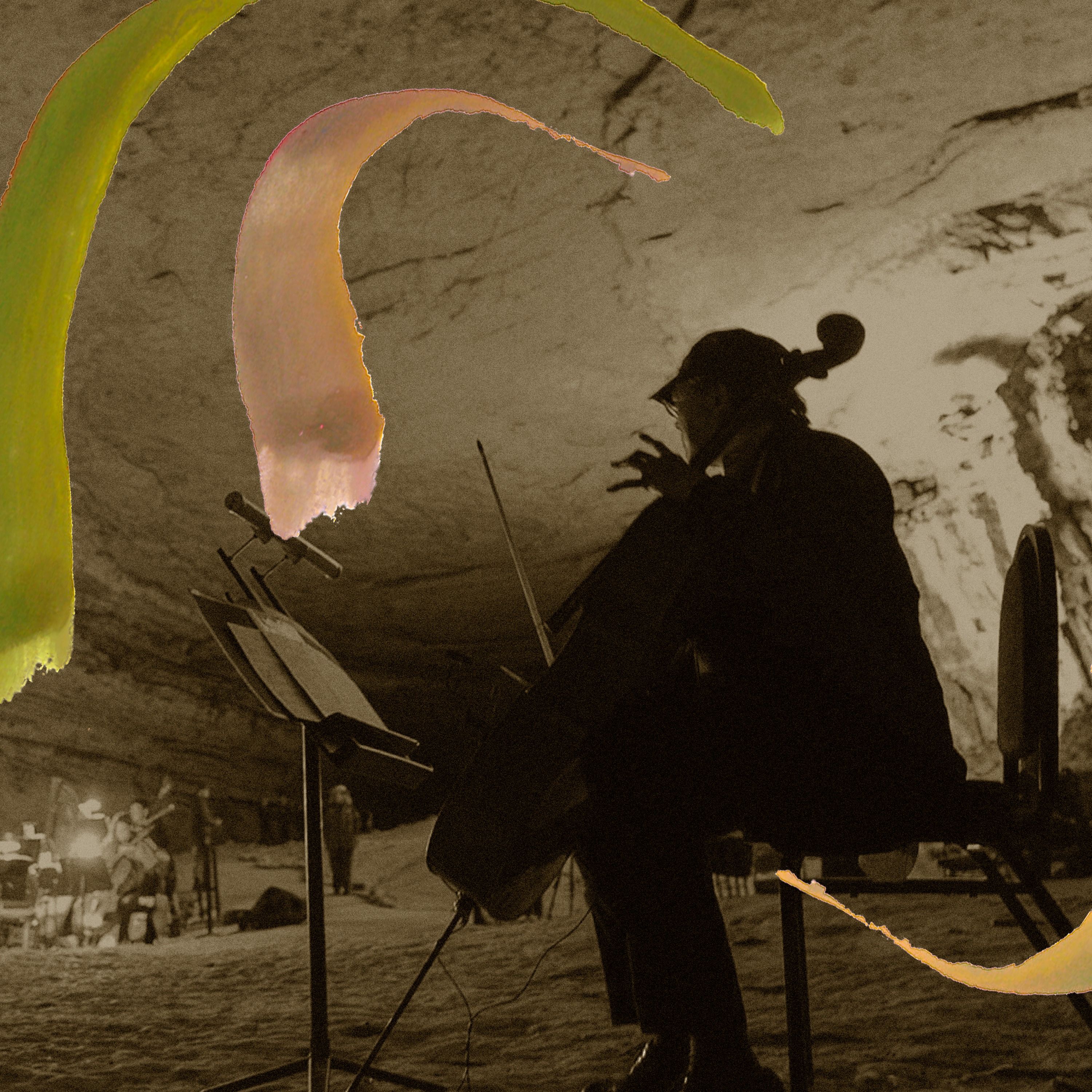
Classical Music Happy Hour
Kentucky: Yo-Yo Ma and the Louisville Orchestra perform in Mammoth Cave
00:33:45
A cave can hold secrets. Louisville Orchestra conductor Teddy Abrams knows that, which is why he wrote a piece for symphony orchestra to be performed entirely underground. Yo-Yo joins the orchestra as a soloist in a performance within Mammoth Cave that unlocks centuries of stories preserved by the caves' seemingly endless walls.
Loading summary
Transcript156 lines
- [00:05]
A
I'm just like, this is going to.
- [00:06]
B
Be a once in a lifetime kind of event.
- [00:09]
A
A world renowned cellist outside of our hometown of Bowling Green, Kentucky, we're thrilled to have someone of his caliber to come here.
- [00:15]
C
The cello is my favorite instrument and.
- [00:18]
B
I'm a big fan of the cave.
- [00:20]
D
We're going to walk into the cave and we're going to see Yo Yo.
- [00:23]
A
Ma play his cello inside Mammoth Cave. Are you scared at all to be in the dark?
- [00:31]
D
Yeah.
- [00:31]
A
It's kind of be exciting and a little scary. That sounds how I feel too. It's early spring in central Kentucky. The dogwood trees are blooming, those white star flowers, and the air is damp from thunderstorms. I'm here outside the visitor center at Mammoth Cave national park with a couple hundred people waiting to head down into the cave for an event.
- [00:55]
E
No details have really been leaked. I hear it will be very different than anything we will probably ever see again.
- [01:03]
A
All anyone knows is that Yo Yo Ma and the Louisville Orchestra are in the cave right now under our feet, getting ready to premiere a new composition by music director Teddy Abrams titled Mammoth. We're expecting something very exciting. The idea of a symphony orchestra playing in a cave is a little bewildering to me, but then again, I'm not from Kentucky.
- [01:27]
F
Growing up as a kid, what you.
- [01:29]
A
Did in this part of the country.
- [01:30]
F
Is you explored caves.
- [01:32]
A
I always think it's really interesting when sometimes it rains a lot and there.
- [01:35]
B
Will just be collapses and all these.
- [01:38]
E
Antique Corvettes and fancy vehicles are just sitting in the bottom of the hole. It's like, oh, yeah, we live in Kentucky. It's just a reminder. It's very mysterious here.
- [01:51]
A
Nobody really knows how big Mammoth Cave is. There are speculations, good guesses. It's almost like a parallel universe under the soil, unfazed by the changing world. Outside of its many many, the cave itself is just rock dust. But within those seemingly inert walls, the air holds eons of stories.
- [02:19]
G
If you hold a piece of rock that's a million years old, you are actually in contact with something way beyond our present feeling and knowledge of.
- [02:38]
F
Foreign.
- [02:42]
A
I'm Ana Gonzalez, and this is our common nature. A musical journey with Yo Yo Ma through this complicated country to help us all find that connection to nature that so many of us are missing. We climb mountains, play music, drive dirt roads, recite poetry, traverse rivers and oceans.
- [03:00]
H
And even our own brains.
- [03:01]
A
All to figure out how to better live on our planet together. And today, we're using music to connect us to the earth's. Longest cave system that we know of. This thing is in Kentucky. And it is beyond huge, Like a world underground made up of hundreds of miles of caverns and rivers and passageways that human beings have yet to fully Explore. In the 1880s, this was one of the most popular attractions in the world. There was a train that took people straight to the cave. But today, most people don't even know about it.
- [03:42]
G
I think what's great about music is that it's something that can lock in time through how powerful a present moment is felt.
- [03:55]
E
The title of the piece of music you're about to hear this evening is called mammoth, and it was inspired by the history and people here at mammoth cave. It was written specifically for us for this moment in time.
- [04:27]
A
I didn't really know what I was expecting expecting when I walked into Mammoth cave. I haven't spent a lot of time in caves, so I was kind of just picturing it like a long tube underground that kept going for hundreds and hundreds and hundreds of miles. But that's not what Mammoth Cave is.
- [04:42]
B
I think when people go into this place, they feel like they're entering into the earth itself. It's like you've entered into a different planet. It feels like there is some kind of spiritual center there.
- [04:53]
A
This is Teddy Abrams.
- [04:55]
B
I am the music director of the Louisville orchestra, and I'm talking about mammoth here.
- [05:00]
A
He wrote and conducted the piece we're listening to mammoth to be performed deep underground. But he had no idea if it was gonna work.
- [05:08]
B
I still don't even understand how they did it. I mean, are the percussion instruments going to make it down into the cave? Will the harp not crack? And will all the strings just split like, you're not supposed to leave harps in a 54 degree cave, but we had to. And there were two of them in this piece, by the way.
- [05:24]
G
You know, it was a wild idea to do that. And it takes wild and courageous imagination and perseverance of Teddy Abrams to pull it off.
- [05:37]
A
Teddy has been obsessed with mammoth cave and its very special history for years now.
- [05:42]
B
Yes, you should see my stack of books.
- [05:45]
A
And that's because Teddy has a mission. As musical director of the Louisville orchestra.
- [05:50]
B
My dream was to take the orchestra and bring it to every part of Kentucky with the goal of bridging the urban rural divide through music.
- [05:57]
A
Yo yo had worked with Teddy before and loved the idea of doing a piece inside the cave at Mammoth cave national park.
- [06:06]
G
So much has happened in those caves, and, in fact, in some ways defines, among other things, the history of Our nation.
- [06:15]
A
So the park. Yo yo and Teddy, they're all down to make this project happen. Only one problem. Teddy didn't know how to drive. He lived his life in the city, and he was used to public transportation, which there's not a lot of in Kentucky, especially not from Louisville direct to mammoth cave.
- [06:33]
B
I'm going to figure this out. And I biked myself down there, which took, you know, it took about, like, 10 hours.
- [06:38]
A
You biked 10 hours?
- [06:39]
B
Yeah, because it's well over 100 miles of hard biking. Like, you know, you can't go on the interstate, obviously.
- [06:48]
H
Yeah.
- [06:48]
A
And it's uphill through 100 miles of rolling farmlands, Pedaling through small towns and farms, past horses and hazards.
- [06:57]
B
I got chased by dogs left and right. It was exciting.
- [07:01]
A
When it was safe enough, he listened to music.
- [07:04]
B
I actually listened to most of the ring cycle.
- [07:11]
A
The classic Wagner set of operas for Famous for some of the most dramatic musical motifs in popular culture.
- [07:18]
B
It was for a specific purpose, because I had in mind that whatever we made in the cave was going to have a kind of epic quality to it in the sense of, like, a big spiritual piece.
- [07:29]
A
Hour after hour, the tension for Teddy to arrive at the cave mounted. It felt like a pilgrimage. Once he finally arrived at Mammoth 10 hours later, it was even more magnificent than he could have imagined.
- [07:49]
B
It gave me the perspective of a lot of the people who would have experienced getting from place to place in the 19th century up to the middle part of the 20th century. Much of that would have been influenced by the challenge of just getting there. And this gave me a big window into how actually the piece should ultimately be made, because it needed to be respectful and honest, Honor the circumstances of the people that have made mammoth cave what it is to this day.
- [08:16]
A
Wow. And I bet that 10 hours gave you a lot of time to think about all.
- [08:20]
G
Yes.
- [08:21]
B
And it led to some deep realizations of, like, what caves mean to people.
- [08:27]
A
Caves have always been places human beings are drawn to because they protect us from the elements. They're a natural home, and their safety gives you time to rest, reflect, and go deep within your mind. So it makes sense that mammoth cave would hold the history of the people that entered it. It's almost like a monument to them. And that's how Teddy thought about writing this music.
- [08:55]
B
So the piece originally took on the structure of kind of a requiem mass.
- [08:58]
A
A musical form based on the catholic mass to honor the souls of the dead. For mammoth, this means everything and everyone that the cave has held in itself. Depths.
- [09:08]
B
Yeah. So the way the piece is structured, actually begins long before you enter into the final room where most of the performance takes place.
- [09:17]
A
As the audience files past a waterfall, down a staircase and into the underworld, a small group of musicians greets them with drums.
- [09:25]
B
You don't know what you're listening to. It's just these percussion instruments, really deep drums, bells and some chimes that give pitches. And then the musicians start singing these lines of chant that sound almost like the kind of chant you would hear in the eight hundreds or nine hundreds in church.
- [09:53]
A
Once the whole audience enters, all five or six hundred of them, the musicians join the group and walk down about a quarter mile through a mini canyon that opens up into. Into a cavernous rotunda set for a musical performance. Aglow, with lights reflecting off of limestone. And it's as grand as any house of worship lying just below the crust of the earth.
- [10:18]
B
Then the audience, or as I call them, the congregation, forms a ring around this massive room.
- [10:26]
A
Singer Devon Tynes is wearing a black sleeveless cloak. It goes all the way down to his boots. And he's carrying a lantern that lights his solemn face. He walks to the middle of the hall.
- [10:38]
F
We are together here in this deep place within the earth. This is the realm below.
- [10:49]
A
Devon is the narrator through the piece.
- [10:51]
B
The way I've structured it is first you hear the natural history of the piece. So you tell the story of how the cave came to be.
- [11:03]
F
The water make this place.
- [11:19]
B
Yo yo enters and begins basically the overture to the piece, which presents all the themes that you're then going to hear.
- [11:44]
A
What was your first impression of Mammoth Cave?
- [11:47]
G
Dark and cold.
- [11:49]
A
Big Mammoth, even.
- [11:51]
G
Yeah, yeah, Very apt.
- [11:58]
C
There's notated improvised water sounds. So to do that we had these miced aquariums to mimic the flowing, dripping water.
- [12:06]
G
Yeah.
- [12:07]
A
These are members of the percussion section. One bass drum was not enough for this piece. It had to go mammoth.
- [12:12]
C
So we have four of them, plus a kick drum for the earthquake.
- [12:17]
G
I have a bucket full of rocks.
- [12:19]
A
That I'm shaking around. Where'd you get the rocks from here? Authentic. That's what it would really sound like. Wow. After the natural history section, Mammoth, the musical piece was opens up into the human history of Mammoth. The cave, from its early discovery by prehistoric people right up into the complicated modern history of the park. Guides who've been leading people through these caves for over 100 years, lived here.
- [13:02]
E
And today many of us still have our families here.
- [13:05]
A
This is a moment where park guide Johnny Meredith comes on stage. He paces back and forth against the cave walls and talks about his family who are all guides.
- [13:14]
E
They're resting in cemeteries above us. And at this time, I would love to introduce you to a man who has his own story to tell. I give you Mr. Jerry Bransford.
- [13:35]
A
Jerry walks on stage. He's an older black man wearing a crisp national park service uniform. And he takes off his flat brimmed hat and holds it in his hands.
- [13:45]
D
Well, good afternoon, ladies and gentlemen. I've got American story I want to share with you about some old kin folks who were in slavery here 185 years ago. It's an American story.
- [13:59]
A
Jerry's family were guides too. They were enslaved people and that was one of their jobs. But that history was lost for generations until the cave brought it back.
- [14:11]
D
So our families stay on here. This become our home. So when I walk through the cave, I see their names on the cave wall. Matt 1850. Nick 1857. It bring a tear to my eye, what hardship they must have endured.
- [14:29]
A
Do you remember that performance and the things you were feeling when you were telling that story?
- [14:34]
D
Well, I think probably I may have got a little emotional. It was almost unbelievable. And I felt that this is my one opportunity to tell the story in a way that maybe it's never been told before. And that's what I try to do.
- [14:54]
A
Jerry Bransford has been a guide at Mammoth Cave national park for 20 years. But the Bransford name goes back more than a hundred years before that. And after the break, we hear that story.
- [15:20]
H
Our common nature is supported by the National Forest Foundation, a nonprofit transforming America's love of nature into action for our forests. Did you know that the national forests provide clean drinking water to one in three Americans? And that national forests and grasslands cover nearly 10% of the U.S. hosting 150,000 miles of trails and providing habitat for over 3,000 species of plants and animals? The National Forest foundation supports the places where we come alive, keeping the trails, rivers and forests we love healthy. Last year, they planted 5.3 million trees and advanced over 300 projects to protect nature and communities nationwide. Their work creates lasting impact by restoring forests and watersheds, strengthening wildfire resilience and expanding recreation access for generations to come. And when forests struggle, so do we. The water in our taps, the air we breathe, and the trails that connect us all. Learn how you can help@nationalforest.org Yoyoma WNYC.
- [16:24]
I
Studios is supported by the New York Phil Mozart's music is showcased in two concerts. Violinist Gilchrist Shaham leads the orchestra as soloist in two concertos, the elegant second and Exuberant fifth Louis Langri then conducts the orchestra's wind section in Mozart's genial Grand Partida and Richard Strauss Lyrical Serenade January 2nd and 3rd at David Geffen Hall. Tickets@nyphil.org.
- [16:53]
C
Hey, it's Frances Lam, host of the Splendid Table. Every week on our show, we talk about food and cooking and the meanings of food and cooking. We talk with the most interesting people in food about their techniques, their culture and everything in between. Whether it's about how fried chicken took over the world or how Instagram changes the way people are actually eating. It's a food show where everyone is welcome. Come join us. You can listen to the Splendid Table wherever you get your podcasts.
- [17:26]
A
Our common nature is back. I'm Anna and I'm talking to Jerry Bransford about Mammoth Cave. Jerry is in his 70s today. It's his last year being a guide at Mammoth Cave before he retires.
- [17:38]
D
If you think the cave is friendly everywhere, it is not. There's parts of that cave you can file 30 and 40 and 50ft off the edge. There's parts of that cave that's wet and muddy. There's parts of that cave that's wonderful. There's parts of that cave that can be very unforgiving.
- [17:58]
A
Jerry has known about the cave his whole life from the stories of his.
- [18:02]
D
Ancestors, Nick and Matt Bransfoot.
- [18:05]
A
By all accounts, Nick and Matt were close, like brothers, but not related. They were both owned by Thomas Bransford, a white slave owner. But Matt was actually Thomas Bransford's biological son. We don't know too much more than that, but it could have been a good reason to get teenage Matt out of the house.
- [18:24]
D
So they were rented for $100 a.
- [18:26]
A
Year each, rented to a man who owned a cave that he wanted to open up as a tourist attraction. And this man owned another enslaved teenager who was already tasked with exploring and mapping the underworld. So when Matt and Nick showed up, they joined him underground. And so you have this one 17 or 18 year old teaching these other two guys who had probably never been in a cave in their lives, how to explore the underworld, how to spelunk down 50 foot walls, how to cross underground rivers, how to keep your lanterns lit while guiding groups of the world's most elite into the heart of the earth.
- [19:07]
D
You got you a lantern and a candle and you'd go out to places where no one ever been. And it scares me to death to go out there with co workers and modern day lighting equipment, let alone going with a candle or a lantern.
- [19:23]
A
The three of them were like the Indiana Joneses of the deep dark below. Matt was especially good at catching the eyeless fish that lived in the cave's rivers to sell for some extra cash. They were hobnobbing with rich white folks who trusted their lead underground and even taught them how to read and write their names on the cave walls. But at the end of the day, they were all still enslaved. And Jerry grew up hearing stories about these guys.
- [19:53]
D
How would it be for you to take people through the cave and they have a one and joyful time? They would go their way. And after the stagecoach pulled away, guess what? You're still in slavery. I can only imagine how they must have felt.
- [20:13]
A
Matt got married eventually to a girl named Parthena.
- [20:16]
D
Isn't that a lovely name?
- [20:17]
A
And because Matt and Parthena were enslaved, their kids were considered the property of their slave owners, and three of them were sold off to other families.
- [20:28]
D
I'm really overpowered about how Matt must have felt, he and his wife seeing those children led away.
- [20:34]
A
Matt used the cave as a solitary place to grieve. He was quoted in a book written by a cave visitor.
- [20:41]
D
He said, I'm a man and I can bear it. Though it went mighty hard. Men don't supposed to cry but sometime I'll go down in that cave to the river where don't nobody see me. I cried my eyes out.
- [21:03]
A
Matt Bransford stayed on the land around Mammoth Cave for the rest of his life. He stayed through the civil war, through the abolition of slavery. He stayed because he had a home there. He had work as a guide. And he stayed for his children, who would hopefully know where to find him if they ever came back. And they did. Matt went on to have grandchildren and great grandchildren. He died an old man with a good job as cave guide. And the Branspers were leaders in their community of black and white cave guides who lived up on the ridge above the main entrance. That is, until the United States government decided to make Mammoth Cave a national park. More on that after the break.
- [21:57]
H
Our common nature is supported by the National Forest Foundation, A nonprofit transforming America's love of nature into action for our forests. Did you know that the national forests provide clean drinking water to one in three Americans? And that national forests and grasslands cover nearly 10% of the U.S. hosting 150,000 miles of trails and providing habitat for over 3,000 species of plants and animals. The national Forest foundation supports the places where we come alive, Keeping the trails, rivers, and forests we love healthy. Last year, they planted 5.3 million trees and advanced over 300 projects to protect nature and communities nationwide. Their work creates lasting impact by restoring forests and watersheds, strengthening wildfire resilience, and expanding recreation access for generations to come. And when forests struggle, so do we the water in our taps, the air we breathe, and the trails that connect us all. Learn how you can help@nationalforest.org Yoyoma WNYC.
- [23:01]
I
Studios is supported by the New York Phil Mozart's music is showcased in two concerts. The violinist Gil Shaham leads the orchestra as soloist in two concertos. The elegant second and exuberant fifth, Louis Langri then conducts the orchestra's wind section in Mozart's genial Grand Partita and Richard Strauss lyrical serenade January 2nd and 3rd at David Geffen Hall. Tickets@nyphil.org.
- [23:29]
C
Hey, it's Francis Lamb, host of the Splendid Table. Every week on our show we talk about food and cooking and the meanings of food and cooking. We talk with the most interesting people in food about their techniques, their culture and everything in between. Whether it's about how fried chicken took over the world or how Instagram changes the way people are actually eating. It's a food show where everyone is welcome. Come join us. You can listen to the Splendid Table wherever you get your podcasts.
- [24:03]
A
Our common nature is back. We're in Mammoth Cave national park in Kentucky talking about how becoming a national park changed everything in this community. It started in the 1920s.
- [24:15]
D
Five and seven rural families were alerted that this could become a national park.
- [24:20]
A
The US government identified roughly 45,000 acres of land around the cave that they wanted for the park. In the end, around 600 families were asked to leave their land. Jerry Bransbrade was told about a relative who asked a park official.
- [24:37]
D
He says, I've had restless nights thinking about losing my place. I was born here. My daddy was born here, his daddy before him. Is there a chance that we could be spared?
- [24:49]
A
The answer was no. The Bransfords and all of the families on Flintridge Road, black and white, had just 16 months to vacate their land, which was full of farms and houses, schools and churches built by hand. Jerry's family even had a hotel, the Bransford Summer Resort, that they ran so black visitors would have somewhere safe to stay. And all of it had to be abandoned. Much of it was demolished in order for the land to return back to forest.
- [25:20]
D
It was not an easy transition. There are people that are still bitter about that. There's people that were forced off their land. They said they will never come back to that national park. One of the more heartbreaking things for me is that they didn't know at that time that not only were they going to lose their land, they weren't going to be tour guides anymore. By 1941, it was over.
- [25:45]
A
1941 was the year that Mammoth Cave became a national park, a public space in a Jim Crow state. Everything about Mammoth became legally segregated, including its workforce. Not only did the Bransfords lose their homes, they lost their jobs as cave guides because the park no longer allowed black guides. It was a whites only position. Black men could only work manual labor jobs in the park.
- [26:14]
D
Fourth generation guide, and now you are a pick and shovel guy in a cave working to build trails that you have walked over for 30 years. It just breaks my heart.
- [26:28]
A
Jerry's father was in his twenties when this happened. He had to move to another county to find work. He never became a guide, no black men his age did. But he always talked about Mammoth Cave with a lot of love and pride.
- [26:42]
D
We went to cave often when I was a kid. We would go up to where the homestead is, where Mammoth Cave's college school was and where Pleasant Union Baptist church once stood. So daddy would drive down this country lane. He says, over there is where I used to run up and down this hill barefooted. What it really meant to my father to go back up in those woods. He was actually going back home.
- [27:11]
A
Jerry grew up about 20 miles away from Mammoth in a small segregated town in Kentucky. He said it was happy but controlled by race.
- [27:20]
D
You know, going downtown to the local theater, people of color had to sit upstairs.
- [27:25]
A
And when he and his family went to visit Mammoth Cave, it was the same deal. Jerry's dad still knew most of the guides that were able to remain at the cave because he grew up with them. But they were all white.
- [27:36]
D
And I used to wonder how would it feel if I could wear that uniform. What is it like where they've been? Well, of course, at that time, we weren't even allowed inside the hotel restaurant. So I never ever thought about working down there.
- [27:54]
A
Actually, no black person was a park ranger at Mammoth cave until the 1970s. And still to this day, the overwhelming majority of park rangers at Mammoth and across the country are white. In one generation, the presence of black cave guides at Mammoth was reduced. Reduced to memory. All traces of the black Bransford family above the ground in the park were gone.
- [28:21]
D
But underground, there's places in the cave that my great great grandfather's name is scratched on the cave wall in a limestone Madison Bransford, 1850. Looks as though it Was done yesterday.
- [28:41]
A
Throughout Mammoth Cave, there are what looks like layers of graffiti all over some of the cave walls. And today that's illegal to do. But back in the 1800s, the people who came to Mammoth Cave before it was a national park would have been carrying torches, lanterns, and candles, and then they would burn their names, the date, and even the outline of their faces into the soft limestone. And the cave, at 54 degrees day in, day out, preserved it. At least that's what one of the park guides, Dominique, told me, because they made it to the ends of the earth. So everybody that comes after them, they want to know that they were there too. Dominique is leading me down deep into Mammoth Cave into what they call the hall of signatures, because it's just filled with the names of people who walk these steps into the utter darkness. You said you had a flashlight, right? Oh, I see it, though. Right there. Mat. Yeah, Mat, there is. Whoa, That's Matt with the year 1850 over it.
- [29:48]
G
Cool.
- [29:48]
A
1850, mat short for Madison Bransford. The cave never forgot.
- [29:58]
G
I think to put your name in a cave, that's to say, you know, I was there. You're building the scaffolding of your life way into the next century, right?
- [30:10]
H
Yeah.
- [30:11]
A
To me, it's as simple as saying, like, yeah, I was here. I mattered. I'm part of history, and if no one's gonna write it, I'm gonna write it because I have the ability to do that. The Bransfords lost their land above the cave and their jobs within it. But in 2004, Jerry got a chance to write a new ending to the story.
- [30:35]
D
I can only imagine the things that I would have missed out on and things that I wouldn't have known if I hadn't have accepted that job.
- [30:43]
A
Jerry was offered a job as a park guide, and he took it. He finally got to put on that uniform and that flat, brimmed hat.
- [30:52]
D
Perhaps it will give due to the family that was there for so long and they felt so badly when they left. Perhaps this closes that gap a little bit.
- [31:12]
G
It's funny. Listening to Jerry's story is like doing some time travel. To connect to a human whose family went through all of that, and for them to have this deep connection to the cave and to land and, in a way, to reconciliation, is unbelievably moving.
- [31:44]
A
And playing this piece, Mammoth, this grand, epic, cinematic musical story, let all of us feel the pull of the cave.
- [32:00]
B
And I feel like that encapsulates both the permanence and the limitations of the human experience of the Music that we make of the lives that we lead.
- [32:09]
A
Louisville Orchestra music director Teddy Abrams again.
- [32:13]
B
And somehow in that cave, in that spiritual place, those all converge. You know, the forever and the fleeting are all there simultaneously.
- [32:28]
A
Back in the performance, Jerry, being the park guide that he is, wanted people to feel what he feels when he's underground.
- [32:36]
D
So when I walk through the cave and see their names on the cave wall, sometime a tear comes up in my eye. I feel the emotion and the power.
- [32:45]
A
He started to sing a song. The lyrics refer to the river Jordan heading to the promised land. But in Jerry's family, that river was the Ohio in Louisville, Kentucky, where enslaved people would cross in hopes of finding freedom far from the south.
- [33:02]
D
But it's called Deep River. Did you ever hear of that?
- [33:06]
F
Deep River Lord Deep river, Deep river Lord, help me cross over to the other side Deeper here.
- [33:33]
A
Our musical guide, Devon Tynes, emerged again from the crowd and joined Jerry. He's still carrying his lantern and wearing a long black cloak. Devon held Jerry's hand while Jerry looked away, biting his bottom.
- [33:51]
F
L.
- [33:57]
D
De.
- [34:04]
A
One more question, and you don't have to answer this, but is. Is there a Jerry Bransford signature anywhere in the cave?
- [34:11]
D
No, I can't do that. Well, it's something. It's something better. It's something better than that. There is a newly discovered passage in the cave the Cave Resource foundation recommended to to the Mammoth Cave national park that they would name that Jerry Bransford's Way. So that should never, ever change. My name should remain on the cave passageways forever.
- [34:42]
F
Deep Lord, help me cross over to the other side. O Don, you want to go to that freedom feast? Then her own. O de. Help me cross home to the earth.
- [36:05]
A
In the next episode of Our Common Nature, we go to the Smoky Mountains to meet two Cherokee women and the son of a jazz great who are working on reclaiming their histories. Our Common Nature is a production of WNYC in sound postings hosted by me, Ana Gonzalez, produced by Alan Gofinski, editing from Pearl Marvel with sound design and episode music by Alan Gofinski, mixed by Joe Plorde. Fact checking by Ana Alvarado. And our executive producers are Emily Botin, Ben Mandelkern, Sophie Shackleton and Jonathan Bays. Our advisors are Mira Burton Tonic, Kamaka Diaz, Kelly Libby and Chris Newell. Special thanks to the Louisville Orchestra for the recording of Mammoth used throughout this episode. Find out more about their projects and concerts by visiting louisvilleorchestra.org if you want to learn more about the history of enslaved guides at Mammoth Cave, you can read the book Making Their Mark, the signature of Slavery at Mammoth Cave. It was written by Joy Lyons, who was also responsible for getting Jerry that job all those years ago. And if you want to listen to more music from this series, you can check out the Our Coming Nature EP featuring Yo yo playing with Eric Mingus, Jenn Kreisberg and an Icelandic choir. Now available on all streaming platforms. This podcast was inspired by a project of the same name, Consider conceived by Yo Yo Ma and sound postings with creative direction by Sophie Shackleton in collaboration with partners all over the world, Our Common Nature is made possible with support from Emerson Collective and Tambourine Philanthropies.
- [37:51]
H
Our Common Nature is supported by the National Forest Foundation, a nonprofit transforming America's love of nature into action for our forests. Did you know that the National Forests provide clean drinking water to 1 in 3Americans? And when forests struggle, so do we. The National Forest foundation creates lasting impact by restoring forests and watersheds, strengthening wildfire resilience, and expanding recreation access for all. Last year, they planted 5.3 million trees and led over 300 projects to protect.
- [38:22]
A
Nature and communities nationwide.
- [38:25]
H
Learn more@nationalforest.org Yoyoma.