← Classical Music Happy Hour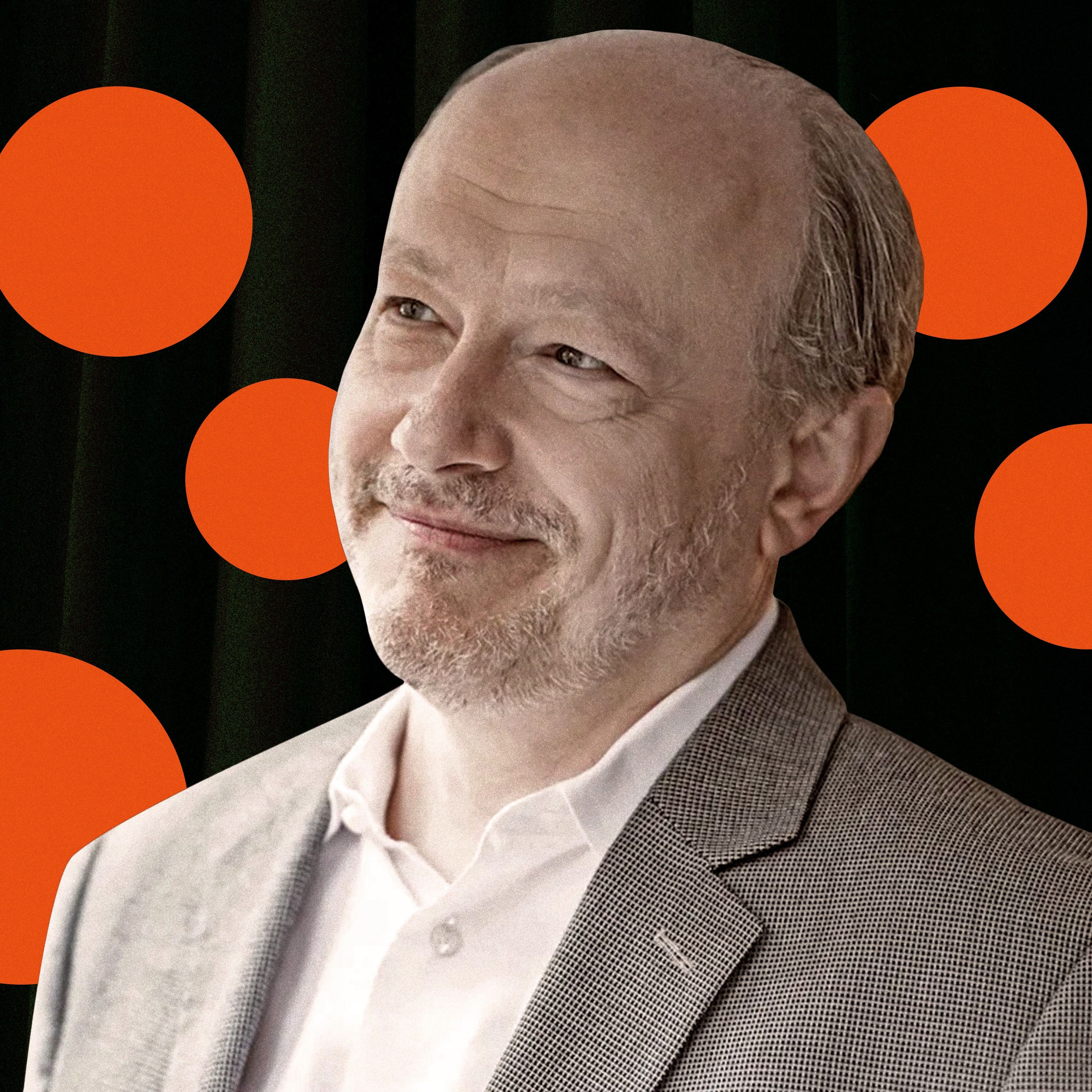
Classical Music Happy Hour
Marc-André Hamelin - Rocks Rachmaninoff
00:31:14
Composer and pianist Marc-André Hamelin joins Manny to talk about growing up with a musical father, the mechanics of piano playing, and the influences behind his prolific performing and recording career. He answers listener questions about piano transcriptions and why music is written in so many different keys. In the music segment, Hamelin performs one of his favorite works by Rachmaninoff live in the studio.
Loading summary
Transcript147 lines
- [00:00]
Sponsor/Announcer
Classical Music Happy Hour is supported by Viking, committed to exploring the world in comfort, offering destination focused small ship experiences on all seven continents with a shore excursion included in every port and programs designed for cultural enrichment. And every Viking voyage is all inclusive with no children and no casinos. Learn more@viking.com do you have a musical hero?
- [00:29]
Marc-André Hamelin
The printed score
- [00:33]
Maniac (Host)
from WQXR and Carnegie Hall. This is Classical Music Happy Hour hosted by me, pianist Maniacs. Each episode will speak with a special guest about their lives, listen to some of their favorite musical gems, play music inspired games, and answer questions from you, our listeners. The New York Times has called today's guest a performer of near superhuman technical prowess. He's one of the world's premier pianists, performing regularly with top orchestras around the world, as well as an avid and accomplished composer. And if that wasn't enough, his discography includes over 70 albums. I am one of his many, many, many adoring fans and it's a privilege for me to also call him a friend. Marc Andre Hamelin, welcome to the show.
- [01:29]
Marc-André Hamelin
It is so good to be here and thank you for inviting me here.
- [01:33]
Maniac (Host)
When we met, we met backstage after one of your recitals in Philadelphia. In Philadelphia. And what I remember about that recital is that you played a fabulous encore of Foray and you proceeded playing it by saying, I just don't know why people don't play this piece more because it's so lovely. And then you proceeded to play one of the most complicated things I've ever seen in my life. And I came backstage and I said, I can tell you exactly why not that many people play it.
- [02:07]
Marc-André Hamelin
So but it wasn't high virtuosity. It was just, it was sort of florid and complex.
- [02:12]
Maniac (Host)
Incredibly complex.
- [02:13]
Marc-André Hamelin
Yeah.
- [02:14]
Maniac (Host)
And you are of course, one of the absolutely miraculous minds in piano playing. When I first encountered your playing, it was hearing an incredible collection of high virtuoso pieces, Liszt opera transcriptions, I think, some of the Chopin ETs, Godofsky, I believe. But the kind of stuff that basically I always dreamt about playing and never actually would dare to attempt. So what got you interested in that particular area?
- [02:46]
Marc-André Hamelin
I owe it to my dad, actually, because my dad was a little bit like me, although I really took it to extremes. He was really looking sort of left and right. I mean, he had an interest in not so standard repertoire. I mean it was kind of limited, but it was there. And he was really inspired. Reading in the 1960s sometime Harold Schoenberg's book, the Great Pianist. It talked extensively about people like alcohol and especially Godowski. And he was very intrigued by Godowski. Unfortunately, most of the music was out of print by then. So he got what he could and he got to amass over time a very enviable collection.
- [03:25]
Maniac (Host)
But you had music in the house and this is what you practiced?
- [03:29]
Marc-André Hamelin
Well, no, I didn't practice at the time. But I remember though that he would sit down at the piano and sight read some of it.
- [03:35]
Maniac (Host)
He must have been a formidable pianist.
- [03:38]
Marc-André Hamelin
Well, he was at a good level, actually. I remember Sometime in the 60s, I think it was 1968, the publishers who had issued the Godowski Chopin studies reprinted them. They hadn't been available for, I think, quite a few decades.
- [03:54]
Maniac (Host)
And just for our listeners, the Godofsky versions of the Chopin studies are. You have the original Chopin etudes and he made those look like child's play. Because a lot of the stuff that would be in the right hand then went to the left hand. He added strands of extra music to everything. It became sort of fantasy. On the Chopin Etudes in a way.
- [04:33]
Marc-André Hamelin
In a way, I really regard them
- [04:35]
Maniac (Host)
as variations on the originals and unbelievably difficult.
- [04:39]
Marc-André Hamelin
Many of them are. Yeah, some of them are more reasonable, But others, especially some of the left hand ones, I mean, you really scratch your head and if you have time and curse at them, I mean, you
- [05:07]
Maniac (Host)
have to need both hands.
- [05:08]
Marc-André Hamelin
Yeah, yeah, you scratch your head with one hand. And so they came out again in five volumes. And my father heard about this and of course he was extremely excited and ordered a set the day that the volumes arrived. I remember sitting with him and looking at those. I was already familiar in a visual sense, but also hearing them with the scores. And we would just stare, we just kept turning pages and we were both absolutely bug eyed at these things. And I have a correspondence from my dad as to when these arrived in the house. I was seven years old.
- [05:49]
Maniac (Host)
Oh my God. Really? So that's where this kind of pattern started for you to learn this, essentially.
- [05:56]
Marc-André Hamelin
But I was always very naturally curious. I remember also around the same time, my dad subscribed to the Piano Quarterly, which then became Piano and Keyboard. It's no longer published, but it was old and very venerable magazine. And they had at the front of the issue always not only reviews of new sheet music, but they also reproduced in miniature the first pages. And it was everything from beginners music to very advanced contemporary stuff. And the advanced contemporary stuff really caught my eye because I'd never seen anything like it. And it was wonderful, strange and weird. So I just went for It. Not in performance, of course, because I was maybe, I don't know, 10 at that point. But a little later, when I had some pocket money, I started buying records of some of these things. Stockhausen, Cage.
- [06:51]
Maniac (Host)
I see.
- [06:51]
Marc-André Hamelin
And it was all wonderful. To me,
- [07:09]
Maniac (Host)
You are the most impeccable and brilliant and overwhelmingly commanding pianist that I can imagine. Do you feel that there's an innate talent for the physicality of piano playing?
- [07:25]
Marc-André Hamelin
Well, I think the thing is, the physicality is nothing without the mind.
- [07:31]
Maniac (Host)
It's really the capacity of your brain to do the things you're doing. I know. The fingers are not the issue.
- [07:38]
Marc-André Hamelin
It was discovered early on that I had perfect pitch. And without wanting to boast, because I hate to do that, but I had good predispositions as having a mind for music. I think that's really where it all started.
- [07:52]
Maniac (Host)
It's just that I'm so dazzled by the amount of complex things that go on in the music you play and how you're in total command of all that, you know.
- [08:03]
Marc-André Hamelin
My desire to share these things with the public entails clarifying everything. Any polyphonic structure, any complexities, in order to render them digestible and palatable and as plain as sunshine.
- [08:18]
Maniac (Host)
Now, you listen to a lot of music. You've looked at a lot of music. What do you look for in a piece of music that makes you want to focus on that, learn it, work on it over a period of time?
- [08:31]
Marc-André Hamelin
Well, it has to strike a chord, of course. But more importantly, it has to have what I think will strike a chord with the audience.
- [08:39]
Maniac (Host)
So you're aware of people listening?
- [08:41]
Marc-André Hamelin
I really try to be, yeah. To me, I always say a recital, it's an offering, and it's an occasion to share. And you can't really share authentically what you don't believe in or what you're sort of unsure about.
- [08:56]
Maniac (Host)
But you love a lot of stuff.
- [08:57]
Marc-André Hamelin
Yeah. Well, I'm kind of a compulsive collector, and I have about maybe 100 crates worth of sheet music at home. You know, I don't know where to put it anymore.
- [09:14]
Maniac (Host)
I'm hoping you can help me answer some questions about classical music from our WQXR listeners. We've invited them to submit their questions, and we're going to do our best to answer them. And if I don't know the answer, I'll just make something up. This is Abraham from New York.
- [09:33]
Listener Question Submitter
How does it work when you have a big orchestral piece and then someone can just play it on the piano? How did they figure out what to play.
- [09:40]
Marc-André Hamelin
Well, transcriptions for the piano of orchestral pieces are legion. Some of them are very successful, some of them not. So I think the mistake that you can make is just to try to transfer as many of the notes as possible, you know, on the keyboard and expect two hands to play it. I think it's much better to just do it by ear. Purely by ear?
- [10:04]
Maniac (Host)
Yes. I think if we tried to play something from a symphony, we'd probably do it more from what we know, from what we heard, than what in the music.
- [10:14]
Marc-André Hamelin
Yeah, exactly right.
- [10:15]
Maniac (Host)
I think that's sort of how you decide, you know, you hear ba ba ba ba. And you try to approximate that on the piano in whatever best way you can.
- [10:24]
Marc-André Hamelin
It's very interesting always, because some well known orchestral pieces have been transcribed by different people. And it's always very interesting to compare.
- [10:33]
Maniac (Host)
And sometimes by the composer himself. Lavallse of Ravel is a good example. Pictures at an exhibition by Mussorgsky went in the other direction.
- [10:42]
Marc-André Hamelin
That's right.
- [10:43]
Maniac (Host)
From piano to orchestra. And there are several orchestral versions of that.
- [11:05]
Marc-André Hamelin
That's right.
- [11:05]
Maniac (Host)
So it's a time honored tradition and I think it's coming back a little bit.
- [11:10]
Marc-André Hamelin
I think young people are much, much more attracted to them. But yes, there was a time when I was studying that things were absolutely taboo. It just wasn't considered a serious pursuit.
- [11:21]
Maniac (Host)
Exactly. But I think now it's much more serious.
- [11:23]
Marc-André Hamelin
Oh, God, yes, yes, yes. I mean. I mean, so many of those young people play Lavals, as you mentioned.
- [11:28]
Maniac (Host)
Yes, thank you for the great question. Do you practice away from the keyboard?
- [11:43]
Marc-André Hamelin
Oh, that's where I get some of my best ideas.
- [11:45]
Maniac (Host)
It's very hard, isn't it?
- [11:47]
Marc-André Hamelin
What do you mean?
- [11:48]
Maniac (Host)
Well, if you're practicing at the piano, the mechanism takes over. If you're, let's say, sitting on an airplane and you have to practice through a piece in your mind, you have to concentrate all the time.
- [12:01]
Marc-André Hamelin
Yes, it's very hard. Yes, but that's when my best ideas come from. Because then everything becomes clear. The tempi sort of gets stabilized. I noticed all kinds of details that had never really been apparent or not so apparent to me when I was at the piano. Because when you're at the piano, half of the task is just producing the sound physically. But when you're just thinking, of course you're free of that encumbrance. So all kinds of wonderful things happen. And then I go to the piano and try to apply these things. They don't always necessarily work. But there will have been an Evolution without my even touching one single key.
- [12:41]
Maniac (Host)
You are a prolific composer, very accomplished composer. Does that influence the way you approach playing music of other people entirely?
- [12:50]
Marc-André Hamelin
There's many reasons why I think performers should at least try to write a little bit, to feel a little closer to the composer of the works they perform. Because it's easy to take these pieces of standard repertoire for granted and not realize what the composer went through to actually bring them to reality. And also, composing helps me make better interpretive decisions. It helps me distinguish foreground from background. It clarifies the structure for me and where it's going. It helps me interpret notation better. It really helps me read a score much, much better. And it also helps you spot typos and mistakes. I see on a sort of microscopic
- [13:36]
Maniac (Host)
level, you know, I'm maniacs. And this Classical Music Happy Hour. We'll return in just a moment.
- [13:51]
Sponsor/Announcer
Classical Music Happy Hour is supported by Viking, committed to exploring the world in comfort. For over 25 years, Viking has been connecting the thinking person with the world. First on the great rivers, then on all five oceans, now on all seven continents. Whether you choose to journey through the heart of Europe on an elegant Viking longship, explore the ancient cities of the Mediterranean on a small ocean ship, or venture to the white shores of Antarctica on a purpose built expedition ship, you will always experience thoughtful service, destination focused dining and cultural enrichment on board and onshore. And every Viking voyage is all inclusive, with no children and no casinos. Learn more@viking.com.
- [14:48]
Maniac (Host)
This is Classical Music Happy Hour. I'm maniacs. Let's hear some more of our conversation with Marc Andre. Amelin, what's your go to beverage after a long day?
- [15:00]
Marc-André Hamelin
I think plain water is really one of the wonders of the world. And what's better than that?
- [15:04]
Maniac (Host)
Do you have a musical hero?
- [15:06]
Marc-André Hamelin
The printed score, Anything that's communicated to us by composers, that's what I go with and that's what I place my faith in.
- [15:15]
Maniac (Host)
Is there an instrument you wish you'd played? Probably the piano, Yes.
- [15:21]
Marc-André Hamelin
I wish I played the piano.
- [15:23]
Maniac (Host)
Just guessing.
- [15:24]
Marc-André Hamelin
Well, you know, the piano offers me everything. I mean, it's my mouthpiece, it's my way of living. I mean, it's full of juice, it can do anything, you know, I wouldn't trade it for anything.
- [15:38]
Maniac (Host)
What is your favorite musical memory?
- [15:41]
Marc-André Hamelin
I have very great memories from my childhood. My dad was a big Liszt fan and whenever Christmas rolled around and we always bought a real tree, not a fake one, so the smell was in the air. And he loved to play the Liszt Christmas tree. Suite for himself. So I cannot hear this music without smelling the pine needles.
- [16:05]
Maniac (Host)
How lovely. We have another question from one of our listeners. Shall we go to Baton Rouge, Louisiana?
- [16:14]
Listener Question Submitter
Hello, my name is Dick Spirer. I'm retired and live in Baton Rouge, Louisiana. I always wondered why music was written in different keys. I understand major and minor keys. They convey a mood. I was always taught that the standard octave has half tones between the third and fourth and seventh and eighth notes. If that's so, why would something be written in G or A instead of just leaving it in C Without the need to rearrange my head to accommodate the sharps or flats of the various keys? I've made it sound more serious than it is. But it's a question that's been on my mind. Thanks for the opportunity to learn more about music.
- [17:02]
Marc-André Hamelin
Each key, I firmly believe, has a very distinct personality. And many composers have understood that. If you've ever heard Gerald Moore's discussion. He was one of the most famous collaborative pianists of the century and accompanied legions of singers. If you hear him discuss about the issue of transposition.
- [17:26]
Maniac (Host)
Yes.
- [17:26]
Marc-André Hamelin
Because you can't always play one song in the same key depending on the
- [17:30]
Maniac (Host)
scene, because of the voice. Because the singer can only go so low or so high. So you often have to change the actual key of the song.
- [17:39]
Marc-André Hamelin
Yeah, but sometimes, depending on the mood of the song, if you go too low or too high, it's going to alter the message of the song drastically. So you have to be careful about that. There is a definite character for each of the keys.
- [17:54]
Maniac (Host)
But I think that maybe the actual key of pieces meant more in the 19th century than it does now.
- [18:02]
Marc-André Hamelin
You do?
- [18:02]
Maniac (Host)
I think so. I think for a composer, there are specific requirements. Because a lot of music that used horns, natural horns, would be in E flat.
- [18:12]
Marc-André Hamelin
Yes.
- [18:13]
Maniac (Host)
So that's a kind of. You have a hunting motive very often because they're horns. So that dictates that key. But I think something like C minor. Meant something very specific to Beethoven and Mozart.
- [18:45]
Marc-André Hamelin
Oh, yes.
- [18:46]
Maniac (Host)
And maybe less so to Chopin. And even less so to, you know, just in terms of the translation of the key to the emotional intent.
- [18:58]
Marc-André Hamelin
Well, there's no question that they all made it their own. But still, sometimes pieces feel like they've been written in the wrong key.
- [19:06]
Maniac (Host)
I'm happy to be wrong and to be corrected.
- [19:09]
Marc-André Hamelin
I mean, there are individual perceptions. Both Messian and Scriabin obviously thought very highly of the key of F sharp major. Because they used it both extensively.
- [19:18]
Maniac (Host)
Was it partly because of the way the hand Lies on the piano. Do you think how much?
- [19:22]
Marc-André Hamelin
No, I think it was simply a question of character. They were both sin seats, and I think they both saw something in F major. Although I. I think they saw different colors. I don't think they saw the same color, but I could be wrong.
- [19:35]
Maniac (Host)
But Beethoven was such a fabulous pianist, obviously.
- [19:39]
Marc-André Hamelin
Yes.
- [19:39]
Maniac (Host)
I wonder if some of the keys that he chose were dictated by. Dictated by how it felt under the hand.
- [19:47]
Marc-André Hamelin
Digital considerations. Yeah, it could be. It could be.
- [19:50]
Maniac (Host)
Yeah.
- [19:50]
Marc-André Hamelin
Yeah.
- [19:51]
Maniac (Host)
Digital considerations. Like we do now with the iPhone or something.
- [19:55]
Marc-André Hamelin
Yes, exactly.
- [19:57]
Maniac (Host)
Thank you for the question. We asked about a piece that you wanted to talk about, and you thought about talking about the Rachmaninoff etud in E flat minor, opus 39, number 5.
- [20:30]
Marc-André Hamelin
That's right. One of Rachmaninoff's greatest creations. Among his miniatures.
- [20:36]
Maniac (Host)
Would you be willing to play a few notes?
- [20:39]
Marc-André Hamelin
Sure, sure.
- [20:40]
Maniac (Host)
That would be fabulous.
- [20:41]
Marc-André Hamelin
At least it's in my fingers.
- [20:42]
Maniac (Host)
That would be wonderful.
- [22:27]
Marc-André Hamelin
Sat.
- [26:09]
Maniac (Host)
Wow. What a privilege to hear that performance. That's fabulous. Just fabulous.
- [26:18]
Marc-André Hamelin
Thank you very much.
- [26:20]
Maniac (Host)
So, I mean, obviously, this is so beautiful and so touching. Is there any way you can put into words what particularly you love about this piece?
- [26:32]
Marc-André Hamelin
Well, I think that the middle section, not only the way it starts, but the harmonic progression and the buildup of tension, the ratcheting up of tension little by little.
- [26:44]
Maniac (Host)
Yeah.
- [26:44]
Marc-André Hamelin
You know, the harmonic progression makes not that much sense if you view it traditionally, but it's a master lesson in building up tension. And I've always really admired that in this piece.
- [27:22]
Maniac (Host)
The contrast between the depth of despair and this ethereal note. The B flat the first time.
- [27:35]
Marc-André Hamelin
Yes.
- [27:39]
Maniac (Host)
And the E flat the second time. And how in the middle, it changes from this. The left hand's going with the incredibly depressed sort of moment. And then as it turns to the major, It's like a consolation or something.
- [28:06]
Marc-André Hamelin
You sound like you've played. Never.
- [28:08]
Maniac (Host)
Never, Never. I'm ashamed to say I've played no Rachmaninoff whatsoever.
- [28:13]
Marc-André Hamelin
You seem to know it intimately.
- [28:15]
Maniac (Host)
Well, it's a piece that deserves to be played the way you play it. And there are, in fact, many, many great performances over the years. Of course, I was very lucky. I heard Richter play this Live in the 60s in New York at Carnegie Hall. But I just wondered, because there's so much beautiful Rachmaninoff music. But you feel this piece is special in.
- [28:40]
Marc-André Hamelin
Well, I think it stands out among these etudes. I can tell you that in that middle section, there is one passage which was never clear to me until I
- [28:49]
Maniac (Host)
actually can you show us?
- [28:50]
Marc-André Hamelin
Yes, absolutely. Yeah, yeah, yeah. Let me get to the piano.
- [28:53]
Maniac (Host)
Yeah.
- [28:58]
Marc-André Hamelin
It's the. Of course you have. But there's a whole bunch of whole tone scales.
- [29:17]
Maniac (Host)
Oh, wow.
- [29:28]
Marc-André Hamelin
And it goes on.
- [29:29]
Maniac (Host)
I see.
- [29:44]
Marc-André Hamelin
Wow.
- [29:44]
Maniac (Host)
He's chat. He's channeling Debussy.
- [29:47]
Marc-André Hamelin
Yes, It's. It's. I spent a lot of time trying to clarify.
- [29:52]
Maniac (Host)
Amazing.
- [29:53]
Marc-André Hamelin
So that you wouldn't lose.
- [29:58]
Maniac (Host)
So you need the top melody and what's happening underneath.
- [30:02]
Marc-André Hamelin
So in a sneaky way, what you can do. It's. So if you don't play them absolutely together, you can hear them both.
- [30:12]
Maniac (Host)
I see. I see.
- [30:15]
Marc-André Hamelin
But if you play them, they're not as clear. Yeah. And there's a way to do that without making it completely mannered.
- [30:25]
Maniac (Host)
Yeah, yeah. Fabulous. Fabulous. And you do something very, to me, kind of unusual in that when the theme returns, you do not overwhelm with sound. Cause usually it's done much, much louder. Yeah. And I find this so touching.
- [30:45]
Marc-André Hamelin
Well, at that point, there is no dynamic marking except for molto mercato for the theme. The theme in the left hand. Yes.
- [30:53]
Maniac (Host)
I see.
- [30:53]
Marc-André Hamelin
I. I have a feeling that Rachmaninoff might not have written Fortissimo there. I mean, a few bars later, at the big climax, he writes triple forte.
- [31:04]
Maniac (Host)
No, but this makes incredibly wonderful sense, what you do with the arch of the piece. Great. Thank you so much.
- [31:14]
Marc-André Hamelin
Sure. I didn't expect to play all of it, but I got carried away.
- [31:16]
Maniac (Host)
That's okay. I don't mind. It's fine. I think we'll all tolerate it. Mark, Andre Hamelin, thank you so much for being with us today and for the wonderful performance of the Rachmaninoff.
- [31:34]
Marc-André Hamelin
Thank you. Well, let's do this every day, shall we?
- [31:37]
Maniac (Host)
With pleasure.
- [31:38]
Marc-André Hamelin
I wouldn't mind.
- [31:39]
Maniac (Host)
With pleasure. Anytime. I'm maniacs. And this is Classical Music Happy Hour. Classical Music Happy Hour is supposed to supported in part by the Robert and Mercedes Eichholtz foundation and by Linda Nelson. Our production team includes Lauren Purcell Joyner Eileen Delahunty, Laura Boyman, Elizabeth Nonemaker, David Norville, Christine Herskovitz and Ed Yim. Our engineering team includes George Wellington, Irene Trudell and Chase Culpont. On Classical Music Happy Hour is produced by WQXR in partnership with Carnegie Hall.