← Classical Music Happy Hour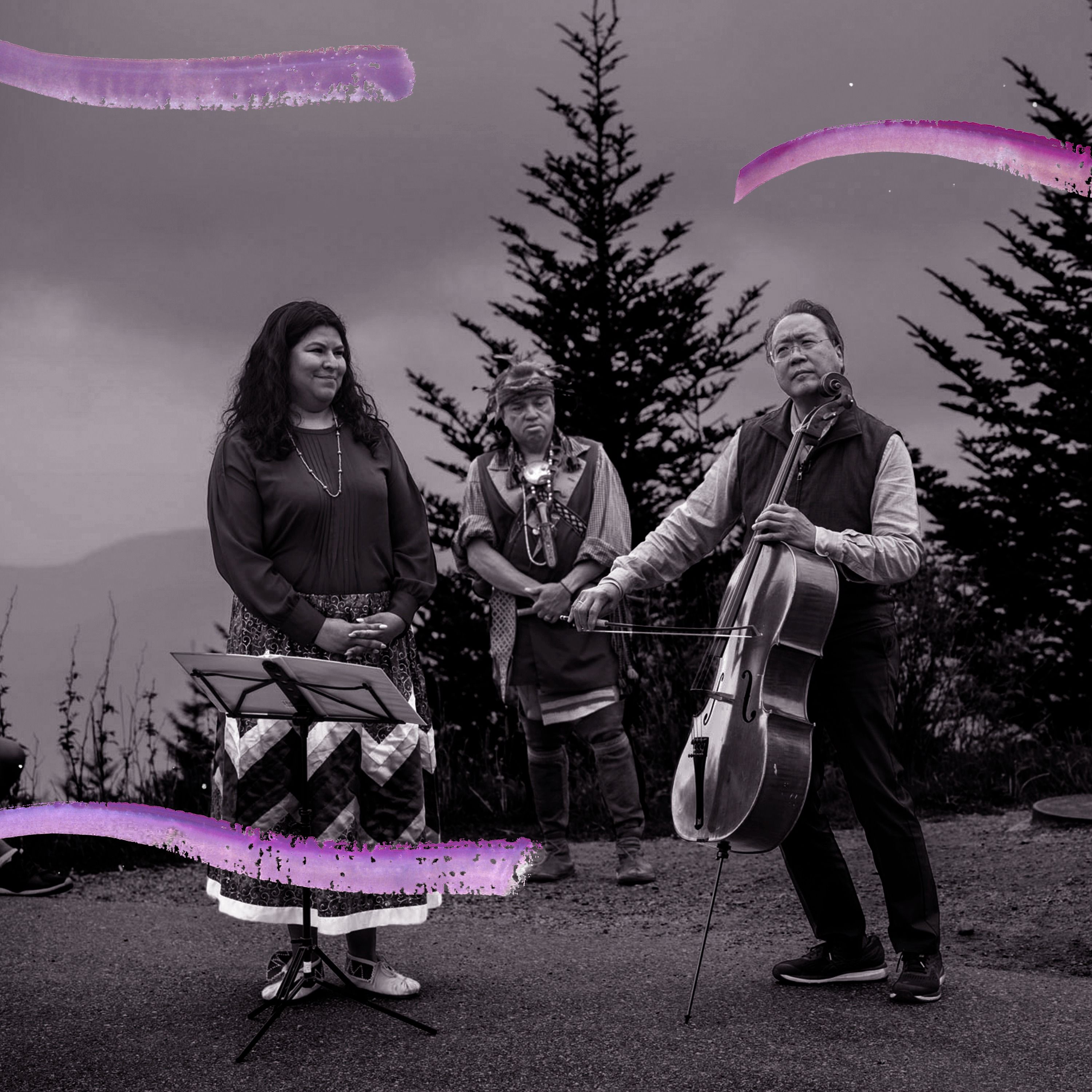
Classical Music Happy Hour
The Smokies: Mountains and Forgotten Family with Yo-Yo Ma
00:42:52
In the Great Smoky Mountains, traditions layer and intersect. Yo-Yo Ma believes that story and song can help us grapple with America’s complicated history. This episode highlights two stories of people who are reclaiming their connections to their homelands.
Loading summary
Transcript187 lines
- [00:02]
A
Pop a wheelie, Anna. I'm doing it. Can you hear? I'm popping a wheelie. There's a path in the Great Smoky Mountains national park that's closed to cars every Wednesday of the warmer months. And today, the last Wednesday in May, my producer Alan and I are riding some bikes into the park. This is idyllic. Like when I imagine a country escape, it is this moment, even when things get a little bit more wild than I'm used to.
- [00:31]
B
There's a bear right down near this white truck, too.
- [00:34]
C
Really?
- [00:34]
A
Yeah.
- [00:35]
B
American black bear. You'll ride right by him quickly.
- [00:40]
A
All right, you ready to roll? We make it down to a gravel path that cuts between two open pastures where horses are grazing. And waiting for us is some real danger.
- [00:51]
C
So, Lisa.
- [00:52]
D
Yes, sir.
- [00:53]
C
We gonna do it?
- [00:54]
D
Let's do it.
- [00:55]
A
Yo Yo Ma is leaning against a park ranger's bike with his CE backdropped by buttercups, blue skies, and green mountains.
- [01:03]
C
So I came here last year, and it was so beautiful, and we thought we'd come back again, and I thought it would be nice to listen to the birds, listen to some music, and see what happens.
- [01:27]
A
Only the park rangers knew that yo yo was going to be here on this day at this time, because yo yo wanted to play for the folks who always come here who were going to be here anyway, and that's what he did.
- [01:41]
B
We were eating lunch and stuff like that, and we.
- [01:43]
A
Is that Yo Yo Mom?
- [01:44]
B
Is that Yo Yo Mom? We were going to go on a hike.
- [01:47]
A
The girls were. Then we said, that's Yo Yo Ma. I think there's so many layers of history, of people and land and place, and this adds another layer and another chapter to that story, makes it more rich. The Great Smoky Mountains are great. They're breathtaking. Rolling across hundreds of thousands of acres from North Carolina into Tennessee, this area is one of the most biologically diverse places in the United States. And the human histories here are just as complex.
- [02:20]
C
Each history is part of the truth, and it's not like your truth is better than mine. It's like we have to live with each other's truths, and if we put them side by side together, we will find truth. And we can do that in music because that's what we do in music. We could put everybody on the same stage to say, tell your truth.
- [02:46]
A
I'm Ana Gonzalez, and this is our common nature, a musical journey with Yo Yo Ma through this complicated country to help us all find that connection to nature that so many of us are missing. We climb mountains Play music, drive dirt roads, recite poetry, traverse rivers and oceans in our own brains. All to figure out how to better live on our planet together. And in this episode, we'll hear two stories from two different parts of the Smoky Mountains. Stories of individuals reconnecting themselves to the land and their families after generations of separation.
- [03:27]
D
I come from a really big family.
- [03:29]
A
How big are we talking?
- [03:30]
D
Golly. My great grandma probably had at least 100 great grandchildren.
- [03:35]
A
Whoa.
- [03:35]
D
Like, tons.
- [03:36]
A
This is Lavita Hill. She grew up in the small town of Cherokee, North Carolina, and like the name suggests, Cherokee is home to the Cherokee people. The Eastern Band of Cherokee Indians owns this town within the Great Smoky Mountains. Lavita is Cherokee and works in tribal government, but she doesn't always feel all that Cherokee.
- [03:57]
D
I almost feel like because I'm Native American, I should just be able to speak the language. It should just be so easy. But I also believe when I go fishing, I should, like, the fish should just jump out to me because they. They feel my connection with the land or something. But that's never the case. I'm a terrible fisherman.
- [04:15]
A
I really want that to be true. Is like, Lavita goes out. It's like everyone wants Lavita on their boat because the fish just jump in.
- [04:24]
D
Yeah. But no.
- [04:26]
A
So that's not the case. Lavita was raised by her grandmother as part of this huge Cherokee family.
- [04:32]
D
So my grandmother's siblings visited a lot. And whenever they visited our home, that's the only time I heard my grandma speak the language.
- [04:44]
A
She's talking about Tsalagi, the Cherokee language. Lavita never learned it.
- [04:48]
D
My sisters and I, we would say, grandma, why don't you teach us how to speak? And that's whenever we learned that it was to protect us rather than to just keep something from us.
- [05:02]
A
Because Lavita's grandmother went to an Indian boarding school where she learned to keep her language hidden.
- [05:09]
D
She would have loved for us to learn, but I also feel strongly that what she did for us, for me and my sisters, after our mom died, was to protect us and keep us safe at all cost. And for us, the cost was the language.
- [05:28]
A
You maybe know about Indian boarding schools. They've been in the news a lot recently. Native kids from all over the United States and Canada were taken from their homes and placed into schools that would require them to wear non native clothes and speak, read and write in English. Only Mary Crow, a Cherokee elder, remembers them.
- [05:49]
E
But we had a boarding school here in Cherokee.
- [05:51]
A
Mary and Lavita's family go way back.
- [05:54]
E
I've known Lavita since She was born. Call her Muffin. All her and her sisters remind me of their mother. Beautiful, strong, lovely.
- [06:08]
A
Mary didn't go to a boarding school, but her dad did.
- [06:12]
E
My father was sent to the boarding school in Chilocco in Oklahoma. Got taken away from home when he was 10 years old, he ran away. He got sent back.
- [06:25]
A
I'm sorry. I'm sorry. It's bringing up so much.
- [06:27]
F
No, don't apologize.
- [06:29]
E
This is healing.
- [06:29]
A
Okay, Good.
- [06:30]
E
This is healing okay, because it's allowing you to see.
- [06:35]
A
Yeah.
- [06:35]
E
That's why we call generational trauma.
- [06:39]
A
The kids who went to boarding schools were punished if they showed any expression of their culture. A 2022 report found hundreds of graves of kids at these schools.
- [06:53]
E
Our people never agreed to anything. We were forced to assimilate in a culture rape. If not, we would have got annihilated.
- [07:06]
A
Today There are about 14,000 members of the Eastern Band, the Cherokee Indians, and only 200 Salagi language speakers, which is sad.
- [07:17]
D
I'm missing a huge part of me and my culture because of boarding school and because of what it did to our people.
- [07:25]
A
This hurt is part of the landscape of the Great Smoky Mountains. And it's a familiar hurt to so many indigenous people around the country and the world. It's that attempt at erasure, the grief of cultural loss. So any movement towards rebuilding Native culture is worth celebrating, even if it's just a post on Facebook.
- [07:49]
E
I shared something on my social media where it was done in the Yellowstone National Park. They changed Doane Mountain to First people's Mountain.
- [08:00]
A
In 2022, Indigenous groups from across the country were able to change the name of a mountain in Yellowstone national park to recognize the indigenous people who called the home before it was a park. And the news lit up Native social media.
- [08:13]
D
And then it was really like, well, why don't we do something? Why don't I do something?
- [08:19]
E
And I said, clingman's Dome. And Lavita jumped on it, and she went, yes, yes, yes.
- [08:28]
A
Clingman's Dome is the tallest peak in the Smoky Mountains. You can see it from Cherokee. It's been made into a tourist spot. You can drive up there, walk around, take some really nice photos. But this mountaintop is more than just a lookout spot. Why did you think to say Clingman's Dome? Because my dad, Mary's dad, was one of the first workers who created its trails.
- [08:50]
E
My dad worked with Park Service as a trailblazer. They'd have to hike these trails, but me and my brothers, we would go with them all the time. And he would always tell me about these trails that our people took. You know, those were our roadways.
- [09:06]
A
So we have this English name, Klingman's Dome. And by the way, Clingman was a Confederate brigadier general who really liked mountains. But you can see Clingman's Dome from Cherokee lands. Mary and Lavita might not speak Tsalagi fluently, but they know enough to know that the language reflects the land, that every word of it emerged out of the Cherokee people's experiences.
- [09:29]
D
This mountain has to have had a Cherokee name. Let's go find it out.
- [09:35]
A
They asked some language speakers and cross referenced that with books, and they found a word.
- [09:41]
D
Kuwahe.
- [09:42]
E
Kuwahe.
- [09:46]
A
And what does kuwahe mean?
- [09:48]
D
Kauahe is the mulberry place singular.
- [09:52]
E
Ku wa k u W a is a mulberry. Kuwohi. Kuwohi is mulberry place.
- [10:00]
B
Ha.
- [10:04]
A
Lavita and Mary do some more research, and they find maps that go back before Clingman was even born.
- [10:10]
D
That was Kauai. It was Kauai for 10,000 years, and it's documented, and you can see it.
- [10:18]
A
The ball began to roll. Mary and Lavita decided to take their work outside of Facebook messenger and try to officially change the name of Clingman's Dome to Kauahi. They started local. They got an interview with the local newspaper who wanted to meet them at the top of Kauhi. So Mary and Lavita, they got in the car, they drive up to the top of the mountain. And then Lavita had this moment where she felt that old insecurity. Maybe I'm not the right person for this. I don't speak Tsalagi. I don't know how to fish. I'm not Cherokee enough.
- [10:49]
D
And so I'm up there at Kauae about to meet this woman to talk about this for the first time. And I'm texting my sisters, like, I'm just so scared, scared. But my little sister, she's just like, no, you cannot be scared because your ancestors are there. They're with you, and we're with you, and this is what you're supposed to do. It gave everything a whole new purpose. Because before, I just didn't know bed. I didn't know that this is something that I'm supposed to tap into or that I'm supposed to let guide me.
- [11:31]
A
So it's like you're reclaiming this name for a mountain, but you're also, like, reclaiming parts of yourself that you didn't know that you even had, that I.
- [11:40]
D
Didn'T even know that I had. Exactly.
- [11:53]
C
So when I heard that that name change was going to take place, I thought, wow, I want to not only go there, but to sort of see what people think. And that's where the storytelling comes in.
- [12:04]
A
And so you went to the top of Kauahi and you played there to.
- [12:09]
C
Just passersby la vida was going to tell stories and how the Cherokee people have always thought of that mountain as a spirit, spiritual location where people go to open up a porthole into a wider universe, and then passersby can experience a little bit of that.
- [12:27]
A
Yo yo is at the top of Kauohi at an overlook. Lovita is there, too, in traditional Cherokee dress with the Great Smoky Mountains all behind her.
- [12:37]
D
For well over 99% of the time, human beings have occupied this place. This mountain has been called Kauahe, the Mulberry Place.
- [12:55]
A
And there was a great crowd that gathered. There was some rumor that yo yo was gonna play, but they didn't know that they were gonna learn this history. But they stayed and they listened.
- [13:08]
C
Because what we're all hoping and this is happening is that this magical place will have an old name.
- [13:19]
D
And today we're seeking to have her rightful name restored.
- [13:29]
A
Kuohi is just one word. It's not a resurrection of an entire language. It doesn't undo any past wrongs. But knowing one word unlocks a door to understanding the Smoky Mountains in a way that Clingman's Dome could never do. When Cherokee people look up from the mother town of Katua, they'll see Kauahi again, and they'll know her name. They'll know that along her trails, they can find mulberries and a connection to thousands of years of stories. And In September of 2024, the U.S. board on Geographic Names approved the name change. Clingman's Dome is now Kuohi once again.
- [14:16]
D
None of this is for me. This work is for our brothers and sisters and for our ancestors. They were so intelligent and that they refused to leave.
- [14:33]
C
The mountain is always going to be there. Right. But, you know, what is that mountain? Geologically, what is that mountain? To a squirrel living on the mountain, right?
- [14:45]
A
Yep.
- [14:45]
C
Or to birds that fly over. So a mountain is all of those things. And I think the more you think about it, then the mountain becomes more and more part of you. And when something becomes part of you you want to take care of.
- [15:39]
A
There's another spot we have to go to to begin to understand the Smokies. It's a spot along a river in the woods where the water grinds like time itself to where there's a clearing right off of a parking lot where worn down stones lay over unmarked graves.
- [15:58]
C
Tiny like seven graves and a little, you know, maybe six by eight and little strips of mounds. And there were no names, no tombstone, nothing. But we knew that it was a grave and we knew probably it was a slave grave site.
- [16:19]
A
And for the people connected to this place, honoring the life here hasn't been easy.
- [16:25]
B
You know, my ancestors are buried there, so it's an important place to me. But it's also very hard to be there.
- [16:33]
A
That's coming up next after the break. Our common nature is supported by the National Forest Foundation, a nonprofit transforming America's love of nature into action for our forests. Did you know that the national Forests provide clean drinking water to one in three Americans? And that national forests and grasslands cover nearly 10% of the U.S. hosting 150,000 miles of trails and providing habitat for over 3,000 species of plants and animals. The National Forest foundation supports the places where we come alive, keeping the trails, rivers and forests we love healthy. Last year, they planted 5.3 million trees and advanced over 300 projects to protect nature and communities nationwide. Their work creates lasting impact by restoring forests and watersheds, strengthening wildfire resilience and expanding recreation access for generations to come. And when forests struggle, so do we. The water in our taps, the air we breathe, and the trails that connect us all. Learn how you can help@nationalforest.org yoyoma. WNYC Studios is supported by the New York Phil Mozart's music is showcased in two concerts. Violinist Gil Shaham leads the orchestra as soloist in two concertos, the elegant second and exuberant fifth. Louis Langri then conducts the orchestra's wind section in Mozart's genial Grand Partita and Richard Strauss Lyrical Serenade, January 2nd and 3rd at David Geffen Hall. Tickets@nyphil.org.
- [18:21]
G
Hey, it's Francis Lamb, host of the Splendid Table. Every week on our show, we talk about food and cooking and the meanings of food and cooking. We talk with the most interesting people in food about their techniques, their culture and everything in between, whether it's about how fried chicken took over the world or how Instagram changes the way people are actually eating. It's a food show where everyone is welcome. Come join us. You can listen to the Splendid Table wherever you get your podcasts.
- [18:52]
A
Our common nature is back in the Smoky Mountains, where It takes about 45 minutes and more than 6,000ft of descent to drive from the top of cool. The tallest peak to a mill. Mingus Mill. It's a less popular destination than Kauahi. So when my producer, Alan and I arrive, we have the place to ourselves. So we're standing next to this old looking part of a mill. I don't even know what it would be called. It's wood, and it's kind of like a bridge, and it goes into the river, and it's attached to this, I guess, what is and was the mill. This is one of the first times in my working memory that I've been to a mill. And I was really excited about it because the name Mingus Mill, as in Charles Mingus, one of the greatest, most unique, prolific jazz bassists and composers and band leaders of all time. I am a Mingus fan, girl, truthfully, because I grew up playing jazz bass, and Charles Mingus was one of my heroes. His playing was tenacious, and his compositions were communal and raw, and Mingus was just beyond cool. He spoke his mind, and he was a proud black man in a time when it was dangerous to be that. So I knew all of this about Charles Mingus, but I never knew where he came from. And it never occurred to me that the history of the Mingus family went deeper than just Charles should have. But I didn't even know what grist was. I think grist is corn. Alan finds the historical placard. Thank God.
- [20:29]
D
Right up top.
- [20:30]
A
First line, you didn't make it without corn. Everyone ate cornmeal sometimes two and three times a day. The placard goes on to say that the Mingus family owned this mill until the 1930s, when it was taken over by the National Park Service. It's the Mingus. This was the largest grist mill in the Smokies. And no one's really here, but the mill is still going, still grinding. The history of this mill holds a lot more weight than a plaque can really tell you. It holds a family history. And, like, you might know, family isn't always comfortable.
- [21:10]
B
I heard about the mill from my father and other Minguses in the family, but it wasn't. It wasn't necessarily like, oh, this is a great place in North Carolina. It's like, yeah, it's where your great grandfather was enslaved, you know?
- [21:23]
A
And this is Eric Mingus. His dad was the late, great Charles Mingus. But to Eric, Charles was just his dad and his first music teacher.
- [21:32]
B
You know, I played cello from a very young age, and I just always loved that instrument. It's also the instrument, you know, my father taught me on that he taught me it with the eye to bass, you know, so it was sort of funny. He was like, we'd tune it to the. So we tune it.
- [21:45]
A
Oh, really?
- [21:46]
C
Yeah.
- [21:46]
B
He was trying to free me from western music in a weird way, but give me the technique to play the instruments, you know, and speak my voice, but not be connected to the page.
- [21:55]
A
Eric has applied that freedom and ear for improvisation to a bunch of different instruments. But most of his professional musical career has been as a singer.
- [22:04]
B
I was on a path towards opera, and I had met with a couple of other African American opera singers, and they were like, yeah, it's not easy. It's hard to get roles. Keep giving you Othello, but they won't give you other ones. And, you know, I don't have control over how people see me.
- [22:20]
A
See, Eric's mom was white, and his dad was black. His family is all different complexions. So Eric has spent his whole life having his race decided by the people who look at him.
- [22:31]
B
I mean, when I was born and when I was raised, I was a young black child, you know, and then everybody starts, you know, deciding what you are. And I kind of know I'm saying it, so I've just stopped saying, but when your family's rooted in slavery and the enslaved, it's, you know, you got. It's very American.
- [22:53]
A
Eric's complicated relationship to race and history and his family is very American, and it's distinctly black American.
- [23:01]
B
The thing about not being able to go back, your history is cut off because someone enslaved you, and their incentive was to disconnect you from anything. So a lot of African Americans don't know where they're from originally. There is no land that they can connect themselves indigenously to.
- [23:21]
A
So Eric knew his great grandfather was enslaved at the Mingus Mill, and he was okay leaving it at that. He didn't learn too much more. He didn't want to visit. For some, digging into this history can be really emotionally draining. But Marcus west sees things a little bit differently.
- [23:41]
F
Being black American, I think it's pretty cool to find yourself, you know, and love all of who you are.
- [23:49]
A
Marcus west works as a butcher, but in his spare time, he loves researching his family's history in western North Carolina.
- [23:56]
F
The more research you find out, the more you find yourself. That's the way I see it. Yeah.
- [24:01]
A
Marcus has lived practically his Entire Life within 20 miles of Mingus Mill. He kind of figured out his family had some tie to the mill because the black community of western North Carolina is small and tight knit. But he didn't know for sure those.
- [24:15]
F
Older folks was here. When I was younger and I was sitting at the table, I couldn't go out and play with nobody. You know, I just want to go play with Kenny. But no, you sit here, you know, So I had to listen to all the old folks and stuff. And that's kind of what got me really started with history.
- [24:29]
A
There were a lot of mysteries in Marcus's family tree. He grew up hearing about all of these great uncles. He had Uncle Frank, Uncle John, Uncle Shan, and Uncle Charles. Charles Mingus Sr.
- [24:45]
F
So I didn't know that Charles Mingus Jr. Was Uncle Charles's son. See, I didn't know about. I didn't know the whole thing until the story just kept going.
- [24:53]
A
People could be named Charles Mingus.
- [24:55]
F
I mean, you know, it was just because that's Charles Jr. And I was like, well, wait a minute. I was like, oh, that's Uncle Charles, son. So I was like, well, dad, you know, you had some jazz royalty in your family, you know, if you're, you know.
- [25:07]
A
So Marcus found out he was related to the Charles Mingus Jr. But he didn't know why that connection to Uncle Charles, Charles Senior didn't last. Why didn't he know about this sooner? And he realized it had to do with the first black Mingus, Daniel Mingus.
- [25:26]
B
Daniel, my great grandfather, was enslaved, but then freed and stayed on working with the family.
- [25:32]
A
Here's Eric again.
- [25:33]
B
And Daniel was an incredible woodworker builder. He built the Mingus household that they lived in, and we believe he built the mill. That's what my family was told.
- [25:44]
A
Daniel was enslaved by a white family with the last name Mingus. He took their last name, and after slavery ended, Daniel stayed on to work for the Minguses in the mill. He got married and had a family. But he also had an affair with the granddaughter of the white Mingus family. They had a son together, Charles. This was a scandal for 1870s North Carolina. The white Minguses tried to cover it up. They claimed Charles as one of their own. That meant saying he was not black, but they didn't treat him very well. Eric was told that this Charles, his dad's dad, had a pretty terrible childhood.
- [26:24]
B
His family basically threw him out and abandoned him.
- [26:27]
A
Charles I ran away from home as a teenager and never looked back. He settled eventually out west, and he lost contact with the rest of his family. Back in North Carolina, he had a kid who would become Charles Mingus Jr. Charles had Eric, and they lived and traveled all around the world as the Mingus name grew more popular. That mill was still grinding away in the Great Smoky Mountains.
- [26:54]
B
And people say, oh, did you ever go? I'm like, well, why would I? You know, it's not really a place of good memories.
- [27:01]
A
After the Great Smoking Mountains became a national park, the mill became a historical tourist spot. But the only story told there was that of the white Mingus family. And it popped into Eric's life again because he started seeing people tagging him and the Mingus Mill on social media.
- [27:19]
B
I started seeing a lot of, like, these bass players going to the Mingus Mill to be like, hey, Mingus Mill. Like, thumbs up. And I was like, well, you know, Mingus is a slave name. So in an odd way, the Mingus Mill is honoring the enslavers, not the enslaved.
- [27:36]
A
Erik didn't know about his cousin Marcus, and Marcus didn't know about Erik. Erik still had no desire to go to the mill. But then there was a tortoise.
- [27:46]
B
Yeah, she's here. Tasha.
- [27:47]
A
Eric and his wife adopted a tortoise named Tasha a few years ago.
- [27:51]
B
Yeah, we never thought of ever having a desert tortoise as a pet, but.
- [27:55]
A
But then they had to drive across the country to get her home because.
- [27:58]
B
Apparently you can't fly with a tortoise. And I said to my wife, why don't we just stop?
- [28:02]
A
They were in North Carolina.
- [28:07]
B
Well, you know, it's just a. It's a two story building. It's a pretty tall building for what it is. It's on stilts, and there's this water feed trough that goes to it. You know, it makes this amazing sound, and it's a building that kind of feels alive just because it has a purpose. But it was still sort of daunting, you know, Like, I don't know how to really explain it, but it's. It's kind of going well. You know, historically, we weren't wanted here, you know, or we were wanted there until we couldn't. We were brought there and, you know, so. So it was a little strange connection to that land there. You know, my ancestors are buried there, so it's an important place to me, but it's also very hard to be there.
- [28:55]
A
Eric and his wife went from the mill up a short, steep path to a clearing in the woods where there were a couple of stones. And underneath it, according to the park service, lay bodies of people who were enslaved. This is the Enloe slave cemetery.
- [29:11]
B
For a while, I would just sit there on my own and just sort of be there, you know, not really talk Just sort of try to have a feeling for the place and listen.
- [29:30]
A
The parks department started telling people about the slave cemetery. That's where Marcus West, Eric's cousin, found out about it. He would go there by himself.
- [29:40]
F
You know, I know it sounds weird, but I'll go up there and just say my piece a little bit. With me, it goes back to the fields. I mean, I've always been a kind of spiritual guy with that. I think that's something that my mother kind of brought to me years ago when I would go down to the plantations. And I remember she would watch me and then she was like, you feel it, don't you? And I didn't know. I was like, well, what do you mean? She said, you feel your heritage. And I was just like, that's it. There's been this myth about slavery wasn't present in Appalachia.
- [30:19]
A
This is Cassius cash. He's the 16th superintendent of the Great Smoky Mountains National Park.
- [30:25]
F
Because the mountains landscapes being unsuitable for large scale plantation farming, if you will, which is how it's usually considered to have enslaved people working.
- [30:35]
A
But Cassius, who's also African American, says that's not true.
- [30:39]
F
When we first started this project, we went to local communities to talk about, hey, have you ever heard stories about African Americans being in the Smokies? We did community meetings, and I thought maybe one or two people would show up at these meetings. The room was packed at each one of these meetings to talk about. And that's what I want people to remember, is that it's important for you to know. Because this country is built off the shoulders of all, all of us. And the moment that we leave one or two of us out of that story is not letting this country be in her full glory.
- [31:12]
A
We go with Cassius to Enloe Slave Cemetery after the break. Our common nature is supported by the National Forest Foundation, a non profit transforming America's love of nature into action for our forests. Did you know that the national forests provide clean drinking water to one in three Americans? And that national forests and grasslands cover nearly 10% of the U.S. hosting 150,000 miles of trails and providing habitat for over 3,000 species of plants and animals. The National Forest foundation supports the places where we come alive, keeping the trails, rivers and forests we love healthy. Last year they planted 5.3 million trees and advanced over 300 projects to protect nature and communities nationwide. Their work creates lasting impact by restoring forests and watersheds, strengthening wildfire resilience and expanding recreation access for generations to come. And when forests struggle so do we. The water in our taps, the air we breathe, and the trails that connect us all. Learn how you can help@nationalforest.org Yoyoma WNYC Studios is supported by the New York Phil Mozart's music is showcased in two concerts. Violinist Gil Shaham leads the orchestra as soloist in two concertos, the elegant second and exuberant fifth. Louis Langri then conducts the orchestra's wind section in Mozart's genial Grand Partita and Richard Strauss Lyrical Serenade January 2nd and 3rd at David Geffen Hall. Tickets@nyphil.org.
- [33:02]
G
Hey, it's Francis Lamb, host of the Splendid Table. Every week on our show, we talk about food and cooking and the meanings of food and cooking. We talk with the most interesting people in food about their techniques, their culture, and everything in between. Whether it's about how fried chicken took over the world or how Instagram changes the way people are actually eating. It's a food show where everyone is welcome. Come join us. You can listen to the Splendid Table wherever you get your podcasts.
- [33:39]
F
All right, so this one is commemorating the in Low Slave Cemetery. Slave cemetery.
- [33:44]
A
So all three, one.
- [33:46]
C
Yep.
- [33:47]
A
Two, three. Our common nature is back and we're with Cash's Cash inside Great Smoky Mountains national park at the Mingus Mill for an unveiling ceremony of two plaques or waysides that explain the history of of the mill and the Enloe Slave Cemetery across the parking lot.
- [34:10]
F
Thank you for that. And if you want to get started.
- [34:12]
A
We can leave it. We walk up the hill as a small group, probably around 20 people.
- [34:18]
F
So before we start our performance, we're.
- [34:20]
B
Going to let Eric Mingus say a couple of words.
- [34:23]
F
Eric, he's caught his breath now, right?
- [34:25]
B
Behold. This has been an amazing journey. I, you know, I'd always heard about Mingus Mill in this area.
- [34:37]
A
As Eric speaks, he begins addressing a few people in the crowd.
- [34:40]
B
Directly, I discovered a family here, the west family, who clearly didn't get very far.
- [34:49]
A
This performance was the first time that Eric met Marcus in real life and Marcus brought along his dad.
- [34:58]
B
It was amazing, you know, to shake hands and give him a hug. I was kind of dressed up a little bit and everybody was saying he's sharper than anybody here.
- [35:07]
F
You make it. You make it look easy, man.
- [35:08]
B
I'm proud to say family. That's what I'm saying, Eric said. That's family. That's family.
- [35:20]
A
Despite the laughter, it's not lost on everyone that this reunion is on top of a burial ground for people in their family who were Enslaved and until recently, forgotten about family isn't comfortable.
- [35:33]
B
Relationships aren't easy. But if we don't talk about these things and we don't acknowledge these things, what's to stop them from happening again, you know? Sorry. I'm staring directly at my family, which. This is nice to have. Thank you for being here. One of my most vulnerable moments.
- [35:52]
A
Eric steps back to stand with yo yo, who has his cello set up behind the unmarked mounds.
- [35:59]
B
From here, I hear. The water, fear.
- [36:35]
F
That was a special moment to me because it was the first time truly hearing his voice. And I could still hear his father. It's a unique sound. You know.
- [36:57]
B
I felt some joy.
- [37:04]
C
I get the shivers. I get the goose pimples from hearing. I mean, it is a deep, personal expression. The first time he kind of lets it all out. I mean, I am frightened. I am. You know, I'm in shock. And, you know, he's a master at that. He tends it that way.
- [37:57]
B
The sweat and blood forgotten.
- [38:07]
E
Here.
- [38:19]
B
They forgot who is buried here. Each of us left here alone, Waiting for some distant family to stroll up here and drop a penny on.
- [38:55]
F
I'm gonna tell you what I felt when I heard him sing that song.
- [38:57]
A
Cash is Cash, the guy who runs the park.
- [39:00]
F
I felt a sense of freedom at last. I mean, it was like Eric was saying, I'm free now. I'm centered. I've discovered who I am and how I move through this space. And he just let it rip that day in that performance. And I just like, oh, my God. I was. I was envious of him, you know, that his truth comes to him with clarity now. And it was expressed on that day through that performance.
- [39:27]
A
And I also hear what you're saying is that's not something that happens a lot, especially for African Americans.
- [39:33]
F
No, not at all.
- [39:35]
B
In that milk he touched.
- [39:48]
C
It was the fact that he had enough trust in the group that this would be respected as a very intimate moment. He could say, this is who I am. This is how I can feel. That's incredible. That's part of his artistry.
- [40:08]
B
But we're here.
- [40:11]
A
We're in the roots.
- [40:16]
B
And we're here in the sun, And we pray that the sun will come. And he love. And undo the brightness under the grinding of.
- [41:24]
C
I'm never going to forget this.
- [41:26]
B
I'm certainly not.
- [41:29]
C
And your family so close. And through your music and through nature, you transcended time and place into one moment that we can share together. Nothing else does this.
- [41:49]
A
There's a line in Eric's song that struck me really hard. We're here in the roots, and we're here in the soil. The Smoky Mountains contain endless contradicting histories. But those twisted roots hold the soil together. They bind together. The ground we get to walk on, the stories we tell and the songs we sing. By reclaiming that connection to nature, no matter how messy, Eric and Lavita are planting their feet in the history and the future of this country. And so it feels fitting to play one more song from our trip to the Smokies. I shall not I shall not be moved I shall not A few days after we went to Kauahi and Enloe on the North Carolina side of the mountains, yo yo played a concert in Knoxville, Tennessee. You're hearing Rhiannon Giddens and Eric Mingus with a band that's made up of musicians from all over Appalachia. There's like 10 people on stage. Some of them are Yo Yo's oldest friends, like Chris Thiele and Edgar Meyer. But then you got Jarrett Wildcat, a Cherokee flautist who's also Mary Crow's nephew. And everybody is singing I shall not be moved.
- [43:38]
B
Climbing Jacob's ladder I will not remove Just like a tree that's been planted by the water I shall not be moved.
- [43:56]
A
There's never gonna be a single song or a single story that represents a place, but all of these musicians can. Coming together and singing this song in front of thousands of people. It felt like we did what yo yo said to do. We put everybody on the same stage to say their truths. And listening to the different twang in every voice as it echoed over the crowd, it felt like the truth was became bigger, like the verses of a song or the mountains in a range. You take one away and it becomes a different thing, less strong and less true. In the next episode of Our Common Nature, we go north, way north, to see how Alaskans are coming together to speak with one voice and protect everything they hold dear. Our Common Nature is a production of WNYC and Sound Postings, hosted by me, Ana Gonzalez. Produced by Alan Gaffinski with editing from Pearl Marvel. Sound design and episode music from Alan Goffins. Mix by Joe Plord. Fact checking by Anna Alvarado. Our executive producers are Emily Bottin, Ben Mandelkern, Sophie Shackleton, and Jonathan Bayes. Our advisors are Mira Burton Tonic Kamaka Diaz, Kelly Libby and Chris Newell. Grinds my Bones the Mill was composed by Eric Mingus. You can find a studio recording of Eric and Yo yo playing that piece in our show Notes. It's so good flute and vocal performance throughout this episode by Jarrett Wildcat. Additional audio recording provided by Taylor McKay. Thanks Taylor. And if you want to listen to more music from this series, you can check out the Our Common Nature EP featuring Yo yo playing with Eric Mingus, Jen Kreisberg and an Icelandic choir. Now available on all streaming platforms. This podcast was inspired by a project of the same name conceived by Yo Yo Ma and sound posting with creative direction by Sophie Shackleton. In collaboration with partners all over the world, Our Common Nature is made possible with support from Emerson Collective and Tambourine Philanthropies. Our Common Nature is supported by the National Forest Foundation, a nonprofit transforming America's love of nature into action for our forest. Did you know that the National Forests provide clean drinking water to 1 in 3Americans? And when forests struggle, so do we. The National Forest foundation creates lasting impact by restoring forests and watersheds, strengthening wildfire resilience, and expanding recreation access for all. Last year, they planted 5.3 million trees and led over 300 projects to protect nature and communities nationwide. Learn more@nationalforest.org Yoyoma.