← Overcoming Distractions-Thriving with ADHD, ADD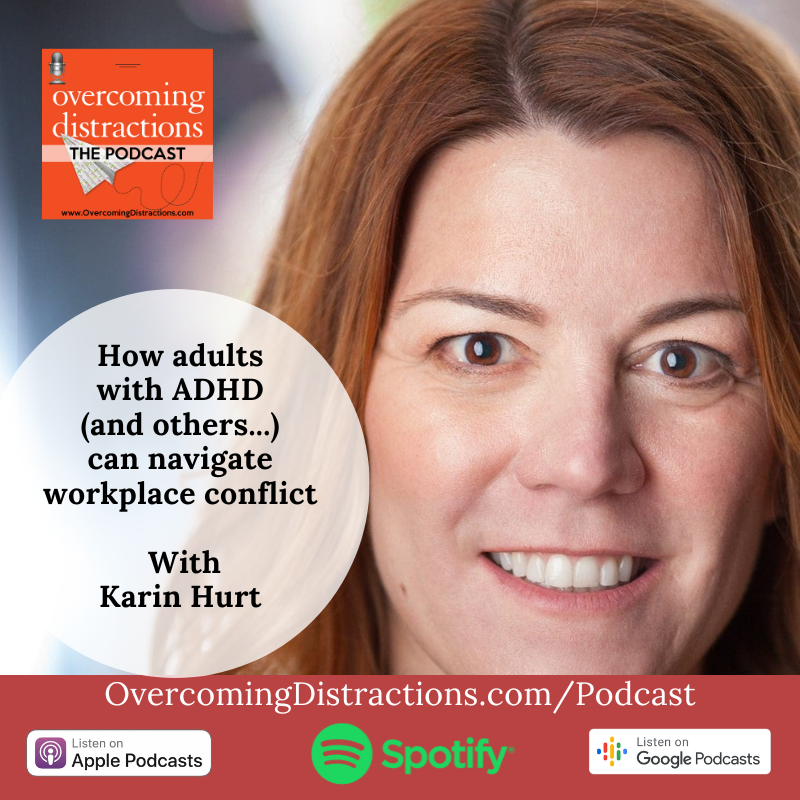
Overcoming Distractions-Thriving with ADHD, ADD
How adults with ADHD can navigate workplace conflict
00:35:33
In this episode we will be discussing workplace conflict. Whether you have ADHD or not, everybody is going to experience some conflict in the workplace at one time or another. Maybe those of us with ADHD experience this more because of our working...
Loading summary
Transcript79 lines
- [00:08]
A
I'm Dave Greenwood, and this is Overcoming Distractions. If you are an adult with adhd, a busy professional, an entrepreneur, a high achiever, or just need some strategies to navigate your adult adhd, you're in the right place. Who am I? I'm an entrepreneur with ADHD and the author of two books, Overcoming Distract and Overcoming Burnout. I coach and mentor people just like you, and together we navigate the ups and downs of adult adhd, from getting out of our own way to helping people just like you thrive in the workplace. That's what I do. Want more info on working with me? Hit overcoming distractions.com ready? Let's get to today's podcast. All right, everybody, we're back. It's Overcoming Distractions. If you are that busy professional with adhd, you have absolutely landed in the right place. If you're new, thank you for coming. If you're an old listener, thank you again for hitting that download button. Always appreciated. Real quick, you know me. I am an entrepreneur with adhd. I have served executive positions. I've had to not only get my own work done, but manage other people along with my adhd. So if you need somebody to help you do some problem solving, get some business and life and other things back on track, just hit my website, overcoming distractions dot com. Click that button that says chat with me for 15 minutes and let's see if we're a good fit. So, all right, that's it. That's the spiel done selling you anything. Let's. Let's get right to it, because today we are talking about workplace conflict. And I know whether you have ADHD or not, I believe everybody's going to experience some workplace conflict at one time or another. Whether it's you're working in a restaurant or you're working as an executive, there's workplace conflict from top to bottom. I just think maybe those of us with ADHD might experience this a little more. And I think you know what I'm talking about. Maybe it's our working habits, may our emotions that get the best of us, other things about just being an adult with ADHD and being busy and juggling personal and professional lives. So. But just like procrastination, as you've probably heard me say, I don't think we own workplace conflict. I think our guest is going to probably agree with me on that. So. But it is something I want to spend some time on. So today we have Karen Hurt. She's the author of Powerful Phrases for Dealing with Workplace Conflict. The book offers you the Reader, some practical guidance, actionable strategies to navigate that workplace conflict with a little bit of confidence. So. And again, I hate to say this, but I think in the world of adhd, there's probably no shortage of that workplace conflict. So let's not waste any time. Let's dig in. So welcome.
- [03:29]
B
Thank you so much for having me, David.
- [03:31]
A
Yeah, absolutely. This is. I think we may have discussed this on the podcast at one time or another, but I've never had somebody who. Who like, just focuses on this for a living. So I'm really interested to. To. To dig in a little bit. But can you just tell people real quick what people can take away from the book, what's in it, how. How it can help them?
- [03:57]
B
Yeah. So often when we're working with clients across a variety of industries all over the world, we are hearing people say to us, okay, I'm in this situation. Just give me the words. Right?
- [04:08]
A
And.
- [04:09]
B
And of course, you can't script conflict, but if you can, when something feels wonky, right? When. When you feel that tension, when. Because conflict in itself is not bad, you need that tension. But. But when you are faced with a conflict that feels uncomfortable or have to have a difficult conversation, what the book does is. Gives you an opportunity to step back. And we offer four dimensions of so to diagnose what's going on. And then the table of contents actually has what kind of conflict are you dealing with? And you right to that conflict. And it'll say, here's. Here's what to try this. Say these words. And we're hearing that that is so helpful for people because the conflicts that we're having, whether you have ADHD or whether you're just having conflict, right. It's. They're so there's. They rhyme. Right. We are having. We have similar conflicts. So we have conflicts with co workers, we have conflicts with our boss, we have conflicts with our team, we have conflicts with ourselves. We have conflicts in matrix teams, we have conflicts caused by remote work. And so to be able to really catalog those major conflicts and to help people navigate them, well, seems to be making a difference for people.
- [05:16]
A
Yeah, No, I think that's awesome that you've actually kind of almost like, like, like it's a manual. Like, here's a conflict on disagreeing with your boss. Let's go to this page or what have you. So I. That is super easy to navigate. So. So I'm looking forward to actually digging in. And in full disclosure, I haven't read the. But I'm definitely interested in digging into that more so. So I might know the answer to this, I might not. But is there one, like, overarching reason for workplace conflict? And. Or is it more complicated than that? Does it come down to disagreements, power plays, egos? What is, what. What is kind of driving this?
- [05:56]
B
Yeah. So we did some extensive research. It was called the World Workplace Conflict and Collaboration Survey. And we surveyed 5,000 people in 45 countries to ask what's going on with conflict and has it gotten more intense since the pandemic? And the answer is yes, it is not only more frequent, it's more intense and it's more complex. So 70% said they are dealing with the same, more significantly more conflict than they had than just a couple of years ago. And what we see found as we really dug through all of the qualitative analysis through this, is that what we're seeing is what we call conflict cocktails. So it's a comp. It's this combined with that. So let me give you an example. One conflict cocktail we call the wedge driver, which is. So there's an organization's leading leave, living through a lot of significant change. And at the same time, you've got more people working remotely, so you've got that lack of connection. And you've got managers who are not necessarily equipped to manage in this new environment. They haven't been trained, and that is creating all kinds of conflict. Or we have one called the blown fuse, which is where you've got tired workers because of staffing shortages and you've got exhausted customers for all the reasons we're all exhausted. Right. Lingering mental health challenges from the pandemic, all the stuff that's happening in the world. So people are on edge. And so then they go in and then they're, like, asked to tip. Creep. Right? So, hey, would you like to tip for buying this pair of shoes? Right? Like, you know, all this stuff, and it's just like. Right. And everybody's tired. So that's. So that is, that's what we're seeing. The dynamics that are really. They're. They're more. They're more nuanced conflicts that we. So that's why it's so important now to eat even more than ever, to really take a step back and say what is actually happening here and then dive in.
- [07:56]
A
You bring up a good point. And I know I've talked to certain people about this as well. We, you know, we hear all about, like, change management and, and everything else, but that's not an easy thing for some people to go through, especially if it's not like, handled properly. Right. I mean, I mean, I've seen companies that have, like, bought other companies or merged or. Or different things, and it's a complete train wreck. Right. For. For in some cases. And then that obviously is going to fuel some type of conflict. Correct?
- [08:26]
B
Yeah. So I think what you're talking. Where that train wreck often comes from is lack of clarity. So we talk about four dimensions of conflict or productive collaboration. Connection. Are we connected as human beings, which could also happen in that merger acquisition. Clarity. Do we have a shared understanding of success, curiosity? Are we genuinely interested in one another's perspectives and what's possible and. And commitment? Do we have a shared agreement? And what I see when organizations are coming together or there is a merger, acquisition, or venture capitalist buyout, which we deal with all of that with our clients, often it's that connection and clarity that are the biggest places to start. So do we know one another as human beings? And because it's harder to have unproductive conflict if you actually care about the person. And then clarity. What is the new way we're doing? What are our most important priorities? How do we do things around here in this new merged organization? And really making that clear, it's been interesting. We've been getting a lot of more than before. So we've been at this for a long time. And more than before, we're getting calls from CEOs, and the sentence goes something like this. Can you teach them to have more couth. And I'm like, well, what is Kooth beat? And can you just come in and tell my people how to dress and how to act and what to say? And I'm like, no, I cannot, you know, because I can't make that decision for you. Right. So I can help you figure out what your priorities.
- [10:03]
A
But I would think initially you start to see some of the problems, right. If somebody says something like that.
- [10:08]
B
Yeah. So I said, I can help you create better clarity. I can help you build a communication plan. But how you want your people to dress when they show up at a board meeting is different in different cultures. And it. Right. So you. But. But people, I think, are afraid to say, you know, so they shy away from. Because they should know, Karen. They should know how not to wear a hoodie to the board meeting. Okay. And I'm like, I'm with you. They should know. But if you haven't told them, the question is, do they know?
- [10:36]
A
Yeah, yeah, no, that's true. You bring up a. A very important word Especially in the ADHD community when it comes to, like, demanding careers, you know, busy professionals, is clarity. Because we do not like a lack of clarity. We might not even know we have a lack of clarity. And it's something that, that we work on a lot in terms of. Because that, that fuels all kinds of things. Like you say conflict, it fuels procrastination, and it fuels all. All different things. So it's interesting to hear you say that. That clarity is a big piece of your work. Right?
- [11:14]
B
Yeah. And I will tell you one. So one. So we have the reason I'm wearing this Goat Whisper T shirt. You know, we have 12 greatest of all time powerful phrases for dealing with conflict. Because I'm sure you're curious why. Why in the world is she wearing this Goat Whisperer T shirt? But I will tell you, one of them is what we call a check for understanding. And that is where you say, so you hear something and then you say, so what I hear you saying is this, and then rephrase, paraphrase it back. Do I have that right? And in the ADHD community, I think there's probably no more powerful phrase than that. Right. When you're talk about clarity, because you're, you know, we're moving fast, right? Like we're, we're distracted. There's a lot of things going on. Our mind is processing a million things all at once. And so to be able to say, is this. What am I hearing? What I think I'm hearing can save you a lot of time. I have one. It's interesting how you have. I'm sure you have this too. You have probably like your super followers, right? The people who are listening to every podcast episode that you have.
- [12:13]
A
Right?
- [12:14]
B
And we have that. We have that too on our blog. And there's a woman with ADHD who reached out to me in 2014 with one of the. When she read one of the blog posts. And since then, she. She reads all the time. She's read all our books. She's brought us in to do work at her company. Right. She's just one person who. And I. And I believe part of it is because she finds it really helpful. And she's also neurodivergent. Right. So she's got both of those things going on. And she said, what I find is what you do is you break down communication and you tell exactly how to, you know, words, to say things, to rephrase processes, tactical tools. And her. One of her favorites is check for understanding. Because of all that. And she said, because a Lot of times I say I'm saving myself time. So my boss comes to me and gives me this project and my brain immediately goes boom. Thinks of all the possibilities for this project. But now I stop and say, I see this project that you're saying taking about 20 hours. Do I have that right? And she's like, sometimes my boss goes, oh, no, no, no, one hour. You got one hour. That's all this should take. Right?
- [13:18]
A
But I, I, but that, that's, that Is it just a massive piece? Because I can't tell you how many people that have, you know, come to me and they need to kind of figure some things out. They're having real challenges in the workplace. They have an ADHD brain. And one of the things is they will again go to like a meeting with co workers or a boss or a client, and then they go back and their ADHD brain didn't get half of what was going on. And now they're not only in an internal conflict, but now they're in a conflict because they have to go back and ask for that clarity. And sometimes they're embarrassed and sometimes they wait, which leads to procrastination and which leads to even more conflict because then they didn't do their job.
- [14:07]
B
Yes. Yeah.
- [14:09]
A
So that leads to me to a question where, I don't know if you guys research this, but where do you see the most conflict? Is it between employees? Is it between leadership and employee or employee to employee? Where do you see the most conflict?
- [14:24]
B
So it's two places. One is conflict with your manager. And, you know, a lot of times the conflict with the manager is really conflict with the organization. And so Dr. Ralph Kilman, he is one of, I asked him when we were, we interviewed him as we were writing the book. I said, can I call you the grandfather of workplace conflict? And he said, yes, that's appropriate. So he's been at this a really long time and studying it for probably 40 years. And one of the things that he really says and emphasizes, which I agree with, is you cannot solve organizational conflict with team building. Right. So if our incentive structures are setting you and me up, David, to compete, right. Or we're going to put us, or our boss is going to stack rank us at the end of the year and one of us is going to be rated exceptional and the other one's going to be rated, but we only get one exceptional. That system is going to cause conflict between you and me if we're both high performers.
- [15:24]
A
Yeah, right.
- [15:24]
B
And it's going to create competition. So so some of what was labeled as conflict with my boss, I think is also really conflict with the organizational bad systems and processes. But the other that we see a lot is conflict in matrix organizations. So one of the conflict cocktails that we talk about is when you've got accountability without empowerment, so you're being held accountable to fix something, but you also need support from all these other people in other departments.
- [15:55]
A
Yes.
- [15:56]
B
And they may have competing priorities. So your most important thing is not their most important thing and you can't get what you need. Done. Done.
- [16:04]
A
And is that the same as. You know, I had a phrase and I don't know where I got it. I think I got it from a, like a business coach I had years ago when I was an executive because I was managing, you know, eight other people in my department. But it was. He had a phrase like authority equal to responsibility.
- [16:21]
B
Yes.
- [16:21]
A
Is that kind of what you're saying? Is it like I've given you authority, you know, based on what I'm asking you to do? Right. Yeah.
- [16:29]
B
Yeah. And it needs to you. Yeah. You. If you're asking somebody to own it, then make sure they have the empowerment to own. To own it.
- [16:35]
A
Yeah. Right. And I don't think I hear a lot of people that, that I've worked with that don't have that or they get questioned or a boss or a manager will come in and they'll change everything up and they'll change exactly what they ask that person to do.
- [16:54]
B
Yes. Yes.
- [16:55]
A
Yeah. And that's a, that's a tough position to be in. So I'm pretty sure I know the answer to this. But in your research, did you uncover any type of trends that linked workplace conflict to burnout? People experiencing burnout?
- [17:16]
B
Yes. Yes. So 27% said, you know, the conflict was caused by being burned out, exhausted, overworked, overwhelmed.
- [17:26]
A
Yeah.
- [17:27]
B
And. And you know, because your, our fuse gets tight, like, you know, shorter when we're exhausted.
- [17:34]
A
Yeah.
- [17:34]
B
And I mean, you know, I find that, I find that in our own work. So, you know, my, my husband is my co. Author and co. Business owner. Right. And if we have conflict all day long, because I have. Right. And we still gotta, still gotta be in a good marriage. And you know, part of it is because our roles are different. And so I'm the, you know, I'm the vision, the, the marketing, the out, like, let's move fast, let's do this. And he's like, let' Right. Operations. Right. Let's make sure that we can execute flawlessly on this. Don't take off more than we can. And in that is constant conflict. And so that's why. And then when we're tired, that makes it even harder. And so that's why, you know, you really do have to have some ways that you're going to talk about things and being pay paying attention to not just what you're saying, but the look on your face and your tone and all of that matters as well.
- [18:22]
A
Right. I, because I think burnout, and we talk about this a lot here as well, is that I think burnout is far more complicated than social media or these quick little posts that people splash up will is there because we always think about, oh, it's overwork or you're not taking breaks. But there are so many other, like, contributing factors to people being stressed out in the workplace and then putting up with it for so long. Right? Yeah, yeah, yeah. So any myths that you uncovered about workplace conflict?
- [19:01]
B
Yeah. So, you know, one of the things that we, we talk about this in the book I talk about myths and you know, one is always use an I statement. And there. And this is one of the. I mean, this has been taught. I learned this in college and I was in college a very long time ago. Right.
- [19:16]
A
And you and me both.
- [19:20]
B
And I mean, the, the, the sentiment behind that is wise because you want to own your feelings as opposed to saying you. But you could also have a statement that starts with I that is terrible. I think you're a jerk. Right. Is an I statement. And so I statements can be a good way to think about it. But also you have to think about the other thing. The other is the sandwich technique for feedback. And sandwich technique is old as well. Tell me something good. Tell me what you really want to say and tell me something good. And, and a lot of times when we go into organizations, people have been trained to do that. Well, the problem with that is it is not direct enough. You can say, oh, so imagine David, my husband is here. And I say, hey, David, I want to really thank you for preparing for this Vietnam Courageous leadership tour. You've really worked hard on it. The decks look great. I'm so excited. Thank you for working so hard. But your leadership is derailing our company. But you're kind of hot now. Like, what is he going to take away from that?
- [20:25]
A
Probably, I don't know, I'm going to get confused.
- [20:29]
B
Right. And I'll probably say, oh, I'm hot. Thank you so much. Right. And totally miss, like, what the heck is going on with his leadership that's derailing now, his leadership is not derailing our company, but, you know, like what? You know, we get confused and we're believers about giving people the positive things and the constructive things, but not necessarily in the same sentence. So if you're trying to get somebody's attention about something, have one conversation at a time. Now, the difference. Now, if somebody comes to you and says, you know, so if you came, okay, if I came to you and said, hey, David, do you have any advice for me on next time I'm on a podcast like yours that would be perfectly appropriate for you to say? Karen, One thing I thought was really good about it was this. And one thing I would suggest for next time is that, because I've initiated the conversation, right? And that's a, that's a, you know, that's a cool way to do that. But if, but if you had to really give feedback to somebody on your team who's coming in late consistently, you're better off saying, hey, I want to have a conversation about this. You've been coming in late consistently. Here's the, here's the pattern. What can you do to fix this? Right. That, that's a more direct conversation before telling them all the great other things that they're doing well.
- [21:36]
A
Right. I know entire books have been written about psychological safety. I know some people have heard the phrase, maybe the company brought somebody in for a lunch and learned real quick, and then they just went through it. Okay, but is that, is that something you guys work on as well? Because as you say, there is healthy conflict, right. And people need to learn how to maybe use conflict in the positive. Is that an accurate, accurate statement?
- [22:11]
B
100. And we're one of those people who have written an entire book on psychological safety.
- [22:15]
A
Well, there you go. We'll have to look for that.
- [22:16]
B
Yeah. So our book on that is called Courageous Cultures, how to Build Teams of Micro Innovators, Problem Solvers, and Customer Advocates. And we talk about. And Dr. Amy Edmondson, who is the pioneer of psychological safety, wrote the forward to that book. So we've been digging into this a lot, too. And, you know, part of it is, you know, psychological safety is, is, is, is a piece of it, right? You have to make it safe. If you've got, you know, toxic courage, crushing behaviors like shame, blame, and intimidation going on, you're not going to have people dealing with conflict productively. You're not going to have new ideas. You're. You're gonna, People are just get, you know, holding on, getting through their day. So that's really. Table Stakes, but also psychological safety is important, but it's not enough. You also need to have clarity about where you're going and, and, you know, these other elements, curiosity to foster collaboration.
- [23:09]
A
Yeah. In your experience going into companies and working with them, are they conscious of psychological safety or is there a lot of. A lot of education that needs to happen, say, in various size companies?
- [23:32]
B
You know, what I find is that there is awareness of psychological safety and then there's a range of how important they think it actually is. And here's the dynamic that I've noticed the most about this. So we do a lot with senior executives, Right. And when we were dealing with senior executives, now, not everybody, but we have noticed a pattern with some where they're so good about creating psychological safety at the front line. So if they walk into the factory, they're going to say the right things, they're going to make it good. They're very careful. They got a comps team behind them wordsmithing things to make sure that everything is good and messages are great. But when they shut the door with their direct report team, they're like, well, these guys get the big bucks. I can just say, I can. You know, I can tell them what the F are you doing here? And that that idea is never going to work. And they do all the things that they would never do at the front line. And here's the thing. Then I hear it from those direct reports. Right. Because those, those executives are human beings too.
- [24:34]
A
Right, Right, right.
- [24:36]
B
And. And then you can see the trickle down. So then those folks go and they shut the door with their direct reports and they're like, now we're not going to let this happen to the front line. But here, just between us, behind closed doors, F this, F that, blah, blah, blah, get it together. Right. Then it goes down a level. And by the time you get through it, it got to the front line. Right. So that's why I think we have to be careful in every relationship. And it seems that the tighter the relationship, the less we work in our communication because we assume that it's okay. We can. We can just speak. But I. You really do. It was interesting the other day. I was moving really, really fast. I had a lot going on. David came to me. My husband came to me. He's like something. I said, oh, that's never going to work. And he says, haven't you written a book on this? Don't you know better? Right. And I would never ever say that to another member of our team. Right.
- [25:28]
A
I would be careful yeah, my. My old boss, years ago. And it was. It was almost a joke because we had a really good relationship. But, you know, you would go down to his office and bring something up and we'd talk, and then he would say, thanks for stopping by. And it was like, yeah, yeah, I'm busy, whatever. But it was kind of a running gag at that point. We all had a really good relationship. Thanks for stopping by. So that means I just need to go back to work. So let's talk solutions, because I always want people to listen to the podcast and be able to walk away with some type of actionable items. But what is the. One of the first things that you feel people should consider if they are engaged in regular conflict? Because again, people come to me because they're having trouble navigating the workplace. I realize at some point, very quickly, or we realize together that because adhders blame ourselves for everything, but then we dig in a little bit and we realize, you know what, Some of this stuff isn't your fault. You're. You're working in a. Maybe a chaotic working environment. So what's one of the first things you can advise people to do if they are. Continue to be engaged in this conflict?
- [26:55]
B
Yeah, so the first thing I would say is the first conflict conversation is the one you have with yourself. Because a lot of times what we found is people talk themselves out of having the conversation. And 21% of the people in our survey, when we asked them about a significant conflict that they had in the past, and if they had that same conflict again, what advice would they give their former self? And 21% said, I would talk about it or talk about it sooner. So the conversation you have with yourself, why does what you have to say matter? Why does it matter for the outcomes? Why does it matter for your relationships? Why does it matter for your own mental health? What's at stake if you stay silent for all those things and then imagine that you've had the conversation now, you might not have gotten everything you wanted, but you have been heard, like, how do you feel? And I've been asking that question of audiences all over the world, and I have people shout out the word. And I bet you can guess the word relieved, right? Yeah, I feel relieved. Well, that's what I want. That's what I want for your listeners, too, to have the courage to have the conversation and then to be relieved. So I would start with that, and then I would say, which. What is happening in this conflict? Is it connection problem? Do you need to slow down and build a human connection. Is it a clarity problem? Are there unmet expectations? Because the expectations aren't clear? Is it a curiosity? Do we need to use one of our goat powerful phrases? I'm curious what this looks like from your perspective. And actively listen because it's very difficult to be curious and furious at the same time. Or is it a commitment problem? Do we not have a shared agreement? Do we need to stop and say what have we agreed to here? And I think if you just do those two things, you're going to have more productive conflict.
- [28:41]
A
That's some great advice. So obviously the title of the book is Using Powerful Phrases. So walk us through how to use those powerful phrases. Maybe some more examples.
- [28:54]
B
Yeah. So let me give you a couple of goats. Graceful.
- [28:57]
A
Some goats.
- [28:59]
B
So my favorite, There are over 300 powerful phrases in the book, but my favorite one of all 300 is a clarity goat. And it is what would a successful outcome do for you? And why do I like this? Because we always say what does success look like? Right. But what would a successful outcome do for you? So imagine David, that you and I work for the same boss and he has given us a project today and it is due Wednesday morning at 9:00'.
- [29:25]
A
Clock.
- [29:26]
B
Okay. So we, and we've got clear definition of success. Great. Now if we take five minutes and we say what would a successful outcome do for you? And I say, you say to me, hey Karen, I gotta tell you, I have been working like 70 hour weeks. What success looks like is that we are super efficient during our time working on this. I don't want to be working late every single night before this. So let's say we're going to walk out of here at 5:30 every day and we're not going to work this weekend. So let's build a project plan that can get that to happen. And then I might say, you know what I think a successful outcome would do for me? I don't think my boss gives me credit for how smart I am on this topic. So when we do this readout on Wednesday can and they're hard questions. Let me answer a couple of the really hard ones so that he gets it. Now if we haven't had that conversation, I might be like, oh, I, I, this project is important. I don't mind working late on this project.
- [30:21]
A
Right, right.
- [30:22]
B
And you might be like, well, oh, tough question. I know the answer. I'm going to jump right in and be helpful. Right?
- [30:27]
A
Yeah.
- [30:27]
B
We didn't mean to hurt each other, but without that conversation we might so that's a clarity one. And then, you know, a commitment one is good. One is what we call scheduling the finish, which is, you know, so we've agreed to this, right? And recap it. Let's schedule a time to talk about this again. So imagine that, you know, I'm in a conflict and we're not like with a co worker and we're not treating each other well. We're on edge and we have agreed. Come together to agree. Like we are going to slow down and we're going to really listen to one another and this is how we're going to do it and come up with a plan. Great. That's not enough because what happens if one or the other of us doesn't meet our commitment? It.
- [31:11]
A
Yeah.
- [31:11]
B
So we say, okay, so why don't we schedule some time. What is it? It's April 4th now. Why don't we schedule some time for May 4th where we're going to talk about how is this going of what we've agreed to. Now, if we're both looking at our calendar and we know that we're going to have to have this conversation again.
- [31:27]
A
Again? Yeah.
- [31:28]
B
We're more likely to do what we said we're going to do, right?
- [31:30]
A
Yeah.
- [31:31]
B
And if we don't do what we said we're going to do, neither one of us has to muster the courage to, to raise the conversation again because we've already scheduled time for it. If we do fix the problem, we don't have to remember to say thank you. We've already scheduled time for it. So that is another way to really approach the conflict from a phrase, perspective.
- [31:50]
A
And how, as we kind of wrap up, how do people, how do you recommend people deal with things that continue not to work, so to speak, where, where people are just not, not coming together, not seeing eye to eye. Is there like a next level where people need to bring this to.
- [32:14]
B
Yeah. So there's two, two, two things. It really depends on what, what is actually going on. So if it's a, if it's an accountability, like if you are the manager or you've got a co worker and they have, they. The expectations are clear and they're clearly not mean those expectations. The conversation needs to shift from what they're doing to the pattern. Right. And so, you know, somebody's coming in late and then you're having this conversation again and you're. And they're like, yeah, but this time my car broke down. You're like, here's the thing, we're not going to talk about the specific incident, because. But what we're going to talk about is the, the pattern. And it's always something. Right? And so I want to know how, how we can get to a point that you can be here reliably, and if you can't be here reliably, then let's talk about that. That. Right. And so you're escalating the conversation. So that's one thing. And then we have a whole chapter in when to quit a conflict. Because there, you know, and questions to ask yourself, you know, is this conflict destroying your mental health? Is this, is this, is this conflict happening only with this in this one situation, but not in other areas of your life? Is this conflict taking a toll? Is this conflict causing you to show up as somebody that you don't like being around yourself?
- [33:28]
A
Yeah, those are.
- [33:29]
B
Yeah, yeah. And then maybe it's time. It's. Maybe it is. You are in. It's time to quit the job. It's time to quit the relationship. Because that, that's, that is destructive. And some, let's be real, like some conflicts can't be there. There are some psychopaths in the world. Right.
- [33:45]
A
And.
- [33:46]
B
Yeah. And so, you know, to, to know that just, you do not have to suffer through that. You have some level of agency in those, in those situations.
- [33:55]
A
Yeah. And I think there's probably very multiple reasons for that. For example, somebody who's being asked to do something that may be against their values or maybe they feel like they're being asked to do something that they feel is, like, beyond their ethics, then I know in the ADHD community, I don't know what it is about the ADHD brain, but we have a sense of morals about us. And when we, when we find that we have that, what they call misalignment of values we have, we have a tough time, like, solving that. So. Yeah, yeah, yeah, yeah. And that's a good point. You've got to know when to, when to cut loose. And as Tony Robbins says, burn the boats. Yeah, yeah, yeah. So cool. Where can people find you guys? I know you said you do some consulting speaking aside from the books. So where can people find you?
- [34:49]
B
Absolutely. Thank you so much. So it's. I'm Karen hurt, K A R I N and David Dye, and we are@letsgrowleaders.com and if you go to our website, you can find, you can find all of our books, the keynote speaking, our leadership development programs, all the things. So cool.
- [35:07]
A
Awesome. Come back anytime. This is a continuing hot topic here. About how we, those of us with adhd, navigate the workplace. So thank you.
- [35:18]
B
Oh, it's been absolutely my pleasure. Thank you so much, David.
- [35:21]
A
Thank you. Awesome. Thanks.