← Overcoming Distractions-Thriving with ADHD, ADD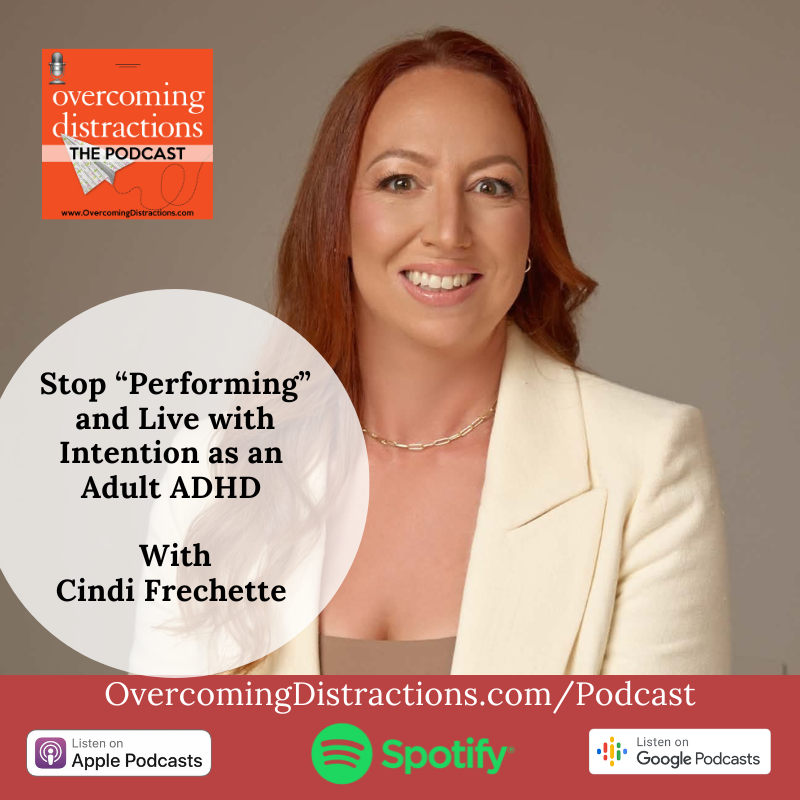
Overcoming Distractions-Thriving with ADHD, ADD
Stop "Performing" and Live with Intention as an Adult ADHD
00:34:21
Loading summary
Transcript75 lines
- [00:08]
A
I'm Dave Greenwood, and this is Overcoming Distractions. If you are an adult with adhd, a busy professional, an entrepreneur, a high achiever, or just need some strategies to navigate your adult adhd, you're in the right place. Who am I? I'm an entrepreneur with ADHD and the author of two books, Overcoming Distract and Overcoming Burnout. I coach and mentor people just like you, and together we navigate the ups and downs of adult adhd, from getting out of our own way to helping people just like you thrive in the workplace. That's what I do. Want more info on working with me? Hit overcoming distractions.com ready? Let's get to today's podcast. All right, people, we're back. It is Overcoming Distractions. You know that because you click the button to listen. So welcome back. Thank you so much for hanging out with us. We are coming from the plush offices of Overcoming Distractions and we are, we are at it again. So I know there's a few things that busy people with ADHD have challenges with. It's overthinking, misalignment. I think that's a huge one for many of us. Burnout. If you've listened to me for any length of time, you know, we discuss burnout on a number of levels here. So that's one of the things we are, we are challenged with. And there's, as you know, as you've listened, burnout is far more complex than these social media gurus would would tell you that it is. So in getting out of it is far more complex. So. But I also think these challenges, sometimes, all the breathing exercises, the visits to the gym, the massages, just may not resolve many of our challenges. And we need something different. So. So what I have a question for you. What if we could learn how to live in alignment with values, something I actually did talk about a couple weeks ago, values that I think are super important for us. So you can go back after this one. Go back and listen to that. But I think many of us with adhd, it's a must have. It's alignment of values. We have to, we need that to thrive. So. So today we're going to talk about something called the Unknown Method. So hang on here, because I think this is kind of cool. So. And I have Cindy for shed to help us dig into this conversation. And I met Cindy a few months ago at a networking event locally. We chatted about this subject and I thought it was something many of you would like to learn more about because I think, you know, listening to this podcast that I don't always follow the ADHD kind of guidebook. I think there's a lot of things that many of us with ADHD can learn from things that are not 100 specific made for ADHD years. I truly believe that. So, so here we are, we're going to talk about the unknown method. So welcome.
- [03:37]
B
Thank you.
- [03:38]
A
Yeah, so can you give everybody just a kind of a, a quick little snapshot of who you are, what you do, who you work with and then I want to kind of dig into this topic a little deeper.
- [03:53]
B
Absolutely. So I'm Cindy frechette. I have 17 years background as a professional therapist and in the last five years have switched into more of the mindset coaching realm and also a person with lived experience with adhd, which I think is really important. When were talking about ADHD burnout, supporting others in this space and like you said, Dave, kind of following more of that non traditional, it's really using some of that lived experience to guide people in the work.
- [04:30]
A
Yeah, I think that's super important. I think there's, and I could go on a whole kind of discussion about, about that, but I think there's, there's some people who might have done okay as an adult with ADHD and they go out and try and help people. There's other people that go out and maybe get a coaching certification that don't have so much of that lived experience. And, and I think that's why people, you know, reach out to me because, you know, I ran a PR firm for 20 years. I was an executive vice president at an organization, all with my ADHD brain, having to manage people, meet payroll, hire fire, you know, meet deadlines, all that stuff. So I think it's, as you say, I think it's important when you do actually choose to kind of have somebody, you know, work with you, mentor or as you say, you know, maybe a more official capacity such as therapy that somebody does. I've heard more times from people that they said they worked with a therapist and, and they're like, oh well, have you tried making a to do list? And it's like they just don't get me. They don't understand, you know, maybe they, they, you know, they're good at therapy, but they don't get me. So.
- [05:54]
B
Well, that's exactly why, or how the unknown method was born and why I created it because people who are living these really busy lives, high achievers, entrepreneurs managing home life, business, they need more than a to do list.
- [06:13]
A
Yeah, yeah, no, they like, like you say they they need a, a certain mindset. They need somebody that can support them, that understands what they're going through. They need to understand that. You know, taking the to do list, for example, is that, you know, some ADHDers would love an electronic to do list than an app. Some people needed just a piece of paper next to the keyboard. You know, I mean, so. Yeah, so, but so cool. So let, let's, let's dig into the topic at hand today. So at, at a high level, what is the unknown method? How is it maybe different from traditional mindset productivity, et cetera, et cetera? Sure.
- [07:00]
B
So the unknown method is a combination where it kind of blends a little bit of therapeutic technique with some neuroscience to help decrease the mental chaos, get really clear on our values, and ultimately stop the overthinking. Because what do we know about adhd? It's not just distraction. A lot of times it's hyper thinking, hyper focus. And when we are caught in that spiral, we need a way to get out, to be our most productive, authentic selves.
- [07:37]
A
You're right, because I think there, there is a, there is a laundry list of things that it's not just like I, I can't focus or I'm distracted or I keep jumping on YouTube or the sports betting app when I should actually be doing my work. There's, there's a, there's a ridiculous amount of things that, that challenge us. You know, it's, it's, you know, getting the day off to the right start. It's, you know, as you say, distractions are a big part of it, but it's learning how to focus, how to manage our energy, how to, how to manage our time appropriately, how to, how to deal with other people, clarity, all those things that, that, that make thriving with adhd, you know, possible, right?
- [08:22]
B
Yes, absolutely. And so within the unknown method, I broke it down into, I'll say, three simple steps. I'm not going to say they're easy, but simple to follow. So we start with unravel, rebuild, reclaim. And unravel is unraveling the thoughts, the thought patterns, the automated pieces that maybe we're not aware about that's kind of running in the background of our brain that's driving us to do the thing. Maybe it's the perfectionism, the overthinking. Then we need to rebuild our relationships. That includes with ourselves and others, and then reclaim our time and energy without guilt.
- [09:04]
A
So let's break those down a little further, if you will. The, the walk me through maybe a possible scenario in the unravel pillar what's involved in maybe the dialogue between you and a client. Sure.
- [09:25]
B
So in the unravel step of the unknown method, that's really about identifying some of the background thoughts that we're not aware that we're having. And so just a little fun statistic to throw out for people. Our brains have something about 80,000 thoughts a day and we're only aware of 3,000. That's a huge gap. And those unknown thoughts are the ones that are running the show.
- [09:53]
A
And then you take somebody with ADHD and you should probably double that, Right? Yeah.
- [09:56]
B
I don't know what the exact statistic is on that. But yes, the point is there's a lot happening in our brains. They're very busy and we need to be really clear on what those unknown thoughts are because that's what's getting us stuck in that overthinking space. And for example, if I'm working with a client in the unravel step, part of it is really understanding what's going on for us in that space because we can't change anything that we're not aware of.
- [10:30]
A
Right.
- [10:31]
B
And you know, our brains really care about things. Three very basic things. Conserving energy, seeking pleasure, and ultimately, you know, staying alive. And our overthinking is really meant as a protective factor to do all of those things. And when we have adhd, that's a little bit more heightened because our brains are very aware and interpret everything with a lot higher intensity than other people. And so that survival skill and that fight or flight response is very strong. And so we need to identify that as the starting point.
- [11:11]
A
Yeah. I've talked with so many people who just. It's a great first step, but they actually are aware of the rumination that goes on in their head. That could be any time of the day. It could be 10:00am, it could be 3:00am it could be. Is that kind of what you're talking about, where there's just all those thoughts, whether based in fact or not, that just continue to kind of take up space in our head?
- [11:43]
B
Yes. So one of the tools that I use with people, just kind of a big old simple thought dump thought download. You, you know, you take a piece. Pen and paper. I'm a huge pen and paper fan because it really forces our brain to slow down.
- [11:58]
A
But.
- [11:59]
B
But it can be done on notes, app, computer, however you want to get words to paper. I tell people, write a topic, whatever you're ruminating about, if that's, you know, the work, meeting, a promotion, something silly that you said at work that you're now beating yourself up about, throw that on a piece of paper, set a timer three to five minutes. Write every single thing that pops into your brain on this piece of paper. I don't care if you're sitting there writing. I don't know why I'm doing this exercise, because even that is a critical piece of information.
- [12:37]
A
Yeah.
- [12:38]
B
So people write everything down for that three to five minutes. Then when the timer goes off, pens down, you go back, look at what you wrote and start to pick out what is a fact and what is an opinion. And very simply, a fact is something that can be proven.
- [12:57]
A
What, what allows somebody to. Because I can take the add brain and I can say, okay, I, I, my, I'm having trouble with my client. I run a business, for example. I'm having trouble with this client. The person's driving me nuts. So I'm going to go through that exercise and then I know some of our brains will be like, okay, well, you know, he gave me crap about this. He didn't like the work I did to that, oh, what's for dinner tonight? Yeah, you know, I mean, and then I'm assuming maybe you cross out the what's for dinner tonight? And I'd like ice cream and everything else, and then you kind of whittle it down to kind of the, the, the, the, the things that allow you to process that, Right?
- [13:44]
B
Yes, exactly. And that is a critical piece of the step. Part of when people work one on one with me, that's the work I help them really take a deep dive into is let's look at the patterns that are coming up in the thinking. Like how many times am I saying a particular thing or how many times is something showing up when I'm doing these quick downloads? Consistently.
- [14:08]
A
Yeah. So is the next step in that process the reclaim, or is it the rebuild? I'm assuming it's the reclaim.
- [14:15]
B
Yes. So the next step is reclaim, but just kind of, just quickly jumping back to kind of finishing that tool piece. Once we've been able to identify a certain thought pattern, we then can ask ourselves a series of questions based on that, asking ourselves, what am I making this mean? What is another way that I might see this? What way would somebody else view this? And it's a whole series of questions to really start identifying that overthinking pattern. And once we are aware of that, then we can start rebuilding our identity, our relationships to other people, which then ultimately allows us to reclaim our time and energy and stop the overthinking Is this similar to.
- [15:05]
A
And again, I'm a knucklehead, you know, I'm an entrepreneur, I'm. But is this similar to like, like what they would call cognitive restructuring where it's just like you gotta, you know, there's something bothering you and then you've got to kind of either prove or disprove it, so to speak. Is that kind of. Or is it a little different or.
- [15:27]
B
You'Re on the right track? Because I did say in the beginning, the unknown method has a blend of therapeutic techniques, neuroscience and coaching. And you're spot on when you say cognitive behavior therapy. Right. Kind of that. Cognitive restructuring.
- [15:42]
A
Yeah, yeah.
- [15:43]
B
But this takes it to a deeper level and really starts matching our values. We. I have a whole process that I help people identify their values and create a little visual pie chart that helps us make those decisions. Because I think that's another really important factor when we're talking about busy professionals in the ADHD kind of realm. You know, when you're the CEO and you're in your office, you can't have a ton of, you know, you probably don't want to be sharing your business with everybody. Right, right. And so these tools are meant to be kept for you, but also always accessible because out of sight, out of mind, they don't exist and we won't use them.
- [16:26]
A
Well, you just summed up adhd, so, you know, I mean. Yeah. So do we move to the reclaim section of this, so to speak? Yeah. And how does that, how does, how does that kind of roll out?
- [16:42]
B
Yeah. So once you're really clear on what your values are. And, and like I said, we're not just talking like Thanksgiving, you know, family, etc, kind of values. Like we take a really deep dive into this. And once you are aware of those values, then that's when we can start reclaiming our time and energy because we know what decisions we need to make to be able to move forward, to lead others. And there's no questions asked. So we're not spiraling and wasting energy in that decision making process because you know exactly what that next step needs to be.
- [17:22]
A
Right. So I mean, we've, we talked about this a few weeks ago. I mean, a value can be everything from, you know, freedom or, you know, not so much locked in a office 40, 50 hours a week. It could be, you know, these are my values moving forward at this season of life. Right? I mean, absolutely. Yeah. So I want, you know, I want the ability to do X, Y and Z. I want to work with these types of people, et cetera, et cetera. Right. Yeah.
- [17:58]
B
And they change. Your values change. I very frequently recommend people reevaluate every three to six months.
- [18:04]
A
Yeah.
- [18:05]
B
Because this is not a set in stone forever. We are a human having a human experience. Things around us are constantly changing. We're growing, we're learning.
- [18:16]
A
And that that's something that, that we've talked about here a lot, is that life does change. Life circumstances change. It's everything from, you know, your career, your employment status. For some people, it could be like, you know, my hours were cut. It could be I had a family member that, that became ill and I started spending more time with that person or caring for that person or maybe going back and forth to their house or doctor's appointments. And then, as you say, life changes. Right. So we need to be able to reevaluate those values, if you will. Right. Because things are going to change. Fundamentally speaking, our work schedule could change. You know, we may be making up work at night because we had, you know, respond to something. Right.
- [19:10]
B
Absolutely. And I think that also kind of leads me to another big piece of the unknown method is really recognizing what we're tying our identity and our self worth to.
- [19:21]
A
Yeah.
- [19:22]
B
And how that then ties into values and how we make decisions. Because I think we all can recognize masking is a huge piece of adhd. And a lot of times we're performing rather than living.
- [19:35]
A
Yes. Yeah. So explain that a little bit because I, I think people, people heard what you just said and go, yeah, I, I hear you, but I need a little more, like, info because I'm, I'm resonating with what you just said. But, you know, I need to dig a little deep on that, you know, because it's true. It's just like, that's almost like survival mode. Right. It's just like you're performing, you're going day to day to day to week to month. Okay. Versus actually, you know, I hate to be Tony Robbins, but, like, designing a Life.
- [20:12]
B
Right, Right, Yeah, yeah. So I think it's looking at that, you know, a lot of people who are high achievers in the ADHD space appear successful on the outside, but it's that internal chaos. Right. That we're talking about that we really want to stop. And when we're talking about kind of performing rather than living, it's looking at where we're putting our identity. Like, are we the helper? Are we the leader? How much of our identity is being tied to that and is that authentic to who we are and what we want to be doing with our time. So it's als. It's also kind of looking at. I was trying to come up with a good example because I hear you and you said, like, this resonates, but let's take it a little bit deeper. I think it's really looking at kind of the. If we're telling ourselves like we should be doing something because we have this role, it's breaking that down even a little bit more to say, like, I think this is probably a common problem that a lot of people with ADHD in the workplace experience organization. I know for myself, that can be a huge. You know, I have three different notebooks, folders are everywhere. Right. Like, how do I organize that stuff? It's breaking that down even more and not tying our identity to it. Because it'd be easy to go in a spiral and be like, if I should just be organized, what's wrong with me? Why am I not doing this? It's looking at, what does organization mean? What are we getting out of it? And it's really like, I want to feel present, I want to feel spacious and asking ourselves the right questions, like, what supports me today to feel present and spacious rather than focusing on that organization.
- [22:16]
A
But I. I think that that is a. That is a challenge for a lot of us, is we. We have a. We're challenged with actually feeling present in the moment, like living the. Because we're living in. Maybe it is survival mode. Maybe it's, you know, constantly putting out fires. No real method to working, so to speak. Everything's urgent, whether it is or not. We're living out of a lack of clarity. We're operating out of fear, urgency, etc. Etc. Right. And it's. And I think I mentioned it last week, is like, a lot of us are, you know, showing up to the office on Monday, wherever that office is, and we're just like, literally clawing our way to the door to get to Friday. Right. Because we're not. We're not present in what we're doing.
- [23:23]
B
Absolutely.
- [23:24]
A
Yeah. So how do we. How. How do we. How do we start to kind of move the needle in our favor and something like that?
- [23:36]
B
Yeah, that's a great question. And it's really being mindful of our thoughts. And so another tool that I work with people on is to really help them understand. It's kind of like a triad. Our thoughts create our feelings, which create our actions.
- [23:55]
A
Yeah.
- [23:57]
B
And if we are aware, you know, of that feeling. Right. We feel chaotic. We can't be present. We're rushing around. We're, you know, five steps ahead because that's where our brain is telling us to go. It's reverse engineering in the model of, you know, if I feel this way, what actions am I taking? How do I want to be feeling? Let's really create thoughts that support that. And when we know what those thoughts are, that changes how we feel, which changes our actions. And this isn't about, like, being overly positive. I just want to be clear, too, that we're not trying to pink paint everything and say, this is great. I love having a disorganized office.
- [24:40]
A
Yeah. I've used this example before, but I used to. I was. I work for a franchise of restaurants up here in the northeast for many years, and then I actually owned one for. For several years, but I had to work at a. At a very busy franchise location and a very busy mall. So. And this was also at the time, if, you know, malls is a food court. Well, the food court was being remodeled, so basically we were the only place.
- [25:13]
B
Oh, boy.
- [25:15]
A
But so it was literally unlocked the doors, and it was just insane from, like, until you lock the doors again at night. But anyways, I was an assistant manager. The manager was all this happy, happy guy, and he was always happy. And, you know, I mean, somebody could punch him in the face, and he'd be like, oh, okay, you know, have a nice day, you know, but it was like, once a month, I'd find him out back with, like, this massive nosebleed, you know, because he was just like. He was almost like, like, too happy, you know, And. And I just. And. And I thought to myself, I'm like, you know, it's okay to go back and, like, throw a pot or a pan against the wall, you know, I mean, because he was just. It was, you know, he was masking all the. The. The rough stuff of the restaurant business. So.
- [26:04]
B
Yeah, absolutely. And then ultimately, that's what leads to burnout.
- [26:07]
A
Yeah. Yeah. Oh, he. He. He definitely got out of the business, like many of us.
- [26:12]
B
Yeah.
- [26:13]
A
So, I mean, that's what drove me out of the business is just crazy. I couldn't see myself living like that forever. So. Yeah, but you're almost forced to mask, you know, you're, like, pissed off in the back room, and then you come out and there's a customer that, like, hi, how you doing? You know.
- [26:31]
B
Absolutely. And that. And I think that's such a, you know, there are times we have to have, you know, our customer service voice on. And. But what's important, though, is we don't stay that way in all of our spaces that we give ourselves a space to unmask and be who we are to prevent some of that burnout. And as you mentioned in the beginning. Right. It's that burnout is really that misalignment.
- [26:54]
A
Yeah, yeah. No, and I don't think, then again, I could go on a rant about, you know, burnout gurus and gurus and everything else in this, this, you know, space. But, but I don't think people put on, you know, it's just like, oh, you work too much or you work weekends or you work, you know, nights or, you know, etc. Etc. But people don't understand that, that getting, getting into burnout for many of us can be a misalignment of values. It just gnaws at us. Right.
- [27:24]
B
Yeah. And I love how you brought the point that we might work on weekends or we might work late at night, because I think that also ties a lot into the unknown method too, because it's. People might view that as being a negative. But I would say for people who have ADHD and executive functioning challenges, we're all very aware of the times that our brains work better and it's important to maximize that time. And if that happens to be at 10 o' clock at night or 5 in the morning or Saturday at 2pm, it's important that we're not assigning the wrong thought to taking those actions. And that's really the crux of my work is being able to take actions that are aligned with what works for you and really being able to block out, I guess, really, for lack of a better word, like the societal constructs of things.
- [28:15]
A
Yeah, right. Yeah. And we've talked about this before. It's just like, you know, we've talked about time management for years, but you can't talk about time management without energy management. And I think some people maybe instinctly know when they work well and when they don't. So. And it's important to, you know, capture those as well. So as, as we wrap up, I think you had mentioned to me about the reset tool. Is that, is that right? So how do people take what they should be unpacking with your three pillars, and how do we begin to essentially hit the reset button so we can kind of get back to that alignment?
- [29:00]
B
Yes. So I've developed a couple different, I hate to call them like exercises because they're, they're so much more powerful than a workbook and exercise. But yeah, I've developed a couple digital Tools that really can help guide people through that first unravel process. And I have those over on Stan Store. So it's Stan Store slash unknowithcindy.
- [29:28]
A
Okay, yeah, we'll put that link up for people to be able to do that. But essentially what is involved in that?
- [29:35]
B
So some of those, it's a little bit of what I talked about today here on the podcast is being able to identify the thought patterns that are keeping you stuck. So there's a couple different tools to really help highlight that and going through the thought, feeling, action, combination and using something called a thought model for that.
- [29:58]
A
Right. So who do you think this kind of best works for? I mean, I'm assuming you, you were trying to develop this for maybe a certain type of person with various circumstances. So who, who, who have you found that this works best for? Is it somebody who's burned out, Somebody who's just literally clawing the way through each day, or.
- [30:33]
B
Yeah, this is designed for the person who is busy, who cannot commit to a ton of time because all none of us need, you know, more to do in our day to day. So these are quick, simple, easily accessible tools for the busy professional who wants to lead without overthinking, with having more energy to show up in all areas of their life, not just the workspace.
- [31:11]
A
So as we leave the overcoming distraction audience with this information, is there one or two basic questions somebody can ask themselves to maybe begin that process of maybe a little more self awareness, to kind of start to understand where they need to, to go? I know many people in the ADHD world say, why am I like this? Which I don't think is a healthy question. You know, it's not uncommon, but on a more constructive path, what are, what are one or two kind of maybe simple but powerful questions somebody can ask themselves?
- [31:58]
B
Absolutely. And I love what you just said there too, because if we ask ourselves good questions, we get good answers, but if we ask ourselves bad questions, we get bad answers.
- [32:08]
A
Right, Exactly. Yeah.
- [32:10]
B
You know, asking why, why can I just not get it together? Yeah, your brain, you know, what we focus on is what we find. And so your brain will always reinforce that loop. And so two, two questions that I think are really powerful for people is, what am I making this mean right now? Because everything we experience is neutral until we assign a thought and a feeling to it. So if we can take that three second pause and say, what am I making this situation mean right now? And that works if you're having a conflict with a coworker, with your boss, you didn't get the sale that you were hoping to. That question works in every scenario. So that would be my top question. And then a second question I would encourage people to really look at is, is this an opinion or is this factual? And again, just to really drive that home, a fact is something you can prove, you know, in a court of law, for lack of a better way. And if it's an opinion, there's room for shifting.
- [33:20]
A
Yeah, that's great. Cool. So we'll put that link to the. The tools in. In the notes. Is there another way people can reach out to you to find.
- [33:35]
B
Yes. I'm on Instagram, so unknow with Cindy.
- [33:39]
A
Okay.
- [33:40]
B
And people are always welcome to send an email. It's cindyknow.method.com.
- [33:49]
A
Cool. All right, well, as we say, we'll have that in the show notes, so. Awesome. This is a great discussion. We should continue this at some point this year. So we're off and running on 2026, so maybe it's a. A good chance for us to unlearn some things. So. So thanks for hanging out.
- [34:09]
B
Thanks so much for having me.
- [34:15]
A
Don't.