← Overcoming Distractions-Thriving with ADHD, ADD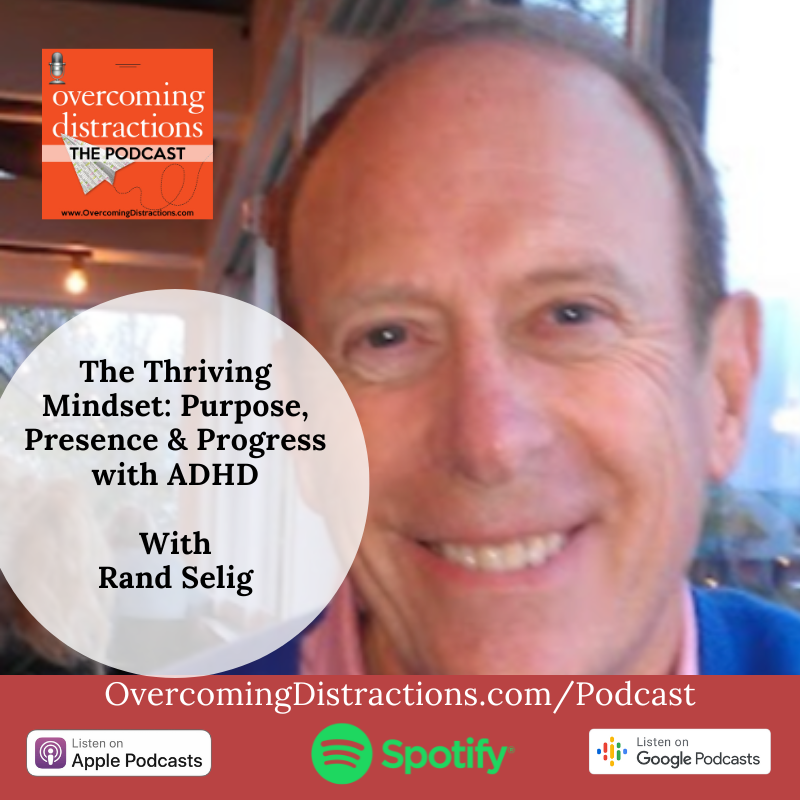
Overcoming Distractions-Thriving with ADHD, ADD
The Thriving Mindset: Purpose, Presence & Progress with ADHD
00:43:05
In this episode of "Overcoming Distractions," Dave welcomes Rand Selig, author of "Thriving: How to Create a Healthier, Happier, and More Prosperous Life." Rand shares his insights on what it truly means to thrive, especially for busy professionals...
Loading summary
Transcript71 lines
- [00:08]
A
I'm Dave Greenwood, and this is Overcoming Distractions. If you are an adult with adhd, a busy professional, an entrepreneur, a high achiever, or just need some strategies to navigate your adult adhd, you're in the right place. Who am I? I'm an entrepreneur with ADHD and the author of two books, Overcoming Distract and Overcoming Burnout. I coach and mentor people just like you, and together we navigate the ups and downs of adult adhd, from getting out of our own way to helping people just like you thrive in the workplace. That's what I do. Want more info on working with me? Hit overcoming distractions.com ready? Let's get to today's podcast. All right, gang, we're back. It is Overcoming Distractions. And if you are that busy professional with ADHD or you think you have adhd, then you are. You're definitely in the right place. You're a high achiever, you got a demanding career, lots of stuff going on in your life, then we are here to help you do a little problem solving, sort some things out, maybe get some ideas for thriving in business and life. And that's actually what we're talking about today. We're going to talk about thriving, and it's actually in the title of the podcast. So I'm super excited to actually have this conversation. How do we thrive as an adult with adhd, again, with that demanding career? And I don't know about you, but I don't want to just get by in life. I'm getting too old for that. I want to. I want to be fulfilled. I want to thrive. I want to have a sense of purpose in my life. I don't want to be grumpy. I want to be healthy, and I want to do things that matter in my life. So today we have Rand Selig, who is going to walk us through how we can thrive again, whether you have ADHD or not. So if you think you have ADHD or you just stumbled on this podcast, please don't hang up, because we're going to have a great discussion. Rand has an MBA from Stanford. He's earned undergraduate degrees in mathematics and psychology. I want to figure out how we got to where we are today with those degrees, but maybe we can chat about that. And he's the author of Thriving how to Create a Healthier, Happier, and More Prosperous Life. So welcome to Overcoming Distractions.
- [02:48]
B
Thanks very much, David. It's a pleasure to be here with you and your guests.
- [02:52]
A
Yeah. Can you tell us a little bit more about your work before we dig into the very big topic of thriving.
- [03:03]
B
Well, this has been a fantastic adventure. I began collecting materials when I was in high school, which is a long time ago. I'd write notes about a book that I thought was very interesting. I'd be collecting quotes, I jotted down ideas I had along the way. And many, many years later, I had this big, big pile and I said, what am I going to do about that? I know there's a couple of books inside me and there's a couple of book inside this big, tall pile and, oh, I started chunking it into what ultimately became the chapters for this book. This is not a story about me, although there are many, many little vignettes and things I bring in to just, you know, make the point. But it's, it's a book that really expresses my observations and a lot of research and science that I brought into this. I've had a lot of experiences in life, running my own company, living in different places on the planet, being a scout master, little league Coach, served on 18 boards, and I am a roll up your sleeves conservationist. So I've met a lot of people and a lot of people who are facing headwinds, who have pain points, and in many ways I've been there at the front lines to help them. But I certainly have come away with some thoughts that I'm trying to show showcase in my book as a compass for how to navigate through life.
- [04:42]
A
You, you just mentioned a couple things such as being a Scout master and doing some volunteering and, and other things about, you know, getting involved in the community. Is that maybe we can dig into this a little more. But is, is that that part of thriving in life? Is having that community part of your life and giving back and, and providing your skill set and expertise?
- [05:11]
B
Absolutely. Thank you so much, David, for bringing that up. People who are just really focused on themselves, maybe because they're struggling and they're just trying to get by. It makes sense. It's completely understandable. And I'm not passing any judgments about people who, who are not others. But when you are out there serving others and you're thinking about something other than yourself, life shifts. It's a dramatic change. You know, you invest in something besides yourself and you, you make people smile, you help people, you help Mother Nature. These are really important things to do. In a way, you become invisible to me. I think my happiest times are when I. It's not about me, of course. I'm. I'm in the game, I'm in the, in the play. So to speak. But. But I'm not doing this for me. And. And as you point out, there's also a possibility of building relationships, building a sense of community, which is, you know, heartbeat. It's really very good thing. So.
- [06:21]
A
Yeah, because, you know, we. We talk, you know, we talk a lot about burnout here too. One, because my second book was about burnout. But two, because a lot of busy people with adhd, they do experience burnout, and they experience it sometimes harder and faster and differently than neurotypical people. But. But one thing we talk about a lot is just, you know, we. We like to, like, hide and duck for cover and stay in our homes. And. And we talk about get out, get, get talking. At the very least, go, like, have a beer or dinner with a close friend. But I think other ways that they can thrive is by kind of getting involved in some aspect of your community. I mean, it could be as simple as helping out at the food pantry on Saturdays or. Or as you say, more extensive types of things. And I think that, you know, it may be hard for somebody to step off the curb at first at certain aspects of life, but I think they feel better when they do so well.
- [07:26]
B
I have very high bar for thriving. So it's not as if you're not doing all these things, you're not thriving. It's not that way. It's a very personal decision. It's a personal evaluation you do. But in my book, I talk about four big dimensions to thriving. The first one is thriving personally. That's actually half the book because it's so foundational to everything else. It talks about building character. It talks about having gratitude, talks about having purpose. It certainly engages with a whole series of emotions that we all have, whether they're the positive ones or the negative ones. It talks about spirituality and religion, if you have a religion that works for you. So there's a whole group of elements there. I say the most important relationship you'll ever have in your life is the one with yourself. So once you build that you're thriving personally, then you can go on and thrive with others. That's part two. You can thrive out in the world. Part three, which is just what we're talking about. Conservation, the environment, or being of service to others on boards or just volunteering. And there's so many different ways that can happen. Just right there out. Basically out your front door, right?
- [08:59]
A
Yeah.
- [09:00]
B
And the fourth part of thriving is thriving by moving ever forward in life, by evolving, by saying, okay, the. I don't. I'm not trying to be superior to my fellow man. I'm trying to be superior to my former self. That's true nobility, as Ernest Hemingway says. So those are the four dimensions. And as I say, that's a high bar. Thriving is not the weather. It's not about today, because today may be a cloudy, dreary day in Boston.
- [09:40]
A
Well, it actually is. How observant of you.
- [09:49]
B
Thriving is the climate. It's the average over time. And that's really where we want to be. And thriving is really fundamentally. And that's why I put it in the title. It's about being healthy. And of course that means physically, but I'm really talking especially about emotional health, healthy, happy. And there's some science about that that I bring up and happier to talk about a little bit today if, if you'd like. And then being more prosperous.
- [10:21]
A
Yeah.
- [10:22]
B
And this means also defining success our way, right?
- [10:26]
A
Yeah. I think a lot of people in this adult ADHD community, part of thriving is, you know, being fulfilled at the end of the week. Not like, like many people with adhd, they. It's just like a rat race to get to Friday and then like they're tired. And you know, part of that is like having some type of control or agency over their week where they actually do have the, the, the room in the. Quite frankly, the, the systems in place to actually be able to enjoy what they're doing, be enjoy leaving work, going home, you know, going to the kids baseball games, those types of things. But I think many of us do struggle in those areas. So you mentioned science, which I think is great. So I think you talk about that in the book. So what does that mean and how does it apply for people who are on a quest to thrive?
- [11:39]
B
Well, as I mentioned, this book is not just my own observations and my own experiences life. It does bring in a lot of information about the studies that have been done research and call it the science overall. And I'll mention three examples just to highlight a few. One is at the beginning of the book is there's a discussion about personality and there's. The primary way in which psychologists think about personality is something called ocean, which is the big fight. Call it the big five. An ocean is a way of defining your personality. Are you open, open to new experiences? That's the O. C is are you curious? E is whether you're. Where are you on the spectrum of extroverted to introverted? And you need to. We're living in an extroverted world. So if you're introverted And a lot of people with, you know, challenges, like the ones we're talking about are maybe not technically introverted, extroverted, but they're challenged by that. So they need to understand this and take. Do things. And there's discussion about that and some great books that I recommend.
- [13:05]
A
Okay.
- [13:05]
B
Yeah, there's a. Which is for association, which is associability, just going out and having a beer with a friend or getting on the phone or something. And then n is whether you're neurotic, which is as opposed to being centered. And so that. That's one. That's. That's really key. And what, what, what. What's important about all this when we're facing challenges is our resilience, our ability to get our way through is by knowing ourselves, knowing what we're good at, and knowing what we are really what our. Our kryptonite is, what. What we're not good at and either leverage ourselves and have other people help us with that or stay away from that as much as possible. So that's. That's personality. I did mention introversion. There's a fantastic book I At the. In the appendix to my book I mentioned, I have a paragraph on 75 books that I've read that really impacted me. And one is a book called Quiet by Susan Cain.
- [14:12]
A
Oh, yeah, yeah, yeah. Okay.
- [14:13]
B
Oh, my gosh, what a fantastic book. I really highly recommend. Recommend that I am. I test as an introvert. Strongly as an introvert. People are shocked when I say that. But I say the definition, the technical definition of being an introvert is that after a lot of social stuff, I need to withdraw. I need to recharge by myself. And I also know that I do my best work quietly by myself, creating an agenda, thinking what's going on, coming up with a plan for the next week or month or whatever it is.
- [14:47]
A
No, and I think you cite a very common example. I. More so in the neurodivergent community. But I think other people in general is. They're like, I'm done with people today. You know, I mean, let's just call it what it is. And you're like, I just don't have any more energy to be able to. People quote, unquote. Yeah. So. And you need time to kind of refresh it. It actually, I believe, kind of chips away at your executive functions. You know, you do expend a certain amount of energy having to deal with people.
- [15:34]
B
Oh, there's no, no question about it. And, and especially if you have a position where you are in Charge of something and you're managing or, or if you're leading separate kinds of functions. Leadership versus management. Yeah, but less is often more. And, and when you find yourself hungry, when you find yourself tired, when you find yourself just not able to concentrate anymore, you need to pull away and, and recharge and give yourself that benefit.
- [16:08]
A
Yeah. I've talked about this before. I used to own a restaurant outside of Boston and it was sandwiches, ice cream. And so there were times where there was like a line out the door and I would very often just walk away for five minutes and actually go in the walk in freezer and shut the door.
- [16:35]
B
Cool down.
- [16:36]
A
I would cool down. There was nobody talking. And I'm like, I just need to walk away. I need to, you know, the fans blowing, but other than that, there was really no other noise and nobody talking to me. But, but sometimes we just need to walk away in order to thrive, right?
- [16:50]
B
Well, it's really the case. I think people who are most positioned to continue to be fulfilled and healthy and happy and prosperous are people who can take care of themselves. They know how to do that. And everybody needs care. I mean, there's nobody who doesn't. It's only a question of what, how often does it come up and what do you do about it? Have you put in into your life on a daily basis? Maybe, maybe, you know, chunks of the day where you're taking care of yourself. Are you going into that cooler? Are you taking some deep breaths? Every week I go for a walk often by myself, where I'm just slowing things down. That's so important too, because I, I have a lot of responsibilities. I have a lot on my plate and I enjoy it. So I'm not busy, I'm just delightfully scheduled. But there are times when I just need to sort of say, okay, relax, calm down. Yeah, notice the beauty, notice the bugs. Look at the leaf on that tree. Right, just.
- [18:09]
A
And that's that, that self awareness piece, which I think a lot of us do have a little bit of difficulty with. And you know, I've used this example numerous times, but there is a lake, you know, a couple miles from my house is very close, but it's about two and a half miles or so around the lake. But it's dead quiet up there. And oftentimes I walk up there, you know, it takes me 40, 45 minutes to walk around. But just the, the environment, the act of walking, the act of being out there with no noise, so to speak, no distractions. I always not only feel better when I say get back to my car, but I've always, like, sorted something out or solved the problem that. That I might be struggling with that you can't do when you're driving in your car or you're between meetings or you're eating lunch. You know what I'm saying? It's just like there's a. There, a. There's an element of. Of fuel there.
- [19:10]
B
That's a very good point. And I think the imagery of what you just described is. Is very nice and very clear. You know, I've been asked many times, well, you talk about taking time to yourself and taking a walk in nature, but I like to catch up and listen to some podcasts while I do it, because that's. This David Greenwood, guys, podcasts are great, and I want to listen to him. And can I.
- [19:36]
A
Thanks for the plug.
- [19:39]
B
Can I walk in nature? Take that walk you're talking about and listen to my podcast. And my answer is yes. Just check to make sure it's working for you. And I would just suggest not knowing you very well. Don't listen all the time to the podcast and take the walk. Sometimes just unplug, just. And stop. Don't move. Just stop.
- [20:04]
A
No, but that you. You bring up a really good point, and that is like my general rule for things like that. So, for example, I love to go to the gym because, you know, for various reasons, you know, health, it. It helps me with my energy, and I'm getting older, so I got to keep my muscle strength up. But when I go to the gym, I do put in a podcast. I do put in the book. And for some reason, that environment allows me to pay attention very well. I absorb what I'm hearing. When I go for a walk, it's headphones out. It's just the sounds of nature. And I see more people taking a walk, and they're on their phone or they're FaceTiming somebody or they're having a meeting while they're. When they could be actually taking advantage of that time by themselves in nature. And it just. Maybe they had to take the meeting. I don't know, but it just kind of frustrates me.
- [21:02]
B
Well, let me. Let me move us one more direction. And that is being present. So being present is that moment where you're actually stopping. You're looking at the. The bird in flight. You're looking at some, you know, amazing thing in nature, something that you may understand something about, maybe you don't. Maybe you're just simply in awe and appreciation of. That's Fine. But there's another kind of presence. And we talk about this. We see people doing this periodically where you're talking to them and that's all that's happening. They're not seeing anybody else but you. They're hearing you close carefully. They're watching your body or your facial reactions. And, you know, it's amazing when you're. You're in that moment with them. And I, I discovered actually fairly recently that my happiest moments are actually when I'm fully present with somebody else. It's so much joy. I'm, I'm just listening. I'm soaking it all in and, and then I'm asking questions. I'm following up. I'm not. While they're talking, I'm not thinking. I'm just take you there.
- [22:19]
A
And in, in, in. In Defense of the ADHD brain. It is difficult. Sometimes we. Our minds do wander. It's the way our, Our brain is wired. But I always. And I've mentioned this a few times, and we're actually going to do a podcast about this entire book, but the Courage to Be Disliked. And I forget the author's name, but it's about the. The teachings of Alfred Adler.
- [22:43]
B
Yes.
- [22:44]
A
That if you sum up the book, it's like, we. We can't live in the past, we can't live in the future. We've got to enjoy the present. That is his philosophy. I understand parts of the book are a little controversial for some people, but the gist of it is we are happier when we're living in the present. Correct.
- [23:01]
B
Oh, I, I think that's certainly my experience. I think that's the experience that I've observed with a lot of other people. I am a big planner and I'm very aware of my past, my history. I am the author of my own story, which means I understand my history, and that gives me great power to create future possibilities for myself. And I'll throw in another line I like to say, is who is driving your bus? If you're in charge and you're making the right choices for yourself and you're taking care of yourself, then you're the driver of the bus. You're deciding how fast to go, when to stop, when to turn right and when to turn left, when to invite new people onto your bus. Yes. Sometimes you got to be social. Gotta take a little bit of a risk. Say, hey, would you like to have a cup of coffee? And when to invite people off your bus. Some people may have been fine for a while or maybe really close but things change, you change. And so sometimes people who are, I'll use the word toxic, but certainly in some way depleting of, you need to be invited off your bus. And these are all powers, incredible powers. We have the power. If we exercise those powers, then we can get on this path to thriving.
- [24:28]
A
Is that what you. I know you talk about intentional decisions in our life, whether it's, you know, whether it's career or personal or home life or what have you. Is that what you're talking about as being. I, I will, I'll defend the ADHD community. We also have a problem with decision fatigue. Like something as simple as what am I going to wear to the gym today? But on a more bigger scale in terms of, as you say, steering the bus. So how, how, how have you experienced or what do you talk about in the book about those intentional decisions like guiding us to our North Star, so to speak?
- [25:13]
B
Well, I, I think the, the thriving element that becomes available to us is when we're making decisions, decisions and making choices. That means you're saying no to some things and yes to others. Choices about how we're spending our time, who we're spending our time with, what our habits are. So you need to do an inventory. What, what habits do I have? Which ones are really serving me well, which ones are bad habits and I need to chip away at those. There's some really great Atomic Habits is a great book. I highly recommend that one to people. And then what. How we're feeling. And yes, those are choices too. One I like to showcase a lot is the habit of being positive. I am relentlessly positive and it's not like I'm being Pollyannish about things. You know, I have reasons for doing that, but I know what the alternative is, which is to be cynical, which is to be angry and anxious. These are not days. They do not serve me well. I don't think they serve very many people well at all. So I choose to a series of emotions to be and be positive is one of the keys to that. So yes, I think these, these are intentional, very intentional. And they start with the self awareness. I know myself very well. I know what I'm really good at and I know things that are hard for me and I know things that I have to continue to work on. And I gotta say I also am kind to myself because I'm a work in progress. You know, I'm a piece of clay. I'm not there flat a block, you know, I have some shape and I can hold some water.
- [26:59]
A
That's right.
- [27:00]
B
So, so that's, that's all, that's all good. But, but I, but I know and I, and I actually take delight in the fact that I am evolving, I'm becoming a better person and I, I enjoy that. I, and I, I, I can celebrate that either privately or with special people I've allowed into that kind of a conversation with, with me.
- [27:21]
A
Yeah. Now how, let's get to the end goal. Or, or is it a consistent goal or is it more of, as you mentioned, the atomic habits type of thing where it's just consistency. But how do we know, know when we're thriving? Is it when we are doing the things you talked about like the consistent self awareness and the consistent work on ourselves and the consistent trying to stay positive or what, what, what elements make up thriving?
- [27:55]
B
Well, it is a very personal thing. And so David, what would you would talk about and count on your top list would be probably similar, but maybe a little different than the ones that I would put on my list. I think they, they aggregate into some common denominators. Yeah. You know, at the end of the day, are, do you, do you feel good about your day? Do you feel good about yourself? Do you, are you complaining? Just listen. Which words are you using? Are you coming back from experience saying, hey, that was interesting, that was fun. I learned something. I'm looking forward to something. Are you pulling back and saying no? Are you smiling? Just pay attention. You can sort of feel. You don't have to just look in a mirror to know whether you're smiling or not.
- [28:46]
A
Right. I'm doing a lot feeling your face.
- [28:49]
B
You can feel it. You can feel, you can feel your body, you know, just be in touch, that sort of feedback loop of the physical and emotional self, you know, you know, when you're thriving. And you know, my, as I say, my standard is very high. You don't have to do all of those things to say, yeah, check, I'm thriving, that's okay. And as I say, it's also the average over time, it's the climate. So don't worry that you're having a, you know, not so good day. That's okay. Don't worry about that.
- [29:20]
A
Yeah, no, and I think it's important for us to define that, as you say, for ourselves and maybe thriving. When I was 25, 30 years old, I might have a different definition 10, 20 years later. Correct. Life circumstances change, industries change, our jobs change, those types of things. Family dynamics change. And I think it probably does make sense to us to, I Don't know if redefine is the right word, but understand what thriving means at different parts of our life. Right?
- [30:06]
B
Very well said. Yes, absolutely. I am a big advocate for being a lifelong learner. And why? Just for the reasons you say. The world is changing all the time and we're changing all the time, so you need to reset, re. Establish the new you and find the joy and the beauty in that. I think a big part of being a lifelong learner is being curious, and that's a choice. You can look at something, say, I don't understand it too much, I'm going to walk away. Or you could say, hey, when I get around to that, I'm going to pick up that book Atomic Habits, or I'm going to read the synopsis of it or something. I'm just curious, how does that work? Why is that bug doing something? And you may not have to go do a Google search about it. You just say, just open yourself up.
- [30:56]
A
So I'm gonna, I'm gonna do a complete sidebar here for the moment because you just mentioned bugs. So. So up here in the northeast, spring is like ant season, right? So, so ants are coming in the house. So I'm sitting there having lunch with my son, and there's an ant carrying a dead ant on his back and walking. I'm like, that's odd. And he keeps picking him up and dropping them. And so I googled it. And then I realized this. I guess this is thriving, right? I was curious. Ants, ants pick up dead ants and get them away from the colony because they emit some toxins that can wipe out the rest of the colony. I'm like, these guys are smart.
- [31:41]
B
Wow. Oh.
- [31:42]
A
But I'm like, to your point, it's just like, it was like, I'm sitting there eating lunch and, and I'm watching this ant walk around the floor and he's carrying a dead end. And I'm like, I'm curious.
- [31:52]
B
Well, notice that when you told the story, you laughed, you enjoyed, you enjoyed the experience of it, like I would.
- [31:59]
A
My, My great grandmother used to say, you learn something new every day.
- [32:03]
B
There we go. Well, we, we can allow ourselves that, that, that great pleasure. Absolutely.
- [32:09]
A
Yeah. So I always, it. It's a part of this podcast is I want people to be able to walk away after listening to this podcast and maybe just implement some things in their life or just think about things or not so much action items or a to do list. But hey, maybe I'll try that. Or, hey, that's maybe next time. Whatever, maybe I can implement this or think about this. So do you have a basic roadmap for thriving? And, and I, I, I add to that the, the busy professional, a person that has a, a demanding life, busy career, kids, maybe they are volunteering their time. So they got a lot of things going on. So, and if they feel they're not living their life to their fullest, is there a basic road map of things that they can be thinking about to maybe feel better about thriving?
- [33:06]
B
Well, absolutely, yes. And in fact, the testimonials from my book. I'm delighted with these amazing testimonials. The head of Kaiser Permanente, Chip Conley, who's, you know, a giant in so many ways, and others have said this is a compass. This is a roadmap for how to go about living life. It's, it's not to, to be or not to be is how to be or how not to be. That serves you. You know, again, this is not me saying, hey, here's the gold standard. And if you don't check off all the boxes, boo on you. Not at all. This is making it work for you so that you're having a life that fulfills you and allows you to move forward to reach your potential, this marvelous potential that you, you have. So I would say, especially for the population that we're talking to here, people who are fully engaged, I understand that's what my life has been all about. Intentionally, purposely of having many, many things going on. People who may be struggling with decision overload or any other kind of overload. I'm going to pick five things that are part of, not necessarily a roadmap, but just a set of really good things to take on. One is, as we were talking about, slow things down at their times when absolutely, just move away from the busyness. Whether that's the business at the desk or the business of too many people or the business of too many things on the list. Slow things down. Second thing, some challenges we face are complicated. A lot of our emotions are complicated. Break them down into pieces, chew them down into bite sized things and then address them bit by bit, step by step. Third is just be grateful. Be grateful. This is really important because think about, you just got bad news, maybe you got fired, maybe you got a medical diagnosis. Not good. Well, you can go into a tailspin, you can go downhill very quickly. You can see somebody else promoted when you think they're chumps. And that's just unfair. And feeling that something's unfair is a terrible feeling. Instead of that, you can say, wait a minute. What. Let me look at the situation. What parts of this can I be grateful for? Wow, look at this. The diagnosis could have been a lot worse. Look at all the support I have that is really helping me, that I can actually have somebody to talk to who understands me, who cares about me, who's going to be there if I need something. There's ways to be grateful. So that's a really big. A big one. Willingness to say no.
- [36:17]
A
You know, you hit the nail on the head on this place.
- [36:22]
B
Yeah. Yeah. And, you know, is there a risk to saying no? Well, yes, but it's not as big as a lot of people think. And the benefits of saying no can be enormous. And there's. There's a. There's. I'll call it a technology of saying no. Sometimes you just say, oh, thanks very much. That's not for me. Sometimes you say, I'd like to very much appreciate that invitation, but it's not the right time. Let's talk again in the future. Or you could say, oh, I'd like to do that. Can we add this, this, and this into it to make it work so I could be really effective and do something? So you're controlling the no, and you're controlling the. The outcome of the yes. So saying no is something a lot of people struggle with. And then the fifth element, I'll say, is ask for support. We don't get a lot of feedback in. In our society. They're sort of frowned on, you know. You know, Dave is wearing this blue shirt today. I don't know about that. Blue's not my favorite color. Actually. It is, but. Yeah.
- [37:29]
A
You know, you should see my closet. There's every shade of blue on the color chart.
- [37:37]
B
I've got the image right now.
- [37:39]
A
Yeah.
- [37:42]
B
So these are all parts of how we can be and how we can manifest our own authorship of our lives, our story, and where we're driving, how fast we're getting there, and what choices we make along the way. It can be. It can be. It can be fabulous. And we got to own that. And we get. We got to own it ourselves. This is where. Defining for ourselves things that are so important, like success. I've met a lot of people who are. Who are very wealthy. I've helped them become more wealthy by selling their company. And then sometime later, people say, oh, you know, all those people really successful. I say, I gotta tell you the truth. Some were. But many, maybe even most were not. Because, look around, they had a big bank account, a big investment portfolio. But their relationships were failed. The business relationships, the personal one. They weren't talking to their kids anymore. These are not successful people. That's my definition, but I'm going to stick to it. You know, success is something we have to define for ourselves. And it's not a balanced question. It's way beyond balance. That's a term that we overuse and misunderstand. What we need to do is create an integrated function of a series of things that are really important to us, and that is, of course, financial things matter, but relationships are key. Having gratitude, I think being a lifelong learner. Yeah, these are, these are things I put in. Having a sense of spirituality, which is going to nature and being in awe and having humility. That's really important. The more you accomplish, the more you have to realize that, hey, I didn't get on top of that tall telephone pole as a. As a turtle by myself, right? Yeah, yeah, I borrowed that from Jane Goodall.
- [39:47]
A
But you, you describe, you said own it, and I think that's what people need to. There are many people, ADHD or not, that I think constantly go through life in response mode, so to speak, instead of actually owning their life, owning their, Their crap. Owning. Yeah, owning the good stuff, owning the bad. And then I don't want to be Tony Robbins and say, design a life, but when you own certain aspects of your life, that sounds like that's a pretty big key factor in actually thriving.
- [40:28]
B
Absolutely. And own the challenges.
- [40:31]
A
Yeah.
- [40:32]
B
You know, again, we all have them. Maybe part of the issue some people struggle with is, oh, I'm the only one who has this, or my problem is bigger than your problem problem. Well, you know, it doesn't matter what, what matters is that how you're dealing with it, you know, you, you know, recognize the good stuff and, and then take on the challenges as you can and be gentle with yourself. Be kind. Be kind.
- [40:57]
A
Yep. Be kind. Great. Thank you for coming on. I thoroughly enjoyed this conversation. It's, you know, we, we talk about things like time management and getting things done and everything else. And, and I always love the conversations about how we can kind of steer the direction of our life and our career, etc. So where can people find you?
- [41:23]
B
Well, my book. Here's here. I'm holding it.
- [41:27]
A
He's holding it up right now for you folks.
- [41:29]
B
Yes, yes. Thriving how to Create a Healthier, Happier, More Prosperous Life is available, I'm happy to say, everywhere, certainly at Amazon, but it's at the independent bookstores, too. Sometimes you gotta order it or have them ordered for you, you can go to my book website www.rand selig r a n- dash as in sam e l I-dot com and there's a lot of information about the book, the testimonials, my bio, a description of the book. There are 40 quotes. My favorite quotes by chapter. People say they printed them out and they just look at them. They say this is the one for me today. There's a media page where I don't update it very often but a list of podcasts that I've been on and and then a connect with Rand and of course throughout you can order the book. You just press a button in order the the buck.
- [42:28]
A
Great. Highly recommended. So thank you again for coming on. This has been a great discussion and please come back anytime.
- [42:37]
B
Oh David, let's plan that. Let's definitely do that. That'd be great. I've enjoyed it thoroughly too. You're a great host and it's fun right. And hopefully impactful.
- [42:50]
A
So people will have ran back soon. So thank you again are a great discussion.