← Overcoming Distractions-Thriving with ADHD, ADD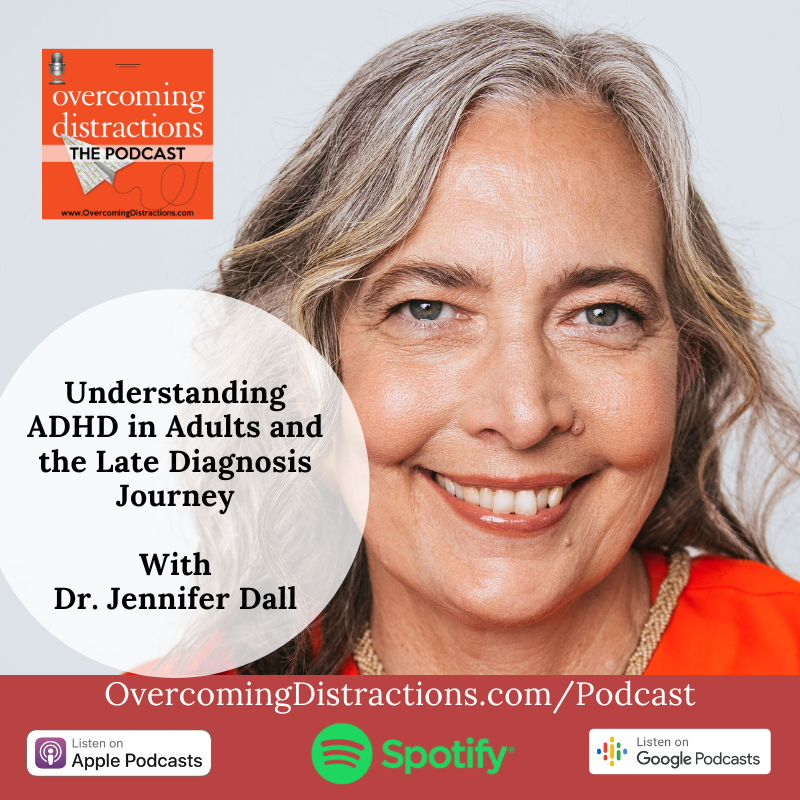
Overcoming Distractions-Thriving with ADHD, ADD
Understanding ADHD in Adults and the Late Diagnosis Journey
00:33:18
Loading summary
Transcript76 lines
- [00:08]
A
I'm Dave Greenwood and this is Overcoming Distractions. If you are an adult with adhd, a busy professional, an entrepreneur, a high achiever, or just need some strategies to navigate your adult adhd, you're in the right place. Who am I? I'm an entrepreneur with ADHD and the author of two books, Overcoming Distract and Overcoming Burnout. I coach and mentor people just like you, and together we navigate the ups and downs of adult adhd, from getting out of our own way to helping people just like you thrive in the workplace. That's what I do. Want more info on working with me? Hit overcoming distractions.com ready? Let's get to today's podcast. All right, everybody, we're back. Welcome back. You are on Overcoming Distractions. If you are that busy adult with ADHD or you think you have adhd, we don't turn anybody away here. So welcome. And as I always say, if you've been listening for a while, welcome back. If you're new, then welcome. I think you are in the right place. So, and as I always do, we try to kind of get right into our discussion. So, so, but let me just set this up a little bit. As you've seen in the title, we're going to talk about maybe not being aware you had ADHD in your, your teens or your twenties or even your thirties. Right. So, and I can't tell you how many people have come to me over the years that I have talked to that I have helped through certain situations that got diagn in their 40s and 50s. And, and I think some of us may have thought we had ADHD and, or over the years maybe started to kind of realize that maybe our brains operated a little differently. So in one very common scenario, and I think our guest probably has heard of this as well, is, you know, I hear this over and over again where an adult took their child to get diagnosed and then the doctor looked at them and said, hey, you know what, maybe you should go and, and see somebody and just run through the, run through the process. So I also know many people in this situation did great in school, have advanced degrees. I've talked to many of you that are PhDs, CEOs, etc. Etc. Have immense success in your career and in your life. But then life happens and then we realize that maybe part of us starts to have some challenges of keeping up and we ask why? So, so today we're talking about being diagnosed later in life that could be 30, 40, 50 years old and so on. But even if you were diagnosed as, as a kid, don't, don't tune out. I think you're going to learn a lot about yourself, hopefully and I think you're going to take away some good stuff here. So, so today we Jennifer Dahl. She is a grief informed neurodivergence specialist and the founder of ADHD Holistically. And she empowers people with ADHD to transform daily struggles. I know we have them into opportunities for growth and self discovery. Did I get most of that right?
- [03:58]
B
You got most of that. You got all of it right.
- [04:00]
A
Cool. All right, so. So before we dig in first, welcome. I'm glad we were able to connect. I know we've been trying to connect for a few months here and life has happened, so. But I'm glad we were able to do this. So would you just tell people briefly about again, who you are, your practice, who you work with, that type of thing. Sure.
- [04:25]
B
I'm Dr. Jennifer Dahl. I, I am an ADHD coach and consultant and writer. I'm getting more into the creating end of it. I work with mostly women, but also I will not turn men away diagnosed or believing once again, not turning anyone away, that they have adhd. Mostly those in the learning process. Even if they knew when they were younger, they might, they probably didn't know what that meant, actually. Yeah, I myself was diagnosed fairly recently after spending quite a bit of time wondering and trying to figure it out. I don't know if it's a benefit or not that I worked in education and I have, you know, a doctorate and everything. And I, I just kept thinking and thinking and wondering and as we learned more and then I finally stood up for myself and went to my doctor and said, hey, I really think we need to talk about this. So that's the short, the very short story.
- [05:21]
A
Yeah. Well, okay, so let's dig into that. So was there an aha moment for you when you might have suspected you had adhd? Was there something kind of going on in life or life changes or what have you, or did you finally say, man, I have adhd?
- [05:44]
B
There were a lot like, I kept coming across things and I'd ask people who I thought would know and they would say, there's no way you don't. And part of that, I think, is that what we knew about ADHD in women, I would say the aha moment was shortly after the pandemic. I had, I had been teaching and then I went to administration and I went back to teaching because I wanted to students. So this was like really early when we first Went back and there was a girl in one of my classes who had adhd. And every time I looked at her and everything she did, I said, oh my goodness, this is me. This is me in middle school and probably still now. And that was just finally the click. I know when I started there was mostly boys. I had mostly boys. You know, we tended to diagnose a lot of them. And so it was seeing this girl and then also realizing that she was getting so much more support. We knew so much more about her. And so then it kind of, I think, and a lot of people with ADHD who find out about it say, oh, if only, like I wonder, I wonder if, you know, when I was her age. So she, she was like the impetus that just really. Wait a minute. Stop playing around.
- [06:59]
A
Yeah, but, but historically, and I've heard this over and over again, we always, we always, not always, but we talk about kind of the difference between boys and girls.
- [07:11]
B
Yes.
- [07:11]
A
And an adhd. And I know, you know, I'm a product of the 60s, I'll just put it that way. Okay, but, and I know, and I think probably it may continue to this day, not to the extent, but I always say the, the boys were ripping apart the classroom while the girls were staring out the window. So yes, we got the attention. Right. We're the ones that, that, that noticeable kind of symptoms or characteristics, right?
- [07:47]
B
Yeah, yes, definitely. And I think a lot of the girls, we were staring out the window or had developed this ability to simultaneously take notes with like half an ear and yet be elsewhere completely. You know, fun. The words going down. I'm sorry, I still have this cough. What was I saying? Oh. And I think that with girls we have found that a lot of times some of their symptoms come out as behavioral or personality issues. You know, you're, you're lazy, you're not paying attention. And then as you get older, like into your teens, people see that as being defiant or other things. So we aren't acting out like you, but our brains are acting out. So we are very much elsewhere and have a hard time being in where we are. And so it just wasn't seen that way.
- [08:38]
A
Yeah, because I know for me personally, I, I, I won't shy away from saying that I was a, I was a train wreck as a kid.
- [08:46]
B
You were that 8 year old boy I like to talk about that everybody thinks about when they think about adhd.
- [08:51]
A
Oh yeah, yeah. I'm, I probably drove my mother crazy. I mean, just be. Because I was, I was so hyper. There was just There was so much energy that just needed to.
- [09:00]
B
Yeah.
- [09:00]
A
To come out when I, When I was younger. So now I would be perfectly happy living in a cabin in the middle of the woods. I don't know what changed.
- [09:10]
B
I think we've all fantasized about that.
- [09:12]
A
But, but, but I've. I've kind of learned to kind of calm myself down. So, so walk us through, because I think a lot of people, like I said, people reached out to me and said, I never got diagnosed. I think I have adhd. And some of us can figure it out by kind of the things they do or don't do or, you know, but if somebody's listening, walk us through your journey of, if you want to call it that, of being diagnosed later in life. I mean, how did you start the process? And what can somebody expect by being diagnosed in their 40s or 50s?
- [09:59]
B
So, as I think probably typical for a lot of ADHD, ADHDers, I did the deep dive on myself. You know, I did the research. I already knew a lot from my education, from what I was doing. But every time I would hear, and I continue to hear of a symptom or something because, you know, everybody with ADHD is different, I would dive into that and look at that and, and I. And it kind of snowballed. So as I started to learn that these things that I had done all my life were most likely related to adhd, I started to find more and more. I know that women tend to be, and sometimes men misdiagnosed or co. Diagnosed with depression or anxiety. So when I would say, I went through my life and school was very structured, I knew how to do school. School is a game. I knew. I stayed in school. I got master's degrees and a doctorate. I taught in school. I knew how to play that game. And I then I transferred it into, like, my family. And I think a lot of it really started to come out when I was then done with education. I'd gotten a doctorate. I mean, I could get another one, but I wasn't going to. My daughter went to college. And so, and, and the job, I changed jobs to a different job within the district. And so so many things changed. And all those str. Went away.
- [11:22]
A
Yeah.
- [11:23]
B
And that's, I think, when I really started to struggle and when more of the ADHD came out. But when I first went to a doctor, it was, oh, you have depression, let's give you an antidepressant. Which, you know, that happens, I think, a fair amount to women in particular. And that, that really didn't take care of much of it, you know.
- [11:41]
A
Right.
- [11:42]
B
Because it wasn't looking at any other option of what it could be. And the meds did all kinds of things to me. So we had that going on and going on and going on. And then we get thrown into a pandemic when even more structures are thrown out the window. And like I said, I just. I just kept finding things. And every time I would hear. And we started to hear more. Right. So then people started the conversation, became much more going on. And for me, because I tend to be that oldest daughter, adhd, Gen X, I'm gonna do it myself.
- [12:17]
A
Right.
- [12:17]
B
I. I went through so much of that, and I think the reason that I finally actually brought it up to a doctor was the belief that, that these meds and these things that. That I was being labeled as were very much wrong.
- [12:33]
A
Yeah.
- [12:34]
B
And it wasn't helping me. And it was time to really kind of re. Look at things, figure out what was going on and what I could do. And so I did. I. I talked to the psychiatrist who had been prescribing the meds, and we went through the whole thing. That was also during, like, late pandemic time when it was really hard to get in with anybody, especially with my personal healthcare system.
- [13:00]
A
Yeah. Any type of doctor at that point. Yeah, it was. Yeah.
- [13:04]
B
Yeah. And. And so I wasn't anxious to get on another med right away. And the process of going off the other one, because it was one of it, the worst to be on was difficult, but it was some validation. And then what can I do instead? Because I also felt like before, with. With the other things, the. The medical diagnosis is just, here's a med. Just take this. And I wanted to really explore what other things I could do, what other things. And then that led to me wanting to help other people because I know that when I hear other people's stories, it means something to me. And I. A lot of people would say to me that they learned a lot from me, that I inspired them, that, you know, they. I made them or I encourage them to. To look at themselves and do what they wanted to do.
- [13:52]
A
But I think you. You touched on something. Is one of the. The first things is you really should kind of do a little bit of research on your own. Because if I hear you correctly, you. You were misdiagnosed right the beginning of the process instead of. And I. And I hear this all. I hear it the other way around too, where somebody was, you know, diagnosed with ADHD and then ended up having Something else. So it's, it's a, it's a complex area for somebody to navigate, right?
- [14:26]
B
It is. And I think, you know, then you end up with a doctor. And it depends what your doctor knows and what you feel comfortable talking to your doctor about and what they hear. It's. It's very complicated because it can be both. But if you're only treating one, then you're not really helping everything and, and getting down to, to what it is. You know, another thing, they never did, like lab tests or anything, so, like, it could have been something else also. So my frustration with all of that is, is that they kind of jump to the first thing that they think of, what's on their radar. And so what I really like to tell people is to really dive into yourself, like, what's going on. If you think you have adhd, it's because you've heard something, some quiz, some survey, something somebody has said has triggered something in you. Has.
- [15:14]
A
Yes.
- [15:15]
B
Has caught your attention. So start there, like, find out more about that. Do you really. And whether you actually have ADHD or not, if whatever you heard about having time blindness, for example, look at that, see what you can do about that and then go from there. Because then if you do decide to go to a doctor, you have information and data and you know about yourself. And if they say, oh, well, we just need to wait or, oh, you just need more sleep or whatever, you can, you can fight back a little bit. And if nothing else, you can continue on that journey yourself because there's so much you can do without actually a doctor's blessing, if that's what needs to happen.
- [15:56]
A
No, and I think adding, you know, or continuing the conversation of complexity. I always like to say, you know, those of us with ADHD don't own procrastination. Right. We don't own some of these things we do or don't do. I mean, so somebody may be a huge procrastinator but doesn't have adhd, Right. There's just other going on that, like, you know, we always talk about the, the emotional aspects of, you know, what are your thoughts when you want to go write the report to your boss and you just can't do it. You know, those types of things, you know, does. Just because you goofed off on it doesn't mean you have adhd, Right? Yeah.
- [16:36]
B
Just because you have ADHD doesn't give you permission to just blow everything off. You still.
- [16:41]
A
True.
- [16:42]
B
Hopefully want to do your things, which that kind of leads into, you know, one of the Things I'm really interested in is, I call it ADHD plus one is this idea that, you know, even if you do have adhd, you probably also have something else. If nothing else, the stressors of living through this world, this life, you know, but other things, like, I know for me, with. With grief and other things, and they just all come together. And even for doctors, then separating it out is hard. So that.
- [17:10]
A
Not.
- [17:10]
B
That is all your job, but if you look inside yourself and like, what's really causing me the most struggle right now, like, what do I most want to start at? Because ADHD wants to take it all on and fix it all like yesterday. But, you know, starting the most success is like just starting really small and back. Back to what you said, like, whether it actually is ADHD or not. Taking a look at yourself, you can see and kind of go in there and. And try to make some little changes that, that might help out.
- [17:41]
A
Right. And then as. As we touched on you, you add different things going on in your life or different, you know, the new term is like seasons of life. So, for example, I would. I would guess that there are a good amount of people in their 40s and 50s that now have to maybe assume the role of a caregiver. They have aging parents, which can be stressful. It can be unpredictable. It can be. It can be a whole host of things which then gets us mentally and physically tired. And then, so. So now we've got. We've got all these elements like playing a role, and then we throw in adhd. So when maybe we, you know, we kicked a little ass in our job up to like 45. Right. And then all of a sudden, you know, we started to get stressed out and other things started happening. And then it just kind of came. Came to a boiling point.
- [18:43]
B
Right, right. Because you probably. Sorry, you probably knew the rules, the game of your job.
- [18:49]
A
Right.
- [18:50]
B
And then taking care of a parent or taking care of a child who's now a young adult, or other things that may be going on, this adds a cognitive load and a new game that you don't know the rules. And I think a lot of those extra things involve then other people. You know, with. At work you have these rules and there's HR and, you know, there's things you do and don't do, but dealing with your parents, your children, other people, other situations with other people. The rules are hazy. And so that just adds a big load, you know, cognitively, executive function, emotionally, all of that. That.
- [19:28]
A
Yeah, or the young professional that was crushing it. In business. And then all of a sudden, you know, kids come into play and they get exhausted because they, you know, you're taking care of young kids, and then you get to get them to the school bus. And there's all those kind of, you know, phases of life that, you know, before kids. Not that. I mean, kids are wonderful. Don't. Don't mistake what I say, people. Okay? But it. It does take an element of. Of energy out of your days and weeks in life that. That can make navigating other things a little more complex. So how. How do you. Now that you kind of went through this not as a kid? How do you advise somebody to handle or navigate that later in life diagnosis? Because I know I've talked to so many people, they feel relieved because they now kind of figured out why they did or didn't do certain things. Some people are just devastated, and they go through this process of, oh, I have adhd. And, you know, so how. How would you advise somebody to move forward after that process?
- [20:44]
B
Yeah, people feel that they. Sometimes they also feel a sense of grief, like I talked about, like, oh, what. What if we had known? Or anger. Why didn't anybody do anything? I think in navigating it, it's. It's one of those things where you really can work on looking at yourself, like, really examining it. Whatever kinds of processes help you get more into yourself and. And look at it, whether you're relieved. Okay, great. What do you want to do with this information? Because it's. Information is what it is. It doesn't. It's not a death sentence. It's information, you know, if you're sad about it, if you're disappointed about it. Okay, so I have this information. What part of it talks to me? Because you can see here this ADHD diagnosis, and you can get this whole list of hundreds of traits. But what really applies to you and what really both makes your life a little bit of a struggle that you could work on, and also not forgetting that there are good things to it. I don't. I'm not one of those ADHD is a superpower people. But, you know, there are ways, like the ways we tend to think. We tend to have the ability to come up with lots of ideas and think outside of the box and maybe embracing what you do well, you know, so that just like any other diagnosis, if you get sick, anything else, looking at what it really means, why you're telling yourself these stories and trying to move on from there. And maybe it means seeing a therapist, reading more, talking to somebody, a coach, taking a real look at your life and if there's changes that needs to happen, maybe you've been struggling at your job because of this and now you know why you're struggling. Especially sometimes, like after you've been promoted or something. You know, you've been really good at a job and then you get a promotion and that isn't matching your abilities as well.
- [22:40]
A
And it's a deeper conversation with yourself. Right. It's just like, oh, all right, I have adhd. Means I need to go on Amazon and buy a Timer.
- [22:46]
B
Cool.
- [22:46]
A
I'm. I'm fixed.
- [22:48]
B
Yeah. I mean, that might work, you know? Yeah. Really having those deeper conversations with yourself. What works, what doesn't work, most likely, you know, it's been there all, like, all along. So, like, what, what's one time in the past where I succeeded with something? What did I do? And can I bring it forward?
- [23:06]
A
Yeah. What was the environment? What are, what were the circumstances? You're. I mean, I think we need to look back and, and, you know, and I think a lot of people who are like, in the coaching or mentoring space, they always ask somebody on their sessions, you know, okay, what, what good things happened between the last time we met, what was positive? All right, you know, all right, now let's dig into what you struggled with and what do we learn from both of those. Those situations.
- [23:35]
B
Right, right. And celebrating that. And I really believe it is taking little steps, you know, back to. I want to buy this 500 page book on Amazon about ADHD and it's got a plan and I'm gonna have it all done by tomorrow. But, you know, I'm not. I'm going to read the first few chapters and it's going to go on the bookshelf and that's going to be the end of it. So really having those conversations with yourself, really figuring out where you want to start. Because just like, if you're trying to get healthy or anything else, you are not going to be as successful if you say, okay, and I'm going to go on this diet and I'm going to work out every day and I'm going to do all these things. What's one thing? Let's just start there and see some success. One of the ideas I've really gotten into lately is the idea of experiments about calling things an experiment. I'm just going to try this as an experiment and then I'm going to learn it works. Doesn't work. Maybe I can tweak it, but it takes some of the pressure off of. I'm going to make this huge change, but instead I'm going to try this. I'm going to try this and see if it works.
- [24:41]
A
No, it's like I want to go. I decided that I want to get into golf. I can either go buy $4,000 worth of golf clubs or, and a membership and you know, or I can go to the driving range, grab one of the old rusty clubs in the basket and hit a few balls and see if I like it. Or it's just like. Yeah, but I think you bring up a very strong point is that people do need to understand that it's going to be some trial and error. You're going to, you're going to try and do things differently and it's going to fail for whatever reason. Right. Or you're going to have a happy accident and realize that, you know, I was just talking to somebody. You know, I like the audio books, but when I put him in the car, I realized after 15 minutes I didn't hear a word that the person said. You know, the author said, I started listening to audiobooks in the gym and I heard every word the person said. I can't explain it, I'm sure there's some scientific whatever to it, but it was a happy accident. And I've, I've read, I'm putting my quotes up here. I listened, I listened to a ton of books in the gym in the past few years.
- [25:53]
B
Yeah. And instead of just being mad at you, Accident.
- [25:56]
A
Yeah.
- [25:56]
B
Like why can't I listen when I'm driving? I spend two hours a day commuting and I'm wasting all this time instead of, oh, I need something else then. But when I go to the gym, that's my jam.
- [26:08]
A
Yeah. Yeah, so what? And I know we've kind of touched on a little bit, but what did you learn that could help others listening to this? Maybe some kind of concrete type of things that, you know, after your diagnosis and then from your professional training as well, you know, what, what worked well and what maybe should you avoid? I know we talked about the four thousand dollar golf clubs and stuff like that, but, but I mean, I always want people to kind of walk away from the podcast with some kind of things to, to think about and maybe put into action, so to speak.
- [26:54]
B
So something that has been successful for me. And this also came about because like I said, I went from very structured environment. Maybe I didn't say this. I, I took early retirement at a certain point. I wanted to leave education after the Pandemic and all this. So I went from very structured all my life, very structured, to very not structured. And I've had to go through a lot of trial and error, a lot of experiments to get to some things that work for me and being able to manage my day. And some of those things are some of the traditional things you might have heard about with adhd, like the Pomodoro method and body doubling or co working. I like those a lot. A good part of the time, they help me focus in and my brain likes those structures. I've also begun working on scheduling my weeks for that. Each week I have what I call a sprint. So I have three days where I have a project, and I've gotten better at getting a project that will fit in. Not just three days, but the three days of that week. Because, as you know, some weeks have all kinds of things going on. And so it's helping me to break tasks down, get something concrete, have a win. And also I find it very helpful for restarting. So if something happens, which things happen all the time.
- [28:13]
A
Sure.
- [28:13]
B
Either in the middle of that sprint, I can restart and say, no, I'm still going to finish this by the third day or, okay, this week's gone and next week I'm starting again.
- [28:23]
A
Yes.
- [28:23]
B
So it's. It's a short enough time that it's not the end of the world if something goes wrong. It's a big enough time to get a reasonable project or task or part of a project done and feel some success. And then it leaves me other time to do other things and, and, you know, adhd, staring at the wall, whatever. But I have found some of those for me and for some of the people I've shared them with to be effective a great deal of the time.
- [28:51]
A
Yeah. And it's not all about just getting stuff done and meeting deadlines and I mean.
- [28:57]
B
Yeah.
- [28:57]
A
Do you do anything or recommend anything for people to have more of a positive mindset rather than just kind of, you know, I think we need to remind ourselves quite a bit, you know, especially as life gets more complicated and busy, that, you know, we're not broken. Even if it's the CEO or the, you know, or, you know, the, the business owner, you know, they're successful, but they have in the back of their head that, like, you know, part of me is broken. Right. So how. How do we, how do we do some simple things to remind ourselves that, you know, we're just. We're just fine, we just work differently.
- [29:41]
B
Right. So. So one of the Things is a lot of those are stories that we were told and that we've told ourselves and probably most of our lives going back to, especially if you didn't know you had ADHD and things were interpreted. Why don't you settle down? Why don't you pay attention? These are stories that are really deeply ingrained in us. And so when you find yourself being critical of yourself, if you can, again those deep conversations with yourself, why am I thinking this? And you know, some of those traditional, like, you know, is this true? Is it always true? How else could I see this? And trying to move forward with that. So I'm feeling like a failure because I didn't do something. Well, can I change it? Or can I change the way I look at it or actually did I do most of it? I'm being too hard on myself because I think a lot of that goes back to what we were told and how we've just kept that inside of ourselves.
- [30:35]
A
I like to read my old report cards and laugh instead of letting it drag me down. Because, yeah, they. They literally are the classic, you know, Dave needs to try harder. Dave needs to pay attention. It's just like they were like pulled out of a. The textbook kind of comments, you know, so. But now I. Someday I think I'm just going to post them and.
- [31:00]
B
Yeah, I mean, I think that would be really helpful for a lot of people. And that's a great example of. People told me this.
- [31:08]
A
Yeah.
- [31:09]
B
And this is why it's not right. It's why it's not true.
- [31:12]
A
Yeah. Yeah. I think they're hysterical. So. But good. I've gotten to. I've gotten to the point in life where I. I can think they're funny now, so.
- [31:21]
B
Right. Right. And some of that, it just takes time. It's like finding out anything else. It takes time. It's not gonna. And I know we want to. We want it fixed and we want it. We want to fix it ourselves tomorrow. And it takes time. And Grace and I have also found if you know other people who. With adhd, like, those are some of your best resources, if nothing else, just to be able to sit there and be yourself with somebody else who also is like that.
- [31:52]
A
Yeah.
- [31:52]
B
Not have to mask and hold that together.
- [31:54]
A
No, because it's true that a lot of people don't get us that. You know, I don't mean that. I don't mean that in a rude way. It's just like some people don't. Why don't you just do the thing and get it done? On time and why, you know, why you know all that. So it's just. Yeah. But. Yeah. Cool. All right. This was a great discussion. I think it is a very common thing for people. I hear it all the time. So thank you for sharing your thoughts and ideas and some strategies for getting diagnosed in your 30s, 40s and 50s. So where. Where can people find you?
- [32:32]
B
My website is ADHD holistically.com. i'm on Instagram@adhd.holistically. you can go there on my website. You can get. I have a free thing, 30, 30 hacks. Really quick, easy hacks that a lot of them we know. But sometimes just having that list and being able to look at it and remind ourselves you can find me those places. And I've been going out and just talking a lot more and trying to do more. More things.
- [32:58]
A
Awesome. Great. Well. Well, thanks for. Thanks for coming on and we'll have to have you back to extend this conversation.
- [33:06]
B
Definitely. Anytime.