Podcast
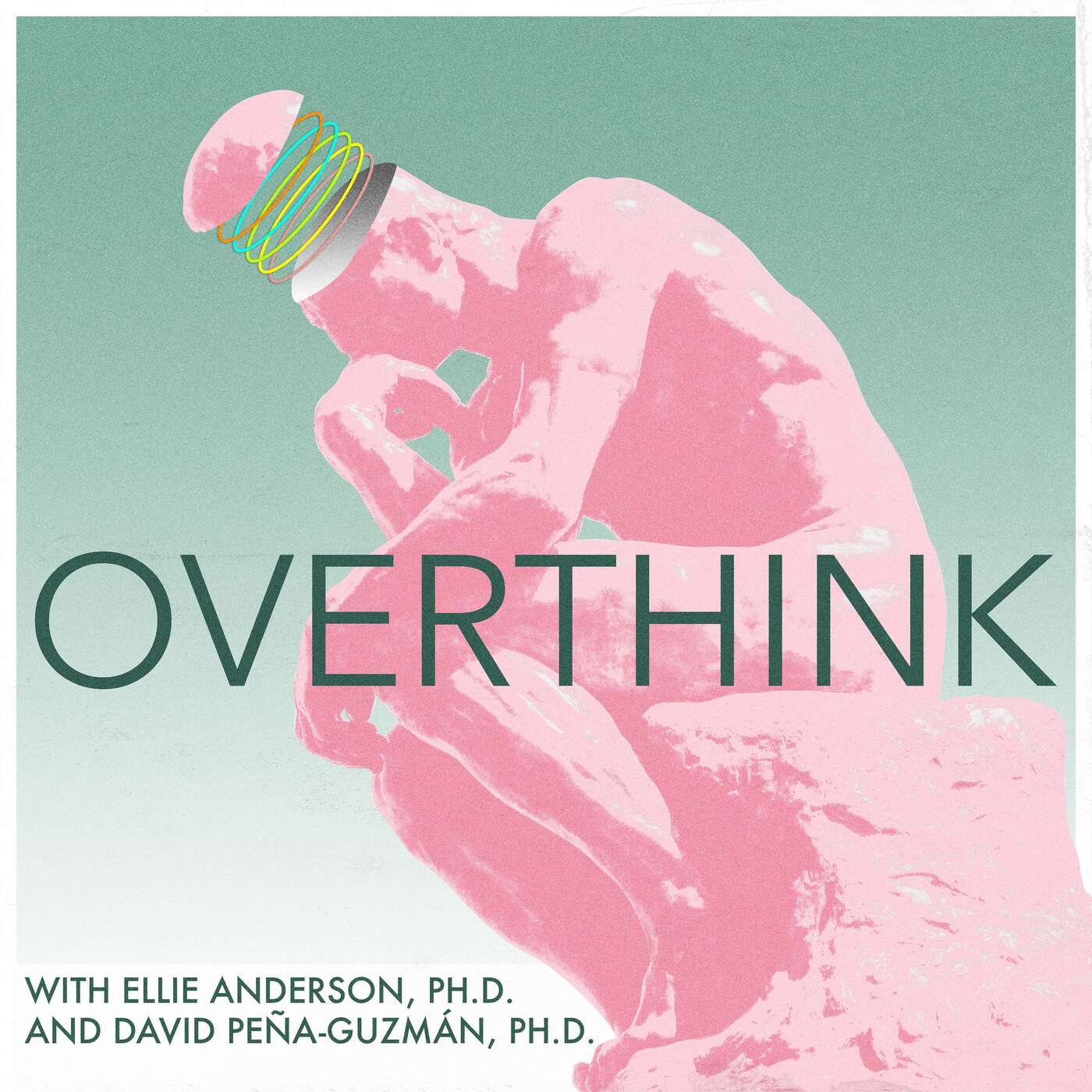
Overthink
Hosted by Ellie Anderson, Ph.D. and David Peña-Guzmán, Ph.D. · EN
The best of all possible podcasts, Leibniz would say. Putting big ideas in dialogue with the everyday, Overthink offers accessible and fresh takes on philosophy from enthusiastic experts.
Hosted by professors Ellie Anderson (Pomona College) and David M. Peña-Guzmán (San Francisco State University).
38episodes
Episodes
Newest firstAll episodes
Air
Jul 1, 202500:54:11Tap to summarizeTime to take in a breath of fresh air. In episode 133 of Overthink, Ellie and David close out their four-part series on the elements with air. They consider Anaximenes of Miletus’s belief that all things are made of air, Luce Irigaray’s belief that air is feminine, and the modern use of air as a weapon of battle. What can the TV series The Last of Us tell us about the inescapability of air Why have some philosophers thought the soul is made of air? And how does air allow itself to be forgotten? In the bonus, your hosts dive deeper into Irigaray, the plurality of air, and the idea of the ether.Works Discussed:Gaston Bachelard, Air in Dreams Steven Connor, The Matter of AirLuce Irigaray, The Forgetting of Air in Martin HeideggerElizabeth Povinelli, GeontologiesPeter Sloterdijk, Terror from the AirMax Horkheimer and Theodor W. Adorno, Dialectic of EnlightenmentThe Last of Us (2025)Support the showPatreon | patreon.com/overthinkpodcast Website | overthinkpodcast.comInstagram & Twitter | @overthink_podEmail | dearoverthink@gmail.comYouTube | Overthink podcast
Transcribe →Earth
Jun 17, 202500:42:09Tap to summarizeThis one’s going to rock your world. In episode 132 of Overthink, Ellie and David dig into the earth for the third part of their four-part series on the elements. They discuss everything from earthworms and carbon dating to the “solidity” of the earth. They look to Foucault, Freud, and Husserl for insights about how the earth can act as a metaphor for the mind and for the past. They also wonder: Is the earth inert matter or a living being? And why do so many creation myths present humans as “made” of earth/clay/mud? So, what is it that we actually mean when we talk about earth as an element? In the bonus, your hosts talk think through Heidegger’s notion of ground and horizon, and the Western association of land with earth.Works Discussed: Michel Foucault, The Archeology of KnowledgeMartin Heidegger, “ The Origin of the Work of Art”Edmund Husserl, Crisis of the European SciencesDavid Macauley, Elemental Philosophy: Earth, Air, Fire, and Water as Environmental Ideas Thomas Nail, Theory of the EarthJames Lovelock, Gaia hypothesisDorian Sagan and Lynn Margulis, “God, Gaia, and Biophilia”Support the showPatreon | patreon.com/overthinkpodcast Website | overthinkpodcast.comInstagram & Twitter | @overthink_podEmail | dearoverthink@gmail.comYouTube | Overthink podcast
Transcribe →Water
Jun 3, 202500:53:33Tap to summarizeOceans, baths, ponds, and amniotic sacs? In episode 131 of Overthink, David and Ellie take a deep dive into the topic of water as part of their four-part series on the elements. They discuss how all life begins in water, and the conceptual features of water, such as its fluidity and shapelessness. What did Thales of Miletus mean by ‘all is water’? How is water used as a metaphor for the Dao? And at what point does being in water go from feeling like Moana to feeling like Jaws? In the Patreon bonus segment, they talk about water as a symbol of purification, the significance of plate tectonics, and the relationship between AI and water usage. Works Discussed: Aristotle, On the Heavens Francis Bacon, Novum OrganumJamie Linton, What Is Water? The History of a Modern AbstractionDavid Macauley, Elemental Philosophy: Earth, Air, Fire, and Water as Environmental Ideas Anna Secor, “Spacetimeunconscious”Neil Shubin, Your Inner FishLao Tzu, Dao De Jing Peter Godfrey Smith, MetazoaSupport the showPatreon | patreon.com/overthinkpodcast Website | overthinkpodcast.comInstagram & Twitter | @overthink_podEmail | dearoverthink@gmail.comYouTube | Overthink podcast
Transcribe →Fire
May 20, 202500:53:57Tap to summarizeAre all fires inherently bad? In episode 130 of Overthink, David and Ellie launch a four-part series on the elements, starting off hot with fire. They look at the role of fire in Greek mythology (focusing on the myth of Prometheus), the evolution of humans’ relationship with fire, and fire’s role as the universal metaphor. Why did Prometheus steal fire from the Olympians and give it to humans? Why does Bachelard believe that fire is “the” philosophical element par excellence? How did Western culture turn fire from friend to foe? And what would a non-antagonistic relationship to fire look like? In the bonus, your hosts give their fiery takes on arson and pyromania.Works Discussed: Gaston Bachelard, The Psychoanalysis of FireStephen J. Pyne, The PyroceneStephen J. Pyne, “Fire in the mind: changing understandings of fire in Western civilization.”Support the showPatreon | patreon.com/overthinkpodcast Website | overthinkpodcast.comInstagram & Twitter | @overthink_podEmail | dearoverthink@gmail.comYouTube | Overthink podcast
Transcribe →Discretion with Barry Lam
May 6, 202500:51:38Tap to summarizeWhat value might there be in having fewer rules? In episode 129 of Overthink, Ellie and David talk to philosopher and host of Hi-Phi Nation Barry Lam about his book, Fewer Rules, Better People: The Case for Discretion. They discuss the problems with legalism and bureaucracy and the importance of discretion, as well as how the emergence of AI affects decision-making, and the negative impact of too many rules on our criminal justice system. Are we obliged to follow government rulings? Why is the ‘by the book bureaucrat’ the biggest villain of all? And how can we train people to make better discretionary decisions? In the bonus, your hosts consider the effects of decisions based on private morality and whether there are cultural differences in discretion.Works Discussed:Ronald Dworkin, Taking Rights SeriouslyBarry Lam, Fewer Rules, Better People: The Case for DiscretionPlato, CritoSupport the showPatreon | patreon.com/overthinkpodcast Website | overthinkpodcast.comInstagram & Twitter | @overthink_podEmail | dearoverthink@gmail.comYouTube | Overthink podcast
Transcribe →Cleanliness
Apr 22, 202500:55:39Tap to summarizeEpisode 128 – CleanlinessHow often should you shower to remain ‘clean’? How many times can you re-wear your jeans before they are considered ‘dirty’? In episode 128 of Overthink, Ellie and David take a look at cleanliness. They get into how humans have turned cleanliness into an art, and maybe even an obsession. Why are we so bothered by dirt? What is dirt, anyways? How are notions of dirtiness and cleanliness even into our symbolic systems, including language and religion? And what is up with TikTok’s obsession with the Clean Girl Aesthetic? As they tackle these questions, your hosts also explore the historical weaponisation of the concept of cleanliness against marginalised groups, such as queer people and people of color. In the bonus, Ellie and David discuss cleanliness as a social construct, the link between it and isolation, and Michel Serres’s ‘excremental theory’ of private property.Works Discussed:Bruce Bagemihl, Biological ExuberanceDana Berthold, “Tidy Whiteness: A Genealogy of Race, Purity, and Hygiene”L’Oreal Blackett, “In The “Hygiene Olympics” Black Folks Always Win — But Aren’t We Tired?”Mary Douglas, Purity and DangerVirginia Smith, Clean: A History of Personal Hygiene and PuritySupport the showPatreon | patreon.com/overthinkpodcast Website | overthinkpodcast.comInstagram & Twitter | @overthink_podEmail | dearoverthink@gmail.comYouTube | Overthink podcast
Transcribe →Oligarchy
Apr 8, 202500:54:03Tap to summarizeIs Trump’s presidential reign turning the US into an oligarchy? Or did the US fall into oligarchic rule many years ago? In episode 127 of Overthink, David and Ellie dive into what an oligarchy looks like, the dangers of a country’s power being in the hands of the wealthy few, and whether or not oligarchic rule is new for the US. They look to the ancient Greeks for ideas on which form of government is conducive to the good life and explore how Aristotle’s notion of pleonexia relates to the current state of the US. Your hosts investigate how oligarchy morphs into tyranny, and try to answer the question, “How can we resist an oligarchy?” In the bonus, Ellie and David look at the four different types of oligarchy discussed by Jeffrey Winters.Works Discussed: Aristotle, PoliticsGordon Arlen, “Aristotle and the problem of oligarchic harm: Insights for democracy”Thom Hartmann, The Hidden History of American OligarchyPlato, Republic Luke Winslow, Oligarchy in America Jeffrey Winters, Oligarchy Support the showPatreon | patreon.com/overthinkpodcast Website | overthinkpodcast.comInstagram & Twitter | @overthink_podEmail | dearoverthink@gmail.comYouTube | Overthink podcast
Transcribe →Disagreement
Dec 31, 2024Tap to summarizeFrom the holiday dinner table to the Twitter fandom wars, disagreements are inescapable. In episode 120 of Overthink, Ellie and David talk through different types of disagreement (e.g. disagreements online vs philosophical disagreements) and consider why we have such a tough time dealing with those who don’t see things as we do. Is the format of social media platforms to blame for the bad faith disagreements that occur on them? What role do confidence and conviction play in disagreement? Can we have a world without disagreement, or is disagreement an inevitable feature of our social lives? And how can we navigate the “shitstorm” when others refuse to agree with us? Prepare to turn on disagreement mode as you listen to two doctors of disagreement reason their way through it all. Plus, in the bonus, they discuss ways of overcoming disagreement, the failure of our education system, and the importance of community in online disagreement. Check out the episode's extended cut here!Works Discussed: Byung-Chul Han, In the Swarm Catherine Elgin, “Persistent Disagreement” Mark Fisher, Capitalist Realism Kathleen Kennedy, “When Disagreement Gets Ugly, Perceptions of Bias and the Escalation of Conflict” Thomas Kuhn, The Structure of Scientific Revolutions Alex J. Novikoff, The Medieval Culture of DisputationBrian Ribeiro, “Philosophy and Disagreement” Ludwig Wittgenstein, On CertaintySupport the showSubstack | overthinkpod.substack.com Website | overthinkpodcast.comInstagram & Twitter | @overthink_podEmail | dearoverthink@gmail.comYouTube | Overthink podcastSee Privacy Policy at https://art19.com/privacy and California Privacy Notice at https://art19.com/privacy#do-not-sell-my-info.
Transcribe →