← Passion Struck with John R. Miles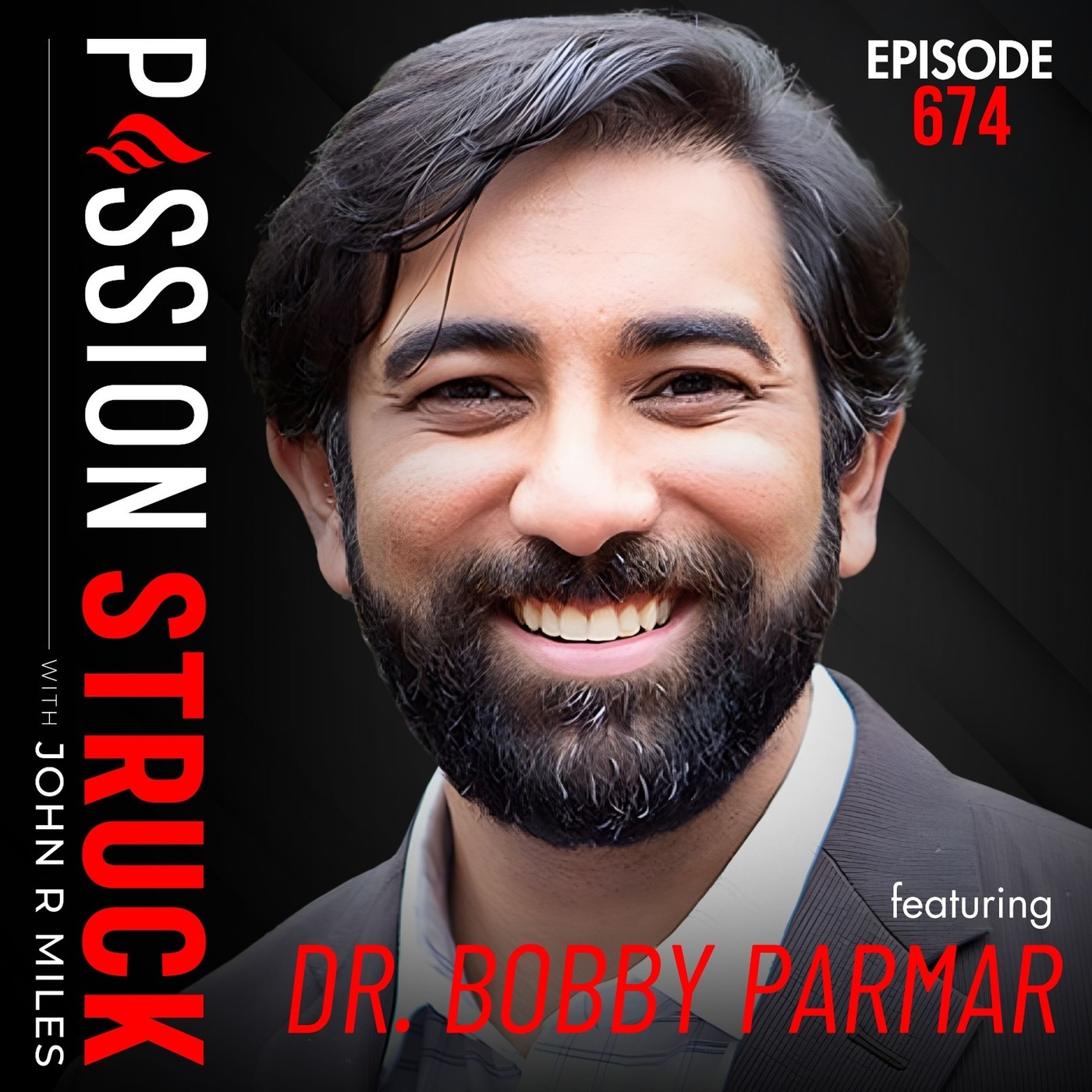
Passion Struck with John R. Miles
Dr. Bobby Parmar on Why Great Leaders Embrace Radical Doubt | EP 674
00:54:50
Loading summary
Transcript84 lines
- [00:00]
John Miles
Coming up next on Passion Struck.
- [00:02]
Dr. Bobby Parmar
By embracing doubt and seeing it as a signal for learning, we're able to pay attention to these multiple aspects of a decision. My personal values, the organizational mission, relationships with key stakeholders, financial profitability. And we're able to try to titrate and make sure, okay, if I'm making a decision that might sacrifice my personal values, I'm doing it intentionally. I'm not doing it as a reaction. I know that in the next decision, I better get back to that somehow, because if I keep going down this path, I'm going to wake up and regret that life that I've led.
- [00:35]
John Miles
Welcome to Passion Struck. I'm your host, John Miles. This is the show where we explore the art of human flourishing and what it truly means to live like it matters. Each week I sit down with change makers, creators, scientists and everyday heroes to decode the human experience and uncover the tools that help us lead with meaning, heal what hurts, and pursue the fullest expression of who we're capable of becoming. Whether you're designing your future, developing as a leader, or seeking deeper alignment in your life, this show is your invitation to grow with purpose and act with intention. Because the secret to a life of deep purpose, connection and impact is choosing to live like you matter. Welcome back friends to episode 674, Passion Struck. I'm so glad you're here. Whether you've been listening for a while or this is your very first episode, welcome. Over a third of you return week after week and that loyalty fuels this global movement. If this show has ever helped you see yourself more clearly or take a step towards growth, here's how you can help a crowd. First, share the episode with someone who.
- [01:51]
Needs to hear it.
- [01:52]
Second, leave a five star rating or review on Apple podcasts or Spotify. It's the single best way to help new listeners discover these conversations. Earlier this week, we kicked off our new series, the Forces We Cannot See. By exploring one of the most fundamental but overlooked forces of gravity, Dr. Brennan Spiegel showed us how something as ordinary as gravity can shape our health, resilience and daily lives in profound ways. If you missed that conversation, I highly encourage you to go Back to episode 673 and listen. It sets the perfect stage for today's topic where we turn to another invisible but equally powerful doubt. For years I put starting a podcast network on the back burner. I doubted whether I could pull it off. Leaving Stitcher the biggest player in the space was terrifying, but that doubt forced me to pause to piece things together. Differently, and eventually it led to the launch of the Passion Struck Network. My guest today has spent his career studying exactly that how doubt can be transformed from something paralyzing into a superpower. Dr. Bobby Parmar is the Shannon G. Smith Bicentennial professor of business administration at UVA's Darden School, Co Director of the Experiential Leadership Development Lab, and former Fellow at Harvard's Safra center for Ethics. He's been named one of the top 40 business school professors under 40 in the world. In his new book, Radical Turning Uncertainty into Surefire Success, Bobby reveals how to stop chasing shallow certainty and instead use moments of doubt as catalysts for learning, resilience and better choices. In this conversation, we explore why information alone fails to change behavior, the pursue, protect and pause systems in your brain, and how to strengthen the one that helps you navigate uncertainty, the danger of being a right answer getter, and how to become a better answer maker. And lastly, real world dilemmas. From dealing with toxic high performers to navigating career paralysis in the age of AI if you've ever found yourself stuck between options, paralyzed by what you don't know, this episode will show you why doubt isn't a weakness, it's the very muscle you need to build stronger decisions and a more intentional life. Before we dive in, a quick reminder. Our new store, Start Mattering is live built on a simple truth. You matter. Live like it. Every hoodie, tee and hat carries that message and fuels the ripple of mattering revolution. Head to start mattering.com and we're the Movement. Now let's get into this powerful conversation on Radical Doubt and uncertainty with Dr. Bobby Parmar. Thank you for choosing Passion Struck and.
- [04:24]
Choosing me to be your host and.
- [04:25]
Guide on your journey to creating an intentional life. Now let that journey begin.
- [04:34]
Experian Advertiser
Look, it's okay to make some financial mistakes. We've all missed payments, signed up for cards we didn't need, or ignored our credit scores. You're not alone. That's why you need Experian, your big financial friend. The Experian app helps you check your FICO score, find ways to save, and get matched with credit card offers that fit your needs. Some cards are labeled no Ding Decline, which means if you're not approved, they won't hurt your credit scores. So yeah, it's okay if you haven't been the best with your finances. That's why you've got Experian on your side. Download the app for free today. Applying for no Ding decline cards won't hurt your credit scores. If you aren't initially approved. Initial approval will result in a hard inquiry which may impact your credit scores.
- [05:28]
Dr. Bobby Parmar
Experience.
- [05:35]
John Miles
I am so excited today to welcome Dr. Bobby Parmar to Passion Struck. Welcome Bobby. How are you today?
- [05:42]
Dr. Bobby Parmar
I'm doing great John. Thanks so much for having me on.
- [05:45]
John Miles
Well, I am so thrilled to be having this conversation and I wanted to start out today. You have been named one of the top 40 business school professors under 40. You've taught thousands at Darden, at the University of Virginia. You co direct the experiential leadership Lab. What drew you personally? Because it seems like you've had a lot of certainty in your life to the topic of uncertainty and doubt.
- [06:10]
Dr. Bobby Parmar
Oh, such a great question. When you look at my bio I think it comes across as this nice linear progression. But it certainly didn't feel that way when I was living it and as I'm living it now. When I was in college I was to be a doctor and had a falling out with that profession for myself. And I think throughout my life being a first generation American, I've always felt in between things, in between communities, in between ideas. And I've always had this fascination with how people deal with being in between and the doubt that can foster in our decision making and where we belong in our self confidence. And then as a bunch of happy circumstances led me to becoming a business school professor, I began to do research in this area area and I started to see these phenomena show up in the kinds of decisions that my students and my executive participants would make.
- [07:03]
John Miles
Man, that's awesome. Is there a defining personal or professional moment early on besides that one where you doubted your own path that you were taking and how that doubt turned into something you didn't expect?
- [07:18]
Dr. Bobby Parmar
What a great question. I think a really formative moment for me. I grew up as a martial artist. I did martial arts for 17 years. It a big part of my life. I spent virtually every day at that school. I met my wife there and now we're celebrating our 20 year wedding anniversary. And there was a moment where that community transformed. Our original teachers sold the school and moved on and I had a young baby. And separating from that school and kind of creating a new path and career for myself was a huge moment of doubt. If I wasn't an instructor, who was I? How do I make my way in a world where I have a different community and people don't see me in the same way? And so that was a moment where I had to really learn to reinvent myself and wrestle with doubt and be okay with not knowing?
- [08:09]
John Miles
Well, I thought maybe it'd be good, before we jump into your book, to talk about like maybe a personal moment of doubt for myself, because I think people see us who are doing things and they think we have it all figured out. And I'll be honest, I recently co founded a new podcast network that we're calling the Passion Struck Network with my friend Rob Greenlee. And as I was on this path, it was really terrifying because I was part of the Stitcher SiriusXM network, which is probably the largest network that there is, one of the ones people long to be with, but sitting in uncertainty because when I was with them I felt a little bit like a small fish in a huge pond. That uncertainty forced me to think differently. And that's exactly what you argue. Why do you think doubt is the missing skill in modern decision making?
- [09:07]
Dr. Bobby Parmar
There's so many wonderful books about decision making, so much great research and so much great advice. And over the last 15 plus years, as I've watched my students try to apply this advice, try to put it into practice, it becomes there's a really interesting phenomena. They read something great or they pick up a really interesting research insight and they try to put it in their practice, but it doesn't quite go according to plan. There are things about their specific context, their specific teams, their own beliefs that make that advice maybe not perfect for their situation. And so they start to experience some doubt and then what happens is they drop that good advice and they look for something else. And what I've noticed is that when people can't really tolerate uncertainty and doubt, it's really easy to try to move from one silver bullet solution to the next silver bullet solution. Never really building the capacity to learn about how to make that good advice work in your context.
- [10:04]
John Miles
Thank you for sharing that. And the name of your new book is Radical Turning Uncertainty into Surefire Success. Why was now the right time to bring this out into the world?
- [10:14]
Dr. Bobby Parmar
I think in some ways it was a happy accident. This is work that I've been doing for the past 15 plus years. I've really been fascinated with how people make sense of complex situations, how they deal with uncertainty, and certainly the social, emotional sides of doubt. And now we find ourselves in a moment where many of us are experiencing doubt on a daily basis, if not an hourly basis. And we have to figure out how to, in those moments, not be derailed by doubt, but to use it as a resource for learning.
- [10:45]
John Miles
Yes, well, one of the things I often talk about on this podcast is the power of choice. And I have Had a bunch of behavioral scientists on the show, and this whole idea of microchoices, microhabits, is something they really blew in on. And one of the things you describe in your book is that doubt can be a superpower for better choices. Yeah. Can you explain radical doubt in practice?
- [11:10]
Dr. Bobby Parmar
Absolutely. And so let me step back for just a second and think about where this experience of doubt comes from. Doubt, as I define it, is sitting in between these multiple conflicting interpretations of what the current situation is that we're facing. Should I sell my company to this buyer, or should I keep it and grow it? Should I take a new job in a new city that might be unfamiliar, or should I stick with what I know? We have a hard time imagining a future, and therefore, or we can imagine it in so many different ways that we don't have a clear enough mental map to help us figure out where to go. And often we do have a clear mental map. We see something rewarding out in an environment, A great conversation with a colleague, a tasty meal, and we're able to catalyze action and either approach or avoid stimuli. And so the brain basically has these two systems that regulate our approach and avoidance responses. I call them our pursue system and our protect system. And when there are clear signals that either we're under threat or there's something rewarding around the corner, those systems activate, and we go after that thing, or we run away from whatever might be threatening to us, both socially or physically. But then there are times where there's conflicting signals, where I'm not quite sure whether I should pursue something or whether I should protect myself. And this third aspect of the brain, this third circuit, gets activated, and I call that our pause and piece together system. And this is the part of the brain that notices uncertainty, and it says, wait a second. Have a clear picture of what to do here. And because most of us have gone through school and we've learned that being smart means getting the right answer, we associate that feeling of not knowing with somehow being inferior or not good enough or not smart enough. And then we can't tolerate that feeling enough to actually use it as a catalyst for learning. So doubt can be radical when we associate that sensation of not knowing or what to do with a catalyst for learning. Saying, wait a second. One metaphor I like to use with my students is, when you're working out the first couple of reps, let's say you're doing some bicep curls. The first couple of reps is just warm up, right? It's rep 7, rep 8 rep, 9. Where you start to feel the burn. That's the part where you're actually getting stronger. And doubt is like that signal, but for your mind, it's saying, this is the part where I'm about to get smarter or more capable or learn something new. And yet if we all gave up the second where you're in the gym and you start to feel that burn, we would never get stronger. But we do it all the time when it comes to our brain. We've learned not to do it in the context of our bodies.
- [13:46]
John Miles
Thank you for going through those three different models that you bring up in the book, because I think they're one of the core things that sets the whole book up. I was hoping maybe we could take this into a real world situation. So one of the companies I was with was called Catalina Marketing. And Catalina, for people who aren't familiar with it, when you used to go to mass merchants, pharmacies, supermarkets, you probably remember getting your coupon and then they would hand you your receipt and then they would hand you a coupon with it. Catalina was offering those personalized offers to you at the counter. And the brands loved it because we had almost a 70% readership of those ads. And we would personalize it because we were looking at two to three years of shopping history. So we knew what you shop for, we knew what you liked. However, we were starting to run into a lot of issues competing against the newcomers who were doing digital ads, digital coupons, and our whole model was basically a push model. Myself and one of my direct reports approached our CEO and the board with a model that would have thrown the whole thing on its head. And instead of being a push, we were going to be a pull. So we were going to pull from all these different containers, and then we could serve up the ads not only at the cash register, but we could put them on digital billboards, we could put them on to smartphones, but it would require us shifting the model to the high CPMs that we were delivering to more of a model that was like what Google AdWords uses, where the network at any time changes. And so you've got dynamic pricing. And I think today, if they would have shifted to that model, they wouldn't be going almost bankrupt like they are today. But what ended up happening is everyone had all these doubts on whether this shift could actually work, and that doubt caused paralysis and we ended up never making a change or decision. And this is something I'm bringing up because I think it's a real world scenario. That happens in a lot of companies.
- [16:05]
Dr. Bobby Parmar
Oh, it happens in virtually every organization. It's such a great example.
- [16:09]
John Miles
Yeah.
- [16:09]
So if you apply what you were just talking about to this, how does it unfold?
- [16:15]
Dr. Bobby Parmar
Yeah. So let's notice a couple things. First, you and your colleague who came up with this idea of a pool model. Right. What's happening? You're imagining a future where one, you're serving up more relevant ads, you're serving them up in many different locations versus just the piece that you're getting with the receipt at the cash register. And you're imagining a better future for the company and for your customers. Right. And so you're getting excited about those positives and you're much more willing to pursue this particular course of action. Whereas some of your colleagues, what are they? Maybe they don't see the benefits as clearly as you do. Maybe they're focused on the benefits of the status quo. Hey, what we're really good at are the kinds of, whether it's analytics or understanding what customers have bought from this particular store and printing them out at point of sale. And you know what, it might be really costly to do this big change. And so their protect system is much more active and they're less reticent to go after this change. Either of those approaches causes a conflict. And so it's hard sometimes, if you're the ones trying to argue for change, to try to convince those that are being more reticent. But what I think radical doubt argues is that you want to be informed by both of those perspectives. There's obviously clear benefits to adapting our business model, learning to experiment and expand what our current offerings are. And there's probably some things that we got to watch out for in that process. And so the idea would be that by engaging our pause and piece together system, we're noticing relevant risks. We're not. We're paying attention to the potential rewards and we're trying to one, shrink the doubt. To say, instead of this giant thing where in one decision we switch the company from this particular business model to this other particular business model, is there a set of experiments or tests that we can run? What are the kinds of data that we could collect to help us know that these tests are working, how are we going to convince others that these tests are going to be relevant? So throughout this decision making process, in creating any kind of innovation, whether it's new products, new services, new processes, decision makers are walking through a series of stages. They're framing the problem. Well, what's the problem? Part of the problem, as I heard you describe it, is we have new competitors and these new competitors are using a multitude of platforms to reach their customers and clients. And we're not doing that. Right. That's one way of framing the problem. You could frame the problem another way. Maybe we want ads that are not just push or pull. Maybe they're interactive in some way. I'm making up an example. Right. So we have to frame problems, we have to generate potential solutions, we have to test those solutions. And at each stage it's really easy to shortcut that process when we get derailed by doubt. Right. And so we have to be able to maintain the focus and the flexibility to learn at each of those stages. Problem framing, option generation, option evaluation, implementation. And so I typically talk about how doubt plus fear is some kind of paralysis or avoidance, as you mentioned with some of your former colleagues. And doubt plus motivation is curiosity. And so you and your colleague who had this idea, you were super curious about how can we get this to work for our customers. And so figuring out how to unleash that motivation when we feel paralyzed or when we feel like this is a big change is really critical to continuing to learn when we're stressed.
- [19:36]
John Miles
I hope you've been enjoying this conversation with Dr. Bobby Parmar.
- [19:39]
We'll be right back after a quick break from our sponsors.
- [19:42]
Thank you for supporting those who support the show. You're listening to Passion Struck on the Passion Struck Network. Welcome back to my conversation with Dr. Bobby Parmar.
- [19:58]
Yeah, I think what you said has a lot of merit. The interesting thing for me, and I still look back upon that and wonder what I could have done differently to influence a final decision making. Because we weren't trying to get them to buy into going from A to B overnight. What we were trying to ask them to do was let's do some minimally viable products just to see what this would look like at a low cost environment. Because at the time a private equity group had bought Catalina and we knew we had to change and modernize our platform and it was going to cost over $100 million to do it. This other solution would have been a fraction of the cost and would have given us so much more capabilities. But I think what I failed to realize at the time was the person who was most reluctant to implement the change was the sales organization because they were so accustomed to selling these high ticket CPMs and they couldn't figure out on the surface how do you sell a dynamic changing CPM model in a network that's constantly evolving which to me I would have looked at it as an opportunity to give a whole lot of different options to your customer base. But they really saw it as we're going to have to change the whole way the sales organization sells. This is going to be a major lift. But what I failed to to really convey was that changing of behaviors and the cost of it is a fraction of what it's going to cost for us to try to develop what we're currently doing into a different model anyway.
- [21:41]
Dr. Bobby Parmar
It's such a great example. Right. And because what it illustrates is that one of the biggest barriers that leaders face is self doubt. When we have a salesforce who's not clear about who will I be in this new model, who how will I provide for my family or be the top sales person in this environment. Like, they've got to be able to see a path towards their goals in this context. And helping others leveraged out is just as important as helping yourself.
- [22:09]
John Miles
So I wanted to ask you this question. One of the things about my podcast, and I think it's a lot of podcasts or could be social media posts that people see, courses people take, sermons they listen to on the weekends, is that I don't think information alone changes behaviors. I think it's the application of the information. And to me that's the huge gap that a lot of us face is we get a ton of information thrown at us all the time, but what do we do with it? So one of the ways I've started to try to change that is I created a substack where I'm trying to amplify like this conversation with a post that I'll do in substack. And with that I'll end up putting a whole guidebook or workbook to allow the listener, if they want to take this conversation and put into action in their life. What I'm having a hard time getting people to do is to actually take action on that. So I'm putting all these workbooks out there. Some people are finding it, but a lot of my listeners, not as many as I would like, aren't taking that next step. So what role do you think self regulation ends up playing in that decision making? And what is something I could do to change people who are doubting this path into a conversion?
- [23:33]
Dr. Bobby Parmar
Ooh, really important set of questions, right? Because it's such a sign of the times, in many ways we are all inundated with so much information. And the more information, the more noisy the channel, the simpler the messages become. And when the Messages become simple. Let's say, do this and don't do this. And then you try to apply simple recipes to your life and they don't work. And so people either give up or they just take. Continue to take in the information without making real change. And those of us that care about actually helping people build the lives that they want, just giving them the information isn't enough. And I'm fortunate in the sense that when I get to work with MBA students or executives that come to the University of Virginia for executive education, I get to get them to do things. It's not just that we lecture to them or give them information. It's that you have to put that information into practice. And so when we give them opportunities to try things out and they say, oh, look at how differently things went when I applied this advice, in this conversation or in the way that I made this decision, that starts to build the habits of, oh, I can do this. So it's not just about the ideas. It's about, to your point, putting the ideas into practice. And so when we don't have the luxury of being with people in person, as I often do, one of the things we can try to do is inspire communities to work together. And whether it's listening to a podcast or reading a chapter and finding a buddy that you two are going to have a conversation about this, that's the first step. The next step is you're going to try to use this to make a decision and then report back to your colleague, your buddy, and say, how did this go? We've got to find ways of trying to disseminate the community that holds people accountable to trying things out, because it's really hard. In this one to many model of I'm a fantastic podcaster and I've got awesome ideas, or I'm an author and I think I've got some advice that'll be helpful to you. And then you've got this giant audience. It's really easy to just be one book, one podcast in hundreds, if not thousands that they listen to. And it's easy to confuse getting the information with building the skill. And I see this all the time with executives and with students is they confuse actual recognition of information with mastery. Just because I've heard this idea before doesn't mean you know it. When you ask them to, like try something out, then they can't even put that idea into practice.
- [25:52]
John Miles
I've seen it so many times. And one of the things that you write about that I think reflects this is that so Many of us, when we're facing decisions like that, act, as you call it, right answer getters when we're facing hard choices. But I think as you write, you need to have this mental shift from seeking the right answers to creating better answers in your life. And that's what I'm trying to do on the podcast. But how can someone close that gap in their own life? Yeah.
- [26:22]
Dr. Bobby Parmar
So the first part is to become okay with the fact and to be able to regulate yourself in a way that when you don't have the right answer out of the gate, that you don't see that as paralyzing. Right. That you see that as, wait a second. This is an opportunity to grow. And then helping people build the capacity to say, what are some things that we can try? Let's go run an experiment. What are some small ways I can put this into practice? And you start to act your way into a different way of thinking and believing rather than, here's a set of ideas. And now it's going to completely change my practices. And so I think becoming a better answer maker rather than a right answer getter requires being willing to roll up your sleeves, try some things out. They're not going to be perfect, but you're willing to say, what did I learn from that experiment? Okay, I learned that next time I should try this. Okay, let me go back. It's really about this ability to be resilient when we're right answer getters. The first time we fail, it's a sign that there's something wrong with us. So I'm not going to try again. When we're better answer makers, we stumble. We learn to pick ourselves back up again, and we try again. And we try again. One of my favorite stats has to do with, in the context of personal change, smoking cessation. Smoking cessation is something where you can really study very clearly how people's efforts and actual change connect to each other. And I think, on average, a smoker who wants to quit tries something like north of 25, 27 times before he or she is able to successfully quit. Right. It's not like you just make the decision to say, hey, I want to quit smoking, and then the next day, very few people can quit cold turkey. You've got to sign up for, look, I'm going to fall off the bandwagon. I'm going to get back on. I'm going to fall off and get back on. And if you can build that resilience, you can start to build the skill that it takes to actually get these things done.
- [28:10]
John Miles
Anyone who's ever tried to do that, one of the things that they probably have also learned is that you have to change your environment because you're typically used to smoking in certain scenarios with certain people. And what I have found is not only do you have to stop the habit, you've got to stop the other aspects of it that foster that habit to begin with.
- [28:31]
Dr. Bobby Parmar
Exactly. And in closing this gap, my colleagues and I, as you mentioned at the beginning, run something called the experiential Leadership Development lab. And at Darden, we have really smart students. They're incredibly hardworking, they have fascinating experience, and when we talk about difficult things, they're really good at talking about them. And so what the lab does is students come into the lab, we outfit them with different sensors like galvanic skin response and heart rate monitor, so we can basically capture their level of stress. Then they read a short scenario like, you've got to fire someone, or you've got to give someone difficult feedback, or you've got to mediate a contentious meeting between two employees. And after reading this half a page setup, I have actors that I've hired and trained who walk into the lab and my participants have to do it. They actually have to fire someone, or they actually have to listen to two people argue and scream at each other and try to mediate effectively. And what's fascinating is that my smart, hard working students, who can very quickly tell you, here's the recipe for how to do it, fail to actually execute on the recipe. And so the thing I laugh about all the time is in the one where you have to fire someone, 50% of that time, that person gets promoted laterally somewhere else in the organization. Because it's so hard to look someone in the eye and say, you're not cutting it. I'm sorry, we've tried everything. It's not going to work. And so without being able to regulate yourself in those situations, it takes real practice. So they. Everything in my lab is recorded. Students then get to watch their own recording back. They debrief with a coach. They watch a partner. So when I watch your video, like, wow, John did such a better job than me. Now what can I do? What can I take from John's actions that might inform me next time? It starts to build the skill and you give him a chance to try it again and try it again. And after a couple weeks, it's amazing the growth that you see when people are actually practicing putting ideas into practice rather than just talking about ideas.
- [30:25]
John Miles
Yeah, I know it's a huge shift, and I wanted to go through one of these scenarios with you because in your book you use the story of Kim, who's a star performer, who's also a jerk. And I ran into this scenario really early into my career. Career. I was a young ensign. I was on one of the first ships that I served on when I was in the Navy. And there was this lieutenant on board who was the star performer. But man, this guy was so arrogant. I remember we were filling out our input when we were getting our fitness report, and most of us were trying to document all the things that we had done, the qualifications, the moments we had. On his input form, all he wrote was, I am a God. But I think we've all run into situations where someone is a shooting star like him is. But oftentimes there's another side of them that just ends up pushing so many people away. And I know if you're a leader like you were just talking about, it's hard to deal with those people because you want Kim on the team, because Kim is delivering so many results. But also they're creating disunity amongst the other people you're working with. So what is your advice for leaders to get out of no win scenarios like that?
- [31:55]
Dr. Bobby Parmar
Such a great example. I'm sorry you had to deal with that. But it is such a common example, which is why I write about it in the book. And what makes it hard is on the one hand that there are some tangible results these individuals are getting, whether that's increased sales or performance. And however we measure it, they're doing some good for the organization. But at the same time, there are some clear negatives. Right. And so they're having a negative impact on the team. And so when you put this kind of scenario in front of new decision makers, they have a very quick reaction. Half of them tend to think, look, what matters is performance. And so we've got to keep this guy Kim because if we don't, then our sales will fall and we can't handle that. And then you have the other half of the novice decision makers who look at this and oh, look, he's having a negative impact on the culture and on the organization. We gotta get rid of him. We can't tolerate this. Like they're. The way that they think about the problem itself is very simplistic. It's either or. And if we're able to embrace doubt, part of it is to one understand the shape of the problem. You've got this performer is he Coachable, we don't know, right? And so when we're incapable of dealing with doubt, we take these uncertainties, these questions that we might have. Can he be reformed? Will he take feedback? And we just interpret them in ways that make our intuition the right answer. So if we say no, he can't be reformed, it's because we think we got to get rid of him. Or if we really want to keep him here, we start to give him excuse after excuse. No, we gotta keep giving him feedback and he'll be okay. The important thing here is to not use your intuition as your decision. Right? Novice decision makers have this intuition. They're like, ah, Kim is not a great performer, or Kim is a great performer. And they use that intuition as their decision. What we notice from more experienced decision makers is they use that intuition as a hypothesis. So they say, huh, I'm leaning towards getting rid of Kim. What are the things that could teach me that I'm wrong? What are the things that I could learn about how to do it to minimize impact on the organization? Can I have someone ready who can pick up sales? Can I promote someone else that'll mitigate any impact the organization? And so that by treating your intuition as a hypothesis, you're learning about both the strengths and the potential weaknesses of your course of action so that you can mitigate those weaknesses and make the best decision possible.
- [34:16]
John Miles
So I want to go to something different. In the book you write that my colleague likes to say, ethics is not just about whether you can live with yourself. We've got to live with you too. And you go on to say, some senior executives tell me that they know they are making the right decision because they can sleep well at night. And you respond with, well, that's great. Being able to live with ourselves is an important consideration, but it's not the only consideration. Lots of people who do terrible things sleep just fine with themselves. So my purpose for going here is I talk a lot about personal values or core values, but oftentimes people are making trade offs and they're really, as you write, willfully blind to essential parts of the social terrain that they're dealing with.
- [35:02]
Can you explain why this dynamic matters?
- [35:05]
Dr. Bobby Parmar
Oh, it's such a great question. So when we're incapable of tolerating doubt, what we do is we try to find the criteria in a decision that makes a final right answer. And so we might say, look, that final right answer is dictated by my personal values. If I can sleep well at night, I know I've made a good decision. That Final right answer might be dictated by the company's mission. If this idea is consistent or this proposal is consistent with the company mission, it's the right answer. The right answer might be dictated by profitability. Hey, if it makes the most money, then it's the right answer. We try to find the single criterion by which there is a clear right answer. Now, most of the interesting, complicated problems that senior leaders have to face are what we call multi criteria problems. They're problems that have to do with your personal values, that have to do with your reputation, that have to do with harms and benefits to the organization, including financial as well as cultural. And when we're able to tolerate doubt, we're able to understand those competing facets of the decision, not reduce the decision to any one of those to make it quickly, but to be able to understand that, wait a second, I've got to do something here, that one will impact my own reputation the way others see me. It'll impact how I see myself. Which to your point, is something that people underestimate in their day to day decision making. I have plenty of colleagues and friends and former students who wake up 10, 15 years later and they're a very different person that they wanted to be when they were their more young, idealistic self because they've never paid attention to their own values or to their own purpose in decision making. And so by embracing doubt and seeing it as a signal for learning, we're able to pay attention to these multiple aspects of a decision. My personal values, the organizational mission, relationships with key stakeholders, financial profitability. And we're able to try to titrate and make sure, okay, if I'm making a decision that might sacrifice my personal values, I'm doing it intentionally, I'm not doing it as a reaction. I know that in the next decision I better get back to that somehow. Because if I keep going down this path, I'm going to wake up and regret that life that I've led. Or if I'm making a decision that might not maximize profitability. Well, in the next decision I better make sure that I'm not also doing that, because that's not a sustainable course of action going forward. And so what's critical about what you raise is that by becoming better answer makers, by being able to use doubt as a catalyst for learning, we don't quickly reduce the complexity of problems that we face or decisions that we face to one single criteria and then say, oh, I'm good with this criteria, so I'm done learning.
- [37:46]
John Miles
So I wanted to do a follow on to this. One of the things a little bit later in this chapter that you provide the audience of readers is a process for meeting moments of doubt. And it's a five step process. I wish I would have had this five step process in my own book that came out last year. But you put in here, define who you want to be, zoom out, understand your larger social consultation text, generate and refine ideas is the third step. Fourth is prepare to offer justifications and then assemble a recommendation. I want to jump into the second part of that. In my book, Passion Struck, one of the core shifts that I tell people they need to make. I called it the perspective shifter. Similar to what you're saying here. I was talking about, we tend to look at things through only one lens and we fail to often shift our perspective of looking at things differently. And the way I wrote this, I was using the Golden Gate Bridge as if you look at it from the perspective of being a person on the road, it looks like one direction. But if you're an airplane pilot looking at it, it completely changes the dynamics of how the bridge looks. But I think for so many of us, it's so hard to put ourselves into a situation where we're looking at all the other considerations that we need to be taken into account. Principles, consequences, impacts of relationships. Why is it so important to focus on the zooming out?
- [39:19]
Dr. Bobby Parmar
I love your example of the Golden Gate Bridge and using different lenses. So it's so important to, you know, oftentimes when we encounter problems or decisions that are very familiar, we've made the same decision 10, 15 times. We understand what the consequences are. We understand the impacts on ourselves and on others, and we can rely on our intuition. But when we encounter novel, complex, uncertain decisions, we don't really have the relevant experience to understand what will happen. And so looking at that choice from different angles, trying to understand who's harmed and who's benefited by it, what are the relevant rules or norms around this particular decision? How will certain choices impact how I see myself, how others will see me? Right. My connection with other relevant stakeholders. All of those lenses allow you to learn something new about the decision that you're facing. It illuminates some aspect of the decision that maybe wasn't visible from a certain vantage point. Another way to think about this building on your Golden Gate Bridge example is let's say you're navigating some really dangerous terrain. And if you're looking down from like a ridge into this really treacherous valley, you might not see all the pitfalls. But if you hike a little bit along the ridge and oh, wait a second, there was this, there's this deeper ravine here or there's like a river or there's all these other things, by changing your vantage point, you're learning more. And by learning more, you can take more resilient actions that allow you to avoid those barriers that you are blind to by only using one lens.
- [40:59]
John Miles
I want to take another practical example. So let's maybe do this on some famous Darden graduates, maybe John Strangfeld, who is the former CEO of Prudential Financial. My question, Bobby, is this from your research? What differentiates an expert decision maker like him from novices when it comes to uncertainty?
- [41:22]
Dr. Bobby Parmar
I think a key point is that experts don't treat their intuition as their decision. Many novices have an intuition. I'm leaning towards doing A versus B. And then what they do is they take all of the uncertainties and they twist the world so that answer A is the right one. Of course I should do A. Rather than saying, an expert might say, look, I'm leaning towards doing A. What could teach me that I'm wrong? They treat their intuition as if it's a hypothesis. And so they don't stop learning after they identify what their intuition is, they say, okay, now that I know that I'm leaning towards option A, what might teach me that I'm wrong? How could I go about that in a way that is more resilient and that would cause fewer problems for the organization? What are the weaknesses of going with option A? And so what they're doing is they're continually learning in the process of making decisions rather than treating decisions as a point in time. And so maybe that's a nice way of thinking about it, is that most novices, the dominant model of making a decision is like regurgitating your math facts, right? Something comes up, the teacher has the flashcard and it's three times five. And if you're smart, you know that it's 15 versus saying wait a second, I've got to frame the problem and I've got to generate alternatives and I've got each step, I'm learning along the way rather than just knowing the answer and stop doing the work, work.
- [42:45]
John Miles
And I think that's part of it. I think there are other things in companies that affect decision making even in our relationships. One of our own biases, another thing is our overconfidence or ego. Another one is blind spots that we have in our own self awareness. And if it's In a company, it could be a cultural blind spot. So how, if you're a leader or even a person who's trying to improve their life, do you pay more attention to those things that could derail effective decision making?
- [43:16]
Dr. Bobby Parmar
I think one of the most proven strategies here is to have a group of people around you that are willing to tell you things that you might find uncomfortable or inefficient. And so when someone says, hey, Bobby, like, the way that you're thinking about it is missing this thing, or did you notice that when you did this, it had this impact on this person that maybe you don't realize helping people close that gap of how we think about ourselves and our environment and saying, yeah, one of the best ways of mitigating these kinds of biases is to have a group, because members of the group have different biases that ideally, if they get along and if they trust each other and if they talk to each other, well, you can mitigate some of those biases. Now, groups can also exacerbate biases. So it's not a panacea that just having a group by itself is not going to make things better. It's got to be the right type of group where people are willing to say hard things to each other, where they have the kinds of relationships, where they treat each other with dignity and respect, despite the fact that they see the world differently.
- [44:17]
John Miles
I wanted to go to more big picture here of how you can use this framework with some of the global uncertainties that we're facing. Our interview happens just after a summit. The leaders of India, North Korea, China, Russia. And coming out of that, those leaders said, what choice is the world going to make? Are we going to make a choice for peace or for war? We're facing the same dilemma when it comes to climate change inequality in so many parts of the world. How can your framework help us navigate through these global uncertainties?
- [44:57]
Dr. Bobby Parmar
Such an important question. It feels like we're living through unprecedented times, but given that this is the only time I'm living through, I don't know if previous generations said the same thing. The first thing is to not be derailed by the sheer volume of things that now we can't take for granted. There's so many things that we could rely on. Global supply chains are going to continue, that democracies will be stable, all those kinds of things, that our planet will have a relatively stable temperature. Those kinds of things are now open to questions. Right? And I think it's really easy to jump from situation to situation. Problem to problem and to feel demoralized and there's nothing that we can do. And I think the first thing is to acknowledge that this is hard. The second thing is to be able to say, look, there are certain issues. You can't do everything as an individual. You got to pick one, maybe two things that you are willing to do the work on and then have some connections and friends who are doing work on other things and you rely on them to say, look, I trust John. I don't have the time to dig into the latest climate science, but John does and I'm going to trust him on that. I'm going to move forward on these other initiatives that I find a personal connection to. And then once you've done that is to think through what are some tangible steps that I can make to either reduce externalities that I personally am creating, help other people see the consequences of their actions, basically to take small, clear steps forward. Right. That's what helps us feel like we have capability and competence, is that we're able to move forward. These are big problems that are not going to be solved overnight. And if we think that somehow we're going to sit in a cubicle or in an office and come up with the right answer to these things, that's not going to happen. It's going to take millions of us rolling up our sleeves, doing the hard, diligent day to day work to actually turn the tide on some of these really pressing issues. And that also means that we can't just give up and say, you know what, it's too much, I can't handle this. Just going to check out and I guess, cash out.
- [46:57]
John Miles
At the beginning of our conversation, before we came on air, I was asking you if you knew Jeffrey Walker, a friend of mine who has a deep affiliation with University of Virginia. He started the Contemplative Science center. And these are the exact types of questions he's trying to get to on his podcast, Systems Catalyst. Because what he's arguing is we need people to start fixing the systems that are causing some of the issues. And it's not going to be the governments who do it. It's going to be a bunch of us uniting and starting to look at what are the breakdowns. So one thing we just talked about, macro. Now I want to go micro. So I've got two kids, 21 and 27, who often tell me they're paralyzed by what direction they should take in their career. With the onslaught of digital disruption that's happening, especially the evolution of AI and how Many industries, jobs, professions, it's disrupting. What advice would you give to other young leaders or students who are paralyzed with the same decision?
- [48:06]
Dr. Bobby Parmar
That is a moment in life that is a really hard moment. It's particularly many smart, hard working young leaders. What's difficult is they could do lots of things and that's what's paralyzing. It's easier for folks who are like, look, I'm naturally gifted and excited about this thing. I want to be a nurse and I've always wanted to be a nurse and more power to those folks. But many people are like, oh, I could be a nurse and I could be a physician and I could be a lawyer. Or thinking about yourself as I want to be a consultant or an investment banker, and then all of a sudden having doubts about that because of the rise of AI and things like that. And in those moments, there isn't a simple answer. There's no, hey, you shouldn't be a lawyer, you should go into elder care or those kinds of things. But this is a perfect example of a multi criteria decision, right? It's a decision that is based on your values, who you are, who you want to be. It's a decision that's also sensitive to what kind of life would I be able to create for myself and my family? Or is this a growing industry, a shrinking industry? What kind of effect do I want to have on the world? Is this meaningful to me? And by thinking about all of those things, we've got to be able to put together a couple of places where we want to try. Hey, I'm really excited about what's happening in education technology. I'm really excited about what's happening at the intersection of AI and financial literacy and finding places to run experiments and build a set of skills that make people adaptable. That's the other thing, is by making uncertainty smaller in this moment, part of what makes it hard is believing that you're picking a career always and forever versus saying, look, I'm going to do this thing for three and a half years and I'm going to learn a lot and I'm going to then build some skills that are going to allow me to pivot to something else. And that I think is going to become much more of the new normal is that like many things that used to be stable and no longer are, this idea that I'm going to do the Same thing for 35 years is also going to go out the window.
- [50:00]
John Miles
It is an agonizing time not just for the youngsters of the world. But I think for all of us, thinking where this is going to head. And I remember all these companies making so many promises. We're not going to change headcount. We're not going to allow AI to change what we're doing. And we're seeing all those promises go to the wayside. So definitely something people need to be tuning into for sure. Well, Bobby, I wanted to do something fun. I sometimes like to incorporate rapid rounds of questions, and I thought your topic is a great one. So I'm going to ask you a few things and I'm hoping that you can just answer with your best thought. One word.
- [50:40]
Dr. Bobby Parmar
Maybe one word.
- [50:41]
John Miles
Okay, maybe one sentence, depending on what it is. So the first one I'm going to ask is, what is the number one sign a team is faking? Certainty.
- [50:52]
Dr. Bobby Parmar
Speed.
- [50:55]
John Miles
Okay, finish this sentence. Great decisions start with humility. Intuition. Do you trust it or do you test it?
- [51:06]
Dr. Bobby Parmar
Test it.
- [51:09]
John Miles
What's the question? Leaders don't ask enough.
- [51:13]
Dr. Bobby Parmar
That's a good one. What do we learn today?
- [51:18]
John Miles
One meeting ritual you would ban tomorrow.
- [51:23]
Dr. Bobby Parmar
Oh, that's a good one. One meeting ritual I would ban tomorrow. I don't know. Trust falls.
- [51:32]
John Miles
Since we've been talking a lot about executives, if you could give every executive out there a dashboard metric for uncertainty, it would be what?
- [51:41]
Dr. Bobby Parmar
Oh, a dashboard metric for uncertainty. That's a hard one, right? There's different types of uncertainties. I think the easy answer here is something like confidence. But hold on, let me think about. This is a good one. Yeah. Okay, so I think if there were an easy metric or if I were to recommend a metric to executives for uncertainty, I would think about ambivalence. Do people have things that they're excited about and concerned about at the same time?
- [52:27]
John Miles
Okay, great. I've got two more for you. A book, not yours, that made you better at decisions.
- [52:33]
Dr. Bobby Parmar
Oh, The Social Psychology of Organizations by Carl Weich.
- [52:37]
John Miles
Okay, and last one. Can you name a historical figure who you feel modeled radical doubt? Well, I'll tell you, to me, who.
- [52:44]
Popped in my head, I'm not sure.
- [52:46]
Why was General Patton.
- [52:47]
Dr. Bobby Parmar
Oh, that's a really good one. If I were to add to that, I'd say John Dewey, the philosopher and educational researcher. I think he helped us really see the value of doubt.
- [52:59]
John Miles
Awesome. And last question for you. If you could leave a listener or viewer today with one message about embracing doubt as a catalyst for growth, what would it be?
- [53:10]
Dr. Bobby Parmar
Doubt doesn't mean that there's something wrong with you or that you're not smart enough. Doubt is actually the part of decision making where you're getting stronger.
- [53:19]
John Miles
Bobby, if listeners want to learn more about you and your work, your book, etc. Is there a great place that they can go to?
- [53:26]
Dr. Bobby Parmar
Yeah, the book has a website. You can connect with me on LinkedIn. I always love hearing from folks. Those are the two best places.
- [53:33]
John Miles
Well Bobby, thank you so much for joining us today. It was such an honor to have you on Passion Struck.
- [53:38]
Dr. Bobby Parmar
Thank you so much for having me, John.
- [53:40]
John Miles
That's a wrap on Today's conversation with Dr. Bobby Parmar. What struck me most is how often we try to escape doubt, when in reality it's the very thing that can sharpen our choices, strengthen our leadership and help us grow. For me, that truth was real when I doubted whether I could ever launch a podcast network. Instead of letting the uncertainty paralyze me, I leaned into it. And the lessons I learned in that fog are what allowed the Passion Struck network to become a reality. Bobby reminds us that doubt isn't a dead end. It's an invitation to pause, to piece things together, to build better answers rather than chase the illusion of the right one. If today's episode resonated with you, I highly recommend picking up his new book, Radical Doubt. It's packed with practical frameworks and you can find it@passionstruck.com in the show notes. And if you're new here, make sure to follow or subscribe to Passionstruck. Every week we bring you world class guests and actionable ideas to help you live intentionally and ignite your most passionate life. You can also get the workbook for today's episode at our substack theignitedlife.net coming up next in our Forces We Cannot See series, my conversation with Judd Kessler, Wharton professor and co author of Lucky by Design, will explore the fascinating role of luck how much of it is random, how much of it is created, and how to put yourself in its path. More often, it's a conversation that will change how you think about opportunity.
- [55:01]
Liberty Mutual Advertiser
The way that I think about the hidden markets that I talk about in the book is indeed about scarcity and about when there's more people who want something than we have slots to give. And that's true for French Laundry reservations. It's true for Taylor Swift tickets. It's true for the seats in the best elementary schools in New York City. But it's also true in getting into the elite colleges and the admissions rates at the Ivy Leagues and at many of the universities that are the best in the country are very small the chance of getting in is vanishingly small.
- [55:32]
John Miles
Until next time.
- [55:33]
Notice the forces pulling at you. Lead with intention. And as always, live life passion struck.
- [55:54]
Dr. Bobby Parmar
And Doug, here we have the Limu Emu in its natural habitat, helping people customize their car insurance and save hundreds with Liberty Mutual. Fascinating. It's accompanied by his natural ally, Doug. Limu is that guy with the binoculars watching us? Cut the camera. They see us.
- [56:13]
John Miles
Only pay for what you need@liberty mutual.com Liberty, Liberty.
- [56:17]
Liberty.
- [56:18]
Liberty Savings Fairy Unwritten by Liberty Mutual Insurance Company and affiliates. Excludes Massachusetts.