← Passion Struck with John R. Miles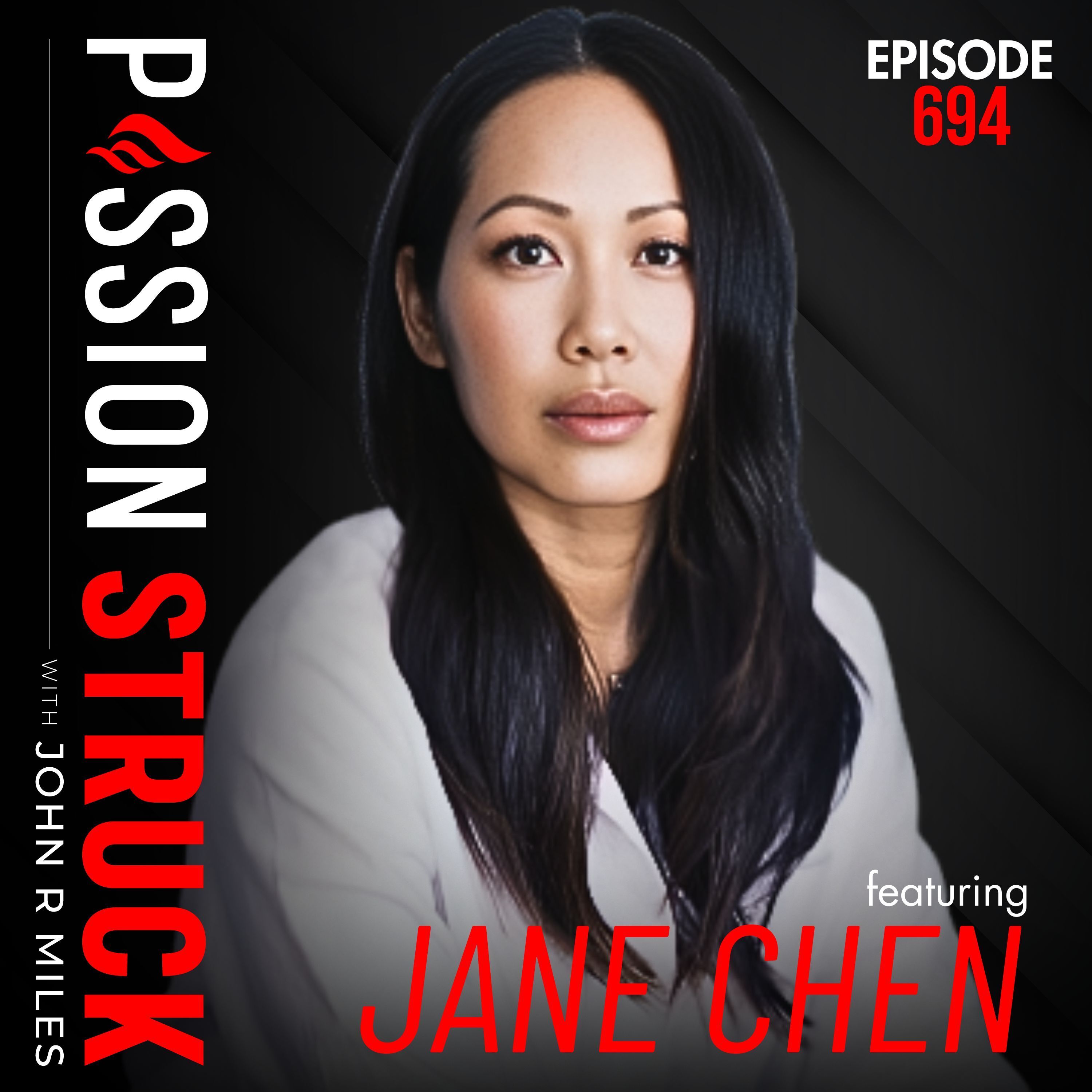
Passion Struck with John R. Miles
Jane Marie Chen on Letting Go and Becoming Your True Self | EP 694
01:16:05
Loading summary
Transcript139 lines
- [00:00]
Sleep Number Salesperson
Why choose a sleep number Smart bed?
- [00:02]
Jane Chen
Can I make my site softer?
- [00:03]
Podcast Guest or Commentator
Can I make my site firmer?
- [00:05]
John Miles
Can we sleep cooler?
- [00:07]
Sleep Number Salesperson
Sleep number does that cools up to eight times faster and lets you choose your ideal comfort on either side your Sleep number setting Enjoy personalized comfort for better sleep night after night. It's our Black Friday sale recharged this season with a bundle of cozy soothing comfort. Now only $17.99 for our C2 mattress and base plus free premium delivery. Price is higher in Alaska and Hawaii. Check it out at a Sleep number store or sleepnumber.com today.
- [00:31]
Podcast Narrator/Announcer
Coming up next on Passion Struck, I.
- [00:33]
Jane Chen
Finally connected the dots feeling so powerless through my childhood. That's what had driven me to want to help the most powerless people in the world. I had not made that connection before, so my pain had become my purpose. But it was also my shadow because it led me to working in very unhealthy ways. As I said, to the point of just complete burnout. Because I also believe that my worth depended on what I achieved. So it wasn't just like the passion and the urgency, but there was this whole thing where my worthiness and sense of enoughness was tangled up in achievement.
- [01:18]
Podcast Narrator/Announcer
Welcome to Passion Struck. I'm your host, John Miles. This is the show where we explore the art of human flourishing and what it truly means to live like it matters. Each week I sit down with change makers, creators, scientists and everyday heroes to decode the human experience and uncover the tools that help us lead with meaning, heal what hurts, and pursue the fullest expression of who we're capable of becoming. Whether you're designing your future, developing as a leader, or seeking deeper alignment in your life, this show is your invitation to grow with purpose and act with intention. Because the secret to a life of deep purpose, connection and impact is choosing to live like you matter. Welcome back, friends, to Passion Struck. This is episode 694 and today we're doing something very special. I'm coming to you live from the Oxford Exchange in Tampa, Florida, where we recorded this conversation in front of an incredible audience. And I want to begin by saying thank you to those of you who were in the room last night and to every listener who returns week after week. Over a third of you never miss an episode, and that loyalty fuels this global movement. If this show has ever inspired you or helped you make a meaningful shift, here are two simple ways to help it grow. First, share this episode with someone who'll find it meaningful and leave a five star review on Apple Podcasts or Spotify it truly is the single best way to help new listeners discover these conversations. We're in the heart of a series I'm calling the Irreplaceables, a journey into what makes us most deeply, undeniably human. Last Tuesday, Scott Anthony helped us reimagine possibility in a world of disruption. Then last Thursday, Lynn Smith guided us into the courage it takes to silence the brain bullet. And today we go even deeper. I invited Jane Chen on the show because her story sits at the intersection of heartbreak, purpose, self worth and human resilience. Precisely the terrain of this series. Many of you know Jane is the co founder of Embrace, the low cost infant warmer that has saved the lives of more than 1 million premature babies across across the globe. Her work has been praised by President Obama, supported by Beyonce, and featured everywhere from the New York Times to the World Economic Forum. But that's not why I asked her here. I invited Jane because behind all of those achievements is a human story, one of trauma, burnout, collapse and the radical rediscovery of self worth. Her memoir, Like a Wave We Break, doesn't just chronicle the impact she made in the world, but it reveals the internal journey she spent years avoiding. It begins with a literal wipeout and unfolds into a spiritual, emotional and psychological awakening. In our conversation, we explore how childhood trauma silently fueled her drive to save others. We go into the collapse of a mission she spent over a decade building, the burnout that nearly broke her in the moments that rebuilt her how meditation, internal family systems and psychedelic therapy opened her back to herself and the stunning insight that we're not the waves of chaos and emotion, we are the emotion beneath them. This is an episode about healing, surrender, identity and the courage to stop performing and start becoming. Before we begin, remember, you can find companion notes, frameworks and reflection prompts for every episode@theignitedlife.net my free substack where I help you apply these ideas from the conversations to your own life. Next, let's step into this powerful, intimate and deeply human conversation recorded live at the Oxford Exchange with the remarkable Jane Chen. Thank you for choosing Passion Struck and choosing me to be your host and guide on your journey to creating an intentional life. Now let that journey begin.
- [05:19]
VRBO Advertiser
Did you know you can opt out of winter with VRBO? Save up to $1,500 for booking a month long stay when thousands of sunny.
- [05:27]
Jane Chen
Homes are waiting for you.
- [05:29]
VRBO Advertiser
Why subject yourself to the cold? Put the snow shovel down, put the parka back in the closet and don't you dare scrape another windshield slip into some flip flops. Consider a sunless tan and use the monthly stays filter to save up to $1,500. Book your warm getaway at vrbo.com.
- [05:51]
Podcast Guest or Commentator
You.
- [05:51]
John Miles
Ever wake up and feel like your.
- [05:53]
Podcast Narrator/Announcer
Body'S auditioning for a Rice Krispies commercial? I mean, joints, popping muscles, stiff workouts taking forever to bounce back from. That's why I went all in on Bub's Naturals. Collagen peptides I get. Listen to this. 18 grams of clean protein with only 70 calories and believe me, it tastes like magic. Even in plain water. No clumps, no chalky taste. You'd never even know it's there. Named after Navy Seal Glen Bubb Dougherty, this brand walks the talk, donating 10% of profits to charity. And Bub's is legit. It's Whole30 approved and sustainably sourced. No sugar, no junk, no weird fillers. So live better, longer for unlimited time only. Our listeners are getting 20% off at Bubs Naturals by using Code Passion Struck at checkout. Just head to Bubsnaturals.com and use code Passionstruck and you're all set. After purchase, they will ask you where you heard about them. Please support our show and tell them.
- [06:51]
John Miles
Our show sent you. Thank you all for coming today. I'm John Miles and we're so lucky to have Jane Jonas today, all the way, actually, from Hawaii, with a little stop in between in San Francisco and New York before coming. So thank you so much for being here.
- [07:11]
Jane Chen
Thanks for having me.
- [07:12]
John Miles
For those who aren't familiar with the podcast, I've been doing it now for about five years. It's actually in the alternative health space and its focus is on the art and science of human flourishing. We cover kind of all aspects of behavioral science, but we also get into functional medicine, longevity, things like that. But I love to have stories of reinvention. Those are one of my favorite topics. And so when Jane's publisher reached out, it was and I heard it was a memoir. It was just a book that I wanted to personally read. And those are my favorite to have the authors on because I pour myself into them. And as I got more into this, I just knew it was going to be a spectacular interview. So thank you so much for coming. Thank you so for those, because we're doing a podcast here who didn't see it. We started out with an entry video that was all about Jane in the water. And your book actually starts out the book, for those of you who aren't here, is like a wave we break is actually her surfing at the start of it. And you're an avid surfer, I understand. How did you develop that as a passion?
- [08:23]
Jane Chen
Well, I discovered it, maybe. When was this? 2016. My family was in Hawaii on holiday, and I just would watch the surfers and be so captivated. Like, it was something I really wanted to try. So I found a teacher and I did it, and I instantly fell in love with it. I just surfed the whole week, every morning. And when I went back to San Francisco, I thought, oh, it's too cold. I'm not going to do it. But I bought myself a wetsuit and a surfboard, and I just kept going. And then it just turned into something that. It wasn't just about the sport, but what the ocean taught me about letting go, about surrendering, about kind of playing with this force so much bigger than you. So it became a philosophy as much as it was a sport.
- [09:09]
John Miles
I like the way that it started because it really serves as a metaphor for the whole book. And for anyone who's ever surfed or. I love paddleboarding, there are those moments where you kind of catch the wave and you have the perfect wave. In your case, you're trying to catch this perfect wave, and then it's this enormous wave, and you realize, if I don't try to beat the wave, it's gonna encompass me. Can you take us back to that moment?
- [09:36]
Jane Chen
I will. And, in fact, I was wondering if I could just read just a little bit of the beginning of the book, because it starts with that moment. The book starts with a wipeout. At its core, a wave is pure energy moving through water. A wave breaks when that energy collides with something. A sandbar, the shore, the reef. A wave breaking is energy reaching its end, just as I had reached my end. When I was a kid, I would climb in bed to snuggle with my dad on weekend mornings. My feet were always cold, so he'd tuck them under his, warming my icy toes. As the warmth flooded back into my feet, he'd drill me on my times tables, barking out numbers, rapid fire. 7 times 7, 3 times 9, 2 times 10. With each right answer, his eyes lit up. Thanks to those drills, I won all the math competitions in second grade. When I reported my wins, dad would smile proudly. Goody, goody, he'd say. And I could feel the golden beam of his approval shining down upon me. The flip side was that when I fell short of his demands, he made sure I knew it with a belt, his hands, a nearby stick. I quickly learned that mistakes were not permissible. That what I achieved was more important than who I was. And who I was depended on what I achieved. I didn't realize how deeply those beliefs shaped me until everything fell apart. So, yes, this is the story of a wipeout. Not just the one that left me shaking on the shore that day, but the collapse of the dream I poured my soul into. When it all came crashing down, I didn't just lose a dream, I lost myself.
- [11:29]
John Miles
It really is such a beautiful beginning of the book and sets the whole. The whole tone for everything we're going to discuss today. But before we get into your journey and your breakthrough moment, I want to start out with your parents. Because you are first generation immigrant from Taiwan. And when your parents were growing up, this was during a period of really profound change in Taiwan because the ruling party had kind of just moved there. And as I understand it, your father really wanted autonomy in a society that wouldn't provide that. So he had this long dream of getting to the United States. But it wasn't an easy journey. I understand.
- [12:13]
Jane Chen
Yeah. So Taiwan. I learned so much about the history of Taiwan as I wrote this book. And Taiwan was under martial law for 38 years. It was the country under martial law for the longest period of time, until Syria surpassed that recently. And so during this period, there was so much violence and oppression. Hundreds of thousands of people were executed, disappeared during that time. And my father really wanted autonomy and freedom. And so he moved us to America to pursue the American dream, you know, but it was. It was not easy. And my parents, they didn't speak much English. When we moved to America, we didn't have much family or community. So it was a very, I think, isolating experience for them.
- [13:01]
John Miles
One of the. The parts of the book that really grabbed me was your father had this huge passion for fishing. And we're in one of the best areas here in Tampa in the world for fishing. So. But you saw that whole light kind of disappear in him. And it happened to do with, I guess, a delicacy in Taiwan that isn't quite the delicacy here. Could you perhaps share that?
- [13:24]
Jane Chen
In Taiwan, fish heads are considered a delicacy, but in America, we don't eat fish heads. And so my father loved fishing. And he would go on this boat to go deep sea fishing. And so every boat ride, he just watched with horror as the fishermen gutted their fish, cut off the heads, and then threw them away. They're trash. And so one day, with his very limited English, he worked up enough courage to Ask the captain of the boat if he could keep the fish heads. And after all the men had finished their fishing and gutting and all that, they. He went back to the captain and he had all these, like this. This bucket of fish heads. And he looked at my dad and he just said, why would you want that? It's trash. And he threw all the fish heads into the ocean. And I just felt so heartbroken when my father told me that story. But I think it was just, you know, in America, our. Our treasure was considered trash. And so he stopped fishing after that, you know, and there was a lot of things that my parents faced that with my mother. In Taiwanese culture, food is such a big part of the culture, right? How you greet people is, have you eaten? That's saying, hello. And so my mother would prepare all of these Taiwanese delicacies for our neighbors to try to fit in and try to belong. And one day a neighbor came after she had, you know, delivered all of these noodles and dumplings, and she. She knocked on the door, and she said to my mother, I don't. I didn't like any of that food. I just threw it all away. And so after that, my mother stopped interacting with the neighbors and really kept to herself. So it was a lot of, like, little moments like that kind of made them withdraw more and more.
- [15:11]
John Miles
When I understand that the food, even for you as a little girl, became a bit of a problem because your mom would make you rice balls and seaweed, and the kids would tease you about it, and you would have to eat these things kind of in the corner because it made you feel different.
- [15:29]
Jane Chen
Yeah, yeah, yeah, yeah. My mom would pack. I love rice bowls. And back then, you know, Japanese food wasn't a thing. Now it's everywhere. But my mom would pack me these little rice balls and packets of seaweed. It was my favorite food. And I would open my lunchbox, and all the kids would be like, ew, what is that? You know, now you can find it at Whole Foods. But back then, that wasn't the case. And so I was so embarrassed, I just started throwing away these little packets, and I would, like, go in the corner and, like, quickly eat my food so no one could see, as a.
- [16:01]
John Miles
Little girl, as you're growing up, you know, you describe your dad changing all these jobs, and then you kind of describe your mom as almost being silenced. Did you see that as a child, or was it kind of beyond your awareness? Like, did they. Did they keep that hidden from you, or was it pretty apparent to you?
- [16:23]
Jane Chen
No, it was really beyond my awareness. I think I was just so confused. I was born in Taiwan. We moved to America when I was 4. And so understanding, like, what is this life in this new place and this new culture? And so much of it was just trying to fit in, you know, and doing anything it took to fit in. And so I don't think I had kind of a consciousness as to, you know, what was normal or unusual. I just knew I didn't really fit into either world over time because I wasn't purely American, nor was I purely Taiwanese.
- [16:55]
John Miles
And I've been spending a lot of time myself trying to understand modern society. And right now, the statistics are pretty overwhelming. There are over 40% of high school students in the United States right now who persistently feel hopeless or sad, which is just really alarming to me that kids grow up so much of their young life feeling that they don't belong. And I understand you kept trying and trying and trying to fit in, but there was this kind of undercurrent, even as you were in middle school and in high school, that you got close to it, but you never quite felt like you were part of the group. Is that a good way to.
- [17:37]
Jane Chen
Definitely. It would take a long time for me to feel like I belonged.
- [17:41]
John Miles
Yeah. And so you end up going from high school. And what made you decide to go into psychology? I know your. Your dad often referred to you as Dr. Chen.
- [17:53]
Jane Chen
Yeah, so my dad really wanted me to be a doctor. And in Taiwan, that's kind of like the highest, most noble profession. Both of my grandfathers were doctors. My dad wanted to be a doctor, but he didn't become one. And so growing up, he would make me practice saying my name. He would ask me, what's your name? And I'd have to answer, Dr. Chen. Really? So he was trying to brainwash me from a very early age. And I didn't become a doctor, you know, in an act of rebellion, I became a management consultant. But in college, I decided to study psychology because it was something that was just interesting to me. How do minds work? Why do people do the things they do? And so I pursued that path and then got a job after I graduated in Hong Kong. Actually, it was an American firm, but it was out in Hong Kong doing management consulting work. So it was kind of strategy consulting for these big Fortune 500 companies.
- [18:52]
John Miles
And then you end up going from there to the Harvard School for Public Policy. What, at that point, were you hoping to do?
- [18:58]
Jane Chen
Yeah, so when I was living in Hong Kong, I actually started doing HIV AIDS work. And that started because I read an article in the New York Times one day that told the story of the AIDS epidemic in China. And basically what happened was in the 90s, millions of poor farmers contracted HIV through selling their blood. There was this huge blood collection campaign run by the government, but the way the blood was collected was unsanitary. So they would pool everyone's blood together, separate the plasma, which is what they needed, and then re inject every donor with the remaining red blood cells, believing it would allow them to generate blood again more quickly. And as a result of that, in these villages, so 60 to 80% of the adult population became HIV positive. So I read this and I was floored, just floored. And I thought, I have to do something to help now. At that time, I didn't know what was driving me. I just felt so much compassion for these people who were absolutely powerless to do anything about their situation. And so I quit my consulting job and I quit my consulting job. I worked with a nonprofit that was helping to sponsor the education of children who had been orphaned by aids. And I spent the next few years doing that work and saw that a small group of really dedicated, passionate people could make a difference. We sponsored hundreds of students. And through the visibility of that work, the Chinese government actually stepped in and changed its policy and began to provide free education to all of the students affected in those areas, all of the orphans who were affected. And so I thought, this is what I want to dedicate my life to, helping others who are powerless. And I knew I wanted to do something more. I didn't know what that was. And so I decided to go to school. And that's what led me to the Kennedy School and then to Stanford.
- [21:01]
Podcast Narrator/Announcer
I hope you're enjoying this live conversation with Jane Chen. To watch the full video behind the scenes clips and audience moments from the Oxford Exchange, subscribe to our YouTube channels. And if you want to wear and if you want to wear reminders that reinforce your worth, visit start mattering.com purpose driven apparel designed to whisper what the world often forgets to say. You matter. Now a quick word from our sponsors. Thank you for supporting the brands that support the show. You're listening to Passion Struck on the Passion Struck network. Now back to my conversation with Jane Chen at Stanford.
- [21:44]
John Miles
For those of you who aren't familiar, I wasn't when I first discovered this. Stanford has a lot of degrees, but one of the schools that kind of sits at the heart of the university. But isn't a degree producing aspect of it something called the D school, which I guess is the planner school. And my first cousin went to Stanford and he said that everyone wants to go to the D school because the classes are so much fun and you get involved with so many different topics. What attracted you? I mean, did you have the same experience with the D school?
- [22:18]
Jane Chen
I did. So I was doing my MBA at the time, and I learned about the design school, which it's not, as John said, a graduate program. All of the graduate school students can take courses there, but they're so fun. And there's this one class, it's called Design for Extreme Affordability. So the class is all about creating low cost products or technologies for people living on less than a dollar a day. And when I heard about this, I was like, wow, I want to do this. I want to build something. And what's beautiful about it is it's interdisciplinary. So it's students from all the different graduate programs. So in my class of maybe 50 people, there were students from the engineering school, the medical school, the law school. Right. And it's all about kind of seeing things through a fresh lens. And so that year that I took the course, one of the challenges you could work on was to build a baby incubator that cost less than 1% of a traditional incubator, which in the US is at the time was about $20,000. And I ended up teaming up with a group of students to address this problem. We took this course together. We discovered 15 million preterm and underweight babies are born every year around the world. Three million babies die within the first 28 days of their life. One of the biggest problems they face is simply staying warm or regulating their temperature. That's the primary function of an incubator. But traditional incubators are not only expensive, they require electricity. They required trained health care providers to operate them. We ended up doing research in Nepal, in India. I remember one of the first women I met in South India. Her name was Sujatha. She lost her baby, who was born two months premature because she had taken her baby to a village doctor who said, you need to go to a city hospital so your baby can be placed in an incubator. That hospital was over four hours away and she didn't have the money to get there, and so her baby died. And as I traveled across India, I would hear this very same story over and over again. And so what we realized was what's needed is not just a lower cost version of a traditional incubator. We need something that can function without electricity. That's portable, that is super easy to use. And with that, we created our product, the Embrace Incubator, which looks nothing like an incubator, Looks like a little sleeping bag for a baby. The core technology is what's called a phase change material. So it's a wax like substance that melts at 98 degrees, which is what these babies need to be kept at. Once it's melted, it maintains the exact same temperature for up to six hours. And you just reheat it every six hours. A little pouch of wax that you tuck into the back of the sleeping bag. And that is sufficient to maintain the warmth of these babies.
- [25:25]
John Miles
That's an amazing story. And I think because of the way you described the planter school and having all these cross functional people who populate it, it's how some of these ideas like this are birthed.
- [25:37]
Jane Chen
Exactly.
- [25:37]
John Miles
Because you have engineers working with business people working.
- [25:40]
Jane Chen
Yes. Yeah. And none of us had medical background. None of us had ever built a product before. And I think that was a real asset because it took kind of looking at the problem with an outside lens to come up with something so different.
- [25:53]
John Miles
And then I understand it was like an initial team of three of you, and then you had another friend who ended up joining you, but you decided instead of incubating the incubator in the United States, you end up moving to India.
- [26:08]
Jane Chen
Yeah.
- [26:08]
John Miles
On what you thought was going to be a year turned out to be a little bit longer than that. Can you talk a little bit about that journey?
- [26:15]
Jane Chen
Sure. So we wrapped up the class and initially none of us thought we were going to take it forward, but we knew we had a good idea and we knew if we didn't do it, no one else would. So we started applying to different business plan competitions all around the US to try to get some funding. We lost all of them. And it was, I remember it was a week before I graduated from Stanford. We still had no money. I had no job. I hadn't even looked for any other jobs. And then that final week of school, we won two competitions at the same time. That gave us our first bit of money. And with that, we thought, let's go to India. The reason is India's home to 40% of all the world's premature babies in design thinking. What we had learned is the most important part of solving a problem is empathy. How do you stand in the shoes of your customer? How do you truly see the world through their perspective? We had built this product based on that early research, but to get it into the world we believed we had to be in the environment it was going to be used in. Right. To really breathe the air and be in the culture and all of that. And so we said, let's do it. We packed our bags, we moved to India. We thought, it'll just be a year. And when I go back to our early business plans, it's like pure comedy now because we thought in a year we could raise all this money, figure out manufacturing, distribute our product all over the world, and then, you know, I could come home to America, you know, And I ended up being there for four years. And at that point, you know, we had just barely touched the tip of the iceberg.
- [27:55]
John Miles
And what part of India were you in?
- [27:57]
Jane Chen
I was in Bangalore. So that's South India.
- [28:00]
John Miles
Has anyone in the room ever been to India? I've been there 24, 25 times, and I've been throughout all. All the country, including Bangalore. But it is. And it's a real. I don't know how to describe it. It's a beautiful country and it's got amazing people, but at the same point, it's a huge disparity between the haves and the haves nots. And I saw it in some communities more than others, but I was in rural areas like you're talking about, where they basically had nothing and were living in basically makeshift that it's not even tents, I can't even describe. It almost seemed like cardboard boxes practically to then in Bangalore, where you've got super cities of technology. So it really is a. Yeah. So I understand that over time the product then emerges in 25 or so countries. Is that accurate?
- [29:03]
Jane Chen
Yeah. So it took us a few years to continue developing the product and then do the clinical testing, figure out manufacturing, and nothing went according to plan. Right. India is a very, very hard country to operate in. But we couldn't find a manufacturer that met our quality standards, for example, so we ended up having to build our own manufacturing facility from scratch. We couldn't find the right distributors. We built out our own distribution team. But every step along the way, we faced so many challenges, but we finally got the product out there and that was the most rewarding part of the journey. I'll just share one story. So early on, maybe just a few weeks after we launched the product, we donated a few incubators to an orphanage. And they called us a few days later saying they had found a baby who was abandoned on a street who weighed less than two pounds. He had already gone for days without food or water. They weren't sure. If he was going to survive. So they kept him in our incubator for weeks, and he did survive. Seven months later, I visited the orphanage and I held him in my arms. A few months after that, he was adopted by family in Chicago. And I remember that just being one of the happiest days of my life. But there are so many stories like that, and it was like deeply, deeply rewarding to me. Every family we could help, every baby we could help. That's what gave me the motivation to keep moving forth, even though it was so challenging.
- [30:40]
John Miles
And if I have it correct, it wasn't like you were just going from one part of India to the other. You went to Beijing, if the baby is correct. And then you actually got to meet him when he was 13 again.
- [30:55]
Jane Chen
Yeah, yeah, I got to meet him actually last year he. And so I kept in touch with his family over the years. And last year they came to visit me in Hawaii, where I live now, and I took him surfing. I'm obsessed with surfing. And it was so surreal to, like, watch him and think about 13 years earlier, holding him in my arms, not knowing what tomorrow was going to look like for him, you know, to, to like, all these years later, he's catching waves with me in Hawaii, you know, it was, it was such an amazing and surreal experience.
- [31:32]
John Miles
So this startup idea that a bunch of social entrepreneurs starts becoming a global phenomenon and you're in the New York Times, you're lauded by President Obama. Earlier on the screen, there was a check, I think it was, for 500,000 that Beyonce gives you in person. I mean, you're on cloud nine. You have to think like, we're here saving the world. What was that moment like?
- [31:56]
Jane Chen
Yeah, well, it was all of it. It was thrilling. And we started to not only make impact, but to get a lot of acclaim in the media. I was named a TED Fellow, I became a TED speaker. I was a young global leader of the World Economic Forum. We got the Economist Innovation Award and the Fast Computer Company Innovation Award and, you know, all of these honors, which was incredible. But on the inside, I was really struggling, you know, it was so exhausting. And those years I lived in India, I never took a weekend off. I worked 80 to 100 hour weeks. I didn't make a single friend the entire four years I lived there because I was working around the clock, you know, and it was a combination of a. It was so much more challenging than we had anticipated. So we would have things crop up constantly, fires that I needed to put out. And then it Felt it felt so hard to take time for myself because of the nature of what we were working on. Like, I would think, oh, my gosh, if I stop and I take a break, lives are on the line, babies are dying here, right? And so for years my mantra was embrace my company. Embrace first, me second. Take care of the company first, and when it gets to a good place, then I can take care of myself. And what that ended up leading to is just complete and utter burnout.
- [33:20]
John Miles
And then it was not only yourself burning out, the company itself started to burn out. So here, here you are, you've invested and sacrificed your life, your relationships to try to build this company. And about 10 years in, it starts falling apart. Like, what, what ended up happening? And. And yeah, you know, did things also start unraveling between the founders too, or. Or what? What happened?
- [33:47]
Jane Chen
I mean, there was always. Starting a company is really hard and doing something like we were doing. Yes, there was always like that conflict, but we stuck together pretty well as a team. But like I said, we would face everything from manufacturing challenges to distribution challenges. We quickly realized the economics of this just didn't work out for us to manufacture and distribute a single product on our own. So we had an offer from Philips Healthcare to become our global distributor. So we thought this is the answer, you know, and I was so excited because this was like six years in and I'd been working so hard and I thought, this is the thing that will help us really be sustainable, you know, know, and make impact. We worked on this deal for nine months, and right before signing the deal, the CEO of the healthcare company stepped down and she had been the main advocate for the deal.
- [34:37]
Podcast Narrator/Announcer
So the whole.
- [34:38]
Jane Chen
The deal was shut down. They pulled the plug on it. And that meant we didn't have a distributor or the funding to continue our work. So that was kind of the first of many setbacks. And with that we had to, you know, we had to pivot. We had to figure out a new business strategy. We ended up launching a US consumer product at one point. And then ultimately we ran out of funding and so we had a potential acquisition offer on the table. This is another thing we worked on for six months. This time we actually signed all of the paperwork. And the day that deal was supposed to be completed, we found out the acquiring firm was shutting down.
- [35:17]
John Miles
Wow.
- [35:18]
Jane Chen
And so that left us with. Without the funding to continue. And now this is like 10 years in. I was beyond burned out. And I just did not see a way forward at this point.
- [35:30]
John Miles
And I remember at this point in the book, you talk about being on an airplane and in flight, and it's like you're trying to process your whole life and what's going on. Can you take us to that moment and what's going through your mind?
- [35:44]
Jane Chen
I just. I felt shattered, really. I felt so broken in, in mind, body and spirit. You know, I. I was exhausted and I. I had given everything, I had sacrificed everything for this. And so I felt like I had failed. You know, I had failed this mission. And there was a part to, truth be told, there was a part of me that didn't want to do it anymore because I was so exhausted. And I knew that I had tried to step down and pass the torch to another CEO, but it just didn't work out. And I kept getting pulled back into it. So there's a part of me that knew I was exhausted and then this other part of me that felt like I just failed. I just. I was an utter failure. And so at this point, I. I would really. I'd say I had a mental breakdown. And the only thing I could think was I need to get away from everything to find myself again.
- [36:44]
John Miles
At this point, as much as the company was spiraling, you say kind of that you were going through your own spiral of rediscovering yourself and you decided you were going to put as much effort into trying to heal yourself as you did in this company. Yeah, I understand at the start of this, or kind of towards the end of this journey, a person from Tony Robbins organization reaches out because Tony, if you're familiar with them, puts money into causes that he believes in and he had heard of Embrace and wanted to invest in it. But I understand this went from an investment moment to a Tony mentorship type of moment. Is that an accurate way to.
- [37:26]
Jane Chen
Yes. So it's really interesting because everything came crashing down and I was forced to just surrender, let go. And when that happened, magic started to happen in my life. So basically at that point, I packed up a surfboard and a suitcase and I bought a one way ticket to Indonesia. And I thought, I am just gonna pour myself into healing because I feel so broken. So I put on my kind of CEO hat and I was like, I'm gonna heal the shit out of myself. But right before leaving, I turned on Netflix and I came across a film about Tony Robbins. I didn't know much about Tony at the time, but I watched this film and it's called I'm not yout Guru. And I just cried my eyes out from beginning to end. And there was something about Tony's authenticity, you know, and his, his love for people and wanting to help people. And so the whole film documents his event called Date with Destiny that happens at the end of every year. And at the end of watching the film, I wrote in my notebook, go to Date with Destiny. And then I forgot about it. So I go to Indonesia and three weeks into my trip I receive a phone call completely out of the blue from a man named Jonathan. And he says to me, I work with Tony Robbins. Tony and I just found out about your company. We'd like to make an investment and Tony would like to invite you to Date with Destiny as his guest. So of course I went, I met Tony, I met his team, and we can go into it later. They ended up playing an instrumental role in resurrecting Embrace. But more importantly, that kind of started me on my healing journey, you know, and everything I learned about Tony. And one of the things Tony often says is life happens for you, not to you. And so this moment that was like rock bottom for me, I started thinking, how, how could this be for me? You know, what am I supposed to learn here? And I ended up going into this very deep healing journey that in which I started to uncover the wounds that were driving me and what I needed to heal from.
- [39:44]
John Miles
I wanted to go through some of the modalities that she went through because I found as I was reading the book, it was pretty interesting journey. So a lot of us, I, I do, I've done my mindfulness for years. I like to do it first thing in the morning on my walks. But you kind of took it to a different extreme. You were going to these retreats, one of them in Indonesia, another one you did where you're going for days without talking to anyone. So you would. If I have it right, you wake up at like 4 o' clock in the morning and until about 10 o' clock at night, you're in solitary confinement? Almost.
- [40:23]
Jane Chen
Yes. So these are called vipassana retreats and they're silent meditations. So these are ten day silent meditations. And I decided to do one in the jungle of Indonesia. So you're in complete silence for 10 days, no reading, no writing, no eye contact, no exercise, nothing. You wake up at 4am, you meditate until 10pm every day. So it's a very kind of militant, intense form of meditation. And I had done my first one in Hawaii years before that and it was amazing. And so I decided to do an Indonesia. And the whole idea of it is to teach you about Impermanence to teach you that everything comes and goes. So if you're sitting there and your knees start to ache, well, if you just sit with that, that's going to come and go. That pain will come and go. All of our physical sensations are impermanent. And so when you start to understand that, you become unattached to any particular moment or sensation because you know it will pass. Right. So that's kind of the premise of it. But I did it in a very, very extreme way.
- [41:34]
John Miles
Yes, you did well. And as I kept going through, that wasn't the only thing you did in extremes. It's like everyone, you went in extreme. So I end up at this point, you want to start looking at psychedelics, but you don't just want to look at psychedelics. You start to search out the brainchild of it all. Can you talk about that story and how it kind of led you on a journey to mdma?
- [42:04]
Jane Chen
Yeah. So I had read Michael Pollan's book How to Change youe Mind. And at that point, like everyone in the Bay Area in San Francisco was talking about psychedelics to treat depression, anxiety and so on. So I started looking into the clinical studies and it was amazing. Right. For MDMA in particular, we often think of it as this party drug, but there's been years of research showing its effect on ptsd, particularly for veterans. And what the research showed was just this incredible result. Just three sessions of MDMA could get people off of the PTSD scale. So I became really fascinated with that modality and that was one of the things I tried that was actually incredibly helpful for me.
- [42:51]
John Miles
I'm not sure if anyone's familiar with the research. I've had a number of experts on the podcast, both with some psilocybin and mdma, but they're now using it in the va. And typical talk therapy has an efficacy of somewhere around 30 to the high 30%. But what they're finding with the psychedelics is that it's 70% and at times 80 to 85% with long lasting results. So, yeah, I forget. I think MDMA is in, is in third phase clinical and psilocybin's in second phase. So in the future, both of these will be. Will both be regulated for treatment. But like you're saying, it's not as if you're just. You're giving it on your own. It's typically done in a very controlled environment.
- [43:47]
Jane Chen
Yes, it's done in a controlled environment. It's done with the help of a guide or a therapist. And you're working with therapists leading up to it as well. So it's not just this one moment, but it's all the work you're doing up until that point. And one of the reasons it's so effective. If I could talk about the science of trauma a little bit. But, you know, on this journey, I started to understand what is the science of trauma, right? And one of the ways I learned that was through reading the Body Keeps the Score by Bessel Van der Kolk. And what I learned from that is trauma is not just something that happened in the past, that stays in the past. And that's what I thought most of my life, right? Difficult things I went through, I just wanted to kind of brush them under the rug and move on. Trauma actually rewires your brain and your nervous system, so it's the way you're bringing the past into the present. And trauma is also stored in our limbic brains. We have three parts of our brain. There's the reptilian brain, right? Which is responsible for our most basic functions, the limbic brain, which is where all of our emotions are stored and our bodily sensations. And then there's the neocortex. That's our thinking brain. Trauma is stored in the limbic brain, but talk therapy happens in our thinking brain. And so that's why I believe some of these modalities, including psychedelics, that allow us to kind of go deeper into our consciousness and into our emotions, are more effective than things that are just at the level of the intellect, right? And so through that, I really started to explore what had happened to me growing up. And there was a lot of physical violence in my childhood. And I remember there was one incident in particular. When I was 12 years old, I came home from school one day, and I decided to read my history book on the front lawn. It was a beautiful sunny day when my father came home and he saw this. He flew into a rage. He decided homework shouldn't be done on a lawn. It should be done at a desk. And so he beat me, and he demanded that I apologize. I refused, because for the first time in my life, I knew I had done nothing wrong. I also knew that I was totally powerless in that moment. And so, as I went on this healing journey, I finally connected the dots, feeling so powerless through my childhood. That's what had driven me to want to help the most powerless people in the world. I had not made that connection before, you know, so my pain had become my purpose, but it was also my shadow, because it led me to Working in very unhealthy ways, as I said, to the point of just complete burnout. Because I also believe that my worth depended on what I achieved. So it wasn't just, like the passion and the urgency, but there was this whole thing where my worthiness and sense of enoughness was tangled up in achievement.
- [47:02]
John Miles
So going back to your. Your childhood, one of the. The stories that I remember from the book is you. You described, like, there'd be cold mornings where you would jump into bed with your dad and. And he would kind of COVID you and warm up your toes. But it was kind of conditional. Like he. He. He would quiz you.
- [47:23]
Jane Chen
Yeah.
- [47:26]
John Miles
And if you were doing everything that he wanted, you would get his love. If you were doing things that went against what he kind of desired in his mind that you should be fulfilling, it was met with pretty much 180 degrees. The opposite. Is that a good way to kind of frame it?
- [47:44]
Jane Chen
Yeah.
- [47:45]
John Miles
Do you ever feel like part of what was happening to you is he was taking out his own frustrations and unmet dreams on you and hoping you would fulfill what he hadn't been able to?
- [47:58]
Jane Chen
I think so. I think it took me a long time to piece it together, you know, and in the book I talk about, I think there is a part of that, and I think that's what's so confusing for a child, when there is no kind of clear cause and effect. And the things that would happen, they're very innocent acts, like reading my history book in the wrong part of the house. The punishment felt very disproportionate. And so I think as a child, what happens is you end up believing there's something wrong with me. And so that was the sense that I had, that no matter how. As I grew up, no matter how many degrees I got or babies I saved or how much recognition I received, there was still this sense of, like, not enough, not enough. And I think this is. I've started to see this, that sometimes our trauma can get channeled into this. This drive. Right. Because we feel like we need to prove more and be more and do more. So I actually see this with a lot of high achievers who have kind of early wounding. It manifests itself in this way. I think it's extremely. It's extremely confusing as a child. But in the book, I also explore just intergenerational trauma and the fact that my father had grown up in a certain way, and so that was what he knew. That doesn't make it right. But through the process of writing the book and Understanding my broader story, you know, I developed a lot of compassion for him and for my family, but still those effects for me as a child, I needed to confront that. And it's something, I think when we have painful experiences. Something I've really learned in this process is the power of allowing ourselves to feel all of our feelings. Right. And research shows that when we have painful emotions, we try to avoid them through social media, overworking, drinking, whatever it might be. But when we suppress our emotions, they don't go away. They later resurface more intensely. Right. Often as an anxiety or depression. And so there's something really, really important about pausing long enough to allow ourselves to feel our heartbreak, you know, wherever that might come from. But just sitting with that then allows us to move through it.
- [50:14]
John Miles
And if anyone in the room is interested in exploring this more. There are three really good books. I've had all three of the authors on the podcast, but one would be Susan Cain's book Bittersweet does an excellent job of exploring painful emotions and why they're so valuable. Another one is Liz Foslian, and she has a. A book she co wrote called Big Feelings, which is a great book on this. And then the last one would be Ethan Cross, who runs the psychology program at University of Michigan. And he just came out with a new book as well. So all, all three of those are excellent books if you want to explore that a little bit more.
- [50:54]
Jane Chen
Yeah.
- [50:55]
John Miles
So I was hoping we could just talk about inf a little bit because I know that this is something that is important to you.
- [51:02]
Jane Chen
Yes. Before we get to ifs, I'll just mention one of the things that happened after I read the Body Keeps the Score. I became so obsessed with the author Bessel Van der Kolk, that as my overachiever self would do, I basically stalked him until he agreed to become my therapist. And he said no to me about six times. And vessel's like 83 now. He wasn't taking new clients, but I kind of kept at it. And so working with him was one of the most life changing things for me because he really created the space for me to acknowledge some very, very difficult things. And in writing the book, it was really interesting because I went back and I watched dozens of our therapy videos. It is horrifying to watch your own therapy videos, by the way. But I and I started to see what was happening in our exchange. And there's something about, I think healing happens in community. It doesn't happen on our own. And there's something about the other person holding that space for you, you know, or moments where I didn't. I would tell a story and not even realize it was sad. And Bessel would just pause me, and he would look so sad, or he would take a deep breath, and then I would take a deep breath, you know? And I think it's why that. It's why I don't believe AI bot or ChatGPT therapy can replace a human because of that empathetic resonance that we need to heal. And so that work with Bessel just gave me kind of the spirit and the empathy from someone else to dive deep into some of these very painful things. And one of the things Bessel introduced me to was a practice called internal family Systems, or parts work. It's founded. There are many variations of this, but there's a man, Dick Schwartz, who wrote a book called no Bad Parts, that I highly recommend for anyone interested in this. The premise of IFS is. Is that we all contain a multitude of parts. So there are parts that emerge to protect us, right? So, John, you might have your overachiever part, or the control freak, or the perfectionist. I'm making this all up. I have those parts in me. I have this warrior part that one of my exes nicknamed Genghis Khan. So we have these parts who are there to protect us from some of the more difficult emotions. And we also have these parts that the practice calls exiles. So a part of you that might have felt rejected when you were young or abandoned or really scared and alone, right? And because we don't want to face those feelings, these protectors or managers come in and they do all these things, right? The overachiever comes in and tries to prove to everyone that we are enough to protect the part of us that feels like we're not enough. And the whole goal of this practice is to develop to get to know your parts and then develop compassion for them. Not to banish them or shame them, but to have love and compassion and to thank the parts for the role they've played in our lives, right? And so one of the parts I discovered was this little girl inside me who was so scared that she wasn't enough. For years, I wanted everyone else to show her that she was worthy. At one point, I became obsessed with this modality called a psychodrama. So it's a group therapy where you pick people to kind of play the roles of your parents, and you reenact what happened, and then you pick a different set of people, and they play the role of your ideal parents and the Idea is to kind of give yourself a more ideal version of what could have happened, which can be very, very healing. So I became obsessed with the idea of finding an ideal father, thinking if I just heard the things I needed to hear when I was young, I would be healed. At one point, I even enlisted a man who looked like Santa Claus to play the role of my ideal father. Turns out the big jolly white man was not my ideal father. But towards the end of the book, in this journey that I did, I picked the perfect ideal father, hand selected a friend to play the role. I wrote out every sentence I wanted him to say to me. And we went through this and he said all the lines, he said them perfectly, and I still felt nothing. So finally I picked up this photograph of me as a five year old and I finally said all the things that she needed to hear. And I said, I'm so sorry, you didn't deserve that. You were worthy and you're loved. And she finally believed me. And so that's when I realized that resilience is about self love and self compassion. Right. All the things we're looking for out there, they have to come from within here, or else the goalpost keeps moving and nothing's going to be enough. But when we believe deep in our bones that we're enough outside of our achievements, outside of our purpose, outside of how many likes we get on social media, that is true resilience. Because then no matter what happens out there, we can brush ourselves off and we can keep going. You know, we can take risks and fail and know that we're going to be okay. When we have this inner sense of worthiness.
- [56:55]
John Miles
It'S beautiful. And it gets back to what I was talking about at the beginning with so many high school kids who are expressing these feelings that they are, but it's happening years and years before that. So the time to intervene really is when children are, you know, 3 to 10 years old is, is where this kind of gets reinforced. And we're living in this perpetual aspect of society where so many adults today feel like they're not enough and they're invisible in their own lives. And then because they don't, they're not showing up for themselves, they're not showing up for their kids, and it just keeps perpetuating the cycle. And that's a, that, that, that's pretty much where I spend a tremendous amount of my time researching.
- [57:42]
Jane Chen
Yeah, I'm curious, like, how many people in this room have ever felt like they weren't enough? Right. It's Just, it's, it's. All of us have felt this, and it's something I feel so passionate about because addressing this and working with people on that, their inner wholeness, because I think the relationship we have with ourselves is the foundation for every relationship in our lives. When we have self compassion, we can more easily extend that to others. And I don't like to talk about politics, but I think there are some traumatized people, you know, in leadership roles in our country today. And I think when we don't address our inner trauma and our inner wounds, we tend to lead from a place of fear and ego and control. Right. Whereas when we do have that inner sense of worthiness, then we can lead from a place of love and compassion and purpose. So I really just believe in this so much. And I think if every child felt safe and loved, our world would look so different. And I think that goes to the inner child in each of us.
- [58:57]
John Miles
Yeah, I mean, what you're saying is a great point. Has anyone ever heard of General Stan McChrystal? He led all forces in Afghanistan at one point, and I was interviewing him about his leadership style, and he calls it humbitious. He's really big on this, eyes on, hands off leadership. And his whole thinking is, if I'm here at CENTCOM in Tampa and I'm trying to lead a Green Beret team or a SEAL team and they're doing direct action, it's impossible for me to micromanage them. So as a leader, I have to give them enough so that they understand the aspects of what mission success looks like. I have to train them in order to do it. But I need to let go of my ego and trust that they're going to make the right decisions based on the situation that they're facing. And it's my job to have them properly prepared. But if you let the ego get in, then you start to try to micromanage everything. Watch them from drones, satellites, everything else. And then you take over operational control and start interfering with the real time decisions that they're making. And I think you can apply that in so many different ways, but it kind of goes to what you were saying.
- [60:16]
Jane Chen
Yeah, that's such a good point. And I think there's a health difference between kind of healthy striving. Right. Of course we want to achieve goals and there's things we want to do, and it's good to have all of that. And then when it becomes unhealthy is when we have this sense of like, we should do it or doing that's going to prove our worthiness, Right. That's kind of when it starts to get into that zone of unhealthy striving. And there's kind of a fine line between the two. But for me now, it's like I have goal. I just came out with this book. It's probably the scariest thing I've ever done. It's so vulnerable. And of course, I wanted to do well, and I really wanted to impact people and bring hope and healing to others. I've put five years of my life into it. But there's something to be said of, like, letting go as well, Right. Like, we're not in control. So the way I define success now is very different from how I used to define success. And it's really about less, about outcomes and more. Am I living my values? Am I living with love every day? Am I giving to other people? Am I growing? And those are all things we can control, right? So as long as I'm doing those things, the outcomes don't matter as much. A couple weeks ago, a friend came out to Hawaii to do a little ceremony with me around the book. And at the end of it, I only had one copy of the book at that time, and I threw it into the ocean. And it was just this beautiful act of surrender, right. That I've given my soul to this. And now I'm gonna let the waves take the message to where it needs to go.
- [61:52]
John Miles
Did you want to read another excerpt from the book?
- [61:54]
Jane Chen
Yeah. Can I? Okay. Will this be the final excerpt or.
- [61:57]
John Miles
This will be the final.
- [61:58]
Jane Chen
Okay.
- [61:59]
John Miles
Because you. You kind of book in the book starting out with water.
- [62:04]
Jane Chen
Yes.
- [62:05]
John Miles
And you kind of end there, too.
- [62:06]
Jane Chen
Yeah. Okay, let me just read it short. It is easy to believe that we are defined by our circumstances, by the wounds of our past, by family, by fate. But circumstances, however powerful, are just the waves rising, crashing, ever changing. Beneath their churning lies something steady, infinite. No matter what we have endured, no matter where we've come from, our essence remains. And that essence is love, unconditional and limitless. We are not the waves, but the sea itself. The waves will always come. They will rise. They will crash. And at times, they will pull me under. There will always be forces beyond my control, moments that threaten to swallow me whole. But now I know the way back. Back to the surface, back to myself. When I wipe out, I know I will rise again. Even when my lungs burn, even when my skin is scraped raw from the ocean floor. The voice that once taunted, you're so stupid. You should die has been replaced by something softer and stronger. You got this. You are enough. I journeyed to the corners of the world, seeking the love I thought I was missing. I sought it in conference rooms and straw huts, in silent meditation retreats and crowded seminars in therapy, in medicine. I search for it in the rhythm of waves, in the fire of rituals, in the stillness and the storm, only to discover it was always already within me. Love is not a distant shore. It's the current that courses through us. Healing is not about fixing ourselves. It's about embracing who we are. The mess, the chaos, the grief, the fear, the heartbreak. It's not about erasing our pain, but finding the courage to hold ourselves through it. Like a wave, we break. Like an ocean, we can never be broken.
- [64:45]
John Miles
Thank you so much for sharing that. So, Jane, what is next for you?
- [64:52]
Jane Chen
Yeah, well, as I mentioned, I'm so passionate about helping people find their most authentic selves, their most aligned selves. So over the last couple years, I've been doing leadership coaching. This year, I stepped down from Embrace, so Embrace was saved. Tony Robbins played a critical role in that. You guys will have to read the book to find out what happened, but we reached a million babies this year. Congratulations. Thank you. Yeah, so I stepped down. I handed the torch to a new CEO. And with the book, I'm really stepping more into doing leadership coaching. And there's actually, I'll give you guys, I have a little bookmark with a QR code. But for people who are interested in going on their own healing journey, I have a bunch of free resources. Parts. Work has been so important to me that I developed an exercise that you can download on my website if you want to try it on yourself. And I'm doing leadership coaching both for individuals and for corporations as well. And so my hope is that in helping people lead their most authentic life, that compassion they find for themselves can ripple out into the world and into everyone that they work with. And so that's what's next for me in the long run. I know I want to work directly with kids who are. Who have trauma, who have been victims of abuse and neglect. And so there's a lot of volunteer work that I'm doing on the side with that. But my whole mission now, as I said, is to ensure that we live in a world where every child feels safe and loved.
- [66:29]
John Miles
I'm going to open it up for questions in just one second. I'm going to do one bonus question.
- [66:33]
Jane Chen
Yeah.
- [66:34]
John Miles
So I have heard a lot about this frog poison, and I Can't leave this discussion without understanding a little bit more like, what was that ceremony like? And how painful is it?
- [66:46]
Jane Chen
Yeah. So frog poison. This is an Amazonian practice where they basically burn holes in your leg for women. It's a different part of the body for men. And then they sprinkle desiccated frog poison into these holes, and it's supposed to help purge toxins out of your body and purge your past. I ended up purging everything I'd ever eaten in my entire life. And so you kind of vomit into this bucket, you know, 10, 15 times, and then you're running to the bathroom. And it was very intense. It was not my preferred healing modality, but that's one of the many things.
- [67:27]
John Miles
That I think you'd be running to do again.
- [67:29]
Jane Chen
Yeah. Yeah. Not something I'd be running to do again, but just for your podcast listeners. Coming back to your other question, for folks that are interested in doing. I'm doing a bunch of leadership workshops for corporates as well. And so folks can find me on my website@janemariechen.com awesome.
- [67:48]
John Miles
Well, I'm going to open it up for questions from you all. Do you have any?
- [67:54]
Jane Chen
Yeah, just regarding leadership and corporations, etc. And you brought up a few times about high schoolers and the anxieties they face.
- [68:05]
Audience Member
And I see that at college level.
- [68:08]
Jane Chen
Can you imagine creating something for leadership.
- [68:11]
Audience Member
With a younger audience?
- [68:14]
Jane Chen
Definitely. I would love that as well. And something that I've been thinking about that's probably longer term, but I would love to develop curriculum and programs that can be integrated kind of in the education system. Right. Because I wish. These are so many things that I wish I knew when I was younger. And I would think I could have lived a very different life if I had. And so how do we start to teach some of these things in the school system? We're starting to see things like meditation come up into the. Some school systems, but I think there's something more there. Yeah. That kind of helps people feel enough. And I think especially in this age of social media. Right. Where even more so than ever before, we think we have to, like, look a certain way or be a certain way to feel loved. Like, how do we combat that? Right. And help kids early on with that sense of wholeness and enoughness.
- [69:11]
John Miles
Yeah.
- [69:11]
Jane Chen
It's a great idea.
- [69:15]
Audience Member
Well, I feel inspiring, and I think your work will. Your story will help others. There are times I know, especially in the future, where I'll be in the presence of people trying to help people who've been trafficked, which unfortunately, in our area, that's a big thing. And I know you could say something, but I know people aren't ready to hear it.
- [69:40]
John Miles
Right.
- [69:40]
Audience Member
If they don't believe it, that they're worthy.
- [69:42]
Jane Chen
Yes.
- [69:45]
Audience Member
Do you have any ideas, like, what are some words you could say that wouldn't diminish what they've been to or would be like, toxic positivity? I just think a lot of us don't. We want to say something instead of just being silent with them, but we don't know what to say.
- [70:02]
Jane Chen
Yeah.
- [70:03]
Audience Member
Any suggestions where. Where to even begin?
- [70:06]
John Miles
So I guess that. So I. I can repeat it for the YouTube. Is you. You were saying in the area. We live in Tampa Bay, unfortunately, we have a high occurrence of human trafficking going on. And. And there we have many victims. So what do you say to someone who has faced that in their lives and feels that they're not. They're not worthy?
- [70:28]
Jane Chen
Yeah. You know, I think it's. It's in my mind. You're right. I think until someone's ready to receive a message, it's hard to say something that will be received. And so I think the key is to. Is acceptance and helping someone feel like all of their feelings are valid, whatever those feelings are. Right. And so it's creating that safe space for someone to feel the shame, the rejection, the abandonment, all of those, I think that is the most important. And there's something about your presence in being with someone that can allow them to be seen and validated. And I think it's even less about the words and more about that space you create and the energy that you give to somebody. Yeah. Such a great question. Thank you.
- [71:20]
Audience Member
So do you have any desire to be a mother or plan to be a parent?
- [71:27]
Jane Chen
That's like, that's. That's a very personal question.
- [71:30]
Audience Member
For saving lives and making sure they are nurtured and valued versus strangers versus your own.
- [71:40]
Jane Chen
I don't know. It's not something I've never felt like a huge calling to do that, to be honest. I'm not closed to it, but it's not something that has been in the cards for me yet, I'll put it that way. But I explore this a lot in. In the book and with everything I've been through, I think intimacy has been very challenging for me. And it's been hard to feel safe in intimacy. And so this is something I've struggled with. And this healing journey has helped me to feel just more safe in my own body so that I can Feel safe with others. So I don't know. It's a big question for me. But, you know, as I was writing this book, a lot of the book happened real time. Like the last third of the book, I was writing about it as I was living it. This is not one of those memoirs that you're writing like 20 years later and you're reflecting on your past. And so as I was writing it, I'd kind of wonder, I wonder how that, you know, I wonder how this is going to end and maybe I'll meet my prince charming and live happily ever after and all of that. And that's not the end of the book. And I actually am really grateful for that because the end of the story in the book is really finding myself. And to me, that's the most important thing. Yeah, it's the beginning. It's the beginning. Exactly. It's the end of the book. That's the beginning of a whole new journey, you know, and a whole new way of being for me. Yeah.
- [73:16]
John Miles
Wow.
- [73:17]
Jane Chen
Thank you for asking that, though. You guys are welcome to ask anything.
- [73:23]
John Miles
Well, Laura, thank you so much for, for having us here at the Oxford Exchange and thank you all for coming.
- [73:29]
Jane Chen
Thank you. We do have books downstairs in the bookstore and we will have them continually poster if you'd like any signed copies. Thank you so much, Jen.
- [73:38]
John Miles
Thank you.
- [73:40]
Jane Chen
Thank you, John.
- [73:41]
John Miles
My wife will tell you I don't do enough plugging. I do have a children's book that's coming out in February. It's titled you Matter, Luma. And it basically tells the story of this young bunny named Luma who doesn't feel like she's worthy and doesn't feel like her stories matter. And so it tells the story of her journey with a guide I call Oliver, who's a wise owl who kind of guides her into finding her voice and sharing it amongst her forest friends. And it's part of something larger that we're building called the Mattering Verse, which is a Pixar like ecosystem of books, stories in the future, films, applications, other things to try to create a universe for children to feel like their lives do matter and carry worth.
- [74:34]
Jane Chen
I love that.
- [74:35]
John Miles
Yeah. So cool. Coming out in a. In a few months.
- [74:38]
Jane Chen
Oh, I love that. Yeah. And this is day five, I think, of my book launch. So if the story resonates with you, my ask is you share with friends, gift it for the holidays, write a review, but just anything to help me get the word out. Thank you, guys.
- [74:56]
John Miles
Yes, thank you. And I just wanted to say she has some great advance praise from Tony Robbins, Marc Benioff, who I've known for years, Adam Grant, Laura Love, Harden and Bessel. Yeah, so great endorsers. Thank you.
- [75:15]
Jane Chen
Thanks.
- [75:16]
Podcast Narrator/Announcer
That's a wrap on today's live conversation with the extraordinary Jane Chen. A conversation about trauma, healing and the courage to come home to yourself. If you were here in the room at the Oxford Exchange, you felt it. That quiet shift that happens when someone tells the truth about their inner world with no armor, no pretense and no performance. Here are a few truths worth carrying with you this week. First, burnout often shows up when we've built a life. The world applauds, but our inner self can't inhabit. Second, unresolved trauma doesn't disappear. It disguises itself as ambition, perfectionism, or overachievement. And as Jane reminded us, we are not the waves of emotion that crash and collapse. We are the oceans beneath them. Her memoir, Like a Wave We Break, is one of the most honest soul bearing books that I've read this year. And if her story resonated with you, I encourage you to share it with someone who needs it. If today's episode moved you, please take 30 seconds to leave a five star review on Apple Podcasts or Spotify. It truly is the most powerful way to help new listeners discover these conversations. Want to go deeper? Join me@theignitedlife.net for weekly insights and tools for intentional living. Subscribe on YouTube for full episodes, live clips and exclusive behind the scenes content and visit start mattering.com to wear your purpose and remind yourself every day that you matter. Next week we continue the Irreplaceables with a conversation that expands from the inner world to to the world around us. My guest is Don Martin, author of the new book Where Did Everybody why We're Lonely But Not Alone? One of the most surprising and myth busting explorations of loneliness I've ever read. It's a conversation about the spaces between us, the systems that shape us, and the simple human truth that people need people. A perfect counterpoint to today's exploration of reconnecting with yourself.
- [77:06]
Podcast Guest or Commentator
A lot of times we engage with deep dark topics, loneliness, death, religion, politics, all of those kinds of things and come away just feeling really depressed and hopeless. And who am I? I'm just one person. I don't matter. And I think bringing it back to something that you all talk about, I think giving people a sense of purpose and a sense that this information isn't too much for you, you can learn it. You can learn a new thing. You can embrace a new thing. You can talk about the big scary stuff in life.
- [77:36]
John Miles
So.
- [77:37]
Podcast Guest or Commentator
And your opinion on it, your involvement in it, even just your willingness to learn about it matters because you matter.
- [77:44]
Podcast Narrator/Announcer
Until then, remember. To matter is to be seen. To be seen is to be known. Every revolution begins with one intentional act of paying deeper attention.
- [77:54]
John Miles
I'm John Miles.
- [77:55]
Podcast Narrator/Announcer
You've been passion struck.