← Passion Struck with John R. Miles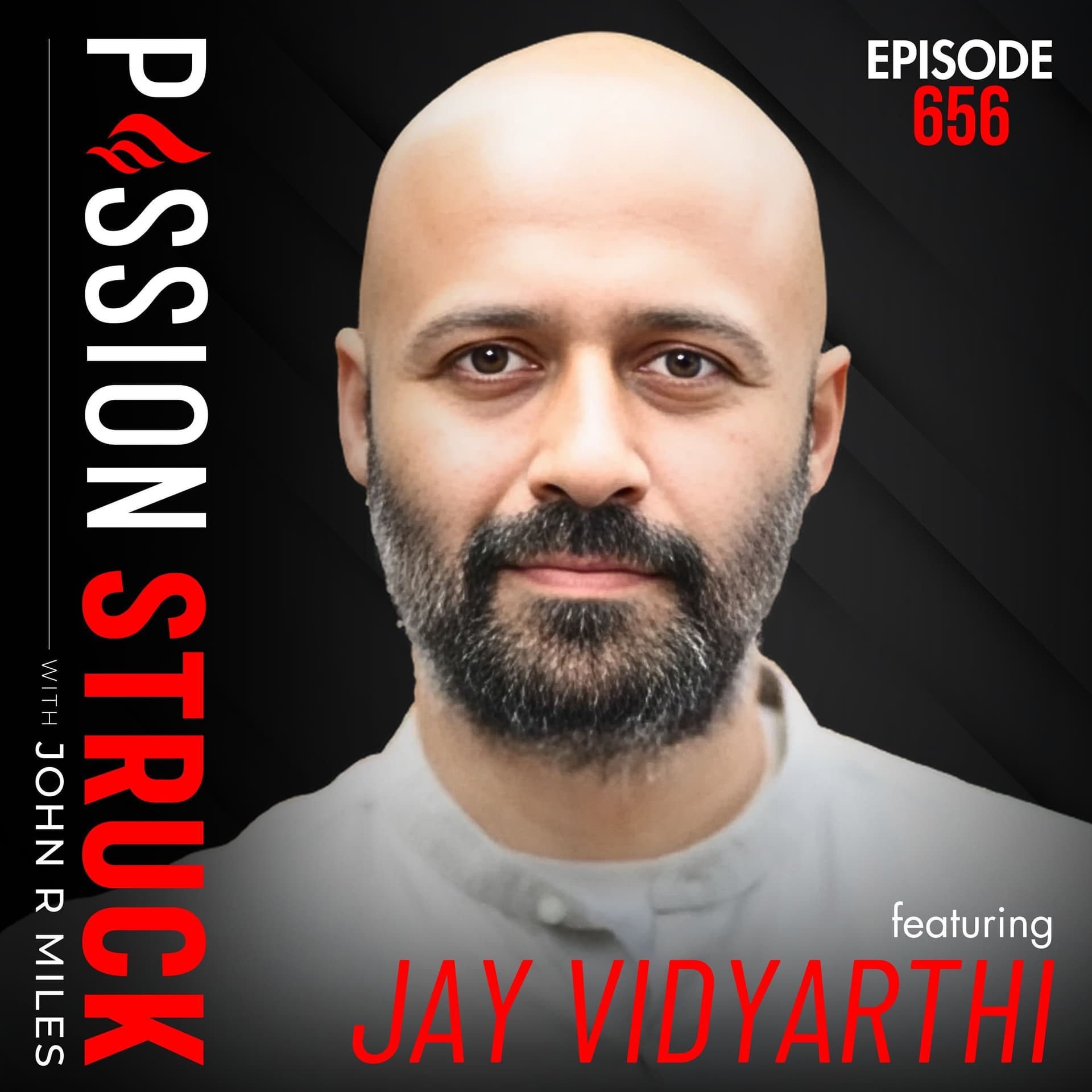
Passion Struck with John R. Miles
Jay Vidyarthi on How to Reclaim Your Mind in the Digital Age | EP 656
00:55:59
Loading summary
Transcript59 lines
- [00:00]
John R. Miles
Coming up next on Passion Struck.
- [00:02]
Jay Vidyarthi
Unfortunately for all time, human beings seem to have complicated emotional and social relationships with anything that changes our state of mind, whether it's a substance and whether that's like a psychedelic or a drug or whether it's just caffeine or alcohol. We build these social cultures around things that change our state of mind. And technology absolutely changes our state of mind. It changes how we feel, but also what we think about and what we think about ourselves. And so it's, you could describe it as psychoactive and therefore it is a very complicated relationship that we can form.
- [00:41]
John R. Miles
Welcome to Passion Struck. Hi, I'm your host, John R. Miles. And on the show we decipher the secrets, tips and guidance of the world's most inspiring people and turn their wisdom into practical advice for you and the those around you. Our mission is to help you unlock the power of intentionality so that you can become the best version of yourself. If you're new to the show, I offer advice and answer listener questions. On Fridays, we have long form interviews the rest of the week with guests ranging from astronauts to authors, CEOs, creators, innovators, scientists, military leaders, visionaries and athletes. Now let's go out there and become passion Struck.
- [01:23]
Hey friends. Welcome Back to episode 656 of Passion Struck. Whether this is your first time here or you've been with us week after week, thank you. Your presence means more than you know. In fact, 36% of you return weekly. And that tells me this movement is resonating. I don't take that lightly. Over the past few weeks, we've been rediscovering wellness together. Red redefining it not as just diet and exercise, but as a four part journey. Fuel for the body, fuel for the mind. Fulfill through purpose. And now, in our final week, flow through spirit. Each step builds on the last, creating a pathway to healing from the inside out. And now we've arrived at flow, the most overlooked part of wellness. Flow isn't just about productivity or being in the zone. It's about alignment. It's about connecting with your inner truth, your energy and your spirit in a.
- [02:16]
Way that carries you forward without resistance.
- [02:18]
And that's exactly why I chose today's conversation. Because in a world designed to hijack our attention, reclaiming flow has never been more important. I'll be honest, this one hits home for me. Everywhere I look, I see extraordinary people drained by distraction. Parents who want to be present for their kids but can't stop scrolling. Leaders who want to make impact but feel enslaved by email. Individuals who mistake their worth for their productivity. I chose this conversation because reclaiming our attention isn't just a matter of focus, it's a matter of meaning.
- [02:53]
If we don't own our attention, we.
- [02:55]
Can'T own our lives. And there's no better guide for this than today's guest, Jay Vidiarthi, mindfulness teacher, design strategist and and author of the powerful new book Reclaim youm Mind. Jay has redesigned over 50 technologies for mental health and well being from the award winning Muse Headband to Sonic Cradle. His work lives at the intersection of ancient wisdom and modern design. In this conversation, we explore why your tech habits aren't a failure of discipline, but a mirror of unmet emotional needs. How to treat your screen time as a relationship, not a moral failing, the surprising science behind distraction, shame and behavioral design and why your presence, practiced daily, becomes the foundation for mattering to yourself and to the world. Before we dive in, one quick update. Our new store start mattering.com is now live. It's part of the Mattering Revolution, a movement to remind each of us that you matter. Live like it Each hoodie, tee and hat carry symbols of courage, belonging and impact, because what you wear should reflect what you believe. Lastly, if you didn't catch my episode On Tuesday with Dr. Jodi Blinco, I highly encourage you to go back and find out how your inner alchemy can help with your flow. Alright, let's dive into episode 656 of Passion Struck Reclaiming youg Mind in the Digital Age with Jay Vidiarthi. Thank you for choosing passionstruck and choosing me to be your host and guide on your journey to creating an intentional life. Now let that journey begin.
- [04:33]
I am so honored today to bring Jay Vidyarthi to Passion Struck. Jay, welcome to Passion Struck.
- [04:39]
Jay Vidyarthi
I am excited to be here. John, good to talk to you. I'm a listener so this is like I've stepped into a podcast that I listen to here.
- [04:48]
John R. Miles
Well, absolutely. I'm thrilled to hear that and have to congratulate you on your sub stack and I'll just put it out there right away that if people are listening to this, you should hop over to Jay's substack and perhaps you can give the name to it because it's one that I read and I love the perspectives that you put out on it.
- [05:06]
Jay Vidyarthi
It's called Attention Activist and it started as an experiment with this idea that attention itself is being commoditized and those of us who seek to reclaim our attention are making A kind of subversive stand in the modern world, but it's actually broadened. And I've shared a little bit about my journey with a neurodiverse child. I've shared a little bit about other personal learnings, and it's become a great outlet and way to connect with people online. So I appreciate you saying that.
- [05:34]
John R. Miles
When you were talking about the attention and how we reclaim it, I did this episode with a former monk, former Hindu monk. Now he's a Hindu priest, Dandapandi. Are you familiar with him? Now, it's a great episode if you or the audience wants to check it out. But we. His whole book was on the missing art of focus. And during his 10 years as a monk, kind of asked him what was the biggest teaching he learned from his teachers. And it was this innate ability to command focus over your. Your life. And I thought it was one of the most profound episodes I had done. So I just wanted to put that out there. But for your conversation, let's start with this. What's something that people misunderstand about your work at the intersection of mindfulness and technology?
- [06:30]
Jay Vidyarthi
Ultimately, it's that those two things are at odds with each other. That's the big misunderstanding. I think technology is inherently not mindful and that mindfulness is incompatible with technology. I think we could talk. I mean, we will talk for an hour about it, but if I could summarize why that's not true. It's certainly the technology that has become the mainstream of our modern world is informed by a certain set of values that aren't necessarily inherent to technology itself. And so there is possibility. And I think we've all had moments of connection and awe and awareness using technology. Similarly, while it does seem challenging to bring mindfulness to our interactions with technology, it is almost certainly possible. I can tell you from experience it's possible. But also the more we resist that, the less we open ourselves up to actually thinking critically about it and applying the practice directly when we're looking at our phone because we feel like, oh, it's not compatible. I'm just on my phone now. I'll meditate later or I'll be present in other areas of my life where actually, no, you can be present on your phone too. And I feel like you wall yourself off from that if you have this flawed idea that they're at odds with each other.
- [07:44]
John R. Miles
Well, absolutely. And it's interesting. I was listening to another podcast that you were on. It was a Buddhist focused podcast, and the host, and I can't remember his Name was a former employee at Facebook and he was talking in the episode about how as they were designing new features. And I guess this shouldn't have surprised me given all that we know about how these tech companies are trying to manipulate our attention. But hearing it from someone on the inside really caused me to do a lot of self reflection. Because what he said, if I have it correct, is that when he was working on different projects and different features to bring out into the applications under Meta, there were different criteria that they used to decide what would go live and what wouldn't. And he said one of those criterias was revenue generation and how much a feature would achieve. And so what he said, which was really scary, is that there were a ton of features that they wanted to put out that would make people flourish more in life to focus on inner awareness and more mindfulness in their life. And every time one of those came up for approval, it was denied because it didn't bring in the revenue projections that Meta wanted. Am I getting it correct?
- [09:05]
Jay Vidyarthi
Fundamentally, the incentives of large organizations make it very difficult to find a happy medium between growing shareholder value and doing right by the people who use our technologies. Some organizations in some sectors are able to figure out ways to do this in some sense, but the large majority of the tech platforms we interact with maybe barely think about our well being at all. But if they do, it's certainly pretty low on the priority list compared to generating that value. And this is where the attention in attention activism comes from. The number one way to do that in the modern world is to harvest as much attention as possible. If you would like to influence people's purchasing behavior or even voting behavior, commanding attention is the way to do it. And so the more you can create a spectacle, the more you can have dancing gifts and flashing red icons and appeals to who you are and calling your name and telling you that there's something waiting for you in your inbox on this new app or whatever, the more you're able to be pulled in to be exposed to what they want to. As a designer by trade, I sometimes think of design as the choreography of attention. And that can be like the better angels of our nature, like the naive 20 year old who entered this field was like, wow, we can use this amazing superpower to create things that choreograph people's attention in ways that make their lives better. But then as you start to interface with the modern world, like the dark side of it is also very possible and tends to dominate the kind of media ecosystem given the narrow incentives of our organizations.
- [10:47]
John R. Miles
Thank you for sharing that. And it just to me is a wake up call of how we need to see behind the rationale that's being used to develop so many of these technologies and why what we're going to be discussing today about your brand new book which came out in February, reclaim youm Mind, is so important. Jay, you reached out to me after hearing my episode with Gaia Bernstein and and if people aren't familiar with Gaia, she's Seton Hall, a law professor. But she wrote this great book called Unwired and I had her on for episode 274. And then also through our mutual friend Emma Cepella, who I had on the show to talk about her great book called Sovereign. And Emma is a professor at Yale and I love both of them. What resonated with you about the way that we approach our interviews on the podcast and how we approach maybe AI and tech as well as well being here on the show?
- [11:48]
Jay Vidyarthi
Well, I think the questions that you're asking are coming from a perspective of not making assumptions first. And I really resonate with that's one of the reasons I enjoy the podcast is it's not like you're not carrying an inherent ideology or prior assumption into the question you're asking. You're asking with that beginner's mind, to use the term from meditation, which is let's just get curious about what's really happening here. And to me that resonates with the message I'm trying to get out in the world. Because when we're talking about surveillance capitalism or the attention economy or all of these technologies ability to manipulate us, I think one of the tracks that has emerged in the past five, ten years as this conversation has gone more mainstream is one that is while accurate and scary what's going on, it also engenders a victim mentality. It brings a lot of fear, guilt and shame to the surface that makes people feel powerless. Oh, these large organizations are manipulating our attention and there's nothing we can do about it. Hopefully the people in power figure out how to regulate it. But as a meditation practitioner myself, and very related to Emma's book, Sovereign, there's actually a significant amount of choice we still have in how we relate to our experience and how we relate to our technology. So when I heard those interviews, I think there was something about the openness in the approach here on Passion Struck that made me feel like I could actually come and talk about this in a grounded way that doesn't feel like it's fear mongering or making people feel guilty for loving video games. I love video games and I don't feel guilty about it. Right. And I think there's a lot of messages in this space that do make people feel guilty. Like, they shouldn't look at TikTok and that meta is the devil. And I just don't think that's what's really happening here. I think we've got some problematic incentive structures and we've got some challenging personalities, but ultimately we are not powerless. There's a lot we can do in our own lives to start to be the change that the entire industry needs. But it starts in those mundane moments in your bedroom when you choose not to put your phone on your bedside table or in the way you talk to your kids about their devices or whenever it might be that these things really matter.
- [14:08]
John R. Miles
So I want to go to that gamer you are. Because in Reclaim youm Mind, you write that you're both a meditation teacher and a gamer. Which on the surface, for someone who has studied Buddhism, seems like, how can you be both? But in your case, you make them work. And I want you to explain how. And also, how do those two identities shape your perspective?
- [14:35]
Jay Vidyarthi
Let's start with the second question, which is I grew up loving technology, tinkering with code, playing video games, watching anime. Just what then was called being a nerd and now is just the mainstream of culture online and in person. I love seeing NBA players with anime character tattoos. And you're just like, worlds are colliding, right? Trying to balance these two things as a kid wasn't hard. Right. Like, I was curious about mental health. Someone in my family has a serious mental health issue, and I was exposed to that at a young age, and I think earlier than most, very clearly saw that the state of our mind shapes our view of the world and how we show up in it, and that it's almost primordial to our life experience. Yet also I saw that with tinkering with code, you can reshape virtual realities. And now that's even more true than it was when I was a kid. So it wasn't hard to live in those contradictions the way many contradictions aren't hard to live in when you're an adolescent and teenager. But as you start to become an adult, the world pressures you to take on certain identities. And I was straddled between two identities. When I built my business in tech and, like, work remotely off a laptop, the idea of meditation was not very, like, common and friendly and part of the tech world. Similarly, when I would go off on a meditation retreat, I'd go to a monastery. I'm not exactly going to pull out a Nintendo Switch and feel at home to just play Switch in the middle of the lounge of a meditation center, right? So I was forced to confront this duality in my own life and to recognize with much struggle and experimentation, how to integrate these worlds and not have to give in to one identity or another and be my authentic self. Finding a mindful way of engaging with video games and finding video games that are truly mindful, as well as bringing mindfulness to my work, bringing awareness and compassion to the way I show up in the tech world. And by merging those two, I discovered that these societal scripts aren't necessarily the only possibility. And now, more recently, as I've been talking to people about this book and connecting with organizations that have shown interest, it's becoming clearer to me that especially with the advent of AI, in fact, in the future, there's nothing we need more than wise people to engage with technology. We need wise, wise people to help steward this next evolution of technology. But we can't have them all escape to the mountains while the rest of us are addicted to our AI agents that are designed to tell us everything that we want to hear. That integration has resulted in who I am as a person, and therefore my work.
- [17:25]
John R. Miles
And now a quick message from our sponsors. Welcome back to my conversation with Jay Vidiarthi.
- [17:38]
I want to go back to a moment that shifted your career and you just touched on it a little bit, but it's also a similar echo to my own career. I can't remember if I was at Dell at the time or if I was at Catalina Marketing at the time, but I just started having this feeling that I was making other people's dreams come true. I was making other people lots of money, but I wasn't really making myself flourish. And it had become this cycle where I was just getting more and more disappointed by the outcomes that were happening. And I just felt myself starting to drift and not wanting to do it anymore. And it really led to me when I came up with this idea for Passion Struck, like, how do you design for human flourishing and not put profit as the main thing that you're going after? Because I always felt like the profit will come if you're doing something right. But if you, if you focus on the end goal that you want to achieve, which is to help people live better lives, then the other stuff will take care of itself. But that's never been the focus that we have here, we've put the end goal of making people live lives that matter and being intentional about how they do it. The primary thing that we're focused on, and I think you have a similar story. So what cracked open that transition for you?
- [19:10]
Jay Vidyarthi
I think people that are on some kind of spiritual path, whether that's like secular mindfulness or religious or whatever it might be, to put it in Neil Young's words, they're like mining for a heart of gold. And if you imagine a world where we're using all of this technology, we're using our skills, but we're also mining for a heart of gold. I think we end up with a world where people are profiting to the point that they can sustain a lifestyle that they really enjoy. And also going from passion struck to compassion struck. Right. That we're like sharing so much benefit to others and holding hands and helping people go. And for me, the moment I started my career, I went to school for psychology and neuroscience. I was interested in the mind for many reasons from my upbringing, but some I've already mentioned. And when I found design and I realized that design wasn't just about making things pretty, but it was about understanding how people interact with things and technology, that was really fascinating for me as a process. And I find that school is really good at teaching us, like, the topic that we're interested in, but not as much about what we want to spend our time doing. So I went into the career of a designer, and the first three to five years I'm consulting for whoever would pay and learning from my mentors about how to do this process. Love the process. Super drained by the fact that a lot of the projects feel almost pointless to me. And there were like two projects that felt really exciting, that felt more compassionate, though I didn't have the words for it at the time. But I think I was aware that as a designer, you put things in the world. And I wanted to put things in the world that aligned with my values. And then I was assigned to one project where I had to go in house with the client. So I went to their office for a couple of months, and on the first day, he gathered the team together. And just when everyone went quiet, he said, okay, let's talk about the goal of this project. And the goal of the project is to make me rich. And everyone laughed. And I was like, this is not a joke. That's actually the goal. And why we're laughing is not because that's not true. It's because he had the Gall to say the quiet part out loud. And that was something that really precipitated me in the subsequent years moving on to exploring how do I find that value alignment of doing something that I actually want to see in the world and also living a modern life. And that led me to go to graduate school where I was exploring mindfulness technologies for the first time. It also led me to go on mindfulness retreats. Like I was dabbling with meditation at the time. But I started to take it more serious. And it's not mindfulness for everyone, but for me, mindfulness was an access point to understanding that there might be a way to mine for a heart of gold and also live in the modern world. And the decades since have been a journey of trying to balance those extremes. Can I continue that pursuit of deeper compassion and awareness while also applying it to entrepreneurship and building a business? And I'm proud to say that since that transition, 95% of my work has been something that I feel is value aligned and is putting something in the world that I think that is truly of benefit to people. Sometimes I didn't get paid that well for it. Sometimes I had a lot of self doubt. But so far I've been managing to thread that needle. Would I be much richer had I given into some of those job offers? Yes. But I generally feel like the personal professional integration is one of the biggest sources of well being in my life, along with my meditation practice and my family. Right.
- [22:56]
John R. Miles
I have to take you back in time to 2010. And at this point, I'm a CIO at Dell and I have spent much of the past year flying around the world with Marc Benioff, preaching about cloud computing. Because at that point in time, Dell had the largest implementation in the world of Salesforce and he had launched this capability, people may remember it called Chatter. And I was helping him talk about how Chatter could be used within a company, et cetera. So fast forward, he invites me to come and do the opening keynote for him for Dreamforce. So I had no idea what I was walking into because I'd never been to Dreamforce before, had no idea that the conference was going to have 50,000 people in the audience. And so the day of the speech, there's a lot of buzz going on behind the stage, a lot of things that are happening. And at that point I had known Mark pretty well and he said a few VIPs and I need to go do my thing. Would you mind as a favor, taking care of them? So he leads me to this back room and there were a collection of people there, but some of them were the Black Eyed Pea members. And Neil Young and I got into this really robust conversation with Will immediately about the use of cloud computing for non profits. But the interesting thing is you had all this buzz and people talking and then Neil Young was sitting in a corner by himself, just in almost quiet contemplation. And I remember asking him because he was performing for a small subset of the people who were attending Salesforce, he was doing a one person concert. And I asked him, could you play Heart of Gold? And not only did he, not only did he not play it, but he didn't play Rocking in the Free World, he didn't play Ohio, he didn't play any of his most memorable songs. He. It was really, I think songs that were like his favorites that he chose. He was mindful about what he wanted to play, but none of the fan favorites that we all came to hear. So that's my Neil Young story sense.
- [25:09]
Jay Vidyarthi
That Neil Young is a pretty wise guy. Obviously don't know him, but I've listened to his music for a long time. And what I love about that story is that what my story in my head of what he's doing is he's playing at Dreamforce and he's playing the songs he thinks this group needs to hear more than what they want to hear. And that's very much been my experience with some of the great meditation teachers that I've worked with is that I think the, the meditation teachers that just are good people to be with are the ones that can really remind you of things you already know to ground in the moment. But the ones that have truly sent my personal practice leaps and bounds in the future are the ones that have told me not what I wanted to hear and not what I already knew, but something I really needed to hear that almost challenged me when I heard it. But then maybe days or even months later, it dawned on me like the true value of that. And yeah, I suspect there's something to that in your story. But what a coincidence that you got to connect with Neil Young. I don't know where that came from, that using his song lyric there is not something I regularly do, but some energy. Some part of us knew that we were both fans of Neil Young.
- [26:19]
John R. Miles
There you go. Well, I'm just going to close out this segment by saying I never thought about it the way you just put it there. But he is very contemplative and very introspective when you meet him. And, and he will talk to you, but. And he was very close friends and an advisor to Mark, so it wasn't the first time I had been around him. But he. It didn't seem like he was comfortable around all that commotion. He just wanted his own space. But when I think back upon that concert, in that event, there was a VIP who was there who maybe he was trying to send a message to, given the playlist that he played. And that was Colin Powell, who was on the board of Salesforce, but at the time, I believe was 2010, probably would have been Secretary of State at that time. It could have been he was trying to send him a message, but who knows?
- [27:09]
Jay Vidyarthi
Who knows? I wouldn't put it past him.
- [27:12]
John R. Miles
We started the whole conversation about my story with Facebook, and you've said a couple times that it's not that we need to reject technology like Facebook, TikTok, et cetera. It's just that we need to relate better to it. Why do you think these heavy emotions like guilt and shame have become the dominant ones that we see around tech use?
- [27:38]
Jay Vidyarthi
You can use food as a kind of metaphor that, like, if you don't eat well, there can be a lot of really challenging consequences in your life, from the way you look to the way you feel, feel to the general health of your body. And these are socially relevant contexts that we feel really bad about. And so similarly, I think we've created a situation where if you're really distractible and you can't read a book anymore, and you just are like, zone your phone at a party and you know, all the different trappings with social media and the hearts and the likes and the retweets. There's a weird relationship we have where we're both, like, loving this stuff and feeling ashamed that we love it so much. And it's a very difficult cycle to get out of. And unfortunately, from for all time. Human beings seem to have complicated emotional and social relationships with anything that changes our state of mind, whether it's a substance and whether that's like a psychedelic or a drug or whether it's just caffeine or alcohol. We build these social cultures around things that change our state of mind. And technology absolutely changes our state of mind. It changes how we feel, but also what we think about and what we think about ourselves. And so it's. You could describe it as psychoactive. And therefore, it is a very complicated relationship that we can form. We can have a healthy relationship, we can have a secure relationship, but we can also have an anxious relationship with it where we just like panic when the battery is dying because we need our phone to feel safe. Or we can have an avoidant relationship where we say, oh, it's all bad and kids these days are addicted to their games and it's all a waste of everything. Or we can have a chaotic or disorganized relationship with it. And I think the goal should be to try to find a secure relationship where we can use it in healthy ways and we can be self aware when we're falling into traps. And as an individual, but also as a family and a community and a society, move beyond the, like pendulum swinging from extremes of love and hate to something that's a little bit more grounded and secure. And ultimately I think the market will have to follow us there. But in order to get there, it takes an immense amount of like, social emotional skill and awareness in the moment to be able to achieve that. And I think that's the challenge of our time, is to learn how to relate with all this technology in a healthy way, because it's not going anywhere and maybe a few of us can retreat. But ultimately we need, like I said, wise people to be online.
- [30:16]
John R. Miles
I understand that you often, as a family, have a game night, not games like Stratego, but video games. And it brought me back to when my kids were younger. I'm thinking of a time period like 2005, 2007, and I can't remember the exact name of the game, but one came out and it was the rage at the time because you would play instruments and have to play against the game and the notes that it would give you. And my kids love music, love playing different things, and it was a way for us to expose them to it, but we would all play in it. One of us would sing, one of us would play guitar, one of us would play drums, et cetera. And it really became an opportunity. Although we were using technology, it was really a way to build stronger relationships and to have fun doing something that we all enjoyed doing, while it was also teaching the kids music appreciation. And what I loved is a lot of the songs that they love playing to were ones that I listened to for much of my childhood. So it was fun introducing that to them as well. So many people might hear our stories and say, you're playing video games with your kids, how is that a good thing? And I would like you to give the counter approach to that and how this could be used as a way to actually build connection, not in a way that drives us further from it.
- [31:42]
Jay Vidyarthi
I think you're talking about Rock Band. Is that right?
- [31:43]
John R. Miles
Rock Band. That's exactly it.
- [31:45]
Jay Vidyarthi
Yeah. I think there were a few Neil Young tracks on that game, too. So it all connects. I think it's a great question. I get this a lot. I think a lot of people, especially if they're parents and they're not gamers, they have a real hard time figuring out how to relate to their kids if their kids are gamers. But even if you are a gamer, it can be really hard, especially with all this shame and guilt, to see your kids spend hours and hours playing video games. But I think the best way that I can illustrate this is. Let me paint two pictures for you. Right? So my kid is now six. When he was two or three, he started to show an interest in video games. His first love was Mario. Everyone knows Mario, right? So there's two ways I could have spent the last three or four years, right? I. I could have immediately been like, mario, no, it's bad. And I could have been like, put that screen away. You spent too much time. I could be yelling at him. I could be telling him that video games are awful and that he shouldn't play them. Or I could have been like, hey, buddy, play games as much as you want. Whatever, it's fine. In both of those cases, I think you're taking a pretty extreme position, right? Because in one, you're just completely guilting, shaming, and forbidding this natural interest into something that is a huge part of our world. And in another situation, you're just letting him, like, unfettered access to the open Internet, which is not necessarily friendly for kids. And you're also probably blocking his ability to access other experiences like going outside and playing with his friends and getting into gardening or baking or math or whatever it might be, right? So the middle way here, or the Golden Mean, to use Western philosophical terms, would be to say, okay, so there's kids into Mario, what level are you on? Let's play a little bit together. Okay, now, it's been a lot today, so, you know, why don't you finish that level and then we'll wrap up for today? And then over time, as he starts to be like, I'm a little bit bored of Mario taking an active interest. Okay, well, what other games are out there? And you help him and find games that are actually going to be really connective, that are going to toe that line between being fun yet also being the healthy form of screen time. So when we have our weekly video game party, our son has limits of his screen time throughout the week. He gets 30 minutes after school and on weekends sometimes he gets a bonus 30 minutes. So he ends up with an hour. My wife and I are both of the agreement, that's the rule. But we can be really flexible about it because we don't care about the number of minutes or we care about the quality of the screen time. So what is quality screen time? What game is he playing? Is it something that has some useful elements to it, but it's also fun? So he's enjoying it. Is he playing a long hold up with the screen on his face or is he like sitting in front of a TV beside his friends or parents and they're talking and sharing a good emotional bonding moment? And also is he being thinking rationally and reading and being creative? And so right now, in order to release the pressure of that on the weekend, we'll have one night where we'll all take turns. We'll do 15 minute turns each. My wife will play, I will play, and he will play in order. So he sees us modeling our enjoyment of really good video games. We all talk about each other's games. I'm playing Zelda at one point and we're going through this epic story and we're talking about some of the emotional themes of the story. And in fact, right now his love for Mario has evolved into a love for Mario Maker 2, which is a game where you build Mario levels. And I have to say, when I sit there and watch him building Mario levels and then challenging my wife and I to try to play through them, it doesn't look a whole lot different than my work as a designer. Right. I'm just like, he's learning how to make choices, he's designing experiences for other people. He's learning how to put these building blocks. He's being creative. He's sometimes watching YouTube videos from great levels that grownups have made for inspiration. So there's a form of screen time out there that's measured. We're setting boundaries around the traps, but it's also interactive. We're building connection around it. Like in your example, we're fostering a love for music. So it's going to look different for every kid. Like I said, my kid is neurodivergent and has some special needs around this stuff too. But the point is not that you have to replicate exactly what I'm doing, but to understand that there are extremes and there's a balanced middle. And I wanted to say one more thing, which is one of the rules I instituted from his very first interest in Screen time was that I would never turn the power off on him. I would never yank the controller out of his hand. I would always empower him to choose to turn it off. So when his timer goes off, first of all, he sets the timer himself. I make sure he does that. So he's setting an intention. And when it goes off, I will talk with him, I will reason with him sometimes I will pressure him. But he has to be the one to turn the power button off and decide that he's had enough. And what skill could be more relevant in the world that these kids are about to inherit? It's the one that we struggle with. How do you decide yourself when you've had enough? How do you set a clear intention of how much you want to do and how do you turn it off yourself?
- [36:57]
John R. Miles
And being intentional about doing that is the most important thing. For instance, I heard you talk about a video game that was causing you, I guess, to have too much angst about it and having that self awareness to realize that you were starting to mega concentrate on it and it was taking up too many cycles of your life that you had to put it away. But that's the same thing that we need to do with any addiction that we face, whether it's sexual relationships, too much work, et cetera.
- [37:29]
Jay Vidyarthi
Self awareness is the key. And that's where the overlap with, I think mindfulness and other forms of contemplative practice are relevant. Because that's a skill, right? The neuroscience is showing us that awareness is a skill that we can train. And so the more aware we can be of how a certain substance or technology is influencing us, the, the better we can step out of those streams when we get caught in them. And the game you're talking about is a game called Rocket League. And with awareness and self inquiry, I can say not only did I notice Rocket League was becoming a cult compulsive need for me that I had to step out of. I also noticed why. I noticed that at that point when my son was really young, there was a ton of responsibility on my shoulders. It was all very serious and I didn't have enough room for play and I didn't have a lot of agency in my life at the time. And that was trapping me into trying to find some illusion of play and agency through this video game. And when I realized that it wasn't just that I stepped out of the stream at Rocket League, I actually joined a dragon boating club, which is something I've never tried before because I could just tell, oh, I was longing for some sort of freedom, some sort of agency, some sort of play and exploration. So I was like, listen. I told my wife, I was like, listen, I know we're busy, but I just need one hour a week to get out to the lake and get on this dragon boat with strangers. And not only did I step out of that game, I didn't really crave it as much because I addressed the healthy, deeper emotional need that was driving that trap.
- [39:02]
John R. Miles
Jay, thanks for sharing that. And I think those are some great ideas for listeners to take at heart too. One of the things I wanted to talk about is you use this term for false urgency a lot. Can you unpack a little bit for us what that means and how it hijacks our daily attention?
- [39:21]
Jay Vidyarthi
So I've been experimenting with a mindful relationship, a secure relationship to technology for decades now. And one of the biggest themes I've noticed that can be challenging to work with in all areas of technology is a false sense of urgency. Things technology can make things seem more urgent than they really are. So whether that's a headline in the news that's portraying something as a crisis, when really it's a conversation that two politicians had and nothing's really escalated yet, or the ability for a work notification to have you up at 9pm, like looking at a PowerPoint deck, or a piece of code that totally can wait till the morning, or hammering through Your inbox at 7 in the morning before you when you should be helping your kid get to school or doing your morning routine because everything just feels like it has to be done now. All the way to like video games that are having like scarcity. Oh, you have to act now if you want to unlock the free pack and rewards or social media making it feel like you need to be more than you are, you need to be more successful and more beautiful. There's this underlying theme of false urgency that drives us to get into these traps. And I think some of us in certain phases of life can be even more susceptible to them because we are in a position where things feel more urgent. The double edged sword here is it also makes things that are actually urgent harder to find because when everything's an emergency, nothing's an emergency. We just used to this heightened pace of life. So my advice for people is to for example, groom their feeds, groom their channels and subscriptions and the apps that we use with the lens of false urgency, don't follow channels that are giving into this myth. And also to move unapologetically slower than the group norm because in some ways, part of what creates false urgency is the fact that we all buy into it. And that makes it even harder to disconnect from. Because you feel that fomo, like you're not staying up to date on the news, that you're not staying up to date with work notifications. Excuse me. So often it can feel really powerful to make an intention to say, I am going to intentionally move a bit slower than the group, and if I'm a leader, possibly even draw the group to move a little bit slower can be a really powerful tool. Combative habit against false urgency.
- [41:55]
John R. Miles
Every time I hear that term, false urgency, it brings me back to Stephen Covey. And one of my favorite sermons I've ever heard in church was this Methodist pastor I used to go to see in North Carolina. And he did this sermon this one day that was just profound. On the main thing about the main thing is keeping the main thing. And to me, when we have this false urgency, we're doing everything but keeping the main thing in our life the main thing. And so he used the Eisenhower matrix in that sermon as a way to. To think about this differently. And it's something that I now use when I talk to people who have this issue. And you just create two matrixes. One of them is urgency, one of them is important, and it's an easy thing to start doing. If something is important and it's urgent, then you need to do it. But if something is not important yet, it feels urgent, but it isn't, you need to put that to the side. And it's such an easy thing that people can start implementing in their lives. And after a while, it's a tool you can use to help making better decisions.
- [43:00]
Jay Vidyarthi
When the overlap with technology, you can use that tool to customize your notification settings. For example, like a lot of people online will say, oh, turn off all your notifications. Well, if someone's babysitting my kid, I want those notifications right. So what's the level of urgency of these notification settings? And another example would be like, I would challenge you and your listeners right now. Wherever you get your news, look at the different channels you subscribe to. Click into each of them and take 30 seconds on each to skim the headlines and make a quick decision, like, what level of urgency is this channel presenting and how accurate is that to the actual urgency of the information being shared? And it'll make it very clear which of these channels are worth subscribing to. For me, I was getting really into political news at a time and I realized that I really want to stay abreast of what's happening. I feel like it's fundamental to a democratic society that citizens are paying attention. At the same time, news is getting overwhelming. And so this lens allowed me to say, okay, well, these are the topics I need to like. I work in design. I need to be up to date on what's going on in my work. And so that's something I can be following digitally. But for the political news, I unsubscribe from everything, and I started subscribing to paper magazines because I was, like, 30 days later. A reasoned analysis is the level of urgency I actually need for that information. And that's not true of every channel, but it's true for political news. So I think, like, auditing your channels and subscriptions around false urgency, Taking the Eisenhower matrix as a perfect example, you can just categorize all your information sources and notification settings by that matrix, and things will become a lot clearer.
- [44:47]
John R. Miles
I think that is a fantastic idea. So thank you so much for sharing it, because as you said, there are some things that are very urgent, like messages from your wife that you probably shouldn't ignore.
- [45:00]
Jay Vidyarthi
Yeah.
- [45:01]
John R. Miles
So if I have this correct, you often talk about designing your home screen and text setup to act like a singing bowl. Do I have that word correct?
- [45:12]
Jay Vidyarthi
Yes.
- [45:12]
John R. Miles
A cue for mindfulness. What are some ways that listeners can build those same singing bowl reminders into their digital life?
- [45:21]
Jay Vidyarthi
If I had to boil it down to one tip, I would say a sudden absence creates an incredible opportunity for awareness. So we live our lives following certain habits, and our technology is certainly no exception to that. If you pull out your phone, your thumb is going to reach for a certain app. That's just the habit that you have. And I think there's a lot of voices out there that'll say, listen, you need to delete that app. And I would say. I would say you need to experiment with that app and explore. How does it actually feel when you're wanting to use that app? How does it feel during using it? How does it feel after? What kind of thoughts does it promote in your mind? What are you bringing to it? What cravings and allergies does it foster in your life? And one way to do that really easily is to simply delete the app for 24 hours. Not out of shame and guilt, not out of a lack of willpower, but as a singing bowl. The way that mindfulness teachers will ring a singing bowl and invite you to listen fully to it without distraction is to say, every time you notice your hand reach for your phone and your thumb reach for that app and then you have that moment where you're like, oh, it's not there anymore. To have that be a positive moment of curiosity. Wait, what is happening right now? Why am I reaching for this app? Oh, I'm waiting for the bus and the bus is late, so I'm bored. So I'm reaching for this because I'm bored. Interesting. Like maybe write that down and then the next time you're reaching for it. Why? Oh, I just got in a fight with my partner and I'm trying to escape into this app right now. Interesting. I'm seeking some sort of numbness. And so there's a whole language of, oh, we need to remove our social media, remove our apps and manage what we're using. That's full of guilt and shame. But there's also a way we can talk about it that's about self awareness and curiosity. And what I would contend is that the latter leads us to deeper insights, but also leads us to a balanced relationship where, for example, I'll give you an example from my own life that's counterintuitive. I have a real hard time having substack on my phone because I run this substack and the kind of feedback and metrics I get can be very attractive to my deeper emotional need to be a provider and to be seen and to feel accomplished. So I actually can't have substack on my phone. And on the other hand, TikTok, which is an app that a lot of people describe as like the most addictive thing in the world. I experimented with TikTok and I actually don't have a hard time using TikTok very rarely because whatever emotional needs it's speaking to are not like my personal injury, like history of injury. So TikTok is something I actually don't get stuck on and substack is something I do do get stuck on. And that's very counterintuitive. But if you're approaching this with curiosity, you're going to figure out how to make your own secure, healthy relationship. And it might not be the kind of boilerplate talking points that the digital wellness conversation might suggest.
- [48:33]
John R. Miles
Thank you again, Jay, for sharing that. And the last thing I wanted to touch on with you is you now do a lot of creative work, but you're doing it from the standpoint of trying to design for well being. And as I understand it, you've now designed over 50 technologies around that lens, from Muse to Sonic Cradle what are the biggest lessons you've learned about building tools that help instead of harm people?
- [48:59]
Jay Vidyarthi
I think with mental health and technology, the design landscape looks a lot different from other areas. So, for example, if you're using like the Nike Fuel band or Fitbit and you're trying to motivate yourself to run, there's all these design patterns around getting a streak and maximizing your new record. Whenever I see products try to do that for things in the mental health space, whether it's therapy or meditation or cold plunges, I always cringe a little bit because I'm finding that again, a lot of that motivational grind mentality runs counter to the more balanced, effortless pace that we need for well being. So that's one big design lesson for those that are designing technologies for wellbeing is to like engender that self compassion for people to take care of themselves ultimately and not beat themselves up about the fact that they didn't meditate enough and not a step in the right direction. I also want to bring up AI for this question. So the modern large language models that are taking over right now, one of the ways that they work is that, yes, they're trained on all this data, but then they go through a process called RLHF, which is reinforcement learning with human feedback, which is basically, you can think of it as lots of people training the bot and taming the bot to be fractured, friendly and personable and give answers that we want to hear. That is the same pattern that kind of messed up our social media world, because our social media newsfeed algorithms also are designed to show us what we want to click on. And what it resulted in is a lot of echo chambers where we're only hearing perspectives we want to hear. And you can see this. You can go to ChatGPT today and you can ask it a question and you'll get a very optimistic and supportive answer. And then if you challenge it and say, are you sure? You sure you're not being optimistic? Like, I think there's actually some real challenges here for me. And then it'll quickly change tech and be like, you're right, there are challenges for you, like, it's a yes man. It'll always agree. And for some of the projects we're working on now for technologies for mental health, I think this is a fundamental limitation because as we discussed earlier, a good therapist or meditation teacher or anyone who's guiding you, a coach needs to not be afraid to tell you what you need to hear, even if it's not what you want to hear. And right now that's a big limitation of technology. So I think I'm really a big fan of untold. It's like a new AI technology where you can journal in an intelligent way. I think the new era of mindful technology, the AI offers the ability for it to be very personalized to your unique experience, but its challenge is actually introducing the friction needed to lead to transformative change. And so I think that'll be the next step of this. And it's stuff we're actively working on at Still Lake right now.
- [51:59]
John R. Miles
Awesome. And in closing, if you could plant one seed in the minds of our listeners today, something that they could carry forward the next time they pick up their phone, what would it be?
- [52:11]
Jay Vidyarthi
Why am I here? Would be a good question to ask yourself in that moment, that moment you pick up your phone, why am I here? What's happening in this moment? Step out of the stream of habit and just say, what's really happening here? And how much does it line up with my deeper intentions? And I will caveat to say there might be a really good reason. It might be just fun to look at social media, and that's great. We don't need the guilt and shame around that. It feels good when someone puts a heart on your posts or reshares your podcast episode. It feels good. And there's no shame in enjoying those metrics. But if we find ourselves in traps, asking why and then why and going to those deeper whys will really help you unravel those traps at the root. Instead of forcing yourself to not use a piece of technology to address the deeper emotional need that might be leading you to be trapped.
- [53:04]
John R. Miles
Jay, thank you so much for joining us today. And to the audience, make sure you pick up a copy of his new book that came out in February, Reclaim your mind. And where's the best other places for them to go? I know they can find the book on Amazon or and all the other bookstores that carry it, but if they want to learn more about you, where should they tune into?
- [53:26]
Jay Vidyarthi
So my name.com, jvthearthy.com is my website. I have links to all the different bookstores and bookshops and also you can ask local booksellers to stock it. So that's a good way to support a local bookstore as well. And yeah, if you Google me, there's lots to find and there's a form on my website, so reach out if I can support with something and I'm very easy to find.
- [53:47]
John R. Miles
Well, Jay, thank you so much again for joining us.
- [53:50]
Jay Vidyarthi
Thanks for having me. It's an honor.
- [53:52]
John R. Miles
That's a wrap on today's powerful conversation with Jay Vidyarthi. Here are a few key takeaways I hope you carry with you.
- [53:58]
First, you need to understand you're not.
- [54:00]
Broken, it's just your attention habits often mirror deeper, unmet needs. Second, technology isn't inherently the enemy with awareness and design. It can support your values instead of stealing your piece. And lastly, reclaiming your mind starts not with abandoning your phone, but with reclaiming your choice. If this episode resonated with you, I highly encourage you to pick up a copy of Jay's brand new book, Reclaim youm the Joy, Shame and Curiosity of Wayfinding in a Digital Age. It's available everywhere now and it just might transform how you relate to your digital life. As always, I'd also love your support. Leave a five star review on Apple or Spotify. It helps this movement reach more intentional change makers like you. Share this episode with a friend, a colleague, or even your family, especially those feeling overwhelmed by distraction. And head over to theignitedlife.net to explore our substack where you will find a companion guide for today's episode coming up next in our new series, the Science of being human, Dr. Bruce Miller and Dr. Virginia Sturm join me to explore brain health, purpose and what neuroscience can teach us about living fully.
- [55:06]
Guest or Expert (Unnamed)
Empathy allows us to feel all sorts of things. Good things, positive things, bad things, or negative things. So the same system in the brain might allow us to feel the pain of a loved one who is injured or sick, but also to share in the joy of their success or experiencing something amazing or beautiful in life. Like you said, it's that resonance system that allows us to reverberate in our bodies with that other person's experiences, be they good or bad.
- [55:42]
John R. Miles
Until then, live boldly, lead with intention, and as always, live life. Passion struck.
- [55:50]
Sa.