← Passion Struck with John R. Miles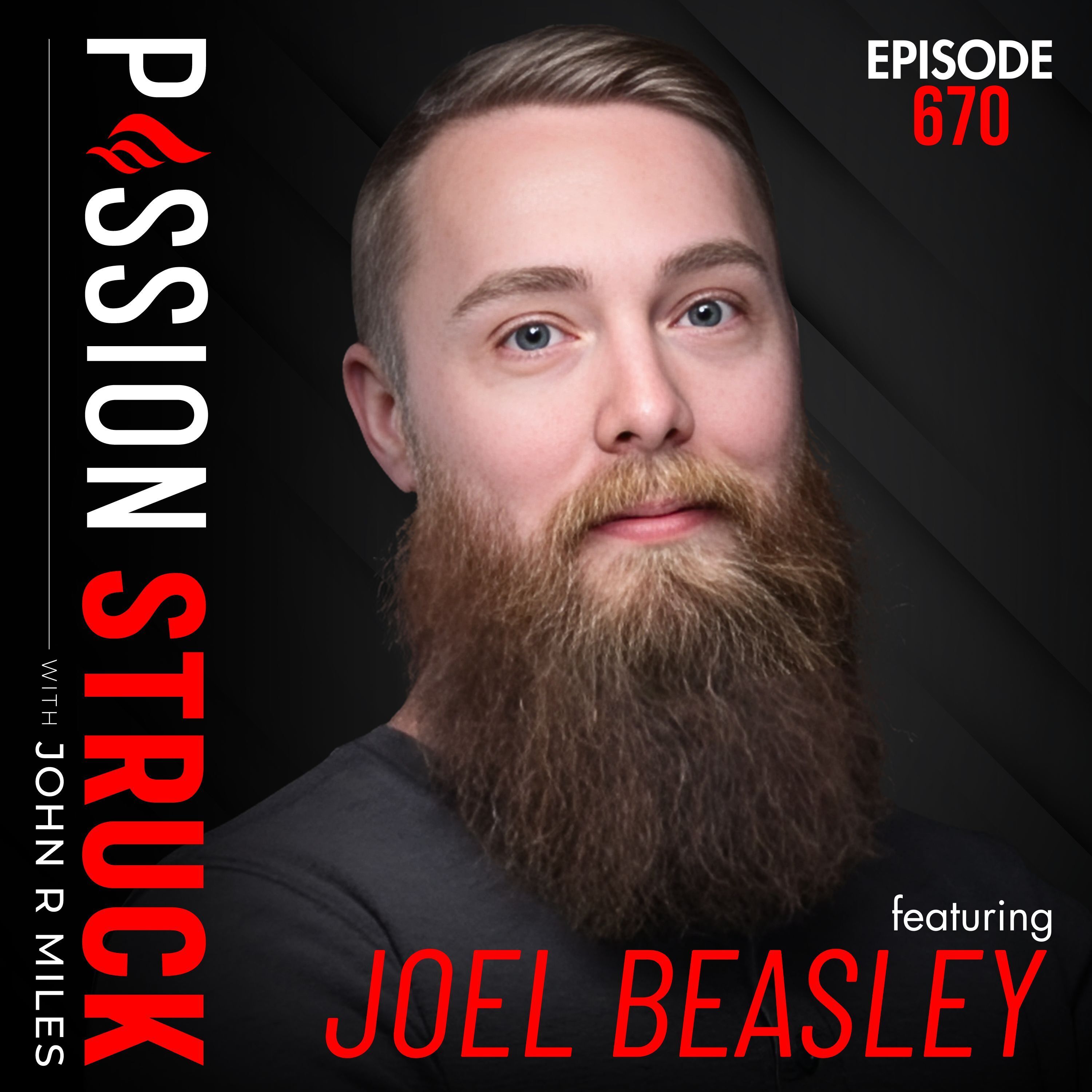
Passion Struck with John R. Miles
Joel Beasley on Starting Over, Stand-Up, and Self-Discovery | EP 670
00:58:49
Loading summary
Transcript116 lines
- [00:00]
Experian Announcer
Not great with finances.
- [00:01]
Joel Beasley
That's okay.
- [00:02]
Experian Announcer
Experian is your big financial friend. Explore credit card offers. Some labeled no Ding decline, which means if you're not approved, they won't hurt your credit scores. See experian.com for details. Applying for no Ding Decline cards won't hurt your credit scores if you aren't initially approved. 2025 Experian.
- [00:13]
Joel Beasley
Experian.
- [00:15]
John Miles
Coming up next on Passion Struck.
- [00:17]
Joel Beasley
I need very difficult things, otherwise I spiral into depression. So if I'm not trying to solve some incredibly difficult problem, then I'm just uninterested in life itself. So early in my career, a lot of those were software problems, building systems, and then it became building businesses. And then I said, okay, well, now I've got to figure out how to solve this comedy problem. I had to set a goal and I had to be careful. Ken taught me that One of the issues with my podcast is I set my goal and I achieved it without having another goal behind it. And once you achieve that, like, massive goal that you never thought was possible, it's, oh, I thought that would take me a lifetime. And that took me seven years. Right.
- [00:55]
John Miles
Welcome to Passion Struck. I'm your host, John Miles. This is the show where we explore the art of human flourishing and what it truly means to live like it matters. Each week I sit down with change makers, creators, scientists, and everyday heroes to decode the human experience and uncover the tools that help us lead with meaning, heal what hurts, and pursue the fullest expression of who we're capable of becoming. Whether you're designing your future, developing as a leader, or seeking deeper alignment in your life, this show is your invitation to grow with purpose and act with intention. Because the secret to a life of deep purpose, connection, and impact is choosing to live like you matter. Episode 670 of Passion struck is here, and I'm so glad you're with us. Whether you've been here since the first episode or this is your very first time listening, welcome. Over a third of you return every week, which tells me this isn't just another podcast. It's becoming a movement. Together, we're passing the ripple of mattering farther than ever before. If this show has ever helped you see yourself more clearly or take one small step toward growth, here's how you can help keep it growing. Share this episode with someone who needs to hear it. Leave a five star rating or review on Apple or Spotify. It tells the algorithm these conversations matter and and helps others discover them. We are in the final week of our decoding humanity series exploring the science, struggles and stories that make us human. Last week, we dove deep into identity and belonging. Olga Kazan from the Atlantic unpacked how she went about changing her own personality and how we can change ours too. Then Robert Glaser showed us how to find our compass and align our work and life with our core values. And in my solo episode, I shared six choices that you can make right now to build belonging and create deep connection and purpose in your own life. And that brings us to today, the start of our final week, the stories that shape and save us. Here's the thing. Many of the people I bring on the show have already completed their hero's journey. We see them on the other side of struggle, reflecting on what they've learned. But what fascinates me just as much, maybe more, is, is what it looks like in the middle of the story. That's why I wanted to bring on Joel Beasley. Joel is best known as the creator and host of Modern cto, one of the most respected podcasts for technology leaders worldwide. He's already built one successful arc, taking a show from a crazy idea to a global brand that influences some of.
- [03:25]
John (Interviewer/Host)
The biggest names in tech.
- [03:27]
John Miles
But today we're talking about his next arc, his leap into stand up comedy, and what it takes to become Passion Struck all over again. Because the truth is, becoming passion Struck isn't a one time event. It's a lifelong practice of saying yes to the next thing that scares you, stretches you and forces you to grow. In this conversation, you'll learn the mindset shifts that took Joel from self taught coder to global podcast host, why relationships are the real currency of modern leadership, how to turn challenges into growth accelerators, and how to pursue something entirely new, even when the path is anything but conventional. If you want to go deeper, download the free companion workbook and weekly reflection prompts at our substack@theignitedlife.net and don't forget, you can watch the full video conversation and past episodes on the Passionstruck YouTube channel at JohnRMiles. Now let's dive in. Here's my powerful conversation with Joel Beasley. Thank you for choosing Passion Struck and choosing me to be your host and guide on your journey to creating an intentional life. Now let that journey begin.
- [04:30]
Experian Announcer
Look, it's okay to make some financial mistakes. We've all missed payments, signed up for cars we didn't need, or ignored our credit scores. You're not alone. That's why you need Experian, your big financial friend. The Experian app helps you Check your FICO score, find ways to save and get matched with credit card offers that fit your needs. Some cards are labeled no Ding Decline, which means if you're not approved, they won't hurt your credit scores. So, yeah, it's okay if you haven't been the best with your finances. That's why you've got Experian on your side. Download the app for free today. Applying for no Ding Decline cards won't hurt your credit scores. If you aren't initially approved, initial approval will result in a hard inquiry, which may impact your credit scores.
- [05:19]
Joel Beasley
Foreign.
- [05:33]
John (Interviewer/Host)
I am so glad to see you today. How's it been going?
- [05:35]
Joel Beasley
Life is good. I cannot complain.
- [05:37]
John (Interviewer/Host)
Audience Joel Beasley and I met seven or eight years ago. @ the time he was living in Sarasota, I was in St. Pete working for a company called Bull Business, and Joel had recently started his podcast Modern cto, which at the time was way before the curve of where podcasting is today. He was very much in the early days trying to get funding for the show and was really coming up with some unique ways to do it. Man, it's hard to imagine looking back how far you've come in relatively such a short period of time.
- [06:14]
Joel Beasley
Yeah, it's been a wild journey. We started with this model when I met you. We were taking the model of licensing interviews for education technology companies. That all went away during COVID because everybody cut their budgets for that type of content and then, or at least all of our customers did. And that's when we transitioned into a sponsorship model where we started taking sponsors for the shows. And that's worked out pretty well.
- [06:38]
John (Interviewer/Host)
So is it true you started coding when you were like 13 years old?
- [06:43]
Joel Beasley
My father is a software engineer. He came out of the Air Force. They were responsible. His team was responsible for putting the first GPS system into the Stealth bomber. And so he learned both hardware and software in the Air Force through that project. Came out, did a bunch of projects in the late 80s, early 90s, everything from hotels getting their first scan card systems to CPAs getting their first computer systems. And so he would go around, do all these consulting type projects and would bring me along with him. And he started giving me small tasks to do. And as an adult now with three kids, I realized he was just trying to keep me busy so he could get his work done. But it turns out I like doing these small tasks and that went into software engineering for me, man.
- [07:33]
John (Interviewer/Host)
And you actually had a pretty large, close like seven figures when you were really young.
- [07:41]
Joel Beasley
Yeah. So in 18, I did back to back a couple softwares from real estate to fitness to finance. And that got me. I had maybe three exits between 18 and 25 in those categories.
- [07:56]
John (Interviewer/Host)
When we originally met, I was intrigued about Modern CTO because my whole background was in technology in that same field, interacting with a lot of the peers that you were interviewing. But you had not been one of those in Fortune 50 company before. So what made you choose that vertical?
- [08:19]
Joel Beasley
The way I got into it was because I had the successful building the engineering teams and selling or growing the company. People started coming to me and they said, hey, we're looking to fund this company. We're going to inject a bunch of capital. We're going to scale their engineering team. These founders have never scaled beyond two or three people you have, and would you talk with them? And so I said, okay. So then just word got around socially. I had these conversations, and it was really cool at first, but then it became very repetitive. So I said, I need to write a book or a blog or something so I can just send them the information or at least give it to them after the conversation. And I did. And then before I published the book, I started saying, oh, what's going to happen on Amazon? Am I going to get ripped apart if I publish this? I don't have 20 years, 30 years of experience at the time. And so I started sending copies out to CTOs that had larger teams than I had ever had. And I was like, hey, does this hold up at scale and all of these things? And those conversations were so fun that my wife was like, hey, you should turn this into a podcast. And I said, well, what's a podcast? And that's when I learned what the podcast was, oddly enough, before I was recording the conversations. And I had an email newsletter chain thing that, with a couple close friends, and I would just send it to that group and just wav files. And then they're like, you got to do a podcast. And I said, oh, okay.
- [09:43]
John (Interviewer/Host)
When I was at Bold Business, I had this crazy idea to start this thing called the Bold Leader Spotlight. And the guy was working for. Really didn't know if it was going to work or not. And I'm going to, I promise I'm going to tie this into our conversation. But when I started, we didn't have any leaders, and I wanted to get the biggest leaders in the world to highlight them on this old business platform that we were doing. And I went out big, and I ended up scoring some really huge names. And it was shocking that what I found Was if you did a good job with them, they would just, without you asking, say, you need to have Elon Musk on. You need to have Jeff Bezos on. You need to have. Let me make an introduction for you. Did you find it was the same thing for you in the CTO world?
- [10:37]
Joel Beasley
Yeah. So the first 6 months was me just cold emailing every CTO through data I was purchasing and saying, hey, I'm trying to help the next generation of tech leaders. Would you come on and share lessons that you've learned? And then it got booked up. We were doing. At the beginning. We were doing five episodes a week. It was getting wild. It got so bad, John, that I lost my voice. And my wife pulled me aside, and she's like, hey, I need. I was like, I'll learn sign language. She's like, no, I need to be able to talk to my husband after work. I said, okay, so I'll back it off. So we backed it off to three times a week. I found that my voice could withstand that. And the first six months go by, and then I get a call from the CTO of Microsoft or the CIO of. It was like, the same week I talked to this, the CTO of Microsoft, of all of Microsoft, not like a field cto, Kevin Scott, because he was launching a podcast, and he was like, hey, I listened to your show on my commute. He goes, and I'm launching a podcast, and I would love to come on your show to help launch my podcast. And I said, absolutely, for sure. And then Cody, who was the cio, at T Mobile, he retired since then, but he came on the same week as Kevin. And then it was like, within two or three weeks, we were booked up six months in advance because everybody heard those guys, and they're like, now I want to come on. And now I. And so from there, it was just like, it switched the dynamic from us having to reach out to people reaching out to us. We still do outreach today for topics I'm very specifically interested in. But we get, I don't know, five. And I'm sure you do, too. You get. Well, you probably get more. Cause you have a way larger audience than the CTO audience. But we get five people a day that reach out and want to come on the show.
- [12:22]
John (Interviewer/Host)
Man, it's crazy. Right now. You and I are recording this in August. I'm already booking for March and April next year because we're just so darn busy. And that's with me probably turning down nine out of every 10 people I'm getting, because I personally, I don't. I like trying to go out and search for the people I want on the show, although it's hard to turn down some of the great authors that are releasing books as well. But, yeah, it's a real challenge. I've often thought about doing more shows because that's why I went to three episodes a week, because I just couldn't keep up with the demand. And all of a sudden I was sitting on the backlog of like, 40 interviews and I couldn't get them out, and I was never going to get them out.
- [13:04]
Joel Beasley
There's at least 200 unreleased episodes of Modern CTO from the early days now.
- [13:09]
John (Interviewer/Host)
I feel really good that you released my episode.
- [13:11]
Joel Beasley
Yeah, no, you're great. I've liked you since. Right. When we met you and we start, we were talking about your experience at Dell and all of that. I was like, I went home. I remember that day. I went home to my wife. I was like, these guys are really cool.
- [13:22]
John (Interviewer/Host)
Talking about Kevin Scott, I don't think I ever told you this, but I interviewed to be the CIO at Microsoft. I'm not sure when he came in, but I was interviewing with them in 2012, time frame. And that was a brutal interview process for two reasons. One, similar to Dell, they put you through five or six rounds of interviews. And the second aspect of it was, at the time, none of those senior leaders were happy. There was so much infighting, unfortunately, back in the day, that there was no way I was going to take that job.
- [13:57]
Joel Beasley
He came in through the LinkedIn acquisition is what he told me. So I think he was an executive at LinkedIn, and then when they bought them, that's how he came in.
- [14:04]
John (Interviewer/Host)
Well, the time to join was when Satya took over. Yeah, he was the last person I interviewed with, and he. He was like, john, just. Things are going to change. Just give it time. I don't think I would have lasted the three or four years between.
- [14:18]
Joel Beasley
He did, though. You got to give that guy credit.
- [14:21]
John (Interviewer/Host)
Well, he completely turned it around. So if you think back to the time when we first met, when you started this, what's one thing about you that's completely changed and what's one thing that stayed the same?
- [14:36]
Joel Beasley
Oh, man. One thing that has completely changed is the beard.
- [14:41]
John (Interviewer/Host)
Well, yes, dude, that is absolutely true.
- [14:47]
Joel Beasley
The thing that stayed the same, or maybe it's even. It's it. Let's go with just the ability not to give up, like, the persistence. I've always been pretty steady on persistence, and I Think that came from early childhood, slash DNA. Maybe it's just built in, but I'm not a give up type person.
- [15:12]
John (Interviewer/Host)
Well, did you ever imagine that the podcast would become the number one tech leadership show in the world when you started it?
- [15:20]
Joel Beasley
Absolutely not. What I thought would happen when I like the origin of it is I was going to do this and my financial excuse because I put in 250k of my own cash and that was all the money we had. And we had just. Our first child was just being born. And so it was a very risky thing. I realized I could always fall back on software or something if it didn't work out. But I thought it would help me get a job at like Uber or Airbnb, like some one of the big tech companies. I thought the relationships would help me get a senior leadership position because I was good enough to CTO a company with like 50 engineers. But I wanted to get that experience of being like VP of engineering and having me like a thousand engineers under me, something like that. And so I thought the relationships from the podcast would help me achieve that. I didn't realize the podcast itself would become the thing.
- [16:14]
John (Interviewer/Host)
I never thought my podcast was going to come the thing either. The only reason I really started it was I wanted to write a book, which I did. Passion struck. But at the time I was going to all these agents and no one would represent me because they're like, you don't have a platform. And anyone who does books today realizes I'm not even sure the publishers care what's in the book. All they really care about is your ability to market it. So that's been a little bit disturbing for me that the quality of the content isn't what's driving this. It's more how many followers you have and those things to get the book out. Which is why the hybrid publishing, self publishing is becoming more and more attractive for so many people. But the agent said, you need to speak, you need to see if your message is even going to resonate. And at the time it was Covid. So I couldn't speak on stages. Can't see anyone if you're speaking virtually. So I'm like, I'll start a podcast. And I have had a lot of fun guests on the show. And similar to you, I've interviewed everything from CEOs to technology people to astronauts. And a lot of people ask me, do you have a favorite conversation? But what I wanted to ask you is, do you have a guest who surprised you the most and possibly why?
- [17:40]
Joel Beasley
Okay, a Guess that surprised me the most.
- [17:43]
John (Interviewer/Host)
Like you went into it thinking one thing and then they blew you away. I had a conversation yesterday with this Kevin Tracy, who I was Dr. Kevin Tracy. I was interested about interviewing him because we were talking about the vagus nerve, which the more you find out about this thing, the more you realize how much influence it has. But he's been working on this for 20 years. And recently this group he's partnered with became the first FDA approved device that can basically eliminate rheumatoid arthritis symptoms. And as we dove into it, the implications of this, of how this could potentially solve chronic inflammation for so many people which could help in other areas of their life, was just mind boggling to me. So that was a surprise.
- [18:39]
Joel Beasley
Yeah, surprise, I would say. Okay, one surprise was John Lennox. He's a Christian apologist, but he's also a professor of AI at Oxford. And he came on, my team had found him through my interest in wanting to talk about AI. And this was maybe three or four years ago before the chat GPTs. And we looked up authors that were successful and read some of their books. And we invited John Lennox on and then I'd say like halfway through the conversation, he mentioned something about God and he's like, you don't want to talk about that. And I was like, well, I do want to talk about. So we ended up having this really interesting conversation about the intersection of like faith and AI and all of that. So that was very memorable. And then I get off the call, or like at the end of the call when we're done recording and we're chatting, find out he's one of the most popular Christian apologists out there. And I was like, this is hilarious because like, I had no idea that he had this background. And when he put the incentive out to go down it, he was very knowledgeable in that area too. So that was like a really surprising episode and it was really interesting to talk with him because rarely do you find super respected professor level technology people who also are willing to talk about faith.
- [19:56]
John (Interviewer/Host)
Well, rarely do you find anyone in the scientific community who really wants to do that. So you've now done like well over a thousand interviews. What's the most important lesson that you've learned since you've been doing this? Is there just one or maybe two?
- [20:16]
Joel Beasley
Well, I take all the. As a podcast host, the way I make it so I don't have pressure is I put it all on the guest. They're the expert. I'm a monkey. I'm just like messing around trying to get the best knowledge out of them. So I just constantly, in my mental model, like downplay it. Just, it's not that big of a deal. It's just, I'm going, they're a human. Also, as you start to interview, I don't know, hundred, I think probably get to like 100 people or 200 people. You all of a sudden can just relate to them on a different level. It's actually hard for me to even put into words, but it's like they're all humans when we're humans. And even if they're the CIO of MasterCard, I love that guy Ed. Even if it's like the CIO of MasterCard, he has kids, he woke up and he ate breakfast. There's actually so much more in common that we have as just people than anything. And I tested this idea too with some Uber drivers that had over 10,000 rides. And I asked them, I said, hey, what's one thing you can say about humanity after doing 10,000 rides? And I've done that four or five times. They all said the same thing, some variation of it. They said, humanity is generally good. People are generally good. And I was like, that made me happy.
- [21:31]
John Miles
I hope you're enjoying my conversation with Joel Beasley. We will return shortly after a quick break from our sponsors. Thank you for supporting those who support the show. You're listening to Passion Struck on the Passion Struck Network. Welcome back to my conversation with Joel Beasley.
- [21:53]
John (Interviewer/Host)
What you're saying resonates so much to me. A few years ago when I was in the early stages, I was trying to book some a listed actors, actresses and other. I was talking to someone who, who had been a top agent with either WME or uta, one of them, and she's doing something. She's actually now helping her former clients go through sobriety. But I was asking her about it and she was representing people like Ben Stiller and a whole litany of people of that caliber. And she's gone. They're the most screwed up people on the whole planet. So don't ever worry about thinking that you're beneath them or anyone's beneath them for a nanosecond because they have the same insecurities multiplied by tenfold than the rest of us do and even more issues than most of us. So I think what you're saying is absolutely true. So you're doing this and then you're building ancillary businesses around it. So how did you make that leap from being a host to then building businesses around the show.
- [23:06]
Joel Beasley
The first time it happened was some guest came on the show and he had said, hey, I like that advice that I gave or this other person gave. Can you clip that two minute piece of advice and send it to my engineering leaders so I can send it to them? And I said, oh, okay. So that's how it started. That gave me the idea that people would want to license small bits of insight. And then we ended up building a software that would do. They would select the bits that they wanted their teams to see and they could select by categories. And we had chopped up all the content. And that's the leadership software that we ended up licensing and all of that. That was the first intro then that did very poorly in Covid. We lost 90% of our revenue in two weeks. I just got back to back phone calls because at the time people were freaking out. They were like closing down things and everyone was just going bananas, as you remember. And so I said, okay, well, we need something else. And at the same time, someone was offering to pay to sponsor the show. And so I said, all right, let's just pivot to the show being sponsored. And so that's the move that we made. And that's, I guess, the second line of business. And then the other things that have come up are just relationships. Like we started a bitcoin mine. I don't know if I've talked with you about that, but that was through relationships from the podcast. And then those are all the businesses. And then my latest.
- [24:34]
John (Interviewer/Host)
While you bought all those acres where you live now, you had to start mining and you needed a location.
- [24:40]
Joel Beasley
No, we actually ended up partnering with in Knoxville, Tennessee, there's a fractionation plant. And they were just burning this ethane because it didn't make sense to bottle it and ship it because it was break even. And it was a huge logistical thing. So we said, well, why don't we just bring generators to you and why don't we bring containers of computers to you and we'll throw it on this land that you have near the fractionation plant. And instead of you burning the trash, the ethane was the trash byproduct. Instead of you burning that, we'll pay you for it. And they're like, sweet, you're going to pay us for our trash? And I'm like, yep. And they're like, you're going to dispose of it for us? I was like, yep. And so they're like, sign us up. It turns out though, because they're not bitcoin miners in the bitcoin space, everything's about cost of energy, right? So everyone's getting, if you're doing good commercial deals and you're a publicly traded miner, you're getting energy cost, which is the only thing that matters in bitcoin mining is energy cost for 6 or 7 cents a kilowatt hour. But with tax credits and using this wasted energy, our cost was negative 4 cents a kilowatt hour.
- [25:42]
John (Interviewer/Host)
Oh, wow.
- [25:43]
Joel Beasley
Yeah, because the tax credits, they don't want the stuff being burned into the atmosphere. Right. That's one of the reasons why they'll give you tax credits. And so instead of it being wasted into the atmosphere, we're now using it to produce bitcoin. And so we got tax credits. And all of those tax credits ended up dropping the kilowatt hour cost to negative 4 cents. It was a very profitable situation. And so it's right now being built and it will go online in October this year.
- [26:12]
John (Interviewer/Host)
So any of those CTOs, CIOs might be listening to this. They should be listening to this. Because I've built four or five data centers. The largest one I built was about a 200,000 square foot one. And similar to mining crypto, most expensive thing about a data center is your energy costs. And so anytime we would build one, we would try to negotiate incentives and as far out as we could when I put one in San Antonio, because San Antonio and the energy grid, they did like a tax deal with us for 20 years. But they should take this model, burn plastic, offset your energy costs, save you more than going solar.
- [26:51]
Joel Beasley
We got the idea from those guys who made a killing on the wood chipper. It's, I call it the wood chipper model. They saw all the tree service companies, they would have to pay to dispose of the trees that they cut down and they instead went and picked up the trees for them so they didn't have to pay that cost anymore. And then mulched it and turned it into chips that you use for your barbecue.
- [27:12]
John (Interviewer/Host)
Oh, my God, that's brilliant. I thought you were going to say for your patio. No, they're like children's playground, stuff like that.
- [27:19]
Joel Beasley
No, they did it. They seasoned it and then sold it. And that's if you go buy those big bags at Home Depot. That's how that business got started.
- [27:26]
John (Interviewer/Host)
Love charcoal. There you go. I've learned something new on the show. Well, I just want to go back to this burning trash thing because here in St. Pete we have recyclable cans and we have the regular trash cans. And I was for years always trying to recycle everything, trying to be Mr. Green Energy here. And one of my friends ended up getting elected mayor and we were having a conversation one day and recycling came up because I was in the process of starting a business in the trash arena. I don't know if I ever told you about this. It was called Reducerator. And we get into talking and he's, when you pass 275, you see all this recyclable stuff off the side of the road. Well, we don't want the general public to know what we're doing it with it. So we move it at night and we take it over to the trash area where we're burning the trash. And it actually benefits us burning the most difficult trash that we have to combust because it burns at a higher level. So we just burn all the recyclables. I'm like, you're kidding me. He's no. So this whole time I thought the recyclables were going somewhere and being turned into PVC and other things that you buy in Home Depot and it turns out they were just burning them.
- [28:47]
Joel Beasley
I found that out last year and I was blown away. I was like, are you kidding me? I saw some video online. There was some small micro like 20 minute documentary where they followed the trash, separate it and then it all goes to the same spot. This is mind blowing.
- [29:06]
John (Interviewer/Host)
My neighbor across the street was complaining to me the other day because she's like, I put a garbage bag that was filled with plastics into my recycling. But she's, they're not going to take that because you put a garbage bag in that and it won't. I'm like, lady, I go, I'm going to tell you this garbage is going to go and it's going to get burned. She goes, no, I'm here from California and I've been told that's not what happens. I'm like, I have two mayors perhaps from St. Pete and another mayor from Largo, who've all told me that it goes to the same place. Plus my business partner was in the industry for 30 years and he's been there when they're burning it, it goes right down the street from us and it's burned in the atmosphere and God knows how many microplastics we're inhaling. But yeah, that's what happens. Anyway.
- [29:50]
Joel Beasley
We'Re going to turn into robots real fast inhaling all these microplastics.
- [29:53]
John (Interviewer/Host)
Yeah, here's where I'm going to go with this. So I When I was launching the book, I knew I had to get back on stages. I'm not the most comfortable person starting out to get on stages, so I decided I'm gonna go back into Toastmasters and start reworking my courage muscles and had this radical idea that I'm gonna try improv, which scares the dickens out of me because I'm not someone who naturally thinks very quickly on their feet. I like to process things. And I have to tell you, Joel, those two things were two of the best things I did a few years ago, because it makes you learn how to relate to people, even in podcasting, so much better. So not only did you take the leap into improv, you decided to sell off a lot of the businesses that we were talking about and make this bold leap that you want to be one of the top comedians in the world. What the heck were you thinking?
- [30:58]
Joel Beasley
So that was the. So the original plan, before we had kids, after I'd done that software thing, was to go into comedy. So I went into comedy eight years ago for about two months, three months, and I loved it. And when I found out that we were having this baby at the same time, I was looking at my software stuff and I said, I got. I just got scared. I got scared, and I went with the safer route. Fast forward all these years, I'd say I started with the podcast doing well and everything. I started to get a little down, and my wife could tell. And we looked at our finances, and we're pretty good savers and all of that. And we said, look, let's go take this leap and take the path that we didn't take before and which was comedy. And we started down that path, and it's been seven months, almost eight. Well, no, eight months and eight days now. I've done about 70 shows, and I have a show this weekend, and so I'm flying out tomorrow to Utah. I'll do a small theater there, and then I'll fly back Sunday afternoon. So that's a lot of what I'm.
- [32:04]
John (Interviewer/Host)
Doing right now, going back to my improv. I do not consider myself a funny person remotely. I just have never found that to be really a gift. But when I was doing improv, suddenly people were, like, laughing at me and laughing at the things I was saying, and I was, like, shocked. How did you know that you were funny?
- [32:26]
Joel Beasley
Yeah.
- [32:27]
John (Interviewer/Host)
Might be a stupid question, but did you just know that this was in your DNA?
- [32:32]
Joel Beasley
Yes. So a couple ways. The first one is, my wife would tell me. She's like, that's why I'm with you. And I was like, all right. She's. That's the redeeming quality, apparently. And so she had just been saying that over and over. But you're married. As they just say stuff over and over, it just becomes, you need other proof, right? You need other validation. And when I was getting depressed, I happened to have Ken Coleman on my show from the Ramsey people, and we had some really good conversation where he coached me. And the byproduct of that coaching was I went and talked to people. I went on Facebook and talked to people who were my friends in elementary school and middle school, and I asked them, hey, why did you spend time with me? Because at that age, it's completely elective of why you're spending time with people, right? And they all said the same thing. They're like, because you're funny. And I said, oh, okay. So that was that third party validation that mixed with my wife telling me for several years that she wants me to do comedy and she thinks I'd be good at it. And me doing it those couple times for those few weeks and really liking it. I said, okay, I will. I'll give it a shot. I'll do it.
- [33:41]
John (Interviewer/Host)
So you're now a regular in the Nashville area at Joker's Comedy House, and you also perform on a date night comedy tour as well. But I have to imagine this isn't just something that you flip a switch and all of a sudden you're getting booked in these different places. One of the things we talk a lot about here on the podcast is people have these aspirations that they want to do something different. Maybe they're One of the CTOs that you talk to, and they're miserable and want to get out of it, but don't know how to cross that chasm. Like, you were doing something really successfully, you were making good money doing it, and this is a leap. You've got three kids and everything else. Like, how did you convince yourself, besides the support of your wife, to have the courage to make that leap?
- [34:33]
Joel Beasley
I think I have to do it because I need very difficult things, otherwise I spiral into depression. So if I'm not trying to solve some incredibly difficult problem, and then I'm just uninterested in life itself. So early in my career, a lot of those were software problems, building systems, and then it became building businesses. And then I said, okay, well, now I've got to figure out how to solve this comedy problem. I had to set a goal and I had to be careful. Ken taught Me that one of the issues with my podcast is I set my goal and I achieved it without having another goal behind it. And once you achieve that, like, massive goal that you never thought was possible, it's, oh, I thought that would take me a lifetime. And that took me seven years. Right. And so I said, I need the biggest goal I could have in comedy. So I made. I thought a lot about this. A lot. For a couple weeks, the biggest goal I could come up with is to sell out a stadium. It's like, all right, I'm gonna go until I can sell out stadium. I'm gonna go from open mic to sell out a stadium. And it turns out comedy is challenging enough. It's really difficult to do comedy. It's also difficult because I have to keep the revenue going to pay for the wife and kids and the family and the lifestyle that we have. So I have to keep that going while also getting good as a comedian while also showing up as a husband and a father. So it's not just, I'm a single 20 something and I'm just laser vision on becoming a popular comedian. It's I have to continue to run the business, I have to continue to show up for my family, and I have to get good at comedy. And so I'm definitely using the consistency compound over time versus methodology, versus when I started in business early on, I would just burn myself out, like going 24, seven as hard as I could go. And then I realized when the things I was successful with was the things that I stuck with. So I said in my head, okay, this is going to take me 10 or 20 years to do. That's fine. I'm not going to give up. I'm going to take it. I'm not going to burn out. I'm going to do it slowly. And so I go out like three nights a week to do comedy, put the kids in bed, go out and do comedy about three nights a week. And then I typically have a show that I'm flying to or something like every other weekend. And I'm building relationships and I'm growing and I have a whole system and I'm tracking it on Instagram in 60 second weekly updates. So I have, I'm on week 33 right now.
- [36:58]
John (Interviewer/Host)
Something interesting that you might want to think about. And maybe you've already thought about it, but the show, School of Greatness. Lewis Howes.
- [37:06]
Joel Beasley
Yeah. Yeah.
- [37:07]
John (Interviewer/Host)
So Louis, I'm not sure how he's doing it because I think he's got a kid on the way and he just got married, but he's decided to, in his early 40s, try out again for the Olympic team. And so he's started a new podcast where he's profiling this journey that he's going through to do. It could be an interesting idea for you to start a podcast about your journey.
- [37:29]
Joel Beasley
Yeah, you're reading my mind. That was actually the notes I was making in my Evernote last night. I was like, do I just do the podcast as the 60 second updates or do once a month? Do I review all the past four weeks or do I do it quarterly? So I'm going to go check out how Mr. Howells is doing it to see if I can get some inspiration.
- [37:50]
John (Interviewer/Host)
So are there skills from podcasting or your tech background that unexpectedly helped you on stage?
- [37:57]
Joel Beasley
Oh, for sure, absolutely. So the first one is that I'm just completely comfortable with the fact that I might mess up. I'm like, I'm just totally okay with that. The second thing is, while I'm okay with messing stuff up, but also I've spoken so much, and through the podcast, I've gotten so many opportunities to speak on stages about the podcast or about what I'm learning from the people who've come on the podcast that now I've spoken to thousands of people, like in the room, on stage, the lar. Like, I've spoken to more people in a room as a tech speaker than I have as a comedian. So my largest tech speaker thing is 5,000 people in a room. My largest comedy has been 400 people in a small theater. So as far as being on stage, like other comedians that have been in there longer, they've come up, they're like, you've only been doing this seven months. How are you so comfortable on stage? How are you? How do you speak so clearly? And I suppose, well, this is what I do during the day.
- [39:03]
John (Interviewer/Host)
When I was 19 or 20, I had this group of friends from high school that we would get together. One of us would get blindfolded, we'd put a map of the United States on the wall, and we would throw a dart at it. And wherever it hit, we would do a trip. And this one year, it happened to luckily land on New Orleans. So we take this trip to New Orleans and we're over by Tulane in this just college bar that's there, and we were playing chess and just goofing off. It's two or three o' clock in the afternoon, and all of a sudden this guy in dregs walks up to the bartender and Has a four or five minute conversation with them. Next thing we know that they're setting up on the stage inside this bar and then start playing. Lo and behold, it was UB40 and I guess they had a gig coming up in New Orleans and needed a practice session. Fast forward. A couple years ago, I hear on the radio that the Killers are doing a practice show in front of 100 fans in Tampa. Limited seats, they're going on sale in like the next hour. And they played at the Orpheum. The next day they opened up their tour at the Amphitheater. But I think we see these big acts and we think that they have it all together. And where I'm going with this is I've seen Steve Martin and Jerry Seinfeld say, and even Chris Rock say that oftentimes they will just pop into small comedy shows because about 90% of their content never lands. So they go in there just to test the content. Where I'm going with this is we see these people on stage and we think it's so easy. I saw this thing on Steve Martin where it said it like took him 12 years to become the person that he is. How difficult have you found it to come up with material? And I heard Jerry Seinfeld say that he writes a joke daily and just so he can keep up with trying to come up with a new content. How do you go about doing it?
- [41:10]
Joel Beasley
So I actually took Steve Martin's class. He has a comedy class on Masterclass. And I've also listened to that interview with Seinfeld and those things hold true. So it's just a ratio game, right? So if you're sitting. If 90% of the content you write doesn't land, then you just need to write a lot, right? You just. That's what they do. They're professionals, they're writing. It takes a lot of work to come up with one solid minute of stage timed comedy. And so for me, I'm at 20 minutes and I am seven months in, I'm at like 20 acceptable minutes. I'd say 13 of them are like just back to back, do well. But all in all, 20 minutes currently. And to do that, I've written 10 times that. And I've just got on stage and said things and people not laughed. And so what I do is I just record every single set that I do. I learned this from one of Joe Rogan's interviews. I record every set that I do and I watch back and I note the laughs and I just. I'm unemotional. About it. I just say, okay, this is where people laugh. They liked this. They didn't like that. And then I just do it. And then I just slowly build the set, and I track every performance I do. I review footage and I make notes, and I have it all in a spreadsheet. And then I know what jokes work, and then I adjust my set accordingly, and I move forward. And that's all you really can do, is just work the system that these brilliant people who are household names like Martin and Seinfeld, they go out there and they tell you, they say, this is the system. And they're pretty simple systems, right? Every day, go out, record yourself, listen back to it, note where people laugh, repeat, and it's boring. It's just like a business, John, really.
- [42:50]
John (Interviewer/Host)
It's like podcasting.
- [42:52]
Joel Beasley
It's boring. It's. Look, you want your McDonald's? I hate using McDonald's. I got to find another analogy. You want your Burger King to be, like, consistent. When you're on your road trip in college, no matter where you are, you.
- [43:02]
John (Interviewer/Host)
Want that consistent, crappy burger to taste good.
- [43:05]
Joel Beasley
You do. And the only way to do that is really stable, solid systems. And so it's. The unsexy truth about doing anything great is you need some really solid systems in place that are consistent and stable, and then you just have to wake up and manufacture the desire to operate the systems consistently over time.
- [43:25]
John (Interviewer/Host)
Well, isn't the same thing with parenting? Honestly?
- [43:29]
Joel Beasley
Yes. Yeah. You just gotta do it in your acts.
- [43:34]
John (Interviewer/Host)
You talk a lot about marriage, parenting, relationships. How do you take, like, such deeply personal stories and make them land with the universal audience? Like, you have a. I was listening to one of your acts, and you have. One of your children has down syndrome, and I heard you talking about that. That in a routine.
- [43:55]
Joel Beasley
Like.
- [43:55]
John (Interviewer/Host)
Like, how do you bring those things and feel comfortable bringing those things to an audience?
- [44:01]
Joel Beasley
So it's in alignment with my goals. Right? My goal is to do all of this while keeping being a strong husband and a father to the kids. And one of my ways of dealing with that is by making them a part of the act. And so that's what I have found to be really useful for me. Also, they come and watch it, and they love it. A couple rules I have. I don't necessarily run around and blast from the rooftops that I'm a clean comedian, but I am. But my level of clean. Everyone has a different level of clean. My level of clean is very subjective. It's.
- [44:38]
John (Interviewer/Host)
Would I subjectively clean?
- [44:40]
Joel Beasley
Yeah, it's subjectively. Clean. It's TV clean for sure. Church clean. I get mixed audience. The church is too saved. They're too holy. It doesn't work. We got some sinners in the house. They'll like it. My bar, the reason why I went into this is because I love comedy. One of the reasons. And I love comedy. And I can't watch like, while Joe Rogan's one of my favorite comics because I think he does this really interesting intellectual thing, I'm not going to put him on in front of my kids because of the words he uses. And my kids are really young and I've always thought it's really trashy when you hear a seven year old drop an F bomb. So I've always been like, I'm gonna keep them away from that. I'm not gonna do that. And so my bar is, would I be okay with my kids watching this if I. I'm making this for me, for other me's out there and if those other me's like can flip on Netflix and hit play and watch it in front of their kids, that's the win. So there's not enough people doing that. And it's actually the niche I thought, similar to the CTO niche. There wasn't really people doing it and there's a handful of people that are really great at it. Nate Bariatsky is one of them, John Cristism. And there's some really great clean comics out there. But I didn't think there were enough. So I said, I'm going to add myself to that roster.
- [45:50]
John (Interviewer/Host)
I want to go back to learnable takeaways for the audience. What you're going into is a really difficult thing based on a lot of interviews that I've heard with comedians who have struggled and struggled before they broke through it. But what you're going through is not any different from anyone who's trying to pick up a new skill set or, or try to start something different in their life, which could be sobriety or it could be trying to make a major life change, not just a career change. Like when you are meeting the enormous resistance that you're getting at time and facing failures. What's your advice for people who are listening on how you work through that?
- [46:33]
Joel Beasley
I don't have advice, but I do have my experience and I have taken other people. So I'll give you some advice that I took, that I put in an experience and that has worked well for me for over 10 years now. So that advice was decide that you're going to do it whether you're successful or not until you die. So when I make that decision, I did that with the podcast, and I think that's why the pod, like, if people ask me why the podcast is successful, not my interview skills, not the guests or anything, it was because when I went into it, I sat down, I did that really lame thing where you look at yourself in the mirror and talk to yourself. And I made this decision that I'm going to podcast consistently and I'm going to do this. And even if it's not successful financially, even if it takes me 20 years or I'm like the KFC guy and I pop off like in my 70s, I'm going to do this. And the way my justification for it is when I am on my deathbed and I am looking back on my life and I have podcasts consistently my entire life, and I still didn't become anybody, I'm okay with that. I will die peacefully. If I am on my deathbed and I look back and I gave up after two or three years, I will essentially go feel like I'm in hell because I didn't stick with it. I didn't continue. I didn't make this. I broke a promise to myself. Unacceptable. So when I went into it with the podcast, I said, I'm going to do this until I die, whether or not I'm successful. And that's just who I am now. It removed all negotiation. When I wake up, I don't think about if I'm going to do it, am I going to continue to do it, how much money? Like, how low will my bank account be before I quit doing it? Like, I don't. There's no more negotiation. This is just who I am now. Full identity assumed. And then I'm very, very careful about ever making another one of those. So I don't have six of those going on at once. For business stuff, I'm like, I've got. So I thought, literally, my wife and I talked about it for a full 12 months before we said, this is the thing. And I had taken some classes I experimented, talked a little bit about before I decided that this is. I'm going to approach it like this. And so I put a lot of weight into that decision. I wouldn't recommend waiting 12 months to decide. But if you. I don't know. For me, that's just what happened, because comedy is real stupid. That needed 12 months because that was like a real stupid thing. But anyways, that's just what I did. And when I did the podcast thing, it was almost instantly I heard the advice and I said, I'm doing it. And the next day I did it, and that's who I was. So with the podcast, it was immediate, once the finances got stable and everything. And I'm just going to try to leap out to do the second dream. And look, it takes a lot, John, to tell Life, universe, God, whatever that you have. You said there would be nothing better in life. You had this dream, you achieved it. And now what? I'm daring to ask for a second dream. I don't know. That seems like a bit much, but I'm gonna do it. And so I put all this thought into it, decided to do it. And now, no matter what happens when you want to interview me when I'm 70, I'm still going to be a comedian and I'm still going to be a podcaster.
- [49:47]
John (Interviewer/Host)
I remember when I first started out and I realized that the podcast was making money and that this could be a main thing. And it's interesting because a lot of people, their coaching business or their medical practice is the main thing, and they use the podcasting as a marketing arm for it or. But I remember my identity used to be, what do you do for work? John CIO of Dell. For me, the first time I told someone I'm a professional podcaster, it almost seemed like. It was almost like a joke I was telling someone. Because when you think about how many podcasts there are, the vast majority of them aren't making any money. So when and if people know that and you tell them you're a professional podcaster, I just felt like I was an imposter.
- [50:34]
Joel Beasley
Oh, yeah. I have to tell you, I'm unemployed twice. I'm a podcaster and a comedian, and I just let them think that. Whatever they think, I stopped. I don't care as much anymore. I used to because I was. I had a little trouble in my mind transitioning. Because if you said software engineer before that, like, a lot of clout came along with that. They had all these ideas in their head, and then when you say podcaster, they have all these ideas in their head that aren't as positive as software engineer. But I just. I don't care anymore. I'm just like, ah, it's whatever.
- [51:09]
John (Interviewer/Host)
So every comedian has a bomb story. I have several from doing improv. Can you share one of yours and what you learned from it?
- [51:17]
Joel Beasley
So bombing is essentially when whatever content you're doing is not working with the crowd. People aren't laughing. That's bombing. Just a lot of silence. And I'm comfortable with the silence when you're getting started, you're trying stuff, and I will tell you, I've got one for you. So about three months ago, I had at least solid 10 minutes, and I was doing that at a lot of clubs. And then for whatever reason I think it was, graduation was happening. So there were four people at the club, and that did not go well because you need a certain number of people, like, a certain capacity of people to get laughs going. And so that was probably the roughest show. But I bonded with the other comedians on that set, too, because usually there's 50 to 100 people at that club. But it was graduation weekend. For whatever reason, that night, there wasn't anybody there, but there was four people. And they're like, we're not canceling the show. We're still doing it. And I said, okay, let's do it. I also bombed really hard, like, in one of my jokes last week, because I have this joke about my wife and three kids. And I get into the joke, I do some crowd engagement where I'll ask people. I say, hey, clap it up. New parents if you have kids, or parents if you have kids. And this one lady, like, really wanted to get called on, right? And I could tell. And I was like, all right, how many kids do you have? And she goes, oh, really hard to answer. And I go, oh, that means there's a lot of kids. And everybody kind of laughed. And she goes, no. She goes, I have one son, and he died last week. And I was like, why are you raising your hand at a comedy show? What are you doing? What are you trying to crush the. So the energy just sucked out of the room. And then I brought it back because my next joke was, like, a joke about my son dying. And so I just said, you're really not gonna like this next joke. And then I just barreled through it, and then she laughed, and it was good, and everybody saw that, and it worked. But it was probably the most awkward moment I've had in comedy is. I don't know, maybe she just wanted to talk.
- [53:15]
John (Interviewer/Host)
So I want to talk about the next chapter for you. You said that you want to eventually sell out a stadium, so I'm thinking Jerry Seinfeld here or someone. Adam Sandler, someone like that. What are some of the dream comedy gigs that are on your bucket list?
- [53:35]
Joel Beasley
Zany's main stage is definitely a really cool one. I haven't gotten to do their main stage. I've gotten to do Their secondary stage called the Lab. It's like if they're adjoining buildings, so Zani's main stage would be really cool. And then the stadium, I just am laser focused on getting to the stadium. And then I don't care about the venues that much. I know a lot of comedians do. They'll have like specific venues that they want to play. And for whatever reason, maybe I'm just immature in my comedy journey because I'm only eight months in. But I don't have, like dream venues right now. I have comics that I want to perform with, though, if I have dreams. Like, I want to perform with certain comics. Like, I want to perform with John Chris. I want to perform with Nate Bargacky. I want to perform with Aaron Weber. I want to perform with Derek Strope. He was on Jimmy Fallon last week. But there's. So there's people that I follow that I like and I'm like, I would love to be. Because almost all the time, it's never just one comedian. It's always three or four. There's like an. A host, an opener, middle, like, and then the actual main act. So they're always traveling in packs. And. And so those are some of the dream people, if anyone knows how to get me involved with any of those people. Joel comedy dot com.
- [54:47]
John (Interviewer/Host)
All right, and I want to end today with a little bit of a lightning round with you. What's the first stand up set you've ever saw live?
- [54:57]
Joel Beasley
The first stand up set I ever saw live, I don't remember. It was something at McCurdy's Comedy in Sarasota, Florida, but I don't remember who it was.
- [55:07]
John (Interviewer/Host)
All right, how about your favorite joke you've ever written?
- [55:16]
Joel Beasley
Oh, right now it's a toss between. It's probably the life insurance. I got this life insurance joke about my wife and us getting life insurance. So that's probably the best joke. You can find it on Instagram.
- [55:30]
John (Interviewer/Host)
What's a tech gadget that you just can't live without?
- [55:33]
Joel Beasley
Fitbit, baby. Without a doubt, the best, most positive impact any technology has ever had on my life. Fitbit.
- [55:42]
John (Interviewer/Host)
Most surprising thing about being a dad.
- [55:46]
Joel Beasley
How you can love the kids so much and simultaneously wish they would just go to bed. I love you, but I need you to go away right now.
- [56:00]
John (Interviewer/Host)
What's one thing comedy taught you about leadership?
- [56:04]
Joel Beasley
Nervous or not? Like when it's time to do the thing, you just got to do the thing. Like you just when that stage call and they say, come into the stage. Joel Beasley or whatever it is, or you got to fire that person. You know that you get that energy, that pit in your stomach, and just. You can't ignore it. You can't put it. Don't put it off. Like, it's just. Just take action when you feel it and move on to the next thing.
- [56:27]
John (Interviewer/Host)
Okay, and the last one, I think a lot of the listeners have seen the Martian. You are Mark Watney. You're stranded on Mars, and you're the first person who's going to be there to colonize it. And you need to set up a structure for the planet. What would be the biggest guiding principle that you would want to give new humanity?
- [56:50]
Joel Beasley
Oh, well, I'd be selfish. I would build a stadium and do a set and then die.
- [56:57]
John (Interviewer/Host)
Oh, my gosh. Oh, man. Joel, it's been great having you. If people want to learn more about the podcast and your comedy work, where's the best place for them to go?
- [57:08]
Joel Beasley
Joel Comedy J o e l comedy.com awesome.
- [57:13]
John (Interviewer/Host)
Well, thank you so much for joining us, man, it's always such a joy to. To get to talk to you.
- [57:19]
Joel Beasley
It was my pleasure. Thank you so much, John.
- [57:22]
John Miles
And that's a wrap on today's conversation with Joel Beasley. But in many ways, this episode isn't a conclusion. It's the midpoint of a story still unfolding. Here's what struck me most. Joel reminded us that growth just isn't about reaching the top of one mountain. It's about having the courage to climb the next one. Joel could have stayed where he was successful, respected, comfortable. But he chose to start over, to risk being a beginner again. Second, passion struck is a process, not a destination. It's not just about the arc you've completed, but about the arc you dare to begin. And lastly, curiosity is the engine of reinvention. Whether you're scaling a company or standing under the lights of a comedy club for the first time, the question is the same. What happens if I try? Joel's story reminded me that the most transformative moments in life rarely happen when.
- [58:10]
John (Interviewer/Host)
We have it all figured out.
- [58:11]
John Miles
They happen when we take the leap while the ending is still uncertain. So here's my challenge to you. Where in your life are you playing it safe? Because you've already proven yourself once? What would it look like to begin again, to step into your own next arc? With curiosity and courage, you can connect with Joel and check out everything that he's doing by going to the show notes@passionstruck.com if something Joel shared sparked an idea for you share this episode with someone who needs to hear it. And if you haven't yet, please leave a five star rating or review on Apple or Spotify. It's the best way to help more people discover this movement. Coming up next, I'm joined by Sandy Yazipovich, entrepreneur, humanitarian, and three time medical miracle who shares her extraordinary story of surviving Gillen Bear Syndrome, Lyme Disease and stage four cancer and how she built a life of faith, family and purpose. It's one of the most inspiring stories we've ever featured on the show. You won't want to miss it.
- [59:04]
Sandy Yazipovich
I learned early on that fear only exists in the absence of faith. I was faith filled and I'm grateful for that. It really was. When I made my alignment, when that life support system came in, I realized that, okay Lord, whatever you've got for me, I will endure and persevere for however long it takes. And that alignment happens. It doesn't even have to be. In the severest case, it's mine. It could be you have those experiences with something through a divorce or a separation or losing a child at birth. I've seen so many friends and how they've overcome such complex emotions, such deep, heart stricken emotions that their faith has carried them through.
- [59:46]
John Miles
So until then, step into your next arc. Lead with intention and as always, live life. Passion struck.
- [59:55]
Joel Beasley
Sa.