← Passion Struck with John R. Miles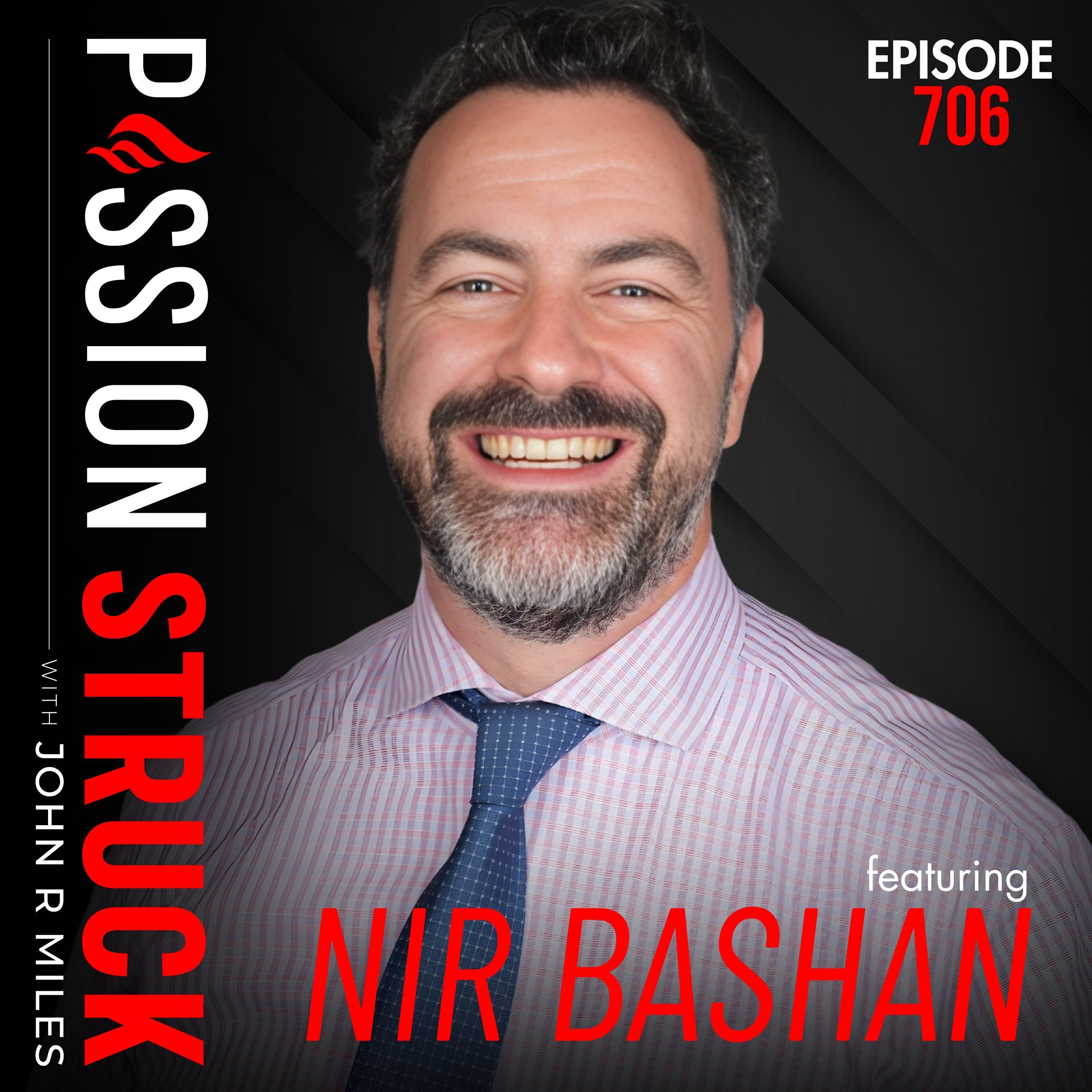
Loading summary
Transcript107 lines
- [00:00]
John Miles
Coming up next on Passion Struck for people.
- [00:03]
Nir Bashan
I highly suggest that somebody's frustrated at work. Things aren't happening. I highly suggest that you step out of that, like laser focus of what's going on that minute, that day, that week and start to look at your career and start to look at your life as a long term trajectory. Right. Is it how you treat other people? Maybe you going to work at that particular place, John, isn't about the work that you do, maybe about how you're touching other employees there and how you're helping them through their problems, how you're making an impact with your community.
- [00:40]
John Miles
Welcome to Passion Struck. I'm your host, John Miles. This is the show where we explore the art of human flourishing and what it truly means to live like it matters. Each week I sit down with change makers, creators, scientists and everyday heroes to decode the human experience and uncover the tools that help us lead with meaning, heal what hurts, and pursue the fullest expression of who we're capable of becoming. Whether you're designing your future, developing as a leader, or seeking deeper alignment in your life, this show is your invitation to grow with purpose and act with intention. Because the secret to a life of deep purpose, connection and impact is choosing to live like you matter. Hey friends. Welcome Back to episode 706 of Passion Struck. We're continuing our series the Season of Becoming. This very real transition between the life we've known and the fuller, braver life calling us forward. This last week has taken us across some powerful terrain. We stepped into the wild with Ollie raisin and Boris McGuire of Safarini leadership, exploring what leadership looks like when you change the environment, not just the mindset. Then on Thursday, in a special live conversation, Joshua Green and Rick Hanson helped us widen the circle of moral concern, reminding us that becoming isn't just personal, it's collective. And it has real world consequences for how we care for one another. Today we bring all of that energy home. Because after insight, after awareness, after awakening, there's a question that always follows. Now what? In our culture, we celebrate creativity.
- [02:24]
Interviewer/Host (possibly John Miles or a co-host)
We idolize ideas.
- [02:25]
John Miles
We applaud imagination. But ideas don't solve problems, solutions do. And that's why I wanted to share.
- [02:32]
Interviewer/Host (possibly John Miles or a co-host)
This conversation for you.
- [02:33]
John Miles
My guest today is a dear friend of mine and of this show. Nirbhaan first joined us way back on episode 36 to discuss his groundbreaking work.
- [02:43]
Interviewer/Host (possibly John Miles or a co-host)
In the creator mindset.
- [02:44]
John Miles
Since then, I've watched his work evolve as he's listened to the struggles of leaders and creators worldwide. What he realized and what we're diving into today is that while creativity is the spark, it isn't enough on its own. People were still getting stuck between the idea and the result. Nir is a world renowned expert who has worked with everyone from Hollywood stars like Woody Harrelson to global giants like Microsoft and AT&T. He's back to show us his new framework, the Solution mindset. His mission is to move you past the spark and into the solution by codifying a repeatable formula for solving the unsolvable. In today's episode, we discuss the 10 problem solving superpowers, why they are innate in you but likely sitting dormant. The Just Starting principle, which is why the first step is often the only one that matters. In the process of becoming, we go into untangling complexity. How a simple filter can reveal the answer hiding in the noise of a busy life, and why positivity is strategic. It's not naive. It's a requirement for innovation and moving forward. If you've ever felt overwhelmed by complexity.
- [03:55]
Interviewer/Host (possibly John Miles or a co-host)
If you've ever had a great idea.
- [03:56]
John Miles
But didn't know how to move it forward, or if you're in a season where clarity matters more than inspiration, this episode is for you. Before we begin, a quick favorite. If something in this conversation helps you solve a real problem today, share this episode with someone who's stuck where you used to be. And don't forget, you can watch full episodes and highlights on our YouTube channels, passion struck clips and John R. Miles. And lastly, I hope all of you have a wonderful holiday season and enjoy the rest of this week. All right, let's move from insight to execution. This is episode 706 with Nirvashan. Let's dive in. Thank you for choosing Passion Struck and choosing me to be your host and guide on your journey to creating an intentional life. Now let the journey begin.
- [04:43]
Interviewer/Host (possibly John Miles or a co-host)
Hey Passion Struck listeners.
- [04:45]
John Miles
There are supplements and they're game changers. Mitrepura Gummies from Timeline are in a league of their own. They're the first longevity gummy with Urolithin a a powerful ingredient shown to boost cellular energy and improve muscle strength by 12% in just 16 weeks. And I'm telling you, I feel the difference. More energy, faster recovery, sharper focus. All from just two gummies a day. If you want to stay strong and energized now and as you age, then you've got to try Mitopur Gummies. My friends at timeline are offering 20% off just for my listeners. Head to timeline.compassinstruct to to get started. That's timeline.com passionstruck yourselves. Will. Thank you.
- [05:36]
Interviewer/Host (possibly John Miles or a co-host)
I am so excited today to welcome my friend Nir Bashan back to Passionstruck. Nir, it is so awesome to see you. I'm so excited we could do this live here today in St. Pete, Florida. Great to see you again.
- [05:51]
Nir Bashan
Thank you, sir. Thanks for having me. This is incredible. I'm so happy to be on the show. I heard just in the other room that you're on episode 600.
- [06:00]
Interviewer/Host (possibly John Miles or a co-host)
It's hard to believe when I had you on, it was episode 36. We were just beginning the journey, and I was so honored to have you back then to discuss your first book, the Creator Mindset. And I wanted to start today because I think that's a great launching point. You came out with this book five years ago, 2020. And when you look back at the Creator Mindset, is there a core idea from the book that as you've now taken this five years into the future, that still resonates as much today or even more as it did that?
- [06:37]
Nir Bashan
Yeah, definitely. Good to be on. I kind of want to take some credit for the fact that you're on episode 600. The creator mindset was all about using creativity to solve problems. And the thought throughline has been always about how to be more creative, how to be more innovative, and it's something that I think is still relevant as it was five years ago. Wow, that's a long time ago. That was during COVID Yeah, it was.
- [07:04]
Interviewer/Host (possibly John Miles or a co-host)
So I actually waited a little bit to start the podcast because of COVID not knowing what was going to happen. But I launched February of 2021.
- [07:13]
Nir Bashan
Wow.
- [07:13]
Interviewer/Host (possibly John Miles or a co-host)
It's hard to imagine. We'll turn the page on 700 episodes here pretty soon.
- [07:18]
Nir Bashan
Amazing.
- [07:19]
Interviewer/Host (possibly John Miles or a co-host)
Well, after the release of the book, what question or struggles did you feel like you were consistently hearing as you were bringing the Creator Mindset up into audiences, companies you were working with?
- [07:33]
Nir Bashan
The Creator Mindset was a wide ranging book. It focused on a lot of issues that people were having on a broad scale. And a lot of the feedback that I started getting, John, is okay, this is great. We understand the background, we get the philosophy of why we're trying to solve these kind of wide ranging issues. But then people are like, oh, how do you do it right? And the Creator Mindset had some tools in there and had some techniques, but the new book focuses really on taking those wide ranging ideas with good storytelling and different elements of people throughout the world that are solving problems. But then I give people concrete things that they can do right away to become more creative. And innovative. And those are things that people can do at work, they can do in their communities, they can do. I know that mattering and doing things in life that are important not just for commerce, but important for relationships and important for the world are something that you're really focused on working on. And so this book, the new book has a lot of kind of wide ranging stories, but then it gives people those actionable things that they can do no matter what they want to accomplish.
- [08:46]
Interviewer/Host (possibly John Miles or a co-host)
I remember a number of years ago I had the opportunity to interview Jim McKelvey and for those of you who don't know who Jim is, he's the co founder of Square and as we were talking about the Square Journey and he's a repeat entrepreneur, I was asking him like, what is the biggest thing that you coach entrepreneurs about? And he said, well, there's always an inherent problem that needs to be solved. So as you were giving these keynotes and you're a real prolific keynote speaker and congrats on now being part of the Passion struck speakers bureau. Love having you.
- [09:23]
Nir Bashan
Thank you for that.
- [09:24]
Interviewer/Host (possibly John Miles or a co-host)
Was there a consistent problem that you realized that there was a gap that led you to writing the solution mindset? And what Was that gap?
- [09:34]
Nir Bashan
100%. So the gap is really around trying to apply creativity every day. People knew that they wanted to become more creative. They knew that it's something that was important to do, but like physically applying it every day, connecting the rubber to the road and making it go was a concern. It was something that people were like, hey Nir, I like the keynote. I get it. I'm inspired by the creator mindset. I'm an accountant, so what does that have to do with me? Or I'm a supply chain manager at a manufacturing plant. How does that impact my day to day life? And it really is about connecting the dots for people and letting them understand that creativity is something that is inherent in every human being on earth. It's like a gift that God gave us to be able to go out in the world and solve problems as they come up instead of reacting to them or, or coming up with contingency plans. This is the one thing that I've found consistently throughout my entire career. To work in circumstances that no other solution has worked in.
- [10:46]
Interviewer/Host (possibly John Miles or a co-host)
Man, I love that. And anytime I write a book, I try to think of the audience for it. I try to think of the approach. In the solution mindset, you end up coming up with 10 superpowers. But I imagine there's always a multi year cycle that goes into writing One of these, when you were creating this, were you thinking at first, this is for individuals, this is for companies? And how did you arrive at 10 superpowers?
- [11:14]
Nir Bashan
This book is really all about individuals. Right. I've worked with a lot of companies over the years, a lot of different associations. I wanted this book, John, to get people excited, and I wanted to plant that seed very early on that this book is really about a tool that anybody can use to become more innovative and more creative, especially if people didn't think that they were creative to start with. And that's the catalyst. So it is written for the individual, the beauty that companies and different associations, people who read it, people have bought copies to give to their entire workforce. It has been about spreading that individual hope and optimism and positivity and allowing people to own their own journey, be happy, be thankful that they get the opportunity to solve problems, which is an incredible thing. Most of us spend our entire life running away from issues. Right? But this creativity gives you that power to take on those problems head on and solve them once and for all.
- [12:25]
Interviewer/Host (possibly John Miles or a co-host)
Well, in my work on mattering, one of the things that I have found is that superpowers are innate in everyone. But I think what ends up happening, why people oftentimes don't feel like they matter, is because they remain dormant, because we don't know how to turn them on.
- [12:42]
Nir Bashan
Yeah.
- [12:43]
Interviewer/Host (possibly John Miles or a co-host)
How did you go about showing that in the solution mindset that these weren't just superpowers, but they're superpowers that you don't just have, but you actually can use 100%.
- [12:57]
Nir Bashan
So I looked around the world at the 10 most pressing issues that I can find. All kinds of issues from pollution to overcrowding of jails and how we treat prisoners to health care in Japan and all kinds of issues that we are having as a society. And I looked at those issues and said, these are things that are able to be solved simply by putting in the effort to go out and solve them. And I found people that are doing just incredible things that we never hear about. Right. Because the media won't report on it. They just won't report on it.
- [13:38]
Interviewer/Host (possibly John Miles or a co-host)
So these are in some cases, everyday heroes who are doing amazing things. They're organizations who are trying to tackle big, hairy problems that the world is facing. So it's surprising that people aren't reporting on them. Was there like one or two superpowers that jumped off the page first as the biggest barriers for leaders and organizations?
- [14:01]
Nir Bashan
One of the most incredible superpowers is the first chapter in the Book and that talks about. Just start. It follows an incredible person doing amazing things with the environment. And this guy is Tito.
- [14:15]
Interviewer/Host (possibly John Miles or a co-host)
Juan Bennek for Tito.
- [14:17]
Nir Bashan
Juan. Yeah, Tito. And he's out in the Tahiti, surfed every day. Was a prolific surfer and still is. One day, his friends all pull together some money and they buy a boat and. Right? And it's like a rickety boat, got holes in it. It's barely. Get them to their favorite surf spot or whatever, and they notice there's no surf, right? They go. They've been surfing there since they were kids. They notice there's no surf. And they're like, what's going on here? Right? This is the weirdest thing. So they dive down and they notice that the coral is bleached out. It's not, you know, what it used to be. There's no fish anymore. So he runs home like all of us would do. And he goes on Google, hey, what can I do to help with the oceans? Help with coral reef. He gets a few ideas. He goes and talks to these scientists, right? And they tell him, dude, you're 16. You got to get a PhD. You got to go to oceanography school. You got to. There's all these things that you have to do before you get out there. And he told them, and I remember in the interview, it was very specific. He basically told them that, I love you guys and I love science, and it's very important to have those scientific backgrounds and to have that wonderful schooling, but it is far more important to just start to just get in there and dive into an idea. John, you know this. You've run tons of companies. You're an entrepreneur. You're a serial entrepreneur. You know that the first step is just getting in the water, just getting to do it. And so he went and just got a bunch of rope and got some coral and tried it, and it failed. And then he tweaked it, and he tried it again, and it failed. And then he kept tweaking and tweaking. And today he's got the largest coral restoration company on earth. And some of those scientists that told him, hey, buddy, go to school, or whatever are now his employees.
- [16:08]
Interviewer/Host (possibly John Miles or a co-host)
It's an amazing story because it shows a couple different things. So I have a children's book coming out in a few months, and this called you matter Luma. And this is exactly one of the things I was trying to showcase in the book is that you don't have to be Elon Musk or Jeff Bezos or the president of a country to make a huge difference, what you have to do is just start. But oftentimes even with me, we recently started a podcast network. But I actually thought about doing this four years ago. And sometimes that just starting is the hardest thing. What gets in people's ways before they have that courage drop moment that they can start.
- [16:52]
Nir Bashan
So I am very lucky to be one of the most viral authors on Psychology today. So I have an answer for you. Right? It is the fact that we get in our own way, we self doubt. We get in our minds too much. We start to doubt an idea and we overthink it, then we underthink it, then we're like, oh, somebody must have done it by now. If it's a good enough idea, it's probably out there in the world somewhere. And then that turns into more self doubt and more, oh, we'll do it tomorrow. And then tomorrow never comes. And next week turns into next month and next month turns into next year. We have to just start. And John, it doesn't matter how we just start. We can be just a baby step for you with the network that there could have been maybe a call with some people who are doing it or just sending an email out to somebody saying, hey, this is an idea that I have. Those little steps have an amazing chain reaction. When we look at creativity happens when very little things become really big things. But it doesn't happen overnight. It's an evolution, not a revolution. I think everyone's looking for that big moment. Yeah, I got this idea and it's going to be the next big thing. But those stories seldom happen. It's the little steps along the way that lead to greatness.
- [18:14]
John Miles
Before we continue, I want to pause on something important. Listening to a podcast is one thing. Becoming the person you're listening for is another. Every single week, people tell me, john, I love these conversations, but how do I actually do this in my life? That's exactly why we create companion workbooks for each episode. Simple, powerful tools to help you apply what you discover here. For this conversation with Nir. The workbook helps you activate the solution mindset in real time with prompts and tools designed to move you from thinking to solving. You can download all our free workbooks@theignitedlife.net where becoming isn't passive, it's practice. Now, a quick break for our sponsors. Thank you for supporting those who support the show. You're listening to Passion Struck on the Passion Struck Network. Now back to my conversation with Neer Bashan.
- [19:10]
Interviewer/Host (possibly John Miles or a co-host)
I think for me, one of the Things that was really getting in my way was I was part of stitcher, SiriusXM, so one of the most prestigious podcast networks that is out there. And I was making good money from it. So the barrier was I had this prestige from being with what I thought was this big brand. I'm making great money, more money from the podcast than I had before. So part of it was my confidence level in would I be able to replicate the revenue from my own thing. But what I realized with them was that I was in the big scheme of things, out of all the different brands, that they have a really small fish in a huge ecosystem. And so I didn't feel that inherent push to help me increase my brand. Yeah, to help it grow, to help it become stickier. And I didn't really see this magnifying effect that I could take this on to help other people do what I was doing. And it was because of those additional layers that I thought if I could have more control than this tiny one show could start impacting people. When you start adding other voices who help magnify it. But once you start, as you say in this story about coral reefs, where you end up ends up becoming a different place completely because you end up hitting different creative barriers that you have to find solutions for. Which is why I love the whole premise of the book, because you need to have the creativity, but you also need to come up with the solutions to come up with the barriers and novel ways.
- [20:54]
Nir Bashan
Yep.
- [20:55]
Interviewer/Host (possibly John Miles or a co-host)
So you fast forward and there's another superpower I want to talk about, which is how to untangle complexity. And I am a huge bicycle enthusiast. I love to ride, whether it's outdoors or on a spin bike. How did you hear about VanMoof Printing and having them solve this bicycle shops issue where I understand they kept delivering bicycles, but they kept on coming, damaged. Like, how did you even hear about this story?
- [21:29]
Nir Bashan
Yeah, so this is. I have a small and modest research team, and we're constantly generating new report, new studies. I read so many of the latest research studies. More than just the summary and the abstract. I'll read. Oh, chart. Page 622 had the chart in here. And when I first started, I could barely read it. Now I'm like, oh, look, this is really interesting. Honey, check this out. She's. What are you talking about? Like, this is really interesting. One of those studies came in and it was fascinating. It showed that there was a bicycle manufacturer that kept getting their bikes damaged on delivery. And they were the kind of manufacturer that people loved. They were like, Oh, I love this bike. I can't wait. I'm so excited to get. It wasn't a basic bike, it was something that higher end riders liked and this kind of stuff. So when it came, people were really excited. And it wasn't the basement bargain either. So they were excited. It was an investment. It would come, they would open the box right, really pumped and like the fork would be bent or some part would be damaged in the shipping. And so this manufacturer said, we gotta solve this problem. So they started by, hey, we're gonna put more padding, right? We're gonna put more padding and we're gonna get bigger boxes. Cause that's gonna solve everything. And so they did the padding, they did the boxes, and the stuff kept getting damaged. And they loved it. It was a handmade bike and a lot of love and attention went into this thing and it damage. So one night, one day, the group got together. And then something I talk about in my keynotes quite often, which is the 15 minute silly idea meeting. I tell people all the time, executives at some of the best companies in the U.S. i say, how often are you guys practicing creativity? They're like, what? We're just waiting for an idea to come in. What do you mean practicing? I'm like, well, it's something you got to do every single day to get better at, right? You can't just show up and expect creativity to happen. So I encourage people to have this 15 minute meeting. In that meeting, everybody gets in the room, right? Or a teams or however you're doing it, and you come up with a, with an idea and it could be a silly idea or it could be a brilliant one. Well, this company did it, this bicycle manufacturer did it. And somebody said, you know, on the boxes, instead of more padding, instead of spending all this money, instead of triple packing everything, which was the prevalent wind, we're going to paint the picture of a TV on the side of the box, right? And we're going to put fragile and in that hopefully when it gets shipped and handled and the different vendors are delivering it to our customers, hopefully they'll be more delicate with it. And it worked. And it literally cost nothing. A little bit of extra printing cost. But they were able to recoup all of those costs that they put into extra shipping and better handling and all of that stuff. It turns out that all they needed was a slight creative hack to make people think that it was a tv. And then everyone handled the bike with care.
- [24:34]
Interviewer/Host (possibly John Miles or a co-host)
And I'd love that for a couple of different reasons. One, there was a book that came out a couple of years ago from the Stanford design school called IdeaFlow.
- [24:42]
Nir Bashan
Yep.
- [24:43]
Interviewer/Host (possibly John Miles or a co-host)
And what you're describing right there is that whole idea flow process just let people shoot out different ideas, whether they're crazy, whether they're not, and find the ones that are the stickiest. So I love that in this example they approach the whole solution in a very non complex way. Just treat the packaging differently. And what were the end results? How much did it end up changing?
- [25:13]
Nir Bashan
I think the last study that we saw was 90% improvement in the bikes arriving without breakage. Really great result. And customers were happy. They were happy because people were treating the bikes in better shape. The world is full, John, of these really simple solutions. Right. But we're too afraid. We're, oh, we're doubting. Oh, we're really successful. So why would we take a risk on something and we devoid and lose that ability to solve these incredibly pressing problems. In this case it's shipping. In the other case, it's coral reefs on earth in the waters of the ocean, simply because we don't take a chance on those ideas. And it was. The results were incredible. The shipping improved, the damages decreased, all because of an image of a tv and people thought that there was a TV in the box.
- [26:09]
Interviewer/Host (possibly John Miles or a co-host)
I want to stay on this theme of untangling complex complexity because we took an example of a bicycle shop. But one of the things I love about what you do in the book is you're not only talking about small issues. So we were talking about coral reefs, which is a big issue solved by an unsung hero. We talk about a bicycle shop, small business, but you also highlight big issues. So here in the United States, we really need healthcare reform in a big way, big time. Turns out they needed health care reform in Japan too.
- [26:44]
Nir Bashan
Yes, the end of World War II was a very interesting time. We are an incredible nation. And we made the decision then with Harry Truman, who was in office, to not punitively punish our enemies. We did that in Germany and we did that with the Japanese. We could have easily have said, you know what? We're putting in a government. We're done with you guys, Kick out the Emperor, the whole deal. But we took a very measured, disciplined, and incredible approach there. General MacArthur was the steward of the Japanese islands for seven years. Seven years. He said, hey, this is about building road. This is about getting back the Japanese people back to where they can contribute to the world and not become a fascist or a Nazi state. This is about rehabilitation and that decision was made. But the actual work, right, the rubber meeting, the road got really bad. Why? Because he got people together in Japan and said, okay, guys, we have to rebuild this road. And they were like, great. That's a committee that meets Tuesdays. So he waited till Tuesday, went to the committee meeting, and he said, guys, we got to build this road. Oh, yeah, yeah. But that's on Thursday. That's a national road. This is a local road. The. There's a jurisdiction that handles both the roads. And he was like, the complexity was insane, right? Everything had a committee. Everything had all of these layers that took an immense amount of time to get through. Right? That sound familiar?
- [28:18]
Interviewer/Host (possibly John Miles or a co-host)
Very familiar.
- [28:19]
Nir Bashan
Bureaucracy of a government and bureaucracy of an organization. So he said, guys, no, we're not doing this. Here's what we're gonna do. We're gonna simplify this whole dang thing, okay? When we're gonna do this road, these three committees, you guys get together and you figure out how to make one decision on Tuesdays, okay? This isn't. We're not hopping back and forth for three months. And they were like, well, we can't. He's like, figure it out. And they got together and they figured out ways to lower and to minimize the bureaucracy so that stuff can get done. He touched health care, too, and he said, hey, if you break your arm in outside of Tokyo, at the little local hospital, let's say it's $100 to reset. I don't know the exact numbers, but let's say it is $100 to reset. If you go to the fancy, really nice hospital In Tokyo, it's $300. There's no difference in resetting your arm, right? You broke it, you had a fall, whatever. You break it, the two hospitals are going to reset it the same way. They put the cast on the same way. They take the same X rays and all of that stuff. So he made a system in Japan that had one cost per incident. No matter what it was. That system still exists today. And it's incredible. They get together once a year, and the pharmaceuticals and the equipment manufacturer and everybody always battle for the prices. But once they're set for a year, I think or two, and people have predictability in that cycle, they know that the medicine will cost this much no matter where they go. They know that their healthcare, no matter where they go, will be consistent. And they've gotten the. The feeds down, they've gotten the expenses down. And I would love to do something like that in this country.
- [30:02]
Interviewer/Host (possibly John Miles or a co-host)
Well, when you think about it. And my wife is a primary care provider, so does a lot of prescriptions. I always thought it was just and still is crazy that you can go to cvs, you can go to Walgreens, you can go to Walmart, and you have three completely different pricing architectures for the same drug.
- [30:23]
Nir Bashan
Wild.
- [30:23]
Interviewer/Host (possibly John Miles or a co-host)
And go across the country, they're probably a hundred.
- [30:26]
Nir Bashan
So wild.
- [30:27]
Interviewer/Host (possibly John Miles or a co-host)
What you're describing in Japan is they set one price and that is one price for the entire country.
- [30:33]
Nir Bashan
One price is one price is one price. That's it. And it helps the bureaucracy of healthcare because all the paperwork and the form, then the communication, it helps control their costs. They're actually a nationalized healthcare system. They take it out of everyone's paycheck every month and it's said at a reasonable rate. It really that idea of eliminating clutter and focusing on the goal itself rather than letting the clutter become part of the solution.
- [31:04]
Interviewer/Host (possibly John Miles or a co-host)
The reason I wanted to focus on this is because coming from big Fortune 50 companies, I've seen this firsthand. When I was at Dell, we were in the middle of, I would argue the largest transformation of the company. It has historically been a hardware provider. People knew it for enterprise servers and your personal devices. But Michael and the board knew that wasn't the long term destiny to make money. So they needed to become a solutions based which solution? Mindset company. But in order to do that, it meant you started to have to take these new ideas and you had to get them out of the mothership. So when I was there, as they were unearthing, going through this idea flow type of concept, new creative ideas, they would actually not only take the idea and assign it to a vice president or director and let them run with it, they mandated that it would go outside of the local area. And even when we were in Austin, there was another building that just housed Dell startups. Because they didn't want the bureaucracy of the big business to get in the way of them being able to be agile in the way that they were coming up with these ideas. Do you think that's a way that large companies could innovate without them getting stuck with coming into the slowness of the bigger mothership type of thinking process?
- [32:32]
Nir Bashan
100%. I think that's one of many ideas of how to get rid of really good ideas out of these big companies that that in a way the bureaucracy has been set by the company's growth and the company's success. But yeah, there are definitely ways there's having that type of separation between the mothership and the, the startup there is coming up with some mergers and acquisitions and acquiring that talent. On there is cultural shifts that can happen even in a behemoth company with tens of thousands of employees. That just shifts the paradigm a little bit. Again, it's not everyone's always looking for the big kind of, oh, this is going to revolutionize everything and change everything tomorrow. But sometimes it's those little ideas, those little movements that can create incredible ripples down the line that are some of the most powerful impacts ever.
- [33:28]
Interviewer/Host (possibly John Miles or a co-host)
So I want to switch gears with you and another one of the superpowers that you have in the book is to embrace the routine. And what I love about this is that you use a bourbon brand as one of the stories to illustrate this. And for those who are watching, the bourbon brand is Kentucky Owl. And this is a brand that has a long history, but that history was one that needed a rewrite. So what did that rewrite have to do with embracing that consistency and establishing a routine? How do those two intersect?
- [34:04]
Nir Bashan
Definitely good question. In my book, the Solution Mindset, I looked at a company dedicated to the long run, right? And I found two incredible companies. One was a bourbon company, the other is International Paper. Right. Out of all the companies, everyone thinks the liquor and cigarette business, oh, they're the worst and even worse than them, the paper industry, right. They're clear cutting forests everywhere. And it turns out that is like completely not true. What really is going on is that people are making in the bourbon industry and this company in particular are making choices for the long run, right? Not about, hey, you know, what trend will come and go. How do we make this bourbon last, then take the trip so that when 18 years, 25 years, 30 years later, when we're all gone, hopefully not. But some of the people who work on that bourbon aren't 70 to 80 years old. They won't be around in 30 years. Just taste what will come out of that. But their dedication, the quality and their investment in that long term is incredibly important. So it really is about looking at what we do and distancing ourselves from those short gains. John, and start looking and planning on making those long term gains. Because in my opinion, those are the really important gains. But we're surrounded these days by social media. We're surrounded by the apps and everybody, oh, look at me, I've got a Maybach BMW or Mercedes and I'm riding around, look at me. And I'm taking selfies. But that is not real long term wealth. That is not real long term gold. Generation that is not real long term creativity. So breaking that down and understanding that these bourbon companies that are making things aren't in it for the initial gain. They're in it to make really good products to last.
- [36:03]
Interviewer/Host (possibly John Miles or a co-host)
Reminds me of Dori Clark's work on the long game in many ways is oftentimes we think of things in months, in years. We don't really think about legacy.
- [36:15]
Nir Bashan
Right.
- [36:16]
Interviewer/Host (possibly John Miles or a co-host)
So when you think about this topic and you take this to a human level, how could someone apply this concept into their personal life? You have. Yeah, because you have two great brands here. You got a bourbon brand, you've got International Paper. But I also think that this one really applies to us personally, 100%.
- [36:35]
Nir Bashan
So for me, it is about recognizing that success comes in long and measured steps. It's not about showing up one day, coming up with an idea and having it hit just because you know you wanted it to. These are really long term investments. In the case of International Paper, this is an incredible organization. They literally plant stuff now that they'll harvest in 30 years. And they rotate the land so that they can get the ground, the soil to be fertile to be able to support that kind of thing. They have wildlife plans, they have all kinds of things that help spread the growth long term. And for people, I highly suggest that somebody's frustrated at work, things aren't happening. I highly suggest that you step out of that like laser focus of what's going on that minute, that day, that week and start to look at your career and start to look at your life as a long term trajectory. Right. Is it how you treat other people? Maybe you going to work at that particular place, John, isn't about the work that you do, maybe about how you're touching other employees there and how you're helping them through their problems, how you're making an impact with your community because you got this company to invest in, doing some work with some charities. People always look at what's going on in the minute and make quick judgments. Oh yeah, it's not going well. Oh yeah, it's going great or whatever. But when we start looking at bourbon companies that 30 years to mature, when we start looking at these amazing forests that take all of this time to grow properly before they're harvested, we start to look at ourselves and find that sometimes the goals that we've set out to accomplish are really touched tangentially by an amazing connection to the world, to other people, to our communities that is incredibly worthwhile.
- [38:40]
Interviewer/Host (possibly John Miles or a co-host)
Thank you Nir for sharing that. When I was at Lowe's. One of my peers, Steve Shirley Eustace, who was in charge of strategy, used to always say to our cio, Steve, we need to focus on failing fast and failing often. And our CIO used to always go to Steve and say, I cannot believe you're saying that. What we should be doing is winning fast and winning often. And he's, well, you win fast and you win often by failing fast and failing often. So one of the superpowers that you highlight in the book is the need to fail successfully, which is exactly what Steve Shirley was talking about. And I had a guest on the show last year. Her name is Robin Steinberg. And Robin is really focused in the United States. She's an attorney on prison reform. And specifically, what she is trying to look at is mass incarceration and how it is not only flooding the system with too many inmates, but we keep the inmates in far too long for many of the things that they do. And this is something that you tackle in the book, but you tackle it through another country who has looked at this and seen that there is a way to completely rethink in a creative manner about how do you take these inmates and reform them in a really amazing way. So I was hoping you could walk us through that, because I thought this was a great example of how you reform a large system. But specifically, how does the fail successfully come into play here in Norway?
- [40:25]
Nir Bashan
Yeah, so Norway's prison system is amazing. It's like kind of an incredible thing. And what's going on there is the rehabilitation, the focus on rehabilitation, right. In the US Our prison system is lock them up, throw away the keys, and hope for the best. And we have one of the highest recidivism rates and in the world. And what that basically means is the rate of somebody who gets incarcerated, gets out and goes back in. It's something like 70%. I don't know. I forgot the stat. I got to look at it. But it is incredibly high, and it shouldn't be high. So we have a lot of creative decisions being made to improve that in Norway. Right. For instance, there is more common sense in. In dealing with a prisoner, even if their prison, even if they've committed some very serious crimes. Right. There is less of a focus on punishing, more of a focus on rehabilitation. Incredible things like, hey, you get to go home for the weekend. Imagine that. Imagine a prisoner in the US for grand larceny or whatever they're in for, going home on the weekend. And you say to yourself, well, why would you do that? You it's because our prison population's insanely high. There is no real focus on rehabilitation. And there should be because there's millions of people who can benefit from whether it's schooling or coaching or just given opportunities that they've never had to reintegrate into society and become contributing members. So what has been done in Norway is people focus on all of these little decisions along the way. Again, it's not, hey, we're going to do some big thing, it is about these little decisions along the way. How long do we incarcerate? What about the weekend? What about a spouse, a wife or a husband? What about kids? How do those, how do all of these things come together in order to make proper punishment decisions, but also proper rehabilitation decision?
- [42:28]
Interviewer/Host (possibly John Miles or a co-host)
And I'm going to take it from Norway to a movie. So let's talk Shashank Redemption for.
- [42:32]
Nir Bashan
There we go.
- [42:33]
Interviewer/Host (possibly John Miles or a co-host)
When I think about that and the Morgan Freeman character, Red, he's so here's a guy who's in for killing someone when he was 18 years old and he keeps going up for these hearings so that he could go back into the general populace. And every time he gets denied until he finally says, I wish I could go back and tell that 18 year old how stupid he was. And oftentimes a lot of these, it's happening to young males. Overindexed, I think, over female. The research I've looked at, but if you look at what Tim Robbins, the other character in the movie did is he was trying to create a library. He was trying to create different ways to educate the populace at Shawshank because he saw that was the best way to rehabilitate. Why do you think that has been such a thing in the States that we're not focused on?
- [43:33]
Nir Bashan
Man, that's a good question. I really don't know. I think that we've institutionalized the process and we've demonized the other. Instead of being really creative and innovative and thinking, okay, this is a problem, how do we overcome it? We've gone back to the English Australia model where we're just going to put them away, right? We're just going to send all the prisoners away. And we do that today instead of sending them away to a different country, we just lock them up. But there's, there's people in prison right now that are on drug charges, there's non violence, there's all kinds of reform that we could be doing. And I advocate for using creative and innovative solutions to improve not only our lot, but everyone's lot on Earth. It is all about finding new ideas and taking chances on them to improve life.
- [44:24]
Interviewer/Host (possibly John Miles or a co-host)
When I think about it at a more macro level, it leads to another one of your superpowers, when I was thinking about it, which is we should really be questioning the data and looking at it in a different way. If we are having decades and decades of mass incarceration increasing and we have repeat offenders time and time again, then ultimately the data is telling us something. And if you keep. Where I want to go with this is if you keep treating the data in the same way and you keep getting the same answers and they keep getting worse, then you got to change the way that you're looking at the inputs that are causing the data to be where they are. Which is my way of getting you to explain why is questioning the data so important.
- [45:08]
Nir Bashan
So important? It's so important. We need to look that data in new and different ways. Right. People look at data like it's the best thing ever, right? Oh, I've got an Excel that shows me a certain thing and it must be true. The problem is that, yes, there is a lot of analytic data that shows there's re recivitism and people coming in and out of prison, but there's also a lot of data showing that there's very focused programs that are working incredibly well. Some of them are faith based, some of them are like work based, where prisoners learn a certain tool, technique, an approach, a vocation, and they go out there and do really well. And those are underfunded and the ones that don't work are overfunded. Right. It's about getting creative with the data and looking at it and going, okay, cool. This is an indication of something, but it's not the full story.
- [46:02]
Interviewer/Host (possibly John Miles or a co-host)
Yeah, a great story of this from my time at Lowe's was when I took over the IT operations group. I knew I was given a huge issue to solve. We had just come off the largest hacking incident in retail history. And so I was being asked to lead the charge on overcoming that. But I will never forget, I go to meet our head of hr. Her name was Maureen. And I think we're going to be talking about this and maybe what I need to do do on the bus to put in new talent. And she ends up saying, we didn't talk about this during the interview process, but we recently did an employee engagement survey where we looked at every single organization for the first time in the company. And in addition to everything else you have to solve, your group was ranked worse in employee engagement in the Entire company. And Lowe's at that time had 350,000 associates, 18,000 stores, 1800 stores, this huge supply. And I have got the worst performing group. So where I'm going with this is there are many ways that I could look at the data, but instead of looking at it as, oh, I've got the worst group, I started to look at it as, what did this employee's data show? And so the number one thing I found was that repeated in their comments was they had no idea how their jobs and what they were spending their time doing, how that impacted the company strategy, or a typical customer walking into a low store because they couldn't see the correlation between sitting in a security command center or operations command center or data center or call center to solving a customer's needs. And so when I started to look at that data, I started to look at it. Well, I need to give them a line of sight between why they're coming into work and their impact on a customer having a better shopping experience. So that I just wanted to give for the audience that is a clear way that you can look at it that involves both your books, because there's a creative angle to that and then there's a solution angle to that 100%.
- [48:20]
Nir Bashan
And that's so important to do. Connecting the dots, like most people would go, oh, I've got the worst report in. Woe is me. This is the worst thing that's ever happened. And they give up or they fade into themselves and work out something for another few months while they're sending resumes, Right? But you looked at that and said, hey, wait a second. What can this data do to improve? What can I do to take this worst scenario and look at ways to improve? And you found it. You found improving. And hey, it's really about connecting the narrative. The work that you're doing here in this department is really important to that mom and dad in Kansas City who are going and shopping to do their baby's room with paint and all this equipment. Because these three things that connects. And all of a sudden you. You've energized somebody 100%. The data is there not to just depress you. It's there so that you can work on it. It's there so that you can come up with solution. But the data alone, without creativity, without innovation, won't take you to where you want to go. I work with companies all the time, and they're like, near. This is the data set. And we're a car manufacturer that I work with. The EVs aren't leaving the lot, so what do we do? I'm like, the EVs not leaving the lot is the best thing that could ever happen to you guys. And they're like, what? What do you mean? And I said, you're taking a. You got to make opportunities. You got to make lemonade out of all these lemons. They're like, great, well, how do we do that? I was like, let's come up with ideas, right? Maybe it's a micro lease program where somebody leases the EV for a month. They're like, how would that work? I'm like, I don't know, let's figure it out. Is that like a decent idea? They're like, well, yeah, maybe we'll do a three month program. Maybe there's something we could do with the rental car company and that generates all kinds of ideas. I think most people, when they get this bad data or negative data or, or tough to deal with data with a prisoner system, they, oh, that's how things are. And that's how they've been yesterday, that's how they'll be tomorrow. That's the way it is. I've made a life out of questioning that. I've made a life out of working with people very. And sometimes in a very intimate way, sometimes with tens of thousands of people on saying no. The acceptance of, hey, this is the way it is not indicative of your creative and innovative potential. Listen, we were born with genes that are turned on and off by creativity, literally. It was a study came out about a year ago that found that we are wired for creative and innovative solution, but somewhere along the way we kind of lose it. We fall in love with analytics, we go to business school and it tells us, look at the Excel's got everything you want in it.
- [51:04]
Interviewer/Host (possibly John Miles or a co-host)
It's every private equity company.
- [51:06]
Nir Bashan
You're right. Ever. Right. So the problem is that's not true. And we've been led to believe that it's true. We need to balance creativity and analytics together in order to get where we.
- [51:17]
Interviewer/Host (possibly John Miles or a co-host)
Need to go near. Earlier today, I recently hired a new PR firm and one of the areas that they put a ton of focus on is who are your competitors? Who do you compare yourself to as passion strapping? And I always hate this question because I don't necessarily, I'm not trying to be compared to someone else. I'm trying to create my own new category. But they like, insisted. So I said, well, in some ways you could think of the ecosystem that Gary Vaynerchuk built with VaynerMedia, Vayner speakers, his V friends. You could think of Mel Robbins and what she's trying to do. You could think of Simon Sinek and his Optimism company or mindvalley. But I always thought that there's this issue when you get into a comparison trap that can halt creativity and halt solutions, and this is actually one of your superpowers. So how does this comparison trap come into it?
- [52:20]
Nir Bashan
So I think we live in an unprecedented world where we can literally pull out a device and see what a competitor doing down the street. We could see real time what is going on around us. And it literally leads to nowhere good. Literally leads to nowhere good. We're constantly comparing ourselves to others and saying, oh, you should have done this, and these guys did that. And what ends up happening is we lose that sense of creative and innovative problem solving that we are innately born with. The beauty of having creativity in your DNA because is that the way that you solve problems is not going to be the same way that I solve it, and it's not going to be the same way that Gary Vaynerchuk or whomever. Do you remember when he was doing wine online?
- [53:07]
Interviewer/Host (possibly John Miles or a co-host)
Yes. That's how it started. Well, it goes back further than that. So I was talking to Matt Higgins, who wrote the book Burn the Boat.
- [53:13]
Nir Bashan
Yeah.
- [53:14]
Interviewer/Host (possibly John Miles or a co-host)
People don't realize it, but Matt Higgins, through his efforts, was the first person who put money into the whole VaynerMedia ecosystem. But Cass and Mike, I can't remember their last names, they developed a company that they ended up selling to Salesforce. And Gary actually begged them, could I have a conference room to use in your corporate headquarters? And he ended up overtaking their conference room. But that's how he got his start.
- [53:41]
Nir Bashan
Got it.
- [53:42]
Interviewer/Host (possibly John Miles or a co-host)
And he transitioned from getting that foothold in the wine industry to then realizing that media was going to shift and getting ahead of that. And it's very similar when you back into it of Jeff Bezos. So Jeff realized he wanted to create the Everything store, but he needed a starting point. So he thought, what better than books to try to disrupt? And so he developed a new creative way to do it and then implemented the solution mindset in order to do it.
- [54:11]
John Miles
Yep.
- [54:11]
Interviewer/Host (possibly John Miles or a co-host)
But there are two very good examples.
- [54:13]
Nir Bashan
Yeah, it's incredible.
- [54:15]
Interviewer/Host (possibly John Miles or a co-host)
So when you think about the impact that you want this book to make, this isn't just about changing companies. This is about people themselves choosing a different solution mindset that they walk not only into their work life with, but their family life.
- [54:33]
John Miles
Yeah.
- [54:34]
Interviewer/Host (possibly John Miles or a co-host)
So what do you hope that People who pick this book up will take away from it.
- [54:39]
Nir Bashan
I hope that people who read the book get energized and realize what a special gift it is to be alive today in a country like this, where we have so many opportunities and so much ability to do what it is that we want to do. And realize that you have the potential to solve any problem on Earth. There is no problem that is bigger than our ability as a humanity to solve it. I believe that 1000%, and I've been on a mission now for several years to speak in front of different audiences, to write books like this to get people really excited and energized about being able to solve problems. And part of that is selfish, right? Because I want people to go out there and solve pollution issues and all the problems that we're having today that affect my life. Because I know if I get people really excited and thinking in a new and a different way, that our lives will all be better.
- [55:42]
Interviewer/Host (possibly John Miles or a co-host)
I'm all about the need to matter. So I think oftentimes people come up with this huge idea flow and they come up with all these different ideas. So one of the things I wrote about in Passion Struck was something I call the deliberate action process. And one of the most fundamental aspects of that process is what I call the prioritization phase. Yeah, you have another word for it. You call it use a filter. How does someone who has these creative ideas use the filter and then take that chance to implement it going forward? What would be your best advice?
- [56:20]
Nir Bashan
So a lot of people have all these ideas, right? Oh, it's the opposite. Just start problem. They, oh, I've got like 20 ideas. Let's go out and do it. The issue with that is that sometimes we need to filter out the thoughts and identify the and prioritize one of them. So in the book, I talk about that development of a filter through an amazing scientist who took on water in Africa. He traveled and noticed that there are large sections of the African continent where people don't have access to clean water. Right. And he thought to himself, well, we got to come up with some way to filter it. And there was a lot of expensive solutions. There was a lot of solutions that didn't work. And at the end of the day, he came up with a solution that is cheap, that requires no moving parts, that lasts like a year or a year and a half, and that it's personal, and it's basically a straw that you can drink contaminated water from. It's incredible. They sell it here in the US For People camping or explorers or out in the wild or whatever. But in parts of Africa it's a day to day thing and it's basically called a life straw. And it filters out all of the negativity and the contaminants and all the horribleness from the water. So the way that I use the filter and the way I teach business owners and different employees, people in different businesses is I teach them, hey, use this filter to start filtering out these negative thoughts. The thoughts that will slow you down. I ask people, okay, cool. What do you want to do? Oh, Nir, I want to build a cart and go out and sell books in it. Okay, cool. That sounds great. Is that your dream? Yes, it's my dream, but I'm not going to do it. Why? Because the cart's expensive. Okay, cool. Maybe you should build your own cart or whatever. It's about filtering out the negative thoughts and amplifying the positive ones. Find a cart builder partner with somebody you know to build the cart for you and give them 10% royalty on the sales. Again, it's about coming up with all of these ideas that get you over a perceived roadblock and filter out the negativity and add some positivity into it.
- [58:25]
Interviewer/Host (possibly John Miles or a co-host)
Nir, last question for you before we wrap up is you are on passion struck. You are obviously passion struck about what you're doing yourself. So my question for you is, what does it mean for you to be passion struck?
- [58:38]
Nir Bashan
Being passion struck for me, John, is all about really taking ideas and making them happen and energizing people and getting them excited and getting them knowledgeable about their ability and their role in this world. I think far too many of us have been beaten down by the news, by the press, by what we read and see out there in society, which is all bad news. And what I am trying to do is I'm trying to amplify the good News which is 10 times, 100 times, a thousand times more prevalent than all the bad news we're believed this world is to be. There is so much good happening. There's so many good people in the world like you, sir, doing amazing impact and helping people every single day just become a little bit better. And you should be on the COVID of the magazines. You, sir, should be talked about in the news. And yet we talk about the fringe cases, we talk about the cases that don't really matter. For me, being passion struck is recognizing what is really important. And what is really important is, is adding positivity, is making things matter, is making your life the short time that we have here on earth really matter and that that is what being passion struck means to me.
- [59:58]
Interviewer/Host (possibly John Miles or a co-host)
I love that answer Nir and thank you for those plugs. If people wanted to learn more about you and the new book and where they can pre order it, where are the best places for them to go?
- [60:06]
Nir Bashan
Yes sir. So it's on Amazon, Target, Walmart, anywhere you can buy books. My name is Nir Bashan. There's another near Bashan somewhere there on the Internet uploading Minecraft clips. So that's not me. There's not that many of us on earth. I think there's three or four the my website Nirbashan.com N I R B A S H A N dot com the book is on Amazon now. All of the fine retailers available for pre order. So Wiley and Son's book, an incredible book and I hope that it gives you the gift of realizing how important you and how incredible your ability is if you just tap into it and get it out into the world.
- [60:45]
Interviewer/Host (possibly John Miles or a co-host)
Nir, thank you so much my friend. Thank you here. I was so glad we were able to do this in person and thank you and congratulations on writing such a fantastic book.
- [60:56]
Nir Bashan
Thank you so much.
- [60:56]
Interviewer/Host (possibly John Miles or a co-host)
I think this is an amazing complement to what you did with the first book and really brings the two together. So congratulations.
- [61:05]
Nir Bashan
Thank you. Really appreciate it.
- [61:07]
John Miles
That's a wrap on today's conversation with Nir Bashan.
- [61:09]
Interviewer/Host (possibly John Miles or a co-host)
It's always a pleasure to have Nir.
- [61:11]
John Miles
Back on the show. What I appreciate most about Nir's work is this. He doesn't romanticize creativity, he operationalizes it. He reminds us that solutions don't arrive through brilliance alone. They arrive through discipline, clarity and the willingness to engage. Here are a few ideas worth carrying forward. Creativity without structure leads to frustration. Simplicity isn't weakness, it's leverage. And becoming a problem solver starts with investing in yourself. If this episode helped you see a challenge differently, please share it. That's how this movement grows person to person. And if you want to apply what you heard on today's show, join us@theignitedlife.net where every episode becomes a practice, not just a conversation. Also, my new children's book, Umatter Luma is available for pre order at Barnes and Noble, a reminder that problem solving, compassion and mattering starts early. You can also find it@umatterluma.com coming up later this week, I'm joined by Mark Murphy, New York Times bestselling author, for a powerful conversation on leadership, communication and what it takes to be understood in a world full of noise.
- [62:17]
Guest or Contributor (unnamed)
I happened to come across. And so this is in the 90s. I happened to come across a line that Michael Jordan had said. So Michael Jordan's one day walking off the court, and one of the assistant coaches, Tex Winters, the guy who architected detected the triangle offense, he hollers over to Michael and he goes, hey, Michael, there's no I in team. And Jordan looks back at him and goes, yeah, but there isn't win. And walks off the court. And I said, yes, that is what I'm going to. When I someday write a book about teams, that is what I'm going to call it.
- [62:50]
John Miles
Until then, solutions don't happen by accident. They happen by design. I'm John Miles. You've been passion struck. Now go live like you matter.