← Passion Struck with John R. Miles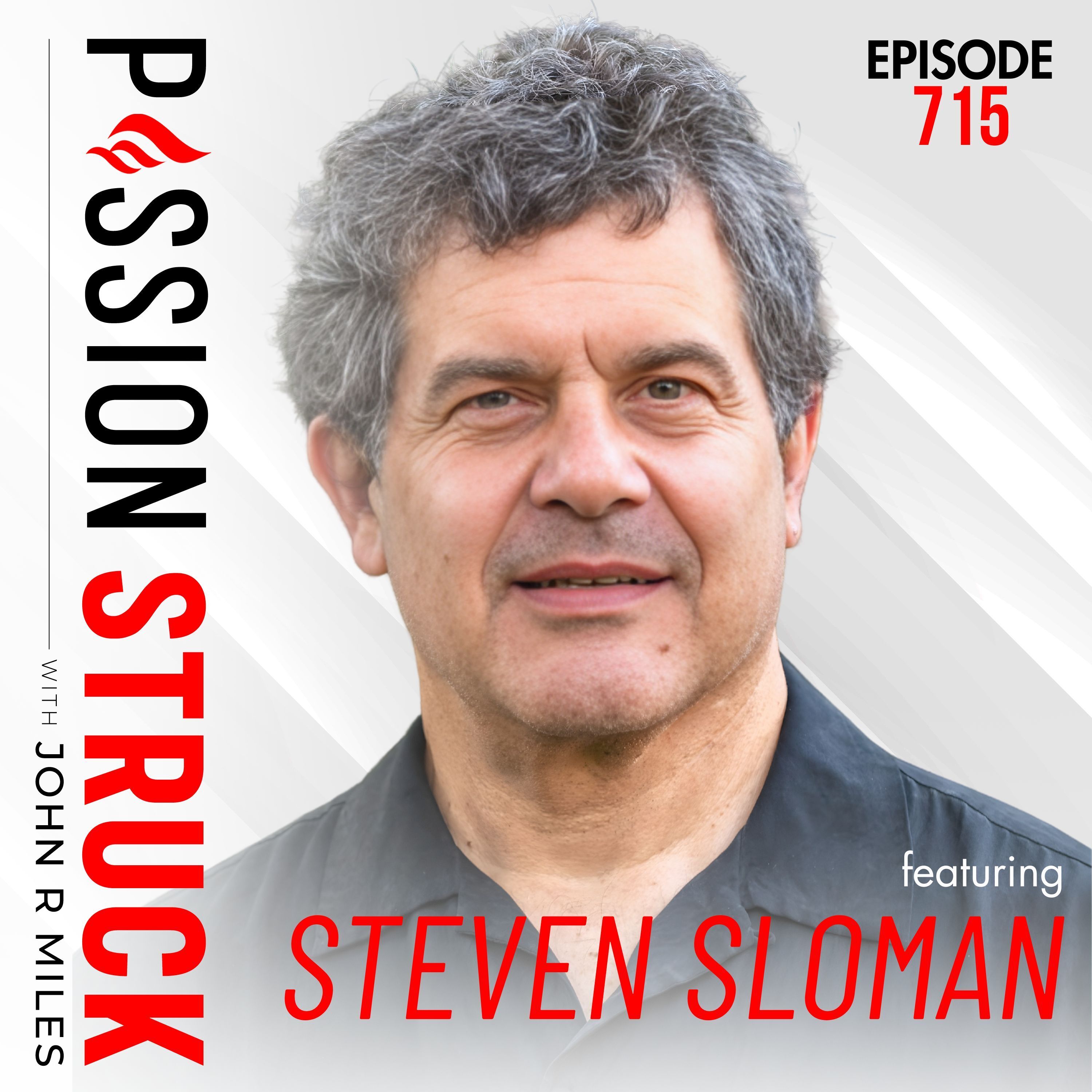
Passion Struck with John R. Miles
Sacred Values: How Our Deepest Convictions Lead Us Astray | Dr. Steven Sloman – EP 715
00:53:34
Loading summary
Transcript59 lines
- [00:00]
John Miles
Coming up next on Passion Struck.
- [00:02]
Dr. Steven Sloman
If you really want to make good decisions, you need people with contrasting views to yours, right? You don't necessarily need them to generate ideas to generate hypotheses, but you need them to test those ideas. Like the best way to perfect your own thinking is to describe it to someone who disagrees with you vehemently. And that way you'll construct really good arguments.
- [00:33]
John Miles
Welcome to Passion Struck. I'm your host, John Miles. This is the show where we explore the art of human flourishing and what it truly means to live like it matters. Each week I sit down with change makers, creators, scientists and everyday heroes to decode the human experience and uncover the tools that help us lead with meaning, heal what hurts, and pursue the fullest expression of of who we're capable of becoming. Whether you're designing your future, developing as a leader, or seeking deeper alignment in your life, this show is your invitation to grow with purpose and act with intention. Because the secret to a life of deep purpose, connection and impact is choosing to live like you matter. Hey friends, and welcome Back to episode six, 715, a passion struck. We're now into week two of our new series, the Meaning Makers, where we're exploring how humans construct meaning and what happens when those structures begin to fail. Over the past few episodes, we've been examining what sustains a life once momentum is no longer the problem and meaning becomes the question. Last week we kicked off the series with Dr. Steven Post, exploring meaning as a biological and relational necessity. How compassion, contribution and unlimited love don't just feel good, but stabilize the human system itself. Then world renowned poet Mark Nepo went inward into presence, acceptance, and the discipline of living truthfully once the external metrics of success stopped working. But today we turn to a more uncomfortable and essential what happens when the very beliefs that give our lives meaning begin to harden into certainty? My guest today is Dr. Steven Sloman. Steven is a professor at Brown University and one of the world's leading experts on how humans think reason and form beliefs. His work explores why we hold convictions so fiercely and why those convictions, when left unexamined, can quietly fracture communities, distort judgment and narrow our capacity for understanding. In today's conversation, we explore why sacred values bind us and can divide us, how belonging shapes what feels right or wrong, why certainty is psychologically comforting but socially costly, and how learning to think in trade offs rather than absolutes may be one of the most important skills of our time. Before we dive in, a quick note on a project that mirrors the themes of inherent worth. My new children's book, you Matter Luma is a bridge to that truth, a reminder that your significance is isn't earned by your performance. It's a fact of your existence. You can pre order it now at Barnes and noble or umatirluma.com if this episode resonates, please share it with someone navigating a similar season. And if you haven't yet, a five star rating or review on Apple Podcasts or Spotify helps these conversations reach the people who need it most. You can also catch the full visual experience on our YouTube channels. Passion struck Clips and John R. Miles if you've ever felt certain only to realize later that certainty came at a cost to your relationships, your curiosity, or your sense of shared reality, then this conversation is for you. Now let's begin the Meaning Makers with Stephen Sloman. Thank you for choosing Passionstruck and choosing me to be your host and guide on your journey to creating an intentional life. Now let that journey begin.
- [03:58]
Interviewer/Host (possibly John Miles or a co-host)
I am so excited Today to welcome Dr. Stephen Sloman. Welcome Steve, to Passion Struck. How are you today?
- [04:04]
Dr. Steven Sloman
I'm great. Thanks so much for having me. John.
- [04:07]
Interviewer/Host (possibly John Miles or a co-host)
Well, I'm absolutely thrilled to have you and I wanted to have this discussion because your brand new book, the Cost of Conviction really does something that's counterintuitive to many of the discussions I have. So many of the conversations talk about how your values guide you to the right place. This kind of gives another lens of those sacred values and how they might take you to a different destination. So I'm going to start out with this. You've spent decades studying how people think individually and collectively. What drew you to write a book about conviction and the cost of our deepest values?
- [04:50]
Dr. Steven Sloman
Well, it was a couple of things. On one hand in it's hard to live in America right now without thinking about conviction and what its determinants are and what problems it leads to. But more specifically, I had been doing a bunch of research on how individuals think and how we depend on the people around us for thought, and it became clear that we have two very different ways of of thinking and making decisions. And one of them is the kind of thinking that we actually tend to think we're engaged in all the time, namely thinking about how our actions will lead to consequences. But the other is a kind of thinking that really comes to the fore when we're thinking about important social and moral issues, namely whether the actions we're taking we consider to be right or wrong. And this distinction became really important when I was studying something called the knowledge illusion, or in psychological circles it's referred to as the illusion of explanatory depth. But the idea is that people don't understand things as well as they do, as well as they think they do. And you show this simply by asking people how well they understand a common object, like a toaster or a zipper or a toilet, and then ask them. And people tend to think they understand it pretty well, but then when you ask them to explain it, it turns out they can't explain how it works at all. So people lower their own sense of their understanding. And we have found that this is true even with regard to political policies. So if you ask people how well they understand a political policy, Obamacare, say they'll think they have decent understanding when you ask them to explain it. They do. They stumble over their words, discover they can't, and lower their sense of understanding. And this suggested to me that what's really going on in these situations is that people are actually coming to the policy not with a deep understanding of what the consequences of the policy are, but with a few slogans that they get from their communities about why the policy is consistent with their values or inconsistent with their values and why it outrages them. So this is really what led me directly to this distinction between thinking about the appropriateness of the actions that we take, like supporting a particular policy, as opposed to thinking making that sort of difficult step of thinking hard about what the actual implications of the policy will be. So, sorry, that was a long answer to a short question.
- [07:57]
Interviewer/Host (possibly John Miles or a co-host)
Yeah, I just turned in my manuscript earlier this week for my 12th book that I've written. And I always think every time I write a book, it makes me more aware of my own values and my own thought processes. I'm sure for you, as you were writing this, it probably made you aware of your own sacred values and how they shape your own decisions, for good or bad. Could you possibly share an example that maybe changed?
- [08:28]
Dr. Steven Sloman
Sure. So the brunt of the book is to argue that we depend more on our sacred values than we should. And so really what I spent my time thinking about while writing the book was how I should avoid my sacred values and actually make the difficult step of thinking hard about the consequences of things. But you're right, as you think about any issue, you become clearer and clearer about what your sacred values are or aren't. And you could take any policy that we're now at war with about in this country, and by virtue of thinking about it, you become clearer and clearer about your sacred values. So you know, immigration. I had to come to terms through writing the book with the fact that despite being a good liberal, I do think that there are limits on the rights people should have to come to enter this country. I think perhaps the one and only issue in which I agree with the current federal administration is birthright citizenship. Right. It's not obvious to me that simply being born in this country should afford you citizenship. Certain things were clarified for me in the process. And by the way, congratulations on your new book.
- [09:57]
Interviewer/Host (possibly John Miles or a co-host)
Well, thank you. You turn in the manuscript, and then it takes 12 months to 18 months for them to get it to print. So it's going to be a while. But I appreciate it. I always like how books open up, and you open up with the concept of zealotry, like you go from ancient Judea to Joan of Arc. Why do you think stories of extreme conviction like those still resonate so powerful today?
- [10:27]
Dr. Steven Sloman
I think that our sacred values are what tie our communities together. So if you ask, what represents a political party as opposed to a different political party, or what's special about a particular country, why do people like going to Paris so much? And I think the answer is often in the form of sacred values. So what people like more than anything is to observe other people. Turn on the tv. Unless you're watching a nature show, you're watching other people do something. And so there's something about sacred value which is really at the heart, at the center. Center of the thing that interests us the most, namely other people's goals and ambitions and how they pursue them. The stories we tell are about other people and their motivations. And people's primary motivations for the larger acts that they do are their sacred values. So I think that that's what drives history to a large degree.
- [11:47]
Interviewer/Host (possibly John Miles or a co-host)
Yeah. So a friend of mine you may know is Judd Brewer, who also teaches at Brown, and Judd is known a lot for his work on habits. You distinguish sacred values from habits or conventions. How do we know when we've crossed into being sacred from a habit that we might be performing?
- [12:13]
Dr. Steven Sloman
Interesting. Finally, John, I think about it in the other direction. So I think of habits as behaviors that we perform in a regular way based on associations to the environment around us. I actually think sacred values are like habits. They become like habits over time because they're also ingrained in us through this process of reinforcement learning that starts when we're very young. Right. We get our first sacred values from our parents and from our families. And our cultures reinforce all kinds of beliefs about which actions are right and which are wrong. I actually think sacred values are an example of a habit. They just are a habit that have a lot of symbolic content. They're habits that we think about. They're habits that govern the way we frame our understanding of other people's behavior. So they're cognitive habits in that sense.
- [13:23]
Interviewer/Host (possibly John Miles or a co-host)
Thank you for that distinction. One of the things, Steve, that I've really spent a lot of my time doing is studying the science of belonging, kind of Jeff Cohen's work, Gregory Waltman's, and the science of mattering, Gordon Flett's work, as well as some of the work that Lori Sanders Santos and others have done. And you've written that our identities are tied to our social groups through shared sacred values. And when I think of those social groups, a lot of it has to do with that sense of belonging that we have. How do these sacred values both unite us, but also times drive us into conflict in these social groups?
- [14:05]
Dr. Steven Sloman
Yeah, well, that's a really great and important question. And it's nice to think about the issue in terms of belonging, because I think you really captured the essence of what motivates us to see the world through our sacred values. Look, I guess I have a fairly simple view of this, which is that we align ourselves with some community, and those communities inevitably have some sacred values. Right. So if you think about the community of Americans, then once upon a time, democracy was a sacred value and free speech was a sacred value. And if you're a Republican, then family values are a sacred value. And if you're a Democrat, then there are other things. Doing little harm is a sacred value. Every group, even hockey teams, have sacred values in a way. Right. Win the game. So whichever community you're a part of, if you don't accept the fundamental sacred values of that community, you're not going to have a sense of belonging within that community. So sacred values are tightly tied to our sense of belonging in that sense. But there's this unfortunate dynamic which occurs, which is that we tend to distinguish ourselves from other nearby communities through our sacred values. If we're on one hockey team, then we distinguish ourselves from the other hockey teams that we play in, that we want to beat them and they want to beat us.
- [15:56]
Interviewer/Host (possibly John Miles or a co-host)
Right.
- [15:56]
Dr. Steven Sloman
There's a clear distinction there. But you can see this in all kinds of communities. The obvious example these days is to think about how Republicans and Democrats define themselves. And what happens is our sacred values become more and more polarized because they're used to represent our community. So if they're going to represent our community, then they can't represent the other guy's community. So we choose values which maximally distinguish us and we start focusing on those values which maximally distinguish us so that our self definition becomes a sort of anti definition of the other side.
- [16:47]
Interviewer/Host (possibly John Miles or a co-host)
Yeah, as I was thinking through this myself, I kept going back to some of the work of Malcolm Gladwell, especially his work around Rosetto, Pennsylvania. That town that for so many years had shared values that united the whole town for decades and decades. And then those shared values started to shift and the town began to unravel. And I think if you look at that, the town's only a couple thousand people, but you can look at that as an example of what happens to us across society. And one of the areas that I think this is happening is in the way that the values in young men, especially in the United States, are changing so rapidly. I think this has been shown in, in the book Adrift that Scott Galloway put out a couple years ago. But it's really in the whole movement that Movember has been doing to try to show how different men's values are changing. What do you think about that?
- [17:50]
Dr. Steven Sloman
Well, I think it's sad, and I think that there's a huge social cost to what you're pointing out. But I also think it exemplifies exactly the dynamic that I was just trying to describe, in the sense that I do believe what's happening with young men is in part a response to DEI initiatives. So they see themselves as being downtrodden and disrespected and not having opportunity. Sometimes it goes overboard. Clearly, when they feel that there are opportunities they should have is to have sex with anybody they want, then I think that's crazy. But if they see the opportunities they're losing to be not being able to get a job because they're male or being told that the life they lead is toxic by virtue of their gender, then you can see why they would want to distinguish themselves from those who are promulgating those values that are so offensive to them. So as a result, they develop a community that just completely turns off everybody else and start developing sacred values that distinguish them and allow them to cheer for themselves in a way that cuts off others and in the end creates a lot of hostility and unfortunately, a lot of violence too.
- [19:26]
John Miles
Before we continue, I want to pause on something important. Listening to a conversation about belief, certainty and sacred values is one thing. Living with that awareness, especially in a world that rewards speed, slogans and outrage, is another. That tension between belonging and understanding, conviction and Humility is exactly what this conversation with Stephen Sloman is about. Meaning doesn't come from being right. It comes from being responsible with what we believe. That's why each episode in the Meaning Makers series is paired with reflection tools inside the Ignited Life. My substack to help you build the internal architecture to think more clearly. Asking questions like, where am I treating a value as sacred to avoid engaging trade offs? What beliefs feel untouchable? And why am I protecting meaning or protecting identity? Because meaning isn't something you declare. It's something you practice carefully, courageously, and over time. You can join us@theignitedlife.net Now, a quick break from our sponsors. Thank you for supporting those who support the show. You're listening to Passion Struck on the Passion Struck Network. Now back to my conversation with Stephen Sloman.
- [20:35]
Interviewer/Host (possibly John Miles or a co-host)
It is a really sad state of affair. I was looking at some of the most recent statistics and across the world there are 132 million, you know, young men who've even dropped out of high school. And these trends are just continuing and continuing well. And anyway, you talk about trade offs in the book and you discuss taboo trade offs and tragic trade offs. What are the differences?
- [21:02]
Dr. Steven Sloman
Can I just make one quick comment about young men before we, before I try to answer?
- [21:07]
Interviewer/Host (possibly John Miles or a co-host)
Absolutely.
- [21:08]
Dr. Steven Sloman
I just, I do want to say that I don't think sacred values are the whole story. There's there. Right. There's a lot going on in society. The, not just social media, but the presence of AI and Internet porn and all sorts of pressures are going on at the same time. And the sacred values that people hold are just part of the mix that are used to justify feelings that that may be arising for other reasons. I do think it's important to maintain some perspective on the complexity of the situation. And I think it's particularly important in this conversation because the appeal to sacred values is essentially an attempt to simplify a complicated world. And so this process of simplification is actually what's leading to a lot of, of the problems that we're facing. People are just not willing to face the complexity of life. So back to your question, tragic versus taboo trade offs. So the thing about sacred values is that people tend to hold them absolutely right. They differ from consequentialist values in that consequentialist values have to be traded off. Right. So you want to get something that's as cheap as possible, but you also want to get something that has the best quality. And so there's a trade off between price and quality. And when you're thinking in consequentialist terms. You always have to make these kinds of trade offs. That's actually the game of consequentialist thinking, thinking about how to make trade offs. When it comes to sacred values, we tend to treat sacred values as absolute, right? So if my value is that abortion is bad, then that's an absolute statement. Abortion is always bad and there are never exceptions. But so what does that mean? What that means is you're not willing to trade off your value for material gain. So presumably there's no amount of money, I hope and assume there's no amount of money I could pay you to murder someone, because murdering is wrong. It's a sacred value that I certainly hold and I strongly suspect you hold too. And so you're not willing to make a trade off between violating that sacred value and material gain. If you do, that would be a taboo trade off, right? It's taboo to make that compromise. On the other hand, sometimes we're faced between trade offs, between competing sacred values. Sometimes I have to kill somebody in order to save my family or in order to save my country. And in that case I have no choice but to violate a sacred value because if I don't violate it, I'll be violating a different sacred value. So that's a tragic trade off. And in a sense that's the hardest thing to deal with in life, right? When you have competing sacred values that dictate opposite actions, then you have to give up something that is very meaningful to you and might even be central to your identity.
- [24:57]
Interviewer/Host (possibly John Miles or a co-host)
So, Steve, I want to take this and do a follow up question on this. One of the people you highlight in the book was Paul Jennings Hill, who was an American minister, religious extremist and anti abortion terrorist. Why did you choose to use his story? He ended up being executed for the murder he committed. But it's really a pretty chilling example.
- [25:20]
Dr. Steven Sloman
Abortion is one of the issues that most clearly distinguishes these different frames of reference, right? So usually when we vast majority of time when we talk about abortion were we're talking about our sacred values and when we debate abortion, we're debating sacred values. And I think that's why the debate doesn't go anywhere, right? Because you can't really argue about sacred values. The way to send a debate somewhere productive is to discuss consequences. That is to think about not only what the consequences to the baby would be, but what the consequences to the mother would be, what the consequences to society would be, what the consequences of any particular policy that we want to Implement would be unless we go to that difficult and complicated discussion, we're just not going to reach any common ground. The reason that I discussed William Jennings Bryan is because it was an opportunity to discuss this sort of paragon example of how. What sacred values, how they inhibit discussion, but also how they compel action and, and how they, how important they are at the political level for motivating people to do things. Whenever there's war, for instance, it's a sort of prerequisite, is that the country elicit its sacred values and make those prominent and get people to frame the situation according to their sacred values in order to feel strongly enough that they're willing to do something like risk their own lives.
- [27:26]
Interviewer/Host (possibly John Miles or a co-host)
Yeah, well, you saw that in World War II on both sides and the way that Hitler used sacred values to unite the Germans. And then you also saw Winston Churchill do it as a way to ignite the, the English through the sacrifices that they would have to make in order to confront the tyranny that Germany was bringing throughout the world.
- [27:47]
Dr. Steven Sloman
Absolutely. You, you name any war that's currently going on and you can see exactly the same dichotomy.
- [27:56]
Interviewer/Host (possibly John Miles or a co-host)
Well, let's bring this a little bit closer to home. We talked about the importance of groups and belonging. I find that so many of the communities that we find ourselves in try to enforce sacred values. It could be enforcing through cancer culture. It could be you're in a fraternity and they have loyalty test. It could be heresy trials. What do all of those through this lens of belonging or mattering due to social cohesion?
- [28:30]
Dr. Steven Sloman
That's another great question, John. So on the positive side, they induce social cohesion because they ensure that all the members of the community accept that community sacred values and say so publicly. And that's critical. Right. Like I don't want a member of my team who doesn't want my team to win. But I think your examples show that kind of enforcement of sacred values can easily go too far and tends to go too far. Right. If you have some kind of fraternity ritual that, that causes pain and that serves no purpose except to. Except to bond the community through awareness that they've done something that they shouldn't have done, then that's obviously a harmful consequence of something that otherwise makes sense, namely to induce a set of sacred values in the community and make explicit what they are.
- [29:50]
Interviewer/Host (possibly John Miles or a co-host)
Yeah. When I think about what we're talking about, it always reminds me of the late Emile Bruno and his work on dehumanization. Because that, that to me is like the extreme of what this can bring. I think Kurt Gray is. Kurt Gray has discussed this as well in his work. But I want to talk about a couple other people's work. I've been a big fan of Don Moore and Max Azerman, you know, for decades now, and their work on ethics and decision making is something that I really tried to use during my own career when I was a business executive. You describe sacred values in that lens as cognitively seductive because it ends up simplifying decision making. What do you mean by that? Simplicity can become dangerous.
- [30:41]
Dr. Steven Sloman
It's important to understand that making decisions inevitably requires simplification. Making decisions that matter in any sense requires that we don't see the full complexity of the consequences of the various options, because inevitably there are just too many of them. And seeing those consequences roll out over time is pretty much impossible. I mean, take any example. Take making a decision about which car to buy. Should you buy an electric vehicle? Should you buy a gas powered vehicle? Should you buy a hybrid? Well, one question there is what's going to happen to the oil economy and what's going to happen to the battery economy? Is Trump going to succeed in killing windmills and solar projects? If he does, then that has obvious implications for what kind of car you should buy. So in order to make a decision of any magnitude, you have to predict the future. And if there's anything that's hard to predict, it's the future. And sometimes complexity comes from all sorts of other directions, too. Do I understand battery technology? Do I know if my car's battery will last for a significant period of time? Do I really understand what damage to the environment it's going to cause? Not only to collect the chemicals and elements, then minerals that go into building the battery, but to getting rid of the battery at the end, too. There's all sorts of questions. So the world is complex and we have to simplify. And there are consequentialist strategies for simplification. Decision theorists have spent decades now explaining what those are. A lot of the critical work was done in the 70s and 80s and 90s by Danny Kahneman and Amos Tversky, pointing out the heuristics that we use in order to simplify sacred values strike me as another form of simplification. In fact, they're an extreme form of simplification because what they do is they allow you to ignore consequences, right? They allow you to ignore what is, in a sense, the most important part of a decision. You simply focus on action and have some simple rule that tells you this action is good or this Action is bad. So sometimes we need those kinds of simple rules, especially if we have to make decisions really quickly or if we have to make decisions in a large group where we might have different beliefs about what the consequences will be.
- [33:46]
Interviewer/Host (possibly John Miles or a co-host)
Yeah, I just wanted to stop you there because I think one of the most provocative arguments you make in the whole book is what you're just discussing, is that many of our decisions aren't about consequences at all, but about honoring the sacred values that we've been discussing. So I wanted to turn this into maybe a takeaway for the listeners. How can they become more aware of that distinction and so that it could possibly change the way that they live their everyday lives? Because I think this goes into how people lead, how they parent, how they vote. It influences so many things.
- [34:21]
Dr. Steven Sloman
I think a really good heuristic tool to use is to ask yourself, why am I doing this? Why do I believe this? Why is it a good idea? And if the only answer you can provide is because I've always done it this way or because it rings true, then I would say you're probably making the decision based on sacred values and you're not really thinking through the consequences. So sometimes we have to do this. If the baby is screaming or if the dog is out on the street and going to get hit by a car, then we don't have time to think things through and we have to take the action that we think that comes to mind that will resolve the emergency. But if it's an important enough decision that it's worth taking the time for, then if we can't explain why we're doing it, then we probably haven't thought it through as much as we should and could. And this is particularly relevant when we're making decisions in the context of other people that we disagree with. So this is something that I really wish politicians would take seriously and that when we're thinking about our views on any hot button political issue at the moment, especially if we're not surrounded by friends but by people who might disagree with us, it's absolutely necessary to focus the conversation on those consequences, such as.
- [36:13]
Interviewer/Host (possibly John Miles or a co-host)
Shutting the government down, for instance.
- [36:17]
Dr. Steven Sloman
But unfortunately, every two days there's a new example these days. But that's the latest. Yes, absolutely.
- [36:25]
Interviewer/Host (possibly John Miles or a co-host)
Well, maybe we can use a real life other example that brings a lot of polarization and that's climate change, because this is another one of those things where people are so much on one camp or the other. Either you're fully in believing that this does exist and the reasons for it happening, scientifically proven, or you believe it's all a hoax and this is a scenario that we really need to unite around because it has consequences that could end the world.
- [37:02]
Dr. Steven Sloman
I couldn't agree more.
- [37:04]
Interviewer/Host (possibly John Miles or a co-host)
So you suggest reframing as a path forward, but can you walk us through maybe in this lens of climate change, one or two examples of how that works, or maybe reframing isn't the best example. What are one or two things from your book that could help people on that topic?
- [37:28]
Dr. Steven Sloman
Well, look, that's a topic in which I myself have been heaved to and fro in recent days. So I actually think that people on both the left and the right of this issue have a habit of thinking about climate change in sacred values terms. So on. On the right, it's clear they just call it a hoax and deny it, and their sacred value is to pursue their own interest. But on the left, there's also a tendency to simplify and to treat the issue as perhaps more catastrophic than it is. Because every question like, should we be building windmills in our inside of our oceanfront properties? Or should we cover our homes with solar panels? Should we be buying electric cars? Each of these is a complicated decision that has pros and cons on each side. And if you simply say, well, I'm going to protect the environment at all costs, you might end up damaging the environment. Right. Like we have to think about what the consequence of having windmills in the ocean is. We have to think about what the consequences of having to get rid of millions of huge batteries in 10 or 15 years time is, even if we want to protect the environment. So the implication is that when we're making specific decisions, rather than just enforcing thoughtless kind of rules of behavior, make sure that you can generate an explanation for why this action in this case is the best. But also appreciate your explanation is not going to be complete and it's not going to be perfect, that it's not going to be the explanation that an expert on the issue would offer, for instance, because we just don't have the skills, most of us who aren't experts, to generate those kinds of explanations. So we have to be happy with the sort of minimal explanation we're able to generate. But the other thing we have to do, of course, is respect expertise, is focus on those people who really do know what they're talking about and take their advice seriously.
- [40:08]
Interviewer/Host (possibly John Miles or a co-host)
So one of my favorite interviews I did on this show is with Seth Godin, and we were talking about his project, the Carbon almanac, which brought 700 cross functional leaders from around throughout the world. Not to take a conservative side or a liberal side, but just to try to give the facts. And they identified five culprits that are causing most of the warming that we're seeing. When I was talking to him, what he said, which I think applies to so many issues that we face, is that at the end of the day, what needs to happen is systems change. And systems change is very difficult to do because it has so many different levels. And it rarely starts from from the government top down. It mostly starts from the bottom up. So when I start thinking about that and I start thinking about what that's going to really take is it's going to take some small community where people start showing up and they start doing something differently and then it's going to spread from that point and shift people val value system. How do those things happen? Because I'm going to go back to your other book, the Knowledge Illusion. You wrote we never think alone. And to me that's where this change starts happening is it starts when we start listening to others and not canceling them out just because they don't fit the script that we have in our mind is the right one. So how do those things take fire? I guess is where I'm trying to get to.
- [41:42]
Dr. Steven Sloman
So I've got a graduate student named Amosh Molnar, and we're working closely on what we call adversarial cooperation. And this is an idea that has been promulgated by a number of people. Jonathan Height is a big name in this area. And the idea is that if you really want to make good decisions, you need people with contrasting views to yours, right? You don't necessarily need them to generate ideas to generate hypotheses, but you need them to test those ideas. Like the best way to perfect your own thinking is to describe it to someone who disagrees with you vehemently. And that way you'll construct really good arguments. So our idea is that this is what society needs, right? But it's important to acknowledge that society's full of communities that operate on the basis of adversarial cooperation already. So courts are adversarial, involve adversarial processes. Right? When engineers build things, there's necessarily adversarial processes because the thing has to work. So in a sense, the world is the adversary. Philosophers are great at this, right? If you go to a philosophy seminar, you'll just find people disagreeing with each other left and center. And that's the game to disagree. I think that there are actually lots of scientific contexts in which adversity is a respected sacred value. In a way. Right. Disagreeing is encouraged. Now, to be honest, I think there used to be more adversarial cooperation than there is now. But nevertheless, it certainly has found its place in certain communities, at certain universities. So we have examples of this kind of process all around us. And the real problem is scaling it up, scaling it up to a social level. There's a sense in which our government is an adversarial process. It's an adversarial process in multiple ways. So there are these different branches of government that are supposed to, in a sense, they're supposed to cooperate, but they're also supposed to put limits on one another, the executive, judiciary and legislative. One wonders these days whether that process is really working and if not, why not. But there's also adversity within each of those institutions. So legislatures have people from different parties that, you know, generally have to come to some sort of agreement. And this is the problem with the two party system, right, that it's too binary and within each chamber there's just one party that tends to dominate. And so that limits the constructive act of disagreement that is possible. But the main point is that allowing, encouraging, fostering systems that have this property, I think is one way to achieve what you're looking for.
- [45:19]
Interviewer/Host (possibly John Miles or a co-host)
Okay, and another fan of mine who I've had on the show is Joshua Green, and he calls sacred values a heads I win, tells you lose rhetorical device. What is your best advice to counter when someone uses a right, a duty to immunize their position against evidence?
- [45:43]
Dr. Steven Sloman
So there's two steps. Step one is to acknowledge their value and just let them know you understand where they're coming from. Because if you don't do that, they won't listen to you. But once you. But you don't have to disagree with them, you just have to acknowledge that you understand their sacred value. And once you've done that, then you can start spelling out the consequences of their view. And some may be positive and some may be negative, but in the end, you can at least try to foster a rich conversation about what will actually ensue if we take them seriously. And sometimes you're going to agree to the conclusion that there will be more bad consequences than good consequences. That doesn't happen too often. It's hard, if not impossible, to persuade people of things that are opposite to what they come into a situation believing. But it can happen, particularly if they're not too intransigent.
- [46:51]
Interviewer/Host (possibly John Miles or a co-host)
And then, Steve, I have one or two fun questions for you. Sure. If you could redesign how political debates are conducted, what's the first change you would consider making?
- [47:05]
Dr. Steven Sloman
So I think there are some productive political debates. So I. I have watched the British House of Commons on occasion, and it can be both fun and enlightening.
- [47:17]
Interviewer/Host (possibly John Miles or a co-host)
That is entertaining, isn't it?
- [47:18]
Dr. Steven Sloman
Yes. But I guess, following from the ideas that we've been discussing, what I would want to do is make sure that people stop sloganizing. Right. There has to be more direct. So what I find when I watch, say, presidential debates is that the debaters just express their values and leave it at that, and others don't really take issue with it because there's not much to say when you disagree with someone's values other than you disagree with. With their value. But that's not a discussion that goes anywhere productive. So forcing people to say why and how this thing works. Right. Could lead to actual interchange where people are actually responding to one another, hopefully filtering out the wheat and. Or filtering out the chaff, leaving the wheat as the product of the conversation.
- [48:31]
Interviewer/Host (possibly John Miles or a co-host)
I used to be a senior executive at Dell, and while I was there, we bought Pro Systems, the company Ross Perot founded. And I had the opportunity to meet Ross a number of times. And I go back to the debates that he was in with Bill Clinton and President Bush the first. And it was so interesting because he took a completely different angle than the other two. And I think it shocked a lot of people and how he did it. And I wish we had more people who went into the debates like he did, focused on solutions and change, rather than staying rigid in their lane. Last question for you is if you could give a book to the audience that changed how you think about decision making, not your own, what would you recommend that they read?
- [49:17]
Dr. Steven Sloman
Well, I saw that you interviewed Annie Duke, and I really liked her book on poker. I will say, for those who have not been introduced to the psychology of decision making at all, I think you have to go back to the old seminal work of Kahneman Tversky. And I think reading it firsthand is incredibly enlightening because they wrote as if they were writing the Bible in the sense that every sentence had value and every demonstration was clearly thought through in its implications for how people think. And the kind of mistakes we should be aware of were really clear. They. There's a lot of stuff they wrote. Danny Kahneman's book, what's It Called? It's About Two Systems of Thinking, is not a terrible introduction to it.
- [50:15]
Interviewer/Host (possibly John Miles or a co-host)
And Then lastly, Steve, where can people find more about your work?
- [50:19]
Dr. Steven Sloman
Well, so as you very nicely pointed out, I do have these two books that I hope people pay attention to. The first was the Knowledge illusion, published in 2017, and the latest is the Cost of Conviction. If they're interested in more, they can look at my website, which they can just Google Sloman Lab and it'll appear. It's not a fancy site, but it's got some information in it and I guess those are the best places.
- [50:47]
Interviewer/Host (possibly John Miles or a co-host)
Well, awesome. Well, Steve, it was such an honor to have you today on Passion Struck. Thank you for all your contributions.
- [50:53]
Dr. Steven Sloman
Well, thank you so much. It's been a real pleasure, John.
- [50:57]
John Miles
That brings us to the close of today's conversation with Stephen Sloman. What stayed with me most is this. Meaning doesn't disappear when we loosen our grip on certainty. It deepens when we're willing to examine the cost of of what we believe. Sacred values help us belong, but when they go unquestioned, they can quietly narrow our thinking, harden our identities, and bind us to consequences we never intended. Stephen reminds us that wisdom isn't the absence of conviction. It's the ability to hold conviction while remaining open to trade offs, complexity and responsibility. And that brings us to the next step in the Meaningmakers series. If today was about how beliefs form and how certainty shapes our sense of meaning, then next we turn to what happens when those beliefs collide with real world decisions. In my upcoming episode on Thursday, I'm joined by Alex Amos, whose work focuses on decision making under pressure and a powerful idea known as the winner's curse. The phenomenon where people win by overpaying over committing or overreaching, only to discover that the victory itself carried hidden costs. If Stephen Sloman helped us understand the cognitive architecture of belief, Alex Emis will help us explore the behavioral architecture of choice and why so many of us are exhausted. Not because we failed, but because we succeeded at something that asked too much.
- [52:16]
Alex Amos
Don't succumb to the sunk cost fallacy. So the sunk cost fallacy is this idea that I've already done something, I've already gone down this path, I might as well keep going. Even though it's looking like a bad decision. Don't succumb to that sunk cost fallacy. Always take a moment, think is the next step. If I hadn't gone into this decision to begin with, if I hadn't paid money to invest in this stock, if I hadn't taken those, that one class in that topic, would I still do that?
- [52:43]
Interviewer/Host (possibly John Miles or a co-host)
Next thing?
- [52:44]
Alex Amos
If the answer is no. Stop. Do something else. Just this is one of the most important things that behavioral science has taught us.
- [52:52]
John Miles
Before you move on with your day, I'd invite you to pause and ask, where in my life might I be protecting certainty or chasing a win without fully counting the cost? If you want support applying these ideas, you can join me inside theignitedlife.net, where each episode in the series is paired with reflection tools designed to help you integrate insight into action. As we continue the Meaning makers, remember, significance isn't built by winning at all costs. It's built by choosing what actually sustains you. I'm John Miles. You've been passion struck.