← Passion Struck with John R. Miles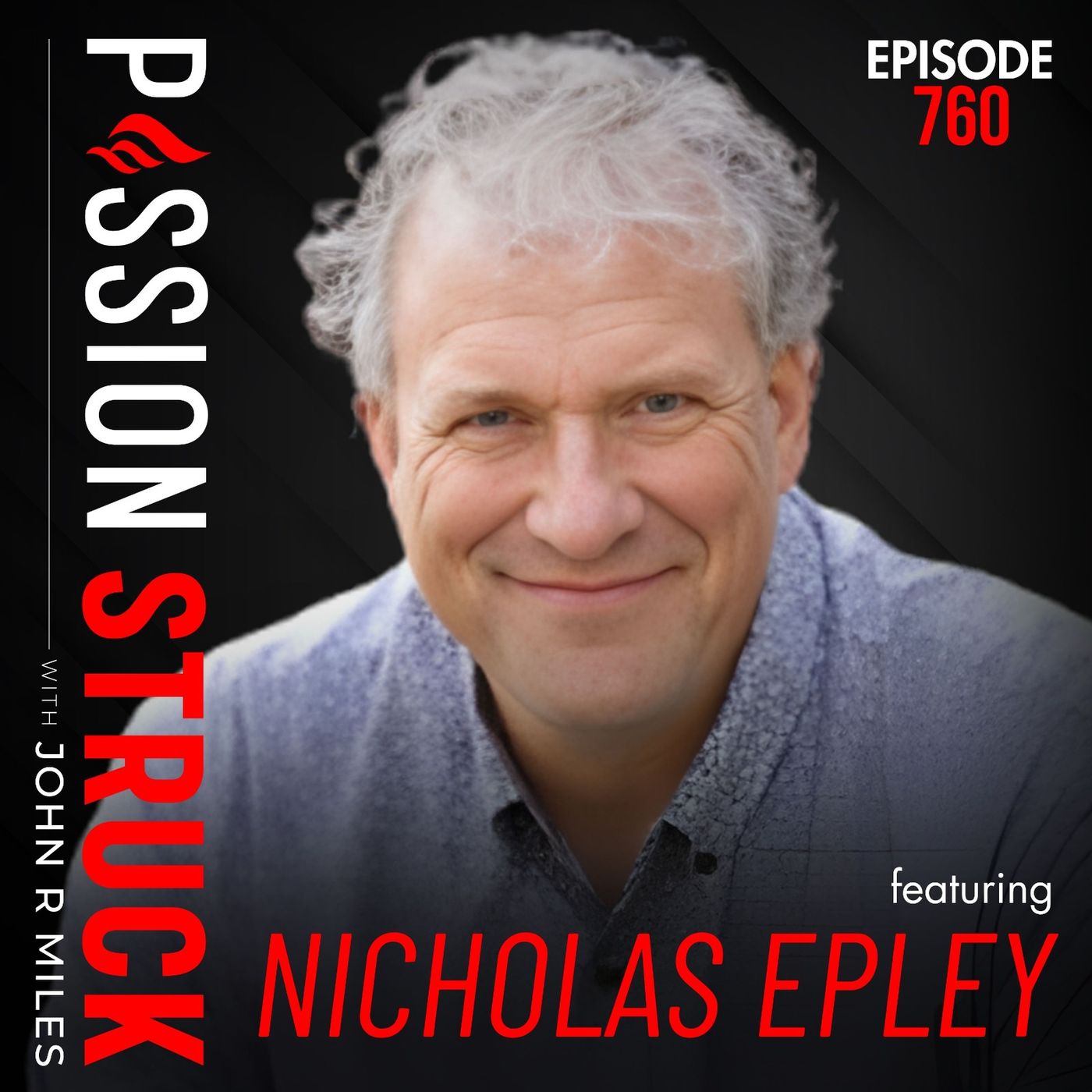
Passion Struck with John R. Miles
The Science of Connection and Why We Underestimate Others | Nicholas Epley - EP 760
00:59:04
What if the happiness, belonging, and meaning you are looking for is hiding in the conversations you never start? In this episode of Passion Struck, John R. Miles sits down with social psychologist Nicholas Epley to explore why we consistently...
Loading summary
Transcript402 lines
- [00:00]
Spinquest Advertiser
You know what? It sucks to be bored. But when I get on my phone and play real casino games on spinquest.com, the time flies by. That two hour wait at the DMV seems like 10 minutes. Play your favorite slots, live blackjack, live craps with a live dealer. New players, thirty dollar coin packs are on sale for ten bucks. Play spinquest.com and you'll never be bored again.
- [00:24]
Spinquest Legal Disclaimer
Spinquest is a free to play social casino void where prohibited. Visit spinquest.com for more details.
- [00:31]
Blue Lizard Sunscreen Advertiser
The sun is calling. Are you ready? From beach days to soccer plays. Blue Lizard Australian Sunscreen helps protect your family's skin so you can focus on the fun, not the sun. With no fragrances, parabens or phthalates, our mineral sunscreen is designed for your sensitive skin and trusted by dermatologists, pediatricians and parents alike. Be fearless in the sun with Blue Lizard Australian sunscreen. Shop now on Amazon.com coming up next on Passion Struck.
- [01:02]
Nicholas Epley (Nick)
We tend to think about ourselves in
- [01:04]
terms of our competency, right?
- [01:05]
So you're thinking about starting a conversation. You think, well, what are we going to talk about? Do I have anything in common? This person, Can I carry it on? Right, you're an agent. You're thinking about your competency. Okay, Other people, they care about your competency, but not first and foremost. What they first and foremost care about is how nice are you. That's the basic how warm are you? Are you friendly? Are you trustworthy? Are you a friend I can interact
- [01:28]
with or a ufo?
- [01:29]
Somebody I should avoid? Right? So we're evaluating ourselves through this lens of competency.
- [01:33]
Other people are evaluating us through this lens of warmth.
- [01:37]
When you reach out to engage with somebody positively, those are inherently warm acts. Those are going to be high on that spectrum, on the warmth spectrum. People are going to react to that generally pretty positively.
- [01:49]
John Miles (Host)
Welcome to Passion Struck. I'm your host, John Miles. This is the show where we explore the art of human flourishing and what it truly means to live like it matters. Each week I sit down with change makers, creators, scientists and everyday heroes to decode the human experience and uncover the tools that help us lead with meaning, heal what hurts, and pursue the fullest expression of who we're capable of becoming. Whether you're designing your future, developing as a leader, or seeking deeper alignment in your life, this show is your invitation to grow with purpose and act with intention. Because the secret to a life of deep purpose, connection and impact is choosing to live like you matter. Welcome back, friends, to episode 760 of Passion Struck.
- [02:41]
I am so glad you're here.
- [02:43]
Whether this is your first time or your hundredth. Thank you for being part of this global community of people who are committed to to living, intentionally leading with purpose, and creating a world where every person feels like they matter. Today's conversation is part of our monthly Purpose by Design series where we've been exploring a simple but profound idea. That purpose isn't something you find, it's something you design through your choices, through your relationships, and through the meaning you create every day. If this show has ever inspired you or helped you take one meaningful step forward, the best way to support it is simple. First, share this episode with someone who
- [03:24]
will find it valuable.
- [03:26]
Second, leave a five star rating or review on Apple Podcasts or Spotify. It helps new listeners discover these conversations. Throughout this series, we've been exploring purpose from multiple dimensions. We began with Arthur Brooks, examining the growing crisis of meaning and and why fulfillment is something we can cultivate. Then, with best selling author Kayla Shaheen, we turn inward, looking at how our unseen patterns shape the life we build. With Stanford professor Claude Steele, we examined identity and the hidden forces that shape how we show up in the world. With Angela Meyers, we looked at mattering itself and how feeling seen, valued and needed changes everything. Then last week, two extraordinary conversations helped deep, deepen the arc. Last Tuesday with Nobel laureate Alvin Roth, we examined how systems, incentives and social norms quietly influence our choices. Then last Thursday, with Diana Hill, we explored wise effort, how directing our energy towards what matters most becomes a design choice in itself. Today we bring those threads together because meaning, identity, mattering, energy all come alive through one essential force.
- [04:34]
Nicholas Epley (Nick)
Connection.
- [04:35]
John Miles (Host)
Because maybe purpose isn't just about what you pursue. Maybe it's also about who you reach toward. And what if some of that meaning we long for is hiding in the smallest choices? The conversation we don't start, the gratitude we don't express, the stranger we don't acknowledge, and the friendship we don't deepen. That's why I wanted to bring Nick Epley on the show. Nick is one of the world's leading social psychologists, and in his brilliant new book, A Little More Social, he reveals something deeply that happiness, health and belonging often begin not with radical change, but with one small act of connection. And in this conversation we unpack why we consistently underestimate how much others want to connect, how tiny moments of reciprocity can transform well being, why our silence is often built on false assumptions, and how choosing connection may be one of the most important design decisions we make. Because perhaps purpose is not only designed through what we build, but through the relationships that help us become. Now let's dive into my conversation with Nicholas Epley. Thank you for choosing Passion Struck and choosing me to be your host and guide on your journey to creating an intentional life that matters.
- [05:48]
Now let that journey begin.
- [05:50]
Spinquest Advertiser
Whether it's slots or live dealers, Spinquest.com has the fun and action you're looking for with Spinquest exclusives. Blackjack, roulette, baccarat and even live dice with craps and bubble craps. The games never stop so you don't have to. And right now, new users get $30 coin packs for just 10 bucks.
- [06:12]
Nicholas Epley (Nick)
Play now@Spinquest.com SpinQuest is a free to
- [06:15]
Spinquest Legal Disclaimer
play social casino void where prohibited. Visit spinquest.com for more details.
- [06:25]
John Miles (Host)
I am absolutely thrilled today to welcome Dr. Nick EP to Passion Struck. Nick, it's so great to see you today. How are you?
- [06:32]
Nicholas Epley (Nick)
Thanks, John. I'm having a good day. It's off to a good start.
- [06:35]
John Miles (Host)
Well, I cannot wait for this discussion. We're going to be talking about this brand new book. I actually have an advanced reader's copy that I was so excited to get.
- [06:43]
It's titled A Little More How Small
- [06:46]
Choices Create Unexpected Happiness, Health, and Connection. Congratulations on your second book.
- [06:53]
Nicholas Epley (Nick)
Thank you, John. This one's been a long haul. This one was harder than the first, and the first one was so hard I told my wife I'd never write another one. Then life happens and here we go.
- [07:03]
John Miles (Host)
What do you think is harder? Writing the book or doing the publicity for it?
- [07:08]
Nicholas Epley (Nick)
Because oh, definitely writing the book. The publicity part of it is a little uncomfortable when you're trying to reach out to lots of people. It's a lot of cold calling and things like that, but this kind of stuff is super fun. Like the diff. The big difference is that when you're
- [07:24]
writing the book, this camera that I'm looking at right now is off and there's also nobody in my office like
- [07:30]
there is right now. And it's hours and hours on end of doing this all by yourself.
- [07:36]
Whereas research is often very collaborative.
- [07:38]
I've got PhD students and postdocs, collaborators I'm working with all the time.
- [07:41]
But writing a book is just alone time.
- [07:43]
But at least when I'm talking with folks about it, I'm talking with people about it and that's pretty fun. This will be a fun conversation today.
- [07:50]
John Miles (Host)
I've recently been trying to get a hold of Angela Duckworth who blurbed your book, and her assistant told me she is in a writing Dungeon. And it's very difficult to find. So I understand that analogy very much.
- [08:03]
Nicholas Epley (Nick)
Yes. I would carve out entire mornings every day where I would write and nobody could bother me. It was like I was traveling and away. And you just got to do it at some point, get the thing done.
- [08:15]
John Miles (Host)
Nick, we began before we came on Today talking about your morning commute. And I want to start with two moments that feel completely different, but I think are actually connected. There's the story you tell in the book about a woman who died and no one noticed for two years. And then there's something much more ordinary, which is sitting on a train next to someone and choosing not to say a word to them. Or it could be a plane, which I experience more frequently. What are those two moments reveal about how we're living today?
- [08:46]
Nicholas Epley (Nick)
I think they highlight what for me is a real paradox that sits right at the heart of human life, which is that we're highly social. We're made happier and healthier when you reach out and connect with other people. And yet we often choose not to. And so there are lots of silent spaces out there in the world. And whether this is unique today or part of our nature, for a long time, we just have choices to be alone more often. Whether it's different today or not is a different question maybe we'll get into.
- [09:14]
But there are lots of silent spaces
- [09:16]
in the world today where we're around other people. We could engage with them, and we choose not to. Instead, we choose to spend time alone. In the case of the woman who died and wasn't discovered, this was in Italy for two years. This reveals somebody who lived and lived her life so completely alone that nobody even seemed to be aware that she was alive. So that when she died, there was nobody around to pay attention or notice.
- [09:44]
And both of those are tragic. One small right.
- [09:47]
We take these moments where we could connect and engage with other people to make dull moments a little brighter for both me and the person I'm connecting to. That's bad not to do that. It makes those moments worse. There's a little tragedy there. But living your whole life so completely alone so that people don't notice when you're gone, that's a major tragedy.
- [10:08]
John Miles (Host)
Not sure if you're a fan of the band Alice in Chains or not.
- [10:11]
Nicholas Epley (Nick)
Oh, are you kidding me?
- [10:13]
Yeah, Yeah, I saw them twice in concert.
- [10:17]
John Miles (Host)
In fact, when I think about the lead singer's demise, he wasn't discovered two years from the time he died, but it was like, weeks. And I just think, you have someone here who is so famous and you would have thought so loved, yet in such despair with his heroin addiction that in the last elements of his life, he was completely alone.
- [10:40]
Nicholas Epley (Nick)
There are lots of tragedies out there like that. And what's interesting to me are that there are lots of opportunities, both big and small moments long before you get into a tragedy like that, where we could reach out and connect with other people. And we often choose not to.
- [10:55]
John Miles (Host)
I was listening to your podcast episode that you did with Lori Santos probably a year ago, might have been a little bit longer than that, and you were talking about the famous train study you did. But one part of the conversation really piqued my interest. You had said that the Chicago transportation people brought you in after you had done this, and they said that they were going to implement a quiet car. A quiet car, which kind of goes counterintuitive to everything that we're going to be talking about today. But you said, why don't you do the opposite? What happened when. When you asked that?
- [11:30]
Nicholas Epley (Nick)
So first, let me just explain the experiment we did, which was the first one we did, that kind of started a decade and a half long research program for me trying to understand why, as highly social animals, we often seem so reluctant to reach out and engage with other people. And that eureka moment happened to me on a train one morning where I just had this realization, here we are highly social creatures, made happier and healthier by connecting with other people. And we were all sitting on this train completely alone, and we could have heard a pin drop on the train that morning. And so we conducted an experiment where we randomly assign people to do one of three things on the train to
- [12:06]
either keep to themselves and just focus on their day ahead.
- [12:10]
Just enjoy their solitude. That's a solitude condition. To do whatever they normally do. That's the control condition. Or.
- [12:16]
Or to do something radical when somebody comes and sits down next to them, try to get to know them a
- [12:20]
little bit, try to have a conversation,
- [12:22]
try to get to know him or her.
- [12:23]
That's our connection condition.
- [12:25]
When we asked people to predict how
- [12:27]
they would feel in each of those conditions, they thought they'd be happiest in the solitude condition and be the least happy in the connection condition. Not surprising then, that almost nobody talks to someone on the train in the morning, except for me, maybe, and the friends that I've made over the years riding on the train.
- [12:45]
But then when we actually ran people in the experiment and actually had them do this, they reported having the most
- [12:49]
positive commute in the Connection condition and the least positive commute in the solitude condition. So there was a big disconnect between people's beliefs about how they'd feel, what they thought would make that commute better, that moment better, and what actually did. They thought keeping to themselves would be better. In fact, connecting with somebody else was better.
- [13:07]
And the big thing, the reason for
- [13:08]
that we found, was that people don't misunderstand themselves.
- [13:12]
People know that if they had a
- [13:14]
nice conversation with somebody, they would enjoy it.
- [13:16]
It's that they misunderstand other people.
- [13:18]
We think other people don't want to talk to us. They're not interested. We think other people aren't as social as they actually are.
- [13:24]
So to your point, after we ran those experiments, I was in conversation with
- [13:29]
the folks at Metra because obviously we didn't want to be arrested running experiments on their property, so we had to get permission. So I was in. In conversation with the head of the marketing group there, Virginia Chandler was her name, lovely person, since retired from the job.
- [13:44]
And I called her up after we
- [13:45]
got the results in, and I told her what we found, just what I told you now.
- [13:48]
And she said, nick, I totally resonate with this.
- [13:51]
I understand this. All of my commutes are some of my favorite commutes. When I'd come in from into work
- [13:57]
every day were the times when I
- [13:59]
had a conversation with someone.
- [14:01]
But you're not going to believe what we're about to do, she said. And I asked her, what are you going to do, Virginia? She said, well, we're going to start
- [14:07]
this new policy on all the trains,
- [14:09]
which came to be called the quiet car, right? The quiet car is on.
- [14:13]
It's on every line of train. So there are four or five cars, train cars in each segment that would
- [14:19]
go down the train. One of them was designated as the quiet car, where you weren't allowed to talk and you weren't allowed to talk. No cell phone, which is a little
- [14:26]
different, but also no talking with anybody. So it is totally different.
- [14:30]
I said, virginia, why are you doing that? And she said, well, because we asked our writers what they wanted, and they
- [14:38]
said, this is what they wanted.
- [14:39]
I said, if we had asked, if we had asked the people in our experiments what they wanted, they also said
- [14:44]
they would have wanted it to be completely quiet. But it turns out those beliefs were wrong.
- [14:48]
In fact, they were happier when they
- [14:50]
had a chance, when it was easy to connect with somebody.
- [14:52]
And so I asked her, have you ever tried the opposite? Have you ever tried a chatty car
- [14:56]
where I don't know, you got high top tables or something.
- [14:58]
You just get together and chit chat with your friends and neighbors. And she said no, Nick, we'd never done that. But we have done something similar over the years. We used to have the bar cars.
- [15:08]
Anybody you know living in Chicago 15,
- [15:11]
20 years ago will remember these. They were usually the back, the last car on the train and they would go to the far northwest suburbs, out to Rockford and out to Deerfield where
- [15:22]
you said your mom lived for many years.
- [15:24]
And, and they had the bar car. But she said we don't have the bar cars anymore. And I asked her why don't you have the bar cars? I was imagining people getting off the
- [15:32]
trains drunk or something, causing car accidents, whatever, getting into fights, those things that come with alcohol.
- [15:38]
She said no, we don't have them anymore because they were a safety issue because the trains were too crowded. And I remember when I heard that from her, I had such a stark realization that I can't really be a missionary for our research. I can't tell people what they ought to do. You can only show them what the data are and let people do with
- [16:01]
it, do with it what they will.
- [16:03]
But yeah, there they had the evidence that when you actually try it, it
- [16:06]
seems to work pretty well.
- [16:08]
I will say two other things I
- [16:09]
want to say about this.
- [16:10]
One thing that I noticed is that Metra recently, the train company that I
- [16:15]
ride into the office with every day,
- [16:18]
they did experiment a little bit with a cafe car this year.
- [16:21]
Not on my line but on other lines. That strikes me as brilliant idea. I would hope that worked. That would be great. The other thing to mention is that
- [16:28]
yesterday on my train ride in I had a conversation with a woman who
- [16:33]
had awesome black cowboy boots. And so I just couldn't help but
- [16:37]
compliment her on her cowboy boots.
- [16:39]
And we started talking and I and got to chit chatting a little bit
- [16:44]
and she mentioned that for a long time she tried sitting on the quiet car and it made her so mad when other people would talk and she just found she was crabby all the
- [16:55]
time when she was in the car
- [16:57]
and so she gave that up and she since has moved just to the regular cars and let go of that expectation. And she, she told me I've been feeling joyful on my commutes ever since.
- [17:08]
Yeah, we had a nice conversation in
- [17:10]
fact yesterday on the trainer and I
- [17:12]
posted this on LinkedIn, which I believe you saw as well.
- [17:15]
I actually had an opportunity to give
- [17:17]
away a colleague of mine's book as well. Gillian Sandstrom's new book, Once Upon a Stranger, was able to pass that along to her as well. So it was a lovely conversation. And one more data point that the quiet car maybe is not quite as joyful as you,
- [17:32]
John Miles (Host)
Nick.
- [17:33]
I have spent more time on airplanes than I would like to admit, and it's so interesting. I just took a trip last week. I recently released a children's book, and I went out to talk to this elementary school that I'd heard about on NPR because they had done 2,000 acts of kindness. And I wanted to go out and tell the kids that their ripple traveled all the way from Colorado to Florida and to let them know how much they matter. Because my book is on mattering. And on this trip, man, everyone was just wearing headphones all the time. So before you even had a chance to speak to someone, they were wearing headphones. Well, lucky enough for me that the gentleman I was sitting next to on the last leg going into Grand Junction, where I had never gone before, starts talking to me. And thank goodness he did, because he started to talk about all these incredible hiking destinations that you could go to, which completely changed my whole trip.
- [18:30]
Nicholas Epley (Nick)
Oh, is that right?
- [18:31]
That's lovely.
- [18:32]
John Miles (Host)
But I want to tell you another story is years ago, I was coming out of Austin and I sat next to this guy named Todd, and Todd
- [18:42]
just looked like a rock star, but
- [18:44]
I didn't really want to go there because the second you do, they typically figure you're a fan and they don't want to talk to you. So I just started talking to him about life, and it ended up being this incredible discussion. Never went into who he played for, what he did, any of that. But we get to the next destination, which is another flight from Dallas to then Philadelphia. And as I'm going up to my next flight, he's also in line there, and he walks up to Tommy Shaw from Styx, and it turns out Todd is the lead drummer for Styx. So I'm standing behind these guys, and I'm thinking, like, man, I am going to hear this most incredible rock star story you can possibly hear. And they start talking about Tommy Shah's window coverings. So I'm listening to this, and then I go on the plane and I'm actually sitting next to Tommy Shawn. I'm like, dude, you guys are fricking ruining it for me here. I think you're going to be talking about drugs, chaos, all this stuff, and you're talking about window coverings.
- [19:46]
Nicholas Epley (Nick)
Right? Right.
- [19:47]
Turns out they got homes and families and kids. They're Normal people too.
- [19:51]
John Miles (Host)
Turns out that's what the whole conversation started with. And then they all started playing musical chairs. So by the time I was done, I actually sat with every single member of the family on the plane. So it actually shows you one of the reasons we should talk to people. And you study this. So what happens when people actually do choose to talk instead of being in the quiet car?
- [20:17]
Nicholas Epley (Nick)
A lot of things happen. Research, just decades and decades of research has demonstrated that the moments when we're engaging with other people leave us feeling happier than the moments when we're alone for stop. And this is true regardless of whether you consider yourself to be introverted or extroverted.
- [20:32]
In fact, just acting more extroverted, being
- [20:35]
more outgoing, is a reliable positive mood induction. You'll feel better if you do that.
- [20:41]
So one big thing that happens is
- [20:42]
you just feel better connecting with another person. It's on some of these tight spaces in particular, it can be a little awkward to sit next to somebody cheek to jowl, cheetah cheek by jowl with someone and not engage with them. But when you connect, you just feel better. You create a bond with somebody. And creating that bond is positive. For most of human history, actually for all of human history, until somewhat recently,
- [21:07]
being completely alone was essentially a death sentence.
- [21:10]
You couldn't make it on your own,
- [21:11]
now you can, right? But our brain is still equipped, is
- [21:15]
still built in such a way that
- [21:18]
when we do the things that connect
- [21:19]
us positively with others, it pumps us full of all of the endorphins and opiates that make us feel good.
- [21:25]
Because we're doing the thing our body
- [21:26]
is telling us to do a little more often, which is connect positively with other people. That's one thing.
- [21:32]
So you had that little uplifting moment
- [21:34]
when you were connecting with famous folks.
- [21:36]
But we have it with non famous folks too.
- [21:38]
We feel that little uplift.
- [21:39]
The second thing that happens when we
- [21:41]
connect with other people, particularly in conversation,
- [21:44]
is what happened with you on your flight to Grand Junction, which is you learn stuff. You learn stuff. Bill Nye, world famous science guy, once said, everyone you ever meet knows something you don't. That's absolutely true. Everyone you ever meet knows something you don't. They've been to places you've never seen, experiences you've never had, done things you've never done, learned things you never knew about, and in conversation you learn those things. In fact, if you think about what you've learned over the course of your life, most of the things you've learned have come from other people.
- [22:17]
Communicating it to you, not you experiencing it directly.
- [22:21]
We find, though, in our work that despite the positive outcomes that come from engaging with other people, the happiness that comes from it, and the learning that comes from it, people tend to underestimate that pretty profoundly.
- [22:35]
They underestimate both how positive they'll feel talking with someone and also how much they'll learn from talking with someone.
- [22:42]
John Miles (Host)
Before we continue, a quick note. If today's conversation is making you reflect on the small choices shaping your relationships, I want to invite you to go even deeper. This month in our Purpose by Design series, we've been exploring a powerful truth. Purpose isn't only built through big breakthroughs, it's shaped through everyday decisions. How you redirect your energy, how you design your habits, and how you build connection. And that's exactly what I'm exploring each week every@theignitedlife.net through reflections, tools and frameworks designed to help you not just understand these ideas, but live them. Because insight alone doesn't change your life. Applied insight does. And as Nick reminds us today, sometimes the smallest social choice creates the biggest ripple. If you want to go deeper into designing a life of purpose, belonging and mattering, visit theignitedlife.net now a quick break for our sponsors. Thank you for supporting those who support
- [23:32]
the show Foreign
- [23:36]
Nicholas Epley (Nick)
Quest, where you can
- [23:37]
Spinquest Advertiser
play and win from the comfort of your own home with hundreds of slot games and all of the table games you love with real cash prizes. Right now, $30 coin packs are on sale for $10. For new users, it's all@spinquest.com that's S-P-I-N
- [23:55]
Spinquest Legal Disclaimer
Q U-E-T.com SpinQuest is a free to play social casino to avoid where prohibited. Visit spinquest.com for more details.
- [24:11]
John Miles (Host)
You're listening to Passion Struck right here on the Passion Struck Network. Now back to my conversation with Nick Epley.
- [24:18]
Yes. Why do you think people predict that these conversations that you're referencing will be awkward or unpleasant when they consistently turn out for most people to be better than what we expect?
- [24:30]
Nicholas Epley (Nick)
Yep. So I think there are three things going on here, at least. So one is when you're anticipating interacting with somebody, Right. You're thinking about reaching out to somebody. You want to call somebody on the phone, reach out to an old friend or somebody sits down next to you on a plane and you're thinking about having a conversation.
- [24:47]
Or you have a kind thought, a
- [24:48]
compliment come to your mind, Right.
- [24:50]
About saying, I liked the person's boots
- [24:51]
on the train yesterday. And I think about Sharing that with them, right?
- [24:56]
Your perspective, you're seeing the world from your own point of view, through your own eyes, with your own concerns and interests. Other people, though, are evaluating us, are viewing us from a different point of view. And it turns out the way we view ourselves, the way we think about
- [25:08]
ourselves, is different from the way that
- [25:10]
other people think of us in ways that I think can create problems in these social settings. We tend to think about ourselves in terms of our competency, right? So you're thinking about starting a conversation. You think, well, what are we going to talk about? Do I have anything in common? This person? Can I carry it on? Right, you're an agent. You're thinking about your competency. Okay? Other people, they care about your competency, but not first and foremost. What they first and foremost care about is how nice are you. That's the basic how warm are you? Are you friendly? Are you trustworthy? Are you a friend I can interact with? Or are you a foe, somebody I should avoid? So we're evaluating ourselves through this lens of competency.
- [25:46]
Other people are evaluating us through, through this lens of warmth.
- [25:49]
When you reach out to engage with somebody positively, those are inherently warm acts. Those are going to be high on that spectrum, on the warmth spectrum. People are going to react to that generally pretty positively as long as your
- [26:02]
warmth and your positive intention is clear.
- [26:04]
But if you're thinking about your competency just by regression alone, just by noise alone, you're going to underestimate how positive
- [26:11]
that's going to go.
- [26:12]
And indeed, you find that people are
- [26:14]
overly concerned about their competency in conversations. You're more capable of doing this than you think.
- [26:19]
So I think that's a big one. And that cuts across lots of social
- [26:22]
interactions where what you're doing is meant
- [26:26]
to be, is inherently warm and friendly. So that's one. Another one is that interaction itself has a magnetic quality to it that generally pulls us together when we're trying to
- [26:40]
connect with other people in positive ways ways.
- [26:43]
And that magnetic pull is what psychologists sometimes call reciprocity. There's a back and forth to sometimes responsiveness, right? You reach out to somebody, they respond back to you.
- [26:53]
They can respond back to you in a particular way.
- [26:55]
And social interaction, live social interaction, conversation in particular, is full of reciprocity and responsiveness. So when I'm talking with you, you're nodding back and forth at me, you're smiling at me. If I reach out to say hello to you, what do you generally say? Back to me? You say hello back to me, right? I wave at you, you generally wave back to me, right? But what we find in our work is that people tend not to recognize the power of those dynamic processes, those
- [27:24]
magnetic qualities that pull us together.
- [27:27]
Instead, we tend to treat people more. More like marbles. Not like magnets that have some connection
- [27:32]
to each other when they start interacting, but rather like marbles.
- [27:34]
And they underestimate how positive a conversation
- [27:38]
which has these interactive, dynamic qualities that go back and forth will actually be.
- [27:44]
Something like an email which doesn't have those properties probably isn't going to be
- [27:48]
as positive as talking because it lacks those things.
- [27:51]
So I think that's the second one. It's not that we underestimate how positively all interaction is going to turn out. It's that we underestimate how positively interaction that goes back and forth is going
- [28:01]
to be that has those dynamic properties.
- [28:03]
And then the last thing is that it's hard to learn this. That is, it's hard to learn how social interaction is actually going to turn out, because our beliefs can govern the data that we get about it. So one of my former colleagues here,
- [28:22]
Robin Hogarth, who passed away just a couple of years ago, sadly, Robin Hogarth
- [28:27]
had this brilliant distinction between kind and confusing learning environments. He actually called them kind and wicked,
- [28:34]
but I'll call them confusing here.
- [28:37]
A lot of cognitive science demonstrates that we're amazing at learning if we have really good data to learn from. Hogarth referred to these as kind environments. Kind environments are when my beliefs aren't affecting the experiences that I have, right?
- [28:52]
So I take a test. I've got a bunch of beliefs about answers to these questions, and I get feedback on all of them, and I
- [28:58]
learn which ones are right and which ones are wrong. Okay, That's a kind learning environment. And there we can learn brilliantly. But much of social life is actually a confusing learning environment where our beliefs dictate the experiences that we have in ways that cut out a lot of the data that we actually need to learn. Well, so if I believe talking to you, John, on the plane is going to be fun and enjoyable, you're not wearing your headphones, right? Or at least if you are wearing
- [29:25]
your headphones, I say hi, and you say hi back to me, we start a conversation.
- [29:28]
I think it's going to be pleasant. I'll try. And then I'll learn whether it's pleasant or not. Right? But notice, if I'm pessimistic, if I'm doubtful about how this is going to go, I won't reach out to you, and I might never Find out that I was wrong. So our approach oriented tendencies, our optimism can get calibrated, but our pessimism cannot. Pessimism, avoidance oriented beliefs tend to be miscalibrated because we lack the data. We don't actually get the data we need to tell us whether our fears
- [30:02]
are on the marker off.
- [30:04]
John Miles (Host)
Yeah. Nick, I want to go back to something you just talked about, reciprocity. I saw that Sonia Liebermersky blurbed your book and I had a great conversation with her and Harry Reese about this exact topic. And I love how in their book they use the concept of a relational seesaw to describe how reciprocity is working or not working. And their work reminded me a little bit of Dan Gilbert's work. Who I know you. You have studied and it's.
- [30:32]
Nicholas Epley (Nick)
And Dan's a good friend of mine,
- [30:34]
a long time friend. Yeah.
- [30:36]
John Miles (Host)
And when I look at Dan's work, some of the stuff that he talks about is we're not great at predicting what will make us happy. Do you think social connection is one of the biggest blind spots to our happiness?
- [30:49]
Nicholas Epley (Nick)
I would have a hard time naming another. It's certainly the biggest, most consistent one.
- [30:55]
I think so. Dan's work focused a lot on failing to appreciate how our own minds operate. That crops up in lots of different ways, very specific, precise ways. His work is fabulous.
- [31:10]
The social stuff, though, is where most
- [31:12]
of our happiness actually sits.
- [31:14]
So if I want to know how
- [31:16]
happy you are in your life, how positive you're feeling in your life, how good your life is, I really want to know about what your relationships are like because that explains a huge amount of the variance.
- [31:28]
But other people's minds are hard to understand, harder to understand, perhaps even than our own minds. And if we're consistently overly pessimistic about
- [31:37]
how interactions will go and we avoid
- [31:40]
the moments that would actually bring us
- [31:42]
opportunities to come connect. Turn strangers into acquaintances, acquaintances into friends,
- [31:47]
friends into good friends. Right. Sometimes good friends into lifelong partners, then our social lives will suffer for it. And there's no better way, I think, to have a life that's less good than it could be than making your
- [31:59]
relationships worse than they need to be.
- [32:02]
I make the claim in the book
- [32:05]
that the choice that we have to reach out and engage with other people
- [32:11]
or hold back all of social connection,
- [32:13]
or much of social connection at least, is a choice we make. It doesn't just happen to us.
- [32:17]
It's a choice we make about whether we reach out and engage with other
- [32:20]
people or hold back and avoid them.
- [32:22]
And how you make that choice maybe the most important choice you make over and over again in your life because it dictates so much of your happiness,
- [32:31]
your health and your success in life.
- [32:33]
And if you get that choice wrong, you're overly avoidant, you live a lonelier life than you need to, then I
- [32:42]
think that's a huge mistake and one
- [32:44]
that I think we could do better with. I think this is a place where we can intervene in our own lives
- [32:51]
to live a little more wisely and to live better.
- [32:55]
John Miles (Host)
It's hard not to think of your work and look at the work of Bob Waldinger and the Harvard Study of Advanced Aging. And I think it's interesting because these small moments that you are talking about, they happen to us every single day. But how much of our life are we missing, do you think, based on your research, just by staying silent?
- [33:16]
Nicholas Epley (Nick)
Boy, that's a good question. This is going to vary across people.
- [33:20]
I don't really know. One thing that I encourage people to
- [33:23]
do, we've actually run a little research on this, is to do a choice audit in your life and then you can find out.
- [33:31]
A choice audit is one where you think back over like yesterday or at the end of a day.
- [33:35]
You think back over the course of
- [33:36]
your day and you think about. You try to identify moments where you have the choice to reach out and
- [33:42]
engage with somebody or to hold back a knot.
- [33:46]
Sometimes the choice is invisible, like you're
- [33:50]
commuting in your car on the way to work.
- [33:53]
You might not think that you could have used that opportunity to call your
- [33:58]
kid or call an old friend, right? Or call a co worker, colleague. I taught this winter in downtown Chicago to our MBA students in the evening and I would leave around 9:15.
- [34:10]
And I always took that opportunity on
- [34:12]
the drive home not to just sit there and listen to music Sticks or Alex and Alice in Chains, which might
- [34:18]
have been lovely, but rather to call my son, who is a big Alice in Chains fan, my oldest son, who's out in Oregon. And the time worked perfect. So every week we got time to
- [34:27]
talk with each other or to call my dad.
- [34:29]
So I think you can in your own life do this choice audit. And each hour think about, was there a moment where you could have chosen to engage? Sometimes they're small things, like when I come into the office in the morning. I've made a habit of walking to my office with my head up, smiling and saying hello to people. And there's a five minute walk around the office on my way up here that now has me waving at Keith who's got the biggest smile in the building.
- [34:58]
He's one of our custodial staff.
- [35:00]
He's just a wonderful guy.
- [35:02]
Saying hi to Mario in the morning, saying hi to Maria in the elevator on the way up.
- [35:06]
My colleague Eric Hearst was here this morning, said hi to him. It didn't slow me down at all on the way in. I got here the same amount of time, but those were little moments where I chose to engage, and it made me get to my office this morning in a little better mood. I think if you go over the course of your day, my bet is that. So when we asked people to do
- [35:27]
this, they were awake on average, somewhere, 14, 15 hours a day. Varies a little bit, depending on how much folks are sleeping.
- [35:36]
On average, they were finding about seven
- [35:38]
to 10 moments over the course of their day where they could have been a little more social in little ways or small.
- [35:44]
Right. That's about half of your day, maybe
- [35:46]
you're missing, on average.
- [35:48]
It doesn't necessarily mean that taking every
- [35:50]
one of those moments is a good idea. It doesn't.
- [35:53]
But it means that some of those moments you could take, and those moments would be better. So I'm not going to say how
- [36:01]
much, like any given listener listening to us here now could make their day a little better. But I think most listeners could take a choice audit and then test some of those moments. Would that moment be better? Do it themselves? Yeah.
- [36:14]
John Miles (Host)
I just want to touch on something you just said. When I was at Lowe's, one of my favorite leaders, I thought he was one of the best I've ever worked with, was a gentleman named Steve Solagian. At the time, Steve was a senior vice president, ran all the distribution centers, so had 30,000 employees, big job. And I remember every time you would ever meet him, he would always have this huge smile on his face, which is something I think we should always do with our kids, that social mirroring. And. And you would greet them and you would say, steve, how are you doing? And he would always say, I am outstanding and fabulous. And I asked him about it one time when we were on a trip, and he said, I used to do like everyone else said. I used to say, I'm doing okay. Or I would just say, it's good. But he said, I realized when I started saying it's amazing or I'm knocking it out of the park or something, that was positive, it would make him feel more positive. And he said after a while, it completely changed the trajectory of his day and all his interactions. So I started to Practice as well. And it actually worked because when you go into any environment and you're smiling and you're optimistic, you're going to expect better possible reciprocity from it.
- [37:30]
Nicholas Epley (Nick)
Yeah, for sure.
- [37:31]
John Miles (Host)
For sure.
- [37:32]
Nicholas Epley (Nick)
Absolutely.
- [37:32]
So there are a couple things going on there, but I think the big one that.
- [37:35]
So some of it is just doing this yourself, but I think if you
- [37:38]
just did this office, did this in
- [37:40]
your office on your own, it wouldn't feel as good.
- [37:43]
John Miles (Host)
Right.
- [37:44]
Nicholas Epley (Nick)
What makes that feel good, walking around
- [37:46]
with a smile to other people, is that they tend to smile back to you. It's that social component that makes that good. So saying that you feel outstanding all on your own when you're alone and you're on office, that might have a little boost. But when you greet somebody with that, it's likely to be more positive, for sure.
- [38:03]
And at least it's worth calling out. Maybe you don't want to make that
- [38:06]
up all the time, but at least
- [38:08]
it's worth calling out in the moments where you do feel really good to be willing to say it.
- [38:14]
John Miles (Host)
Nick, I'm going to butcher this name, so you'll have to probably correct me, but I want to bring in Ha Jong's rejection experiment.
- [38:21]
Nicholas Epley (Nick)
Jia Jiang.
- [38:22]
John Miles (Host)
Yeah, Jia Jiang. But you describe how he expected rejection, but instead found surprise and kindness. What struck you the most about that?
- [38:30]
Nicholas Epley (Nick)
So one really fun thing about writing a book is you meet all these interesting people who are doing all sorts of interesting things. Right. I met Claire Foyer, who is the. Who is the founding member of the New York City Subway Social Club, which is super fun. And Dave Fleischer, who is a community organizer out in LA who practices deep canvassing. And after a talk I gave at Princeton one time, one of the clinical psychologists, Eric Nook, who himself was just a ray of sunshine. That guy's fabulous. Eric came up to me and said,
- [39:00]
oh, you gotta talk to this guy, Jia Jiang. And Jia. So I read up on him and
- [39:07]
his life, and then I reached out to him. He reached right back to me, and we had some fabulous conversations.
- [39:13]
So his story is that he and this was probably 20.
- [39:18]
I don't quite remember when it was.
- [39:19]
I want to say 2014 or 2015,
- [39:21]
but that may be wrong. You certainly find out when you look online.
- [39:24]
He was an aspiring entrepreneur who was terrified of rejection, as we all are.
- [39:30]
Right.
- [39:30]
One of the reasons we find that
- [39:31]
people are reluctant to try talking to strangers is that they think other people
- [39:35]
don't want to talk to them. Right. So if somebody's not talking to you, you infer that, that they don't want to talk to you and therefore you might be rejected. And so Gian knew that in order to be a successful entrepreneur, he needed
- [39:47]
to be able to go out and pitch to people, be comfortable hearing no's.
- [39:51]
And he had learned of this cognitive behavioral therapy technique really inspired by Stefan
- [39:57]
Hoffman, who's a German psychologist, who I also have had a lovely opportunity getting to talk with and know too.
- [40:03]
And Stefan pioneered this practice known as
- [40:07]
exposure therapy, which was a real revolutionary step in cognitive behavioral therapy to actually
- [40:12]
put people in the situations that they're afraid of, to show them what reality
- [40:16]
is actually, which is usually more optimistic than you're imagining.
- [40:19]
So Jia had heard of exposure therapy, and he decided his fear of rejection was so big, so severe, he couldn't do the standard routine of 30 days
- [40:28]
in a row of doing, of getting rejected, exposing himself to opportunities to get rejected.
- [40:32]
He needed a hundred days. So he set out, he decided that he was going to make one outlandish request each day for 100 days in a row, sure that he would be rejected every single time. And he videotaped these experiences, posted them
- [40:48]
on a blog which went viral. The videos are fabulous.
- [40:51]
You can find them@rejectiontherapy.com and so he set out to be rejected 100 days in a row. And we studied his videos, we just watched his videos to see what happened. Now there's a well known phenomena known
- [41:06]
as the underestimation of compliance effect by Frank Flynn and Vanessa Bones, two fabulous social psychologists, Frank at Stanford and Vanessa at Cornell, where psychologists have learned, they've
- [41:17]
learned that we underestimate how willing other
- [41:19]
people are to comply with our requests.
- [41:22]
And we found Xuan Zhao. And I learned that this underestimation of compliance effect is driven at least in part by underestimating how willing and happy other people are to help you when you ask them. Jia went into his hundred days of rejection being sure that he was going to get rejected every day. What he actually experienced, though, were r effects. So on the first day, he goes out and he asks a security guard if I remember right, if he can borrow a hundred bucks. That security guard at a bank, if I can borrow a hundred bucks, a
- [41:57]
security guard says, chuckles at it, says, no, I can't do that.
- [42:02]
And so he's off to a good start. He gets rejected. But then he notes the rejection wasn't actually that bad. Like, the guy chuckled, he was nice about it. He didn't pull a gun on him or yell at him or. It was pretty nice on the third day, though, he starts to have trouble. He really starts to experience artifacts. He goes into a Krispy Kreme doughnut store in Atlanta, Georgia, and he walks up to the counter and he asks the woman working there, jackie Brown is her name. He asked, jackie, could you make me a display of donuts in the shape of the Olympic rings? Right? And he thought, of course. They're not going to do this. This is ridiculous. This is ridiculous. Nope. Jackie stops what she's doing. She gets out a piece of paper, and she gets down into her thinker pose, and she starts contemplating, what do the rings actually look like? She's drawn them. Just give me a minute. I'll come back. Fifteen minutes later, she comes out with this box of amazing donuts in the shape of Olympic rings.
- [43:05]
His voiceover to this video is saying
- [43:07]
something like, and this is why humanity is worth saving. And if you look over the course of these hundred videos, Jia is asking people to do ridiculous things. He goes into private airport. He's never flown a plane in his life. He asks, can I copilot a plane with somebody? Sure. That gets done.
- [43:24]
He walks.
- [43:24]
He's in Texas. He walks up to somebody's house, knocks on the door. He's got a soccer ball. Asks, would you be willing to take a picture of me playing soccer in your backyard? No problem. Done. Walks up to somebody's house with a pink rose, asks, can I plant this rose in your front yard? You betcha. Planted right there in the front rows. He goes up to a Southwest Airlines flight, asks the guy who's managing the boardings, can I do the security announcement to the plane? They say, well, by FAA regulations, we can't do that, but you're welcome to talk to the whole plane if you want, before we start. And so there he is on the plane, making an announcement to the entire plane. Over the course of his 100 crazy requests, he's actually accepted more often than he's rejected. He's accepted 51 times and rejected only 48 times. If I remember the 49 times, something like that. There were a few that were ambiguous. So there were like 6. 51 and 48. 51 acceptances. 48 rejections. And then he got carried away a few days, and he asked multiple requests. So he ended up making more than 100 requests. Some were ambiguous. They couldn't do the thing he asked for the Southwest airline planes, but they did something similar. And what we also found was that the tone of the rejections actually were generally positive, both the acceptances and the rejections only 7 out of the 105 times was the tone that Jia got when we watched the videos and coded them ourselves. Were they negative in any way? And even those were very mild. Right. So Jia went into this experience thinking he was going to develop thick skin and therefore be able to handle rejection. He came to handle rejection, but not because he developed thick skin, but because he better understood what other people actually like. He learned that other people are kinder
- [45:16]
than he had expected them to be.
- [45:18]
John Miles (Host)
I'm so glad you brought Vanessa up. We were talking about the psychology behind our choices that we make when I interviewed her, and I want to get to that because it's a core part of your book. I just wanted to ask one other question for you. I've had Johan Hari on the show, and we talked about how disconnection he feels is the root of all suffering. And then I had Julian Holt Lunstead, who was talking about loneliness and its impact on us. Do you think what we're really experiencing isn't just loneliness or disconnection, but that
- [45:53]
we're surrounded by people and we still feel invisible?
- [45:58]
Nicholas Epley (Nick)
Well, that is very much what the subjective experience of loneliness is. And loneliness, as my late colleague and friend John Cacioppo documented, is driven by some social cognition errors of the kinds that we're documenting in precise detail. People who are extremely lonely often think others don't want to interact with them, and therefore, they get more withdrawn. And as that cycle continues, you get more and more withdrawn until you get to a point where perhaps you could live so completely alone that you die
- [46:28]
at your own home alone, and not
- [46:31]
be found for two years. Right. As happened in Italy. So, yes, by loneliness, what we mean is that subjective experience of feeling that you're not actually connected with other people.
- [46:43]
And. And there is tragedy in that.
- [46:45]
So avoiding other people when it's dangerous for you, legitimately dangerous and scary, and other people legitimately don't want to talk to you, that's one thing. There's wisdom there.
- [46:54]
But what we're finding is misunderstanding, underestimating the power that we have to actually
- [47:01]
reach out and connect with other people in ways that are both big and small.
- [47:06]
And that part is a bit tragic. Right. And I think the ultimate message of our research, at least for me, the way it has impacted my life, is that it's fundamentally empowering. Jia Jiang told me that he feels like he has a superpower. So many of the people I talked to in writing this book had that same word. They said they feel like they have a superpower they're not held back by
- [47:31]
fears of reaching out and engaging with other people. They learn that other people are friendlier
- [47:36]
than they might have thought. They learn the power that they have
- [47:38]
themselves to create positive social connections. If you hold back and avoid other
- [47:43]
people, they'll avoid you too, right? And if those bars, those fears that are keeping us from reaching out to other people are mistaken, they're not steel bars. They're more like pasta noodles. If you don't ever push on them
- [47:57]
to find out that you might be
- [47:59]
wrong, you're keeping yourself overly lonely. And so what I've learned, at least over the course of my life and the message I see from our research is that these gaps between our beliefs
- [48:09]
about how these interactions will go and how they actually go afford us, I think, a lot of wisdom because it's
- [48:15]
between those gaps where wisdom lies. Once you realize the power you have
- [48:21]
to create positive social connection, it changes
- [48:24]
the way you live your life. And if you're feeling lonely, it gives you some insight on what you might be able to do to repair that
- [48:32]
feeling a little bit, to connect with other people in more positive ways. I think it's fundamentally empowering.
- [48:37]
John Miles (Host)
Let's talk about these small choices. I first heard the term microchoice when I was talking to Michelle. Now I'm drawing a whole blank. She's a behavioral scientist at the University of Michigan. Anyway, since I talked to her years, it's probably been five years ago, I have continually heard people. Katie Milkman.
- [48:58]
Spinquest Advertiser
You know what? It sucks to be bored. But when I get on my phone and play real casino games on spinquest.com the time flies by. That two hour wait at the DMV seems like 10 minutes. Play your favorite slots. Live blackjack, Live preps with a live dealer. New players. $30 coin packs are on sale for 10 bucks. Play Spinquest and you'll never be bored again.
- [49:22]
Spinquest Legal Disclaimer
Spinquest is a free to play social casino void where prohibited. Visit spinquest.com for more details.
- [49:28]
John Miles (Host)
Vanessa Other people talk about the power of microchoices. And when you talk about this gap that we're facing, why is it these small choices that have the greatest potential to improve our lives?
- [49:45]
Nicholas Epley (Nick)
Yes, there are a few things.
- [49:46]
John Miles (Host)
One is that Michelle seeker. Sorry.
- [49:49]
Nicholas Epley (Nick)
Our happiness responds really to the frequency
- [49:53]
events of events, not as much to the intensity of them. So Ed Diener documented this decades ago that the intuition here, I think is pretty clear happiness, that positive feeling that we have going through the course of our day is a mood and it rises and falls.
- [50:09]
It's like A leaky tire, it's got
- [50:11]
a hole in it. And the way to keep the tire
- [50:13]
filled up is to just keep pumping it up. So those moments do matter. The way to have a good day
- [50:18]
is to string a bunch of good moments along the way. To have a good week is to string a bunch of good days along the way. To have a good month is to string good weeks along the way to have a good life, string good months along.
- [50:29]
So that's one frequency matters. The other is that our emotional response to events is what psychologists often call scope insensitive. The intensity of our emotional reaction isn't necessarily that sensitive to the magnitude of
- [50:45]
the event we experience. So the little thank you note that I get from a student out of the blue that hits me at just the right time, right?
- [50:54]
Can make me feel great for the rest of the day.
- [50:55]
A nice conversation I have in the morning to start the day can lift me up, can get me to a level that some, a big event might
- [51:01]
get me up too, right? I take this amazing trip that makes me feel great too, right? But I'm already the max of the scale sometimes even with just the smaller
- [51:09]
things too, can make me feel really good.
- [51:12]
Where there's. If you want to think about this
- [51:13]
in a business school, so sometimes I think about this way.
- [51:16]
If you want to think about the return on the investment of your choices of your actions, where the big return is on the small things that you can do easily, routinely, that you can make a habit. The little conversation that I have on the train in the morning when I
- [51:32]
come in, I can do that easily every day. It doesn't really cost much for me.
- [51:35]
That can lift my mood every day. The little walk, the positive walk I
- [51:38]
have at the office can brighten that mood every day.
- [51:41]
The compliment I can pass along to somebody very easily can lift their mood in a way that lasts for hours or maybe even the rest of the day. And those things are not hard to do, right? And so you can get the frequency
- [51:56]
and from small, easy things that you need to make it a habit to make it something easy to do and therefore sustainable.
- [52:03]
The big things, those are hard, right? The big trip you take is expensive
- [52:08]
and it's costly, it's infrequent, right?
- [52:10]
You know, the scholarship that you create for a student to go to school, that costs a lot of money. You can't create a thousand of those, right? You ought to create some. You ought to pay attention to how much to doing big things too. But it's hard to get a lot
- [52:23]
of reps on those.
- [52:25]
And so it's not that you shouldn't
- [52:26]
think about doing the big things, too.
- [52:29]
You ought to. But if I come home with flowers for my wife, she feels great, right? She feels great. We could fly to Paris, too. But she feels great when I do the little things as well. And it's the little things we can
- [52:43]
do more quite easily.
- [52:46]
And that's the margin we have, I
- [52:48]
think, to really make a difference in our lives on a routine basis. That's why they matter.
- [52:53]
John Miles (Host)
Nick, I want to make sure I ask this question. I want to talk about secrets, adaptation and comparison.
- [53:00]
Nicholas Epley (Nick)
Okay?
- [53:00]
John Miles (Host)
So one of my favorite episodes I did years ago was with Michael Slappian, who does a lot of work on secrets. And I read you referenced him in the book. But one of the people I talk about the most on this show is Tom Gilovich, who I've never met. I've always wanted to have him on the show, but I always talk about his research on regrets. But he, he also talks about the enemies of gratitude. So how do things like adaptation, secrets and comparison quietly block connection that we don't even realize in our lives?
- [53:29]
Nicholas Epley (Nick)
So Tom gilovich was my PhD advisor, and he is as amazing a PhD advisor and friend as he is researcher and scientist. Tom has the real genius that behavioralists, that really impactful behavioral scientists have, which I've tried to take on as much as I can in my own work
- [53:48]
of being able to look out in
- [53:49]
the world and identify the problems that are really interesting to solve. And Tom has a. This is more of a talk than
- [53:56]
anything where he put together research identifying why is it that. That we don't feel grateful as often as we could. And in my book, I spend a
- [54:06]
lot of time talking about why we
- [54:07]
don't express gratitude when we feel it. But the other barrier to expressing gratitude
- [54:12]
is that you don't feel it in the first place.
- [54:14]
And one that he highlights is adaptation, right? So you adapt to almost everything, right? Your mood returns back to baseline. And that's an enemy of gratitude because
- [54:25]
when somebody does something really great for you, right? You get a scholarship to go to college, right? They fund your college or somebody. An amazing high school teacher in my life, Craig Oni, high school band teacher,
- [54:37]
really changed my life in a positive way.
- [54:38]
I think about him a lot now.
- [54:40]
Once that positive thing happens, you get used to it. And when you get used to it, that gratitude, then you don't feel as much. You feel it right away when a
- [54:49]
positive thing happens to you.
- [54:50]
But after it's over, you can Go back to baseline. Adaptation is often a really good thing
- [54:55]
for us when we're dealing with negative stuff.
- [54:57]
Right? You can get over pain, but when it's a positive thing you'd like to be feeling, adaptation is a problem. The second thing he documents is adversity that our life has. Headwinds and tailwinds, he notes, right? There are things, blessings that we have to be grateful for, and then there are things that get in our way that are problems, adversity that we face. The problem, as any cyclist knows, as
- [55:21]
Tom has described, because he is a cyclist himself, is when you're riding down
- [55:27]
the trail and the wind's at your back, you don't really feel it. And that's unfortunately true of many of the blessings in our lives, the benefits that we have. The fact that, for instance, my parents have had the best marriage I think I've ever seen in my life for more than 50 years. I was raised in a very loving home. That can be massive benefits in life. But you don't think about it every day. It's a tailwind. And so the things you have to be grateful for are often tailwinds that you overlook. The things that get in your way, the things you have to be frustrated for are the things you have to deal with. Right? And so we're highly sensitive. Our mind tends to go to. To the frustrations and the adversity that we have. It's not surprising that every basketball team or sports team on the planet talks about all the adversity they had to overcome on their way to some championship. For sure, you're focused on the things you have to get through.
- [56:14]
All right, adversity is something we have to attend to.
- [56:16]
But it unfortunately for feeling gratitude, it makes it easy to overlook all the blessings that you had. The fact that your players didn't get injured, right. The fact that you had a good family upbringing, the fact I had a wonderful PhD advisor like Tom.
- [56:29]
Those things can be easy to overlook because they're tailwinds.
- [56:33]
And the last one, he notes, is comparison. And comparison. That gets to be a problem.
- [56:38]
By the way, you asked at the beginning of this about book promotion and publishing.
- [56:43]
Lots of other people have wonderful books. You work so hard on yours, right? You think, oh, my gosh, this was so much effort. And then everyone else is coming out with books at the same time, and they seem to be doing better than you. Whatever, right? So you have done this thing that almost no academic does, very few actually do. And instead of feeling great, the experience is, oh, I'm not doing enough. Right. It's because you start comparison comparing yourself with other people and often you make upward comparisons. Right. And so that can stifle gratitude. Tom demonstrated this with Olympic medalists. It turns out the silver medalists feel worse than the bronze medalist because a silver medalists are thinking, ah, I could have won a gold. Right. That comparison hurts. The bronze medalists are thinking, I could have won nothing here. And that makes them feel great. Right. Our subjective experience is really a lot about construal and interpretation, interpreting how we're experiencing. And unfortunately, the thief of gratitude, as
- [57:40]
Teddy Roosevelt once said, can sometimes be a comparison.
- [57:44]
John Miles (Host)
I want to close out today by reminding the audience that what we've been talking about today is Nick's book, A Little More Social. And they're books that I get that I speed read through. And I was so glad I got this arc because when I took that long trip to Colorado, I got to take this on the plane and read it cover to cover. And what I really learned from this, and I hope listeners are taking away, is that if you want more connection, you need to be wisely social. And it starts with small, consistent shifts. And what I really took away is you don't need more time or more people. You need to make different choices, as we just discussed in the moments that already exist. Nick, where is the best place people can learn more about you and the amazing work that you do at the University of Chicago?
- [58:31]
Nicholas Epley (Nick)
Well, the best is reading the book. I've poured everything that I've learned over the last roughly two decades of my research into that book. That is the place where we put it down. I put it down in a way that I'm hopeful readers will find interesting. Otherwise. You can find me online at Nicholas Epilepsy. And I've also been playing around recently with LinkedIn and having some fun there, sharing stories about what it's like to live a little more social life. And so you can find me there, too.
- [58:59]
John Miles (Host)
Awesome. Well, it was such an honor to have you, Nick, today. Thank you so much for joining us.
- [59:03]
Nicholas Epley (Nick)
Thank you, John. This is great fun, as I knew it would be.
- [59:07]
John Miles (Host)
That brings us to the end of today's conversation with Nick Epley. And what stood out most to me is this. We often think a better life comes from bigger goals, bigger changes, bigger breakthroughs. But Nick reminds us that some of life's most meaningful transformations begin in moments so small we often overlook them. A question, a compliment, a thank you, A conversation with a stranger. A Little more social. And maybe that's the deeper lesson. Connection isn't accidental. It's designed one microchoice at a time. Because every time we choose, curiosity over withdrawal, warmth over hesitation, connection over silence, we aren't just changing a moment, we're shaping a life. And perhaps even more than that, we're reminding another person that they matter. And that insight leads directly into the final conversation in our Purpose by Design series. Because if today was about how we design connection with others, our next episode asks how do we design alignment within ourselves? This Thursday I'm joined by Deepika Chopra and it's a beautiful way to close out this series because across this month we've explored purpose through meaning, through identity, through mattering, through systems, through wise effort, and today through connection. And with Deepika, we bring it all inward, into intention, into self, trust, into becoming. It's a powerful closing conversation and you won't want to miss it.
- [60:23]
Guest Speaker or Contributor
We've lived through right now. You have lived and gotten through all of your hardest days in X amount of decades of being here on this planet. And that in itself is the fabric and makeup of how we increase and cultivate more optimism to help us with our journey in navigating through the other struggles that might come our way or what we can expect for the hope that things will get better or go well. And optimism is so rooted in that idea of anticipation and expectation and again, rooted in your personal, personal, historical resiliency story.
- [61:03]
John Miles (Host)
If this episode resonated with you, share it with someone you want to reconnect with. Leave a 5 star rating review on Apple or Spotify and explore more tools and insights@theignitedlife.net Remember, purpose is rarely built in giant leaps. It is designed through a thousand small choices. I'm John Miles and you've been passion struck
- [61:25]
Nicholas Epley (Nick)
foreign.
- [61:35]
Spinquest Promoter
What's up baby? It's Bretzky and I'm here to tell you that spinquest.com is giving out free sweeps coins. All you gotta do is purchase a ten dollar coin pack and guess what? They're gonna give you the coins from a thirty dollar coin pack that lets you play all your free favorite games like Blackjack, Wanted Dead or Wild. And we're talking real cash prizes baby.
- [61:56]
Spinquest Legal Disclaimer
Spinquest.com Spinquest is a free to play social casino void where prohibited. Visit spinquest.com for more details.