← Passion Struck with John R. Miles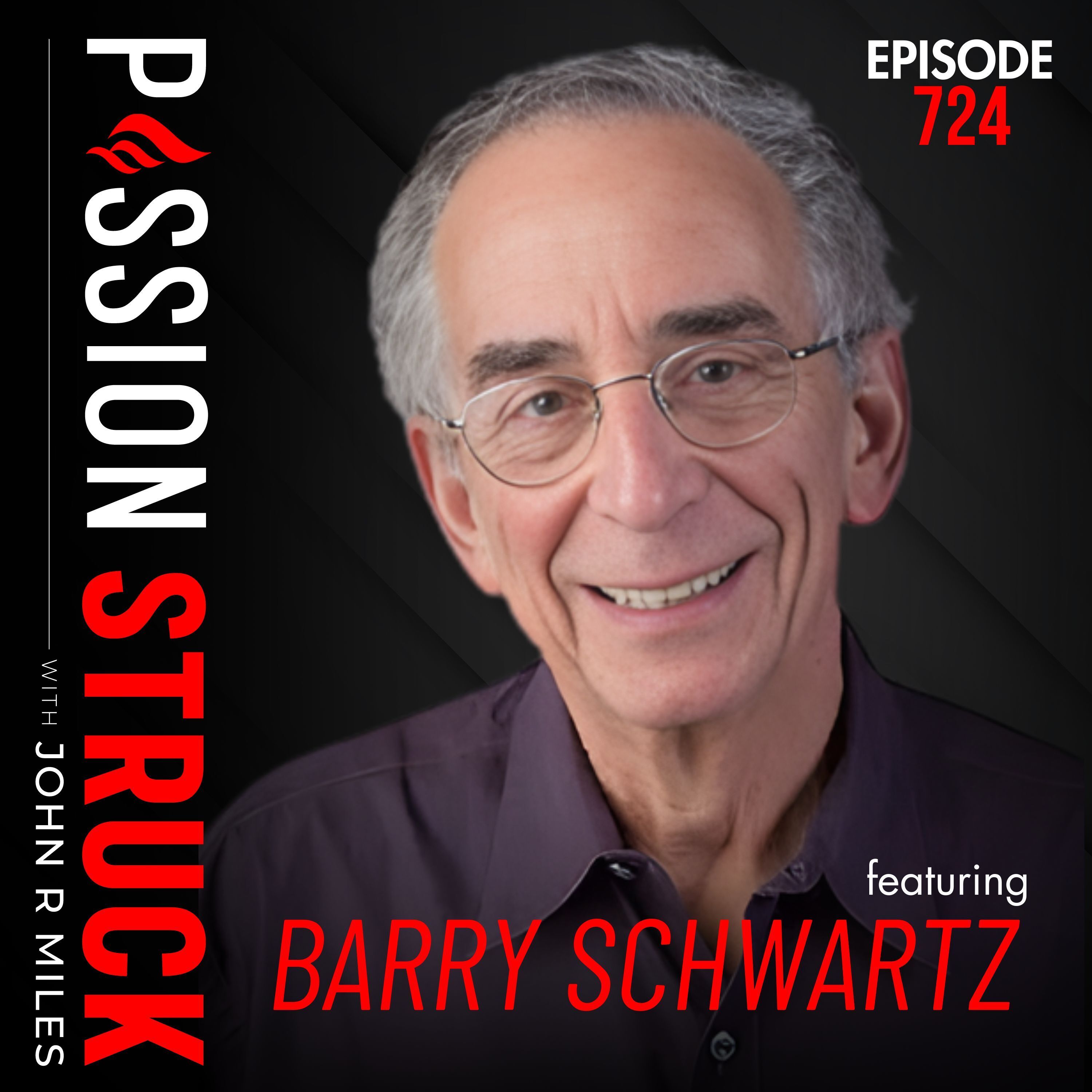
Passion Struck with John R. Miles
Why Choosing Wisely Shapes Agency, Meaning, and Mattering |Barry Schwartz - 724
01:13:26
Loading summary
Transcript98 lines
- [00:00]
John Miles
Coming up next on Passion Struck.
- [00:02]
Barry Schwartz
What we're trying to suggest in the book is that it's important to think of our lives as ongoing narratives, that there's a trajectory to life, that it isn't simply about attaining one pleasurable moment of experience followed by another pleasurable moment of experience with no particular connection between them. That is to say, life needs to have meaning. There are different ways that people can get meaning out of life, and in a pluralistic society like ours, you certainly see that.
- [00:43]
John Miles
Welcome to Passion Struck. I'm your host, John Miles. This is the show where we explore the art of human flourishing and what it truly means to live like it matters. Each week I sit down with change makers, creators, scientists and everyday heroes to decode the human experience and uncover the tools that help us lead with meaning, heal what hurts, and pursue the fullest expression of who we're capable of becoming. Whether you're designing your future, developing as a leader, or seeking deeper alignment in your life, this show is your invitation to grow with purpose and act with intention. Because the secret to a life of deep purpose, connection and impact is choosing to live like you matter. Hey, friends, and welcome Back to episode 724 of Passion Struck. Last week we closed out our Meaning Makers series with two powerful conversations. On Thursday, I was joined by investigative journalist Charles Piller, examining truth, integrity and institutional failure. And on Tuesday, I sat down with New York Times bestselling author Jim Murphy, exploring inner excellence and the unseen foundations of extraordinary performance. Together, those conversations ask a hard question. What happens when the systems we trust stop serving human significance? Today, we begin a new series called you'd Matter, an exploration of what it actually means to feel feel significant in our modern world that measures, ranks, optimizes and replaces. This series is about mattering, and we explore it as lived experience. Do our choices register? Does our presence count? And how do modern systems quietly drain us to doubt that it does? This conversation is especially timely as we lead towards the launch of my upcoming children's book, you, matter Luma, on February 24. A story designed to plant the truth of intrinsic worth early before the world teaches kids to confuse value with performance. But today's episode is not about children. It's about choice, agency and regret, and how the sheer abundance of options can erode meaning rather than expand it. My guest today is Barry Schwartz, one of the most influential social psychologists of our time and the author of the Paradox of Choice and his new book, Choose Wisely. Barry's work exposed something most of us feel but rarely name, that most Freedom does not always lead to better lives. That endless choice can exhaust us, and that when every decision is framed as optimization, we slowly lose authorship over our own lives. In this episode, we explore why too many options can undermine agency instead of empowering it how modern systems replace judgment with metrics and what that costs us the difference between satisfaction and meaning why regret has become a defining emotional pattern of modern life and how reclaiming mattering requires limits, commitment, and discernment. Before we begin, a quick if you'd like to watch these episodes in addition to listening to them, you can join us on our YouTube channels at John R. Miles and Passion Struck Clips now let's begin the you Matter series with renowned psychologist Barry Schwartz. Thank you for choosing Passion Struck and choosing me to be your host and guide on your journey to creating an intentional life. Now let that journey begin.
- [04:19]
Podcast Host/Interviewer
It is truly an honor today to welcome Barry Schwartz to Passion Struck. Barry, how are you today?
- [04:25]
Barry Schwartz
I'm great, John, and it's a pleasure to be with you.
- [04:29]
Podcast Host/Interviewer
As I had told you a little bit about me leading up to this interview, I have really been immersed in the study of the science and mattering for over seven years now, and I am currently in the final stages of doing my final edits for a book I have coming out called the Mattering Effect. And I was actually speaking with Rebecca Goldstein, who has an amazing book herself, the Mattering Instinct, which I would encourage our leaders to really read. She was telling me about her own fantastic work on the topic, and then she reminded me of a meeting that you had in 2019 with David Yadin, Marty Seligman, and a number of other colleagues that I'm calling the Dream Team. In the paper that came out of that meeting, you define mattering as an action oriented, context dependent construct, something that effectively functions as a successor to action. My question is this. In my own research on mattering, I have identified something I'm calling the High Performance Trap. Where so many leaders today, high achievers, treat life like it's a spreadsheet of isolated wins. If mattering requires us to see the impact of our actions, does this isolated win mentality specifically blind us to the impact that creates a sense of mattering?
- [06:00]
Barry Schwartz
Well, it certainly can. It doesn't necessarily have to. But isolated wins are just that. And lives have trajectories and you, you do things that have effects on other people that continue into the future, and you may not be mindful of the longer term effects of your actions. So if you tend to think of life as a spreadsheet and you enter your assets and liabilities in the cells of the spreadsheet and at this moment in time, and at that moment in time, and then you just add them up. You lose the ramifications of things that you do because you're treating every moment in life as an isolated moment. Now the virtue of doing that, if you want to have a science of something, is that it can be analytically precise. And that's a good thing. Physics has taught us. The drawback is that it may be that you are getting an analytically precise measure of something that's the wrong thing to measure. And that's my worry. And the book that I just came out with is a critique of rational choice theory, which comes from economics for precisely that reason. It, it atomizes and tries to quantify the things we value. And in that way it distorts, I think, the kinds of issues we think about when we have decisions to make.
- [07:32]
Podcast Host/Interviewer
And the book you're referencing, which we're going to discuss in a little bit, is titled Choose Wisely, Rationality, Ethics and the Art of Decision Making, which you.
- [07:41]
John Miles
Co wrote with the philosopher.
- [07:43]
Barry Schwartz
I did.
- [07:45]
Podcast Host/Interviewer
So I love the combination.
- [07:47]
Barry Schwartz
Well, so do I. And I met him in my very first year at Swarthmore College in 1971, and we have been the closest of friends ever since. We've taught together, we've worked together, we haven't written much together because he tends not to write, because he can see what's wrong with every idea he has before he finishes writing about it. I have lower standards, so I publish. So we published a paper together in 1978 and this book is the next paper, the next thing we publish together. So we have a long and wonderful history. And he taught me a lot. I taught him a little.
- [08:30]
Podcast Host/Interviewer
I love it. Well, getting back to this topic of mattering, before we dive into the book, this group of people who met at that meeting came up with something called the Organizational Mattering Scale, which makes a really brilliant distinction between two Greek concepts of achievement and recognition. In a high stakes environment. I see people drowning in recognition. Kleios. They have the renown, the titles, the broad, the board seats, whatever, but they have no internal sense of arete. Why do you think this is happening? And does it have something to do with self efficacy?
- [09:13]
Barry Schwartz
Well, my take on this, which I agree with your assessment of the situation, but I think there's enormous pressure to externalize consequences of our actions and our plans and to externalize them on a dimension that can be quantified. We live in a market driven Society and the standards of measurement and achievement are so colored by what markets value that it's very hard to avoid putting what you do in that, inside that framework. And the problem with doing that is that it leaves, I would say, the most important stuff out. But you can certainly see it. You can see it. I spent my whole life in educational institutions and over the half century there's been more and more effort to make quantitative and precise what our expectations are of students and what their performance is. As if you could capture the sort of qualities of mind of a student with a single letter. Now we have to give grades. I understand their practicalities, those. The problem comes when we reify the grades that we give. And they think that the grade actually is a complete representation of the mind and the work of the student who got that grade. So I think the pressure to think about life in that way is very. Is pervasive and powerful. And we don't even realize often that when we do that we're distorting what we should be thinking about and what we should be aspiring to. So I'm not surprised that it happens. And you almost have to live in a monastery to avoid being influenced by the sort of ideology of the market.
- [11:17]
Podcast Host/Interviewer
It's really interesting that you bring this up and I'm going to ask one more question on it. But for many of our listeners, they are probably too young to explain, have lived through the Vietnam War and I was too young to live through it. But I went to the Naval Academy and we studied it heavily. And I had a rare, extremely liberal teacher when I was there who taught a course examining the war through motion pictures. And he actually used to bring up Robert McNamara a lot because he would call it McNamara's War and Robert McNamara. And I'm going to let you tell the audience about this because you reference him a lot and you use him as the ultimate warning of what happens when we try to manage complex human systems through math based results alone. And I'm going to let you tee that up here in a second. But the reason I'm bringing this up is I was researching the book, I interviewed Jamil Zaki and what you were just talking about with students. He brought this vision to me that what we're doing with mattering now is we're making it into a marketplace. These businesses are making it into a marketplace of mattering where they're using math based algorithms to really govern our lives. So I was hoping maybe you could take this Robert McNamara and what Jamil said and maybe expand on it.
- [12:47]
Barry Schwartz
Be happy to. The story that we tell in the book, first of all, listeners should know that McNamara came to the Department of Defense after a distinguished career running Ford Motor Company. And so he really had this very analytic turn of mind, and the notion that your job was to take the fog of war and remove the fog so that things could be reasonably, precisely measured and could lead to effective strategies which could then be reasonably, precisely evaluated. So that was his approach. And one of the many problems with the Vietnam War was that it wasn't obvious that we were winning, which seems bizarre given the United States and the opposition, the asymmetry. And it was becoming increasingly unpopular with the public, very unpopular. And the political side of the question of how to fight the war included the question, how do we get popular support for what we're doing? So the question that arose was, well, how can we? What would matter to people? And the conclusion was, if people saw that we were winning, they would be less upset that we're fighting. So then the question became, how can we show people that we're winning? And again, for listeners who are too young, this was one of the first of what has come to be called asymmetric wars. We have this massive army with massive artillery, and we're fighting in a jungle against ragtag bands of opposition. So it really wasn't at all obvious at any given moment who was winning, because the metrics weren't clear. They decided a pretty good proxy for the question who's winning Is who's losing? More people. In other words, body counts became the measure of who was winning and who was losing. Now, we could have a long conversation about whether body counts are actually capturing what matters, but that isn't really the point of the example. The point of the example is that once they decided that was what they were going to focus on, they changed the way they fought because the objective became maximizing enemy casualties. So instead of using that as a metric for assessing how the war is going, it became the metric for how the war is going. And it isn't necessarily true that strategies that maximize casualties are also going to be the same strategies that maximize your advantage. So because of this need to quantify and to be able to point to something as an indication that we were on the right track and that we were making progress, the whole framework, excuse me, the whole framework within which strategic decisions were made got completely distorted, and thousands of people died needlessly. So this is a case where rationalizing what you do, that is being able to quantify it precisely, really distorted the objectives and all of that got lost in the public conversation. So it didn't even. It didn't seem as though it was being distorted, but it was. And we take this as a kind of vivid and very consequential example of what can happen when you're focusing on the wrong things. And we think that again, the sort of framework of market calculation pushes us to focus on the wrong things.
- [16:57]
Podcast Host/Interviewer
I'm going to extrapolate this on a second, but to me, when I hear this story, it's almost as asinine. In World War I, where the forces were doing trench warfare, hundreds of thousands of people lose their lives trying to gain inches of territory. It's ridiculous when you think about it.
- [17:18]
Barry Schwartz
Yeah. There's a wonderful book, by the way, that I'm rereading by the novelist Pat Barker called Regeneration. And it's set in a psychiatric hospital during World War I. And this psychiatrist is treating people who are. Have been psychologically shattered by their participation in the war, including a couple of poets. And if people want a vivid reminder that war is hell, it's a wonderful book to read.
- [17:53]
Podcast Host/Interviewer
Thank you for sharing that. I just wanted to make this analogy really real to people. I spent most of my life after I got out of the military as a business executive. Executive working for companies like Dell and Lowe's in the C suite. And when I look at what McNamara was doing in Vietnam, it's what major corporations throughout the world have been doing for the past three decades. So we measure everything based on shareholder value, customer success metrics, things like that. And then we wonder why 70% of the workforce worldwide billion people are disengaged. It's because we're treating them as body counts instead of bodies. And that's really what I try to bring forth in the book is what's happening to so many people today and why it's leading to hopelessness, loneliness, burnout, all these different conditions that are now becoming chronic epidemics globally.
- [18:58]
Barry Schwartz
I couldn't agree with you more. The paper that I wrote with Richard Shulden Fry 50 years ago was essentially that argument applied to factory work, where in effect the people working were regarded as interchangeable parts in the same way that the equipment was. And the idea was to create jobs that were so low skilled that if somebody left, that person could be replaced instantly by someone else. And the underlying assumption is the only reason people work is to get paid. And as long as we pay them okay, they won't care what they do. So why don't we make what they do as horrible, boring, monotonous and repetitive as possible and they won't care because they're getting a paycheck. So this argument was that we had what this process did was turn work into something where there was no opportunity for satisfaction except for the paycheck because everything else had been removed. And that's what you're describing. And in those days our focus was on the blue collar. But the same process has continued to occur and it is now operating in the white collar workforce as well. Which is, as you say, why so many people, they're looking for the next job the day after they start the current one, because it's clear they're not going to get any needs or desires satisfied except for a good sized paycheck.
- [20:33]
Podcast Host/Interviewer
I remember my time at Dell, which I talk about the most. I was working 100 hour weeks, traveling globally two weeks out of the month, barely seeing my family, and no one cared. No one ever asked if you're doing okay. They're just, they care. Are the projects running on time? Are we making the money we should? Is the budget right? And then when you're not doing that, all I was dealing with was HR issues from people.
- [21:02]
Barry Schwartz
And it's even worse than that because even if people asked you if you were doing all right, you might ask yourself, why are they asking me that? And my sense is that the reason they're asking you that is that they want to make sure you remain productive. They don't really care about whether you're doing all right, but their assumption is that if you're not, it'll show up in your productivity. So they want to keep you happy enough that you remain productive enough for them to see value in continuing to employ you. So even when they ask the question, they're almost certainly asking it with the wrong intentions.
- [21:39]
John Miles
Before we continue, I want to pause for a moment. Conversations like this can feel quietly disorienting when the sheer number of choices we face is questioned. Our instinct is either to optimize harder or to disengage altogether. But mattering isn't built through optimization. It's built through discernment inside the ignited life. Each episode in the youe Matter series is paired with guided reflection prompts designed to help you reclaim judgment without collapsing into paralysis or regret. This week's prompts focus on recognizing when choice has turned into pressure, identifying where optimization has replaced authorship, and clarifying what it means to choose an alignment with what actually matters. You can Explore them@theignitedlife.net Now a quick break for our sponsors. Thank you for supporting those who support the show. You're listening to passionstruck on the Passion Struck Network. Now back to my conversation with Barry Schwartz.
- [22:37]
Podcast Host/Interviewer
I couldn't agree more with you. Well, in Choose Wisely, you argue that an ideally meaningful life is one of organic utility rather than a mere list of accumulated experiences or, as you say in the book, rocks in a Basket. I want to back up here for a second because. Because most of the listeners are probably going to not have any clue what organic unity means. But I was hoping that you could explain this.
- [23:05]
Barry Schwartz
I'll try. What we're trying to suggest in the book is that it's important to think of our lives as ongoing narratives, that there's a trajectory to life, that it isn't simply about attaining one pleasurable moment of experience followed by another pleasurable moment of experience with no particular connection between them. That is to say, life needs to have meaning. There are different ways that people can get meaning out of life, and in a pluralistic society like ours, you certainly see that. So we're not trying to tell people what they ought to think of as meaningful. What we are suggesting is that people ought to be thinking that in living their lives, they should be aspiring to meaningfulness, which I think is a very close cousin to mattering. Meaningful means that what you do matters. What you do makes a difference. It can make a difference to the world. It can make a difference to the people who are close to you. It can make a difference to our collective knowledge about how the world works. There are different ways that it can make a difference. But you want somehow to have some confidence that the world will show that you once lived in some way. For most of us, I think a lot of that aspiration is reflected in family, because more of us can hope that our legacy will be embodied in the continuing members of the family. Fewer of us can delude ourselves into thinking that we're actually going to change the world for, even for strangers, or change in a fundamental way how we understand the world. But everybody, almost everybody, can see that their life will matter in the way it's manifest in the lives of people who are close to them going forward. And the argument in the book is that the framework that we use, that we are encouraged to use, that has the honorific designation rational, is one that focuses not on life as a narrative, life as a trajectory, but instead on moment by moment, wins and losses, each of which can be quantified, each of which can be quantified on a single scale, a utility scale. Say, how much utility did this last week of work bring me. And then you can say, well, I got the utility from my paycheck. I got utility from my interactions with clients. I got utility from my interactions with coworkers. Add it all up and you get an answer to the question, how much utility was this week providing me? That's way too narrow of framework for assessing a life. It's way too narrow a framework to use for making decisions that may have long term consequences for you and others. Yet it's the framework that we are encouraged to use and rewarded for using in the society that we live in. So this book is an attempt to. To suggest to people that it is leaving almost all the important stuff out to think about your life in that way. And one reason why I was so impressed with Rebecca Goldstein's book is that sort of is the point of the book. And I'm eager to see yours when it's done as well.
- [26:52]
Podcast Host/Interviewer
Thank you, Barry. And I'm going to try to break this to the listeners in the way they can understand it is when I think about rational choice theory, you're basically treating people as interchangeable units of maximizing behavior. So in many ways, when I think of the modern crisis of burnout, it's actually a crisis of replaceability. Is that a way to think about it?
- [27:21]
Barry Schwartz
Well, I think it is. There is a certain sense, again, to use the term you like mattering, the more replaceable you are, the less you matter. What it means to matter is that you can give an answer to the question, what is my unique contribution to the world if you're just an interchangeable part? The answer to that question is almost certainly that your contribution is essentially nothing. And the attraction of homogenizing people in this way is that it can make the enterprise that you're a part of more efficient. You pull out one transistor that stops working and you replace it with another one, instead of inquiring as to what went wrong with this transistor. So you pull out one person who's underperforming and you replace that person with another one. So the efficiency, the drive to be efficient and thus more profitable is what encourages us to treat people as interchangeable parts with no aspirations, no trajectories, no important personal identity. And I think people who manage other people know that's not what these people they're managing are. But from their point of view, the only thing that matters is the aspect of the person that is going to be manifest in the work that person does inside the workplace. And, and yes, that leads to burnout. Now it should be said that you can also burn out because everything matters too much. I love the idea that I can take my work home with me. On the other hand, when you can take your work home with you, what's to stop you from simply working every waking moment of every day and letting that crowd out other aspects of your life that are important? You have to find a way to make maintain balance. If your supervisors aren't putting pressure on you to put in 100 hour weeks, you can put pressure on yourself to put in 100 hour weeks. So you get burnout from feeling like you don't matter, and you get burnout from caring so much that you can't let it rest and you can't make the work you do just part of a full life rather than all of it.
- [29:44]
Podcast Host/Interviewer
Barry, my wife is going to be listening to this and saying, as I've been working on this book, what you're saying is exactly what's been happening to me. I work from home. And when you have a deadline, it is so easy to walk down the hall and focus on the task at hand.
- [29:59]
Barry Schwartz
I spent my whole career that way and it is easy. The nice thing about having little kids running around is that they'd simply demand they stop doing what you're doing. But when the little kids get bigger, it's really entirely in your hands how much you can maintain balance in your life. And we depend in the Choose Wisely book on the framework that Aristotle created 3,000 years ago. And for him, really it was about balance because of the many virtues that you wanted to cultivate in people. All of them were important and sometimes they were in conflict. And so what you needed to be a good person from Aristotle's point of view is all of the virtues, all of the attributes that he regarded as virtues in the right balance and deployed at the right time. And so you could be the smartest person in the world and be a monster, because the virtue of intellectual power simply overshadowed everything else. And you can't live a life just because you have the biggest head in the room. Life demands more of us than that. So for him, balance, finding the right amount, finding the mean, he called it, is at the heart of what he called Euday monia, which Marty Seligman translates as real happiness, authentic happiness.
- [31:34]
Podcast Host/Interviewer
So I've become pretty active on Substack. I think it's a great way to practice writing, which I love to do, but also get ideas out there. And I recently did a post that I called the Architecture of Significance.
- [31:49]
John Miles
And what I was trying to do.
- [31:52]
Podcast Host/Interviewer
And I think it relates well to your book is I said that so many people today are trying to be build an architecture of success. And if you look at the ancient builders, people who were building the great cathedrals, the pyramids, Great Wall of China, most of the people who were working on these projects knew going in that they were never going to be alive to see the fruits of their labor. But they treated it as a legacy that they were passing down to their offspring. And what I think people are doing today is we are trying to build that cathedral in our lifetime. So we want to come up with the strategy, we want all the accolades. We want this living monument to ourselves, something that I call we become a vanquisher. And what I'm arguing is that a monument. Let's just take the national monument in D.C. it's great to look at from the outside, but you surely can't live in. Doesn't really provide a lot for you. And what I am suggesting is that people need to form their lives. As an architect of significance, where when you start looking at the foundation, the windows, the pilings, the roof, it should be something that becomes more like an orchestrator or something I'll call a creative amplifier, where what you're trying to do in your life is to amplify the benefits to the rest of society so that what you're creating is something that leaves a much longer legacy of good goodness, something I think Dacher Keltner, who we talked about, mentions as moral beauty to humanity. Yet I think society rewards us for being the architect of success, especially on social media, things like that. What do you think of that analogy?
- [33:44]
Barry Schwartz
I think you're right, but what I would want to emphasize is it takes a certain. A certain set of beliefs or faith that the future is going to be like the present in some relevant way. To work on a cathedral, knowing that not only will you not live to see it finished, but neither will your kids. You need confidence that eventually it will be finished. And that confidence comes partly from a sense of continuity in the society you live in. And what has happened in modern societies is that the time units that matter have really gotten smaller and smaller. There's no reason for us to have confidence that our grandchildren's world will be anything like our world world. And if that's true, then all of a sudden your time horizons shrink. If I'm embarking on a project that's going to take three or four generations to complete, why believe that the third generation is going to care about this project that Change has really happened. A moment was a lot longer two centuries ago than it is now. And that even if your boss isn't pushing you to have a very narrow window of concern, the world is pushing you to have a very narrow window of concern. And that really is going to take a lot of the potential meaning out of projects and can and shrink our aspirations. The reason we want to leave a monument is that we don't have any confidence that the world will care about what we did to 20 years from now. And if you're a scientist doing relatively trivial experiments in the hope that every experiment you do is adding a brick and eventually you'll have a wall, and eventually that wall will become part of a cathedral, then you can really be content with the modest contributions that you're making, because without those contributions, there would never be a cathedral. But when you stop being so sure that there is a cathedral in the future, well then what you're doing day to day looms much larger than the ultimate contribution, the ultimate result that you've made a modest contribution to. And it's really hard to criticize people for being short term in their thinking, because society has become short term in its thinking and we're to some degree, we're victims of that. So I think your fingers on the problem, but I don't think it's fixable simply by changing attitudes of individual people.
- [36:37]
Podcast Host/Interviewer
Recently been reading, I think it's Nexus. And the book is all about the propagation of information and how much it is sped up over time. And it's really interesting to me because when you look at the evolution of the printing press and you just look at religion up into the printing press, you take something like the Bible, they had to be handwritten. And so in a given year, maybe you had 150, 200 of them, if you were lucky, replicated. All of a sudden now you can have 10,000 of them replicated. And so it gets distributed. Well, now that we're in the information age, it's like something happens in Jakarta and we hear about it in the United States 30 seconds later. Yep.
- [37:27]
Barry Schwartz
And not only do we hear about it in the United States, everybody in the world hears about it 30 seconds later. That's right. But think about that. Think about having a job as a scribe where it might take you a year to produce a Bible. Why would anyone do that in a world that feels incredibly temporary? You need to have some confidence that people are going to care about this book in order for you to devote a year of your life to producing it. So that. So copying a book was almost as much work as writing it. So I must say, when I wrote this last book, I was asking myself, does it still make sense to write books in the world we're currently living in? Will anyone read something as 250 pages long? It's like reading War and Peace. And. And it's a little defeating to think that the time, the rhythm of life has changed so much that it seems like an impossible burden on people to ask them to read a book, not to mention writing it.
- [38:48]
Podcast Host/Interviewer
Well, Barry, I spent the time to read yours, and it's interesting. I read probably 100 to 125 books a year because as an author myself on this podcast, I feel like I'm doing a disservice to a person I'm bringing on if I don't know the subject matter at least. And I will be honest to say that there's some books that pique my interest more than others, and I read more carefully. When I released my first book, I went on about 80 podcasts, and I think out of the 80, maybe three people read the book. So it goes to what you said. But I think your book is a fantastic book, and it gave me so many ideas, as did that research at Uncle Seligman and others did. And Rebecca in 2019.
- [39:33]
Barry Schwartz
But let me just say something about that research, because it's an interesting lesson in the problems of taking a scientific, quantitative approach. So the paper is about mattering, which is a vague concept, and it tries to come up with tools for making it more precise and measurable, since if you want to do study it scientifically, you need to be. The thing you're studying needs to somehow be measurable, quantifiable, and people can agree that what you say you measured is what you've actually measured. There's a certain respect in which that was very premature, because figuring out whether your quantified assessment of mattering is what's needed requires that you have a pretty good understanding of what mattering means. So there's a lot of conceptual work that needed to be done before you rolled up your sleeves and figured out how to study it scientifically. And we, in that meeting, put the cart before the horse by trying to quantify something before we fully understood what that something was. And of course, one of the things we know about human beings is that they're very impressed with quantitative evidence because it seems so solid and scientific. So once you've quantified something, it dominates the conversation. The quantification dominates the conversation, and the Subtleties about figuring out what mattering means, which I presume will be in your book and I know are in Rebecca's. Those sorts of discussions don't happen because the focus is so much on how can we measure it. So I had my reservations about the whole project as we were working on it because I thought maybe it would be a good project to do. After we spent a year talking about what mattering meant, which we didn't do.
- [41:42]
Podcast Host/Interviewer
It made me think of the discussion I had with David Yadin, who was one of the people who was in the room with you. And what David is doing now is really interesting because he's studying psychological states at Johns Hopkins by examining people who are on mind altering substances. One of the things he is trying to do is to look into the eye of someone to understand what this mattering state looks like. So you are right. I think that's one of the reasons it's a difficult topic because it hasn't been nearly studied as much as people think it has.
- [42:21]
Barry Schwartz
No, it's one of these things where I can't tell you exactly what I can't tell you, give you a precise definition, but I know what I mean. Concepts like that enable us to get through the day. There are lots and lots of things that we have imprecise or only semi precise definitions of that we don't all mean the same thing by, but we mean enough the same thing that we can actually have a conversation about them. And insisting that everyone means exactly the same thing is not always the best strategy because it stops you from working out what that concept should mean. And I don't think Rebecca is the last word on what mattering should mean. And I'm suspecting that your book won't either be but as efforts are made to try to get as clear as we can about what it is and why it's important, over time you would imagine that an understanding will develop and be refined and we will make a fair amount of progress in taking a vague term term and making it much less vague. But you shouldn't start with precise definitions, you should end with precise definitions.
- [43:40]
Podcast Host/Interviewer
I couldn't agree with you more.
- [43:43]
Barry Schwartz
We have to disagree about something.
- [43:47]
John Miles
Well, let's talk about something that you.
- [43:49]
Podcast Host/Interviewer
And I both care about. So I live here in Tampa Bay and throughout most of the year we wear shorts here because it is so warm. But I grew up in Pennsylvania, in Lancaster, and not too far from where you taught for all those years. And I have always loved wearing blue jeans. In fact, I always love environments where I get to wear blue jeans. And I understand you love blue jeans as well.
- [44:15]
Barry Schwartz
I do.
- [44:16]
Podcast Host/Interviewer
And I have several sponsors of the podcast who sells blue jeans.
- [44:21]
John Miles
And one of the most frustrating things for me is there are like a.
- [44:25]
Podcast Host/Interviewer
Million different types of blue jeans out there on the market. How does this whole topic of blue jeans relate to your book?
- [44:32]
Barry Schwartz
So this is my claim to fame. I wrote a book 20 years ago. I am now with a former student writing a revision of it because the world has changed so much in the 20 years since the book came out. The book's called the Paradox of Choice. And the central argument in the book is that we all believe, correctly, that being able to make choices is essential to well being. It's what enables us to live the kind of life we want. It's what enables us to feel autonomy and control over our lives. It's good. And we all know that the point of the book is simply to illustrate, to show that yes, choice is good, but it isn't only good. And when there's too much of it, instead of liberating people, it can paralyze them. In addition to paralyzing them, it can lead them to make poor decisions. In addition to that, it can lead them to be dissatisfied even when they make good decisions. And so the book lays out why it is that there can be too much of a good thing. In this case, the good thing being freedom of choice. And the book begins with my trip to buy a new pair of jeans at the Gap, which is where I used to buy my jeans. And I walked in and I told the clerk my size. And normally buying jeans took five minutes. And the clerk said, you want slim fit, easy fit or relaxed fit? Do you want button fly or zipper fly? Do you want boot cut or taper? Do you want slim or regular? You want acid washed or stonewashed? On and on the options went. And she said, and I said, I want the kind that used to be the only kind. But of course they didn't make that kind anymore. And you and understand this is in a place that only sells Gap jeans, right? So it's not like there was an infinite set of possibilities, but compared to what I was used to, there was effectively an infinite set of possibilities. And I tried all the different styles on and I walked out with the best fitting jeans I'd ever purchased. I did better and I felt worse. And it wasn't because I spent so much time buying jeans. It was because as I was trying all these pairs on, I came to the view that one there had to be one style that was going to be perfect. If they made them so many different styles, one would be perfect. And what I got was good, but it wasn't perfect. So I felt my standard had gone up. And because my standard had gone up, I felt like the decision I made hadn't met that standard. And that never used to be a problem. When I bought jeans, they fit however they fit, and I walked out with them and. And went on with my life. So that's what led me to write the book. I'm happy to say that in the 25 years or so since I started writing the book, there's been hundreds of studies done on this problem of choice overload. And none of the arguments in the book require modification. It has stood up. The only thing that requires modification is that what I regarded as an unmanageable amount of choice seems trivially small in comparison to options that people face in the digital world. The Gap had eight styles. Now you go to Amazon and you find 80,000. How do you choose a pair of jeans from 80,000 possibilities? That's my claim to fame.
- [48:18]
Podcast Host/Interviewer
During the holidays, my. My wife was shopping for jeans and she likes to get them at the White House black market. And the same thing happened. I happened to be there at the store with her, and they have this picture that has all these jeans on it. And I think they should put the same model wearing all the jeans so you can see how they all fit. But they don't do that.
- [48:36]
John Miles
But there were like 12 different ones.
- [48:38]
Podcast Host/Interviewer
I'm like, how do you pick it? But certainly once you find the one that fits, that's the one you got to remember. But probably next year they're going to change it.
- [48:46]
Barry Schwartz
Not probably. Certainly next year they will change it. That's why one of the things that I have come to do when it comes to shopping is when I find something that really seems like this is the right thing, I buy three of three or four copies of it. So that when the one I bought wears out, I've got another one I can count on. Because I know that if I go back to the store, they won't have that kind of find anymore. So I now buy in bulk, hoping I live long enough to use all the things that I buy.
- [49:23]
Podcast Host/Interviewer
So much truth to that. Well, I'm excited to read the updated version of that book as well, which I have a copy of. But I recently interviewed Alex Amos, who helped Richard Thaler update the Winner's Curse. And I was happy to see that the Winner's Curse also lived up to the test of time, but they did significant re architecture to that book.
- [49:44]
Barry Schwartz
Well, we've done the same. The new book is going to have four chapters that are completely new stuff that wasn't discussed at all in the last editions because as I say, a lot of research has been done since that book came out. Happily, there are no sentences that say, 20 years ago I said this and it turns out this is wrong, so accept this. Instead, it's just things have developed and understanding has been refined over the 20 years. And it's gratifying in a way. Although it would have been more gratifying if somehow people read my book and decided their mission should be to simplify the world, which is not exactly what happened.
- [50:32]
John Miles
So one of the other things I.
- [50:34]
Podcast Host/Interviewer
Wanted to talk about was relationships. And in the book you talk about how transactional relationships are increasingly replacing deeper ones. And I think that this is one of the biggest issues that we're facing in today's world. And I want to relate this to another theory that Richard Ryan and Edward Deasy did, self determination theory, where one of their most important elements in that in addition to autonomy, et cetera, was connectedness. How do you think what's happening today is eroding aspects of self determination theory?
- [51:12]
Barry Schwartz
Well, here's my problem with their framework. Connectedness is very important, but connectedness implies constraint. The more connected you are to other people, the more the effects of your decisions will be reflected in them. And so if you are an island, then you can express your autonomy and self determination and do whatever you think is the right thing for you to do. And you don't have to worry so much about the consequences for other people because you're an island. The less of an island you are, the more connected you are. The more you have to consider the effects of your decisions on other people and be constrained by that. So there is a sense in which the desire for self determination and autonomy is in conflict with the desire for connectedness, because connectedness will inevitably reduce your autonomy and self determination and how you reconcile two really important aspirations. I want to be a free, autonomous agent. I want to be connected to other people is the problem of our times. In my view, these two things need to be kept in balance. There have been periods in history where connectedness to other people was so oppressive that you basically couldn't break out of the shackles that surrounded you when you came into the world. And people weren't able to live the kind of life they thought they should. And now we're living in a time that's just the reverse. You can do anything you want, but it doesn't seem like anything you want matters very much because it's just you. It's not you and the people who depend on you in one way or another. So figuring that out is really very challenging. And when you put so much emphasis on the self determination part, I think it's inevitable that you will neglect the connectedness part. And it's not accidental, which I assume is what you have in mind in asking this. That loneliness seems to be the problem of our age.
- [53:42]
Podcast Host/Interviewer
Exactly where I was going.
- [53:44]
Barry Schwartz
With eight and a half billion people on the planet, it's hard to imagine that loneliness is a problem. But here you are living in a city with 8 million people and you don't know anybody. You know, when you go into your apartment, you close the door. There's no one else there on Earth. It's just you. And that's not a healthy way to live.
- [54:07]
Podcast Host/Interviewer
Well, we think there are others because they're out there in social media or in our gaming universe, but it's such.
- [54:13]
Barry Schwartz
A superficial kind of relation to others that it's really not. It's not an adequate substitute for the kinds of entanglements that were a part of normal life in the past. What does it mean to say, I have 4,000 friends? What can that mean?
- [54:36]
Podcast Host/Interviewer
Or 2 million followers?
- [54:37]
Barry Schwartz
Or 2 million followers. I don't know what kind of a commitment Taylor Swift has to all of her followers, but I suspect it's not what DC and Ryan have in mind when they talk about connectedness.
- [54:50]
Podcast Host/Interviewer
She's actually a case study in making her fans feel seen and heard and valued. She is.
- [54:56]
Barry Schwartz
She does an amazing job of making everyone somehow feel like the most important person on Earth during her concerts. And it's a gift to do that, to be able to do that. So that's my problem with the DC and Ryan framework, that two really valuable things are push us in opposite direction, push us in different directions, and our job is to figure out, again, as Aristotle would say, the mean connected but not so connected that you're. That you're completely constrained. Constrained, but not so constrained. Free, but not so free that you're not willing to accept the constraints that other people impose on you.
- [55:43]
Podcast Host/Interviewer
Barry, one thing in the time we have left, I wanted to make sure we covered. Is that a core theme of your book is that no formula substitutes for judgment?
- [55:53]
Barry Schwartz
Correct.
- [55:56]
Podcast Host/Interviewer
Why is it that we don't use that judgment as often as we should?
- [56:04]
Barry Schwartz
Well, I think there are a couple of reasons for it. One is that judgment is not a great thing to depend on. If you don't have good judgment, you need good judgment, not just judgment. And in another book I wrote with a different colleague some years ago about wisdom, we made the argument that wisdom is learned, but it can't be taught. And what we meant by that is the way you develop good judgment is by using your judgment, paying attention to the results, and slowly developing better and better judgment as you learn more about the subtleties of the kinds of decisions that you have to make. So you don't. One reason that we rely on rules is that we don't trust the judgment of the people who are we are asking to follow the rules. That's one second. The thing about judgment is context matters, and every situation is in some ways unique. What that means is that the pattern of decisions we make may not be completely transparently coherent in the eyes of someone else in the age we currently live in. As soon as you promote one person but not another, you can almost count on being accused of bias. So the way we protect ourselves from those kinds of accusations is to turn the decision into one that can be made by formula. So when the person who doesn't get the promotion accuses you of bias, you can point to your spreadsheet and say, person A did this and this and you didn't do these things. Person that got promoted and you didn't get promoted. So you've got nice, clear, objective evidence that it was performance, measurable performance, and not judgment, not bias that led to your decision. And there's more and more pressure as a kind of insurance policy for organizations to demand that people in positions of decision making authority be able to have stuff they can point at that shows A, they treat everyone the same, and B, they actually have good reason for the decisions that they make. So this pushes people to develop rules, even if they know that the rules are really not up to the complexities of the situation. And the last thing I'll say is that relying on people to use their judgment requires that we trust people not only to have good judgment, but to have good intentions. It isn't enough that I think you can make hard decisions. Well, I have to also think that your aim in making decisions is a good aim. So do we trust the people we interact with, the people who supervise us, the people we supervise, the students we teach, the professors who teach us? Is there enough of a relationship of trust? Trust that we have the welfare of other people firmly in mind such that when I make a judgment call in dealing with A student. The student will trust that I might have made a mistake, but at least the student will trust that my aim was to serve the interests of that student as I saw them. We don't live in an environment where there's a general atmosphere of trust. Quite the opposite. We live in an environment where there's an atmosphere of deep suspicion. If you are suspicious of other people's intentions, if you are wary about the quality of other people's judgment, you're going to make a rule every chance you can to protect yourself from bad intentions and bad judgment. So that's why it's more of a problem now than it was. And in fairness to modern society, the more diverse society in is, the harder it is to use your judgment in a way that seems reasonable and fair to everyone. Because people come into a situation with such different perspectives that you almost feel obliged to wedge them into something more formulaic so that you can treat them all the same. We don't treat our children the same. I don't know how you raised your kids, but one of the things that having a second kid teaches you is that you thought you got it figured out with the first kid. Well, you were wrong, because the second kid needs a completely different set of operations on the part of the parents. Every kid isn't unique, but we get to know our kids well enough that we can actually make different decisions for Kid 2 than we did for Kid 1. We tend not to know our employees as well. I certainly don't know the 300 people who are in my introductory class well enough to tailor what I do to the particular needs of each student. Can't do it.
- [61:28]
Podcast Host/Interviewer
Throughout my career, as I would change jobs and go on interviews, I would have described myself back in the day as a servant leader. I now think that more of us need to be gardener leaders is a term I use. But when I would get the question that you always do in an interview session, people would ask, can you describe your leadership style? I would always say, it's situational. And people would just give me this look like, what the heck are you talking about? How can you do situational leadership? I'm like, a different situation determines how you're going to lead in it, right? Meaning we all have different personality types. So if I try to use a particular leadership type on every single employee I'm dealing with, especially a direct support, the way I motivate one person is completely different than the way you have to motivate someone else. And it's the same thing that you just said.
- [62:18]
Barry Schwartz
With no, absolutely. But then you open yourself up to being accused of being unfair, partisan, what have you the right answer to the question, what's your leadership style? My view the right answer to that question is it's situational. And instead of giving you a look of what the hell is he talking about? People should be nodding and say, ah, he understands that everybody is different. But instead you get these looks of how did you manage to rise so high in the organization with a leadership style like that? So we agree about this completely. And I don't think it's encouraged in the actual institutions that we operate in. It's actively discouraged.
- [63:01]
Podcast Host/Interviewer
I have this funny story. I was at Lowe's at the time time and they brought in Korn Ferry to evaluate all the leaders in the organization who were deemed to be high potential C suite executives. And I remember I'm talking to this organizational psychologist and she was one of the people I told about situational leadership and she references Marshall Goldsmith's book what got you here isn't going to get you where you need to be. And that's what she told me when I brought up situational leaders leadership. And I just sat there and shook my head. If you're evaluating our leadership and you as an organizational psychologist don't value situational leadership, man, we, we are doomed.
- [63:45]
Barry Schwartz
Yeah, but it's hard to publish journal articles about situational leadership because you can't have nice neat graphs measuring easily quantified variables.
- [63:57]
Podcast Host/Interviewer
That is the truth. Barry, a question I love to ask people as the last question on the show is what does it mean when you hear the words passion struck for you to live a passion struck life?
- [64:11]
Barry Schwartz
Well, if I were to use that phrase, what it would mean to me is figuring out somehow what your mission on earth should be. That is to say, what do I really want to spend my time and energy on and why. And passion struck, as a phrase suggests that this is something that happens to us like a bolt of lightning. And maybe sometimes it is that way, but it's also possible that it's something that we can discover with hard work. Thinking about what gets us excited, what we have the talent to make a contribution to, and so on. So it's less about being struck than it is about intelligently searching with the hope, with the goal of figuring out what the what. Where the passions lie, the thing that makes. And I think it's a wonderful thing to, to aspire to. When my kids were growing up, I tried without being too pushy, to encourage them to have very modest tastes with regard to material things.
- [65:31]
Podcast Host/Interviewer
And.
- [65:33]
Barry Schwartz
The reason was that I said this to them. I don't ever want you to, to take a job because you can't afford to live the life you want without it. I want you to take a job because you're excited about the job and not because of how well it pays. And that can be a huge sacrifice. And the more modest your tastes are, the less of a sacrifice it is to take the job that excites you rather than the job that, that compensates you well. And so I want you always to have the freedom to say no to the high paying job and yes to the lower paying job. And a good way to do that is to develop habits that are modest. And so there is, it seems to me that's a useful lesson for people to have in mind if you want to find something that you're passionate about. You also want to organize your life life so that you can actually pursue that thing. And sometimes we make day by day decisions that push us further and further away from pursuing our passion because these decisions we make put demands on us that only certain kinds of activities can satisfy those that. Those that pay well. One of my grandkids lives in Seattle. She's a young adult and she came to the conclusion about two years ago, sadly, that either she was going to spend her life doing work she hated and living in a place she loved, or doing work she loved, but living in a place she hated. In other words, she came to the view that there was simply no way she could live a life in Seattle, a very expensive place to live, and do the work that excited her, because the work that excited her wasn't going to pay her enough for her to live in Seattle. I think she was maybe a little too pessimistic, but certainly this kind of thinking is not unreasonable. We find ourselves in situations sometimes beyond our control where we have to abandon the passion, whatever it is, because it won't be possible to live a decent life in pursuit of that passion. And that's, that's really a sad thing. So that's what I take passion struck to mean. Was I approximately where you at in mine?
- [68:15]
John Miles
It's always interesting for me to hear.
- [68:17]
Podcast Host/Interviewer
Everyone else's thoughts on it. I have my own definition of it, but I think one of the best, best ones I was ever given is I had this gentleman who leads an MBA school at the Catholic University, and he had previously been a Swiss Guard for Pope John Paul ii. And Pope John Paul II used the exact phrase to him. This gentleman was completely at the time floating like Abraham Lincoln described himself like a piece of driftwood from side to side, not knowing where he needed to go, go in, in life. And the Pope said to him that what God wants for you is to become passion struck. He wants you to solve a problem that only he has given you the tools and superhuman talents to solve that benefits humanity for its betterment. And that's how the Pope described Ash. That, to me, is really what I hope people take from it, is that passion for some people comes as a lightning bolt. For others, it comes, as you said, we really have to struggle for what it. What it means to us. But once you find that problem, that only you can solve it, then is the relentless hope of mine that people start cultivating their lives around it.
- [69:35]
Barry Schwartz
Exactly.
- [69:36]
Podcast Host/Interviewer
If you live it like I was for so many years as a corporate executive executive, I was exhausting every bit of my life doing things that were counter to what was making me. Passion struck. And it was exhausting the life out of me.
- [69:50]
Barry Schwartz
Yep.
- [69:50]
Podcast Host/Interviewer
Because every single day I was pedaling on a treadmill farther and farther away of what was bringing me.
- [69:57]
Barry Schwartz
And that's exactly what my advice to my daughter when she was a teenager was meant to prevent happening. If your material tastes and expectations are modest, when you get smacked in the face by your passion, you'll be better able to pursue it than if your material tastes and aspirations are not modest. So whether you're waiting for the thunderbolt or you're looking for it, either way, it's nice to make sure that you have prepared your life so that when you find it, you'll actually be able to act on it.
- [70:35]
Podcast Host/Interviewer
Well, I just have to go to the study of Paul Waldinger is working on at the Harvard Adult Study of Aging.
- [70:42]
Barry Schwartz
Yeah. And they wrote a wonderful book. Yeah.
- [70:45]
Podcast Host/Interviewer
Good Life. The people who had the most money were definitely not the ones who were the happiest or most fulfilled. It was exactly the people that you have just described who were the most fulfilled in life. And isn't that what human flourishing is all about?
- [71:00]
Barry Schwartz
That's what I think.
- [71:02]
John Miles
Well, Barry, it was such an honor.
- [71:04]
Podcast Host/Interviewer
To have you here today. Thank you so much for joining us on Passion Struck.
- [71:08]
Barry Schwartz
It was great to be with you. You asked wonderful questions, and I learned a lot.
- [71:13]
John Miles
That brings us to the close of today's conversation with Barry Schwartz. If this episode stayed with you, it's because it touched something familiar. The quiet fatigue of too many options and the deeper exhaustion of never feeling settled inside your own choices. Here are three reflections I'm carrying forward. First, more choice does not equal more freedom. Second, agency requires limits. We don't become authors of our lives by optimizing everything, we do it by deciding what actually matters. And third, mattering grows through discernment. When we stop chasing the best possible option, we make room for significance to take risk. Root Barry reminds us that a meaningful life isn't built through constant comparison. It's built through presence, responsibility, and chosen constraint. If this conversation resonated, please consider sharing it with someone who feels stuck and indecision. Or leave a five star review on Apple Podcasts or Spotify. It's one of the most powerful ways.
- [72:10]
Podcast Host/Interviewer
To support the show.
- [72:11]
John Miles
If you'd like to continue the work we do here on the show, visit theignitedlife.net for episode reflections. Watch the full conversation on YouTube at John R. Miles or Passion struck clips or explore Intention Driven Apparel at Start Mattering.
- [72:24]
Podcast Host/Interviewer
Com.
- [72:24]
John Miles
Later this week we continue the you Matter series with Daniel Ellenberg, where we examine how expertise, authority, and modern performance culture shape who gets seen and who quietly disappears.
- [72:36]
Barry Schwartz
If the only way that you can matter in a way is to prove your masculinity, that's a very ineffective and vulnerable way of living and ironically that trying to hide vulnerabilities by proving masculinity. But it's ultimately and ironically the most exposed you can potentially be because improving masculinity, it can always be disproved. And a lot of guys live like that.
- [73:05]
John Miles
Until then, remember, you don't matter because you choose. Choose perfectly. You matter because you show up and stayed. I'm John Miles and you've been passion struck.