← Passion Struck with John R. Miles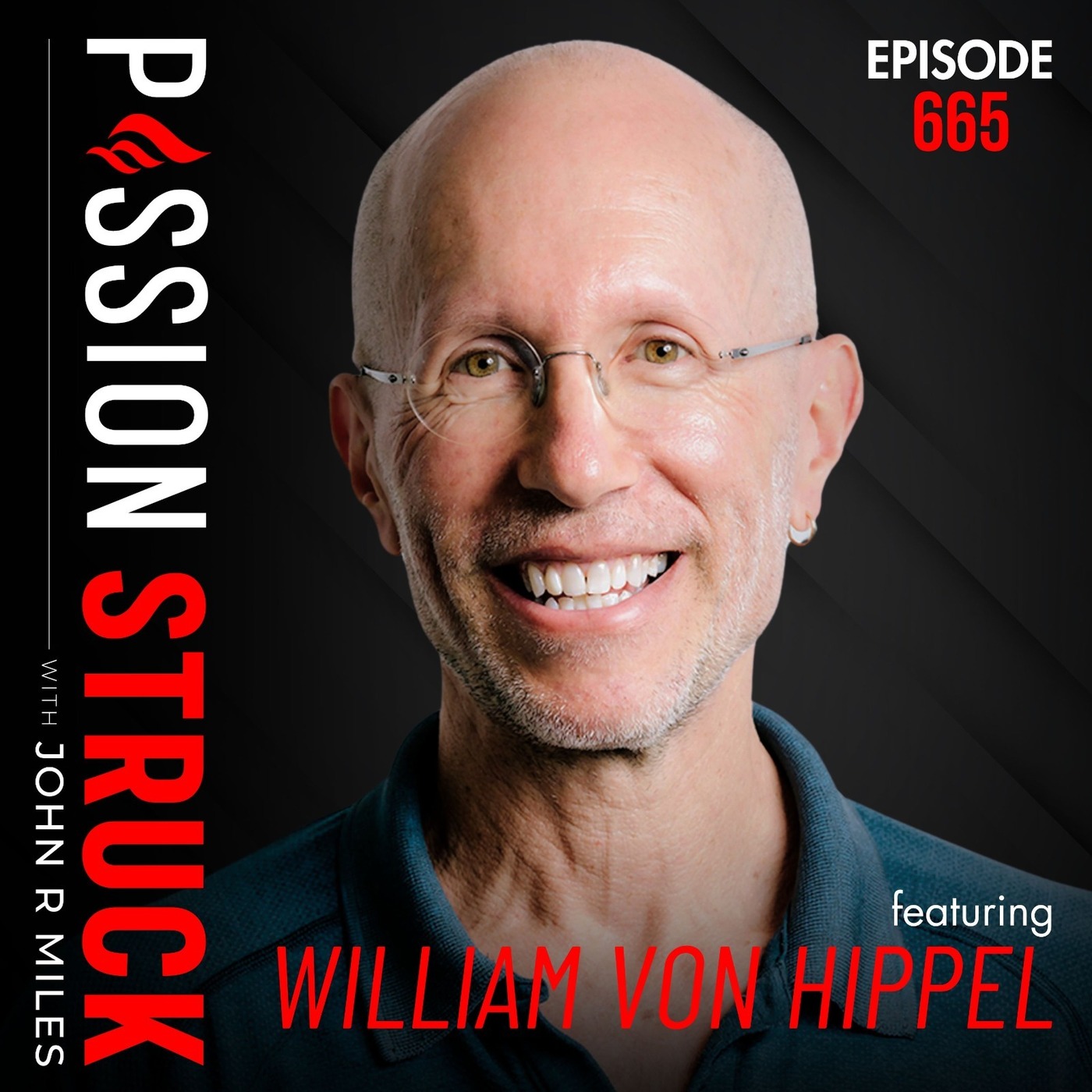
Passion Struck with John R. Miles
William von Hippel on The Social Paradox: Why Autonomy Can Make Us Lonely | EP 666
00:54:31
Loading summary
Transcript65 lines
- [00:01]
Audible Narrator
Audible's romance collection has something to satisfy every side of you when it comes to what kind of romance you're into. You don't have to choose just one fancy a dalliance with a duke or maybe a steamy billionaire. You could find a book boyfriend in the city and another one tearing it up on the hockey field. And if nothing on this earth satisfies, you can always find love in another realm. Discover modern rom coms from authors like Lily Chu and Ali Hazelwood, the latest romantasy series from Sarah J. Maas and Rebecca Yarros, plus Regency favorites like Bridgerton and Outlander, and of course, all the really steamy stuff. Your first great love story is free when you sign up for a free 30 day trial at audible.com wondery that's audible.com wondery Shopify's point of sale system.
- [00:46]
Shopify Representative
Helps you sell at every stage of your business. Need a fast and secure way to take payments in person? We've got you covered. How about card readers you can rely on anywhere you sell?
- [00:56]
Listener or Guest Commentator
Thanks.
- [00:57]
Shopify Representative
Have a good one. Yep, that too. Want one place to manage all your online and in person sales? That's kind of our thing. Wherever you sell. Businesses that grow grow with Shopify. Sign up for your $1 a month trial at shopify.com listen shopify.com listen Coming.
- [01:14]
Podcast Host or Producer
Up next on Passion Struck, it's a.
- [01:17]
William von Hippel
Problem that youngsters are using social media so heavily. What I'm worried about is that, as you say, if it's just the straw that broke the camel's back and if it's not the whole problem, people are going to expect big returns on these changes. And I think we're going to see small returns on these changes. I think they're going to make a difference. I think that there's a host of reasons why I think phones are bad ideas. In my book I talk about how we become lazy in our social habits because it's so easy to get on social media and so difficult to go across town to get together with our friends. But in fact, going across town to get together with their friends is the most important thing we can do. And we don't understand our own desires sometimes. And so we do the lazy, easy, less satisfying thing.
- [01:54]
John R. Miles
Welcome to Passion Struck. Hi, I'm your host, John R. Miles, and on the show we decipher the secrets, tips and guidance of the world's most inspiring people and turn their wisdom into practical advice for you and those around you. Our mission is to help you unlock the power of intentionality so that you can become the best version of yourself. If you're new to the show, I offer advice and answer listener questions on Fridays. We have long form interviews the rest of the week with guests ranging from from astronauts to authors, CEOs, creators, innovators, scientists, military leaders, visionaries and athletes. Now let's go out there and become passion struck.
- [02:37]
Podcast Host or Producer
Episode 665 of Passion Struck is here and I am so glad you've joined us. Whether you're a longtime listener or brand new welcome, over a third of you come back week after week, which tells me Passion Struck isn't just a podcast, it's becoming a global movement. Together, we are passing the ripple of mattering farther than we ever imagined. If this show has helped you see yourself more clearly or take one small step toward healing, here's how you can help keep it growing. First, share the episode with someone who needs to hear it. Second, leave a five star rating or review on Apple or Spotify. That small act tells the algorithm that these stories matter and helps more people find them. Lastly, I have some exciting news. I am working on something that will take Passion Struck beyond the podcast, giving you new ways to engage with these ideas, apply them and spread them into your communities. I'll share more in the coming weeks, so stay tuned. We are continuing week three of our Decoding Humanity series, talking about legacy, justice and the choices that define us. On Tuesday, we heard Cheryl McKessick Daniel share her extraordinary five generation family story, one that began in slavery and now builds the very infrastructure of America. Today we're looking even deeper, beyond individual lives and family legacies to the forces that shaped humanity itself. If you've ever asked yourself why do I crave connection even when I value independence? Why does loneliness feel so painful? And why do I sometimes feel invisible even when surrounded by people? Today's conversation is for you. Joining me is William von Hippel, evolutionary psychologist, professor at the University of Queensland and author of the Social Leap. Joining me is William von Hippel, evolutionary psychologist, professor at the University of Queensland and author of the books the Social Leap and the Social Paradox. His work explores how our ancestors survival depended not just on strength or intelligence, but on our ability to cooperate, connect and matter to one another. In our conversation, we explore how our evolutionary past wired us for connection long before autonomy was an option, why the tension between fitting in and standing out defines so much of our modern struggle, how loneliness acts like social pain and what it's really trying to tell us, and how understanding our deep social roots can help us become not just better individuals but. But better members of families, teams and communities. If you want to go deeper, you can download the free companion workbook and reflection prompts for this episode@theignitedlife.net our substack. Now let's explore the science of social evolution and why it holds the key to mattering with Professor William Von Hippel. Thank you for choosing Passion Struck and choosing me to be your host and guide on your journey to creating an intentional life.
- [05:29]
John R. Miles
Now let that journey begin. Have such an incredible honor today to have William Von Hippel on Passion Struck. Welcome, Bill. It's so great to see you here.
- [05:44]
William von Hippel
Thanks, John. Delighted to be here.
- [05:47]
John R. Miles
So you and I were talking a few minutes before you came on air. You're one of the few guests I get to talk to from across the world in Australia. I was hoping you might be able to start there. And how did you end up there? Because you've been living there for quite a while now.
- [06:02]
William von Hippel
Yeah, that's right. So I've been here 25 years now. About we, we came across on sabbatical in the late 90s. I was teaching at Ohio State University, and I love Ohio State. I love my job over there. But when I got to Australia, it was pretty magical. And so about two years later, I got an email from them saying, hey, we've got jobs, if you guys would like to come back. And it took me about a nanosecond to say yes. And so having remembered this beautiful life on sabbatical in Sydney, living in Coogee beach, actually. And so we, we moved across to Australia in August of 2001.
- [06:33]
John R. Miles
And I love my time there. And I think the defining thing for me is I spent most of my time in Sydney. To me, it was like some cross between San Diego and San Francisco with the best parts of each brought together because I just love that you could be at the beach or you could go up the Blue Mountains and just the people there were tremendous.
- [06:53]
William von Hippel
Yeah, totally agreed.
- [06:56]
John R. Miles
Today we are going to be talking about primarily your new book, the Social Paradox. The subtitle is Autonomy, Connection and why We Need Both Define Happiness. Congratulations on it becoming a Next Big Idea club must read and one of their top psychology books of the year. It's quite an honor.
- [07:12]
William von Hippel
Oh, thank you. Yeah, I was delighted.
- [07:15]
John R. Miles
Let's start at the beginning. Was there some type of defining moment that made you realize the central tension between autonomy and connection in your life or your research?
- [07:26]
William von Hippel
There was a defining moment that I didn't realize was defining at the time. If you don't mind, I'll tell you what happened. And then it was only later that I actually figured it out. I was visiting a friend of mine in Manhattan, this guy named Steve, and he had really made it big. He and I grew up doing fine, but he suddenly earned a fortune as an adult. And so I hadn't visited him at his apartment yet since he'd made it big. And so when I went out to see him and he's showing me around his place, I was like, oh, my gosh, this place is over the top. He had this most extraordinary life. The maid is running off there, the cook is there, he's got this beautiful view out the window. And he said almost instantly, yeah, but I'm not any happier. And I was like, come on, how could that be possible? And then he started listing off this kind of litany of first world problems. And I remember at the time thinking, feeling very superior to him. If I had this kind of cash, I would appreciate it. I wouldn't have this list of first world problems that disrupted my ability to be happy. And it was only later, when I was reading Frank Marlow's book on the Hadza that I realized that, in fact, I'm just like Steve, because by comparison to the Hadza, I'm a multi millionaire. I've got so much security, I've got so much comfort, I've got so many entertainment options, and yet I'm no happier than they are. And in fact, if anything, on average, people today are less happy than the Hadza. Who are these immediate return hunter gatherers who only own what they can carry, who eat today, what they kill today, and so tomorrow is always an unknown. Who live in if it's too hot or too cold, they're uncomfortable. Who their society is primarily premedical, and so they bury some of their children. The list goes on of how great we have it compared to them. And yet they're not only just as happy as we are, the data suggests they're actually happier. And that was when I thought, something's happening here that I don't understand. Let me see if I can figure out how that could possibly be.
- [09:17]
John R. Miles
I'm going to stop you right there because some of the listeners might be hearing you right now and thinking, who in the heck are the Hotza? My understanding is they're a tribe in Tanzia, if I have that correct. Can you tell us a little bit more about them?
- [09:30]
William von Hippel
Sure. So the Hadza live in Tanzania, and they're what we call immediate return hunter gatherers. And so they don't own very Much stuff. Because they're nomadic, they have to be able to carry everything they own with them wherever they go. They're hunter gatherers. And so primarily the men will go out on hunting expeditions and the women will gather. They move around Lake Iasi. A lot of them live in that area. And they know each other and hadza from other groups, but Maybe there'll be 20 to 50 in their group and maybe 30, 40 in another. And they're what we call fission fusion. They'll break camp and maybe some will go and join another group and some won't. Some will come and join them. And so they live this life that we believe is very similar to the life our ancestors lived. We believe that's exactly how humans lived for many hundreds of thousands of years. Well, as humans and then as pre humans. And we also believe this is actually the area where we evolve. So in some ways, this magical population that gives us a tiny bit of a window into what life had been like for our ancestors.
- [10:28]
John R. Miles
It is quite amazing. And I think the junk position between the story you talked about of your friend and them is a huge gap. And this kind of leads me into. You describe autonomy and connection as our two deepest evolutionary drives. But as opposed to the Hasda, why does modern life, the way so many billions of us are leading it, tilt so heavily towards autonomy? And how has that shift affected our sense of mattering, do you think?
- [11:02]
William von Hippel
That's a great question. So there's two issues here. The first issue is that our ancestors had these lives that were very tightly connected because they had to imagine that everything you own is what you can personally make, make a spear, make a bow and arrow, or somebody in your group makes it and gives it to you. So you only own things that relatively simple that you're capable of creating yourself. You only own things that you can carry. And now you have to somehow survive in an environment that's pretty hostile. There's lions everywhere, hyenas everywhere. They want to eat you. It's not just you want to eat something else. And so in order to survive in an environment like that, you have to have a lot of skills and you have to be on the lookout all the time. And so these are people who are living this lifestyle that doesn't have any of the modern conveniences that we have. And so they have to be connected to one another. The only way they can survive is by cooperating, by working together closely. And in fact, in this group and in every other group of immediate hunter gatherers that we've ever seen, on this planet, they have a couple of very basic rules that demand sharing all the time. For example, if you're successful on your hunt, when you come back, you're required to share the proceeds of your hunt with the rest of the people in the camp. If you own more than two or three arrows, you're required to share your arrows with other people. And people have the right to ask you for almost anything. And if you say no without a good reason, that's almost the worst thing that you could be, because that's a sign that you're stingy and not cooperative and not sharing. So their lives were very tightly connected, but they had very few opportunities for autonomy. If I want to go north and my group wants to go south, I can in principle go north, but of course, if I go by myself, I'm going to end up being lion food. So I have to talk somebody into it. I have to persuade them, or I have to go along with them. And so our ancestors had these very tightly connected lives, much like hunter gatherers do today. And they had very few opportunities for autonomy, real opportunities where they could actually take it. And so what I believe, but don't know, but what I believe is going on, is that we now have an evolutionary mismatch where we don't require connection anymore. I can do just fine never even leaving my apartment, just by ordering everything on the Internet. And as a consequence, I'm letting my connections lapse. And I keep choosing autonomy when opportunities emerge, because for our ancestors, those were rare and special. A real opportunity for autonomy was like fat, salt and sugar. If it's available, you grab it, even if you're not hungry. Now, of course, in the modern world, that's led to this obesity crisis, because we're eating when we aren't hungry, when we don't need to. But for our ancestors, there was no risk of overeating. The risk was under eating. Similarly, I believe that for our ancestors, there was no risk of grabbing too much autonomy. There's a risk of never getting enough. And so I believe that we've evolved to want autonomy whenever we can have it. And that's become a form of mis wanting in today's world, where it's available everywhere.
- [13:44]
John R. Miles
I appreciate you sharing that, and I want to go back to your friend and something you've written about. You call it the sad success story, because I've lived this. And at the time when my sad success story was at its peak, I was a senior executive at Dell. I had this job on the outside that people would have died for. On paper, everything looked tremendous. But I remember, and I like to use this analogy, it was as if I was sitting on a stool at the time. But the stool was completely out of balance because the constant grind of work was the strongest pillar. And everything else underneath me was collapsing because I had this success. But not only did I have no one to share it with, all the other areas of my life were starting to unravel. And what does that analogy of kind of that stool out of balance teach us about autonomy when unbalanced? How it erodes our sense of. For me, it was significance.
- [14:51]
William von Hippel
Our sense of autonomy is, I believe, our second most important need. That connection was super important to survive. But then we needed autonomy in order to be able to find our own way in life. To say, well, here's where I have good prospects. I'm going to dedicate my energy and resources to becoming really good at this, so my group will value me. Now, the interesting fact is, therefore, that I develop a sense of autonomy in order to enhance my connections. So connection is really what matters. But autonomy allows me to find my own route there, because, let's say, for example, my parents think I'll be a great doctor, but it doesn't interest me. It's my sense of autonomy that drives me into law instead, because I find that much more interesting. And I know I can devote my energy and resources into that, whereas medicine and the science behind it don't interest me in that kind of example. So the problem is that because we now live in this world where autonomy is everywhere, we can somehow forget that autonomy is actually in service of connection. And so your amazing job at Dell, with all this incredible opportunity, but all this hard work that it requires to have those opportunities, becomes the center of your existence rather than something that's actually designed to get you to tighten your connections, to make you more valuable to your group. And so rather than when you get there, rather than going, oh my gosh, this is awesome, this is exactly what I wanted. I can take care of people in my matter. To me, I can do all these great things. Instead, you get focused on the job itself and the autonomy itself and the other opportunities that you could still pursue because there's always more rather than using what you've already gained in order to tighten your connections to others.
- [16:19]
John R. Miles
So interesting, because when I got the job at Dell, it. It was actually a dream job for me because I had worked a lot in Austin prior to this kind of dot com boom and the bust. But at the time, I couldn't Find a path into Dell. So when I finally had this opportunity was working directly with Michael Dell himself. Everything. I was just so excited. But what I realized about 18 months into the job, I was owned by the job, and it was killing me because I was working 80 to 100 hours a week. I was traveling all around the world. And you're right, my life had become the job, and it was a miserable aspect. And the really interesting thing is, during that time, it's amazing how we can be surrounded by people yet still feel invisible.
- [17:14]
William von Hippel
Yeah.
- [17:14]
John R. Miles
And that's exactly what I felt.
- [17:16]
William von Hippel
Yeah. That's a perfect example of what I believe is a fundamental tension between autonomy and connection. That because you're devoting so much energy to this position and all the 80 to 100 hours a week and all the travel, of course, you're constantly, constantly disrupting your connections. Now you'll have some at work where you'll see them regularly, but even people at work that you see regularly, that's more a functional relationship. Usually it's not. You're not getting together and playing squash. You're hard at it, trying to solve problems. And so the consequence is that you're really creating an amazing opportunity for yourself and for other people. You're doing wonderful things. But in order to do that for 80 to 100 hours a week, it's. It literally demands that you keep cutting back your connections. Sorry, I'm not going to make dinner. No, I can't go to the movie with you. The list just goes on. And so that's a really good example of that fundamental tension. We're meant to balance it. We evolved a balance where connection was strong and autonomy was there when we could have it. It's probably even okay if you balance them equally. But that kind of a job is a wild shift in the other direction. And it's a classic example of what I mean by sad success stories, where on the one hand you've got everything you wanted, but the other hand you suddenly realize, but, yeah, I've sacrificed everything that matters to get there.
- [18:26]
John R. Miles
Bill, I was listening to you. It might have been Stephen Bartlett. I listened to quite a few of the podcasts you were on to prepare for this, but you were talking about the hunter gatherers in this conversation, and you were talking about how. And you've touched on this already. They didn't even know where the next meal was going to come from. In many cases, half their family members would die before they reached adulthood. And yet they're so much happier than we are today. And the one Thing that they did have was they didn't feel lonely. And you point out that wealth and independence often correlate with loneliness, if I have it correct. So it begs me to wonder, could money in some ways be a mattering killer, removing the friction points where we used to feel needed and seen?
- [19:16]
William von Hippel
Well, it can do that and it doesn't need to. But the way that it does do that is it's a little bit like waiting for the bus. Imagine that you've got a 20 minute walk or a five minute bus ride. You can think how many times when you've gone to the bus station, it's been running late and ended up taking more than 20 minutes because you sat waiting for the bus for so long that just didn't come. Well, it's the kind of thing that you can prevent from happening if you decide in advance, okay, I'm going to go to the bus stop, I'm gonna give it five minutes and if it's not there already, I'm just walking because I don't have time, or taking an Uber, whatever, it doesn't matter. Making that decision in advance, because if you don't make the decision in advance, you keep thinking, well, I should wait a little bit longer because it's probably coming any minute now. The same thing holds for what it means to be a success. When I start my career in computer science or whatever it is that I do, I should ask myself, well, what's my aspiration? What will I define as successful? Because it's a virtual guarantee that once I get in there, I'm going to redefine that. Because in our huge world that we live in today, there's always somebody who's more successful than you are. And so you might just define success as well. I feel like I'm a complete success if I can get to this manager level position where I still work with the computers, but I manage a team as well. But once you get there, you think, boy, this is a great job. But look at this like county level or regional manager, you can start upping the ante. And the problem with that is that that's when money kills connection and when it creates loneline. Because you keep chasing this, you get on this treadmill where you keep chasing your redefined version of success rather than using the success that you initially hoped for that was probably perfectly reasonable, and then leveraging that success to reconnect with family, to start a family of your own, to do all the kinds of things that we do when we try to achieve our connection goals.
- [21:02]
John R. Miles
I wanted to talk to you a little bit about self determination theory. So about 18 months ago, had the honor of interviewing Richard Ryan, and he and I did a deep dive on this. It's interesting. Ethan Cross led me down this path to self determination theory as I was trying to examine this concept of mattering. And you touch on two aspects of it. Autonomy, for sure. And to me, relatedness and connection are synonymous. But the one thing that you don't really bring up is the middle piece that they examined, which is our ability to get super good at something that we do. How does your work correlate with self determination theory?
- [21:43]
William von Hippel
That's a great question. So, first of all, Richard Ryan is a super lovely guy, and I used to go to the ski conference with him every year, many years ago, and we would talk about work and ski all day, and it was really fantastic. Yeah, it was awesome. He's a super lovely guy. DC and Ryan have put together this extraordinary theory that explains an enormous amount. And although I disagree with him, I want to emphasize it's on one small point. We're disagreeing about one little tiny brick in this enormous wall that they've built. And that enormous wall is super important, and it's moved the field of psychology forward a great deal. But the level of disagreement is this. So for DC And Ryan, autonomy is about having agency in your decisions, feeling like you can decide to do whatever you want. It's that feeling that you have. And from my evolutionary perspective, autonomy is actual self governance. It doesn't really matter whether I feel it or not, although evolution probably gets me to do it by helping me feel that way. Evolution works that way that we get feelings that are good to us and then we pursue that activity. For me, autonomy is the actual self governance. And so for them, it's this feeling of agency. And what that means is that they'll say things like, well, in a relationship, a good relationship, autonomy and connection are positively correlated. Because if I have a partner who I love and who loves me, and we're comfortable with each other, that partner gives me a lot of autonomy. And that's certainly true. But of course, what it's forgetting is that to enter that relationship in the first place, I have to sacrifice some of my autonomy. Because relationships constantly require compromise. They may be good compromises, I may be delighted to make them, but they're compromises nonetheless. And so if I wanted to go to the skiing again and my relationship partner wants to go look at art, I may prefer to go look at art with her than to ski Alone, but still I'm sacrificing what I want in order to do that. And so this is the one area where we disagree, where they see autonomy and connection as positively related because they think about autonomy differently than the way I think about it from a more evolutionary point of view. The second part of the question comes back to what you asked about becoming really good at something. And for me that's a byproduct or a consequence of autonomy. That's actually why autonomy matters. So the whole reason that from an evolutionary perspective that I need to develop the sense of autonomy is I need to decide where I have best prospects. I need to say, well, all right, I'm going to try to be the best hunter in my group. And then you and I keep going hunting. I'm like, John's always catching something and I'm just not, I'm not doing it. All right, fine, I'm going to shift gears and I'm become the best arrow maker in our group. And it's because I could try to become something else, maybe the best medicine person, but maybe I don't like that. Whereas I love to hunt and secondarily I love to make arrows. And so that's what my autonomy is for. It's actually to help me develop that competence. And so I completely agree with them that these are the three pillars. But I, from my perspective, competence is an outcome of autonomy. That's what autonomy evolved for, to get us to our domain of competence and then to get us to practice and keep working on that domain. In your case, the 80 to 100 hours a Dell and doing all these interesting problems for our ancestors, it might be spending hours and hours by the campfire while people are telling stories, just carving arrows over and over again, trying to get it right.
- [24:48]
John R. Miles
So I want to take what you just said and explore this in a little bit different way. A couple years ago I had Hal Hirschfeld on and Benjamin Hardy and we were talking about the science of future self. And I think a lot of people, especially in the self development world, do a lot of thinking about this aspirational self that we want to shape ourselves into. And I wonder in some ways could it be distorted by the lack of communal reflection that we're getting because we're so autonomous and how we're trying to shape our aspirational self, that we don't have that communal component that our predecessors once had, like my parents generation.
- [25:31]
William von Hippel
Yeah, it's very possible. It's not only warping what it is that we want, but it's also warping how famous we hope to get for our ancestors. It was not an unreasonable goal to be the best arrow maker in our group. There's 30 to 50 of us and people have lots of different interests. And so I might become one or two, very top level in our group at making arrows and be valuable to our group as a consequence. The chance of my becoming the first or second best at anything on this planet is zero. And so when we now live in this world where we're all connected to each other via the Internet, and so there's billions of people out there, you can hear statements like, well, LeBron James isn't really that good of a basketball player. And I. I literally saw that recently on YouTube and I'm like, that's crazy, right? Because he's so outlandishly good. But it's somebody with a straight face, with billions of humans on the planet, can say, I can name these other players who have these other skills that are better than his. And so we warp not just what it is we want to do with every. The average kid today saying, everybody wants to be a YouTuber, right? But we also warp what it is that how good we think we can get at it. And then we define success. Just, it's defined too high, that requires way too much autonomy, way too much practice, et cetera, to get there. For almost all of us, there'll be some whom magically will get there, but the rest of us just. It's just not going to happen.
- [26:46]
John R. Miles
Well, when I think about mattering, I think it has a number of different dimensions. I think there's personal mattering. We need to feel like we matter, but I think it has a relational side. That part of our feeling like we matter comes from other people making us feel like we matter. And then I think there's a ripple effect component of it, that in order for us to make other people feel like they matter, the first two ingredients have to apply. My question becomes, if that's the case, what then happens to our identity when we're no longer getting that relational feedback? Can someone really know that they matter if they become socially untethered for too long?
- [27:27]
William von Hippel
That's a great question. And in your case, I think the answer would have been a clear no. I promise you, you mattered at Dell. You were doing super important work. You were keeping the company going, you were probably integral to lots of different teams in all of your travels and your ideas, but it didn't feel like it did that you mattered anymore because you felt so disconnected. You were just Working all the time, you're always on the go. And you probably also felt disconnected from family and friends. And when that happens, it's impossible for us to feel that we matter. Because if I was the first guy to get to Mars, I would matter and I'd be reporting back to you every day on what's happening. But I wouldn't feel it if I don't get communication back from Earth about how wonderful it is. I just feel like this lonely guy on Mars. And that's unfortunately what can happen when you did, when you over dedicate yourself down the autonomy road. Our ancestors never had that problem for two reasons. One, when they brought back the kill from the day's hunt, or when they brought back the food that they'd gathered, everybody was excited to see it. They're like, oh boy, this is great, we're going to eat well tonight. And so they knew they mattered because they got that wonderful feedback from their closest friends every single day, or they provided others with that feedback. The second reason they didn't have that problem is that part of mattering also was, well, where do I fit in the grand scheme of things? And our ancestors knew the answer to that question. They knew that their ancestors had died and become spirits, and that they too were part of that unbroken chain that started at the beginning of time and that would go throughout all of time. And modern science has taken that away from us. And so lots of people don't believe that their lives have any meaning at all. And that of course is a central component to mattering.
- [29:04]
John R. Miles
It definitely is. And the interesting thing for me is as I got more and more into this study, I kept hearing all these things that people are experiencing today, whether it's hopelessness, helplessness, loneliness, the list can go on. And I was thinking that they were isolated epidemics on their own. But the more I got to thinking about it, I think they're all interconnected. And to me, the thing that I think from my standpoint is holding it all together. It's anti mattering or the lack of mattering that's causing all of them to happen in different ways. And it's interesting because the way you describe loneliness is that it hits the brain just like physical pain. Is that just biology or do you think it's evolution's way of warning us we no longer matter to the group?
- [30:02]
William von Hippel
I think it's the latter. I think that evolution gives us a bunch of signs that things aren't going well. I can be lonely when I'm sitting in my camp mates because you guys are all just ignoring me. And then everyone's gonna say, oh, hey, John. And then you just ignore me and you keep talking to your friend. And I'll be terribly lonely in that circumstance. And I'll also be very lonely when I wake up in the morning and my group has gone south. And I was arguing I wanted to go north and they said, fine, and they left. And here I am by myself. And we are a gregarious species. There's nothing more important to us than other members of our species and being around them. And so that's where mattering is going to come from. And if you feel lonely, even if other people don't see it, it just means that for whatever reason, you feel like your connection needs aren't being met. And it's tightly linked to all these problems. And yes, it feels like physical pain because evolution wanted to be sure that when Bill wakes up in the morning and everybody's gone, it's all good. Now I get to do whatever I want. That guy never had children, right? And so the feelings of, oh good, I'm all alone have disappeared from our species.
- [31:02]
John R. Miles
So I want to jump from what we were just talking about to the research of Jonathan Haidt. I'm in the middle of reading his book Anxious Generation, and I've really enjoyed his previous work. But in this book, if you're familiar with it, he is really trying to make the case that something happened around the year 2015, once smartphones started getting into adolescents hands, that fundamentally changed society into what he calls the great reset. When I think about this reset, I kind of wonder, although the data he's giving us is pretty compelling, I'm wondering, was this reset happening way before 2015? And was the smartphone just the thing that took us over the top? What's your thought on that?
- [31:55]
William von Hippel
Yeah, that's a great question. So John and I went to college together way back in the day. And he's crazy smart guy and he is, he's enormously influential. He's got so many great ideas and I love his books as well. In this particular case, I think that you're right. I think it's not. The world is multicausal. It's rare that we have one enormous outcome that was caused by one particular event. It happens. But usually when you have an enormous outcome, there's many events that underlie that you can think of much the same way genes work. It's rare that one gene causes you to be something like tall. It's usually many genes that make you tall. Or short or whatever you are. And so in this particular case, I agree with them. I think that smartphones in the hands of adolescents is a very bad idea, but I don't think it's this central cause. And so what I'm worried about, what I think might happen, in fact, what we can already see happening, is lots of countries are saying, okay, let's limit smartphones in the hands of adolescents in a variety of ways. Here in Australia in December of this year, social media use will be illegal. If you're under 16, you cannot. You're not allowed to be on it. Yeah, it's amazing. And YouTube is. Google is recently suing our government, saying that you can't limit it in this kind of way, and arguing that YouTube wasn't a social media platform. So there's the constant haggling around the edges. The in the United States, there's a number of states that have instituted parental consent laws for social media use for people under 16, like Connecticut, the laws are already in place. A number of states, the laws are on the books, are soon to be on the books. And this happening in Europe and elsewhere as well, worldwide. And that's a good thing. I think John's right. It's a problem that youngsters are using social media so heavily. What I'm worried about is that, as you say, if it's just the straw that broke the camel's back, and if it's not the whole problem, people are going to expect big returns on these changes. And I think we're going to see small returns on these changes, I think, make a difference. I think that there's a host of reasons why I think phones are bad ideas. In my book, I talk about how we become lazy in our social habits because it's so easy to get on social media and so difficult to go across town to get together with our friends. But in fact, going across town to get together with their friends is the most important thing we can do. And we don't understand our own desires sometimes. And so we do the lazy, easy, less satisfying thing. So I do believe that these new initiatives are going to make a difference. They're going to get teenagers socializing better again, but it's not going to suddenly reverse the problems that I think are rife across the board with anxiety and depression in younger generations.
- [34:26]
John R. Miles
What I do think is a major issue is, as we were talking about autonomy, that these industries around social media have never built these technologies for community engagement. They're all for monetizing the individual. And so they're built to make you become autonomous. So to me, the better strategy would be more to force companies to change the way their algorithms work than it would be to try to set these precedents like Australia to do. But it's so doubtful that could ever even possibly happen because of how much that they would countersue and put obstructions up to do it. So if this is the case that we're living in and the cat is already out of the hat, how do you envision starting to confront this? Like, what do you see these future generations, especially Gen Z and now Gen Alpha? Like, how if this evolutionary cat is out of the bat now, how do you start addressing this in these generations? Or is this just an evolution that we're going to have to go through?
- [35:42]
William von Hippel
Well, I think it's fixable for two reasons. One is that when, if you ask young people about their smartphone use or their social media use, they often report that they're unhappy with it and that they use it too much and that it doesn't make them feel better, but they can't stop themselves. And what's happening among young people and everybody else for that matter, is that instead of supplementing our social interactions, it's replacing it. So when I used to walk by a construction site, I'd see the guys all laughing and telling stories and having a good time together on their breaks, and I literally see them all sitting on the side of the building scrolling down their phones by themselves. And in principle that's perfectly reasonable decision because whatever story the guy next to me was going to tell me, he probably told me something similar before. But I could see a new cat video if I scroll down my phone. And so in the moment that decision might make sense, but in the longer term it's a terrible idea because I'm no longer good friends with these people. I'm more just a casual acquaintance because we don't spend real time together. And the same with all my friends at school, I flick through their Instagram pages and stuff like that, but I don't get together with them and talk with them. In fact, when I'm with them, I keep interrupting my conversations to look at my phone and do things like that. And human beings can do things that are not in our own self interest for a long time. We've been moving to cities, for example, in Mass for over 150 years now. And people in the country are happier than they are in the city cities. But you've got more autonomy in the cities, more opportunity. And so people keep doing it. It's now the case that more than half of humanity lives in cities. We vote with our feet, even though we're voting in the wrong direction. But in this case, I've got to believe that there are going to be some companies who know what the problem is and think, how could I design a social media platform or whatever kind of social connection platform that's designed to be supplemental rather than replacing, that's designed to help you get together with your friends when they're far away, but never when they're close. I can't even envision what that platform is, where it's not open to abuse, but where it works naturally. But I couldn't envision Facebook till they started. Right. Somebody's going to come up with one of these great ideas and it's just going to take over and the rest of them are going to be left in the dust.
- [37:41]
John R. Miles
Well, the hope is that happens sooner than later.
- [37:44]
William von Hippel
Yes, agreed.
- [37:46]
John R. Miles
If you were designing. Hypothetical question here. If you were redesigning modern life for optimal human flourishing, how would you balance the autonomy we crave with the connection we've lost? If you could reset this, you're on the mission to Mars. You get to set this up for all of humanity going forward. What would you change?
- [38:05]
William von Hippel
That's a great question. It's super tough, right? And one thing I would do is that I said that cities are making us unhappy, but they haven't always made us unhappy. Cities used to have residential blocks in them that were stable, where you never came and left. And so you always knew your neighbors and you felt safe in your immediate environments, and you knew everybody in every apartment. Now, when you move into your building, you may not have ever even said hello to the person who's three doors down. And so I would try to restrict residential mobility. You don't want to create rules that do it. You want to create incentives that do it. And so is there some kind of way you can incentivize people to move somewhere and pretty much stay? Is there some kind of way that you can incentivize people that they have X amount of hours of screen time, and when they go beyond that, it becomes expensive or something? And so I think, all right, I've got an hour a day. I can be on my screens or social media screens, not work. I'm going to use that to talk to my sister in London. I'm not going to waste it on that schmuck who lives across town. I'll go get coffee with him tomorrow. Can we create a life that has the kind of Incentive structures around socializing and community that our ancestors had, but that still allow us to make our own decisions. And I think if we do that, and I, by the way, think we will get there because this is so new, it's no surprise that it's driving us nuts and it's causing all sorts of problems that we didn't envision. I think we will get there, but we're absolutely in the wrong spot right now. We're in this dip, if anything, where things are just getting worse and more and more fragmented. But those are the kinds of ways that I would want to. You can't create a society that goes back to the 1950s, where we had lots and lots of spare time on our hand because it wasn't much to do as far as entertainment was concerned, and we had no way of getting together without doing it in person. And so we got together once a week with our Elks Club members or things like that have almost disappeared off the map. We can't do that. But we can leverage the modern world to say, well, let's reorganize the incentive structures to do what we know makes people happy and helps them connect, but still gives them the autonomy that they need.
- [39:59]
John R. Miles
I want to talk about an Australian, Bronnie Ware, who you're probably familiar with. Bronnie has been studying patients and palliative care for years. And what's always been so interesting to me is her real life experience mirrors the research that you might be familiar of him, Tom Gilovich has done at Cornell University. And what they both have shown, both in real life and through his research, is that about 76% of all people in their third trimester all have the same regret, and that is they regret not living their ideal life. So if you think about the people that they've been looking at, these are people who were in the greatest generation and the generation before that, and they have that large a gap. Do you think if you would look at this in the years to come, that gap is going to increase even further, or do you think it's going to close?
- [41:01]
William von Hippel
My understanding of the work on regret, and I could be wrong and misinformed, but. But I've always looked at it as if you think about things that you did that you shouldn't have done and things that. And I'll call those sins of commission and things that you didn't do, but maybe you should have done, and I'll call those sins of omission. If you look at those things, hoping that your sins of commission aren't too bad you never accidentally killed somebody in a car wreck or any of the kinds of things that really could ruin your life. You know, the things that you've done wrong, you know all the bad that they've caused. And it's manageable because you've gotten on your friends, hopefully you've forgiven you, whatever the case, or you've got new friends, whatever the case might be. But your sins of omission have unknown and infinite possibility. And so our regrets tend to be living our ideal life. It just feels like it would be so different from the life we had because I could have pursued that opportunity in the arts, but I so hard to make it as an artist, and I'm not sure I'm good enough. And so I didn't. I took that safe job at the law firm or whatever it is that I did. Well, when you do that, probabilistically, you're making the right choice because it is really hard to make in the arts. And 10 years later, you're probably waiting tables and thinking, it's time for me to get to do something else. But because there's infinite possibility in things that you didn't do, and there's known costs and consequences in things that you do that you have done, we tend to have those regrets about what might have been. So when I look at the world now, the one positive that I see is that I mentioned earlier, the most common job that people want is to be a YouTuber. I suspect that lots of them even mount that channel. They're 13, they set it up, they give it a go. Every once in a while they succeed, and suddenly they've got this big YouTube channel doing whatever it is that they do, putting on makeup or exercising or whatever their favorite hobby is. And so, weirdly, you could imagine a world where people are less regretful about not living their ideal life because they at least know that they gave it a shot in today's world where autonomy has become paramount. With that said, if they gave it a shot and they never gave up, if they were a sad success story and they didn't realize it and they kept pursuing it, then I think we're going to see the opposite problem, where they're going to get to the end of the game and think, oh, my God, I cannot believe that I spent my entire life on an airplane trying to sell this product or enhance that particular way of doing things.
- [43:26]
John R. Miles
And it's interesting because my father did that. He has over 3 1/2 million miles on Delta and was a salesperson most of his career. And so I remember as a kid, he was pretty much gone three quarters of the time. And I know as he looks back, there's a lot of regret that he has for not being there, and more of the moments of us growing up, especially last year when my sister died, and he felt the loss in moments where he could have been there more. Bill, I want to talk to you about intention, because when I think of behavior change, I think intentionality goes hand in hand with it. I wanted to ask, how do you think intention might be able to serve as the glue between autonomy and connection, especially in the society that we live in, which is obsessed with optimization over meaning. Do you think there's a link?
- [44:21]
William von Hippel
I think that's a very interesting question, but I'm not totally sure which aspect of it you're asking. Can you be a little bit.
- [44:27]
John R. Miles
Yeah, let me. Maybe I'll go into this aspect. So last year I was interviewing Angela Duckworth, and we were talking about Grit, and I said to her, I love your book. I'm a huge fan, and I truly understand the science between having passion and it's linked to perseverance. But if I take the example of myself at the Naval Academy, when I was there, a lot of the midshipmen had passion and perseverance, but then three or four hundred of them decided to cheat on an electrical engineering exam. And so I said to her that to me, that's where you need to have intention, that you're applying that passion and perseverance in the right direction. And she argued with me a little bit, but she said, fundamentally, what you're coming back to is self control and the study of self control, and that you need to have self control to make sure that the way that you're using passion and perseverance align with your values, your ambitions, your aspirations. So I guess that's the way I would describe intention.
- [45:34]
William von Hippel
Yeah. So the self control is, of course, mission critical, and Duckworth and many others have shown how terribly important that is. A big part of self control is creating a life where we don't have temptations. Right. And as my father once told me, I'm terrible at resisting temptation, but I'm great at avoiding it. And that's what a high self control person does. They create a world in which they can avoid temptations rather than have to resist them all the time. So these midshipmen, they were highly passionate about being successful in the Navy, but whatever opportunity that was, to cheat where 300 of them could take that opportunity was obviously a golden Opportunity, so to speak. It was probably just too tempting. It was too. If you knew by hard work, I could get there. If you knew it, you would just do it. Unless you're. There's an exception. There's a small percentage of us who go, no, shortcuts are everything for me. But if you really have passion for what you're doing, you don't want to get there by shortcuts. You want to get there the right way. But a little bit of passion and a little bit of insecurity leads people to do things like grab shortcuts because they really want to be a. To make it in the Navy, but they're not 100% sure that they're not going to be one of the guys who gets cut. And so these kinds of things can lead us to make decisions that we probably then regret for a very long time when we take shortcuts and we shouldn't. In my case, when I think about this conflict between autonomy and connection, I think about trying to recreate our habits, because I'm worried about intention. I'm worried that it's hard to keep making that decision every day over and over again. And so how can you make the decision once? Like, in an ideal world, you make that decision one time, and then you never need to make it again. It's a little bit like brushing your teeth. I said, well, yes, I want to have clean teeth. I'm going to brush my teeth every day after breakfast now. I surrendered control of my teeth brushing to the environment. I'm done with breakfast. It's time to brush my teeth, and I just do it. And so those are the kinds of habits that we want to create, where if we're too autonomous, if we're all about our job, we have to think, okay, where can I start reintegrating connection into my life? And how can I create habits that help me do that?
- [47:32]
John R. Miles
Yeah. And I want to take that one step further, Bill. If you look at your own life, how do you personally restore the balance between independence and intimacy? And along those lines of habits, what small practices have you found make the biggest difference?
- [47:49]
William von Hippel
I think the small habits is the key question. That's the exact way to phrase it. When I remember reading an article in the New York Times where the writer talked about how he fallen out of touch with all of his old friends from college, and so he decided to call them all up and get together with them. And over weeks, he tracked them down and they found each other and they got together. And he ends the article by saying, Am I going to keep this up? Probably not. It's just too time demanding. We don't have time to do this. And what you want are little things that you can change that don't actually, that aren't too demanding of your time. And so for me, what I thought about is, okay, what are all the things that I do alone just because of things I want to do, but they don't have to be alone. And sometimes it might seem like they have to be alone. Like, I like to do the New York Times crossword, but you don't have to do a crossword puzzle alone, especially if you're not very good. Like I'm not, because then you could use a little help. And so my sister, who I mentioned earlier and lives in London, also likes to do the crossword. And by Thursday, the puzzle's gotten hard enough that I struggle to solve it, and so does she. So now she lives in London. I live in Australia. When she wakes up in the morning, it's late in the afternoon for me. She makes herself coffee. And then she gets on social media and contacts me and up pops her on the phone or my computer. And then we just, we chit chat and do the crossword puzzle together. And it's way nicer than doing the puzzle by yourself, because you still are autonomous. You're still doing what you want to do, but now you're also maintaining connection at the same time. And so that was the decision. And I actually arrived at that decision during COVID when suddenly it's, we're all locked down to a fair degree, and it's hard to get together with people in person. I thought, okay, how can I rebuild connection into parts of my life where I just have to be alone? And it's those lots of little decisions like that when you exercise, when you paint, when you do walk your dog, any of those kinds of things, you don't need to be alone, and so therefore, you shouldn't be.
- [49:35]
John R. Miles
Well, this leads me to the final question I wanted to ask you. If someone who's listening today feels like I did, that they were invisible, that they no longer matter to others, to society, to themselves, what are a few small steps they can start to take to help them begin to rebuild the foundation?
- [49:56]
William von Hippel
For me, the most important first step is reconnecting with people who always mattered to you. Hopefully you've got some of those in your life. They could be siblings, they could be spouse, we may think, but I'm already connected to my spouse. I'm married to her. We're Happily married. We haven't got divorced or something like that. But the data showed that we're spending way less time with our spouses than we used to. It's quite remarkable. There's so many opportunities for entertainment that I previously would have been, well, if you want to exercise, you can jog or ride a bike. And so what are we going to do? Well, let's go jog today and we'll ride our bike on Thursday. And we would do it together, but now you could, well, I'll go to step class and you go do hiit training because you prefer hit and I prefer step. Fine, I do and you do, but that's still a bad idea. Better to ramp down and not meet your exact preferences, but meet your overall goal and do it together. So I would say reconnecting with people who matter is always the first step. The first and best step. If you're in the really bad situation where you're like, well, I'm not even sure who matters anymore, then you have to do the hard yards of reestablishing those relationships either with new people or with those who've fallen away. And it sounds hard and it is hard, but you can do it by regularity. And so just as a. For example, I love to rock climb. I go outside sometimes, but it takes a long time and I'm a busy guy, so I like to go to the gym. And I go to the same gyms at the same time a couple times a week. And then you just start to see the same people over and over again and you start to talk to them. How are you going to do that? Oh great. You did a great job. Oh, what should I do here? And you become friends with people just by virtue of doing what you want to do and having some regularity in your habits about it. And so there's ways to get there that are easier than they sound. And it may require you. Well, I love to paint. Fine. Join a studio and paint next to other artists. You may not. You make good things may come of that. It can be a little bit hard at the front end, but it's absolutely mission critical. It's worth the energy and the angst and the anxiety and all the things that come along with it to try to either create or re establish connections that matter.
- [51:54]
John R. Miles
What you said is so true. It's, it's interesting. I, I spend most of my early mornings is when I would go to the gym. And at 5, 5:30 in the morning, 95% of the same people who show up because they're crazy enough to get up that time in the morning and do it, but they're pretty passionate about their health routine and their routine in general. So it makes sense.
- [52:17]
William von Hippel
And then grab a copy with them afterwards. Don't just get on with life. Try to start establishing a little bit of connection beyond just the activity. Right.
- [52:25]
John R. Miles
That is the important next step. Bill, it's such an honor to have you here today. If a listener wants to learn more about your books and you, where's the best place that you would direct them to go?
- [52:36]
William von Hippel
So you can go to my website, billvon hempel.com or org or any of those kinds of things. You can find my books anywhere that books are sold, like on the web or Audibles or at the bookstore. And my publisher asked me to set up an Instagram account with the second book and I've now done it and I'm enjoying it. I'm not great at it yet, but I would love to. You can see what I'm up to on Instagram. Those are all the sort of easiest places. And if you're a fellow scholar, of course I've got a Google Scholar page where you can read the original research, but mostly that's dry and statistical. It's not of interest to most people.
- [53:09]
John R. Miles
Bill, it was such an honor to have you here today. Thank you so much for joining us.
- [53:13]
William von Hippel
Oh, John, it was my pleasure. I really enjoyed chatting with you.
- [53:16]
Podcast Host or Producer
That's a wrap on today's conversation with Bill Von Hippel. And I hope it left you reflecting on what it really means to thrive, not just survive. Here are three takeaways that stood out to me. Loneliness isn't weakness, it's actually biology. Just like hunger tells you to eat, loneliness is evolution's way of saying reconnect. Second, autonomy and connection aren't enemies, they're actually partners. Autonomy is meant to enhance our belonging, not replace it. And lastly, mattering is relational. We can't fully feel it in isolation. We need feedback from others to know we count. Today's episode reinforced something I've lived. Success without connection can be hollow. I've been there, working 80 to 100 hour weeks, flying around the world, achieving everything on paper, yet feeling completely invisible. Bill's work reminds us that autonomy is meant to serve connection, not come at its expense. If today's conversation sparks something in you, share it with a friend who needs to hear it. And if you haven't yet, please leave a five star rating and review on Apple or Spotify. It's the best way to grow this movement. And help more people rediscover their own sense of mattering. You can download the companion workbook and discussion prompts for this episode@theignitedlife.net and catch the full video conversation on the Passion Struck YouTube channel. Coming up next on Decoding Humanity, we shift into week four, identity, Belonging, and why Community Heals. I'll be joined by journalist Olga Kazan to explore how we form identity in a fractured world and why belonging is medicine for the soul.
- [54:45]
Listener or Guest Commentator
You can try very hard. You can do everything in your power to try to get a certain outcome, but you can't ultimately control the outcome. Like, you have to let go at a certain point and let the cards fall where they may. And to me, that was really freeing because I had lived my whole life thinking that if I didn't control the outcome and I didn't have the outcome that I wanted, that it was my personal fault and I should have done things differently. But I could just, I don't know, it's like, nice to know that, like, other people also have this struggle and have realized that at a certain point, yeah, you can try. You can work on a political campaign super duper hard and then come election day, they might pick the other guy. And that's just part of life.
- [55:29]
Podcast Host or Producer
Until then, connect deeply, lead with intention, and as always, live life. Passion struck.