← Passion Struck with John R. Miles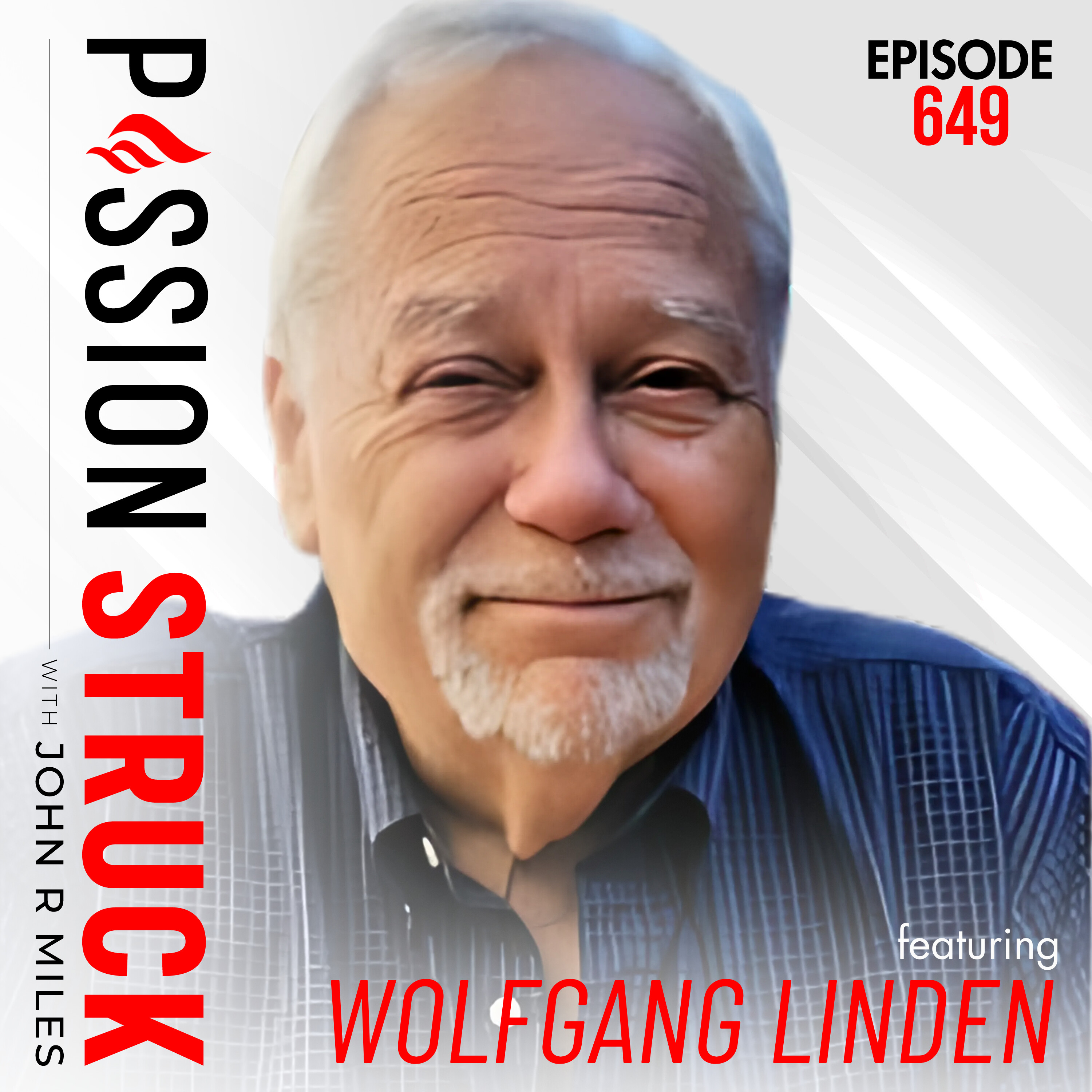
Passion Struck with John R. Miles
Wolfgang Linden on How to Know When It’s Time to Take a Risk | EP 649
00:57:25
Loading summary
Transcript65 lines
- [00:00]
Sleep Number Representative
Why choose a Sleep Number Smart bed?
- [00:02]
Dr. Wolfgang Linden
Can I make my site softer? Can I make my site firmer?
- [00:05]
John R. Miles
Can we sleep cooler?
- [00:07]
Sleep Number Representative
Sleep Number does that cools up to eight times faster and lets you choose your ideal comfort on either side. Your Sleep Number setting Get early Access to sleep number's biggest sale of the year, 25% off the i8 bed. Our most popular plus free home delivery limited time All Sleep Number Smart beds offer temperature solutions for your best sleep. Check it out at a Sleep number store or sleepnumber.com today.
- [00:30]
Passion Struck Host
Coming up next on Passion Struck, every.
- [00:33]
Dr. Wolfgang Linden
Once in a while you will run into a dead end and the only solution is to try something you've never done before. Will you know ahead of time that's going to work? No, you do not. You have to take the risk. But given that everything else you've done so far hasn't worked, you have really no choice but to engage in the risk. And with marital partners, you may have a number of relationships that just didn't work. And if you leave one behind, there's no guarantee that the next one is better. But there is a chance that it's better.
- [01:11]
John R. Miles
Welcome to Passion Struck. Hi, I'm your host John R. Miles, and on the show we decipher the secrets, tips and guidance of the world's most inspiring people and turn their wisdom into practical advice for you and those around you. Our mission is to help you unlock the power of intentionality so that you can become the best version of yourself. If you're new to the show, I offer advice and answer listener questions. On Fridays, we have long form interviews the rest of the week with guests ranging from astronauts to authors, CEOs, creators, innovators, scientists, military leaders, visionaries and athletes. Now let's go out there and become Passion Struck.
- [01:54]
Passion Struck Host
Hey friends, welcome Back to episode 649 of Passion Struck. You're new to the show, I'm your host, John Miles, and I'm so glad you're here. Passion Struck isn't just a podcast. It's a movement. A global community of world shapers, difference makers, and intentional seekers committed to building lives of deeper purpose, lasting impact, and inner strength. And if you've been with us for a while, thank you. Your presence in this journey means more than you know. Quick update before we dive in our substack, the Ignited Life is growing fast. Every week I share insights that go deeper than the podcast, tools, frameworks and behind the scenes stories designed to help you live with courage and clarity. You can find it@theignitedlife.net or through passionstruck.com before we get into today's episode, I want to remind you we're right in the middle of our Redefining Wellness series, a deep dive in how we reclaim our health, purpose and vitality in a culture of burnout and distraction. Last week we had two powerhouse episodes. Dr. Erica Schwartz, who blew the doors open on hormonal health, preventative medicine, and taking back control of your well being, and Dr. Drew Ramsey, who gave us a masterclass on nutritional psychiatry and why you are quite literally what you eat and think. This past Friday, I released a solo episode on the absorption gap, why so many wellness routines fail to create lasting change and what to do about it. If you missed it, I highly recommend giving it a listen. Now, today's conversation. We often talk about stress like it's the enemy, something to fight, suppress, or escape. But what if we've misunderstood stress altogether? My guest today, Dr. Wolfgang Lindon, is a groundbreaking psychologist whose decades of research have reframed how we think about stress, resilience and healing. He believes it's not always the stress itself that matters most, but how we relate to it. In this powerful episode, we'll explore why stress isn't the villain and how our response to it shapes our well being, the healing power of structured emotional expression, the surprising role of spirituality and meaning in managing chronic illness, and what true resilience looks like in life, in therapy, and in the face of adversity. This isn't just a conversation about mental health. It's a redefinition of what it means to be fully, fiercely human. So let's dive in to episode 649 of Passionstruck with Dr. Wolfgang Linden. Thank you for choosing Passionstruck and choosing me to be your host and guide on your journey to creating an intentional life.
- [04:21]
John R. Miles
Now let that journey begin. I am absolutely honored today to have Dr. Wolfgang Linden on Passion Struck. Welcome, Wolfgang.
- [04:34]
Dr. Wolfgang Linden
Good morning to you.
- [04:36]
John R. Miles
I'm gonna get into your book the Illusion of A Practical Guide to Avoid Futile Struggles here in a second, but I just have to tell you, when I was a Youngster in my 20s, I happened to go on this trip to Europe and we flew into Germany. I met some of the most incredible people I've ever met my entire life in Germany. We were around Frankfurt and this group of kids about our same age took us in and ended up chaperoning us around. Then we went to the Netherlands, Belgium, down to France, and then all throughout Germany and they ended up becoming our tour guides. And I will never forget the generosity in this group of kids that I had never met before in my life. Just wanted to tell you how great of stories I have and memories of Germany.
- [05:28]
Dr. Wolfgang Linden
That's a wonderful foundation for connecting here. You know what? I've made similar experiences in lots of other places. And I keep being surprised at how many lovely people out there. There's some terrible ones too. You gotta figure out who the good ones are and seek them out.
- [05:46]
John R. Miles
Today we're gonna be talking about your book the Illusion of Control. And I think when it comes to control, we all have different definitions of what that word means. And I was hoping you might be able to give us your definition.
- [05:59]
Dr. Wolfgang Linden
It really is all about results, if you want. Right. If I want to control another person, it's because I want them to do something that is for me or useful to me, or hopefully useful for the world. But I may not get what I want because I don't have direct influence over other people. In fact, it's one of the main thesis of the book that you do not directly control other people. And on the other hand, the emphasis of the book is on what it is that you can do for yourself and that people actually underestimate how much it is. And so it's really about results and realizing how much investment is worth it. And when you need to pull the plug, you clearly realize that this can't go anywhere. And I have numerous examples in the book that say weight control is one of those issues, or insomnia. At some point you just have to change strategies because you don't get what are you targeting.
- [07:07]
John R. Miles
That's absolutely true. And as I was doing research on you, you've worked across everything from psychosocial cardiac rehab to childhood trauma prevention. Throughout those different experiences, how has your perspective on control evolved?
- [07:24]
Dr. Wolfgang Linden
I've been around long enough that I have no longer any idea what I learned, when, from whom, where. So it all comes together in one big jumbo but beautiful jumble. And so really, when working with clients, because I'm trained as a clinical psychologist, I've been surprised at people not realizing that they're barking up the wrong tree sometimes. Because what you really can do first and foremost is engage in your own behavior. So you can be extremely anxious of, let's say, dogs. And you can go and pat a dog even while you're anxious. And when I work with clients, I use a triangle. And a triangle has three legs. One is behavior, one is thinking, and one is emotions. So the hardest to control directly is emotions. The easiest to work with is behavior. And the thinking process is a bit more tricky. But each one of those corners of the triangle connects with the other. It's bi directional flow. So if you change your behavior, it will have some immediate impact on your thinking and on your mood. Let's say if you're sitting on the couch and you're depressed and you don't know what to do, you can move your butt off the couch, get out the house and just walk around the block and realize, oh, it's a sunny day and I see some buds out after a long winter. Your mood is immediately going to change. And it was a very simple behavior that was eminently doable. So that, I find is the best starting point. And in terms of thinking, people can think themselves into horrendous knots that they just can't get out of anymore. And ultimately, if they're willing to listen to you, you can say, look, these knots are of your own making. You can undo them.
- [09:20]
John R. Miles
I want to go through with you different aspects of the book that were some of my favorite. And this starts with this idea of quicksand of control. You write, many people sink deeper into emotional quicksand the harder they struggle to fix others. What do you mean by this emotional quicksand?
- [09:40]
Dr. Wolfgang Linden
Quicksand, by definition is something where the usual strategy of putting in an effort to get out produces the opposite result because you sink in deeper. So it is meant to sensitize you to the idea that you need to figure out what is the nature of this problem and can this particular attempt at a solution work. And within the quicksand, if you start and you realize you're sinking right, you absolutely have to stop. Otherwise it just gets worse. And then there are other situations like it. Relationships. You know, some relationships can be repaired and are worth repairing and not every one of them is worth hanging on to. You will lose some friends over time, and some marriages fall apart. Some of those might have been fixable with good therapy, but every once in a while you're just connected to the wrong person. You need to recognize this can't go anywhere and move on. So most books, you know, that I found or theories think of other people as being largely the same, but they're not. Every person has their unique in terms of their thinking and their behavior. And we have people who are very troublesome to deal with. That's true in family, that's true at the workplace. And then when we talk about the notion of control, well, if you have a family member who's a lot of trouble, you stuck family as part of your perpetual makeup. Right? On the other hand, if you have a friend who is just very unreliable or exploits you somehow, you can make a choice. If you realize that this can't go anywhere, you don't owe absolute loyalty forever.
- [11:32]
John R. Miles
Well, I'm so glad you brought that up because one of the cornerstones of this whole podcast is the power of choice. And I think it's one of the most important things that has come out of Behavior of science is that it's our microchoices that really influence the person we become. And so I love your quote where you refer to this. You say you cannot suppress thoughts or control what not to think about, but you can choose what you do and what you are paying attention to. But I think people understand at a high level this power of choice, but it sure is a lot more difficult to implement it than it is when you first hear it. Why do people struggle with this so much?
- [12:17]
Dr. Wolfgang Linden
It's a principle. It's not hard to sell as a principle. People can say, oh, that kind of makes sense. But the reason you have to do way more, either write a book about it or engage in a therapy process is you really have to practice that skill. There is a question of awareness. You have to be mindful of your own feelings, your circumstances, and trying to understand what other people around you going through. And then on that basis you say, well, what's the best strategy that might work? Think about also when and how do I know that something works? Right? So to have a goalpost somewhere, say, oh, if I get that kind of response, that probably means this is going to be a good friend or a good partner, as in, if I don't, then maybe I'll have to put this one in the gray zone and do a little more testing whether this person is the best employee or the best partner. And every once in a while you just say, no, stop, move on, step aside. That's the art. But you put your finger on it. It's not something you can immediately implement just because you understand the principle.
- [13:37]
John R. Miles
Absolutely. And you referenced Daniel Wegner's famous White Bear study to show how thought suppression backfires. And I like this because so many of us try to control our thoughts by force and the choices we make by force. How can we begin redirecting attention in a way that's actually helpful?
- [14:01]
Dr. Wolfgang Linden
Thinking is choosable. The content is choosable, right? Let's say, pick the example of trying to fall asleep and you really need that night's sleep because you got big plans on the next day. If you can't let go of those ruminative thoughts that keep you away from actually falling asleep, then you can package the change to thinking with the behavior. And the standard advice for sleep is get up, get out of bed, do something else. And that something else makes it much easier to then change what you're thinking about. So to get out of bed, go to another room, turn on the tv, check something on your cell phone, or watch something on Netflix. Whatever it is, that behavior trigger makes it a lot easier to let go of the old thought that it's not working. And also because you changed the environment, now you have different stimuli that get you to think about different things.
- [15:03]
John R. Miles
This got me thinking about something that I experienced a lot in work. I've heard so many people over the past two decades describe themselves when they ask, what's your leadership style? Almost every single interview I'm in describe themselves as a servant leader. And what I've seen across many servant leaders is they say that is their leadership style. But a trait that comes out of them more than any other seems to be micromanagement. And you cite this whole phenomenon of micromanagement in the workplace. And we see this huge phenomenon now that we've been experiencing for about that same time where in most western countries disengagement of employees has been on the rise. And I think that there is a direct link, in my opinion, to over control a road's morale. Why do you think leaders fall into this trap so often?
- [16:06]
Dr. Wolfgang Linden
I think in order to avoid that, you need to be able to trust. And so if you have really good employees or team members who you've worked with and you've got good experiences with, then I think you can delegate or let them do their thing and walk away and do your own. Obviously, if you are in business, you're judged by results. Those results are higher income for the company or greater efficiency of your service and the public image that's behind it. As you have those goal posts, those destinations, you can see whether the people you work with are actually progressing in that direction or whether they're going to fall to the side and don't quite deliver. So I'll give you as an example, I've had 20 doctoral students over my lifetime and they were very different people. They had clearly superb qualifications when they started. But what I tried to tell them from scratch was I'll give you a leash if you the goal posts and their regular reviews on the graduate program, I won't yank the leash, but if I sense you falling behind, leaving, then I will pull and then I'll become a bit of a micromanager. And then we might actually meet once a week, hammer out what is a very concrete piece of work that you can handle in one week so that also you can learn to trust yourself that this amount of work is doable in this timeframe. And I have the comfort of knowing that we're actually going to move forward. But so you have to track how well people are responding to this and whether they can carry that responsibility or not.
- [18:10]
John R. Miles
One of the things about this area is I really think today we need a completely different form of leadership, especially since so much of the workforce is in remote areas. So I had a book that came out last year myself, and one of the chapters I explored this concept of gardener leadership, meaning just like a gardener tends to their crops, but is also hands off at times. I think we need leaders who are eyes on, but hands off because you need to give people direction, but you also need them to bring out their own creativity and ideas, or you're really suppressing the whole value system of why you even have people in the workforce. And so like this metaphor of the gardener, because I think it's better for the leadership style that we need in the future. What are your thoughts of that metaphor?
- [19:05]
Dr. Wolfgang Linden
I think it's very much overlapping with what I described as the leash situation. And strikingly enough too, my parents are gardeners and florists, so it's super easy to connect with the gardener analogy. And so I think we're very much on the same page in that respect. There are natural processes which will unfold and it's often just good to let them unfold the way they're pre programmed. And every once in a while you got to get in there and fix something because it does not go in the right direction.
- [19:40]
John R. Miles
So, Wolfgang, you have this other great quote. Being taught that one has control when it later turns out to be false belief is bound to translate into many repeated and ultimately exhaustive efforts. And you describe a powerful animal experiment where rats lose their ability to escape pain and eventually give up trying. And I think it eerily mirrors what I felt when I experienced burnout. In your experience, how does this illusion of control contribute to learned helplessness? And what are your thoughts on how we can reverse it?
- [20:18]
Dr. Wolfgang Linden
I'm not an expert in business administration and business leadership by any stretch, but I think all managers need to be aware of off the fact that burnout occurs. And with it you will have absenteeism. People might show up physically at work, but not contributing and so you need to have a dialogue every once in a while about whether people are happy or not. Now, again, limited expertise in the domain, but human resource professionals in a company can see very clearly how many people quit or. And how many don't quit. Right? So if you have a very high quit rate, you just have to ask yourself the question, why do people leave? And you have other companies that you know, have employees that stay lifelong and are very proud to work for Employer xyz. So again, there is a reason for that. So the other thing that employees themselves can do is find the courage to move on. I've encountered a number of people in my life who simply will not leave the job they have because it comes with certain benefits and they're familiar with everything. But they're totally missing out on other job opportunities because they can't find the courage to try something new. And that's part of my thinking too, that every once in a while you will run into a dead end. And the only solution is to try something you've never done before. Will you know ahead of time that's going to work? No, you do not. You have to take the risk. But given that everything else you've done so far hasn't worked, you have really no choice but to engage in the risk and with marital partners. And you may have a number of relationships that just didn't work. And if you leave one behind, there's no guarantee that the next one is better, but there is a chance that it's better. This is a particular approach in psychotherapy that's behind it. It's called step inside Commitment therapy. I don't know whether you've followed the literature, but I found it extremely useful, very influential in my thinking to go that route.
- [22:41]
John R. Miles
Can you explain a little bit more.
- [22:43]
Dr. Wolfgang Linden
About it, the number of major tenants to it? It's not a super easy one to explain. The first one is that that's so bad that we shouldn't try for sure that you need to think of emotions as being your friends. You have emotions for a reason. If you're anxious, you're anxious about a particular outcome that has bad consequences. If you're depressed, there's a reason for it. And so in this particular approach, Stephen Hayes is the main proponent. You accept that you will go through a variety of emotions and they serve a point. And yes, if you're depressed for too long, you need probably professional help. But you could have mood phases where you're just not full of juice and you have to accept that and work through it so the attempt at avoiding any bad feelings creates a whole bunch of new problems. The attempt of avoiding an anxiety producing situation becomes a problem. So if you're afraid of public spaces and then or public speaking, well, then you're depriving yourself of opportunities and that is a problem. So then you end up having to solve two problems. And so the second component to this is what I've already tried to describe to some degree, namely that oftentimes we kind of program to use a particular solution for a particular problem and we may become indiscriminate in how we're trying to use that same solution over and over again and don't realize it doesn't work. And when it doesn't, well, then you have to go and try something new for make new grooves and see whether those are better grooves.
- [24:35]
John R. Miles
Thank you so much for sharing that. And I wanted to shift the discussion to your chapter on the toolbox shift, where you rightly go into the move from external fixes which I think so many of us gravitate towards, to internal strength. And you quote one of my favorite authors, Rick Hansen, I actually was just talking to him yesterday and Rick has this quote. Your brain is like Velcro for negative experiences and Teflon for positive ones. And I think Rick's metaphor explains how early adversity shapes our neural pathways. And I want to ask for someone who might be listening today who feels, feels stuck in negative emotional patterns, which you were just talking about. What's the first step that they can take to rewire their internal narrative? And do you think neuroplasticity gives us hope?
- [25:31]
Dr. Wolfgang Linden
The short answer, of course, is yes. I very much believe in neuroplasticity. But that has to be up for these discussions. When you look at brain development over the entire lifespan, then the first two years of life are extremely important because that is where your neural system learns how the world interacts with you. Namely, whether you can feel safe, whether things are predictable, whether you get the nurturance and the care that are provided, and if you are given those qualities and those aren't things that as a baby you can generate yourself. It's what the environment your parents give you. So if you have them, you're very well set up to handle a lot of stressful situations, offers a lot of resilience. On the other hand, if you had a truly catastrophic upbringing, whether that is mostly neglect or whether that is abuse, emotional, physical abuse, sexual abuse, unfortunately, you carry that with you and you can't just shake it off. It's Part of your experience, and one analogy that I like and I've used with clients is that all of your life experiences are a part of you. That may sound incredibly negative, but you can never shake it. But again, this is a Stephen Hayes quote. You can think of yourself as a driver off the bus. And every experience you make as a passenger, you can decide where your passengers sit. Are they going to sit right behind you and tell you all the bad stuff that happened to you, or do you stick them to the back of the bus? You can drive with me, but I'm not going to pay any attention to you. And I'm going to put a number of people in between you and me that are much more constructive and nice people. And that is a choice you can make. And I really like that. Because otherwise, people, again, trying to get rid of this person at the end of the bus, which will not leave. Let's say, if your parent who's lost a child, running across the street and getting hit by a car at age 4 or 6, it would be horrible to try to tell these parents, oh, they're all going to forget about it. They're not going to forget about it. It's an unbelievably terrible, tearing kind of a process. And that grief will take years to get over. And you will not forget that child. That child has a name. That child has photographs in the family album. And that child doesn't want to be forgotten, but it doesn't have to be taking up all your attention every day. That's the shift you can make.
- [28:17]
John R. Miles
Yeah. For the listeners who are listening to this, I did a solo episode number 615 on a lot of this same topic where I was talking about our mental health is really an ecosystem. And I use this analogy that there was this recent JAMA psychology research that was done where they described this ecosystem like a lake, and that typically, when a lake is performing as it should, you're not getting a lot of cloudiness in the water and toxicity. But over time, similar to our mental health, that can change. And it doesn't happen to change overnight. It tends to change gradually. And so a lot of that gradual change has to do with, as you're describing, the bus that we're riding on and the ecosystem of people that we're surrounding ourselves with, along with the activities that we're doing. So I really agree with you on that whole concept. And I always advocate for people to do something that I call a mosquito audit, meaning I have these three mosquitoes that I refer people to. I Call them the pain in the ass, the invisible suffocator, and the last one is the bloodsucker. And they're just three out of many mosquitoes that you can refer to. But each one is really destroying the boundaries that you're trying to set and your emotional regulation. I agree with you. Do you have any more thoughts on it?
- [29:50]
Dr. Wolfgang Linden
I'd like to expand a bit more on it. And that is when you go through psychotherapy, let's say depression is the key issue that's being presented. Then as a therapist, you can ask a person and say, well, what percentage of the time during any typical day are you typically in a gloomy mood? And a profoundly clinically depressed person will say 80, 90% of the time. Occasionally they forget it. But if you ask people who don't see themselves as depressed where they ever are in a bit of a gloomy mood, they will tell you they are and they're functioning people. So the switch is not perfectly gradual. There is a switch point. And that switch point, we've tracked it in therapy sessions each day, looking at what percentage of mood is of what kind. And the switch point is around 60, 61%. So if you were 60% depressed and 40 not depressed, it still feels very heavy. But if you get just a bit over that, all of a sudden the whole mood flavor flips over and you can hear it in the speech, if you track the words carefully. So people will tell you that there's no way I can get that situation ever solved. And they might come back two weeks later. And they don't quite hear themselves necessarily. They say, well, I've been looking at that situation, it is shitty. I think I can get through it. And that's a massive shift in the emotional quality behind it, in the sense of, oh, there's a little bit of empowerment here that you can get to the other side. So I don't look at it as just as perfectly gradual accumulation. There's a switch point.
- [31:45]
John R. Miles
I agree with you, and thank you so much for sharing that. I wanted to go, Wolfgang, to the triangle that you introduce in the book of behavior, emotion and thought. And I am sorry, so often asked the question of people, how do you start the process of change? And I always say that it starts with, you've got to make a choice, but the next thing that follows it is you have to take action. Now, for me, that action should probably be in the place that is the epicenter that's causing you the most grief. But a lot of, like, for me, when I did a lot of internal change. It was because of some ptsd experiences that I had. So for me, going through first cbt and then prolonged exposure therapy and some other modalities was the action that I ended up taking. But for others, it could be something else. But so often people keep ruminating about the fact that they want to change, but they don't do anything to shift their behaviors. So I was hoping maybe you could share a real world story where someone changed their actions first and found that their thoughts and emotions followed.
- [33:04]
Dr. Wolfgang Linden
It's the preeminent first step in treatment for depression. The most often described and effective one is cognitive behavioral therapy. But phase one routinely is what we refer to as behavioral activation. Because when you're depressed, typically it means you withdraw from the world, you don't interact with people, you don't get out of the house, you don't do fun things. So even though your mood has got awful, you can, like I described this earlier, you can get out of the house and go and do your food shopping or do something with friends. I'll give you one example which was great fun to watch. I had a fellow in therapy who was 40 something, and he had crohn's syndrome, chronic bowel problems, and it made him want to stay home. And it was all the time, and it was really painful and all true. There's no point telling him that's nuts. So I asked him, I said, so what do you do for fun? And the guy said, what do you mean for fun? You're crazy. I've got Crohn's, I'm in pain. I don't do anything for fun. Would you be willing to make an experiment? Huh? He seemed open to the idea. I said, well, if you didn't have it, is there something you would like to do that you liked or used to do and enjoyed? He said, yeah, I like to go and shoot pool with my friends. And I said, is it physically impossible for you now to go and shoot pool with friends? He says, no. So next week you come back and you tell me you did exactly that. And he did. He came back the next week, he shot pool. Did he tell me that his pain was gone? No, but he had fun shooting pool. And at least during that time, he was nowhere near as aware of his pain and his symptoms as before. So he really got the idea of, oh, I can change my behavior and it will change, move me in the right direction. It's not going to be that one step isn't going to be all the answers, but you implant the sense of this is possible. Step by step, we can get you into a different sphere.
- [35:22]
John R. Miles
So I wanted to talk about something tangentially similar to that. I was struck in the book by your story of Felix and Julianne and the unintended consequence of one partner growing while the other stood still. And we just started watching, my wife and I, this new show that's about three different couples that are friends that are coming together, and the one is growing apart from his spouse. And what this is really getting to is systems theory, principle. You cannot change just one element of a system. How can couples, or if it's an organization, better anticipate the ripple effects of personal growth so it doesn't fracture the larger system? Because I think what Felix and Julianne are going through is what a ton of people go through in their relationships.
- [36:16]
Dr. Wolfgang Linden
A number of phases to it. Right. Have a section in the book which likely came across about at what age to choose a partner. Because if you choose a life Partner at age 20, you don't really know who you are, your partner doesn't know who they are. So there's a high likelihood that you're going to develop in somewhat different directions, that you have different levels of ambition and investment. So as you get a little bit older, way better how much you fit in terms of those directions. So you can avoid some of that by clarifying your goals, for one thing, but also making a commitment to somebody when you know this person is moving on the same train as I have. So that's part one, of course. Have you not done that? That doesn't mean you have to divorce. But then if one person makes this kind of change, then I think you need to alert the other one that this is going to have implications, that we should do changes together, that if I do this, you do something, you choose what it is. It doesn't have to be the exact same thing. But if you're going to invest in something, I also want to invest because, well, if I spend a lot of time learning a new hobby and you're going to feel left alone at home while I'm out there following my new hobby, that's not going to go well. So you could decide jointly that you want to grow a hobby and it doesn't have to be the same one, but it would then take equal amounts of time away from each other, from home, and you don't have to feel guilty or, you know, complain to your partner that your partner is never there. So mainly it is by making this visible and consciousness that you could prevent.
- [38:08]
John R. Miles
The trouble so my wife and I just went through this in a decision that we were making. I've always been someone who loves boating and I've owned boats previously in my life, but we haven't had one since we've been together. And recently I've been talking to her about buying a boat and she felt that was a big commitment to make. So we made the choice together to join a boat club so we could still experience it without the risk of having to go full in on owning a boat and having a place to put it, etc. And then, you know, I took it a step further. She's hasn't done a lot of time on the water driving a boat. So I encouraged her that as we were going through the training that she herself go through it. So she starts getting more comfortable with driving the boat, getting used to being on the water herself for a number of reasons. One being so she gets more acclimated to it. But two, you never know what could happen out on the water and I could get hurt and the other person needs to operate the boat and feel comfortable with it. But I think this is an example where I could have just gone down and maximized my own hobby and told her you can just stay at home. But more, we talked about it and came to a common agreement about how we wanted to approach it.
- [39:30]
Dr. Wolfgang Linden
I think it was a good move involve her. It may turn out that this isn't what she wants to spend her time on, but at least then she'll know and make a conscious decision or she'll get to enjoy it as much as you do.
- [39:42]
John R. Miles
I wanted to move to chapter six of your book which is really focused on relationships and the fantasy of control. Since we're talking about relationships and you have this great quote. Trying to change someone's mind is like drilling holes in stone and sometimes the stone pushes back. I loved it. And you describe how oftentimes, whether it's an intimate relationship or maybe just a relationship you have with a friend or a coworker, we try to give advice and oftentimes it's well meaning. But it often activates power dynamics implying I know better than you. Why is it such a common psychological trap to fall into? And how can people become more aware when they're doing it?
- [40:30]
Dr. Wolfgang Linden
Ultimately, I think we all have our pride. I'm also a little bit biased and maybe you can. You will share that with me. I think men are a little more prone to pride related decisions than women. I think there's a gender difference here. And women, we just like the world to believe that we're competent individuals. And if I get too much advice, then I'm tempted to interpret that as, this person doesn't think I'm competent. And that's just not a thought that's appealing to people. Right. The other thing is, why do you do it? Some people want to give advice because that is how they want to exert power. And, no, I don't want to give you that power over me and find another way to do this in your life. And of course, the rational part is if you can step back and think about what is this person who's giving me Ancilla's advice trying to do here is look at what does this person know that I don't know? So if somebody gives me advice who knows even less about woodworking than I do, then I'm insulted. But if I realize, oh, this is the person who's done some fabulous cabinetry work and I've seen the product and they know this person is good, then, yeah, it's smart to just say, please, bring it on. I want to hear how you did this. And the person who is wanting to give the advice needs to be aware of, do I really have something to offer that the other person doesn't have? And language matters. I will try on those occasions. Say, look, you probably know this already, right? So take a little bit of the sting out of that one. But have you thought about. I find that's getting you gradually through an open door. And if you sense that the other side says, yeah, I've thought about this. So basically, they tell you to go away, and then the thing to do is go away, but they say, no, but what do you think? And so then you might get that opening. And they say they actually want to hear what you have to say. But if you fall the Germanist, right, with the door into the house just paf, then people will take offense and back away. That's part of the systems theory. All of a sudden you propose in a power shift that I'm better than you, and then you buck and say, no, I'm not better than I. We're both good. Maybe you're not better than I am.
- [43:10]
John R. Miles
And then there's the other thing that you talk about, which is the backfire effect. And I think so many of us need to shift from using a sledgehammer type of approach to the power of using the behavioral science concept of a nudge. And when we want to move someone's opinion in a little bit of a different direction, I find the sledgehammer tactic, especially with my kids, never worked.
- [43:35]
Dr. Wolfgang Linden
Kids is a special topic, of course, because they are yours, and you have responsibility to equip them with the right tools for life. And up to a point, they're listening. And then you're going to have 10, 20 years where they reject everything you have to offer. And then they come back, oh, yeah, you used to do that. It made sense. Yeah. I remember one example I overheard, my son, was 16 at the time, talking to a friend of his, and he said, you know, my dad is a real pain in the ass. He's constantly telling me this and that. He says, what's even worse, some of the time he's right. And I said to myself, you get it? You did it right? Walked away, never said a word. You have to celebrate that one silently, privately. But it was worth the celebration.
- [44:29]
John R. Miles
Thank you for sharing that. And I was also hoping you might be able to talk about the story of King Friedrich and the potato. And you were talking here in this story about creative reframing and cognitive dissonance and how this tactic ends up working. Real world persuasion, especially when we're, like, addressing an emotionally charged issue like politics, which is hard to avoid these days, someone's health, or even the dynamics of someone's relationship.
- [45:01]
Dr. Wolfgang Linden
Yeah, yeah. You can imagine. While I wrote the book, there's been a huge amount of political change, and from where I stand, more so in the US than I see elsewhere. So you can't stop making analogies and connections between all of those. And I'm somewhat baffled that things have become as incredibly divisive as they have become. I've had political discussions with friends with my dad my whole life, but they've never been hostile and bitter. They were lively and disagreeable, but in the end, they strengthened the relationship. And right now you have things happening that make all the relationships worse. You can't have a discussion where you separate the value of the person from a particular opinion. You're not allowed to have a different opinion. And there's just something incredibly threatening in that. I don't really know what to do with. It has to change. It's awful.
- [46:08]
John R. Miles
Well, it absolutely is, for sure. Wolfgang. I wanted to shift the discussion to a different topic that I like to talk about. I'm not sure if you're familiar with the work of another Canadian named Gordon Flet, but Gordo has.
- [46:28]
Dr. Wolfgang Linden
Small world that it is. Yes. It's done a lot of work together with one of my colleagues. So we met at conferences.
- [46:35]
John R. Miles
Well, great. Well, he's been doing a lot of work on what he calls anti mattering and the science of mattering. And I want to ask, you've spent now four decades shaping policy, education, patients, outcomes, what does mattering mean to you?
- [46:52]
Dr. Wolfgang Linden
That particular aspect of Gordon's work I'm not so familiar with. I know more of his work with my colleague about perfectionism. And I think there's a connection that you obviously know this better from having interviewed Gordon, but that with perfectionism you assign too much value, the details matter too much and so ultimately you get lost in the process and you really don't succeed. So somewhere you need to find the balance in what is valuable. What should I invest in and how much should I invest? And it connects with chapter three of the book where I focus on purpose in life. So I know an interview of yours that I followed, you talked about people really losing out on life. They spent the whole time on autopilot. And when I listened to you on that topic, true, on autopilot you don't really participate in life. You don't quite enjoy what you're doing, but you still have to set the autopilot in a particular direction. You have to say where are you going to go? And then while you're on the way, maybe you don't enjoy it enough and don't participate enough, but you still have to pointed in a direction first. There has to be a conscious process.
- [48:18]
John R. Miles
To some degree, actually have gravitated from the metaphor of autopilot because I think for better or for worse, we're pointing the plane in a certain direction. But as you articulated in the book, now that so many people are influenced by social media and influencers and other people around them, I think more people today are living like they're the pinball in the game of pinball and they are directionless or they're following the direction of others instead of putting their autopilot on anything. And so they end up just bouncing from one thing to the next, directionless. And what I'm trying to show people more and more now is that like a pinball game I think is a great analogy to life because if you understand how to play pinball is actually pretty complicated because it's a game within many sub games. And it's like life. You've got to learn how to play the game to understand how to control the ball instead of the ball controlling everything about you. So that's how I'm trying to explain the way I think people are living today. Become less autopilot and more pinball. Like.
- [49:34]
Dr. Wolfgang Linden
If I would could rewrite chapter six on how to influence other people, I think the pinball analogy would work very nicely. How it might feel it's hopeless, but if you play really well, you can get somewhere. But it just takes a lot of skill, a lot of effort to make that happen.
- [49:57]
John R. Miles
And I just wanted to go back to mattering for just one second with you, because I'll explain to you how I think Gordon and I are thinking about it and how it differs maybe from Jeff Cohen's work on belonging. So I think we've all had that situation where we're back in school and we're hoping someone picks us to be on a team and they go down the list and eventually your name is called. So when they call your name, you now feel like you belong, you're part of the team. But that doesn't mean that the teammates are showing you that you feel valued, that. That you feel seen that they're passing the ball to you or making you feel like you're a part of the team. So when I think of the difference between belonging and mattering, that's how I look at the two. And what really got me to start studying mattering is we keep hearing about the epidemic of loneliness, the epidemic of people feeling hopeless, people feeling burned out. And the more I started hearing about all those, I started to think of them as symptoms of something larger. And that's where I think Gordon's whole concept of anti mattering takes place. Because we've replaced so much of the connections that we've had in the communities that we're. We were part of with digital means, other means, and it's now collapsing. And when you don't have that sense of community, of feeling that other people feel like you matter, then, you know, are no longer making other people feel like they matter. And you get into this vicious cycle of unmattering that he's talking about. Just to give you context, that's what I mean when I'm talking about mattering and what he refers to as anti mattering.
- [51:45]
Dr. Wolfgang Linden
I can certainly understand and sense where you're going with it. And I think the more we have electronic means to avoid each other, the worse it gets. And I'm at a very subjective level. I don't know in how many ways I've told people explicitly when Covid was over, how much I enjoyed getting back together with them as real people. Have a beer and argue about politics, have a garden party, just have a lunch with somebody and made an effort to make that happen. It's Like, I still, to this day, I cannot get myself to use a checkout cash at the store. I routinely go to a live person and I tell them, I enjoy interacting with you more than dealing with a machine. And I think we can fight this with these little details where we connect.
- [52:37]
John R. Miles
You're absolutely right. But it's going to take conscious effort. And I heard this week that Satya Nadella made this statement that he's no longer going to listen to podcasts. Instead, he's going to take all the podcasts that he likes and he's going to plug them into Copilot and now have conversations with Copilot about the podcast. And I was like, satya, you're like, I go back to Steve Jobs. When Steve Jobs came up with the iPhone, his whole purpose for doing it was to help people connect more, not get them to connect less. And you're basically now using AI in the way that every scientist who studies it is telling you not to use it as a replacement for human interaction. And now you've got the CEO of one of the largest tech companies in the world saying and advocating, that's exactly how he's going to use it. So to me, it sets the wrong sentiment out in the world.
- [53:35]
Dr. Wolfgang Linden
I feel I'm totally with you. Ultimately, if you look at connections, you don't need a thousand connections, but you need a handful of good ones. That's where the value is.
- [53:47]
John R. Miles
That's the most important part. So, Wolfgang, we've had a great discussion today. I wanted to ask if there's one idea from this book that you hope outlives you, what would it be?
- [53:58]
Dr. Wolfgang Linden
Make a continued effort to estimate the probability that something can work. Create an expectation and see will this behavior give me that result. And if it doesn't, move on. So it reconnects with neuroplasticity. Constantly do something new. Like I've told my kids, I do not want to become one of those old people who will tell you the same war stories, because that's all I have to talk about. I will do all kinds of different things and we can talk about that some other times. And to make constantly new experiences. And I'm not too old to make new experiences so I can hear new stories. And I recommend that to everybody. Go to a restaurant and look at normally eat here. Don't pick it, pick the other one. Pick the weird one at the bottom, the pasta in ink or something you would never have tried. You may not do it again, but at least give it a try. Break some habits and form some new growths and force your brain to practice plasticity.
- [55:04]
John R. Miles
Wolfgang, it was such an honor to have you today and congratulations on the release of your book last year, the Illusion of Control A Practical Guide to Avoid Futile Struggles. Thank you so much for being here.
- [55:16]
Dr. Wolfgang Linden
John. It was fabulous and you really got the gist of it, so I very much enjoyed our discussion.
- [55:22]
John R. Miles
Well, thank you so much for that and I enjoyed it very much myself.
- [55:26]
Dr. Wolfgang Linden
Take care.
- [55:28]
Passion Struck Host
And that's a wrap of my deeply thought provoking conversation with Dr. Wolfgang Linden. His work is a powerful reminder that stress isn't always the enemy. It can be a catalyst for growth, meaning and resilience when we learn to engage with it differently. As you reflect on today's episode, consider how am I currently relating to stress in my life? Am I suppressing my emotions or giving them healthy expression? Where could I create more meaning in the challenges I'm facing right now? If this conversation shifted how you think about stress, I'd love for you to leave a five star rating or review. It's the best way to help us reach more people with these intentional life changing discussions. And if someone in your life is navigating illness, burnout or emotional overwhelm, share this conversation with them. It could shift their healing journey in ways you can't predict. And if your organization is looking to elevate how your teams lead live and perform, I'd love to bring these ideas to your next keynote retreat or executive session. Just head to johnrmiles.com speaking to start the conversation. You'll find all the resources we discuss, along with links to Dr. Linden's research right in the shownotes@passionstruck.com Coming up next on Passionstruck, we explore the vast, mysterious, still largely misunderstood world of the vagus nerve with Dr. Kevin Tracy. You'll learn why it's not just one nerve, but a network of 200,000 fibers shaping everything from our inflammation response to our emotional state. And why the science is only scratching the surface.
- [56:54]
Dr. Kevin Tracy
Your body and all its organs is connected. Each and every cell almost of your body is connected to a nerve ending, and those nerve endings are receiving information about the status of your cells and your organs all the time. How much glucose is in your liver, how much carbon dioxide is in your lungs, how fast your heart is, how much pressure there is in your stomach or your intestines. There is an overwhelming amount of information in your body that is constantly transmitted through sensory nerves. Many of them in the vagus nerve. Not all, but many of them in the vagus nerve. Up into your brain.
- [57:35]
Passion Struck Host
Until then, remember, stress can be a signal, not a sentence. Face it with courage, use it with wisdom. And as always, live life. Ashenstruck.