Podcast
PBM Reform Podcast
Hosted by Pharmacy Podcast Network · EN
Pharmacy benefit managers were created as middlemen to reduce administrative costs for insurers, validate a patient’s eligibility, administer plan benefits, and negotiate costs between pharmacies and health plans. Over time, PBMs have been allowed to operate virtually unchecked. A lack of transparency in PBM practices has led several states to implement licensure/registration, fair pharmacy audit, or generic drug pricing legislation to try to level the playing field for pharmacies and patients. by the NCPA https://www.ncpanet.org/advocacy/state-advocacy/pbm-reform This Podcast is focusing on discussions & interviews about PBM Reform & those ”Business of Pharmacy” professionals leading this much needed reform.
12episodes
Episodes
Newest firstAll episodes

Pharmacists Fight Back: Federal PBM Reform Advances | PBM Reform
2w ago00:46:12Tap to summarizePBM Reform Podcast Sponsored by American Pharmacy Cooperative, Inc. (APCI) Host: Greg Reybold Special Guest: Ben Mudd, PharmD, Executive Director, Kentucky Pharmacists Association Momentum for meaningful pharmacy benefit manager reform is building in Washington. In this episode of the PBM Reform Podcast, host Greg Reybold welcomes Dr. Ben Mudd, Executive Director of the Kentucky Pharmacists Association, to examine the bipartisan Pharmacists Fight Back Act, H.R. 6610, and what its advancement could mean for patients, pharmacists, employers, and the future of independent pharmacy. On July 22, 2026, the House Committee on Oversight and Government Reform reported the legislation favorably following a committee markup. Introduced by Chairman James Comer of Kentucky and Representative Jake Auchincloss of Massachusetts, the bill would establish new requirements for pharmacy benefit managers participating in the Federal Employees Health Benefits Program. The proposed reforms would require participating PBMs to provide fair pharmacy reimbursement, apply manufacturer rebates toward reducing beneficiaries’ prescription drug costs, prohibit patient steering to PBM-affiliated pharmacies, increase transparency, and establish penalties for noncompliance. Greg and Ben discuss why the Federal Employees Health Benefits Program could become an important proving ground for broader PBM accountability and how federal action may influence commercial plans, state legislation, and future healthcare policy. Episode Discussion The conversation explores: Why H.R. 6610 has attracted bipartisan support How PBM reimbursement practices threaten independent pharmacy sustainability The impact of patient steering and PBM-affiliated pharmacy networks Why manufacturer rebates should directly reduce patients’ prescription costs What “fair reimbursement” must include to protect pharmacy access How enforcement provisions and financial penalties could improve accountability Kentucky’s role in advancing pharmacy and PBM reform The connection between federal legislation and state-level advocacy What pharmacists should communicate to legislators and patients The remaining steps required before H.R. 6610 can become law Dr. Mudd brings the perspective of a practicing community pharmacist and association executive who has worked extensively in pharmacy advocacy. A graduate of the University of Kentucky College of Pharmacy, he practiced in both chain and independent pharmacy settings before assuming leadership of the Kentucky Pharmacists Association. Ben is running for Kentucky State Senate position this November. Lear more about his platform and issues most important: https://www.votemudd.com/meet-ben Key Takeaway PBM reform is no longer simply an industry debate. It is a patient-access, healthcare-affordability, pharmacy-choice, and community-infrastructure issue. The Pharmacists Fight Back Act represents a significant federal effort to separate PBM compensation from practices that may increase drug costs, restrict patient choice, and financially disadvantage independent pharmacies. The legislation’s advancement is an important milestone—but pharmacists must remain informed, engaged, and vocal as the bill moves through the legislative process. Subscribe to the PBM Reform Podcast for continuing coverage of legislation, regulation, litigation, and advocacy shaping the future of pharmacy benefit management and community pharmacy. The PBM Reform Podcast is sponsored by American Pharmacy Cooperative, Inc., supporting independent pharmacies and advocating for a more transparent, competitive, and patient-centered prescription drug marketplace.
Transcribe →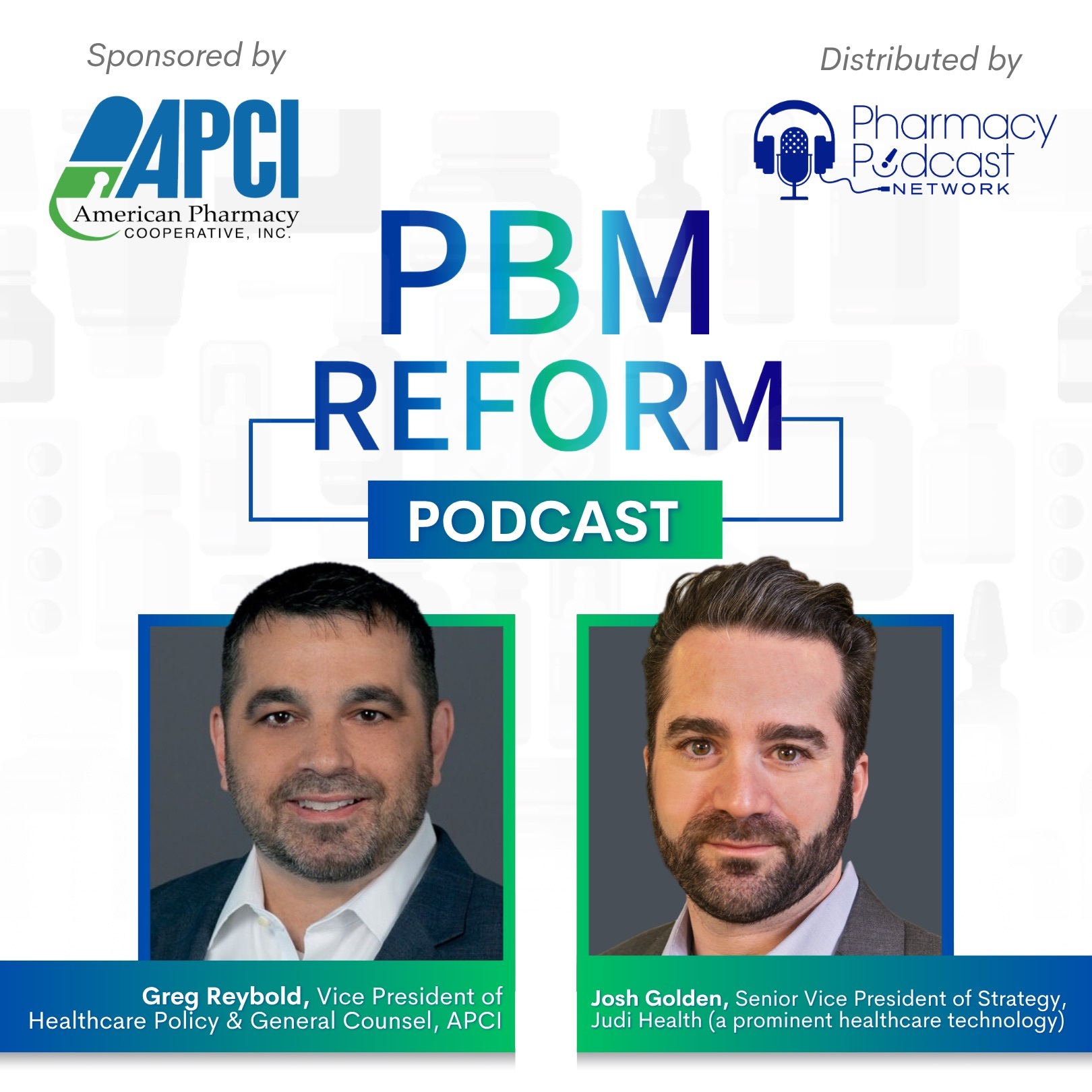
Transparency, Auditing, and the PBM Shell Game | PBM Reform Podcast
Jun 200:48:19Tap to summarizeIn this episode of the PBM Reform Podcast, host Greg Reybold, Vice President and General Counsel at APCI, welcomes Josh Golden, Senior Vice President of Strategy at Judi Health and a nationally recognized voice in Pharmacy Benefit Manager reform. With more than 20 years of healthcare consulting experience, Golden brings deep expertise in vendor procurement, contract negotiation, plan design, and benefit strategy for large employers, government entities, and unions. Together, Reybold and Golden examine the financial models behind today’s PBM industry and why true transparency remains so difficult for employers, plan sponsors, patients, and pharmacies. The conversation explores how current PBM arrangements often benefit the PBMs more than the employers paying for coverage or the patients relying on their prescription benefits. Golden explains why auditing PBM contracts, rebate structures, spread pricing, administrative fees, pharmacy networks, and formulary decisions is essential to understanding the real economics of prescription drug benefits. This episode also addresses a growing concern in healthcare: PBM steering behavior. Are patients being quietly pushed toward specific formularies, specific pharmacies, and restricted networks that operate like closed networks without being clearly disclosed? Reybold and Golden discuss how this behavior can limit patient choice, disadvantage independent pharmacies, and distort the stated goal of lowering drug costs. The discussion also tackles the role of federal reform efforts, including whether the Appropriations Act represents meaningful PBM accountability or whether it risks becoming another layer in the broader shell game surrounding PBM reform. Finally, the episode asks one of the most important questions in pharmacy policy today: should PBMs own pharmacies? If vertical integration is promoted as a way to lower drug costs, where is the proof — and who actually benefits? Transparency, Auditing, and the PBM Shell Game | PBM Reform Josh Golden is the Senior Vice President of Strategy at Judi Health (a prominent healthcare technology and benefit management firm closely associated with Capital Rx) and a nationally recognized thought leader in Pharmacy Benefit Manager (PBM) reform. With over 20 years of healthcare consulting experience, Golden specializes in vendor procurement, contract negotiation, and plan design consultation for large employers, government entities, and unions.
Transcribe →
Tennessee PBM Reform Win | APCI PBM Reform
Apr 3000:33:34Tap to summarizeTennessee lawmakers have passed a major pharmacy reform bill aimed at pharmacy benefit managers, or PBMs, by barring companies from owning both a PBM and a pharmacy. The legislation is widely seen as targeting CVS Health, which owns Caremark and operates pharmacies across the state. Supporters say the bill is designed to curb vertical integration, restore fair competition, and protect independent pharmacies from reimbursement practices they view as harmful to patient access and community pharmacy survival. CVS has pushed back hard, warning that the new law could force it to shut down its 134 Tennessee pharmacy locations and trigger a legal challenge. The company argues the measure would reduce access for patients and does not directly address broader PBM issues like pricing or formularies. This Tennessee fight reflects a larger national battle over PBM reform, pharmacy ownership, market power, and the future of prescription drug access.
Transcribe →
PBM Reform Updates, Next steps, from CPhA | PBM Reform Podcast
Mar 500:44:56Tap to summarizeIn this episode, listeners get to know the leadership of the California Pharmacists Association (CPhA), exploring their professional journeys, personal backgrounds, and the experiences that shaped their commitment to advancing the pharmacy profession. Susan Bonilla, CEO of the California Pharmacists Association, joins Dr. Sean Kim, PharmD, Vice President of Practice & Professional Development at CPhA, to discuss California’s progress in pharmacy benefit manager (PBM) reform. As the largest state in the nation, California continues to play a significant role in shaping policies that strengthen patient access to pharmacy care and improve transparency within the prescription drug supply chain. Bonilla and Kim share insights into the reforms California has achieved, the legislative and regulatory priorities currently underway, and how these efforts may influence PBM reform conversations across the country. The PBM Reform Podcast is sponsored by the American Pharmacy Cooperative, Inc. (APCI). APCI’s sponsorship supports the production of this program but does not imply affiliation with the individual guests, nor endorsement of the views, opinions, or insights shared by podcast hosts or guests. APCI does not endorse any statements or content discussed on the PBM Reform Podcast or across the Pharmacy Podcast Network. Please reach out to the APCI Communication's team for additional information.
Transcribe →
Bagging Better Benefits: The Grocery PBM Disruptor | PBM Reform
Feb 2300:40:26Tap to summarizeHow Kroger does PBM and the future of community pharmacy is clinical encounters.
Transcribe →
Pharmacists Fight Back! Live on Capitol Hill | PBM Reform; Presented by APCI
Dec 1800:41:21Tap to summarizeAmerican Pharmacy Cooperative, Inc. (APCI) called on Congress on Thursday, December 11, 2025 to pass the reintroduced Pharmacists Fight Back Act, two coordinated pieces of federal legislation designed to reform pharmacy benefit manager (PBM) practices. The Pharmacy Podcast Network provides exclusive coverage of the event held on Capitol Hill.
Transcribe →
U.S. Congressman Jake Auchincloss | PBM Reform
Dec 1500:41:37Tap to summarizeIn this episode, Greg Reybold speaks with Jake Auchincloss, U.S. Congressman of Massachusetts 4th District.
Transcribe →
Don't Get Paid Below Your Cost Anymore! | PBM Reform
Dec 1200:31:12Tap to summarizeThis week on the PBM Reform Podcast, Breck L. Rice takes listeners inside a major new software upgrade designed to integrate directly with state-level PBM complaint and reporting systems. Breck also recounts his recent meetings with state Insurance Commissioners—where he presented this breakthrough technology while PBM lobbyists pushed back in real time, leaving community pharmacy with only one voice in the room standing up for them. He underscores a critical issue that often goes unaddressed: while states continue to pass legislation aimed at PBM accountability, the real failures are happening in execution and enforcement. Without meaningful oversight, even the strongest laws fall short, and independent pharmacies continue to bear the consequences.
Transcribe →
Cutting Through the Noise: A nuanced discussion on MFN, Rebates, and Premiums | PBM Reform
Nov 1300:54:37Tap to summarizeDr. Robert Popovian is a pharmacist, and economist with a deep background in research and public policy. In this episode we have a nuanced discussion on policy impacting pharmacy including PBMs, President Trumps Most Favored Nation Executive Order, Rebates, and insurance premiums. Links to resources referenced in discussion: • Pioneer Institute, 340B tool: https://pioneerinstitute.org/340babuse/ • Pioneer Institute, IRA tool: https://pioneerinstitute.org/the-inflation-reduction-act-ira-overview/ • Editorial regarding TrumpRX: https://www.linkedin.com/pulse/promise-trumprx-robert-popovian-vskne/?trackingId=dtiG1P%2B%2BSDq6adLfFeEbeg%3D%3D • Pioneer Institute, IRA report: https://pioneerinstitute.org/wp-content/uploads/Prescription-Drug-Price-Controls-06252025.pdf • GHLF tool, Impact of Accumulators and Maximizers on Premiums: https://cutt.ly/Rr9Di7Vf • Conquest Advisors website: https://conquestadvisors.godaddysites.com/
Transcribe →
PBM Reform and the AMA | PBM Reform
Sep 500:28:18Tap to summarizeIn this episode, we sit down with the President of the American Medical Association to discuss PBM reform and its impact on patients, physicians, and the future of healthcare. From drug pricing transparency to ensuring access to needed medications, this conversation explores why PBM reform is at the center of today’s healthcare policy debates.
Transcribe →